Six mesures pour améliorer la gouvernance des organismes publics au Québec | Yvan Allaire


Je suis tout à fait d’accord avec la teneur de l’article de l’IGOPP, publié par Yvan Allaire* intitulé « Six mesures pour améliorer la gouvernance des organismes publics au Québec», lequel dresse un état des lieux qui soulève des défis considérables pour l’amélioration de la gouvernance dans le secteur public et propose des mesures qui pourraient s’avérer utiles. Celui-ci fut a été soumis au journal Le Devoir, pour publication.

L’article soulève plusieurs arguments pour des conseils d’administration responsables, compétents, légitimes et crédibles aux yeux des ministres responsables.

Même si la Loi sur la gouvernance des sociétés d’État a mis en place certaines dispositions qui balisent adéquatement les responsabilités des C.A., celles-ci sont poreuses et n’accordent pas l’autonomie nécessaire au conseil d’administration, et à son président, pour effectuer une véritable veille sur la gestion de ces organismes.

Selon l’auteur, les ministres contournent allègrement les C.A., et ne les consultent pas. La réalité politique amène les ministres responsables à ne prendre principalement avis que du PDG ou du président du conseil : deux postes qui sont sous le contrôle et l’influence du ministère du conseil exécutif ainsi que des ministres responsables des sociétés d’État (qui ont trop souvent des mandats écourtés !).

Rappelons, en toile de fond à l’article, certaines dispositions de la loi :

– Au moins les deux tiers des membres du conseil d’administration, dont le président, doivent, de l’avis du gouvernement, se qualifier comme administrateurs indépendants.

– Le mandat des membres du conseil d’administration peut être renouvelé deux fois

– Le conseil d’administration doit constituer les comités suivants, lesquels ne doivent être composés que de membres indépendants :

1 ° un comité de gouvernance et d’éthique ;

2 ° un comité d’audit ;

3 ° un comité des ressources humaines.

– Les fonctions de président du conseil d’administration et de président-directeur général de la société ne peuvent être cumulées.

– Le ministre peut donner des directives sur l’orientation et les objectifs généraux qu’une société doit poursuivre.

– Les conseils d’administration doivent, pour l’ensemble des sociétés, être constitués à parts égales de femmes et d’hommes.

Yvan a accepté d’agir en tant qu’auteur invité dans mon blogue en gouvernance. Voici donc son article.


Six mesures pour améliorer la gouvernance des organismes publics au Québec

par Yvan Allaire*


La récente controverse à propos de la Société immobilière du Québec a fait constater derechef que, malgré des progrès certains, les espoirs investis dans une meilleure gouvernance des organismes publics se sont dissipés graduellement. Ce n’est pas tellement les crises récurrentes survenant dans des organismes ou sociétés d’État qui font problème. Ces phénomènes sont inévitables même avec une gouvernance exemplaire comme cela fut démontré à maintes reprises dans les sociétés cotées en Bourse. Non, ce qui est remarquable, c’est l’acceptation des limites inhérentes à la gouvernance dans le secteur public selon le modèle actuel.


535284-membres-conseils-administration-16-societes


En fait, propriété de l’État, les organismes publics ne jouissent pas de l’autonomie qui permettrait à leur conseil d’administration d’assumer les responsabilités essentielles qui incombent à un conseil d’administration normal : la nomination du PDG par le conseil (sauf pour la Caisse de dépôt et placement, et même pour celle-ci, la nomination du PDG par le conseil est assujettie au veto du gouvernement), l’établissement de la rémunération des dirigeants par le conseil, l’élection des membres du conseil par les « actionnaires » sur proposition du conseil, le conseil comme interlocuteur auprès des actionnaires.

Ainsi, le C.A. d’un organisme public, dépouillé des responsabilités qui donnent à un conseil sa légitimité auprès de la direction, entouré d’un appareil gouvernemental en communication constante avec le PDG, ne peut que difficilement affirmer son autorité sur la direction et décider vraiment des orientations stratégiques de l’organisme.

Pourtant, l’engouement pour la « bonne » gouvernance, inspirée par les pratiques de gouvernance mises en place dans les sociétés ouvertes cotées en Bourse, s’était vite propagé dans le secteur public. Dans un cas comme dans l’autre, la notion d’indépendance des membres du conseil a pris un caractère mythique, un véritable sine qua non de la « bonne » gouvernance. Or, à l’épreuve, on a vite constaté que l’indépendance qui compte est celle de l’esprit, ce qui ne se mesure pas, et que l’indépendance qui se mesure est sans grand intérêt et peut, en fait, s’accompagner d’une dangereuse ignorance des particularités de l’organisme à gouverner.

Ce constat des limites des conseils d’administration que font les ministres et les ministères devrait les inciter à modifier ce modèle de gouvernance, à procéder à une sélection plus serrée des membres de conseil, à prévoir une formation plus poussée des membres de C.A. sur les aspects substantifs de l’organisme dont ils doivent assumer la gouvernance.

Or, l’État manifeste plutôt une indifférence courtoise, parfois une certaine hostilité, envers les conseils et leurs membres que l’on estime ignorants des vrais enjeux et superflus pour les décisions importantes.

Évidemment, le caractère politique de ces organismes exacerbe ces tendances. Dès qu’un organisme quelconque de l’État met le gouvernement dans l’embarras pour quelque faute ou erreur, les partis d’opposition sautent sur l’occasion, et les médias aidant, le gouvernement est pressé d’agir pour que le « scandale » s’estompe, que la « crise » soit réglée au plus vite. Alors, les ministres concernés deviennent préoccupés surtout de leur contrôle sur ce qui se fait dans tous les organismes sous leur responsabilité, même si cela est au détriment d’une saine gouvernance.

Ce brutal constat fait que le gouvernement, les ministères et ministres responsables contournent les conseils d’administration, les consultent rarement, semblent considérer cette agitation de gouvernance comme une obligation juridique, un mécanisme pro-forma utile qu’en cas de blâme à partager.

Prenant en compte ces réalités qui leur semblent incontournables, les membres des conseils d’organismes publics, bénévoles pour la plupart, se concentrent alors sur les enjeux pour lesquels ils exercent encore une certaine influence, se réjouissent d’avoir cette occasion d’apprentissage et apprécient la notoriété que leur apporte dans leur milieu ce rôle d’administrateur.

Cet état des lieux, s’il est justement décrit, soulève des défis considérables pour l’amélioration de la gouvernance dans le secteur public. Les mesures suivantes pourraient s’avérer utiles :

  1. Relever considérablement la formation donnée aux membres de conseil en ce qui concerne les particularités de fonctionnement de l’organisme, ses enjeux, ses défis et critères de succès. Cette formation doit aller bien au-delà des cours en gouvernance qui sont devenus quasi-obligatoires. Sans une formation sur la substance de l’organisme, un nouveau membre de conseil devient une sorte de touriste pendant un temps assez long avant de comprendre suffisamment le caractère de l’organisation et son fonctionnement.
  2. Accorder aux conseils d’administration un rôle élargi pour la nomination du PDG de l’organisme ; par exemple, le conseil pourrait, après recherche de candidatures et évaluation de celles-ci, recommander au gouvernement deux candidats pour le choix éventuel du gouvernement. Le conseil serait également autorisé à démettre un PDG de ses fonctions, après consultation du gouvernement.
  3. De même, le gouvernement devrait élargir le bassin de candidats et candidates pour les conseils d’administration, recevoir l’avis du conseil sur le profil recherché.
  4. Une rémunération adéquate devrait être versée aux membres de conseil ; le bénévolat en ce domaine prive souvent les organismes de l’État du talent essentiel au succès de la gouvernance.
  5. Rendre publique la grille de compétences pour les membres du conseil dont doivent se doter la plupart des organismes publics ; fournir une information détaillée sur l’expérience des membres du conseil et rapprocher l’expérience/expertise de chacun de la grille de compétences établie. Cette information devrait apparaître sur le site Web de l’organisme.
  6. Au risque de trahir une incorrigible naïveté, je crois que l’on pourrait en arriver à ce que les problèmes qui surgissent inévitablement dans l’un ou l’autre organisme public soient pris en charge par le conseil d’administration et la direction de l’organisme. En d’autres mots, en réponse aux questions des partis d’opposition et des médias, le ministre responsable indique que le président du conseil de l’organisme en cause et son PDG tiendront incessamment une conférence de presse pour expliquer la situation et présenter les mesures prises pour la corriger. Si leur intervention semble insuffisante, alors le ministre prend en main le dossier et en répond devant l’opinion publique.

_______________________________________________

*Yvan Allaire, Ph. D. (MIT), MSRC Président exécutif du conseil, IGOPP Professeur émérite de stratégie, UQÀM

Bâtir un conseil d’administration à « valeur ajoutée »


La question que pose l’auteur Robyn Bew, directeur à la National Association of Corporate Directors (NACD), est directe et d’une grande importance : Les Boards sont-ils prêts pour affronter les changements des 20 dernières années ?

En effet, cela fait déjà vingt ans que le rapport du NACD (Blue Ribbon Commission on Director Professionalism) a fait ses recommandations sur les principes de saine gouvernance.

Cet article nous invite à revisiter les règles de gouvernance à la lumière des changements significatifs survenus depuis 20 ans.

Il ne s’agit pas de rafraîchir la composition du CA, mais plutôt de s’assurer que ce dernier constitue un actif stratégique durable.

L’article a été publié aujourd’hui sur le site du Harvard Law School Forum on Corporate Governance.

Bonne lecture !

Building the Strategic-Asset Board


33273_10014323_1317887626_69127-e_1000x533


In 1996, the Report of the NACD Blue Ribbon Commission on Director Professionalism made recommendations on issues including establishing mechanisms for appropriate director turnover/tenure limitations, evaluation of the full board and of individual directors, and ongoing director education. [1] It stated, “the primary goal of director selection is to nominate individuals who, as a group, offer a range of specialized knowledge, skills, and expertise that can contribute to the successful operation of the company,” and advocated that boards must “[expand] the pool of potential nominees considered to include a more diverse range of qualified candidates who meet established criteria.”[2]

Twenty years later, the world in which boards operate has been transformed in fundamental ways, including increased complexity in the business environment; rapidly changing technology; volatility in global politics as well as in international economic and trade flows; the proliferation of information; the presence of major threats such as cyberattacks; higher levels of engagement between companies, boards, and investors of all stripes, including activists; new regulatory requirements; and greater levels of scrutiny from the press and the public. The velocity of the changes directors are facing shows no signs of slowing down.

The NACD 2016 Blue Ribbon Commission began its dialogue by asking whether boards are keeping up, and concluded that there is no single answer. It is clear that advancing director ages and tenures, coupled with low boardroom turnover, are external symptoms that are of increasing concern to investors and other stakeholders. But equally—if not more—significant is the question of whether a board’s composition, director skill sets, and core board processes remain fit-for-purpose in a world where the board’s mandate is evolving in fundamental ways, including but not limited to earlier involvement in strategy-setting discussions with management and greater engagement between designated board members and major investors. This new mandate places substantially different demands on directors, and boards need to ask themselves, “Are we ready?”

Many stakeholders are focused on encouraging higher levels of director turnover—often termed “board refreshment”—through the use of tenure-limiting mechanisms. We believe that such mechanisms can help to drive needed change in the boardroom, but alone they are not sufficient to ensure that boards truly remain fit for-purpose over time. We are encouraging directors to think more holistically, and more ambitiously. Business as-usual approaches will not be sufficient.

As a starting point, directors should review the organization’s corporate governance guidelines, including the board’s mission and key operating principles. Are all board members familiar with them? How often are they reviewed and updated? How rigorously have they been implemented? Do they help to foster a culture of continuous improvement and ongoing learning?

Boards are unique entities. While (in the case of public companies) they are elected by and accountable to shareholders, they are self-constituting, self-evaluating, self-compensating, and self-perpetuating: that is, in the normal course of business, they control their own composition and succession planning. This also means that boards are equipped to take action to elevate their performance on an entirely self-directed, voluntary basis—and they should do so. Otherwise, if board leadership appears to be passive or slow to act in the face of a challenging competitive environment and greater scrutiny from all angles, directors should prepare for the possibility of “shock treatments” imposed from the outside, in the form of activist challenges, regulatory mandates, or quotas. Put another way, without sufficient and timely evolution, boards could face revolution.

Beyond “Board Refreshment”: Building a Strategic-Asset Board

Too many companies still view changes in their boardrooms as necessary primarily on an incremental basis and from the standpoint of director replacement—i.e., responding to the loss of directors due to age or other reasons for departure in a fairly reactive, one-off manner. And while (as noted above) the idea of “board refreshment” has attracted increasing attention in the corporate governance community, as well as with regulators and the press, in the words of one Commissioner, “the current definition [of board refreshment] can still be somewhat limiting—it can imply change for the sake of change.”

The Commission advocates a more ambitious approach, centered on proactive measures that help to build a strategic-asset board. Characteristics of this approach include:

A focus on continuous improvement of overall board composition, individual director skills, and boardroom processes—collectively aimed at achieving and maintaining a high-performance boardrather than a primarily reactive or event-driven approach to board change. One indicator of well-established continuous-improvement processes is that they are used in times of good performance, not just when the company is in a down cycle or facing external challenge

Using the company’s current and future needs as the starting point for determining board composition. Such an approach will certainly include considerations about maintaining an appropriate level of continuity and institutional memory in the boardroom—but in the words of Vanguard CEO Bill McNabb, “To be frank, board members cannot be more worried about their own seats than they are about the future of the company they oversee.”[3]

A set of tools and processes that works together as a system for continuous improvement—avoiding what one Commissioner called the “formulaic approach” of overreliance on automatic tenure-limiting mechanism

While outcomes will be specific to individual boards, in general, we expect to see improvements such as the following:

Boards that are composed of directors who collectively have the right skills and insights to support the formulation and execution of the organization’s strategy—in other words, boards where it is clear that the whole is greater than the sum of the parts

Boards that have the ability to adapt and retool themselves over time, so that they are able to maintain a superior level of oversight and guidance and evolve as the organization’s strategy and competitive environment evolve

Boards that are transparent in their communications with investors and other stakeholders about who they are and how they operatenacd-1

SECTION 1 of the report describes the ways in which the board’s mandate has evolved in response to external factors and strategic imperatives, and outlines the ways in which the Commission believes boards must respond: by moving beyond traditional approaches to “board refreshment” and establishing a system for continuous improvement in the boardroom.

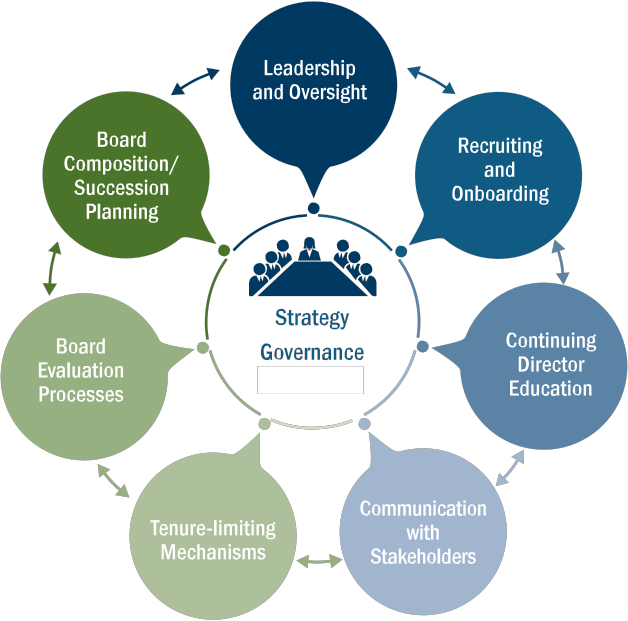
SECTION 2 explores the key dimensions of continuous improvement, focusing on seven areas in particular: board leadership and oversight responsibilities; board composition and succession planning; recruiting and onboarding new directors; processes for board evaluation; continuing education; tenure-limiting mechanisms; and communication with shareholders and stakeholders.

SECTION 3 summarizes the Commission’s recommendations, and the Appendices provide tools and related resources to help boards implement the recommendations.

NACD has characterized the mission of the board as “[becoming] a strategic asset of the company measured by the contributions we make—collectively and individually—to the long-term success of the enterprise.” [4] We believe this report will help directors in organizations of all sizes and in all sectors to do exactly that.

Recommendations of the 2016 NACD Blue Ribbon Commission

  1. Boards should review their governance principles on a regular basis (at least every other year) to ensure they are complete, up-to-date, and fully understood by current members and director candidates. Governance principles should incorporate a definition of director responsibilities, including a commitment to ongoing learning and the belief that service on the board should not be considered to be a permanent appointment.
  2. The nominating and governance committee should oversee the board’s processes for continuous improvement, working in close coordination with the nonexecutive chair or lead director and with the endorsement of the full board.
  3. Director renominations should not be a default decision, but an annual consideration based on a number of factors, including an assessment of current and future skill sets and leadership styles that are needed on the board.
  4. Nominating and governance committees should develop a “clean-sheet” assessment of the board’s needs in terms of director skill sets and experience at least every two to three years, and use it as an input in continuous-improvement efforts (including recruitment and director education).
  5. The director recruitment process should have a time horizon that matches the organization’s long-term strategy, typically three to five years or more. The process should be designed to include candidates from diverse backgrounds.
  6. Recruiting and onboarding processes should familiarize prospective and new directors with the board’s governance principles and set expectations regarding criteria for renomination, ongoing director education, and other aspects of continuous improvement as defined by the board.
  7. Conduct annual evaluations at the full-board level, and evaluations of committees and individual directors at least once every two years. Use a qualified independent third party on a periodic basis, to encourage candor and add a neutral perspective.
  8. Participation in continuing education should be a requirement for all directors, regardless of experience level or length of board tenure.
  9. Tenure is an important aspect of boardroom diversity. Nominating and governance committees should strive for a mix of tenures on the board—for example, maintaining a composition that includes at least one director with <5, 5–10, and >10 years of service.
  10. High-performance boards will not need to rely exclusively on tenure-limiting mechanisms to ensure appropriate board turnover and composition. However, boards that use such policies should consider replacing or combining retirement age with a maximum term of service.
  11. Communications with investors and other key stakeholders should include a detailed explanation of the link between the organization’s strategic needs and the board’s composition and skill sets, as well as information about the board’s continuous-improvement processes.

Tools for Directors

The report’s 12 appendices enable boards to benchmark their current practices and implement the report’s recommendations. Examples of appendix content are below.

Early Engagement: Going Beyond Traditional Board Succession Planning

A reference list of more than 25 questions to help directors evaluate the board’s ability to manage succession planning as a portfolio, instead of as a series of one-off replacements of individual directors; the strength of the board’s search capabilities, including early-engagement activities and the depth of the candidate pipeline; and the role that board and company culture play in succession planning.

Considerations for Upgrading Board Evaluation Processes

The appendix provides guidance to help boards

  1. establish effective, ongoing rhythms for evaluation processes;
  2. avoid “evaluation fatigue”;
  3. inform the use of third-party facilitators;
  4. make evaluations more holistic by incorporating input from management; and
  5. act on evaluation results.

Guidelines for Developing Board and Individual-Director Learning Agendas

The appendix includes frameworks and questions to help inform full-board and individual-director education activities:

  1. Suggested categories and topic areas for education, with sourcing strategies
  2. A personal learning and development checklist for directors
  3. Outline of a “lifecycle approach” to learning and development for the board, with components of a global director leadership profile

Tools, Templates, and Examples

Multiyear board succession planning matrix

Sample board and committee-level evaluation questions

New-director onboarding checklist

Examples of effective disclosures of director skills, board evaluations, and director education

Examples of corporate governance principles and board tenure policies

* * *

The complete publication is available exclusively to NACD members and is available for download here.

Endnotes:

1NACD, Report of the Blue Ribbon Commission on Director Professionalism, 2011 ed. (Washington, DC: NACD, 2011), pp. 12, 5, 15, 10.(go back)

2Ibid., p. 13.(go back)

3F. William McNabb III, Getting to Know You: The Case for Significant Shareholder Engagement, Harvard Law School Forum on Corporate Governance and Financial Regulation, June 24, 2015.(go back)

4NACD, Report of the Blue Ribbon Commission on Board Evaluation: Improving Director Effectiveness, 3rd ed. (Washington, DC: NACD, 2010), p. 2.(go back)

La planification de la relève du PDG par le CA | Une activité très négligée


Voici un article d’Eben Harrell paru dans le numéro de décembre 2016 de Harvard Business Review.

L’auteur affirme, basé sur plusieurs résultats de recherche, que les conseils d’administration ne sont pas préparés à assurer la relève du président-directeur général.

En effet, il appert que le roulement des fonctions de CEO s’accélère grandement (plus de 15 %) et que seulement la moitié des CA sont préparés à faire face aux conséquences.

On estime que 40 % des nouvelles recrues CEO ne peuvent répondre aux exigences de leurs tâches dans les 18 premiers mois !

Le remplacement d’un PDG peut prendre plusieurs mois, voire des années !

Doit-on recruter à l’interne ou recruter à l’externe ? Les recherches montrent que l’on a de plus en plus tendance à recruter les candidats à l’externe ; on parle de 20 % à 30 % du recrutement qui se fait à l’externe.

On constate que les conseils d’administration ne font pas les efforts nécessaires pour planifier la relève de leur CEO et que les coûts reliés à ces manquements sont considérables.

Bonne lecture !

Succession Planning: What the Research Says


All CEOs will inevitably leave office, yet research has long shown that most organizations are ill-prepared to replace them. In this article, we review the most salient studies of succession planning and offer context from experts on the process of picking new leaders for organizations.

Boards Aren’t Ready for Succession

Each year about 10% to 15% of corporations must appoint a new CEO, whether because of executives’ retirement, resignation, dismissal, or ill health. In 2015, in fact, turnover among global CEOs hit a 15-year high. Activist investors are increasingly forcing out leaders they deem underperforming. Yet despite these trends, most boards are unprepared to replace their chief executives. A 2010 survey by the search firm Heidrick & Struggles and the Rock Center for Corporate Governance at Stanford University revealed that only 54% of boards were grooming a specific successor, and 39% had no viable internal candidates who could immediately replace the CEO if the need arose.

0c6d26e8-bd5f-41bd-beb5-9153dfb50498_originalAn organization’s top executive is one of the few variables over which boards have total control—and their failure to plan for CEO transitions has a high cost. A study of the world’s 2,500 largest public companies shows that companies that scramble to find replacements for departing CEOs forgo an average of $1.8 billion in shareholder value. A separate study reveals that the longer it takes a company to name a new CEO during a succession crisis, the worse it subsequently performs relative to its peers. Finally, poor succession planning often extends the tenure of ineffective CEOs, who end up lingering in office long after they should have been replaced. A study by Booz & Company found that, on average, firms with stock returns in the lowest decile underperformed their industry peers by 45 percentage points over a two-year period—and yet the probability that their CEOs would be forced out was only 5.7%. The authors commented that “boards are giving underperforming CEOs more latitude than might be expected.”

Lack of preparedness is only part of the problem, however. An equal challenge, the consultant Ram Charan wrote in 2005, is that all too often, “CEOs are being replaced badly.” Boards aren’t finding the right man or woman for the job. Estimates suggest that up to 40% of new CEOs fail to meet performance expectations in the first 18 months.

Planning Takes Years, Not Months

So what can directors do not only to prepare for succession events but to ensure they make a winning pick when the time comes? A first step is to integrate executive development programs with CEO succession planning so that the best internal candidates are identified early and flagged at the board level. The proof that such an approach works can be found in companies with prestigious leadership-training programs. Researchers at Santa Clara University and Indiana University who examined the track records of chief executives groomed at “CEO factories,” such as General Electric, IBM, and Procter & Gamble, found that the stock market reacted positively when they were appointed and that they delivered superior operating performance over the next three years. The researchers concluded that certain firms “are efficient in developing leadership skills” because “they are able to expose executives to a broad variety of industries and help them develop skills that can be transferred to different business environments.”

Internal grooming of promising executives can create value beyond the avoidance of costly interregnums. In his book Succession, Noel Tichy, a management professor at the Ross School of Business at the University of Michigan, argues that by putting potential successors in charge of new projects, companies can accelerate change while also testing candidates’ suitability for the top spot. Few boards of directors seize that opportunity, however. Research by the Conference Board, the Institute of Executive Development, and the Rock Center found that most directors lack detailed knowledge of the skills, capabilities, and performance of senior executives just one level below the CEO. Only 55% of directors surveyed in the study claimed to understand the strengths and weaknesses of those executives well or very well. Seventy-seven percent did not participate in the performance evaluations of their firm’s top executives other than the CEO. And only 7% of companies formally assigned a director to mentor senior executives below the CEO.

Some commentators believe this lack of involvement is the result of CEOs’ efforts to stymie boards: The absence of clear successors keeps incumbents in the job longer and gives them more bargaining power with boards. A packed governance agenda may also be to blame. When the consulting firm Mercer Delta surveyed directors about the amount of time they spent on nine key activities, a large majority reported devoting more and more hours to monitoring accounting, risk, and financial performance and other governance duties. Directors also indicated that they spent less time interacting with potential CEO successors than on any other activity.

Michael Useem, a professor of management at the University of Pennsylvania’s Wharton School, believes a shortage of directors with experience in hiring top executives also contributes to poor succession planning. He advocates for more current and former CEOs on boards. “People who know how to hire and manage top executives will better understand what a company needs in executive talent and which of the final candidates best brings that to the table,” he says.

In his book It’s Not the How or the What but the Who, Claudio Fernández-Aráoz of the search firm Egon Zehnder lays out six succession-planning guidelines for busy directors: First, start early, ideally the moment a new CEO takes charge. Second, create strict performance metrics and a process for evaluating the CEO against them. Third, identify and develop potential successors within the firm and then benchmark them against external talent. (Useem says directors can go deep during vetting by interviewing all the direct reports of the internal front-runners.) Fourth, look externally to widen the pool of candidates, through executive search firms that don’t use contingency arrangements or charge percentage fees (which Fernández-Aráoz believes create perverse incentives). Fifth, require the board to conduct periodic emergency succession drills. And finally, put in place an extensive transition process to help with onboarding, which is especially important given that 80% of CEO appointees have never served in a chief executive role before.

Insiders Versus Outsiders?

Boards often face a binary choice: Go with an internal candidate, or recruit an executive from another company? Traditionally, internal candidates favored by boards have progressed through positions with responsibility for larger and more complex P&L centers. They might start off by managing a single product and then move into an overseas “head of country” position before returning to the main corporate office to supervise a business unit and then run an entire division. Such a tightly choreographed internal trajectory is increasingly rare in a world of job hopping and frequent executive shuffles, however. Consider that in 1988, an executive typically worked for fewer than three employers in his or her lifetime; 10 years later the average had risen to more than five.

Increasingly, CEO vacancies are being filled by external candidates. In 2013, 20% to 30% of boards chose to replace an outgoing CEO with an external hire. In contrast, just 8% to 10% of newly appointed CEOs at S&P 500 companies were outsiders during the 1970s and 1980s.

This trend toward external hires has been strongly criticized by some scholars, including Harvard Business School’s Rakesh Khurana, who argues in his book Searching for a Corporate Savior that too often boards hire charismatic outsiders even when their experience and abilities are not right for companies’ needs. He also blames high-priced executive search firms for driving up demand for external candidates and censures the business press and the investor community for helping fuel what he calls “the cult of the outsider.”

Khurana may have a point: Candidates that are headhunted from other firms are paid more than internally promoted candidates. According to the executive-compensation research firm Equilar, the median pay of CEOs who are outsiders is $3.2 million more than the median pay of insiders. Far from deserving such a premium, externally appointed CEOs seem to underperform their internally promoted counterparts over the long run. A 2010 study by Booz & Company found that insider CEOs had delivered superior market-adjusted shareholder returns in seven out of the preceding 10 years. And Gregory Nagel of Middle Tennessee State University and James Ang of Florida State University used elaborate multiple regression analyses to show that, on average, going outside the company to fill the top office was justified in just 6% of cases.

These studies might not be capturing the whole picture, however. Companies tend to look outside their own ranks for leaders when recent financial results are poor, which suggests that external hires might struggle simply because they’re walking into challenging conditions at underperforming companies. What’s more, multiple studies have concluded that the CEO’s influence on corporate performance pales in comparison with other, uncontrollable effects—which is to say, it’s very hard to ascertain if a CEO is lucky or good. Furthermore, studies indicate that outsiders who join the company three to four years before they become CEO do just as well as insiders with much more experience at the firm, a crossover category of executive that Harvard Business School’s Joseph Bower calls “inside-outside” leaders. For these and other reasons, says David Larcker, a professor at Stanford Business School, “it is difficult to conclude whether internal or external candidates are systematically better operators.”

What Are the Traits of a Great CEO?

Whether they’re searching for a successor in a firm’s internal ranks or an external pool, directors would benefit from knowing which qualities best predict success in the top job. Unfortunately, while much ink has been spilled on the topic of individual leadership, very little of it can be scientifically supported. In an influential book published in 1991, the University of San Diego’s Joseph Rost pointed out that writers had defined leadership in more than 200 ways since 1900, often with nothing but conjecture or personal experience to back up their claims. That’s slowly changing as researchers look for correlations between personal biographies and leadership success. For instance, one study found that CEOs who had previously served on the boards of large public companies seemed to outperform those without such experience. Another study found that CEOs with military backgrounds were less likely to engage in fraudulent activity. Yet another found that CEOs who spent lavishly in their personal lives were more likely to oversee corporations with loose internal financial controls. Age may also be relevant: Researchers at Mississippi State and the University of Missouri found that younger CEOs outperformed their older counterparts, even after accounting for the fact that younger CEOs were more likely to work in fast-growing industries such as technology. And charismatic CEOs seemed to outperform during periods of upheaval and uncertainty but provided no boost during more stable times.

The private equity industry, which has vast experience hiring CEOs, may also offer some clues about what qualities make for strong CEOs. A recent survey of managing partners at 32 firms found that when choosing a chief executive, they paid less attention to attributes such as track record and industry experience and gave more weight to softer skills such as team building and resilience. But the PEs valued urgency much more highly than empathy—a finding more in keeping with a separate assessment of CEO personalities at venture-backed and private-equity-owned corporations, which suggested that attributes having to do with execution (such as speed, aggressiveness, persistence, work ethic, and high standards) were more predictive of strong performance than interpersonal strengths (such as listening skills, teamwork, integrity, and openness to criticism).

While intriguing, the attempt to find the traits of the ideal CEO-in-waiting is still in its infancy. No one has yet disproved the view of legendary management scholar Peter Drucker, who wrote that successful executives “differ widely in their personalities, strengths, weaknesses, values, and beliefs. All they have in common is that they get the right things done.” While we may be a long way from building a predictive algorithm that can identify the perfect CEO successor, researchers have shown that there still remains a great deal more that boards could do to improve their succession planning—starting (in many cases) with having a plan in the first place.

Le point sur la gouvernance au Canada en 2016 | Rapport de Davies Ward Phillips Vineberg


Le rapport annuel de Davies est toujours très attendu car il brosse un tableau très complet de l’évolution de la gouvernance au Canada durant la dernière année.

Le document qui vient de sortir est en anglais mais la version française devrait suivre dans peu de temps.

Je vous invite donc à en prendre connaissance en lisant le court résumé ci-dessous et, si vous voulez en savoir plus sur les thèmes abordés, vous pouvez télécharger le document de 100 pages sur le site de l’entreprise.

Cliquez sur le lien ci-dessous. Bonne lecture !

Rapport de Davies sur la gouvernance 2016


Davies Governance Insights 2016, provides analysis of the top governance trends and issues important to Canadian boards, senior management and governance observers.

insights_governance_2016_fr_thumbnail

The 2016 edition provides readers with our take on important topics ranging from shareholder engagement and activism to leadership diversity and the rise in issues facing boards and general counsel. We also provide practical guidance for boards and senior management of public companies and their investors on these and many other corporate governance topics that we expect will remain under focus in the 2017 proxy season.


Assurer une efficacité supérieure du conseil d’administration


Aujourd’hui, je cède la parole à Johanne Bouchard* qui agit, de nouveau, à titre d’auteure invitée sur mon blogue en gouvernance.

Celle-ci a une solide expérience d’interventions de consultation auprès de conseils d’administration de sociétés américaines ainsi que d’accompagnements auprès de hauts dirigeants de sociétés publiques (cotées), d’organismes à but non lucratif (OBNL) et d’entreprises en démarrage.

Dans cet article publié dans la revue Ethical Boardroom, Achieving higher board effectiveness, elle aborde un sujet qui lui tient particulièrement à cœur : Assurer une efficacité supérieure du conseil d’administration.

L’auteure insiste sur les points suivants :

  1. Le suivi des réunions du CA par le président du conseil
  2. L’intégration des nouveaux membres du conseil
  3. La formation en gouvernance et l’apprentissage des rouages de l’entreprise
  4. Les sessions de planification stratégique
  5. L’évaluation du leadership du CEO, du conseil et du management

L’expérience de Johanne Bouchard auprès d’entreprises cotées en bourse est soutenue ; elle en tire des enseignements utiles pour tous les types de conseils d’administration.

Bonne lecture ! Vos commentaires sont toujours les bienvenus.


Achieving higher board effectiveness


eb_achieving_higher_1000-230x300

« Achieving higher board effectiveness goes well beyond adhering to rules, regulations, legal and ethical compliance. While there are many experts who address the regulatory requirements, an aspect that requires the utmost attention, and is often underestimated and even ignored, is the human element »

That is the basic and subtle dynamics and the complexities inherent in having individuals with diverse experience, different views and perspective, and varied cultural and personal backgrounds gathering a few times a year to serve an entity to which they are not privy on a day-to-day basis. It’s further complicated by the fact that these individuals often don’t know each other outside of their board service.

How can a board maintain its independence, make critical decisions, provide valuable and timely insights to management and be effective as a group of individuals if they have minimal access to the ins and outs of an organisation? How can they truly assess the leadership potential of the CEO, the board and management and effectively minimise vulnerabilities and risk when they’re outsiders?

There are initiatives that a board should commit to that can heighten the potential of every director within the context of their roles and responsibilities, allowing them collectively to achieve higher effectiveness. It is fundamentally critical to the board’s ability to stay current, effective and focussed in enhancing long-term shareholder value.

These initiatives include: board meeting follow-ups with the chair and the CEO; on-boarding and integration of new directors; educational sessions; strategic planning sessions; and CEO, board and management leadership effectiveness assessments.

Board meeting follow-ups with the chair and CEO

Whenever directors come together to meet to fulfill their roles and responsibilities, the chair and the CEO can’t assume that the directors have felt that they’ve made their optimal contributions; that they didn’t feel intimidated or even shy to share their insights. That they felt at ease with the dynamics of the meeting, were satisfied with the results of the board meeting and were comfortable with the way the chair led the meeting and the CEO interacted as an executive director. It is important for a chair and for the CEO to take the initiative of reaching out to all directors immediately after the meeting to do a simple check-in.

This provides an opportunity to gain input about the meeting’s outcomes as well as following up with each director on a one-on-one basis to seek their views about the meeting. It’s an opportunity to constructively share their expectations about the director for that meeting and his/her level of preparedness for that meeting and any committee duties, rather than not addressing it or postponing it to an annual board effectiveness assessment. The individual directors’ effectiveness (including the CEO) as well as the chair’s, are too important not to be handled after each meeting. These check-ins are significant to ensure that the possible ‘elephants in the boardroom’ are promptly addressed. They also enable each director and the chair, and each director and the CEO to get to know each other better.

In any relationship, it is important to have the ability to readily share what works, what is missing and what could have been done better. It takes time and, from my experiences with boards, it makes a great difference when every director is prepared to allocate time between meetings to evaluate the prior meeting before attending the next one. These frank exchanges benefit the chair in preparing the agenda for the next meeting and in leading the board meeting itself. Furthermore, it is also the chair’s responsibility to poll each director, in person or over the phone, to get a pulse about his/her ability to stay abreast of the strategy.

On-boarding and integration

It is tempting to let a director join a board and attend his/her first meeting without proper on-boarding. A board can’t afford for a new director to join for his/her first board meeting without a formal on-boarding process. A director is a human being who is being asked to participate, not to simply fill in a seat. A formal on-boarding can include a meeting with the chair and the CEO shortly after the director has been voted in by the board to formally welcome him/her, confirm their expectations and his/her expectations in having joined the board; bring the director up to date with any crisis, strategic priorities and networking opportunities where he/she could specifically provide insights; and to update the director about board governance processes the directors need to understand.

It is good business, tactful and sensible to acknowledge the need to create a proper introduction of the board and the organisation for all new directors as well as introducing and integrating the incoming directors within the board integration event can last 30 minutes to an hour and is planned and professionally facilitated, thus ensuring that the board doesn’t create a climate of ‘us and them’ as the board augments and/or is refreshed. Proper on-boarding and integration enables new directors to quickly get to know the rest of the board and enables all board directors to further connect, respect and trust each other. While a brief session, it is very powerful to welcoming an incoming director and to further integrating all existing directors within the board.

Educational sessions

Our business ecosystem is becoming more complex and is being intermittently disrupted. A board can’t afford not to be current on the trends that can affect their organisation, even if, at a glance, the trend might not appear to have any potential impact on their strategic roadmap. It is important for a CEO with his/her chair to be on top of trends and to identify specific topics that need to be addressed internally at a high level to keep the board informed as a group – but not necessarily within the scheduled meeting, due to time constraints.

I have written in the past about ‘the four pillars’ that make a great relationship between a chair and a CEO. One of the pillars is communication. It is crucial for the chair and CEO to take the time to speak in person, or at least on the phone, or remotely via video-conferencing tools to check in about their relationship, their effectiveness in their respective roles and to ensure that together they address how to keep the board current about market and industry dynamics. Topics can include how the digital economy is impacting the organisation; the cybersecurity evolution and its associated threats; new strategic considerations for the organisation, vis-à-vis corporate social responsibility; shifting the organisation’s focus from shareholders to stakeholders; making an organisational commitment to sustainability, etc.

There is a plethora of topics that a board must address and can’t realistically address within their formal meetings. This creates an opportunity for the board to further align on strategic priorities, to further ascertain how vulnerable the composition of its board may or may not be and whether the board composition needs to be refreshed or augmented. Industry and expert speakers can be invited to present and conduct small roundtables at these educational sessions.

Strategic planning sessions

Since the National Association of Corporate Directors (NACD) in the United States stipulates that boards have the responsibility to engage in the development and amendment of strategy, it is imperative for boards to participate in an annual strategic planning session – in addition to each director staying current about the industry trends. Not only are strategic planning sessions important to aligning the board on strategy, but they also contribute to evaluating human behaviour dynamics and assessing the entire leadership potential of the board.

Directors must be and stay fully informed about the organisation they serve. In particular, when directors are independent, they must have knowledge of the industry and about the business they commit to serve, given that they are not connected to the business, meeting only four-to-six times a year. Better aligned boards can be more effective in assessing the accuracy, completeness, relevance and validity of information presented to them.

A board has an opportunity to really see in action the effectiveness of their CEO when participating in the annual strategic planning session. Likewise, a CEO gets the same opportunity to experience first-hand the agility of its board during such sessions.

The chair (and CEO) should commit to an annual strategic planning session. This initiative ensures that:

■ Board effectiveness is not affected by information asymmetry that would impede its ability to adequately provide guidance, make decisions and constructively challenge the executive team. The board must be continually informed about industry dynamics, the competitive landscape, the organisation’s business model, its value proposition and its strategic milestones. It is unrealistic that a board can approve financial projections, detect overly ambitious production targets and ascertain budgets and profitability objectives without a clear understanding of strategy and key strategic performance indicators

■ The board is exposed to organisational dynamics and to the dynamics of the CEO with selected or most key executive members, which will assist with its identifying warning flags about the company’s strategic priorities and help reconsider performance indicators as needed

A board has an opportunity to really see in action the effectiveness of their CEO when participating in the annual strategic planning session. Likewise, a CEO gets the same opportunity to experience first-hand the agility of its board during such sessions.

The adoption of strategic planning enables the CEO to share more openly among themselves, with the CEO and with management. I have often seen as a result of these sessions healthier effectiveness within the entire Pivotal Leadership Trio (Board, CEO and Executive Team).

CEO, board and management leadership effectiveness assessment

The effectiveness of a board is highly dependent on having the right leader for the organisation during major and critical strategic inflection points of the organisation, having the right leader of the board with the optimal board composition, and the right leadership in all functional areas of the organisation.

A board needs to know when the CEO can’t step up to leadership and organisational challenges, as well as when any board director or member of the management team can’t fulfil their role.

CEO leadership effectiveness assessment

For the board to adequately fulfil its duty of addressing CEO succession, it has a responsibility to evaluate the CEO’s leadership effectiveness. A board can’t assume that the CEO has the skill set, experience and leadership maturity to lead the organisation through different stages of growth, crisis and changes.

This initiative should be conducted by an objective third party. The process should include:

■ A custom and comprehensive inquiry, specifically created to evaluate the CEO of the organisation that the board serves

■ A custom inquiry to address the CEO’s role as an executive director on the board

■ In-person meetings conducted between the CEO and a third-party professional, and between each direct report to the CEO and the third-party professional and each director of the board and the third-party professional

■ Presentation of the CEO’s leadership effectiveness results to the CEO and the chair before being presented to the board as a group

Board and management leadership effectiveness assessments

The evaluation of the directors and the management team also needs to be conducted annually to appropriately support overall succession planning. These should ideally be conducted at the same time as the CEO’s to maximise everyone’s time. For the board assessments, the process should include:

■ A custom and comprehensive inquiry, specifically created to evaluate the board thoroughly

■ In-person meetings between directors and the third-party professional

■ Custom inquiries to capture the insights of the CFO, the CHRO and the general counsel

■ In-person individual meetings between the CFO, the CHRO, the general counsel and the third-party professional

■ Presentation of the board leadership assessment results to the chair and the governance chair before they’re presented to the board as a group

A similar process needs to be adopted for the management team.

It is good practice for the board assessment inquiry to include a director self-assessment, a peer review and an examination of the governance practices.

Leadership effectiveness assessments are natural processes and need to be positioned as such and should not be threatening.

Achieving higher board effectiveness has to be intentional by all directors, individually and collectively as a board, beyond check lists and formal systematic processes. Without a conscious intention, a board will not raise the bar of its effectiveness to the level where it can and should operate. While maintaining independence, the board has to be cognisant of the importance of not assuming anything at any time, not overlooking the need to coalesce on priorities, calibrating and stepping back afresh each time it works together, being in alignment on strategic priorities and refreshing leadership as needed.

Directors can’t afford to underestimate the cultural and values tone they are establishing with their CEO. The board has to pause and ask itself every time it gathers if it is as effective as it should be.

_________________________________________

*Johanne Bouchard est consultante auprès de conseils d’administration, de chefs de la direction et de comités de direction. Johanne a développé une expertise au niveau de la dynamique et de la composition de conseils d’administration. Après l’obtention de son diplôme d’ingénieure en informatique, sa carrière l’a menée à œuvrer dans tous les domaines du secteur de la technologie, du marketing et de la stratégie à l’échelle mondiale.


Points saillants eu égard aux rémunérations des hauts dirigeants en 2016 | The Conference Board


Quels ont été les développements eu égard aux rémunérations de la haute direction des sociétés publiques américaines en 2016 ?

C’est le sujet de l’article publié par Matteo Tonello, directeur exécutif du Conference Board.

Chaque année, l’organisation publie un état de la situation de la rémunération des grands patrons des sociétés américaines.

L’étude, rendue publique récemment, vient de paraître dans le Harvard Law School Forum ; on y présente les changements majeurs dans les politiques de rémunération et l’on y dresse un portrait complet des pratiques de rémunération supervisées par les conseils d’administration.

C’est un compte rendu incontournable pour tous les membres de comités des ressources humaines.

Bonne lecture !


CEO and Executive Compensation Practices: 2016 Edition


The report has been designed to reflect the changing landscape of executive compensation and its disclosure. In addition to benchmarks on individual elements of compensation packages and the evolving features of short-term and long-term incentive plans (STIs and LTIs), the report provides details on shareholder advisory votes on executive compensation (say-on-pay) and outlines the major practices on board oversight of compensation design.

future-leaders-400x219carousel

Compensation data is examined and segmented by business industry and company size (measured in terms of annual revenue). For the purpose of the industry analysis, the report aggregates companies within 10 industry groups, using the applicable Global Industry Classification Standard (GICS) codes. In addition, to highlight differences between small and large companies, findings in the Russell 3000 Index are compared with those from the S&P 500 Index. The S&P 500, or subset of the S&P 500, is also used to further investigate certain compensation practices, such as changes in pension value, perquisites, and incentive plans. Figures and illustrations used throughout the report refer to the Russell 3000 analysis unless otherwise specified.


Key Findings from the study


Several highest paid CEOs have made the top-25 list for years; shareholder return is rarely the performance goal driving their compensation.

In the last few years, companies have been responding to public scrutiny over pay-for-performance and made significant adjustments to their compensation policies—curbing base salaries and annual bonuses, introducing retention requirements on equity awards, and shifting from single metric to blended-metric incentive plans. And yet The Conference Board found that pay and performance alignment, at least where performance is measured in terms of total shareholder return (TSR), continues to elude some industries’ chief executives; their top-level compensation is due to performance metrics other than TSR. For example, at asset management public company GAMCO, Mario Gabelli receives fees related to the total assets that his investment company manages, not only the returns generated by those invested assets. At media companies Viacom and CBS, the performance targets of choice are operating income and free cash flow, both for annual and long-term incentives; moreover, the compensation required to retain a CEO is inevitably distorted by the generous compensation offered by those companies to the artists and other media talent needed to appeal to wide audiences. Therefore, at least for these individuals, an analysis of TSR performance is only going to tell some of the story.

CEOs of smaller companies benefited from the highest total pay growth in 2015, but the compensation gap between them and their colleagues in the S&P 500 remains wide.

Excluding the effects of pensions, the increase in median total compensation for CEOs in the S&P 500 was 2.9 percent, contributing to a six-year rise (from 2010) of 22.25 percent. The equivalent figures for the Russell 3000 were 4.2 percent and 54.7 percent respectively. In fact, in the smallest company bracket by revenue, under US$100 million, the increase in median total pay was 37 percent, just between 2014 and 2015 levels. In contrast, the CEOs of the largest companies (US$50 billion and over) received a rise in median pay of 10.8 percent, while smaller organizations saw their median compensation shrink even when excluding the effects of pensions.

Smaller increases in total CEO compensation documented for some industries (including energy, utilities, and telecommunication services) reflect the lackluster performance caused by the slump in commodity prices, new regulatory restraints, and market saturation.

According to the business sector analysis, and again excluding the effect of pension change, CEOs in telecommunications, utilities, industrials, and energy saw median total compensation fall. For energy firm CEOS, the decrease was as large as 17.7 percent. In contrast, CEOs of companies in the consumer discretionary (such as entertainment and travel), consumer staples, and health care sectors all experienced double digit increases, with the highest going to consumer staples CEOs at 28 percent. On the other hand, no industry reported a negative six-year change, with health care CEOs experiencing median growth in total compensation between 2010 and 2015 of 94 percent, from US$1,817,000 to US$3,525,000.

As companies continue to strive to achieve pay-for-performance, a rise in the value of stock awards drives the bulk of total CEO compensation increases.

Stock awards have taken up the slack of virtually every other component of pay. S&P 500 CEOs receive 47 percent of their total pay in the form of stock awards, up from a third in 2010, while in the Russell 3000 it has risen from less than a quarter of total pay to more than a third. More specifically, in 2015 the value of stock awards grew by over 23 percent at the median for CEOs in the Russell 3000, and by 13.7 percent for CEOs in the S&P 500. Over the last six years, the growth in the value of median stock awards for the Russell 3000 has been impressive at 291.4 percent (and as high as 358.3 percent for small companies with asset values between US$500 and US$999 million). In the first quarter of 2015, when decisions about most stock awards are made, awarded stocks in both the S&P 500 and the Russell 3000 were higher than at the beginning of 2014. It remains to be seen whether the volatility that these equity indices registered in 2015 will curb the rise of stock award value in 2016.

With an inflation rate of less than one percent for both 2014 and 2015, market pressure and the looming application of the new SEC pay ratio rules explain the moderate rises in CEO base salary.

Compared to 2015, base salary rose four and 4.7 percent for CEOs in the S&P 500 and the Russell 3000, respectively. Double-digit total compensation increases for CEOs of consumer staples companies were not caused by any increase in base salary, since median salary fell by two percent in that industry. The base salary of energy CEOs showed no increase at all at the median. But for most others, base salary rose by between two percent (utilities and materials) and 6.8 percent (information technology (IT)). Similar disparities can be found when companies are broken down by revenue and asset size. CEOs at the largest companies saw either no increase in median salary or, in the case of companies with annual revenue between US$25 and US$49.9 billion, a decline in median salary by 8 percent. In contrast, CEOs of companies with annual revenue of less than US$100 million reported median salary increase of 9.4 percent, compared to a 7.5 percent increase for companies with asset values of US$500 million or less.

Stock options have been losing importance as a compensation incentive in large companies, where scrutiny on share value manipulation and other unintended behavioral effects has been felt the most.

However, when smaller organizations are analyzed, the move away from stock options is not as significant as is commonly claimed. Options as a percent of total CEO pay fell from around 18 percent to 15 percent in the S&P 500. In contrast, CEOs in the Russell 3000 have been steadily receiving around 15 percent of their pay in stock options in each of the last six years, with little or no change in the percentage.

Pension value changes and the increase in non-qualified deferred compensation (NQDC) have fallen back to normal levels following the absorption of the major actuarial valuation adjustments that occurred in 2014.

In the S&P 500, for example, the amount went from less than three percent of pay in 2013 to almost eight percent in 2014, before halving to four percent in 2015. Given the lack of involvement of boards and compensation committees in such volatility, it is hardly surprising that most surveys are careful to give figures that both exclude and include this element of pay. Across industries and company size groups, the change in pension value and NQDC was negative, both between 2014 and 2015 and over the entire six-year period.

The gain in strength of the US dollar has slowed the operational performance of many multinational companies, causing a sharp year-on-year decrease in the median annual bonuses granted to CEOs in both the Russell 3000 and the S&P 500.

In fact, in the S&P 500, median 2015 bonuses are lower than they were six years ago (when they stood close to US$2 million), though similar in level to the median bonus awarded in 2012 and 2011 (around US$1,850,000). As with other compensation elements, median bonuses for CEOs of the smallest companies reverse the general trend. Median bonuses for CEOs of companies with annual revenue of less than US$100 million increased by three percent; for companies with asset values of less than US$500 million, this increase was seven percent. In contrast, CEOs of companies with an asset value of more than US$100 billion saw median bonus value fall by almost a fifth.

In 2015, for the first time in years, the annual growth in percentage points of total NEO compensation exceeded that of CEOs—a sign that companies may be concerned about talent retention at the top in a tightening job market.

While growth of compensation for NEOs exceeded that of CEOs between 2014 and 2015, growth for NEO compensation in the long-term lags that of CEOs. NEO pay rose between 2010–2015 (32 percent and 15.8 percent in the Russell 3000 and S&P 500 respectively), but CEO pay rose more over this period (55 percent and 22 percent for each index). The latest year of slower pay growth may also reflect concerns that differentials are widening too far between CEOs and NEOs. In 2015, median total compensation for NEOs (other than the CEO) was US$1,439,000 in the Russell 3000 and US$3,563,000 in the S&P 500.

The increasing attention paid by investors and other stakeholders to sustainability and long-termism is prompting companies to add non-financial targets to their incentive plans, which seldom still rely on a single metric of performance.

The number of performance measures included in an incentive plan has steadily increased over the past five years, expanding to a series of qualitative aspects of firm performance—ranging from customer satisfaction to the implementation of safety standards and from employee turnover rates to environmental impact measures. When non-financial measures are included in the target count, more than a quarter of firms use more than six performance metrics in their STI plans. Excluding them brings that proportion down to one percent. Without non-financial measures, a third of companies have between two and three metrics for their annual plans. The volume of companies using only a single metric continues to shrink quite rapidly; in STIs, it is down from 16 percent to 14 percent from 2014 to 2015, up from almost a third of the examined 2010 sample. For LTIs, companies using a single metric dropped from 41 percent in 2010 to 19 percent in 2015.

Say-on-pay analysis confirms a significant turnover in failed votes, with several companies losing the confidence of their shareholders this year after winning the vote by a wide margin in 2014.

In the Russell 3000, only 27 of the executive compensation plans put to a say-on-pay vote in the first half of 2016 failed to receive the support of a majority of shareholders. This compares with 52 and 51 percent of companies with failed votes during the same period in 2015 and 2014, respectively. Two companies that reported failed votes in 2016 had also missed a majority support level in 2015: Masimo Corp and Tutor Perini Corporation. (There were eight of these cases in 2015.) Tutor Perini Corporation is the only company in the Russell 3000 that has failed all six years of say-on-pay advisory votes. Nabors Industries Ltd. had four consecutive failed votes as of 2014, received 65.3 percent of for votes at its 2015 annual general meeting (AGM), and then failed the advisory vote again in 2016 (with a mere 36 percent of votes cast in favor of the compensation plan proposed by management).

Conseil d’administration | Perte de contrôle ?


Cette semaine, je donne la parole à Joanne Desjardins* qui agit à titre d’auteure invitée sur mon blogue en gouvernance.

L’auteure a une solide expérience de consultation dans plusieurs grandes sociétés. Joanne est associée de Keyboard, une firme spécialisée en gouvernance et en stratégie.

Elle est aussi régulièrement invitée comme conférencière pour échanger sur la stratégie et la gouvernance.

Dans ce billet, l’auteure présente les raisons sous-jacentes à la mise en place d’un conseil d’administration (et même d’un comité consultatif) et elle décrit les quatre principaux avantages de la constitution d’un CA.

Bonne lecture ! Vos commentaires sont les bienvenus.


Conseil d’administration | Perte de contrôle ?

par

Joanne Desjardins


Jonglez-vous avec l’idée de constituer un conseil d’administration (CA) ? Avez-vous le pied sur le frein ? Pourquoi ?

Avez-vous peur de perdre le contrôle ? Est-ce qu’un CA prendra véritablement le contrôle de votre entreprise ?

Mettons les pendules à l’heure… juste.

Allez-vous vraiment perdre le contrôle ? 

Comme dirigeant de l’entreprise, vous croyez avoir le contrôle. En affaires, la notion de contrôle est ambiguë, hachurée de zones grises. Qui a véritablement le contrôle de votre entreprise ? Vos actionnaires, votre banquier, vos clients, vos fournisseurs ont tous — collectivement — un certain contrôle sur votre entreprise.

8161047-12737301

Une étude de chercheurs de l’Université Harvard (The Founder’s Dilemma) démontre que des fondateurs motivés par le contrôle vont généralement prendre des décisions qui leur permettent de diriger l’entreprise, au détriment de l’accroissement de sa valeur. Selon Pearl Zhu (Digitizing Boardroom : The Multifaceted Aspects of Digital Ready Boards), le rôle du CA est de faire descendre l’équipe de direction de l’arbre pour lui faire voir la forêt.

Avec un CA, vous aurez inévitablement des comptes à rendre. Même si vous rendez des comptes, vous demeurez le capitaine du navire. Néanmoins, vous devez être prêt à faire preuve d’ouverture, de transparence et à entretenir une relation avec votre CA.

Est-ce que le CA peut gérer mon entreprise ? 

Vous êtes responsable des opérations quotidiennes de votre entreprise. Vous possédez tous les pouvoirs et la capacité d’action requise pour assurer le bon fonctionnement de votre entreprise. Certains administrateurs connaissent bien les rudiments de la gestion puisqu’ils gèrent ou ont déjà géré des entreprises et des équipes.

La tentation est souvent grande pour ceux-ci de plonger dans la baignoire de la gestion avec vous. Mais, vous avez le bouchon de la baignoire. À titre d’administrateur, leur rôle se limite à accompagner, guider et orienter votre équipe de direction et non à gérer votre entreprise. Comme le dit le dicton : ¨nose in, fingers out!¨. Avec un CA, vous aurez le bénéfice de consulter des administrateurs cumulant ensemble plus de 100 ans d’expérience » (Solutions Keyboard).

Quels sont les 4 principaux avantages d’un CA ? 

Un CA comporte plusieurs avantages pour votre entreprise, dont les suivants :

(1) briser l’isolement du président 

Quand vient le moment de prendre des décisions importantes sur le destin de votre entreprise, les regards sont rivés sur vous. En période d’accalmie, cette responsabilité est plus facile à assumer. Cependant, quand le presto de la marmite saute, l’appui d’un CA aide à briser l’isolement et à vous éclairer dans les grandes décisions à la suite d’une réflexion partagée avec d’autres administrateurs expérimentés.

(2) source d’expertises complémentaires

Vous aurez le bénéfice de consulter des administrateurs cumulant collectivement plus de 100 ans d’expérience ! Utilisez le CA comme un tremplin pour vous propulser vers le sommet, comme un accélérateur de croissance.

(3) crédibilité accrue et réputation renforcée

Le CA accroît la crédibilité et renforce la réputation de votre entreprise. Vous cherchez du financement ou un nouveau partenaire ? L’appui d’un CA solide rassure les investisseurs potentiels, car il conduit à plus de rigueur dans la gestion de la performance et le suivi des résultats.

(4) force du réseau

Vous pourrez bénéficier du réseau des administrateurs pour renforcer vos projets d’affaires : nouveau marché, lancement d’un nouveau produit, recherche d’un fournisseur, etc. Pour des astuces sur le recrutement efficace d’administrateurs, nous vous invitons à consulter l’article suivant : Comité consultatif : sept erreurs de recrutement à éviter


*Joanne Desjardins, LL.B., MBA, ASC, CRHA, est associée chez Keyboard, www.solutionskeyboard.com une firme spécialisée en gouvernance et en stratégie. Elle est aussi régulièrement invitée comme conférencière pour échanger sur la stratégie et la gouvernance. Elle rédige actuellement un livre sur la stratégie et la gouvernance.

Le point sur la gouvernance au Canada en 2016 | Rapport de Davies Ward Phillips Vineberg


Le rapport annuel de Davies est toujours très attendu car il brosse un tableau très complet de l’évolution de la gouvernance au Canada durant la dernière année.

Le document qui vient de sortir est en anglais mais la version française devrait suivre dans peu de temps.

Je vous invite donc à en prendre connaissance en lisant le court résumé ci-dessous et, si vous voulez en savoir plus sur les thèmes abordés, vous pouvez télécharger le document de 100 pages sur le site de l’entreprise.

Cliquez sur le lien ci-dessous. Bonne lecture !

Rapport de Davies sur la gouvernance 2016


Davies Governance Insights 2016, provides analysis of the top governance trends and issues important to Canadian boards, senior management and governance observers.

insights_governance_2016_fr_thumbnail

The 2016 edition provides readers with our take on important topics ranging from shareholder engagement and activism to leadership diversity and the rise in issues facing boards and general counsel. We also provide practical guidance for boards and senior management of public companies and their investors on these and many other corporate governance topics that we expect will remain under focus in the 2017 proxy season.


Assurer une efficacité supérieure du conseil d’administration


Aujourd’hui, je cède la parole à Johanne Bouchard* qui agit, de nouveau, à titre d’auteure invitée sur mon blogue en gouvernance.

Celle-ci a une solide expérience d’interventions de consultation auprès de conseils d’administration de sociétés américaines ainsi que d’accompagnements auprès de hauts dirigeants de sociétés publiques (cotées), d’organismes à but non lucratif (OBNL) et d’entreprises en démarrage.

Dans cet article publié dans la revue Ethical Boardroom, Achieving higher board effectiveness, elle aborde un sujet qui lui tient particulièrement à cœur : Assurer une efficacité supérieure du conseil d’administration.

L’auteure insiste sur les points suivants :

  1. Le suivi des réunions du CA par le président du conseil
  2. L’intégration des nouveaux membres du conseil
  3. La formation en gouvernance et l’apprentissage des rouages de l’entreprise
  4. Les sessions de planification stratégique
  5. L’évaluation du leadership du CEO, du conseil et du management

L’expérience de Johanne Bouchard auprès d’entreprises cotées en bourse est soutenue ; elle en tire des enseignements utiles pour tous les types de conseils d’administration.

Bonne lecture ! Vos commentaires sont toujours les bienvenus.


Achieving higher board effectiveness


eb_achieving_higher_1000-230x300

« Achieving higher board effectiveness goes well beyond adhering to rules, regulations, legal and ethical compliance. While there are many experts who address the regulatory requirements, an aspect that requires the utmost attention, and is often underestimated and even ignored, is the human element »

That is the basic and subtle dynamics and the complexities inherent in having individuals with diverse experience, different views and perspective, and varied cultural and personal backgrounds gathering a few times a year to serve an entity to which they are not privy on a day-to-day basis. It’s further complicated by the fact that these individuals often don’t know each other outside of their board service.

How can a board maintain its independence, make critical decisions, provide valuable and timely insights to management and be effective as a group of individuals if they have minimal access to the ins and outs of an organisation? How can they truly assess the leadership potential of the CEO, the board and management and effectively minimise vulnerabilities and risk when they’re outsiders?

There are initiatives that a board should commit to that can heighten the potential of every director within the context of their roles and responsibilities, allowing them collectively to achieve higher effectiveness. It is fundamentally critical to the board’s ability to stay current, effective and focussed in enhancing long-term shareholder value.

These initiatives include: board meeting follow-ups with the chair and the CEO; on-boarding and integration of new directors; educational sessions; strategic planning sessions; and CEO, board and management leadership effectiveness assessments.

Board meeting follow-ups with the chair and CEO

Whenever directors come together to meet to fulfill their roles and responsibilities, the chair and the CEO can’t assume that the directors have felt that they’ve made their optimal contributions; that they didn’t feel intimidated or even shy to share their insights. That they felt at ease with the dynamics of the meeting, were satisfied with the results of the board meeting and were comfortable with the way the chair led the meeting and the CEO interacted as an executive director. It is important for a chair and for the CEO to take the initiative of reaching out to all directors immediately after the meeting to do a simple check-in.

This provides an opportunity to gain input about the meeting’s outcomes as well as following up with each director on a one-on-one basis to seek their views about the meeting. It’s an opportunity to constructively share their expectations about the director for that meeting and his/her level of preparedness for that meeting and any committee duties, rather than not addressing it or postponing it to an annual board effectiveness assessment. The individual directors’ effectiveness (including the CEO) as well as the chair’s, are too important not to be handled after each meeting. These check-ins are significant to ensure that the possible ‘elephants in the boardroom’ are promptly addressed. They also enable each director and the chair, and each director and the CEO to get to know each other better.

In any relationship, it is important to have the ability to readily share what works, what is missing and what could have been done better. It takes time and, from my experiences with boards, it makes a great difference when every director is prepared to allocate time between meetings to evaluate the prior meeting before attending the next one. These frank exchanges benefit the chair in preparing the agenda for the next meeting and in leading the board meeting itself. Furthermore, it is also the chair’s responsibility to poll each director, in person or over the phone, to get a pulse about his/her ability to stay abreast of the strategy.

On-boarding and integration

It is tempting to let a director join a board and attend his/her first meeting without proper on-boarding. A board can’t afford for a new director to join for his/her first board meeting without a formal on-boarding process. A director is a human being who is being asked to participate, not to simply fill in a seat. A formal on-boarding can include a meeting with the chair and the CEO shortly after the director has been voted in by the board to formally welcome him/her, confirm their expectations and his/her expectations in having joined the board; bring the director up to date with any crisis, strategic priorities and networking opportunities where he/she could specifically provide insights; and to update the director about board governance processes the directors need to understand.

It is good business, tactful and sensible to acknowledge the need to create a proper introduction of the board and the organisation for all new directors as well as introducing and integrating the incoming directors within the board integration event can last 30 minutes to an hour and is planned and professionally facilitated, thus ensuring that the board doesn’t create a climate of ‘us and them’ as the board augments and/or is refreshed. Proper on-boarding and integration enables new directors to quickly get to know the rest of the board and enables all board directors to further connect, respect and trust each other. While a brief session, it is very powerful to welcoming an incoming director and to further integrating all existing directors within the board.

Educational sessions

Our business ecosystem is becoming more complex and is being intermittently disrupted. A board can’t afford not to be current on the trends that can affect their organisation, even if, at a glance, the trend might not appear to have any potential impact on their strategic roadmap. It is important for a CEO with his/her chair to be on top of trends and to identify specific topics that need to be addressed internally at a high level to keep the board informed as a group – but not necessarily within the scheduled meeting, due to time constraints.

I have written in the past about ‘the four pillars’ that make a great relationship between a chair and a CEO. One of the pillars is communication. It is crucial for the chair and CEO to take the time to speak in person, or at least on the phone, or remotely via video-conferencing tools to check in about their relationship, their effectiveness in their respective roles and to ensure that together they address how to keep the board current about market and industry dynamics. Topics can include how the digital economy is impacting the organisation; the cybersecurity evolution and its associated threats; new strategic considerations for the organisation, vis-à-vis corporate social responsibility; shifting the organisation’s focus from shareholders to stakeholders; making an organisational commitment to sustainability, etc.

There is a plethora of topics that a board must address and can’t realistically address within their formal meetings. This creates an opportunity for the board to further align on strategic priorities, to further ascertain how vulnerable the composition of its board may or may not be and whether the board composition needs to be refreshed or augmented. Industry and expert speakers can be invited to present and conduct small roundtables at these educational sessions.

Strategic planning sessions

Since the National Association of Corporate Directors (NACD) in the United States stipulates that boards have the responsibility to engage in the development and amendment of strategy, it is imperative for boards to participate in an annual strategic planning session – in addition to each director staying current about the industry trends. Not only are strategic planning sessions important to aligning the board on strategy, but they also contribute to evaluating human behaviour dynamics and assessing the entire leadership potential of the board.

Directors must be and stay fully informed about the organisation they serve. In particular, when directors are independent, they must have knowledge of the industry and about the business they commit to serve, given that they are not connected to the business, meeting only four-to-six times a year. Better aligned boards can be more effective in assessing the accuracy, completeness, relevance and validity of information presented to them.

A board has an opportunity to really see in action the effectiveness of their CEO when participating in the annual strategic planning session. Likewise, a CEO gets the same opportunity to experience first-hand the agility of its board during such sessions.

The chair (and CEO) should commit to an annual strategic planning session. This initiative ensures that:

■ Board effectiveness is not affected by information asymmetry that would impede its ability to adequately provide guidance, make decisions and constructively challenge the executive team. The board must be continually informed about industry dynamics, the competitive landscape, the organisation’s business model, its value proposition and its strategic milestones. It is unrealistic that a board can approve financial projections, detect overly ambitious production targets and ascertain budgets and profitability objectives without a clear understanding of strategy and key strategic performance indicators

■ The board is exposed to organisational dynamics and to the dynamics of the CEO with selected or most key executive members, which will assist with its identifying warning flags about the company’s strategic priorities and help reconsider performance indicators as needed

A board has an opportunity to really see in action the effectiveness of their CEO when participating in the annual strategic planning session. Likewise, a CEO gets the same opportunity to experience first-hand the agility of its board during such sessions.

The adoption of strategic planning enables the CEO to share more openly among themselves, with the CEO and with management. I have often seen as a result of these sessions healthier effectiveness within the entire Pivotal Leadership Trio (Board, CEO and Executive Team).

CEO, board and management leadership effectiveness assessment

The effectiveness of a board is highly dependent on having the right leader for the organisation during major and critical strategic inflection points of the organisation, having the right leader of the board with the optimal board composition, and the right leadership in all functional areas of the organisation.

A board needs to know when the CEO can’t step up to leadership and organisational challenges, as well as when any board director or member of the management team can’t fulfil their role.

CEO leadership effectiveness assessment

For the board to adequately fulfil its duty of addressing CEO succession, it has a responsibility to evaluate the CEO’s leadership effectiveness. A board can’t assume that the CEO has the skill set, experience and leadership maturity to lead the organisation through different stages of growth, crisis and changes.

This initiative should be conducted by an objective third party. The process should include:

■ A custom and comprehensive inquiry, specifically created to evaluate the CEO of the organisation that the board serves

■ A custom inquiry to address the CEO’s role as an executive director on the board

■ In-person meetings conducted between the CEO and a third-party professional, and between each direct report to the CEO and the third-party professional and each director of the board and the third-party professional

■ Presentation of the CEO’s leadership effectiveness results to the CEO and the chair before being presented to the board as a group

Board and management leadership effectiveness assessments

The evaluation of the directors and the management team also needs to be conducted annually to appropriately support overall succession planning. These should ideally be conducted at the same time as the CEO’s to maximise everyone’s time. For the board assessments, the process should include:

■ A custom and comprehensive inquiry, specifically created to evaluate the board thoroughly

■ In-person meetings between directors and the third-party professional

■ Custom inquiries to capture the insights of the CFO, the CHRO and the general counsel

■ In-person individual meetings between the CFO, the CHRO, the general counsel and the third-party professional

■ Presentation of the board leadership assessment results to the chair and the governance chair before they’re presented to the board as a group

A similar process needs to be adopted for the management team.

It is good practice for the board assessment inquiry to include a director self-assessment, a peer review and an examination of the governance practices.

Leadership effectiveness assessments are natural processes and need to be positioned as such and should not be threatening.

Achieving higher board effectiveness has to be intentional by all directors, individually and collectively as a board, beyond check lists and formal systematic processes. Without a conscious intention, a board will not raise the bar of its effectiveness to the level where it can and should operate. While maintaining independence, the board has to be cognisant of the importance of not assuming anything at any time, not overlooking the need to coalesce on priorities, calibrating and stepping back afresh each time it works together, being in alignment on strategic priorities and refreshing leadership as needed.

Directors can’t afford to underestimate the cultural and values tone they are establishing with their CEO. The board has to pause and ask itself every time it gathers if it is as effective as it should be.

_________________________________________

*Johanne Bouchard est consultante auprès de conseils d’administration, de chefs de la direction et de comités de direction. Johanne a développé une expertise au niveau de la dynamique et de la composition de conseils d’administration. Après l’obtention de son diplôme d’ingénieure en informatique, sa carrière l’a menée à œuvrer dans tous les domaines du secteur de la technologie, du marketing et de la stratégie à l’échelle mondiale.

La nouvelle réalité des comités de gouvernance des conseils d’administration | en rappel


Aujourd’hui, je veux partager avec vous certaines considérations cruciales pour un meilleur fonctionnement des comités de gouvernance des conseils d’administration (aussi appelés comités de nomination).

Cet article, publié par Ruby Sharma* et Ann Yerger*, associées au EY Center for Board Matters de la firme Ernst & Young, paru sur le blogue du Harvard Law School Forum on Corporate Governance (HLSF), montre l’ascension fulgurante des comités de gouvernance. Ce phénomène est attribuable à l’importance accrue accordée à la diversité et à la divulgation, dans un contexte où les investisseurs institutionnels et les fonds activistes sont de plus en plus soucieux de la compétence des administrateurs de sociétés.

Les auteurs montrent toute l’importance qui doit être apportée au travail des comités de gouvernance afin de mieux s’adapter aux changements majeurs qui surviennent dans le monde de la gouvernance.

(1) Les comités de gouvernance doivent faire preuve de plus de divulgation sur la composition du conseil d’administration, sur les qualifications des administrateurs ainsi que sur le mix de leurs compétences, et sur les méthodes d’évaluation des administrateurs afin de montrer comment chacun contribue au CA.

(2) Les comités de gouvernance doivent intégrer les considérations liées à la diversité, à l’expertise, au nombre de mandats ainsi qu’aux questions de planification de la relève.

(3) Enfin, les comités de gouvernance doivent être sensibles au fait que la composition des conseils d’administration influencera de plus en plus le vote des investisseurs (actionnaires) aux assemblées générales annuelles.

Voici un extrait de l’article publié dans HLSF.

Bonne lecture !

Three Things Nominating Committees Need to Know


gouvernance


(1) Evaluate and enhance disclosures about director qualifications, board composition and board assessment processes

Most institutional investors we spoke with (more than 75%) said companies are not doing a good job explaining why they have the right directors on the board. Historically, investor understanding of director qualifications has been limited to basic biographic information in proxy filings representing “to the letter” compliance with the requirement to disclose: “… the particular experience, qualifications, attributes or skills that qualified that person to serve as a director of the company … in light of the company’s business.”

Now, companies are increasingly enhancing their disclosures by explaining more about how each director contributes to the board. Some disclosures go further to describe how the board and its committees, as a whole, have the appropriate mix of skills, expertise and perspectives to oversee the company’s key strategies, challenges and risk management efforts.

Companies are making other efforts to enhance the way they communicate to investors, such as by using graphics, tables and letters to shareholders. Some are exploring the use of videos and other media. And some are looking to other markets such as the United Kingdom, Australia and Canada for ideas for how to enhance their own disclosures. For example, some companies may explain how new directors complement the existing board, provide specific examples of industry and functional expertise, illustrate how different forms of diversity combine to provide for a more dynamic board, explain how the board’s expertise is enhanced through additional educational opportunities and discuss how the board assessment process is used to further strengthen the board.

When there are questions about company performance, investors are likely to look more closely at board composition, and when there are minimal or no disclosures demonstrating how directors contribute to the company’s strategic goals, investors may question the performance assessment process. For example, they may ask how the evaluation process is structured, how often it’s carried out and how results are addressed. They also may ask about the role of independent board leaders, other stakeholders and/or third parties in the process. They may also question how board candidates are sourced, the board succession planning process and director education practices.

(2) Integrate diversity, expertise and tenure considerations into board composition and succession planning

Nominating committees play the critical role of linking the board’s director recruitment, selection and succession planning processes to the company’s strategic goals. They do this by trying to maintain the best mix of expertise and perspectives in the boardroom to address the ever-changing business environment and oversee the company’s key strategic efforts.

Nominating committees, institutional investors and other governance observers are increasingly weighing additional perspectives in the director selection process, such as diversity (including gender, racial, cultural, geographical, generational diversity), industry knowledge, global perspectives, and expertise in areas such as cybersecurity and environmental sustainability.

An ongoing focus on board composition allows the nominating committee to maintain a balanced mix of fresh insights (from recently appointed directors) with institutional knowledge (from seasoned and longer-tenured directors) and other perspectives in between (based on variations in board tenure). The table below provides some general metrics on board composition, which may be helpful to nominating committees seeking to develop a view about longer-term positioning for their boards.

How does your brand compare?

Summary data S&P 500 S&P 1500 Russell 3000
Average board tenure 10 10 9
Average age 63 63 62
Gender diversity 20% 16% 13%

(3) Growing attention to board composition and quality may influence how investors vote in future director elections

Investors historically have voted against director nominees based on triggers such as poor meeting attendance, excessive board service, executive compensation challenges, independence concerns, perceptions of subpar performance and/or unresponsiveness to shareholders.

Now, institutional investors appear to be moving beyond these traditional metrics for evaluating boards. Increasingly investors are calling out the lack of board diversity as a governance issue in engagement conversations with companies, stewardship reports and proxy voting guidelines —with some investors adopting policies of voting against board nominees when they perceive insufficient diversity, such as too few women and/or minority directors.

New policies by proxy advisory firm Glass Lewis reflect the emerging shift to consider board composition and director qualifications in voting recommendations. For example, beginning in 2016, Glass Lewis, which develops its policies with investor input, will recommend that investors oppose the re-election of a nominating committee chair in the event of poor performance and the chair’s “failure to ensure the board has directors with relevant experience, either through periodic director assessment or board refreshment …”


Where do nominating committees go from here?


Nominating committee members should recognize that these developments are occurring as investor votes are becoming more meaningful, with annually elected boards (versus staggered) and with a majority voting requirement (versus plurality). There also appears to be an emerging trend of targeted voting practices, with investors opposing perceived action or inaction by specific directors and committees. For example, we recently found that companies with low say-on-pay votes saw higher opposition votes directed at compensation committee members.

When directors step off the board, whether as planned or unexpectedly, nominating committees need to reconsider overall board composition, what the departure may mean for the board now and going forward, and how best to communicate these changes to investors. An effective, experienced and diverse board is a strategic asset to any company and its investors and there’s an opportunity cost to standing still. The keys to that are in the nominating committee hands.

2015 director opposition votes


Summary data S&P 500 large cap S&P 400 mid cap S&P 600 small cap Russell 3000
Average director opposition votes 3% 4% 5% 5%
Number of director candidates 4,700 2,500 3,200 17,500
Portion of director nominees with more than 20% opposition votes 2% 3% 5% 4%

Questions for the board and nominating committee to consider


  1. Are the company’s proxy disclosures adequately showcasing the diverse backgrounds, skills and qualifications of the directors?
  2. Is there a robust mix of perspectives—aligned with company strategies and risks—among the current line-up of directors?
  3. Based on changing company strategies, risks and challenges, how much board turnover is optimal—in the next one, two or three years—in order to stay on top of these developments?
  4. Is the board providing a robust disclosure of the board assessment processes?
  5. Does the board follow through with board assessments by reviewing key takeaways and implementing an action plan—with deadlines?
  6. When was the last time the selection criteria for director nominees was reassessed and updated?

___________________________________

*Ruby Sharma is a principal and Ann Yerger is an executive director at the EY Center for Board Matters at Ernst & Young LLP. The following post is based on a report from the EY Center for Board Matters, available here.


Dix mesures que les présidents de CA devraient examiner afin d’affirmer leurs rôles de leader


À chaque semaine je donne la parole à Johanne Bouchard* qui agit à titre d’auteure invitée sur mon blogue en gouvernance. Ce billet est une reprise de son article publié le 27 juillet 2015.

L’auteure a une solide expérience d’interventions de consultation auprès de conseils d’administration de sociétés américaines et d’accompagnements auprès de hauts dirigeants de sociétés publiques.

Dans ce billet, elle propose dix (10) mesures que les présidents de conseils d’administration (PCA) devraient considérer afin de mieux exercer leurs rôles de leader.

Je crois que vous serez intéressés à connaître les mesures qu’une consultante chevronnée recommande aux présidents de conseils eu égard au bon fonctionnement de leurs conseils ? Elle nous invite par ailleurs à examiner le fonctionnement du CA à la lumière de ces questions.

Bonne lecture ! Vos commentaires sont les bienvenus.

Soyez un président de conseil d’administration exemplaire en dix (10) étapes

CA

L’article que je recommande aujourd’hui s’adresse aux praticiens qui se questionnent encore sur la pertinence et l’à-propos de l’utilisation des médias sociaux pour communiquer des informations financières, dans ce cas-ci par l’intermédiaire de Twitter.

Les auteurs ont procédé à une étude scientifique, l’une des plus exhaustives dans le domaine, afin de connaître les effets de la divulgation des résultats financiers sur Twitter, le média par excellence pour faire connaître, universellement et à une période bien définie, des informations concernant la performance des entreprises. L’article investigue en détail les effets bénéfiques de l’utilisation de ce canal pour disséminer des informations simultanément à toute la communauté des affaires.

L’article utilise une méthodologie scientifique rigoureuse et une analyse statistique élaborée qui peut cependant paraître un peu difficile d’accès. C’est pourquoi je vous recommande la lecture de l’extrait qui suit et qui décrit sommairement l’approche méthodologique, les questions de recherches ainsi que l’analyse des résultats.

En bref, aujourd’hui, aucune entreprise ne peut se passer de l’apport des médias sociaux pour communiquer de manière instantanée avec le marché financier. L’étude examine les stratégies que les entreprises mettent en œuvre afin de profiter au maximum des opportunités offertes à l’ère des médias sociaux (par exemple, en étant plus actives lorsque les résultats sont conformes ou dépassent les attentes des analystes financiers).

Cet article, publié dans le Harvard Law School Forum, par les professeurs James Naughton et  Clare Wang de Northwestern University, Michael Jung, de New York University, et Ahmed Tahoun, du London Business School, est l’un des premiers à s’intéresser à la divulgation des résultats via Twitter.

Bonne lecture ! Vos commentaires sont les bienvenus.

Peu importe le type de conseil, l’exercice du pouvoir d’influence autour de la table est loin d’être évident. Bien qu’il y ait une personne nommée pour présider les réunions du conseil, il y a en général plusieurs personnes autour de la table qui voudront exercer leur pouvoir d’influence sur les autres. Il est fréquent pour les membres du conseil d’administration de manquer de précision au sujet de la responsabilité du président, y compris pour le président lui-même et le chef de la direction.

Encore aujourd’hui, les postes de président du conseil d’administration et de chef de la direction sont trop souvent tenus par la même personne. On peut comprendre que dans des circonstances exceptionnelles, telle une transition au niveau du chef de la direction, cela puisse être encore le cas. Cependant, afin d’assurer une gouvernance exemplaire, les postes de président du conseil d’administration et de chef de la direction doivent être séparés et occupés par deux personnes distinctes, même si cela peut créer des défis au niveau relationnel et dynamique. Ceci peut créer de la confusion quant à l’attribution des responsabilités de chacun.

Voici dix (10) mesures que vous pouvez prendre pour devenir un excellent président de CA

1. Soyez clairs au sujet de votre rôle et de celui des autres

À titre de président, votre rôle est la direction générale du conseil d’administration. Le président est responsable d’assurer la bonne gouvernance du conseil et d’établir des processus clairs que tous les membres comprennent lorsqu’on traite de questions critiques. Les conseils d’administration doivent adopter des procédures pour traiter de ces questions. Maîtrisez-les et assurez-vous que chaque personne autour de la table connaisse votre rôle et le leur, y compris le rôle du chef de la direction (ou du directeur général quand il s’agit du conseil d’administration d’un organisme à but non lucratif).

2. Le président du conseil et le chef de la direction doivent travailler ensemble, et non les uns contre les autres

Le chef de la direction assure la direction de son équipe de gestionnaires (le management) et assiste d’office aux réunions du conseil d’administration, sans nécessairement être un administrateur ; c’est le président toutefois qui dirige le conseil.

3. Établissez des règles éthique élevées

Concentrez-vous d’abord sur la gouvernance; établissez et maintenez des normes éthiques élevées, accompagnées d’un véritable code d’éthique, que les administrateurs comprennent et avec lequel ils sont d’accord et qui reflète la culture de l’entreprise. Soyez un modèle en ce qui regarde la conduite éthique. Ayez le courage de bien faire, en étant conscients des conséquences négatives de ne pas bien le faire.

4. Bâtissez et maintenez le bon conseil

Autrefois, les conseils d’administration fonctionnaient comme un groupe d’individus se réunissant pour entendre les mises à jour et prendre des décisions, sans s’engager dans la stratégie de l’entreprise. De nos jours, il est essentiel que le président du conseil d’administration bâtisse un conseil efficace avec la vision et la volonté de gérer rondement les crises majeures, avec le plus de transparence possible, le tout sans nuire à l’accomplissement des affaires quotidiennes.

5. Incitez chaque administrateur à respecter les normes d’éthique établies par le conseil

Vous devez prendre des mesures correctives lorsque le comportement d’un membre s’écarte des règles d’éthique acceptées. Il n’y a pas de place pour les excuses.

6. Définissez et respectez un ordre du jour clair

C’est la responsabilité du président de rencontrer et d’interagir avec tous les membres du conseil d’administration, ainsi qu’avec le chef de la direction (ou avec le directeur général, s’il s’agit d’un OBNL) entre les réunions du conseil pour recueillir leurs commentaires concernant les actions qui nécessitent une prise de décision et les questions non résolues qui doivent être abordées à la prochaine rencontre. Le chef de la direction doit être impliqué dans la préparation de l’ordre du jour, mais c’est le président du conseil qui doit donner son accord final. Il en est le maître.

7. Le président du conseil devrait guider le chef de la direction

Le rôle du président du conseil est de fournir de l’aide au chef de la direction entre les réunions. Il est important de soutenir le chef de la direction dans la communication des faits, bons et moins bons. Ne soyez pas complaisant avec lui. Félicitez-le, lorsque cela est justifié, et n’hésitez pas à lui dire ce qui n’est pas acceptable. Assurez-vous qu’il ne reçoive pas d’informations divergentes d’autres administrateurs de la société, et qu’il se sente confortable avec vous lorsque qu’une clarification est nécessaire ou lorsqu’il doit rester sur ses positions pour le bien de l’entreprise.

8. Le président du conseil doit prioriser la formation continue et le développement des compétences

Soyez conscients que votre leadership se doit d’être inspirant, et que vous devez avoir le pouls des enjeux en cours. Vous devez avoir des connaissances spécifiques en ce qui regarde les affaires de l’entreprise, ses clients, ses partenaires et son management. Vous devez avoir une bonne connaissance des facteurs qui menacent l’industrie, tels que la cyber-sécurité, la fraude, la mondialisation, les actionnaires activistes, etc. La surveillance des risques demeure la responsabilité du président et des membres de son conseil d’administration.

9. Le président doit guider le conseil de manière à ce qu’il établisse un processus de participation à la conception et au suivi de la planification stratégique avec le chef de la direction et son groupe de dirigeants

Les temps sont révolus où un conseil d’administration se contentait simplement d’approuver les décisions. Ne tenez pas pour acquis que le président et son conseil sont d’accord sur la meilleure stratégie à mettre en œuvre à un moment précis de croissance ou de stress de l’entreprise. Veillez à ce que les actions du conseil et celles des cadres soient bien alignées. Prenez l’initiative, avec le chef de la direction, de planifier une retraite annuelle de discussion stratégique avec les cadres. Celle-ci doit être minutieusement préparée avec le soutien d’un expert-conseil qui ne soit pas lié aux résultats, qui n’ait pas de préjugés concernant les participants, et qui soit objectif en toute circonstance.

10. Le président doit être un précurseur et tenir le CA, le chef de la direction et les autres dirigeants imputables

Évaluez annuellement l’efficacité du conseil d’administration est une quasi-nécessité de nos jours. Sincèrement, connaissez-vous une équipe dont on n’évalue pas la performance ? Alors, déléguez cette importante responsabilité au président du comité de gouvernance. Assurez-vous de reconnaître les talents de tous vos administrateurs et essayez de repérer des moyens pour améliorer votre propre leadership. Évaluez le rendement du chef de la direction ainsi que la performance de l’équipe dirigeante.

Quand j’évalue le leadership d’un conseil d’administration, je remarque que les administrateurs respectent un président qui est engagé, qui sait comment créer une culture saine au sein du conseil et qui peut soutenir son chef de la direction dans l’amélioration de son rendement. Les membres de la haute direction me rappellent souvent que les présidents de conseils d’administration peuvent amoindrir son efficacité s’ils ne sont pas clairs quant aux limites de leur rôle. Bien que les dirigeants désirent un rapprochement avec le conseil d’administration, son président ne devrait pas utiliser ces occasions pour se ranger du côté des cadres au détriment du leadership du chef de la direction. Il est crucial pour le président et les administrateurs de connaître le potentiel des hauts dirigeants.

Prenez le temps requis pour bien préparer les administrateurs avant les réunions du conseil. Soyez transparents avec eux. Devenez un leader puissant, non pas pour vous approprier un pouvoir personnel, mais pour gagner le respect que ce rôle de leader exige.


*Johanne Bouchard est consultante auprès de conseils d’administration, de chefs de la direction et de comités de direction. Johanne a développé une expertise au niveau de la dynamique et la de composition d’un conseil d’administration. Après l’obtention de son diplôme d’ingénieure en informatique, sa carrière l’a menée à œuvrer dans tous les domaines du secteur de la technologie, du marketing et de la stratégie à l’échelle mondiale.

Pour en connaître plus sur le site de Johanne Bouchard

The Directors Toolkit | Un document complet de KPMG sur les bonnes pratiques de gouvernance et de gestion d’un CA


Voici la troisième édition d’un document australien de KPMG, très bien conçu, qui répond clairement aux questions que tous les administrateurs de sociétés se posent dans le cours de leurs mandats.

Même si la publication est dédiée à l’auditoire australien de KPMG, je crois que la réalité réglementaire nord-américaine est trop semblable pour se priver d’un bon « kit » d’outils qui peut aider à constituer un Board efficace.

C’est un formidable document électronique interactif de 182 pages. Voyez la table des matières ci-dessous.

J’ai demandé à KPMG de me procurer une version française du même document mais il ne semble pas en exister.

Bonne lecture !

The Directors Toolkit | KPMG

 The Directors' Toolkit cover

Our business environment provides an ever-changing spectrum of risks and opportunities. The role of the director continues to be shaped by a multitude of forces including economic uncertainty, larger and more complex organisations, the increasing pace of technological innovation and digitisation along with a more rigorous regulatory environment.

At the same time there is more onus on directors to operate transparently and be more accountable for their actions and decisions.

To support directors in their challenging role, KPMG has created an interactive Directors’ Toolkit. Now in its third edition, this comprehensive guide is in a user friendly electronic format. It is designed to assist directors to more effectively discharge their duties and improve board performance and decision-making.

Key topics

Duties and responsibilities of a director

Oversight of strategy and governance

Managing shareholder and stakeholder expectations

Structuring an effective board and sub-committees

Enabling key executive appointments

Managing productive meetings

Better practice terms of reference, charters and agendas

Establishing new boards.

What’s New

In this latest version, we have included newly updated sections on:

Roles, responsibilities and expectations of directors of not-for-profit organisations

Risks and opportunities social media presents for directors and organisations

Key responsibilities of directors for overseeing investment governance, operations and processes.

Énoncés de principes de gouvernance généralement reconnus


Voici une « lettre ouverte » publiée sur le forum de la Harvard Law School on Corporate Governance par un groupe d’éminents dirigeants de sociétés publiques (cotées) qui présente les principes de la saine gouvernance : « The Commonsense Principles of Corporate Governance »*.

Les principes sont regroupés en plusieurs thèmes :

  1. La composition du CA et la gouvernance interne
    1. Composition
    2. Élection des administrateurs
    3. Nomination des administrateurs
    4. Rémunération des administrateurs et la propriété d’actions
    5. Structure et fonctionnement des comités du conseil
    6. Nombre de mandats et âge de la retraite
    7. Efficacité des administrateurs
  2. Responsabilités des administrateurs
    1. Communication des administrateurs avec de tierces parties
    2. Activités cruciales du conseil : préparer les ordres du jour
  3. Le droit des actionnaires
  4. La reddition de comptes et la divulgation des activités
  5. Le leadership du conseil
  6. La planification de la relève managériale
  7. La rémunération de la direction
  8. Le rôle du gestionnaire des actifs des clients dans la gouvernance des sociétés


Bonne lecture ! Vos commentaires sont les bienvenus.


Commonsense Principles of Corporate Governance


sociétariat_gouvernance


The following is a series of corporate governance principles for public companies, their boards of directors and their shareholders. These principles are intended to provide a basic framework for sound, long-term-oriented governance. But given the differences among our many public companies—including their size, their products and services, their history and their leadership—not every principle (or every part of every principle) will work for every company, and not every principle will be applied in the same fashion by all companies.

I. Board of Directors—Composition and Internal Governance

a. Composition

  1. Directors’ loyalty should be to the shareholders and the company. A board must not be beholden to the CEO or management. A significant majority of the board should be independent under the New York Stock Exchange rules or similar standards.
  2. All directors must have high integrity and the appropriate competence to represent the interests of all shareholders in achieving the long-term success of their company. Ideally, in order to facilitate engaged and informed oversight of the company and the performance of its management, a subset of directors will have professional experiences directly related to the company’s business. At the same time, however, it is important to recognize that some of the best ideas, insights and contributions can come from directors whose professional experiences are not directly related to the company’s business.
  3. Directors should be strong and steadfast, independent of mind and willing to challenge constructively but not be divisive or self-serving. Collaboration and collegiality also are critical for a healthy, functioning board.
  4. Directors should be business savvy, be shareholder oriented and have a genuine passion for their company.
  5. Directors should have complementary and diverse skill sets, backgrounds and experiences. Diversity along multiple dimensions is critical to a high-functioning board. Director candidates should be drawn from a rigorously diverse pool.
  6. While no one size fits all—boards need to be large enough to allow for a variety of perspectives, as well as to manage required board processes—they generally should be as small as practicable so as to promote an open dialogue among directors.
  7. Directors need to commit substantial time and energy to the role. Therefore, a board should assess the ability of its members to maintain appropriate focus and not be distracted by competing responsibilities. In so doing, the board should carefully consider a director’s service on multiple boards and other commitments.

b. Election of directors

Directors should be elected by a majority of the votes cast “for” and “against/withhold” (i.e., abstentions and non-votes should not be counted for this purpose).

c. Nominating directors

  1. Long-term shareholders should recommend potential directors if they know the individuals well and believe they would be additive to the board.
  2. A company is more likely to attract and retain strong directors if the board focuses on big-picture issues and can delegate other matters to management (see below at II.b., “Board of Directors’ Responsibilities/Critical activities of the board; setting the agenda”).

d. Director compensation and stock ownership

  1. A company’s independent directors should be fairly and equally compensated for board service, although (i) lead independent directors and committee chairs may receive additional compensation and (ii) committee service fees may vary. If directors receive any additional compensation from the company that is not related to their service as a board member, such activity should be disclosed and explained.
  2. Companies should consider paying a substantial portion (e.g., for some companies, as much as 50% or more) of director compensation in stock, performance stock units or similar equity-like instruments. Companies also should consider requiring directors to retain a significant portion of their equity compensation for the duration of their tenure to further directors’ economic alignment with the long-term performance of the company.

e. Board committee structure and service

  1. Companies should conduct a thorough and robust orientation program for their new directors, including background on the industry and the competitive landscape in which the company operates, the company’s business, its operations, and important legal and regulatory issues, etc.
  2. A board should have a well-developed committee structure with clearly understood responsibilities. Disclosures to shareholders should describe the structure and function of each board committee.
  3. Boards should consider periodic rotation of board leadership roles (i.e., committee chairs and the lead independent director), balancing the benefits of rotation against the benefits of continuity, experience and expertise.

f. Director tenure and retirement age

  1. It is essential that a company attract and retain strong, experienced and knowledgeable board members.
  2. Some boards have rules around maximum length of service and mandatory retirement age for directors; others have such rules but permit exceptions; and still others have no such rules at all. Whatever the case, companies should clearly articulate their approach on term limits and retirement age. And insofar as a board permits exceptions, the board should explain (ordinarily in the company’s proxy statement) why a particular exception was warranted in the context of the board’s assessment of its performance and composition.
  3. Board refreshment should always be considered in order to ensure that the board’s skill set and perspectives remain sufficiently current and broad in dealing with fast-changing business dynamics. But the importance of fresh thinking and new perspectives should be tempered with the understanding that age and experience often bring wisdom, judgment and knowledge.

g. Director effectiveness

Boards should have a robust process to evaluate themselves on a regular basis, led by the non-executive chair, lead independent director or appropriate committee chair. The board should have the fortitude to replace ineffective directors.

II. Board of Directors’ Responsibilities

a. Director communication with third parties

  1. Robust communication of a board’s thinking to the company’s shareholders is important. There are multiple ways of going about it. For example, companies may wish to designate certain directors—as and when appropriate and in coordination with management—to communicate directly with shareholders on governance and key shareholder issues, such as CEO compensation. Directors who communicate directly with shareholders ideally will be experienced in such matters.
  2. Directors should speak with the media about the company only if authorized by the board and in accordance with company policy.
  3. In addition, the CEO should actively engage on corporate governance and key shareholder issues (other than the CEO’s own compensation) when meeting with shareholders.

b. Critical activities of the board; setting the agenda

  1. The full board (including, where appropriate, through the non-executive chair or lead independent director) should have input into the setting of the board agenda.
  2. Over the course of the year, the agenda should include and focus on the following items, among others:
    1. A robust, forward-looking discussion of the business.
    2. The performance of the current CEO and other key members of management and succession planning for each of them. One of the board’s most important jobs is making sure the company has the right CEO. If the company does not have the appropriate CEO, the board should act promptly to address the issue.
    3. Creation of shareholder value, with a focus on the long term. This means encouraging the sort of long-term thinking owners of a private company might bring to their strategic discussions, including investments that may not pay off in the short run.
    4. Major strategic issues (including material mergers and acquisitions and major capital commitments) and long-term strategy, including thorough consideration of operational and financial plans, quantitative and qualitative key performance indicators, and assessment of organic and inorganic growth, among others.
    5. The board should receive a balanced assessment on strategic fit, risks and valuation in connection with material mergers and acquisitions. The board should consider establishing an ad hoc Transaction Committee if significant board time is otherwise required to consider a material merger or acquisition. If the company’s stock is to be used in such a transaction, the board should carefully assess the company’s valuation relative to the valuation implied in the acquisition. The objective is to properly evaluate the value of what you are giving vs. the value of what you are getting.
    6. Significant risks, including reputational risks. The board should not be reflexively risk averse; it should seek the proper calibration of risk and reward as it focuses on the long-term interests of the company’s shareholders.
    7. Standards of performance, including the maintaining and strengthening of the company’s culture and values.
    8. Material corporate responsibility matters.
    9. Shareholder proposals and key shareholder concerns.
    10. The board (or appropriate board committee) should determine the best approach to compensate management, taking into account all the factors it deems appropriate, including corporate and individual performance and other qualitative and quantitative factors (see below at VII., “Compensation of Management”).
  3. A board should be continually educated on the company and its industry. If a Board feels it would be productive, outside experts and advisors should be brought in to inform directors on issues and events affecting the company.
  4. The board should minimize the amount of time it spends on frivolous or non-essential matters—the goal is to provide perspective and make decisions to build real value for the company and its shareholders.
  5. As authorized and coordinated by the board, directors should have unfettered access to management, including those below the CEO’s direct reports.
  6. At each meeting, to ensure open and free discussion, the board should meet in executive session without the CEO or other members of management. The independent directors should ensure that they have enough time to do this properly.
  7. The board (or appropriate board committee) should discuss and approve the CEO’s compensation.
  8. In addition to its other responsibilities, the Audit Committee should focus on whether the company’s financial statements would be prepared or disclosed in a materially different manner if the external auditor itself were solely responsible for their preparation.

III. Shareholder Rights

  1. Many public companies and asset managers have recently reviewed their approach to proxy access. Others have not yet undertaken such a review or may have one under way. Among the larger market capitalization companies that have adopted proxy access provisions, generally a shareholder (or group of up to 20 shareholders) who has continuously held a minimum of 3% of the company’s outstanding shares for three years is eligible to include on the company’s proxy statement nominees for a minimum of 20% (and, in some cases, 25%) of the company’s board seats. Generally, only shares in which the shareholder has full, unhedged economic interest count toward satisfaction of the ownership/holding period requirements. A higher threshold of ownership (e.g., 5%) often has been adopted for smaller market capitalization companies (e.g., less than $2 billion).
  2. Dual-class voting is not a best practice. If a company has dual-class voting, which sometimes is intended to protect the company from short-term behavior, the company should consider having specific sunset provisions based upon time or a triggering event, which eliminate dual-class voting. In addition, all shareholders should be treated equally in any corporate transaction.
  3. Written consent and special meeting provisions can be important mechanisms for shareholder action. Where they are adopted, there should be a reasonable minimum amount of outstanding shares required in order to prevent a small minority of shareholders from being able to abuse the rights or waste corporate time and resources.

IV. Public Reporting

  1. Transparency around quarterly financial results is important.
  2. Companies should frame their required quarterly reporting in the broader context of their articulated strategy and provide an outlook, as appropriate, for trends and metrics that reflect progress (or not) on long-term goals. A company should not feel obligated to provide earnings guidance—and should determine whether providing earnings guidance for the company’s shareholders does more harm than good. If a company does provide earnings guidance, the company should be realistic and avoid inflated projections. Making short-term decisions to beat guidance (or any performance benchmark) is likely to be value destructive in the long run.
  3. As appropriate, long-term goals should be disclosed and explained in a specific and measurable way.
  4. A company should take a long-term strategic view, as though the company were private, and explain clearly to shareholders how material decisions and actions are consistent with that view.
  5. Companies should explain when and why they are undertaking material mergers or acquisitions or major capital commitments.
  6. Companies are required to report their results in accordance with Generally Accepted Accounting Principles (“GAAP”). While it is acceptable in certain instances to use non-GAAP measures to explain and clarify results for shareholders, such measures should be sensible and should not be used to obscure GAAP results. In this regard, it is important to note that all compensation, including equity compensation, is plainly a cost of doing business and should be reflected in any non-GAAP measurement of earnings in precisely the same manner it is reflected in GAAP earnings.

V. Board Leadership (Including the Lead Independent Director’s Role)

  1. The board’s independent directors should decide, based upon the circumstances at the time, whether it is appropriate for the company to have separate or combined chair and CEO roles. The board should explain clearly (ordinarily in the company’s proxy statement) to shareholders why it has separated or combined the roles.
  2. If a board decides to combine the chair and CEO roles, it is critical that the board has in place a strong designated lead independent director and governance structure.
  3. Depending on the circumstances, a lead independent director’s responsibilities may include:
    1. Serving as liaison between the chair and the independent directors
    2. Presiding over meetings of the board at which the chair is not present, including executive sessions of the independent directors
    3. Ensuring that the board has proper input into meeting agendas for, and information sent to, the board
    4. Having the authority to call meetings of the independent directors
    5. Insofar as the company’s board wishes to communicate directly with shareholders, engaging (or overseeing the board’s process for engaging) with those shareholders
    6. Guiding the annual board self-assessment
    7. Guiding the board’s consideration of CEO compensation
    8. Guiding the CEO succession planning process

VI. Management Succession Planning

  1. Senior management bench strength can be evaluated by the board and shareholders through an assessment of key company employees; direct exposure to those employees is helpful in making that assessment.
  2. Companies should inform shareholders of the process the board has for succession planning and also should have an appropriate plan if an unexpected, emergency succession is necessary.

VII. Compensation of Management

  1. To be successful, companies must attract and retain the best people—and competitive compensation of management is critical in this regard. To this end, compensation plans should be appropriately tailored to the nature of the company’s business and the industry in which it competes. Varied forms of compensation may be necessary for different types of businesses and different types of employees. While a company’s compensation plans will evolve over time, they should have continuity over multiple years and ensure alignment with long-term performance.
  2. Compensation should have both a current component and a long-term component.
  3. Benchmarks and performance measurements ordinarily should be disclosed to enable shareholders to evaluate the rigor of the company’s goals and the goal-setting process. That said, compensation should not be entirely formula based, and companies should retain discretion (appropriately disclosed) to consider qualitative factors, such as integrity, work ethic, effectiveness, openness, etc. Those matters are essential to a company’s long-term health and ordinarily should be part of how compensation is determined.
  4. Companies should consider paying a substantial portion (e.g., for some companies, as much as 50% or more) of compensation for senior management in the form of stock, performance stock units or similar equity-like instruments. The vesting or holding period for such equity compensation should be appropriate for the business to further senior management’s economic alignment with the long-term performance of the company. With properly designed performance hurdles, stock options may be one element of effective compensation plans, particularly for the CEO. All equity grants (whether stock or options) should be made at fair market value, or higher, at the time of the grant, with particular attention given to any dilutive effect of such grants on existing shareholders.
  5. Companies should clearly articulate their compensation plans to shareholders. While companies should not, in the design of their compensation plans, feel constrained by the preferences of their competitors or the models of proxy advisors, they should be prepared to articulate how their approach links compensation to performance and aligns the interests of management and shareholders over the long term. If a company has well-designed compensation plans and clearly explains its rationale for those plans, shareholders should consider giving the company latitude in connection with individual annual compensation decisions.
  6. If large special compensation awards (not normally recurring annual or biannual awards but those considered special awards or special retention awards) are given to management, they should be carefully evaluated and—in the case of the CEO and other “Named Executive Officers” whose compensation is set forth in the company’s proxy statement—clearly explained.
  7. Companies should maintain clawback policies for both cash and equity compensation.

VIII. Asset Managers’ Role in Corporate Governance

Asset managers, on behalf of their clients, are significant owners of public companies, and, therefore, often are in a position to influence the corporate governance practices of those companies. Asset managers should exercise their voting rights thoughtfully and act in what they believe to be the long-term economic interests of their clients.

  1. Asset managers should devote sufficient time and resources to evaluate matters presented for shareholder vote in the context of long-term value creation. Asset managers should actively engage, as appropriate, based on the issues, with the management and/or board of the company, both to convey the asset manager’s point of view and to understand the company’s perspective. Asset managers should give due consideration to the company’s rationale for its positions, including its perspective on certain governance issues where the company might take a novel or unconventional approach.
  2. Given their importance to long-term investment success, proxy voting and corporate governance activities should receive appropriate senior-level oversight by the asset manager.
  3. Asset managers, on behalf of their clients, should evaluate the performance of boards of directors, including thorough consideration of the following:
    1. To the extent directors are speaking directly with shareholders, the directors’ (i) knowledge of their company’s corporate governance and policies and (ii) interest in understanding the key concerns of the company’s shareholders
    2. The board’s focus on a thoughtful, long-term strategic plan and on performance against that plan
  4. An asset manager’s ultimate decision makers on proxy issues important to long-term value creation should have access to the company, its management and, in some circumstances, the company’s board. Similarly, a company, its management and board should have access to an asset manager’s ultimate decision makers on those issues.
  5. Asset managers should raise critical issues to companies (and vice versa) as early as possible in a constructive and proactive way. Building trust between the shareholders and the company is a healthy objective.
  6. Asset managers may rely on a variety of information sources to support their evaluation and decision-making processes. While data and recommendations from proxy advisors may form pieces of the information mosaic on which asset managers rely in their analysis, ultimately, their votes should be based on independent application of their own voting guidelines and policies.
  7. Asset managers should make public their proxy voting process and voting guidelines and have clear engagement protocols and procedures.
  8. Asset managers should consider sharing their issues and concerns (including, as appropriate, voting intentions and rationales therefor) with the company (especially where they oppose the board’s recommendations) in order to facilitate a robust dialogue if they believe that doing so is in the best interests of their clients.

*The Commonsense Principles of Corporate Governance were developed, and are posted on behalf of, a group of executives leading prominent public corporations and investors in the U.S.

The Open Letter and key facts about the principles are also available here and here.

Top 15 des billets en gouvernance les plus populaires publiés sur mon blogue au deuxième trimestre de 2016


Voici une liste des billets en gouvernance les plus populaires publiés sur mon blogue au deuxième trimestre de 2016.

Cette liste de 15 billets constitue, en quelque sorte, un sondage de l’intérêt manifesté par des milliers de personnes sur différents thèmes de la gouvernance des sociétés. On y retrouve des points de vue bien étayés sur des sujets d’actualité relatifs aux conseils d’administration.

Que retrouve-t-on dans ce blogue et quels en sont les objectifs?

Ce blogue fait l’inventaire des documents les plus pertinents et les plus récents en gouvernance des entreprises. La sélection des billets est le résultat d’une veille assidue des articles de revue, des blogues et des sites web dans le domaine de la gouvernance, des publications scientifiques et professionnelles, des études et autres rapports portant sur la gouvernance des sociétés, au Canada et dans d’autres pays, notamment aux États-Unis, au Royaume-Uni, en France, en Europe, et en Australie.


Revue-de-presse-630x350


Je fais un choix parmi l’ensemble des publications récentes et pertinentes et je commente brièvement la publication. L’objectif de ce blogue est d’être la référence en matière de documentation en gouvernance dans le monde francophone, en fournissant au lecteur une mine de renseignements récents (les billets) ainsi qu’un outil de recherche simple et facile à utiliser pour répertorier les publications en fonction des catégories les plus pertinentes.

Quelques statistiques à propos du blogue Gouvernance | Jacques Grisé

Ce blogue a été initié le 15 juillet 2011 et, à date, il a accueilli plus de 192000 visiteurs. Le blogue a progressé de manière tout à fait remarquable et, au 30 juin 2016, il était fréquenté par des milliers de visiteurs par mois. Depuis le début, jai œuvré à la publication de 1373 billets.

En 2016, j’estime qu’environ 5000 personnes par mois visiteront le blogue afin de sinformer sur diverses questions de gouvernance. À ce rythme, on peut penser quenviron 60000 personnes visiteront le site du blogue en 2016. 

On note que 80 % des billets sont partagés par l’intermédiaire de différents moteurs de recherche et 20 %  par LinkedIn, Twitter, Facebook et Tumblr.

Voici un aperçu du nombre de visiteurs par pays :

  1. Canada (64 %)
  2. France, Suisse, Belgique (20 %)
  3. Maghreb [Maroc, Tunisie, Algérie] (5 %)
  4. Autres pays de l’Union européenne (3 %)
  5. États-Unis [3 %]
  6. Autres pays de provenance (5 %)

En 2014, le blogue Gouvernance | Jacques Grisé a été inscrit dans deux catégories distinctes du concours canadien Made in Blog [MiB Awards] : Business et Marketing et médias sociaux. Le blogue a été retenu parmi les dix [10] finalistes à l’échelle canadienne dans chacune de ces catégories, le seul en gouvernance. Il n’y avait pas de concours en 2015.

Vos commentaires sont toujours grandement appréciés. Je réponds toujours à ceux-ci.

N.B. Vous pouvez vous inscrire ou faire des recherches en allant au bas de cette page.

Bonne lecture !

 Voici les Tops 15 du second trimestre de 2016 du blogue en gouvernance


 1.       Vous siégez à un conseil d’administration | comment bien se comporter ?
2.       Cinq (5) principes simples et universels de saine gouvernance ?
3.       Le rôle du comité exécutif versus le rôle du conseil d’administration
4.       Taille du CA, limite d’âge et durée des mandats des administrateurs
5.       Les conséquences juridiques du Brexit
6.       LE RÔLE DU PRÉSIDENT DU CONSEIL D’ADMINISTRATION (PCA) | LE CAS DES CÉGEP
7.       Composition du conseil d’administration d’OSBL et recrutement d’administrateurs | Une primeur
8.       La composition du conseil d’administration | Élément clé d’une saine gouvernance
9.       Un guide essentiel pour comprendre et enseigner la gouvernance | En reprise
10.   L’utilisation des huis clos lors des sessions de C.A.
11.   Il ne faut pas attendre d’être à la retraite pour convoiter des postes sur des conseils d’administration !
12.   Attention au syndrome du « bon gars » dans la gouvernance des OBNL !
13.   Quinze (15) astuces d’un CA performant
14.   Comment procéder à l’évaluation du CA, des comités et des administrateurs | Un sujet d’actualité !
15.   Performance et dynamique des conseils d’administration | Yvan Allaire

La séparation des fonctions de président du conseil et de président de l’entreprise (CEO) est-elle généralement bénéfique ?


Les autorités réglementaires, les firmes spécialisées en votation et les experts en gouvernance suggèrent que les rôles et les fonctions de président du conseil d’administration soient distincts des attributions des PDG (CEO).

En fait, on suppose que la séparation des fonctions, entre la présidence du conseil et la présidence de l’entreprise (CEO), est généralement bénéfique, c’est-à-dire que des pouvoirs distincts permettent d’éviter les conflits d’intérêts, tout en rassurant les actionnaires.

C’est ce que les professeurs de finance Harley Ryan*, Narayanan Jayaraman et Vikram Nanda ont tenté de valider empiriquement dans leur récente étude sur le sujet. L’article a paru aujourd’hui dans le forum du Harvard Law School on Corporate Governance. Comme on le sait, la plupart des études antérieures ne sont pas concluantes à cet égard.

Les auteurs ont proposé un modèle d’apprentissage de la dualité des deux fonctions en identifiant une stratégie basée sur la préparation de la relève : “passing the baton” (PTB). Dans ce modèle, les administrateurs s’allouent une période de probation afin de bien connaître les habiletés de leurs nouveaux CEO.

Si les membres du CA sont rassurés sur les talents du CEO et s’ils sont satisfaits de ses performances, ils lui attribuent également le poste de « chairman ». Le pouvoir accru du CEO améliore la rétention des meilleurs éléments.

Les résultats de la recherche montrent que les CEO qui ont obtenu le titre de « chairman » dans ces conditions (PTB) tendent à mieux réussir qu’avant la nomination à ce poste. De plus, les actionnaires sont plutôt réceptifs à ce mode de nomination, surtout si la promotion est faite dans un court délai, car cela leur indique que le CEO constitue une valeur sûre pour l’organisation.

Les auteurs insistent sur l’importance de considérer les mécanismes d’apprentissage en place (PTB) ainsi que les objectifs de rétention des meilleurs CEO dans l’évaluation des structures de gouvernance.

Ainsi, les actionnaires ne sont pas toujours nécessairement mieux servis par la séparation des deux rôles. Notons cependant qu’en général, les sociétés cotées ont de plus en plus tendance à séparer les deux fonctions.

Le billet paru sur mon blogue le 17 novembre 2015 fait état de la situation à ce jour :

Les études contemporaines démontrent une nette tendance en faveur de la séparation des deux rôles. Le Canadian Spencer Stuart Board Index estime qu’une majorité de 85 % des 100 plus grandes entreprises canadiennes cotées en bourse ont opté pour la dissociation entre les deux fonctions. Dans le même sens, le rapport Clarkson affiche que 84 % des entreprises inscrites à la bourse de Toronto ont procédé à ladite séparation. Subsistent cependant encore de nos jours des entreprises canadiennes qui  permettent le cumul. L’entreprise Air Transat A.T. Inc en est la parfaite illustration : M. Jean-Marc Eustache est à la fois président du conseil et chef de la direction. A contrario, le fond de solidarité de la Fédération des travailleurs du Québec vient récemment de procéder à la séparation des deux fonctions.

Aux États-Unis en 2013, 45 % des entreprises de l’indice S&P500 (au total 221 entreprises) dissocient les rôles de PDG et de président du conseil. Toutefois, les choses ne sont pas aussi simples qu’elles y paraissent : 27 % des entreprises de cet indice ont recombiné ces deux rôles. Évoquons à ce titre le cas de Target Corp dont les actionnaires ont refusé la dissociation des deux fonctions .

Est-ce dans l’air du temps ? Est-ce le résultat d’études sérieuses sur les principes de bonne gouvernance ?

Comme on dit souvent en management : Ça dépend des cas !

Qu’en pensez-vous ?

Bonne lecture !


Does Combining the CEO and Chair Roles Cause Poor Firm Performance?


Considerable disagreement exists on the merits of CEO-Chair duality. In recent years, there has been growing regulatory and investor pressure to split the titles of CEO and Chairman of the Board. In fact, there is a significant trend towards separation of the two titles. However, the empirical evidence in the literature is inconclusive on the impact of separating these roles. We argue that the inconclusive evidence arises from endogenous self-selection that complicates empirical identification strategies and the ability to recognize the correct counterfactual firms.

juridique-3

In our paper, Does Combining the CEO and Chair Roles Cause Poor Firm Performance?, which was recently made publicly available on SSRN, we propose a learning model of CEO-chair duality and implement an identification strategy to address sample selection issues. Our model and identification is based on “passing the baton” (PTB) firms that award the chair position after a probationary period during which the board of directors learns about the ability of the CEO. In the model, the board optimally awards the additional position of board chair if the CEO demonstrates sufficient talent. The increase in CEO power improves the retention of high-quality CEOs by mitigating concerns about the board reneging on compensation contracts. The model delivers several implications that we test in our empirical analysis.

Using a very large sample of over 22,000 firm-year observations for the period 1995-2010, we explore the determinants and consequences of the combining the two roles. Firms that always combine the two roles, always separate the roles, or award the additional title following a period of evaluation exhibit significantly different firm characteristics, which suggest self-selection. We find that PTB firms are more likely to be from industries that are less homogenous. This is consistent with a learning rationale underlying PTB strategies: CEO performance is harder to benchmark in such industries and reneging on contracts may be of greater concern to CEOs. We also find that firms with more business segments are more likely to combine the two roles. These findings suggest that more complex organizations are better served by combining the roles of the CEO and the Chairman.

Overall, CEOs that receive the additional title of board chair outperform their industry benchmark before receiving both titles. In firms that combine the roles after observing the CEO’s performance under a separate board chair, the combination is positively related to both firm and industry performance in the two years prior to the combination. As predicted by our model, a naïve analysis of the post-chair appointment performance, one that fails to control for selection issues and mean reversion in performance data, indicates a significant drop in firm performance relative to the pre-chair period. However, in a matched sample of firms where the matching criteria includes the pre-appointment performance and firm attributes that predict a high propensity for using a PTB succession strategy, there is no evidence of post-appointment underperformance. These results suggest that the pass-the-baton succession process appears to be an equilibrium mechanism in which some firms optimally use the PTB structure to learn about the CEO and then award the additional title of board chair to increase the odds of retaining talented CEOS. Thus, the evidence is broadly consistent with the learning hypothesis that the additional title is awarded by the board after evaluating the ability of the CEO.

Our model suggests that, ceteris paribus, talented CEOs in a weaker bargaining position relative to the board will tend to be promoted to chair more quickly. The reason is that more vulnerable CEOs are more likely to pursue outside opportunities. Supportive of the prediction, we find that when the board is more independent, is not coopted and the CEO is externally sourced—the promotion to chair occurs more quickly. These findings are also counter to the notion that agency considerations and influence are central to the CEO being appointed chairman. We also show that stockholders react positively to combinations that occur early in the CEO’s tenure, which suggests that early promotions reveal directors’ private information about the quality of the CEO to the market. This is inconsistent with alternative explanations such as an incentive rationale for PTB or agency problem, since both of these alternatives would suggest a negative market reaction to such promotions.

A major implication of our analysis for researchers is that one should consider learning mechanisms and retention objectives when evaluating various board structures. Structures that are seemingly incompatible with effective monitoring may in fact be optimal when one considers the impact of learning on retention. For governance activists and policy makers, the implications of our analysis are straightforward: the results call into question the prevailing wisdom that suggests that shareholders will always be better served by separating the two roles. Thus, those who seek to reform governance should be cautious in proposing to unambiguously separate the roles of CEO and board chair. Forcing separation by fiat is likely not an ideal policy. Overall our evidence suggests that having one type of executive and board leadership structure is not optimal for all firms.

The full paper is available for download here.


Harley Ryan* is Associate Professor of Finance at Georgia State University, Narayanan Jayaraman is Professor of Finance at Georgia Institute of Technology et Vikram Nanda is Professor of Finance at the University of Texas at Dallas.

Il ne faut pas attendre d’être à la retraite pour convoiter des postes sur des conseils d’administration !


Cet article de Avery Blank * publié dans le magazine Forbes le 8 juin 2016, est très court et tout à fait pertinent. Il ne faut pas attendre d’être à la retraite pour s’intéresser à des postes sur des conseils d’administration.

Comme le dit l’auteure, un mandat d’administrateur constitue une stratégie pour faire avancer sa carrière, plutôt qu’un plan de retraite…

On évoque trois étapes pour se démarquer dans sa carrière :

(1) le fait de siéger à un CA démontre que vous possédez du leadership et que vous faites preuve d’un bon jugement ;

(2) Vous contribuez à asseoir votre crédibilité et vous assurez votre visibilité au niveau de votre organisation ;

(3) Vous développez un réseau de contacts qui peut être mis à profit dans votre carrière.

Voici les points qui sont présentés avec un peu plus de détails dans l’article.

Bonne lecture !


Being A Board Member Is A Three-Step Strategy For Advancement, Not A Retirement Plan


Being a board member is an advancement strategy (Credit: Shutterstock).


In response to my How To Get On A Board By 30 article, one reader shared with me that “It’s about time that AARP membership is not required for board service.” She is right. Board membership is not a retirement plan, it is an advancement strategy.  Leveraging the years you have in front of you will help you to achieve your goals and then some. Being a board member is not the endgame, it is just the beginning.

Here are the three ways being a board member helps you to advance.

1. Positions you as a leader and assumes good judgment

When you are a member of a board, you are seen as a leader. You have been elected or appointed to oversee an organization. Someone else or a group of people has selected you to look after the best interest(s) of an organization. This is more than “hey, they like me.” They trust you. They are looking to you to make considered decisions and come to sensible conclusions. When others see you as a leader and having good judgment, they will respect and trust you too.

Having good judgment need not mean falling in line either. Take Facebook board member and venture capitalist Peter Thiel. Thiel admitted that he, independently, has funded lawsuits against news outlet Gawker Media, which goes against Facebook’s values in its users being able to express themselves and freely publish on the platform. Did Thiel exercise good judgment? Facebook COO Sheryl Sandberg said that Thiels’ actions have placed Facebook executives in a difficult position but that he will remain on the board. She suggested that independently-minded board members also make great board members. The question of whether Thiel exercised good judgment ultimately lies with Facebook shareholders who will have their annual stockholder meeting on June 20.

2. Adds credibility and visibility for you and your organization

Being a board member of an organization tells others that you are someone worthwhile knowing. People will reach out to you, wanting to get to know more about you, your career, and your role as a board member.

It also provides you with another outlet to become known. No longer are you just associated with the entity for whom you work, but you now are connected with another organization. Your name will become known in other circles. So, too, will your board membership help the company with which you currently work. Along with your name will be your affiliation. What is good for you is good for your company, as well. (If you work for an organization, review your organization’s Code of Conduct as many organizations will require approval by the conflicts committee before accepting a board appointment.)

This is critical for those, particularly women, who find it difficult to self-promote or advocate for themselves. Being a board member is a way for your accomplishment to do the talking for you.

 3. Develops connections that can be leveraged

You get more exposure to people and opportunities when you are a board member. Once you are a member of a board, it is not uncommon to start receiving invitations to sit on other boards. As a board member, you are a member of a club of individuals that have already been vetted (to a certain degree). It becomes easier and quicker to assume roles on other boards when you have one under your belt.

I hear many executives say that when they retire, they will sit on a board or two. Imagine the possibilities if they had assumed board memberships years or decades before retirement. Do not wait until you are at the end of your career to become a board member. Leverage your skills and expertise to find the right board opportunity now. The opportunities can be exponential.

_________________________

*Avery Blank is a millennial lawyer, strategist, and women’s advocate who holds seats on boards and councils.

Le fait de siéger à des CA externes augmente-t-il les chances de promotion d’un haut dirigeant dans son entreprise ?


Voici un article très intéressant, récemment publié dans Harvard Business Review par Steven Boivie, Scott D. Graffin, Abbie Oliver et Michael C. Withers, qui montre, de façon convaincante, que, pour un haut dirigeant, le fait de siéger à un CA externe augmente ses chances de promotion dans son entreprise.

Lorsque l’on sait que le travail des administrateurs des entreprises publiques (cotées) est de plus en plus exigeant, l’on peut se demander pourquoi un PDG (CEO) accepte de siéger à un conseil d’administration d’une autre entreprise !

Les auteurs de l’étude ont trouvé des réponses à cette question. Les hauts dirigeants des entreprises de la S&P 1500 qui siègent à d’autres CA augmentent de 44 % leurs chances d’accéder à un poste de CEO dans une entreprise de la S&P 1500, comparativement à leurs collègues qui ne siègent pas à d’autres CA. Et, même s’ils n’ont pas de promotion, la recherche montre que leur rémunération s’accroît de 13 %.

So what do these findings mean for today’s boards of directors and aspiring CEOs? The evidence shows that board appointments increase an executive’s visibility and give him/her access to unique contacts and learning opportunities. Further, these opportunities translate into tangible economic benefits, specifically promotions and raises, which help explain why a sane person would choose to sit on a board.

La recherche d’administrateurs avec un profil de CEO ou de haut dirigeant est de plus en plus fréquente et les firmes de recrutement considèrent que l’obtention de promotions est un signe de leadership notable.

Photo1-petit-poisson

L’étude conclut que, contrairement à la croyance populaire, le fait de siéger à des conseils constitue un atout pour un haut dirigeant, un moyen susceptible d’accroître ses opportunités de carrière.

Il semble bien que le haut dirigeant considère qu’il y a un avantage personnel réel à exercer la fonction d’administrateur dans une autre entreprise. Mais, le CA de l’entreprise sur lequel il siège en retire-t-il un avantage aussi appréciable ?

Ultimately board service is a key professional development tool in grooming potential CEOs that executives and boards alike are beginning to recognize and value.

Je vous invite à lire ce court article du HBR.

Bonne lecture !

Serving on Boards Helps Executives Get Promoted


More than 25 years ago, William Sahlman wrote the HBR article “Why Sane People Shouldn’t Serve on Public Boards,” in which he compared serving on a board to driving without a seatbelt, that it was just too risky—to their time, reputations, and finances—for too little reward.

Board service has always been very demanding. When Warren Buffett retired from Coca-Cola’s board in 2006, he said he no longer had the time necessary. When you consider all of the retreats, travel, reading, meeting prep time, transactions, and committee meetings involved, it is a wonder anyone serves at all.

So why would a busy executive agree to sit on a board? Why is there is a cottage industry of executive search firms focusing on “reverse board searches,” where they proactively work to place executives on outside corporate boards? What do executives gain from serving on boards?

This question was at the heart of a recent study we conducted that is forthcoming at the Academy of Management Journal. In an effort to explore executives’ motivations for serving on boards, we looked at how board service is evaluated in the executive labor market. Specifically we studied whether or not board service increased an executive’s likelihood of receiving a promotion, becoming a CEO, and/or receiving a pay increase.

We hypothesized that being a board director would help an executive in two main ways: First, sitting on a board serves as an important signal or “seal of approval,” for an executive. It means that other people think this executive has potential and value as a result of being selected to serve on a board. Second, board service is an avenue for an executive to gain access to unique knowledge, skills, and connections, so firms actively use external board appointments as a way to groom and develop executives. As Mary Cranston, former CEO and Chairman of Pillsbury, LLP said in an interview, “Being on that board really helped me develop as a CEO because I had another CEO to watch. It was an incredible leadership school for me. On a board you’re together a lot, and you’re working on problems together and you have a shared fiduciary duty, so it creates very tight bonds of friendship.” Similarly, Sempra CEO Debra L. Reed has also said that sitting on the board of another company is “better than an M.B.A.


*Steven Boivie is an associate professor in the Mays Business School at Texas A&M University, Scott D. Graffin is an associate professor at the University of Georgia’s Terry College of Business and also an International Research Fellow at Oxford University’s Centre for Corporate Reputation, Abbie G. Oliver is a doctoral candidate in strategic management at the University of Georgia’s Terry College of Business, Michael C. Withers is an assistant professor of management in the Mays Business School at Texas A&M University.

Orientation de Berkshire Hathaway eu égard à la sélection des administrateurs de sociétés


Vous trouverez, ci-dessous, l’extrait d’une lettre que Warren Buffett fait parvenir annuellement à tous les actionnaires de Berkshire Hathaway. Les énoncés de cette lettre sont issus des rapports annuels de la société.

Cette lettre réfère aux orientations de l’entreprise eu égard à la sélection des administrateurs siégeant au conseil d’administration de Berkshire Hathaway, mais aussi, je suppose, aux nombreux conseils d’administration dans lesquels la société est représentée. Quels enseignements peut-on retirer de l’approche Berkshire, et qui peut expliquer, en partie, le succès phénoménal de cette entreprise ?

Ce que le comité de sélection recherche, ce sont des administrateurs foncièrement indépendants, c’est-à-dire des personnes qui ont la volonté, l’expérience et les compétences pour poser les questions clés aux membres de la direction. Selon Buffett la vraie indépendance est très rare.

Le secret pour assurer cette indépendance est de choisir des personnes dont les intérêts sont alignés sur les intérêts supérieurs des actionnaires, et solidement ancrés dans la détention d’une partie significative de l’actionnariat (pas d’options ou d’unités d’action avec restriction ou différées).

Également, la rémunération des administrateurs de Berkshire est minimale ; selon la doctrine Buffett, aucun administrateur ne devrait compter sur une rémunération susceptible de constituer une part importante de ses revenus et ainsi de compromettre son indépendance (on parle ici de rémunérations globales de l’ordre de 250 000 $ et plus…).

La sélection des administrateurs repose donc sur quatre critères fondamentaux : (1) l’orientation propriétaire (2) l’expérience et la connaissance des affaires (3) l’intérêt pour l’entreprise et (4) l’indépendance complète vis-à-vis du management.

La lettre se termine par ce propos empreint de sagesse… et de simplicité.

At Berkshire, we are in the specialized activity of running a business well, and therefore we seek business judgment.

Je suis reconnaissant à Henry D. Wolfe, investisseur privé dans le capital de risque et dans les fonds LBO, pour avoir partagé cette lettre sur LinkedIn.

Bonne lecture !


Warren Buffett: Annual Letter Comments Regarding the Selection of Corporate Directors


Berkshire Hathaway 2003 Annual Report: Pages 9-10: (bold not italics added)


True independence – meaning the willingness to challenge a forceful CEO when something is wrong or foolish – is an enormously valuable trait in a director. It is also rare. The place to look for it is among high-grade people whose interests are in line with those of rank-and-file shareholders – and are in line in a very big way.

We’ve made that search at Berkshire. We now have eleven directors and each of them, combined with members of their families, owns more than $4 million of Berkshire stock. Moreover, all have held major stakes in Berkshire for many years. In the case of six of the eleven, family ownership amounts to at least hundreds of millions and dates back at least three decades. All eleven directors purchased their holdings in the market just as you did; we’ve never passed out options or restricted shares. Charlie and I love such honest-to-God ownership. After all, who ever washes a rental car?

2014-02-52f337563c760

In addition, director fees at Berkshire are nominal (as my son, Howard, periodically reminds me). Thus, the upside from Berkshire for all eleven is proportionately the same as the upside for any Berkshire shareholder. And it always will be…

The bottom line for our directors: You win, they win big; you lose, they lose big. Our approach might be called owner-capitalism. We know of no better way to engender true independence. (This structure does not guarantee perfect behavior, however: I’ve sat on boards of companies in which Berkshire had huge stakes and remained silent as questionable proposals were rubber-stamped.)

In addition to being independent, directors should have business savvy, a shareholder orientation and a genuine interest in the company. The rarest of these qualities is business savvy – and if it is lacking, the other two are of little help. Many people who are smart, articulate and admired have no real understanding of business. That’s no sin; they may shine elsewhere. But they don’t belong on corporate boards.


Berkshire Hathaway 2006 Annual Report: Page 18: (bold not italics added)


In selecting a new director, we were guided by our long-standing criteria, which are that board members be owner-oriented, business-savvy, interested and truly independent. I say “truly” because many directors who are now deemed independent by various authorities and observers are far from that, relying heavily as they do on directors’ fees to maintain their standard of living. These payments, which come in many forms, often range between $150,000 and $250,000 annually, compensation that may approach or even exceed all other income of the “independent” director. And – surprise, surprise – director compensation has soared in recent years, pushed up by recommendations from corporate America’s favorite consultant, Ratchet, Ratchet and Bingo. (The name may be phony, but the action it conveys is not.)

Charlie and I believe our four criteria are essential if directors are to do their job – which, by law, is to faithfully represent owners. Yet these criteria are usually ignored. Instead, consultants and CEOs seeking board candidates will often say, “We’re looking for a woman,” or “a Hispanic,” or “someone from abroad,” or what have you. It sometimes sounds as if the mission is to stock Noah’s ark. Over the years I’ve been queried many times about potential directors and have yet to hear anyone ask, “Does he think like an intelligent owner?”

The questions I instead get would sound ridiculous to someone seeking candidates for, say, a football team, or an arbitration panel or a military command. In those cases, the selectors would look for people who had the specific talents and attitudes that were required for a specialized job. At Berkshire, we are in the specialized activity of running a business well, and therefore we seek business judgment.

L’évaluation des comportements et de la performance des membres du conseil d’administration


Aujourd’hui, je cède la parole à Johanne Bouchard* qui agit, de nouveau, à titre d’auteure invitée sur mon blogue en gouvernance.

Celle-ci a une solide expérience d’interventions de consultation auprès de conseils d’administration de sociétés américaines ainsi que d’accompagnements auprès de hauts dirigeants de sociétés publiques (cotées), d’organismes à but non lucratif (OBNL) et d’entreprises en démarrage.

Dans ce billet, elle aborde une activité assez délicate, mais qui devrait s’imposer pour la bonne gouvernance des entreprises : l’évaluation de la performance des membres du conseil d’administration.

Johanne nous fait part :

(1) de son expérience de consultante eu égard à cette activité

(2) de sa méthode de travail pour assurer l’adhésion des administrateurs

(3) des résultats auxquels on est en mesure de s’attendre.

L’expérience de Johanne Bouchard auprès d’entreprises cotées en bourse est soutenue ; elle en tire des enseignements utiles pour tous les types de conseils d’administration.

Bonne lecture ! Vos commentaires sont toujours les bienvenus.

Assessments for Effective and High-Performing Boards


Do you belong to a board? How healthy is it? With the kick off of a new year, I invite you to encourage your board to conduct an annual leadership effectiveness assessment (if you haven’t already). Regardless of the type of board(s) you belong to (corporate, private and/or non-profit), your board(s) will heighten its/their effectiveness by committing to this process.

I began conducting board leadership effectiveness assessments at the request of a CEO client over a decade ago. In my role as a trusted confidante to CEOs, it has been very common to exchange about the dynamics and climate of the board and how to best support his/her effectiveness as a director and leader of the organization.

Assessments for Effective and High-Performing Boards

My clients and I agree that it is extremely beneficial to work with a 3rd party. It has helped my CEO clients to engage me with the support of their Chair or Governance Chair to be a trusted partner to the board. And, Chair and directors are often my champions for engaging with this process. In meeting everyone on the board, I can share insights that sometimes are not easily addressed within the board, between the directors, with the CEO and/or with the Chair.

While an internal general counsel could conduct a process to assess their boards, this approach may not be as objective as having someone who is totally detached from the outcome and has no preconceived judgments. Besides, I personally believe that it is important that the general counsel not be the facilitator but be included in the process so that his/her observations are also taken into consideration, given his/her important role with the board. Similarly, the Chief Financial Officer (CFO) and the Chief Human Officer (CHO) need to be polled.

The Board Performance Assessment that I have developed helps my board clients to be more proactive in evaluating how they execute their fundamental role as a board, evaluate the interrelationships within the board, assure that they attend to governance priorities, and are actively involved in the development and oversight of the organization’s business strategy and goals.

Not every board’s dynamic is the same. Here’s what to consider when choosing how to approach an evaluation for yours:

Don’t conduct an assessment just to check off getting it done. If you are a Governance Chair, a Board Chair or a CEO, take a few minutes to reflect about your board and honestly take note of how healthy it really is.

Are the dynamics as healthy as they should be? Is communication within the board (including between the Chair and the CEO/Executive Director, as well as between the directors and the CEO/Executive Director/Chair) fair, good or outstanding? Are there sticky issues overdue for examination? Is the board’s composition great or just ok? Is diversity of skills, experience and talent optimal and in alignment with the strategic trajectory of the organization? Is the board clear of the boundaries with management, investors and shareholders? Is the board’s composition due for refreshment or augmentation? Etc.

Be clear that there should be a director self-assessment as well as a peer evaluation. Stay away from associating “assessment” with “criticism.” Rather, consider assessment as a powerful approach to constructively examine how each director is effective individually and collectively. No one should feel threatened. Everyone should feel eager to be part of the process and empowered as a result of it. Ensure that governance will be examined in a constructive and helpful manner. Ask your CEO for what s/he would like to know more about regarding his/her effectiveness wearing the director hat.

Refrain from filling out a questionnaire online. Rather, invite a conversation—ideally in person, but at least over the phone. It is ok to have some questions answered by email in addition to a verbal exchange while cognizant of total confidentiality and security. There is enormous value to including a 3rd party, such as myself, in this process to probe during the moment when any insights are being shared.

Ensure that the results are effectively summarized according to the priorities.

Make sure the outcome includes a list of next steps for the committees, the Chair, the CEO and individual directors.

What results should you look for?

Clear identification of what works well with the board, what needs improvement and what is missing.

Surfacing of delicate and important role and responsibility issues.

Clarity or greater clarity of Chair, CEO and committee roles and alignment on the roles and responsibilities.

Identification of any unconscious split between board members with a long history with the organization and newer board members. (Opening this up for discussion clears the air and explains some previous attitudes and opinions on issues.)

Clarification of expectations amongst all directors.

Succinct recommendations in areas of board dynamics, board composition, roles and responsibilities, succession planning and other governance issues.

Conducting a leadership effectiveness assessment ensures that no assumptions are made about the board, that elephants get out of the room and that sticky issues are addressed with an attitude of maturity. It is an opportune time to agree to what works and to applaud the people who are really taking the lead in their individual roles. It is also a time to get insights about how leadership, opining during meetings, deliberation, process adoption and priorities can be better addressed. This is a wonderful opportunity to take the board to a new level of effectiveness, collaboration, cordiality, respect, trust and openness. It is the time to have a breakthrough to welcome positive change and make progress in the needed direction.

Remember, a board need not be dysfunctional to commit to a board leadership effectiveness assessment. It is good governance to adhere to an annual process either as a stand-alone assignment or as a precursor to gathering the board for a strategic planning session to align the board on strategy.

_________________________________________

*Johanne Bouchard est consultante auprès de conseils d’administration, de chefs de la direction et de comités de direction. Johanne a développé une expertise au niveau de la dynamique et de la composition de conseils d’administration. Après l’obtention de son diplôme d’ingénieure en informatique, sa carrière l’a menée à œuvrer dans tous les domaines du secteur de la technologie, du marketing et de la stratégie à l’échelle mondiale.


Les dix (10) billets vedettes sur mon blogue en gouvernance au premier trimestre de 2016


Voici une liste des billets en gouvernance les plus populaires publiés sur mon blogue au cours du dernier trimestre se terminant le 31 mars 2016.

Cette liste constitue, en quelque sorte, un sondage de l’intérêt manifesté par des milliers de personnes sur différents thèmes de la gouvernance des sociétés. On y retrouve des points de vue bien étayés sur des sujets d’actualité relatifs aux conseils d’administration.

Que retrouve-t-on dans ce blogue et quels en sont les objectifs?

Ce blogue fait l’inventaire des documents les plus pertinents et les plus récents en gouvernance des entreprises. La sélection des billets est le résultat d’une veille assidue des articles de revue, des blogues et des sites web dans le domaine de la gouvernance, des publications scientifiques et professionnelles, des études et autres rapports portant sur la gouvernance des sociétés, au Canada et dans d’autres pays, notamment aux États-Unis, au Royaume-Uni, en France, en Europe, et en Australie.

ECH20163057_1

Je fais un choix parmi l’ensemble des publications récentes et pertinentes et je commente brièvement la publication.

L’objectif de ce blogue est d’être la référence en matière de documentation en gouvernance dans le monde francophone, en fournissant au lecteur une mine de renseignements récents (les billets) ainsi qu’un outil de recherche simple et facile à utiliser pour répertorier les publications en fonction des catégories les plus pertinentes.

Quelques statistiques à propos du blogue Gouvernance | Jacques Grisé

Ce blogue a été initié le 15 juillet 2011 et, à date, il a accueilli plus de 170000 visiteurs. Le blogue a progressé de manière tout à fait remarquable et, au 31 décembre 2015, il était fréquenté par plusieurs milliers de visiteurs par mois. Depuis le début, j’ai œuvré à la publication de 1305 billets.

En 2016, j’estime qu’environ 5000 personnes par mois visiteront le blogue afin de s’informer sur diverses questions de gouvernance. À ce rythme, on peut penser qu’environ 60000 personnes visiteront le site du blogue en 2016. 

On note que 44 % des billets sont partagés par l’intermédiaire de LinkedIn et 45 % par différents moteurs de recherche. Les autres réseaux sociaux (Twitter, Facebook et Tumblr) se partagent 11 % des références.

Voici un aperçu du nombre de visiteurs par pays :

  1. Canada (64 %)
  2. France, Suisse, Belgique (20 %)
  3. Maghreb (Maroc, Tunisie, Algérie) (5 %)
  4. Autres pays de l’Union européenne (3 %)
  5. États-Unis (3 %)
  6. Autres pays de provenance (5 %)

Il y a deux ans, le blogue Gouvernance | Jacques Grisé a été inscrit dans deux catégories distinctes du concours canadien Made in Blog (MiB Awards) : Business et Marketing et médias sociaux. Le blogue a été retenu parmi les dix (10) finalistes à l’échelle canadienne dans chacune de ces catégories, le seul en gouvernance. Il n’y avait pas de concours en 2015.

Vos commentaires sont toujours grandement appréciés. Je réponds toujours à ceux-ci.


N.B. Vous pouvez vous inscrire ou faire des recherches en allant au bas de cette page.


Bonne lecture !

1.      Cinq (5) principes simples et universels de saine gouvernance ?
2.      Comment un bon président de CA se prépare-t-il pour sa réunion ?
3.      Composition du conseil d’administration d’OSBL et recrutement d’administrateurs | Une primeur
4.      Le rôle du comité exécutif versus le rôle du conseil d’administration
5.      Document complet de KPMG sur les bonnes pratiques de gouvernance et de gestion d’un CA | The Directors Toolkit
6.      Une formation en éthique 2.0 pour les conseils d’administration
7.      La nouvelle réalité des comités de gouvernance des conseils d’administration
8.      Dix thèmes majeurs pour les administrateurs en 2016 | Harvard Law School Forum on Corporate Governance
9.      Un guide essentiel pour comprendre et enseigner la gouvernance | En reprise

10.  L’utilisation des huis clos lors des sessions de C.A.