Recommandations des firmes de conseils en votation pour l’année 2019


Comme à chaque fin d’année, le blogue du Harvard Law School on Corporate Governance Forum, présente un sommaire des grandes tendances en gouvernance.

Voici les recommandations que les firmes-conseils en votation Institutional Shareholder Services (ISS) et Glass Lewis & Co. font aux actionnaires qui voteront lors des assemblées annuelles de 2019.

Ces changements aux politiques de votation nous offrent une belle occasion de constater l’évolution des pratiques de saine gouvernance.

Bonne lecture !


ISS and Glass Lewis Policy Updates for the 2019 Proxy Season


Résultats de recherche d'images pour « recommandations de Institutional Shareholder Services (ISS) »


The key changes to ISS’ proxy voting policies for 2019 relate to:

Board Gender Diversity—Beginning in 2020, ISS will generally recommend voting against nominating committee chairs (and potentially other directors) at companies with no female directors unless certain mitigating factors apply.

Economic Value Added Data for Pay-For-Performance Evaluation—In 2019, solely for informational purposes, ISS will include on a phased-in basis Economic Value Added (EVA) data in its proxy research reports as a supplement to GAAP/accounting performance measures to provide additional insight into company performance when evaluating pay-for-performance alignment. ISS will continue to explore the potential future use of EVA data as part of its pay-for-performance evaluation.

Management Ratification Proposals

Under a new policy, ISS will generally recommend voting against management proposals to ratify provisions of the company’s existing charter or bylaws, unless such provisions align with best practice.

ISS will also recommend voting against or withholding from individual directors, members of the governance committee or the full board, where boards ask shareholders to ratify existing charter or bylaw provisions considering specified factors.

Under a revised policy, if a management proposal to ratify existing charter or bylaw provisions fails to receive majority support, ISS will conduct a board responsiveness analysis for the next annual meeting.

Chronic Poor Attendance by Directors—In cases of “chronic poor attendance” by a director (defined as three or more consecutive years of poor attendance without reasonable explanation), in addition to recommending votes against the director(s) with chronic poor attendance, ISS will generally recommend voting against or withholding from appropriate members of the nominating/governance committee or the full board.

Director Performance Evaluation—Under a revised policy, when evaluating director performance, ISS will assess a company’s 5-year total shareholder returns (TSR) as part of the initial screen for underperformance rather than during the second step of its evaluation.

Reverse Stock Splits—Under a revised policy, ISS will evaluate on a case-by-case basis certain management proposals to implement reverse stock splits, taking into consideration (i) disclosure of substantial doubt about the company’s ability to continue as a going concern without additional financing, (ii) the company’s rationale or (iii) other factors as applicable.

Shareholder Proposals on Environmental and Social (E&S) Issues—Under a revised policy, ISS expanded the factors it will consider when analyzing E&S shareholder proposals to include whether there are significant controversies, fines, penalties or litigation associated with the company’s E&S practices.

Excessive Non-Employee Director Compensation—ISS will delay until at least 2020 its previously-announced new policy of potentially issuing negative vote recommendations against members of the board committee responsible for setting or approving excessive non-employee director compensation in two or more consecutive years without a compelling rationale or other mitigating factors.

Nouvelles perspectives pour la gouvernance en 2018


Aujourd’hui, je vous propose la lecture d’un excellent article de Martin Lipton* sur les nouvelles perspectives de la gouvernance en 2018. Cet article est publié sur le site du Harvard Law School Forum on Corporate Governance.

Après une brève introduction portant sur les meilleures pratiques observées dans les entreprises cotées, l’auteur se penche sur les paramètres les plus significatifs de la nouvelle gouvernance.

Les thèmes suivants sont abordés dans un contexte de renouvellement de la gouvernance pour le futur :

  1. La notion de l’actionnariat élargie pour tenir compte des parties prenantes ;
  2. L’importance de considérer le développement durable et la responsabilité sociale des entreprises ;
  3. L’adoption de stratégies favorisant l’engagement à long terme ;
  4. La nécessité de se préoccuper de la composition des membres du CA ;
  5. L’approche à adopter eu égard aux comportements d’actionnaires/investisseurs activistes ;
  6. Les attentes eu égard aux rôles et responsabilités des administrateurs.

À l’approche de la nouvelle année 2018, cette lecture devrait compter parmi les plus utiles pour les administrateurs et les dirigeants d’entreprises ainsi que pour toute personne intéressée par l’évolution des pratiques de gouvernance.

Bonne lecture ! Vos commentaires sont appréciés.


Some Thoughts for Boards of Directors in 2018


Introduction


As 2017 draws to a conclusion and we reflect on the evolution of corporate governance since the turn of the millennium, a recurring question percolating in boardrooms and among shareholders and other stakeholders, academics and politicians is: what’s next on the horizon for corporate governance? In many respects, we seem to have reached a point of relative stasis. The governance and takeover defense profiles of U.S. public companies have been transformed by the widespread adoption of virtually all of the “best practices” advocated to enhance the rights of shareholders and weaken takeover defenses.

While the future issues of corporate governance remain murky, there are some emerging themes that portend a potentially profound shift in the way that boards will need to think about their roles and priorities in guiding the corporate enterprise. While these themes are hardly new, they have been gaining momentum in prompting a rethinking of some of the most basic assumptions about corporations, corporate governance and the path forward.

First, while corporate governance continues to be focused on the relationship between boards and shareholders, there has been a shift toward a more expansive view that is prompting questions about the broader role and purpose of corporations. Most of the governance reforms of the past few decades targeted the ways in which boards are structured and held accountable to the interests of shareholders, with debates often boiling down to trade-offs between a board-centric versus a more shareholder-centric framework and what will best create shareholder value. Recently, efforts to invigorate a more long-term perspective among both corporations and their investors have been laying the groundwork for a shift from these process-oriented debates to elemental questions about the basic purpose of corporations and how their success should be measured and defined.

In particular, sustainability has become a major, mainstream governance topic that encompasses a wide range of issues such as climate change and other environmental risks, systemic financial stability, labor standards, and consumer and product safety. Relatedly, an expanded notion of stakeholder interests that includes employees, customers, communities, and the economy and society as a whole has been a developing theme in policymaking and academic spheres as well as with investors. As summarized in a 2017 report issued by State Street Global Advisor,

“Today’s investors are looking for ways to put their capital to work in a more sustainable way, one focused on long-term value creation that enables them to address their financial goals and responsible investing needs. So, for a growing number of institutional investors, the environmental, social and governance (ESG) characteristics of their portfolio are key to their investment strategy.”

While both sustainability and expanded constituency considerations have been emphasized most frequently in terms of their impact on long-term shareholder value, they have also been prompting fresh dialogue about the societal role and purpose of corporations.

Another common theme that underscores many of the corporate governance issues facing boards today is that corporate governance is inherently complex and nuanced, and less amenable to the benchmarking and quantification that was a significant driver in the widespread adoption of corporate governance “best practices.” Prevailing views about what constitutes effective governance have morphed from a relatively binary, check-the-box mentality—such as whether a board is declassified, whether shareholders can act by written consent and whether companies have adopted majority voting standards—to tackling questions such as how to craft a well-rounded board with the skills and experiences that are most relevant to a particular corporation, how to effectively oversee the company’s management of risk, and how to forge relationships with shareholders that meaningfully enhance the company’s credibility. Companies and investors alike have sought to formulate these “next generation” governance issues in a way that facilitates comparability, objective assessment and accountability. For example, many companies have been including skills matrices in their proxy statements to show, in a visual snapshot, that their board composition encompasses appropriate skills and experiences. Yet, to the extent that complicated governance issues cannot be reduced to simple, user-friendly metrics, it remains to be seen whether this will prompt new ways of defining “good” corporate governance that require a deeper understanding of companies and their businesses, and the impact that could have on the expectations and practices of stakeholders.

Against this backdrop, a few of the more significant issues that boards of directors will face in the coming year, as well as an overview of some key roles and responsibilities, are highlighted below. Parts II through VI contain brief summaries of some of the leading proposals and thinking for corporate governance of the future. In Part VII, we turn to the issues boards of directors will face in 2018 and suggestions as to how to prepare to deal with them.


Expanded Stakeholders


The primacy of shareholder value as the exclusive objective of corporations, as articulated by Milton Friedman and then thoroughly embraced by Wall Street, has come under scrutiny by regulators, academics, politicians and even investors. While the corporate governance initiatives of the past year cannot be categorized as an abandonment of the shareholder primacy agenda, there are signs that academic commentators, legislators and some investors are looking at more nuanced and tempered approaches to creating shareholder value.

In his 2013 book, Firm Commitment: Why the Corporation is Failing Us and How to Restore Trust in It, and a series of brilliant articles and lectures, Colin Mayer of the University of Oxford has convincingly rejected shareholder value primacy and put forth proposals to reconceive the business corporation so that it is committed to all its stakeholders, including the community and the general economy. His new book, Prosperity: Better Business Makes the Greater Good, to be published by Oxford University Press in 2018, continues the theme of his earlier publications and will be required reading.

Similarly, an influential working paper by Oliver Hart and Luigi Zingales argues that the appropriate objective of the corporation is shareholder welfare rather than shareholder wealth. Hart and Zingales advocate that corporations and asset managers should pursue policies consistent with the preferences of their investors, specifically because corporations may be able to accomplish objectives that shareholders acting individually cannot. In such a setting, the implicit separability assumption underlying Milton Friedman’s theory of the purpose of the firm fails to produce the best outcome for shareholders. Indeed, even though Hart and Zingales propose a revision that remains shareholder-centered, by recognizing the unique capability of corporations to engage in certain kinds of activities, their theory invites a careful consideration of other goals such as sustainability, board diversity and employee welfare, and even such social concerns, as, for example, reducing mass violence or promoting environmental stewardship. Such a model of corporate decision-making emphasizes the importance of boards establishing a relationship with significant shareholders to understand shareholder goals, beyond simply assuming that an elementary wealth maximization framework is the optimal path.

Perhaps closer to a wholesale rejection of the shareholder primacy agenda, an article by Joseph L. Bower and Lynn S. Paine, featured in the May-June 2017 issue of the Harvard Business Review, attacks the fallacies of the economic theories that have been used since 1970 to justify shareholder-centric corporate governance, short-termism and activist attacks on corporations. In questioning the benefits of hedge fund activism, Bower and Paine argue that some of the value purportedly created for shareholders by activists is not actually value created, but rather value transferred from other parties or from the public purse, such as shifting a company’s tax domicile to a lower-tax jurisdiction or eliminating exploratory research and development. The article supports the common sense notion that boards have a fiduciary duty not just to shareholders, but also to employees, customers and the community—a constituency theory of governance penned into law in a number of states’ business corporation laws.

Moreover, this theme has been metastasizing from a theoretical debate into specific reform initiatives that, if implemented, could have a direct impact on boards. For example, Delaware and 32 other states and the District of Columbia have passed legislation approving a new corporate form—the benefit corporation —a for-profit corporate entity with expanded fiduciary obligations of boards to consider other stakeholders in addition to shareholders. Benefit corporations are mandated by law to consider their overall positive impact on society, their workers, the communities in which they operate and the environment, in addition to the goal of maximizing shareholder profit.

This broader sense of corporate purpose has been gaining traction among shareholders. For example, the endorsement form for the Principles published by the Investor Stewardship Group in 2017 includes:

“[I]t is the fiduciary responsibility of all asset managers to conduct themselves in accordance with the preconditions for responsible engagement in a manner that accrues to the best interests of stakeholders and society in general, and that in so doing they’ll help to build a framework for promoting long-term value creation on behalf of U.S. companies and the broader U.S. economy.”

Notions of expanded stakeholder interests have often been incorporated into the concept of long-termism, and advocating a long-term approach has also entailed the promotion of a broader range of stakeholder interests without explicitly eroding the primacy of shareholder value. Recently, however, the interests of other stakeholders have increasingly been articulated in their own right rather than as an adjunct to the shareholder-centric model of corporate governance. Ideas about the broader social purpose of corporations have the potential to drive corporate governance reforms into uncharted territory requiring navigation of new questions about how to measure and compare corporate performance, how to hold companies accountable and how to incentivize managers.


Sustainability


The meaning of sustainability is no longer limited to describing environmental practices, but rather more broadly encompasses the sustainability of a corporation’s business model in today’s fast-changing world. The focus on sustainability encompasses the systemic sustainability of public markets and pressures boards to think about corporate strategy and how governance should be structured to respond to and compete in this environment.

Recently, the investing world has seen a rise of ESG-oriented funds—previously a small, niche segment of the investment community. Even beyond these specialized funds, ESG has also become a focus of a broad range of traditional investment funds and institutional investors. For instance, BlackRock and State Street both offer their investors products that specifically focus on ESG-oriented topics like climate change and impact investing—investing with an intention of generating a specific social or environmental outcome alongside financial returns.

At the beginning of 2017, State Street’s CEO Ronald P. O’Hanley wrote a letter advising the boards of the companies in which State Street invests that State Street defines sustainability “as encompassing a broad range of environmental, social and governance issues that include, for example, effective independent board leadership and board composition, diversity and talent development, safety issues, and climate change.” The letter was a reminder that broader issues that impact all of a company’s stakeholders may have a material effect on a company’s ability to generate returns. Chairman and CEO of BlackRock, Laurence D. Fink remarked similarly in his January 2017 letter that

“[e]nvironmental, social and governance factors relevant to a company’s business can provide essential insights into management effectiveness and thus a company’s long-term prospects. We look to see that a company is attuned to the key factors that contribute to long-term growth: sustainability of the business model and its operations, attention to external and environmental factors that could impact the company, and recognition of the company’s role as a member of the communities in which it operates.”

Similarly, the UN Principles for Responsible Investment remind corporations that ESG factors should be incorporated into all investment decisions to better manage risk and generate sustainable, long-term returns.

Shareholders’ engagement with ESG issues has also increased. Previously, ESG was somewhat of a fringe issue with ESG-related shareholder proxy proposals rarely receiving significant shareholder support. This is no longer the case. In the 2017 proxy season, the two most common shareholder proposal topics related to social (201 proposals) and environmental (144 proposals, including 69 on climate change) issues, as opposed to 2016’s top two topics of proxy access (201) and social issues (160). Similar to cybersecurity and other risk management issues, sustainability practices involve the nuts and bolts of operations—e.g., life-cycle assessments of a product and management of key performance indicators (KPIs) using management information systems that facilitate internal and public reporting—and provide another example of an operational issue that has become a board/governance issue.

The expansion of sustainability requires all boards—not just boards of companies with environmentally sensitive businesses—to be aware of and be ready to respond to ESG-related concerns. The salient question is whether “best” sustainability practices will involve simply the “right” messaging and disclosures, or whether investors and companies will converge on a method to measure sustainability practices that affords real impact on capital allocation, risk-taking and proactive—as opposed to reactive—strategy.

Indeed, measurement and accountability are perhaps the elephants in the room when it comes to sustainability. Many investors appear to factor sustainability into their investing decisions. Other ways to measure sustainability practices include the presence of a Chief Sustainability Officer or Corporate Responsibility Committee. However, while there are numerous disclosure frameworks relating to sustainability and ESG practices, there is no centralized ESG rating system. Further, rating methodologies and assessments of materiality vary widely across ESG data providers and disclosure requirements vary across jurisdictions.

Pending the development of clear and agreed standards to benchmark performance on ESG issues, boards of directors should focus on understanding how their significant investors value and measure ESG issues, including through continued outreach and engagement with investors focusing on these issues, and should seek tangible agreed-upon methodologies to address these areas, while also promoting the development of improved metrics and disclosure.

Promoting a Long-Term Perspective


As the past year’s corporate governance conversation has explored considerations outside the goal of maximizing shareholder value, the conversation within the shareholder value maximization framework has also continued to shift toward an emphasis on long-term value rather than short term. A February 2017 discussion paper from the McKinsey Global Institute in cooperation with Focusing Capital on the Long Term found that long-term focused companies, as measured by a number of factors including investment, earnings quality and margin growth, generally outperformed shorter-term focused companies in both financial and other performance measures. Long-term focused companies had greater, and less volatile, revenue growth, more spending on research and development, greater total returns to shareholders and more employment than other firms.

This empirical evidence that corporations focused on stakeholders and long-term investment contribute to greater economic growth and higher GDP is consistent with innovative corporate governance initiatives. A new startup, comprised of veterans of the NYSE and U.S. Treasury Department, is working on creating the “Long-Term Stock Exchange”—a proposal to build and operate an entirely new stock exchange where listed companies would have to satisfy not only all of the normal SEC requirements to allow shares to trade on other regulated U.S. stock markets but, in addition, other requirements such as tenured shareholder voting power (permitting shareholder voting to be proportionately weighted by the length of time the shares have been held), mandated ties between executive pay and long-term business performance and disclosure requirements informing companies who their long-term shareholders are and informing investors of what companies’ long-term investments are.

In addition to innovative alternatives, numerous institutional investors and corporate governance thought leaders are rethinking the mainstream relationship between all boards of directors and institutional investors to promote a healthier focus on long-term investment. While legislative reform has taken a stronger hold in the U.K. and Europe, leading American companies and institutional investors are pushing for a private sector solution to increase long-term economic growth. Commonsense Corporate Governance Principles and The New Paradigm: A Roadmap for an Implicit Corporate Governance Partnership Between Corporations and Investors to Achieve Sustainable Long-Term Investment and Growth were published in hopes of recalibrating the relationship between boards and institutional investors to protect the economy against the short-term myopic approach to management and investing that promises to impede long-term economic prosperity. Under a similar aim, the Investor Stewardship Group published its Stewardship Principles and Corporate Governance Principles, set to become effective in January 2018, to establish a framework with six principles for investor stewardship and six principles for corporate governance to promote long-term value creation in American business. A Synthesized Paradigm for Corporate Governance, Investor Stewardship, and Engagement provides a synthesis of these and others in the hope that companies and investors would agree on a common approach. In fact, over 100 companies to date have signed The Compact for Responsive and Responsible Leadership: A Roadmap for Sustainable Long-Term Growth and Opportunity, sponsored by the World Economic Forum, which includes the key features of The New Paradigm.

Similarly, the BlackRock Investment Stewardship team has proactively outlined five focus areas for its engagement efforts: Governance, Corporate Strategy for the Long-Term, Executive Compensation that Promotes Long-Termism, Disclosure of Climate Risks, and Human Capital Management. BlackRock’s outline reflects a number of key trends, including heightened transparency by institutional investors, more engagement by “passive” investors, and continued disintermediation of proxy advisory firms. In the United Kingdom, The Investor Forum was founded to provide an intermediary to represent the views of its investor members to investee companies in the hope of reducing activism, and appears to have achieved a successful start.

Similarly, in June 2017, the Coalition for Inclusive Capitalism and Ernst & Young jointly announced the launch of a project on long-term value creation. Noting among other elements that trust and social cohesion are necessary ingredients for the long-term success of capitalism, the project will emphasize reporting mechanisms and credible measurements supporting long-term value, developing and testing a framework to better reflect the full value companies create beyond simply financial value. There is widespread agreement that focusing on long-term investment will promote long-term economic growth. The next step is a consensus between companies and investors on a common path of action that will lead to restored trust and cohesion around long-term goals.


Board Composition


The corporate governance conversation has become increasingly focused on board composition, including board diversity. Recent academic studies have confirmed and expanded upon existing empirical evidence that hedge fund activism has been notably counterproductive in increasing gender diversity—yet another negative externality of this type of activism. Statistical evidence supports the hypothesis that the rate of shareholder activism is higher toward female CEOs holding all else equal, including industries, company sizes and levels of performance. A study forthcoming in the Journal of Applied Psychology investigated the reasons that hedge fund activists seemingly ignore the evidence for gender-diverse boards in their choices for director nominees and disproportionately target female CEOs. The authors suggest these reasons may include subconscious biases of hedge funds against women leaders due to perceptions and cultural attitudes.

In the United Kingdom, the focus on board diversity has spread into policy. The House of Commons Business, Energy, and Industrial Strategy Committee report on Corporate Governance, issued in 2017, included recommendations for improving ethnic, gender and social diversity of boards, noting that “[to] be an effective board, individual directors need different skills, experience, personal attributes and approaches.” The U.K. government’s response to this report issued in September 2017 notes its agreement on various diversity-related issues, stating that the “Government agrees with the Committee that it makes business sense to recruit directors from as broad a base as possible across the demographic of the UK” and further, tying into themes of stakeholder capitalism, that the “Government believes that greater diversity within the boardroom can help companies connect with their workforces, supply chains, customers and shareholders.”

In the United States, institutional investors are focused on a range of board composition issues, including term limits, board refreshment, diversity, skills matrices and board evaluation processes, as well as disclosures regarding these issues. In a recent letter, Vanguard explained that it considers the board to be “one of a company’s most critical strategic assets” and looks for a “high-functioning, well-composed, independent, diverse, and experienced board with effective ongoing evaluation practices,” stating that “Good governance starts with a great Board.” The New York Comptroller’s Boardroom Accountability Project 2.0 is focused on increasing diversity of boards in order to strengthen their independence and competency. In connection with launching this campaign, the NYC Pension Funds asked the boards of 151 U.S. companies to disclose the race and gender of their directors alongside board members’ skills in a standardized matrix format. And yet, similar to the difficulty of measuring and comparing sustainability efforts of companies, investors and companies alike continue to struggle with how to measure and judge a board’s diversity, and board composition generally, as the conversation becomes more nuanced. Board composition and diversity aimed at increasing board independence and competency is not a topic that lends itself to a “check-the-box” type measurement.

In light of the heightened emphasis on board composition, boards should consider increasing their communications with their major shareholders about their director selection and nomination processes to show the board understands the importance of its composition. Boards should consider disclosing how new director candidates are identified and evaluated, how committee chairs and the lead director are determined, and how the operations of the board as a whole and the performance of each director are assessed. Boards may also focus on increasing tutorials, facility visits, strategic retreats and other opportunities to increase the directors’ understanding of the company’s business—and communicate such efforts to key shareholders and constituents.


Activism


Despite the developments and initiatives striving to protect and promote long-term investment, the most dangerous threat to long-term economic prosperity has continued to surge in the past year. There has been a significant increase in activism activity in countries around the world and no slowdown in the United States. The headlines of 2017 were filled with activists who do not fit the description of good stewards of the long-term interests of the corporation. A must-read Bloombergarticle described Paul Singer, founder of Elliott Management Corp., which manages $34 billion of assets, as “aggressive, tenacious and litigious to a fault” and perhaps “the most feared activist investor in the world.” Numerous recent activist attacks underscore that the CEO remains a favored activist target. Several major funds have become more nuanced and taken a merchant banker approach of requesting board representation to assist a company to improve operations and strategy for long-term success. No company is too big for an activist attack. Substantial new capital has been raised by activist hedge funds and several activists have created special purpose funds for investment in a single target. As long as activism remains a serious threat, the economy will continue to experience the negative externalities of this approach to investing—companies attempting to avoid an activist attack are increasingly managed for the short term, cutting important spending on research and development and focusing on short-term profits by effecting share buybacks and paying dividends at the expense of investing in a strategy for long-term growth.

To minimize the impact of activist attacks, boards must focus on building relationships with major institutional investors. The measure of corporate governance success has shifted from checking the right boxes to building the right relationships. Major institutional investors have reiterated their commitment to bringing a long-term perspective to public companies, including, for example, Vanguard, which sent an open letter to directors of public companies world-wide explaining that a long-term perspective informed every aspect of its investment approach. Only by forging relationships of trust and credibility with long-term shareholders can a company expect to gain support for its long-term strategy when it needs it. In many instances, when an activist does approach, a previously established relationship provides a foundation for management and the board to persuade key shareholders that short-term activism is not in their best interest—an effort that is already showing some promise. General Motors’ resounding defeat of Greenlight Capital’s attempt to gain shareholder approval to convert its common stock into two classes shows a large successful company’s ability to garner the

support of its institutional investors against financial engineering. Trian’s recent proxy fight against Procter & Gamble shows the importance of proactively establishing relationships with long-term shareholders. Given Trian’s proven track record of success in urging changes in long-term strategy, Nelson Peltz was able to gain support for a seat on P&G’s board from proxy advisors and major institutional investors. We called attention to importantlessons from this proxy fight (discussed on the Forum here and here).


Spotlight on Boards


The ever-evolving challenges facing corporate boards prompts an updated snapshot of what is expected from the board of directors of a major public company—not just the legal rules, but also the aspirational “best practices” that have come to have equivalent influence on board and company behavior. In the coming year, boards will be expected to:

Oversee corporate strategy and the communication of that strategy to investors;

Set the tone at the top to create a corporate culture that gives priority to ethical standards, professionalism, integrity and compliance in setting and implementing strategic goals;

Choose the CEO, monitor the CEO’s and management’s performance and develop a succession plan;

Determine the agendas for board and committee meetings and work with management to assure appropriate information and sufficient time are available for full consideration of all matters;

Determine the appropriate level of executive compensation and incentive structures, with awareness of the potential impact of compensation structures on business priorities and risk-taking, as well as investor and proxy advisor views on compensation;

Develop a working partnership with the CEO and management and serve as a resource for management in charting the appropriate course for the corporation;

Oversee and understand the corporation’s risk management and compliance efforts, and how risk is taken into account in the corporation’s business decision-making; respond to red flags when and if they arise (see Risk Management and the Board of Directors, discussed on the Forum here);

Monitor and participate, as appropriate, in shareholder engagement efforts, evaluate potential corporate governance proposals and anticipate possible activist attacks in order to be able to address them more effectively;

Evaluate the board’s performance on a regular basis and consider the optimal board and committee composition and structure, including board refreshment, expertise and skill sets, independence and diversity, as well as the best way to communicate with investors regarding these issues;

Review corporate governance guidelines and committee charters and tailor them to promote effective board functioning;

Be prepared to deal with crises; and

Be prepared to take an active role in matters where the CEO may have a real or perceived conflict, including takeovers and attacks by activist hedge funds focused on the CEO.

To meet these expectations, major public companies should seek to:

Have a sufficient number of directors to staff the requisite standing and special committees and to meet expectations for diversity;

Have directors who have knowledge of, and experience with, the company’s businesses, even if this results in the board having more than one director who is not “independent”;

Have directors who are able to devote sufficient time to preparing for and attending board and committee meetings;

Meet investor expectations for director age, diversity and periodic refreshment;

Provide the directors with the data that is critical to making sound decisions on strategy, compensation and capital allocation;

Provide the directors with regular tutorials by internal and external experts as part of expanded director education; and

Maintain a truly collegial relationship among and between the company’s senior executives and the members of the board that enhances the board’s role both as strategic partner and as monitor.

______________________________________

*Martin Lipton is a founding partner of Wachtell, Lipton, Rosen & Katz, specializing in mergers and acquisitions and matters affecting corporate policy and strategy. This post is based on a Wachtell Lipton publication by Mr. Lipton, Steven A. Rosenblum, Karessa L. Cain, Sabastian V. Niles, Vishal Chanani, and Kathleen C. Iannone.

Une saine tension entre le CA et la direction : Gage d’une bonne gouvernance | Billet revisité


Dans son édition d’avril 2016, le magazine Financier Worldwide présente une excellente analyse de la dynamique d’un conseil d’administration efficace.

Pour l’auteur, il est important que le président du conseil soit habileté à exercer un niveau de saine tension entre les administrateurs et la direction de l’entreprise.

Il n’y a pas de place pour la complaisance au conseil. Les membres doivent comprendre que leur rôle est de veiller aux « intérêts supérieurs » de l’entreprise, notamment des propriétaires-actionnaires, mais aussi d’autres parties prenantes.

Le PDG de l’entreprise est recruté par le CA pour faire croître l’entreprise et exécuter une stratégie liée à son modèle d’affaires. Lui aussi doit travailler en fonction des intérêts des actionnaires… mais c’est la responsabilité fiduciaire du CA de s’en assurer en mettant en place les mécanismes de surveillance appropriés.

La théorie de l’agence stipule que le CA représente l’autorité souveraine de l’entreprise (puisqu’il possède la légitimité que lui confèrent les actionnaires). Le CA confie à un PDG (et à son équipe de gestion) le soin de réaliser les objectifs stratégiques retenus. Les deux parties — le Board et le Management — doivent bien comprendre leurs rôles respectifs, et trouver les bons moyens pour gérer la tension inhérente à l’exercice de la gouvernance et de la gestion.

Les administrateurs doivent s’efforcer d’apporter une valeur ajoutée à la gestion en conseillant la direction sur les meilleures orientations à adopter, et en instaurant un climat d’ouverture, de soutien et de transparence propice à la réalisation de performances élevées.

Il est important de noter que les actionnaires s’attendent à la loyauté des administrateurs ainsi qu’à leur indépendance d’esprit face à la direction. Les administrateurs sont élus par les actionnaires et sont donc imputables envers eux. C’est la raison pour laquelle le conseil d’administration doit absolument mettre en place un processus d’évaluation de ces membres et divulguer sa méthodologie.

Également, comme mentionné dans un billet daté du 5 juillet 2016 (la séparation des fonctions de président du conseil et de président de l’entreprise [CEO] est-elle généralement bénéfique ?), les autorités réglementaires, les firmes spécialisées en votation et les experts en gouvernance suggèrent que les rôles et les fonctions de président du conseil d’administration soient distincts des attributions des PDG (CEO).

En fait, on suppose que la séparation des fonctions, entre la présidence du conseil et la présidence de l’entreprise (CEO), est généralement bénéfique à l’exercice de la responsabilité de fiduciaire des administrateurs, c’est-à-dire que des pouvoirs distincts permettent d’éviter les conflits d’intérêts, tout en rassurant les actionnaires.

Cependant, cette pratique cède trop souvent sa place à la volonté bien arrêtée de plusieurs PDG d’exercer le pouvoir absolu, comme c’est encore le cas pour plusieurs entreprises américaines. Pour plus d’information sur ce sujet, je vous invite à consulter l’article suivant : Séparation des fonctions de PDG et de président du conseil d’administration | Signe de saine gouvernance !

Le Collège des administrateurs de sociétés (CAS) offre une formation spécialisée de deux jours sur le leadership à la présidence.


Banque des ASC
Gouvernance et leadership à la présidence


Vous trouverez, ci-dessous, l’article du Financier Worldwide qui illustre assez clairement les tensions existantes entre le CA et la direction, ainsi que les moyens proposés pour assurer la collaboration entre les deux parties.

J’ai souligné en gras les passages clés.

Bonne lecture ! Vos commentaires sont appréciés.


In this age of heightened risk, the need for effective governance has caused a dynamic shift in the role of the board of directors. Cyber security, rapid technological growth and a number of corporate scandals resulting from the financial crisis of 2008, all underscore the necessity of boards working constructively with management to ensure efficient oversight, rather than simply providing strategic direction. This is, perhaps, no more critical than in the middle market, where many companies often don’t have the resources larger organisations have to attract board members, but yet their size requires more structure and governance than smaller companies might need.

Following the best practices of high-performing boards can help lead to healthy tension between management and directors for improved results and better risk management. We all know conflict in the boardroom might sometimes be unavoidable, as the interests of directors and management don’t necessarily always align. Add various personalities and management styles to the mix, and discussions can sometimes get heated. It’s important to deal with situations when they occur in order to constructively manage potential differences of opinion to create a healthy tension that makes the entire organisation stronger.

Various conflict management styles can be employed to ensure that any potential boardroom tension within your organisation is healthy. If an issue seems minor to one person but vital to the rest of the group, accommodation can be an effective way to handle tension. If minor issues arise, it might be best to simply avoid those issues, whereas collaboration should be used with important matters. Arguably, this is the best solution for most situations and it allows the board to effectively address varying opinions. If consensus can’t be reached, however, it might become necessary for the chairman or the lead director to use authoritarian style to manage tension and make decisions. Compromise might be the best approach when the board is pressed for time and needs to take immediate action.

Résultats de recherche d'images pour « saine tension entre le CA et la direction »

The board chairperson can be integral to the resolution process, helping monitor and manage boardroom conflict. With this in mind, boards should elect chairs with the proven ability to manage all personality types. The chairperson might also be the one to initiate difficult conversations on topics requiring deeper scrutiny. That said, the chairperson cannot be the only enforcer; directors need to assist in conflict resolution to maintain a proper level of trust throughout the group. And the CEO should be proactive in raising difficult issues as well, and boards are typically most effective when the CEO is confident, takes the initiative in learning board best practices and works collaboratively.

Gone are the days of the charismatic, autocratic CEO. Many organisations have separated the role of CEO and chairperson, and have introduced vice chairs and lead directors to achieve a better balance of power. Another way to ensure a proper distribution of authority is for the board to pay attention to any red flags that might be raised by the CEO’s behaviour. For example, if a CEO feels they have all the answers, doesn’t respect the oversight of the board, or attempts to manage or marginalise the board, the chairperson and board members will likely need to be assertive, rather than simply following the CEO’s lead. Initially this might seem counterintuitive, however, in the long-run, this approach will likely create a healthier tension than if they simply ‘followed the leader’.

Everyone in the boardroom needs to understand their basic functions for an effective relationship -executives should manage, while the board oversees. In overseeing, the board’s major responsibilities include approving strategic plans and goals, selecting a CEO, determining a mission or purpose, identifying key risks, and providing oversight of the compliance of corporate policies and regulations. Clearly understanding the line between operations and strategy is also important.

Organisations with the highest performing boards are clear on the appropriate level of engagement for the companies they represent – and that varies from one organisation to the next. Determining how involved the board will be and what type of model the board will follow is key to effective governance and a good relationship with management. For example, an entity that is struggling financially might require a more engaged board to help put it back on track.

Many elements, such as tension, trust, diversity of thought, gender, culture and expertise can impact the delicate relationship between the board and management. Good communication is vital to healthy tension. Following best practices for interaction before, during and after board meetings can enhance conflict resolution and board success.

Before each board meeting, management should prepare themselves and board members by distributing materials and the board package in a timely manner. These materials should be reviewed by each member, with errors or concerns forwarded to the appropriate member of management, and areas of discussion highlighted for the chair. An agenda focused on strategic issues and prioritised by importance of matters can also increase productivity.

During the meeting, board members should treat one another with courtesy and respect, holding questions held until after presentations (or as the presenter directs). Board-level matters should be discussed and debated if necessary, and a consensus reached. Time spent on less strategic or pressing topics should be limited to ensure effective meetings. If appropriate, non-board-level matters might be handed to management for follow-up.

Open communication should also continue after board meetings. Sometimes topics discussed during board meetings take time to digest. When this happens, board members should connect with appropriate management team members to further discuss or clarify. There are also various board committee meetings that need to occur between board meetings. Board committees should be doing the ‘heavy lifting’ for the full board, making the larger group more efficient and effective. Other more informal interactions can further strengthen the relationship between directors and management.

Throughout the year, the board’s engagement with management can be broadened to include discussions with more key players. Gaining multiple perspectives by interacting with other areas of the organisation, such as general counsels, external and internal auditors, public relations and human resources, can help the board identify and address key risks. By participating in internal and external company events, board members get to know management and the company’s customers on a first-hand basis.

Of course, a strategy is necessary for the board as well, as regulatory requirements have increased, leading to greater pressure for high-quality performance. Effective boards maintain a plan for development and succession. They also implement CEO and board evaluation processes to ensure goals are being met and board members are performing optimally. In addition to the evaluation process, however, board members must hold themselves totally accountable for instilling trust in the boardroom.

Competition in today’s increasingly global and complex business environment is fierce, and calls for new approaches for success. Today’s boards need to build on established best practices and create good relationships with management to outperform competitors. The highest performing boards are clear on their functions, and understand the level of engagement appropriate for the companies they support. They are accountable and set the right tone, while being able to discern true goals and aspirations from trendiness. They are capable of understanding and dealing with the ‘big issues’ and are strategic in their planning and implementation of approaches that work for the companies they serve. With the ever-changing risk universe, the ability to work with the right amount of healthy tension is essential to effective governance.

_______________________________________

Hussain T. Hasan is on the Consulting Leadership team as well as a board member at RSM US LLP.

Guide des pratiques exemplaires en matière de gestion des risques | Les responsabilités des administrateurs


Les administrateurs de sociétés doivent apporter une attention spéciale à la gestion des risques telle qu’elle est mise en œuvre par les dirigeants des entreprises.

Les préoccupations des fiduciaires pour la gestion des risques, quoique fondamentales, sont relativement récentes, et les administrateurs ne savent souvent pas comment aborder cette question.

L’article présenté, ci-dessous, est le fruit d’une recherche de Martin Lipton, fondateur de la firme Wachtell, Lipton, Rosen & Katz, spécialisée dans les fusions et acquisitions ainsi que dans les affaires de gouvernance.

L’auteur et ses collaborateurs ont produit un guide des pratiques exemplaires en matière de gestion des risques. Cet article de fond s’adresse aux administrateurs et touche aux éléments-clés de la gestion des risques :

(1) la distinction entre la supervision des risques et la gestion des risques ;

(2) les leçons que l’on doit tirer de la supervision des risques à Wells Fargo ;

(3) l’importance accordée par les investisseurs institutionnels aux questions des risques ;

(4) « tone at the top » et culture organisationnelle ;

(5) les devoirs fiduciaires, les contraintes réglementaires et les meilleures pratiques ;

(6) quelques recommandations spécifiques pour améliorer la supervision des risques ;

(7) les programmes de conformité juridiques ;

(8) les considérations touchant les questions de cybersécurité ;

(9) quelques facettes se rapportant aux risques environnementaux, sociaux et de gouvernance ;

(10) l’anticipation des risques futurs.


Voici donc l’introduction de l’article. Je vous invite à prendre connaissance de l’article au complet.

Bonne lecture !


Risk Management and the Board of Directors


Résultats de recherche d'images pour « Gestion des risques et administrateurs de sociétés »


Overview

The past year has seen continued evolution in the political, legal and economic arenas as technological change accelerates. Innovation, new business models, dealmaking and rapidly evolving technologies are transforming competitive and industry landscapes and impacting companies’ strategic plans and prospects for sustainable, long-term value creation. Tax reform has created new opportunities and challenges for companies too. Meanwhile, the severe consequences that can flow from misconduct within an organization serve as a reminder that corporate operations are fraught with risk. Social and environmental issues, including heightened focus on income inequality and economic disparities, scrutiny of sexual misconduct issues and evolving views on climate change and natural disasters, have taken on a new salience in the public sphere, requiring companies to exercise utmost care to address legitimate issues and avoid public relations crises and liability.

Corporate risk taking and the monitoring of corporate risk remain prominently top of mind for boards of directors, investors, legislators and the media. Major institutional shareholders and proxy advisory firms increasingly evaluate risk oversight matters when considering withhold votes in uncontested director elections and routinely engage companies on risk-related topics. This focus on risk management has also led to increased scrutiny of compensation arrangements throughout the organization that have the potential for incentivizing excessive risk taking. Risk management is no longer simply a business and operational responsibility of management. It has also become a governance issue that is squarely within the oversight responsibility of the board. This post highlights a number of issues that have remained critical over the years and provides an update to reflect emerging and recent developments. Key topics addressed in this post include:

the distinction between risk oversight and risk management;

a lesson from Wells Fargo on risk oversight;

the strong institutional investor focus on risk matters;

tone at the top and corporate culture;

fiduciary duties, legal and regulatory frameworks and third-party guidance on best practices;

specific recommendations for improving risk oversight;

legal compliance programs;

special considerations regarding cybersecurity matters;

special considerations pertaining to environmental, social and governance (ESG) risks; and

anticipating future risks.

Enquête de Deloitte sur la diversité des conseils d’administration ! En rappel


Il existe une solide unanimité sur l’importance d’accroître la diversité dans les conseils d’administration.

Mike Fucci, président du conseil de Deloitte, nous présente une excellente infographie* sur le sujet.

Voici un sommaire des thèmes traités dans son article, paru dans Harvard Law School Forum on Corporate Governance.

(1) Perception de la diversité dans les conseils d’administration

Les CA sont d’accord avec la nécessité d’une grande diversité

Les leaders perçoivent clairement les bienfaits de la diversité

Cependant, il y a peu d’administrateurs qui voient le manque de diversité comme un problème majeur !

(2) Recrutement et pratiques d’évaluation

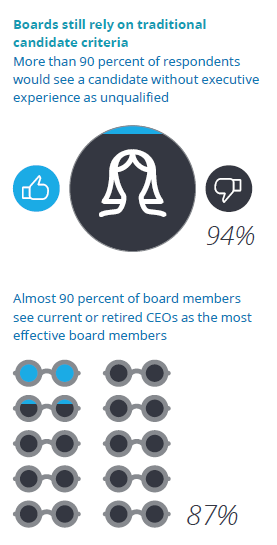
Les CA s’en remettent trop souvent aux critères traditionnels de sélection des administrateurs (grande expérience de management ou de PDG)

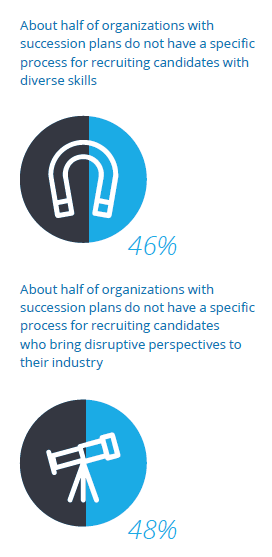
Environ la moitié des organisations qui ont des plans de relève n’ont pas de processus de recrutement comportant des habiletés liées à la diversité

Presque toutes les organisations sont conscientes que les politiques concernant la limitation du nombre de mandats et de l’âge sont nécessaires pour assurer le renouvellement du CA

Cependant, les pratiques utilisées semblent limiter la diversité

(3) Nouveau modèle de gouvernance — la mixtocratie

Atteindre un équilibre entre l’expérience souhaitée et la diversité requise

Nécessité de revoir la notion de risque

Faire la promotion du modèle de diversité

Revoir systématiquement la composition du conseil

Redynamiser la planification de la relève

Avoir des objectifs clairs de diversité


L’infographie présentée parle d’elle-même. Bonne lecture !


2017 Board Diversity Survey


Part 1. Perceptions of board diversity


The findings in this section show that the survey found nearly universal agreement on the need for diverse skill sets and perspectives on the board, and on the potential benefits of diversity.


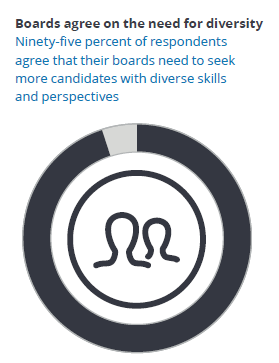
Boards agree on the need for diversity


Note, however, that this finding does not reveal where diversity of skill sets and perspectives are needed. Thus, the skills and perspectives could be those of, say, financial or operating or information
technology executives. Such backgrounds would represent diversity of skills and perspectives, but not the demographic diversity that the term “diversity” usually implies.

Demographic diversity remains an essential goal in that gender and racial differences are key determinates of a person’s experiences, attitudes, frame of reference, and point of view.

As the next finding reveals, however, respondents do not see demographic diversity as enough.


Board members see diversity as going beyond basic demographics


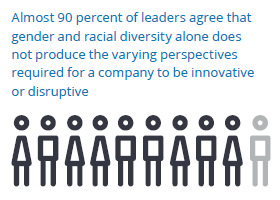
Nine in ten respondents agree that gender and racial diversity alone does not produce the diversity required for an organization to be innovative or disruptive. This may be surprising, given that gender and racial differences are generally seen as contributing to diverse perspectives. Yet those contributions may be tempered if recruiting and selection methods skew toward candidates with the backgrounds and experiences of white males with executive experience.

More to the point, it would be unfortunate if a focus on diversity of skills and perspectives were to undermine or cloud the focus on gender and racial diversity. In fact, typical definitions of board diversity include a demographic component. Deloitte’s 2016 Board Practices Report found that 53 percent of large-cap and 45 percent of mid-cap organizations disclose gender data on their board’s diversity; the respective numbers for racial diversity are, far lower, however: 18 percent and 9 percent. [1]

So, the deeper questions may be these: How does the board go about defining diversity? Does its definition include gender and racial factors? Does it also include factors such as skills, experiences, and perspectives? Will the board’s practices enable it to achieve diversity along these various lines?

Before turning to practices, we consider the potential benefits of diversity.


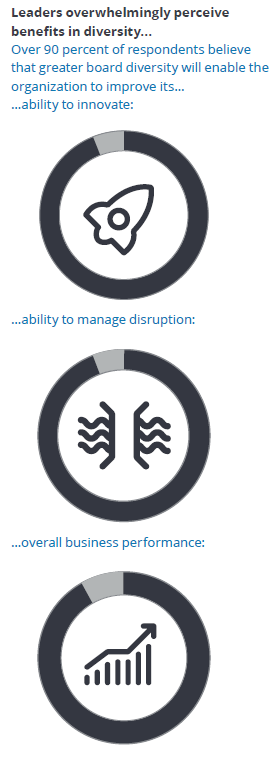
Leaders overwhelmingly perceive benefits in diversity


Taken at face value, these answers indicate that boards believe in diversity, however they go about defining it, for business reasons and not just for its own sake or reasons of social responsibility.


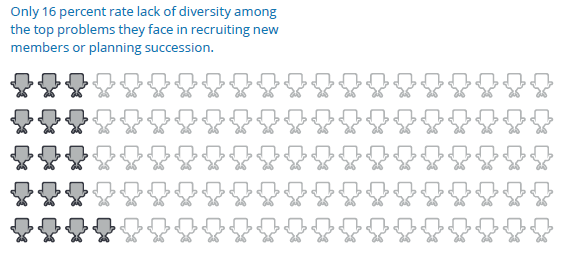
…Yet relatively few see a lack of diversity as a top problem


The foregoing findings show that leaders believe that boards need greater diversity of skills and perspectives, that demographic diversity alone may not produce that diversity, and that diversity is seen as beneficial in managing innovation, disruption, and business performance. Yet, somewhat surprisingly, few respondents cited a lack of diversity as a top problem.

So, while 95 percent of respondents agree that their board needs to seek out more candidates with diverse skills and perspectives, far smaller percentages cite lack of diversity as among the top problems they face in candidate recruitment or selection.

Does this reflect contentment with current board composition and acceptance of the status quo?

Perhaps, or perhaps not.

However, we can say that many board recruitment and selection practices remain very traditional.


Part 2. Recruitment and evaluation practices


Board recruitment practices have arguably not kept pace with the desire and need for greater board diversity.


Boards still rely on traditional candidate criteria


In addition, 81 percent of respondents would expect multiple board members to see a candidate without executive experience as unqualified to serve on the board.

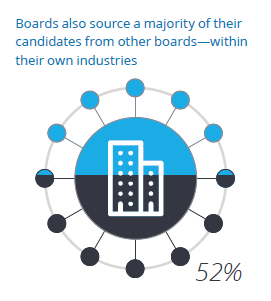
The low percentage of women candidates (16 percent) is striking, as is that of racial minorities (19 percent). However, that may be a logical outcome of a process favoring selecting candidates with board experience—who historically have tended to be white and male.

So, in the recruitment process, board members are often seeking people who tend to be like themselves—and like management. Such a process may help to reinforce a lack of diversity in perspectives and experiences, as well as (in most companies) in gender and race.

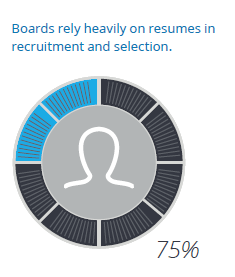
Relying on resumes, which reflect organizational and educational experience, helps to reinforce traditional patterns of board composition.


About half of organizations have processes focused on diverse skills and disruptive views


Given all their other responsibilities, many boards understandably rely on existing recruitment tools and processes. They use resumes, their networks, and executive recruiters—all of which tend to generate results very similar to past results.

However, our current disruptive environment likely calls for more creative approaches to reaching diverse candidates. Some organizations have taken steps to address these needs.


Our survey did not assess the nature or extent of the processes for recruiting candidates with diverse skills or perspectives, indicating an area for further investigation.


Policies affecting board refreshment


Policies, as well as processes, can affect board composition. Low turnover on boards can not only hinder movement toward greater diversity but also lead to myopic views of operations or impaired ability to oversee evolving strategies and risks.

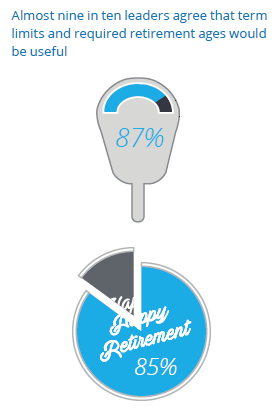
While board members expressed agreement with term and age limits, the latter are far more common. Our separate 2016 Board Practices Report found that 81 percent of large-cap and 74 percent of mid-cap companies have age limits, but only 5 percent and 6 percent, respectively, have term limits. [2] This evidences a large gap between agreement with term limits as an idea and term limits as a practice.


Current practices tend to limit diversity


Deloitte’s 2016 Board Practices Report also found that 84 percent of large-cap and 90 percent of mid-cap organizations most often rely on current directors’ recommendations of candidates. [3] That same study found that 68 percent and 79 percent, respectively, use a recruiting firm when needed, and that 62 percent and 79 percent use a board skills matrix or similar tool.

Relying on current directors’ recommendations will generally produce candidates much like those directors. Recruiting firms can be valuable, but tend to adopt the client’s view of diversity. Tools such as board competency matrices generally do not account for an organization’s strategy, nor do they provide a very nuanced view of individual board members’ experiences and capabilities. In other words, bringing people with diverse skills, perspectives, and experiences to the board—as well as women and racial and ethnic minorities—requires more robust processes than those currently used by most boards.


Part 3. A path forward—The Mixtocracy Model


The term meritocracy describes organizational advancement based upon merit—talents and accomplishments—and aims to combat the nepotism and cronyism that traditionally permeated many businesses. However, too often meritocracy results in mirrortocracy in which all directors bring similar perspectives and approaches to governance, risk management, and other board responsibilities.

A board differs from a position, such as chief executive officer or chief financial officer, in that it is a collection of individuals. A board is a team and, like any other team, it requires people who can fulfill specific roles, contribute different skills and views, and work together to achieve certain goals.

Thus, a board can include nontraditional members who will be balanced out by more traditional ones. Many existing recruiting methods do too little to achieve true diversity. The prevalence of those criteria and methods can repeatedly send boards back to the same talent pool, even in the case of women and minority candidates. For example, Deloitte’s 2016 Board Diversity Census shows that female and black directors are far more likely than white male directors to hold multiple Fortune 500 board seats. [4]

Therefore, organizations should consider institutionalizing a succession planning and recruitment process that more closely aligns to their ideal board composition and diversity goals. Here are three ways to potentially do that:

 Look beyond “the tried and true.” Even when boards account for gender and race, current practices may tend to source candidates with similar views. Succession plans should create seats for those who are truly different, for example someone with no board experience but a strong cybersecurity background or someone who more closely mirrors the customer base.

Take a truly analytical approach. Developing the optimal mix on the board calls for considering risks, opportunities, and markets, as well as customers, employees, and other stakeholders. A data-driven analytics tool that assesses management’s strategies, the board’s needs, and desired director attributes can help define the optimal mix in light of those factors.

Use more sophisticated criteria. Look beyond resumes and check-the-box approaches to recruiting women, minorities, and those with the right title. Surface-level diversity will not necessarily generate varying perspectives and innovative responses to disruption. Deep inquiry into a candidate’s outlook, experience, and fit can take the board beyond standard criteria, while prompting the board to more fully consider women and minority candidates—that is, to not see them mainly as women and minority candidates.

To construct and maintain a board that can meet evolving governance, advisory, and risk oversight needs, leaders should also consider the following steps.


Rethink risk


Digitalization continues to disrupt the business landscape. The ability to not only respond to disruption, but to proactively disrupt, has commonly become a must. Yet boards have historically focused on loss prevention rather than value creation. Every board should ask itself who best can help in ascertaining that management is taking the right risks to innovate and win in the marketplace. The more diversity of thought, perspectives, experiences, and skills a board collectively possesses, the better it can oversee moves into riskier territory in an informed and useful way—and to assist management in making bold decisions that are likely to pay off.


Elevate diversity


Current definitions of board diversity tend to focus on at-birth traits, such as gender and race. While such diversity is essential, it may promote a check-the-box approach to gender and racial diversity. Boards that include those traits and also enrich them by considering differences gained through employment paths, industry experiences, educational, artistic, and cultural endeavors, international living, and government, military, and other service will more likely achieve a true mix of perspectives
and capabilities.

They may also develop a more holistic vision of gender and racial diversity. After all, woman and minority board members do not want to be “women and minority board members”—they want to be board members. In other words, this approach should aim to generate a fuller view of candidates and board members, as well as more diversity of skills and perspectives and gender and race.


Retool board composition


Current tools for achieving an optimal mix of directors can generally be classified as simplistic, generic, and outdated. They often help in organizing information, but provide little to no support in identifying strategic needs and aligning a board’s skills, perspectives, and experiences with those needs.

Successful board composition typically demands analysis of data on organizational strategies, customer demographics, industry disruption, and market trends to identify gaps and opportunities. A board should consider not only individual member’s profiles but also assess the board as one working body to ascertain that complementary characteristics and capabilities are in place or can be put in place.

A tool to support this analysis should be the initial input into the succession planning and recruitment process. It should also be used in ongoing assessments to help ensure that the board equals a whole that is greater than the sum of its parts.


Revitalize succession planning


The process of filling an open board position may be seen as similar to that for recruiting C-suite candidates. But that would ignore the fact that the board is a collection of individuals rather than a single role. An approach geared to creating a mixtocracy can strengthen the board by combining individual differences in a deliberate manner. Differing gender and ethnic backgrounds as well as skills, perspectives, and experiences can make for more rigorous, far-reaching, and thought-provoking discussions, inquiries, and challenges. This can enable the board to provide a more effective counterbalance to management as well as better support in areas such as innovation, disruption, and assessments of strategies, decisions, and underlying assumptions.

In plans for board succession, the uniqueness of thought an individual will bring to the table can be as important as his or her more ostensible characteristics and accomplishments.


Toward greater board diversity


Given its responsibility to provide guidance on strategy, oversight of risk, governance of practices, and protection of shareholders’ interests, the board arguably has a greater need for diversity than the C-suite, where diversity also enriches management. The path forward remains long, but it is becoming increasing clear as boards continue to work toward achieving greater diversity on multiple fronts.

____________________________________

Endnotes

1 2016 Boards Practices Report – A transparent look at the work of the board. Tenth edition, 2017, Society for Corporate Governance and Deloitte Development LLC.(go back)

2 ibid.(go back)

3 ibid.(go back)

4 Missing Pieces Report: The 2016 Board Diversity Census of Women and Minorities on Fortune 500 Boards, 2017, Deloitte Development LLC.(go back)


*The 2017 board diversity survey was conducted in spring 2017 among 300 board members and C-suite executives at U.S. companies with at least $50 million in annual revenue and at least 1,000 employees. Conducted by Wakefield Research via an email invitation and online questionnaire, the survey sought to ascertain respondents’ perspectives on board diversity and their organizations’ criteria and practices for recruiting and selecting board members. The margin of error for this study is +/- 5.7 percentage points at the 95 percent confidence level.

Enjeux clés concernant les membres des comités d’audit | En rappel


Le récent rapport de KPMG sur les grandes tendances en audit présente sept défis que les membres des CA, notamment les membres des comités d’audit, doivent considérer afin de bien s’acquitter de leurs responsabilités dans la gouvernance des sociétés.

Le rapport a été rédigé par des professionnels en audit de la firme KPMG ainsi que par le Conference Board du Canada.

Les sept défis abordés dans le rapport sont les suivants :

– talent et capital humain ;

– technologie et cybersécurité ;

– perturbation des modèles d’affaires ;

– paysage réglementaire en évolution ;

– incertitude politique et économique ;

– évolution des attentes en matière de présentation de l’information ;

– environnement et changements climatiques.

Je vous invite à consulter le rapport complet ci-dessous pour de plus amples informations sur chaque enjeu.

Bonne lecture !


Tendances en audit


Résultats de recherche d'images pour « tendances en audit »


Alors que l’innovation technologique et la cybersécurité continuent d’avoir un impact croissant sur le monde des finances et des affaires à l’échelle mondiale, tant les comités d’audit que les chefs des finances reconnaissent le besoin de compter sur des talents de haut calibre pour contribuer à affronter ces défis et à en tirer parti.

Le rôle du comité d’audit est de s’assurer que l’organisation dispose des bonnes personnes possédant l’expérience et les connaissances requises, tant au niveau de la gestion et des opérations qu’au sein même de sa constitution. Il ne s’agit que de l’un des nombreux défis à avoir fait surface dans le cadre de ce troisième numéro du rapport Tendances en audit.

Les comités d’audit d’aujourd’hui ont la responsabilité d’aider les organisations à s’orienter parmi les nombreux enjeux et défis plus complexes que jamais auxquels ils font face, tout en remplissant leur mandat traditionnel de conformité et de présentation de l’information. Alors que les comités d’audit sont pleinement conscients de cette nécessité, notre rapport indique que les comités d’audit et les chefs des finances se demandent dans quelle mesure leur organisation est bien positionnée pour faire face à la gamme complète des tendances actuelles et émergentes.

Pour mettre en lumière cette préoccupation et d’autres enjeux clés, le rapport Tendances en audit se penche sur les sept défis qui suivent :

  1. talent et capital humain;
  2. technologie et cybersécurité;
  3. perturbation des modèles d’affaires;
  4. paysage réglementaire en évolution;
  5. incertitude politique et économique;
  6. évolution des attentes en matière de présentation de l’information;
  7. environnement et changements climatiques.

Au fil de l’évolution des mandats et des responsabilités, ce rapport se révélera être une ressource précieuse pour l’ensemble des parties prenantes en audit.

La souveraineté des conseils d’administration | En rappel


Je partage avec vous une excellente prise de position d’Yvan Allaire et de Michel Nadeau, respectivement président et directeur général de l’Institut de la gouvernance (IGOPP), que j’appuie totalement. Cet article a été publié dans Le Devoir du 6 janvier 2018.

Il est impératif que le conseil d’administration, qui est le fiduciaire des parties intéressées, conserve son rôle de gardien de la bonne gouvernance des organisations. Les règles de gouvernance sont fondées sur le fait que le conseil d’administration est l’instance souveraine.

Comme le disent clairement les auteurs : « La gouvernance des sociétés repose sur une pierre angulaire : le conseil d’administration, qui tire sa légitimité et sa crédibilité de son élection par les membres, les actionnaires ou les sociétaires de l’organisation. Il est l’ultime organe décisionnel, l’instance responsable de l’imputabilité et de la reddition de comptes. Tous les comités du conseil créés à des fins spécifiques sont consultatifs pour le conseil ».

Cet article est court et précis ; il met l’accent sur certaines caractéristiques du projet de loi 141 qui mine la légitimité du conseil d’administration et qui sont potentiellement dommageable pour la cohésion et la responsabilisation des membres du conseil.

Je vous en souhaite bonne lecture ; n’hésitez pas à nous faire connaître votre opinion.


Projet de loi 141: les conseils d’administration doivent demeurer responsables


Résultats de recherche d'images pour « projet de loi 141 »
Projet de loi 141
 

Dans son projet de loi visant principalement à améliorer l’encadrement du secteur financier, le ministre des Finances du Québec a mis la barre haute en proposant quelque 2000 modifications législatives touchant l’ensemble des institutions d’assurance, de dépôts et de fiducie relevant de l’État québécois.

Le texte de 488 pages soulèvera de nombreuses questions, notamment chez les intermédiaires financiers lors de la commission parlementaire des 16 et 17 janvier prochains. En tant qu’experts en gouvernance, nous sommes très préoccupés par certains articles du projet de loi qui enlèvent aux conseils d’administration des institutions des pouvoirs qui leur sont reconnus par la loi québécoise et canadienne sur les sociétés par actions. De plus, certaines propositions du projet de loi risquent de semer la confusion quant au devoir de loyauté des membres du conseil envers l’organisation.

La gouvernance des sociétés repose sur une pierre angulaire : le conseil d’administration, qui tire sa légitimité et sa crédibilité de son élection par les membres, les actionnaires ou les sociétaires de l’organisation. Il est l’ultime organe décisionnel, l’instance responsable de l’imputabilité et de la reddition de comptes. Tous les comités du conseil créés à des fins spécifiques sont consultatifs pour le conseil.

Arrangements insoutenables

De façon sans précédent, le projet de loi 141 impose aux conseils d’administration l’obligation de « confier à certains administrateurs qu’il désigne ou à un comité de ceux-ci les responsabilités de veiller au respect des saines pratiques commerciales et des pratiques de gestion saine et prudente et à la détection des situations qui leur sont contraires ».

À quelles informations ce « comité » aurait-il accès, lesquelles ne seraient pas connues d’un comité d’audit normal ? En quoi cette responsabilité dévolue à un nouveau comité est-elle différente de la responsabilité qui devrait incomber au comité d’audit ?

Le projet de loi stipule que dès que le comité prévu prend connaissance d’une situation qui entraîne une détérioration de la situation financière (un fait qui aurait échappé au comité d’audit ?), qui est contraire aux pratiques de gestion saine et prudente ou qui est contraire aux saines pratiques commerciales, il doit en aviser le conseil d’administration par écrit. Le conseil d’administration doit alors voir à remédier promptement à la situation. Si la situation mentionnée à cet avis n’a pas été corrigée selon le jugement de l’administrateur ou du comité, celui-ci doit transmettre à l’Autorité une copie de cet avis.

Le conseil d’administration pourrait, soudainement et sans avoir été prévenu, apprendre que l’AMF frappe à la porte de l’institution parce que certains de leurs membres sont d’avis que le conseil dans son ensemble n’a pas corrigé à leur satisfaction certaines situations jugées inquiétantes.

Ces nouveaux arrangements de gouvernance sont insoutenables. Ils créent une classe d’administrateurs devant agir comme chiens de garde du conseil et comme délateurs des autres membres du conseil. Une telle gouvernance rendrait impossibles la nécessaire collégialité et l’égalité entre les membres d’un même conseil.

Cette forme de gouvernance, inédite et sans précédent, soulève la question fondamentale de la confiance dont doit jouir un conseil quant à sa capacité et à sa volonté de corriger d’éventuelles situations préoccupantes.

Comité d’éthique

Le projet de loi 141 semble présumer qu’un comportement éthique requiert la création d’un comité d’éthique. Ce comité devra veiller à l’adoption de règles de comportement et de déontologie, lesquelles seront transmises à l’AMF. Le comité avise, par écrit et sans délai, le conseil d’administration de tout manquement à celles-ci.

Le projet de loi 141 obligera le comité d’éthique à transmettre annuellement à l’Autorité des marchés un rapport de ses activités, incluant la liste des situations de conflit d’intérêts, les mesures prises pour veiller à l’application des règles et les manquements observés. Le texte de ce projet de loi devrait plutôt se lire ainsi : « Le Comité d’éthique soumet son rapport annuel au conseil d’administration, qui en fait parvenir copie à l’AMF dans les deux mois suivant la clôture de l’exercice. »

Encore une fois, c’est vraiment mal comprendre le travail des comités que d’imputer à ceux-ci des responsabilités « décisionnelles » qui ne devraient relever que du conseil dans son ensemble.

L’ensemble des textes législatifs sur la gouvernance des organisations ne laisse place à aucune ambiguïté : la loyauté d’un membre du conseil est d’abord envers son organisme. Or, le projet de loi instaure un mécanisme de dénonciation auprès de l’AMF. Insatisfait d’une décision de ses collègues ou de leur réaction à une situation donnée, un administrateur devrait ainsi renoncer à son devoir de loyauté et de confidentialité pour choisir la route de la dénonciation en solo.

L’administrateur ne devrait pas se prévaloir de ce régime de dénonciation, mais livrer bataille dans le cadre prévu à cette fin : le conseil. Agir autrement est ouvrir la porte à des manœuvres douteuses qui mineront la cohésion et la solidarité nécessaire au sein de l’équipe du CA. Si la majorité des administrateurs ne partagent pas l’avis de ce valeureux membre, celui-ci pourra démissionner du conseil en informant l’Autorité des motifs de sa démission, comme l’exige le projet de loi 141.

Le projet de loi 141 doit être amendé pour conserver aux conseils d’administration l’entière responsabilité du fonctionnement de la bonne gouvernance des organismes visés par le projet de loi.

Éléments clés à considérer par les administrateurs dans la gouvernance des organisations


Récemment, je suis intervenu auprès du conseil d’administration d’une OBNL et j’ai animé une discussion tournant autour des thèmes suivants en affirmant certains principes de gouvernance que je pense être incontournable.

J’ai regroupé les thèmes en 15 volets :

(1) Le conseil d’administration est souverain — il est l’ultime organe décisionnel.

(2) Le rôle des administrateurs est d’assurer la saine gestion de l’organisation en fonction d’objectifs établis. L’administrateur a un rôle de fiduciaire, non seulement envers les membres qui les ont élus, mais aussi envers les parties prenantes de toute l’organisation. Son rôle comporte des devoirs et des responsabilités envers celle-ci.

(3) Les administrateurs ont un devoir de surveillance et de diligence ; ils doivent cependant s’assurer de ne pas s’immiscer dans la gestion de l’organisation (« nose in, fingers out »).

(4) La décision la plus importante du conseil d’administration est le choix du premier dirigeant, c’est-à-dire le directeur général de l’organisation.

(5) Les administrateurs élus par l’assemblée générale ne sont pas porteurs des intérêts propres à leur groupe ; ce sont les intérêts supérieurs de l’organisation qui priment.

(6) Le président du conseil est le chef d’orchestre du groupe d’administrateurs ; il doit être en étroite relation avec le premier dirigeant et bien comprendre les coulisses du pouvoir. Il doit de plus s’assurer que chaque administrateur apporte une valeur ajoutée aux décisions du CA.

Résultats de recherche d'images pour « gouvernance des organisations »

(7) Les membres du conseil doivent entretenir des relations de collaboration et de respect entre eux ; ils doivent viser les consensus et exprimer leur solidarité, notamment par la confidentialité des échanges.

(8) Les administrateurs doivent être bien préparés pour les réunions du conseil et ils doivent poser les bonnes questions afin de bien comprendre les enjeux et de décider en toute indépendance d’esprit. Pour ce faire, ils peuvent tirer profit de l’avis d’experts indépendants.

(9) La composition du conseil devrait refléter la diversité de l’organisation. On doit privilégier l’expertise, la connaissance de l’industrie et la complémentarité.

(10) Le conseil d’administration doit accorder toute son attention aux orientations stratégiques de l’organisation et passer le plus clair de son temps dans un rôle de conseil stratégique.

(11) Le rôle des comités du conseil (Ressources humaines, audit, gouvernance) est crucial ; ceux-ci doivent alimenter la réflexion des membres du conseil et faire des recommandations.

(12) La nécessité de fonctionner avec un comité exécutif varie selon la configuration du conseil d’administration de l’organisation.

(13) Chaque réunion devrait se conclure par un huis clos, systématiquement inscrit à l’ordre du jour de toutes les rencontres.

(14) Le président du comité de gouvernance doit mettre en place une évaluation du fonctionnement et de la dynamique du conseil.

(15) Les administrateurs doivent prévoir des activités de formation en gouvernance et en éthique.


Vos commentaires sont les bienvenus.

Guide pratique à la détermination de la rémunération des administrateurs de sociétés | En rappel


Aujourd’hui, je vous suggère la lecture d’un excellent guide publié par International Corporate Governance Network (ICGN). Ce document présente succinctement les grands principes qui devraient gouverner l’établissement de la rémunération des administrateurs indépendants (« non-executive »).

Il va de soi que la rémunération des administrateurs ne représente qu’une part infime du budget d’une entreprise, et celle-ci est relativement très inférieure aux rémunérations consenties aux dirigeants ! Cependant, il est vital d’apporter une attention particulière à la rémunération des administrateurs, car ceux-ci sont les fiduciaires des actionnaires, ceux qui doivent les représenter, en veillant à la saine gestion de la société.

Il est important que le comité de gouvernance se penche annuellement sur la question de la rémunération des administrateurs indépendants, et que ce comité propose une politique de rémunération qui tient compte du rôle déterminant de ces derniers. Plusieurs variables doivent être prises en ligne de compte notamment, la comparaison avec d’autres entreprises similaires, les responsabilités des administrateurs dans les différents rôles qui leur sont attribués au sein du conseil, la nature de l’entreprise (taille, cycle de développement, type de mission, circonstances particulières, etc.).

Personnellement, je suis d’avis que tous les administrateurs de sociétés obtiennent une compensation pour leurs efforts, même si, dans certains cas, les sommes affectées s’avèrent peu élevées. Les organisations ont avantage à offrir de justes rémunérations à leurs administrateurs afin (1) d’attirer de nouvelles recrues hautement qualifiées (2) de s’assurer que les intérêts des administrateurs sont en adéquation avec les intérêts des parties prenantes, et (3) d’être en mesure de s’attendre à une solide performance de leur part et de divulguer les rémunérations globales.

Le document du ICNG propose une réflexion dans trois domaines : (1) la structure de rémunération (2) la reddition de comptes, et (3) les principes de transparence.

On me demande souvent qui doit statuer sur la politique de rémunération des administrateurs, puisqu’il semble que ceux-ci déterminent leurs propres compensations !

Ultimement, ce sont les actionnaires qui doivent approuver les rémunérations des administrateurs telles que présentées dans la circulaire de procuration. Cependant, le travail en aval se fait, annuellement, par le comité de gouvernance lequel recommande au conseil une structure de rémunération des administrateurs non exécutifs. Notons que les comités de gouvernance ont souvent recours à des firmes spécialisées en rémunération pour les aider dans leurs décisions.

C’est cette recommandation qui devrait être amenée à l’assemblée générale annuelle pour approbation, même si dans plusieurs pays, la juridiction ne le requiert pas.

En tant qu’administrateur, si vous souhaitez connaître le point de vue du plus grand réseau de gouvernance à l’échelle internationale, je vous invite à lire ce document synthétique.

Bonne lecture. Vos commentaires sur le sujet sont sollicités.


ICGN Guidance on Non-executive Director Remuneration – 2016


Le processus de gestion des réunions d’un conseil d’administration | Deuxième partie en rappel


Plusieurs personnes me demandent de l’information sur le processus de gestion des réunions d’un conseil d’administration.

Souvent, les personnes intéressées souhaitent obtenir des documents pragmatiques et concrets.

Afin d’explorer plus à fond cette problématique, j’ai effectué une recherche documentaire assez exhaustive sur les bonnes pratiques eu égard aux réunions de conseils d’administration.

Cette recherche m’a amené à considérer quatre étapes incontournables dans la mise en place d’un processus efficace de gouvernance :

  1. la préparation de l’information et de la documentation pertinente ;
  2. la conduite de la réunion du conseil ;
  3. l’évaluation de la réunion ;
  4. les suivis apportés à la réunion.

Chacune de ces activités représente un niveau d’importance égal à mes yeux.

Mon premier billet, Le processus de gestion des réunions d’un conseil d’administration | Première partie, portait sur les étapes 1 et 2. J’ai rassemblé les informations les plus pertinentes sur le sujet.

Dans ce billet, j’aborderai les activités se rapportant aux deux autres thèmes : l’évaluation de la réunion et les suivis apportés à la réunion.


(3) L’évaluation de la réunion et de l’efficacité du conseil


L’évaluation de chaque réunion du conseil est à recommander. Il s’agit d’une activité menée par le président du conseil et elle peut se faire lors du huis clos. Cependant, il est essentiel que cette activité se fasse annuellement.

Tel que je l’ai publié sur mon blogue en gouvernance le 16 novembre 2016 (Comment procéder à l’évaluation du CA, des comités et des administrateurs | Un sujet d’actualité!), les conseils d’administration sont de plus en plus confrontés à l’exigence d’évaluer l’efficacité de leur fonctionnement par le biais d’une évaluation annuelle du CA, des comités et des administrateurs.

En fait, le NYSE exige depuis dix ans que les conseils procèdent à leur évaluation et que les résultats du processus soient divulgués aux actionnaires. Également, les investisseurs institutionnels et les activistes demandent de plus en plus d’informations au sujet du processus d’évaluation.

Les résultats de l’évaluation peuvent être divulgués de plusieurs façons, notamment dans les circulaires de procuration et sur le site de l’entreprise.

L’article publié par John Olson, associé fondateur de la firme Gibson, Dunn & Crutcher, professeur invité à Georgetown Law Center, et paru sur le forum du Harvard Law School, présente certaines approches fréquemment utilisées pour l’évaluation du CA, des comités et des administrateurs.

On recommande de modifier les méthodes et les paramètres de l’évaluation à chaque trois ans afin d’éviter la routine susceptible de s’installer si les administrateurs remplissent les mêmes questionnaires, gérés par le président du conseil. De plus, l’objectif de l’évaluation est sujet à changement (par exemple, depuis une décennie, on accorde une grande place à la cybersécurité).

C’est au comité de gouvernance que revient la supervision du processus d’évaluation du conseil d’administration. L’article décrit quatre méthodes fréquemment utilisées.

(1) Les questionnaires gérés par le comité de gouvernance ou une personne externe

(2) les discussions entre administrateurs sur des sujets déterminés à l’avance

(3) les entretiens individuels avec les administrateurs sur des thèmes précis par le président du conseil, le président du comité de gouvernance ou un expert externe.

(4) L’évaluation des contributions de chaque administrateur par la méthode d’auto-évaluation et par l’évaluation des pairs.

Chaque approche a ses particularités et la clé est de varier les façons de faire périodiquement. On constate également que beaucoup de sociétés cotées utilisent les services de spécialistes pour les aider dans leurs démarches.

La quasi-totalité des entreprises du S&P 500 divulgue le processus d’évaluation utilisé pour améliorer leur efficacité. L’article présente deux manières de diffuser les résultats du processus d’évaluation.

(1) Structuré, c’est-à-dire un format qui précise — qui évalue quoi ; la fréquence de l’évaluation ; qui supervise les résultats ; comment le CA a-t-il agi eu égard aux résultats de l’opération d’évaluation ?

(2) Information axée sur les résultats — les grandes conclusions ; les facteurs positifs et les points à améliorer ; un plan d’action visant à corriger les lacunes observées.

Notons que la firme de services aux actionnaires ISS (Institutional Shareholder Services) utilise la qualité du processus d’évaluation pour évaluer la robustesse de la gouvernance des sociétés. L’article présente des recommandations très utiles pour toute personne intéressée par la mise en place d’un système d’évaluation du CA et par sa gestion.

Voici trois articles parus sur mon blogue qui abordent le sujet de l’évaluation :

L’évaluation des conseils d’administration et des administrateurs | Sept étapes à considérer

Quels sont les devoirs et les responsabilités d’un CA ?  (la section qui traite des questionnaires d’évaluation du rendement et de la performance du conseil)

Évaluation des membres de Conseils

Le texte de l’IGOPP, Performance et dynamique des conseils d’administration, est assez explicite sur le sujet de l’évaluation. On indique que celle-ci comporte plusieurs volets :

Une évaluation, sous forme de questionnaire, du fonctionnement du conseil et de ses comités; cette démarche est quasi-universelle;

Une évaluation nominative des membres du conseil par les pairs; cette forme d’évaluation gagne en fréquence, mais ne fait pas lunanimité chez nos participants; elle est même carrément rejetée par plusieurs parce que, selon eux, elle est susceptible de semer la zizanie au conseil;

Une auto-évaluation par les membres du conseil, laquelle est communiquée au président du conseil (PCA) et sert de base de discussion individuelle avec le PCA;

Une évaluation d’ensemble (anonyme et non nominative) des membres du conseil suivi d’une rencontre individuelle avec le ou la président(e) du conseil; cette démarche reçoit plus dappui;

De l’avis de nos informateurs, quelle que soit la démarche adoptée, la rencontre du PCA avec chaque membre individuellement est une démarche incontournable pour relever la qualité du conseil; le PCA doit être franc et ferme durant cette rencontre à propos de la contribution et de la préparation de chacun ainsi qu’à propos des aspects à améliorer, s’il y a lieu; cest le moment privilégié pour susciter des départs et ainsi renouveler et renforcer le conseil;

Une pratique, qui a du mérite, fut mentionnée : la direction (le PDG et ses subalternes immédiats) est invitée à évaluer le conseil dans son ensemble ainsi qu’à suggérer des enjeux qui devraient être considérés par le conseil au cours de la prochaine année;

L’évaluation doit aussi porter sur la façon dont le PCA s’acquitte de ses responsabilités; cette évaluation menée par le président du comité de gouvernance s’appuie habituellement sur les réponses des membres du conseil à un questionnaire préparé à cette fin.


 (4) Suivis apportés à la réunion


La direction doit être incitée à effectuer tous les suivis requis par le conseil d’administration et le CA doit l’accompagner dans la conception et la préparation de tableaux de suivis et de tableaux de bord.

Ces instruments sont essentiels au travail de supervision des administrateurs. On y retrouve généralement la date ou la résolution, la nature du suivi à effectuer, le ou les responsables de ces activités, l’échéance, les notes pertinentes au dossier.

Également, un tableau de bord doit être produit à chaque rencontre. On y retrouve des indicateurs liés à la performance de l’organisation ainsi que les principaux risques à mitiger.

Encore ici, c’est le président du conseil qui doit s’assurer que ces outils de suivis sont mis en place et utilisés à bon escient. Sans un suivi soutenu entre les rencontres du CA ou des comités, les administrateurs sont dans le brouillard.

Je vous invite également à prendre connaissance des deux documents synthèses suivants :

Assurer une efficacité supérieure du conseil d’administration

Règles et pratiques relatives aux réunions du conseil d’administration — UdeS

En terminant, il faut insister sur l’importance pour l’organisation de protéger la confidentialité et la sécurité des données par l’utilisation d’une plateforme permettant d’avoir accès aux contenus des réunions. Les firmes les plus connues pour offrir ces services sont idside et LeadingBoards.

Je suis assuré que les informations soumises dans ce rapport vous aideront à dégager une grille d’analyse pertinente pour l’évaluation de l’efficacité des conseils d’administration.

Adapter le modèle de gouvernance à la réalité des OBNL de petite taille | en rappel


Il est vrai que la réalité des organisations à but non lucratif (OBNL) est souvent assez éloignée des grands principes de gouvernance généralement reconnus.

Les différences principales portent essentiellement sur l’application rigoureuse de certains principes de gouvernance lorsque l’entreprise est à ses débuts ou en transition.

La distinction nette entre les activités des administrateurs et l’embryon de direction peut alors prendre une forme différente. Il est évident que pour les entreprises en démarrage, le rôle des administrateurs peut comprendre des tâches qui relèveraient normalement de la direction générale de l’entreprise.

Cependant, les administrateurs doivent toujours saisir qu’ils ont d’abord et avant tout un rôle de fiduciaire, ce qui rend leurs prestations d’autant plus délicates ! La gestion de conflits d’intérêts potentiels est à prévoir dans ces cas. Le président du conseil doit être très vigilant à cet égard.

Les administrateurs doivent accepter l’idée que l’organisation ne puisse survivre sans leur apport concret, en attendant la constitution d’une véritable structure de management avec l’embauche d’un directeur général ou d’une directrice générale.

Voici le témoignage de Sandra Dunham* qui a une longue expérience dans la direction des OBNL et qui a été invitée à contribuer au blogue de Imagine Canada.

Bonne lecture ! Ce billet est-il pertinent ? Avez-vous des interrogations ? Vos commentaires sont les bienvenus.


Modèles de gouvernance du CA : oser la différence !


Résultats de recherche d'images pour « obnl imagine canada »


Résultats de recherche d'images pour « OBNL »


Lorsque j’ai débuté dans mon tout premier poste de directrice générale à la fin des années 1990, tout le monde parlait du modèle de gouvernance de Carver. À l’époque, j’ignorais tout de l’existence même d’un « modèle de gouvernance ». Les adeptes de cette théorie l’étudiaient soigneusement, élaboraient des politiques et renseignaient leurs collègues-administrateurs à son sujet. Le modèle Carver était alors considéré comme le nec plus ultra des modèles de gouvernance.

Dans l’organisation à laquelle je me joignais alors, le directeur général sortant avait participé à une formation à ce sujet et avait suggéré aux administrateurs des façons de faire pour devenir un conseil d’administration (CA) conforme au modèle Carver. À mon arrivée, les membres avaient créé une multitude de règlements superflus à propos du fonctionnement du CA, soit en raison des informations relayées par l’ancien directeur général, soit en raison de l’interprétation qu’eux-mêmes en avaient faite ou en raison de l’expertise des nouveaux administrateurs.

Encore aujourd’hui, j’entends certains administrateurs décrire leur CA comme un « CA selon Carver », mais il est devenu beaucoup plus courant de parler d’un modèle de gouvernance par politiques. Malgré la multiplication des formations en gouvernance, les administrateurs ignorent souvent à quel type de CA s’identifier, et s’ils le savent, ils ne réussissent pas toujours à agir en fonction des caractéristiques du modèle choisi.

J’estime qu’il est grand temps pour les CA d’arrêter de vouloir travailler relativement à certaines catégories qui ne correspondent pas à leur réalité et de s’excuser de leur mode de fonctionnement. Ils devraient plutôt se concentrer sur les priorités qui s’imposent compte tenu de leur étape de développement et définir clairement leur rôle dans l’organisation.


Politiques, opérations et entre-deux


Presque tous les CA remplissent d’abord une fonction opérationnelle. Puisque très peu d’organismes comptent des employés dès le jour un de leur existence, les administrateurs doivent assurer le fonctionnement de l’organisation jusqu’à ce qu’un employé rémunéré ou un nombre suffisant de bénévoles se joignent à l’équipe et libèrent les administrateurs de cette tâche. Or, de nombreux CA continuent à assumer certaines tâches opérationnelles même après l’arrivée de personnel et laissent à ces derniers le soin de mettre en œuvre les programmes offerts par l’organisme.

Puis, généralement, au fur et à mesure qu’une organisation grandit et embauche une personne responsable de la gestion quotidienne des activités, les administrateurs prennent leurs distances avec ces aspects de l’organisation (comptabilité, ressources humaines, relations avec les donateurs, etc.) et commencent à se concentrer sur la définition d’orientations stratégiques, l’élaboration de politiques de gouvernance et l’embauche et l’encadrement de la personne la plus haut placée dans l’organisation, soit le directeur général ou la directrice générale. Idéalement, le CA se serait alors déjà doté de politiques qui clarifient les relations entre lui-même et cette personne à la tête de l’organisation.

Cependant, la transition entre ces deux catégories n’est pas un processus linéaire, parfait ou permanent, et il existe autant de bonnes que de mauvaises raisons incitant un CA à tergiverser entre le modèle opérationnel et le modèle par politiques. Voici quelques situations exemplaires :

Pendant les phases de transition, de croissance significative, de changement de mandat ou de menace importante pour l’organisation, un CA qui fonctionne selon le modèle de gouvernance par politiques peut être appelé à participer aux activités opérationnelles de l’organisation.

Certains administrateurs ne reconnaissent pas la valeur de la gouvernance par politiques et ne peuvent s’empêcher de s’ingérer dans les détails des activités opérationnelles.

Si un ou plusieurs administrateurs sont en conflit personnel avec la personne directrice générale, ils pourraient essayer de s’immiscer dans les activités opérationnelles dans une tentative de recueillir des arguments pour une destitution de cette personne.

Lorsque la personne à la tête de la direction générale ne fournit pas assez d’information aux administrateurs pour leur permettre de remplir leurs obligations fiduciaires, ces derniers peuvent décider de participer davantage aux activités opérationnelles pour s’assurer que l’organisation a les reins solides.

Si le CA a réalisé son mandat stratégique et n’est pas en mesure d’amorcer une réflexion visionnaire pour créer une nouvelle stratégie à long terme, ses membres pourraient, par défaut, se tourner vers l’aspect opérationnel du travail afin de s’assurer de leur propre pertinence.


Comment trouver le meilleur modèle pour son CA ?


Dans un monde idéal, les administrateurs et la personne à la tête de la direction générale recevraient une formation exhaustive en matière de gouvernance, adopteraient et respecteraient des politiques de gouvernance adéquates et réaliseraient une autoévaluation sur une base régulière afin de s’assurer que l’organisation continue de fonctionner conformément au modèle de gouvernance retenu. En réalité, la plupart des administrateurs, voire des directeurs généraux, apprennent la gouvernance « sur le tas ». Ils se fient souvent aux informations relayées par des administrateurs ayant siégé à d’autres CA, sans l’assurance que cette information est juste.

Les organisations dont les ressources leur permettent de se prévaloir d’une formation en gouvernance adaptée à leur contexte et leurs besoins devraient en profiter. Cette formation devrait d’abord reconnaître que le modèle de gouvernance par politiques n’est pas approprié pour tous les organismes sans but lucratif et qu’il existe des modèles hybrides, alliant gouvernance opérationnelle et gouvernance par politiques, qui se prêtent davantage à certaines organisations, surtout les petites.

Pour déterminer son rôle le plus approprié dans le contexte de l’organisation, un CA peut également réviser différentes normes de certification en matière de gouvernance, une méthode très efficace et qui demande peu de ressources. Ainsi, le programme de normes d’Imagine Canada est articulé autour des règles de gouvernance les plus importantes, en plus de présenter des normes différentes et adaptées pour les petites organisations.


Mon CA joue un grand rôle opérationnel, et alors ?


Je propose que les CA de petites organisations cessent de s’excuser pour la participation de leurs administrateurs aux activités opérationnelles, car il serait totalement illogique pour une organisation avec un budget de moins de 100 000 $ de suivre le même modèle de gouvernance qu’un hôpital ou une université. Or, souvent, on évalue ces petites organisations en fonction des mêmes critères applicables aux grandes.

Les administrateurs devraient utiliser les normes définies par un programme de certification pertinent pour la taille de leur organisation comme point de référence et de comparaison. S’ils peinent à respecter ces normes, ils peuvent demander de l’aide pour ajuster leur modèle de gouvernance. Si, par contre, ils respectent toutes les normes et si leur organisation fonctionne de manière efficace et réalise ses priorités stratégiques, ils ont toutes les raisons de se montrer fiers de leur travail, de reconnaître leur propre compétence à gérer une organisation en fonction de sa taille et de mettre en lumière tout le travail que les petites organisations réussissent à faire avec peu de moyens.


À propos de l’auteure

Sandra Dunham a à son actif plus de 30 ans d’expérience dans le secteur de la bienfaisance et sans but lucratif ainsi qu’une maîtrise en administration publique de l’Université Dalhousie obtenue alors qu’elle poursuivait une carrière déjà bien entamée. Sandra est la propriétaire unique de Streamline New Perspective Solutions, une boîte de consultation spécialisée en gestion et collecte de fonds dans le secteur caritatif. Nos auteurs invités s’expriment à titre personnel. Leurs opinions ne reflètent pas nécessairement celles d’Imagine Canada.

Séparation des fonctions de PDG et de président du conseil d’administration | Signe de saine gouvernance !


Selon le modèle de gouvernance des entreprises privées canadiennes et américaines, le PDG (CEO) relève du conseil d’administration (CA) de l’entreprise. En effet, ce sont les actionnaires qui, lors de l’assemblée générale annuelle (AGA), votent pour des administrateurs dont la responsabilité fiduciaire est de les représenter sur le conseil d’administration de l’entreprise.

Ainsi, lors des AGA des entreprises publiques (cotées en bourse), les actionnaires sont appelés à voter sur une recommandation du CA développée par le comité de gouvernance. Il existe également des règles qui permettent aux actionnaires de faire inscrire des candidats sur la liste présentée par le CA.


Résultats de recherche d'images pour « Séparation des fonctions de PDG et de président du conseil d’administration »
Le PDG de JPMorgan conforté par les actionnaires mais …


Le CA a la responsabilité de veiller aux intérêts supérieurs des actionnaires tout en considérant les intérêts des diverses parties prenantes.

Les actionnaires ne votent pas pour un PDG (CEO) ; ils votent pour des représentants en qui ils ont confiance dans la supervision de leurs affaires, notamment dans le choix du premier dirigeant (PDG – CEO).

Il est clair pour tous que c’est le CA qui a la responsabilité d’embaucher le PDG (CEO), de l’orienter, de le rémunérer, de l’évaluer et de mettre en place un processus de relève et de transition.

Personnellement, je ne crois pas approprié que le PDG soit aussi un administrateur au sein du CA, bien qu’il doive y assister à titre de premier dirigeant, mais sans droit de vote.

Cette prise de position implique, a fortiori, que le PDG ne soit pas désigné comme président (Chairman of the Board) du CA.

Bien que notre mode de gouvernance semble exclure le cumul des fonctions de président du conseil et de PDG, il n’existe aucune obligation juridique à le faire.

Ainsi, comme mentionné dans un billet daté du 5 juillet 2016 (la séparation des fonctions de président du conseil et de président de l’entreprise [CEO] est-elle généralement bénéfique ?), les autorités réglementaires, les firmes spécialisées en votation et les experts en gouvernance suggèrent que les rôles et les fonctions de président du conseil d’administration soient distincts des attributions des PDG (CEO).

En fait, on suppose que la séparation des fonctions, entre la présidence du conseil et la présidence de l’entreprise (CEO), est généralement bénéfique à l’exercice de la responsabilité de fiduciaire des administrateurs, c’est-à-dire que des pouvoirs distincts permettent d’éviter les conflits d’intérêts, tout en rassurant les actionnaires.

Cependant, cette pratique cède trop souvent sa place à la volonté bien arrêtée de plusieurs PDG d’exercer le pouvoir absolu, comme c’est encore le cas pour plusieurs entreprises américaines.

Dans un autre billet daté du 17 novembre (Séparation des fonctions de président du conseil [PCA] et de chef de la direction [PCD] : un retour sur un grand classique !), on note que les études contemporaines démontrent une nette tendance pour la séparation des deux rôles.

Le Canadian Spencer Stuart Board Index estime qu’une majorité de 85 % des 100 plus grandes entreprises canadiennes cotées en bourse a opté pour la dissociation entre les deux fonctions.

Aux États-Unis, en 2013, 45 % des entreprises de l’indice S&P500 dissociaient les rôles de PDG et de président du conseil. Plus de 50 % de ces entreprises combinent les deux fonctions !

L’article d’Yvan Allaire, publié dans le journal Les Affaires du 21 novembre 2016, mentionne « deux arguments invoqués pour appuyer la séparation des rôles » :

1- Le PDG relève du conseil qui doit en évaluer la performance, établir sa rémunération, le remplacer si cette performance est inadéquate, proposer de nouveaux membres pour le conseil ; comment peut-on, comme PDG, présider également le conseil, lequel doit prendre ces décisions critiques pour le PDG ;

Environ 50 % des grandes sociétés américaines sont présidées par un administrateur indépendant, comparativement à 23 % il y a 15 ans.

Toute la question du bien-fondé de la dualité des rôles PDG/Chairman est encore ambiguë, même si les experts de la gouvernance et les actionnaires activistes sont généralement d’accord avec la séparation des fonctions.

2-  En notre époque alors que la gouvernance est plus exigeante, plus prenante de temps et d’énergie pour la société ouverte cotée en Bourse, comment une même personne peut-elle s’acquitter de ces deux rôles sans que l’un soit négligé au profit de l’autre ? Dans le nouveau contexte de gouvernance, postérieur à Sarbanes-Oxley, les exigences pour le PCA sont telles qu’il n’est pas souhaitable qu’une même personne assume ces deux fonctions (PCA et PDG).

En conséquence, 85 % des 100 plus grandes entreprises canadiennes cotées en Bourse se sont donné un président du conseil distinct du PDG, mais dans 38 % des cas ce président du conseil ne se qualifiait pas comme indépendant. (Spencer Stuart, février 2012).

La situation n’est certainement pas limpide, mais la tendance est évidente. L’indépendance du président du conseil ainsi que la séparation du pouvoir entre Chairperson du CA et CEO devrait, selon moi, trouver son application dans tous les types d’organisations : OBNL, sociétés d’État, petites et moyennes entreprises, et coopératives.

Évidemment, chaque organisation a ses particularités, lesquelles sont ancrées dans des pratiques de gouvernance assez diverses. La séparation des rôles n’est pas une panacée; c’est une meilleure assurance d’une saine gouvernance.

Vos commentaires sont les bienvenus

Cadre de référence pour évaluer la gouvernance des sociétés – un questionnaire de 100 items | En rappel


Le Bureau de la vérification interne (BVI) de l’Université de Montréal (UdeM) a récemment développé un cadre de référence novateur pour l’évaluation de la gouvernance. La méthodologie, ainsi que le questionnaire qui en résulte, contribue, à mon avis, à l’avancement des connaissances dans le domaine de l’évaluation des caractéristiques et des pratiques de la gouvernance par les auditeurs internes.

Ayant eu l’occasion de collaborer à la conception de cet instrument de mesure de la gouvernance des sociétés, j’ai obtenu du BVI la permission de publier le résultat de cet exercice.

Cette version du cadre se veut « générique » et peut être utilisée pour l’évaluation de la gouvernance d’un projet, d’une activité, d’une unité ou d’une entité.

De ce fait, les termes, les intervenants ainsi que les structures attendues doivent être adaptés au contexte de l’évaluation. Il est à noter que ce cadre de référence correspond à une application optimale recherchée en matière de gouvernance. Certaines pratiques pourraient ne pas s’appliquer ou ne pas être retenues de façon consciente et transparente par l’organisation.

Le questionnaire se décline en dix thèmes, chacun comportant dix items :


Thème 1 — Structure et fonctionnement du Conseil

Thème 2 — Travail du président du Conseil

Thème 3 — Relation entre le Conseil et le directeur général (direction)

Thème 4 — Structure et travail des comités du Conseil

Thème 5 — Performance du Conseil et de ses comités

Thème 6 — Recrutement, rémunération et évaluation du rendement du directeur général

Thème 7 — Planification stratégique

Thème 8 — Performance et reddition de comptes

Thème 9 — Gestion des risques

Thème 10 — Éthique et culture organisationnelle


On retrouvera en Annexe une représentation graphique du cadre conceptuel qui permet d’illustrer les liens entre les thèmes à évaluer dans le présent référentiel.

L’évaluation s’effectue à l’aide d’un questionnaire de type Likert (document distinct du cadre de référence). L’échelle de Likert est une échelle de jugement par laquelle la personne interrogée exprime son degré d’accord ou de désaccord eu égard à une affirmation ou une question.


  1. Tout à fait d’accord
  2. D’accord
  3. Ni en désaccord ni d’accord
  4. Pas d’accord
  5. Pas du tout d’accord
  6. Ne s’applique pas (S.O.)


Une section commentaire est également incluse dans le questionnaire afin que les participants puissent exprimer des informations spécifiques à la question. L’audit interne doit réaliser son évaluation à l’aide de questionnaires ainsi que sur la base de la documentation qui lui sera fournie.


Résultats de recherche d'images pour « gouvernance d'entreprise »


Thème 1 — Structure et fonctionnement du Conseil

(Questions destinées au président du comité de gouvernance [PCG] et/ou au président du Conseil [PC])


1.       Le Conseil compte-t-il une proportion suffisante de membres indépendants pour lui permettre d’interagir de manière constructive avec la direction ?
2.       La taille du Conseil vous semble-t-elle raisonnable compte tenu des objectifs et de la charge de travail actuel ? (dans une fourchette idéale de 9 à 13 membres, avec une moyenne d’environ 10 membres)
3.       La composition du Conseil est-elle guidée par une politique sur la diversité des membres ?
4.       Le Conseil a-t-il conçu un processus rigoureux de recrutement de ses membres, basé sur une matrice des compétences complémentaires ?
5.       Le président et les membres du comité responsable du recrutement (comité de gouvernance) ont-ils clairement exprimé aux candidats potentiels les attentes de l’organisation en matière de temps, d’engagement et de contributions reliés avec leurs compétences ?
6.       Les réunions sont-elles bien organisées et structurées ? (durée, PV, taux de présence, documentation pertinente et à temps, etc.)
7.       Les échanges portent-ils sur surtout sur des questions stratégiques, sans porter sur les activités courantes (qui sont davantage du ressort de l’équipe de direction) ?
8.       Les membres sont-ils à l’aise d’émettre des propos qui vont à contre-courant des idées dominantes ?
9.       Une séance à huis clos est-elle systématiquement prévue à la fin de chacune des réunions afin de permettre aux membres indépendants de discuter des sujets sensibles ?
10.    Les membres ont-ils accès à la planification des rencontres sur une période idéale de 18 mois en y incluant certains items ou sujets récurrents qui seront abordés lors des réunions du Conseil (plan de travail) ?


Thème 2 — Travail du président du Conseil 

(Questions destinées à un administrateur indépendant, au PC [auto-évaluation] et au président du comité de gouvernance [PCG])


1.       Le président s’assure-t-il de former un solide tandem avec le directeur général et de partager avec lui une vision commune de l’organisation ?
2.       Le président promeut-il de hauts standards d’efficacité et d’intégrité afin de donner le ton à l’ensemble de l’organisation ?
3.       Le président, de concert avec le directeur général, prépare-t-il adéquatement les réunions du Conseil ?
4.       Le président préside-t-il avec compétence et doigté les réunions du Conseil ?
5.       Le président s’assure-t-il que les échanges portent surtout sur des questions stratégiques et que les réunions du Conseil ne versent pas dans la micro gestion ?
6.       Le président s’investit-il pleinement dans la sélection des présidents et des membres des comités du Conseil ?
7.       Le président s’assure-t-il de l’existence d’une formation et d’une trousse d’accueil destinées aux nouveaux membres afin qu’ils soient opérationnels dans les plus brefs délais ?
8.       Le président s’assure-t-il de l’existence d’un processus d’évaluation du rendement du Conseil et de ses membres ?
9.       Le président prend-il la peine d’aborder les membres non performants pour les aider à trouver des solutions ?
10.    Le président s’assure-t-il que les membres comprennent bien leurs devoirs de fiduciaire, c’est-à-dire qu’ils doivent veiller aux meilleurs intérêts de l’organisation et non aux intérêts de la base dont ils sont issus ?


Thème 3 — Relation entre le Conseil et le directeur général (direction)

(Questions destinées au PC et au Directeur général [DG])


1.       Le président du Conseil et le directeur général ont-ils des rencontres régulières et statutaires pour faire le point entre les réunions du Conseil ?
2.       Le président du Conseil et le directeur général maintiennent-ils une communication franche et ouverte ? (équilibre entre une saine tension et des relations harmonieuses et efficaces)
3.       Le Conseil résiste-t-il à la tentation de faire de la micro gestion lors de ses réunions et s’en tient-il à assumer les responsabilités qui lui incombent ?
4.       Le Conseil agit-il de façon respectueuse à l’endroit du directeur général lors des réunions du Conseil et cherche-t-il à l’aider à réussir ?
5.       Le Conseil procède-t-il à une évaluation annuelle du rendement du directeur général (par le comité de GRH) basée sur des critères objectifs et mutuellement acceptés ?
6.       Les membres du Conseil s’abstiennent-ils de donner des ordres ou des directives aux employés qui relèvent de l’autorité du directeur général ?
7.       Le président comprend-il que le directeur général ne relève pas de lui, mais plutôt du Conseil, et agit-il en conséquence ?
8.       Le directeur général aide-t-il adéquatement le président dans la préparation des réunions du Conseil, fournit-il aux membres l’information dont ils ont besoin et répond-il à leurs questions de manière satisfaisante ?
9.       Le directeur général s’assure-t-il de ne pas embourber les réunions du Conseil de sujets qui relèvent de sa propre compétence ?
10.    Le directeur général accepte-t-il de se rallier aux décisions prises par le Conseil, même dans les cas où il a exprimé des réserves ?


Thème 4 — Structure et travail des comités du Conseil

 (Questions destinées au PC et au président d’un des comités)


1.       Existe-t-il, au sein de votre organisation, les comités du Conseil suivants :

·         Audit ?

·         Gouvernance ?

·         Ressources humaines ?

·         Gestion des risques ?

·         Sinon, a-t-on inclus les responsabilités de ces comités dans le mandat du Conseil ou d’une autre instance indépendante ?

·         Autres comités reliés à la recherche (ex. éthique, scientifique) ?


2.       Les recommandations des comités du Conseil aident-elles le Conseil à bien s’acquitter de son rôle ?
3.       Les comités du Conseil sont-ils actifs et présentent-ils régulièrement des rapports au Conseil ?
4.       Estimez-vous que les comités créent de la valeur pour votre organisation ?
5.       Les comités du Conseil s’abstiennent-ils de s’immiscer dans la sphère de responsabilité du directeur général ?
6.       À l’heure actuelle, la séparation des rôles et responsabilités respectifs du Conseil, des comités et de la direction est-elle officiellement documentée, généralement comprise et mise en pratique ?
7.       Les membres qui siègent à un comité opérationnel comprennent-ils qu’ils travaillent sous l’autorité du directeur général ?
8.       Le directeur général est-il invité à assister aux réunions des comités du Conseil ?
9.       Chacun des comités et des groupes de travail du Conseil dispose-t-il d’un mandat clair et formulé par écrit ?
10.    S’il existe un comité exécutif dans votre organisation, son existence est-elle prévue dans le règlement de régie interne et, si oui, son rôle est-il clairement défini ?


Thème 5 — Performance du Conseil et de ses comités 

(Questions destinées au PC et au président du comité de gouvernance [PCG])


1.       Est-ce que la rémunération des membres du Conseil a été déterminée par le comité de gouvernance ou avec l’aide d’un processus indépendant ? (Jetons de présence ?)
2.       Par quels processus s’assure-t-on que le Conseil consacre suffisamment de temps et d’attention aux tendances émergentes et à la prévision des besoins futurs de la collectivité qu’il sert ?
3.       Est-ce que l’on procède à l’évaluation de la performance du Conseil, des comités et de ses membres au moins annuellement ?
4.       Est-ce que la logique et la démarche d’évaluation ont été expliquées aux membres du Conseil, et ceux-ci ont-ils pu donner leur point de vue avant de procéder à l’évaluation ?
5.       A-t-on convenu préalablement de la façon dont les données seront gérées de manière à fournir une garantie sur la confidentialité de l’information recueillie ?
6.       Est-ce que le président de Conseil croit que le directeur général et la haute direction font une évaluation positive de l’apport des membres du Conseil ?
7.       L’évaluation du Conseil et de ses comités mène-t-elle à un plan d’action réaliste pour prendre les mesures nécessaires selon leur priorité ?
8.       L’évaluation du Conseil permet-elle de relever les lacunes en matière de compétences et d’expérience qui pourraient être comblées par l’ajout de nouveaux membres ?
9.       Est-ce que les membres sont évalués en fonction des compétences et connaissances qu’ils sont censés apporter au Conseil ?
10.    Les membres sont-ils informés par le président du Conseil de leurs résultats d’évaluation dans le but d’aboutir à des mesures de perfectionnement ?


Thème 6 — Recrutement, rémunération et évaluation du rendement du DG

(Questions destinées au PC, au DG [auto-évaluation] et au président du comité des RH)


1.       Existe-t-il une description du poste de directeur général ? Cette description a-t-elle servi au moment de l’embauche du titulaire du poste ?
2.       Un comité du Conseil (comité de GRH) ou un groupe de membres indépendants est-il responsable de l’évaluation du rendement du directeur général (basé sur des critères objectifs) ?
3.       Le président du Conseil s’est-il vu confier un rôle prépondérant au sein du comité responsable de l’évaluation du rendement du directeur général afin qu’il exerce le leadership que l’on attend de lui ?
4.       Le comité responsable de l’évaluation du rendement et le directeur général ont-ils convenu d’objectifs de performance sur lesquels ce dernier sera évalué ?
5.       Le rendement du directeur général est-il évalué au moins une fois l’an en fonction de ces objectifs ?
6.       Les objectifs de rendement du directeur général sont-ils liés au plan stratégique ?
7.       Le comité responsable de l’évaluation du rendement s’est-il entretenu avec le directeur général en cours d’année pour lui donner une rétroaction préliminaire ?
8.       La rémunération du directeur général est-elle équitable par rapport à l’ensemble des employés et a-t-elle fait l’objet d’une analyse comparative avec le marché des organisations afin d’assurer un certain degré de compétitivité ?
9.       Les hausses salariales du directeur général sont-elles uniquement accordées en fonction de l’évaluation de son rendement ?
10.    Est-ce que le Conseil consacre l’attention nécessaire à la succession du directeur général et dispose-t-il d’un processus robuste d’identification d’un nouveau premier dirigeant, tant pour les transitions planifiées que non planifiées ?


Thème 7 — Planification stratégique 

(Questions destinées au PC et au DG)


1.       Votre organisation possède-t-elle un plan stratégique incluant notamment :

·         le contexte dans lequel évoluent la société et les principaux enjeux auxquels elle fait face ?

·         les objectifs et les orientations stratégiques de la société ?

·         les résultats visés au terme de la période couverte par le plan ?

·         les indicateurs de performance utilisés pour mesurer l’atteinte des résultats ?

2.       Le plan stratégique porte-t-il sur une période cohérente avec la mission et l’environnement dans lequel il œuvre ?
3.       La mission, les valeurs et l’énoncé de vision de l’organisation ont-ils été déterminés et réévalués périodiquement ?
4.       Est-ce qu’il y a eu une analyse Forces/faiblesses et opportunités/menaces ?
5.       L’ensemble des parties prenantes de l’organisation a-t-il été consulté notamment au moyen de sondages et d’entrevues, et lors d’un atelier de planification stratégique ?
6.       Les membres ont-ils été engagés dans le processus, notamment par la création d’un comité ad hoc chargé de piloter l’exercice et par des rapports périodiques aux réunions du Conseil ?
7.       Le Conseil évalue-t-il la stratégie proposée, notamment les hypothèses clés, les principaux risques, les ressources nécessaires et les résultats cibles, et s’assure-t-il qu’il traite les questions primordiales telles que l’émergence de la concurrence et l’évolution des préférences des clients ?
8.       Le président du Conseil s’assure-t-il que le plan stratégique soit débattu lors de réunions spéciales et que le Conseil dispose de suffisamment de temps pour être efficace ?
9.       Le Conseil est-il satisfait des plans de la direction pour la mise en œuvre de la stratégie approuvée ?
10.    Le Conseil surveille-t-il la viabilité permanente de la stratégie, et est-elle ajustée, si nécessaire, pour répondre aux évolutions de l’environnement ?


Thème 8 — Performance et reddition de comptes

 (Questions destinées au Président du comité d’audit ou au PC, au DG et au secrétaire corporatif)


1.       S’assure-t-on que les indicateurs de performance utilisés par la direction et présentés au Conseil sont reliés à la stratégie de l’organisation et aux objectifs à atteindre ?
2.       S’assure-t-on que les indicateurs de la performance sont équilibrés entre indicateurs financiers et non financiers, qu’ils comprennent des indicateurs prévisionnels et permettent une comparaison des activités similaires ?
3.       A-t-on une assurance raisonnable de la fiabilité des indicateurs de performance qui sont soumis au Conseil ?
4.       Utilise-t-on des informations de sources externes afin de mieux évaluer la performance de l’organisation ?
5.       Le Conseil et les comités réexaminent-ils régulièrement la pertinence de l’information qu’il reçoit ?
6.       Le Conseil examine-t-il d’un œil critique les informations à fournir aux parties prenantes ?
7.       Le Conseil est-il satisfait du processus de communication de crise de la société et est-il à même de surveiller de près son efficacité si une crise survient ?
8.       Le Conseil est-il satisfait de son implication actuelle dans la communication avec les parties prenantes externes et comprend-il les évolutions susceptibles de l’inciter à modifier son degré de participation ?
9.       Est-ce que la direction transmet suffisamment d’information opérationnelle au Conseil afin que celui-ci puisse bien s’acquitter de ses responsabilités de surveillance ?
10.    Est-ce que le Conseil s’assure que les informations sont fournies aux parties prenantes telles que les organismes réglementaires, les organismes subventionnaires et les partenaires d’affaires ?


Thème 9 — Gestion des risques

 (Questions destinées au PC et au Président du comité de Gestion des risques ou au Président du comité d’audit)


1.       L’organisation a-t-elle une politique de gestion des risques et obtient-elle l’adhésion de l’ensemble des dirigeants et des employés ?
2.       L’organisation a-t-elle identifié et évalué les principaux risques susceptibles de menacer sa réputation, son intégrité, ses programmes et sa pérennité ainsi que les principaux mécanismes d’atténuation ?
3.       L’organisation a-t-elle un plan de gestion de la continuité advenant un sinistre ?
4.       Est-ce que les risques les plus élevés font l’objet de mandats d’audit interne afin de donner un niveau d’assurance suffisant aux membres du Conseil ?
5.       L’organisation se penche-t-elle occasionnellement sur les processus de contrôle des transactions, par exemple l’autorisation des dépenses, l’achat de biens et services, la vérification et l’approbation des factures et des frais de déplacement, l’émission des paiements, etc. ?
6.       Existe-t-il une délégation d’autorité documentée et comprise par tous les intervenants ?
7.       Le Conseil a-t-il convenu avec la direction de l’appétit pour le risque ? (le niveau de risque que l’organisation est prête à assumer)
8.       Le Conseil est-il informé en temps utile lors de la matérialisation d’un risque critique et s’assure-t-il que la direction les gère convenablement ?
9.       S’assure-t-on que la direction entretient une culture qui encourage l’identification et la gestion des risques ?
10.   Le Conseil s’est-il assuré que la direction a pris les mesures nécessaires pour se prémunir des risques émergents, notamment ceux reliés à la cybersécurité et aux cyberattaques ?


Thème 10 — Éthique et culture organisationnelle

 (Questions destinées au DG et au PC)


1.       Les politiques de votre organisation visant à favoriser l’éthique sont-elles bien connues et appliquées par ses employés, partenaires et bénévoles ?
2.       Le Conseil de votre organisation aborde-t-il régulièrement la question de l’éthique, notamment en recevant des rapports sur les plaintes, les dénonciations ?
3.       Le Conseil et l’équipe de direction de votre organisation participent-ils régulièrement à des activités de formation visant à parfaire leurs connaissances et leurs compétences en matière d’éthique ?
4.       S’assure-t-on que la direction générale est exemplaire et a développé une culture fondée sur des valeurs qui se déclinent dans l’ensemble de l’organisation ?
5.       S’assure-t-on que la direction prend au sérieux les manquements à l’éthique et les gère promptement et de façon cohérente ?
6.       S’assure-t-on que la direction a élaboré un code de conduite efficace auquel elle adhère, et veille à ce que tous les membres du personnel en comprennent la teneur, la pertinence et l’importance ?
7.       S’assure-t-on de l’existence de canaux de communication efficaces (ligne d’alerte téléphonique dédiée, assistance téléphonique, etc.) pour permettre aux membres du personnel et partenaires de signaler les problèmes ?
8.       Le Conseil reconnaît-il l’impact sur la réputation de l’organisation du comportement de ses principaux fournisseurs et autres partenaires ?
9.       Est-ce que le président du Conseil donne le ton au même titre que le DG au niveau des opérations sur la culture organisationnelle au nom de ses croyances, son attitude et ses valeurs ?
10.    Est-ce que l’organisation a la capacité d’intégrer des changements à même ses processus, outils ou comportements dans un délai raisonnable ?


Annexe

Présentation du schéma conceptuel


Thème (1) — Structure et fonctionnement du Conseil

Thème (2) — Travail du président du Conseil

Thème (3) — Relation entre le Conseil et le directeur général (direction)

Thème (4) — Structure et travail des comités du Conseil

Thème (5) — Performance du Conseil et de ses comités

Thème (6) — Recrutement, rémunération et évaluation du rendement du directeur général

Thème (7) — Planification stratégique

Thème (8) — Performance et reddition de comptes

Thème (9) — Gestion des risques

Thème (10) — Éthique et culture organisationnelle

Comment se comporter correctement lorsque l’on siège à un conseil d’administration ?


À chaque semaine je donne la parole à Johanne Bouchard* qui agit à titre d’auteure invitée sur mon blogue en gouvernance. Ce billet est une reprise de son article publié le 29 juin 2015.

L’auteure a une solide expérience d’interventions de consultation auprès de conseils d’administration de sociétés américaines et d’accompagnements auprès de hauts dirigeants de sociétés publiques. Dans ce billet, elle aborde ce que, selon elle, doivent être les qualités des bons administrateurs.

Quels conseils, simples et concrets, une personne qui connaît bien la nature des conseils d’administration, peut-elle prodiguer aux administrateurs eu égard aux qualités et aux comportements à adopter dans leurs rôles de fiduciaires ?

Bonne lecture ! Vos commentaires sont les bienvenus.

Siéger à un conseil d’administration : comment exceller ?

par

Johanne Bouchard

Conseil_d_administration_ws1013666341

En 2014, Bryan Stolle, un des contributeurs de la revue Forbes, également investisseur au Mohr Davidow Ventures, a examiné le sujet dans un billet de son blogue. Il a écrit : « L’excellence d’un conseil d’administration est le résultat de l’excellence de chacun de ses membres ». Il poursuit en soulignant ce qu’il considère en être les principaux attributs. Je suis d’accord avec lui mais j’aimerais ajouter ce qui, selon moi, fait la grandeur et la qualité exceptionnelle d’un membre de conseil d’administration.

Intention

D’abord et avant tout, être un excellent membre de conseil d’administration commence avec « l’intention » d’en être un, avec l’intention d’être bienveillant, et pas uniquement avec l’intention de faire partie d’un conseil d’administration. Malheureusement, trop de membres ne sont pas vraiment résolus et déterminés dans leur volonté de devenir membres d’un conseil.

La raison de se joindre à un conseil doit être authentique, avec un désir profond de bien servir l’entité. Être clair sur les raisons qui vous poussent à vous joindre au conseil est absolument essentiel, et cela aide à poser les jalons de votre réussite comme administrateur. En adhérant à un conseil d’administration, votre devoir, ainsi que celui de vos collègues administrateurs, est de créer une valeur ajoutée pour les actionnaires.

Attentes

Ensuite, vous devez comprendre ce que l’on attend de vous et du rôle que vous serez appelé à jouer au sein du conseil d’administration. Trop de membres d’un conseil ne comprennent pas leur rôle et saisissent mal les attentes liées à leur charge. Souvent, le président du conseil et le chef de la direction ne communiquent pas suffisamment clairement leurs attentes concernant leur rôle.

Ne tenez rien pour acquis concernant le temps que vous devrez consacrer à cette fonction et ce qu’on attendra de votre collaboration. Est-ce qu’on s’attend à ce que vous soyez présent à toutes les réunions, que vous siégiez à un comité ou que vous participiez aux conférences téléphoniques entre les réunions normalement prévues ? Votre réseau suffit-il, à ce stade-ci de la croissance de l’entreprise, pour répondre au recrutement de nouveaux talents et pour créer des partenariats ? Est-ce que votre expérience de l’industrie est adéquate; comment serez-vous un joueur-clé lors des discussions ? Y aura-t-il un programme d’accueil et d’intégration des nouveaux administrateurs pour faciliter votre intégration au sein du conseil. De plus, comment prévoyez-vous atteindre un niveau suffisant de connaissance des stratégies commerciales de l’entreprise? Soyez clairs en ce qui concerne les attentes.

Exécution

Vous devez honorer les engagements associés à votre responsabilité de membre du conseil d’administration. Cela signifie :

Être préparé : se présenter à une réunion du conseil d’administration sans avoir lu l’ordre du jour au préalable ainsi que les documents qui l’accompagnent est inacceptable. Cela peut paraître évident, mais vous seriez surpris du nombre de membres de conseils coupables d’un tel manque de préparation. De même, le chef de la direction, soucieux d’une gestion efficace du temps, a la responsabilité de s’assurer que le matériel soit adéquatement préparé et distribué à l’avance à tous les administrateurs.

Respecter le calendrier : soyez à l’heure et assistez à toutes les réunions du conseil d’administration.

Participation

Écoutez, questionnez et ne prenez la parole qu’au moment approprié. Ne cherchez pas à provoquer la controverse uniquement dans le but de vous faire valoir, en émettant un point de vue qui n’est ni opportun, ni pertinent. N’intervenez pas inutilement, sauf si vous avez une meilleure solution ou des choix alternatifs à proposer.

Bonnes manières

Il est important de faire preuve de tact, même lorsque vous essayez d’être directs. Évitez les manœuvres d’intimidation; le dénigrement et le harcèlement n’ont pas leur place au sein d’une entreprise, encore moins dans une salle du conseil. Soyez respectueux, en particulier pendant la présentation du comité de direction. Placez votre cellulaire en mode discrétion. La pratique de bonnes manières, notamment les comportements respectueux, vous permettront de gagner le respect des autres.

Faites valoir vos compétences

Vos compétences sont uniques. Cherchez à les présenter de manière à ce que le conseil d’administration puisse en apprécier les particularités. En mettant pleinement à profit vos compétences et en participant activement aux réunions, vous renforcerez la composition du conseil et vous participerez également à la réussite de l’entreprise en créant une valeur ajoutée pour les actionnaires.

Ne soyez pas timide

Compte tenu de la nature stratégique de cette fonction, vous devez avoir le courage de faire connaître votre point de vue. Un bon membre de conseil d’administration ne doit pas craindre d’inciter les autres membres à se tenir debout lorsque qu’il est conscient des intérêts en cause, ni d’être celui qui saura clairement faire preuve de discernement. Un bon membre de conseil d’administration doit être prêt à accomplir les tâches les plus délicates, y compris celles qui consistent à changer la direction de l’entreprise et le chef de la direction, quand c’est nécessaire, et avant qu’il ne soit trop tard.

Évitez les réclamations monétaires non justifiées

Soyez conscients des émoluments d’administrateur qu’on vous paie. N’abusez pas des privilèges. Les conséquences sont beaucoup trop grandes pour vous, pour la culture de l’entreprise et pour la réputation du conseil. Si vous voulez que je sois plus précise, je fais référence aux déclarations de certaines dépenses que vous devriez payer vous-même. Sachez que quelqu’un du service de la comptabilité examine vos comptes de dépenses, et que cela pourrait facilement ternir votre réputation si vous soumettiez des dépenses inacceptables.

Faites preuve de maturité

Vous vous joignez à un conseil qui agit au plus haut niveau des entreprises (privée, publique ou à but non lucratif), dont les actions et les interventions ont une grande incidence sur les collectivités en général. Gardez confidentiel ce qui est partagé lors des réunions du conseil, et ne soyez pas la source d’une fuite.

Maintenez une bonne conduite

Le privilège de siéger au sein d’un conseil d’administration vous expose à une grande visibilité. Soyez conscients de votre comportement lors des réunions du conseil d’administration et à l’extérieur de la salle de réunion; évitez de révéler certains de vos comportements inopportuns.

Confiance et intégrité

Faites ce que vous avez promis de faire. Engagez-vous à respecter ce que vous promettez. Tenez votre parole et soyez toujours à votre meilleur et fier d’être un membre respectable du conseil d’administration.

Valeurs

Un bon membre de conseil d’administration possède des valeurs qu’il ne craint pas de révéler. Il est confiant que ses agissements reflètent ses valeurs.

Un bon membre de conseil est un joueur actif et, comme Stolle l’a si bien noté, de bons administrateurs constituent l’assise d’un bon conseil d’administration. Ce conseil d’administration abordera sans hésiter les enjeux délicats, tels que la rémunération du chef de la direction et la planification de la relève – des éléments qui sont trop souvent négligés.

Un bon membre du conseil d’administration devrait se soucier d’être un modèle et une source d’inspiration en exerçant sa fonction, que ce soit à titre d’administrateur indépendant, de président, de vice-président, de président du conseil, d’administrateur principal, de président d’un comité – quel que soit son rôle – il devrait avoir la maturité et la sagesse nécessaires pour se retirer d’un conseil d’administration avec grâce, quand vient le temps opportun de le faire.

Enfin, prenez soin de ne pas être un membre dysfonctionnel, ralentissant les progrès du conseil d’administration. Bien qu’étant un administrateur indépendant, chacun a le même devoir qu’un joueur d’équipe.

Je vous invite à aspirer à être un bon membre de conseil d’administration et à respecter vos engagements. Siéger à un trop grand nombre de conseils ne fera pas de vous un meilleur membre.

Je conduis des évaluations du rendement des conseils d’administration, et, je vous avoue, en toute sincérité, que de nombreux administrateurs me font remarquer que certains de leurs collègues semblent se disperser et qu’ils ne sont pas les administrateurs auxquels on est en droit de s’attendre. Vous ne pouvez pas vous permettre de trop « étirer l’élastique » si vous voulez pleinement honorer vos engagements. Rappelez-vous que c’est acceptable de dire « non » à certaines demandes, d’être sélectif quant à ce que vous souhaitez faire, mais il est vital de bien accomplir votre charge dans le rôle que vous tenez.

______________________________

*Johanne Bouchard est maintenant consultante auprès de conseils d’administration, de chefs de la direction et de comités de direction. Johanne a développé une expertise au niveau de la dynamique et la de composition d’un conseil d’administration. Après l’obtention de son diplôme d’ingénieure en informatique, sa carrière l’a menée à œuvrer dans tous les domaines du secteur de la technologie, du marketing et de la stratégie à l’échelle mondiale.

Pour en connaître plus sur le site de Johanne Bouchard

Conseils d’administration d’OBNL et recrutement d’administrateurs


Ayant collaboré à la réalisation du volume « Améliorer la gouvernance de votre OSBL » des auteurs Jean-Paul Gagné et Daniel Lapointe, j’ai obtenu la primeur de la publication d’un chapitre sur mon blogue en gouvernance.

Pour vous donner un aperçu de cette importante publication sur la gouvernance des organisations sans but lucratif (OSBN), j’ai eu la permission des éditeurs, Éditions Caractère et Éditions Transcontinental, de publier l’intégralité du chapitre 4 qui porte sur la composition du conseil d’administration et le recrutement d’administrateurs d’OSBL.

Je suis heureux de vous offrir cette primeur et j’espère que le sujet vous intéressera suffisamment pour vous inciter à vous procurer cette nouvelle publication.

Vous trouverez, ci-dessous, un court extrait de la page d’introduction du chapitre 4. Je vous invite à cliquer sur le lien suivant pour avoir accès à l’intégralité du chapitre.


La composition du conseil d’administration et le recrutement d’administrateurs


Vous pouvez également feuilleter cet ouvrage en cliquant ici

Bonne lecture ! Vos commentaires sont les bienvenus.

__________________________________


Les administrateurs d’un OSBL sont généralement élus dans le cadre d’un processus électoral tenu lors d’une assemblée générale des membres. Ils peuvent aussi faire l’objet d’une cooptation ou être désignés en vertu d’un mécanisme particulier prévu dans une loi (tel le Code des professions).

ameliorezlagouvernancedevotreosbl


L’élection des administrateurs par l’assemblée générale emprunte l’un ou l’autre des deux scénarios suivants:

1. Les OSBL ont habituellement des membres qui sont invités à une assemblée générale annuelle et qui élisent des administrateurs aux postes à pourvoir. Le plus souvent, les personnes présentes sont aussi appelées à choisir l’auditeur qui fera la vérification des états financiers de l’organisation pour l’exercice en cours.

2. Certains OSBL n’ont pas d’autres membres que leurs administrateurs. Dans ce cas, ces derniers se transforment une fois par année en membres de l’assemblée générale, élisent des administrateurs aux postes vacants et choisissent l’auditeur qui fera la vérification des états financiers de l’organisation pour l’exercice en cours.


La cooptation autorise le recrutement d’administrateurs en cours d’exercice. Les personnes ainsi choisies entrent au CA lors de la première réunion suivant celle où leur nomination a été approuvée. Ils y siègent de plein droit, en dépit du fait que celle-ci ne sera entérinée qu’à l’assemblée générale annuelle suivante. La cooptation n’est pas seulement utile pour pourvoir rapidement aux postes vacants; elle a aussi comme avantage de permettre au conseil de faciliter la nomination de candidats dont le profil correspond aux compétences recherchées.

Dans les organisations qui élisent leurs administrateurs en assemblée générale, la sélection en fonction des profils déterminés peut présenter une difficulté : en effet, il peut arriver que les membres choisissent des administrateurs selon des critères qui ont peu à voir avec les compétences recherchées, telles leur amabilité, leur popularité, etc. Le comité du conseil responsable du recrutement d’administrateurs peut présenter une liste de candidats (en mentionnant leurs qualifications pour les postes à pourvoir) dans l’espoir que l’assemblée lui fasse confiance et les élise. Certains organismes préfèrent coopter en cours d’exercice, ce qui les assure de recruter un administrateur qui a le profil désiré et qui entrera en fonction dès sa sélection.

Quant à l’élection du président du conseil et, le cas échéant, du vice-président, du secrétaire et du trésorier, elle est généralement faite par les administrateurs. Dans les ordres professionnels, le Code des professions leur permet de déterminer par règlement si le président est élu par le conseil d’administration ou au suffrage universel des membres. Comme on l’a vu, malgré son caractère démocratique, l’élection du président au suffrage universel des membres présente un certain risque, puisqu’un candidat peut réussir à se faire élire à ce poste sans expérience du fonctionnement d’un CA ou en poursuivant un objectif qui tranche avec la mission, la vision ou encore le plan stratégique de l’organisation. Cet enjeu ne doit pas être pris à la légère par le CA. Une façon de minimiser ce risque est de faire connaître aux membres votants le profil recherché pour le président, profil qui aura été préalablement établi par le conseil. On peut notamment y inclure une expérience de conseil d’administration, ce qui aide à réduire la période d’apprentissage du nouveau président et facilite une transition en douceur.

En reprise | Quelle est la raison d’être d’une entreprise ? Comment opère la gouvernance ?


Quelle est la raison d’être d’une entreprise sur le plan juridique ? À qui doit-elle rendre des comptes ?

Une entreprise est-elle au service exclusif de ses actionnaires ou doit-elle obligatoirement considérer les intérêts de ses parties prenantes (stakeholders) avant de prendre des décisions de nature stratégiques ?

On conviendra que ces questions ont fréquemment été abordées dans ces pages. Cependant, la réalité de la conduite des organisations semble toujours refléter le modèle de la primauté des actionnaires, mieux connu maintenant sous l’appellation « démocratie de l’actionnariat ».

L’article de Martin Lipton* fait le point sur l’évolution de la reconnaissance des parties prenantes au cours des quelque dix dernières années.

Je crois que les personnes intéressées par les questions de gouvernance (notamment les administrateurs de sociétés) doivent être informées des enjeux qui concernent leurs responsabilités fiduciaires.

Bonne lecture. ! Vos commentaires sont les bienvenus.


The Purpose of the Corporation


Résultats de recherche d'images pour « actionnaires définition »


Whether the purpose of the corporation is to generate profits for its shareholders or to operate in the interests of all of its stakeholders has been actively debated since 1932, when it was the subject of dueling law review articles by Columbia law professor Adolf Berle (shareholders) and Harvard law professor Merrick Dodd (stakeholders).

Following “Chicago School” economics professor Milton Friedman’s famous (some might say infamous) 1970 New York Times article announcing ex cathedra that the social responsibility of a corporation is to increase its profits, shareholder primacy was widely viewed as the purpose and basis for the governance of a corporation. My 1979 article, Takeover Bids in the Target’s Boardroom, arguing that the board of directors of a corporation that was the target of a takeover bid had the right, if not the duty, to consider the interests of all stakeholders in deciding whether to accept or reject the bid, was widely derided and rejected by the Chicago School economists and law professors who embraced Chicago School economics. Despite the 1985 decision of the Supreme Court of Delaware citing my article in holding that a board of directors could take into account stakeholder interests, and over 30 states enacting constituency (stakeholder) statutes, shareholder primacy continued to dominate academic, economic, financial and legal thinking—often disguised as “shareholder democracy.”

While the debate continued and stakeholder governance gained adherents in the new millennium, shareholder primacy continued to dominate. Only since the 2008 financial crisis and resulting recession has there been significant recognition that shareholder primacy has been a major driver of short-termism, encourages activist attacks on corporations, reduces R&D expenditures, depresses wages and reduces long-term sustainable investments—indeed, it promotes inequality and strikes at the very heart of our society. In the past five years, the necessity for changes has been recognized by significant academic, business, financial and investor reports and opinions. An example is the 2017 paper I and a Wachtell Lipton team prepared for the World Economic Forum, The New Paradigm: A Roadmap for an Implicit Corporate Governance Partnership Between Corporations and Investors to Achieve Sustainable Long-Term Investment and Growth, which quotes or cites many of the others.

This year we are seeing important new support for counterbalancing shareholder primacy and promoting long-term sustainable investment. Among the many prominent examples is the January 2018 annual letter from Larry Fink, Chairman of BlackRock, to CEOs:

Without a sense of purpose, no company, either public or private, can achieve its full potential. It will ultimately lose the license to operate from key stakeholders. It will succumb to short-term pressures to distribute earnings, and, in the process, sacrifice investments in employee development, innovation, and capital expenditures that are necessary for long-term growth. It will remain exposed to activist campaigns that articulate a clearer goal, even if that goal serves only the shortest and narrowest of objectives. And ultimately, that company will provide subpar returns to the investors who depend on it to finance their retirement, home purchases, or higher education.

This was followed in March by the report of a commission appointed by the French Government recommending amendment to the French Civil Code to add, “The company shall be managed in its own interest, considering the social and environmental consequences of its activity,” following the existing, “All companies shall have a lawful purpose and be incorporated in the common interest of the shareholders.” The draft amendment is intended to establish the principle that each company should pursue its own interest—namely, the continuity of its operation, sustainability through investment, collective creation and innovation. The report notes that this amendment integrates corporate and social responsibility considerations into corporate governance and goes on to state that each company has a purpose not reducible to profit and needs to be aware of its purpose. The report recommends an amendment to the French Commercial Code for the purpose of entrusting the boards of directors to define a company’s purpose in order to guide the company’s strategy, taking into account its social and environmental consequences.

Also in March, the European Commission in its Action Plan: Financing Sustainable Growthproposed both corporate governance and investor stewardship requirements:

Subject to the outcome of its impact assessment, the Commission will table a legislative proposal to clarify institutional investors’ and asset managers’ duties in relation to sustainability considerations by Q2 2018. The proposal will aim to (i) explicitly require institutional investors and asset managers to integrate sustainability considerations in the investment decision-making process and (ii) increase transparency, towards end-investors on how they integrate such sustainability factors in their investment decisions in particular as concerns their exposure to sustainability risks.

Further, the Commission proposes a number of other laws or regulations designed to promote ESG, CSR and sustainable long-term investment.

In addition to these examples, there are similar policy statements by major investors and similar efforts at legislation to modulate or eliminate shareholder primacy in Great Britain and the United States. While it is not certain that any legislation will soon be enacted, it is clear that the problems have been identified, support is growing to find a way to address them and if implicit stakeholder governance does not take hold, legislation will ensue to assure it.

_____________________________________

*Martin Lipton is a founding partner of Wachtell, Lipton, Rosen & Katz, specializing in mergers and acquisitions and matters affecting corporate policy and strategy. This post is based on a Wachtell Lipton publication by Mr. Lipton.

Rôle du CA dans l’établissement d’une forte culture organisationnelle | Une référence essentielle


Vous trouverez, ci-dessous, un document partagé par Joanne Desjardins*, qui porte sur le rôle du CA dans l’établissement d’une solide culture organisationnelle.

C’est certainement l’un des guides les plus utiles sur le sujet. Il s’agit d’une référence essentielle en matière de gouvernance.

Je vous invite à lire le sommaire exécutif. Vos commentaires sont appréciés.


Managing Culture | A good practical guide – December 2017


Résultats de recherche d'images pour « tone at the top »

Executive summary


In Australia, the regulators Australian Prudential Regulation Authority (APRA) and Australian Securities and Investments Commission (ASIC) have both signalled that there are significant risks around poor corporate culture. ASIC recognises that culture is at the heart of how an organisation and its staff think and behave, while APRA directs boards to define the institution’s risk appetite and establish a risk management strategy, and to ensure management takes the necessary steps to monitor and manage material risks. APRA takes a broad approach to ‘risk culture’ – includingrisk emerging from a poor culture.

Regulators across the globe are grappling with the issue of risk culture and how best to monitor it. While regulators generally do not dictate a cultural framework, they have identified common areas that may influence an organisation’s risk culture: leadership, good governance, translating values and principles into practices, measurement and accountability, effective communication and challenge, recruitment and incentives. Ultimately, the greatest risk lies in organisations that are believed to be hypocritical when it comes to the espoused versus actual culture.

The board is ultimately responsible for the definition and oversight of culture. In the US, Mary Jo White, Chair of the Securities and Exchange Commission (SEC), recognised that a weak risk culture is the root cause of many large governancefailures, and that the board must set the ‘tone at the top’.

Culture also has an important role to play in risk management and risk appetite, and can pose significant risks that may affect an organisation’s long-term viability.

However, culture is much more about people than it is about rules. This guide argues that an ethical framework – which is different from a code of ethics or a code of conduct – should sit at the heart of the governance framework of an organisation. An ethical framework includes a clearly espoused purpose, supported by values and principles.

There is no doubt that increasing attention is being given to the ethical foundations of an organisation as a driving force of culture, and one method of achieving consistency of organisational conduct is to build an ethical framework in which employees can function effectively by achieving clarity about what the organisation deems to be a ‘good’ or a ‘right’ decision.

Culture can be measured by looking at the extent to which the ethical framework of the organisation is perceived to be or is actually embedded within day-to-day practices. Yet measurement and evaluation of culture is in its early stages, and boards and senior management need to understand whether the culture they have is the culture they want.

In organisations with strong ethical cultures, the systems and processes of the organisation will align with the ethical framework. And people will use the ethical framework in the making of day-to-day decisions – both large and small.

Setting and embedding a clear ethical framework is not just the role of the board and senior management – all areas can play a role. This publication provides high-level guidance to these different roles:

The board is responsible for setting the tone at the top. The board should set the ethical foundations of the organisation through the ethical framework. Consistently, the board needs to be assured that the ethical framework is embedded within the organisation’s systems, processes and culture.

Management is responsible for implementing and monitoring the desired culture as defined and set by the board. They are also responsible for demonstrating leadership of the culture.

Human resources (HR) is fundamental in shaping, reinforcing and changing corporate culture within an organisation. HR drives organisational change programs that ensure cultural alignment with the ethical framework of the organisation. HR provides alignment to the ethical framework through recruitment, orientation, training, performance management, remuneration and other incentives.

Internal audit assesses how culture is being managed and monitored, and can provide an independent view of the current corporate culture.

External audit provides an independent review of an entity’s financial affairs according to legislative requirements, and provides the audit committee with valuable, objective insight into aspects of the entity’s governance and internal controls including its risk management.


*Joanne Desjardins est administratrice de sociétés et consultante en gouvernance. Elle possède plus de 18 années d’expérience comme avocate et comme consultante en gouvernance, en stratégie et en gestion des ressources humaines. Elle est constamment à l’affût des derniers développements en gouvernance et publie des articles sur le sujet.

Mesures à prendre en matière de contrôle interne afin d’éviter les fraudes de cybersécurité


Voici un article qui met l’accent sur les mesures à prendre en matière de contrôle interne afin d’éviter les fraudes de cybersécurité.

Les auteurs, Keith Higgins*et Marvin Tagabanis exposent les résultats de leurs recherches dans un billet publié sur le site de  Havard Law School Forum.

Les fraudes dont il est question concernent neuf entreprises qui ont été la cible des arnaques par l’utilisation de courriels.

The nine defrauded companies lost a total of nearly $100 million as a result of the email scams. The companies operated in different business sectors including technology, machinery, real estate, energy, financial, and consumer goods, which the Report suggests “reflect[s] the reality that every type of business is a potential target of cyber-related fraud.” The Report also highlighted the significant economic harm posed by “business email compromises” more broadly, which, based on FBI estimates, has caused over $5 billion in losses since 2013, with an additional $675 million in adjusted losses in 2017—the highest estimated out-of-pocket losses from any class of cyber-facilitated crime during this period.

Les auteurs notent que les escroqueries par le biais des courriels étaient principalement de deux types :

(1) Courriels envoyés par de faux dirigeants ;

(2) Courriels envoyés par de faux vendeurs.

Les auteurs présentent les implications du contrôle interne pour minimiser ces fraudes.

Bonne lecture !


Implementing Internal Controls in Cyberspace—Old Wine, New Skins


Résultats de recherche d'images pour « contrôle interne et cybersécurité »


On October 16, 2018, the SEC issued a Section 21(a) investigative report (the “Report”), [1]cautioning public companies to consider cyber threats when designing and implementing internal accounting controls. The Report arose out of an investigation focused on the internal accounting controls of nine public companies that were victims of “business email compromises” in which perpetrators posed as company executives or vendors and used emails to dupe company personnel into sending large sums to bank accounts controlled by the perpetrators. In the investigation, the SEC considered whether the companies had complied with the internal accounting controls provisions of the federal securities laws. Although the Report is in lieu of an enforcement action against any of the issuers, the SEC issued the Report to draw attention to the prevalence of these cyber-related scams and as a reminder that all public companies should consider cyber-related threats when devising and maintaining a system of internal accounting controls.

The nine defrauded companies lost a total of nearly $100 million as a result of the email scams. The companies operated in different business sectors including technology, machinery, real estate, energy, financial, and consumer goods, which the Report suggests “reflect[s] the reality that every type of business is a potential target of cyber-related fraud.” The Report also highlighted the significant economic harm posed by “business email compromises” more broadly, which, based on FBI estimates, has caused over $5 billion in losses since 2013, with an additional $675 million in adjusted losses in 2017—the highest estimated out-of-pocket losses from any class of cyber-facilitated crime during this period.

Two types of email scams were employed against the nine companies: (i) emails from fake executives, and (ii) emails from fake vendors.

Emails from Fake Executives. In the first type of scam, perpetrators emailed company finance personnel using spoofed email domains and addresses of an executive (typically the CEO) so that it appeared as if the email were legitimate. The spoofed email directed the employees to work with a purported outside attorney identified in the email, who then directed them to wire large payments to foreign bank accounts controlled by the perpetrators. Common elements among each of these schemes included: (1) the transactions or “deals” were time-sensitive and confidential; (2) the requested funds needed to be sent to foreign banks and beneficiaries in connection with foreign deals or acquisitions; and (3) the spoofed emails typically were sent to midlevel personnel, who were not generally responsible or involved in the deals and rarely communicated with the executives being spoofed.

Emails from Fake Vendors. The second type of scam was more technologically sophisticated than the spoofed executive emails because the schemes typically involved the perpetrators hacking into the email accounts of the companies’ foreign vendors. The perpetrators then requested that the vendors’ banking information be changed so that a company’s payments on outstanding invoices for legitimate transactions were sent to foreign accounts controlled by the perpetrators rather than the real vendors. The Report noted that some spoofed vendor email scams went undetected for an extended period of time because vendors often afforded companies months before considering a payment delinquent.

Considerations for Public Companies

In the Report, the SEC advises public companies to “pay particular attention to the obligations imposed by Section 13(b)(2)(B) to devise and maintain internal accounting controls that reasonably safeguard company and, ultimately, investor assets from cyber-related frauds.” Finance and accounting personnel at public companies should be aware that the above-described cyber-related scams exist, and these types of scams should be considered when implementing internal accounting controls.

Although the “cyber” aspect of these scams helps to make them a topic du jour, fake invoices are certainly no recent invention, nor are vendor requests to direct payments to a new address something that is unique to the email era. If the result of the Report is to cause companies to liberally insert “cyber” references into their internal controls, and little more, it will not have accomplished its objective. SEC Enforcement staff observed that the cyber-related frauds succeeded, at least in part, because the responsible personnel at the companies did not sufficiently understand the company’s existing controls or did not recognize indications in the emailed instructions that those communications lacked reliability. For example, in one matter, the accounting employee who received the spoofed email did not follow the company’s dual-authorization requirement for wire payments, directing unqualified subordinates to sign-off on the wires. In another case, the accounting employee misinterpreted the company’s authorization matrix as giving him approval authority at a level reserved for the CFO.

Scams will always be with us, and the Report recognizes that the effectiveness of internal accounting control systems largely depends on having trained personnel to implement, maintain, and follow such controls. Public companies should also consider the following points raised by the actions taken by the defrauded companies following the cyber-related scams:

Review and enhance payment authorization procedures, verification requirements for vendor information changes, account reconciliation procedures and outgoing payment notification processes, particularly to foreign jurisdictions.

Evaluate whether finance and accounting personnel are adequately trained on relevant cyber-related threats and provide additional training on any new policies and procedures implemented as a result of the above step.

The Report confirms that the SEC remains focused on cybersecurity matters and companies should continue to be vigilant against cyber threats. While the SEC stated that it was “not suggesting that every issuer that is the victim of a cyber-related scam is . . . in violation of the internal accounting controls requirements of the federal securities laws,” the Report also noted that “[h]aving internal accounting control systems that factor in such cyber-related threats, and related human vulnerabilities, may be vital to maintaining a sufficient accounting control environment and safeguarding assets.”

_________________________________________________

Endnotes

1Report of Investigation Pursuant to Section 21(a) of the Securities Exchange Act of 1934 Regarding Certain Cyber-Related Frauds Perpetrated Against Public Companies and Related Internal Accounting Controls Requirements, Exchange Act Release No. 84429 (Oct. 16, 2018) (available here).(go back)

*Keith Higgins is chair of the securities and governance practice and Marvin Tagaban is an associate at Ropes & Gray LLP. This post is based on their Ropes & Gray memorandum.

Cinq questionnements qui préoccupent les nouveaux administrateurs de sociétés | SpencerStuart


Aujourd’hui, je reviens sur un texte vraiment très important de SpencerStuart qui propose des conseils aux nouveaux administrateurs qui acceptent de siéger à des conseils d’administration, peu importe le type d’organisation.

Les conseils prodigués par les auteurs George AndersonTessa BamfordJason BaumgartenKevin A. Jurd, afin d’accélérer l’efficacité des nouveaux administrateurs peuvent se résumer essentiellement à cinq grandes préoccupations :

  1. Comment puis-je savoir si je choisis le bon CA ? Quels devoirs dois-je accomplir avant d’accepter une offre ?
  2. Comment dois-je me préparer pour ma première réunion du conseil ?
  3. Quels comportements en matière de prises de parole dois-je adopter lors de cette première rencontre ?
  4. Quelles sont les stratégies à adopter pour avoir un impact et une plus-value sur le CA et sur l’entreprise ?
  5. Si j’expérimente une grande préoccupation, comment montrer mon désaccord ou soulever une question délicate ?


À l’heure où environ le tiers des postes d’administrateurs sont occupés par de nouvelles recrues, il est crucial de bien explorer les occasions qui se présentent, car un engagement comme administrateur peut nous occuper plus de 20 jours par année, pour une période de neuf ans !

Je vous invite donc à lire attentivement ce document si vous êtes dans votre première année d’un mandat qui pourrait être assez long.

Bonne lecture !


The Five Most Common New Director Questions


Résultats de recherche d'images pour « spencer stuart »


No matter how experienced they are as leaders or how much previous boardroom exposure they have had, most first-time directors will admit to having some trepidation before their first board meeting: What will the first board meeting be like? Should I say anything at all in my first meeting? Am I prepared?

Helping these directors quickly acclimate matters because, depending on the country, first-timers can represent a sizable share of the new director population in a given year. One-third of newly appointed S&P 500 directors in the U.S., for example, are serving on their first corporate board, as are about 30 percent of new U.K. non-executive directors. Given the escalating demands on boards, new directors must be prepared to quickly contribute.

In working with first-time board directors around the world and the chairmen and lead independent directors of the boards they join, we have found that their questions and concerns about board experience typically fall into the five following areas:

  1. How do I know what’s the right board to join? Should I say yes to the first board invitation?
  2. What do I need to do to prepare for my first board?
  3. How much should I speak up during the early board meetings?
  4. How can I have an impact for the board and company?
  5. What if I have concerns? How do I disagree or raise questions when I’m new?

To explore these first-time director questions in more detail, we spoke with directors around the world who shared what they learned from their first board experience and offered observations that boards can use to enhance their new director onboarding programs.


(1) Selecting the right opportunity


Most directors would describe their first non-executive board role as a major professional milestone, a terrific growth opportunity and something they are very glad they did, even though it represented a significant commitment. Given the demands of board service — 20-30 days a year up to nine or more years — it pays to carefully weigh the pros and cons of a given opportunity. The key question, say directors, is whether it is mutually beneficial — one that the prospective director finds engaging and useful as a growth opportunity and that adds a valuable perspective to the board. As one director put it, “You need something that will bind you to the job, because it is a lot of time.” Ask yourself, “Is this a business that I will still be interested in, say, in six to nine years’ time?”

Other considerations may be who else is on the board — especially the opportunity to work with a good chair and gain exposure to experienced executives from other industries — the strength and diversity of the management team, and how well the board and management team work together, which in part reflects how much the CEO values the board’s contribution. “I asked the CEO, ‘Do you like having a board?’ And he very honestly said, ‘Mostly.’ If he’d said to me, ‘I think they’re marvelous all the time,’ I’d know he was lying because that’s just not how executives think,” recalls one director.

When considering whether you can balance board service with other commitments, particularly if you have a full-time executive role, understand that you will likely underestimate how much time it will take, especially early on. “It took much more time than I thought would be required initially to get up to speed — to understand the business, strategies, key issues and opportunities,” one director told us. If you have to travel to meetings, plan on that adding a day or two to the board meeting commitment. You also should allow time for work related to committee assignments and, depending on your expertise, you may be tapped to mentor someone on the executive team, work on issues outside of board meetings or respond to unexpected demands related to a crisis or deal. “It can be hard to budget for that, and it can happen at the worst time. But you can’t shake off your responsibilities at the time when you’re needed most, when there’s an activist or stakeholder issue, a significant transition or a succession planning issue that you have to work through.”

Conversely, don’t immediately take yourself out of the running for a very valuable opportunity. “If I thought too much about the time commitment, there is a chance I would have turned it down, which would have been a terrible thing,” one director told us. Equally do your research; it’s amazing the sorts of businesses that initially might seem not right for you but on further research are really interesting and worth pursuing.


(2) Preparing for the first board meeting


As part of your due diligence, you will already have read published information about the company, and it goes without saying that new directors will have received a wealth of material as part of the onboarding process and in advance of the first meeting. What many don’t appreciate before they’ve done it is just how much pre-reading material there can be, and the amount of time it can take to thoroughly digest it.

Many first-time directors have presented to their own company’s board of directors, but these encounters provide just a narrow glimpse of the board’s responsibilities. For this reason, some first-time directors find it helpful to attend a formal director education program providing a deep dive into corporate governance, including the board’s fiduciary responsibilities and areas such as NED liability, reporting to shareholders and reporting on sustainability. “They expect you to have an understanding of governance when you come in. They’re happy to answer questions, but they’re not going to know what you don’t know. If you don’t even know what you don’t know, then you don’t know to ask,” said one director.

Most formal onboarding programs encourage new directors to meet with key members of management, and many will schedule site visits to key operations. “It was really helpful to spend quality time with each of the CEO’s main direct reports so that I could get a sense of their top priorities and how they think about running their businesses. Without that little additional context from some of these executives in the organization, you’re really operating in a bubble.”

One-on-one meetings with as many of other directors as possible before the first board meeting can provide a sense of the priorities of the board, and the dynamics among directors and between management and the board. When these meetings are not an explicit part of the onboarding process, it can feel awkward to reach out to other board members, but directors say arranging a breakfast or dinner meeting or even a coffee with other directors, starting with committee chairs, is well worth it. “Everybody is busy, but the time you take to meet people upfront definitely pays dividends in the long run because you get context you wouldn’t have gotten any other way. You can’t replace seeing someone’s facial expression or their gestures while they’re talking about a certain topic. You’ll see how much something worries them. How emphatic they’re being. You’ll see their brow wrinkle when you dig deeper into certain issues.”

What else did new directors find most helpful in preparing for their first board meetings?

The key performance indicators (KPIs) and lead indicators for the company. “What do I have to keep my eye on? Every other question ends up stemming from those KPIs.”

A glossary of company and industry-specific jargon and acronyms. “Many companies overlook this, but it’s a real impediment to being productive in your first couple of meetings.”

Meeting with as many members of the executive committee or senior management team as possible.

Understand how the board views sector and company risk. How does management assess, present and articulate risk? Are assumptions discussed and challenged clearly and freely?

A detailed overview of the operations, operational challenges and underlying infrastructure. “You can think you know how an airline runs, but when you walk through the operation center and see hundreds of people managing thousands of flights in the air at the same time around the world, you begin to understand the complexity of the business.”

A holistic view of the board calendar and activities — not just what the next board meeting is about, but the key processes of the board over the course of 12 months of board meetings. “When you’re new, you might wonder why the board isn’t talking about the compensation implication of a decision, as an example, but everyone else knows that’s because the next meeting is the one when the board does the comp review.”

A detailed explanation of how the finances are organized, including a complete listing of accounts in an accounting system. “Everybody’s chart of accounts is different. Depending on how it’s drawn, you can get a very different look at P&L.”


Spotlight: Director induction best practices


Most boards have a formal induction program, which typically includes the following:

Presentations from management on the business model, profitability and performance

A review of the previous 12 months’ board papers and minutes to provide context on the current issues

Meetings with key business executives and functional leaders, including finance, marketing, IT, HR, etc.

Site visits providing new directors a better sense of how the business works and an opportunity to meet people on the ground

Meetings with external advisers such as accountants, bankers, brokers and others

Explanation of regulatory and governance issues

Attendance at an investor day

Mentoring: First-time directors, especially, tell us they appreciate having a mentor during the first six to 12 months on the board. An informal mentor program pairs a new director with a more experienced director who can provide perspective on boardroom activities and dynamics or help with meeting preparation, explain aspects of board papers, and debrief and act as a sounding board between meetings.

What new directors can do: Don’t be afraid to ask for the process to be tailored to your needs if you want to explore certain areas of the business in greater depth.

(3) Participating in early meetings


First-time directors tend to assume that they should say little during their first few meetings, while they observe and get to know the board and its dynamics. The directors we spoke with recommend a more balanced approach: listen more than talk, but be willing to participate in the discussion, especially in your area of expertise. “You’re there for a reason. You’re there because they thought you could add value.” New directors appreciate getting feedback from the board chair or lead director about their contribution level — so, if it’s not given, directors should ask for it. “After the first meeting, the lead director said, ‘I’m glad you spoke up a couple times. Do that more. We brought you here to get your point of view so feel free to speak up.’ It was great to hear that. You never want to hear it the other way, where you spoke up too much or took up too much air time.”

Nothing is more valuable for getting a sense of the board dynamics and directors’ expectations for how you should behave in those early meetings than one-on-one discussions with individual board members. “I wanted to get to know them a little bit personally before meetings where more-involved or controversial topics would be discussed so that we at least have met and have a little bit of an understanding of one another.”

New directors also appreciate when the board chair or lead independent director is proactive in making sure that the multiple voices are heard in board discussions. “Even when the board composition is diverse along many dimensions, your work isn’t done. You still have to actively work to avoid conforming your behaviors and opinions and to hear diverse viewpoints. That’s a constant work in progress.”


(4) Having an impact


“How do I have impact?” It’s a question that is top of mind for most new directors, especially those who were brought on the board because of their expertise in areas such as digital technology, product development, risk management or go-to-market experience. Depending on the size of the company and experience of the management team, a new director’s involvement outside the boardroom could include interviewing candidates for key roles, mentoring senior leaders, advising on specific topics or making useful introductions. “Engagement has to be on the terms that work for the executive team,” advised one of the directors we interviewed.

New directors with specialized expertise also play a role in educating other directors. “You don’t want a situation where the rest of the board sits back while all the questions flow to one person. Over time, all directors want to learn how to ask challenging questions in these areas. I find that other directors ask me questions like: ‘Why did you ask that? Why did you put the question in this way? What were you looking for? There seems to be something in the response to that question that troubles you, so let’s peel that apart a little bit.’”

First-time directors can find it challenging to know if they are having a positive impact on the board — and that the board is positively contributing to the business — because of the lack of regular feedback. “I would like a little more focus on making performance feedback a continuous process, particularly for the first six to 12 months. Following every meeting, there should be opportunities to point to out what’s working well and what could work differently, even if it’s just a 10- or 15-minute conversation to reinforce and correct the issues that didn’t go well in context.” So it is important to ask the chairman for feedback.


(5) Raising questions


By definition, a new director lacks perspective on the board’s history — the sacred cows, the topics that have been debated ad nauseam already and other important context. This makes knowing when to raise questions or to push for more information all the more difficult. “Fresh eyes are good, but one of the worst things you can do is walk into the board and hone in on topics that aren’t going to be productive, that the board has already hashed to death.” That is why it is important to have read the board minutes, if not papers, for the previous year or so, so you can understand some of the key issues and debates.

Getting a read from other directors about the board’s priorities can provide important context, as can using meeting breaks to follow up on your questions. “You’re not going to know everything going in. Expect that you’ve got a lot of holes. When I have big questions, I’ll grab a board member who I know will have the context and say, ‘Hey, I noticed this,’ or ‘I had a question on this,’ or ‘I’m sure there’s context here that I don’t know about,’ and just let them talk.”

When a director does have questions or concerns that go deeper, the delivery is important. “Asking questions, even when you know what the answer is, rather than making declarative statements is a good general approach. Other directors will be receptive to your questions if you communicate that you’re trying to get to the heart of important issues and facilitate discussion that needs to happen to gain consensus on direction.” How you frame questions also is important: Ask, “How are you thinking about …?” rather than trying to be too prescriptive and asking, “Have you considered …?”


Conclusion


Most new directors truly value their first board assignment, despite the time demands and steep learning curve. First-time directors are most likely to enjoy the experience when they conduct careful research and due diligence before accepting a board invitation, prepare thoroughly for board meetings and have the confidence to be themselves in the boardroom.

______________________________________________________________

Participating Directors :

Stewart Butel, former managing director of Wesfarmers Resources and independent director for DUET Company Limited
Amy L. Chang, CEO and founder of Accompany and non-executive director of Cisco, The Procter & Gamble Company and Splunk
Sue Clark, managing director of SABMiller Europe and non-executive director of Britvic
Greg Couttas, former Deloitte audit partner and non-executive director of Virtus Health
Tom Killalea, former Amazon vice president and independent director of Capital One, Carbon Black and MongoDB
George Mattson, former managing director of the Global Industrials Group for Goldman Sachs and independent director of Delta Air Lines
Admiral (Ret.) Gary Roughead, former chief of Naval Operations and independent director of Northrop Grumman Corporation
Michelle Somerville, former KPMG audit partner and independent director of The GPT Group and Challenger
Sybella Stanley, director of corporate finance at RELX and non-executive director at Tate & Lyle and Merchants Trust
Jane Thompson, former senior vice president of Match.com and independent director of Michael Kors
Gene Tilbrook, chair of The GPT Group Nomination and Remuneration Committee
Trae Vassallo, co-founder and managing director of Defy Partners and non-executive director of Telstra Corporation

Les pratiques émergentes à long terme


Voici un article que je ne peux passer sous silence tellement le travail de recherche de Brian Tomlinson* est exemplaire eu égard à l’exploration des pratiques émergentes à long terme.

Je vous invite à prendre connaissance des points soulevés dans cet article paru sur le site de Harvard Law School on Corporate Governance.

Bonne lecture !


Emerging Practice in Long-Term Plans


Résultats de recherche d'images pour « long terme »


Executive Summary

The information asymmetry between corporations and investors is particularly severe regarding long-term strategic plans: existing market infrastructure for disclosure is very short-term focused and underserves sources of long-term value creation. The CEO-delivered long-term plan gives corporations an opportunity to reorient disclosures to the long-term. The Strategic Investor Initiative provides comprehensive guidance to CEOs and their Investor Relations teams on the key components of a long-term plan—set out in our Investor Letter to CEOs.

Through feedback from institutional investors we have identified content elements essential to an effective investor-facing CEO-delivered long-term plan:

  1. Additive to existing disclosures: Add information to the public domain or provide additional context for existing disclosures.
  2. More than marketing—contextualized disclosures: A strategic plan narrative is not a recitation of good news stories. Initiatives should be contextualized to help investors assess their significance.
  3. Focused by materiality: A long-term plan should disclose information that is material to the operating performance and financial prospects of the business.
  4. Integrated discussion of material Environmental, Social, and Governance (ESG) issues: Part of an integrated discussion—not a silo or presented as a list of “awards.”
  5. Forward looking information: A long-term plan is an opportunity for a company to meaningfully talk about the future across a broad range of value-relevant topics, accompanied by goals, metrics and milestones.

Emerging Practice in Long-Term Plans—By Key Theme

In this paper we set out key themes that CEOs have addressed in their long-term plan presentations delivered at CEO Investor Forums convened by the Strategic Investor Initiative. We identify why each theme is an enduring subject of investor interest (and identified in our Investor Letter to CEOs) and provide examples from CEO presentations of content that was well-received by institutional investors. We also provide suggestions of key additions that CEOs can make to enhance the utility of disclosures on these key themes:

  1. Risk factors and mega-trends: Highlights presentations by Delphi and PG&E
  2. Corporate governance: Highlights presentations by Medtronic and Merck
  3. Capital allocation: Highlights the presentation by Becton Dickinson
  4. Human capital management: Highlights the presentation by Aetna
  5. Shareholder and stakeholder engagement: Highlights the presentations by Merck, Telia, and Prudential

We are delighted to feature Insights from FCLTGlobal in the corporate governance theme.

Introduction: The Long-Term Imperative

A gap exists between a corporation’s knowledge of its practices and prospects and the knowledge of its investors. Periodic disclosures are intended to reduce the level of this information asymmetry. This structural information gap between corporations and investors appears particularly severe regarding forward-looking information about a corporation’s long-term strategic plans—an issue long-term institutional investors are increasingly vocal about wanting companies to address.

Corporations endure, and often plan, over decades through long-term-focused management and strategic planning processes. Although a strategic plan can address periods of 3, 5, or 15 years, corporations tend to communicate in quarters (through the 10-Q and earnings call).

Some corporations do, of course, communicate with investors through a variety of other forums (in addition to the earnings call), including investor days, industry conferences, and, increasingly, common year-round bilateral engagements, in addition to mandatory disclosures such as the 10-K and voluntary disclosures, such as sustainability reports. However, the landscape of corporate communications with shareholders does not include a disclosure venue focused on long-term sustainable value creation. The existing market infrastructure for disclosure remains very short-term focused and the mix of information provided underserves sources of long-term value creation—to the continuing of frustration of long-term institutional investors.

Through our convening of CEO Investor Forums, we provide a venue for a curated conversation between leading CEOs and long-term investors to help plug an unmet need for information with a long-term time horizon and reorient capital markets toward the long term. To date, over 25 companies (representing over $2 trillion in market cap) have presented long-term plans at a CEO-Investor Forum to an investor audience representing in excess of $25 trillion in AUM.

In this paper, we set out examples of emerging practices in CEO-presented long-term plans, identify core investor content expectations, and highlight how CEOs are seeking to tackle key themes for improved corporate disclosure. We hope both investors and corporations find it useful.

Six Reasons Companies Should Share Their Long-Term Thinking

  1. To demonstrate that there is an effective long-term strategy
  2. To show that the company can anticipate and capitalize on mega-trends
  3. To help investors understand ESG issues “through the eyes of management”
  4. To encourage the C-Suite to reflect on the corporate ecosystem, including a consideration of its stakeholders
  5. To help inspire—and retain—both employees and investors over the long-term
  6. To foster leadership in corporate-shareholder communications

Adapted from “Far Beyond the Quarterly Call: CECP’s first CEO Investor Forum” published in the Journal of Applied Corporate Finance

SII’s Investor Letter to CEOs

In the Strategic Investor Initiative’s Investor Letter to CEOs, signed by Bill McNabb and nine leading institutional investors, we ask CEOs to present their long-term plans for sustainable value creation at our CEO Investor Forums.

The letter asks CEOs to: set out a long-term plan with a five-year trajectory accompanied by goals, metrics and milestones; offer commentary on the role of the board in formulating and monitoring strategy; discuss financially material risks and the firm’s framework for identifying material ESG risks; and review the company’s capital allocation strategy.

The Themes of the Seven Questions Every CEO Should Be Able to Answer

How Do These Themes Connect to Long-Term Strategy:

  1. Risk factors and mega-trends
  2. Corporate purpose and role in society
  3. Frameworks for shareholder engagement
  4. Financially material business issues and frameworks for identifying those issues
  5. Human capital management
  6. Board composition
  7. Role of the board

Investor Feedback: Helping CEOS Meet Investors’ Content Expectations

CEO-delivered long-term plans can help plug a gap in existing market infrastructure and help meet the information needs of long-term investors. To date, we’ve received feedback, both in person and online, from hundreds of institutional investors on the long-term plans presented at CEO Investor Forums. We asked these investors to identify in each CEO presentation the themes that were most useful and the themes that were least useful for informing their investment outlook, voting, and engagement activities.

Building on this investor feedback, we have identified content elements essential to an effective investor-facing long-term plan—in addition to the expectations set out in our Investor Letter to CEOs:

Additive to existing disclosures: A long-term plan should add information to the public domain or provide additional contextualizing commentary to such existing disclosures (e.g., build on disclosures made at the investor day or in other disclosure forums).

More than marketing—Contextualized disclosures: a strategic plan narrative is not a recitation of good news stories. A long-term plan presentation is an opportunity to delineate key risks and challenges facing the business and to help investors see those issues “through the eyes of management,” given management’s “unique perspective on its business that only it can present.” Highlighting key initiatives within the business is useful for expanding investor understanding. However, to avoid being dismissed as marketing, such initiatives should be contextualized to help investors assess their significance within the business.

Focused by materiality—A long-term plan should disclose information that is material to the operating performance and financial prospects of the business over the long term. Material business issues tend to vary systematically by sector, giving management an opportunity to provide a focused presentation on issues of enduring investor interest and relevance for that sector. The disclosure framework provided by the Sustainability Accounting Standards Board (SASB) gives corporations a method to identify and organize such disclosures in a way relevant to investors.

Integrated discussion of material ESG issues—These issues are widely acknowledged as core to business success over the long term. As a result, ESG issues should be part of an integrated discussion—not be placed in a silo or presented as list of “awards.”

Forward looking information—Corporate disclosure abounds with backward-looking information. A long-term plan is an opportunity for a company to meaningfully talk about the future across a broad range of value-relevant topics, accompanied by goals, metrics, and milestones.

Least Useful CEO Disclosures

  1. Disclosures unconnected to long-term strategy
  2. Sustainability presented as a silo or eye-catching initiatives without adequate context
  3. Extended commentary on the history of the corporation
  4. Discussions of “corporate purpose” unconnected to operations and strategy
  5. Extended discussion of issues immaterial to the industry or sector

Emerging Practice in Long-Term Plans: Early Evidence From a Year of CEO Investor Forums

The long-term plan is an experimental form. CEOs who have presented their corporations’ plans to date have been guided by our Investor Letter to CEOs—but they do have broad flexibility to set out their corporations’ authentic long-term narratives.

Set out below are key themes addressed in long-term plans presented at our CEO Investor Forums and examples of how companies have tackled those themes. In each case, we identify the broad market need for such information and why it is relevant to long-term-focused investors.

Risk Factors and Mega-Trends

Leading executives spend much of their time addressing long-term business issues and strategy with their teams—and increasingly with their boards. Such thinking requires a consideration of the mega-trends impacting the operating model, product markets, and geographies in which their company operates. Capitalizing on these long-range trends is a key informing context for the development of a corporation’s strategic plan and the capital allocation decisions that will enable the plan to be implemented.

To date, existing disclosures have not proved effective in enabling corporations to talk about these long-term, forward-looking trends with their investors—and, when disclosures are made on these topics, they tend to be of low utility to investors.

For example, the MD&A section of the 10-K 9 requires disclosures regarding “known trends and uncertainties.” In considering disclosure, the corporation is asked to assess the likelihood of the trend occurring and, if it is reasonably likely to occur, seek to quantify the potential impact of that trend. This gives a corporation an opportunity to reflect on long-range trends—information highly valuable to investors. The wide discretion provided by the two-part materiality determination significantly reduces the extent of such disclosures, which also tend to be static—with only a small percentage of firms making significant changes to MD&A language over time. Risk factor disclosures are also a requirement in the 10-K. Specific risk factor disclosures are decision-relevant to investors.

However, disclosures of risk factors often lack corporation-specific elements, tend toward generic or vague language—best characterized as boilerplate—drafted more as a litigation shield than as a medium through which to inform investors.

As a result, existing disclosures inadequately capture the elements and outcomes of the strategic planning process and often fail to address long-range trends (whether market, environmental or societal) in a manner useful to investors.

Mega-trends Identified at CEO Investor Forums: Investor Letter Question:
  1. The transition to a low-carbon economy (PG&E)
  2. Disruption and democratization of product markets (UPS)
  3. Aging societies (BD)
  4. Unsustainable health care systems (Aetna, Medtronic)
  5. Technology amplifying corporate risk from cybersecurity to reputation (Delphi)


Mega-trends“What are the key risk factors and mega-trends (such as climate change) your business faces over the next three to seven years and how have these influenced corporate strategy?”

Mega-trends represent a formidable set of financial, operational, governance, and policy challenges; these cross-cutting issues vary in intensity by sector.

Kevin Clark of Delphi highlighted how the major disruptions of the Fourth Industrial Revolution, such as AI and drive-train electrification, are changing the nature of the automobile—and, consequently, the nature of the automobile technology business. Clark identified the mega-trends of “Safe, Green, and Connected” that are broadly impacting the automotive sector and sought to identify how trends were having impacts on long-term strategy across the business. One element identified was the extent to which new technology required significant adjustments in workplace skills and recruitment patterns. Delphi had responded to these new requirements through collaborations in “talent rich” recruitment markets among other initiatives.

Anthony Earley and Geisha Williams of PG&E structured their presentations in the context of the transition to a low-carbon economy in both energy generation and transport and highlighted how that trend was driven by regulation, the urgency of climate change, and consumer demand. That overview was contextualized by commentary on PG&E’s science-based emission reduction targets and proportion of renewable energy in its overall energy generation mix. Both presentations set out comparisons of carbon intensity with peer utilities and identified the trajectory of future energy generation and use.

Examples of Key Issues for Discussion in “Mega-Trends and Key Risks”

Climate Change and Task Force on Climate-related Financial Disclosures (TCFD): In those sectors with large exposures to issues involved in climate change, investors expect a structured discussion on the implications of climate change.

The TCFD provides a four-part framework through which corporations can address climate change:

  1. Governance
  2. Strategy
  3. Risk management
  4. Metrics and targets

Commentary, structured around the operating model of the business, enables investors to assess whether climate change adaptation is being implemented at an adequate scale and the extent of exposures to related risks, such as regulatory change.

The extent of scenario analysis conducted and the assumptions underlying it gives investors critical visibility into a corporation’s preparedness for climate change under various scenarios. Given the board-centric view of many long-term investors, commentary around the governance arrangements for assessing and responding to climate risk is particularly well received.

Corporate Governance: Long-Term Strategy, Compensation, and Composition

Long-term investors are deeply interested in effective governance and high-quality boards. Shareholders have some agency here as the boards of directors of listed companies are appointed by shareholders. This focus on the board is also a product of the board’s key responsibility as overseer of long-term strategy, although recent work suggests that many public boards neglect this key strategic role and are mired in issues of compliance.

Expectations of the competence and workload of corporate boards have expanded significantly as institutional investors have taken increasingly clear positions on key corporate governance issues such as risk and strategy oversight, entrenchment, pay, tenure, refreshment, and diversity. Investors have also set out broad elements they expect to see in effective corporate governance practices, providing companies with key signals to reflect in their governance arrangements. This more assertive stance is partly driven by a concern that boards have been too passive, unwilling to interrogate the strategy of assertive management teams. Boards have also been identified as a source of short-term performance pressures.

At the CEO Investor Forums, long-term plans are presented by CEOs. Therefore, we ask the CEO to provide commentary on the role of the board (included in our Investor Letter to CEOs). A CEO’s stated understanding of the role expected of the board and its functioning will give investors valuable insights into how effectively a corporation is governed and the extent to which the board is meaningfully involved in strategy formation, oversight and challenge. In a CEO’s discussion of the long-term plan, what is useful is setting out a commentary on the way the board signals for management to take the long-term view—but employ language that isn’t a boilerplate description of formal corporate governance arrangements.

Investor Letter Question: Board’s Involvement in Strategy

How will the composition of your board (today and in the future) help guide the corporation to its long-term strategic goals?

What is the role of the board in setting corporate strategy, setting incentives for and overseeing management?

We note that a useful discussion of the role of the board in corporate strategy, incentives, and oversight could take many forms and that an effective board may have a variety of characteristics beyond a box-tick of observable formal elements.

Omar Ishrak provided an overview of Medtronic’s corporate governance practices. He described a board deeply immersed in the strategy of the business at the business unit level in addition to the overall strategy for the firm (at country-specific and global levels). He indicated that an effort had been made to limit the time spent on compliance issues at the full board level to enable discussion of strategy by business unit and region (which consumed 4-6 hours of every board meeting). Ishrak indicated that these were real, iterative discussions with business unit heads. This is vital commentary as one of the most valuable activities for a board is to debate within itself and with the CEO and senior management the appropriateness and effectiveness of strategy; increasing the likelihood that the board does not take a reflexively subordinate role to CEO and senior management but rather adopts a stance of “constructive support and engaged challenge.”

Ishrak talked about the value of diversity within Medtronic’s board and throughout the organization. This complemented similar discussions in the presentations by Ken Frazier (CEO and Chairman of Merck) and Alex Gorsky (CEO and Chairman of Johnson & Johnson) about the need for corporations operating in health care, pharmaceuticals and medical devices to maintain a significant proportion of the board dedicated to professionals with a science background.

Going Further with the Board

Is the board enabled to be effective on long-term strategy:

Investors want to know that boards are performing well and are engaged in meaningful discussions on long-term strategy and related risks. A CEO can spend valuable time explaining the governance structures and procedures the company uses to ensure meaningful strategy discussions:

  1. Is the full board and relevant board committees structured to facilitate strategy discussion? Is time carved out for strategy discussion?
  2. Does the board test the assumptions underlying strategy and with what frequency?
  3. How does the board monitor strategy implementation? Does it seek external views in testing strategy?
  4. How is the board’s composition, now and in the future, related to long-term strategy?

Insights From FCLTGlobal

FCLTGlobal, a member-supported not-for-profit organization dedicated to developing practical tools that encourage long-term business and investment behaviors, recently published, “Long-term Boards in a Short-term World,” outlining a set of potential tools to aid boards considering taking a longer-term approach.

Directors, as shareholders’ representatives and leaders of the company, typically with average tenures that exceed management, are uniquely positioned to keep a company focused on the distant horizon, setting an appropriate long-term tone for both corporate management and shareholders.

One of the hallmarks of a successful long-term board is direct engagement with long-term shareholders. Companies that have developed board-level relationships with their key shareholders, hearing from them regularly on not just governance topics but also matters related to strategy and investment, benefit from investors’ perspective—lending invaluable insight that serves as a counterpoint to the often short-term views presented by media, the sell-side, and transient or activist investors.

Practical solutions to enable board-level dialogue with shareholders include:

  1. Appointing a lead independent director or directors as shareholder relationship manager(s),
  2. Encouraging director attendance and availability for shareholder meetings and at events like investor days, and
  3. Having a published statement which spells out the Board’s belief of its duty to long-term shareholders.

Capital Allocation

Capital allocation is the fuel that enables strategy implementation—making the investments the strategic plan identifies as key to long-term performance. Corporations strive to maintain enduring capital allocation frameworks. However, these must be adaptable to allow the corporation to make critical long-term investments and capitalize on the competitive landscape, market, and mega-trends it faces.

A long-term plan is an opportunity to highlight those long-term investments that will take time to pay off and perhaps how those investments distinguish the corporation from its industry peers. Investors should be given a working understanding of those investments and be able to track progress against the strategy over time. In Q&A, investors have sought commentary on how CEOs think about capital allocation in the context of the current concerns regarding the extent, timing, and impact of share buy-backs.

Investor Letter Context: Capital Allocation

A corporation should communicate its view of key financially material risks, including long-range mega-trends and the relevant frameworks used to identify ESG factors. The majority of this discussion should focus on the strategy and resources allocated to address future risks.

Investors expect a CEO to outline the corporation’s framework for allocating capital and how that framework enables strategy implementation. CEOs at our Forums have presented such frameworks supplemented by long-range capital distribution goals such as maintaining the historic dividend trajectory.

Vince Forlenza of Becton Dickinson (BD) described how capital allocation and business-relevant stakeholder investments were the keys to the long-term success of his business. Forlenza provided a detailed discussion of the capital allocation framework, with specific dollar allocations to each segment. That set up the discussion of strategy, beginning with BD’s 2020 Sustainability Strategy and Goals—with sustainability discussed as a whole-firm concept. Taking a similar approach, Kevin Clark of Delphi embedded the discussion of capital allocation in the context of the “Safe, Green, and Connected” mega-trends identified earlier. This commentary was well received as it placed the capital allocation framework in the context of core strategy.

Building on These Presentations—The Pozen Framework

Enhancing the discussion of capital allocation through Senior Lecturer, MIT Sloan School of Management Robert Pozen’s capital allocation template:

For the next 3 to 5 years a corporation should outline the target percentage of its annual free cash flow allocated to the following:

Return to shareholders in the form of dividends (and share repurchases); and

Reinvest in the corporation for growth:

How much will be allocated to external growth via acquisitions (or how much will be funded by divestitures), even if this is a qualitative indication?

How much will be allocated to internal growth: i. R&D and innovation? ii. Major capital expenditures? iii. Human capital development? iv. Investments in other capitals or significant stakeholder groups as long-term system-health investments, investments in brand and reputation and in risk mitigation?

Human Capital Management

Human capital management is a key source of resilient business performance. As intangibles have become the dominant location of business value, how a business recruits, retains and incentivizes its people has become a value-relevant issue of investor interest.

Human capital management is an extremely broad topic for a CEO to address concisely in a long-term plan as it could include: high-level commentary on establishing and maintaining a strong organizational culture to support the firm’s mission and vision; Occupational Health and Safety compliance; or managing performance on key metrics such as training and development spend, employee turnover and employee engagement survey results. The picture is complicated further by effective human capital management tending not to rely on a single management technique or metric but rather a bundle of supportive practices that work together to drive value.

Corporations collect a wealth of human capital metrics for internal management purposes, much of which are not disclosed; regulatory requirements to disclose human capital are very limited.

Investors seek expanded disclosures on human capital. The Human Capital Management Coalition recently submitted a rule-making petition to the SEC to request that the Commission’s required disclosures be extended to include decision-useful information on human capital “policies, practices, and performance”. Investors such as BlackRock and Vanguard have identified human capital as a priority issue in their engagement strategies with investee companies. Index providers, including Thomson Reuters, have developed products (the Diversity & Inclusion Index is one) that acknowledge both the demand for good human capital practices and their value-relevance.

Given the complexity of the issue, a CEO must give priority to telling the corporation’s authentic human capital management story: how is the corporation investing in human capital? how does that relate to long-term strategy? what does the firm expect those investments to achieve in terms of improved performance?

Human Capital—Financially Material—The Evidence: Investor Letter Question:
  1. Companies identified as best to work for, outperform
  2. High-quality human capital management delivers enhanced returns
  3. Employee engagement correlated with performance
  4. Human capital analytics enable better performance
Human Capital“How do you manage your future human capital requirements over the long term and how do you communicate your future human capital management plans to your investors?”

A valuable example was provided by Mark Bertolini of Aetna; he spoke about human capital in the context of developing a culture of health for employees, in addition to addressing pay equity, as keys to long-term business performance.

Bertolini identified how employee engagement surveys were uncovering a pattern of employees talking about the difficulties of their working lives. These lower-income employees tended to be on food stamps and Medicaid. Bertolini explained his decision to raise wages and reduce the health care costs of these workers. He then identified key costs and outcomes: $27 million cost in year one, 5,700 workers affected, on average 22% increase in disposable income. This initiative was combined with programs on mindfulness, tuition assistance, and life style practices associated with productivity (e.g., paying employees to get 8 hours of sleep a night). Bertolini indicated that these measures were associated with significant increases in employee engagement scores—but he emphasized that it was vital for management to “get beyond the spreadsheet” to understand the benefits (hard and soft) of such investments in human capital over the long term. This commentary provides investors with an understanding of management’s view of the business and some of its thinking about its people and how that relates to the operating performance and financial prospects of the business.

Meeting Investor Needs on Human Capital

Human capital is a material issue across industries, though the relevance of human capital-related factors can vary by sector. Investors have identified a variety of measures by which corporations can enhance their disclosure of human capital issues.

Nine broad categories of information were deemed fundamental to human capital analysis as a starting point to ongoing dialogue with investors:

Workforce demographics Workforce stability Workforce composition
Workforce skills and capabilities Workforce culture and empowerment Workforce health and safety
Workforce productivity Human rights Workforce compensation and incentives

Shareholder and Stakeholder Engagement

Shareholder expectations of the volume and quality of engagement with investee companies have expanded significantly. The Commonsense Corporate Governance Principles regard effective corporate governance as requiring constructive engagement between a company and its shareholders. This is reflected in companies taking more time to prepare directors for on-going engagements and relationship building with investors and devoting significant time and resources to such engagements. Investors use these year-round engagements to inform their investing outlook, voting, and future engagement activities—and expect companies to be responsive, to some extent, to these engagements.

Shareholders expect investee companies to develop a rigorous process and framework for managing shareholder engagement and responding to the themes on which meaningful investor engagement takes place. Corporations can take several approaches. However, it is key that they enable their shareholders to understand the approach and structure of investor engagement efforts—this allows investors to respond and coordinate their activities accordingly.

A long-term plan also gives a CEO an opportunity to reflect on the company’s relationship with its broader community of stakeholders. As a long-term plan is an investor-facing presentation, it is useful for a CEO to highlight the framework through which the corporation identifies which stakeholder interests are critical to the long-term success of the company and how the corporation seeks to manage those stakeholder relationships.

Investor Letter Question: Shareholder and Stakeholder Engagement

What is the corporation’s framework/strategies for interacting with its shareholders and key stakeholders?

Prudential’s presentation by Marc Grier, Chairman of the Board, outlined a set of leading corporate governance practices that it has adopted, including designating its Lead Independent Director as the primary point of engagement with shareholders. Prudential had also sought to describe its approach to shareholder engagement, quantify such engagement, and account for its outcomes in expanded proxy statement disclosures (identified as an example of best practice by the Council of Institutional Investors).

Corporations have taken different approaches to identifying key stakeholder interests and describing the business, strategy and governance implications of that effort. Merck’s CEO Ken Frazier described a stakeholder matrix in which more than 40 stakeholder issues were analyzed in the context of long-term business performance. Frazier identified how that matrix helped inform board-level strategy considerations—and had proved useful in guiding the long-term direction of the company.

Telia CEO Johan Dennelind explained how its board of directors had adopted a statement of significant audiences and materiality. Through this kind of statement, a board acknowledges a specific set of stakeholders (broader than shareholders) relevant to its future success and key material issues for its business. The statement is a new tool on the corporate reporting landscape. In addition to the benefits it offers a board in thinking through key issues and stakeholders, such a statement may help CEOs provide investors with an overview of how the corporation thinks about and manages material stakeholder interests.

__________________________________________________________

*Brian Tomlinson is Research Director of the Strategic Investor Initiative at CECP. This post is based on a CECP memorandum by Mr. Tomlinson. Related research from the Program on Corporate Governance includes Socially Responsible Firms by Alan Ferrell, Hao Liang, and Luc Renneboog (discussed on the Forum here) and Social Responsibility Resolutions by Scott Hirst (discussed on the Forum here).