Compte rendu hebdomadaire de la Harvard Law School Forum on Corporate Governance | 12 janvier 2017


Voici le compte rendu hebdomadaire du forum de la Harvard Law School sur la gouvernance corporative au 12 janvier 2017.

J’ai relevé les principaux billets.

Bonne lecture !


harvard_forum_corpgovernance_small


  1. Global and Regional Trends in Corporate Governance for 2017
  2. Compensation Season 2017
  3. Sustainability Practices: 2016 Edition
  4. The Ivory Tower on Corporate Governance
  5. Constitutionality of SEC’s Administrative Law Judges Headed to Supreme Court?
  6. Moving Beyond Shareholder Primacy: Can Mammoth Corporations Like ExxonMobil Benefit Everyone?
  7. Mergers and Acquisitions—A Brief Look Back and a View Forward
  8. Top 250 Report on Long-Term Incentive Grant Practices for Executives
  9. Corporate Governance: The New Paradigm
  10. A Strategic Cyber-Roadmap for the Board
  11. 2016 Year-End Activism Update
  12. Short-Termism and Shareholder Payouts: Getting Corporate Capital Flows Right

Principales tendances en gouvernance à l’échelle internationale en 2017


Voici un excellent résumé des principales tendances en gouvernance à l’échelle internationale. L’article paru sur le site de la Harvard Law School Forum est le fruit des recherches effectuées par Rusty O’Kelley, membre de CEO and Board Services Practice, et Anthony Goodman, membre de Board Effectiveness Practice de Russell Reynolds Associates.

Les auteurs ont interviewé plusieurs investisseurs activistes et institutionnels ainsi que des administrateurs de sociétés publiques et des experts de la gouvernance afin d’appréhender les tendances qui se dessinent pour les entreprises cotées en 2017.

Parmi les conclusions de l’étude, notons :

  1. Le besoin de se coller plus étroitement à des normes de gouvernance universellement acceptées ;
  2. La nécessité de bien se préparer aux nouveaux risques et aux nouvelles opportunités amenées par la montée des gouvernements populistes de droite ;
  3. Une responsabilité accrue des administrateurs de sociétés pour la création de valeur à long terme ;
  4. L’importance d’une solide compréhension des changements globaux eu égard à l’exercice d’une bonne gouvernance, notamment dans les états suivants :

–  États-Unis

–  Union européenne

–  Japon

–  Inde

–  Brésil

Cette lecture nous donne une perspective globale des défis qui attendent les administrateurs et les CA de grandes sociétés publiques en 2017.

Bonne lecture !


Global and Regional Trends in Corporate Governance for 2017


Russell Reynolds Associates recently interviewed numerous institutional and activist investors, pension fund managers, public company directors and other governance professionals about the trends and challenges that public company boards will face in 2017. Our conversations yielded a wide array of perspectives about the forces that are driving change in the corporate governance landscape.


accesaumarche


The changing pressures and dynamics that boards will face in the coming year are diverse and significant in their impact. Institutional investors will continue their push for more uniform standards of corporate governance globally, while also increasing their expectations of the role that boards should play in responsibly representing shareholders. Political uncertainty and the surprise results of the US Presidential and “Brexit” votes may require that boards take a more active role in scenario planning and helping management to navigate increasingly costly risks. The movement for companies and investors to adopt a more long-term orientation has gained momentum, with several large institutional investors now pressuring boards to demonstrate that they are actively involved in guiding a company’s strategy for long-term value creation.

Higher Expectations and Greater Alignment Around Corporate Governance Norms

Continuing the trend from last year, large institutional investors and pension funds are pushing for more aligned approaches to corporate governance across borders to support long-term value creation. Regulators are responding, particularly in emerging economies and those with nascent corporate governance regimes. Recent reforms in Japan, India and Brazil have borrowed heavily from the US or UK models. Where regulators have not yet caught up to or agreed with investor expectations, institutional investors are engaging companies directly to advocate for the governance reforms they want to see. These investors also expect more from their boards than ever before and are increasingly willing to intervene when they do not feel they are being responsibly represented in the boardroom.

Corporate Governance in an Era of Political Uncertainty

Populist political movements have gained broad support in several countries around the world, contributing to uncertainty about the future regulatory and political environments of two of the world’s five largest economies. In the UK, the Conservative government has signaled potential support for shareholder influence over executive pay and disclosure of the CEO-employee pay ratio. In the US, President-elect Trump has demonstrated a willingness to “name and shame” specific companies that he perceives to have benefited unfairly from trade deals or moved jobs overseas. Boards must be prepared to navigate these new reputational risks and intense media scrutiny, and review management’s assumptions about the political implications of certain decisions.

Increasing Board Accountability for Long-Term Value Creation

Efforts to encourage a more long-term market orientation have intensified in recent years, with several prominent business leaders and investors, most notably Larry Fink, Chairman and CEO of BlackRock, urging companies to focus on sustained value creation rather than maximizing short-term earnings. In his 2016 letter to chief executives of S&P 500 companies and large European corporations, Mr. Fink specifically called for increased board oversight of a company’s strategy for long-term value creation, noting that BlackRock’s corporate governance team would be looking for assurances of this oversight when engaging with companies.

Global and Regional Trends in Corporate Governance in 2017

Based on our global experience as a firm and our interviews with experts around the world, we believe that public companies will likely face the following trends in 2017:

  1. Increasing expectations around the oversight role of the board, to include greater oversight of strategy and scenario planning, investor engagement, and executive succession planning.
  2. Continued focus on board refreshment and composition, with particular attention being paid to directors’ skill profiles, the currency of directors’ knowledge, director overboarding, diversity, and robust mechanisms for board refreshment that go beyond box-ticking exercises.
  3. Greater scrutiny of company plans for sustained value creation, as concerns increase that activist settlements and other market forces are causing short-term priorities to compromise long-term interests.
  4. Greater focus on Environmental, Social and Governance (ESG) issues, and in particular those related to climate change and sustainability, as industries beyond the extractive sector begin to feel investor pressure in this area.

We explore these trends and their implications for five key regions and markets: the United States, the European Union, India, Japan and Brazil.

United States

The surprise election of Donald Trump has increased regulatory and legislative uncertainty. Certain industries, such as financial services, natural resources and healthcare, may face less pressure and government scrutiny. We expect nominees to the Securities and Exchange Commission (SEC) to be less supportive of the increased disclosure requirements around executive pay and diversity. However, public pension funds and institutional investors will continue to push governance issues through increased specific engagement with individual companies.

  1. Investors continue to push boards to demonstrate that they are taking a strategic and proactive approach to board refreshment. In particular, they are looking for indicators that boards are adding directors with the skill sets necessary to complement the company’s strategic direction, and ensuring a diversity of backgrounds and perspectives to guide that strategy. Some investors see tenure and age limits as too blunt an instrument, preferring internal or external board evaluations to ensure that every director is contributing effectively. Several large institutional investors will continue to push boards to conduct external board evaluations by third parties to increase the quality of feedback and improve governance.
  2. Ongoing fallout from the Wells Fargo scandal will increase pressure on boards to split the CEO/Chair role, particularly in the financial services sector. Given investor pressure, particularly from pension funds, we also anticipate increased demand for clawbacks, a trend that is likely to go beyond the banking sector.
  3. We expect that 2017 will be a significant year for ESG issues, and in particular those related to climate change and sustainability. Industries beyond the extractive sector will begin to feel investor pressure in this area. While this pressure is being exerted by a number of stakeholder groups, the degree to which the baton has been picked up by mainstream institutional investors is notable.
  4. Increased attention on climate risk is also changing the way many companies and investors think about materiality and disclosure, which will have significant implications for audit committees. Michael Bloomberg is currently leading the Financial Stability Board’s Task Force on Climate-related Financial Disclosures, which will seek to develop consistent, voluntary standards for companies to provide information about climate-related financial risk. The Task Force’s recommendations are expected in mid-2017.
  5. Boards will increasingly be expected to ensure sufficient succession planning not just at the CEO level but in other key C-suite roles as well, as investors want to know that boards are actively monitoring the pipeline of talent. Additionally, there is a relatively new trend of some boards conducting crisis management exercises as a supplement to the activism risk assessment we have seen over the past couple of years.
  6. In the event that all or parts of the Dodd-Frank regulations are repealed, investors will likely turn to private ordering—seeking to persuade companies to change their by-laws—to keep the elements that are most important to them (e.g. “say on pay”). Current SEC rules require that companies begin disclosing their CEO-employee pay ratio in 2018, but we believe this to be a likely target for repeal.

European Union

Across many countries in Europe, the push for board and management diversity will continue apace in 2017. Executive pay continues to be the focus of government, investor and media attention with various proposals for reining in compensation. Work being done in the UK on board oversight of corporate culture has the potential to spill across European borders and travel farther afield over the next few years.

  1. Many countries in Europe continue to push ahead with encouraging gender diversity at the board level, as national laws regulating the number of female directors proliferate. In the UK, the Hampton-Alexander Review recommended that the Corporate Governance Code be amended to require FTSE 350 companies to disclose the gender balance of their executive committees in their annual report.
  2. After ebbing slightly in 2014, activism has made a comeback in Europe: whereas 51 companies were targeted in 2014, 64 were targeted in the first half of 2016 alone. We anticipate that European activists will continue to apply less aggressive and more collaborative tactics than those seen in the US. Additionally, we expect to see US and European institutional investors to be supportive of European activist investors, particularly those who are self-described “constructive activists”, who take a less aggressive approach than their US counterparts.
  3. The EU is expected to amend its Shareholder Rights Directive in 2017 to include an EU-wide “say on pay” framework that would give shareholders the right to regular votes on prospective and retrospective remuneration. While these votes are not expected to be binding, the directive does require that pay be based on a shareholder-approved policy and that issuers must address failed votes. Germany saw a sharp increase in dissents on “say on pay” proposals this year, jumping from 8% to over 20%. In France, the government is currently debating whether to make “say on pay” votes binding, spurred by the public outcry about the Renault board’s decision to confirm the CEO’s 2015 compensation, despite a rejection by a majority of shareholders.
  4. The UK government is expected to continue its push for compensation practice reform in 2017, having recently published a series of proposed policies, including mandatory disclosure of the CEO pay ratio, employee representation in executive compensation decisions, and making shareholder votes on executive compensation binding. We also expect continued strong media coverage and related public opposition to large public company pay packages, which could put UK boards in the spotlight.
  5. In Germany, the ongoing fallout from the Volkswagen scandal is the likely impetus for proposed amendments to the corporate governance code that would underscore boards’ obligations to adhere to ethical business practices. The proposed amendments also acknowledge the increasingly common practice of investor engagement with the supervisory board, and recommend that the supervisory board chair be prepared to discuss relevant topics with investors.
  6. In the UK, boards will be focused on implementing the recommendations of the recent Financial Reporting Council (FRC) report on corporate culture and the role of boards, which makes the case that long-term value creation is directly linked to company culture and the role of business in society.

India

Indian boards continue to struggle with the implementation of many of the major changes to corporate governance practices required by the 2013 Companies Act, but reform is progressing. While the complete fallout from the recent Tata leadership imbroglio is not yet clear, it will almost certainly reverberate through the Indian corporate governance landscape for years to come.

  1. Recent regulatory changes have increased the scope of responsibilities for the Nomination and Remuneration Committee, requiring boards to ensure that directors have the right set of skills to deliver on these new responsibilities. Increased emphasis on CEO succession planning and board evaluations have necessitated that Committee members become more fluent in these governance processes and methodologies, particularly as the requirement to report on them annually has increased the spotlight on the board’s role in these processes.
  2. The introduction in 2013 of a mandatory minimum of at least one female director for most listed companies has increased India’s gender diversity at the board level to one of the highest rates in Asia, with 14% of all directorships currently held by women. However, concerns persist about the potential for “tokenism”, as a sizeable portion of the women appointed come from the controlling families of the company.
  3. India has also attempted to integrate ESG and Corporate Social Responsibility (CSR) issues at the board level, having mandated that every board establish a CSR committee and that the company spend 2% of net profits on CSR activities. However, companies will need to ensure that their approach to CSR amounts to more than a box-ticking exercise if they want to attract the support of the growing cadre of ESG-focused investors.
  4. Boards are increasingly expected to take a more active role in risk management, particularly cybersecurity risks. Boards should also ensure that their companies are adequately anticipating and responding to cybersecurity threats.
  5. Changes to the 2013 Companies Act have considerably enhanced the duties and liabilities of directors, along with strict penalties for any breach of these duties and the potential for class action lawsuits against individual directors. While potentially helpful in increasing director accountability, these changes also significantly increase the personal risk that a director assumes when joining a board.

Japan

Japan’s Corporate Governance Code was reformulated in 2015, as part of the “Abenomics” push for structural reforms. Japanese companies continue to implement the corporate governance principles resulting from the new regulations, with many hoping that the adoption of more Western norms will help prompt the return of foreign investors.

  1. The overhaul of Japan’s corporate governance model in 2015 has begun to yield significant results, as 96% of Japanese boards now have at least one outside director and 78% have at least two. However, Japan’s famously deferential corporate culture may make it difficult for boards to unlock the value of these independent perspectives, as seniority and family ownership often still take precedence.
  2. Increasing investor interest in the Japanese market is likely to increase pressure on boards to adopt more Western norms of corporate governance. CalPERS, the California public pension fund, recently began an explicit program of engagement in Japan, their second-largest equity market, in order to encourage the adoption of more Western norms, including increased board independence and diversity, defining narrower standards of independence, and increasing the disclosure of director qualifications.
  3. Gender diversity remains a challenge for Japanese boards, with only 3% of directorships held by women. However, women account for 22% of outside directors, suggesting that gender diversity on boards will likely continue to increase as the appointment of independent directors becomes more common. A new law, introduced in April 2016, now requires companies with more than 300 employees to publish data on the number of women they employ and how many hold management positions. We anticipate this increased scrutiny at all levels of the company to have a knock-on effect for boards.
  4. While other elements of the new Corporate Governance Code have seen near unanimous compliance, only 55% of listed companies have complied with the stipulation to conduct formal board evaluations. Moreover, the quality and format of the evaluations that are occurring vary significantly, with many adopting a self-evaluation process that amounts to little more than a box-ticking exercise.
  5. The common Japanese practice of former executives and chairs remaining in “advisor” roles beyond the end of their formal tenure is now coming under increasing scrutiny. ISS will now generally vote against amendments to create new advisory positions, unless the advisors will serve on the board and therefore be held accountable to shareholders.

Brazil

Brazil’s corporate governance regime has evolved significantly in the last decade, as various regulatory entities have sought to apply greater protections for minority shareholders and better align standards with other Western models to attract greater foreign investment.

  1. As Brazil continues to navigate the fallout of the Petrobras scandal, many are questioning how the mechanisms for encouraging and enforcing investor stewardship and corporate governance can be strengthened.
  2. AMEC, Brazil’s association of institutional investors, recently released the country’s first Investor Stewardship Code, calling on investors to adhere to seven principles, including implementing mechanisms to manage conflicts of interest, taking ESG issues into account, and being active and diligent in the exercise of voting rights.
  3. In an effort to address the high levels of absenteeism among institutional investors at general meetings, Brazil’s Security and Exchange Commission (CVM) will, beginning in 2017, require that listed companies allow shareholders to vote by mail or email, rather than requiring that they (or their proxy) be physically present to cast their vote. Brazilian companies, and their boards, should be prepared for the increased requests for investor engagement that are likely to result from the more active participation of institutional investors in the voting process.
  4. New regulations for the country’s Novo Mercado segment of listed companies will be announced in 2017. Highlights of the proposed changes include the required establishment of audit, compensation and appointment committees, a minimum of two independent directors, and more stringent disclosure of directors’ relationships to related companies and other parties.

Compte rendu hebdomadaire de la Harvard Law School Forum on Corporate Governance | 5 janvier 2017


Voici le compte rendu hebdomadaire du forum de la Harvard Law School sur la gouvernance corporative au 5 janvier 2017.

Bonne lecture !


harvard_forum_corpgovernance_small


  1. Are Directors Really Irrelevant to Capital Structure Choice?
  2. 2017 Board Priorities Report
  3. The Life (and Death?) of Corporate Waste
  4. Progress in Understanding Proxy Access and the Shareholder Proposal Process
  5. Rethinking Compensation Philosophies: Top 5 Questions for Boards
  6. Controlling Stockholder M&A Does Not Automatically Trigger Entire Fairness Review
  7. Are Shareholder Votes Rigged?
  8. Jury Verdict in “Spread Bet” Insider Trading Case: A Reminder of U.S. Long-Arm Regulatory Risk
  9. REIT M&A, Governance and Activism—Themes for 2017
  10.  Activism, Strategic Trading, and Liquidity
  11. The Delaware General Corporation Law, Simplified
  12. Gender Parity on Boards Around the World

L’activisme de Bill Ackman a du succès dans le cas de CP Rail | Quelles leçons en retirer ?


Yvan Allaire*, président exécutif de l’Institut de la gouvernance des organisations privées et publiques (IGOPP), vient de me transmettre une synthèse de l’analyse de la saga CP-Ackman-Pershing Square, portant sur les leçons à tirer de cet épisode d’agression par un fonds « activiste ».

Cet article a été publié sur le site du Harvard Law School Forum on Corporate Governance and Financial Regulation le 23 décembre 2016.

Comme le disent les auteurs, l’une des leçons à retirer de cette saga est que les conseils d’administration de l’avenir doivent agir comme des activistes, en ce sens qu’ils doivent être continuellement à la recherche d’informations susceptibles de questionner leurs stratégies et leur modèle d’affaires. Sinon, certains fonds activistes seront bien tentés par l’aventure…

Le texte complet du cas est accessible en cliquant sur « here » en fin de texte.

Pershing Square Capital Management, an activist hedge fund owned and managed by Bill Ackman, began hostile maneuvers against the board of CP Rail in September 2011 and ended its association with CP in August 2016, having netted a profit of $2.6 billion for his fund. This Canadian saga, in many ways, an archetype of what hedge fund activism is all about, illustrates the dynamics of these campaigns and the reasons why this particular intervention turned out to be a spectacular success… thus far.

Et vous, quelles leçons en retirez-vous ?

Bonne lecture !


A “Successful” Case of Activism at the Canadian Pacific Railway: Lessons in Corporate Governance

In 2009, the Chairman of the board of the Canadian Pacific Railway (CP) asserted that the company had put in place the best practices of corporate governance; that year, CP was awarded the Governance Gavel Award for Director Disclosure by the Canadian Coalition for Good Governance. Then, in 2011, CP ranked 4th out of some 250 Canadian companies in the Globe & Mail Corporate Governance Ranking. [1] Yet, this stellar corporate governance was no insurance policy against shareholder discontent.

Pershing Square began purchasing shares of CP on September 23, 2011. They filed a 13D form on October 28th showing a stock holding of 12.2%; by December 12, 2011, their holding had reached 14.2% of CP voting shares, thus making Pershing Square the largest shareholder of the company.

screen-shot-2013-06-04-at-12_22_02-am

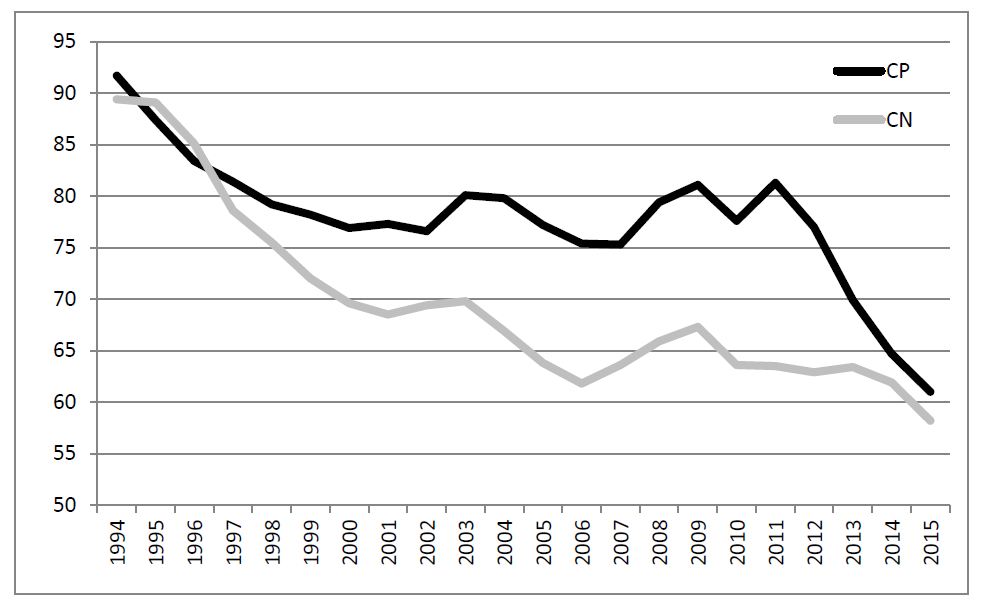
On February 6, 2012, Ackman, with Hunter S. Harrison (retired CEO of CN—direct competitor of CP and leader in efficiency among Class 1 North American railways—and his candidate for CEO of CP) by his side, made a fact-based presentation about the shortcomings and failings of the CP board and management. Harrison and Ackman stated that their goal for CP was to achieve an operating ratio of 65 for 2015 (down from 81.3 in 2011—the lower the ratio, the better the performance).

The Board qualified Harrison’s (and Ackman’s) targets of “shot in the dark”, showing a lack of research and a profound misunderstanding of CP’s reality. Relying on an independent consultant report (Oliver Wyman Group), Green mentioned that Harrison’s target for CP’s operating ratio was not achievable since CP’s network was characterized by steeper grades and greater curvature thus adding close to 6.7% to the operating ratio compared to its competitors. [2]

On April 4th 2012, Bill Ackman came out swinging in a scathing letter to CP shareholders disparaging CP’s Board of directors in general, and its CEO, Fred Green, in particular. According to Mr. Ackman, “under the direction of the Board and Mr. Green, CP’s total return to shareholders from the inception of Mr. Green’s CEO tenure to the day prior to Pershing Square’s investment was negative 18% while the other Class I North American railways delivered strong positive total returns to shareholders of 22% to 93%.” [3] Thus, according to him, “Fred Green’s and the Board’s poor decisions, ineffective leadership and inadequate stewardship have destroyed shareholder value.” [4]

A few hours before the annual meeting, CP issued a press release in which it stated that Fred Green had resigned as CEO, and that five other directors, including the Chairman of the Board, John Cleghorn, would not stand for re-election at the company’s shareholder meeting.

Pershing Square had won the proxy fight; all the nominees proposed by Ackman were elected.

Almost exactly five years after first buying shares of CP, Ackman confirmed in August 2016 that Pershing Square would sell its remaining shares of CP, thus formally exiting the “target.” Over those five years, CP has generated a compounded annualized total shareholder return of 45.39% (between September 23, 2011 and August 31, 2016), a performance well above the CN and the S&P/TSX 60 index (CP is a constituent of that index). Pershing Square pocketed an estimated $2.6 billion in profits for its venture into CP.

With massive reductions in the workforce, a transformation of the operations and a radical change of the CP’s organizational culture, CP is undoubtedly a different company from what it was before the proxy fight. In early September 2016, Bill Ackman resigned from CP’s Board, officially concluding this episode.

Lessons in corporate governance

In this day and age, the CP case teaches us that no matter its size or the nature of its business, a company is always at risk of being challenged by dissident shareholders, and most particularly by those funds which make a business of these sorts of operations, the activist hedge funds. Of course, a number of critical features of this saga can be singled out to explain the particular success of this intervention, but this is not the focal point of this post. [5] After all, a widely held company with weak financial results and a stagnating stock price will inevitably attract the attention of these funds.

But the puzzling question and it is an unresolved dilemma of corporate governance remains: how come the board did not know earlier what became apparent very quickly after the Ackman/Harrison takeover? Why would the board not call on independent experts to assess management’s claim that structural differences made it impossible for CP to achieve a performance similar to that of other railroads? The gap in operating ratio between CP and CN had not always been as wide. In fact, as shown in Figure 1, CP had a lower operating ratio than CN during a period of time in the 1990s (Of course, CN was a Crown corporation at that time). The gap eventually widened, reaching unprecedented levels during Fred Green’s tenure (the last full year of operating ratios attributable to Green was in 2011).

capture

Figure 1. Evolution of the operating ratio (%—left scale) for the CP and CN (1994-2015)

How could the board have known that performances far superior to those targeted by the CEO could be swiftly achieved?

Lurking behind these questions is the fundamental flaw of corporate governance: the asymmetry of information, of knowledge and time invested between the governors and the governed, between the board of directors and management. In CP’s case, the directors, as per the norms of “good” fiduciary governance, relied on the information provided by management, believed the plans submitted by management to be adequate and challenging, and based the executives’ lavish compensation on the achievement of these plans. The Chairman, on behalf of the Board, did “extend our appreciation to Fred Green and his management team for aggressively and successfully implementing our Multi-Year plan and creating superior value for our shareholders and customers.” [6] That form of governance is being challenged by activist investors of all stripes.

Their claim, a demonstrable one in the case of CP, is that with the massive amount of information now accessible about a publicly listed company and its competitors, it is possible for dedicated shareholders to spot poor strategies and call for drastic changes. If push comes to shove, these funds will make their case directly to other shareholders via a proxy contest for board membership.

Corporate boards of the future will have to act as “activists” in their quest for information and their ability to question strategies and performances.

The full paper is available for download here.

Endnotes

1The Board Games, The Globe & Mail’s annual review of corporate governance practices in Canada.(go back)

2Deveau, S. “CP Chief Fred Green Defends his Track Record.” Financial Post, March 27, 2012.(go back)

3Letter addressed by William Ackman to Canadian Pacific Railway shareholders, Proxy Circular from April 4th, 2012.(go back)

4Ibid.(go back)

5The case analysis identified four factors that are rarely present in other cases of activism, a fact which explains why few of these interventions achieve the level of success of the CP case.(go back)

6Cleghorn, John. Chairman’s letter to shareholders, CP’s Annual Information Form 2011.(go back)

__________________________________

*Yvan Allaire is Emeritus professor of strategy at Université du Québec à Montréal (UQAM) and Executive Chair of the Institute for Governance of Private and Public Organizations (IGOPP); François Dauphin is Director of Research of IGOPP and a lecturer at UQAM. This post is based on their recent paper.

Compte rendu hebdomadaire de la Harvard Law School Forum on Corporate Governance


Voici le compte rendu hebdomadaire du forum de la Harvard Law School sur la gouvernance corporative au 29 décembre 2016.

Bonne lecture !


harvard_forum_corpgovernance_small

  1. A “Successful” Case of Activism at the Canadian Pacific Railway: Lessons in Corporate Governance, posted by Yvan Allaire and François Dauphin, IGOPP and UQAM, on Friday, December 23, 2016
  2. U.K. Proposed Enhancements to Corporate Governance: Will the New U.S. Administration Follow?, posted by Cydney S. Posner, Cooley LLP, on Friday, December 23, 2016
  3. Delaware Supreme Court Ruling in Zynga: Reasonable Doubt of Director Independence , posted by Thomson Reuters Practical Law, Corporate & Securities Service, on Saturday, December 24, 2016
  4. Do CEO Bonus Plans Serve a Purpose?, posted by Wayne R. Guay and John D. Kepler, University of Pennsylvania, on Monday, December 26, 2016
  5. 2016 Corporate Governance Annual Summary, posted by Michael McCauley, Florida State Board of Administration, on Monday, December 26, 2016
  6. Areas of Focus for Global Audit Regulators, posted by Steven B. Harris, Public Company Accounting Oversight Board, on Tuesday, December 27, 2016
  7. Rethinking US Financial Regulation in Light of the 2016 Election, posted by Reena Agrawal Sahni, Shearman & Sterling LLP, on Tuesday, December 27, 2016
  8. 2016 Spencer Stuart Board Index, posted by Spencer Stuart, on Wednesday, December 28, 2016
  9. Results of the 2016 Proxy Season in Silicon Valley, posted by David A. Bell, Fenwick & West LLP, on Wednesday, December 28, 2016
  10. Female Directors, Board Committees and Firm Performance, posted by Colin Green and Swarnodeep Homroy, Lancaster University, on Thursday, December 29, 2016
  11. Executive Compensation: Analysis of Recent Incentive Financial Goals, posted by John R. Sinkular and Julia Kennedy, Pay Governance LLC, on Thursday, December 29, 2016

Dix stratégies pour se préparer à l’activisme accru des actionnaires


La scène de l’activisme actionnarial a drastiquement évolué au cours des vingt dernières années. Ainsi, la perception négative de l’implication des « hedge funds » dans la gouvernance des organisations a pris une tout autre couleur au fil des ans.

Les fonds institutionnels détiennent maintenant 63 % des actions des corporations publiques. Dans les années 1980, ceux-ci ne détenaient qu’environ 50 % du marché des actions.

L’engagement actif des fonds institutionnels avec d’autres groupes d’actionnaires activistes est maintenant un phénomène courant. Les entreprises doivent continuer à perfectionner leur préparation en vue d’un assaut éventuel des actionnaires activistes.

L’article de Merritt Moran* publié sur le site du Harvard Law School Forum on Corporate Governance, est d’un grand intérêt pour mieux comprendre les changements amenés par les actionnaires activistes, c’est-à-dire ceux qui s’opposent à certaines orientations stratégiques des conseils d’administration, ainsi qu’à la toute-puissance des équipes de direction des entreprises.

L’auteure présente dix activités que les entreprises doivent accomplir afin de décourager les activistes, les incitant ainsi à aller voir ailleurs !

Voici la liste des étapes à réaliser afin d’être mieux préparé à faire face à l’adversité :

  1. Préparez un plan d’action concret ;
  2. Établissez de bonnes relations avec les investisseurs institutionnels et avec les actionnaires ;
  3. La direction doit entretenir une constante communication avec le CA ;
  4. Mettez en place de solides pratiques de divulgations ;
  5. Informez et éduquez les parties prenantes ;
  6. Faites vos devoirs et analysez les menaces et les vulnérabilités susceptibles d’inviter les actionnaires activistes ;
  7. Communiquez avec les actionnaires activistes et tentez de comprendre les raisons de leurs intérêts pour le changement ;
  8. Comprenez bien tous les aspects juridiques relatifs à une cause ;
  9. Explorez les différentes options qui s’offrent à l’entreprise ciblée ;
  10. Apprenez à connaître le rôle des autorités réglementaires.


J’espère vous avoir sensibilisé à l’importance de la préparation stratégique face à d’éventuels actionnaires activistes.

Bonne lecture !


Ten Strategic Building Blocks for Shareholder Activism Preparedness


Shareholder activism is a powerful term. It conjures the image of a white knight, which is ironic because these investors were called “corporate raiders” in the 1980s. A corporate raider conjures a much different image. As much as that change in terminology may seem like semantics, it is critical to understanding how to deal with proxy fights or hostile takeovers. The way someone is described and the language used are crucial to how that person is perceived. The perception of these so-called shareholder activists has changed so dramatically that, even though most companies’ goals are still the same, the playbook for dealing with activists is different than the playbook for corporate raiders. As such, a corresponding increase in the number of activist encounters has made that playbook required reading for all public company officers and directors. In fact, there have been more than 200 campaigns at U.S. public companies with market capitalizations greater than $1 billion in the last 10 quarters alone. [1]

4858275_3_f7e0_ces-derniers-mois-le-fonds-d-investissement_eccbb6dc5ed4db8b354a34dc3b14c30fIt’s not just the terminology concerning activists that has changed, though. Technologies, trading markets and the relationships activists have with other players in public markets have changed as well. Yet, some things have not changed.

The 1980s had arbitrageurs that would often jump onto any opportunity to buy the stock of a potential target company and support the plans and proposals raiders had to “maximize shareholder value.” Inside information was a critical component of how arbs made money. Ivan Boesky is a classic example of this kind of trading activity—so much so that he spent two years in prison for insider trading, and is permanently barred from the securities business. Arbs have now been replaced by hedge funds, some of which comprise the 10,000 or so funds that are currently trying to generate alpha for their investors. While arbitrageurs typically worked inside investment banks, which were highly regulated institutions, hedge funds now are capable of operating independently and are often willing allies of the 60 to 80 full time “sophisticated” activist funds. [2] Information is just as critical today as it was in the 1980s.

Institutions now occupy a far greater percentage of total share ownership today, with institutions holding about 63% of shares outstanding of the U.S. corporate equity market. In the 1980s, institutional ownership never crossed 50% of shares outstanding. [3] Not only has this resulted in an associated increase of voting power for institutions by the same amount, but also a change in their behavior and posture toward the companies in which they invest, at least in some cases. Thirty years ago, the idea that a large institutional investor would publicly side with an activist (formerly known as a “corporate raider”) would be a rare event. Today, major institutions have frequently sided with shareholder activists, and in some cases privately issued a “Request for Activism”, or “RFA” for a portfolio company, as it has become known in the industry.

It seldom, if ever, becomes clear as to whether institutions are seeking change at a company or whether an activist fund identifies a target and then seeks institutional support for its agenda. What is clear is that in today’s form of shareholder activism, the activist no longer needs to have a large stake in the target in order to provoke and drive major changes.

For example, in 2013, ValueAct Capital held less than 1% of Microsoft’s outstanding shares. Yet, ValueAct President, G. Mason Morfit forced his way onto the board of one of the world’s largest corporations and purportedly helped force out longtime CEO Steve Ballmer. How could a relatively low-profile activist—at the time at least—affect such dramatic change? ValueAct had powerful allies, which held many more shares of Microsoft than the fund itself who were willing to flex their voting muscle, if necessary.

The challenge of shareholder activism is similar to, yet different from, that which companies faced in the 1980s. Although public markets have changed tremendously since the 1980s, market participants are still subject to the same kinds of incentives today as they were 30 years ago.

It has been said that even well performing companies, complete with a strong balance sheet, excellent management, a disciplined capital allocation record and operating performance above its peers are not immune. In our experience, this is true. When the amount of capital required to drive change, perhaps unhealthy change, is much less costly than it is to acquire a material equity position for an activist, management teams and boards of directors must navigate carefully.

Below are 10 building blocks that we believe will help position a company to better equip itself to handle the stresses and pressures from the universe of activist investors and hostile acquirers, which may encourage the activists to instead knock at the house next door.

Building Block 1: Be Prepared

Develop a written plan before the activist shows up. By the time a Schedule 13-D is filed, an activist already has the benefit of sufficient time to study a target company, develop a view of its weaknesses and build a narrative that can be used to put a management team and board of directors on the defensive. Therefore, a company’s plan must have balance and must contemplate areas that require attention and improvement. While some activists are akin to 1980s-style corporate raiders with irrational ideas designed only to bump up the stock over a very short period, there are also very sophisticated activists who are savvy and have developed constructive, helpful ideas. A company’s plan and response protocol need to be well thought through and in place before an activist appears. In some cases, the activist response plan can be built into a company’s strategic plan.

The plan needs inclusion and buy-in from the board of directors and senior management. Some subset of this group needs to be involved in developing the plan, not only substantively, but also in the tactical aspects of implementing the plan and communicating with shareholders, including activists, if and when an activist appears.

This preparatory building block extends beyond simply having a process in place to react to shareholder activism. It should complement the company’s business plan and include the charter and bylaws and consideration of traditional takeover defense strategies. It should provide for an advisory team, including lawyers, bankers, a public relations firm and a forensic accounting firm. We believe that the plan should go to a level of detail that includes which members of management and the board are authorized by the board to communicate with the activist and how those communications should occur.

Building Block 2: Promote Good Shareholder Relations with Institutions and Individual Shareholders

If the lesson of the first block was “put your own house in order,” then the second lesson is, “know your tenants, what they want, and how they prefer to live in your building.” This goes well beyond the typical investor relations function. This is where in-depth shareholder research comes into play. We recommend conducting a detailed perception study that can give boards and management teams a clear picture of what the current shareholder base wants, as well as how former and prospective shareholders’ perceptions of the company might differ from the way management and the board see the company itself.

In a takeover battle or proxy contest, facts are ammunition. Suppositions and assumptions of what management thinks shareholders want are dangerous. It is critical to understand how shareholders feel about the dividend policy and the capital allocation plans, for example. Understand how they view the executive compensation or the independence of the board. Do not assume. Ask candidly and revise periodically.

Building Block 3: Inform, Teach and Consult with the Board

Good governance is not something that can be achieved in a reactive sort of manner or when it becomes known that an activist is building a position. Without shareholder-friendly corporate governance practices, the odds of securing good shareholder relations in a contest for control drops significantly and creates the wrong optics.

There are governance issues that can cause institutional shareholders to act, or at least think, akin to activists. Recently, there have been various shareholder rebellions against excessive executive compensation packages—or say-on-pay votes. In fact, Norges, the world’s largest sovereign wealth fund, has launched a public campaign targeting what it views as excessive executive compensation. The fund’s chief executive told the Financial Times that, “We are looking at how to approach this issue in the public space.” He is speaking for an $870 billion dollar fund. The way those votes are cast can mean the difference between victory and defeat in a proxy contest.

Building Block 4: Maintain Transparent Disclosure Practices

While this building block relates to maintaining good shareholder relations, it also recognizes that activists are smart, well informed, motivated and relentless. If a company makes a mistake, and no company is perfect, the activist will likely find it. Companies have write-downs, impairments, restatements, restructurings, events of change or challenges that affect operating performance. While any one of these events may invite activist attention, once a contest for control begins, an activist will find and use every mistake the company ever made and highlight the material ones to the marketplace.

A company cannot afford surprises. One “whoops” event can be all it takes to turn the tide of a proxy vote or a hostile takeover. That is why it is critical to disclose the good and the bad news before the contest begins rather than during the takeover attempt. It may be painful at the time, but with a history of transparency, the marketplace will trust a company that tells them the activist is in it for its own personal benefit and that the proposal the activist is making will not maximize shareholder value, but will only increase the activist’s short-term profit for its investors. Developing that kind of trust and integrity over time can be a critical factor in any contest for corporate control, especially when research shows that the activist has not been transparent in its prior transactions or has misled investors prior to or after achieving its intended result.

When a company has established good corporate governance policies, has been open and transparent, has financial statements consistent with GAAP and effective internal control over financial reporting and knows its shareholder base cold, what is the next step in preparing for the challenge of an activist shareholder?

Building Block 5: Educate Third Parties

Prominent sell-side analysts and financial journalists can, and do, move markets. In a contest for corporate control, or even in a short slate proxy contest, they can be invaluable allies or intractable adversaries. As with the company’s shareholder base, one must know the key players, have established relationships and trust long before a dispute, and have the confidence that the facts are on the company’s side. But winning them over takes time and research, and is another area where an independent forensic accounting firm can be of assistance.

For example, when our client, Allergan, was fighting off a hostile bid from Valeant and Pershing Square, we identified that Valeant’s “double-digit” sales growth came from excluding discontinued products and those with declining sales from its calculation. This piece of information served as key fodder for journalists, who almost unanimously sided against Valeant for this and other reasons. Presentations, investor letters and analyst days can make the difference in creating a negative perception of the adversary and spreading a company’s message.

Building Block 6: Do Your Homework

Before an activist appears, a company needs to understand what vulnerabilities might attract an activist in the first place. This is where independent third parties can be crucial. Retained by a law firm to establish the privilege, they can do a vulnerability assessment of the company compared to its peers.

This is a different sort of assessment than what building block two entails, essentially asking shareholders to identify perceived weaknesses. Here, a company needs to look for the types of vulnerabilities that institutional shareholders might not see—but that an activist surely will. When these vulnerabilities such as accounting practices or obscure governance structures are not addressed, an activist will use them on the offensive. Even worse are the vulnerabilities that are not immediately apparent. In any activist engagement, it is best to minimize surprises as much as possible.

Building Block 7: Communicate With the Activist

Before deciding whether to communicate, know the other players.

This includes a deep dive into the activist’s history—what level of success has the activist had in the past? Have they targeted similar companies? What strategies have they used? How do they negotiate? How have other companies reacted and what successes or failures have they experienced?

If the activist commences a proxy contest or a consent solicitation, turn that intelligence apparatus on the slate of board nominees the activist is proposing. Find out about their vulnerabilities and paint the full picture of their business record. Do they know the industry? Are they responsible fiduciaries? What is their personal track record? These are important questions that investigators can help answer.

Armed with information about the activist and having consulted with management, the board has to decide whether to communicate with the activist, and if so, what the rules of the road are for doing so. What are the objectives and goals and what are the pros and cons of even starting that communication process? If a decision is made to start communications with the activist, make sure to pick the time to do so and not just respond to what the media hype might be promoting. Poison pills can provide breathing room to make these determinations.

Always keep in mind that communications can lead to discussions, which in turn can lead to negotiations, which may result in a deal.

Before reaching a settlement deal, a company must be sure to have completed the preceding due diligence. More companies seem to be choosing to appease activists by signing voting agreements and/or granting board seats. Although this will likely buy more time to deal with the activist in private, it may simply delay an undesirable outcome rather than circumvent the issue. Whether or not the company signs a voting agreement with the activist, management and the board of directors should know the activist’s track record and current activities with other companies in great detail as the initial step in considering whether to reach any accommodation with the activist.

Building Block 8: Understand the Role of Litigation

Most of the building blocks thus far have involved making a business case to the marketplace and supporting that case with candid communications. But in many activist campaigns—especially the really adversarial ones—there will come a time when the company needs to make its case to a court or a regulator or both.

As with other building blocks, litigation goes to one of the most valuable commodities in a contest for corporate control: TIME. In most situations, the more time the target has to maintain the campaign, the better. The company’s legal team needs to work with the forensic accountants to understand and identify issues that relate to the activist’s prior transactions and business activities, while ensuring that the company is not living in a glass house when it throws stones. Armed with the facts, lawyers will do the legal analysis to determine whether the activist has complied with or broken state, federal or international law or regulation. If there are causes of action, then one way to resolve them is to litigate.

Building Block 9: Factor in Contingencies and Options

Contingencies can include additional activists, M&A and small issues that can become big issues. This building block is about understanding the environment in which the company is operating.

For example, are there hedge funds targeting the same company in a “wolfpack”, as the industry has coldly nicknamed them? If two or more hedge funds are acting in concert to acquire, hold, vote or dispose of a company’s securities, they can be treated as a group triggering the requirement to file a Schedule 13-D as such. Under certain circumstances, the remedy the SEC has secured for violating Section 13(d) of the Williams Act is to sterilize the vote of the shares held by the group’s members. So, if there is evidence indicating that funds are working together which have not jointly filed a Schedule 13-D, the SEC may be able to help. Or better yet, think about building block eight and litigate.

In the case of a hostile acquisition, consider whether there is an activist already on the board of the potential acquirer? Has the activist been a board member in prior transactions? If so, what kind of fiduciary has that activist shown himself to be?

Another contingency is exploring “strategic alternatives.”

Building Block 10: Understand the Role of Regulators

Despite the passage of the Dodd-Frank Act, regulators today may be less inclined to intervene in these kinds of issues than they were 30 years ago.

When an activist is engaging in questionable or illegal practices, contacting regulators should be considered. But this requires being proactive.

The best way to approach the regulators is to present a complete package of evidence that is verified by independent third parties. Determine the facts, apply legal analysis to those facts and have conclusions that show violations of the law. Do not just show one side of the case; show both sides, the pros and the cons of a possible violation. Why? Because if the package is complete and has all the work that the regulator would want to do under the circumstances, two things will happen. First, the regulator will understand that there is an issue, a potential harm to shareholders and the public interest which the regulator is sworn to protect. Second, the regulator will save time when it presents the case for approval to act.

Using forensic accountants before and when an activist appears is one of the major factors that can assist companies today and also help the lawyers who are advising the target company. If other advisors are conflicted, the company needs a reputable, independent third party who can help the company ascertain facts on a timely basis to make informed decisions, and if the determination is made to oppose the activist, make the case to shareholders, to analysts, to media, to regulators and to the courts.

Each of these buildings blocks is important. While they have remained mostly the same since the 1980s, tactics, strategies and the marketplace have changed. Even though activists may appear to act the same way, each is different and each activist approach has its own differences from all the others.

Endnotes

1FactSet, SharkRepellent.(go back)

2FactSet, SharkRepellent.(go back)

3The Wall Street Journal, Federal Reserve and Goldman Sachs Global Investment Research.(go back)

_____________________________________________

*Merritt Moran is a Business Analyst at FTI Consulting. This post is based on an FTI publication by Ms. Moran, Jason Frankl, John Huber, and Steven Balet.

La gouvernance des CÉGEPS | Une responsabilité partagée


Nous publions ici un cinquième billet de Danielle Malboeuf* laquelle nous a soumis ses réflexions sur les grands enjeux de la gouvernance des institutions d’enseignement collégial les 23 et 27 novembre 2013, le 24 novembre 2014 et le 4 septembre 2015, à titre d’auteure invitée.

Dans un premier article, publié le 23 novembre 2013 sur ce blogue, on insistait sur l’importance, pour les CA des Cégeps, de se donner des moyens pour assurer la présence d’administrateurs compétents dont le profil correspond à celui qui est recherché. D’où les propositions adressées à la Fédération des cégeps et aux CA pour élaborer un profil de compétences et pour faire appel à la Banque d’administrateurs certifiés du Collège des administrateurs de sociétés (CAS), le cas échéant. Un autre enjeu identifié dans ce billet concernait la remise en question de l’indépendance des administrateurs internes.

Le deuxième article publié le 27 novembre 2013 abordait l’enjeu entourant l’exercice de la démocratie par différentes instances au moment du dépôt d’avis au conseil d’administration.

Le troisième article portait sur l’efficacité du rôle du président du conseil d’administration (PCA).

Le quatrième billet abordait les qualités et les caractéristiques des bons administrateurs dans le contexte du réseau collégial québécois (CÉGEP)

Dans ce cinquième billet, l’auteure réagit aux préoccupations actuelles de la ministre de l’Enseignement supérieur eu égard à la gouvernance des CÉGEPS.


La gouvernance des CÉGEPS | Une responsabilité partagée

par

Danielle Malboeuf*  


Dans les suites du rapport de la vérificatrice générale portant sur la gestion administrative des Cégeps, la ministre de l’Enseignement supérieur, madame Hélène David a demandé au ministère un plan d’action pour améliorer la gouvernance dans le réseau collégial. Voici un point de vue qui pourrait enrichir sa réflexion.

Rappelons que pour atteindre de haut standard d’excellence, les collèges doivent compter sur un conseil d’administration (CA) performant dont les membres font preuve d’engagement, de curiosité et de courage tout en possédant les qualifications suivantes : crédibles, compétents, indépendants, informés et outillés.

Considérant l’importance des décisions prises par les administrateurs, il est essentiel que ces personnes possèdent des compétences et une expertise pertinente. Parmi les bonnes pratiques en gouvernance, les CA devraient d’ailleurs élaborer un profil de compétences recherchées pour ses membres et l’utiliser au moment de la sélection des administrateurs.  Au moment de solliciter la nomination d’un administrateur externe auprès du gouvernement, ce profil devrait être fortement recommandé. Sachant que chacun des 48 CA des Collèges d’enseignement général et professionnel compte sept personnes nommées par la ministre pour un mandat de trois ans renouvelable, il est important de lui rappeler l’importance d’en tenir compte.

373bb2f

Il est également essentiel qu’elle procède à ces nominations dans les meilleurs délais. À l’heure actuelle, on constate que, dans certains cas, le délai pour nommer et remplacer des administrateurs externes peut être de plusieurs mois. Cette situation est doublement préoccupante quand plusieurs membres quittent le CA en même temps. Sachant qu’il existe une banque de candidats dûment formés par le Collège des administrateurs de sociétés et des membres de plusieurs ordres professionnels qui répondent au profil de compétences recherchées par les collèges, il serait pertinent de recruter des candidats parmi ces personnes.

De plus, pour être en présence d’administrateurs performants, il est essentiel que ces personnes soient au fait de leurs rôles et responsabilités. Des formations devraient donc leur être offertes. Toutefois, cette formation ne doit pas se limiter à leur faire connaître les obligations légales et financières qui s’appliquent au réseau collégial, mais les bonnes pratiques de gouvernance doivent également leur être enseignées. À ce sujet, il faut se réjouir du souhait formulé par madame David afin d’offrir des formations en ce sens.

Signalons aussi que les administrateurs ne devraient pas se retrouver en situation de conflit d’intérêts. Ainsi, il faut s’assurer, entre autres, que les administrateurs internes ne subissent pas de pressions des  groupes d’employés dont ils proviennent. Les  conseils d’administration des collèges comptent quatre membres du personnel qui enrichissent les échanges par leurs expériences pertinentes. La Loi sur les collèges prévoit que ces administrateurs internes sont élus par leurs pairs. Dans plusieurs collèges, le processus de sélection est confié au syndicat qui procède à l’élection de leur représentant au conseil d’administration lors d’une assemblée syndicale. Ces personnes peuvent subir des pressions surtout quand certains syndicats inscrivent dans leur statut et règlement que ces personnes doivent représenter l’assemblée syndicale et y faire rapport. D’autres collèges ont prévu des modalités qui respectent beaucoup mieux l’esprit de la loi. On confie au secrétaire général, le mandat de recevoir les candidatures et de procéder dans le cadre de processus convenu à la sélection de ces personnes. Cette dernière pratique devrait être encouragée.

Considérant les pouvoirs du CA qui agit tant sur les aspects financiers et légaux que sur les orientations du collège, il est essentiel que la direction fasse preuve de transparence et transmette aux membres toutes les informations pertinentes. Pour permettre aux administrateurs de porter des jugements adéquats et de juger de la pertinence et de l’efficacité de sa gestion, le collège doit aussi leur fournir des indicateurs. Sachant que des indicateurs sont présents dans le plan stratégique, les administrateurs devraient, donc porter une attention toute particulière à ces indicateurs, et ce, sur une base régulière.

Par ailleurs, les administrateurs ne doivent pas hésiter à poser des questions et à demander des informations additionnelles, le cas échéant. Le président du CA peut, dans ce sens, jouer un rôle essentiel. Il doit, entre autres, porter un regard critique sur les documents qui sont transmis avant les rencontres et encourager la création de sous-comités pour enrichir les réflexions. Considérant le rôle qui lui est confié dans la Loi, les présidents de CA pourraient être tentés de se limiter à jouer un rôle d’animateur de réunions, ce qui n’est pas suffisant.

En résumé, la présence de CA performant dans les Cégeps exige une évolution des pratiques et idéalement, des modifications législatives qui mettront à contribution chacun des acteurs du réseau collégial.

_______________________

*Danielle Malboeuf est consultante et formatrice en gouvernance ; elle possède une grande expérience dans la gestion des CÉGEPS et dans la gouvernance des institutions d’enseignement collégial et universitaire. Elle est CGA-CPA, MBA, ASC, Gestionnaire et administratrice retraitée du réseau collégial et consultante.

___________________________

Articles sur la gouvernance des CÉGEPS publiés sur mon blogue par l’auteure :

(1) LE RÔLE DU PRÉSIDENT DU CONSEIL D’ADMINISTRATION (PCA) | LE CAS DES CÉGEPS

(2) Les grands enjeux de la gouvernance des institutions d’enseignement collégial

(3) L’exercice de la démocratie dans la gouvernance des institutions d’enseignement collégial

(4) Caractéristiques des bons administrateurs pour le réseau collégial | Danielle Malboeuf

Enhanced by Zemanta

Six mesures pour améliorer la gouvernance des organismes publics au Québec | Yvan Allaire


Je suis tout à fait d’accord avec la teneur de l’article de l’IGOPP, publié par Yvan Allaire* intitulé « Six mesures pour améliorer la gouvernance des organismes publics au Québec», lequel dresse un état des lieux qui soulève des défis considérables pour l’amélioration de la gouvernance dans le secteur public et propose des mesures qui pourraient s’avérer utiles. Celui-ci fut a été soumis au journal Le Devoir, pour publication.

L’article soulève plusieurs arguments pour des conseils d’administration responsables, compétents, légitimes et crédibles aux yeux des ministres responsables.

Même si la Loi sur la gouvernance des sociétés d’État a mis en place certaines dispositions qui balisent adéquatement les responsabilités des C.A., celles-ci sont poreuses et n’accordent pas l’autonomie nécessaire au conseil d’administration, et à son président, pour effectuer une véritable veille sur la gestion de ces organismes.

Selon l’auteur, les ministres contournent allègrement les C.A., et ne les consultent pas. La réalité politique amène les ministres responsables à ne prendre principalement avis que du PDG ou du président du conseil : deux postes qui sont sous le contrôle et l’influence du ministère du conseil exécutif ainsi que des ministres responsables des sociétés d’État (qui ont trop souvent des mandats écourtés !).

Rappelons, en toile de fond à l’article, certaines dispositions de la loi :

– Au moins les deux tiers des membres du conseil d’administration, dont le président, doivent, de l’avis du gouvernement, se qualifier comme administrateurs indépendants.

– Le mandat des membres du conseil d’administration peut être renouvelé deux fois

– Le conseil d’administration doit constituer les comités suivants, lesquels ne doivent être composés que de membres indépendants :

1 ° un comité de gouvernance et d’éthique ;

2 ° un comité d’audit ;

3 ° un comité des ressources humaines.

– Les fonctions de président du conseil d’administration et de président-directeur général de la société ne peuvent être cumulées.

– Le ministre peut donner des directives sur l’orientation et les objectifs généraux qu’une société doit poursuivre.

– Les conseils d’administration doivent, pour l’ensemble des sociétés, être constitués à parts égales de femmes et d’hommes.

Yvan a accepté d’agir en tant qu’auteur invité dans mon blogue en gouvernance. Voici donc son article.


Six mesures pour améliorer la gouvernance des organismes publics au Québec

par Yvan Allaire*


La récente controverse à propos de la Société immobilière du Québec a fait constater derechef que, malgré des progrès certains, les espoirs investis dans une meilleure gouvernance des organismes publics se sont dissipés graduellement. Ce n’est pas tellement les crises récurrentes survenant dans des organismes ou sociétés d’État qui font problème. Ces phénomènes sont inévitables même avec une gouvernance exemplaire comme cela fut démontré à maintes reprises dans les sociétés cotées en Bourse. Non, ce qui est remarquable, c’est l’acceptation des limites inhérentes à la gouvernance dans le secteur public selon le modèle actuel.


535284-membres-conseils-administration-16-societes


En fait, propriété de l’État, les organismes publics ne jouissent pas de l’autonomie qui permettrait à leur conseil d’administration d’assumer les responsabilités essentielles qui incombent à un conseil d’administration normal : la nomination du PDG par le conseil (sauf pour la Caisse de dépôt et placement, et même pour celle-ci, la nomination du PDG par le conseil est assujettie au veto du gouvernement), l’établissement de la rémunération des dirigeants par le conseil, l’élection des membres du conseil par les « actionnaires » sur proposition du conseil, le conseil comme interlocuteur auprès des actionnaires.

Ainsi, le C.A. d’un organisme public, dépouillé des responsabilités qui donnent à un conseil sa légitimité auprès de la direction, entouré d’un appareil gouvernemental en communication constante avec le PDG, ne peut que difficilement affirmer son autorité sur la direction et décider vraiment des orientations stratégiques de l’organisme.

Pourtant, l’engouement pour la « bonne » gouvernance, inspirée par les pratiques de gouvernance mises en place dans les sociétés ouvertes cotées en Bourse, s’était vite propagé dans le secteur public. Dans un cas comme dans l’autre, la notion d’indépendance des membres du conseil a pris un caractère mythique, un véritable sine qua non de la « bonne » gouvernance. Or, à l’épreuve, on a vite constaté que l’indépendance qui compte est celle de l’esprit, ce qui ne se mesure pas, et que l’indépendance qui se mesure est sans grand intérêt et peut, en fait, s’accompagner d’une dangereuse ignorance des particularités de l’organisme à gouverner.

Ce constat des limites des conseils d’administration que font les ministres et les ministères devrait les inciter à modifier ce modèle de gouvernance, à procéder à une sélection plus serrée des membres de conseil, à prévoir une formation plus poussée des membres de C.A. sur les aspects substantifs de l’organisme dont ils doivent assumer la gouvernance.

Or, l’État manifeste plutôt une indifférence courtoise, parfois une certaine hostilité, envers les conseils et leurs membres que l’on estime ignorants des vrais enjeux et superflus pour les décisions importantes.

Évidemment, le caractère politique de ces organismes exacerbe ces tendances. Dès qu’un organisme quelconque de l’État met le gouvernement dans l’embarras pour quelque faute ou erreur, les partis d’opposition sautent sur l’occasion, et les médias aidant, le gouvernement est pressé d’agir pour que le « scandale » s’estompe, que la « crise » soit réglée au plus vite. Alors, les ministres concernés deviennent préoccupés surtout de leur contrôle sur ce qui se fait dans tous les organismes sous leur responsabilité, même si cela est au détriment d’une saine gouvernance.

Ce brutal constat fait que le gouvernement, les ministères et ministres responsables contournent les conseils d’administration, les consultent rarement, semblent considérer cette agitation de gouvernance comme une obligation juridique, un mécanisme pro-forma utile qu’en cas de blâme à partager.

Prenant en compte ces réalités qui leur semblent incontournables, les membres des conseils d’organismes publics, bénévoles pour la plupart, se concentrent alors sur les enjeux pour lesquels ils exercent encore une certaine influence, se réjouissent d’avoir cette occasion d’apprentissage et apprécient la notoriété que leur apporte dans leur milieu ce rôle d’administrateur.

Cet état des lieux, s’il est justement décrit, soulève des défis considérables pour l’amélioration de la gouvernance dans le secteur public. Les mesures suivantes pourraient s’avérer utiles :

  1. Relever considérablement la formation donnée aux membres de conseil en ce qui concerne les particularités de fonctionnement de l’organisme, ses enjeux, ses défis et critères de succès. Cette formation doit aller bien au-delà des cours en gouvernance qui sont devenus quasi-obligatoires. Sans une formation sur la substance de l’organisme, un nouveau membre de conseil devient une sorte de touriste pendant un temps assez long avant de comprendre suffisamment le caractère de l’organisation et son fonctionnement.
  2. Accorder aux conseils d’administration un rôle élargi pour la nomination du PDG de l’organisme ; par exemple, le conseil pourrait, après recherche de candidatures et évaluation de celles-ci, recommander au gouvernement deux candidats pour le choix éventuel du gouvernement. Le conseil serait également autorisé à démettre un PDG de ses fonctions, après consultation du gouvernement.
  3. De même, le gouvernement devrait élargir le bassin de candidats et candidates pour les conseils d’administration, recevoir l’avis du conseil sur le profil recherché.
  4. Une rémunération adéquate devrait être versée aux membres de conseil ; le bénévolat en ce domaine prive souvent les organismes de l’État du talent essentiel au succès de la gouvernance.
  5. Rendre publique la grille de compétences pour les membres du conseil dont doivent se doter la plupart des organismes publics ; fournir une information détaillée sur l’expérience des membres du conseil et rapprocher l’expérience/expertise de chacun de la grille de compétences établie. Cette information devrait apparaître sur le site Web de l’organisme.
  6. Au risque de trahir une incorrigible naïveté, je crois que l’on pourrait en arriver à ce que les problèmes qui surgissent inévitablement dans l’un ou l’autre organisme public soient pris en charge par le conseil d’administration et la direction de l’organisme. En d’autres mots, en réponse aux questions des partis d’opposition et des médias, le ministre responsable indique que le président du conseil de l’organisme en cause et son PDG tiendront incessamment une conférence de presse pour expliquer la situation et présenter les mesures prises pour la corriger. Si leur intervention semble insuffisante, alors le ministre prend en main le dossier et en répond devant l’opinion publique.

_______________________________________________

*Yvan Allaire, Ph. D. (MIT), MSRC Président exécutif du conseil, IGOPP Professeur émérite de stratégie, UQÀM

La planification de la relève du PDG par le CA | Une activité très négligée


Voici un article d’Eben Harrell paru dans le numéro de décembre 2016 de Harvard Business Review.

L’auteur affirme, basé sur plusieurs résultats de recherche, que les conseils d’administration ne sont pas préparés à assurer la relève du président-directeur général.

En effet, il appert que le roulement des fonctions de CEO s’accélère grandement (plus de 15 %) et que seulement la moitié des CA sont préparés à faire face aux conséquences.

On estime que 40 % des nouvelles recrues CEO ne peuvent répondre aux exigences de leurs tâches dans les 18 premiers mois !

Le remplacement d’un PDG peut prendre plusieurs mois, voire des années !

Doit-on recruter à l’interne ou recruter à l’externe ? Les recherches montrent que l’on a de plus en plus tendance à recruter les candidats à l’externe ; on parle de 20 % à 30 % du recrutement qui se fait à l’externe.

On constate que les conseils d’administration ne font pas les efforts nécessaires pour planifier la relève de leur CEO et que les coûts reliés à ces manquements sont considérables.

Bonne lecture !

Succession Planning: What the Research Says


All CEOs will inevitably leave office, yet research has long shown that most organizations are ill-prepared to replace them. In this article, we review the most salient studies of succession planning and offer context from experts on the process of picking new leaders for organizations.

Boards Aren’t Ready for Succession

Each year about 10% to 15% of corporations must appoint a new CEO, whether because of executives’ retirement, resignation, dismissal, or ill health. In 2015, in fact, turnover among global CEOs hit a 15-year high. Activist investors are increasingly forcing out leaders they deem underperforming. Yet despite these trends, most boards are unprepared to replace their chief executives. A 2010 survey by the search firm Heidrick & Struggles and the Rock Center for Corporate Governance at Stanford University revealed that only 54% of boards were grooming a specific successor, and 39% had no viable internal candidates who could immediately replace the CEO if the need arose.

0c6d26e8-bd5f-41bd-beb5-9153dfb50498_originalAn organization’s top executive is one of the few variables over which boards have total control—and their failure to plan for CEO transitions has a high cost. A study of the world’s 2,500 largest public companies shows that companies that scramble to find replacements for departing CEOs forgo an average of $1.8 billion in shareholder value. A separate study reveals that the longer it takes a company to name a new CEO during a succession crisis, the worse it subsequently performs relative to its peers. Finally, poor succession planning often extends the tenure of ineffective CEOs, who end up lingering in office long after they should have been replaced. A study by Booz & Company found that, on average, firms with stock returns in the lowest decile underperformed their industry peers by 45 percentage points over a two-year period—and yet the probability that their CEOs would be forced out was only 5.7%. The authors commented that “boards are giving underperforming CEOs more latitude than might be expected.”

Lack of preparedness is only part of the problem, however. An equal challenge, the consultant Ram Charan wrote in 2005, is that all too often, “CEOs are being replaced badly.” Boards aren’t finding the right man or woman for the job. Estimates suggest that up to 40% of new CEOs fail to meet performance expectations in the first 18 months.

Planning Takes Years, Not Months

So what can directors do not only to prepare for succession events but to ensure they make a winning pick when the time comes? A first step is to integrate executive development programs with CEO succession planning so that the best internal candidates are identified early and flagged at the board level. The proof that such an approach works can be found in companies with prestigious leadership-training programs. Researchers at Santa Clara University and Indiana University who examined the track records of chief executives groomed at “CEO factories,” such as General Electric, IBM, and Procter & Gamble, found that the stock market reacted positively when they were appointed and that they delivered superior operating performance over the next three years. The researchers concluded that certain firms “are efficient in developing leadership skills” because “they are able to expose executives to a broad variety of industries and help them develop skills that can be transferred to different business environments.”

Internal grooming of promising executives can create value beyond the avoidance of costly interregnums. In his book Succession, Noel Tichy, a management professor at the Ross School of Business at the University of Michigan, argues that by putting potential successors in charge of new projects, companies can accelerate change while also testing candidates’ suitability for the top spot. Few boards of directors seize that opportunity, however. Research by the Conference Board, the Institute of Executive Development, and the Rock Center found that most directors lack detailed knowledge of the skills, capabilities, and performance of senior executives just one level below the CEO. Only 55% of directors surveyed in the study claimed to understand the strengths and weaknesses of those executives well or very well. Seventy-seven percent did not participate in the performance evaluations of their firm’s top executives other than the CEO. And only 7% of companies formally assigned a director to mentor senior executives below the CEO.

Some commentators believe this lack of involvement is the result of CEOs’ efforts to stymie boards: The absence of clear successors keeps incumbents in the job longer and gives them more bargaining power with boards. A packed governance agenda may also be to blame. When the consulting firm Mercer Delta surveyed directors about the amount of time they spent on nine key activities, a large majority reported devoting more and more hours to monitoring accounting, risk, and financial performance and other governance duties. Directors also indicated that they spent less time interacting with potential CEO successors than on any other activity.

Michael Useem, a professor of management at the University of Pennsylvania’s Wharton School, believes a shortage of directors with experience in hiring top executives also contributes to poor succession planning. He advocates for more current and former CEOs on boards. “People who know how to hire and manage top executives will better understand what a company needs in executive talent and which of the final candidates best brings that to the table,” he says.

In his book It’s Not the How or the What but the Who, Claudio Fernández-Aráoz of the search firm Egon Zehnder lays out six succession-planning guidelines for busy directors: First, start early, ideally the moment a new CEO takes charge. Second, create strict performance metrics and a process for evaluating the CEO against them. Third, identify and develop potential successors within the firm and then benchmark them against external talent. (Useem says directors can go deep during vetting by interviewing all the direct reports of the internal front-runners.) Fourth, look externally to widen the pool of candidates, through executive search firms that don’t use contingency arrangements or charge percentage fees (which Fernández-Aráoz believes create perverse incentives). Fifth, require the board to conduct periodic emergency succession drills. And finally, put in place an extensive transition process to help with onboarding, which is especially important given that 80% of CEO appointees have never served in a chief executive role before.

Insiders Versus Outsiders?

Boards often face a binary choice: Go with an internal candidate, or recruit an executive from another company? Traditionally, internal candidates favored by boards have progressed through positions with responsibility for larger and more complex P&L centers. They might start off by managing a single product and then move into an overseas “head of country” position before returning to the main corporate office to supervise a business unit and then run an entire division. Such a tightly choreographed internal trajectory is increasingly rare in a world of job hopping and frequent executive shuffles, however. Consider that in 1988, an executive typically worked for fewer than three employers in his or her lifetime; 10 years later the average had risen to more than five.

Increasingly, CEO vacancies are being filled by external candidates. In 2013, 20% to 30% of boards chose to replace an outgoing CEO with an external hire. In contrast, just 8% to 10% of newly appointed CEOs at S&P 500 companies were outsiders during the 1970s and 1980s.

This trend toward external hires has been strongly criticized by some scholars, including Harvard Business School’s Rakesh Khurana, who argues in his book Searching for a Corporate Savior that too often boards hire charismatic outsiders even when their experience and abilities are not right for companies’ needs. He also blames high-priced executive search firms for driving up demand for external candidates and censures the business press and the investor community for helping fuel what he calls “the cult of the outsider.”

Khurana may have a point: Candidates that are headhunted from other firms are paid more than internally promoted candidates. According to the executive-compensation research firm Equilar, the median pay of CEOs who are outsiders is $3.2 million more than the median pay of insiders. Far from deserving such a premium, externally appointed CEOs seem to underperform their internally promoted counterparts over the long run. A 2010 study by Booz & Company found that insider CEOs had delivered superior market-adjusted shareholder returns in seven out of the preceding 10 years. And Gregory Nagel of Middle Tennessee State University and James Ang of Florida State University used elaborate multiple regression analyses to show that, on average, going outside the company to fill the top office was justified in just 6% of cases.

These studies might not be capturing the whole picture, however. Companies tend to look outside their own ranks for leaders when recent financial results are poor, which suggests that external hires might struggle simply because they’re walking into challenging conditions at underperforming companies. What’s more, multiple studies have concluded that the CEO’s influence on corporate performance pales in comparison with other, uncontrollable effects—which is to say, it’s very hard to ascertain if a CEO is lucky or good. Furthermore, studies indicate that outsiders who join the company three to four years before they become CEO do just as well as insiders with much more experience at the firm, a crossover category of executive that Harvard Business School’s Joseph Bower calls “inside-outside” leaders. For these and other reasons, says David Larcker, a professor at Stanford Business School, “it is difficult to conclude whether internal or external candidates are systematically better operators.”

What Are the Traits of a Great CEO?

Whether they’re searching for a successor in a firm’s internal ranks or an external pool, directors would benefit from knowing which qualities best predict success in the top job. Unfortunately, while much ink has been spilled on the topic of individual leadership, very little of it can be scientifically supported. In an influential book published in 1991, the University of San Diego’s Joseph Rost pointed out that writers had defined leadership in more than 200 ways since 1900, often with nothing but conjecture or personal experience to back up their claims. That’s slowly changing as researchers look for correlations between personal biographies and leadership success. For instance, one study found that CEOs who had previously served on the boards of large public companies seemed to outperform those without such experience. Another study found that CEOs with military backgrounds were less likely to engage in fraudulent activity. Yet another found that CEOs who spent lavishly in their personal lives were more likely to oversee corporations with loose internal financial controls. Age may also be relevant: Researchers at Mississippi State and the University of Missouri found that younger CEOs outperformed their older counterparts, even after accounting for the fact that younger CEOs were more likely to work in fast-growing industries such as technology. And charismatic CEOs seemed to outperform during periods of upheaval and uncertainty but provided no boost during more stable times.

The private equity industry, which has vast experience hiring CEOs, may also offer some clues about what qualities make for strong CEOs. A recent survey of managing partners at 32 firms found that when choosing a chief executive, they paid less attention to attributes such as track record and industry experience and gave more weight to softer skills such as team building and resilience. But the PEs valued urgency much more highly than empathy—a finding more in keeping with a separate assessment of CEO personalities at venture-backed and private-equity-owned corporations, which suggested that attributes having to do with execution (such as speed, aggressiveness, persistence, work ethic, and high standards) were more predictive of strong performance than interpersonal strengths (such as listening skills, teamwork, integrity, and openness to criticism).

While intriguing, the attempt to find the traits of the ideal CEO-in-waiting is still in its infancy. No one has yet disproved the view of legendary management scholar Peter Drucker, who wrote that successful executives “differ widely in their personalities, strengths, weaknesses, values, and beliefs. All they have in common is that they get the right things done.” While we may be a long way from building a predictive algorithm that can identify the perfect CEO successor, researchers have shown that there still remains a great deal more that boards could do to improve their succession planning—starting (in many cases) with having a plan in the first place.

Le point sur la gouvernance au Canada en 2016 | Rapport de Davies Ward Phillips Vineberg


Le rapport annuel de Davies est toujours très attendu car il brosse un tableau très complet de l’évolution de la gouvernance au Canada durant la dernière année.

Le document qui vient de sortir est en anglais mais la version française devrait suivre dans peu de temps.

Je vous invite donc à en prendre connaissance en lisant le court résumé ci-dessous et, si vous voulez en savoir plus sur les thèmes abordés, vous pouvez télécharger le document de 100 pages sur le site de l’entreprise.

Cliquez sur le lien ci-dessous. Bonne lecture !

Rapport de Davies sur la gouvernance 2016


Davies Governance Insights 2016, provides analysis of the top governance trends and issues important to Canadian boards, senior management and governance observers.

insights_governance_2016_fr_thumbnail

The 2016 edition provides readers with our take on important topics ranging from shareholder engagement and activism to leadership diversity and the rise in issues facing boards and general counsel. We also provide practical guidance for boards and senior management of public companies and their investors on these and many other corporate governance topics that we expect will remain under focus in the 2017 proxy season.


Deux livres phares sur la gouvernance d’entreprise


On me demande souvent de proposer un livre qui fait le tour de la question eu égard à ce qui est connu comme statistiquement valide sur les relations entre la gouvernance et le succès des organisations (i.e. la performance financière !)

Le volume publié par David F. Larcker et Brian Tayan, professeurs au Graduate School de l’Université Stanford, en est à sa deuxième édition et il donne l’heure juste sur l’efficacité des principes de gouvernance.

Je vous recommande donc vivement ce volume.

Également, je profite de l’occasion pour vous indiquer que je viens de recevoir la dernière version  des Principes de gouvernance d’entreprise du G20 et de l’OCDE en français et j’ai suggéré au Collège des administrateurs de sociétés (CAS) d’inclure cette publication dans la section Nouveauté du site du CAS.

Il s’agit d’une publication très attendue dans le monde de la gouvernance. La documentation des organismes internationaux est toujours d’abord publiée en anglais. Ce document en français de l’OCDE sur les principes de gouvernance est la bienvenue !

Voici une brève présentation du volume de Larcker. Bonne lecture !

This is the most comprehensive and up-to-date reference for implementing and sustaining superior corporate governance. Stanford corporate governance experts David Larcker and Bryan Tayan carefully synthesize current academic and professional research, summarizing what is known and unknown, and where the evidence remains inconclusive.

Corporate Governance Matters, Second Edition reviews the field’s newest research on issues including compensation, CEO labor markets, board structure, succession, risk, international governance, reporting, audit, institutional and activist investors, governance ratings, and much more. Larcker and Tayan offer models and frameworks demonstrating how the components of governance fit together, with updated examples and scenarios illustrating key points. Throughout, their balanced approach is focused strictly on two goals: to “get the story straight,” and to provide useful tools for making better, more informed decisions.

Book cover: Corporate Governance Matters, 2nd edition

This edition presents new or expanded coverage of key issues ranging from risk management and shareholder activism to alternative corporate governance structures. It also adds new examples, scenarios, and classroom elements, making this text even more useful in academic settings. For all directors, business leaders, public policymakers, investors, stakeholders, and MBA faculty and students concerned with effective corporate governance.

Selected Editorial Reviews

An outstanding work of unique breadth and depth providing practical advice supported by detailed research.
Alan Crain, Jr., Senior Vice President and General Counsel, Baker Hughes
Extensively researched, with highly relevant insights, this book serves as an ideal and practical reference for corporate executives and students of business administration.
Narayana N.R. Murthy, Infosys Technologies
Corporate Governance Matters is a comprehensive, objective, and insightful analysis of academic and professional research on corporate governance.
Professor Katherine Schipper, Duke University, and former member of the Financial Accounting Standards Board

Les grandes sociétés sont plus résistantes que l’on est porté à le croire !


Voici un excellent article partagé par Paul Michaud, ASC, et publié dans The Economist.

Il y a plusieurs pratiques du management et de la gouvernance à revoir à l’âge des grandes entreprises internationales qui se démarquent par l’excellence de leur modèle d’acquisiteur, de consolidateur et de synergiste.

Incumbents have always had a tendency to grow fat and complacent. In an era of technological disruption, that can be lethal. New technology allows companies to come from nowhere (as Nokia once did) and turn entire markets upside down. Challengers can achieve scale faster than ever before. According to Bain, a consultancy, successful new companies reach Fortune 500 scale more than twice as fast as they did two decades ago. They can also take on incumbents in completely new ways: Airbnb is competing with the big hotel chains without buying a single hotel.

Vous trouverez, ci-dessous un bref extrait de cet article que je vous encourage à lire.

The new Methuselahs


IN SEPTEMBER 2009 Fast Company magazine published a long article entitled “Nokia rocks the world”. The Finnish company was the world’s biggest mobile-phone maker, accounting for 40% of the global market and serving 1.1 billion users in 150 countries, the article pointed out. It had big plans to expand into other areas such as digital transactions, music and entertainment. “We will quickly become the world’s biggest entertainment media network,” a Nokia vice-president told the magazine.

20160917_srd004

It did not quite work out that way. Apple was already beginning to eat into Nokia’s market with its smartphones. Nokia’s digital dreams came to nothing. The company has become a shadow of its former self. Having sold its mobile-phone business to Microsoft, it now makes telecoms network Equipment.

There are plenty of examples of corporate heroes becoming zeros: think of BlackBerry, Blockbuster, Borders and Barings, to name just four that begin with a “b”. McKinsey notes that the average company’s tenure on the S&P 500 list has fallen from 61 years in 1958 to just 18 in 2011, and predicts that 75% of current S&P 500 companies will have disappeared by 2027. Ram Charan, a consultant, argues that the balance of power has shifted from defenders to attackers.

Incumbents have always had a tendency to grow fat and complacent. In an era of technological disruption, that can be lethal. New technology allows companies to come from nowhere (as Nokia once did) and turn entire markets upside down. Challengers can achieve scale faster than ever before. According to Bain, a consultancy, successful new companies reach Fortune 500 scale more than twice as fast as they did two decades ago. They can also take on incumbents in completely new ways: Airbnb is competing with the big hotel chains without buying a single hotel.

Next in line for disruption, some say, are financial services and the car industry. Anthony Jenkins, a former chief executive of Barclays, a bank, worries that banking is about to experience an “Uber moment”. Elon Musk, a founder of Tesla Motors, hopes to dismember the car industry (as well as colonise Mars).

It is perfectly possible that the consolidation described so far in this special report will prove temporary. But two things argue against it. First, a high degree of churn is compatible with winner-takes-most markets. Nokia and Motorola have been replaced by even bigger companies, not dozens of small ones. Venture capitalists are betting on continued consolidation, increasingly focusing on a handful of big companies such as Tesla. Sand Hill Road, the home of Silicon Valley’s venture capitalists, echoes with talk of “decacorns” and “hyperscaling”.

Second, today’s tech giants have a good chance of making it into old age. They have built a formidable array of defences against their rivals. Most obviously, they are making products that complement each other. Apple’s customers usually buy an entire suite of its gadgets because they are designed to work together. The tech giants are also continuously buying up smaller companies. In 2012 Facebook acquired Instagram for $1 billion, which works out at $30 for each of the service’s 33m users. In 2014 Facebook bought WhatsApp for $22 billion, or $49 for each of the 450m users. This year Microsoft spent $26.2 billion on LinkedIn, or $60.5 for each of the 433m users. Companies that a decade ago might have gone public, such as Nest, a company that makes remote-control gadgets for the home, and Waze, a mapping service, are now being gobbled up by established giants.

…..

Les CEO adoptent une vision à long terme, mais ils doivent souvent rechercher des objectifs à court terme pour y arriver !


Cet article récemment publié par Richard T. Thakor*, dans le Harvard Law School Forum on Corporate Governance, aborde une problématique très singulière des projets organisationnels de nature stratégique.

L’auteur tente de prouver que même si les CEO ont généralement une vision à long terme de l’organisation, ils doivent adopter des positions qui s’apparentent à des comportements courtermistes pour pouvoir évoluer avec succès dans le monde des affaires. Ainsi, l’auteur insiste sur l’efficacité de certaines actions à court terme lorsque la situation l’exige pour garantir l’avenir à long terme.

Aujourd’hui, le courtermisme a mauvaise presse, mais il faut bien se rendre à l’évidence que c’est très souvent l’approche poursuivie…

L’étude montre qu’il existe deux situations susceptibles d’exister dans toute entreprise :

  1. il y a des circonstances qui amènent les propriétaires à choisir des projets à court terme, même si ceux-ci auraient plus de valeur s’ils étaient effectués avec une vision à long terme. L’auteur insiste pour avancer qu’il y a certaines situations qui retiennent l’attention des propriétaires pour des projets à long terme.
  2. ce sont les gestionnaires détestent les projets à court terme, même si les propriétaires les favorisent. Pour les gestionnaires, ils ne voient pas d’avantages à faire carrière dans un contexte de court terme.

L’auteur donne des exemples de situations qui favorisent l’une ou l’autre approche. Ou les deux !

Bonne lecture. Vos commentaires sont les bienvenus.


A Theory of Efficient Short-Termism


court_terme_long_425


In the area of corporate investment policy and governance, one of the most widely-studied topics is corporate “short-termism” or “investment myopia”, which is the practice of preferring lower-valued short-term projects over higher-valued long-term projects. It is widely asserted that short-termism is responsible for numerous ills, including excessive risk-taking and underinvestment in R&D, and that it may even represent a danger to capital quiism itself. Yet, short-termism continues to be widely practiced, exhibits little correlation with firm performance, and does not appear to be used only by incompetent or unsophisticated managers (e.g. Graham and Harvey (2001)). In A Theory of Efficient Short-termism, I challenge the notion that short-termism is inherently a misguided practice that is pursued only by self-serving managers or is the outcome of a desire to cater to short-horizon investors, and theoretically ask whether there are circumstances in which it is economically efficient.

I highlight two main findings related to this question. First, there are circumstances in which the owners of the firm prefer short-term projects, even though long-term projects may have higher values. There are other circumstances in which the firm’s owners prefer long-term projects. Moreover, this is independent of any stock market inefficiencies or pressures. Second, it is the managers with career concerns who dislike short-term projects, even when the firm’s owners prefer them.

These results are derived in the context of a model of internal governance and project choice, with a CEO who must approve projects that are proposed by a manager. The projects are of variable quality—they can be good (positive NPV) projects or bad (negative NPV) projects. The manager knows project quality, but the CEO does not. Regardless of quality, the project can be (observably) chosen to be short-term or long-term, and a long-term project has higher intrinsic value. The probability of success for any good project depends on managerial ability, which is ex ante unknown to everybody.

In this setting, the manager has an incentive to propose only long-term projects, because shorter projects carry with them a risk of revealing negative information about the manager’s ability in the interim. Put differently, by investing in a short-term project that reveals early information about managerial ability, the manager gives the firm (top management) the option of whether to give him a second-period project with managerial private benefits linked to it, whereas with the long-term project the manager keeps this option for himself. The option has value to the firm and to the manager. Thus, the manager prefers to retain the option rather than surrendering it to the firm.

The CEO recognizes the manager’s incentive, and may thus impose a requirement that any project that is funded in the first period must be a short-term project. This makes investing in a bad project in the first period more costly for the manager because adverse information is more likely to be revealed early about the project and hence about managerial ability. The manager’s response may be to not request first-period funding if he has only a bad project. Such short-termism generates another benefit to the firm in that it speeds up learning about the manager’s a priori unknown ability, permitting the firm to condition its second-period investment on this learning.

There are a number of implications of the analysis. First, not all firms will practice short-termism. For example, firms for which the value of long-term projects is much higher than that of short-term projects—such as some R&D-intensive firms—will prefer long-term projects, so not all firms will display short-termism. Second, since short-termism is intended to prevent lower-level managers from investing in bad projects, its use should be greater for managers who typically propose “routine” projects and less for top managers (like the CEO) who would typically be involved in more strategic projects. Related to this, since it is more difficult to ascertain an individual employee’s impact on a project’s payoffs at lower levels of the hierarchy, this suggests that the firm is more likely to impose a short-termism constraint on lower-level managers. Third, the analysis may be particularly germane for managers who care about how their ability is perceived prior to the realization of project payoffs. As an example of this, it is not uncommon for a manager to enter a job with the intention or expectation of finding a new job within a few years. The analysis then suggests that the manager would rather not jeopardize future employment opportunities by allowing (potentially risky) project outcomes to be revealed in the short-term, instead preferring that those outcomes be revealed at a time when the manager need not be concerned about the result (i.e. in a different job).

Overall, the most robust result from this analysis is that informational frictions may bias the investment horizons of firms, and that the bias towards short-termism may, in fact, be value-maximizing in the presence of such frictions. This means that castigating short-termism as well as the rush to regulate CEO compensation to reduce its emphasis on the short term may be worth re-examining. Indeed, not engaging in short-termism may signal an inability or unwillingness on the CEO’s part to resolve intrafirm agency problems and thus adversely affect the firm’s stock price. This is not to suggest that short-termism is necessarily always a value-maximizing practice, since some of it may be undertaken only to boost the firm’s stock price. The point of this paper is simply that some short-termism reduces agency costs and benefits the shareholders.

For example, the project horizon for a beer brewery is typically 15-20 years. Similarly, R&D investments by drug companies have payoff horizons typically exceeding 10 years.

The paper is available for download here.

References

Graham, John R., and Campbell R. Harvey, 2001, “The Theory and Practice of Corporate Finance: Evidence from the Field”. Journal of Financial Economics, 60 (2-3), 187-243.

This is in line with Roe (2015), who states: “Critics need to acknowledge that short-term thinking often makes sense for U.S. businesses, the economy and long-term employment … it makes no sense for brick-and-mortar retailers, say, to invest in long-term in new stores if their sector is likely to have no future because it will soon become a channel for Internet selling.”

One can think about the long-term and short-term projects concretely through examples. Within each firm, there are typically both short-term and long-term projects. For example, for an appliance manufacturer, investing in modifying some feature of an existing appliance, say the size of the freezer section in a refrigerator, would be a short-term project. By contrast, building a plant to make an entirely new product—say a high-technology blender that does not exist in the company’s existing product portfolio—would be a long-term project. The long-term project will have a longer gestation period, with not only a longer time to recover the initial investment through project cash flows, but also a longer time to resolve the uncertainty about whether the project has positive NPV in an ex post sense. There may also be industry differences that determine project duration. For example, long-distance telecom companies (e.g. AT&T) will typically have long-duration projects, whereas consumer electronics firms will have short-duration projects.


*Richard T. Thakor, Assistant Professor of Finance at the University of Minnesota Carlson School of Management.

Assurer une efficacité supérieure du conseil d’administration


Aujourd’hui, je cède la parole à Johanne Bouchard* qui agit, de nouveau, à titre d’auteure invitée sur mon blogue en gouvernance.

Celle-ci a une solide expérience d’interventions de consultation auprès de conseils d’administration de sociétés américaines ainsi que d’accompagnements auprès de hauts dirigeants de sociétés publiques (cotées), d’organismes à but non lucratif (OBNL) et d’entreprises en démarrage.

Dans cet article publié dans la revue Ethical Boardroom, Achieving higher board effectiveness, elle aborde un sujet qui lui tient particulièrement à cœur : Assurer une efficacité supérieure du conseil d’administration.

L’auteure insiste sur les points suivants :

  1. Le suivi des réunions du CA par le président du conseil
  2. L’intégration des nouveaux membres du conseil
  3. La formation en gouvernance et l’apprentissage des rouages de l’entreprise
  4. Les sessions de planification stratégique
  5. L’évaluation du leadership du CEO, du conseil et du management

L’expérience de Johanne Bouchard auprès d’entreprises cotées en bourse est soutenue ; elle en tire des enseignements utiles pour tous les types de conseils d’administration.

Bonne lecture ! Vos commentaires sont toujours les bienvenus.


Achieving higher board effectiveness


eb_achieving_higher_1000-230x300

« Achieving higher board effectiveness goes well beyond adhering to rules, regulations, legal and ethical compliance. While there are many experts who address the regulatory requirements, an aspect that requires the utmost attention, and is often underestimated and even ignored, is the human element »

That is the basic and subtle dynamics and the complexities inherent in having individuals with diverse experience, different views and perspective, and varied cultural and personal backgrounds gathering a few times a year to serve an entity to which they are not privy on a day-to-day basis. It’s further complicated by the fact that these individuals often don’t know each other outside of their board service.

How can a board maintain its independence, make critical decisions, provide valuable and timely insights to management and be effective as a group of individuals if they have minimal access to the ins and outs of an organisation? How can they truly assess the leadership potential of the CEO, the board and management and effectively minimise vulnerabilities and risk when they’re outsiders?

There are initiatives that a board should commit to that can heighten the potential of every director within the context of their roles and responsibilities, allowing them collectively to achieve higher effectiveness. It is fundamentally critical to the board’s ability to stay current, effective and focussed in enhancing long-term shareholder value.

These initiatives include: board meeting follow-ups with the chair and the CEO; on-boarding and integration of new directors; educational sessions; strategic planning sessions; and CEO, board and management leadership effectiveness assessments.

Board meeting follow-ups with the chair and CEO

Whenever directors come together to meet to fulfill their roles and responsibilities, the chair and the CEO can’t assume that the directors have felt that they’ve made their optimal contributions; that they didn’t feel intimidated or even shy to share their insights. That they felt at ease with the dynamics of the meeting, were satisfied with the results of the board meeting and were comfortable with the way the chair led the meeting and the CEO interacted as an executive director. It is important for a chair and for the CEO to take the initiative of reaching out to all directors immediately after the meeting to do a simple check-in.

This provides an opportunity to gain input about the meeting’s outcomes as well as following up with each director on a one-on-one basis to seek their views about the meeting. It’s an opportunity to constructively share their expectations about the director for that meeting and his/her level of preparedness for that meeting and any committee duties, rather than not addressing it or postponing it to an annual board effectiveness assessment. The individual directors’ effectiveness (including the CEO) as well as the chair’s, are too important not to be handled after each meeting. These check-ins are significant to ensure that the possible ‘elephants in the boardroom’ are promptly addressed. They also enable each director and the chair, and each director and the CEO to get to know each other better.

In any relationship, it is important to have the ability to readily share what works, what is missing and what could have been done better. It takes time and, from my experiences with boards, it makes a great difference when every director is prepared to allocate time between meetings to evaluate the prior meeting before attending the next one. These frank exchanges benefit the chair in preparing the agenda for the next meeting and in leading the board meeting itself. Furthermore, it is also the chair’s responsibility to poll each director, in person or over the phone, to get a pulse about his/her ability to stay abreast of the strategy.

On-boarding and integration

It is tempting to let a director join a board and attend his/her first meeting without proper on-boarding. A board can’t afford for a new director to join for his/her first board meeting without a formal on-boarding process. A director is a human being who is being asked to participate, not to simply fill in a seat. A formal on-boarding can include a meeting with the chair and the CEO shortly after the director has been voted in by the board to formally welcome him/her, confirm their expectations and his/her expectations in having joined the board; bring the director up to date with any crisis, strategic priorities and networking opportunities where he/she could specifically provide insights; and to update the director about board governance processes the directors need to understand.

It is good business, tactful and sensible to acknowledge the need to create a proper introduction of the board and the organisation for all new directors as well as introducing and integrating the incoming directors within the board integration event can last 30 minutes to an hour and is planned and professionally facilitated, thus ensuring that the board doesn’t create a climate of ‘us and them’ as the board augments and/or is refreshed. Proper on-boarding and integration enables new directors to quickly get to know the rest of the board and enables all board directors to further connect, respect and trust each other. While a brief session, it is very powerful to welcoming an incoming director and to further integrating all existing directors within the board.

Educational sessions

Our business ecosystem is becoming more complex and is being intermittently disrupted. A board can’t afford not to be current on the trends that can affect their organisation, even if, at a glance, the trend might not appear to have any potential impact on their strategic roadmap. It is important for a CEO with his/her chair to be on top of trends and to identify specific topics that need to be addressed internally at a high level to keep the board informed as a group – but not necessarily within the scheduled meeting, due to time constraints.

I have written in the past about ‘the four pillars’ that make a great relationship between a chair and a CEO. One of the pillars is communication. It is crucial for the chair and CEO to take the time to speak in person, or at least on the phone, or remotely via video-conferencing tools to check in about their relationship, their effectiveness in their respective roles and to ensure that together they address how to keep the board current about market and industry dynamics. Topics can include how the digital economy is impacting the organisation; the cybersecurity evolution and its associated threats; new strategic considerations for the organisation, vis-à-vis corporate social responsibility; shifting the organisation’s focus from shareholders to stakeholders; making an organisational commitment to sustainability, etc.

There is a plethora of topics that a board must address and can’t realistically address within their formal meetings. This creates an opportunity for the board to further align on strategic priorities, to further ascertain how vulnerable the composition of its board may or may not be and whether the board composition needs to be refreshed or augmented. Industry and expert speakers can be invited to present and conduct small roundtables at these educational sessions.

Strategic planning sessions

Since the National Association of Corporate Directors (NACD) in the United States stipulates that boards have the responsibility to engage in the development and amendment of strategy, it is imperative for boards to participate in an annual strategic planning session – in addition to each director staying current about the industry trends. Not only are strategic planning sessions important to aligning the board on strategy, but they also contribute to evaluating human behaviour dynamics and assessing the entire leadership potential of the board.

Directors must be and stay fully informed about the organisation they serve. In particular, when directors are independent, they must have knowledge of the industry and about the business they commit to serve, given that they are not connected to the business, meeting only four-to-six times a year. Better aligned boards can be more effective in assessing the accuracy, completeness, relevance and validity of information presented to them.

A board has an opportunity to really see in action the effectiveness of their CEO when participating in the annual strategic planning session. Likewise, a CEO gets the same opportunity to experience first-hand the agility of its board during such sessions.

The chair (and CEO) should commit to an annual strategic planning session. This initiative ensures that:

■ Board effectiveness is not affected by information asymmetry that would impede its ability to adequately provide guidance, make decisions and constructively challenge the executive team. The board must be continually informed about industry dynamics, the competitive landscape, the organisation’s business model, its value proposition and its strategic milestones. It is unrealistic that a board can approve financial projections, detect overly ambitious production targets and ascertain budgets and profitability objectives without a clear understanding of strategy and key strategic performance indicators

■ The board is exposed to organisational dynamics and to the dynamics of the CEO with selected or most key executive members, which will assist with its identifying warning flags about the company’s strategic priorities and help reconsider performance indicators as needed

A board has an opportunity to really see in action the effectiveness of their CEO when participating in the annual strategic planning session. Likewise, a CEO gets the same opportunity to experience first-hand the agility of its board during such sessions.

The adoption of strategic planning enables the CEO to share more openly among themselves, with the CEO and with management. I have often seen as a result of these sessions healthier effectiveness within the entire Pivotal Leadership Trio (Board, CEO and Executive Team).

CEO, board and management leadership effectiveness assessment

The effectiveness of a board is highly dependent on having the right leader for the organisation during major and critical strategic inflection points of the organisation, having the right leader of the board with the optimal board composition, and the right leadership in all functional areas of the organisation.

A board needs to know when the CEO can’t step up to leadership and organisational challenges, as well as when any board director or member of the management team can’t fulfil their role.

CEO leadership effectiveness assessment

For the board to adequately fulfil its duty of addressing CEO succession, it has a responsibility to evaluate the CEO’s leadership effectiveness. A board can’t assume that the CEO has the skill set, experience and leadership maturity to lead the organisation through different stages of growth, crisis and changes.

This initiative should be conducted by an objective third party. The process should include:

■ A custom and comprehensive inquiry, specifically created to evaluate the CEO of the organisation that the board serves

■ A custom inquiry to address the CEO’s role as an executive director on the board

■ In-person meetings conducted between the CEO and a third-party professional, and between each direct report to the CEO and the third-party professional and each director of the board and the third-party professional

■ Presentation of the CEO’s leadership effectiveness results to the CEO and the chair before being presented to the board as a group

Board and management leadership effectiveness assessments

The evaluation of the directors and the management team also needs to be conducted annually to appropriately support overall succession planning. These should ideally be conducted at the same time as the CEO’s to maximise everyone’s time. For the board assessments, the process should include:

■ A custom and comprehensive inquiry, specifically created to evaluate the board thoroughly

■ In-person meetings between directors and the third-party professional

■ Custom inquiries to capture the insights of the CFO, the CHRO and the general counsel

■ In-person individual meetings between the CFO, the CHRO, the general counsel and the third-party professional

■ Presentation of the board leadership assessment results to the chair and the governance chair before they’re presented to the board as a group

A similar process needs to be adopted for the management team.

It is good practice for the board assessment inquiry to include a director self-assessment, a peer review and an examination of the governance practices.

Leadership effectiveness assessments are natural processes and need to be positioned as such and should not be threatening.

Achieving higher board effectiveness has to be intentional by all directors, individually and collectively as a board, beyond check lists and formal systematic processes. Without a conscious intention, a board will not raise the bar of its effectiveness to the level where it can and should operate. While maintaining independence, the board has to be cognisant of the importance of not assuming anything at any time, not overlooking the need to coalesce on priorities, calibrating and stepping back afresh each time it works together, being in alignment on strategic priorities and refreshing leadership as needed.

Directors can’t afford to underestimate the cultural and values tone they are establishing with their CEO. The board has to pause and ask itself every time it gathers if it is as effective as it should be.

_________________________________________

*Johanne Bouchard est consultante auprès de conseils d’administration, de chefs de la direction et de comités de direction. Johanne a développé une expertise au niveau de la dynamique et de la composition de conseils d’administration. Après l’obtention de son diplôme d’ingénieure en informatique, sa carrière l’a menée à œuvrer dans tous les domaines du secteur de la technologie, du marketing et de la stratégie à l’échelle mondiale.

L’efficacité du rôle du président du conseil


Nous publions ici un quatrième billet de Danielle Malboeuf* laquelle nous a soumis ses réflexions sur les grands enjeux de la gouvernance des institutions d’enseignement collégial les 23 et 27 novembre 2013, à titre d’auteure invitée.

Dans un premier billet, publié le 23 novembre 2013 sur ce blogue, on insistait sur l’importance, pour les CA des Cégep, de se donner des moyens pour assurer la présence d’administrateurs compétents dont le profil correspond à celui recherché.

D’où les propositions adressées à la Fédération des cégeps et aux CA pour préciser un profil de compétences et pour faire appel à la Banque d’administrateurs certifiés du Collège des administrateurs de sociétés (CAS), le cas échéant. Un autre enjeu identifié dans ce billet concernait la remise en question de l’indépendance des administrateurs internes.

Le deuxième billet publié le 27 novembre 2013 abordait l’enjeu entourant l’exercice de la démocratie par différentes instances au moment du dépôt d’avis au conseil d’administration.

Le troisième billet portait sur l’efficacité du rôle du président du conseil d’administration (PCA).

Ce quatrième billet est une mise à jour de son dernier article portant sur le rôle du président de conseil.

Voici donc l’article en question, reproduit ici avec la permission de l’auteure.

Vos commentaires sont appréciés. Bonne lecture.

________________________________________


LE RÔLE DU PRÉSIDENT DU CONSEIL D’ADMINISTRATION | LE CAS DES INSTITUTIONS D’ENSEIGNEMENT COLLÉGIAL 

par Danielle Malboeuf*  


Il y a deux ans, je publiais un article sur le rôle du président du conseil d’administration (CA) [1]. J’y rappelais le rôle crucial et déterminant du président du CA et j’y précisais, entre autres, les compétences recherchées chez cette personne et l’enrichissement attendu de son rôle.

Depuis, on peut se réjouir de constater qu’un nombre de plus en plus élevé de présidents s’engagent dans de nouvelles pratiques qui améliorent la gouvernance des institutions collégiales. Ils ne se limitent plus à jouer un rôle d’animateurs de réunions, comme on pouvait le constater dans le passé.

president-du-conseil-dadministration

Notons, entre autres, que les présidents visent de plus en plus à bien s’entourer, en recherchant des personnes compétentes comme administrateurs. D’ailleurs, à cet égard, les collèges vivent une situation préoccupante. La Loi sur les collèges d’enseignement général et professionnel prévoit que le ministre [2] nomme les administrateurs externes. Ainsi, en plus de connaître des délais importants pour la nomination de nouveaux administrateurs, les collèges ont peu d’influence sur leur choix.

Présentement, les présidents et les directions générales cherchent donc à l’encadrer. Ils peuvent s’inspirer, à cet égard, des démarches initiées par d’autres organisations publiques en établissant, entre autres, un profil de compétences recherchées qu’ils transmettent au ministre. Ils peuvent ainsi tenter d’obtenir une complémentarité d’expertise dans le groupe d’administrateurs.

Une fois les administrateurs nommés, les présidents doivent se préoccuper d’assurer leur formation continue pour développer les compétences recherchées. Ils se donnent ainsi l’assurance que ces personnes comprennent bien leur rôle et leurs responsabilités et qu’elles sont outillées pour remplir le mandat qui leur est confié. De plus, ils doivent s’assurer que les administrateurs connaissent bien l’organisation, qu’ils adhèrent à sa mission et qu’ils partagent les valeurs institutionnelles. En présence d’administrateurs compétents, éclairés, et dont l’expertise est reconnue, il est plus facile d’assurer la légitimité et la crédibilité du CA et de ses décisions.

Un président performant démontrera aussi de grandes qualités de leadership. Il fera connaître à toutes les instances du milieu le mandat confié au CA. Il travaillera à mettre en place un climat de confiance au sein du CA et avec les gestionnaires de l’organisation. Il  cherchera à exploiter l’ensemble des compétences et à faire jouer au CA un rôle qui va au-delà de celui de fiduciaire, soit celui de contribuer significativement à la mission première du cégep : donner une formation pertinente et de qualité où l’étudiant et sa réussite éducative sont au cœur des préoccupations.

Plusieurs ont déjà fait le virage… c’est encourageant ! Les approches préconisées par l’Institut sur la gouvernance des organismes publics et privés (IGOPP) et le Collège des administrateurs de sociétés (CAS) puis reprises dans la loi sur la gouvernance des sociétés d’État ne sont sûrement pas étrangères à cette évolution. En fournissant aux présidents de CA le soutien, la formation et les outils appropriés pour améliorer leur gouvernance, le Centre collégial des services regroupés (CCSR) [3] contribue à assurer le développement des institutions collégiales dans un contexte de saine gestion.

Un CA performant est guidé par un président compétent.


[1] https://jacquesgrisegouvernance.com/2014/01/24/le-role-du-president-du-conseil-dadministration-pca-le-cas-des-cegep/

[2] Ministre de l’Enseignement supérieur, de la Recherche, de la Science et de la Technologie

[3] Formation développée en partenariat avec l’Institut sur la gouvernance des organisations privées et publiques (IGOPP)

_______________________________

*Danielle Malboeuf est consultante et formatrice en gouvernance ; elle possède une grande expérience dans la gestion des CEGEP et dans la gouvernance des institutions d’enseignement collégial et universitaire. Elle est CGA-CPA, MBA, ASC, Gestionnaire et administratrice retraité du réseau collégial et consultante.


Articles sur la gouvernance des CEGEP

(1) Les grands enjeux de la gouvernance des institutions d’enseignement collégiaux

(2) L’exercice de la démocratie dans la gouvernance des institutions d’enseignement collégiaux

(3) LE RÔLE DU PRÉSIDENT DU CONSEIL D’ADMINISTRATION (PCA) | LE CAS DES CÉGEP

Enhanced by Zemanta

Dix thèmes majeurs pour les administrateurs en 2016 | Harvard Law School Forum on Corporate Governance


Vous trouverez, ci-dessous, les dix thèmes les plus importants pour les administrateurs de sociétés selon Kerry E. Berchem, associé du groupe de pratiques corporatives à la firme Akin Gump Strauss Hauer & Feld LLP. Cet article est paru aujourd’hui sur le blogue le Harvard Law School Forum on Corporate Governance.

Bien qu’il y ait peu de changements dans l’ensemble des priorités cette année, on peut quand même noter :

(1) l’accent crucial accordé au long terme ;

(2) Une bonne gestion des relations avec les actionnaires dans la foulée du nombre croissant d’activités menées par les activistes ;

(3) Une supervision accrue des activités liées à la cybersécurité…

Pour plus de détails sur chaque thème, je vous propose la lecture synthèse de l’article ci-dessous.

Bonne lecture !


Ten Topics for Directors in 2016 |   Harvard Law School Forum on Corporate Governance


U.S. public companies face a host of challenges as they enter 2016. Here is our annual list of hot topics for the boardroom in the coming year:

  1. Oversee the development of long-term corporate strategy in an increasingly interdependent and volatile world economy
  2. Cultivate shareholder relations and assess company vulnerabilities as activist investors target more companies with increasing success
  3. Oversee cybersecurity as the landscape becomes more developed and cyber risk tops director concerns
  4. Oversee risk management, including the identification and assessment of new and emerging risks
  5. Assess the impact of social media on the company’s business plans
  6. Stay abreast of Delaware law developments and other trends in M&A
  7. Review and refresh board composition and ensure appropriate succession
  8. Monitor developments that could impact the audit committee’s already heavy workload
  9. Set appropriate executive compensation as CEO pay ratios and income inequality continue to make headlines
  10. Prepare for and monitor developments in proxy access

Strategic Planning Considerations

Strategic planning continues to be a high priority for directors and one to which they want to devote more time. Figuring out where the company wants to—and where it should want to—go and how to get there is not getting any easier, particularly as companies find themselves buffeted by macroeconomic and geopolitical events over which they have no control.

axes

In addition to economic and geopolitical uncertainty, a few other challenges and considerations for boards to keep in mind as they strategize for 2016 and beyond include:

finding ways to drive top-line growth

focusing on long-term goals and enhancing long-term shareholder value in the face of mounting pressures to deliver short-term results

the effect of low oil and gas prices

figuring out whether and when to deploy growing cash stockpiles

assessing the opportunities and risks of climate change and resource scarcity

addressing corporate social responsibility.

Shareholder Activism

Shareholder activism and “suggestivism” continue to gain traction. With the success that activists have experienced throughout 2015, coupled with significant new money being allocated to activist funds, there is no question that activism will remain strong in 2016.

In the first half of 2015, more than 200 U.S. companies were publicly subjected to activist demands, and approximately two-thirds of these demands were successful, at least in part. [1] A much greater number of companies are actually targeted by activism, as activists report that less than a third of their campaigns actually become public knowledge. [2] Demands have continued, and will continue, to vary: from requests for board representation, the removal of officers and directors, launching a hostile bid, advocating specific business strategies and/or opining on the merit of M&A transactions. But one thing is clear: the demands are being heard. According to a recent survey of more than 350 mutual fund managers, half had been contacted by an activist in the past year, and 45 percent of those contacted decided to support the activist. [3]

With the threat of activism in the air, boards need to cultivate shareholder relations and assess company vulnerabilities. Directors—who are charged with overseeing the long-term goals of their companies—must also understand how activists may look at the company’s strategy and short-term results. They must understand what tactics and tools activists have available to them. They need to know and understand what defenses the company has in place and whether to adopt other protective measures for the benefit of the overall organization and stakeholders.

Cybersecurity

Nearly 90 percent of CEOs worry that cyber threats could adversely impact growth prospects. [4] Yet in a recent survey, nearly 80 percent of the more than 1,000 information technology leaders surveyed had not briefed their board of directors on cybersecurity in the last 12 months. [5] The cybersecurity landscape has become more developed and as such, companies and their directors will likely face stricter scrutiny of their protection against cyber risk. Cyber risk—and the ultimate fall out of a data breach—should be of paramount concern to directors.

One of the biggest concerns facing boards is how to provide effective oversight of cybersecurity. The following are questions that boards should be asking:

Governance. Has the board established a cybersecurity review > committee and determined clear lines of reporting and > responsibility for cyber issues? Does the board have directors with the necessary expertise to understand cybersecurity and related issues?

Critical asset review. Has the company identified what its highest cyber risks assets are (e.g., intellectual property, personal information and trade secrets)? Are sufficient resources allocated to protect these assets?

Threat assessment. What is the daily/weekly/monthly threat report for the company? What are the current gaps and how are they being resolved?

Incident response preparedness. Does the company have an incident response plan and has it been tested in the past six months? Has the company established contracts via outside counsel with forensic investigators in the event of a breach to facilitate quick response and privilege protection?

Employee training. What training is provided to employees to help them identify common risk areas for cyber threat?

Third-party management. What are the company’s practices with respect to third parties? What are the procedures for issuing credentials? Are access rights limited and backdoors to key data entry points restricted? Has the company conducted cyber due diligence for any acquired companies? Do the third-party contracts contain proper data breach notification, audit rights, indemnification and other provisions?

Insurance. Does the company have specific cyber insurance and does it have sufficient limits and coverage?

Risk disclosure. Has the company updated its cyber risk disclosures in SEC filings or other investor disclosures to reflect key incidents and specific risks?

The SEC and other government agencies have made clear that it is their expectation that boards actively manage cyber risk at an enterprise level. Given the complexity of the cybersecurity inquiry, boards should seriously consider conducting an annual third-party risk assessment to review current practices and risks.

Risk Management

Risk management goes hand in hand with strategic planning—it is impossible to make informed decisions about a company’s strategic direction without a comprehensive understanding of the risks involved. An increasingly interconnected world continues to spawn newer and more complex risks that challenge even the best-managed companies. How boards respond to these risks is critical, particularly with the increased scrutiny being placed on boards by regulators, shareholders and the media. In a recent survey, directors and general counsel identified IT/cybersecurity as their number one worry, and they also expressed increasing concern about corporate reputation and crisis preparedness. [6]

Given the wide spectrum of risks that most companies face, it is critical that boards evaluate the manner in which they oversee risk management. Most companies delegate primary oversight responsibility for risk management to the audit committee. Of course, audit committees are already burdened with a host of other responsibilities that have increased substantially over the years. According to Spencer Stuart’s 2015 Board Index, 12 percent of boards now have a stand-alone risk committee, up from 9 percent last year. Even if primary oversight for monitoring risk management is delegated to one or more committees, the entire board needs to remain engaged in the risk management process and be informed of material risks that can affect the company’s strategic plans. Also, if primary oversight responsibility for particular risks is assigned to different committees, collaboration among the committees is essential to ensure a complete and consistent approach to risk management oversight.

Social Media

Companies that ignore the significant influence that social media has on existing and potential customers, employees and investors, do so at their own peril. Ubiquitous connectivity has profound implications for businesses. In addition to understanding and encouraging changes in customer relationships via social media, directors need to understand and weigh the risks created by social media. According to a recent survey, 91 percent of directors and 79 percent of general counsel surveyed acknowledged that they do not have a thorough understanding of the social media risks that their companies face. [7]

As part of its oversight duties, the board of directors must ensure that management is thoughtfully addressing the strategic opportunities and challenges posed by the explosive growth of social media by probing management’s knowledge, plans and budget decisions regarding these developments. Given new technology and new social media forums that continue to arise, this is a topic that must be revisited regularly.

M&A Developments

M&A activity has been robust in 2015 and is on track for another record year. According to Thomson Reuters, global M&A activity exceeded $3.2 trillion with almost 32,000 deals during the first three quarters of 2015, representing a 32 percent increase in deal value and a 2 percent increase in deal volume compared to the same period last year. The record deal value mainly results from the increase in mega-deals over $10 billion, which represented 36 percent of the announced deal value. While there are some signs of a slowdown in certain regions based on deal volume in recent quarters, global M&A is expected to carry on its strong pace in the beginning of 2016.

Directors must prepare for possible M&A activity in the future by keeping abreast of developments in Delaware case law and other trends in M&A. The Delaware courts churned out several noteworthy decisions in 2015 regarding M&A transactions that should be of interest to directors, including decisions on the court’s standard of review of board actions, exculpation provisions, appraisal cases and disclosure-only settlements.

Board Composition and Succession Planning

Boards have to look at their composition and make an honest assessment of whether they collectively have the necessary experience and expertise to oversee the new opportunities and challenges facing their companies. Finding the right mix of people to serve on a company’s board of directors, however, is not necessarily an easy task, and not everyone will agree with what is “right.” According to Spencer Stuart’s 2015 Board Index, board composition and refreshment and director tenure were among the top issues that shareholders raised with boards. Because any perceived weakness in a director’s qualification could open the door for activist shareholders, boards should endeavor to have an optimal mix of experience, skills and diversity. In light of the importance placed on board composition, it is critical that boards have a long-term board succession plan in place. Boards that are proactive with their succession planning are able to find better candidates and respond faster and more effectively when an activist approaches or an unforeseen vacancy occurs.

Audit Committees

Averaging 8.8 meetings a year, audit continues to be the most time-consuming committee. [8] Audit committees are burdened not only with overseeing a company’s risks, but also a host of other responsibilities that have increased substantially over the years. Prioritizing an audit committee’s already heavy workload and keeping directors apprised of relevant developments, including enhanced audit committee disclosures, accounting changes and enhanced SEC scrutiny will be important as companies prepare for 2016.

Executive Compensation

Perennially in the spotlight, executive compensation will continue to be a hot topic for directors in 2016. But this year, due to the SEC’s active rulemaking in 2015, directors will have more to fret about than just say-on-pay. Roughly five years after the Dodd-Frank Wall Street Reform and Consumer Protection Act was enacted, the SEC finally adopted the much anticipated CEO pay ratio disclosure rules, which have already begun stirring the debate on income inequality and exorbitant CEO pay. The SEC also made headway on other Dodd-Frank regulations, including proposed rules on pay-for-performance, clawbacks and hedging disclosures. Directors need to start planning how they will comply with these rules as they craft executive compensation for 2016.

Proxy Access

2015 was a turning point for shareholder proposals seeking to implement proxy access, which gives certain shareholders the ability to nominate directors and include those nominees in a company’s proxy materials. During the 2015 proxy season, the number of shareholder proposals relating to proxy access, as well as the overall shareholder support for such proposals, increased significantly. Indeed, approximately 110 companies received proposals requesting the board to amend the company’s bylaws to allow for proxy access, and of those proposals that went to a vote, the average support was close to 54 percent of votes cast in favor, with 52 proposals receiving majority support. [9] New York City Comptroller Scott Springer and his 2015 Boardroom Accountability Project were a driving force, submitting 75 proxy access proposals at companies targeted for perceived excessive executive compensation, climate change issues and lack of board diversity. Shareholder campaigns for proxy access are expected to continue in 2016. Accordingly, it is paramount that boards prepare for and monitor developments in proxy access, including, understanding the provisions that are emerging as typical, as well as the role of institutional investors and proxy advisory firms.

The complete publication is available here.

Endnotes:

[1] Activist Insight, “2015: The First Half in Numbers,” Activism Monthly (July 2015).
(go back)

[2] Activist Insight, “Activist Investing—An Annual Review of Trends in Shareholder Activism,” p. 8. (2015).
(go back)

[3] David Benoit and Kirsten Grind, “Activist Investors’ Secret Ally: Big Mutual Funds,” The Wall Street Journal (August 9, 2015).
(go back)

[4] PwC’s 18th Annual Global CEO Survey 2015.
(go back)

[5] Ponemon Institute’s 2015 Global Megatrends in Cybersecurity (February 2015).
(go back)

[6] Kimberley S. Crowe, “Law in the Boardroom 2015,” Corporate Board Member Magazine (2nd Quarter 2015). See also, Protiviti, “Executive Perspectives on Top Risks for 2015.”
(go back)

[7] Kimberley S. Crowe, supra.
(go back)

[8] 2015 Spencer Stuart Board Index, at p. 26.
(go back)

[9] Georgeson, 2015 Annual Corporate Governance Review, at p. 5.
(go back)

Pourquoi séparer les fonctions de président du conseil (PCA) et de président et chef de la direction (PDG) ?


Très bonnes réflexions d’Yvan Allaire sur le dogme de la séparation des rôles entre PCA et PDG. À lire sur le blogue Les Affaires .com.

Rien à rajouter à ce billet de l’expert en gouvernance qui , comme moi, cherche des réponses à plusieurs théories sur la gouvernance. Plus de recherches dans le domaine de la gouvernance serait grandement indiquées… Le CAS et la FSA de l’Université Laval mettront sur pied un programme de recherche dont le but est de répondre à ce type de questionnement.

Pourquoi séparer les fonctions de président du conseil (PCA) et de président et chef de la direction (PDG) ?

« Parmi les dogmes de la bonne gouvernance, la séparation des rôles du PCA et du PDG vient au deuxième rang immédiatement derrière « l’i1031_mgmnt_twojobs_630x420ndépendance absolue et inviolable » de la majorité des administrateurs. … Bien que les études empiriques aient grande difficulté à démontrer de façon irréfutable la valeur de ces deux dogmes, ceux-ci sont, semble-t-il, incontournables. Dans le cas de la séparation des rôles, le sujet a pris une certaine importance récemment chez Research in Motion ainsi que chez Air Transat. Le compromis d’un administrateur en chef (lead director) pour compenser pour le fait que le PCA et le PDG soit la même personne ne satisfait plus; le dogme demande que le président du conseil soit indépendant de la direction ».

L’importance de la confiance du président du conseil envers son CA | En reprise


Voici le point de vue de Liam McGee paru récemment dans la section Leadership de la revue du Harvard Business School (HBR). L’auteur relate son expérience alors qu’il était le président et chef de la direction (PCD) de la Hartford Financial Services Group.

Selon lui, tous les présidents de conseils d’administration tentent de « gérer leur CA » en utilisant diverses approches basées sur le contrôle et le pouvoir de l’information. Cependant, depuis une dizaine d’années, les conseils d’administration ont progressivement repris leurs droits ! Ils cherchent à maintenir une plus grande distance entre leurs rôles de fiduciaires et ceux qui incombent à la direction de l’organisation.

Pour l’auteur, il n’y a qu’une façon de réconcilier les deux parties : le partenariat. Celui-ci est fondé sur la confiance, et la confiance ne s’acquiert pas du jour au lendemain ! Il faut élaborer une stratégie et mettre en œuvre des mécanismes qui renforceront graduellement la confiance entre le CA et la haute direction. Selon lui, il vital que le PCD ait confiance en son CA.

Toute la carrière de l’auteur a été consacrée à l’établissement de liens de confiance essentiels aux bonnes pratiques de gouvernance. C’est de son expérience dont il est question dans ce bref extrait. Bonne lecture !


idees-installer-climat-confiance-dans-votre-PME-F

CEOs, Stop Trying to Manage the Board


It’s understandable that most CEOs try to manage their boards. With directors often attempting to take a more active role in decisions these days, CEOs naturally feel a bit threatened. They’re trying to lead a group of people who typically lack the time or expertise to fully understand what’s going on — but who have real power.

At most companies, despite all the best intentions, managing the board usually means keeping directors at arm’s length. Most CEOs I’ve known are inclined to give out just enough information to satisfy their fiduciary obligations, often in highly structured meetings that leave little to chance. They hold off on revealing the deeper challenges or complexities that might provoke tough questions.

But as I learned over the course of my career, there’s a better approach with boards. A CEO can work in partnership with directors without sacrificing his or her authority — and thereby accomplish far more than is possible with an arm’s-length relationship. It’s all a matter of developing trust. In my five years as CEO of The Hartford, a Fortune 100 insurer, winning trust was crucial to turning around the company in the aftermath of the global financial crisis.

Building trust can be a delicate thing, but it isn’t magic. You don’t need special charisma. All you really need is courage and self-confidence.

The first step is to show that you trust your directors. In practical terms, that means not trying to stage-manage board interactions. When I took over at The Hartford, the management team took up most of our board meetings going through long slide decks. I got rid of that barrier. We distilled the most important information into pre-reads for the directors to study in advance. The meetings themselves, aside from the CFO’s report on financials, focused on discussions of the main issues. Real transparency, I learned, isn’t so much in the numbers, but in open conversation.

That wasn’t easy at first for my executives, who were used to wielding their slide decks to control their presentations. I had to coach them not to worry and to remember that directors were genuinely interested in their businesses and in getting to know them as managers. So they should just be open to the discussions that came up.

These unscripted meetings not only freed directors to ask more questions, but also gave them more of a window into the company. They got to see the other executives in action, including my potential successors.

It’s important to remember that boards see only a small part of you, and even less of the company. They visit for a day or two and get a snapshot. How you work with them is often as important as the substance of what you say. If you give the board unfettered access to executives, you’ll build trust with the directors as well as with your management team. Openness and transparency in board meetings over time can go a long way toward making everyone comfortable with everyone else.

Still, those steps weren’t enough for me to build a strong basis of trust. It’s one thing to allow open discussion on the usual company topics. But what about the issues that involved me personally? How could I get the directors to trust me on my own performance? Obviously a CEO will want to maintain some discretion here. But openness on even these issues can pay off enormously.

A year into my tenure, a senior executive quit abruptly and, on the way out, criticized my management style to the board. I was concerned enough to get a coach, who conducted a full 360-degree feedback process for me. But instead of just telling the directors about the coaching, I decided to give them an overview of my coach’s findings. Her report was generally positive, but it had some tough parts in it, and I decided to discuss these openly. It may have been risky, but it helped to break the ice. The board members felt relaxed enough to give me some feedback of their own. My lead director even became something of a second coach. All of this was invaluable, and it wouldn’t have happened if I hadn’t made myself vulnerable in the first place.

That trust made a big difference in 2012, when an activist investor challenged us to restructure the company. We were still in the process of developing our new strategy, and the stock price was disappointingly low. The controversy could have led to my departure and, more important, a costly delay in the company’s revival. Instead the board stayed unified and we stuck to our plan, which turned out to be a better approach than the strategy the activist was pushing.

All along the way, as we developed trust, I grew to welcome the board members’ tough questions. I could see they were focused on helping me protect and improve the company. A CEO’s job is hard enough. One of your biggest responsibilities is to avoid making dumb decisions. Wouldn’t you want all the directors to feel comfortable challenging you and each other?


*Liam McGee was chairman and CEO of the Hartford Financial Services Group (“The Hartford”) from 2009 to June of 2014. He died in February 2015.

Recrudescence de l’activisme des actionnaires en Europe


Voici un article très bien documenté sur la recrudescence de l’activisme des actionnaires en Europe.

L’actif sous contrôle des activistes européens est passé de 21,7 B $, en 2012, à 27,5 B $, en 2015.

Bonne lecture !

Activist Investing in Europe: A Special Report


The inaugural edition of this report, published nearly two years ago, suggested that so long as opportunities presented themselves, activists would continue to seek governance, strategy and capital allocation reforms from European issuers. Indeed they have. After ebbing briefly in 2014, when only 51 companies were publicly targeted (after 61 in 2012 and 59 in 2013), activism has roared back, with 67 companies targeted in 2015 and 64 in the first half of 2016 alone. Assets under management for European activists have grown slowly in that period—from $21.7 billion in 2012 to $27.5 billion in 2015—suggesting the growth has been funded by new entrants and foreign players.

Even publicity-shy activists who have been working with companies behind closed doors for many years concede that the growth in activism in Europe is accelerating. Some see a cyclical boom, with activists hoping to catalyse M&A. Yet on topics such as remuneration, and with the launch of specialist European activist funds, the change appears built to last. Part of the evolution of activism in Europe has been the success of tactics seen as more common in the U.S., including proxy contests. Although longer-term participants and the bulk of campaigns suggest lowkey, collaborative approaches are still more common, activists are becoming less shy about testing where the boundaries lie.

The five countries covered in detail in this post represent approximately 80% of the companies targeted by activists since 2010, although in the past two-and-a-half years the level has been lower. Outside of their ranks, Scandinavia and the Netherlands are popular hunting grounds, while Southeastern Asset Management picked up a board seat at Spain’s Applus in July.

Future editions of this report will have to find a different flag for the front cover, following the U.K.’s decision to leave the European Union. The impact on activism in Europe could be still more profound. In the short period since the referendum, stock markets all over Europe dipped temporarily, creating buying opportunities at export-led companies. Elliott Management, a U.S. hedge fund with a well-established London office, has disclosed four positions since the vote (although it held some as toe-holds previously). Some of these companies were already subject to takeover offers, and Elliott has agitated for higher bids.

Another development, albeit not directly connected with traditional forms of activism, is the rise of activist short selling, where investors bet against a company and attempt to convince investors the stock price will drop. Such campaigns more than doubled from 2014 to 2015, and gained prominence after fuelling sell-offs at the likes of Quindell and Wirecard. Already in the first half of 2016, six companies had been targeted.

The U.S. has seen activism spread beyond a disciplined asset class in recent years. Whether European investors prove to be quite as demanding remains to be seen. But if markets continue to be volatile, opportunities for value investors, arbitrageurs and short sellers will be more plentiful. Recent events suggest there will be opportunists to match.

United Kingdom

Activism has roared back to prominence in the United Kingdom since 2014, with three high-profile proxy battles and the first FTSE 100 company accepting an activist into its boardroom.

ValueAct Capital Partners, a San Francisco-based hedge fund known for its engagements with Adobe and Microsoft, prefers to be seen as a cooperative investor. It generally avoids aggressive tactics such as proxy fights, lawsuits and public letter-writing, preferring testimonials from CEOs it has worked with in the past. Investing in Rolls-Royce Holdings, with its strategically important submarine business and stately shareholders, required a display of deference. As well as hiking its stake to above 10%, the fund worked with new CEO Warren East for over 200 days before its nominee was offered a board seat.

Others have taken less conciliatory paths. Sherborne Investors, defeated in a 2014 proxy contest at Electra Private Equity, raised its stake to 30% before finally winning two board seats the following year. Since then, almost all the other directors have been forced out, and the fund’s external manager served notice. Smoother contests saw victories for Elliott Management at Alliance Trust and the family office of Luis Amaral at Stock Spirits. Yet whereas the former has reformed slowly, attracting potential suitors in the process, the latter has descended into acrimony. The Stock Spirits board may have promised not to engage in acquisitions and to pay a special dividend, but risked conflict by designating the activist nominees non-independent.

Strong shareholder rights, including the ability to call a meeting with just 5% of shares, and a highly liquid and dispersed market, should mean the U.K. continues to be a focal point for activism in Europe. With stocks initially down sharply after the country voted to leave the European Union, a few bargain-hunters may even be preparing campaigns.
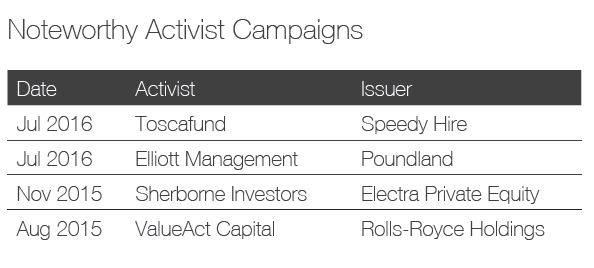
skadden-1

Proxy fights have become increasingly common at U.K. companies, with activists claiming a better record of success than in previous years after the Alliance Trust watershed. Toscafund, fighting the first in its 16-year history, will hope that track record continues. Elliott Management has also made merger arbitrage central to its strategy in recent years. Although operational activist Cevian Capital appears to be more focused on Continental Europe, turnarounds at exporters Rolls-Royce Holdings and Meggit are attracting activist attention.
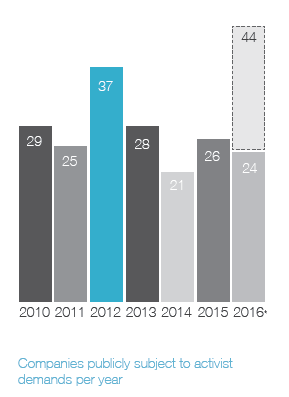
skadden2

Activism in the U.K. increased steadily after the financial crisis, culminating in the shareholder spring of 2012. Despite a dip thereafter, 2015 and 2016 have seen steadily more activity and this year is expected to be the busiest year yet.

* as of 30th June 2016. Projected full-year figure shown in dotted box.
skadden3

Easy access to shareholder rights, including meeting requisitions and proposals ensure that smaller companies are always vulnerable to activism. With several well funded and established activists setting up in London, however, large cap companies are starting to draw more attention.

Shareholder Activism—recent developments in the U.K.

Continuing the trend of previous years, the U.K. continues to see the lion’s share of activism in Europe. Over the last 12 months, approximately 43% of all European campaigns were played out in the U.K., according to Activist Insight data. Whilst the traditional mix of activist strategies were deployed, attempts to obtain board representation received most attention and generated most success.

In April 2015, Elliott Management’s criticism of Alliance Trust’s poor performance and high costs resulted in two new non-executive directors (“NED”) being appointed to the latter’s board. At Stock Spirits, Western Gate Private Investment’s (“WGPI”) complaints of “spiraling costs” and a board prone to “group-think” also resulted in the appointment of two NEDs following a shareholder vote. At Rolls- Royce Holdings, too, ValueAct Capital’s complaints regarding a fifth profit warning in two years resulted in a NED appointment for ValueAct’s chief operating officer in return for the promise that ValueAct would not lobby for a break-up of the company, nor increase its stake above 12.5%.

In each of these cases, the activists’ public rationale for supporting NED appointments has been to better long-term results through improved corporate governance and executive scrutiny. Also notable is that in two of the cases mentioned above, new appointments were subject to negotiation and compromise, with the activists accepting limitations on the extent of their directors’ participation in board meetings and board committees.

Board appointments have not gone without criticism, however, particularly regarding the perceived lack of independence of the new directors. Certainly, fears over conflicts of interest can have practical implications. In the case of Rolls-Royce,

ValueAct’s seat on the board was subject to limited rights: it has no ability to propose changes in strategy or management, call a shareholder meeting nor push for mergers or acquisitions. At Stock Spirits, the new NEDs have been prevented from sitting on certain committees and the chairman has publicly stated that they may be asked to leave meetings where commercially sensitive information, such as pricing, is discussed.

The U.K.’s legal, regulatory and political landscape remains supportive of shareholder engagement, and activists will leverage this to reinforce their (shorterterm) theses. Witness the increasing activity of Investor Forum (the “Forum”), whose 40 members own approximately 42% of the FTSE All Share Index. The Forum seeks to promote long-term investment and collective engagement with U.K. companies by its members. In August, after over a year of private engagement with Sports Direct alongside major institutions holding approximately 12% of Sports Direct, the Forum issued a press release calling for a comprehensive and independent review of corporate governance at the company.

Whilst the mechanics for investor engagement have remained largely constant over the last few years in the U.K., the grounds for activist shareholders to demand change remains dynamic. In addition to the traditional activist calling cards of under-par growth, over-inflated executive salaries and deficiencies in corporate governance, Britain’s recent referendum vote to leave the European Union may lead to some boards being challenged on their strategies to cope with Brexit. For so long as activists can continue to find intrinsic, unlocked value in U.K. companies, the facilitative environment and dynamic business conditions will continue to catalyse activism in the U.K.
skadden4

France

Controlling shareholders, double voting rights and government stakes in key industries make activism a challenging proposition in France, though there is no sign of activists abandoning their ambitions altogether. Last year, Airbus quietly sold its stake in Dassault Aviation in order to buyback shares, a year after The Children’s Investment Fund suggested the move.

Admittedly, not all activists have had such success. Elliott Management is currently in a legal battle with XPO Logistics Europe (formerly Norbert Dentressangle). Although it failed to remove CEO Troy Cooper at this year’s annual meeting, it owns enough to prevent the U.S. parent from delisting the company. In 2015, U.S.-based P. Schoenfeld Asset Management (“PSAM”) acquired a small stake in Vivendi and suggested selling Universal Music Group in order to pay larger dividends. Vivendi Chairman Vincent Bolloré increased his stake and pushed through double voting rights for long-term investors, enhancing his control.

Nonetheless, activism has begun to thrive in France. Electrical parts company Rexel waved goodbye to its CEO just months after Cevian Capital disclosed a stake earlier this year, Carrefour faced another request for board seats, and a merger between Maurel & Prom and MPI saw opposition from U.K. and South African funds. Meanwhile, the Paris-based hedge fund CI-AM has been making a name for itself, attempting to use the courts to stop the takeover of Club Med by China Fosun International and to reshape a licensing agreement between Euro Disney and The Walt Disney Company, to ensure investors in the Paris theme park were adequately compensated.

Activist short selling is also making its presence felt. In December, Muddy Waters Research released a 22-page report on grocery chain Groupe Casino, which it said was “dangerously leveraged, and… managed for the very short term.” Shares were down 11.6% a week after the report was published.
skadden5

Elliott has already been holding out at Norbert Dentressangle for more than a year, preventing the company from delisting following a takeover bid by XPO Logistics. An attempt to take the chairman role from CEO Troy Cooper at this year’s annual meeting failed, but the company has yet to be delisted–unlike MPI, which has now been merged with Maurel & Prom. Vincent Bolloré shows no signs being slowed down by U.S. activists such as P. Schoenfeld Asset Management, which won dividends but no seat on the board from a 2015 raid. In December, Muddy Waters Research released a much discussed short report on grocer Groupe Casino.
skadden6

2015 saw a sudden renewal of activist interest in France, coming close to the peak of 2012. So far, 2016 is off to a reasonable start, although it seems the country will continue to be targeted intermittently.

* as of 30th June 2016. Projected full-year figure shown in dotted box.
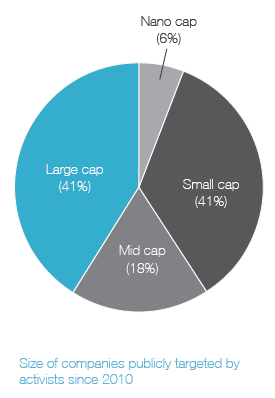
skadden7

Activist targets tend to be larger, on average, in France than in other countries, perhaps because they are more likely to be susceptible to international pressure. However, a rising number of campaigns at small cap companies may presage a busier market in future.

France is in the process of strengthening its Say on Pay

The emergence of shareholder activism in France over the last decade has been supported by the development of corporate governance rules and best practices. A number of campaigns following the global financial crisis focused on corporate governance, including the separation of chairmen and CEO roles, management performance and compensation.

Say on Pay was introduced in France in 2013 in the form of a soft law set forth in the corporate governance code applicable to French listed companies (the “AFEP-MEDEF Code”). France opted for an annual non-binding shareholder vote on all forms of compensation paid or granted to the company’s officers, including the chairman (vote consultatif des actionnaires). If compensation is rejected, a board is required to post a release on the company’s website following its next board meeting detailing how it intends to deal with such vote.

As the vote is non-binding, the general view until now is that boards may maintain compensation granted to the company’s officers, even when it is rejected by shareholders, or receives very limited support. In 2016, Renault and Alstom’s CEO compensation gave rise to a negative Say on Pay vote by shareholders. In the case of Renault, the board met immediately after the meeting and decided to confirm the 2015 compensation of the company’s CEO, generating criticism from the French state, which holds a significant stake in Renault, and politicians, as well as questions on the efficacy of French Say on Pay.

Following the Renault controversy, a public consultation was launched in order to, amongst other things, strengthen the Code’s Say on Pay provisions. The proposed new wording (likely to be in force from September 2016), is somewhat more restrictive than that currently in force, as it contemplates an express obligation for the board to amend the relevant officers’ compensation for the previous year or the company’s management compensation policy for the future. The French government also proposed in early June in a bill currently under discussion at the French Parliament (the “Loi Sapin II”) to introduce a binding Say on Pay in the French Commercial Code. This bill was highly debated and, at the date hereof, the French Assemblée Nationale and Sénat have taken different positions on this topic.

In the context of this reform, it is essential that French legislators bear in mind that the board has always been and shall remain the competent corporate body to fix the compensation granted to the company’s officers. In particular, the board is the sole corporate body which can set the applicable performance criteria for the annual and long-term variable remuneration of the company’s officers and assess whether or not these criteria have been met. In our view, the best way to achieve a well-balanced system would be to implement a Say on Pay inspired by the U.K. model, with (i) a binding shareholder vote every three or four years on the company’s compensation policy, and (ii) a nonbinding shareholder vote every year on the compensation granted to the company’s officers for the previous fiscal year, without any effect provided that such compensation complies with the management compensation policy approved by the shareholders.

Germany

Shareholders have always occupied a more complicated role in Germany, where a two-tier board structure gives labour unions and other interest groups a role, while limiting direct contact with executives.

In recent years, however, activists have descended on Germany. Knight Vinke, a Monaco-based hedge fund that specialises in large cap companies, has written a white paper on how E.On should be reshaped, while Cevian Capital has stakes in Bilfinger and ThyssenKrupp, where it is practising its traditional long-term, operational style of activism. Sports retailer Adidas has been forced to deny suggestions that Southeastern Asset Management was behind a decision to sell its golf division.

Events at Volkswagen since the emissions scandal highlight both the opportunities and the challenges for activism in Germany. London-based hedge fund The Children’s Investment Fund (“TCI”), wrote a scathing public letter in May, attacking executive compensation and deals with local state officials and unions that had damaged productivity levels.

Other investors sought to use Volkswagen’s annual meeting to send a message by attempting to deny management board members discharge from liability for their decisions and to halt dividend payments. Despite a number of investors speaking at the meeting and criticism from proxy voting advisers, the management resolutions were carried comfortably, reflecting the concentrated ownership of the Porsche and Piëch families.

A proxy contest at drugmaker Stada Arzneimittel may yet present activists with a path to influencing German companies, however. Investors defied management to elect a director selected by Active Ownership Capital (“AOC”), voted down Chairman Martin Abend and rejected the company’s remuneration plan. Other investors have openly called for the company to be sold, although AOC denied it would push for this.
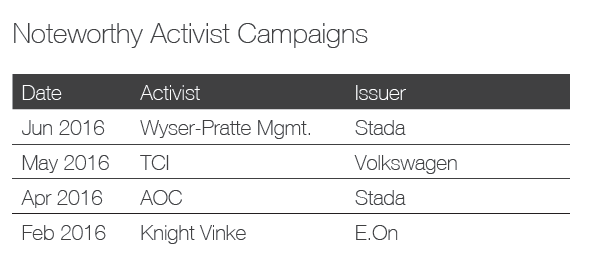
skadden8

The proxy contest at Stada Arzneimittel is a rare beast in a country that generally encourages activists to work more with management than directors to get things done. Even The Children’s Investment Fund Management, which has a fearsome reputation, is relying on its bully pulpit as a shareholder in Volkswagen to get things done, rather than initiating a formal contest. Activists have appointed supervisory board members in the past, however. Cevian Capital, a big player in the region, is currently involved at several construction sector companies.
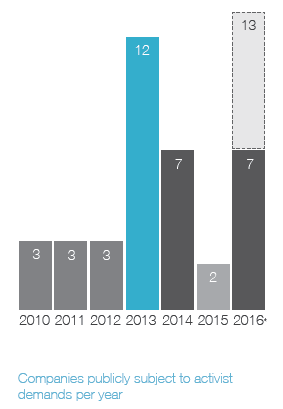
skadden9

A wave of merger arbitrage by activists such as Kerrisdale Capital and Elliott Management as well the traditional activism of Cevian Capital made 2013 a banner year for activism in Germany. Cevian are showing the country more attention than ever, with 2016 on course to finish strongly.

* as of 30th June 2016. Projected full-year figures shown in dotted box.
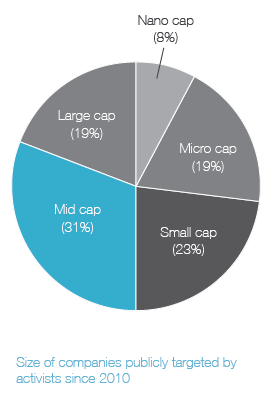
skadden10

Growing interest in activism in Germany has seen a wider range of market caps affected by activism since our last report. Both mid cap and large cap targets have increased in prominence, thanks to well-resourced activists showing interest in recent years.

New players rising

Shareholder activism in Germany continues to receive attention from the public, particularly with new domestic and short selling activists that understand how to utilise statutory legal instruments to implement their strategies entering the stage.

Elliott Management, a typical activist investor in special situations, continued to fiercely enforce its claim for an increase of the consideration for its 14.4% stake in Kabel Deutschland as part of the tender offer by Vodafone Group. In 2013, Elliott requested a special audit to review the offer of €84.53 per share. Since Vodafone vetoed a further special audit at the 2015 annual meeting, Elliott filed a court action requesting a further special audit alleging that €188 would have been fair; it seized upon its right pursuant to Sec. 145 German Stock Corporation Act (“AktG”). The court ruled in favour of Elliott, while the verdict of the further audit is outstanding.

Turning to “strategic” activists, with Active Ownership Capital (“AOC”) a new German player has entered the stage. In April 2016, AOC purchased a 5.1% position in Stada Arzneimittel and requested the replacement of initially five, later three, of the nine members of Stada’s supervisory board. Originally, Stada accepted these nominations but then changed its mind, eventually adjourning its annual meeting by nearly three months. Meanwhile AOC established a shareholders’ forum (Sec. 127a AktG) asking major shareholders to nominate candidates for election, eventually picking four to take into the proxy contest. Additionally, AOC called for the election of a new auditor; then it proposed the replacement of management board members even though the management board is appointed by the supervisory board whose members are independent from shareholders. AOC has been supported by Guy Wyser-Pratte and German Shareholder Value Management, drawing scrutiny by the German supervisory authority BaFin. It remains unclear whether AOC is seeking a longterm partnership or publicity to raise Stada’s market value, possibly with the goal of a sale; respective rumours of a partial or complete sale have evolved.

Besides the shareholders’ forum and direct communication with management, AOC essentially may use the following legal instruments: request that discharge of management not be granted on an individual basis (Sec. 120 para. 1 sent. 2 AktG), individual election of supervisory board members (Sec. 5.4.3 German Corporate Governance Code) and voting on its own director nominees prior to candidates proposed by management, thus enhancing their chances for election (Sec. 137 AktG).

The influence of activists is further proven by Cevian Capital’s investment in Bilfinger. For years Cevian has closely followed Bilfinger’s management and presumably “installed” Eckhard Cordes as chairman of the supervisory board, prompting various changes to the management board.

Aside from some other campaigns, a new kind of activists has emerged—those selling shares short and spreading news adversely affecting the share price. The lawfulness of this may be doubted. Examples include Muddy Waters (at Ströer) and Zatarra (Wirecard).

This illustrates the continuing increase in shareholder activism in Germany and that German law provides requisite instruments for it.

Italy

Shareholder representation on company boards is the rule and not the exception in Italy, with large investors dividing board seats amongst themselves and majority shareholders choosing managers. As of 2014, 83% of listed companies had a controlling shareholder, or a coalition of shareholders in control. However, the long-term trend is that the weight of the owners is slowly decreasing, and the presence of foreign institutional investors rising.

Moreover, the country’s prolonged economic crisis and new laws have weakened families and institutions that have controlled Italy’s largest companies for decades. Changes include the conversion of the largest co-operative banks into limited companies, a ban on director overboarding within competing entities in the financial sector, and limits on the grip of foundations on the country’s banks.

Railway signalling group Ansaldo STS has recently faced one of the most outspoken activist campaigns ever seen in the country, with Elliott Management and Amber Capital fighting for an increase in the price of a tender offer by Japan’s Hitachi—which recently acquired the Italian company’s controlling stake. Elliott also exploited Italy’s proxy access rules to elect three directors to the board of Ansaldo STS.

London-based Amber, which has an office in Milan, is also fighting a battle at dairy multinational Parmalat, where it has a board seat and accuses the controlling shareholder of improper related-party transactions.

In the 2016 proxy season, the Investment Managers’ Committee, an association assisting investment firms in nominating independent directors, submitted slates at 34 companies—up from 14 in 2013–and elected close to 60 board members, largely thanks to laws granting seats to minority shareholders.
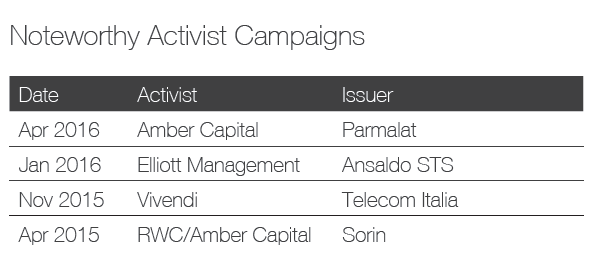
skadden11

Elliott Management has launched one of the most outspoken activist campaigns ever seen in Italy, electing three directors at Ansaldo STS and filing a lawsuit to gain complete control of the board. Amber Capital is engaging with several companies, and a battle with Parmalat’s largest shareholder that started in 2012 is still ongoing. In 2015, Vincent Bolloré’s Vivendi won three seats on the board of Telecom Italia.
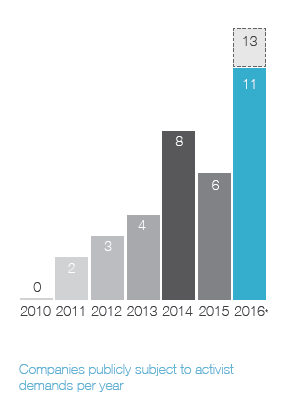
skadden12

Activism in Italy has been rising steadily since the eurozone crisis, and 2016 is the busiest year on record as regulatory reform increases the scope for investors to apply pressure.

* as of 30th June 2016. Projected full-year figures shown in dotted box.
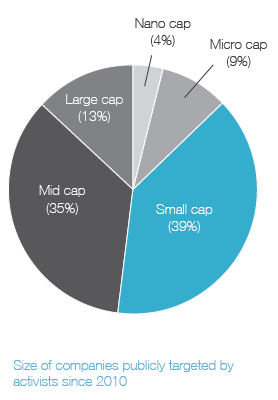
skadden13

Activism in Italy is dominated by companies with a market capitalisation of less than 1.8 billion euros, although high-profile examples of large companies being targeted can be found.

Switzerland

Activism in Switzerland continues to play a role in several aspects of corporate life. Despite campaigns at the likes of Transocean, Xstrata and UBS, the country has previously been thought of as unfavourable to activism because, as in Germany, many companies have dual board structures. However, that failed to stop investors recently demanding changes to boards at Holcim, fashion retailer Charles Vögele and listed hedge fund Altin.

M&A activity including some of the largest Swiss companies, such as Syngenta and LafargeHolcim, has forced management teams to engage more meaningfully with shareholders, although investors have been less successful in wringing out meaningful concessions than in 2012, when a shareholder vote on golden parachutes for Xstrata executives forced the resignation of Chairman John Bond.

At Sika, a specialty chemicals company, Bill Gates’ family office Cascade Investment has opposed a takeover offer from Cie de Saint-Gobain, lobbying the takeover panel to force the bidder to tender for minority shareholders’ stakes. At the time of writing, Swiss courts were being asked to decide whether Sika could limit the majority voting rights of its founding family, which sold its 16% stake to the bidder.

A campaign at Altin highlights the lengths activists have to go to in Switzerland. In February, Alpine Select requisitioned a shareholder meeting to vote on the appointment of three new directors and a special dividend. When Alpine won just one seat on the board, its nominee resigned, and it went on to build a majority stake before negotiating an agreement whereby the company nominated three new directors, paid a hefty dividend and agreed to delist from the London Stock Exchange. Altin CEO Tony Morrongiello also announced his resignation in favour of Alpine’s Claudia Habermacher at the June annual meeting.
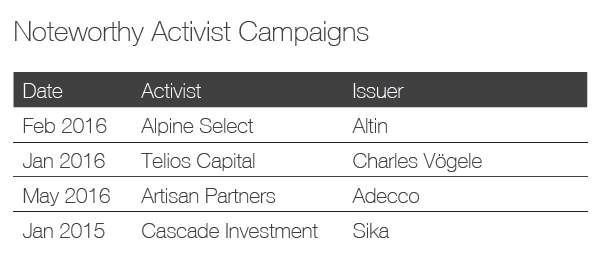
skadden14

The restricted power of dual-class Swiss boards often limits investors to complaining about decisions from outside the boardroom—as with the appointment of Adecco’s new CEO—or legal action—as Bill Gates’ family office Cascade Investment is pursuing at Sika. Mergers have also catalysed activism, with Syngenta and Holcim targeted. As ever, Cevian Capital is present through its stake in ABB, while Swiss activist Telios may be one to watch in the future.
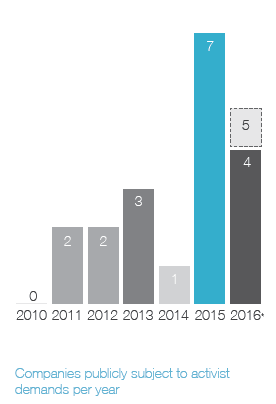
skadden15

After an exceptionally busy 2015, this year has a lot to live up to. However, activists have started strongly, targeting more companies than in any year before 2015.

* as of 30th June 2016. Projected full-year figures shown in dotted box.
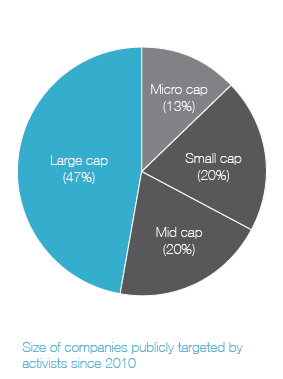
skadden16

The make up of activist targets has changed only slightly in recent years. Many Swiss targets of activists being international by nature and often involved in crossborder mergers, the predominance of large cap targets is perhaps not surprising.


Malaise au conseil | Les effets pervers de l’obligation de divulgation des rémunérations de la haute direction (en rappel)


Aujourd’hui, je cède la parole à Mme Nicolle Forget*, certainement l’une des administratrices de sociétés les plus chevronnées au Québec (sinon au Canada), qui nous présente sa vision de la gouvernance « réglementée » ainsi que celle du rôle des administrateurs dans ce processus.

L’allocution qui suit a été prononcée dans le cadre du Colloque sur la gouvernance organisée par la Chaire de recherche en gouvernance de sociétés le 6 juin 2014. Je pensais tout d’abord faire un résumé de son texte, mais, après une lecture attentive, j’en ai conclu que celui-ci exposait une problématique de fond et constituait une prise de position fondamentale en gouvernance. Il me semblait essentiel de vous faire partager son article au complet.

Nous avons souvent abordé les conséquences non anticipées de la réglementation, principalement celles découlant des exigences de divulgation en matière de rémunération. Cependant, dans son allocution, l’auteure apporte un éclairage nouveau, inédit et audacieux sur l’exercice de la gouvernance dans les sociétés publiques.

Elle présente une solide argumentation et expose clairement certains malaises vécus par les administrateurs eu égard à la lourdeur des mécanismes réglementaires de gouvernance. Les questionnements présentés en conclusion de l’article sont, en grande partie, fondés sur sa longue expérience comme membre de nombreux conseils d’administration.

Comment réagissez-vous aux constats que fait Mme Forget ? Les autorités réglementaires vont-elles trop loin dans la prescription des obligations de divulgation ? Pouvons-nous éviter les effets pervers de certaines dispositions sans pour autant nuire au processus de divulgation d’informations importantes pour les actionnaires et les parties prenantes.

Vos commentaires sont les bienvenus. Je vous souhaite une bonne lecture.


MALAISE AU CONSEIL | Les effets pervers de l’obligation de divulgation en matière de rémunération

 par

Nicolle Forget*


Merci aux organisateurs de ce colloque de me donner l’occasion de partager avec vous quelques constatations et interrogations qui m’habitent depuis quatre ou cinq ans concernant diverses obligations imposées aux entreprises à capital ouvert (inscrites en Bourse). Je souligne d’entrée de jeu que la présentation qui suit n’engage que moi.

Depuis l’avènement de quelques grands scandales financiers, ici et ailleurs, on en a mis beaucoup sur le dos des administrateurs de sociétés. On voudrait qu’un administrateur soit un expert en semblable matière.  Il ne l’est pas.  Il arrive avec son bagage, c’est pourquoi on l’a choisi.  On lui prépare un programme de formation pour lui permettre de comprendre l’entreprise au conseil de laquelle il a accepté de siéger, mais il n’en saura jamais autant que la somme des savoirs de l’entreprise.  C’est utopique de s’attendre au contraire.  Même un administrateur qui ne ferait que cela, siéger au conseil de cette entreprise, ne le pourrait pas.

nicolle-forget

Des questions reviennent constamment dans l’actualité : où étaient les administrateurs ? N’ont-ils rien vu venir ou rien vu tout court?  Ont-ils rempli leur devoir fiduciaire?  Tout juste si on ne conclut pas qu’ils sont tous des incompétents.  Les administrateurs étaient là.  Ils savaient ce que l’on a bien voulu leur faire savoir. (ex. Saccage de la Baie-James. Les administrateurs de la SEBJ, convoqués en Commission parlementaire à Québec, au printemps 1983,  ont appris, par un avocat venu y témoigner, l’existence d’un avis juridique qu’il avait préparé à la demande de la direction.  La SEBJ poursuivait alors les responsables du saccage et un très long procès était sur le point de commencer.  Avoir eu connaissance de son contenu, au moment où il a été livré au PDG, aurait eu un impact sur nos décisions.  J’étais alors membre du conseil d’administration).

Posons tout de suite que la meilleure gouvernance qui soit n’empêchera jamais des dirigeants qui veulent cacher au conseil certains actes d’y parvenir — surtout si ces actes sont frauduleux. Même avec de belles politiques et de beaux codes d’éthique, plusieurs directions d’entreprise trouvent encore qu’un conseil d’administration n’est rien d’autre qu’un mal nécessaire.  Les administrateurs sont parfois perçus comme s’ingérant dans les affaires de la direction ou dans les décisions qu’elle prend. Aussi, ces dirigeants ont-ils tendance à placer les conseils devant des faits accomplis ou des dossiers tellement bien ficelés qu’il est difficile d’y trouver une fissure par laquelle entrevoir une faille dans l’argumentation au soutien de la décision à prendre. Pourtant, et nous le verrons plus loin, en vertu de la loi, le conseil « exerce tous les pouvoirs nécessaires pour gérer les activités et les affaires internes de la société ou en surveiller l’exécution ».

Les conseils d’administration, comme les entreprises et leurs dirigeants, sont soumis à quantité de législations, réglementations, annexes à celles-ci, avis, lignes directrices et autres exigences émanant d’autorités multiples — et davantage les entreprises œuvrent dans un secteur d’activités qui dépasse les frontières d’une province ou d’un pays. Et, selon ce que l’on entend, il faudrait que l’administrateur ait toujours tout vu, tout su…

Malaise!

En 2007, Yvan Allaire écrivait que « … la gouvernance par les conseils d’administration est devenue pointilleuse et moins complaisante, mais également plus tatillonne, coûteuse et litigieuse ; les dirigeants se plaignent de la bureaucratisation de leur entreprise, du temps consacré pour satisfaire aux nouvelles exigences » 1. Denis Desautels, lui, signalait que « Certains prétendent que le souci de la conformité aux lois et aux règlements l’emporte sur les discussions stratégiques et sur la création de valeur.  Et d’autres, que l’adoption ou l’endossement des nouvelles normes n’est pas toujours sincère et, qu’au fond, la culture de l’entreprise n’a pas réellement changé » 2.

Pour mémoire, voyons quelques obligations (de base) d’un administrateur de sociétés.

Au Québec, la Loi sur les sociétés par actions (L.r.Q., c. S-31.1) prévoit que les affaires de la société sont administrées par un conseil d’administration qui « exerce tous les pouvoirs nécessaires pour gérer les activités et les affaires internes de la société ou en surveiller l’exécution » (art. 112) et que, « Sauf dans la mesure prévue par la loi, l’exercice de ces pouvoirs ne nécessite pas l’approbation des actionnaires et ceux-ci peuvent être délégués à un administrateur, à un dirigeant ou à un ou plusieurs comités du conseil. »

De façon générale, les administrateurs de sociétés sont soumis aux obligations auxquelles est assujetti tout administrateur d’une personne morale en vertu du Code civil. « En conséquence, les administrateurs sont notamment tenus envers la société, dans l’exercice de leurs fonctions, d’agir avec prudence et diligence de même qu’avec honnêteté et loyauté dans son intérêt » (art. 119). L’intérêt de la société, pas l’intérêt de l’actionnaire.  La loi fédérale présente des concepts semblables.  (La Cour Suprême du Canada a d’ailleurs rappelé dans l’affaire BCE qu’il n’existe pas au Canada de principe selon lequel les intérêts d’une partie — les actionnaires, par exemple — doivent avoir priorité sur ceux des autres parties.)

Si la société fait appel publiquement à l’épargne, elle devient un émetteur assujetti. Alors s’ajoutent les règles de la Bourse concernant les exigences d’inscription initiale ainsi que celles concernant le maintien de l’inscription. S’ajoutent aussi les obligations édictées dans la Loi sur les valeurs mobilières (L.R.Q., c. V-1.1), de même que les règlements qui en découlent, et dont l’Autorité des marchés financiers (AMF) est chargée de l’application. L’émetteur assujetti est tenu aux obligations d’information continue. Si vous êtes un administrateur ou un haut dirigeant d’un tel émetteur ou même d’une filiale d’un tel émetteur, vous êtes un initié avec des obligations particulières.

L’article 73 de cette Loi stipule que tel émetteur « … fournit, conformément aux conditions et modalités déterminées par règlement, l’information périodique au sujet de son activité et de ses affaires internes, dont ses pratiques en matière de gouvernance, l’information occasionnelle au sujet d’un changement important et toute autre information prévue par règlement. ». «L’émetteur assujetti doit organiser ses affaires conformément aux règles établies par règlement en matière de gouvernance». (art.73.1)

La mission de l’Autorité, (entendre ici AMF) telle qu’énoncée à l’article 276.1 de la Loi sur les valeurs mobilières se décline comme suit :

  1. Favoriser le bon fonctionnement du marché des valeurs mobilières ;
  2. Assurer la protection des épargnants contre les pratiques déloyales, abusives et frauduleuses ;
  3. Régir l’information des porteurs de valeurs mobilières et du public sur les personnes qui font publiquement appel à l’épargne et sur les valeurs émises par celles-ci ;
  4. Encadrer l’activité des professionnels des valeurs mobilières et des organismes chargés d’assurer le fonctionnement d’un marché des valeurs mobilières.

Dans sa loi constituante, l’Autorité a une mission plus élaborée qui reprend sensiblement les mêmes thèmes, mais en appuyant davantage sur la protection des consommateurs de produits et utilisateurs de services financiers. (art.4, L.R.Q., c. A-33.2)

Aux termes de la législation en vigueur, « L’Autorité exerce la discrétion qui lui est conférée en fonction de l’intérêt public» (art.316, L.R.Q., c. V-1.1) et un règlement pris en vertu de la présente loi confère un pouvoir discrétionnaire à l’Autorité » (art.334).  En outre, toujours selon cette Loi, « Les instructions générales sont réputées constituer des règlements dans la mesure où elles portent sur un sujet pour lequel la loi nouvelle prévoit une habilitation réglementaire et qu’elles sont compatibles avec cette loi et les règlements pris pour son application. »

Je vous fais grâce du Règlement sur les valeurs mobilières (Décret 660-83 ; 115 G.O.2, 1511) ; quant à l’Annexe (51-102A5), portant sur la Circulaire de sollicitation de procuration par la direction, et celle (51-102A6) portant spécifiquement sur la Déclaration de la rémunération de la haute direction, j’y reviendrai plus loin.

Ceci pour une société qui ne fait affaire qu’au Québec, et à l’exclusion de toutes les autres législations et les nombreux règlements portant sur un secteur d’activité en particulier. Pensons juste aux activités qui peuvent affecter l’environnement, même de loin.  Alors, si une société fait affaire ailleurs au Canada et aux É.-U. ou sur plusieurs continents — ajoutez des obligations, des modes différents de divulgation de l’information — et cela peut vous donner une petite idée de « l’industrie » qu’est devenue la gouvernance d’entreprise avec l’obligation de livrer l’information en continu et sous une forme de plus en plus détaillée.  Et les administrateurs devraient tout savoir, avoir tout vu…

Les très nombreuses informations que nous publions rencontrent-elles l’objectif à l’origine de ces exigences ? Carol Liao soutient que « les autorités réglementaires sont par définition orientées vers l’actionnaire ce qui aurait mené à une augmentation des droits de ces derniers, bien au-delà de ce que les lois canadiennes (sur les sociétés) envisageaient. »  On a vu plus haut que la Loi sur les sociétés par actions édicte que « les administrateurs sont notamment tenus envers la société dans l’exercice de leurs fonctions, d’agir avec prudence et diligence de même qu’avec honnêteté et loyauté dans son intérêt ».  Se pourrait-il que « ce qui est dans l’intérêt supérieur des actionnaires ne coïncide pas avec une meilleure gouvernance ? (doesn’t align with better governance – that’s where the practice falls down »3.)

J’aime à croire que l’origine de l’obligation qui est faite aux entreprises de dire qui elles sont, ce qu’elles font, comment elles le font, et avec qui elles le font, est la protection du petit investisseur — vous et moi qui plaçons nos économies en prévision de nos vieux jours — comme disaient les anciens.

À moins d’y être obligé par son travail, qui comprend le contenu des circulaires de sollicitation de procuration par la direction, émises à l’intention des actionnaires ? Les Notices annuelles ? D’abord, qui les lit?  Chaque fois que l’occasion m’en est donnée, je pose la question  – et partout le même commentaire :  si je n’avais pas les lire je ne les lirais pas. La quantité de papier rebute en partant ; la complexité des informations à publier en la forme prescrite est difficile à comprendre pour un non-expert, alors imaginez pour un petit investisseur.  Si même  il s’aventure à lire le document.

Donc, si tant est que les circulaires et les notices ne soient pratiquement lues que par ceux qui n’ont pas le choix de le faire, il serait peut-être temps de se demander à quoi, ou plutôt, à qui elles servent ? Et à quels coûts pour l’entreprise. A-t-on une idée de combien d’experts s’affairent avec le personnel de l’entreprise à préparer ces documents sans compter les réunions des comités d’Audit, de Ressources humaines, de Gouvernance et du conseil qui se pencheront sur diverses versions des mêmes documents ?

Encore une fois, pour quoi ? Pour qui ?

Pourquoi pas aux activistes de toutes origines ?

La dernière crise financière (2008/2009) semble avoir été l’accélérateur de l’activisme de groupes, autour des actionnaires, de même que l’arrivée d’experts de toutes sortes en gouvernance d’entreprise. Une industrie venait de naître!  Le Rapport sur la gouvernance 2013, de Davies Ward Phillips & Vineberg, s.e. n.c. r. l., soutient qu’il s’agit d’une tendance alimentée surtout « par le nombre accru d’occasions d’activisme découlant de certaines  tendances actuelles de la législation et des pratiques à vouloir que plus de questions soient soumises à l’approbation des actionnaires » 4.

Mais, l’a-t-on oublié ? Les administrateurs ont un devoir de fiduciaire envers la société, pas juste envers les actionnaires.  Ils doivent assurer la pérennité de l’entreprise et pas juste afficher un rendement à court terme qui entraîne des effets pervers sur la gestion des ressources humaines et ne tient pas suffisamment compte d’une saine gestion des risques.  Question :  est-ce que la mesure de l’efficacité consiste en une reddition de compte trimestrielle ? Est-ce que cette reddition de compte, toute formatée, n’est pas en train de remplacer la responsabilité et l’engagement personnel des hauts dirigeants ? La pression  mise sur les conseils d’administration, par certains activistes (d’ailleurs pas toujours actionnaires de l’entreprise !), et de leurs conseillers divers, pour discuter avec le président du conseil et le président du comité de ressources humaines est perçue comme une tentative de la part de ces activistes d’imposer leur programme — au détriment des autres actionnaires et de l’intérêt même de l’émetteur.  Et comme certains fournisseurs de ces activistes (agences de conseils en vote) produisent des analyses pour leur clientèle en vue d’une recommandation de vote lors d’une assemblée annuelle — cette démarche peut être interprétée comme une pression à la limite de l’intimidation.

Venons-en aux obligations de divulgation portant sur la rémunération des membres de la haute direction visés.

Les prêteurs, les actionnaires, ont le droit de connaître — à terme — les obligations de l’entreprise, y compris celles envers ses hauts dirigeants. Remarquez, ils ont aussi le droit de savoir s’il y a exagération ou abus. Mais, ont-ils besoin, entre autres, de connaître dans le détail les objectifs personnels fixés à Monsieur X ou à Madame Y?; pour quel % cela compte-t-il dans la rémunération incitative à court terme?; à quel % tels objectifs ont-ils été rencontrés?; pourquoi l’ont-ils été à ce %?.  Peut-on sérieusement croire qu’une entreprise va publier que telle ou telle personne n’est pas à la hauteur, 12 à 15 mois après les faits?.  Ou bien cette personne a rencontré les objectifs fixés de façon satisfaisante ou bien elle n’est plus là.  Denis Desautels avance, dans le texte cité plus haut, qu’il « n’est pas sage d’appuyer les régimes de rémunération sur des formules trop quantitatives ou mathématiques et d’allouer une trop grande portion de la rémunération globale à la partie variable ou à risque de la rémunération ».  Pourtant, les pressions ne cessent d’augmenter pour que cela soit le cas (Pay for Performance) et que ce soit basé sur des mesures objectives et connues comme le cours de l’action ou le résultat par action… le tout par rapport au groupe de référence.  Performance devient le nouveau leitmotiv.  S’est-on jamais demandé ce que cette divulgation pouvait avoir comme effet d’« emballement » sur la rémunération des hauts dirigeants?  Et les politiques de rémunération doivent continuellement s’ajuster.

Le Règlement 51-102, à son Annexe A6 (Déclaration de la rémunération de la haute direction) prescrit non seulement le contenu, mais aussi la forme que doit prendre cette déclaration :

L’ensemble de la rémunération payée, payable, attribuée, octroyée, donnée ou fournie de quelque autre façon, directement ou indirectement, par la société ou une de ses filiales à chaque membre de la haute direction visé et chaque administrateur, à quelque titre que ce soit, notamment l’ensemble de la rémunération en vertu d’un plan ou non, les paiements directs ou indirects, la rétribution, les attributions d’ordre financier ou monétaire, les récompenses, les avantages, les cadeaux ou avantages indirects qui lui sont payés, payables, attribués, octroyés, donnés ou fournis de quelque autre façon pour les services rendus et à rendre, directement ou indirectement, à la société ou à une de ses filiales. (art. 1.3 par, 1 a).

L’émetteur assujetti doit, en outre, produire une analyse de la rémunération, laquelle doit :

1) Décrire et expliquer tous les éléments significatifs composant la rémunération attribuée, payée, payable aux membres de la haute direction visés, ou gagnée par ceux-ci, au cours du dernier exercice, notamment les suivants :

  1. a) les objectifs de tout programme de rémunération ou de toute stratégie en la matière ;
  2. b) ce que le programme de rémunération vise à récompenser ;
  3. c) chaque élément de la rémunération ;
  4. d) les motifs de paiement de chaque élément ;
  5. e) la façon dont le montant de chaque élément est fixé, en indiquant la formule, le cas échéant ;
  6. f) la façon dont chaque élément de la rémunération et les décisions de la société sur chacun cadrent avec les objectifs généraux en matière de rémunération et leur incidence sur les décisions concernant les autres éléments.

2) Le cas échéant, expliquer les actions posées, les politiques établies ou les décisions prises après la clôture du dernier exercice qui pourraient influencer la compréhension qu’aurait une personne raisonnable de la rémunération versée à un membre de la haute direction visé au cours du dernier exercice.

3) Le cas échéant, indiquer clairement la référence d’étalonnage établie et expliquer les éléments qui la composent, notamment les sociétés incluses dans le groupe de référence et les critères de sélection.

4) Le cas échéant, indiquer les objectifs de performance ou les conditions similaires qui sont fondés sur des mesures objectives et connues, comme le cours de l’action de la société ou le résultat par action. Il est possible de décrire les objectifs de performance ou les conditions similaires qui sont subjectifs sans indiquer de mesure précise.

Si les objectifs de performance ou les conditions similaires publiés ne sont pas des mesures financières conformes aux PCGR, en expliquer la méthode de calcul à partir des états financiers de la société.

Et le tout dans un langage clair, concis et « présenté de façon à permettre à une personne raisonnable, faisant des efforts raisonnables de comprendre (…)

  1. a) la façon dont sont prises les décisions concernant la rémunération des membres de la haute direction visés et des administrateurs ;
  2. b) le lien précis entre la rémunération des membres de la haute direction visés et des administrateurs et la gestion et la gouvernance de la société (par. 10). »

L’Instruction générale relative au règlement 51-102 sur les obligations d’information continue définit, en son article 1.5, ce qu’il faut entendre par langage simple.  C’est en quatorze points ; je vous en fais grâce.  Je rappelle ici qu’une instruction générale est réputée constituer un règlement.

Trop, c’est comme pas assez. C’est aussi ce que  pourrait se dire la personne raisonnable après avoir fait des efforts raisonnables pour comprendre tout cela. Cette personne pour laquelle l’entreprise publie toutes les informations réclamées par le législateur/autorité réglementaire poussé par l’industrie de la gouvernance qui, elle, bénéficie de la complexification des règles.

L’émetteur est placé devant ces obligations auxquelles il veut bien se conformer, mais pas au point de livrer des éléments importants de ses stratégies de développement au premier lecteur venu. Ce qui pourrait même être contre l’intérêt des actionnaires, et finalement ne bénéficier qu’à la concurrence.  Ce qui fait que l’on en est rendu à se demander comment éviter de divulguer « les secrets de familles », si je puis dire, sans indisposer les autorités réglementaires — surtout si on doit aller au marché dans les mois qui suivent.

Malaise!

Si mon souvenir est bon, les pressions sont venues de groupes divers (investisseurs institutionnels, gestionnaires de fonds et autres) qui jugeaient les rémunérations des hauts dirigeants extravagantes et non méritées. Pour eux, les administrateurs étaient responsables de cet état de fait. Alors, on a légiféré, réglementé, permis le Say on Pay et diverses propositions d’actionnaires.  La rémunération a-t-elle baissé ? Non. Les parachutes ont-ils disparu?  Non.  Chacun se compare à l’autre et ne voit pas pourquoi il ne serait pas rémunéré comme son vis-à-vis de l’entreprise Z.  Et les PDG de se négocier un contrat blindé — pourquoi pas?  Ils sont assis sur un siège éjectable.

Ne pourrait-on pas se demander maintenant si partie ou toutes ces exigences ne produisent pas davantage d’effets pervers que de bénéfices ? (Dans le plan d’affaires 2013-2016 des ACVM. Les deux dernières priorités sont :  réglementation des marchés ; et efficacité des mesures d’application de la loi).

Ne pourrait-on pas aussi se demander si exiger une durée minimale de détention de l’actionnariat pour obtenir le droit de vote à une assemblée générale ne serait pas souhaitable ?

Si publier les résultats deux fois l’an, au lieu de quatre, ne donnerait pas un peu d’oxygène aux entreprises — un début de délivrance de la tyrannie du rendement à court terme ? Et, quant à y être, pourquoi continuer de publier l’information telle qu’exigée, si elle n’est pas lue ?

Et puis, à quoi servent les administrateurs si les actionnaires peuvent s’immiscer dans la gestion d’une entreprise et imposer leurs volontés en tout temps ?

Et à quel actionnaire permettre quoi ? Un Hedge Fund qui achète et vend des millions d’actions par minute ? Un fond mutuel qui garde des actions quelques années ?  Un retraité qui conserve ses actions depuis 20 ans ?

D’ici à ce que l’on ait réfléchi à tout cela, ne peut-on pas marquer le pas ?


  1. 1. Allaire, Yvan, Pourquoi cette vague de privatisation d’entreprises cotées en Bourse, La Presse, mars 2007.
  2. 2. Desautels, Denis, OC, FCA, Les défis les plus difficiles des administrateurs de sociétés, Collège des administrateurs de sociétés, Conférence annuelle, 11 mars 2009.
  3. 3. Carol Liao, A Canadian Model of Corporate Governance, Where do shareholders really stand? Director Journal, January/February 2014, p. 37
  4. 4. p. 55.

*Nicolle Forget siège au conseil d’administration du Groupe Jean Coutu (PJC) Inc., de Valener Inc. et de ses filiales et du Collège des administrateurs de sociétés. Elle a, entre autres, fait partie d’un comité d’éthique de la recherche et des nouvelles technologies et de comités d’éthique clinique, de même que du Groupe de travail sur l’éthique, la probité et l’intégrité des administrateurs publics et a présidé le Groupe de travail sur les difficultés d’accès au financement pour les femmes entrepreneuses.

Madame Forget a été chargée de cours à l’École des Hautes Études commerciales et elle est l’auteure de cas en gestion de même que de quelques ouvrages biographiques. Madame Forget a d’abord fait du journalisme à Joliette avant de se consacrer à la gestion d’organismes de recherche et de formation durant les années 1970. Elle a aussi été membre (juge administratif) de tribunaux administratif et quasi judiciaire durant les années 1980 et 1990.

Madame Forget est diplômée de l’UQÀM (brevet d’enseignement spécialisé en administration), des HEC (baccalauréat en sciences commerciales) et de l’Université de Montréal (licence en droit et DESS en bioéthique). Elle fût membre du Barreau du Québec jusqu’en 2011.

Madame Forget a siégé à de nombreux conseils d’administration dont : Fédération des femmes du Québec, Conseil économique du Canada, SEBJ, Hydro-Québec, Hydro-Québec International, Gaz Métro Inc., Agence québécoise de valorisation industrielle de la recherche, Fonds de solidarité des travailleurs du Québec, Université de Montréal, École polytechnique, Innotermodal. Elle a, de plus, présidé les conseils de Accesum Inc., Nouveler Inc., Accès 51, Ballet Eddy Toussaint, Festival d’été de Lanaudière et Association des consommateurs du Québec.