La gouvernance des grandes institutions bancaires européennes au cours des dix années qui ont suivi la crise financière des 2008


Voici un article publié par Lisa Andersson*, directrice de la recherche à Aktis et Stilpon Nestor, paru sur le site du Forum de Harvard Law School, qui brosse un portrait de l’évolution de la gouvernance des grandes institutions bancaires européennes au cours des dix années qui ont suivi la crise financière des 2008.

Je vous invite à prendre connaissance de ce document illustré d’infographies très éclairantes. J’ai reproduit, ci-dessous, l’introduction à l’article.

Si vous avez un intérêt pour la gouvernance dans le milieu bancaire, cet article est pour vous.

Bonne lecture ! Vos commentaires sont les bienvenus.


Governance of the 25 Largest European Banks a Decade After the Crisis


Résultats de recherche d'images pour « gouvernance bancaire européenne »


This summer marked the 10-year anniversary of the start of the global financial crisis. Over the 18 months following August 2007, several bank collapses in the United States, Germany and Britain, culminating with the demise of Lehman Brothers in September 2008 shook the financial system to its core. The interconnectivity of the world’s financial system meant that the repercussions would be felt globally, and on a monumental scale. The US Department of the Treasury has estimated that total household wealth would lose some $19.2 trillion following a publicly-funded government bailout program. Over the last decade governments, regulators, banks and their investors have revamped the financial system and its supervision in order to recover the public subsidy and prevent a similar crash from happening again.

In Europe, politicians and regulators at both the national and European level abandoned the path of deregulation and dramatically increased regulatory requirements and the scope of prudential supervision with an unparalleled focus on governance. The Capital Requirements Directive IV (CRD IV) and the ensuing European Banking Authority (EBA) and European Central Bank (ECB) guidance implied stricter suitability reviews for board members and senior management, along with individual responsibility and in some cases criminal liability of non-executive directors (“NEDs”), as well as strict limits on variable remuneration. Higher regulatory requirements were compounded by the creation of a single supervisor for all systemic Eurozone banks. In many countries, especially the smaller ones, familiarity with supervisors usually allow a larger margin of forbearance and greater tolerance in assuming local sovereign risk. This has since disappeared. New rules and stricter oversight practices in the financial industry have translated into higher governance requirements and expectations for European banks’ boards of directors and senior management. So how do the boards and management committees of the top European banks measure up to their former selves? Data from the 25 largest listed banks [1] in Europe shows that boards today are smaller, work harder, and have a higher level of expertise than a decade ago.

While board sizes are getting smaller, the number of committees supporting the board has consistently grown over the years. This is in part driven by the mandatory separation of the audit and risk committee into two separate committees, but also by a general trend towards establishing more and more committees focusing on regulatory and compliance issues, as well as bank culture, conduct and reputation.

On average, 86% of board membership has been refreshed post-crisis. New board members brought with them greater independence, banking experience and general financial expertise among NEDs, as well as an improved gender balance on the board. In fact, women now comprise on average 34% of top European banks’ board membership, a development largely driven by national initiatives. Another significant change since 2007 is the fact that all the bank boards in the group now conduct regular assessments of the effectiveness of the board, a Capital Requirements Directive IV (CRD IV) requirement. The disclosure of this process has also improved significantly, with 48% of banks now disclosing specific challenges identified and actions taken to address these.

The role of a bank NED has evolved post-crisis. With increased scrutiny, boards of financial institutions are now required to adopt a more hands-on approach, requiring a greater time-commitment by their non-executive directors. On average, the workload per director has increased by over 30% compared to pre-crisis levels.

In contrast to the board, the size of management committees has grown in recent years. The top management committee now tend to include more heads of functions, reflected by the increased presence of the Chief Risk Officer, Head of Compliance and Head of Legal. Despite the positive development of a better gender balance on the board of directors, the number of women on the highest management committee has not increased significantly over the last ten years. This may suggest that the “top-down” approach of board quotas adopted in many European countries might be less than effective in promoting gender equality.


*Lisa Andersson is Head of Research of Aktis and Stilpon Nestor is Managing Director and Senior Advisor at Nestor Advisors. This post is based on their recent Nestor Advisors/Aktis publication.


L’indépendance des administrateurs, c’est bien ; mais, des administrateurs qui sont impérativement crédibles et légitimes, c’est mieux !


C’est avec enthousiasme que je vous recommande la lecture de cette dixième prise de position d’Yvan Allaire* au nom de l’IGOPP.

L’indépendance des administrateurs est une condition importante, mais d’autres considérations doivent nécessairement être prises en compte, notamment la légitimité et la crédibilité du conseil d’administration.

Comme l’auteur le mentionne, il faut parfois faire des arbitrages afin de se doter d’un conseil d’administration efficace.

J’ai reproduit, ci-dessous, le sommaire exécutif du document. Pour plus de détails sur ce document de 40 pages, je vous invite à lire le texte au complet.

Bonne lecture ! Vos commentaires sont les bienvenus. Ils orienteront les nouvelles exigences en matière de gouvernance.


D’indépendant à légitime et crédible : le défi des conseils d’administration


L’indépendance de la plupart des membres de conseils d’administration est maintenant un fait accompli. Bien qu’ayant contribué à un certain assainissement de la gouvernance des sociétés, force est de constater que cette sacro-sainte indépendance, dont certains ont fait la pierre angulaire, voire, la pierre philosophale de la «bonne» gouvernance, n’a pas donné tous les résultats escomptés.

Déjà en 2008, au moment de publier une première prise de position sur le thème de l’indépendance, l’IGOPP argumentait que ce qui faisait défaut à trop de conseils, ce n’était pas leur indépendance mais la légitimité et la crédibilité de leurs membres. Le fait qu’un administrateur n’ait pas d’intérêts personnels contraires aux intérêts de la société, son indépendance, devait être vu comme une condition nécessaire mais non suffisante au statut d’administrateur légitime.

Les évènements depuis lors, en particulier la crise financière de 2008, ont donné raison à cette prise de position et ont suscité de nouveaux enjeux de légitimité, comme la diversité des conseils, la représentation au conseil de parties prenantes autres que les actionnaires, le droit, contingent à la durée de détention des actions, de mettre en nomination des candidats pour le conseil, les limites d’âge et de durée des mandats comme administrateur.

Quant à la crédibilité d’un conseil, l’IGOPP proposait en 2008 que celle-ci devait s’appuyer sur «une expérience et une expertise pertinentes aux enjeux et aux défis avec lesquels l’organisation doit composer» ainsi que sur une connaissance fine «du modèle d’affaires de l’entreprise, de ses moteurs de création de valeurs économique et sociale» (Allaire, 2008). Pour l’IGOPP, la crédibilité du conseil suppose également l’intégrité et la confiance réciproque entre les membres du conseil et la direction. Donc, celle-ci devenait si importante qu’il serait acceptable, voire nécessaire, de suspendre l’exigence d’indépendance pour certains membres si c’était le prix à payer pour relever la crédibilité du conseil.

Depuis 2008

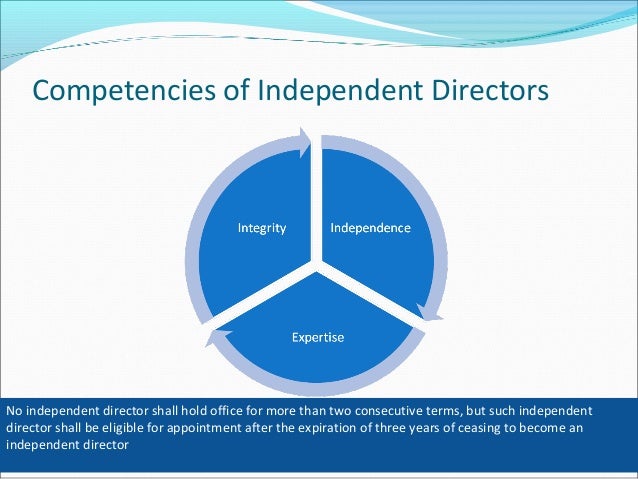
Profondément perturbés par la crise financière, les sociétés, les agences de règlementation et tous les observateurs de la gouvernance durent admettre que l’indépendance des membres du conseil et leur expérience de gestion dans des secteurs d’activités sans similarité avec l’entreprise à gouverner étaient nettement insuffisants. Ceux-ci devaient également posséder des compétences et une expérience à la mesure des enjeux et défis précis de la société qu’ils sont appelés à gouverner.Résultats de recherche d'images pour « indépendance des administrateurs »

Graduellement, pour la sélection des membres de conseil, on s’est préoccupé de leur expérience et connaissance spécifiques au type d’organisation qu’ils sont appelés à gouverner ainsi que de leur intégrité et leur fiabilité. Ainsi, l’évolution du monde de la gouvernance depuis 2008 a conforté la position de l’IGOPP et lui a donné un caractère prescient.

Toutefois, certains ont constaté que cette crédibilité pouvait être parfois difficile à concilier avec l’indépendance. En effet, si la crédibilité d’un candidat provient d’une longue expérience à œuvrer dans l’industrie à laquelle appartient la société-cible, il est bien possible que pour cette raison cette personne ne satisfasse pas à tous les desiderata d’une indépendance immaculée.

La prise de position de 2018 de l’IGOPP offre des précisions et des solutions aux nouveaux enjeux apparus depuis 2008.

Ainsi, l’IGOPP propose un net changement dans les démarches d’évaluation des conseils, dans les critères de sélection des nouveaux membres ainsi que pour l’établissement du profil de compétences recherchées.

La démarche d’évaluation du conseil

L’évaluation du conseil constitue le premier pilier d’une nécessaire réforme de la gouvernance. Cette évaluation doit répondre aux questions suivantes : le conseil est-il légitime par la façon dont les membres ont été mis en nomination? Par qui furent-ils élus ou nommés?

L‘IGOPP estime qu’une recherche de légitimité relevée et élargie pour un conseil deviendra un enjeu à plus ou moins brève échéance. Même dans le contexte juridique actuel, il est possible de s’interroger sur la qualité des démarches de mise en nomination et d’élection ainsi que du sens à donner aux variations dans le support électif reçu par les différents membres d’un conseil.

Puis, le conseil est-il crédible? L’IGOPP propose une évaluation des connaissances et de l’expérience spécifiques au type d’industries dans lequel œuvre la société que le conseil est appelé à gouverner. Il est important que la plupart des membres du conseil (tous?) possèdent des connaissances économique et financière pertinentes à ce secteur d’activités.

Un conseil d’administration n’est crédible que dans la mesure où une grande partie de ses membres peuvent soutenir un échange avec la direction sur ces aspects de performance et sur les multiples facteurs qui exercent une influence dynamique sur cette performance. Ce type de questionnement suppose, de la part du conseil, une fine et systémique compréhension du modèle d’affaires de la société.

Les critères de sélection de nouveaux membres:

Le président du conseil et le comité de gouvernance doivent s’équiper d’une grille de sélection à la mesure des enjeux actuels. Ainsi, plus de la moitié des membres doivent être indépendants et le conseil doit se préoccuper de la diversité de sa composition. Idéalement, le conseil devrait rechercher des nouveaux membres qui sont indépendants, ajoutent à la diversité du conseil et sont crédibles selon le sens donné à ce terme dans ce texte.

Toutefois, il pourra arriver qu’un conseil doive faire des arbitrages, des compromis entre ces trois qualités souhaitables pour un nouveau membre du conseil.

Si une personne par ailleurs dotée de qualités attrayantes pour le conseil ne possédait pas une expérience qui en fasse un membre crédible dès son arrivée, il faut s’assurer préalablement que celle-ci dispose du temps nécessaire, possède la formation et la rigueur intellectuelle essentielles pour acquérir en un temps raisonnable, un bon niveau de crédibilité; il est essentiel qu’un programme fait sur mesure soit mis en place pour relever rapidement la crédibilité de ce nouveau membre du conseil

Le profil d’expertise recherché:

Cette prise de position propose que le profil établi pour la recherche de nouveaux candidats pour le conseil débute par l’identification de secteurs d’activités proches de celui dans lequel œuvre la société en termes de cycle d’investissement, d’horizon temporel de gestion, de technologie, de marchés desservis (industriels, consommateurs, international), de facteurs de succès et de stratégie (leadership de coûts, différenciation/segmentation, envergure de produits).

Des dirigeants ayant une expérience de tels secteurs apprivoiseront plus rapidement les aspects essentiels d’une société œuvrant dans un secteur s’en rapprochant. Cette façon de procéder permet de concilier «indépendance» et «crédibilité».

Puis, si l’éventail des expertises au conseil indique une carence, disons, en termes de «finance», la recherche ne doit pas se limiter à identifier une personne qui fut une chef de la direction financière, mais bien une personne dont l’expérience en finance fut acquise dans le type de secteurs d’activités identifiés plus tôt. La gestion financière, des ressources humaines, des risques ou de la technologie d’information sont sans commune mesure selon que l’entreprise en est une de commerce au détail ou une minière ou une banque ou une entreprise du secteur aéronautique.

Conclusion

Notre prise de position de 2008 conserve toute sa pertinence. En fait les évènements survenus depuis 2008 appuient et confortent nos propositions d’alors. Si, à l’époque, nous étions une voix dans le désert, notre propos est maintenant sur la place publique, appuyé par des études empiriques et repris par tous ceux qui ont un peu réfléchi aux dilemmes de la gouvernance contemporaine.

Cette révision de notre prise de position de 2008 y ajoute des clarifications, aborde des enjeux devenus inévitables et veut rappeler à tous les conseils d’administration que:

«Si c’est par sa légitimité qu’un conseil acquiert le droit et l’autorité d’imposer ses volontés à la direction, c’est par sa crédibilité qu’un conseil devient créateur de valeur pour toutes les parties prenantes d’une organisation.» (Allaire, 2008).


*Ce document a été préparé et rédigé par Yvan Allaire, Ph. D. (MIT), MSRC, président exécutif, IGOPP

La gestion des notes de réunion par les administrateurs | Bonnes pratiques pour éviter les quiproquos


Aujourd’hui, je partage avec vous une lecture très inintéressante, intrigante même, sur les bonnes façons de prendre des notes et de les sécuriser lors des réunions du conseil d’administration.

Les organisations ont tout avantage à avoir une politique relative à la gestion des notes prises par les administrateurs avant, durant et après les réunions du CA.

L’auteur, David A. Katz*, fait très bien ressortir les problématiques entourant la prise de notes :

  1. Les notes sur les documents du CA
  2. Les notes électroniques
  3. Les courriels

Comme vous le constaterez, l’article présente une perspective très rigoureuse de la gestion des notes (1) pour éviter les conséquences des fuites et (2) pour se protéger en cas d’éventuelles enquêtes judiciaires.

Directors must prepare carefully for and be actively engaged during board meetings. When they leave the boardroom, it is incumbent upon directors to handle their notes and board materials in a manner that is consistent with board policy and applicable law. Directors should review the board’s record retention policy and fully commit to following it. For electronic materials, such as board portals, the retention policy should automatically function to delete notes or other annotations of the materials. The consistent application of a thoughtful and well-tailored policy is in the best interests of the company, the board, and the directors themselves.

Bonne lecture ! Et vous, quels moyens utilisez-vous pour protéger vos informations ? Vos commentaires sont les bienvenus.


Directors’ Notes: A Trap for the Unwary?


Résultats de recherche d'images pour « notes des réunions de CA »


“To take notes or not to take notes—that is the question” often asked in corporate board rooms today. As a matter of good governance, it is important that the minutes serve as the single, clear, official record of each in-person or telephonic board and committee meeting. Board materials that are circulated and discussed at the meeting should be part of the official record and either attached to the minutes or maintained in the corporate secretary’s files, as appropriate. In connection with significant transactions, board minutes will be reviewed by third parties for diligence purposes and to confirm that all appropriate (and required) actions have been taken. Moreover, these minutes will be scrutinized closely in the event that a decision taken at the board meeting is subsequently challenged in litigation or otherwise. Directors should use caution in creating or retaining any notes, texts or emails that could be considered an unofficial record of a board meeting. Directors’ notes and emails are discoverable in litigation and can confuse or even undermine the official account of the meeting in question. Various forms of notes—paper, electronic, and email—raise slightly different issues, all of which directors need to understand in advance of their creation.


Notes on Paper


Note-taking can be a useful and, for some directors, a necessary element of preparation as they review board materials in order to participate in a meeting, particularly one involving complex topics. Important documents that will be discussed during a meeting should generally be provided to directors sufficiently ahead of the meeting so that directors can review them in advance and be ready to ask questions and discuss key points at the meeting. During a meeting, some directors may jot down questions or comments as reminders to make certain that their concerns are addressed before the meeting concludes.

While note-taking can be helpful to some directors, the question becomes what to do with these notes once the meeting has concluded, or once the minutes have been finalized. Many corporate secretaries, as well as outside counsel, discourage any note-taking by directors to minimize the possibility that these notes could create issues at some future time. Directors are often counseled that the length of their deposition in any shareholder litigation will have a direct correlation to the amount of notes they have taken and retained. It is a common practice among many boards to collect all directors’ meeting notes (and copies of unneeded meeting materials) at the conclusion of a meeting so that they can be destroyed. Some boards have a policy of note destruction after the minutes have been finalized so that directors who wish to refer to their notes as they review the draft minutes can do so. This practice should be discouraged, as in the event that litigation arises after the meeting and before the notes are destroyed, the notes may need to be preserved and produced. In order to minimize the need to retain notes, in most circumstances, draft minutes should be prepared promptly after the meeting.

Some directors may feel that their notes could protect them in litigation, by demonstrating that they have been diligent and fully engaged during board meetings. However, properly-drafted minutes can serve the same purpose without the risks inherent in retaining meeting notes. In many cases, notes are informal comments or questions in document margins whose import may be easily misinterpreted by others or even misremembered by the author, since litigation may occur months after the event. Moreover, notes taken during a meeting are by nature often incomplete and cryptic. If a director annotates material with a question, but does not then write down the answer, it can appear that an issue was not fully discussed or resolved. Inconsistencies between notes and board-approved minutes can undermine the official record of the meeting and could even cause directors to become adversely positioned against each other in litigation. If a director jots down unrelated notes, such as doodles or a shopping list, these can be used to show that the director lacked diligence and attention to the matter at hand. Similarly, if a director sends numerous emails during a meeting unrelated to the matter at hand (which may be discoverable in litigation), the director may be accused of not being appropriately engaged in the matters addressed at the meeting.

Electronic Notes


There is a growing trend toward electronic delivery of board materials using portals and iPads. This environmentally friendly approach enables immediate, cost-free delivery of board materials anywhere in the world. Nonetheless, electronic documents create issues of their own, and board portals may not be the panacea that directors and corporate secretaries imagine. Because there is no natural limit to the quantum of materials that can be uploaded to the board portal, some boards will find themselves inundated with documents. Too much in the way of board materials can be as dangerous as too little. Management teams should monitor the quantum of materials to be reviewed prior to each board meeting to make sure that action items have sufficient documentation and that directors are not overwhelmed with information.

The use of electronic board portals can create other headaches for directors and corporate secretaries. Documents that are downloaded to directors’ personal computers raise security issues as well as difficulties in ensuring that the documents and related notes are deleted in accordance with company policy. Documents that are not downloadable but are read-only may be difficult or impossible to annotate, making them less useful to directors as they try to prepare for an upcoming meeting. Corporate secretaries should have specific discussions with board members to make sure that the directors are comfortable with the materials provided, that they take appropriate actions to safeguard materials, and that they refrain from creating additional documents discoverable in pending or subsequent litigation. If directors are permitted to annotate their electronic board materials, these annotations should be automatically deleted at the conclusion of the board meeting.

Chief Justice Leo Strine of the Delaware Supreme Court has raised additional concerns about online documents and electronic board portals. He observes that it is difficult to focus on materials that, unlike paper documents, are necessarily viewed on a device that contains many other distractions; and at the same time, the online data room can be monitored for access and active use. (Monitoring should be strongly discouraged, and usage should not be tracked, but this information can be automatically generated by the portal without directors’ knowledge unless this functionality is fully disabled.) Chief Justice Strine cites an example of a director, on a long flight to a board meeting, opening his computer to review board documents and ending up spending much of his time watching movies, sending emails, and attending to his primary work, rather than focusing on the board materials. If access to an online board portal can be monitored, the log later may reveal that the director spent very little time—potentially even negligently little time—reviewing the materials available. The use of electronic documents and notes should be carefully managed to avoid becoming a trap for the unwary.

Emails


Email is also used to deliver board materials, and directors often communicate with each other and with the company via email, but directors should exercise caution in using email, texts, or similar means (including mobile applications such as Messenger or WhatsApp) for substantive board business. In addition to the security issues inherent in sending emails or messages with confidential information and attachments outside the company, there are also potentially significant discovery issues. After the 2016 Yahoo! case in the Delaware Chancery Court, it is clear not only that electronically stored information is explicitly required to be produced in discovery under Delaware law, but also that if a director uses her own work or personal email account for board materials, those email accounts may be subjected to a highly intrusive search in litigation discovery. Directors should be aware that using these accounts for board business means potentially opening them up to intense and unfriendly scrutiny in litigation.

It can be particularly difficult to implement document destruction policies with respect to email. Often backups are made automatically on one or more servers, of which the director may not even be aware, and these backup copies are subject to discovery as well. Moreover, if a director conducts board business using her external business email, those emails may be subject to routine or litigation-driven searches and reviews relating to that other workplace. Although unrelated to the company on which she serves as a director, these searches could compromise the confidentiality of the company information contained therein and call into question any attorney-client privilege that would have applied.

The asymmetric use of email can also yield a distorted version of events. When emailed concerns are addressed in a subsequent phone call, there remains a record of only the concern and not its resolution, which, years later, may be forgotten or misremembered. It is a wiser practice to raise concerns in person or on the phone rather than with an email or text inquiry. The purpose of this practice is not to subvert discovery but to avoid creating an incomplete and misleading record that may be difficult to defend after the fact.


Consistency and Control


Each board should have a policy regarding directors’ notes, draft minutes, and other board documents that best serves that board’s specific needs. Policies can and will differ across companies. The key element is to implement a policy consistently, across all directors of a particular company and across time. The company should be able to rely on directors’ following the policy systematically and without exception. It will be problematic if, for example, discovery reveals that a director retained notes from every meeting except the one at which a material transaction was approved. Of course, if litigation or an investigation or audit is pending or reasonably foreseeable, directors must preserve all relevant materials, including emails, texts and notes.

Directors should make sure that they will continue to have access to minutes and board materials from the term of their directorship if necessitated by a subsequent litigation or investigation, even one commencing after their directorship has ended. Directors should not maintain their own files of notes and materials for this purpose. The creation of a personal set of documents would increase the risks of inconsistencies and other issues arising that would be to the detriment of both the director and the company.

Directors’ notes, if not properly handled, can result in unintentional waivers of privilege and violations of confidentiality obligations. In order to preserve attorney-client privilege where applicable, official minutes indicate that a lawyer was present and simply note the general topic discussed. Directors’ notes may not be annotated in the same manner and may contain more detail than is advisable; if these notes are treated carelessly, privilege may not survive. Similarly, if directors’ meeting notes are not destroyed, confidential information reflected in such notes may not be secure.

Directors must prepare carefully for and be actively engaged during board meetings. When they leave the boardroom, it is incumbent upon directors to handle their notes and board materials in a manner that is consistent with board policy and applicable law. Directors should review the board’s record retention policy and fully commit to following it. For electronic materials, such as board portals, the retention policy should automatically function to delete notes or other annotations of the materials. The consistent application of a thoughtful and well-tailored policy is in the best interests of the company, the board, and the directors themselves.

________________________________________________________________

*David A. Katz* is partner and Laura A. McIntosh is consulting attorney at Wachtell, Lipton, Rosen & Katz. This post is based on a Wachtell Lipton publication by Mr. Katz and Ms. McIntosh that originally appeared in the New York Law Journal.

Quel client les firmes d’audit servent-elles ?


Voici un article-choc publié par Chris Hughes dans la revue Bloomberg qui porte sur l’indépendance (ou le manque d’indépendance) des quatre grandes firmes d’audit dans le monde.

Il y a une sérieuse polémique eu égard à l’indépendance réelle des grandes firmes d’audit.

Cet article donne les grandes lignes de la problématique et il esquisse des avenues de solution.

Qu’en pensez-vous ?


Just Whom Does an Auditor Really Serve?


Shareholders need to be the client, not company executives.

L’une des quatre grandes firmes


British lawmakers are pushing for a full-blown antitrust probe into the country’s four big accountancy firms following the demise of U.K. construction group Carillion Plc.

The current domination of KPMG, PricewaterhouseCoopers, EY and Deloitte isn’t working for shareholders. But creating more competition among the bean counters won’t be enough on its own. The fundamental problem is who the client is. The thrust of reform should be on making auditors see that their client is the investor and not the company executive. Randgold Resources is the only FTSE 100 company not to be audited by one of the Big Four !

Carillion’s accounts weren’t completely useless. Recent annual reports contained red flags of the company’s deteriorating financial health that were apparent to the smart money. Some long funds cut their holdings and hedge funds took large short positions, as my colleague Chris Bryant points out.

If the evidence was there to those who looked hard, it’s odd that the company was given a clean bill of health from accountancy firm KPMG months before it went bust. The impression is that auditors are on the side of the company rather than the shareholder. (KPMG says it believes it conducted its audit appropriately.)

Would more competition have made a difference? Companies may have only one accountant available if the few competing firms are already working for a rival. A lack of choice in any market usually leads to lower quality.

One response would be to force the Big Four to shed clients to mid-tier firms, creating a Big Five or Big Six. The risk is this greater competition just leads to a race to the bottom on fees with no improvement in quality. Other remedies are needed first.

The combination of audit and more lucrative consultancy work has long been chided – with good reason. Consultancy creates a client-pleasing culture. That’s at odds with the auditor’s role in challenging the assumptions behind company statements.

Opponents of a separation say combining the two services helps attract talent. This is a weak argument. Further lowering the current cap on consultancy fees, or completely separating audit and consultancy, is hard to argue with.

The accountancy firm should clearly serve the non-executive directors on the company’s audit committee which, in turn, is charged with looking out for shareholders. The risk is that the auditor’s main point of contact is the executive in the form of the chief financial officer.

Shareholders already have a vote on the appointment of the auditor. But annual reports could provide more useful disclosure on the frequency and depth of the last year’s contact between the firm and the audit committee, and between the latter and shareholders.

Now consider the nature of the job itself. Companies present the accounts, auditors check them. Out pops a financial statement that gives the false impression of extreme precision. Numbers that are the based on assumptions might be better presented as a range, accompanied by a critique of the judgments applied by the company.

Creating more big audit firms may create upward pressure on quality. But so long as they aren’t incentivized to have shareholders front of mind, it won’t be a long wait for the next Carillion.

__________________________________________________________

This column does not necessarily reflect the opinion of the editorial board or Bloomberg LP and its owners.

L’évaluation du conseil d’administration et des administrateurs | Une activité essentielle


Il y a quelques années, j’ai publié, en collaboration avec Geoffrey KIEL et James BECK (1), un guide pratique des questions clés que les conseils d’administration devraient prendre en considération lorsqu’ils planifient une évaluation du conseil d’administration.

Cet article est toujours d’actualité ; il met l’accent sur l’utilité d’avoir des évaluations bien menées ainsi que sur les sept étapes à suivre pour obtenir des évaluations efficaces. Vous pouvez consulter cet article sur mon blogue : « SEPT ÉTAPES À SUIVRE POUR DES ÉVALUATIONS EFFICACES D’UN CONSEIL D’ADMINISTRATION ET DES ADMINISTRATEURS ».

Récemment, les auteurs Geoffrey KIEL* et James BECK, ont publié un livre sur l’importance de l’évaluation du conseil d’administration dans une perspective de valeur ajoutée : « Reviewing Your Board—A Guide to Board and Director Evaluation ».

Après avoir brossé un tableau de la progression très marquée de l’activité d’évaluation, les auteurs reviennent sur l’approche conceptuelle idéale à adopter.

Je vous invite à prendre connaissance de cette documentation afin de valider la portée de cette activité qui relève du comité de gouvernance.

Bonne lecture !


Board Performance Evaluations that Add Value


Résultats de recherche d'images pour « évaluation du fonctionnement du conseil d'administration »


Annual board evaluations are now commonplace for both for-profit and non-profit organizations, with specific board evaluation recommendations forming a key component in nearly every major corporate governance standard, review or report internationally.

Recent data on US boards from the global consulting firm Spencer Stuart shows that 98% of S&P 500 boards conduct a board evaluation of some type, although only about a third review the board as a whole, individual directors and committees as part of the process. [1] In the UK, the majority of boards on the FTSE 150 conduct board reviews, with 60.7% conducting their evaluations internally, while 38% of boards used an external facilitator. [2] Encouragingly, PwC reports that in 2017 68% of public company directors in the US say that the board has taken action based on the results of their last board review, which was an increase on the 49% from PwC’s survey in 2016. [3]

In a cross sector review of board effectiveness by the UK arm of Grant Thornton, more than 60% off those surveyed agreed or strongly agreed that there were “adequate processes in place to evaluate the performance of the whole board.” [4] But are “adequate processes” good enough? For example, adequate processes might mean a perfunctory activity is conducted annually to meet listing requirements or pay lip service to best practice governance. And what about the 40% of boards in the UK survey that do not have adequate processes?

Our experience, having been involved in many board evaluations in large and small, for-profit and non-profit organisations, is that the effectiveness of board reviews ranges from counterproductive exercises, which exacerbate already fractious and poorly performing boards, to truly transformational change leading to superior governance and organisational outcomes. Further, our experience suggests that understanding the relative advantages and disadvantages of the different types of board reviews, and properly planning and implementing the board’s evaluation significantly increases the likelihood of positive outcomes.


A seven step framework for board evaluations


We wrote our recently released book, Reviewing Your Board—A Guide to Board and Director Evaluation, to address this need for more information about board and director evaluations to give boards and their directors the opportunity to think about board evaluations and how they can be carried out to add—rather than subtract—value to the organization.

Our approach to effective board and director evaluations uses a seven-step framework (see Figure 1) that asks the vital questions all boards should consider when planning an evaluation. [5] While these questions must be asked for all board evaluations, the combined answers can be quite different. Thus, although the seven questions may be common to each, the subsequent review processes can range markedly in their scope, complexity and cost. Further, while our framework is described sequentially, in practice, most boards will not follow such a linear process.


Figure 1

Framework for a board evaluation


Source: Kiel, et al., 2018, p. 4


1. What are our objectives?


The first (and, in our opinion, most important) aspect of any evaluation is establishing why the board is doing it. The primary motivation can be characterized as “conformance” or “value adding”:

– conformance focuses on meeting the expectations of external scrutiny through compliance with various laws and following appropriate governance standards—whether mandated or self-imposed; and

– value adding focuses on improving both organizational and board performance. For example, taking proactive steps to ensure the board is effective in bringing new talent into the boardroom to maintain a proper mix of skills.

In practice, most board reviews will be aimed at meeting both conformance and value-adding objectives.

Without a solid rationale shared by the directors, any evaluation is likely to meet resistance and/or fail. There are many aspects of its performance the board may wish to evaluate. Apart from a desire to contribute to firm performance, many boards feel that regular evaluation contributes significantly to group processes within the board. A regular board review can indicate potential problems or differences of opinion that can be addressed before they become a source of conflict.

Generally, the answer to the first question in the seven-step framework will fall into one of the following two categories:

– organizational leadership, e.g., “We want to clearly demonstrate our commitment to performance management”; or

– problem resolution, e.g., “We do not seem to have the appropriate skills, competencies or motivation on the board”.

Clearly identified objectives enable the board to set specific goals for the evaluation and make decisions about the scope of the review; e.g., the approach the board will take, how many people will be involved, how much time and money will be allocated.


2. Who will be evaluated?


Comprehensive governance evaluations can entail reviewing the performance of a wide range of individuals and groups. Boards need to consider three groups:

– the board as whole (including committees);

– individual directors (including the role of the chair); and

– key governance personnel (generally the CEO and corporate/company secretary).

Considerations such as cost or time constraints, however, may prevent reviewing all three groups.

Alternatively, a board may have a very specific objective for the review process that does not require the review of all individuals and groups identified. In both cases, an effective evaluation requires the board to select the most appropriate individuals or groups to review, based on its objectives.


3. What will be evaluated?


The third stage in establishing a framework for a board evaluation involves deciding the criteria for the evaluation process. This is necessary whether the board is seeking general or specific performance improvements, and will suit boards seeking to improve areas as diverse as board processes, director skills, competencies and motivation, or even boardroom relationships.

To cover the range of objectives the board may have, including meeting any compliance requirements, board evaluations generally use some form of leading practice framework, such as the National Association of Corporate Directors’ Key Agreed Principles [6]or the Business Roundtable Principles of Corporate Governance[7] Of course, a comprehensive list of areas for investigation will need to be balanced with the scope of the evaluation and the resources available for the process. At this stage, a realistic assessment of the resources available, a component of which is the time availability of directors and other key governance personnel, can be made.


4. Who will be asked?


The vast majority of board and director evaluations concentrate exclusively on the board as the sole sources of information for the evaluation process. However, this discounts other potentially rich sources of feedback. Participants in the evaluation can be drawn from within or from outside the organization. Internally, directors, the CEO, senior executives and, in some cases, other management personnel and employees may be able to provide useful feedback on elements of the governance system. Externally, depending on the ownership structure, shareholders may provide valuable data for the review. Similarly, in some situations, key stakeholders such as government departments or agencies, major clients and suppliers may have close links with the board and be in a position to provide useful information on its performance.


5. What techniques will be used?


Depending on the degree of formality, the objectives of the evaluation, and the resources available, boards may choose between a range of qualitative and quantitative techniques. Quantitative data are in the form of numbers. They can be used to answer questions of “how much” or “how many”. Questionnaire-based surveys are by far the most common form of quantitative technique used in board evaluations and can be an important information-gathering tool.

Questions of “what”, “how”, and “why” require qualitative research methods. The three main methods used for collecting qualitative data are:

  1. Interviews, either one-on-one or in small groups, provide an excellent way of assessing directors’ perceptions, meaning and constructions of reality by asking for information in a way that allows them to express themselves in their own terms;
  2. Board meeting observation is especially useful when the evaluation objectives relate to issues of boardroom dynamics or relationships between individuals; and
  3. Document analysis of board packs, governance policies and similar can also be a rich source of information to identify areas of improvement in board processes.

When the board evaluation’s objectives are to identify governance issues, qualitative research is particularly useful. Qualitative data does, however, have several drawbacks. The major one being that interpreting the results requires judgment and experience on the part of the person undertaking the review and analysis.

There is no best methodology. Research techniques need to be adapted to the evaluation objectives and board context. However, there are advantages to be gained from combining a questionnaire with interviews. The questionnaire (most often delivered online) allows directors to benchmark the board along a series of dimensions (e.g. very poor to very good; 1 to 5; etc.), which allows directors to see where they have differing viewpoints from other directors. This can then be followed-up by interviews to allow directors to provide further context to the topics covered in the questionnaire and to raise areas of concern not covered in the survey.


6. Who will do the evaluation?


Who conducts the evaluation process will depend on whether the review is to be conducted internally or externally and what methodology is chosen. Internal reviews are conducted within the organization, either by one or more directors or governance personnel such as the corporate secretary. External reviews are conducted by external parties, most often either specialist consulting firms in corporate governance, large generalist consulting firms or law firms.

Internal reviews are more likely to provide board members with confidence surrounding the confidentiality of the process and are likely to cost less. All of these are important considerations when making the decision.

There are, however, several limitations to an internally conducted review. The internal reviewer may lack the skills required (e.g., interview technique, survey design), they are likely to have a bias (often unconscious) that carries over into the assessment and it is a less transparent process where the review process is carried out by one of the board’s own. Perhaps most significantly, the review is likely to achieve little if the reviewer (e.g., the chair) is the source of the problems or it may not be appropriate given the objectives of the review.

An external facilitator can offer a number of advantages including that:

– a good external facilitator is more likely to have undertaken a significant number of reviews and will often provide important insights into techniques, comparison points and new ideas;

– an external party often aids transparency and objectivity;

– a good external party can play a mediating role for boards facing sensitive issues through being the messenger for difficult matters involving group dynamics and egos.

Ultimately, factors such as the complexity of the governance problems faced, the experience of the board and cost considerations will determine whether the board decides to conduct the evaluation internally or seek external advice. However, it is now becoming more and more common for boards to alternate between an internal review one year and an external review the next.


7. What will we do with the results?


The evaluation’s objectives should be the determining factor when deciding to whom the results will be released. Most often, the board’s central objective will be to agree a series of actions that it can take to improve governance. Since the effectiveness of the governance system relies on people within the organization, communicating the results to all directors and key governance personnel is critical for boards seeking performance improvement. Where the objective of the board evaluation is to assess the quality of board—management relationships, a summary of the evaluation may also be shared with the senior management team.

If the board wishes to build its reputation for transparency and/or to develop relationships with external stakeholders, a positive, focused board evaluation is an excellent way of demonstrating that it is serious about governance and is committed to improving its performance. Obviously, when considering what information to communicate externally, a balance needs to be struck between transparency on the one hand and the need for shareholders and other external stakeholders to retain faith in the board’s ability and effectiveness on the other hand. Such communication outline how the evaluation was conducted (e.g. internal or external review), the focus of the review (e.g. role fulfilment) and, perhaps, some of the major outcomes (e.g. identified need to further focus on strategy or requirements for new skills on the board).

In communicating board review outcomes, it should be remembered that the confidentiality of the process contributes significantly to full and frank insights being provided by participants and provides the board with defensible results. As such, director confidentiality must be protected.


Implementing the outcomes


Once the annual performance evaluation is over, the board’s attention will move on to other issues and any stimulus for change that may have come when the results were first delivered can dissolve. Worse still, directors along with any executives who participated in the process will feel the evaluation has been a waste of their valuable time if recommendations for improvement were accepted, but not acted on. Therefore, it is critical that any agreed actions that come out of an evaluation are implemented and monitored. Many boards include a review of action steps as an agenda item to be tracked at each meeting. Milestones can be established for the achievement of the action plans and progress reviewed until all agreed changes have been implemented.


Other approaches to board evaluation


There are a number of different approaches to evaluating board performance that may better suit a board’s objectives and differ from the “traditional” board, individual director (self and peer), chair or committee evaluations. For example, board skills assessment and board maturity assessment all serve a different purpose and can bring about significant improvements to the board’s performance if appropriately implemented.

If the board’s primary objective in undertaking a review of its performance is to focus on the current and required skills of the board, a dedicated skills analysis rather than a board evaluation would be the best way to identify the skills that currently exist on the board and consequently, highlight any skills gaps.

More recently, a new type of board review is being used, board maturity assessment. Maturity assessments involve benchmarking the board against what is regarded as good practice. Maturity models have become popular in several management disciplines. They involve establishing different levels of practice from “basic” to “advanced” over the key functions of an activity, based on contemporary views of best practice. In corporate governance, the key functions include the role of the board in relation to the CEO, risk practices, compliance, the conduct of board meetings, effective use of board committees, and so on. The governance activity of the organization in all these governance dimensions is then assessed by an external evaluator experienced in corporate governance against the maturity model to provide a current maturity rating. Directors’ views can be part of the process, with directors indicating what level of maturity is desirable for the organization given its circumstances. Looking at the gaps between the current level of governance practice and the appropriate level as agreed by directors shows where better practice may be implemented. This approach also has the benefit of indirectly educating directors as to what is good governance practice.


Conclusion


Performance evaluation is an increasingly important feature of boardrooms across the globe. These reviews have benefits for individual directors, boards and the organizations for which they work. Boards also need to recognize that the evaluation process is an effective team-building, ethics-shaping activity. Our observation is that boards often neglect the process of engagement when undertaking evaluations; unfortunately, boards that fail to engage their members are missing a major opportunity for developing a shared set of board norms and inculcating a positive board and organizational culture. In short, the process is as important as the content.

______________________________________________________________-

Endnotes

1Spencer Stuart, 2017 Spencer Stuart US Board Indexwww.spencerstuart.com/research-and-insight/ssbi-2017, accessed 7 March 2018.(go back)

2Spencer Stuart, 2017 Spencer Stuart UK Board Indexwww.spencerstuart.com/research-and-insight/uk-board-index-2017, accessed 7 March 2018.(go back)

3 PwC, 2017 Annual Corporate Directors Surveyhttps://www.pwc.com/us/en/governance-insights-center/annual-corporate-directors-survey/assets/pwc-2017-annual-corporate–directors–survey.pdf, accessed 7 March 2018.(go back)

4Grant Thornton UK, 2017, The Board: creating and protecting valuehttps://www.grantthornton.co.uk/globalassets/1.-member-firms/united-kingdom/pdf/publication/board-effectiveness-report-2017.pdf, accessed 8 March 2018, p 10(go back)

5G Kiel, G Nicholson, J Tunny, and J Beck, 2018, Reviewing Your Board: A Guide to Board and Director Evaluation, Australian Institute of Company Directors, Sydney.(go back)

6National Association of Corporate Directors (NACD), 2011, Key Agreed Principleshttps://www.nacdonline.org/files/PDF/KEY%20AGREED%20PRINCIPLES%202011.pdf, accessed 1 May 2018.(go back)

7Business Roundtable, 2016, Business Roundtable Principles of Corporate Governancehttps://businessroundtable.org/sites/default/files/Principles-of-Corporate-Governance-2016.pdf, accessed 1 May 2018.(go back)

___________________________________________________

*Professor Geoffrey Kiel is a Specialist Advisor and James Beck is Managing Director at Effective Governance Pty Ltd. This post is based on an Effective Governance publication by Prof. Kiel and Mr. Beck.

(1) Geoffrey KIEL, James BECK et Jacques GRISÉ (1) Geoffrey Kiel, Ph.D., premier vice-chancelier délégué et doyen de l’École d’administration, University of Notre Dame, Australie, et président de la société Effective Governance Pty Ltd, James Beck, directeur général, Effective Governance Pty Ltd, Jacques Grisé, Ph.D., F.Adm.A., collaborateur spécial du Collège des administrateurs de sociétés (CAS), Faculté des sciences de l’administration, Université Laval, Québec.

Conséquences à la non-divulgation d’une cyberattaque majeure


Quelles sont les conséquences de ne pas divulguer une intrusion importante du système de sécurité informatique ?

Les auteurs, Matthew C. Solomon* et Pamela L. Marcogliese, dans un billet publié sur le forum du HLS, ont étudié de près la situation des manquements à la sécurité informatique de Yahoo et ils nous présentent les conséquences de la non-divulgation d’attaques cybernétiques et de bris à la sécurité des informations des clients.

Ils exposent le cas très clairement, puis ils s’attardent aux modalités des arrangements financiers avec la Securities and Exchange Commission (SEC). 

Comme ce sont des événements susceptibles de se produire de plus en plus, il importe que les entreprises soient bien au fait de ce qui les attend en cas de violation des obligations de divulgation.

Les auteurs font les cinq (5) constats suivants eu égard à la situation vécue par Yahoo :


— First, public companies should take seriously the SEC’s repeated warnings that one of its top priorities is ensuring that public companies meet their obligations to adequately disclose material cybersecurity incidents and risks. This requires regular assessment of cyber incidents and risks in light of the company’s disclosures, with the assistance of outside counsel and auditors as appropriate, and ensuring that there are adequate disclosure controls in place for such incidents and risks.

— Second, the SEC’s recently released interpretive guidance on cybersecurity disclosure is an important guidepost for all companies with such disclosure obligations. The guidance specifically cited the fact that the SEC views disclosure that a company is subject to future cybersecurity attacks as inadequate if the company had already suffered such incidents. Notably, the Yahoo settlement specifically faulted the company for this precise inadequacy in its disclosures. Similarly, the recent guidance encouraged companies to adopt comprehensive policies and procedures related to cybersecurity and to assess their compliance regularly, including the sufficiency of their disclosure controls and procedures as they relate to cybersecurity disclosure. The Yahoo settlement also found that the company had inadequate such controls.

— Third, at the same time the SEC announced the settlement, it took care to emphasize that “[w]e do not second-guess good faith exercises of judgment about cyber-incident disclosure.” [7] The SEC went on to note that Yahoo failed to meet this standard with respect to the 2014 Breach, but by articulating a “good faith” standard the SEC likely meant to send a message to the broader market that it is not seeking to penalize companies that make reasonable efforts to meet their cyber disclosure obligations.

— Fourth, it is also notable that the SEC charges did not include allegations that Yahoo violated securities laws with respect to the 2013 Breach. Yahoo had promptly disclosed the 2013 Breach after learning about it in late 2016, but updated its disclosure almost a year later with significant new information about the scope of the breach. The SEC’s recent guidance indicated that it was mindful that some material facts may not be available at the time of the initial disclosure, as was apparently the case with respect to the 2013 Breach. [8] At the same time, the SEC cautioned that “an ongoing internal or external investigation – which often can be lengthy – would not on its own provide a basis for avoiding disclosures of a material cybersecurity incident.” [9]

— Finally, it is worth noting that the Commission did not insist on settlements with any individuals. Companies, of course, can only commit securities violations through the actions of their employees. While it is not unusual for the Commission to settle entity-only cases on a “collective negligence” theory, the SEC Chair and the Enforcement Division’s leadership have emphasized the need to hold individuals accountable in order to maximize the deterrent impact of SEC actions. [10]


Bonne lecture !


Failure to Disclose a Cybersecurity Breach


Résultats de recherche d'images pour « yahoo data breach »


On April 24, 2018, Altaba, formerly known as Yahoo, entered into a settlement with the Securities and Exchange Commission (the “SEC”), pursuant to which Altaba agreed to pay $35 million to resolve allegations that Yahoo violated federal securities laws in connection with the disclosure of the 2014 data breach of its user database. The case represents the first time a public company has been charged by the SEC for failing to adequately disclose a cyber breach, an area that is expected to face continued heightened scrutiny as enforcement authorities and the public are increasingly focused on the actions taken by companies in response to such incidents. Altaba’s settlement with the SEC, coming on the heels of its agreement to pay $80 million to civil class action plaintiffs alleging similar disclosure violations, underscores the increasing potential legal exposure for companies based on failing to properly disclose cybersecurity risks and incidents.

Background

As alleged, Yahoo learned in late 2014 that it had recently suffered a data breach affecting over 500 million user accounts (the “2014 Breach”). Yahoo did not disclose the 2014 Breach until September 2016. During the time period Yahoo was aware of the undisclosed breach, it entered into negotiations to be acquired by Verizon and finalized a stock purchase agreement in July 2016, two months prior to the disclosure of the 2014 Breach. Following the disclosure in September 2016, Yahoo’s stock price dropped 3% and it later renegotiated the stock purchase agreement to reduce the price paid for Yahoo’s operating business by $350 million.

In or about late 2016, following its disclosure of the 2014 Breach, Yahoo learned about a separate breach that had taken place in August 2013 and promptly announced that such breach had affected 1 billion users (the “2013 Breach”). In October 2017, Yahoo updated its disclosure concerning the 2013 Breach, announcing that it now believed that all 3 billion of its accounts had been affected.

The Settlement

Altaba’s SEC settlement centered on the 2014 Breach only. The SEC found that despite learning of the 2014 Breach in late 2014—which resulted in the theft of as many as 500 million of its users’ Yahoo usernames, email addresses, telephone numbers, dates of birth, hashed passwords, and security questions and answers, referred to internally as Yahoo’s “crown jewels”— Yahoo failed to timely disclose the material cybersecurity incident in any of its public securities filings until September 2016. Although Yahoo senior management and relevant legal staff were made aware of the 2014 Breach, according to the SEC, they “did not properly assess the scope, business impact, or legal implications of the breach, including how and where the breach should have been disclosed in Yahoo’s public filings or whether the fact of the breach rendered, or would render, any statements made by Yahoo in its public filings misleading.” [1] The SEC also faulted Yahoo’s senior management and legal staff because they “did not share information regarding the breach with Yahoo’s auditors or outside counsel in order to assess the company’s disclosure obligations in its public filings.” [2]

Among other things, the SEC found that Yahoo’s risk factor disclosures in its annual and quarterly reports from 2014 through 2016 were materially misleading in that they claimed the company only faced the risk of potential future data breaches, without disclosing that “a massive data breach” had in fact already occurred. [3]

The SEC also alleged that Yahoo management’s discussion and analysis of financial condition and results of operations (“MD&A”) in those reports was also misleading to the extent it omitted known trends or uncertainties with regard to liquidity or net revenue presented by the 2014 Breach. [4]Finally, the SEC further found that Yahoo did not maintain adequate disclosure controls and procedures designed to ensure that reports from Yahoo’s information security team raising actual incidents of the theft of user data, or the significant risk of theft of user data, were properly and timely assessed to determine how and where data breaches should be disclosed in Yahoo’s public filings. [5]

Based on these allegations, the SEC found that Yahoo violated Sections 17(a)(2) and 17(a)(3) of the Securities Act and Section 13(a) of the Securities Exchange Act. [6] To settle the charges, Altaba, without admitting or denying liability, agreed to cease and desist from any further violations of the federal securities laws and pay a civil penalty of $35 million.

Takeaways

There are several important takeaways from the settlement:

— First, public companies should take seriously the SEC’s repeated warnings that one of its top priorities is ensuring that public companies meet their obligations to adequately disclose material cybersecurity incidents and risks. This requires regular assessment of cyber incidents and risks in light of the company’s disclosures, with the assistance of outside counsel and auditors as appropriate, and ensuring that there are adequate disclosure controls in place for such incidents and risks.

— Second, the SEC’s recently released interpretive guidance on cybersecurity disclosure is an important guidepost for all companies with such disclosure obligations. The guidance specifically cited the fact that the SEC views disclosure that a company is subject to future cybersecurity attacks as inadequate if the company had already suffered such incidents. Notably, the Yahoo settlement specifically faulted the company for this precise inadequacy in its disclosures. Similarly, the recent guidance encouraged companies to adopt comprehensive policies and procedures related to cybersecurity and to assess their compliance regularly, including the sufficiency of their disclosure controls and procedures as they relate to cybersecurity disclosure. The Yahoo settlement also found that the company had inadequate such controls.

— Third, at the same time the SEC announced the settlement, it took care to emphasize that “[w]e do not second-guess good faith exercises of judgment about cyber-incident disclosure.” [7] The SEC went on to note that Yahoo failed to meet this standard with respect to the 2014 Breach, but by articulating a “good faith” standard the SEC likely meant to send a message to the broader market that it is not seeking to penalize companies that make reasonable efforts to meet their cyber disclosure obligations.

— Fourth, it is also notable that the SEC charges did not include allegations that Yahoo violated securities laws with respect to the 2013 Breach. Yahoo had promptly disclosed the 2013 Breach after learning about it in late 2016, but updated its disclosure almost a year later with significant new information about the scope of the breach. The SEC’s recent guidance indicated that it was mindful that some material facts may not be available at the time of the initial disclosure, as was apparently the case with respect to the 2013 Breach. [8] At the same time, the SEC cautioned that “an ongoing internal or external investigation – which often can be lengthy – would not on its own provide a basis for avoiding disclosures of a material cybersecurity incident.” [9]

— Finally, it is worth noting that the Commission did not insist on settlements with any individuals. Companies, of course, can only commit securities violations through the actions of their employees. While it is not unusual for the Commission to settle entity-only cases on a “collective negligence” theory, the SEC Chair and the Enforcement Division’s leadership have emphasized the need to hold individuals accountable in order to maximize the deterrent impact of SEC actions. [10]

_________________________________________________________________________

Endnotes

1Altaba Inc., f/d/b/a Yahoo! Inc., Securities Act Release No. 10485, Exchange Act Release No. 83096, Accounting and Auditing Enforcement Release No. 3937, Administrative Proceeding File No. 3937 (Apr. 24, 2018) at ¶ 14.(go back)

2Idat ¶ 15.(go back)

3Idat ¶¶ 2, 16.(go back)

4Id.(go back)

5Idat ¶ 15.(go back)

6Idat ¶¶ 22-23.(go back)

7Press Release, SEC, Altaba, Formerly Known As Yahoo!, Charged With Failing to Disclose Massive Cybersecurity Breach; Agrees To Pay $35 Million (Apr. 24, 2018), https://www.sec.gov/news/press-release/2018-71.(go back)

8As we have previously discussed, the federal securities laws do not impose a general affirmative duty on public companies to continuously disclose material information and, as acknowledged in Footnote 37 of the interpretive guidance, circuits are split on whether a duty to update exists. However, in circuits where a duty to update has been found to exist, a distinction has often been drawn between statements of a policy nature that are within the company’s control and statements describing then current facts that would be expected to change over time. The former have been held subject to a duty to update while the latter have not. See In re Advanta Corp. Securities Litigation, 180 F.3d 525, 536 (3d Cir. 1997) (“[T]he voluntary disclosure of an ordinary earnings forecast does not trigger any duty to update.”); In re Burlington Coat Factory Securities Litigation, 114 F.3d 1410, 1433 (3d Cir. 1997); In re Duane Reade Inc. Securities Litigation, No. 02 Civ. 6478 (NRB), 2003 WL 22801416, at *7 (S.D.N.Y. Nov. 25, 2003), aff’d sub nom. Nardoff v. Duane Reade, Inc., 107 F. App’x 250 (2d Cir. 2004) (“‘company has no duty to update forward–looking statements merely because changing circumstances have proven them wrong.’”).(go back)

9See SEC, Commission Statement and Guidance on Public Company Cybersecurity Disclosures, 83 Fed. Reg 8166, 8169 (Feb. 26, 2018), https://www.federalregister.gov/documents/2018/02/26/2018-03858/commission-statement-and-guidance-on-public- company-cybersecurity-disclosures.(go back)

10See, e.g., Steven R. Peikin, Co-Director, Div. Enf’t., SEC, Reflections on the Past, Present, and Future of the SEC’s Enforcement of the Foreign Corrupt Practices Act, Keynote Address at N.Y.U. Program on Corporate Law and Enforcement Conference: No Turning Back: 40 Years of the FCAP and 20 Years of the OECD Anti-Bribery Convention Impacts, Achievements, and Future Challenges (Nov. 9, 2017), https://www.sec.gov/news/speech/speech-peikin2017-11-09;
SEC Div. Enf’t., Annual Report A Look Back at Fiscal Year 2017, at 2 (Nov. 15, 2017), https://www.sec.gov/files/enforcement-annual-report2017.pdf.(go back)

_______________________________________________________________________

*Matthew C. Solomon and Pamela L. Marcogliese are partners and Rahul Mukhi is counsel at Cleary Gottlieb Steen & Hamilton LLP. This post is based on a Cleary Gottlieb publication by Mr. Solomon, Ms. Marcogliese, Ms. Mukhi, and Kal Blassberger.

L’évolution du statut d’administrateur indépendant en 2017 | EY


Comment a évolué la situation du statut d’indépendance des administrateurs en 2017 ?

La publication d’EY est très intéressante à cet égard ; elle tente de répondre à cette question et elle brosse un tableau de la composition des conseils d’administration en 2017.

L’étude effectuée par l’équipe de Steve W. Klemash* auprès des entreprises du Fortune 100 montre clairement l’importance accrue accordée au critère d’administrateur indépendant au fil des ans.

Ainsi, au cours des deux dernières années, 80 % des administrateurs nommés par les actionnaires avaient la qualité d’administrateurs indépendants.

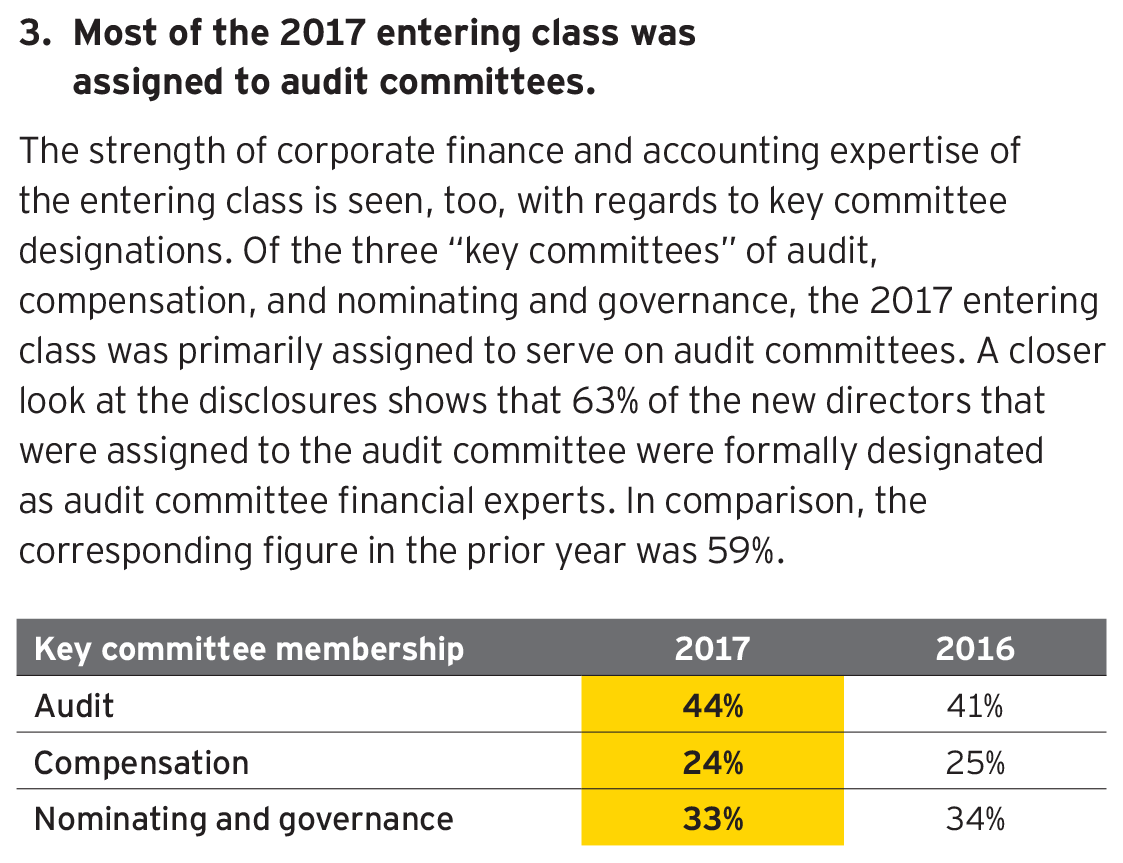
La plupart des nouveaux administrateurs avaient une expertise en finance et comptabilité et 44 % de ceux-ci ont été nommés sur le comité d’audit.

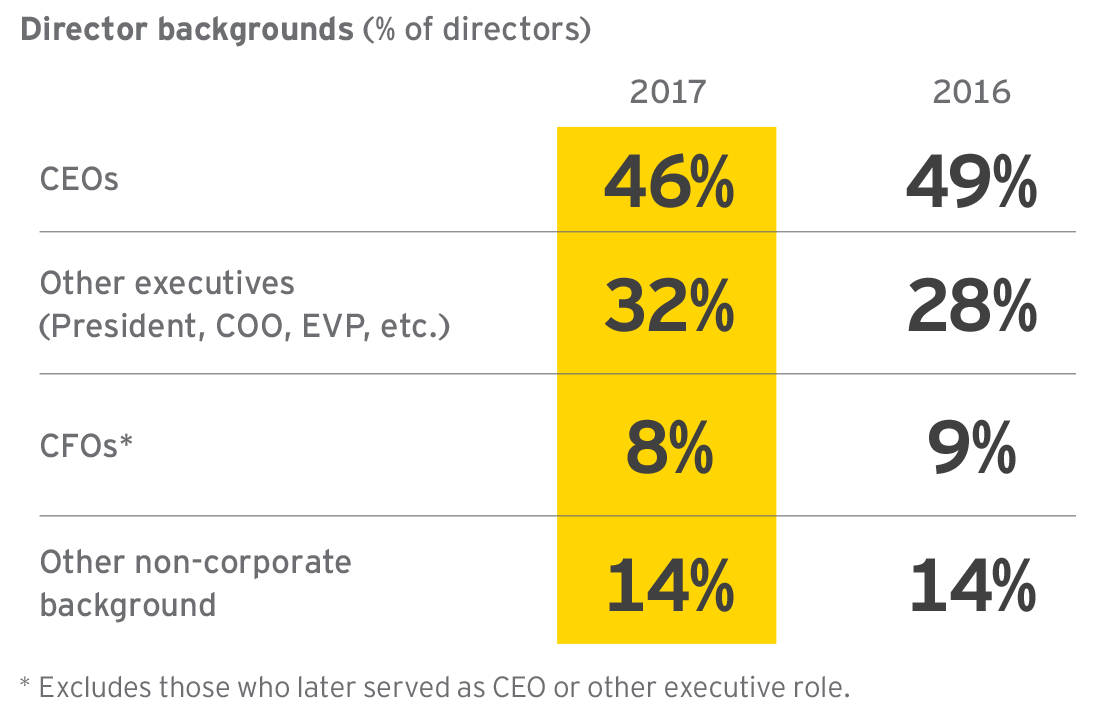
Cette année, 54 % des nouveaux arrivants étaient des personnes qui n’étaient pas CEO, comparativement à 51 % l’année précédente.

On compte 40 % de femmes parmi les nouveaux administrateurs en 2017.

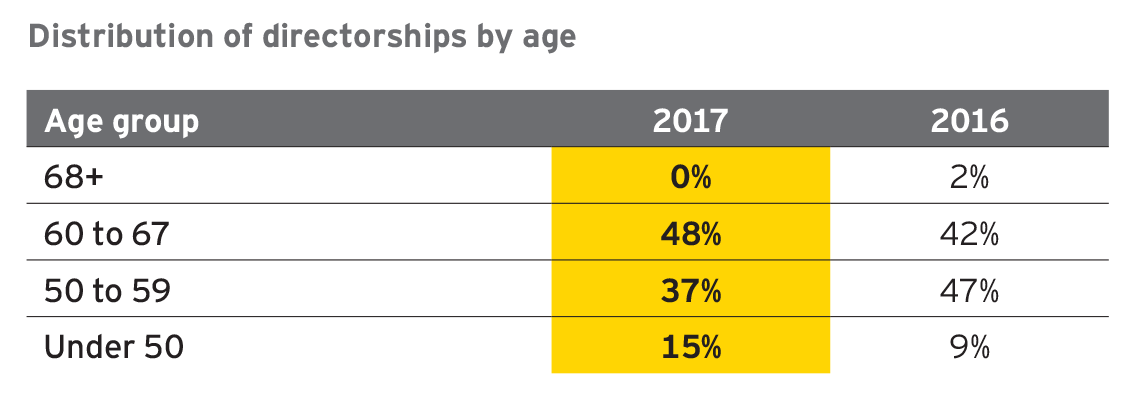
Également, les nouveaux administrateurs sont plus jeunes : 15 % ont moins de 50 ans comparativement à 9 % l’année précédente. De plus, 85 % des nouveaux administrateurs avaient entre 50 ans et 67 ans.

Les entreprises recherchent une plus grande diversité de profils d’origine, d’expertises, d’habiletés et d’expériences.

J’ai tenté de résumer les principales conclusions de cette étude. Je vous renvoie à l’étude originale afin d’en connaître les détails.

Bonne lecture ! Vos commentaires sont les bienvenus.


Independent Directors: New Class of 2017


Résultats de recherche d'images pour « independant director »


Companies are continuing to bring fresh and diverse perspectives into the boardroom and to enhance alignment of board composition with their forward-looking strategies.

In our second annual report, we share the results of our analysis of independent directors who were elected by shareholders to the board of a Fortune 100 company for the first time in 2017—what we refer to as the “new class of 2017.”

We looked at corporate disclosures to see what qualifications and characteristics were specifically highlighted, showcasing what this new class of directors brings to the boardroom. Our research was based on a review of proxy statements filed by companies on the 2017 Fortune 100 list. We also reviewed the same 83 companies’ class of 2016 directors to provide consistency in year-on-year comparisons.


Our perspective


What we’re hearing in the market is that boards are seeking slates of candidates who bring a diverse perspective and a range of functional expertise, including on complex, evolving areas such as digital transformation, e-commerce, public policy, regulation and talent management. As a result, boards are increasingly considering highly qualified, nontraditional candidates, such as non-CEOs, as well as individuals from a wider range of backgrounds. These developments are expanding the short lists of potential director candidates.

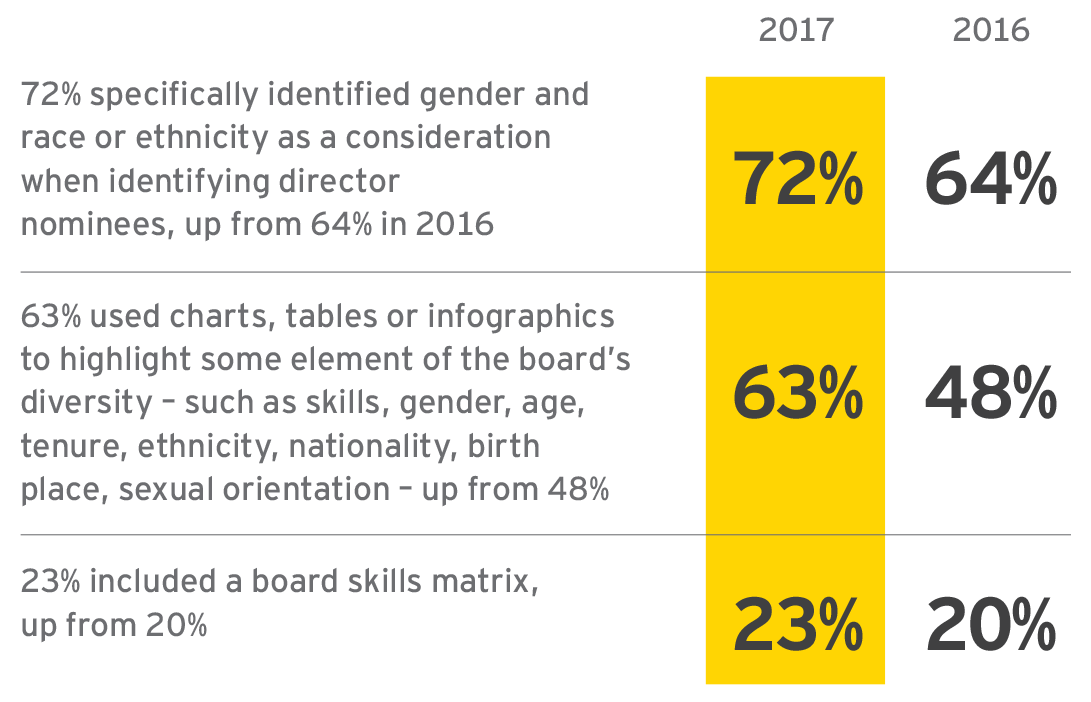
At the same time, companies are expanding voluntary disclosures around board composition. Our review of Fortune 100 disclosures around board composition found that:

While diverse director candidates are in high demand and related shifts in board composition are underway, these developments may be slow to manifest. For example, consider that the average Fortune 100 board has 10 seats. In this context, the addition of a single new director is unlikely to dramatically shift averages in terms of gender diversity, age, tenure or other considerations.

That said, whether a board’s pace of change is sufficient depends on a company’s specific circumstances and evolving board oversight needs. Boards should challenge their approach to refreshment, asking whether they are meeting the company’s diversity, strategy and risk oversight needs. Waiting for an open seat to nominate a diverse candidate may mean waiting for the value that diversity could bring.

In 2018, we anticipate that companies will continue to offer more voluntary disclosure on board composition, showing how their directors represent the best mix of individuals for the company—across multiple dimensions, including a diversity of backgrounds, expertise, skill sets and experiences.


Key findings

1. Most Fortune 100 companies welcomed a new independent director in 2017


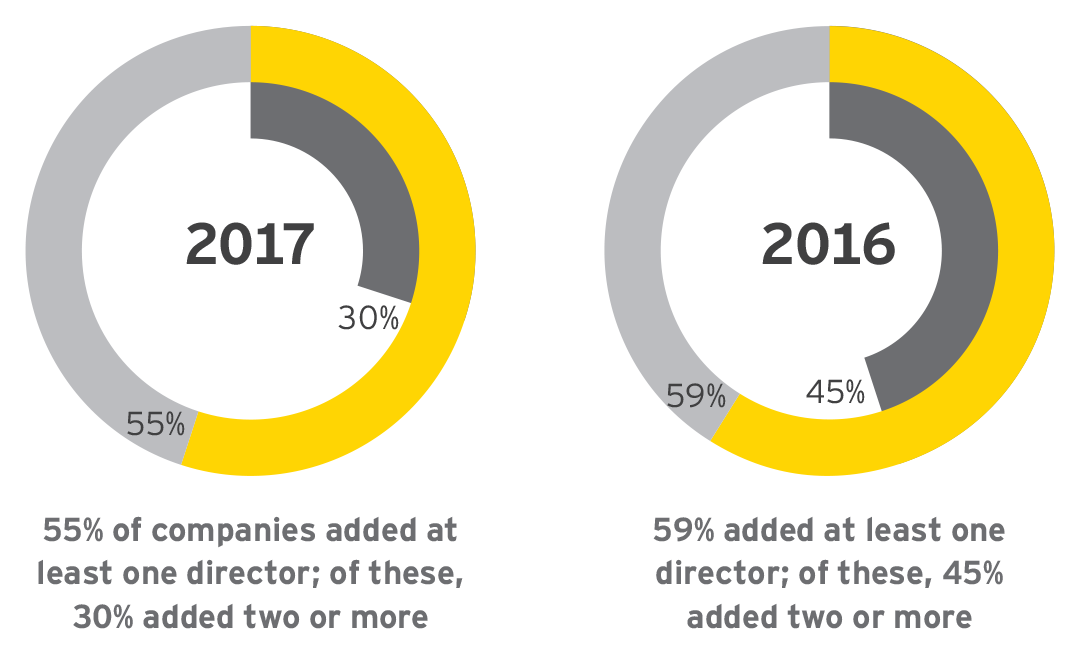
This past year, over half of the Fortune 100 companies we reviewed added at least one independent director. This figure is a little lower than the prior year; but overall, during the two-year period from 2016 to 2017, over 80% of the companies added at least one independent director. Taking into account director exits—whether due to retirement, corporate restructuring, pursuit of new opportunities or other reasons—we found that nearly all of the companies experienced some type of change in board composition during this period.

2. The class of 2017 brings greater finance and accounting, public policy and regulatory, and operational skills to the table.


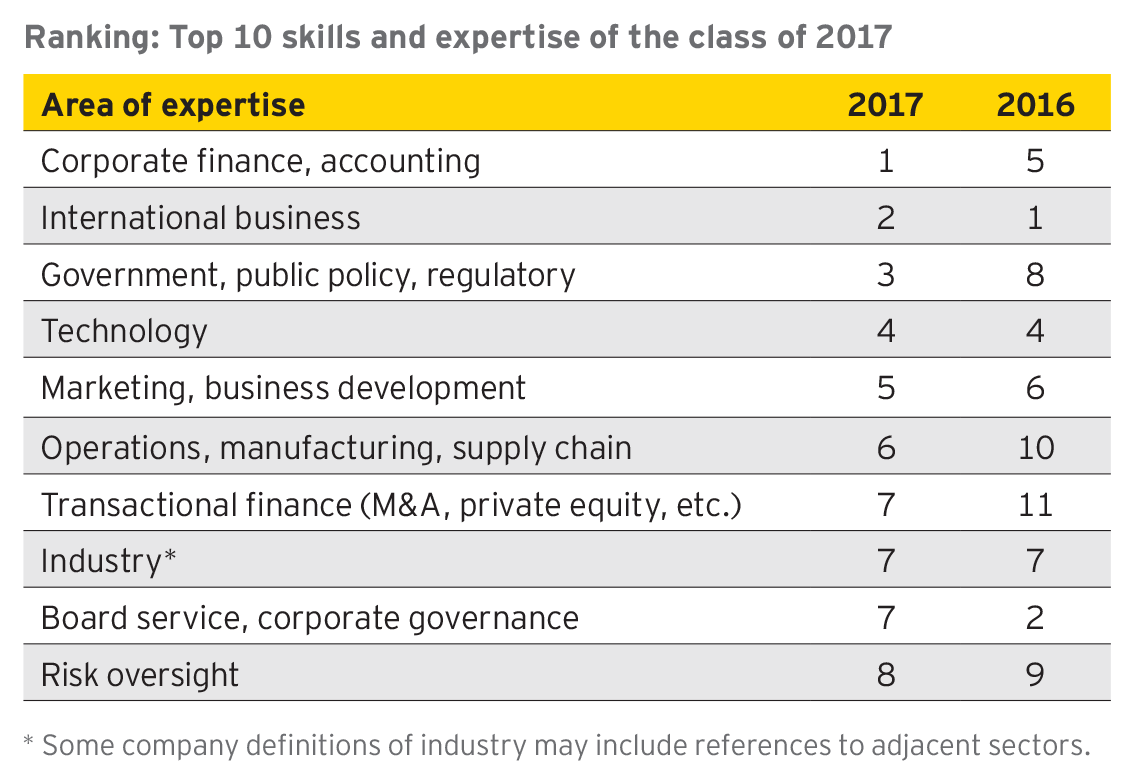
Corporate finance and accounting were the most common director qualifications cited by companies in 2017, up from fifth in 2016. A couple areas saw notable increases: government and public policy, operations and manufacturing, and transactional finance. This year, some areas tied in ranking, and in a twist, corporate references to expertise in strategy fell from third in 2016 to below the top 10 categories of expertise. Companies also made fewer references to board service or governance expertise compared to the prior year.

3. Most of the 2017 entering class was assigned to audit committees.


The strength of corporate finance and accounting expertise of the entering class is seen, too, with regards to key committee designations. Of the three “key committees” of audit, compensation, and nominating and governance, the 2017 entering class was primarily assigned to serve on audit committees. A closer look at the disclosures shows that 63% of the new directors that were assigned to the audit committee were formally designated as audit committee financial experts. In comparison, the corresponding figure in the prior year was 59%.


4. The Fortune 100 class of 2017 includes more non-CEOs.


While experience as a CEO is often cited as a traditional first cut for search firms, 54% of the entering class served in other roles, with non-CEO backgrounds including other executive roles or non-corporate backgrounds (academia, scientific organizations, nonprofits, government, military, etc.). This represents a slight increase from 2016 with most of the shift stemming from individuals holding or having held other senior executive positions. Approximately 30% appear to be joining a Fortune 100 public company board, having never previously served on a public company board—similar to 2016.

5. The class of 2017 is 40% female


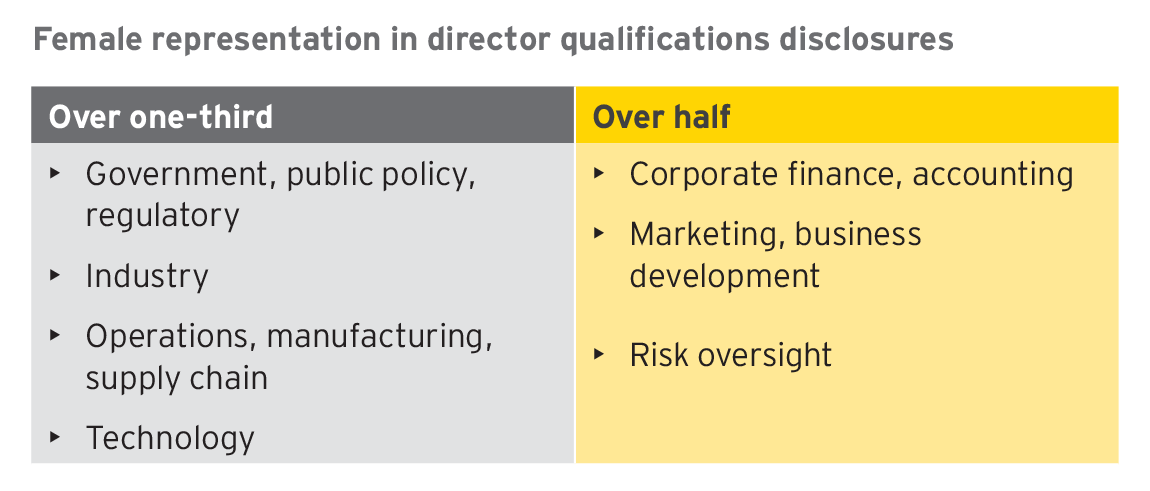
As in the prior year, 40% of the entering class were women, but overall percentages were largely unchanged, with women directors averaging 28% board representation compared to 27% in 2016. Also, there was minimal age difference, with the women directors averaging 57 compared to 58 for male counterparts. Among the directors bringing the top categories of expertise, women directors accounted for over one-third of the disclosed director qualifications. In some cases, they represented over half of the disclosed category of expertise.

6. The class of 2017 tends to be younger


There appears to be an ongoing shift toward younger directors. For the class of 2017 entering directors, the average age of these individuals was 57, compared to 63 for incumbents and 68 for exiting directors. Of the entering class, 15% were under 50, an increase from 9% in the prior year. And, for the second consecutive year, we observe that over half of the entering class was under the age of 60. Exiting directors largely continue to be age 68 or older.

Questions for the board to consider


– How is the company aligning the skills of its directors—and that of the full board—to the company’s long-term strategy through board refreshment and succession planning efforts? How is the company providing voluntary disclosures around its approach in these areas?

– Does the company’s pool of director candidates challenge traditional search norms such as title, age, industry and geography?

– How is the company addressing growing investor and stakeholder attention to board diversity, and is the company providing disclosure around the diversity of the board—defined as including considerations such as age, gender, race, ethnicity, nationality—in addition to skills and expertise?

______________________________________________________________________________________

*Steve W. Klemash is Americas Leader, Kellie C. Huennekens is Associate Director, and Jamie Smith is Associate Director, at the EY Center for Board Matters. This post is based on their EY publication.

Le cycle de vie des sociétés régies par des classes d’actions diverses


Les études montrent que ces types d’arrangements ne sont pas immanquablement dommageables pour les actionnaires, comme nous laissent croire plusieurs groupes d’intérêt tels que le Conseil des investisseurs institutionnels et la firme de conseil Institutional Shareholder Services (« ISS »). Plusieurs militent en faveur d’une durée limitée pour de telles émissions d’actions.

Les récentes émissions d’actions à classes multiples des entreprises de haute technologie ne nous permettent pas, à ce stade-ci, de statuer sur les avantages à long terme pour les actionnaires.

Les auteurs, Martijn Cremers et coll., concluent qu’il est trop tôt pour se prononcer définitivement sur la question, et pour réglementer cette structure de capital. Voir à cet égard l’article suivant : Are Dual-Class Companies Harmful to Stockholders? A Preliminary Review of the Evidence.

Bonne lecture !


The Life-Cycle of Dual Class Firms


Résultats de recherche d'images pour « Dual Class Firms »


In our paper, The Life-Cycle of Dual Class Firms, we consider the market valuation of dual class firms over their life cycle. Dual class financing is on the rise in recent years, particularly among high-tech firms, following Google’s seminal 2004 dual-class IPO structure. This financing choice leaves control of the firms in the hands of entrepreneurs, giving outside investors with inferior-vote shares no direct mechanism to influence the board or management. Rather, public investors buying inferior vote shares at the IPO are betting that granting the entrepreneurs such control allows them to better implement their unique vision.

However, as dual class firms mature and their vision is largely accomplished, entrepreneurs’ leadership may no longer be needed, and entrepreneurs may start self-serving behavior. Public investors’ resentment may then develop, accusing dual class firms’ controlling shareholders for wanting their money without any accountability. Such public pressure arguably recently led MSCI to issue a proposal to reduce the weight of inferior-vote shares in MSCI indices by multiplying the regular weight by the shares fractional voting power. Notably, the same MSCI also issued a report a few months ago stating that “[o]ur research shows that unequal voting stocks in aggregate outperformed the market over the period from November 2007 to August 2017, and that excluding them from market indexes would have reduced the indexes’ total returns by approximately 30 basis points per year over our sample period.” Obviously, confusion reigns over the merits of dual class financing.

Bebchuk and Kastiel (2017) (The Untenable Case for Perpetual Dual-Class Stock, Virginia Law Review) argue that any initial benefits of dual class structures decay with firm age, while the potential agency costs associated with dual class structures increase with time. Thus, Professors Bebchuk and Kastiel advocate sunset clauses to dual class financing. The sunset clauses would require the “non-interested” public shareholders of the firm to vote on whether or not to extend the dual class structure, some pre-determined number of years after the IPO. If the extension proposal is declined, firms would unify the low- and high-vote shares, i.e., convert all shares into a single class of shares with “one share one vote”.

In our paper, we empirically investigate the desirability of sunset provisions by examining the life-cycle of dual class firms. Using an extensive sample of all single-and dual-class firm IPOs in the U.S. during 1980-2015, and relying on comparing dual class firms to similar single class firms, we document several novel phenomena in the life cycle of dual class firms.

First, the difference in firm valuation between dual and single class firms strongly varies over the corporate life cycle. At the IPO, dual class firms tend to have higher valuations, as at the IPO year-end the market valuation of dual class firms is, on average, 11% higher than that of matched single class firms. This initial valuation premium of dual class firms dissipates in the years after the IPO, and on average it becomes insignificantly negative about six to nine years after the IPO. We also find that the difference between the voting and equity stakes of the controlling shareholders of dual class firms (the “wedge”) tends to increase as the firm ages. According to one of our estimates, the mean wedge increases from 16% one year after the IPO to 22% five years after the IPO, and to 26% nine years after the IPO. The widening of the wedge is typically associated with more severe valuation reducing agency problems—see Masulis et al. (2009) (Agency Costs and Dual-Class Companies, Journal of Finance). Bebchuk and Kastiel (2018) (The Perils of Small-Minority Controllers, forthcoming Georgetown Law Review) analyze the perils of the widening wedges and advocate informing the public and capping it.

Second, we document interesting differences between dual class firms with a valuation premium (relative to their matched single class firms) at the IPO and dual class firms with a valuation discount at the IPO. Dual class firms with a valuation premium at the end of their IPO year gradually tend to lose this premium, until their valuations become very similar to those of their single class counterparts about six to nine years after the IPO. In contrast, we find no evidence for a life cycle in the relative valuation of initially discounted dual class firms, as their valuation discount persists from the time of their IPO to when they are mature dual class firms as well. The behavior of the subsample of dual class firms with a valuation premium at the IPO suggests that for some firms the dual class structure does not harm valuations, at least in the first decade after the IPO. On the other hand, the behavior of the subsample of dual class firms with an initial valuation discount, which we find is highly persistent, suggests that a mandatory sunset provision may be useful for these firms.

Third, a natural solution to possible dual class inefficiency is a voluntary firm-initiated dual class share unification, in which all share classes are transformed into “one share one vote”. We find that only about 20% of dual class firms unify their shares within 9 years after the IPO. Furthermore, voluntary unifications become rare after six years following the IPO. Most of the mature dual class firms elect to retain a dual class structure, perhaps because unification is against the interests of their controlling shareholders. This implies that some inefficient dual class structures may persist.

Our findings suggest that some sort of a sunset provision might be useful, especially for firms that trade at a valuation discount. Further, regarding the set-in time of any sunset provision, our study suggests to wait at least six years after the IPO. Regulators should also be worried about some potential negative consequences of any sunset regulation. First, some founders may be more reluctant to issue publicly traded shares if their reign over the firm is likely to be more limited in time. Public may lose the opportunity to invest in some breakthrough firms. Second, controlling shareholders may intensify their private benefits extraction in the period before their extra power expires. Third, it is possible that shareholders may elect to abolish dual class structures even when they are (still) beneficial.

Finally, our paper also documents several other interesting life cycle phenomena of dual class firms such as their higher survival rates, similar stock returns and lower likelihoods of being taken over, compared to matched single class firms. We conclude that unequal vote structures are viable financing tools.

The complete paper is available for download here.

________________________________________

*Martijn Cremers* is Bernard J. Hank Professor of Finance at University of Notre Dame Mendoza College of Business, and an ECGI research member; Beni Lauterbach is a Professor of Finance and the Raymond Ackerman Family Chair in Corporate Governance at Bar Ilan University Graduate School of Business Administration, and an ECGI research member; Anete Pajuste is an Associate Professor of Finance and Head of Accounting and Finance Department at the Stockholm School of Economics, and an ECGI research member. This post is based on their recent paper.

Related research from the Program on Corporate Governance includes The Untenable Case for Perpetual Dual-Class Stock (discussed on the Forum here) and The Perils of Small-Minority Controllers (discussed on the Forum here), both by Lucian Bebchuk and Kobi Kastiel.

Les six principes qui gouvernent la conduite des investisseurs — ISG


Aujourd’hui, je vous présente le point de vue de l’association Investor Stewardship Group (the “ISG”) Governance Principles, eu égard aux principes de gouvernance que celle-ci entend promouvoir.

Je reproduis ici les principaux éléments de l’article publié par Anne Meyer* et paru sur le forum du Harvard Law School, notamment les six principes qui gouvernent leur conduite.

1 — Les CA sont redevables envers les actionnaires ;

2 — Les actionnaires doivent avoir des droits de vote qui sont proportionnels à leurs intérêts économiques ;

3 — Les CA doivent être à l’écoute des actionnaires et être proactifs dans la compréhension de leurs perspectives ;

4 — Les CA doivent avoir une solide structure de leadership indépendante ;

5 — Les CA doivent adopter des structures de gouvernance qui mènent à des pratiques efficaces ;

6 — Les CA doivent adopter des structures de rémunération des dirigeants qui sont alignées sur la stratégie à long terme de l’entreprise.

Bonne lecture ! Vos commentaires sont les bienvenus.


The Investor Stewardship Group’s Governance Principles


Résultats de recherche d'images pour « Investor Stewardship Group Governance Principles »


In this post, we provide an overview of the Investor Stewardship Group (the “ISG”) Governance Principles and steps for public companies to consider when evaluating how the principles may be incorporated into their own disclosure and engagement priorities. The ISG’s website, including a link to the ISG Governance Principles, is available here. In January 2017, the Investor Stewardship Group (the “ISG”), a collective of large U.S.-based and international institutional investors and asset managers, announced the launch of its Framework for U.S. Stewardship and Governance (the “Framework”). The measure is an unprecedented attempt to establish a set of elementary corporate governance principles for U.S. listed companies (the “ISG Governance Principles”) as well as parallel stewardship principles for U.S. institutional investors. The Framework’s effective date was January 1, 2018, in order to provide U.S. listed companies with time to adjust to the corporate governance principles prior to the 2018 proxy season.

As the 2018 proxy season gets into full swing, there is evidence that ISG members will be utilizing the Framework as a tool for evaluating the governance regimes at their portfolio companies, informing their engagement priorities, and potentially factoring compliance with the ISG Governance Principles into selected voting policies and decisions. In December, the ISG issued a press release “encouraging companies to articulate how their governance structures and practices align with the ISG’s Corporate Governance Principles and where and why they differ in approach”, leaving it to companies to determine how and where to disclose such alignment. And at least one large investor, State Street Global Advisors, has specifically highlighted that it will screen portfolio companies for compliance with the principles.

As a result, companies and their boards should continue to benchmark and understand how their specific governance practices relate to ISG Governance Principles and remain cognizant of this new regime as they prepare for engagement with investors and draft public disclosures.


Background


The ISG’s global reach and financial influence is significant; currently consisting of 50 investors representing over $22 trillion invested in the U.S. equity markets. The ISG’s signatories includes some of the largest and most influential institutional investors, including BlackRock, CalSTRS, State Street Global Advisors, TIAA Investments, T. Rowe Price, ValueAct Capital and Vanguard, among others. The Framework’s stewardship principles emphasize that these institutional investors have a vested interest and responsibility for the long-term economic success of their portfolio companies.

The ISG’s roll-out of the Framework characterized it as a “sustained initiative” and emphasized an evolutionary view of the ability of U.S. companies and investors to work together under the Framework.

Corporate governance practices at U.S. listed companies have historically been informed by multiple regulatory and rules-based regimes. Rules and regulations of the Securities and Exchange Commission, stock exchange listing requirements, state corporate codes, case law and federal legislation adopted in the wake of past financial market crises, have been the primary dictating standards. More recently, shareholders and other stakeholders have played a larger role in influencing corporate governance norms at U.S. listed companies through engagement and various forms of shareholder activism. In contrast, the ISG Governance Principles are based substantially on U.K., Continental European and other non-U.S. frameworks that establish principles-based corporate governance standards and tend to rely on “comply-or-explain” accountability. [1] Advocates for this type of principles-based approach stress the flexibility that it gives for companies to adopt a tailored response to important tenets such as boardroom transparency, as opposed to responding more narrowly to prescriptive rules. As institutional investors continue to focus more attention on environmental and social matters, including related governance concerns, the Framework’s principles-based approach will be a tool, for both institutions and companies, to promote mutually agreeable objectives, particularly given the lack of rulemaking or legislation mandating more specific disclosure on trending topics such as board diversity and environmental concerns.


The ISG Governance Principles


The six ISG Governance Principles are broad principles that will not look new to those who have been following key issues in corporate governance over the past several years. Indeed, they were designed to reflect the common corporate governance principles that are already embedded in member institutions’ proxy voting and engagement guidelines. The principles emphasize the importance of boardroom effectiveness and oversight, alignment of executive compensation with long-term financial results, and board accountability demonstrated in part through the adoption of governance best practices, including a one-share one-vote capital structure and independent board leadership.

Principle 1: Boards are accountable to shareholders

This principle encompasses the annual election of directors, majority voting, proxy access and more robust disclosure surrounding board practices and corporate governance. Companies are also asked to explain how any anti-takeover measures are in the best long-term interest of the company.

Interestingly, BlackRock’s CEO Larry Fink recently published a letter to the CEOs at the world’s largest public companies in which he argued explicitly that boards are accountable to other stakeholders, such as employees and customers, in addition to shareholders.

Principle 2: Shareholders should be entitled to voting rights in proportion to their economic interest

This principle sets a base line of one-share one-vote and encourages companies with existing multi-class share structures to review and consider phasing out control shares.

In 2017, this issue became national news when Snap Inc. filed for an IPO of non-voting shares. Many large investors were vehemently opposed and at the urging of the Council for Institutional Investors and other investor advocates, the stock index provider FTSE Russell refused to include these shares in its indices.

Principle 3: Boards should be responsive to shareholders and be proactive in order to understand their perspectives

Under this principle, companies are expected to implement shareholder proposals that receive “significant” support or explain why they have not done so. Independent directors are encouraged to participate in engagement on matters that are meaningful to investors, and directors may be held accountable with “against” votes in instances where investors do not feel that their concerns have been adequately addressed.

Principle 4: Boards should have a strong, independent leadership structure

There are two common independent leadership structures at U.S. companies—an independent chairperson and an independent lead director (where the role of Chairman and CEO are combined)—and the principles acknowledge that signatory investors have differing opinions on whether they provide adequate independent oversight.

The overarching position under the principles is that the role of the independent board leader should be “clearly defined and sufficiently robust to ensure effective and constructive leadership.”

Principle 5: Boards should adopt structures and practices that enhance their effectiveness

This principle encompasses an array of board structure and effectiveness issues, including: strong board composition and board diversity; board and committee responsibilities; director attentiveness, preparedness and time commitments; and board refreshment.

Board diversity, in particular gender diversity, has emerged as a high priority for most of the largest institutional investors. There has also been a focus on screening for long-tenured directors and directors that are over-boarded or have poor attendance records as a proxy for identifying directors that may not be adequately engaged or independent.

Principle 6: Boards should develop management incentive structures that are aligned with the long-term strategy of the company

This principle emphasizes that the board, in particular the compensation committee, is responsible for ensuring that drivers and performance goals that underpin the company’s long-term strategy are adequately reflected in a company’s management incentive structure.

Steps to Consider

As noted, the ISG Governance Principles are intended to provide a framework of broad, high-level principles. The individual investors that comprise the ISG have their own voting guidelines and engagement priorities that are tailored to their own investment philosophy and strategy. Even on current hot button issues, such as board diversity, investors have differing views and companies should consider the practices they adopt depending upon their specific facts and circumstances. There are, however, general steps that we recommend companies take to address the growing influence of the Framework.

These include:

Understand how the company’s corporate governance structure and practices relate to the six ISG Governance Principles.

Review the company’s public disclosure regarding corporate governance structure and practices; consider enhancements to be responsive to the ISG’s request that companies disclose how their governance aligns or differs from the ISG Governance Principles.

As with other corporate governance benchmarking exercises, companies should be particularly cognizant of how and why their practices may differ from the ISG Governance Principles and whether these differences are adequately explained in public disclosures. As investors screen their portfolio companies’ governance practices, they will often consider valid explanations, but in the absence of effective disclosure the company may be unnecessarily penalized.

Management and the board should be informed and prepared to respond to questions about the company’s alignment with the ISG Governance Principles during shareholder engagements. Companies can also consider proactively addressing the issue in written materials or prepared remarks during investor presentations.

In preparing for shareholder engagements with ISG signatories, understand how and if they are explicitly incorporating the ISG Governance Principles into engagement and voting priorities and continue to screen their individual voting and engagement policies.

Companies should determine whether, and how, they wish to address and incorporate the ISG Governance Principles based upon their own specific governance profile, disclosure regime and approach to shareholder engagement.


Endnotes

See in particular the UK Investor Stewardship Code, on which the US ISG Principles are largely based. The UK Code “sets out a number of areas of good practice to which … institutional investors should aspire.” Available here.


*Anne Meyer is Senior Managing Director, Don Cassidy is Executive Vice President, and Rajeev Kumar is Senior Managing Director at Georgeson LLC. This post is based their recent Georgeson publication. Related research from the Program on Corporate Governance includes The Agency Problems of Institutional Investors by Lucian Bebchuk, Alma Cohen, and Scott Hirst.

L’application concrète d’un huis clos – en rappel


Nous avons déjà abordé l’importance d’inscrire un item « huis clos » à l’ordre du jour des réunions du conseil d’administration. Celui-ci doit normalement être à la fin de la réunion et comporter une limite de temps afin d’éviter que la réunion ne s’éternise… et que les membres de la direction (qui souvent attendent la fin de la rencontre) soient mieux informés.

Ensuite, le président du conseil d’administration (PCA) devrait rencontrer le président et chef de la direction (PCD) en privé, et dans les meilleurs délais, afin de rendre compte des résultats et de la portée du huis clos. Cette responsabilité du PCA est déterminante, car les dirigeants ont de grandes attentes et un souci eu égard aux discussions du huis clos.

Plusieurs dirigeants et membres de conseil m’ont fait part de leurs préoccupations concernant la tenue des huis clos. Il y a des malaises dissimulés en ce qui a trait à cette activité ; il faut donc s’assurer de bien gérer la situation, car les huis clos peuvent souvent avoir des conséquences inattendues, voire contre-productives !

Ainsi, le huis clos :

(1) ne doit pas être une activité imprévue et occasionnelle inscrite à l’ordre du jour

(2) doit comporter une limite de temps

(3) doit être piloté par le président du conseil

(4) doit comporter un suivi systématique, et

(5) doit se dérouler dans un lieu qui permet de préserver la confidentialité absolue des discussions.

J’insiste sur cette dernière condition parce que l’on a trop souvent tendance à la négliger ou à l’oublier, carrément. Dans de nombreux cas, la rencontre du conseil a lieu dans un local inapproprié, et les dirigeants peuvent entendre les conversations, surtout lorsqu’elles sont très animées…

Au début de la séance, les membres sont souvent insoucieux ; avec le temps, certains peuvent s’exprimer très (trop) directement, impulsivement et de manière inconvenante. Si, par mégarde, les membres de la direction entendent les propos énoncés, l’exercice peut prendre l’allure d’une véritable calamité et avoir des conséquences non anticipées sur le plan des relations interpersonnelles entre les membres de la direction et avec les membres du conseil.


registre-conseils-d-administration


L’ajout d’un huis clos à l’ordre du jour témoigne d’une volonté de saine gouvernance, mais, on le comprend, il y a un certain nombre de règles à respecter si on ne veut pas provoquer la discorde. Les OBNL, qui ont généralement peu de moyens, sont particulièrement vulnérables aux manquements à la confidentialité ! Je crois que dans les OBNL, les dommages collatéraux peuvent avoir des incidences graves sur les relations entre employés, et même sur la pérennité de l’organisation.

J’ai à l’esprit plusieurs cas de mauvaise gestion des facteurs susmentionnés et je crois qu’il vaut mieux ne pas tenir le bien-fondé du huis clos pour acquis.

Ayant déjà traité des bienfaits des huis clos lors d’un billet antérieur, je profite de l’occasion pour vous souligner, à nouveau, un article intéressant de Matthew Scott sur le site de Corporate Secretary qui aborde un sujet qui préoccupe beaucoup de hauts dirigeants : le huis clos lors des sessions du conseil d’administration ou de certains comités.

L’auteur explique très bien la nature et la nécessité de cette activité à inscrire à l’ordre du jour du conseil. Voici les commentaires que j’exprimais à cette occasion.

«Compte tenu de la “réticence” de plusieurs hauts dirigeants à la tenue de cette activité, il est généralement reconnu que cet item devrait toujours être présent à l’ordre du jour afin d’éliminer certaines susceptibilités.

Le huis clos est un temps privilégié que les administrateurs indépendants se donnent pour se questionner sur l’efficacité du conseil et la possibilité d’améliorer la dynamique interne; mais c’est surtout une occasion pour les membres de discuter librement, sans la présence des gestionnaires, de sujets délicats tels que la planification de la relève, la performance des dirigeants, la rémunération globale de la direction, les poursuites judiciaires, les situations de conflits d’intérêts, les arrangements confidentiels, etc. On ne rédige généralement pas de procès-verbal à la suite de cette activité, sauf lorsque les membres croient qu’une résolution doit absolument apparaître au P.V.

La mise en place d’une période de huis clos est une pratique relativement récente, depuis que les conseils d’administration ont réaffirmé leur souveraineté sur la gouvernance des entreprises. Cette activité est maintenant considérée comme une pratique exemplaire de gouvernance et presque toutes les sociétés l’ont adoptée.

Notons que le rôle du président du conseil, en tant que premier responsable de l’établissement de l’agenda, est primordial à cet égard. C’est lui qui doit informer le PCD de la position des membres indépendants à la suite du huis clos, un exercice qui demande du tact!

Je vous invite à lire l’article ci-dessous. Vos commentaires sont les bienvenus».

Are you using in-camera meetings ?

Les femmes CEO des grandes entreprises ont-elles une rémunération plus élevée que leurs homologues masculins ? Leurs CA comptent-ils plus de femmes ?


Les femmes PDG (CEO) des grandes entreprises ont-elles une rémunération plus élevée ? Leurs conseils d’administration sont-ils plus diversifiés, et comptent-ils plus de femmes ?

Ce billet publié par Dan Marcec, directeur d’Equilar, paru sur le forum de la Harvard Law School, tente d’apporter une réponse à ces questions.

On peut retenir que les femmes CEO, en général, comptent légèrement plus de femmes sur leurs conseils.

Le nombre de femmes sur les CA varie selon la taille des entreprises. Plus l’entreprise est grande, plus le CA est susceptible de compter un nombre plus important de femmes :

Equilar 100 Gender Diversity Index,  24 %

Fortune 500,  22,5 %

Fortune 501-1000,  19,2 %

Entreprises plus petites,  14,1 %

Également, la rémunération des femmes CEO des 100 plus grandes entreprises (8 femmes) est de 21,4 M $ comparativement à la moyenne des 92 hommes CEO qui est de 16,4 M $, une différence significative, mais sur un petit échantillon de femmes CEO !

Je vous invite à prendre connaissance de l’article ci-dessous afin de mieux saisir toutes les nuances de cette étude.

Bonne lecture !


Do Women CEOs Earn More and Have More Diverse Boards?


Résultats de recherche d'images pour « Les femmes CEO des grandes entreprises ont-elles une rémunération plus élevée que leurs homologues masculins ? Leurs CA comptent-ils plus de femmes ? »


As gender equity and diversity in corporate leadership continue to be critical discussions, research is regularly published showing links between these factors and company performance. Based on an analysis of Equilar 100 companies—the largest U.S.-listed firms to file proxy statements to the SEC before March 31—women CEOs had a higher representation of women on their boards on average than companies led by male counterparts. They also were awarded higher compensation on average in 2017.

Overall, Equilar 100 companies with women CEOs had an average of 24.0% representation of women on their boards, vs. 23.5% for the companies with male CEOs. Furthermore, the women in the CEO position at Equilar 100 companies were well paid in 2017 with an average pay package of $21.4 million. By comparison, the men who were on the list received an average pay package of $16.4 million. The following two questions examined this data just below the surface, finding that the complete picture is more complicated than it appears.


Do Women CEOs Bring More Females Into the Boardroom?


The Equilar 100 study analyzed recently reported data for fiscal year 2017, including eight women CEOs, a drop from nine the previous year. While Meg Whitman has since left her position at Hewlett Packard Enterprise, she was still in the CEO position during the periods studied, so HPE is included in the analysis.

The answer to the question above—based on an analysis of Equilar 100 data—is yes, companies with women CEOs do have slightly more women in the boardroom. The list of Equilar 100 companies that had women CEOs in 2017 is below, inclusive of their current board composition as of March 31.


Company % Female Board Members Average Board Age Average Board Tenure
Hewlett Packard Enterprise Co 38.5% 62.0 2.4
General Dynamics Corp 27.3% 64.0 5.9
Progressive Corp 27.3% 62.0 9.8
Oracle Corp 25.0% 70.5 14.4
Pepsico Inc 23.1% 63.0 5.5
IBM 20.0% 64.0 6.3
Lockheed Martin Corp 16.7% 66.0 6.6
Duke Energy Corp 14.3% 66.0 4.9
Women CEO Average 24.0% 64.7 7.0
Men CEO Average 
23.5% 63.0 7.2


There are two important factors to consider that give pause in definitively being able to say “women CEOs at Equilar 100 companies lead in gender diversity on boards.” While the numbers are clear—and they are—large-cap companies are much more likely to have women on their boards overall.

According to the recent Equilar Gender Diversity Index, Fortune 500 companies included in the Russell 3000 had an average of 22.5% women on their boards, as compared to 19.2% for Fortune 501-1000 companies and a much lower 14.1% for R3K firms outside the Fortune 1000. The Equilar 100 overall outpaced each of these groups.

It’s also worth noting that most CEOs are also on their own boards. Therefore, if CEOs were removed from the overall numbers, it’s likely the data would show Equilar 100 boards being more inclusive of independent women directors when a male CEO is in place.


The facts are the facts—boards at Equilar 100 companies led by women have a higher percentage of female directors than their counterparts. However, the small sample size—pointing to the lack of women in leadership overall—and these other mitigating factors make a definitive statement difficult to prove.


Do Women CEOs Make More Than Men?


While the women on the Equilar 100 list make more on average than the men, the caveat, of course, is that these numbers reflect a small sample size of women. To get to the eight highest-paid women on the list, you have to go all the way to number 87, whereas you don’t have to leave the top 10 to find the eight highest-paid men. The list of women on the Equilar 100 list (as well as their compensation rank) is below.


Company CEO 2017 Total Compensation ($MM) Equilar 100 RANK
Oracle Corp Safra A. Catz $40.7 4
Pepsico Indra K. Nooyi $25.9 7
General Dynamics Corp Phebe N. Novakovic $21.2 14
Duke Energy Corp Lynn J. Good $21.1 15
Lockheed Martin Corp Marillyn A. Hewson $20.2 16
IBM Virginia M. Rometty $18.0 30
Hewlett Packard Enterprise Margaret C. Whitman $14.8 60
Progressive Corp Susan P. Griffith $9.2 87
Women Ceo Average (N=8) $21.4
Men CEO Average 
(n=92) $16.4


Furthermore, similar to the findings on board composition, the larger the company, the higher the pay. Given the context of the Equilar 100 study more generally—that the largest companies by revenue tend to pay their CEOs more—this small sample size is not sufficient to make a claim that women CEOs earn more than men.

For example, using fiscal year 2016 data, it’s clear that the Equilar 100 stands out over all other public companies. (Since the Equilar 100 is an “early look” at proxy season, comprehensive data is not yet available for these other company groups in 2017.) In 2016, Equilar 100 CEOs were awarded $15.0 million at the median, in comparison to $11.0 million for Equilar 500 companies, and just $6.1 million for all public companies with more than $1 billion in revenue.


In other words, as with board composition, the numbers do indicate that women CEOs earn more than men at face value, but there is more than meets the eye. Ultimately, proof of greater equity in executive compensation and board diversity when women are CEOs is inconclusive from this analysis, highlighting the importance of questioning numbers at face value. Indeed, an academic study was released recently that found there is no meaningful difference in pay between men and women at the CEO level. Each company’s compensation and board refreshment strategy is unique to their circumstances, and monolithic assumptions are not always fair. The gravity of these decisions pored over by each board of directors and their executive teams spotlights the rise of shareholder scrutiny and direct engagement on these matters.

La bonne gouvernance est associée au rendement selon une étude | Le Temps.ch


Aujourd’hui, je partage avec vous un article publié dans le magazine suisse Le Temps.ch qui présente les résultats d’une recherche sur la bonne gouvernance des caisses de retraite en lien avec les recommandations des fonds de placement tels que BlackRock.

L’auteur, Emmanuel Garessus, montre que même si le lien entre la performance des sociétés et la bonne gouvernance semble bien établi, les caisses de retraite faisant l’objet de la recherche ont des indices de gouvernance assez dissemblables. L’étude montre que les caisses ayant des indices de gouvernance faibles ont des rendements plus modestes en comparaison avec les indices de référence retenus.

Également, il ressort de cette étude que c’était surtout la prédominance de la gestion des risques qui était associée à la performance des caisses de retraite.

Comme le dit Christian Ehmann, spécialisé dans la sélection de fonds de placement auprès de Safra Sarasin, « la gouvernance n’est pas une cause de surperformance, mais il existe un lien direct entre les deux ».

Encore une fois, il appert que BlackRock défend les petits épargnants-investisseurs en proposant des normes de gouvernance uniformisées s’appliquant au monde des entreprises cotées en bourses.

J’ai reproduit l’article en français ci-dessous afin que vous puissiez bien saisir l’objet de l’étude et ses conclusions.

Bonne lecture ! Vos commentaires sont les bienvenus.


BlackRock contre Facebook, un combat de géants


Résultats de recherche d'images pour « le temps »


Résultats de recherche d'images pour « gouvernance »


Le principe de gouvernance selon lequel une action donne droit à une voix en assemblée générale est bafoué par de très nombreuses sociétés, surtout technologiques, au premier rang desquelles on trouve Facebook, Snap, Dropbox et Google. BlackRock, le plus grand groupe de fonds de placement du monde, demande aux autorités d’intervenir et de présenter des standards minimaux, indique le Financial Times.

Le groupe dont Philipp Hildebrand est vice-président préfère un appel à l’Etat plutôt que de laisser les fournisseurs d’indices (MSCI, Dow Jones, etc.) modifier la composition des indices en y intégrant divers critères d’exclusion. Barbara Novick, vice-présidente de BlackRock, a envoyé une lettre à Baer Pettit, président de MSCI, afin de l’informer de son désir de mettre de l’ordre dans les structures de capital des sociétés cotées.


Mark Zuckerberg détient 60% des droits de vote


De nombreuses sociétés ont deux catégories d’actions donnant droit à un nombre distinct de droits de vote. Les titres Facebook de la classe B ont par exemple dix fois plus de droits de vote que ceux de la classe A. Mark Zuckerberg, grâce à ses actions de classe B (dont il détient 75% du total), est assuré d’avoir 60% des droits de vote du groupe. A la suite du dernier scandale lié à Cambridge Analytica, le fondateur du réseau social ne court donc aucun risque d’être mis à la porte, explique Business Insider. L’intervention de BlackRock n’empêche pas l’un de ses fonds (Global Allocation Fund) d’avoir probablement accumulé des titres Facebook après sa correction de mars, selon Reuters, pour l’intégrer dans ses dix principales positions.

Cette structure du capital répartie en plusieurs catégories d’actions permet à un groupe d’actionnaires, généralement les fondateurs, de contrôler la société avec un minimum d’actions. Les titres ayant moins ou pas de droit de vote augmentent de valeur si la société se développe bien, mais leurs détenteurs ont moins de poids en assemblée générale. Les sociétés qui disposent d’une double catégorie de titres la justifient par le besoin de se soustraire aux réactions à court terme du marché boursier et de rester ainsi concentrés sur les objectifs à long terme. Ce sont souvent des sociétés technologiques.

Facebook respecte très imparfaitement les principes de bonne conduite en matière de gouvernance. Mark Zuckerberg, 33 ans, est en effet à la fois président du conseil d’administration et président de la direction générale. Ce n’est pas optimal puisque, en tant que président, il se contrôle lui-même. Sa rémunération est également inhabituelle. Sur les 8,9 millions de dollars de rémunération, 83% sont liés à ses frais de sécurité et le reste presque entièrement à l’utilisation d’un avion privé (son salaire est de 1 dollar et son bonus nul).


Quand BlackRock défend le petit épargnant


Le site de prévoyance IPE indique que le fonds de pension suédois AP7, l’un des plus grands actionnaires du réseau social, est parvenu l’an dernier à empêcher l’émission d’une troisième catégorie de titres Facebook. Cette dernière classe d’actions n’aurait offert aucun droit de vote. Une telle décision, si elle avait été menée à bien, aurait coûté 10 milliards de dollars à AP7. Finalement Facebook a renoncé.

BlackRock prend la défense du petit investisseur. Il est leader de la gestion indicielle et des ETF et ses produits restent investis à long terme dans tous les titres composant un indice. Il préfère influer sur la gouvernance par ses prises de position que de vendre le titre. Le plus grand groupe de fonds de placement du monde demande aux autorités de réglementation d’établir des standards de gouvernance en collaboration avec les sociétés de bourse plutôt que de s’en remettre aux fournisseurs d’indices comme MSCI.

La création de plusieurs classes d’actions peut être justifiée par des start-up en forte croissance dont les fondateurs ne veulent pas diluer leur pouvoir. BlackRock reconnaît ce besoin spécifique aux start-up en forte croissance, mais le gérant estime que «ce n’est acceptable que durant une phase transitoire. Ce n’est pas une situation durable.»

Le géant des fonds de placement aimerait que les producteurs d’indices soutiennent sa démarche et créent des «indices alternatifs» afin d’accroître la transparence et de réduire l’exposition aux sociétés avec plusieurs catégories de titres. L’initiative de BlackRock est également appuyée par George Dallas, responsable auprès du puissant International Corporate Governance Network (ICGN).

La gouvernance des «bonnes caisses de pension»


La recherche économique a largement démontré l’impact positif d’une bonne gouvernance sur la performance d’une entreprise. Mais presque tout reste à faire en matière de fonds de placement et de caisses de pension.

«La gouvernance n’est pas une cause de surperformance, mais il existe un lien direct entre les deux. Les caisses de pension qui appartiennent au meilleur quart en termes de bonne gouvernance présentent une surperformance de 1% par année par rapport au moins bon quart», explique Christian Ehmann, spécialisé dans la sélection de fonds de placement auprès de Safra Sarasin, lors d’une présentation organisée par la CFA Society Switzerland, à Zurich.

Ce dernier est avec le professeur Manuel Ammann coauteur d’une étude sur la gouvernance et la performance au sein des caisses de pension suisses (Is Governance Related to Investment Performance and Asset Allocation?, Université de Saint-Gall, 2016). «Le travail sur cette étude m’a amené à porter une attention particulière à la gouvernance des fonds de placement dans mon travail quotidien», déclare Christian Ehmann. Son regard porte notamment sur la structure de l’équipe de gestion, son organisation et son système de gestion des risques. «Je m’intéresse par exemple à la politique de l’équipe de gérants en cas de catastrophe», indique-t-il.

Claire surperformance


L’étude réalisée sur 139 caisses de pension suisses, représentant 43% des actifs gérés, consiste à noter objectivement la qualité de la gouvernance et à définir le lien avec la performance de gestion. L’analyse détaille les questions de gouvernance en fonction de six catégories, de la gestion du risque à la transparence des informations en passant par le système d’incitations, l’objectif et la stratégie d’investissement ainsi que les processus de placement. Sur un maximum de 60 points, la moyenne a été de 21 (plus bas de 10 et plus haut de 50). La dispersion est donc très forte entre les caisses de pension. Certaines institutions de prévoyance ne disposent par exemple d’aucun système de gestion du risque.

Les auteurs ont mesuré la performance sur trois ans (2010 à 2012), le rendement relatif par rapport à l’indice de référence et l’écart de rendement par rapport au rendement sans risque (ratio de Sharpe). Toutes ces mesures confirment le lien positif entre la gouvernance et la performance (gain de 2,7 points de base par point de gouvernance). Les moteurs de surperformance proviennent clairement de la gestion du risque et du critère portant sur les objectifs et la stratégie d’investissement. Les auteurs constatent aussi que même les meilleurs, en termes de gouvernance, sous-performent leur indice de référence.

La deuxième étape de la recherche portait sur l’existence ou non d’une relation entre le degré de gouvernance et l’allocation des actifs. Ce lien n’a pas pu être établi.

Huit (8) principes de base à respecter pour devenir un président de conseil d’administration exemplaire


Voici un article très intéressant publié dans l’édition d’avril 2018 de la Harvard Business Review qui porte sur l’identification des grands principes qui guident les comportements des présidents de conseil d’administration.

L’auteur, Stanislav Shekshnia*, est professeur à l’Institut européen d’administration des affaires (INSEAD) et chercheur émérite dans le domaine de la gouvernance. Son article est basé sur une enquête auprès de 200 présidents de conseils.

Que doit-on retenir de cette recherche eu égard aux rôles distinctifs des présidents de conseils d’administration et aux caractéristiques qui les distinguent des CEO ?

Huit principes ressortent de ces analyses :

(1) Be the guide on the side; show restraint and leave room for others

(2) Practice teaming—not team building

(3) Own the prep work; a big part of the job is preparing the board’s agenda and briefings

(4) Take committees seriously; most of the board’s work is done in them

(5) Remain impartial

(6) Measure the board’s effectiveness by its inputs, not its outputs

(7) Don’t be the CEO’s boss

(8) Be a representative with shareholders, not a player.

Je vous invite à lire l’article au complet puisqu’il regorge d’exemples très efficaces.

Bonne lecture !


How to Be a Good Board Chair


Résultats de recherche d'images pour « qualities board chairman »

*Stanislav Shekshnia is a professor at INSEAD. He is also a senior partner at Ward Howell, a global human capital consultancy firm, and a board member at a number of public and private companies in Central and Eastern Europe.

Les actions multivotantes sont-elles préjudiciables pour les actionnaires ?


Nous avons souvent publié des billets qui abordent diverses conséquences liées à l’émission d’actions à votes multiples. L’article intitulé, « ACTIONS MULTIVOTANTES : LE MODÈLE DE BOMBARDIER SOULÈVE DES VAGUES », publié dans La Presse le 21 juillet 2015 avait d’ailleurs fait couler beaucoup d’encre.

Ces émissions d’actions sont-elles fondées, justifiées, légitimes et équitables dans le contexte de la gouvernance des sociétés cotées en bourse ? Voici ce que pense Yvan Allaire, président de l’Institut sur la gouvernance d’organisations privées et publiques, dans un article paru dans Les Affaires le 9 mai 2016Pourquoi le Canada a besoin des actions multivotantes ?

Vous trouverez, ci-dessous, un article publié par David J. Berger de la firme Wilson Sonsini Goodrich & Rosati, et par Laurie Simon Hodrick de la Stanford Law School, paru sur le site du Harvard Law School Forum on Corporate Governance, qui fait le point sur cette épineuse question.

Les études montrent que ces types d’arrangements ne sont pas immanquablement dommageables pour les actionnaires, comme nous laissent croire plusieurs groupes d’intérêt tels que le Conseil des investisseurs institutionnels et la firme de conseil Institutional Shareholder Services (« ISS »). Plusieurs militent en faveur d’une durée limitée pour de telles émissions d’actions.

Les récentes émissions d’actions à classes multiples des entreprises de haute technologie ne nous permettent pas, à ce stade-ci, de statuer sur les avantages à long terme pour les actionnaires.

Les auteurs concluent qu’il est trop hâtif pour se prononcer définitivement sur la question, et pour réglementer cette structure de capital.

Bonne lecture !


Résultats de recherche d'images pour « actions multivotantes »


Clarion calls for regulating dual-class stock have become a common occurrence. For example, the Council of Institutional Investors (“CII”) has called upon the NYSE and Nasdaq to adopt a rule requiring all companies going public with dual-class shares to include a so-called “sunset provision” in their charter, which would convert the company to a single class of stock after a set period of years. CII has also urged index providers to discourage the inclusion of firms with dual-class structures (and both the S&P Dow Jones and FTSE Russell indices have already done so). Many individual CII members, along with some of the world’s largest mutual funds and other investors, have joined together in the “Framework for U.S. Stewardship and Governance” to take a strong stance against dual class structures.

Proxy advisory services have also announced their opposition to dual-class companies. For example, Institutional Shareholder Services (“ISS”) has announced a plan to recommend against directors at companies with differential voting rights if there are no “reasonable sunset” provisions. Even the SEC’s Investor Advisory Committee has raised its own concerns about dual-class stock companies, calling on the SEC to “devote more resources” to “identify risks” arising out of governance disputes from dual-class structures. [1]

Yet what is the empirical evidence supporting these calls for regulation of dual-class companies? Dual-class companies have existed for nearly a century, going back to the Dodge Brothers’ IPO in 1925 and Ford’s IPO in 1956. Historically, technology companies did not adopt a dual-class capital structure. Rather, until Google’s (now Alphabet) 2004 IPO, most dual-class companies were family businesses, media companies seeking to ensure their publications could maintain journalistic editorial independence, or other companies led by a strong group of insiders. These companies often adopted their dual-class structures to avoid the pressures of having to focus primarily on short-term variations in stock price.

Many of these older dual-class companies were the focus of a seminal 2010 paper that found that dual class firms tend to be more levered and to underperform their single class counterparts, with increased insider cash flow rights increasing firm value and increased insider voting rights reducing firm value. [2]

Since 2010, there have been an increasing number of technology companies going public with dual-class (or multi-class) share structures. Anecdotal evidence is mixed, but the early empirical evidence on the performance of these newer dual-class companies as a group is quite interesting. In particular, though many of these companies have not been public for very long, the limited available data suggests that these newer dual-class companies might even be out-performing single-class structured companies.

For example, MSCI, one of the largest global index providers, recently released a study showing that companies with “unequal voting stocks in aggregate outperformed the market over the period from November 2007 to August 2017.” [3] The study further concluded that excluding these companies “from market indexes would have reduced the indexes’ total returns by approximately 30 basis points per year over [the] sample period.” The differential was even greater in North America, where stocks with unequal voting rights outperformed stocks with the more traditional one-share/one-vote structure by 4.5% annually.

Recent academic research corroborates the outperformance of the newly public companies with dual-class stock. For example, one study concludes that dual-class companies, avoiding short-term market pressures, have more growth opportunities and obtain higher market valuations than matched single-class firms [4] Even with respect to perpetual dual-class stock companies, research shows that these companies, when controlled by a founding family, “significantly and economically” outperform nonfamily firms. [5] Another study maintains that it might be more efficient to give more voting power to shareholders who are better informed, thereby allowing them more influence, and correspondingly less voting power to those who are less informed, including passive index funds. Passive investors would pay a discounted price in exchange for waiving their voting rights. [6]

We have begun our own preliminary research on these issues, with considerations including corporate control, liquidity, capital allocation, “next generation” issues, and using stock as currency for acquisitions and to reward employees. While still in its initial stage, our analysis also raises fundamental questions about how much value shareholders perceive in having voting stock versus non-voting stock in these relatively new to market technology companies. For example, consider Classes A and C of Alphabet, issued through a stock dividend four years ago, which are different only in specific ways, most notably that A has one vote per share and C has none. [7] Atypically, for each of the last three trading days in February, Alphabet’s non-voting class C share, GOOG, had a higher closing market price than its voting class A share, GOOGL. [8] More broadly, since GOOG was introduced on April 3, 2014, the correlation between the two classes’ stock prices is 99.9%, and they have similar stock price standard deviations, betas, trading volume, and short interest. [9]

We believe that it is too early to make a definitive determination from an economic standpoint as to whether having dual-class stock is better or worse for investors in the current market environment, especially for younger companies. Any consideration to limit dual-class stock, including adoption of mandatory sunset provisions, must be based on analysis not anecdotes. It should also recognize the changing nature of public markets, including the following:

  1. The dominance of shareholder primacy has led boards of single-class companies to feel short-term pressure from shareholders. As no less an authority than Delaware Chief Justice Strine has frequently recognized, boards respond to those who elect them. In today’s world, for most public companies that is a handful of institutional investors, as by 2016 institutional investors owned 70% of all public shares, while just three money managers held the largest stock position in 88% of the companies in the S&P 500. [10] While many of these institutions emphasize that they are long-term holders, directors of companies with high institutional investor ownership continue to feel the pressure to take actions to achieve short-term stock increases. For example, a recent survey of over 1000 directors and C-level executives by McKinsey and the Canadian Pension Plan Investment Board (“CPPIB”) found that nearly 80% of these executives felt “especially pressured” to demonstrate strong financial results in two years or less. [11]
  2. The changing nature of the public and private capital markets. The increased use by technology companies of dual-class capital structures when entering the public markets must be viewed within the changing nature of both the public and private markets for technology companies. According to the Wall Street Journal, more money was raised in private markets than in public markets in 2017, while the number of public companies continues to decline—the number of public companies has fallen by about half since 1996. [12] SEC Commissioner Clayton (among others) has spoken repeatedly about the problems arising out of the decline in the number of public companies. Limiting the ability of public companies to have different capital structures will certainly impact the decision by some companies about whether or not to go public.
  3. Dual-class stock and alternative capital structures across the world. Regulators considering how to respond to the growth of dual-class stock should consider the growing acceptance of dual-class stock in markets globally. For example, in recent months both Hong Kong and Singapore have opened their markets to dual-class listings. Many European markets already have rules allowing for dual-class companies or other similar structures that allow companies to focus on longer-term principles as well as non-shareholder constituencies. Even in the U.S., newer markets, such as the Long-Term Stock Exchange, are working to list companies with alternative capital structures, so that companies can focus on building a business, in apparent recognition that surrendering to the current dominance of shareholder primacy may not be the best governance structure for all companies.

For these reasons, we believe that the current effort to mandate some form of one-share one-vote for all public companies in the U.S. is premature. The limited empirical evidence on the technology and emerging growth companies that are the target of these regulations is insufficient to support the adoption of new regulations, as the evidence that is available indicates that the most recent group of dual-class companies may have performed as well, if not better, than those with a single class of stock.

______________________________________

Notes

See “Recommendation of the Investor As Owner Subcommittee: Dual-Class and Other Entrenching Governance Structures in Public Companies,” February 27, 2018, available at https://www.sec.gov/spotlight/investor-advisory-committee-2012/iac030818-investor-as-owner-subcommittee-recommendation.pdf.(go back)

Paul Gompers, Joy Ishii, and Andrew Metrick, “Extreme Governance: An Analysis of Dual-Class Shares in the United States,” Review of Financial Studies 23, 1051-1087 (2010). See also Ronald Masulis, Cong Wang, and Fei Xie, “Agency Problems at Dual-Class Companies” Journal of Finance64, 1697-1727 (2009).(go back)

Dmitris Melas, “Putting the Spotlight on Spotify: Why have Stocks with Unequal Voting Right Outperformed?” MSCI Research, April 3, 2018. The study’s findings are robust to controlling for common factors including country, sector, and style factor exposures.(go back)

Bradford Jordan, Soohyung Kim, Nad Mark Liu, “Growth Opportunities, Short-Term Market Pressure, and Dual-Class Share Structure,” Journal of Corporate Finance 41, 304-328 (2016).(go back)

See Ronald Anderson, Ezgi Ottolenghi, and David Reeb, “The Dual Class Premium: A Family Affair,” August 2017.(go back)

Dorothy Shapiro Lund, “Nonvoting Shares and Efficient Corporate Governance,” Stanford Law Review 71 (forthcoming 2019).(go back)

There are also class B shares with 10 votes per share, 92.7% of which are owned by executives Eric Schmidt, Sergey Brin, and Larry Page as of December 31, 2017, representing 56.7% of the total voting power (source: Alphabet 10K).(go back)

GOOG also closed higher than GOOGL on March 14, March 16, and March 20, 2018. This is not the first such finding: In 1994, Comcast’s nonvoting shares often sold for more than its voting shares. See Paul Schultz and Sophie Shive, “Mispricing of Dual-Class Shares: Profit Opportunities, Arbitrage, and Trading,” Journal of Financial Economics 98, 524-549 (2010).(go back)

For the past four years, GOOG and GOOGL have standard deviations (betas) of 176.6 (1.24) and 177.8 (1.23), respectively.  GOOGL is slightly more liquid than GOOG, as GOOGL daily share volume averages 2.3 million shares, while GOOG averages 1.97 million shares.  GOOGL and GOOG have short interest of 3.4 million and 3.6 million shares, respectively.(go back)

10 See The Hon. Kara M. Stein, Commissioner, Securities and Exchange Commission, The Markets in 2017: What’s at Stake, February 24, 2017.(go back)

11 See Dominic Barton and Mark Wiseman, Investing for the Long-Term, Harvard Business Review, 2014.(go back)

12 Jean Eaglesham and Coulter Jones, “The Fuel Powering Corporate America: $2.4 Trillion in Private Fundraising,” Wall Street Journal, April 3, 2018.(go back)

______________________________

*David J. Berger is a partner at Wilson Sonsini Goodrich & Rosati; and Laurie Simon Hodrick is Visiting Professor of Law and Rock Center for Corporate Governance Fellow at Stanford Law School, Visiting Fellow at the Hoover Institution, and A. Barton Hepburn Professor Emerita of Economics in the Faculty of Business at Columbia Business School. Related research from the Program on Corporate Governance includes The Untenable Case for Perpetual Dual-Class Stock (discussed on the Forum here) and The Perils of Small-Minority Controllers (discussed on the Forum here), both by Lucian Bebchuk and Kobi Kastiel.

Quelle est la raison d’être d’une entreprise ?


Quelle est la raison d’être d’une entreprise sur le plan juridique ? À qui doit-elle rendre des comptes ?

Une entreprise est-elle au service exclusif de ses actionnaires ou doit-elle obligatoirement considérer les intérêts de ses parties prenantes (stakeholders) avant de prendre des décisions de nature stratégiques ?

On conviendra que ces questions ont fréquemment été abordées dans ces pages. Cependant, la réalité de la conduite des organisations semble toujours refléter le modèle de la primauté des actionnaires, mieux connu maintenant sous l’appellation « démocratie de l’actionnariat ».

L’article de Martin Lipton* fait le point sur l’évolution de la reconnaissance des parties prenantes au cours des quelque dix dernières années.

Je crois que les personnes intéressées par les questions de gouvernance (notamment les administrateurs de sociétés) doivent être informées des enjeux qui concernent leurs responsabilités fiduciaires.

Bonne lecture. ! Vos commentaires sont les bienvenus.


The Purpose of the Corporation


Résultats de recherche d'images pour « actionnaires définition »


Whether the purpose of the corporation is to generate profits for its shareholders or to operate in the interests of all of its stakeholders has been actively debated since 1932, when it was the subject of dueling law review articles by Columbia law professor Adolf Berle (shareholders) and Harvard law professor Merrick Dodd (stakeholders).

Following “Chicago School” economics professor Milton Friedman’s famous (some might say infamous) 1970 New York Times article announcing ex cathedra that the social responsibility of a corporation is to increase its profits, shareholder primacy was widely viewed as the purpose and basis for the governance of a corporation. My 1979 article, Takeover Bids in the Target’s Boardroom, arguing that the board of directors of a corporation that was the target of a takeover bid had the right, if not the duty, to consider the interests of all stakeholders in deciding whether to accept or reject the bid, was widely derided and rejected by the Chicago School economists and law professors who embraced Chicago School economics. Despite the 1985 decision of the Supreme Court of Delaware citing my article in holding that a board of directors could take into account stakeholder interests, and over 30 states enacting constituency (stakeholder) statutes, shareholder primacy continued to dominate academic, economic, financial and legal thinking—often disguised as “shareholder democracy.”

While the debate continued and stakeholder governance gained adherents in the new millennium, shareholder primacy continued to dominate. Only since the 2008 financial crisis and resulting recession has there been significant recognition that shareholder primacy has been a major driver of short-termism, encourages activist attacks on corporations, reduces R&D expenditures, depresses wages and reduces long-term sustainable investments—indeed, it promotes inequality and strikes at the very heart of our society. In the past five years, the necessity for changes has been recognized by significant academic, business, financial and investor reports and opinions. An example is the 2017 paper I and a Wachtell Lipton team prepared for the World Economic Forum, The New Paradigm: A Roadmap for an Implicit Corporate Governance Partnership Between Corporations and Investors to Achieve Sustainable Long-Term Investment and Growth, which quotes or cites many of the others.

This year we are seeing important new support for counterbalancing shareholder primacy and promoting long-term sustainable investment. Among the many prominent examples is the January 2018 annual letter from Larry Fink, Chairman of BlackRock, to CEOs:

Without a sense of purpose, no company, either public or private, can achieve its full potential. It will ultimately lose the license to operate from key stakeholders. It will succumb to short-term pressures to distribute earnings, and, in the process, sacrifice investments in employee development, innovation, and capital expenditures that are necessary for long-term growth. It will remain exposed to activist campaigns that articulate a clearer goal, even if that goal serves only the shortest and narrowest of objectives. And ultimately, that company will provide subpar returns to the investors who depend on it to finance their retirement, home purchases, or higher education.

This was followed in March by the report of a commission appointed by the French Government recommending amendment to the French Civil Code to add, “The company shall be managed in its own interest, considering the social and environmental consequences of its activity,” following the existing, “All companies shall have a lawful purpose and be incorporated in the common interest of the shareholders.” The draft amendment is intended to establish the principle that each company should pursue its own interest—namely, the continuity of its operation, sustainability through investment, collective creation and innovation. The report notes that this amendment integrates corporate and social responsibility considerations into corporate governance and goes on to state that each company has a purpose not reducible to profit and needs to be aware of its purpose. The report recommends an amendment to the French Commercial Code for the purpose of entrusting the boards of directors to define a company’s purpose in order to guide the company’s strategy, taking into account its social and environmental consequences.

Also in March, the European Commission in its Action Plan: Financing Sustainable Growthproposed both corporate governance and investor stewardship requirements:

Subject to the outcome of its impact assessment, the Commission will table a legislative proposal to clarify institutional investors’ and asset managers’ duties in relation to sustainability considerations by Q2 2018. The proposal will aim to (i) explicitly require institutional investors and asset managers to integrate sustainability considerations in the investment decision-making process and (ii) increase transparency, towards end-investors on how they integrate such sustainability factors in their investment decisions in particular as concerns their exposure to sustainability risks.

Further, the Commission proposes a number of other laws or regulations designed to promote ESG, CSR and sustainable long-term investment.

In addition to these examples, there are similar policy statements by major investors and similar efforts at legislation to modulate or eliminate shareholder primacy in Great Britain and the United States. While it is not certain that any legislation will soon be enacted, it is clear that the problems have been identified, support is growing to find a way to address them and if implicit stakeholder governance does not take hold, legislation will ensue to assure it.

_____________________________________

*Martin Lipton is a founding partner of Wachtell, Lipton, Rosen & Katz, specializing in mergers and acquisitions and matters affecting corporate policy and strategy. This post is based on a Wachtell Lipton publication by Mr. Lipton.

Les responsabilités des administrateurs eu égard à la gestion des risques


Les administrateurs de sociétés doivent apporter une attention spéciale à la gestion des risques telle qu’elle est mise en œuvre par les dirigeants des entreprises.

Les préoccupations des fiduciaires pour la gestion des risques, quoique fondamentales, sont relativement récentes, et les administrateurs ne savent souvent pas comment aborder cette question.

L’article présenté, ci-dessous, est le fruit d’une recherche de Martin Lipton, fondateur de la firme Wachtell, Lipton, Rosen & Katz, spécialisée dans les fusions et acquisitions ainsi que dans les affaires de gouvernance.

L’auteur et ses collaborateurs ont produit un guide des pratiques exemplaires en matière de gestion des risques. Cet article de fond s’adresse aux administrateurs et touche aux éléments-clés de la gestion des risques :

(1) la distinction entre la supervision des risques et la gestion des risques ;

(2) les leçons que l’on doit tirer de la supervision des risques à Wells Fargo ;

(3) l’importance accordée par les investisseurs institutionnels aux questions des risques ;

(4) « tone at the top » et culture organisationnelle ;

(5) les devoirs fiduciaires, les contraintes réglementaires et les meilleures pratiques ;

(6) quelques recommandations spécifiques pour améliorer la supervision des risques ;

(7) les programmes de conformité juridiques ;

(8) les considérations touchant les questions de cybersécurité ;

(9) quelques facettes se rapportant aux risques environnementaux, sociaux et de gouvernance ;

(10) l’anticipation des risques futurs.


Voici donc l’introduction de l’article. Je vous invite à prendre connaissance de l’article au complet.

Bonne lecture !


Risk Management and the Board of Directors


Résultats de recherche d'images pour « Gestion des risques et administrateurs de sociétés »


Overview

The past year has seen continued evolution in the political, legal and economic arenas as technological change accelerates. Innovation, new business models, dealmaking and rapidly evolving technologies are transforming competitive and industry landscapes and impacting companies’ strategic plans and prospects for sustainable, long-term value creation. Tax reform has created new opportunities and challenges for companies too. Meanwhile, the severe consequences that can flow from misconduct within an organization serve as a reminder that corporate operations are fraught with risk. Social and environmental issues, including heightened focus on income inequality and economic disparities, scrutiny of sexual misconduct issues and evolving views on climate change and natural disasters, have taken on a new salience in the public sphere, requiring companies to exercise utmost care to address legitimate issues and avoid public relations crises and liability.

Corporate risk taking and the monitoring of corporate risk remain prominently top of mind for boards of directors, investors, legislators and the media. Major institutional shareholders and proxy advisory firms increasingly evaluate risk oversight matters when considering withhold votes in uncontested director elections and routinely engage companies on risk-related topics. This focus on risk management has also led to increased scrutiny of compensation arrangements throughout the organization that have the potential for incentivizing excessive risk taking. Risk management is no longer simply a business and operational responsibility of management. It has also become a governance issue that is squarely within the oversight responsibility of the board. This post highlights a number of issues that have remained critical over the years and provides an update to reflect emerging and recent developments. Key topics addressed in this post include:

the distinction between risk oversight and risk management;

a lesson from Wells Fargo on risk oversight;

the strong institutional investor focus on risk matters;

tone at the top and corporate culture;

fiduciary duties, legal and regulatory frameworks and third-party guidance on best practices;

specific recommendations for improving risk oversight;

legal compliance programs;

special considerations regarding cybersecurity matters;

special considerations pertaining to environmental, social and governance (ESG) risks; and

anticipating future risks.

Comment présenter ses arguments lors d’une AGA dont les membres sont considérés comme réfractaires à une position du conseil ? | Un cas de communication


Aujourd’hui, je partage avec vous un cas publié sur le site de Julie Garland McLellan qui demande beaucoup d’analyse, de stratégie et de jugement.

Dans ce cas, Xandra, la présidente du comité d’audit d’une petite association professionnelle, propose une solution courageuse afin de mettre un terme au déclin du membership de l’organisation : une diminution des frais de cotisation en échange d’une hausse des frais de service et des frais associés à la formation.

La proposition a été jugée inéquitable par les membres, qui ont soulevé leur grande désapprobation, en la condamnant sur les réseaux sociaux.

Plusieurs membres insistent pour que cette décision soit mise au vote lors de l’AGA, et que le PDG soit démis de ses fonctions.

Étant donné que les règlements internes de l’organisation ne permettent pas aux membres de voter sur ces questions en assemblée générale (puisque c’est une prérogative du CA), le président du conseil demande à Xandra de préparer une défense pour le rejet de la requête.

Xandra est cependant consciente que la stratégie de communication arrêtée devra faire l’objet d’une analyse judicieuse afin de ne pas mettre la survie de l’organisation en danger.

Comment la responsable doit-elle procéder pour présenter une argumentation convaincante ?

La situation est exposée de manière assez synthétique ; puis, trois experts se prononcent sur le dilemme que vit Xandra.

Je vous invite donc à prendre connaissance de ces avis, en cliquant sur le lien ci-dessous, et me faire part vos commentaires.

Bonne lecture !


Communication des propositions du conseil lors des AGA réfractaires


This month our case study investigates the options for a board to respond to shareholders who know that they want something but don’t quite know how to get it. I hope you enjoy thinking about the governance and strategic implications of this dilemma:

Xandra chairs the audit committee of a small professional association. She has a strong working relationship with the chair and CEO who are implementing a strategic reform based on ‘user pays services’ to redress a fall in membership numbers and hence revenue. The strategy bravely introduced a reduced membership fee compensated by charges for advisory services and an increase in the cost of member events and education.

Some members felt that this was unfair as they used more services than others and would now pay a higher total amount each year. They have voiced their concerns through the company’s Facebook page and in an ‘open’ letter addressed to the board. In the letter they have said that they want to put a motion to the next AGM asking for a vote on the new pricing strategy and for the CEO to be dismissed. They copied the letter to a journalist in a national paper. The journalist has not contacted the company for comment or published the letter.

The CEO has checked the bylaws and the open letter does not meet the technical requirements for requisitioning a motion (indeed the authors seem to have confused their right to requisition an EGM with the right of members to speak at the AGM and ask questions of the board and auditor).

As the only person qualified in directorship on the association board, the Chair has asked Xandra « how can we push back against this request? »

Xandra is not sure that it is wise to rebuff a clear request for engagement with the members on an issue that is important for the survival of their association. She agrees that putting a motion to a members’ meeting could be dangerous. She also agrees that the matter needs to be handled sensitively and away from emotive online fora where passions are running unexpectedly high

How should she advise her chair?

Rôle du conseil d’administration en cas de gestion de crises | Les défis de Facebook


Voici un article qui met en garde les structures de gouvernance telles que Facebook.

L’article publié sur le site de Directors&Boards par Eve Tahmincioglu soulève plusieurs questions fondamentales :

(1) L’actionnariat à vote multiple conduit-il à une structure de gouvernance convenable et acceptable ?

(2) Pourquoi le principe de gouvernance stipulant une action, un vote, est-il bafoué dans le cas de plusieurs entreprises de la Silicone Valley ?

(3) Quel est le véritable pouvoir d’un conseil d’administration où les fondateurs sont majoritaires par le jeu des actions à classe multiple ?

(4) Doit-on réglementer pour rétablir la position de suprématie du conseil d’administration dirigé par des administrateurs indépendants ?

(5) Dans une situation de gestion de crise comme celle qui confronte Facebook, quel est le rôle d’un administrateur indépendant, président de conseil ?

(6) Les médias cherchent à connaître la position du PDG sans se questionner sur les responsabilités des administrateurs. Est-ce normal en gestion de crise ?

Je vous invite à lire l’article ci-dessous et à exprimer vos idées sur les principes de bonne gouvernance appliqués aux entreprises publiques contrôlées par les fondateurs.

Bonne lecture !


Facebook Confronts Its Biggest Challenge: But where’s the “high-powered” board?


Résultats de recherche d'images pour « facebook »i


Facebook is arguably facing one of the toughest challenges the company has ever faced. But the slow and tepid response from leadership, including the boards of directors, concerns governance experts.

The scandal involving data-mining firm Cambridge Analytica allegedly led to 50 million Facebook users’ private information being compromised but a public accounting from Facebook’s CEO and chairman Mark Zuckerberg has been slow coming.

Could this be a governance breakdown?

“This high-powered board needs to engage more strongly,” says Steve Odland, CEO of the Committee for Economic Development and a board member for General Mills, Inc. and Analogic Corporation. Facebook’s board includes Netflix’s CEO Reed Hastings; Susan D. Desmond-Hellmann, CEO of The Gates Foundation; the former chairman of American Express Kenneth I. Chenault; and PayPal cofounder Peter A. Thiel, among others.

Odland points out that Facebook has two powerful and well-known executives, Zuckerberg and Facebook COO Sheryl Sandberg, who have been publicly out there on every subject, but largely absent on this one.

While Zuckerberg released a written statement late today on his Facebook page, he didn’t talk directly to the public, or take media questions. He is reportedly planning to appear on CNN tonight.

It was a long time coming for many.

“They need to get out and publicly talk about this quickly,” Odland maintains. “They didn’t have to have all the answers. But this vacuum of communications gets filled by others, and that’s not good for the company.”

Indeed, politicians, the Federal Trade Commission and European politicians are stepping in, he says, “and that could threaten the whole platform.”

Typically, he adds, it comes back to management to engage and use the board, but “I don’t think Zuckerberg is all that experienced in that regard. This is where the board needs to help him.”

But how much power does the board have?

Charles Elson, director of the University of Delaware’s Weinberg Center for Corporate Governance, sees the dual-class ownership structure of Facebook that gives the majority of voting power to Zuckerberg and thus undermines shareholders and the board’s power.

“It’s his board because of the dual-class stock. There is nothing [directors] can do; neither can the shareholders and a lawsuit would yield really nothing,” he explains.

Elson has been warning against such structures for some time, including in a piece for this publication on Snap’s dual-class IPO.

He and his coauthor Craig K. Ferrere wrote:

Increasingly, company founders have been opting to shore up control by creating stock ownership structures that undercut shareholder voting power, where only a decade ago almost all chose the standard and accepted one-share, one-vote model.

Now the Snap Inc. initial public offering (IPO) takes it even further with the first-ever solely non-voting stock model. It’s a stock ownership structure that further undercuts shareholder influence, undermines corporate governance and will likely shift the burden of investment grievances to the courts.

By offering stock in the company with no shareholder vote at all, Snap — the company behind the popular mobile-messaging app Snapchat that’s all about giving a voice to the many — has acknowledged that public voting power at companies with a hierarchy of stock ownership classes is only a fiction. And it begs the question: Why does Snap even need a board?

But some critics have waved Elson’s assertions away because so many tech companies, including Facebook, have been doing well by investors.

Alas, Facebook’s shares have tanked as a result of the Cambridge Analytica revelations, and it’s unclear what’s happening among the leaders at Facebook to deal with the crisis.

Facebook’s board, advises Odland, needs to get involved and help create privacy policies and if those are violated, they need to follow up.

“This is a relatively young company in a relatively young industry that has grown to be a powerhouse and incredibly important,” he explains.  Given that, he says, there are “new forms of risk management this board needs to tackle.”

Douze questions qu’un administrateur doit se poser afin de cerner l’efficacité de son CA


J’ai trouvé très intéressantes les questions qu’un nouvel administrateur pourrait se poser afin de mieux cerner les principaux facteurs liés à la bonne gouvernance d’un conseil d’administration.

Bien sûr, ce petit questionnaire peut également être utilisé par un membre de CA qui veut évaluer la qualité de la gouvernance de son propre conseil d’administration.

Les administrateurs peuvent interroger le président du conseil, les autres membres du conseil et le secrétaire corporatif.

Les douze questions énumérées ci-dessous ont fait l’objet d’une discussion lors d’une table ronde organisée par INSEAD Directors Forum du campus asiatique de Singapore.

Cet article a été publié par Noelle Ahlberg Kleiterp* sur le site de la Harvard Law School Forum on Corporate Governance.

Chaque question est accompagnée de quelques réflexions utiles pour permettre le passage à l’acte.

Bonne lecture ! Vos commentaires sont les bienvenus.


Twelve questions to determine board effectiveness


In many countries, boards of directors (particularly those of large organisations) have functioned too long as black boxes. Directors’ focus has often—and understandably so—been monopolised by a laundry list of issues to be discussed and typically approved at quarterly meetings.

The board’s own performance, effectiveness, processes and habits receive scant reflection. Many directors are happy to leave the corporate secretary with the task of keeping sight of governance best practices; certainly they do not regard it as their own responsibility.

It occurred to me later that these questions could be of broader use to directors as a framework for beginning a reassessment of their board role.

Résultats de recherche d'images pour « questions de gouvernance »

However, increased regulatory pressures are now pushing boards toward greater responsibility, transparency and self-awareness. In some countries, annual board reviews have become compulsory. In addition, mounting concerns about board diversity provide greater scope for questioning the status quo.

Achieving a more heterogeneous mix of specialisations, cultures and professional experiences entails a willingness to revise some unwritten rules that, in many instances, have governed board functions. And that is not without risk.

At the same time, the “diversity recruits” wooed for board positions may not know the explicit, let alone the implicit, rules. Some doubtless never anticipated they would be asked to join a board. Such invitations often come out of the blue, with little motivation or clarity about what is expected from the new recruit. No universal guidelines are available to aid candidates as they decide whether to accept their invitation.

Long-standing directors and outliers alike could benefit from a crash course in the fundamentals of well-run boards. This was the subject of a roundtable discussion held in February 2017 as part of the INSEAD Directors Forum on the Asia campus.

As discussion leader, I gave the participants, most of whom were recent recipients of INSEAD’s Certificate in Corporate Governance, a basic quiz designed to prompt reflection about how their board applies basic governance principles. It occurred to me later that these questions could be of broader use to directors as a framework for beginning a reassessment of their board role.


Questions and reflections


Q1) True/False: My board maintains a proper ratio of governing vs. executing.

Reflection: Recall basic principles of governance. If you are executing, who is maintaining oversight over you? Why aren’t the executive team executing and the board governing?


Q2) True/False: My board possesses the required competencies to fulfil its duties.

Reflection: Competencies can be industry-specific or universal (such as being an effective director). Many boards are reluctant to replace members, yet the needs of the organisation shift and demand new competencies, particularly in the digital age. Does your board have a director trained in corporate governance who could take the lead? Or does it adopt the outdated view of governance as a matter for the corporate secretary, perhaps in consultation with owners?


Q3) True/False: The frequency and duration of my board meetings are sufficient.

Reflection: Do you cover what you must cover and have ample time for strategy discussions? Are discussions taking place at the table that should be conducted prior to meetings?


Q4) How frequently does your chairperson meet with management: weekly, fortnightly, monthly, or otherwise?

Reflection: Meetings can be face-to-face or virtual. An alternative question is: Consider email traffic between the chair/board and management—is correspondence at set times (e.g. prior to scheduled meetings/calls) or random in terms of topic and frequency?


Q5) Is this frequency excessive, adequate or insufficient?

Reflection: Consider what is driving the frequency of the meetings (or email traffic). Is there a pressing topic that justifies more frequent interactions? Is there a lack of trust or lack of interest driving the frequency?


Q6) True/False: My board possesses the ideal mix of competencies to handle the most pressing issue on the agenda.

Reflection: If one issue continually appears on the agenda (e.g. marketing-related), there could be reason to review the board’s effectiveness with regards to this issue, and probably the mix of skills within the current board. If the necessary expertise were present at the table, could the board have resolved the issue?


Q7) True/False: The executive team is competent/capable. If “false”, is your board acting on this?

Reflection: At this point in the quiz, you should be considering whether incompetency is the issue. If so, is it being addressed? How comfortable are you, for example, that your executive team is capable of addressing digitisation?


Q8) True/False: My chairperson is effective.

Reflection: Perhaps incompetency rests with the chairperson or with a few board members. Are elements within control of the chairperson well managed? Does your board function professionally? If not, does the chair intervene and improve matters? Are you alone in your views regarding board effectiveness? A “false” answer here should lead you to take an activist role at the table to guide the chair and the board to effectiveness.


Q9) Yes/No: Does your board effectively make use of committees? If “yes”, how many and for which topics? If “no”, why not?

Reflection: Well-defined committees (e.g. audit, nomination, risk) improve the efficiency of board meetings and are a vital component of governance. In the non-profit arena, use of board committees is less common. However, non-profit boards can equally benefit from this basic guiding principle of good governance.


Q10) True/False: Recruitment/nomination of new board members adheres to a robust process.

Reflection: When are openings posted? Who reviews/targets potential candidates? How are candidate criteria determined?  And is there a clear “on-boarding” process that is regularly revisited?


Q11) True/False: My board performs a board review annually.

Reflection: A board review will touch on many elements mentioned in previous questions. Obtaining buy-in for the first review might prove painful. Thereafter knowledge of an annual review will undoubtedly lead to more conscious governance and opportunities to introduce improvements (including replacement of board members). Procedurally, the review of the board as a whole should precede the review of individuals.


Q12) Think of a tough decision your board has made. Recall how the decision was reached and results were monitored. Was “fair process leadership” (FPL) at play?

Reflection: Put yourself in the shoes of a fellow board member, perhaps the one most dissatisfied with the outcome of a particular decision. Would that person agree that fair process was adhered to, despite his or her own feelings? Boards that apply fair process move on—as a team—from what is perceived to be a negative outcome for an individual board member. If decisions are made rashly and lack follow-up, FPL is not applied. Energies will quickly leave the room.


From reflection to action


Roundtable participants agreed that these questions should be applied in light of the longevity of the organisation concerned. Compared with most mature organisations, a start-up will need many more board meetings and more interactions between the board and the management team. The “exit” phase of an organisation (or a sub-part of the organisation) is another time in the lifecycle that requires intensified board involvement.

Particularly in the non-profit sector, where directors commonly work pro bono, passion for the organisational mission should be a prerequisite for all prospective board members. However, passion—in the form of a determination to see the organisation’s strategy succeed—should be a consideration for all board members and nominees, regardless of the sector.

Directors who apply the above framework and are dissatisfied with what they discover could seek solutions in their professional networks, corporate governance textbooks or a course such as INSEAD’s International Directors Programme.

If you are considering a board role, you could use the 12 questions, tweak them for your needs and evaluate your answers. Speak not only with the chair, but also with as many board members and relevant executive team members as you can. Understand your comfort level with how the board operates and applies governance principles before accepting a mandate.


Noelle Ahlberg Kleiterp, MBA, IDP-C, has worked for 25 years across three continents with companies including GE, KPMG, Andersen Consulting and Atradius. Noelle owns a sole proprietorship in Singapore and serves as a board member on a non-profit organisation in Singapore.

Enjeux clés concernant les membres des comités d’audit | KPMG


Le récent rapport de KPMG sur les grandes tendances en audit présente sept défis que les membres des CA, notamment les membres des comités d’audit, doivent considérer afin de bien s’acquitter de leurs responsabilités dans la gouvernance des sociétés.

Le rapport a été rédigé par des professionnels en audit de la firme KPMG ainsi que par le Conference Board du Canada.

Les sept défis abordés dans le rapport sont les suivants :

– talent et capital humain ;

– technologie et cybersécurité ;

– perturbation des modèles d’affaires ;

– paysage réglementaire en évolution ;

– incertitude politique et économique ;

– évolution des attentes en matière de présentation de l’information ;

– environnement et changements climatiques.

Je vous invite à consulter le rapport complet ci-dessous pour de plus amples informations sur chaque enjeu.

Bonne lecture !


Tendances en audit


Résultats de recherche d'images pour « tendances en audit »


Alors que l’innovation technologique et la cybersécurité continuent d’avoir un impact croissant sur le monde des finances et des affaires à l’échelle mondiale, tant les comités d’audit que les chefs des finances reconnaissent le besoin de compter sur des talents de haut calibre pour contribuer à affronter ces défis et à en tirer parti.

Le rôle du comité d’audit est de s’assurer que l’organisation dispose des bonnes personnes possédant l’expérience et les connaissances requises, tant au niveau de la gestion et des opérations qu’au sein même de sa constitution. Il ne s’agit que de l’un des nombreux défis à avoir fait surface dans le cadre de ce troisième numéro du rapport Tendances en audit.

Les comités d’audit d’aujourd’hui ont la responsabilité d’aider les organisations à s’orienter parmi les nombreux enjeux et défis plus complexes que jamais auxquels ils font face, tout en remplissant leur mandat traditionnel de conformité et de présentation de l’information. Alors que les comités d’audit sont pleinement conscients de cette nécessité, notre rapport indique que les comités d’audit et les chefs des finances se demandent dans quelle mesure leur organisation est bien positionnée pour faire face à la gamme complète des tendances actuelles et émergentes.

Pour mettre en lumière cette préoccupation et d’autres enjeux clés, le rapport Tendances en audit se penche sur les sept défis qui suivent :

  1. talent et capital humain;
  2. technologie et cybersécurité;
  3. perturbation des modèles d’affaires;
  4. paysage réglementaire en évolution;
  5. incertitude politique et économique;
  6. évolution des attentes en matière de présentation de l’information;
  7. environnement et changements climatiques.

Au fil de l’évolution des mandats et des responsabilités, ce rapport se révélera être une ressource précieuse pour l’ensemble des parties prenantes en audit.