Sept leçons apprises en matière de communications de crise | En rappel


Cette semaine, nous avons demandé à Richard Thibault*, président de RTCOMM, d’agir à titre d’auteur invité. Son billet présente sept leçons tirées de son expérience comme consultant en gestion de crise. En tant que membres de conseils d’administration, vous aurez certainement l’occasion de vivre des crises significatives et il est important de connaître les règles que la direction doit observer en pareilles circonstances.

Voici donc l’article en question, reproduit ici avec la permission de l’auteur. Vos commentaires sont appréciés. Bonne lecture.

Sept leçons apprises en matière de communications de crise

Par Richard Thibault*

La crise la mieux gérée est, dit-on, celle que l’on peut éviter. Mais il arrive que malgré tous nos efforts pour l’éviter, la crise frappe et souvent, très fort. Dans toute situation de crise, l’objectif premier est d’en sortir le plus rapidement possible, avec le moins de dommages possibles, sans compromettre le développement futur de l’organisation.

Voici sept leçons dont il faut s’inspirer en matière de communication de crise, sur laquelle on investit généralement 80% de nos efforts, et de notre budget, en de telles situations.

communication-de-crise-1-728

(1) Le choix du porte-parole

Les médias voudront tout savoir. Mais il faudra aussi communiquer avec l’ensemble de nos clientèles internes et externes. Avoir un porte-parole crédible et bien formé est essentiel. On ne s’improvise pas porte-parole, on le devient. Surtout en situation de crise, alors que la tension est parfois extrême, l’organisation a besoin de quelqu’un de crédible et d’empathique à l’égard des victimes. Cette personne devra être en possession de tous ses moyens pour porter adéquatement son message et elle aura appris à éviter les pièges. Le choix de la plus haute autorité de l’organisation comme porte-parole en situation de crise n’est pas toujours une bonne idée. En crise, l’information dont vous disposez et sur laquelle vous baserez vos décisions sera changeante, contradictoire même, surtout au début. Risquer la crédibilité du chef de l’organisation dès le début de la crise peut être hasardeux. Comment le contredire ensuite sans nuire à son image et à la gestion de la crise elle-même ?

(2) S’excuser publiquement si l’on est en faute

S’excuser pour la crise que nous avons provoqué, tout au moins jusqu’à ce que notre responsabilité ait été officiellement dégagée, est une décision-clé de toute gestion de crise, surtout si notre responsabilité ne fait aucun doute. En de telles occasions, il ne faut pas tenter de défendre l’indéfendable. Ou pire, menacer nos adversaires de poursuites ou jouer les matamores avec les agences gouvernementales qui nous ont pris en défaut. On a pu constater les impacts négatifs de cette stratégie utilisée par la FTQ impliquée dans une histoire d’intimidation sur les chantiers de la Côte-Nord, à une certaine époque. Règle générale : mieux vaut s’excuser, être transparent et faire preuve de réserve et de retenue jusqu’à ce que la situation ait été clarifiée.

communication-de-crise-3-agence-yourastar

(3) Être proactif

Dans un conflit comme dans une gestion de crise, le premier à parler évite de se laisser définir par ses adversaires, établit l’agenda et définit l’angle du message. On vous conseillera peut-être de ne pas parler aux journalistes. Je prétends pour ma part que si, légalement, vous n’êtes pas obligés de parler aux médias, eux, en contrepartie, pourront légalement parler de vous et ne se priveront pas d’aller voir même vos opposants pour s’alimenter.  En août 2008, la canadienne Maple Leaf, compagnie basée à Toronto, subissait la pire crise de son histoire suite au décès et à la maladie de plusieurs de ses clients. Lorsque le lien entre la listériose et Maple Leaf a été confirmé, cette dernière a été prompte à réagir autant dans ses communications et son attitude face aux médias que dans sa gestion de la crise. La compagnie a très rapidement retiré des tablettes des supermarchés les produits incriminés. Elle a lancé une opération majeure de nettoyage, qu’elle a d’ailleurs fait au grand jour, et elle a offert son support aux victimes. D’ailleurs, la gestion des victimes est généralement le point le plus sensible d’une gestion de crise réussie.

(4) Régler le problème et dire comment

Dès les débuts de la crise, Maple Leaf s’est mise immédiatement au service de l’Agence canadienne d’inspection des aliments, offrant sa collaboration active et entière pour déterminer la cause du problème. Dans le même secteur alimentaire, tout le contraire de ce qu’XL Foods a fait quelques années plus tard. Chez Maple Leaf, tout de suite, des experts reconnus ont été affectés à la recherche de solutions. On pouvait reprocher à la compagnie d’être à la source du problème, mais certainement pas de se trainer les pieds en voulant le régler. Encore une fois, en situation de crise, camoufler sa faute ou refuser de voir publiquement la réalité en face est décidément une stratégie à reléguer aux oubliettes. Plusieurs années auparavant, Tylenol avait montré la voie en retirant rapidement ses médicaments des tablettes et en faisant la promotion d’une nouvelle méthode d’emballage qui est devenue une méthode de référence aujourd’hui.

(5) Employer le bon message

Il est essentiel d’utiliser le bon message, au bon moment, avec le bon messager, diffusé par le bon moyen. Les premiers messages surtout sont importants. Ils serviront à exprimer notre empathie, à confirmer les faits et les actions entreprises, à expliquer le processus d’intervention, à affirmer notre désir d’agir et à dire où se procurer de plus amples informations. Si la gestion des médias est névralgique, la gestion de l’information l’est tout autant. En situation de crise, on a souvent tendance à s’asseoir sur l’information et à ne la partager qu’à des cercles restreints, ou, au contraire, à inonder nos publics d’informations inutiles. Un juste milieu doit être trouvé entre ces deux stratégies sachant pertinemment que le message devra évoluer en même temps que la crise.

(6) Être conséquent et consistant

Même s’il évolue en fonction du stade de la crise, le message de base doit pourtant demeurer le même. Dans l’exemple de Maple Leaf évoqué plus haut, bien que de nouveaux éléments aient surgi au fur et à mesure de l’évolution de la crise, le message de base, à savoir la mise en œuvre de mesures visant à assurer la santé et la sécurité du public, a été constamment repris sur tous les tons. Ainsi, Maple Leaf s’est montrée à la fois consistante en respectant sa ligne de réaction initiale et conséquente, en restant en phase avec le développement de la situation.

(7) Être ouvert d’esprit

Dans toute situation de crise, une attitude d’ouverture s’avérera gagnante. Que ce soit avec les médias, les victimes, nos employés, nos partenaires ou les agences publiques de contrôle, un esprit obtus ne fera qu’envenimer la situation. D’autant plus qu’en situation de crise, ce n’est pas vraiment ce qui est arrivé qui compte mais bien ce que les gens pensent qui est arrivé. Il faut donc suivre l’actualité afin de pouvoir anticiper l’angle que choisiront les médias et s’y préparer en conséquence.

En conclusion

Dans une perspective de gestion de crise, il est essentiel de disposer d’un plan d’action au préalable, même s’il faut l’appliquer avec souplesse pour répondre à l’évolution de la situation. Lorsque la crise a éclaté, c’est le pire moment pour commencer à s’organiser. Il est essentiel d’établir une culture de gestion des risques et de gestion de crise dans l’organisation avant que la crise ne frappe. Comme le dit le vieux sage,  » pour être prêt, faut se préparer ! »


*Richard Thibault, ABCP

Président de RTCOMM, une entreprise spécialisée en positionnement stratégique et en gestion de crise

Menant de front des études de Droit à l’Université Laval de Québec, une carrière au théâtre, à la radio et à la télévision, Richard Thibault s’est très tôt orienté vers le secteur des communications, duquel il a développé une expertise solide et diversifiée. Après avoir été animateur, journaliste et recherchiste à la télévision et à la radio de la région de Québec pendant près de cinq ans, il a occupé le poste d’animateur des débats et de responsable des affaires publiques de l’Assemblée nationale de 1979 à 1987.

Richard Thibault a ensuite tour à tour assumé les fonctions de directeur de cabinet et d’attaché de presse de plusieurs ministres du cabinet de Robert Bourassa, de conseiller spécial et directeur des communications à la Commission de la santé et de la sécurité au travail et de directeur des communications chez Les Nordiques de Québec.

En 1994, il fonda Richard Thibault Communications inc. (RTCOMM). D’abord spécialisée en positionnement stratégique et en communication de crise, l’entreprise a peu à peu élargi son expertise pour y inclure tous les champs de pratique de la continuité des affaires. D’autre part, reconnaissant l’importance de porte-parole qualifiés en période trouble, RTCOMM dispose également d’une école de formation à la parole en public. Son programme de formation aux relations avec les médias est d’ailleurs le seul programme de cette nature reconnu par le ministère de la Sécurité publique du Québec, dans un contexte de communication d’urgence. Ce programme de formation est aussi accrédité par le Barreau du Québec.

Richard Thibault est l’auteur de Devenez champion dans vos communications et de Osez parler en public, publié aux Éditions MultiMondes et de Comment gérer la prochaine crise, édité chez Transcontinental, dans la Collection Entreprendre. Praticien reconnu de la gestion des risques et de crise, il est accrédité par la Disaster Recovery Institute International (DRII).

Spécialités :Expert en positionnement stratégique, gestion des risques, communications de crise, continuité des affaires, formation à la parole en public.

http://www.linkedin.com/profile/view?id=46704908&locale=fr_FR&trk=tyah
Un guide essentiel pour comprendre et enseigner la gouvernance | En rappel


Plusieurs administrateurs et formateurs me demandent de leur proposer un document de vulgarisation sur le sujet de la gouvernance. J’ai déjà diffusé sur mon blogue un guide à l’intention des journalistes spécialisés dans le domaine de la gouvernance des sociétés à travers le monde. Il a été publié par le Global Corporate Governance Forum et International Finance Corporation (un organisme de la World Bank) en étroite coopération avec International Center for Journalists.

Je n’ai encore rien vu de plus complet et de plus pertinent sur la meilleure manière d’appréhender les multiples problématiques reliées à la gouvernance des entreprises mondiales. La direction de Global Corporate Governance Forum m’a fait parvenir le document en français le 14 février.

Qui dirige l’entreprise : Guide pratique de médiatisation du gouvernement d’entreprise — document en français


Ce guide est un outil pédagogique indispensable pour acquérir une solide compréhension des diverses facettes de la gouvernance des sociétés. Les auteurs ont multiplié les exemples de problèmes d’éthiques et de conflits d’intérêts liés à la conduite des entreprises mondiales.

On apprend aux journalistes économiques — et à toutes les personnes préoccupées par la saine gouvernance — à raffiner les investigations et à diffuser les résultats des analyses effectuées. Je vous recommande fortement de lire le document, mais aussi de le conserver en lieu sûr car il est fort probable que vous aurez l’occasion de vous en servir.

Vous trouverez ci-dessous quelques extraits de l’introduction à l’ouvrage. Bonne lecture !

Who’s Running the Company ? A Guide to Reporting on Corporate Governance

À propos du Guide

schema_DD_lightbox


« This Guide is designed for reporters and editors who already have some experience covering business and finance. The goal is to help journalists develop stories that examine how a company is governed, and spot events that may have serious consequences for the company’s survival, shareholders and stakeholders. Topics include the media’s role as a watchdog, how the board of directors functions, what constitutes good practice, what financial reports reveal, what role shareholders play and how to track down and use information shedding light on a company’s inner workings. Journalists will learn how to recognize “red flags,” or warning  signs, that indicate whether a company may be violating laws and rules. Tips on reporting and writing guide reporters in developing clear, balanced, fair and convincing stories.


Three recurring features in the Guide help reporters apply “lessons learned” to their own “beats,” or coverage areas:

– Reporter’s Notebook: Advise from successful business journalists

– Story Toolbox:  How and where to find the story ideas

– What Do You Know? Applying the Guide’s lessons

Each chapter helps journalists acquire the knowledge and skills needed to recognize potential stories in the companies they cover, dig out the essential facts, interpret their findings and write clear, compelling stories:

  1. What corporate governance is, and how it can lead to stories. (Chapter 1, What’s good governance, and why should journalists care?)
  2. How understanding the role that the board and its committees play can lead to stories that competitors miss. (Chapter 2, The all-important board of directors)
  3. Shareholders are not only the ultimate stakeholders in public companies, but they often are an excellent source for story ideas. (Chapter 3, All about shareholders)
  4. Understanding how companies are structured helps journalists figure out how the board and management interact and why family-owned and state-owned enterprises (SOEs), may not always operate in the best interests of shareholders and the public. (Chapter 4, Inside family-owned and state-owned enterprises)
  5. Regulatory disclosures can be a rich source of exclusive stories for journalists who know where to look and how to interpret what they see. (Chapter 5, Toeing the line: regulations and disclosure)
  6. Reading financial statements and annual reports — especially the fine print — often leads to journalistic scoops. (Chapter 6, Finding the story behind the numbers)
  7. Developing sources is a key element for reporters covering companies. So is dealing with resistance and pressure from company executives and public relations directors. (Chapter 7, Writing and reporting tips)

Each chapter ends with a section on Sources, which lists background resources pertinent to that chapter’s topics. At the end of the Guide, a Selected Resources section provides useful websites and recommended reading on corporate governance. The Glossary defines terminology used in covering companies and corporate governance ».

Here’s what Ottawa’s new rules for state-owned buyers may look like (business.financialpost.com)

The Vote is Cast: The Effect of Corporate Governance on Shareholder Value (greenbackd.com)

Effective Drivers of Good Corporate Governance (shilpithapar.com)

Un document complet sur les principes d’éthique et les pratiques de saine gouvernance dans les organismes à buts charitables |En rappel


Plusieurs OBNL sont à la recherche d’un document présentant les principes les plus importants s’appliquant aux organismes à buts charitables.

Le site ci-dessous vous mènera à une description sommaire des principes de gouvernance qui vous servirons de guide dans la gestion et la surveillance des OBNL de ce type. J’espère que ces informations vous seront utiles.

Vous pouvez également vous procurer le livre The Complete Principles for Good Governance and Ethical Practice.

What are the principles ?

The Principles for Good Governance and Ethical Practice outlines 33 principles of sound practice for charitable organizations and foundations related to legal compliance and public disclosure, effective governance, financial oversight, and responsible fundraising. The Principles should be considered by every charitable organization as a guide for strengthening its effectiveness and accountability. The Principles were developed by the Panel on the Nonprofit Sector in 2007 and updated in 2015 to reflect new circumstances in which the charitable sector functions, and new relationships within and between the sectors.

The Principles Organizational Assessment Tool allows organizations to determine their strengths and weaknesses in the application of the Principles, based on its four key content areas (Legal Compliance and Public Disclosure, Effective Governance, Strong Financial Oversight, and Responsible Fundraising). This probing tool asks not just whether an organization has the requisite policies and practices in place, but also enables an organization to determine the efficacy of those practices. After completing the survey (by content area or in full), organizations will receive a score report for each content area and a link to suggested resources for areas of improvement.

Voici une liste des 33 principes énoncés. Bonne lecture !


Principles for Good Governance and Ethical Practice 


Legal Compliance and Public Disclosure

  1. Laws and Regulations
  2. Code of Ethics
  3. Conflicts of Interest
  4. « Whistleblower » Policy
  5. Document Retention and Destruction
  6. Protection of Assets
  7. Availability of Information to the Public

Effective Governance

  1. Board Responsibilities
  2. Board Meetings
  3. Board Size and Structure
  4. Board Diversity
  5. Board Independence
  6. CEO Evaluation and Compensation
  7. Separation of CEO, Board Chair and Board Treasurer Roles
  8. Board Education and Communication
  9. Evaluation of Board Performance
  10. Board Member Term Limits
  11. Review of Governing Documents
  12. Review of Mission and Goals
  13. Board Compensation

Strong Financial Oversight

  1. Financial Records
  2. Annual Budget, Financial
    Performance and Investments
  3. Loans to Directors, Officers,
    or Trustees
  4. Resource Allocation for Programs
    and Administration
  5. Travel and Other Expense Policies
  6. Expense Reimbursement for
    Nonbusiness Travel Companions
  7. Accuracy and Truthfulness of Fundraising Materials

Responsible Fundraising

  1. Compliance with Donor’s Intent
  2. Acknowledgment of Tax-Deductible Contributions
  3. Gift Acceptance Policies
  4. Oversight of Fundraisers
  5. Fundraiser Compensation
  6. Donor Privacy

Guide pratique pour l’amélioration de la gouvernance des OSBL | Une primeur


Ayant collaboré à la réalisation du volume « Améliorer la gouvernance de votre OSBL » des auteurs Jean-Paul Gagné et Daniel Lapointe, j’ai obtenu la primeur de la publication d’un chapitre sur mon blogue en gouvernance.

Le volume a paru en mars. Pour vous donner un aperçu de cette importante publication sur la gouvernance des organisations sans but lucratif (OSBN), j’ai eu la permission des éditeurs, Éditions Caractère et Éditions Transcontinental, de publier l’intégralité du chapitre 4 qui porte sur la composition du conseil d’administration et le recrutement d’administrateurs d’OSBL.

Je suis donc très fier de vous offrir cette primeur et j’espère que le sujet vous intéressera suffisamment pour vous inciter à vous procurer cette nouvelle publication.

Vous trouverez, ci-dessous, un court extrait de la page d’introduction du chapitre 4. Je vous invite à cliquer sur le lien suivant pour avoir accès à l’intégralité du chapitre.


La composition du conseil d’administration et le recrutement d’administrateurs


Vous pouvez également feuilleter cet ouvrage en cliquant ici

Bonne lecture ! Vos commentaires sont les bienvenus.

__________________________________


Les administrateurs d’un OSBL sont généralement élus dans le cadre d’un processus électoral tenu lors d’une assemblée générale des membres. Ils peuvent aussi faire l’objet d’une cooptation ou être désignés en vertu d’un mécanisme particulier prévu dans une loi (tel le Code des professions).

L’élection des administrateurs par l’assemblée générale emprunte l’un ou l’autre des deux scénarios suivants:

1. Les OSBL ont habituellement des membres qui sont invités à une assemblée générale annuelle et qui élisent des administrateurs aux postes à pourvoir. Le plus souvent, les personnes présentes sont aussi appelées à choisir l’auditeur qui fera la vérification des états financiers de l’organisation pour l’exercice en cours.

2. Certains OSBL n’ont pas d’autres membres que leurs administrateurs. Dans ce cas, ces derniers se transforment une fois par année en membres de l’assemblée générale, élisent des administrateurs aux postes vacants et choisissent l’auditeur qui fera la vérification des états financiers de l’organisation pour l’exercice en cours.

ameliorezlagouvernancedevotreosbl

La cooptation autorise le recrutement d’administrateurs en cours d’exercice. Les personnes ainsi choisies entrent au CA lors de la première réunion suivant celle où leur nomination a été approuvée. Ils y siègent de plein droit, en dépit du fait que celle-ci ne sera entérinée qu’à l’assemblée générale annuelle suivante. La cooptation n’est pas seulement utile pour pourvoir rapidement aux postes vacants; elle a aussi comme avantage de permettre au conseil de faciliter la nomination de candidats dont le profil correspond aux compétences recherchées.

Dans les organisations qui élisent leurs administrateurs en assemblée générale, la sélection en fonction des profils déterminés peut présenter une difficulté : en effet, il peut arriver que les membres choisissent des administrateurs selon des critères qui ont peu à voir avec les compétences recherchées, telles leur amabilité, leur popularité, etc. Le comité du conseil responsable du recrutement d’administrateurs peut présenter une liste de candidats (en mentionnant leurs qualifications pour les postes à pourvoir) dans l’espoir que l’assemblée lui fasse confiance et les élise. Certains organismes préfèrent coopter en cours d’exercice, ce qui les assure de recruter un administrateur qui a le profil désiré et qui entrera en fonction dès sa sélection.

Quant à l’élection du président du conseil et, le cas échéant, du vice-président, du secrétaire et du trésorier, elle est généralement faite par les administrateurs. Dans les ordres professionnels, le Code des professions leur permet de déterminer par règlement si le président est élu par le conseil d’administration ou au suffrage universel des membres. Comme on l’a vu, malgré son caractère démocratique, l’élection du président au suffrage universel des membres présente un certain risque, puisqu’un candidat peut réussir à se faire élire à ce poste sans expérience du fonctionnement d’un CA ou en poursuivant un objectif qui tranche avec la mission, la vision ou encore le plan stratégique de l’organisation. Cet enjeu ne doit pas être pris à la légère par le CA. Une façon de minimiser ce risque est de faire connaître aux membres votants le profil recherché pour le président, profil qui aura été préalablement établi par le conseil. On peut notamment y inclure une expérience de conseil d’administration, ce qui aide à réduire la période d’apprentissage du nouveau président et facilite une transition en douceur.

Le rôle du comité exécutif vs le rôle du conseil d’administration | En rappel


Voici une discussion très intéressante paru sur le groupe de discussion LinkedIn Board of Directors Society, et initiée par Jean-François Denaultconcernant la nécessité de faire appel à un comité exécutif.

Je vous invite à lire les commentaires présentés sur le fil de discussion du groupe afin de vous former une opinion.

Personnellement, je crois que le comité exécutif est beaucoup trop souvent impliqué dans des activités de nature managériale.

Dans plusieurs cas, le CA pourrait s’en passer et reprendre l’initiative !

Qu’en pensez-vous ?

____________________________________________________


La situation exposée par  est la suivante (en anglais) :

I’m looking for feedback for a situation I encountered.
I am a board member for a non-profit. Some of us learned of an issue, and we brought it up at the last meeting for an update.IMG_20141013_145537
We were told that it was being handled by the Executive Committee, and would not be brought up in board meetings.
It is my understanding that the executive committee’s role is not to take issues upon themselves, but to act in interim of board meetings. It should not be discussing issues independently from the board.
Am I correct in thinking this? Should all issues be brought up to the board, or can the executive committee handle situations that it qualifies as « sensitive »?


The Role of the Executive Committee versus the main board of directors

Alan Kershaw

Chair of Regulatory Board

Depends whether it’s an operational matter I guess – e.g. a staffing issue below CEO/Director level. If it’s a matter of policy or strategy, or impacts on them, then the Board is entitled to be kept informed, surely, and to consider the matter itself. 


John Dinner

John T,  Dinner Board Governance Services

Helping boards improve their performance and contributionI’ll respond a bit more broadly, Jean-François. While I am not opposed to the use of executive committees, a red flag often goes up when I conduct a governance review for clients and review their EC mandate and practices. There is a slippery slope where such committees find themselves assuming more accountability for the board’s work over time. Two classes of directors often form unintentionally as a result. Your situation is an example where the executive committee has usurped the board’s final authority. While I don’t recommend one approach, my inclination is to suggest that boards try to function without an executive committee because of the frequency that situations similar to the one you describe arise at boards where such committees play an active role. There are pros and cons, of course, for having these committees, but I believe the associated risk often warrants reconsideration of their real value and need.


Chuck Molina

Chief Technology Officer at DHI

I currently sit on the EC and have been in that role with other boards. Although I can see the EC working on projects as a subset of the board we Always go back to the full board and disclose those projects and will take items to the full board for approval. The board as a whole is accountable for decisions! There has to be transparency on the board! I found this article for you. http://www.help4nonprofits.com/BrainTeaser/BrainTeaser-Role_of_Executive_Committee.htm , which concurs to John’s comment. If used correctly the EC or a subset of the board can work on board issues more efficiently then venting through the full board, but they should always go back to the Full board for consideration or approval.  


Dave Chapman

CHM and CEO of NorthPoint ERM

I have experienced couple of EB’s and unless the company is in deep financial or legal trouble for the most part the took away from the main board and in the whole worked ok but not great. If the board has over 10 to 15 board members it is almost a requirement but the board them is there for optics more than or effective and efficient decision making

Experienced CEO & Board member of Domestic and European companies.

I think Mr. Dinner, Mr. Molina, and Mr. Chapman summed it up beautifully:
– You cannot have two classes of Directors
– You have to have transparency and every Board member is entitled to the same information
– A Board of 10-15 members is inefficient and may need committees, but that does not change the fact that all Board members are entitled to have input into anything that the Board decides as a body.
– An Executive Committee is a sub-committee of the entire Board, not an independent body with extraordinary powers.


Al Errington

Entrepreneur & Governance Advocate

I agree with John, executive committees tend to be a slippery slope to bad governance. The board of directors has the responsibility of direction and oversight of the business or organization. If anything goes substantially wrong, the board of directors will also be accountable, legally. The rules of thumb for any and all committees is
– Committees must always be accountable to the board of directors, not the other way around.
– Committees must always have limits defined by the board of directors on authority and responsibility, and should have limits on duration.
– Committees should always have a specific reason to exist and that reason should be to support the board of directors in addressing it’s responsibilities. 


Emerson Galfo

Consulting CFO/COO / Board Member/Advisor

Judging from the responses, we need to clearly define the context of what an Executive Committee is. Every organization can have it’s own function/view of what an Executive Committee is.

From my experience, an Executive Committee is under the CEO and reflects a group of trusted C-level executives that influence his decisions. I have had NO experience with Executive Boards other than the usual specific Board Committees dealing with specific realms of the organization.

So coming from this perspective, the Executive Committee is two steps down from the organizational pecking order and should be treated or viewed in that context.. 


Terry Tormey

President & CEO at Prevention Pharmaceuticals Inc.

I concur with Mr. James Clouser (above).
They should be avoided except in matters involving a performance question regarding C-Level Executive Board member, where a replacement may be sought.


John Baily

Board of Directors at RLI Corp

James hit the nail on the head. Executive committees are a throwback to times when we didn’t have the communication tools we do now. They no longer have a reason for their existence. All directors, weather on a not for profit or a corporate board have equal responsibilities and legal exposures. There is no room or reason for a board within a board in today’s world.


Chinyere Nze

Chief Executive Officer

My experience is; Board members have the last say in all policy issues- especially when it concerns operational matter. But in this case, where there is Executive Committee, what it sounds like is that, the organization in question has not clearly identified, nor delineated the roles of each body- which seem to have brought up the issue of ‘conflict’ in final decision- making. Often Executive Committees are created to act as a buffer or interim to the Board, this may sometime cause some over-lapping in executive decision-making.

My suggestion is for the organization to assess and evaluate its current hierarchy- clearly identify & define roles-benefits for creating and having both bodies, and how specific policies/ protocol would benefit the organization. In other words, the CEO needs to define the goals or benefits of having just a Board or having both bodies, and to avoid role conflict or over-lap, which may lead to confusion, as it seems to have been the case here. 


STEPHEN KOSMALSKI

CEO / PRESIDENT/BOARD OF DIRECTORS /PRIVATE EQUITY OPERATING PARTNER known for returning growth to stagnant businesses

The critical consideration for all board members is ‘ fiduciary accountability’ of all bod members. With that exposure , all bod members should be aware of key issues . 


Thomas Brattle « Toby » Gannett

President and CEO at BCR Managment

I think for large organizations, that executive committees still have an important role as many board members have a great deal going on and operational matters may come up from time to time that need to be handled in a judicial manner. While I think that the Executive committee has an important, at times critical role for a BOD, it is also critical that trust is built between the executive Committee and the BOD. This is only done when the executive committee is transparent, and pushes as many decisions that it can to the full board. If the committee does not have time to bring a matter to the full BOD, then they must convey to the BOD the circumstances why and reasoning for their decision. It is the executive committees responsibility to build that trust with the BOD and work hard to maintain it. All strategic decisions must be made by the full BOD. It sounds like you either have a communication failure, governance issue, or need work with your policies and procedures or a combination of issues.


La gouvernance en chiffres | EY


Voici un document appréciable et remarquable qui illustre les principales données sur la gouvernance des sociétés américaines en les présentant sous forme chiffrée. Cet article est paru dans Harvard Law School forum par Ann Yerger, directrice générale du « Center for Board Matters » d’Ernst & Young.

L’auteur a compilé les données de plus de 3 000 sociétés publiques aux États-Unis, en les présentant selon les 5 indices les plus importants : S&P 500, S&P MidCap 400, S&P SmallCap 600, S&P 1500 et Russell 3000.

On se pose souvent des questions sur le profil de la gouvernance, notamment sur la composition des CA ; l’étude répond bien à ces interrogations et est facile à comprendre.

La présentation sous forme de tableaux et d’infographies est très explicite.

Bonne lecture !

Corp-Gov

Board Composition

Board composition* S&P 500 S&P MidCap 400  S&P SmallCap 600  S&P 1500 Russell 3000
Age 62 years 63 years 62 years 62 years 61 years
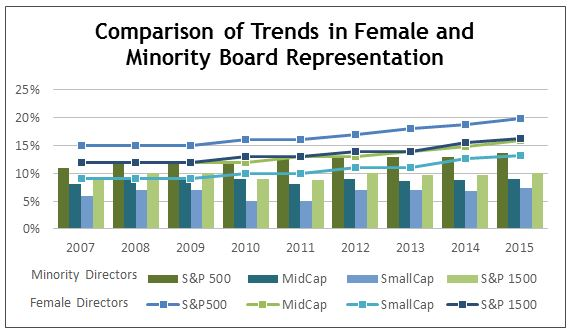
Gender diversity 2 (21%) 2 (16%) 1 (14%) 2 (17%) 1 (14%)
Independence 85% 82% 81% 83% 79%
Tenure 9 years 9 years 9 years 9 years 8 years
* Numbers based on all directorships in each index; gender diversity data represents average number of women directors on a board (and the percentage this represents)

Board Meetings and Size

Board meetings and size S&P 500 S&P MidCap 400  S&P SmallCap 600  S&P 1500 Russell 3000
Board meetings 8 7 8 8 8
Board size 10.8 9.3 8.3 9.4 8.8

Board Leadership Structure

Board leadership structure* S&P 500 S&P MidCap 400  S&P SmallCap 600  S&P 1500 Russell 3000
Separate chair/CEO 47% 57% 61% 55% 56%
Independent chair 28% 37% 42% 36% 36%
Independent lead director 54% 51% 41% 48% 40%
* Percentage based on portion of index; data through 31 Dec 2015

Board Elections

Board elections* S&P 500 S&P MidCap 400  S&P SmallCap 600  S&P 1500 Russell 3000
Annual elections 91% 62% 55% 69% 60%
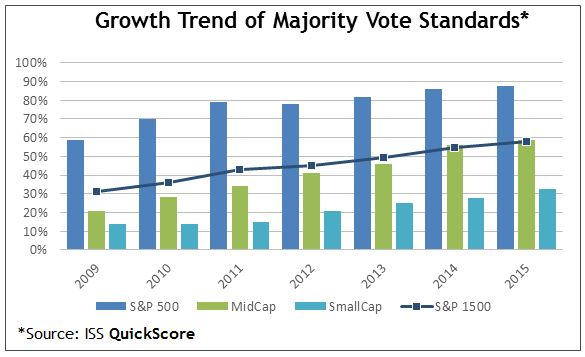
Majority voting in director elections 88% 60% 38% 62% 44%
* Percentage based on portion of index; data through 31 Dec 2015

Board and Executive Compensation

Board and executive compensation S&P 500 S&P MidCap 400  S&P SmallCap 600  S&P 1500 Russell 3000
Independent directors $291,987 $310,238 $171,120 $248,625 $226,053
CEO 3-yr average pay $12.4 million $6.2 million $3.3 million $7.1 million $5.6 million
NEO 3-yr average pay $4.7 million $2.2 million $1.2 million $2.6 million $2.1 million
Average pay ratio: CEO / NEO 2.6 times 2.8 times 2.8 times 2.7 times 2.7 times
* Numbers based on all directorships and executive positions in each index

Russell 3000 Opposition in Votes in Director Elections

Russell 3000: Opposition votes in director elections Full year 2015 Year to date 2016
Total elections 17,808 15,529
Average opposition votes received (support) 4.0% (96.0%) 4.1% (95.9%)
Russell 3000: Opposition votes received by board nominees Full year 2015 Year to date 2016
Directors with less than 80% support (% of nominees) 4.0% 4.0%
Number of directors 709 615
Directors with less than 50% support (% of nominees) 0.3% 0.3%
Number of directors 56 46

Say-on-Pay Proposals

Russell 3000: Say-on-Pay proposals voted Full year 2015 Year to date 2016
Total proposals voted 2,194 1,850
Proposals with less than 70% support (% of proposals) 8.0% 6.7%
Number of proposals 175 124
Proposals with less than 50% support (% of proposals) 2.6% 1.5%
Number of proposals 56 27
Say-on-Pay proposals vote support Full year 2015 Year to date 2016
S&P 500 92.0% 91.5%
S&P 1500 91.6% 91.8%
Russell 3000 91.3% 91.5%

Shareholder Proposals

Shareholder proposal categories Number voted Portion of voted proposals
Environmental/social 199 39%
Board-focused 163 32%
Compensation 56 11%
Anti-takeover/strategic 86 17%
Routine/other 7 1%
All 511 100%


Top shareholder proposals by vote support* Average support
Eliminate Classified Board 74.7%
Adopt Majority Vote to Elect Directors 68.5%
Eliminate Supermajority Vote 61.0%
Adopt/Amend Proxy Access 51.8%
Allow Shareholders to Call Special Meeting 41.9%
Allow Shareholders to Act by Written Consent 39.7%
Increase/Report on Board Diversity 35.4%
Address Corporate EEO/Diversity 32.5%
Appoint Independent Board Chair 29.2%
Review/Report on Climate Related Risks 28.6%
* Based on topics where at least 5 shareholder proposals went to a vote


Top shareholder proposals by number voted* Number voted
Adopt/Amend Proxy Access 76
Appoint Independent Board Chair 47
Review/Report on Lobbying Activities 40
Review/Report on Political Spending 29
Address Human Rights 23
Adopt Majority Vote to Elect Directors 22
Limit Post-Employment Executive Pay 21
Report on Sustainability 20
Allow Shareholders to Call Special Meeting 18
Review/Report on Climate Related Risks 18
* Based on topics where at least 5 shareholder proposals went to a vote

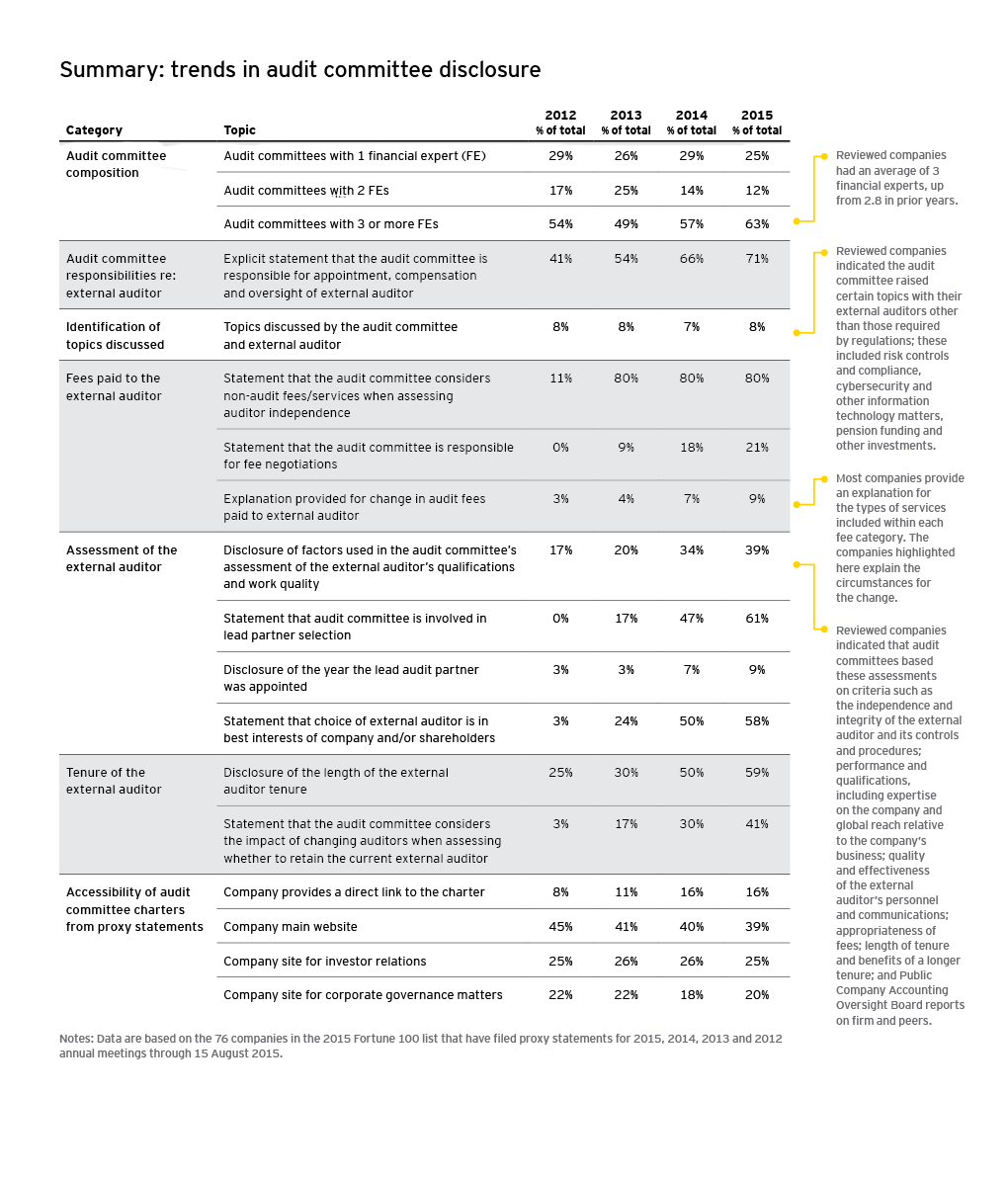
Trends in Audit Committee Disclosures

The data below was current as of August 2015 and appears in Audit committee reporting to shareholders in 2015.


ey

Shareholder Engagement Trends

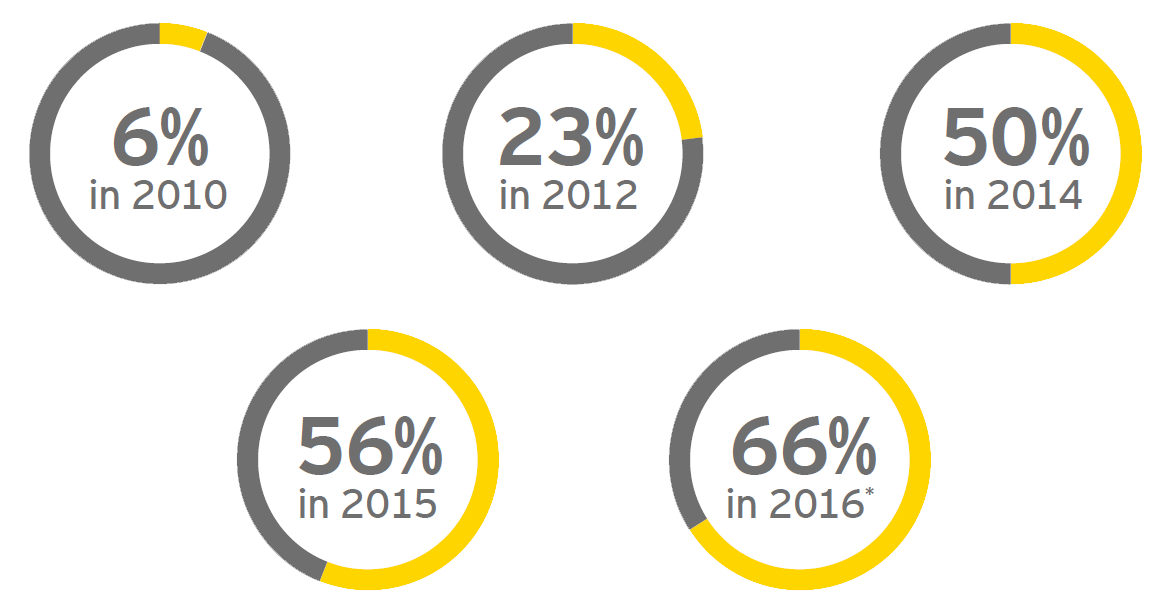
The data below was current as of June 2016 and appears in Four takeaways from proxy season 2016 (discussed on the Forum here).

S&P 500 companies disclosing engaging with investors*

ey-sandp-500-companies-disclosing-engaging-with-investors-June-2016

*Percentages for 2016 based on 436 proxy statements for S&P 500 companies available as of June 10, 2016.

__________________________________

*Ann Yerger is an executive director at the EY Center for Board Matters at Ernst & Young LLP.

Une révision du volume de Richard Leblanc | Handbook of Board Governance


Voici un article de James McRitchie, publié dans Corporate governance, qui commente succinctement le dernier volume de Richard Leblanc.

Comme je l’ai déjà mentionné dans un autre billet, le livre de Richard Leblanc est certainement l’un des plus importants ouvrages (sinon le plus important) portant sur la gouvernance du conseil d’administration.

Je vous encourage à prendre connaissance de la revue de M. McRitchie, et à vous procurer cette bible.

Bonne lecture !


The Handbook of Board Governance


The Handbook of Board Governance


I continue my review of The Handbook of Board Governance: A Comprehensive Guide for Public, Private, and Not-for-Profit Board Member. With the current post, I provide comments on Part 2 of the book, What Makes for a Good Board? See prior introductory comments and those on Part 1. I suspect the book will soon be the most popular collection of articles of current interest in the field of corporate governance.

The Handbook of Board Governance: Director Independence, Competency, and Behavior


Dr. Richard Leblanc‘s chapter focuses on the above three elements that make an effective director. Regulations require independence but not industry expertise; both are important elements. Leblanc cites ways director independence is commonly compromised and how independence ‘of mind’ can be enhanced. He then applies most of the same principles to choosing external advisors.  Throughout the chapter he employees useful exhibits that reinforce the text with bullet points, tables, etc. for quick reference.

Director competency matrices have become relatively commonplace, although not ubiquitous. Leblanc not only provides a sample and scale, he reminds readers that being a CEO is an experience, not a competency and experience is not synonymous with competency. A sample board diversity matrix is also presented with measurable objectives for age, gender, ethnicity and geography.

Director behavior is the last topic in Leblanc’s chapter. Of course, each board needs to define how its directors are to act, subject to self- and peer-assessment but Leblanc’s ten behaviors is a good starting place:

  1. Independent Judgment
  2. Integrity
  3. Organizational Loyalty
  4. Commitment
  5. Capacity to Challenge
  6. Willingness to Act
  7. Conceptual Thinking Skills
  8. Communication Skills
  9. Teamwork Skills
  10. Influence Skills

That’s just one list of many. Leblanc’s examples and commentary on each adds color and depth. Under the UK’s Corporate Governance Code, director reviews are required to be facilitated by an independent provider every two or three years. Great advice for boards elsewhere as well. As Leblanc reminds readers:

« Proxy access and other renewal reforms are the direct result of boards steadfastly resisting director recruitment on the basis of competencies, the removal of underperforming directors; and the lack of boardroom refreshment, diversification, and renewal ».

La controverse au sujet du leadership du CA | Séparation des pouvoirs ou combinaison des rôles ?


L’étude de David Larcker*, professeur de comptabilité à la Stanford Graduate School of Business, publié dans le forum du Harvard Law School, examine la controverse eu égard à la combinaison des fonctions de PDG et de président du conseil. Environ 50 % des grandes sociétés américaines sont présidées par un administrateur indépendant, comparativement à 23 % il y a 15 ans.

Toute la question du bien-fondé de la dualité des rôles PDG/Chairman est encore ambiguë, même si les experts de la gouvernance et les actionnaires activistes sont généralement d’accord avec la séparation des fonctions.

L’auteur a procédé à une enquête auprès des 100 plus grandes sociétés ainsi qu’auprès des 100 plus petites entreprises du Fortune 1000, afin d’étudier l’évolution de ce phénomène au cours des 20 dernières années.

Il ressort de ces études que les grandes sociétés sont beaucoup plus incitées (par les actionnaires) à séparer les deux fonctions que les entreprises plus petites (57 % vs 3 %).

En fait, les 100 plus petites entreprises du Fortune 1000 ne sont pas ciblées par les actionnaires pour opérer ce changement.

Un billet que j’ai publié le 5 juillet, La séparation des fonctions de président du conseil et de président de l’entreprise (CEO) est-elle généralement bénéfique ? , montre que la combinaison des deux rôles peut avoir ses avantages.

En lisant ces deux publications, vous serez certainement plus en mesure d’évaluer les conflits potentiels à assumer les deux fonctions.

Bonne lecture !


Chairman and CEO: The Controversy over Board Leadership


Our paper, Chairman and CEO: The Controversy over Board Leadership, examines the circumstances under which companies decide to combine or separate the chairman and CEO roles and shareholder response to this decision.

In recent years, companies have consistently moved toward separating the chairman and CEO roles. According to Spencer Stuart, just over half of companies in the S&P 500 Index are led by a dual chairman/CEO, down from 77 percent 15 years ago. In theory, an independent chairman improves the ability of the board of directors to oversee management. However, separation of the chairman and CEO roles is not unambiguously positive, and there is little research support for requiring a separation of these roles. Still, shareholder activists and many governance experts remain active in pressuring companies to divide their leadership structure.

Shareholders%20keep%20Moynihan%20as%20Bank%20of%20America%20chairman,%20C_11871607_1452968841970_346339_ver1_0_640_360

Given the controversy over chairman/CEO duality, we examined in detail the leadership structures of publicly traded corporations and the circumstances under which they are changed. Our sample includes the 100 largest and 100 smallest companies in the Fortune 1000 in 2016. The measurement period includes the 20-year period 1996-2015.

We find that board leadership structures are not stable. Only a third (34 percent) of companies made no changes during the entire 20-year measurement period. Slightly under half of these consistently maintained separate chairman and CEO positions (such as Costco, Intel, and Walgreens); slightly more than half of these consistently combined them (such as Amazon, Berkshire Hathaway, and ExxonMobil). Still, these companies are the exception rather than the rule. It is significantly more likely that a company makes at least one change to board leadership structure (combination or separation) over time. On average, companies made 1.7 changes, or approximately 1 change every 12 years. Changes are more frequent among large companies (2.2 changes, on average) than smaller companies (1.3 changes). In both cases, companies are slightly more likely to separate the roles than to combine them.

Most separations occur during the succession process, with the former CEO, founder, or other officer continuing to serve as chair on either a temporary or permanent basis. Of the 171 separations in our sample, 134 (78 percent) are associated with an orderly succession. This is true of both small and large companies. However, large companies are significantly more likely to separate the roles temporarily, whereas smaller companies are more likely to do so permanently.

Approximately a quarter (22 percent) of separations are not part of an orderly succession. Nine percent follow an abrupt resignation of the CEO, 6 percent a governance issue (such as accounting restatement or CEO scandal), 3 percent a merger, 2 percent a shareholder vote, and 2 percent are required of the company as part of a government bailout.

The decision to combine the chairman and CEO roles tends to be more uniform. The vast majority of combinations (91 percent) involve an orderly succession at the top. Only 9 percent are associated with a merger, sudden resignation, or governance-related issue. In 90 percent of combinations, the current CEO is given the additional title of chair; in 10 percent of cases, a new CEO is recruited to become dual chair/CEO.

Most interesting, perhaps, is the frequency with which companies “permanently” separate the leadership roles only to recombine them at a later date. Slightly over one-third (34 percent) of companies in our sample permanently separated the chairman and CEO roles and later recombined them during the 20-year measurement period. Best Buy split the roles for nearly 13 years when founder and chairman Richard Schultze stepped down as CEO in 2002; Schultze eventually resigned from the board and when his successor as chairman retired in 2015, then-CEO Hubert Joly was given the additional title of board chair. The company gave no public explanation of its decision to recombine the roles. Bank of America and Walt Disney both separated the chairman and CEO roles following shareholder votes and subsequently recombined them 5 and 9 years later, respectively, under different management. In both cases, the board justified the decision to recombine as rewarding the successful leadership of the current CEO.

In the cases of Bank of America and Walt Disney, the decisions to recombine the roles were highly controversial. Across the entire sample, however, shareholder response was unexpectedly varied. Only 34 percent of the companies that separated and recombined the chairman and CEO roles were targeted by shareholder-sponsored proxy proposals to require separation. Average support for these proposals was 33 percent, not significantly different from companies that consistently maintain a dual chairman/CEO structure (34 percent support) or that separate the roles temporarily during succession (36 percent support). It was also not significantly different from the average support across the total universe of companies that face shareholder-sponsored proposals requiring separation (32 percent).

Finally, it is interesting to note that pressure to separate the chairman and CEO roles seems to center almost exclusively on large companies. Only 3 of the 95 small companies in our sample were the target of a shareholder proposal to require an independent chairman over the entire 20-year measurement period, even though their board leadership structures are not significantly different from those of larger corporations. By contrast, a majority (56 out of 92) of large companies were targeted at least once. This suggests that the companies that shareholders target to advocate for independent board leadership might not necessarily be those with the most egregious governance problems but instead those that are the most visible public targets.

The full paper is available for download here.


*David Larcker is Professor of Accounting at Stanford Graduate School of Business. This post is based on a paper authored by Professor Larcker and Bryan Tayan, Researcher with the Corporate Governance Research Initiative at Stanford Graduate School of Business.

Les dirigeants les mieux payés dirigent les entreprises les moins performantes


La très grande majorité des gens croient que la rémunération des dirigeants est associée à une performance supérieure de leurs sociétés. Ce n’est pas ce que l’étude récemment publiée dans le Wall Street Journal par Theo Francis* tend à démontrer.

L’étude de la firme de recherche MSCI auprès de 800 CEO indique que, depuis 2006, les CEO les moins bien payés produisent des rendements supérieurs pour leurs firmes ! La différence est assez significative.

Je vous laisse le soin de lire ce compte rendu et de me donner vos impressions.

Bonne lecture !

Best-Paid CEOs Run Some of Worst-Performing Companies


The best-paid CEOs tend to run some of the worst-performing companies and vice versa—even when pay and performance are measured over the course of many years, according to a new study.

The analysis, from corporate-governance research firm MSCI, examined the pay of some 800 CEOs at 429 large and midsize U.S. companies during the decade ending in 2014, and also looked at the total shareholder return of the companies during the same period.

MSCI found that $100 invested in the 20% of companies with the highest-paid CEOs would have grown to $265 over 10 years. The same amount invested in the companies with the lowest-paid CEOs would have grown to $367. The report is expected to be released as early as Monday.


Graphique salaires CEO


The results call into question a fundamental tenet of modern CEO pay: the idea that significant slugs of stock options or restricted stock, especially when the size of the award is also tied to company performance in other ways, helps drive better company performance, which in turn will improve results for shareholders. Equity incentive awards now make up 70% of CEO pay in the U.S.

“The highest paid had the worst performance by a significant margin,” said Ric Marshall, a senior corporate governance researcher at MSCI. “It just argues for the equity portion of CEO pay to be more conservative.”

Executive-pay critics have long said pay and performance could be better aligned, and in June, The Wall Street Journal reported little relationship between one-year pay and performance figures for the S&P 500. Most longer-term analyses have used considered three or five years at a time.

The MSCI study compared 10-year total shareholder return—stock appreciation plus dividends—and cumulative total CEO pay as reported in proxy-filing summary-compensation tables.

The study also examined pay and performance among companies within the same broad economic sectors and found similar results: The top-paid half of CEOs in a sector tended to run companies that performed worse than their peers, while the lower-paid half tended to outperform.

“Whether you look at the entire group or adjust by market-cap and sector, you really get very similar results,” Mr. Marshall.

One possible factor driving the results, the researchers concluded: Annual pay reviews and proxy disclosures, which discourage boards and executives from focusing on longer-term results. The report recommended that the Securities and Exchange Commission require disclosure of cumulative incentive pay over long periods, to help illustrate a CEO’s pay relative to longer-term performance.

__________________________

*Theo Francis covers corporate news for The Wall Street Journal from Washington, D.C., and specializes in using regulatory documents to write about complex financial, business, economic, legal and regulatory issues.

Énoncés de principes de gouvernance généralement reconnus


Voici une « lettre ouverte » publiée sur le forum de la Harvard Law School on Corporate Governance par un groupe d’éminents dirigeants de sociétés publiques (cotées) qui présente les principes de la saine gouvernance : « The Commonsense Principles of Corporate Governance »*.

Les principes sont regroupés en plusieurs thèmes :

  1. La composition du CA et la gouvernance interne
    1. Composition
    2. Élection des administrateurs
    3. Nomination des administrateurs
    4. Rémunération des administrateurs et la propriété d’actions
    5. Structure et fonctionnement des comités du conseil
    6. Nombre de mandats et âge de la retraite
    7. Efficacité des administrateurs
  2. Responsabilités des administrateurs
    1. Communication des administrateurs avec de tierces parties
    2. Activités cruciales du conseil : préparer les ordres du jour
  3. Le droit des actionnaires
  4. La reddition de comptes et la divulgation des activités
  5. Le leadership du conseil
  6. La planification de la relève managériale
  7. La rémunération de la direction
  8. Le rôle du gestionnaire des actifs des clients dans la gouvernance des sociétés


Bonne lecture ! Vos commentaires sont les bienvenus.


Commonsense Principles of Corporate Governance


sociétariat_gouvernance


The following is a series of corporate governance principles for public companies, their boards of directors and their shareholders. These principles are intended to provide a basic framework for sound, long-term-oriented governance. But given the differences among our many public companies—including their size, their products and services, their history and their leadership—not every principle (or every part of every principle) will work for every company, and not every principle will be applied in the same fashion by all companies.

I. Board of Directors—Composition and Internal Governance

a. Composition

  1. Directors’ loyalty should be to the shareholders and the company. A board must not be beholden to the CEO or management. A significant majority of the board should be independent under the New York Stock Exchange rules or similar standards.
  2. All directors must have high integrity and the appropriate competence to represent the interests of all shareholders in achieving the long-term success of their company. Ideally, in order to facilitate engaged and informed oversight of the company and the performance of its management, a subset of directors will have professional experiences directly related to the company’s business. At the same time, however, it is important to recognize that some of the best ideas, insights and contributions can come from directors whose professional experiences are not directly related to the company’s business.
  3. Directors should be strong and steadfast, independent of mind and willing to challenge constructively but not be divisive or self-serving. Collaboration and collegiality also are critical for a healthy, functioning board.
  4. Directors should be business savvy, be shareholder oriented and have a genuine passion for their company.
  5. Directors should have complementary and diverse skill sets, backgrounds and experiences. Diversity along multiple dimensions is critical to a high-functioning board. Director candidates should be drawn from a rigorously diverse pool.
  6. While no one size fits all—boards need to be large enough to allow for a variety of perspectives, as well as to manage required board processes—they generally should be as small as practicable so as to promote an open dialogue among directors.
  7. Directors need to commit substantial time and energy to the role. Therefore, a board should assess the ability of its members to maintain appropriate focus and not be distracted by competing responsibilities. In so doing, the board should carefully consider a director’s service on multiple boards and other commitments.

b. Election of directors

Directors should be elected by a majority of the votes cast “for” and “against/withhold” (i.e., abstentions and non-votes should not be counted for this purpose).

c. Nominating directors

  1. Long-term shareholders should recommend potential directors if they know the individuals well and believe they would be additive to the board.
  2. A company is more likely to attract and retain strong directors if the board focuses on big-picture issues and can delegate other matters to management (see below at II.b., “Board of Directors’ Responsibilities/Critical activities of the board; setting the agenda”).

d. Director compensation and stock ownership

  1. A company’s independent directors should be fairly and equally compensated for board service, although (i) lead independent directors and committee chairs may receive additional compensation and (ii) committee service fees may vary. If directors receive any additional compensation from the company that is not related to their service as a board member, such activity should be disclosed and explained.
  2. Companies should consider paying a substantial portion (e.g., for some companies, as much as 50% or more) of director compensation in stock, performance stock units or similar equity-like instruments. Companies also should consider requiring directors to retain a significant portion of their equity compensation for the duration of their tenure to further directors’ economic alignment with the long-term performance of the company.

e. Board committee structure and service

  1. Companies should conduct a thorough and robust orientation program for their new directors, including background on the industry and the competitive landscape in which the company operates, the company’s business, its operations, and important legal and regulatory issues, etc.
  2. A board should have a well-developed committee structure with clearly understood responsibilities. Disclosures to shareholders should describe the structure and function of each board committee.
  3. Boards should consider periodic rotation of board leadership roles (i.e., committee chairs and the lead independent director), balancing the benefits of rotation against the benefits of continuity, experience and expertise.

f. Director tenure and retirement age

  1. It is essential that a company attract and retain strong, experienced and knowledgeable board members.
  2. Some boards have rules around maximum length of service and mandatory retirement age for directors; others have such rules but permit exceptions; and still others have no such rules at all. Whatever the case, companies should clearly articulate their approach on term limits and retirement age. And insofar as a board permits exceptions, the board should explain (ordinarily in the company’s proxy statement) why a particular exception was warranted in the context of the board’s assessment of its performance and composition.
  3. Board refreshment should always be considered in order to ensure that the board’s skill set and perspectives remain sufficiently current and broad in dealing with fast-changing business dynamics. But the importance of fresh thinking and new perspectives should be tempered with the understanding that age and experience often bring wisdom, judgment and knowledge.

g. Director effectiveness

Boards should have a robust process to evaluate themselves on a regular basis, led by the non-executive chair, lead independent director or appropriate committee chair. The board should have the fortitude to replace ineffective directors.

II. Board of Directors’ Responsibilities

a. Director communication with third parties

  1. Robust communication of a board’s thinking to the company’s shareholders is important. There are multiple ways of going about it. For example, companies may wish to designate certain directors—as and when appropriate and in coordination with management—to communicate directly with shareholders on governance and key shareholder issues, such as CEO compensation. Directors who communicate directly with shareholders ideally will be experienced in such matters.
  2. Directors should speak with the media about the company only if authorized by the board and in accordance with company policy.
  3. In addition, the CEO should actively engage on corporate governance and key shareholder issues (other than the CEO’s own compensation) when meeting with shareholders.

b. Critical activities of the board; setting the agenda

  1. The full board (including, where appropriate, through the non-executive chair or lead independent director) should have input into the setting of the board agenda.
  2. Over the course of the year, the agenda should include and focus on the following items, among others:
    1. A robust, forward-looking discussion of the business.
    2. The performance of the current CEO and other key members of management and succession planning for each of them. One of the board’s most important jobs is making sure the company has the right CEO. If the company does not have the appropriate CEO, the board should act promptly to address the issue.
    3. Creation of shareholder value, with a focus on the long term. This means encouraging the sort of long-term thinking owners of a private company might bring to their strategic discussions, including investments that may not pay off in the short run.
    4. Major strategic issues (including material mergers and acquisitions and major capital commitments) and long-term strategy, including thorough consideration of operational and financial plans, quantitative and qualitative key performance indicators, and assessment of organic and inorganic growth, among others.
    5. The board should receive a balanced assessment on strategic fit, risks and valuation in connection with material mergers and acquisitions. The board should consider establishing an ad hoc Transaction Committee if significant board time is otherwise required to consider a material merger or acquisition. If the company’s stock is to be used in such a transaction, the board should carefully assess the company’s valuation relative to the valuation implied in the acquisition. The objective is to properly evaluate the value of what you are giving vs. the value of what you are getting.
    6. Significant risks, including reputational risks. The board should not be reflexively risk averse; it should seek the proper calibration of risk and reward as it focuses on the long-term interests of the company’s shareholders.
    7. Standards of performance, including the maintaining and strengthening of the company’s culture and values.
    8. Material corporate responsibility matters.
    9. Shareholder proposals and key shareholder concerns.
    10. The board (or appropriate board committee) should determine the best approach to compensate management, taking into account all the factors it deems appropriate, including corporate and individual performance and other qualitative and quantitative factors (see below at VII., “Compensation of Management”).
  3. A board should be continually educated on the company and its industry. If a Board feels it would be productive, outside experts and advisors should be brought in to inform directors on issues and events affecting the company.
  4. The board should minimize the amount of time it spends on frivolous or non-essential matters—the goal is to provide perspective and make decisions to build real value for the company and its shareholders.
  5. As authorized and coordinated by the board, directors should have unfettered access to management, including those below the CEO’s direct reports.
  6. At each meeting, to ensure open and free discussion, the board should meet in executive session without the CEO or other members of management. The independent directors should ensure that they have enough time to do this properly.
  7. The board (or appropriate board committee) should discuss and approve the CEO’s compensation.
  8. In addition to its other responsibilities, the Audit Committee should focus on whether the company’s financial statements would be prepared or disclosed in a materially different manner if the external auditor itself were solely responsible for their preparation.

III. Shareholder Rights

  1. Many public companies and asset managers have recently reviewed their approach to proxy access. Others have not yet undertaken such a review or may have one under way. Among the larger market capitalization companies that have adopted proxy access provisions, generally a shareholder (or group of up to 20 shareholders) who has continuously held a minimum of 3% of the company’s outstanding shares for three years is eligible to include on the company’s proxy statement nominees for a minimum of 20% (and, in some cases, 25%) of the company’s board seats. Generally, only shares in which the shareholder has full, unhedged economic interest count toward satisfaction of the ownership/holding period requirements. A higher threshold of ownership (e.g., 5%) often has been adopted for smaller market capitalization companies (e.g., less than $2 billion).
  2. Dual-class voting is not a best practice. If a company has dual-class voting, which sometimes is intended to protect the company from short-term behavior, the company should consider having specific sunset provisions based upon time or a triggering event, which eliminate dual-class voting. In addition, all shareholders should be treated equally in any corporate transaction.
  3. Written consent and special meeting provisions can be important mechanisms for shareholder action. Where they are adopted, there should be a reasonable minimum amount of outstanding shares required in order to prevent a small minority of shareholders from being able to abuse the rights or waste corporate time and resources.

IV. Public Reporting

  1. Transparency around quarterly financial results is important.
  2. Companies should frame their required quarterly reporting in the broader context of their articulated strategy and provide an outlook, as appropriate, for trends and metrics that reflect progress (or not) on long-term goals. A company should not feel obligated to provide earnings guidance—and should determine whether providing earnings guidance for the company’s shareholders does more harm than good. If a company does provide earnings guidance, the company should be realistic and avoid inflated projections. Making short-term decisions to beat guidance (or any performance benchmark) is likely to be value destructive in the long run.
  3. As appropriate, long-term goals should be disclosed and explained in a specific and measurable way.
  4. A company should take a long-term strategic view, as though the company were private, and explain clearly to shareholders how material decisions and actions are consistent with that view.
  5. Companies should explain when and why they are undertaking material mergers or acquisitions or major capital commitments.
  6. Companies are required to report their results in accordance with Generally Accepted Accounting Principles (“GAAP”). While it is acceptable in certain instances to use non-GAAP measures to explain and clarify results for shareholders, such measures should be sensible and should not be used to obscure GAAP results. In this regard, it is important to note that all compensation, including equity compensation, is plainly a cost of doing business and should be reflected in any non-GAAP measurement of earnings in precisely the same manner it is reflected in GAAP earnings.

V. Board Leadership (Including the Lead Independent Director’s Role)

  1. The board’s independent directors should decide, based upon the circumstances at the time, whether it is appropriate for the company to have separate or combined chair and CEO roles. The board should explain clearly (ordinarily in the company’s proxy statement) to shareholders why it has separated or combined the roles.
  2. If a board decides to combine the chair and CEO roles, it is critical that the board has in place a strong designated lead independent director and governance structure.
  3. Depending on the circumstances, a lead independent director’s responsibilities may include:
    1. Serving as liaison between the chair and the independent directors
    2. Presiding over meetings of the board at which the chair is not present, including executive sessions of the independent directors
    3. Ensuring that the board has proper input into meeting agendas for, and information sent to, the board
    4. Having the authority to call meetings of the independent directors
    5. Insofar as the company’s board wishes to communicate directly with shareholders, engaging (or overseeing the board’s process for engaging) with those shareholders
    6. Guiding the annual board self-assessment
    7. Guiding the board’s consideration of CEO compensation
    8. Guiding the CEO succession planning process

VI. Management Succession Planning

  1. Senior management bench strength can be evaluated by the board and shareholders through an assessment of key company employees; direct exposure to those employees is helpful in making that assessment.
  2. Companies should inform shareholders of the process the board has for succession planning and also should have an appropriate plan if an unexpected, emergency succession is necessary.

VII. Compensation of Management

  1. To be successful, companies must attract and retain the best people—and competitive compensation of management is critical in this regard. To this end, compensation plans should be appropriately tailored to the nature of the company’s business and the industry in which it competes. Varied forms of compensation may be necessary for different types of businesses and different types of employees. While a company’s compensation plans will evolve over time, they should have continuity over multiple years and ensure alignment with long-term performance.
  2. Compensation should have both a current component and a long-term component.
  3. Benchmarks and performance measurements ordinarily should be disclosed to enable shareholders to evaluate the rigor of the company’s goals and the goal-setting process. That said, compensation should not be entirely formula based, and companies should retain discretion (appropriately disclosed) to consider qualitative factors, such as integrity, work ethic, effectiveness, openness, etc. Those matters are essential to a company’s long-term health and ordinarily should be part of how compensation is determined.
  4. Companies should consider paying a substantial portion (e.g., for some companies, as much as 50% or more) of compensation for senior management in the form of stock, performance stock units or similar equity-like instruments. The vesting or holding period for such equity compensation should be appropriate for the business to further senior management’s economic alignment with the long-term performance of the company. With properly designed performance hurdles, stock options may be one element of effective compensation plans, particularly for the CEO. All equity grants (whether stock or options) should be made at fair market value, or higher, at the time of the grant, with particular attention given to any dilutive effect of such grants on existing shareholders.
  5. Companies should clearly articulate their compensation plans to shareholders. While companies should not, in the design of their compensation plans, feel constrained by the preferences of their competitors or the models of proxy advisors, they should be prepared to articulate how their approach links compensation to performance and aligns the interests of management and shareholders over the long term. If a company has well-designed compensation plans and clearly explains its rationale for those plans, shareholders should consider giving the company latitude in connection with individual annual compensation decisions.
  6. If large special compensation awards (not normally recurring annual or biannual awards but those considered special awards or special retention awards) are given to management, they should be carefully evaluated and—in the case of the CEO and other “Named Executive Officers” whose compensation is set forth in the company’s proxy statement—clearly explained.
  7. Companies should maintain clawback policies for both cash and equity compensation.

VIII. Asset Managers’ Role in Corporate Governance

Asset managers, on behalf of their clients, are significant owners of public companies, and, therefore, often are in a position to influence the corporate governance practices of those companies. Asset managers should exercise their voting rights thoughtfully and act in what they believe to be the long-term economic interests of their clients.

  1. Asset managers should devote sufficient time and resources to evaluate matters presented for shareholder vote in the context of long-term value creation. Asset managers should actively engage, as appropriate, based on the issues, with the management and/or board of the company, both to convey the asset manager’s point of view and to understand the company’s perspective. Asset managers should give due consideration to the company’s rationale for its positions, including its perspective on certain governance issues where the company might take a novel or unconventional approach.
  2. Given their importance to long-term investment success, proxy voting and corporate governance activities should receive appropriate senior-level oversight by the asset manager.
  3. Asset managers, on behalf of their clients, should evaluate the performance of boards of directors, including thorough consideration of the following:
    1. To the extent directors are speaking directly with shareholders, the directors’ (i) knowledge of their company’s corporate governance and policies and (ii) interest in understanding the key concerns of the company’s shareholders
    2. The board’s focus on a thoughtful, long-term strategic plan and on performance against that plan
  4. An asset manager’s ultimate decision makers on proxy issues important to long-term value creation should have access to the company, its management and, in some circumstances, the company’s board. Similarly, a company, its management and board should have access to an asset manager’s ultimate decision makers on those issues.
  5. Asset managers should raise critical issues to companies (and vice versa) as early as possible in a constructive and proactive way. Building trust between the shareholders and the company is a healthy objective.
  6. Asset managers may rely on a variety of information sources to support their evaluation and decision-making processes. While data and recommendations from proxy advisors may form pieces of the information mosaic on which asset managers rely in their analysis, ultimately, their votes should be based on independent application of their own voting guidelines and policies.
  7. Asset managers should make public their proxy voting process and voting guidelines and have clear engagement protocols and procedures.
  8. Asset managers should consider sharing their issues and concerns (including, as appropriate, voting intentions and rationales therefor) with the company (especially where they oppose the board’s recommendations) in order to facilitate a robust dialogue if they believe that doing so is in the best interests of their clients.

*The Commonsense Principles of Corporate Governance were developed, and are posted on behalf of, a group of executives leading prominent public corporations and investors in the U.S.

The Open Letter and key facts about the principles are also available here and here.

Performance et dynamique des conseils d’administration | Yvan Allaire


Yvan Allaire, président exécutif du conseil de l’Institut sur la gouvernance (IGOPP) vient de me faire parvenir un nouvel article intitulé « Performance et dynamique des conseils d’administration | un échange avec des administrateurs expérimentés ».

Je crois que cet article intéressera tous les administrateurs siégeant à des conseils d’administration. Personnellement, je suis très heureux de constater que la démarche ait consisté en des rencontres avec des groupes d’administrateurs chevronnés.

Plusieurs messages très pertinents ressortent des rencontres. Ils sont regroupés selon les catégories suivantes :

  1. La taille du conseil
  2. La composition du conseil
  3. La présidence du conseil
  4. L’évaluation du conseil
  5. Information et prise de décision
  6. Les comités du conseil

Je vous invite à lire l’ensemble du document sur le site de l’IGOPP. Voici un  extrait de cet article.

Bonne lecture !

Performance et dynamique des conseils d’administration | un échange avec des administrateurs expérimentés


« Une longue expérience comme administrateur de sociétés mène souvent au constat que la qualité de la gouvernance et l’efficacité d’un conseil tiennent à des facteurs subtils, difficilement quantifiables, mais tout aussi importants, voire plus importants, que les aspects fiduciaires et formels.

Cette dimension informelle de la gouvernance prend forme et substance dans les échanges, les interactions sociales, l’encadrement des discussions, le style de leadership du président du conseil, dans tout ce qui se passe avant et après les réunions formelles ainsi qu’autour de la table au moment des réunions du conseil et de ses comités.

105868_les-administrateurs-independants-se-developpent-dans-les-eti-web-tete-0203979034507

Cela est vrai pour tout type de sociétés, que ce soient une entreprise cotée en bourse, un organisme public, une société d’État, une coopérative ou un organisme sans but lucratif.

L’IGOPP estime que pour relever encore l’efficacité des conseils d’administration il est important de bien comprendre ce qui peut contribuer à une dynamique productive entre les membres d’un conseil.

Pourtant, alors que les études sur tous les aspects de la gouvernance foisonnent, cet aspect fait l’objet de peu de recherches empiriques, et ce pour une raison bien simple. Les conseils d’administration ne peuvent donner à des chercheurs un accès direct à leurs réunions ni à leur documentation en raison des contraintes de confidentialité.

Le professeur Richard Leblanc, grâce au réseau de son directeur de thèse de doctorat et co-auteur James Gillies, a pu, rare exception, observer un certain nombre de conseils d’administration en action. Ils ont publié en 2005 un ouvrage Inside the Boardroom, lequel propose une intéressante typologie des comportements dominants des membres de conseil au cours de réunions.

Depuis aucune autre étude empirique n’a été menée sur le sujet. D’ailleurs, l’ouvrage de Leblanc et Gillies, se limitant aux comportements observables lors de réunions formelles, ne nous éclairait que sur une partie du phénomène »

« L’IGOPP a voulu mieux comprendre cette dynamique et, si possible, proposer aux administrateurs et présidents de conseil des suggestions pouvant améliorer la qualité de la gouvernance.

L’IGOPP a donc invité des membres de conseil expérimentés et férus de gouvernance pour un échange sur cet enjeu. Les 14 personnes suivantes ont accepté promptement notre invitation et nous les en remercions chaleureusement:

  1. Jacynthe Côté
  2. Gérard Coulombe
  3. Isabelle Courville
  4. Paule Doré
  5. Jean La Couture
  6. Sylvie Lalande
  7. John LeBoutillier
  8. Brian Levitt
  9. David L. McAusland
  10. Marie-José Nadeau
  11. Réal Raymond
  12. Louise Roy
  13. Guylaine Saucier
  14. Jean-Marie Toulouse, qui a agi comme modérateur des discussions.

Collectivement, nos interlocuteurs siègent au sein de 75 conseils, dont 34 sont des sociétés ouvertes parmi lesquelles 14 ont leur siège hors Québec.

Nous avons tenu quatre sessions, chacune comptant un petit nombre d’administrateurs, de façon à ce que les discussions permettent à tous de s’exprimer pleinement.

Ces sessions furent riches en commentaires, observations pertinentes et suggestions utiles ».

Plusieurs messages très pertinents ressortent des rencontres. Ils sont regroupés selon les catégories suivantes :

  1. La taille du conseil
  2. La composition du conseil
  3. La présidence du conseil
  4. L’évaluation du conseil
  5. Information et prise de décision
  6. Les comités du conseil

En conclusion, l’auteur mentionne que « ce texte tente de rendre justice aux échanges entre les 14 administrateurs chevronnés qui ont participé à cette recherche de pistes d’amélioration de la dynamique des conseils d’administration et donc de la gouvernance de nos sociétés ».


Étude sur les comportements « limites » des PDG (CEO)


Quelles actions les conseils d’administration sont-ils susceptibles d’adopter dans les cas où leur PDG (CEO) a un comportement « limite » tout en n’étant pas illégal ?

L’article récemment publié par David Larcker* et Brian Tayan** dans la Harvard Business Review présente plusieurs exemples de situations où les CEO captent l’attention du public pour de mauvaises raisons !

Les CA sont les garants de la réputation de l’entreprise et, lorsque confrontés à des comportements fautifs de la part de leur CEO, ils doivent s’assurer de prendre toutes les mesures appropriées.

Les auteurs ont identifié 38 cas de comportements de CEO déviants qui ont un des échos révélateurs et qui ont généré des actions de gestion de crises. L’échantillon des cas retenus a été présenté en cinq grandes catégories :

(1) 34 % des cas impliquent des CEO qui ont menti à propos de leurs affaires personnelles ;

(2) 21 % des cas sont de nature sexuelle, impliquant un subordonné, un entrepreneur ou un consultant ;

(3) 16 % des cas concernent l’utilisation « questionnable » des fonds de l’entreprise ;

(4) 16 % des cas consistent en comportements grossiers ou abusifs ;

(5) 13 % des cas consistent en déclarations publiques qui ont des conséquences négatives sur les clients ou sur un groupe social en particulier.

Les résultats suivants ressortent clairement de l’étude :

– The impact of misbehavior on corporate reputation is significant and long-lasting.

– Shareholders generally (but do not always) react negatively to news of misconduct.

– Most companies take an active approach in responding to allegations of misconduct.

– Corporate punishment for CEO misbehavior is inconsistent.

– CEO misbehavior can reverberate across the organization.

For boards of directors, the lessons are clear: For better or worse, the CEO is often the face of the corporation. When the CEO engages in misconduct, the board has an obligation to investigate the matter, take proactive steps to ensure that it is properly dealt with, and — most important — ensure that corporate reputation, culture, and long-term performance are not damaged.

Je vous invite à lire plus à fond les répercussions de ces mauvais comportements sur la réputation de l’organisation ainsi que les décisions prises par les CA dans chaque situation.

Bonne lecture ! Vos commentaires sont les bienvenus.

Incidents of CEO Bad Behavior


3032212-poster-p-4-aa-dov-charney


Most boards of directors know what to do when their CEO is accused of illegal activity. They conduct an independent investigation, and if the allegations are verified, they take corrective action. In most cases, the CEO is terminated.

It is much less obvious what actions the board should take when the CEO is accused of behavior that is questionable but not illegal. For example, if the CEO makes controversial public statements, has personal relations with an employee or contractor, or develops a reputation for being rude, overbearing, or verbally combative, the board must decide what merits investigation. It must also decide whether to address matters publicly or privately. These decisions become even more important when CEO misbehavior is picked up by the media, bringing unwanted public attention that can have an impact on the organization and its reputation.

To examine how corporations handle allegations of CEO misbehavior, we conducted an extensive review of news media between 2000 and 2015. We identified 38 incidents where a CEO’s behavior garnered a meaningful level of media coverage (defined as more than 10 unique news references). We categorized these incidents as follows:

34% involved reports of a CEO lying to the board or shareholders over personal matters, such as a drunk driving offense, undisclosed criminal record, falsification of credentials, or other behavior.

21% involved a sexual affair or relations with a subordinate, contractor, or consultant.

16% involved CEOs making use of corporate funds in a manner that is questionable but not strictly illegal.

16% involved CEOs engaging in objectionable personal behavior or using abusive language.

13% involved CEOs making public statements that are offensive to customers or social groups.

Examining these incidents in detail, five main findings stood out:

The impact of misbehavior on corporate reputation is significant and long-lasting. The incidents that we identified were cited in over 250 news stories each, on average. Furthermore, media coverage was persistent, with references made to the CEO’s actions up to an average of 4.9 years after initial occurrence. For example, news stories today continue to reference former American Apparel CEO Dov Charney’s odd behavior of walking around the company’s offices in his underwear, even though it was first reported over 10 years ago. Boards should not expect allegations of misbehavior to disappear quickly.

Shareholders generally (but do not always) react negatively to news of misconduct. Among the companies in our sample, share prices declined by a market-adjusted 3.1% (1.1% median) over the three-day trading period around the initial news story. For example, Hewlett-Packard stock fell almost 9% following reports that former CEO Mark Hurd had a personal relationship with a female contractor. However, shareholder reactions are not uniformly negative. Of the 38 companies in our sample. 11 exhibited positive stock price returns when CEO misbehavior made the news. Perhaps unexpectedly, there is no discernible relationship between the type of behavior and stock price reaction.

Most companies take an active approach in responding to allegations of misconduct. In 84% of cases, the company issued a press release or formal statement on the matter. In 71% of cases, a spokesperson provided direct commentary to the press. Board members were much less likely to speak to the media, making direct comments only 37% of the time. In over half of cases (55%), the board of directors was known to initiate an independent review or investigation. The board is most likely to announce an independent review in cases of potential financial misconduct. However, the willingness of an individual director to discuss the matter directly with the press does not appear to be associated with the type of behavior involved or the “severity” of the CEO’s actions.

Corporate punishment for CEO misbehavior is inconsistent. In 58% of incidents, the CEO was eventually terminated for his or her actions. Questionable financial practices was the only category of behavior that almost uniformly resulted in termination; all other behaviors resulted in both outcomes (termination and retention) across our sample. Even behavior as straightforward as falsifying information on a resume was treated inconsistently by different boards. In a third of cases (32%), the board took actions other than termination in response to CEO misconduct, such as stripping the CEO of the chair title, removing the CEO from the board, amending the corporate code of conduct, reducing or eliminating the CEO’s bonus, other director resignation, and other changes to board structure or composition.

CEO misbehavior can reverberate across the organization. Approximately one-third of companies faced additional fallout from the CEO’s actions, including loss of a major client, federal investigation, shareholder or federal lawsuit, or shareholder action such as a proxy battle. Forty-five percent of companies in the sample experienced a significant unrelated governance issue following the event, such as an accounting restatement, unrelated lawsuit, shareholder action, or bankruptcy. As for the CEOs themselves, three were reported to resign from other boards because of their actions. Two CEOs who were terminated were subsequently rehired by the same company. We found that many continued in their position or were hired by other corporations or investment groups; otherwise there was no notable news of what happened to them professionally.

For boards of directors, the lessons are clear: For better or worse, the CEO is often the face of the corporation. When the CEO engages in misconduct, the board has an obligation to investigate the matter, take proactive steps to ensure that it is properly dealt with, and — most important — ensure that corporate reputation, culture, and long-term performance are not damaged.


David Larcker* is the James Irvin Miller Professor of Accounting and Senior Faculty at the Rock Center for Corporate Governance at Stanford University. He is a co-author of the books Corporate Governance Matters and A Real Look at Real World Corporate Governance.

Brian Tayan** is a researcher at the Rock Center for Corporate Governance at Stanford University. He is a co-author of the books Corporate Governance Matters and A Real Look at Real World Corporate Governance.

Le rapport 2016 de la firme ISS sur les pratiques relatives aux conseils d’administration


Chaque année, la firme ISS produit un rapport très attendu sur les pratiques relatives aux conseils d’administration.

L’étude publiée par Carol Bowie*, directrice de la recherche à Institutional Shareholder Services (ISS), et parue sur le forum du HLS, présente de façon claire l’état de la situation, les tendances qui se dessinent ainsi que les nouvelles normes qui prévalent dans les entreprises du S&P 500, du MidCap 400 et du SmallCap 600.

Par exemple, 88 % des entreprises du S&P 500 ont adopté la pratique du vote majoritaire, délaissant ainsi la pratique de la pluralité des voix.

Également, plus de 80 % des entreprises du S&P 500 soumettent leurs administrateurs à des élections annuelles, délaissant ainsi l’habitude des « Staggered Boards » (élections des administrateurs à des périodes différentes).

253092c

En ce qui concerne la réalité de la diversité des conseils d’administration, on note des progrès continus, mais lents. Ainsi, 98 % des entreprises du S&P 500 ont au moins une femme sur le conseil, et 79 % ont au moins un membre d’une minorité sur le conseil. Au total, environ 20 % de femmes siègent à des conseils d’administration et 17 % des administrateurs proviennent de minorités diverses.

Enfin, l’étude montre que 13,3 % de tous les postes d’administrateurs ont été pourvus par de nouvelles recrues (moins de 2 ans sur le CA).

Je vous invite à jeter un œil aux tableaux qui ponctuent le rapport.

Bonne lecture !


ISS 2016 Board Practices Study


ISS’ latest update of the structure and composition of boards and individual director attributes at Standard & Poor’s U.S. “Super 1,500” companies (i.e., companies in the S&P 500, MidCap 400, and SmallCap 600 indices) found a number of new and continuing trends in board practices and director attributes at these key index companies.

Majority Votes for Directors and Annual Board Elections are the New Normal

Based on analysis of public filings (primarily proxy statements) related to shareholder meetings occurring from July 1, 2014, through June 30, 2015, the study reports that annual board elections and majority vote standards for those elections are now the norm across the S&P 1500. While larger companies initially led the way in adopting these accountability enhancements, the pace of abandoning staggered board terms at smaller companies picked up speed in 2015. Also, Small- and MidCap companies adopted majority vote standards for board elections at a faster pace than their S&P 500 counterparts in 2015—increasing by 4 and 3 percentages points, respectively among the Small- and MidCap firms. For the third consecutive year, well over half of all study companies have majority voting standards, which is now the clear market standard at S&P 500 companies, with over 88 percent of companies in the index having adopted the practice. Only 61 total S&P 500 companies maintain a plurality vote standard, down from 67 last year and 87 in 2013.

5-31-1

There has also been a significant increase over the last five years in the number of companies holding annual elections, both at the S&P 1500 and at each constituent index. The proportion is significantly higher at S&P 500 companies, where it has risen more than 20 percentage points in the last five years. Still, over 60 percent of S&P 1500 companies (and over 80 percent of S&P 500 companies) now hold annual elections for all directors, While the prevalence has increased in the S&P 1500 every year since 2009, the largest jump occurred last year, when it rose from 60 to 64 percent, driven by an 8 percentage point increase at the S&P 500, where only 84 boards now hold staggered elections.

Many companies completed the gradual removals of their classified board structures that had begun in response to a large wave of shareholder proposals offered in a campaign organized by the now defunct Shareholder Rights Project at Harvard Law School. A majority of SmallCap companies held annual elections for the first time in 2014, a trend that has continued, as an additional 2 percent of the index’s companies held annual elections in 2015. Bucking the trend were the MidCap companies, which showed a slight decrease in the proportion holding annual elections in 2015, after steading increases in 2009 through 2014.

Board Diversity

Many corporate governance experts believe that the interplay of different backgrounds and perspectives enhances the effectiveness of boards and facilitates greater long-term corporate success. Some advocates for board diversity believe that a “tone at the top” will penetrate the corporate hierarchy and lead to increased diversity across all ranks of employment.
5-31-2
Companies with larger market caps generally have higher levels of gender and racial/ethnic diversity than those with smaller valuations. As of ISS’ latest analysis, almost all S&P 500 companies have at least one female or minority director, while 90 percent of MidCap boards and 78 percent of SmallCap boards have at least one female or minority member. There has been a market-wide increase over the past five years in board diversity:

Ninety-eight percent of S&P 500 boards have at least one female member and 79 percent have at least one minority, up from 89 and 63 percent in 2010, respectively;

Eighty-four percent of MidCap boards have at least one female member and 53 percent have at least one minority, increased from 74 and 36 percent in 2010, respectively; and

Sixty-nine percent of SmallCap boards have at least one female member and 41 percent have at least one minority, increased from 54 and 22 percent in 2010, respectively.

5-31-3
More than 88 percent of S&P 1500 companies have at least one female or minority director, and a majority of the S&P 1500 have either one female and/or one minority, who, in some instances, are the same individual. Minority women hold 329 directorships, an increase from 279 in 2014. Although this represents an absolute increase, the proportion of S&P 1500 directorships held by minority women has remained at approximately 2.4 percent since 2010.

New Directors

In 2015, 1,833 seats, or about 13.3 percent of all directorships, were filled by directors with less than two years’ tenure and who were elected for the first time in 2014 or 2015 (“new” directors). That compares with about 12 percent of all directorships filled by “new” directors in last year’s analysis, suggesting a slight increase in the turnover rate. The characteristics of these new directors were analyzed to develop a better understanding of what companies may be considering when choosing new director candidates.
5-31-4
New directors are generally younger than directors with tenures of over two years. Also, the average age difference is 5.3 years, an increase from 2014.

Fifty-three percent of new directors serve on only one board, which continues the trend identified in last year’s study, which found that nominating committees are bringing on directors who have no prior board experience. However, a majority of open S&P 500 positions, 56 percent, were filled by a director who sits on at least one other board, which drives the “average” number of outside boards for new directors up to nearly one and underscores the fact that market leading companies seek directors with a track record. New directors are more likely than those with more than two years tenure to be outside hires; 46 percent of all directors joining boards in 2014 and 2015 sit on only one board and are not executives of the companies whose boards they have joined.

Similarly, the percentage of new directors who are female or identified as an ethnic/racial minority continues to exceed the proportion of longer-tenured female- and minority-held S&P 1500 directorships. While the proportion of new directorships held by females has increased for several consecutive years, this momentum seems to be slower for minority directors. Minority directors comprised 16 percent of new directorships in 2015, compared to 10 percent of all new directors in 2014. Female directors filled 27 percent of new directorships in 2015, up from 22 percent in 2014, and 20 percent in 2013. This increase highlights both the overall growth in the number of directorships held by women and the acceleration in the growth of female directorships.

______________________

*This post is based on a recent publication authored by ISS U.S. Research analysts Andrew Borek, Liz Williams, and Rob Yates. Information on how to obtain the full report is available here.

L’utilisation des médias sociaux par les entreprises


Il existe peu de recherche sur les stratégies utilisées par les entreprises publiques (dans ce cas-ci l’indice S&P 1500) eu égard à l’adoption des réseaux sociaux pour divulguer de l’information aux investisseurs.

L’étude dont il est ici question a été réalisée par une équipe de chercheurs et elle a été publiée dans le Harvard Law School Forum par Matteo Tonello*, directeur du Conference Board. Elle montre que plus de la moitié des entreprises utilisent Twitter pour relayer différents types d’informations (principalement de nature financière) auprès d’investisseurs actuels ou potentiels.

Tout le monde reconnaît l’impact phénoménal des médias sociaux pour communiquer nos messages, instantanément, à l’échelle planétaire ; l’étude démontre que les entreprises ont également pris le virage et qu’elles utilisent abondamment les médias sociaux dans toutes les sphères des activités relatives aux affaires.

Mais, comment les entreprises utilisent-elles les réseaux sociaux pour communiquer plus efficacement leurs résultats financiers auprès de leurs investisseurs ? Comment ces entreprises profitent-elles des médias sociaux pour améliorer leur image de marque ? Quelles sont les conséquences non anticipées de la diffusion d’information financière par l’intermédiaire de Twitter ?

Avec les médias traditionnels, les organisations sont très dépendantes des services de presse, si bien que les informations financières ne sont généralement pas bien ciblées et que les entreprises ne savent pas si les investisseurs actuels ou futurs ont bien reçu l’information.

Les auteurs recommandent l’utilisation de courts messages dans un média tel que Twitter, avec un lien vers un communiqué de presse ou vers le site de l’entreprise. La recherche montre également que la divulgation de l’information financière aux investisseurs en utilisant ce moyen peut engendrer une perte de contrôle du message !

Aussi, l’étude montre que les organisations sont moins susceptibles de divulguer leurs résultats financiers via Twitter lorsque les profits ne satisfont pas les attentes des analystes. Les entreprises utilisent essentiellement Twitter pour divulguer les bonnes nouvelles. Cela ne surprendra personne, mais ce comportement illustre le manque de transparence de plusieurs entreprises.

Également, l’étude montre que les grands investisseurs réagissent plus rapidement aux tweets liés aux résultats financiers.

Enfin, les résultats indiquent que les retweets d’informations négatives ont une portée virale et qu’ils génèrent une couverture négative dans les médias traditionnels.

Si vous souhaitez approfondir vos connaissances sur la diffusion d’informations par les entreprises publiques via les médias sociaux, je vous invite à lire ce court extrait de l’étude.

Bonne lecture !


Corporate Use of Social Media


While companies devote considerable effort to creating and managing social media presences, little is known about how they use social media to communicate financial information to investors. This report examines the use of social media by S&P 1500 companies to disseminate financial information and the response from investors and traditional media. The findings show that companies use social media to overcome a perceived lack of traditional media attention and that social media usage improves the company’s information environment. There is also evidence that, in contrast with other types of company communications, the beneficial effects of social media on the company’s information environment are offset when the investor-focused social media communications are disseminated by other social media users. The findings are relevant for managers and boards establishing corporate social media disclosure policies, since they suggest that companies may benefit from developing different approaches to disseminating positive versus negative earnings news.

Social media has transformed communications in many sectors of the US economy. It is now used for disaster preparation and emergency response, security at major events, and public agencies are researching new uses in geolocation, law enforcement, court decisions, and military intelligence. Internationally, social media is credited for organizing political protests across the Middle East and a revolution in Egypt. In the business world, social media has revolutionized sales and marketing practices and developed into a powerful recruiting and networking channel.

puzzle-medias-sociaux

Conventionally, if a company wanted to publicize investor-related information such as an earnings announcement, it would do so by sending a press release to intermediaries such as newswire services, equity research databases, and brokerage firms. A company would not know if or when any of its existing or prospective investors received the information. In contrast, with social media platforms such as Twitter, a company can send one or more short messages directly to a known number of followers with a link to a press release on its corporate website. As such, a company can use Twitter to target its news dissemination, increase the speed and flexibility of the news dissemination, and reduce information acquisition costs for its investors and the traditional media outlets that follow it.

Little research exists, however, on how firms use social media to communicate financial information to investors and how investors respond to information disseminated through social media, despite firms devoting considerable effort to creating and managing social media presences directed at investors. While social media is generally viewed as an opportunity to improve investor communications and increase visibility, the authors hypothesize that disseminating investor communications via social media could also result in the company not retaining full control over its financial communications. This concern stems from the viral nature of social media—even though social media allows a company to connect more easily with its investors, it also allows investors to connect more easily with the company, with each other, and with individuals who do not directly follow the company and are likely less informed about the company’s prior financial communications. As a result, a company’s investor communications via social media can potentially spread to uniformed individuals in a way that creates adverse consequences for the company.

The Adoption Rate of Social Media to Disseminate Information to Investors

To collect data on social media usage, the authors identify whether each company in the S&P 1500 Index had a social media presence on Twitter, Facebook, LinkedIn, Pinterest, YouTube, and Google+ as of January 2013 by visiting each corporate website and looking for icons or links to the company’s social media sites. Twitter and Facebook are the two most frequently adopted social media platforms for corporations. The data show that adoption of Twitter and Facebook exceeds 47 percent and 44 percent, respectively, and is highest for customer-facing industries such as meals, retail, books and services (each over 65 percent) and lowest for industrial sectors such as oil (roughly 20 percent) and steel (roughly 14 percent). Corporate adoption is much lower for the other social media platforms, suggesting that they are less conducive for delivering typical corporate communications.

The authors also collect data on when companies joined Twitter or Facebook by searching for the earliest tweets or posts. The time trend in corporate social media adoption for Facebook and Twitter is illustrated in Figure 1. The earliest adopters of Facebook joined in November 2007 and the first set of firms to create Twitter accounts did so in May 2008. By early 2013, the corporate adoption rate of Twitter surpassed the rate for Facebook. By the end of the data collection period, 51 percent of the S&P 1500 companies had adopted one or the other, with Twitter appearing to edge out Facebook slightly as the preferred social media platform for companies.

tcb-1

Since social media adoption does not necessarily imply that social media is used to disseminate information to investors, which is the focus of the study, the next step is to analyze what types of investor-focused information are disseminated over social media. Since the data suggest that Twitter is the preferred social media platform, it is the focus of this analysis. Quarterly earnings-related tweets are the most prevalent type of investor-focused tweets, far outnumbering tweets related to executive turnover, dividends, board of directors, and even new products and customers. The frequency of each type of investor-related tweet is summarized in Table 1.

tcb-3

The number of firm-quarters with earnings announcements on Facebook (5.7 percent) is approximately half the number on Twitter (11.8 percent), suggesting that the preference for Twitter is even stronger when it comes to earnings news. An overview of the corporate use of Twitter and Facebook is illustrated in Figure 2.

tcb-2

Which Companies Use Social Media and What Is The Capital Market Response?

The consequences of social media usage are identified by combining the detailed information on Twitter usage with other data on stock market outcomes and financial statement data. Using Twitter, rather than other social media data, is advantageous because 1) earnings announcements have been shown in prior work to be of first-order importance to investors, 2) the information content of earnings announcements can be controlled for more effectively than the information content of other financial disclosures, and 3) the precise time that earnings announcements were disseminated through Twitter can be identified. The analyses address four related research questions, which are described in the following subsections:

What Types of Companies Disseminate Earnings through Social Media?

An investigation of the factors associated with the choice to disseminate earnings news through Twitter finds that companies that tweet earnings have less traditional media coverage and tend to issue more press releases than those that do not use Twitter. These findings suggest that companies use social media along with other firm-initiated communications in response to a perceived lack of traditional media coverage. The analysis also shows that larger companies are more likely to use Twitter to disseminate earnings news, which is contrary to the notion that smaller companies benefit more from using social media.

Are Companies Strategic in their use of Social Media?

The authors investigate whether companies strategically disseminate earnings news using Twitter by examining whether there is differential usage of Twitter based on the direction of the earnings news (i.e., positive versus negative earnings news). They find that companies are less likely to disseminate earnings news through Twitter when the earnings miss the consensus forecast and the magnitude of the miss is larger. When the sample is split between companies that consistently use Twitter versus those that do not, these results are driven by this latter group. In other words, it appears that there is a subset of companies that are sporadic in their Twitter usage, and that these companies use Twitter strategically to disseminate positive earnings news.

How does the Capital Market Respond to the Corporate Use of Social Media?

The capital market response to social media dissemination is investigated by looking at intra-day and three-day changes in capital market measures related to price, volume, and spreads. There is a reduction in bid-ask spreads when the company tweets earnings news and when more followers receive the earnings announcement tweet. [1]

Modest price- and volume-based responses are found to earnings announcements disseminated over Twitter during three-day earnings announcement windows. However, when short-window intraday tests focused on companies that tweet earnings news during market hours are used, both trading volume and trade size respond to earnings tweets. There is a significant increase in the mean and median abnormal volume, primarily due to an increase in large trades. Therefore, while social media is commonly viewed as a dissemination channel that provides timely access to information for all investors, the results suggest that larger investors react more quickly to earnings-related tweets.

Does Social Media Influence Traditional Media Coverage?

The authors investigate whether there are adverse consequences to the company from non-firm initiated social media disseminations by examining whether retweets negatively affect the company’s information environment and its coverage by traditional media. In contrast with the evidence for tweets, there is an increase in information asymmetry when the company’s earnings announcement tweets are retweeted to individuals who do not follow the company (i.e., the follower’s followers). Media coverage is also adversely affected by retweet activity. While more retweets are associated with more coverage in traditional media, this association is entirely attributable to negative media coverage. This finding suggests that retweets of earnings information increase negative media coverage, but have no effect on positive media coverage.

Conclusion

The findings shows that the usage of social media by corporations has grown dramatically over a relatively short period of time, from less than 5 percent of S&P 1500 companies in 2008 to more than 50 percent in 2013. This trend suggests that social media usage for communicating with investors has the potential to become an integral part of many companies’ disclosure policies. The findings show that even in the absence of the Securities and Commission’s approval of social media as a channel for investor communication, companies used it to disseminate a variety of information, including earnings news, board and executive changes, new contracts, and dividends.

Overall, the findings demonstrate that social media usage improves the company’s information environment, consistent with the notion that it improves investor communications. However, the benefits are offset when the company’s disclosures are disseminated by other social media users, consistent with the notion that there are potential adverse consequences to the company’s information environment that derive from the viral nature of social media. This finding suggests that an appropriate social media policy for investor communications likely differs from social media usage for other business purposes, such as marketing campaigns, in which companies often want to generate viral reactions to social media dissemination. The results also suggest that companies that adopt social media disclosure policies benefit from developing different approaches to disseminating positive versus negative earnings news. These conclusions are relevant for companies, managers, and boards of directors that are establishing social media disclosure policies.

Endnotes:

[1] The bid-ask spread is the difference between the price that someone is willing to pay for a security at a specific point in time (the bid) and the price at which someone is willing to sell (the ask).

_____________________________

*Matteo Tonello* is managing director at The Conference Board, Inc. This post relates to an issue of The Conference Board’s Director Notes series by Michael Jung, James Naughton, Ahmed Tahoun, and Clare Wang.

Les firmes de conseillers en rémunération contribuent-elles à la mise en place de plans salariaux excessifs des PDG ?


Avez-vous confiance dans les conseillers en rémunération pour faire des propositions salariales qui reflètent vraiment la contribution des dirigeants, et qui sont nécessaires pour la rétention des personnes ?

Dans quelle mesure ceux-ci sont-ils responsables de l’augmentation, souvent excessive, des rémunérations des dirigeants ?

Une étude, à laquelle le professeur Omesh Kini de Georgia State University a contribué, montre que, bien que les consultants soient embauchés par les comités de ressources humaines des CA, ceux-ci peuvent subir l’influence indirecte de la direction.

L’auteur décrit différentes approches de firmes de conseillers dans l’établissement des plans de rémunérations des dirigeants. Les firmes prétendent se différencier en proposant des « packages » de rémunération censés aligner les objectifs des actionnaires sur ceux des administrateurs. Les consultants sont sensibles aux effets du « say on pay » et, par conséquent, tentent d’élaborer des programmes de rémunération bien étoffés.

Plusieurs auteurs avancent que les firmes de conseils en rémunération ont tendance à utiliser des échantillons de comparaisons salariales susceptibles de justifier des rémunérations élevées, sinon excessives. Les auteurs suggèrent que les consultants souhaitent obtenir d’autres contrats avec l’entreprise (« repeat business ») et, en ce sens, elles agissent en fonction de leurs intérêts d’affaires.

L’étude montre que, contrairement à la croyance populaire, les firmes de conseillers en rémunération n’opèrent pas de façon très différente les unes des autres. En réalité, elles ne se distinguent pas par des approches particulières.

Les résultats de l’étude montrent que le choix de la firme de consultants a peu d’importance lorsque l’entreprise est reconnue pour ses solides mécanismes de gouvernance. En revanche, si la gouvernance de l’entreprise laisse à désirer (plusieurs administrateurs non indépendants, comité de RH peu soucieux, PDG omniprésent au CA, manque de leadership du président du conseil, CA peu informé, etc.), les firmes de consultants en rémunération sont plus enclines à proposer des plans salariaux généreux.

Les conclusions de cette étude indiquent que les mécanismes de gouvernance sont les facteurs les plus révélateurs dans l’établissement d’une rémunération juste et adéquate et que le choix d’une firme de conseillers particulière est très secondaire, sinon sans réels effets.

Vous trouverez, ci-dessous, un résumé de l’article paru récemment sur le forum du Harvard Law School.

Bonne lecture !

Do Compensation Consultants Have Distinct Styles ?


In our paper, Do Compensation Consultants have Distinct Styles?, which was recently made public on SSRN, we investigate whether the choice of a specific compensation consultant affects the compensation level and structure of top managers. This question is crucially important because existing studies that examine the compensation of CEOs show that compensation schemes influence their behavior and, consequently, impact firm economic outcomes. Compensation consultants are typically hired by the board of directors’ compensation committee to help craft compensation policies for the top managers of the corporation. Although they serve at the behest of the board, consultants can imprint their own distinct styles in fashioning compensation policies for a firm. We examine whether individual compensation consultants influence compensation policies in unique ways, i.e., exhibit distinct “styles,” after controlling for the known economic determinants of these policies.

Compensation consultants strive to signal distinct styles in a positive manner via their own advertising. For example, Towers Watson claims to “bring a unique portfolio of resources” to the table, with an emphasis on aligning board actions with shareholders (e.g., avoiding “say on pay” disputes). [1] Conversely, the media has reported that consulting advice varies little. For example, Towers Perrin was accused in 1997 of giving nearly identical reports on workplace diversity to multiple consulting clients across different industries. [2] Towers Perrin’s response was that all of the clients reported in the article faced similar economic forces and, therefore, received similar advice. [3] Thus, the anecdotal evidence on consultant style is mixed.

cadres

Compensation consultants have been in the direct line of fire from academics, board members, and policy makers. For example, Bebchuk and Fried (2014) take the view that managers will influence the employment of consultants who are likely to recommend higher pay and use their advice to justify excessive compensation. They further argue that compensation consultants, driven by their cross-selling incentives and/or desire to obtain repeat business, design compensation plans that provide excessive pay to managers. Thus, they suggest that compensation consultants worsen, rather than alleviate, agency problems within firms. Board members also claim that compensation consultants are to blame for spiraling CEO pay (Workforce, February 7, 2008). Finally, the former SEC Commissioner Roel C. Campos in a speech stated, “Another significant driver of excessive CEO compensation is the use of compensation consultants.” He goes on to add, “It is extremely difficult to avoid using high comparables, and consultants can pretty much find high comparable income data to support paying a high amount to the CEO. This is the case even if the consultant reports directly to the board.”

Thus, it is an open question whether individual compensation consultants: (i) have distinct styles and managers/boards hire consultants with a specific style, (ii) do not have distinct styles, but instead give compensation advice based purely on economic characteristics, and (iii) respond in a distinct manner to the incentives that arise from the governance environment of the client firm and their own self-interest. We investigate these issues in our paper. In the process, we attempt to shed light on whether compensation consultants facilitate compensation arrangements that reflect a competitive equilibrium in the level of pay and an efficient equilibrium in the incentives provided by optimal contracts (the “efficient” view) or that compensation contracts are written by captive boards and pliant compensation consultants to enhance the welfare of powerful CEOs (the “agency” view).

Our empirical tests detect little evidence suggesting that individual consultants have their own distinct styles. This evidence can be interpreted in two different ways. One possibility is that compensation consultants do not have any specific style and are perfect substitutes for each other. Consequently, the choice of compensation consultant will not matter much because their compensation advice will be grounded in the economic determinants of compensation level and structure and, thus, will be quite similar. An alternative possibility is that compensation consultants do not have distinct styles, but will work in their own self-interest by reacting to the incentives provided by the hiring firm. We distinguish between these views by finding style-like effects for the subsample of client firms with weak governance mechanisms, but not for the subsample of client firms with strong governance mechanisms. These results suggest that the choice of individual consultant does not matter in firms that have strong governance mechanisms. For the weak governance firms, we find that the style-like effects are largely driven by firms that hire consultants who do not have any non-compensation related businesses. In this subsample, both the lead return on assets and Tobin’s q for their client firms are significantly lower for consultants who recommend a higher salary or higher salary percentage as a proportion of total compensation. We also document style-like effects for the subsample of client firms with whom the consultant has existing business relationships unrelated to compensation consulting (conflicted consultants). Further, when these conflicted consultants recommend higher equity-based compensation, the client firms’ values as measured by their lead Tobin’s q are significantly lower and that these client firms tend to have higher accruals.

Our overall conclusion is that it does not matter which compensation consultant is hired by client firms with strong governance mechanisms in place because they will get similar advice based on their economic characteristics and environment. We conjecture that these client firms may still decide to choose a more reputable consultant because of the stronger certification role it plays, but they will likely have to pay higher fees for the services of this consultant. However, consistent with the Bebchuk and Fried (2104) view that consultants can aggravate agency problems within firms, we do observe style-like effects and some resultant perverse outcomes when there is greater potential for managers to take actions in their self-interest and/or when consultants have weaker incentives to provide objective advice. Thus, based on our subsample analysis, we find evidence consistent with both the “efficient” and “agency” views of compensation contracts.

The full paper is available for download here.

__________________________

Endnotes:

[1] See Towers Watson’s 2015 brochure, “Putting Clients First.”
(go back)

[2] “Familiar Refrain: Consultant’s Advice on Diversity was Anything But Diverse…” Wall Street Journal, 3/11/1997.
(go back)

[3] “TP responds to WSJ allegations.” Consultants News 27, 4/1/1997.
(go back)

Les attentes à l’égard du rôle des administrateurs sont-elles irréalistes ?


Harvard Business Review vient de publier un excellent commentaire sur les attentes irréalistes exercées sur les conseils d’administration par les actionnaires, les autorités réglementaires, les investisseurs institutionnels et le public en général.

L’article des professeurs* Steven Boivie, Michael Bednar et Joel Andrus identifie trois obstacles qui empêchent les administrateurs de jouer adéquatement leurs rôles.

(1) La plupart des administrateurs sont également impliqués dans plusieurs autres fonctions de direction ou d’administration dans d’autres organisations.

(2) Les administrateurs ne doivent pas se mêler directement des affaires de la direction des entreprises.

(3) La complexité des grandes entreprises est telle qu’il est impossible pour un groupe d’administrateurs se réunissant environ dix fois par année de bien jouer leur rôle de surveillance.

Les auteurs suggèrent trois moyens pour lever, un tant soit peu, les barrières qui restreignent l’efficacité des administrateurs dans l’exécution de leurs rôles et responsabilités.

Je vous invite à prendre connaissance des conclusions de leur étude publiée dans Academy of management Annals.

Bonne lecture !


Boards Aren’t the Right Way to Monitor Companies


One of the key functions of a board of directors is to oversee the CEO to ensure that shareholders are getting the most out of their investment. This idea has led to regulation such as the Sarbanes-Oxley Act (2002), as well as requirements by the NYSE and NASDAQ that boards have a majority of independent directors and that members on the audit committee have financial expertise. Such rules rest on the premise that if we can just structure the board properly, management misconduct can largely be prevented. But is this a realistic expectation for directors? Maybe not.

1742912880_B978336891Z_1_20160408112809_000_G9C6I65NN_4-0Over the past few years there has been a growing gap between what shareholders and regulators expect of boards and what academic research shows they are capable of. For instance, consider what it means to be a director of a company like General Electric. GE states, “The primary role of GE’s Board of Directors is to oversee how management serves the interests of shareowners and other stakeholders.” However, GE’s annual revenues last year were $117 billion, and it had over 300,000 employees. The company provides services in a myriad of industries, such as health care, water treatment, aviation, and financing.

……

Taken together, much of the research we reviewed shows that these barriers are so prevalent and significant that consistent monitoring just isn’t very likely. Even when boards are filled with capable, motivated directors, we believe that there are simply too many barriers that prevent them from effectively protecting shareholders. In order to gain the full value from a board, we believe that shareholders and regulators need to focus on what boards can do, and then recalibrate their expectations.

First, we need to stop blaming boards for every failure. Too often the press, shareholders, and legislators blame corporate governance failures on directors, suggesting are unmotivated or unwilling to do their job properly. This was illustrated in 2012 when Groupon’s board came under fire for the company revising its earnings. JPMorgan Chase directors were similarly criticized for not preventing a $6 billion trading loss in the company’s investment office back in 2013.

Boards can do a better job in some cases, but these types of criticisms are often misguided. We have found that most directors are hardworking and capable — they’re just placed in a context that makes it virtually impossible for them to do what is expected of them.

Second, we need to focus more on boards’ ability to provide expert advice to CEOs based on their significant knowledge and experience. Board members often are able to provide insights that top executives may not have considered. Going back to GE’s board, most of the directors have expertise in a specific industry and can therefore draw on that experience to connect managers to external resources and knowledge that can benefit the firm. In addition to providing expert advice, boards can take a much more active role in guiding firms during times of crisis, such as when a CEO is being replaced, when the company is in financial distress, or when there is a significant merger or acquisition under consideration.

Third, if shareholders and regulators insist that boards must monitor, then we need to do a better job of removing the barriers in their way. For instance, if external job demands make it impossible for a director to devote enough time and mental energy to their duty as a director, perhaps we need to change our perception that the best directors are active CEOs of other firms. Maybe we also need to work to promote cultural change within boards through increased sharing of information and by using technology to allow them to meet more frequently.

Boards can and do play an important role in the success of companies. Instead of criticizing them for not meeting impractical expectations, we should value them sharing knowledge, providing advice, and lending legitimacy to firms by virtue of their reputations in the industry.

____________________________

Steven Boivie is an associate professor in the Mays Business School at Texas A&M University. He received his Ph.D. in strategic management from the University of Texas at Austin.

Michael Bednar is an associate professor of Business Administration at the University of Illinois.

Joel Andrus is in the Mays Business School at Texas A&M University.

Les entreprises sont-elles sujettes à trop de règles de conformité ?


Voici un article de Sean J. Griffith, professeur de droit à la Fordham Law School, paru sur le forum du Harvard Law School qui montre toute l’importance que revêt aujourd’hui la gouvernance de « conformité ».

Bien entendu, le rôle des autorités réglementaires, ainsi que les nombreuses législations affectant la gouvernance des entreprises, sont des facteurs contribuant à l’accroissement du fardeau de la conformité.

On peut difficilement imaginer que les pressions à la conformité iront en diminuant. Les entreprises s’adaptent donc aux nouvelles exigences en créant de nouveaux départements dirigés par des chefs de la conformité (Chief Compliance Officer). L’article analyse les effets positifs et négatifs de ce virage.

En ce qui me concerne, je pense que l’on doit faire de grands efforts pour simplifier la gestion de conformité, car il me semble que celle-ci prend une place beaucoup trop importante.

Bonne lecture !

Corporate Governance in an Era of Compliance


conseil_strategie_si-conformite_reglementaire


Much of what scholars and practitioners think of as core corporate governance—the oversight and control of internal corporate affairs— is now being subsumed by “compliance.” Although compliance with law and regulation is not a new idea, the establishment of an autonomous department within firms to detect and deter violations of law and policy is. American corporations are at the dawn of a new era: the era of compliance.

Over the past decade, compliance has blossomed into a thriving industry, and the compliance department has emerged, in many firms, as the co-equal of the legal department. Compliance is commonly headed by a Chief Compliance Officer (CCO) with a staff, in large firms, of hundreds or thousands. Moreover, although the CCO reports to the board, compliance is not wholly subordinate to the board. Boards cannot neglect the compliance function or choose not to install and maintain the function on par with industry peers. Furthermore, once compliance officers generate information through monitoring and surveillance, it is beyond a reasonable board’s authority to stop them. Compliance is thus under the board, but its authority comes from somewhere else.

Unlike other governance structures, the origins of compliance are exogenous to the firm. The impetus for compliance does not come from a traditional corporate constituency. It does not come from shareholders, managers, employees, creditors, or customers. It comes from the government. Compliance is a de facto government mandate imposed upon firms by means of ex ante incentives, ex post enforcement tactics, and formal signaling efforts. Moreover, in imposing compliance on firms, the government is not simply making rules that firms must follow, as it does when it passes new laws and regulations, nor is it adjusting its traditional tools—the amount of enforcement and the size of sanctions—to assure compliance with existing law and regulation. Instead, through compliance, the government dictates how firms must comply, imposing specific governance structures expressly designed to change how the firm conducts its business.

At the level of theory, the contemporary compliance function subverts the notion that corporate governance arrangements both are and ought to be the product of a bargain between shareholders and managers. Compliance rewrites Ronald Coase’s famous passage on the internal organization of firms. Compliance officers come into an organization not necessarily (or not entirely) at the behest of an “entrepreneur-co-ordinator, who directs production,” but rather pursuant to the directive of a government enforcer. Seen through the prism of compliance, the corporation no longer resembles a nexus of contracts but rather a real entity, subject to punishment and rehabilitation at the pleasure of a sovereign. Compliance thus rejects mainstream accounts of the firm in favor of a much older theoretical account.

Moreover, because government interventions in compliance come not through the traditional levers of state corporate or federal securities law, but rather through prosecutions and regulatory enforcement actions, a different set of interests and incentives are at play. Compliance questions arise over what purpose or purposes the firm should serve and revives the “other constituencies” debate. Compliance also raises the question whether the authorities pressing for corporate reforms have the right incentives and the right information to do so. If they do not, the development of compliance may merely result in the imposition of inefficient governance structures on firms.

My article, Corporate Governance in an Era of Compliance, recently published in the William & Mary Law Review, aims to provide a comprehensive account of the compliance function and the various ways in which it challenges corporate law orthodoxy. It launches compliance as a field of inquiry for scholars of corporate law and corporate governance by pairing a thorough descriptive account of the contemporary compliance function with a normative account of the ways in which compliance challenges settled theories of the firm and upsets the political economy of corporate governance.

Compliance begs foundational questions of what the firm is and who the author of corporate governance arrangements ought to be. There is a way out of these uncomfortable questions—by limiting the government’s ability to impose compliance reforms through enforcement or by mandating disclosure of firms’ compliance arrangements—but we may not want to set these issues aside so quickly. The fundamental goal of the Article is thus to start the scholarly conversation on compliance and corporate governance, to raise the issues and problems posed by the contemporary compliance function without necessarily solving them. The Article therefore seeks to provoke scholarly debate and provide a framework for prosecutors, policymakers, and scholars of corporate law and corporate governance to engage the question of compliance.

The full article is available here.

Attention au syndrome du « bon gars » dans la gouvernance des OBNL !


Il faut se méfier des problèmes de gouvernance liés au syndrome du « chic type » qui prévaut encore trop souvent dans les OBNL.

Les administrateurs des OBNL ont autant de responsabilités que ceux des autres types d’entreprises. Trop souvent, ceux-ci n’exercent pas la vigilance requise pour la bonne gestion de l’entité.

Les administrateurs n’osent pas prendre de décisions difficiles parce que les personnes impliquées sont bien connues de la communauté et, en conséquence, ils doivent faire preuve d’une tolérance accrue à leur égard…

C’est une erreur d’administrer une entreprise sur une présomption de bon gars (ou de bonne fille) du DG et des dirigeants en général. Il en va de même pour les administrateurs, et même pour le président du conseil.

L’article d’Eugene Fram* fait état des éléments importants à considérer plus particulièrement dans la gouvernance des OBNL.

Bonne lecture !

Nonprofit Boardroom Elephants and the ‘Nice Guy’ Syndrome: A Complex Problem


At coffee a friend serving on a nonprofit board reported plans to resign from the board shortly. His complaints centered on the board’s unwillingness to take critical actions necessary to help the organization grow.

In specific, the board failed to take any action to remove a director who wasn’t attending meetings, but he refused to resign. His term had another year to go, and the board had a bylaws obligation to summarily remove him from the board. However, a majority of directors decided such action would hurt the director’s feelings. They were unwittingly accepting the “nice-guy” approach in place of taking professional action.

20

In another instance the board refused to sue a local contractor who did not perform as agreed. The “elephant” was that the board didn’t think that legally challenging a local person was appropriate, an issue raised by an influential director. However, nobody informed the group that in being “nice guys,” they could become legally liable, if somebody became injured as a result of their inaction.

Over the years, I have observed many boards with elephants around that have caused significant problems to a nonprofit organization. Some include:

• Selecting a board chair on the basis of personal appearance and personality instead of managerial and organizational competence. Be certain to vet the experience and potential of candidates carefully. Beside working background (accounting, marketing, human resources, etc.), seek harder to define characteristics such as leadership, critical thinking ability, and position flexibility.

Failure to delegate sufficient managerial responsibility to the CEO because the board has enjoyed micromanagement activities for decades. To make a change, make certain new directors recognize the problem, and they eventually are willing to take action to alleviate the problem. Example: One board refused to share its latest strategic plan with it newly appointed ED.

Engaging a weak local CEO because the board wanted to avoid moving expenses. Be certain that local candidates are vetted as carefully as others and that costs of relocation are not the prime reason for their selection.

• Be certain that the board is not “rubber-stamping” proposals of a strong director or CEO. Where major failures occur, be certain that the board or outside counsel determines the causes by conducting a postmortem analysis.

Retaining an ED who is only focusing on the status quo and “minding the store.” The internal accounting systems, human resources and results are all more than adequate. But they are far below what can be done for clients if current and/or potential resources were creatively employed.

* A substantial portion of the board is not reasonably familiar with fund accounting or able to recognize financial “red flags.” Example: One CFO kept delaying the submission of an accounting accounts aging report for over a year. He was carrying as substantial number of noncollectable accounts as an asset. It required the nonprofit to hire high-priced forensic accountants to straighten out the mess. The CEO & CFO were fired, but the board that was also to be blamed for being “nice guys,” and it remained in place. If the organization has gone bankrupt, I would guess that the secretary-of-state would have summarily removed part or all of the board, a reputation loss for all. The board has an obligation to assure stakeholders that the CFO’s knowledge is up to date and to make certain the CEO takes action on obvious “red flags”.

* Inadequate vetting processes that take directors’ time, especially in relation to family and friends of current directors. Example: Accepting a single reference check, such as comments from the candidate’s spouse. This actually happened, and the nominations committee made light of the action.

What can be done about the elephant in the boardroom?

Unfortunately, there is no silver bullet to use, no pun intended! These types of circumstances seem to be in the DNA of volunteers who traditionally avoid any form of conflict, which will impinge upon their personal time or cause conflict with other directors. A cultural change is required to recruit board members who understand director responsibilities, or are willing to learn about them on the job. I have seen a wide variety of directors such, as ministers and social workers, successfully meet the challenges related to this type of the board learning. Most importantly, never underestimate the power of culture when major changes are being considered.

In the meantime, don’t be afraid to ask naive question which forces all to question assumptions, as in Why are we doing the particular thing? Have we really thought it through and considered other possibilities? http://bit.ly/1eNKgtw

Directors need to have passion for the organization’s mission. However, they also need to have the prudence to help the nonprofit board perform with professionalism.


*Eugene Fram, Professor Emeritus at Saunders College of Business, Rochester Institute of Technology

Le contrôle interne dans les OBNL | En reprise


Dans ce billet, je fais référence à un très bon article de Richard Leblanc, paru récemment dans CanadianBusiness.com, qui met l’accent sur la sensibilisation du Conseil à l’importance accrue du contrôle interne dans les OBNL.

L’auteur donne quelques bons exemples d’organisations où le contrôle interne a été défaillant et il montre que les OBNL sont particulièrement vulnérables à des malversations, surtout lorsque l’on sait que le contrôle interne est à peu près inexistant !

C’est la responsabilité du conseil d’administration de s’assurer que les bons contrôles sont en place. L’intérêt public l’exige !

Non-profit boards need a hands-on approach


imagesLHULJYGV


« Non-profit and charitable organizations have stretched resources, which makes them particularly vulnerable to fraudsters. The Salvation Army is currently going through such a situation after a whistleblower informed the organization that $2 million in donated toys had disappeared from—or wasn’t delivered to—their main warehouse in north Toronto over roughly two years ».

Le comportement des initiés lors des rachats d’actions par l’entreprise et lors des offres d’achat d’actions au public


Voici un article très pertinent publié sur le Forum en gouvernance du Harvard Law School par Peter Cziraki, professeur d’économie à l’Université de Toronto, qui porte sur un sujet assez mal connu : la nature des transactions effectuées par des personnes initiées (internes à l’organisation) sur la valeur future de l’entreprise.

La recherche de l’auteur porte sur deux types de transactions : (1) le rachat d’actions par l’entreprise et (2) l’offre d’achat d’actions au public.

En résumé, les résultats montrent que les initiés ont tendance à acheter plus d’actions avant la période de rachat d’action par l’entreprise. Ils ont également tendance à vendre davantage avant la période d’offre de vente par leur entreprise.

Le chercheur conclut que non seulement les transactions d’initiés sont indicatives de la valeur future de l’entreprise, mais aussi que les intérêts des initiés sont en congruence avec les décisions de leur entreprise.

Pour les personnes intéressées à connaître davantage la méthodologie de l’étude, je les invite à lire l’article ci-dessous.

Bonne lecture !


What Do Insiders Know?


The evidence that share repurchases and seasoned equity offers (SEOs) contain value-relevant information is extensive in the corporate finance literature. In addition, we also know that insider trading is informative about future firm value. What is less clear is how trading by firms’ insiders prior to corporate events interacts with firms’ actions and whether this interaction contains additional value-relevant information. In our paper, What Do Insiders Know? Evidence from Insider Trading Around Share Repurchases and SEOs, which was recently made publicly available on SSRN, we examine the information contained in insider trades prior to open market share repurchases and seasoned equity offerings using a comprehensive sample of over 4,300 repurchase and nearly 1,800 SEO announcements.

We find that insiders tend to “put their money where their mouth is.” They buy more before repurchases and sell more before SEOs. In particular, there is a sizable increase in insiders’ net buying in the months before a repurchase announcement, equal to 13% of the standard deviation of a measure of net insider trading. There is a similarly large decrease in insiders’ net buying in the months before an SEO announcement, equal to 40% of the standard deviation of the same measure of net insider trading.

parapluie

Next, we show that insiders’ actions prior to announcements of repurchases and SEOs influence the market’s perception of these events. More insider buying and less insider selling prior to share repurchases is associated with larger positive announcement returns. Similarly, more net buying by insiders before SEOs is associated with less negative announcement returns. A one-standard-deviation increase in pre-event abnormal net insider purchases is associated with an increase of around 80 basis points in abnormal returns measured over the three-day period around repurchase announcements. Similarly, a one-standard-deviation increase in abnormal net insider purchases prior to SEOs is associated with abnormal announcement returns that are 45 basis points higher. These numbers are substantial relative to the average announcement returns of 2.1% in the case of repurchases and -2.6% in the case of SEOs.

Our results also indicate that the market does not immediately absorb all the information in insider trading prior to repurchase announcements. For repurchases, the tercile of firms with the highest insider net purchases prior to the event outperforms firms with the lowest insider net purchases by six percentage points in following one year. On the other hand, the market seems to incorporate the information contained in pre-SEO insider trading fast—there is no evidence of a positive association between pre-SEO insider trading and post-SEO long-term returns.

We design our empirical analysis to ensure that these results can be attributed to the joint signal in insider trading and event announcements. In particular, we examine announcement returns relative to returns of firms that have similar characteristics and exhibit comparable insider trading patterns, but do not engage in share repurchase or SEO. This matched-firm evidence demonstrates that there are complementarities between value-relevant information contained in insider trading prior to SEOs and repurchases on one hand and the information in these event announcements on the other hand. We find that the relation between insider trading and future returns is twice as strong around repurchases as it is at other times.

Finally, we analyze why insider trading around repurchases and SEOs is informative for future returns; or what do insiders know that outside investors do not know? We investigate the types of information that insiders seem to possess and convey to the market. Insiders buy more (sell less) prior to repurchases (SEOs) when expected future operating performance is better. For example, the average change in the return on assets in the three years following repurchase announcements is 1.5-1.6 percentage points higher for repurchases belonging to the top tercile of insider net buying than for those belonging to the bottom tercile. The respective figures are 1.0-1.4 percentage points for the case of pre-SEO insider net buying. We also find highly statistically and economically significant differences in changes in risk and cost of capital following repurchases between firms characterized by relatively high net insider purchases and those with low net insider purchases. Using the Fama-French (1997) model as the benchmark, the reduction in post-repurchase cost of capital is 1.1-1.2 percentage points larger within the tercile of repurchases with the most insider net buying than within the tercile with the least insider net buying. This is not the case for SEOs: pre-SEO insider trading does not seem to be negatively associated with post-SEO risk and cost of capital.

In addition, our results suggest that large part of the information contained in insider trading is not about investor sentiment and insiders’ desire to trade against it. In most cases, the information contained in pre-event insider trading does not differ significantly between subsamples of firms sorted by a measure of relative misvaluation.

Overall, our findings suggest that corporate insiders’ personal investment decisions tend to be consistent with their firms’ actions: Insiders sell more on average prior to SEOs and they sell less on average prior to open market repurchases. Investors seem to incorporate the information in insider trading prior to corporate events when forming reactions to event announcements, although the speed with which the market incorporates the information in pre-event insider trading varies across events. The information that insiders trade on prior to corporate events seems to be about future changes in operating performance and, in the case of repurchases, about future changes in the cost of capital. Altogether, it seems that insiders use their superior information about their firm’s fundamentals (about operating performance and changes in risk) to optimize their trades before corporate events.

The full paper is available for download here.