L’efficacité des conseils | Cinq moyens à la disposition des présidents de CA


Voici un article intéressant partagé par Roseanne Landay sur son blogue. Il s’agit d’une synthèse d’un document de recherche de la firme Egon Zhender : Unlocking Great Leadership: How Chairmen Enhance Board Effectiveness.

Dans cet article, on met l’accent sur cinq (5) approches qui peuvent être utilisées par les présidents de conseils d’administration pour améliorer l’efficacité de leurs CA, en trouvant le juste équilibre entre la profitabilité à court terme et la vision à long terme, la surveillance effectuée par le CA et le management, l’expression d’idées diverses et la mise en œuvre d’une stratégie concertée.

Dans sa recherche, Egon Zhender a interrogé plusieurs présidents de conseils ainsi que plusieurs administrateurs indépendants de grandes entreprises multinationales afin d’identifier les meilleures pratiques eu égard à l’efficacité des CA, dans les domaines suivants :

(1)  La surveillance des risques;

(2)  La planification de la relève;

(3)  Les principes de saine gouvernance;

(4)  L’implication dans la stratégie de l’entreprise;

(5)  La culture et la dynamique du conseil.

Vous trouverez ci-dessous une très brève description des résultats de l’étude. Vous pouvez également prendre connaissance du document complet en allant sur le site http//www.egonzehnder.com/files/unlocking_great_leadership.pdf

Bonne lecture !

Board Effectiveness: 5 Best Practices For Achieving Balance

Risk Oversight :

Interviews with independent chairs and directors found that boards are experiencing an increase in the range of risks they must oversee — from financial, operational and reputational risks to risks associated with cybersecurity, sustainability, digital and social media, talent, and innovation. To ensure that risk is regularly addressed by the board, interviewees suggest not only including it on the agenda but also eliciting candid assessments from management, such as by asking the CEO « to articulate clearly the top three things that are going right and three that are not.”

le-conseil-d-administration-et-le-bureau-renouveles

Succession Planning : 

Increased attention to succession planning can improve Board effectiveness. Whereas many boards have an emergency succession plan, they might not have a plan for longer-term succession planning.  In its paper, EgonZhender elaborates in greater detail the following best practices for long-term succession planning: 1) Develop the CEO specification; 2) Assess internal candidates; and, 3) Assess potential external candidates.  The chair of a global insurance company where succession planning is a high priority states: “Succession planning is discussed at every other meeting of the board . . .  and information is shared transparently on the performance of possible successors.”

Good Governance :

Good governance begins with a clear understanding that the board’s role is to oversee the company, not manage it.  In addition, practicing good governance does not end at the board meeting but extends to the structure and functioning of board committees.  In fact, as an interviewee states, “The quality of committee work is more meaningful than the full board meeting. Two-thirds of the total time should be spent in committees and one-third in meetings of the full board.” Adds another, “The chair’s role is to encourage the committees to have candid, substantive discussions and synthesize their conclusions for the full board.”

Strategy Engagement :

Involvement in strategy is a major responsibility for boards. Different from management, independent board directors often can provide a broad, dispasionate perspective. Recent increases in activist shareholders and mergers and acquisitions also require independent directors to have a deep understanding of the company’s strategy and the ability to recognize what will be best for shareholders or, if a nonprofit, constituents. Furthermore, with a good understanding of the company’s long-term strategy, the board can better design its own composition to meet the demands of the future.

Culture & Dynamics :

The board chair sets the tone for the board’s culture and dynamics, the linchpin to an effective board. A culture of trust and openness is necessary for eliciting candid, constructive, diverse dialogue.  Among the ways chairs can develop a healthy atmosphere and productive interactions is to solicit input from independent directors and management prior to developing the board meeting agenda. This can be done through board surveys or one-on-one conversations. However, the chair must be careful not to split the board by creating a preferred group of insiders. Ultimately, says an independent director, the chairman should create an environment which “encourages participation and allows board members to derive meaning, inspiration and satisfaction from their work.”


*Egon Zehnder is the world’s leading privately held executive search and talent management consultancy with more than 400 consultants in 69 offices across 41 countries. The firm provides senior-level executive search, board search and advisory, CEO succession and family business advisory, as well as leadership assessment and development to the world’s most respected organizations. Egon Zehnder’s clients range from the largest corporations to emerging growth companies, family and private-equity controlled entities, government and regulatory bodies, and major educational and cultural organizations.

Pourquoi les dirigeants doivent-ils revoir la qualité de leurs prévisions ?


Les outils de prédiction (« forcasting ») se sont grandement améliorés au cours des vingt dernières années, malgré le fait que les économies soient de plus en plus interdépendantes, complexes et changeantes.  Selon KPMG, 13 % des entreprises errent au sujet de leurs prévisions, ce qui constitue un manque à gagner considérable.

Il devient très couteux pour les entreprises de faire des erreurs de prévision. Selon, *, dans un article paru récemment dans Chief Executive Magazine, les hauts dirigeants et le conseil d’administration sont, en grande partie, responsables de ces erreurs.

Heureusement, les progrès spectaculaires attribuables à l’ère numérique peuvent aider les organisations à mieux appréhender les tendances du futur et à améliorer leur compétitivité. L’auteur ne livre pas de recettes miracles mais il donne quelques exemples très éloquents.

Je crois que les CA doivent poser la question qui tue à leurs dirigeants : « Sur quelles bases prévoit-on la pérennité de l’entreprise ? »

« Quels instruments de prévision utilise-t-on ? Et que font nos concurrents à cet égard ? ».

L’article suivant devrait vous sensibiliser à l’importance de bien faire ce travail de prévision.

Voici un court extrait de l’article. Bonne lecture !

Why CEOs Must Change How Their Organizations Forecast


Forecasts are the foundation of all operational and strategic plans. If the forecasted expectations fail to align with reality, CEOs suffer the brunt of their decisions. The business literature is littered with dozens of examples of leading companies forced to concede missed expectations based on a failed forecast. The result is lost revenue growth and shareholder value, if not the CEO’s job.

income-forecasting-from-the-not-for-high-profits_2

This problem is acute and getting worse. Companies, on average, are missing their forecasts by an average of 13%, according to a KPMG survey. Altogether, they say, this adds up to more than $200 billion in projected revenue that was forecasted to materialize, but ultimately failed to happen.

Why do so many companies miss their targets? One answer is clear: Their CEOs are basing their decisions on half-baked assumptions, conclusions driven solely by the organization’s internal business data. The potential impact of external events is either generalized or disregarded in the analyses.

In an era of constant macroeconomic and geopolitical upheaval, creating a forecast leveraging just the company’s internal data is like predicting the temperature outside one’s house based on how warm it is inside. Yet, it’s this external information that can often make or break a forecast. No global company, for instance, is immune to the ongoing volatility in Asian markets. None can discount the effects of a weakened Euro, the gyrating cost of energy, or the rapid impact of innovative technologies on consumer behaviors.

Emerging economic trends in a geographic region may influence interest rates, inflation and credit capacity, resulting in higher than projected business expenses. Even changing weather patterns can disrupt supply chains and sharply curtail a country’s GDPt, snapping shut consumers’ wallets, when the forecast predicted rising disposable income.

This wide and growing range of potential outcomes from external events is lost in many of today’s forecasts, as they are focused on last year’s quarterly business data to guide next year’s quarterly projections. Target setting without external analyses is like tossing darts wearing a blindfold. Such dangerous forecasts lower the odds of a CEO making superior decisions on whether to enter or exit a market, develop a new product or stick with the current lineup, or engage a new geographic territory.

……

The bottom line: CEOs can no longer rest comfortably, assured that their business forecasts are accurate or even useful to their decision-making. With their jobs increasingly on the line for missing Wall Street estimates, the time has come to invest in robust forecasting tools with predictive data analytics that take into account the world around us.


*Rich Wagner is the founder and CEO of forecasting solutions provider Prevedere. The company’s cloud-based solution collects and analyzes more than 1.5 million global variables in real time to enable companies to systematically compare and correlate internal and external data to predict future revenue and costs.

Les principes directeurs de la bonne gouvernance des sociétés | GNDI


Les questions qui me sont le plus souvent adressées dans le cadre de mes échanges avec les administrateurs de sociétés sont les suivantes :

(1) Qui fait quoi en gouvernance de sociétés au Canada et dans le monde francophone ?

(2) Avez-vous un guide simple et universel des bonnes pratiques de gouvernance, à l’échelle mondiale ?

Il existe plusieurs sources d’informations concernant les pratiques exemplaires en gouvernance. Au Québec et au plan national, le Collège des administrateurs de sociétés (CAS) s’est imposé comme la référence en matière de formation en gouvernance.

L’on peut retrouver sur le site du CAS une mine de renseignements au sujet de la gouvernance : des textes sur la gouvernance, des documents sur les meilleures pratiques, des références aux documents de l’ICCA sur les questions que les administrateurs devraient poser, un programme de certification universitaire complet et détaillé, des cours adaptés aux particularités de la gouvernance des OBNL, des PME, des services financiers, des présidents de CA, des capsules d’experts (vidéos) sur les principaux thèmes de la gouvernance, une boîte à outils, etc.

On peut également consulter le site de l’Institut sur la gouvernance (IGOPP) qui publie régulièrement des prises de positions sur les grands enjeux de la gouvernance.

On peut aussi trouver beaucoup d’informations pertinentes sur la gouvernance en consultant le centre de ressource de l’Institut des administrateurs de sociétés (IAS- ICD).

Notons enfin que les formations en gouvernance du Directors College et de l’Institut français des administrateurs (IFA), deux organisations qui travaillent en partenariat avec le CAS pour les questions de formation, sont particulièrement bien adaptées aux réalités nord-américaines et européennes.

Quant à la suggestion d’un guide universel des bonnes pratiques de gouvernance, je vous réfère à une récente publication du Global Network of Directors Institutes (GNDI), qui propose 13 principes qui devraient être universellement appliqués. Malheureusement, les principes sont publiés en anglais.

Je vous invite à prendre connaissances de cette liste en consultant le document ci-dessous.

Bonne lecture !

The guiding principles of good governance | GNDI


The Global Network of Director Institutes (GNDI), the international network of director institutes, has issued a new perspectives paper to guide boards in looking at governance beyond legislative mandates.

The Guiding Principles of Good Governance were developed by GNDI as part of its commitment to provide leadership on governance issues for directors of all organisations to achieve a positive impact.

Aimed at providing a framework of rules and recommendations, the 13 principles laid out in the guideline cover a broad range of governance-related topics including disclosure of practices, independent leadership and relationship with management, among others.

(more…)

Rémunérations excessives des hauts dirigeants | Extraction ou création de valeur


Bonne lecture !

Vampire CEOs Continue To Suck Blood

As the economy continues to struggle in the seventh year of its supposed recovery after the Great Recession–despite unprecedented amounts of free government money from the Fed–CEO compensation continues to soar.

“The party goes on,” writes David Gelles in the New York Times, with a horrifying list of examples of corporate greed and value extraction. At the top of the list is a coven of four CEOs associated with John Malone at Discovery Communications who received some $350 million in 2014. Not bad for a year’s work, at a time when median compensation for workers has not increased significantly in decades.

Bloomberg calls it “gluttony.”Rémunérations excessives

Harvard Business Review calls it “the biggest financial bubble of them all.”

The New Yorker says, that the effect of reforms such as say-on-pay, aimed at containing excesses in C.E.O. salaries, has been “approximately zero. Executive compensation…is now higher than it’s ever been.”

Shareholder votes “have done little to curb lavish executive pay,” writes David Gelles. Greater public disclosure based on the view that somehow the companies would be ashamed and change their ways ”hasn’t worked.” He quotes Regina Olshan, head of the executive compensation practice at Skadden, Arps, Slate, Meagher & Flom: “I don’t think those folks are particularly ashamed. If they are getting paid, they feel they deserve those amounts. And if they are on the board, they feel like they are paying competitively to attract talent.”

“At root, the unstoppable rise of CEO pay,” says James Surowiecki in the New Yorker, “involves an ideological shift. Just about everyone involved now assumes that talent is rarer than ever, and that only outsize rewards can lure suitable candidates and insure stellar performance…CEO pay is likely to keep going in only one direction: up.”

La croissance des interventions activistes | Comment les organisations doivent-elles réagir ?


Voici un article de Mary Ann Cloyd, directrice du Center for Board Governance de PricewaterhouseCoopers, qui résume parfaitement la nature et la portée des interventions des actionnaires activistes aux États-Unis (et, par enchaînement au Canada).

Les administrateurs des sociétés sont de plus en plus préoccupés par les agissements des actionnaires activistes dont l’objectif ultime est l’amélioration de la situation financière des entreprises par la remise en question de sa gouvernance.

Lors d’un précédent billet, nous avons exploré les tenants et aboutissants du phénomène de l’activisme (Voir Explications du phénomène de l’activisme des actionnaires | PwC) en montrant qu’il y avait différents types d’activismes, en fonction de leur niveau d’engagement.

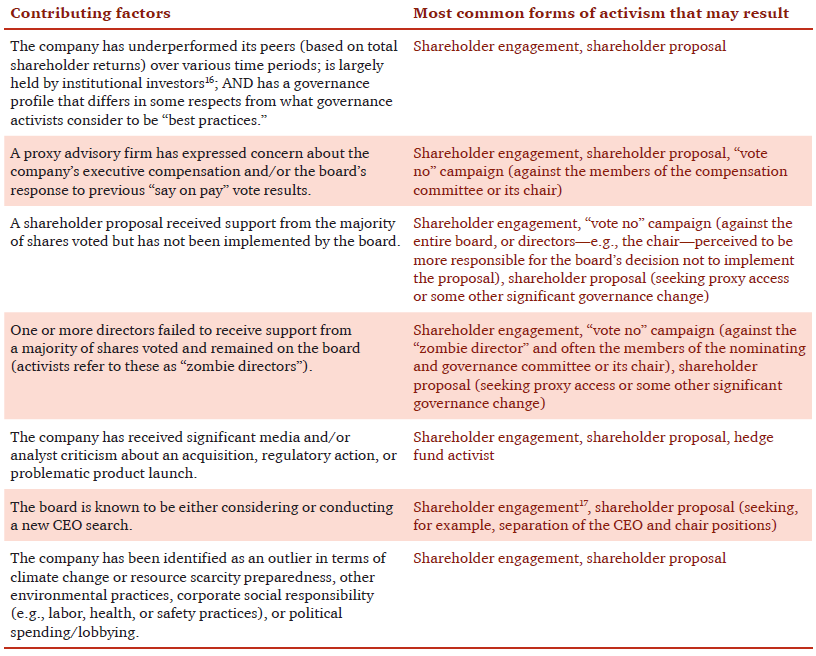
« Shareholder activism comes in different forms, ranging from say-on-pay votes, to shareholder proposals, to “vote no” campaigns (where some investors will urge other shareholders to withhold votes from one or more directors), to hedge fund activism. »

L’auteure présente ici une synthèse d’une enquête menée par PwC; elle met principalement l’accent sur trois aspects de la réponse à la « menace » :

(1) Pourquoi l’entreprise est-elle ciblée ?

(2) L’importance de la préparation continue

(3) Comment réagir lorsque les activistes interviennent ?

Bonne lecture !

Activism can build or progress. If a company is the target of a less aggressive form of activism one year, such as say-on-pay or shareholder proposals, and the activists’ issues are not resolved, it could lead to more aggressive activism in the following years. (For more background information, see a previous PwC publication, discussed on the Forum here.)

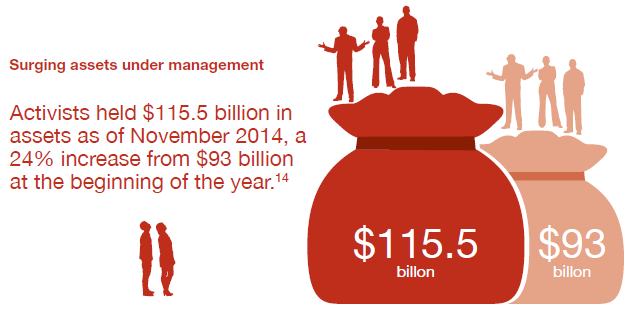
Hedge fund activists are increasing their holdings

pwc

Hedge fund activists may push a company to spin off underperforming or non-core parts of their businesses seek new executive management, operational efficiencies, or financial restructuring, engage in a proxy contest for full control of the board, or work to influence corporate strategy through one or two board seats. Some hedge fund activists target a company’s “capital allocation strategy” and push the company to change its acquisition strategy or return reserved cash to investors through stock buybacks or dividends. In order to drive these changes, activists are generally engaging with at least some of a company’s other major investors to get support for their proposals.

Directors have been taking notice of hedge funds and other activist shareholders, and they are talking about activism in the boardroom: Last year, 29% of directors said their board has interacted with an activist shareholder and held extensive board discussions about activism. [1] An additional 14% said they extensively discussed shareholder activism, though they hadn’t had any interactions with an activist. Given the state of activism, we anticipate the level of boardroom discussion on this topic will continue, or even grow, this year.

What might make your company a target?

About one in five S&P 500 companies was the target of a public activist campaign in 2014—and the number more than doubles when you consider the activity that never become public. [2] What are some common themes?

Companies where management appears to be either unable or unwilling to address issues that seem apparent to the market, investors, or analysts are ripe for activism. In addition, poor financial and stock performance, a weak pipeline of new products, a lack of innovation, the absence of a clear strategy, and turnover in leadership are also frequent red flags.

Hedge fund activists often focus on whether a company’s business line or sector is significantly underperforming in its market. They may target profitable companies with low market-to-book value, a well-regarded brand, and sound operating cash flows and return on assets. If a company’s cash reserves exceed historic norms and those of its peers, the company may be a target, particularly when it’s unclear why it has a large cash reserve. And board composition practices can also draw an activist’s attention—for example, if the company has a classified board or a long average director tenure and few new board members

An activist campaign can come at a very high cost. In addition to the out-of-pocket legal and advisory fees for a proxy battle, the management distraction, emotional impact, and potential business disruption can take a toll. Relationships with suppliers, customers, and even employees can also be damaged.

Preparation is key

Viewing a company through the eyes of an activist can help management and boards anticipate, prepare for, and respond to an activist campaign. A first step is to critically assess the company’s businesses as an activist would—looking for underperforming components. Some companies proactively examine their portfolios and capabilities to determine what fits both strategically and financially.

Companies that can articulate their strategy and demonstrate that it is grounded in a well-considered assessment of both their asset portfolios and their capabilities may be more likely to minimize the risk of becoming an activist’s target. Companies will want to tell a compelling story about their vision for success to shareholders.

Companies should also understand their shareholder base and have a tailored engagement plan in place.

Responding when an activist comes knocking

Companies and their boards will need to consider how to respond based on the facts and circumstances. Generally, an effective response plan will objectively consider the activist’s ideas to identify if there are areas around which to build consensus. Finding a way to work with an activist may avoid the potentially high costs of a proxy contest.

“One of the first areas of focus for boards and the management team is to engage. Sit down, have a discussion, hear out the activist, understand what’s on their mind, and then see if you can find common ground. We find engaging and listening is important,” Tim Ryan, PwC’s Vice Chairman and Markets, Strategy and Stakeholders Leader said in a recent interview with Wall Street Journal Live’s MoneyBeat.

It is important to recognize that the pressure from shareholder activists is not likely to go away any time soon, and companies of all sizes and in all industries need to be on alert. A well-articulated strategy, supported by a proactive assessment of the company’s existing portfolio, is critical. By telling a clear story and openly communicating with shareholders and investors, companies may minimize the risk of becoming a target of activists.

____________________________________

Endnotes:

[1] PwC, 2014 Annual Corporate Directors Survey, October 2014 (discussed on the Forum here).

[2] Brendan Sheehan, “Trends in Shareholder Activism,” Global Governance Advisors, October 2014.

Proposition de la SEC eu égard à la divulgation de la rémunération de la direction en rapport avec la performance organisationnelle


Les actionnaires doivent obtenir toute l’information pertinente pour leur permettre d’évaluer l’efficacité de leurs hauts dirigeants et leur permettre de voter en ayant accès aux meilleures informations possibles. C’est la raison pour laquelle la Securities and Exchange Commission (SEC) propose un amendement règlementaire relatif à la rémunération des hauts dirigeants, en rapport avec la performance.

Il est ainsi proposé que la SEC adopte un renforcement des règles de divulgation dans les circulaires de procuration en publiant une table qui révèle la rémunération de la haute direction en relation avec la performance financière de l’entreprise au cours des cinq dernières années.

La divulgation de ces données, sous une forme standardisée, facilitera les comparaisons avec d’autres entreprises cotées du même secteur d’activité.

Le résultat de cette consultation sera déterminante dans les décisions des autorités règlementaires canadiennes.

Le court article ci-dessous est basé sur les vues exprimées par *, commissaire de la  U.S. Securities and Exchange. J’ai enlevé les notes de bas de page afin d’alléger le billet mais vous pouvez retrouver l’intégralité de ses propos dans l’article Proposed Rule on Pay Versus Performance, publié dans le Harvard Law School of Corporate Governance.

Executive compensation and its relationship to the performance of a company has been an important issue since the first proxy rules were promulgated by the Commission nearly 80 years ago. The first tabular disclosure of executive compensation appeared in 1943, and over the years, the Commission has continued to update and overhaul the presentation and content of compensation disclosures.

CEO Pay – Humongous

Today [April 29, 2015], the Commission, as directed by Congress, takes another important step in modernizing our executive compensation rules by proposing amendments on pay versus performance. Section 953(a) of the Dodd-Frank Wall Street Reform and Consumer Protection Act directed the Commission to adopt rules requiring public companies to disclose in their proxy materials the relationship between executive compensation actually paid, and the financial performance of the company.

I believe that today’s proposal thoughtfully fulfills that mandate. The net result of the proposed rule should be enhanced pay versus performance disclosure in the proxy statement. It should make it easier for shareholders to locate, understand, and analyze executive compensation information before they have to vote.

The Commission’s current rules require that shareholders receive a proxy statement prior to a shareholder meeting. The proxy statement must disclose all the important facts about the issues on which shareholders may be asked to vote. Today’s proposed rule should provide shareholders, via the proxy statement, meaningful new information and metrics to aid in making informed decisions.

The Senate Report that accompanies Section 953(a) of the statute noted: “It has become apparent that a significant concern of shareholders is the relationship between executive pay and the company’s financial performance…The Committee believes that these disclosures will add to corporate responsibility as firms will have to more clearly disclose and explain executive pay.”

In order “to more clearly disclose and explain executive pay” in this context, the Commission is proposing to use a standardized, machine readable table. This table includes, in one location, easy to understand data regarding the last five years of a company’s financial performance. Financial performance data would be presented directly next to the data detailing the compensation of the company’s executive officers during the last five years.

This simple presentation should make it easier for shareholders to understand the relationship between executive pay and company performance. In addition to providing data on compensation “actually paid” to certain executive officers, the proposed table requires registered companies to include the Summary Compensation Table figures for certain executive officers. Including these numbers in the pay versus performance table is vitally important. It would allow shareholders to view a measure of pay that excludes changes in the value of equity grant awards. Providing two measures of compensation in the table may facilitate meaningful comparison, especially in situations where the “actually paid” figure may be misleading or not reflective of the true compensation package awarded to an executive in a given year.

Comparability is also an important part of the proposal. Requiring each registrant to complete this standardized table should promote comparability across all companies. Each registrant would be required to provide data responsive to the same questions, year after year, with clear direction on exactly what the table requires. This comparability also should promote robust data analysis going forward.

Along with providing data in the table, registrants would provide supplemental disclosure about the relationship between executive compensation and performance. The proposed rule appropriately recognizes that some flexibility may be needed to demonstrate this relationship. For example, registrants may describe the relationship in narrative form or by means of a graph or chart. Registrants would be allowed to describe this relationship in a way that is best suited to their particular circumstances. The combination of a standardized table and a more flexible disclosure following the table is a sensible way to ensure comparability and uniformity, while still providing companies with some appropriate flexibility in disclosure.

Finally, I have been a consistent advocate for data tagging of Commission forms, so I am very pleased to see that pay versus performance disclosure, as proposed, will be tagged in eXtensible Business Reporting Language, or XBRL. The proposed rule sets forth an approach toward incorporating machine readable data for communicating compensation and performance information. XBRL streamlines the collection and reporting of financial information. XBRL data tagging involves a process in which a company essentially marks certain parts of its financial disclosure with specific defined terms from a shared dictionary, referred to as a “taxonomy”. All registrants use the same shared taxonomy, which allows for comparability across companies.

In order to achieve comparability, we need structured data in formats like XBRL. Today’s proposal would represent the first piece of data in the proxy statement to be tagged and is hopefully a harbinger of things to come. We should be moving toward having the entire proxy statement tagged, and this is a great first step.

As the SEC Investor Advisory Committee noted in its recommendation advocating for more data tagging, “modern technology provides the SEC with the opportunity to unlock far greater value from the information that it collects and stores.” I personally believe that tagging the entire proxy statement would unlock great value for both the Commission and shareholders.

The current proposal is to have pay versus performance disclosure tagged in XBRL. It is my hope and expectation that this disclosure would be tagged in Inline XBRL once available, which would allow companies to file the required information and data tags in one document rather than repeated in separate exhibits. I understand that Inline XBRL is not yet available on the SEC’s Electronic Data Gathering Analysis and Retrieval (EDGAR) system, but soon will be. When that day comes, Inline XBRL should be used for pay versus performance and all other parts of the proxy statement.


*Kara M. Stein is a Commissioner at the U.S. Securities and Exchange Commission. This post is based on Commissioner Stein’s recent public statement, available here. The views expressed in the post are those of Commissioner Stein and do not necessarily reflect those of the Securities and Exchange Commission, the other Commissioners, or the Staff.

Related research from the Program on Corporate Governance about CEO pay includes Paying for Long-Term Performance (discussed on the Forum here) and the book Pay without Performance: The Unfulfilled Promise of Executive Compensation, both by Lucian Bebchuk and Jesse Fried.

Principes de gouvernance et règlementations en vigueur dans les pays membres de l’OCDE


Ce matin, je porte à votre attention un document-clé de l’Organisation de coopération et de développement économiques (OCDE) qui présente en détail toutes les informations concernant les pratiques de gouvernance dans les 34 pays de l’OCDE ainsi que dans un certain nombre d’autres pays influents : Argentine, Brésil, Hong Kong, Chine, Inde, Indonésie, Lituanie, Arabie Saoudite et Singapore.

Le document intitulé Corporate Governance Factbook est une ressource informationnelle indispensable pour mieux comprendre et comparer les codes de gouvernance et les règlementations relatives aux diverses juridictions. Il s’agit de la deuxième édition de cette publication; celle-ci alimente les révisions apportées annuellement aux Principes de Gouvernance de l’OCDE, principes de gouvernance universellement reconnus.

Le Canada a collaboré activement au partage des informations sur la gouvernance. Ainsi, le rapport présente une multitude de tableaux qui comparent la situation du Canada avec celle des autres pays retenus. C’est une mine d’information vraiment exceptionnelle.

Le document est en version anglaise pour le moment. Vous trouverez, ci-dessous, la référence au document ainsi que la table des matières :

Corporate Governance Factbook


Introduction

The Corporate Landscape

– The ownership structure of listed companies

The Corporate Governance Framework

– The regulatory framework for corporate governance
– Cross-border application of corporate governance requirements
– The main public regulators of corporate governance
– Stock exchangesCorporate Governance Factbook 250 pixels wide

The Rights of Shareholders and Key Ownership Functions

– Notification of general meetings and information provided to shareholders
– Shareholder rights to request a meeting and to place items on the agenda
– Shareholder voting
– Related party transactions
– Takeover bid rules
– The roles and responsibilities of institutional investors

The Corporate Board of Directors

– Basic board structure and independence
– Board-level committees
– Board nomination and election
– Board and key executive remuneration

Le rôle malaisé du PDG dans l’évaluation de la performance de son équipe de direction


L’une des activités les plus cruciales et … décisives d’un PDG (PCD) est de constituer une équipe de hauts dirigeants d’une grande qualité. Son succès personnel et celui de l’organisation dépend ultimement de la cohésion et de l’efficacité de son équipe de direction.

Alors, lorsqu’un problème de performance chez l’un ou plusieurs de ses lieutenants est identifié, il doit nécessairement procéder au rétablissement de l’équilibre, de l’équité et de la performance de son équipe. Mais comment ?

Quels sont les facteurs déterminants dans les mesures correctives que peut apporter le PDG ? Comment doit-il agir pour faire face à la musique ?

C’est un sujet d’une grande complexité, qui exige une solide dose d’analyse de la situation, de coaching et de courage. D’autant plus que l’expérience montre que les équipes de direction sont destinées à échouer un jour ou l’autre !

Voici l’hypothèse qui sous-tend toute la discussion de l’article de Mark Nadler, récemment publié sur le blogue du Harvard Law School Forum on Corporate Governance.

Our approach is grounded in some basic notions concerning the complexity of senior-level jobs and the profound consequences that can result from deficient performance at the top. Experience and observation lead us to this troubling but inescapable conclusion: The composition of the executive team virtually guarantees that some of its members will fail.

Each member of the executive team is required to play multiple, complex, and essential roles—and what’s more, to play them in concert with the CEO and with each other. That’s why it’s so difficult, and so crucial, to create and maintain an effective cast of senior characters. Basically, each member is expected to play these roles:

– Individual contributor, providing specialized analysis, perspectives, and technical expertise to the rest of the team
– Organizational leader, managing the performance of a major segment of the enterprise and representing that segment’s interests in the corporate setting
– Supporter of the CEO, promulgating the CEO’s agenda both publicly and privately
– Colleague and peer, demonstrating public and private support for fellow members of the executive team
– Executive team member, taking an active and appropriate role in the team’s collective work
– External representative of the team and the organization to the workforce at large and to outside constituencies
– Potential successor to the CEO or a potential member of the next generation of top-tier leadership


With each team member playing so many vital roles, just one ineffective, unqualified, or disruptive member can undermine the team and damage the organization in countless ways. The consequences can range from an impotent executive team to the breakdown of a key operating unit to the alienation of essential customers. Within the organization, the perceived tolerance of a senior executive who fails to meet objectives or openly flouts the organization’s values creates a huge credibility problem for management in general, and for the CEO in particular.

L’auteur explore les avenues qui se présentent aux PDG dans les cas de gestion de la performance de son équipe, en considérant plusieurs enjeux liés à la dynamique interpersonnelle des équipes de direction.

La lecture de cet article sera très utile aux PDG aux prises avec des problèmes de procrastination à cet égard.

Bonne lecture !

When Executives Fail: Managing Performance on the CEO’s Team

Picture, if you will, the chief executive officer of a Fortune 500 company slumped over a conference table, holding his head in his hands, anguishing over whether the time had come to pull the plug on one of his most senior executives. “Tell me,” he asks in despair, “is it this hard for everybody?”

Yes, it is.

Of all the complex, sensitive, and stressful issues that confront CEOs, none consumes as much time, generates as much angst, or extracts such a high personal toll as dealing with executive team members who are just not working out. Billion-dollar acquisitions, huge strategic shifts, even decisions to eliminate thousands of jobs—all pale in comparison with the anxiety most CEOs experience when it comes to deciding the fate of their direct reports.

016d128ac4012e1e066ca15673371f718d6b9bb92e

To be sure, there are exceptions. Every once in a while, an executive fouls up so dramatically or is so woefully incompetent that the CEO’s course of action is clear. However, that’s rarely the case. More typically, these situations slowly escalate. Early warning signs are either dismissed or overlooked, and by the time the problem starts reaching crisis proportions, the CEO has become deeply invested in making things work. He or she procrastinates, grasping at one flawed excuse after another. Meanwhile, the cost of inaction mounts daily, exacted in poor leadership and lost opportunities.

This issue is so critical because it is so common. Embedded in the unique composition and roles of the executive team are the seeds of failure; it’s virtually guaranteed that over time, a substantial number of the CEO’s direct reports will fall by the wayside. The stark truth, as David Kearns of Xerox once remarked, is that the majority of executive careers end in disappointment. Nowhere is Kearns’s observation more poignant than at the executive team level. Of all the ambitious young managers who yearn to become CEOs, only a fraction will achieve their ultimate dream. Even among the relative handful who achieve the second tier, only a few possess the rare combination of intelligence, competence, savvy, flexibility, and luck to go out on top. The pyramid is steep and slippery; the closer you get to the top, the harder it is to hold on.

There are lots of ways for senior executives to stumble, and when they do, the shock waves can rock the enterprise. At the most senior level, each executive’s performance is magnified; one dysfunctional individual can stop the entire executive team in its tracks and wreak havoc throughout the organization. Consequently, decisions about replacing executive team members are highly leveraged, with far-reaching consequences often involving thousands of people and literally billions of dollars.

Despite those organizational consequences, the decision by any CEO to remove a direct report is, in the end, an intensely personal one. This isn’t a matter of reasoning your way through a strategic problem or even of deciding to lay off multitudes of workers halfway around the globe. Instead, it involves the face-to-face acknowledgment of failure by a powerful, successful member of the inner circle, quite possibly a long-time colleague. There is no way to take the pain out of these decisions; instead, our intent here is to suggest ways to make them somewhat more rational. There are processes and techniques that can help CEOs deal with executives who are in deep trouble, and methods to sort through the conflicting considerations that inevitably muddle the final decision. When the time comes to actually dismiss someone, however, there are no slick approaches or decision trees that can substitute for character and courage.

…..

Comment aligner les pratiques des comités de RH sur les défis actuels en matière de talents ?


Dans ce billet, je vous propose une courte lecture suggérée par  Chantal Rassart, associée | Chef de la gestion des connaissances en audit, de la firme Deloitte. Dans le numéro d’avril, un aperçu des nouveautés dans le domaine de la gouvernance d’entreprise, Chantal Rassart présente le point de vue de Heather Stockton, associée | Consultation, sur l’amélioration des pratiques des comités de ressources humaines du CA eu égard aux défis posés par la gestion des talents.

L’auteure insiste surtout sur l’importance cruciale de la mise en place d’un plan de formation à l’intention des hauts dirigeants. Les études montrent que les entreprises qui ont misées à fond sur le perfectionnement des dirigeants ont obtenu une performance financière significativement supérieure aux entreprises qui ont négligé cette acticité de développement des talents.

L’article présente également cinq questions que les comités de ressources humaines du CA devraient poser relativement à la gestion des talents.

Quel est votre point de vue à ce propos ? Voici un extrait de l’article en question.

Bonne lecture !


Nos prédictions se sont concrétisées

En 2011, nous avions prédit que nous assisterions à une baisse de l’importance accordée à la rémunération des cadres et à la relève du PDG et à une augmentation de l’importance accordée aux objectifs à long terme des entreprises en matière de gestion des talents et de diversité. Ces prédictions se sont bel et bien concrétisées. Il suffit de jeter un coup d’œil à ce qui est publié ou de discuter avec des administrateurs d’entreprises de toutes tailles et formes juridiques pour constater la place importante qu’occupent maintenant le leadership des futurs dirigeants et les talents dans les activités de gouvernance et de surveillance des conseils d’administration. Alors que nos regards se tournent vers l’avenir, nous constatons que les organisations devront faire face à de nouveaux défis et on s’attend à ce que les conseils d’administration adoptent une approche différente en matière de surveillance afin de les aider à répondre aux attentes de plus en plus élevées des clients, à la concurrence de plus en plus féroce, aux innovations rapides et à l’évolution accélérée des technologies.

Impératif d’affaires

L’attention accrue portée au perfectionnement des dirigeants a des incidences concrètes sur les indicateurs clés de performance de toutes les fonctions de l’organisation. Les organisations qui comptent au sein de leur équipe des dirigeants « de grande qualité » sont 13 fois plus susceptibles de dépasser leurs concurrents sur le plan notamment de la performance financière, de la qualité des produits et des services et de la fidélisation et de la mobilisation du personnel.

Photo du magazine Gouvernance des sociétésUne autre étude récente a examiné la performance d’entreprises durant une décennie en fonction du niveau d’effort consacré au perfectionnement des dirigeants. Les entreprises se situant dans la tranche des 15 % ayant consacré le plus d’efforts au perfectionnement des dirigeants ont accru leur capitalisation boursière de 122 pour cent, tandis que celles se situant dans la tranche des 15 % ayant consacré le moins d’efforts n’ont accru leur capitalisation boursière que de 37 pour cent.

Questions que les comités des ressources humaines devraient se poser

À la lumière de tous ces changements et compte tenu du rôle clair que joue le perfectionnement des talents dans la croissance de l’entreprise, les conseils d’administration devraient examiner continuellement comment leur entreprise se positionne par rapport à ses concurrents sur le plan des talents et comment elle parvient à répondre aux priorités d’affaires tandis que la concurrence s’intensifie. Le comité des ressources humaines peut contribuer au changement pour aider les chefs de la direction et des ressources humaines à diriger leur entreprise vers l’avenir. Outre les questions liées à la rémunération des dirigeants et à la relève du chef de la direction, les comités des ressources humaines devraient poser les cinq questions clés suivantes à la direction :

  1. Quelles qualités et connaissances les futurs hauts dirigeants et dirigeants actuels possèdent-ils? Dans quelle mesure sont-ils prêts à assumer la relève?
  2. Avez-vous en place un plan transition pour préparer les futurs candidats au poste de chef de la direction d’ici la fin du processus de relève?
  3. Le comité de gouvernance du conseil d’administration a-t-il passé en revue la composition du conseil à la lumière de la stratégie d’entreprise, de sa clientèle et des marchés dans lesquels l’entreprise évolue pour s’assurer que l’entreprise dispose des personnes adéquates pour diriger l’entreprise?
  4. Le comité des ressources humaines du conseil d’administration a-t-il discuté de la stratégie relative au travail de l’avenir lorsqu’il a approuvé la stratégie à moyen et à long terme et de la façon dont celle-ci pourrait changer les besoins immobiliers futurs, la nature du travail de votre entreprise et la façon dont vous appuierez vos dirigeants et employés dans le futur?
  5. Le comité des ressources humaines comprend-il les plans du chef des ressources humaines pour moderniser la fonction des ressources humaines et s’aligner sur le travail de l’avenir et votre stratégie d’affaires?

Si le chef de la direction et son équipe de direction ont une vision claire du « comment », vous avez alors les bons ingrédients pour continuer de vous démarquer de vos concurrents et d’obtenir des résultats durables. Une réponse négative à l’une des questions ci-dessus peut avoir une incidence sur la capacité de l’entreprise à atteindre les objectifs de sa stratégie d’affaires. Vos leaders et vos gens sont la seule chose que vos concurrents ne peuvent copier – tout le reste peut être automatisé, créé ou imité.

Quelques caractéristiques d’un CA efficace


Cet article a été publié sur le site de IT Business.ca en avril 2015. Son auteur, *, est un expert en gouvernance; il nous fait part de son expérience avec le fonctionnement des conseils d’administration et il nous présente les six éléments-clés qui contribuent à l’efficacité des CA. et qui constituent sa recette secrète.

Ce bref article est intéressant et il va directement au cœur de la question du succès des bons conseils.

Bonne lecture !

The secret ingredients that make a successful board of directors

« There are few experiences that can have such an extremely different outcome on the spectrum from total nightmare to self-fulfilling achievement, but sitting on a board of directors is one of those experiences. When one has the privilege to serve on a good board it is both a pleasant, educational, and a rewarding experience. When the opposite is true, it can be exacerbating, draining of energy, and very frustrating. I have personally enjoyed the former and attempted to turn around the latter with varying degrees of success. In this blog post, I would like to provide some of the characteristics I find to be common in a good board. »

Great leadership

In most organizations I have been a part of – whether it is a public corporation or the youth organizations I serve on the board of – I always find if there is strong leadership, it leads to a well-run company and a well-functioning board. With a confident and mature CEO there most often will be a strong lead director or chair of the board. Both of these positions must be filled with well-meaning and strong individuals of integral character. If not, the leadership on the board must be instrumental in weeding out unqualified board members and those board members who are disruptive unprepared. Some may need coaching and others may need to be plainly relieved of their board duties.

P1020423

Diversity

A well-functioning board requires diversity of thought, experience, gender, and culture. If all of the board members think and act alike, their decisions will reflect their lack of diversity. I don’t only mean culture and gender. Well run boards also reflect diversity of age, experience, and industry that include complementary skills such as risk management, channel distribution, sales, marketing, human resources, compensation, information technology, finance, fundraising, and industry vertical knowledge. A board needs to be clear about duties, roles and responsibilities of it’s directors in the recruiting process to ensure that applicants expectations and the company are aligned.

Directors who leave their egos at the door

When a board consists of directors who have the company or organization foremost in their minds and feel they don’t have to prove themselves most often make the best contribution to the company. These characteristics are most often present in confident, seasoned executives who have accumulated several years of board experience. All directors need to have their interests aligned with the company. When there is the existence of venture capital investor appointed directors, these directors need to be focused on the strategic direction of the company. That is often not the case and detracts from having a high functioning board.

Strategically minded

A organization with a strong strategic direction where the CEO, chair, directors, and management is most often the organization that will have a strong board and be successful. Whether it is a start-up, a charity or a Fortune 500 company. When the board is holding the CEO accountable for this strategic direction and the directors are not getting their fingers, or worse, noses into the weeds or micro-operations of the company, the best chance of success exists. I have often experienced boards where the director has a lack of governance experience and education. Often, they compensate for this by getting into the minutiae and minor details of the operations of the organization. When directors are mature, experienced, educated and confident in their board roles the resulting board is most often well functioning.

Strong committee structure

A high functioning board will have strong committees with good leadership that will do the heavy lifting on specific board work that will include committees such as audit, compensation, governance and risk. Then based on the need and complexity of the company there will be committees for IT, cyber security, investment, finance and merger and acquisitions when required. The directors will be confident in discharging their duties when they are presented with well-framed reports from the committees of the board.

Time commitment

The days are over when a board member can hold down 10 or 15 board roles. As an individual board member, you have to be committed to the agenda and work of the board you sit on. A board member should have the time and schedule flexibility to be able to attend between five and nine board meetings and another five committee meetings a year and be substantially prepared for those meetings by reading the pre-meeting materials. A director can not deliberate and participate in a discussion without being prepared. In the case of a large bank board the suggested time commitment is half of a full-time career position. Even if you are on the board of a growth stage private company that is raising financing or being acquired, the time commitment can be substantial for extended periods of time. Therefore to ensure your board is high functioning you require board members who have the proper amount of time a schedule flexibility to discharge their responsibilities properly.

When these characteristics exist whether it is in a tech Start-up or multi-billion dollar company the participation in this high functioning board of directors will be both a rewarding and educational experience.

_______________________________

*Gerard Buckley has been working in the financial industry for over 32 years, helping companies strategically plan for accelerated levels of growth at Scotia Capital, Maple Leaf Angels and Jaguar Capital where he is now Managing Director. He leads a management consulting practice with mandates focused on growth in entrepreneurial companies and is an expert in structuring companies to access financing by employing governance, financial management and funding strategies. Gerard has worked on Merger & Acquisition teams transacting over $10 billion of deal flow in his career.As an experienced investor and a member of Angel Investment Networks, he understands the process of investment in growth private companies and advises CEO’s on how to prepare. Gerard is Chairperson of The Board of Directors of Maple Leaf Angels Corporation and was the Entrepreneur in Resident at INcubes, an internet accelerator based in Toronto. He served as a member on the Small and Medium Enterprise Committee of The Ontario Securities Commission and has served on the board of an Exempt Market Dealer and a TSX.V Public Company. He has a passion for helping young entrepreneurs prepare their companies for scale. Read more about Gerard’s advisory firm at http://www.jaguarcapital.ca.

Composition et renouvellement des CA | Une enquête de EY


Je vous invite à prendre connaissance du rapport publié par Ernst & Young Center for Board Matters dans lequel on présente les résultats d’une enquête portant, entre autre, sur la composition des CA et sur les mécanismes de renouvellement des membres du conseil.

Jamais la composition des conseils d’administration n’aura été autant scrutée par les investisseurs et les actionnaires. Et ce n’est que le début des interventions des actionnaires pour l’obtention d’un Board exemplaire…

Il y a vingt ans, il y avait peu d’interrogations sur la matrice des compétences, des habiletés et des expériences des membres des conseils d’administration. De nos jours les actionnaires veulent savoir si leurs élus sont aptes (1) à accompagner la direction dans l’exécution de la stratégie et (2) à superviser la gestion des risques (voir mon billet sur ce sujet Trois étapes pour aider le CA à s’acquitter de ses obligations à l’égard de la surveillance de la gestion des risques).

Le problème du renouvellement des membres du conseil, l’absence d’une politique claire concernant le nombre limite d’années de service au conseil, ainsi que le manque flagrant de diversité sur les conseils sont des facteurs-clés qui amènent les actionnaires à exiger une plus grande divulgation des profils des administrateurs et un processus de nomination plus ouvert, lors des assemblées annuelles.

L’article a été publié sur le blogue du Harvard Law School Forum on Corporate Governance. Voici une brève synthèse des résultats :

More than three-fourths of the investors we spoke with believe companies are not doing a good job of explaining why they have the right directors in the boardroom.
Companies can improve disclosures by making explicit which directors on the board are qualified to oversee key areas of risk for the company and how director qualifications align with strategy. Providing clarity around how board candidates are identified and vetted and the process for supporting board diversity goals may also strengthen investor confidence in the nomination process.
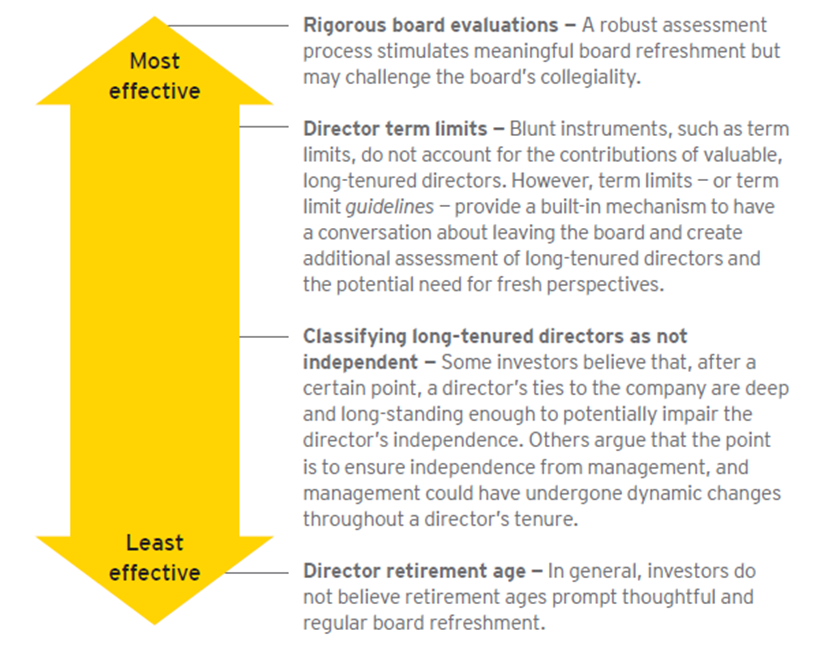
Rigorous board evaluations, including assessing the performance of individual board members, as well as the performance and composition of the board and its committees, are generally considered valuable mechanisms for stimulating thoughtful board turnover, but views about other approaches (e.g., term limits) differ widely.

L’article présente les avenues à explorer pour améliorer la composition des CA. Également, l’article propose trois bons moyens pour renforcer la divulgation liée à la composition du conseil. Enfin, l’article présente une manière originale de conceptualiser le renouvellement des conseils, en s’appuyant, notamment, sur de solides évaluations des administrateurs.

Voici des extraits de l’article. Bonne lecture !

2015 Proxy Season Insights: Board Composition

Room for improvement in making the case for board composition

Despite investor acknowledgement that some leading companies are doing an excellent job in this area, most of the investors we spoke with believe companies are generally not making a compelling enough case in the proxy statement for why their directors are the best candidates for the job.

ey-most-companies-do-good-job

Three ways companies can enhance board composition disclosures

  1. Make disclosures company-specific and tie qualifications to strategy and risk: Be explicit about why the director brings value to the board based on the company’s specific circumstances. Companies should not assume that the connection between a director’s expertise and the company’s strategic and risk oversight needs is obvious. Also, explaining how the board, as a whole, is the right fit can be valuable, particularly given that most investors are evaluating boards holistically.
  2. Provide more disclosure around the director recruitment process and how candidates are sourced and vetted: Disclosing more information around the nomination process—how directors were identified (e.g., through a search firm), what the vetting process entailed, etc.—can mitigate concerns about the recruitment process being insular and informal.
  3. Discuss efforts to enhance gender and ethnic diversity: Many companies—nearly 60% of S&P 500 companies—say they specifically identify gender and ethnicity as a consideration when identifying director nominees, but that is not always reflected in the gender and ethnic makeup of the board. Disclosing a formal process to support board diversity, including providing clarity around what is considered an appropriate level of diversity, can highlight efforts to recruit diverse directors.

A skills matrix tied to company strategy can be a valuable disclosure tool but is not the only way to convey a thoughtful approach. A letter from the lead director or chairman that discusses the board’s succession planning and refreshment process and any recent composition changes can also be effective.

Beyond disclosure, engagement can provide investors a valuable dimension in assessing board quality. Involving key directors in conversations with shareholders can provide further insight into board dynamics, individual director strengths and composition decisions.

Views vary on mechanisms to trigger board renewal

When we asked investors what mechanisms boards can use to most effectively stimulate refreshment, the vast majority chose rigorous board evaluations as the optimal solution and director retirement ages as the least effective. However, views around the different mechanisms and how they should be used vary—as does how investors approach the topic of tenure altogether.

Some investors evaluate tenure and director succession planning as a forward-looking risk, while others focus on past company performance and decisions. The commentary below represents investor opinions on each mechanism.

One of the top takeaways from our dialogue dinners was the importance of robust board evaluations, including evaluations of individual board members, to meaningful board refreshment and board effectiveness. Some directors noted the value in bringing in an independent third party to facilitate in-depth board assessments and in changing evaluation methods as appropriate to reinvigorate the process. Some also noted that board evaluation effectiveness relies on the strength of the independent board leader leading the evaluation.

When it comes to how boards manage director tenure internally, setting expectations up front that directors’ board service will be for a limited amount of time—not necessarily until they reach retirement age—is important. We’ve heard from some directors that having periodic conversations with individual board members about their future on the board is valuable and can help provide “off ramps” and a healthy succession planning process.

ey-mechanisms-is-the-most-effective

Conclusion

Given investors’ increasing focus on board composition, companies may want to review and enhance proxy statement disclosures to ensure that director qualifications are explicitly tied to company-specific strategy and risks and that the board’s approach to diversity and succession planning is transparent.

Beyond disclosure, ongoing dialogue with institutional investors that involves independent board leaders may allow for a rich discussion around board composition. Also, through regular board refreshment and enhanced communications around director succession planning, companies may head off investor uncertainty and temptations to go down a rules-based path regarding director terms.

Qu’est-ce qu’une fondation-actionnaires ? | Dix points-clé


Notre pays méconnaît largement un mode de gouvernance répandu dans le reste de l’Europe. Au Danemark, en Suisse, en Allemagne, de grandes entreprises industrielles et commerciales sont couramment détenues par des fondations.

Et le modèle s’avère durable et vertueux. Pourquoi ?

Quelles sont les spécificités des fondations actionnaires ?

Les voici résumées autour de 10 mots clés.

Qu’en est-il au Québec ? Ce sera le sujet d’un autre billet.

Bonne lecture !

Découvrez les « fondations-actionnaires » (et leurs atouts) en 10 points-clé

Les fondations actionnaires (éd.Prophil) Prophil

INDUSTRIE

Ikea, Lego, Rolex, Bosch, Carlsberg : ces marques sont mondialement connues. Mais parmi leurs millions de clients, combien connaissent leur autre particularité ? Les groupes industriels à l’origine de ces « success stories » sont, depuis longtemps, tous la propriété de… fondations ! Pourtant, faire rimer économie et philanthropie ne va pas de soi, et le terme même de « fondation actionnaire » peut paraître un oxymore. Car la philanthropie s’accorde a priori avec le « don », et l’actionnariat avec l’investissement.

Le terme n’est d’ailleurs pas stabilisé, et ne correspond à aucun statut juridique propre dans les pays étudiés : les Suisses parlent de « fondation entrepreneuriale » ou de « fondation économique», les Danois évoquent les « fondations commerciales », et les anglosaxons les « industrial fondations ». Chez nos voisins, industrie et philanthropie vont assurément de pair.

MAJORITAIRE

La fondation actionnaire, telle que nous la traitons dans cette étude, désigne une fondation à but non lucratif, propriétaire d’une entreprise industrielle ou commerciale. Elle possède tout ou partie des actions, et la majorité des droits de vote et/ou la minorité de blocage.

Ce qui n’empêche donc pas les entreprises concernées d’être en partie cotées en bourse (les fondations actionnaires représentent 54% de la capitalisation boursière de Copenhague).

Dès lors, plusieurs fondations, qui certes détiennent des actions d’entreprises, sortent du champ de cette étude, notamment celles qui ont décidé de filialiser des activités connexes à leur objet, en créant des sociétés (une fondation culturelle qui, par exemple, crée une maison d’édition).

FAMILLES

Les fondations actionnaires sont essentiellement des histoires de familles, d’engagement personnel, comme les nombreux cas de cette étude en témoignent.

Dans un esprit de résistance (La Montagne), avec la volonté de protéger et développer un patrimoine industriel (Bosch), ou avec le souhait d’articuler des engagements humanistes avec une transmission sereine de l’entreprise en absence d’ayant droits (Pierre Fabre), chaque histoire est celle d’un homme, d’une famille qui se projette dans le long terme, avec la volonté de perpétuer une culture d’entreprise singulière, dans une double approche économique et sociétale.

PHILANTHROPIE

Cette transmission est, en soi, un acte de philanthropie majeur. Car les propriétaires font don de leurs titres à une structure créée à cet effet, et renoncent donc aux gains, le cas échéant substantiels, d’une vente avec plus-value. Ils sont philanthropes.

Mais la philanthropie s’exprime aussi, et surtout, dans les dons des fondations, rendus possibles par les dividendes perçus et/ou les intérêts des dotations.

Par exemple, les fondations actionnaires donnent plus de 800 millions d’euros par an au Danemark (seul pays où des études aussi précises existent) et la fondation Novo Nordisk représente, à elle seule, 120 millions d’euros. Sa dotation est telle qu’elle pourrait continuer à vivre sans même percevoir de dividendes !

INTÉRÊT GÉNÉRAL

Au Danemark, la première mission des fondations actionnaires est majoritairement de protéger et de développer l’entreprise ; la seconde, de soutenir une cause culturelle et/ou sociale.

La double mission économique et philanthropique est parfaitement assumée et le rôle de gestion de l’entreprise, prioritaire. Maintenir le patrimoine industriel dans ce petit pays, conserver des fleurons industriels, protéger l’emploi sont considérés comme des sujets d’intérêt général.

Ce n’est pas le cas en France, où intérêt général et activité commerciale ne vont pas facilement de pair. Le principe de spécialité impose en effet aux fondations françaises d’avoir une mission exclusivement d’intérêt général, qui, dans une vision encore assez restrictive, ne peut être économique.

Quant à l’Allemagne, il n’est pas obligatoire d’avoir une mission d’intérêt général pour créer une fondation, a fortiori une fondation actionnaire. Comme le dit le célèbre banquier privé Thierry Lombard, les fondations actionnaires soulèvent des questions non seulement « de loi, mais d’idéologie ».

GOUVERNANCE

C’est le sujet clé. Dans les pays étudiés, et selon le droit national, deux modes de gouvernance prédominent :

1. soit une gestion directe de l’entreprise par la fondation, qui suppose une double finalité pleinement assumée et un conseil d’administration capable de prendre des décisions économiques et philanthropiques à la fois ;

2. soit une gestion indirecte, avec une distinction nette des instances de gouvernance de l’entreprise et de la fondation, via la création d’une société holding intermédiaire. Le droit et la fiscalité sont souvent complexes et variables d’un pays à l’autre : nous avons fait appel à d’éminents spécialistes nationaux pour nous décrire leur « état du droit ».

Notons que dans les fondations actionnaires, la succession des dirigeants n’est pas un sujet aussi sensible qu’ailleurs. La question se règle en général longtemps à l’avance, au niveau de la fondation.

RESPONSABILITÉ SOCIALE

Cette performance globale n’est pas une série de bonnes actions, mais un engagement stratégique d’une entreprise, qui se préoccupe de sa contribution économique, sociale et sociétale à son environnement.

Les entreprises les plus avancées ont compris que leur intérêt particulier rencontrait ici l’intérêt général, pour peu qu’elles ne restent pas les yeux rivés sur une gestion à court terme.

Alors que la pratique de la RSE est devenu de plus en plus un exercice imposé, et trop souvent l’instrument de directions de la communication, la fondation actionnaire place, par nature, la responsabilité sociale et l’approche de long terme au coeur de sa stratégie : dans une forme de fertilisation croisée, fondation et entreprise intrinsèquement liées, s’influencent.

LONG TERME

À un monde économique de plus en plus instable et à court terme, la fondation actionnaire oppose un modèle d’actionnariat stable et durable. La menace de prédateurs est évacuée, puisque toute tentative d’OPA hostile est impossible, et une vision de long terme, dont la redistribution de dividendes n’est pas l’unique préoccupation, oriente la stratégie.

TROISIÈME VOIE

Cette aventure, les tenants de l’économie positive et les philosophes de l’économie altruiste seraient prêts à la tenter. Car intrinsèquement les fondations actionnaires devraient faire consensus : elles allient la création de valeur économique à la force du don, au service d’une économie durable et d’une cohésion sociale renforcée.

C’est pourquoi il est si important de défricher cette troisième voie qui, en France, n’est encore qu’un sentier. La fondation actionnaire peut contribuer à faire émerger un nouveau capitalisme, plus altruiste et durable. Ce paysage pour les générations à venir, beaucoup l’appellent de leurs voeux.

EFFICACITÉ

Mais peut-on conjuguer gouvernance philanthropique et efficacité économique ? Les quelques études scientifiques (voir le panorama danois) existantes tendraient à le prouver : les performances des entreprises propriétés de fondations sont meilleures que celles où l’actionnariat est dispersé*. Le phénomène est comparable dans les sociétés familiales.

D’un point de vue social, ce type d’entreprises semble mieux traverser les crises conjoncturelles. Les dirigeants peuvent en effet s’appuyer sur une meilleure implication de leurs collaborateurs, rassurés par la stabilité de l’actionnariat.

Enfin, à l’heure où les cadres sont à la recherche de sens dans leur vie professionnelle, les valeurs promues par les fondations leur donnent une bonne raison de s’investir dans l’entreprise.

___________________________________

*Comparatif de l’efficacité des fondations actionnaires (colonne de droite), face aux entreprises à l’actionnariat dispersé (colonne de gauche), et aux entreprises à l’actionnariat familial (colonne du centre)  (en anglais)

Source: Steen Thomsen, « Corporate ownership by industrial foundations »)
On constate que les fondations-actionnaires ne sous-performent jamais les autres types d’entreprises. Selon Steen Thomsen, auteur de l’étude dont est tirée le tableau (« Corporate Ownership by Industrial Foundations« ), « les fondations-actionnaires présentent un taux de rentabilité et de croissance comparable aux entreprises classiques, mais avec un niveau de sécurité financière bien plus élevé » (comme le montre le ratio « equity/assets » de 47 au lieu de 36 pour les entreprises à l’actionnariat dispersé, et 38 pour les entreprises familiales).


Trois étapes pour aider le CA à s’acquitter de ses obligations à l’égard de la surveillance de la gestion des risques


Quel doit être le rôle du conseil d’administration eu égard à la surveillance de la gestion des risques ? L’article publié par Scott Hodgkins, Steven B. Stokdyk, et Joel H. Trotter dans le forum du site du Harvard Law School présente, d’une manière très concise, les trois étapes qu’un conseil doit entreprendre en matière de gestion des risques d’une société.

Les auteurs rappellent l’utilisation d’un modèle développé par le COSO (Committee of Sponsoring Organizations de la Commission Treadway), bien connu en gouvernance, qui invite les CA à :

  1. S’entendre avec la direction sur un niveau de risque acceptable (l’appétit pour le risque);
  2. Comprendre les efforts de la direction dans l’exécution des pratiques de gestion des risques;
  3. Revoir le portefeuille des risques en considérant l’appétit pour le risque;
  4. Connaître les risques les plus importants de l’entreprise, ainsi que les stratégies de la direction pour les contrôler.

L’article discute des trois étapes que le CA doit accomplir afin de s’acquitter de son rôle en matière de gestion des risques :

  1. Déterminer le modèle de supervision privilégié par le CA;
  2. Convenir avec le management d’une approche appropriée à la gestion des risques et revoir l’approche retenue;
  3. Évaluer les ressources du CA en matière de gestion de risques et éviter les biais et la pensée de groupe.

Voici donc un extrait de l’article qui précise chacune des trois étapes.

Bonne lecture !

Three Practical Steps to Oversee Enterprise Risk Management

1. Determine the board’s preferred oversight model

Typically, boards either retain primary responsibility for risk oversight or delegate initial oversight duties to a committee, such as the audit committee or a risk committee. Where the board retains primary responsibility, individual committees may provide input on specific types of risk, such as compensation risk, audit and financial risk, and regulatory and compliance risk.

P1050650

In selecting between the active board model and the committee model, the board should consider those directors with the necessary expertise to oversee unique market, liquidity, regulatory, innovation, cybersecurity and other risks that may require special attention. The board should also consider whether adding duties to an existing committee, such as the audit committee, may be too burdensome in light of existing workload.

These issues are unique to each company, and the key is to ensure that the model you choose is effective for your situation.

2. Develop a stated approach to risk management

Some companies may adopt a risk management statement or policy. As with other policy statements, a risk management statement can create a tone-at-the-top benchmark for assessing value-creation opportunities as they arise and provide guideposts for management’s operational decisions.
A risk management statement should separately identify:

  1. Acceptable strategic risks
  2. Undesirable risks
  3. Risk tolerances or thresholds in stated categories, such as strategic, financial, operational and compliance

In developing the company’s approach, the board should consider:

  1. Investor expectations of the company’s risk appetite
  2. Competitors’ apparent risk appetite
  3. Stress-tests for risk scenarios, using historical experience and sensitivity analysis
  4. Long-term strategy versus existing core competencies
  5. Possible long-term market developments
  6. Risk concentrations (e.g., customer, supplier, investment, geographic)
  7. Effects of new business generation on desired risk profile
  8. Strategic planning and operations compared to articulated risk appetite

Developing a stated approach to risk management requires good working relationships among the board members, the CEO and management, as well as active participation by all involved.

3. Assess board capabilities and effectiveness, reviewing for bias and groupthink

The board must evaluate its own capabilities and effectiveness, paying particular attention to the possible emergence of cognitive bias or groupthink.

In assessing board capabilities and effectiveness, the board should consider:

  1. Directors’ skills and expertise compared to the company’s current and future operations
  2. Possible director education initiatives or new directors with additional skills
  3. Delegation of risk oversight in highly technical areas, such as cybersecurity
  4. Retention of independent experts to evaluate specific risk management practices
  5. Clear allocation of responsibility among the board committees and members
  6. The balance between board-level risk oversight and management-level day-to-day ERM Boards must also guard against two types of bias:
  7. Resistance to new ideas from outsiders, thus overlooking new opportunities or risks
  8. Confirmation bias, incorrectly filtering information and confirming preconceptions

Maintaining contact with business realities also requires collegiality and open communication among management and directors.

Boards should consider their risk oversight in light of these three steps to assist in framing an effective approach to enterprise-level risk exposures.

Tendances claires eu égard à la rémunération des administrateurs de sociétés


En gouvernance, on fait très souvent référence aux mécanismes de rémunération de la direction des entreprises mais on s’interroge assez peu sur la rémunération des administrateurs. Également, il y a peu d’études sur le sujet.

L’article qui suit a été publié par Ira Kay* dans le Harvard Law School Forum on Corporate Governance. L’auteure confirme que les administrateurs de sociétés sont de plus en plus sollicités; ils sont donc appelés à investir de plus en plus de temps dans leurs fonctions et ils doivent assumer plus de risques.

La rémunération des administrateurs augmente d’environ 5 % par année et les paiements se font généralement sur une base de 50 % en argent et 50 % en actions à paiement différé.

Les tendances qui se dessinent sont claires. En voici un extrait :

Bonne lecture !

Trends in Board of Director Compensation

Summary and Key Findings

  1. In recent years, total pay has increased by, on average, less than 5% per yearP1040988
  2. Most companies make pay changes less frequently (e.g., every two or three years)
  3. Most large cap companies have eliminated regular meeting fees, in favor of higher annual cash/equity retainers
  4. Equity awards, which are most often RSUs or some other type of full-value award, typically represents 55% to 60% of total pay
  5. Near universal practice of having stock ownership and/or stock retention requirements, such as deferred stock units that are held until after board departure
  6. Some pay practices vary widely by industry and company size; for example smaller cap companies continue to provide meeting fees and may also grant stock options
  7. In the future, we expect annual director pay to increase, on average, by 3% to 5% and the weighting on equity awards to increase

Cash Compensation

The traditional directors’ compensation program included both an annual retainer and a separate fee provided for attending Board and Committee meetings. The presence of a meeting fee encouraged meeting attendance and automatically adjusts for workload as measured by the number of Board and Committee meetings. Meeting attendance is less of an issue today as companies disclose whether their directors attend at least 75% of meetings and proxy advisors scrutinize those directors who fail to meet the threshold. In recent years, most large companies and more mid-sized and small companies have simplified their approach to delivering cash compensation by eliminating the meeting fee element and instead providing a larger single cash retainer. The rationale for this change is to ease the administrative burden associated with paying a director a fee for each meeting attended and to communicate that meeting attendance is expected with less emphasis on actual time spent and more emphasis on the annual service provided to shareholders. We expect this shift to continue among smaller and mid-sized companies where the elimination of meeting fees is not yet a majority practice.

Equity and Cash Compensation Mix

Over time, as director compensation has increased, the trend has been to provide greater focus on equity compensation, which provides direct economic alignment to the shareholders who directors represent. Currently, it is common to have equity represent a slight majority of regular annual compensation – such as a pay mix of equity compensation 55% and cash compensation 45%. In analyzing broad market practices, we typically find directors’ total compensation allocated 40% to 50% to cash compensation and 50% to 60% to equity compensation. The emphasis on equity compensation is also directionally consistent with the typical pay mix for senior executives.

Equity Grant Design

In the early 2000s, stock options delivered most or all of director equity compensation, similar to the approach for compensating executives. The current trend has shifted to the use of full-value shares to deliver all (or at least most) of equity compensation. This shift in approach was driven by the change in accounting standards, negative views of stock options as a compensation vehicle for directors (and executives), and other factors. As a result, today, the most common market practice is to deliver equity compensation solely through full-value shares; a minority of companies (typically 25% or fewer, depending on the set of companies analyzed) continue to grant stock options.

Companies vary in the delivery of the full-value shares with the most common approaches including:

  1. Restricted stock/units, which have a restriction period that may range from six months to three years
  2. Deferred stock units, in which actual share are not delivered or sold until departing the Board
  3. Outright grants, which are immediately vested at grant

The use of performance‐based awards for directors is nearly non‐existent due to the desire to avoid any misperceptions between compensation and their duties and fiduciary responsibilities.

Board Leadership Compensation

Today independent directors are either led by a Non-Executive Chairman (at companies who have separated the leadership role) or a Lead Director (for companies who maintain a combined Chairman and CEO role or an Executive Chairman). At companies who have separated the Board Chairman and CEO roles, an independent Non-Executive Chairman is appointed to lead the independent directors. The responsibilities of this position vary by company as does the amount of additional compensation, which is provided through cash, equity or a combination thereof. At the low end of the spectrum, the Non-Executive Chairman’s extra retainer is positioned modestly above the extra retainer provided to the Audit Committee Chairman (or the Lead Director, which is discussed below) or at the high end of the spectrum, the additional retainer can be significantly higher, such as an additional $200,000 or more.

For those companies who have decided to continue with a single combined role, an independent director serving in the role of Lead Director (or Presiding Director) has emerged as a best practice to lead executive sessions of independent directors. When this role emerged in the mid-2000s, the Lead Director often received no additional compensation and frequently rotated among independent Committee Chairmen or was represented by the Governance Committee Chairman. More recently, for companies to maintain the combined role of Chairman and CEO, Lead Directors have become more prominent and are now typically appointed by the independent directors and are compensated with an additional retainer.

Board Committee Chairmen are typically provided an extra retainer to compensate for the additional work with management and outside advisors in preparing to lead committee meetings. Following the introduction of Sarbanes-Oxley, the extra retainer provided to the Chairman of the Audit Committee increased at a higher rate than other committee chairmen in recognition of the additional workload in terms of number of meetings and required preparation, heightened risk, and the financial expertise required of the position. Following the introduction of the enhanced proxy disclosure rules in 2006 and the Say on Pay advisory vote in 2010, extra retainers provided to the Chairman of the Compensation Committee increased to be positioned closer to (or just below) that of the Audit Committee Chairman.

Stock Ownership Guidelines and Requirements

There is near universal use of stock ownership guidelines or holding requirements for directors, which is consistent with the prevalence of requirements for senior executives. In order to align directors’ economic interests with the shareholders they represent, companies typically provide full-value equity awards and require minimum stock ownership specified as a multiple of the annual retainer or equity award value. At larger companies, the minimum stock ownership guideline is typically three to five times the annual retainer or equity award value with the expectation that this will be achieved within five years of joining the Board. Some companies also have stock holding requirements, which may be used in addition to stock ownership guidelines. For example, companies may require directors to retain net (after tax) shares upon lapse of restrictions until the minimum stock ownership guideline is achieved. Other companies may solely use stock holding requirements (such as grant equity compensation as deferred stock units) to ensure directors accumulate and retain meaningful levels of stock ownership through their tenure as a director.

Contemporary Best Practices

Over time director compensation levels and program design have evolved to address the changing regulatory environment and the enhanced role of the typical director, as described above. Director compensation arrangements have settled to a general design adopted by most companies:

– Annual cash retainer representing approximately 40% to 45% of the total program value

– Annual equity award most often delivered through full-value shares that vest after a specified time and representing approximately 55% to 60% of the total program value

– Extra cash retainers for Non-Executive Chairman, Lead Directors and Committee Chairmen

– Stock ownership guidelines representing three to five times the annual retainer, with stock holding requirements of new grants until the ownership guideline is achieved.

________________________________

*Ira Kay is a Managing Partner at Pay Governance LLC. This post is based on a Pay Governance memorandum by Steve Pakela and John Sinkular.

Colloque étudiant en gouvernance de sociétés


Les personnes  intéressées par les nouvelles recherches en gouvernance des entreprises sont invitées à assister au Colloque étudiant en gouvernance de société mardi 14 avril 2015

En partenariat avec la FSA et la Chaire en gouvernance des sociétés, le CÉDÉ organise un colloque étudiant. Les étudiants du cours de Gouvernance de l’entreprise DRT-6056 du professeur Ivan Tchotourian et du cours de Gouvernance des sociétés CTB-7000 du professeur Jean Bédard présenteront lors de cet événement le bilan de travaux de recherche réalisés durant la session d’hiver 2015.

Heure : 8 h 30 à 11 h 30
Lieu : Salon Hermès de la Faculté des sciences de l’administration

L’entrée est libre.


Un document complet sur les principes d’éthique et de saine gouvernance dans les organismes à buts charitables


Plusieurs OBNL sont à la recherche d’un document présentant les principes les plus importants s’appliquant aux organismes à buts charitables.

Le site ci-dessous vous mènera à une description sommaire des principes de gouvernance qui vous servirons de guide dans la gestion et la surveillance des OBNL de ce type. J’espère que ces informations vous seront utiles.

Vous pouvez également vous procurer le livre The Complete Principles for Good Governance and Ethical Practice.

What are the principles ?

The Principles for Good Governance and Ethical Practice outlines 33 principles of sound practice for charitable organizations and foundations related to legal compliance and public disclosure, effective governance, financial oversight, and responsible fundraising. The Principles should be considered by every charitable organization as a guide for strengthening its effectiveness and accountability. The Principles were developed by the Panel on the Nonprofit Sector in 2007 and updated in 2015 to reflect new circumstances in which the charitable sector functions, and new relationships within and between the sectors.

The Principles Organizational Assessment Tool allows organizations to determine their strengths and weaknesses in the application of the Principles, based on its four key content areas (Legal Compliance and Public Disclosure, Effective Governance, Strong Financial Oversight, and Responsible Fundraising). This probing tool asks not just whether an organization has the requisite policies and practices in place, but also enables an organization to determine the efficacy of those practices. After completing the survey (by content area or in full), organizations will receive a score report for each content area and a link to suggested resources for areas of improvement.

Voici une liste des 33 principes énoncés. Bonne lecture !


Principles for Good Governance and Ethical Practice 


Legal Compliance and Public Disclosure

  1. Laws and Regulations
  2. Code of Ethics
  3. Conflicts of Interest
  4. « Whistleblower » Policy
  5. Document Retention and Destruction
  6. Protection of Assets
  7. Availability of Information to the Public

Effective Governance

  1. Board Responsibilities
  2. Board Meetings
  3. Board Size and Structure
  4. Board Diversity
  5. Board Independence
  6. CEO Evaluation and Compensation
  7. Separation of CEO, Board Chair and Board Treasurer Roles
  8. Board Education and Communication
  9. Evaluation of Board Performance
  10. Board Member Term Limits
  11. Review of Governing Documents
  12. Review of Mission and Goals
  13. Board Compensation

Strong Financial Oversight

  1. Financial Records
  2. Annual Budget, Financial
    Performance and Investments
  3. Loans to Directors, Officers,
    or Trustees
  4. Resource Allocation for Programs
    and Administration
  5. Travel and Other Expense Policies
  6. Expense Reimbursement for
    Nonbusiness Travel Companions
  7. Accuracy and Truthfulness of Fundraising Materials

Responsible Fundraising

  1. Compliance with Donor’s Intent
  2. Acknowledgment of Tax-Deductible Contributions
  3. Gift Acceptance Policies
  4. Oversight of Fundraisers
  5. Fundraiser Compensation
  6. Donor Privacy

Première Grande soirée de la gouvernance Les Affaires


Voici un communiqué du CAS sur le choix des entreprises qui se sont démarquées dans le domaine de gouvernance.

Première Grande soirée de la gouvernance Les Affaires


Grande soirée de la gouvernanceAfin de souligner les meilleures pratiques des conseils d’administration, Les Affaires, en collaboration avec le Collège des administrateurs de sociétés, l’Institut des administrateurs de sociétés et l’Institut sur la gouvernance d’organisations privées et publiques (IGOPP), tenait le 1er avril dernier la Grande soirée de la gouvernance.

Le Collège des administrateurs de sociétés est heureux d’avoir collaboré à cette soirée célébrant la saine gouvernance. Pour la première édition de cet événement, trois conseils ont été honorés pour leurs pratiques exemplaires.

Dans la catégorie Professionnalisation, c’est le conseil d’administration de Marquis Imprimeur qui a été retenu à titre de modèle en se dotant d’un conseil plus solide pour accompagner la croissance. Le Collège tient à souligner la participation du président du CA, M. Jacques Mallette, et du PDG de l’entreprise, M. Serge Loubier, parmi ses formateurs au cours Gouvernance des PME. De plus, M. Jacques Lefebvre, ASC, siège également sur ce conseil et en préside le comité de gouvernance depuis 2009.

Le conseil d’administration de Promutuel Assurance a été, quant à lui, désigné dans la catégorie Transformation en raison de son plan d’action pour changer sa culture grâce à la formation continue. Le Collège a collaboré étroitement à la réalisation de ce plan remarquable avec M. Martin Bergeron, ASC, dans l’un de ses volets visant la formation des 200 administrateurs de l’ensemble des mutuelles.

Le conseil d’administration de Pages Jaunes Limitée s’est aussi distingué dans la catégorie Situation de crise par les actions qu’il a posé au cours des dernières années pour sortir plus fort d’une crise financière.

Explications du phénomène de l’activisme des actionnaires | PwC


Mary Ann Cloyd, responsable du Center for Board Governance de PricewaterhouseCoopers (PwC), vient de publier dans le forum du HLS un important document de référence sur le phénomène de l’activisme des actionnaires.

Son texte présente une excellente vulgarisation des activités conduites par les parties intéressées : Qui, Quoi, Quand et Comment ?

Je vous suggère de lire l’article au complet car il est très bien illustré par l’infographie. Vous trouverez ici un extrait de celui-ci.

Bonne lecture !

Shareholder Activism: Who, What, When, and How?

Who are today’s activists and what do they want?

Shareholder activism Spectrum

pwcsa1

“Activism” represents a range of activities by one or more of a publicly traded corporation’s shareholders that are intended to result in some change in the corporation. The activities fall along a spectrum based on the significance of the desired change and the assertiveness of the investors’ activities. On the more aggressive end of the spectrum is hedge fund activism that seeks a significant change to the company’s strategy, financial structure, management, or board. On the other end of the spectrum are one-on-one engagements between shareholders and companies triggered by Dodd-Frank’s “say on pay” advisory vote.

pwcsa2

The purpose of this post is to provide an overview of activism along this spectrum: who the activists are, what they want, when they are likely to approach a company, the tactics most likely to be used, how different types of activism along the spectrum cumulate, and ways that companies can both prepare for and respond to each type of activism.

Hedge fund activism

pwcsa3

At the most assertive end of the spectrum is hedge fund activism, when an investor, usually a hedge fund or other investor aligned with a hedge fund, seeks to effect a significant change in the company’s strategy.

Background

Some of these activists have been engaged in this type of activity for decades (e.g., Carl Icahn, Nelson Peltz). In the 1980s, these activists frequently sought the breakup of the company—hence their frequent characterization as “corporate raiders.” These activists generally used their own money to obtain a large block of the company’s shares and engage in a proxy contest for control of the board.

In the 1990s, new funds entered this market niche (e.g., Ralph Whitworth’s Relational Investors, Robert Monks’ LENS Fund, John Paulson’s Paulson & Co., and Andrew Shapiro’s Lawndale Capital). These new funds raised money from other investors and used minority board representation (i.e., one or two board seats, rather than a board majority) to influence corporate strategy. While a company breakup was still one of the potential changes sought by these activists, many also sought new executive management, operational efficiencies, or financial restructuring.

Today

During the past decade, the number of activist hedge funds across the globe has dramatically increased, with total assets under management now exceeding $100 billion. Since 2003 (and through May 2014), 275 new activist hedge funds were launched.

Forty-one percent of today’s activist hedge funds focus their activities on North America, and 32% have a focus that spans across global regions. The others focus on specific regions: Asia (15%), Europe (8%), and other regions of the world (4%).

Why?

The goals of today’s activist hedge funds are broad, including all of those historically sought, as well as changes that fall within the category of “capital allocation strategy” (e.g., return of large amounts of reserved cash to investors through stock buybacks or dividends, revisions to the company’s acquisition strategy).

How?

The tactics of these newest activists are also evolving. Many are spending time talking to the company in an effort to negotiate consensus around specific changes intended to unlock value, before pursuing a proxy contest or other more “public” (e.g., media campaign) activities. They may also spend pre-announcement time talking to some of the company’s other shareholders to gauge receptivity to their contemplated changes. Lastly, these activists (along with the companies responding to them) are grappling with the potential impact of high-frequency traders on the identity of the shareholder base that is eligible to vote on proxy matters.

Some contend that hedge fund activism improves a company’s stock price (at least in the short term), operational performance, and other measures of share value (including more disciplined capital investments). Others contend that, over the long term, hedge fund activism increases the company’s share price volatility as well as its leverage, without measurable improvements around cash management or R&D spending.

When is a company likely to be the target of activism?

Although each hedge fund activist’s process for identifying targets is proprietary, most share certain broad similarities:

  1. The company has a low market value relative to book value, but is profitable, generally has a well-regarded brand, and has sound operating cash flows and return on assets. Alternatively, the company’s cash reserves exceed both its own historic norms and those of its peers. This is a risk particularly when the market is unclear about the company’s rationale for the large reserve. For multi- business companies, activists are also alert for one or more of the company’s business lines or sectors that are significantly underperforming in its market.
  2. Institutional investors own the vast majority of the company’s outstanding voting stock.
  3. The company’s board composition does not meet all of today’s “best practice” expectations. For example, activists know that other investors may be more likely to support their efforts when the board is perceived as being “stale”—that is, the board has had few new directors over the past three to five years, and most of the existing directors have served for very long periods. Companies that have been repeatedly targeted by non-hedge fund activists are also attractive to some hedge funds who are alert to the cumulative impact of shareholder dissatisfaction.

A company is most likely to be a target of non-hedge fund activism based on a combination of the following factors:

pwcsat

How can a company effectively prepare for—and respond to—an activist campaign?

Prepare

We believe that companies that put themselves in the shoes of an activist will be most able to anticipate, prepare for, and respond to an activist campaign. In our view, there are four key steps that a company and its board should consider before an activist knocks on the door:

Critically evaluate all business lines and market regions. Some activists have reported that when they succeed in getting on a target’s board, one of the first things they notice is that the information the board has been receiving from management is often extremely voluminous and granular, and does not aggregate data in a way that highlights underperforming assets.

Companies (and boards) may want to reassess how the data they review is aggregated and presented. Are revenues and costs of each line of business (including R&D costs) and each market region clearly depicted, so that the P&L of each component of the business strategy can be critically assessed? This assessment should be undertaken in consideration of the possible impact on the company’s segment reporting, and in consultation with the company’s management and likely its independent auditor.

Monitor the company’s ownership and understand the activists. Companies routinely monitor their ownership base for significant shifts, but they may also want to ensure that they know whether activists (of any type) are current shareholders.

Understanding what these shareholders may seek (i.e., understanding their “playbook”) will help the company assess its risk of becoming a target.

Evaluate the “risk factors.” Knowing in advance how an activist might criticize a company allows a company and its board to consider whether to proactively address one or more of the risk factors, which in turn can strengthen its credibility with the company’s overall shareholder base. If multiple risk factors exist, the company can also reduce its risk by addressing just one or two of the higher risk factors.

Even if the company decides not to make any changes based on such an evaluation, going through the deliberative process will help enable company executives and directors to articulate why they believe staying the course is in the best long-term interests of the company and its investors.

Develop an engagement plan that is tailored to the company’s shareholders and the issues that the company faces. If a company identifies areas that may attract the attention of an activist, developing a plan to engage with its other shareholders around these topics can help prepare for—and in some cases may help to avoid—an activist campaign. This is true even if the company decides not to make any changes.

Activists typically expect to engage with both members of management and the board. Accordingly, the engagement plan should prepare for either circumstance.

Whether the company decides to make changes or not, explaining to the company’s most significant shareholders why decisions have been made will help these shareholders better understand how directors are fulfilling their oversight responsibilities, strengthening their confidence that directors are acting in investors’ best long-term interests.

These communications are often most effective when the company has a history of ongoing engagement with its shareholders. Sometimes, depending on the company’s shareholder profile, the company may opt to defer actual execution of this plan until some future event occurs (e.g., an activist in fact approaches the company, or files a Schedule 13d with the SEC, which effectively announces its intent to seek one or more board seats). Preparing the plan, however, enables the company to act quickly when circumstances warrant.

pwcsa13

Respond

In responding to an activist’s approach, consider the advice that large institutional investors have shared with us: good ideas can come from anyone. While there may be circumstances that call for more defensive responses to an activist’s campaign (e.g., litigation), in general, we believe the most effective response plans have three components:

Objectively consider the activist’s ideas. By the time an activist first approaches a company, the activist has usually already (a) developed specific proposals for unlocking value at the company, at least in the short term, and (b) discussed (and sometimes consequently revised) these ideas with a select few of the company’s shareholders. Even if these conversations have not occurred by the time the activist first approaches the company, they are likely to occur soon thereafter. The company’s institutional investors generally spend considerable time objectively evaluating the activist’s suggestion—and most investors expect that the company’s executive management and board will be similarly open- minded and deliberate.

Look for areas around which to build consensus. In 2013, 72 of the 90 US board seats won by activists were based on voluntary agreements with the company, rather than via a shareholder vote. This demonstrates that most targeted companies are finding ways to work with activists, avoiding the potentially high costs of proxy contests. Activists are also motivated to reach agreement if possible. If given the option, most activists would prefer to spend as little time as possible to achieve the changes they believe will enhance the value of their investment in the company. While they may continue to own company shares for extensive periods of time, being able to move their attention and energy to their next target helps to boost the returns to their own investors.

Actively engage with the company’s key shareholders to tell the company’s story. An activist will likely be engaging with fellow investors, so it’s important that key shareholders also hear from the company’s management and often the board. In the best case, the company already has established a level of credibility with those shareholders upon which new communications can build. If the company does not believe the activist’s proposed changes are in the best long-term interests of the company and its owners, investors will want to know why—and just as importantly, the process the company used to reach this conclusion. If the activist and company are able to reach an agreement, investors will want to hear that the executives and directors embrace the changes as good for the company. Company leaders that are able to demonstrate to investors that they were part of positive changes, rather than simply had changes thrust upon them, enhance investor confidence in their stewardship.

pwcsa14

Epilogue—life after activism

When the activism has concluded—the annual meeting is over, changes have been implemented, or the hedge fund has moved its attention to another target—the risk of additional activism doesn’t go away. Depending on how the company has responded to the activism, the significance of any changes, and the perception of the board’s independence and open-mindedness, the company may again be targeted. Incorporating the “Prepare” analysis into the company’s ongoing processes, conducting periodic self-assessments for risk factors, and engaging in a tailored and focused shareholder engagement program can enhance the company’s resiliency, strengthening its long-term relationship with investors.

Modèle d’affaires nord-américains | La priorité aux actionnaires ou aux parties prenantes ?


Voici un excellent article publié par Tim Koller, Marc Goedhart et David Wessels dans le magazine Insights & Publications de McKinsey & Company, qui avance qu’il est préférable d’opter pour l’appréciation de la valeur aux actionnaires plutôt que pour la satisfaction de toutes les parties prenantes, en autant que l’entreprise met l’accent sur la gestion à long terme.

Cet article explique les principes fondamentaux du modèle d’affaires nord-américain en précisant ce qu’implique (1) la création de valeur pour les actionnaires et (2) la réconciliation des intérêts des parties prenantes (stakeholders).

Les auteurs montrent que la recherche, même inconsciente, de résultats à court terme est vraiment ce qui pose problème. Ce n’est pas la recherche d’accroissement de la valeur des actions qui est questionnable dans le modèle, c’est le court-termisme qui domine les actions.

 Shareholder-oriented capitalism is still the best path to broad economic prosperity, as long as companies focus on the long term.

L’article réfute les argumentations des approches qui évoquent la primauté de la réconciliation des intérêts des parties prenantes sur la recherche des intérêts des actionnaires.

Bonne lecture !

The real business of business

The guiding principle of business value creation is a refreshingly simple construct: companies that grow and earn a return on capital that exceeds their cost of capital create value. The financial crisis of 2007–08 and the Great Recession that followed are only the most recent reminders that when managers, boards of directors, and investors forget this guiding principle, the consequences are disastrous—so much so, in fact, that some economists now call into question the very foundations of shareholder-oriented capitalism. Confidence in business has tumbled.1 1.An annual Gallup poll in the United States showed that the percent of respondents with little or no confidence in big business increased from 27 percent in the 1983–86 period to 38 percent in the 2011–14 period. For more, see “Confidence in institutions,” gallup.com. Politicians and commentators are pushing for more regulation and fundamental changes in corporate governance. Academics and even some business leaders have called for companies to change their focus from increasing shareholder value to a broader focus on all stakeholders, including customers, employees, suppliers, and local communities.

P1010039

No question, the complexity of managing the interests of myriad owners and stakeholders in a modern corporation demands that any reform discussion begin with a large dose of humility and tolerance for ambiguity in defining the purpose of business. But we believe the current debate has muddied a fundamental truth: creating shareholder value is not the same as maximizing short-term profits—and companies that confuse the two often put both shareholder value and stakeholder interests at risk. Indeed, a system focused on creating shareholder value from business isn’t the problem; short-termism is. Great managers don’t skimp on safety, don’t make value-destroying investments just because their peers are doing it, and don’t use accounting or financial gimmicks to boost short-term profits, because ultimately such moves undermine intrinsic value.

What’s needed at this time of reflection on the virtues and vices of capitalism is a clearer definition of shareholder value creation that can guide managers and board directors, rather than blurring their focus with a vague stakeholder agenda. We do believe that companies are better able to deliver long-term value to shareholders when they consider stakeholder concerns; the key is for managers to examine those concerns systematically for opportunities to do both.

What does it mean to create shareholder value?

If investors knew as much about a company as its managers, maximizing its current share price might be equivalent to maximizing value over time. In the real world, investors have only a company’s published financial results and their own assessment of the quality and integrity of its management team. For large companies, it’s difficult even for insiders to know how the financial results are generated. Investors in most companies don’t know what’s really going on inside a company or what decisions managers are making. They can’t know, for example, whether the company is improving its margins by finding more efficient ways to work or by simply skimping on product development, maintenance, or marketing.

Since investors don’t have complete information, it’s not difficult for companies to pump up their share price in the short term. For example, from 1997 to 2003, a global consumer-products company consistently generated annual growth in earnings per share (EPS) between 11 and 16 percent. Managers attributed the company’s success to improved efficiency. Impressed, investors pushed the company’s share price above that of its peers—unaware that the company was shortchanging its investment in product development and brand building to inflate short-term profits, even as revenue growth declined. In 2003, managers were compelled to admit what they’d done. Not surprisingly, the company went through a painful period of rebuilding, and its stock price took years to recover.

In contrast, the evidence makes it clear that companies with a long strategic horizon create more value. The banks that had the insight and courage to forgo short-term profits during the real-estate bubble earned much better returns for shareholders over the longer term.2 2.Bin Jiang and Tim Koller, “How to choose between growth and ROIC,” McKinsey on Finance, September 2007. Oil and gas companies known for investing in safety outperform those that haven’t. We’ve found, empirically, that long-term revenue growth—particularly organic revenue growth—is the most important driver of shareholder returns for companies with high returns on capital (though not for companies with low returns on capital).3 3.Bin Jiang and Tim Koller, “How to choose between growth and ROIC,” McKinsey on Finance, September 2007. We’ve also found a strong positive correlation between long-term shareholder returns and investments in R&D—evidence of a commitment to creating value in the longer term.4 4.Tim Koller, Marc Goedhart, and David Wessels, Valuation: Measuring and Managing the Value of Companies, fifth edition, Hoboken, NJ: John Wiley & Sons, 2010.

The weight of such evidence and our experience supports a clear definition of what it means to create shareholder value, which is to create value for the collective of all shareholders, present and future. This means managers should not take actions to increase today’s share price if they will reduce it down the road. It’s the task of management and the board to have the courage to make long-term value-creating decisions despite the short-term consequences.

Can stakeholder interests be reconciled?

Much recent criticism of shareholder-oriented capitalism has called on companies to focus on a broader set of stakeholders, not just shareholders. It’s a view that has long been influential in continental Europe, where it is frequently embedded in the governance structures of the corporate form of organization. And we agree that for most companies anywhere in the world, pursuing the creation of long-term shareholder value requires satisfying other stakeholders as well.

Short-termism runs deep

What’s most relevant about Stout’s argument, and that of others, is its implicit criticism of short-termism—and that is a fair critique of today’s capitalism. Despite overwhelming evidence linking intrinsic investor preferences to long-term value creation,10 10.Robert N. Palter, Werner Rehm, and Jonathan Shih, “Communicating with the right investors,” McKinsey Quarterly, April 2008. too many managers continue to plan and execute strategy, and then report their performance against shorter-term measures, EPS in particular.

As a result of their focus on short-term EPS, major companies often pass up value-creating opportunities. In a survey of 400 CFOs, two Duke University professors found that fully 80 percent of the CFOs said they would reduce discretionary spending on potentially value-creating activities such as marketing and R&D in order to meet their short-term earnings targets.11 11.John R. Graham, Campbell R. Harvey, and Shiva Rajgopal, “Value destruction and financial reporting decisions,” Financial Analysts Journal, 2006, Volume 62, Number 6, pp. 27–39. In addition, 39 percent said they would give discounts to customers to make purchases this quarter, rather than next, in order to hit quarterly EPS targets. Such biases shortchange all stakeholders.

Shareholder capitalism won’t solve all social issues

There are some trade-offs that company managers can’t make—and neither a shareholder nor a stakeholder approach to governance can help. This is especially true when it comes to issues that affect people who aren’t immediately involved with the company as investors, customers, or suppliers. These so-called externalities—parties affected by a company who did not choose to be so—are often beyond the ken of corporate decision making because there is no objective basis for making trade-offs among parties.

If, for example, climate change is one of the largest social issues facing the world, then one natural place to look for a solution is coal-fired power plants, among the largest man-made sources of carbon emissions. But how are the managers of a coal-mining company to make all the trade-offs needed to begin solving our environmental problems? If a long-term shareholder focus led them to anticipate potential regulatory changes, they should modify their investment strategies accordingly; they may not want to open new mines, for example. But if the company abruptly stopped operating existing ones, not only would its shareholders be wiped out but so would its bondholders (since bonds are often held by pension funds). All of its employees would be out of work, with magnifying effects on the entire local community. Second-order effects would be unpredictable. Without concerted action among all coal producers, another supplier could step up to meet demand. Even with concerted action, power plants might be unable to produce electricity, idling their workers and causing electricity shortages that undermine the economy. What objective criteria would any individual company use to weigh the economic and environmental trade-offs of such decisions—whether they’re privileging shareholders or stakeholders?

In some cases, individual companies won’t be able to satisfy all stakeholders. For any individual company, the complexity of addressing universal social issues such as climate change leaves us with an unresolved question: If not them, then who? Some might argue that it would be better for the government to develop incentives, regulations, and taxes, for example, to encourage a migration away from polluting sources of energy. Others may espouse a free-market approach, allowing creative destruction to replace aging technologies and systems with cleaner, more efficient sources of power.

Shareholder capitalism has taken its lumps in recent years, no question. And given the complexity of the issues, it’s unlikely that either the shareholder or stakeholder model of governance can be analytically proved superior. Yet we see in our work that the shareholder model, thoughtfully embraced as a collective approach to present and future value creation, is the best at bridging the broad and varied interests of shareholders and stakeholders alike.

_______________________________

*Marc Goedhard is a senior expert in McKinsey’s Amsterdam office, and Tim Koller* is a principal in the New York office; David Wessels* is an adjunct professor of finance and director of executive education at the University of Pennsylvania’s Wharton School.

Aux É.U., il est temps de favoriser le rapprochement entre les administrateurs et les actionnaires


Voici un excellent article paru dans la section Business du The New York Times du 28 mars 2015 qui porte sur les appréhensions, relativement injustifiées, des communications (engagement) entre les administrateurs et leurs actionnaires (en dehors des assemblées annuelles).

L’article évoque le manque de communication des Boards américains avec leurs actionnaires et avec les parties prenantes, contrairement à la situation qui prévaut du côté européen. Selon l’auteure, cette grande distance entre les administrateurs et les actionnaires mène aux insatisfactions croissantes de ceux-ci, et cela se reflète dans l’augmentation du nombre d’administrateurs n’obtenant pas le soutien requis lors des assemblées annuelles.

On le sait, les actionnaires des entreprises américaines souhaitent pouvoir faire inscrire leurs propositions dans les circulaires de procuration, notamment pour présenter des candidatures aux postes d’administrateurs.

En 2015, plusieurs grandes corporations américaines permettront l’accès des grands actionnaires à leurs circulaires de procuration (voir Les conséquences inattendues de l’accès des actionnaires à la circulaire de procuration lors de l’assemblée annuelle et Proxy Access Proposals: The Next Big Thing in Corporate Governance).

Il est donc temps de revoir le mode de communication entre les deux acteurs principaux et d’exposer les avantages à collaborer à la gouvernance de l’entreprise. Plusieurs pays européens donnent l’exemple à cet égard.

Ainsi, en Suède et en Norvège, les cinq (5) plus grands actionnaires d’une entreprise reçoivent des invitations à se joindre au comité de gouvernance et de nomination afin de choisir des administrateurs potentiels.

En Europe, les actionnaires ont plus de poids; ceux qui possèdent au moins 1 % de la propriété peuvent soumettre des candidatures pour les postes d’administrateurs. De plus, dans certains pays européens, contrairement à la situation américaine, les administrateurs doivent soumettre leurs démissions s’ils ne reçoivent pas un soutien majoritaire aux élections.

P1060488

Voici une politique sur la communication du CA avec les investisseurs qui pourrait être envisagée; elle présente un certain nombre de sujets jugés appropriés :

(1) la rémunération de la direction,

(2) la structure des comités du conseil,

(3) le processus de planification de la relève,

(4) le rôle du CA dans la supervision de la stratégie.

Je suis assuré que vous trouverez cet article du NYT stimulant et engageant ! Vos commentaires sont les bienvenus.

Bonne lecture !

At U.S. Companies, Time to Coax the Directors Into Talking

It’s shareholder meeting season again, corporate America’s version of Groundhog Day.

This is the time of year when company directors venture out of the boardroom to encounter the investors they have a duty to serve. After the meetings are over, like so many Punxsutawney Phils, these directors scurry back to their sheltered confines for another year.

This is a bit hyperbolic, of course. But institutional investors argue that there’s a troubling lack of interaction these days between many corporate boards in the United States and their most important investors. They point to contrasting practices in Europe as evidence that it’s time for this to change.

“It’s a very different culture in the U.S.,” said Deborah Gilshan, corporate governance counsel at RPMI Railpen Investments, the sixth-largest pension fund in Britain, which has 20 billion pounds, or about $30 billion, in assets. “In the U.K., we get lots of access to the companies we invest in. In fact, I’ve often wondered why a director wouldn’t want to know directly what a thoughtful shareholder thinks.”

As Ms. Gilshan indicated, directors at European companies routinely make themselves available for investor discussions; in some countries, such meetings are required. Many directors of foreign companies even — gasp — give shareholders their private email addresses and phone numbers.

Their counterparts in the United States seem fearful of such contact. Large shareholders say that some directors of American companies refuse to meet at all, preferring to let company officials speak for them.