Un livre phare sur la gouvernance de sociétés


On me demande souvent de proposer un livre qui fait le tour de la question eu égard à ce qui est connu comme statistiquement vrai sur les relations entre la gouvernance et le succès des organisations.

Le volume publié par David F. Larcker et Brian Tayan, professeurs au Graduate School de l’Université Stanford, en est à sa deuxième édition et il donne l’heure juste sur l’efficacité des principes de gouvernance.

Si vous aviez un livre sur la gouvernance à acheter, ce serait celui-ci.

Bonne lecture !

This is the most comprehensive and up-to-date reference for implementing and sustaining superior corporate governance. Stanford corporate governance experts David Larcker and Bryan Tayan carefully synthesize current academic and professional research, summarizing what is known and unknown, and where the evidence remains inconclusive.

Corporate Governance Matters, Second Edition reviews the field’s newest research on issues including compensation, CEO labor markets, board structure, succession, risk, international governance, reporting, audit, institutional and activist investors, governance ratings, and much more. Larcker and Tayan offer models and frameworks demonstrating how the components of governance fit together, with updated examples and scenarios illustrating key points. Throughout, their balanced approach is focused strictly on two goals: to “get the story straight,” and to provide useful tools for making better, more informed decisions.

Book cover: Corporate Governance Matters, 2nd edition

This edition presents new or expanded coverage of key issues ranging from risk management and shareholder activism to alternative corporate governance structures. It also adds new examples, scenarios, and classroom elements, making this text even more useful in academic settings. For all directors, business leaders, public policymakers, investors, stakeholders, and MBA faculty and students concerned with effective corporate governance.

Selected Editorial Reviews

An outstanding work of unique breadth and depth providing practical advice supported by detailed research.
Alan Crain, Jr., Senior Vice President and General Counsel, Baker Hughes
Extensively researched, with highly relevant insights, this book serves as an ideal and practical reference for corporate executives and students of business administration.
Narayana N.R. Murthy, Infosys Technologies
Corporate Governance Matters is a comprehensive, objective, and insightful analysis of academic and professional research on corporate governance.
Professor Katherine Schipper, Duke University, and former member of the Financial Accounting Standards Board

Guide destiné à mieux évaluer les risques


Voici un article très intéressant sur l’évaluation des risques publié par H. Glen Jenkinset paru dans Inside Counsel (IC) Magazine.

Il s’agit d’un bref exposé sur la notion de risques organisationnels et sur les principaux éléments qu’il faut considérer afin d’en faire une gestion efficace.

Je vous invite à prendre connaissance des autres publications sur le site de IC, notamment Evaluating and managing litigation risk.

Bonne lecture !

Risk assessment: A primer for corporate counsel

The scope of legal responsibilities for in-house counsel varies depending on the size and complexity of the company. For instance, an attorney located at corporate headquarters could be chiefly responsible for issues affecting the shared services that are available and used by corporate headquarters, as well as every business unit and division. And yet at other times, in-house counsel’s concerns may be restricted to matters affecting only the parent company or a specific liability issue faced by only one business unit.

risk management flow chart concept handwritten by businessmanIn each instance, however, in-house counsel are generally concerned with specific legal tasks and proactive risk management.

What exactly does risk management mean, and what does it encompass? Furthermore, once the definition of risk management has been established and accepted by the company’s management team, how can in-house counsel efficiently and comprehensively assess all possible risks?

Merriam Webster’s dictionary defines risk as “the possibility that something bad or unpleasant will happen.” Whenever many of us in the accounting and legal profession hear the word “risk,” we inherently may succumb to the aforementioned particular negative connotation of risk. How many times have we heard the phrase, “Risk is a part of life,’ and how often have we associated those five words with an undesirable implication?”


Alternatively, A Positive View of Risk

Taking risks does not always have to be painstakingly negative. It is unlikely that many will disagree with the Institute of Risk Management’s (IRM) assertion that “avoiding all risk would result in no achievement, no progress and no reward.” This statement undoubtedly portrays a different perspective of risk, indicating the potential of a positive outcome.

IRM goes on to define risk as “the combination of the probability of an event and its consequence. Consequences can range from positive and negative.”

Therein lies the basic premise of risk management. If the consequences of risk can be both positive and negative, it would seem only prudent to try and effectively manage risk to have the highest probability of a positive outcome.

Applying IRM’s definition of risk, together with the premise that avoiding all risk would result in no achievement, no progress and no reward, we intrinsically recognize that not all risks are bad and not all risks are to be avoided.

Over the course of three successive articles on risk, we will take a closer look at how in-house counsel works with internal and external resources to help identify, evaluate and categorize risk.

 Risk Assessment: The Starting Point for Successful Risk Management

Risk assessment is the identification, analysis and evaluation of risks involved in a given situation. Risk assessment also implies a comparison against benchmarks or standards, and the determination of an acceptable level of risk. The evaluation of risks should also provide management with a remediation or control for the identified hazard.

The word “risk” alone without any context is a vague and ill-defined term. There is safety risk, country risk, political risk, health risk and the ongoing list is virtually boundless and it is next to impossible to comprehensively assess all possible risks.

According to Tori Silas, privacy officer and senior counsel with Cox Enterprises, Inc., Cox uses the external resources of multinational accounting and advisory companies to assist with its risk assessments. Using best practices they have developed by analyzing business processes and assessing risk for companies on a global level, these organizations assist in the identification of risks in particular areas of the business, and provide a framework within which to rate risks and prioritize remediation efforts associated with those risks.

Assessment Begins with Knowing Who Decides Acceptable Levels of Risk

As an example of financial risk, according to a Tulane University study, the chances of getting hit by an asteroid or comet are 1,000 times greater than winning a jackpot mega millions lottery. Yet, some have accepted that level of risk and will habitually trade their money to play the lottery rather than investing their money or capital in an endeavor that has a much higher probability of building wealth. Whether right or wrong, a good or bad decision, those who make the choice of playing the lottery have intrinsically accepted the financial risk of losing their money in lieu of the near impossible odds to reap a grand reward.

No matter our opinion of playing the lottery, I think we would all agree that it would be highly unlikely to find a pragmatic business executive allotting some portion the company’s wealth and assets to invest in lottery tickets. But why not? Who decides the parameters of acceptable levels of risk for a business and against what benchmarks are those decisions made?

The business owners, board of directors and executive management define the business objectives, and establish the risk appetite and risk tolerances that are to be contemplated on an overall basis by management when making decisions and evaluating options and alternatives. Together they establish a system of rules, practices and processes by which their company is directed and controlled. This concept is often referred to as corporate governance. Businesses of all sizes embrace this concept, but small businesses may cloak this concept within the singular frame of mind of its ownership’s values, ideologies, philosophies, beliefs and individual business principles.

As the privacy officer for Cox Enterprises, Silas strives to make certain the employees of their consumer facing companies are aware of Cox’s obligations regarding data privacy and that they are appropriately trained to identify and mitigate risk related to and to protect any private consumer data they may have collected.

Corporate Governance

Since the purpose of a risk assessment is the identification, analysis, and evaluation of risks that could adversely impact the business meeting its objectives, the process of conducting a risk assessment should be integrated into existing management processes. According to Silas, Cox Enterprises also utilizes its own internal audit services department to examine functional processes and identify opportunities to strengthen controls and mitigate risks. It is recommended that risk assessments should be conducted using a top-down approach beginning with the top level of the company and filtering its way down through each division and business unit.

For example, a company may have three divisions: manufacturing, marketing and finance. Each of those divisions may operate in four global sectors. Using a top-down approach the three top divisions would conduct a risk assessment and each subdivision that is located in each global sector would conduct their own risk assessment. The top-down approach would then be complimented by bottom-up process where the risk assessments are sent up the business chain, gathered and compiled into an integrated risk assessment matrix.

Ten Tips for Conducting an Effective Risk Assessment

In quick summary, here are ten additional tips for conducting an effective risk assessment:

  1. Create, plan and conduct a formal risk assessment;
  2. Define the context and objectives of the risk assessment;
  3. Define and understand the organizations acceptable risk tolerance;
  4. Bring together the best team to conduct the risk assessment;
  5. Employ the best risk assessment techniques for the situation;
  6. Understand control measures to mitigate risk;
  7. Be objective and impartial conducting the risk assessment;
  8. Identify the environment that is conducive to risks;
  9. Identify who could be harmed; and
  10. Review, revisit and re-perform the risk assessment.

La situation du recrutement d’administrateurs en Europe | Au-delà du « Old Boys’ Network »


Je vous invite à lire un rapport très intéressant réalisé par European Confederation of Directors Associations (ecoDa) et la firme de consultation en recrutement de cadres et d’administrateurs Korn Ferry, portant sur l’évolution du processus de recrutement d’administrateurs dans les entreprises européennes.

L’étude conclu que l’ère de la nomination d’administrateurs, choisis parmi le cercle restreint du réseau de l’entreprise (Old Boys’ Network), est révolue. Les organisations européennes ont adopté un processus de recherche systématique d’administrateurs externes d’expérience.

En premier lieu, le document présente, succinctement et clairement, un aperçu des différents régimes de gouvernance européens. Cette partie du rapport apporte un éclairage concis sur la situation de la gouvernance en Europe.

À la suite d’entretiens avec des douzaines de praticiens chevronnés, l’étude identifie quatre grandes forces qui influencent le choix des administrateurs de sociétés :

  1. La turbulence économique et l’instabilité de la zone euro imposent de nouvelles façons de faire;
  2. Les entreprises sont de plus en plus soumises à de nouvelles règles en matière de gouvernance;
  3. La prise en compte de la diversité est une réalité bien européenne;
  4. Les actionnaires sont de plus en plus actifs et les entreprises font l’objet d’une supervision accrue de la part des investisseurs institutionnels.

Les auteurs se penchent également sur tout le débat entourant les procédures de nomination d’administrateurs en Europe.

La dernière section du rapport fait état de 14 étapes devant conduire à un solide processus de nomination d’administrateurs indépendants.

Vous trouverez, ci-dessous, un condensé du document. Pour en connaître plus sur le sujet, veuillez consulter le document ci-joint intitulé « Beyond the Old Boys’ Network »

Bonne lecture !

Beyond The Old Boys’ Network

A new pan-European report analysing what’s happening in boardrooms across the continent outlines a best practice guide to help boards and their nominations committees develop robust and effective nomination procedures.

The report, « Beyond the Old Boys’ Network: What’s happening in the European boardrooms and a guide to best practices » has been produced by the European Confederation of Directors Associations (ecoDa) and global leadership and talent consultancy Korn Ferry.

jvgovernancelarge1

It examines changes in how the board nominations process has worked over the last decade, primarily as a response to new waves of corporate governance guidelines, and explores governance systems used in some jurisdictions and whether they could be applied elsewhere.

Among the systems explored are one-tier versus two-tier boards; making major shareholders members of the nomination committee; ensuring that employees get adequate board representation; and establishing mandatory gender quotas.

The report, which draws on interviews with several dozen board practitioners from across the continent, finds that the implementation of a pan-European set of rules for nominations would be challenging, due to legal, technical and cultural differences.

For example, a fundamental principle of Nordic corporate governance is the « active ownership model », where the nomination committee is constituted not by board members but by representatives of the largest shareholders. While seen as positive in Scandinavia and given praise from other jurisdictions such as Italy, it met with little support from business leaders in the UK, reflecting the more complex nature of a typical UK company’s share register, with the largest shareholders seldom holding more than a 5% share of the company.

One chairman and senior independent director of a company that has seen investor battles said, « We have to represent all the shareholders, and having a couple of major shareholders deciding the appointments to the board could be hugely disruptive and chaotic. »

However, the report finds that although governance codes vary across jurisdictions, best practices transcend different governance jurisdictions. It makes 14 recommendations covering the entire nomination process, from the structuring of the process through succession planning, candidate selection, candidate interview, and the induction of new directors.

Dominic Schofield, Senior Client Partner at Korn Ferry, commented : « Appointing a board director is not what it used to be. Gone are the days of CEOs and chairmen single-handedly planning how to fill their boards with friends, family and colleagues. Market volatility and economic instability, heightened regulatory pressure, the demand and need for diversity, and growing shareholder activism have forced boards to rethink their nomination practices.

« Over the past decade, boards of directors around the world have seen their roles redefined from the scope of their responsibilities and their actual workload to the level of mental agility required. To fulfil their mission, today’s corporate boards must command a broad battery of qualities, skills, and experience. »

Turid Elisabeth Solvang, Managing Director of the Norwegian Institute of Directors, and board member of ecoDa has co-ordinated the project with Mr Schofield. She adds: « Also, having the right competencies and experiences around the board table alone is not sufficient to guarantee board effectiveness. Team dynamics and behaviours are equally important. Underestimating the role of relationships among board members means undermining the board’s ability to adequately support the company.

« As governance and the trend for greater rigour and transparency in boardroom processes increases, the recruitment of board directors has become more contentious: perceived ‘old practices’ often provoke a sharp and public reaction from investors and media observers alike. The goal of this report is to develop a set of best practice recommendations for boards’ recruitment that apply within the different national legal frameworks and corporate governance models. »

The best practice guidelines outlined in the report are:

1. Ensure rigour and independence in the board nomination process from the outset.

2. Keep the main stakeholders informed.

3. The CEO should not have the veto power on nomination committee decisions; however, he/she should be involved in the process and be consulted during the decision making.

4. Build a board succession plan.

5. Know when directors will leave/rotate off the board.

6. Conduct a gap analysis to match the skills and experiences needed with business strategy.

7. Be aware of how team dynamics facilitate (or hamper) board activities.

8. Maintain independence of process by hiring external professional advisors.

9. Use board appointments to foster diversity in the board’s makeup without losing sight of the skills needed.

10. Ask mission-critical questions during candidate interviews.

11. Reference thoroughly.

12. Establish a structured, informative and tailored induction programme.

13. Mentoring should be considered for new / first-time directors.

14. Value feedback from outgoing board members.

Le réseautage | une activité essentielle à tout administrateur potentiel


Aujourd’hui, je cède l’antenne à Johanne Bouchard* qui agira à titre d’auteure invitée sur mon blogue en gouvernance. Son deuxième billet se retrouve dans son e-Book 1.Sur son site, elle a créé une catégorie sous l’entête « What I write about », blogs in French. Tous les articles en français seront accessibles à cet endroit.

L’auteure a une solide expérience d’interventions de consultation auprès de conseils d’administration de sociétés américaines et d’accompagnements auprès de hauts dirigeants de sociétés publiques.

Dans ce billet, elle aborde le sujet de l’importance du réseautage, un préalable à l’obtention de postes d’administrateurs.

Quels conseils une personne qui connaît bien les rouages du processus de composition des CA d’entreprises privées, publiques, petites ou grandes, peut-elle prodiguer, simplement et concrètement, au sujet du thème du réseautage ?

Bonne lecture ! Vos commentaires sont les bienvenus.

Réseautez | Parce que vous ignorez qui vous ignorez!

Bien que le vieil adage « ce n’est pas ce que vous savez qui compte, mais qui vous connaissez », semble vrai, j’ajouterais aussi que vous devriez connaître ce qu’il est important de savoir et savoir qui vous devriez connaître –– qui peut dire de qui vous aurez besoin un jour ?

Le réseautage en affaires est un incontournable. Le réseautage est aussi très important pour accéder à votre premier conseil d’administration ou à plusieurs conseils d’administration. Vous pouvez toujours développer votre entreprise en utilisant le bouche à oreille, cependant, vous n’obtiendrez pas facilement une place au conseil d’administration si les gens ne vous connaissent pas ou n’ont aucune idée de qui vous êtes.

Réseautez: Parce que vous ignorez qui vous ignorez!

Encore plus que les conseils d’administration, le réseautage est important pour plusieurs raisons :

  1. Élargir votre champ d’action pour ouvrir les bonnes portes à de nouveaux contacts ;
  2. Vous faire connaître, soutenir et promouvoir votre entreprise ;
  3. Faciliter votre introduction dans le milieu ;
  4. Être présents à l’esprit de ceux qui pourraient avoir recours à vos services et devenir leur priorité ;
  5. Créer des partenariats stratégiques ;
  6. Créer des liens d’affaires qui augmenteront votre visibilité, vos échanges et peut-être vos compétences-clés ;
  7. Vous tenir informés auprès des gens qui sont aussi des experts dans votre domaine.

Les affaires s’accroissent grâce au soutien et à la collaboration des autres. Le réseautage vous permet d’identifier les bons outils et les ressources appropriées qui vous permettront d’atteindre vos objectifs au cours des différentes étapes de croissance d’une entreprise.

Un réseau se développe un pas à la fois (sans sauter les étapes). Vous ne savez jamais quand quelqu’un pourra bénéficier de votre soutien et quand vous apprécierez le leur.

Quand vous participez à un événement de réseautage, souvenez-vous de :

  1. Prendre le pouls de la salle : Participer à un événement de réseautage peut être intimidant, parfois même accablant. Si vous êtes seul, prenez le temps de circuler dans la pièce et essayez de repérer les gens qui semblent être seuls. Il est plus facile d’aborder une personne seule que d’essayer de vous insérer au milieu d’une conversation de groupe ;
  2. L’image que vous présenterez est celle que les gens retiendront : Vous ne reverrez peut-être plus jamais ces personnes, ou vous n’aurez peut-être jamais besoin de communiquer avec elles. Mais, si cela devait arriver, vous aimeriez qu’on se souvienne de vous comme vous le souhaitez ;
  3. Apportez vos cartes professionnelles, distribuez vos coordonnées à chaque personne que vous rencontrez : Certains vous diront que vous n’avez pas besoin de ces cartes professionnelles et qu’il existe des moyens plus rapides de partager ses coordonnées. Offrez toujours vos coordonnées ou vos cartes professionnelles avant de quitter l’événement, et ce même si vous n’avez échangé que quelques mots avec cette personne ;
  4. Serrez la main des gens quand vous les rencontrez, informez vous d’eux et échangez : Contrôlez ce que vous voulez qu’ils retiennent à votre sujet et respectez leurs valeurs ;
  5. Regardez les gens dans les yeux quand vous leur parlez : Ne penchez pas la tête et ne regardez pas ailleurs. Soyez sincère et soyez attentifs à ce qu’ils disent ;
  6. Ne le prenez pas mal si on ne s’intéresse pas à ce que vous avez à dire ;
  7. Demandez toujours leurs coordonnées ou leurs cartes professionnelles avant qu’ils ne partent.

Après la rencontre de réseau, faites le suivi !

  1. À votre retour au bureau, ou à la maison, assurez vous que tous les détails concernant les coordonnées des gens rencontrés sont inscrites dans vote base de données le plus tôt possible ; vous créerez ainsi progressivement votre réseau pour le futur ;
  2. Envoyez un courriel, à chaque personne que vous avez rencontrée, lui exprimant le plaisir que vous avez eu de la connaître ;
  3. Allez ensuite sur LinkedIn, puis essayez de retrouver les personnes que vous avez rencontrées et invitez-les à vous joindre. Si elles sont influentes, considérez les suivre ;
  4. Allez sur Twitter, trouvez-les et suivez-les.

Comprenez-vous tout le pouvoir du réseautage ?

Si vous savez comment utiliser le réseau, vous augmenterez vos chances d’obtenir un siège à un conseil d’administration.


*Johanne Bouchard est maintenant consultante auprès de conseils d’administration, de chefs de la direction et de comités de direction. Johanne a développé une expertise au niveau de la dynamique et la de composition d’un conseil d’administration. Après l’obtention de son diplôme d’ingénieure en informatique, sa carrière l’a menée à œuvrer dans tous les domaines du secteur de la technologie, du marketing et de la stratégie à l’échelle mondiale.

Pour en connaître plus sur le site de Johanne Bouchard

La gouvernance : une discipline en évolution | Drew Stein et al.


Aujourd’hui, j’ai choisi de publier un récent billet du groupe de discussion LinkedIn, « Boards & Advisors » qui relate une discussion très intéressante sur l’avenir de la gouvernance, notamment sur le rôle du conseil d’administration eu égard aux communications avec les actionnaires/investisseurs.

Ce billet est issu d’une prise de position de Drew Stein, partagée par Richard Leblanc, et commentée par plusieurs experts en gouvernance.

Un premier courant de pensée stipule que la communication des administrateurs avec les actionnaires est inappropriée compte tenu que ceux-ci sont élus annuellement par les actionnaires pour les représenter…

Mais voilà, un autre courant de pensée, prône la communication avec les actionnaires étant donné, qu’avec le temps, les administrateurs sont devenus moins représentatifs puisque ce sont eux qui proposent les administrateurs aux actionnaires !


ECH20163057_1


Quel est votre point de vue sur ce sujet controversé ?

Governance as an Enabling Discipline | Drew Stein

Drew Stein:

« Corporate Governance as a professional discipline has over recent decades been subject to numerous influences. Gone are the days when a corporate “`Mission Statement “ was viewed as the guiding light which all corporate wisdom would be asked to worship. Gradually governance as a discipline has been accepted by most professional business practitioners as an enabling vehicle which provides a platform for determining sound corporate behaviour and structured decision making. Over the years I’ve read and worked with boards on numerous governance documents and it’s interesting to note the maturing of the discipline as it’s morphed from Mission Statement through various stages of re incarnation to today where the governance document and its inherent disciplines are considered mandatory to ensuring professional leadership processes. Most directors accept that a soundly based and structured governance document is one of the most significant discipline and corporate behaviour enablers contributing to a company’s success.

As the governance discipline has in the past continually changed its shape and matured there is no doubt it will continue to do so as the winds of change in the corporate world blow across the business community. It needs to be remembered that governance as a discipline is a living breathing entity which continually requires stroking and attention otherwise it will stagnate and lose its ability to be one of the prime enablers contributing to above average board performance.

Therefore it is my opinion that at present there is a very real risk that governance as a discipline will begin to lose focus of its prime purpose if it does not address strategically important emerging issues. As a result it risks being relegated in status to a simple process driven ideology rather than an enabler to address future pressures and provide the structured platform required to meet new challenges required by today’s market. Let me explain.

Most current governance documents remain relatively silent on the key issue of shareholder communication. Yet as we’ve seen from the growing influence of the shareholder activist groups this is an issue which won’t go away and in some cases is becoming a festering wound. Now it is my contention that within the governance document there should be a highlighted section on how the board manage shareholder communication. Such detail on this extremely important issue will ensure the governance discipline can fulfil its purpose as a high level corporate enabler by providing a structured communication bridge between shareholder/investors and the board. Naturally there will need to be discussions with the major shareholders and agreement reached which would certainly take the distrust out of the current argument. In addition it would cement in place the role of the governance discipline as a high level enabler towards achieving corporate excellence.

I appreciate some readers will not agree that the governance discipline is the place to address shareholder board problems. I’ve seen some commentators suggest that changes in the company’s “Articles of Association” need to occur. However this appears to be a sledge hammer driving a drawing pin when if covered with real purpose in the governance document the resulting platform should be sufficient to engender real harmony and a sense of combined purpose between shareholders and their elected board.

My final comment may not sit well with some business professionals. Never the less it is my belief that some boards have assumed a position of almost arrogance and conferred self-importance upon themselves, conveniently forgetting that they are accountable to the shareholder/investors. Further I believe through judicious application of the governance discipline the balance of accountability can be restored and shareholder/investors will claw back their rightful position as the ultimate stakeholders in any company structure. »

Al Errington

Thank you for posting this Richard. I really enjoy Drew Stein’s insights into business and governance. As a note to Drew, I am very comfortable with his statements about board arrogance and lack of connection to shareholders or membership having lived through a lot of that. Shareholders and membership needs to be treated as the ownership they are and board’s need to think of themselves less as business or organizational elite than stewards of the ownership investment.
To me good governance is less about structure and rules than being focused, effective and accountable. Structure and rules are tools to be focused, effective and accountable but structure and rules are not good governance in and of themselves.

Kaiser Naseem

I agree with what Drew articulates. However, just to emphasize, more important than the CG document/code itself is the ability and willingness of shareholders, board members and senior management to adhere to and practice the principles. I am sure all of us still remember that one of the best document/code ever written was that of ENRON (which later sold for 1 cent on E-bay).

On the comment about arrogance, while agreeing, we should keep in mind the level of sophistication of the shareholders. So it would depend on the market (and I work a lot in emerging markets). At times, the BOD needs to show the way, even to the shareholders. Of course, this should not breed arrogance

David FinchAgree with Dean, but at the risk of stating the obvious (my apologies – Internal Auditors & Risk Managers do this all the time), actions speak louder than words; actions take time and are expensive, while words are instant and cheap…

We need frameworks, but more than anything, we need the right « tone at the top » – a tone which, like the Captain on his ship, is able to work the engine (actions) and rudder ( framework) to steer the vessel through choppy waters and reach the desired destination.

Enron had some nice words, but the overall framework was rottten. The good rudder was missing its equally essential rudder stock, and the engine ploughed on to take the ship into dangerous waters.
So apologies again for a bag of mixed metaphors, but I trust you get my « drift »

Gillian Lansdowne

While ensuring a company or board has the right framework and governance structure is very important, it is relatively easy to accomplish. The more complex equation is getting the people, culture, accountability and performance right. In order to thrive, both elements are essential.

Cam Brinsdon

Commenters – If you read Drew’s other posts you will see that he promotes accountability, culture, ‘tone at the top’, and action. A sound approach in one area of governance does not preclude a positive focus on other attributes of good governance.

Peter Crow

You make some good points Drew, well done.

The core of the tension with many shareholder-owner relationships seems to come down to ‘power’, especially in PLCs where the owner is not easily identified. That hubris and other similar attributes abound in the boardroom doesn’t help either. Thankfully, the problems you describe are somewhat less apparent in privately-held businesses, where the owner (and the wishes of the owner) are more readily identified and asserted.

Notwithstanding this, your proposal, of documenting the relationship, is not the complete answer though, is it? To define how the board and shareholders should correspond and work together (or not!) is one thing. To get boards and shareholders to comply is something else in my view. David Finch’s comment, about ‘tone at the top’ is crucial, as is a very clear division of labour between the owner, the board and management. Have you turned your mind to this problem (of how to achieve the appropriate tone), especially as it relates to PLCs and given the fractious proxy access situation?

Ted Santos

Great insights, Drew.

There is a dilemma for how shareholders should engage the BoD and management, especially since hedge funds win most proxy fights. If there isn’t some CG in place, the shareholders can become more of a distraction to the BoD and management which will further support their reason for being disgruntled. Without governance, shareholders can cut off their nose to spite their face.

At the same time, there are many savvy shareholders who can be extremely valuable to management and the BoD. Therefore, it is in the best interest for boards and shareholders to have collaborative communication. Otherwise, it can be hubris on the board’s part and an example of squandering critical intellectual capital.

I have another concern. If any company becomes an amalgamation of processes, eventually they may lose their way. While processes are important, they cannot navigate the course of a business. They are simply tools for navigating. In other words, my concern is that businesses will lose sight of their prime purpose. Perhaps prime purpose was the difference between Steve Jobs and John Skully.

Henry D. Wolfe

Ted, I completely agree with your last paragraph re processes. In my view, one of the many things that is wrong with current governance is that it is too process driven thereby obscuring the primary responsibility of the board around value maximization. Private equity governance is just the opposite in that there is very little process and a substantial amount of substance as it relates to the performance of the business. To take your analogy a step further, public company governance would be John Skully and PE portfolio company governance would be Steve Jobs.

Ted Santos

Thanks, Henry and well put. There was an article posted in the WSJ that addressed exactly what you are saying about PE back companies. I will post it in this group.

Drew Stein

Governance as a discipline is naturally divisible into various sectorial accountability groups. Some of these groupings are entirely process driven with clearly identifiable boundaries while others are more judgmental by nature being influenced by experience and current market conditions but still being applied within designated boundaries.. It’s important to accept that governance documents require continual review and refreshing in order to fulfil their purpose as one of the most important strategic enablers available to board members. Chairman demonstrate their leadership of the board in many ways including being the sponsor and controller of the governance document and as such providing guidance to the directors on the application and accountability of the various factors shaped within the document.

Henry D. Wolfe

Ted – did you post the WSJ article that you referenced in your last comment?

Ted Santos

Yes, I did post it. It went up the next day. Here is the link to the article: http://blogs.wsj.com/privateequity/2014/10/29/pe-backed-companies-expand-revenue-faster-than-non-pe-peers/

Henry D. Wolfe

Thank you, Ted. In another study that was done by Ernst & Young, when compared to their publicly traded peers (same industry, same size business, etc.), over a 5 year period PE owned companies increased Enterprise Value 33% more than the comparable public companies. The PE governance model was singled out as the prime driver of this outperformance.

The following is a link to another study done re PE portfolio company performance with McKinsey attributing the high performance of the PE companies not to financial engineering but to the PE governance model. I have argued for years that the public company model is in need to being reshaped to approximate the PE model.

http://www.egonzehnder.com/us/leadership-insights/the-private-equity-board-a-good-governance-model.html

Ted Santos

You’re welcome, Henry. Thanks for adding the McKinsey study. I will read it.

Cinq (5) conseils utiles pour obtenir le poste convoité sur un CA


Aujourd’hui, je vous propose la lecture du premier billet en français de Johanne Bouchard* qui se retrouve dans son e-Book 1.

Sur son site, elle a créé une catégorie sous l’entête « What I write about », blogs in French. Tous les articles en français seront accessible à cet endroit.

Johanne a une longue expérience d’interventions de consultation auprès de conseils d’administration de sociétés américaines et d’accompagnements auprès de hauts dirigeants de sociétés publiques.

Dans ce billet, elle aborde un sujet qui intéressera beaucoup de candidats à des postes d’administrateurs.

Quels conseils une personne qui connaît bien différentes facettes d’une dynamique efficace des CA d’entreprises privées, publiques, petites ou grandes, peut-elle prodiguer, simplement et concrètement ?

Bonne lecture. Vos commentaires sont les bienvenus.

Vous ciblez un poste à un CA? Voici cinq (5) conseils utiles pour l’obtenir

Les conseils d’administration ont toujours attiré des candidats de calibre, mais aujourd’hui ces postes sont de plus en plus convoités. Et c’est bien qu’il en soit ainsi. Siéger à un conseil d’administration peut donner un nouvel élan à une carrière de gestionnaires ! Mais siéger sur un conseil d’administration est un engagement sérieux lié à des responsabilités qu’il ne faut pas sous-estimer.

Je vous encourage à bien choisir le conseil d’administration auquel vous pourriez apporter une valeur ajoutée significative et à savoir comment vous pourriez y contribuer positivement. Soyez prêts à honorer votre engagement lorsque vous y obtiendrez votre place.

Mais comment obtient-on un siège sur un conseil d’administration ? Voici mes cinq meilleurs conseils :

(1) Soyez conscients et très clairs à propos de vos compétences et de vos talents.

Ce sont les atouts que vous mettrez en valeur pour inciter un conseil d’administration à vous inviter à sa table. Assurez-vous que votre curriculum vitae (CV) soit à jour et qu’il mette en évidence vos compétences essentielles à l’obtention d’un poste au sein d’un conseil d’administration. Vous pouvez envisager de concevoir un « CV sur mesure pour un CA ».

En explorant les occasions de faire partie d’un conseil d’administration, soyez conscients des compétences que vous avez et de celles qui sont complémentaires aux exigences de ce conseil. De nombreux conseils d’administration n’ont pas un ensemble (un mix) de compétences aussi robustes qu’ils le devraient.

Les compétences les plus souvent recherchées par les conseils d’administration varient. Par exemple, si vous convoitez le conseil d’administration d’une société publique (cotée en bourse), il y a un ensemble de compétences qui s’avèrent relativement incontournables, des compétences et des connaissances qu’il faut posséder. En voici un certain nombre :

– Un bon sens de leadership ;

– Des connaissances à propos de la gouvernance, de la composition d’un conseil d’administration, de la dynamique d’un conseil d’administration ;

– Une expérience pratique au sein de divers types d’organisations : conseil consultatif, organisme à but non lucratif (OBNL), entreprise privée, société cotée en bourse. Si vous n’avez pas siégé à un conseil d’administration, dites alors ce que vous avez fait et quelles compétences transférables vous avez développées ;

Target Banner FRENCH

– Les compétences financières sont toujours recherchées pour joindre un conseil d’administration, et peut-être pour éventuellement participer à son comité d’audit. En somme, le conseil d’administration est imputable face aux actionnaires, et ceux-ci s’attendent à avoir de bonnes retombées financières ;

– L’expérience dans les processus d’émissions d’actions publiques et l’entrée sur un marché boursier (IPO), dans les situations de fusions et d’acquisitions d’entreprises (M&A), ainsi qu’en matière de stratégie est recherchée. Faites la preuve de votre sens du leadership ;

– L’expérience internationale en stratégie et en marketing sur les marchés mondiaux est importante étant donné que les entreprises doivent se développer au-delà de leurs marchés locaux. De plus, les fusions et les acquisitions sont toujours les stratégies de croissance privilégiées par les sociétés pour assurer leur présence sur les marchés internationaux ;

– Des connaissances de l’évaluation des risques ;

– Une certaine expertise en cyber-technologie ;

– Des qualités d’entrepreneurs ;

– Des compétences dans la gestion des opérations ainsi qu’en stratégie corporative ;

– La technologie et les métadonnées sont des atouts majeurs pour toute société, peu importe sa taille. La compréhension des technologies et de la gestion des données, ainsi que les technologies émergentes, telles que les médias sociaux, sont des compétences fonctionnelles essentielles ;

– Le réseautage et les partenariats stratégiques ;

– Les compétences en ressources humaines, particulièrement en matière de rémunération ;

– Savoir reconnaître ses forces et sa valeur ajoutée et comment elles contribueront à renforcer l’efficacité du conseil d’administration.

(2) Faites preuve de diligence raisonnable

Assurez-vous d’être absolument clairs quant au type de conseil d’administration auquel vous souhaitez vous joindre et pourquoi vous voulez vous joindre à celui-ci, en premier lieu. Il y a quatre types de conseils d’administration à considérer: consultatif, à but non lucratif, privé ou public.

Si vous n’avez jamais siégé à un conseil d’administration, impliquez-vous auprès d’un organisme à but non lucratif, ou au moins, en faisant partie d’un comité consultatif ou en le présidant ; joignez-vous au conseil d’administration d’un organisme à but non lucratif (OBNL) dont la mission vous passionne et qui est en harmonie avec la vôtre. Si vous n’êtes sur aucun conseil d’administration et ne vous joignez à aucun d’eux, assurez-vous d’acquérir au moins l’expérience d’animer des séances devant des conseils d’administration et de développer une relation avec des membres d’un conseil d’administration auxquels vous pourriez avoir accès.

Hiérarchisez vos choix et déterminez quelle table de concertation vous souhaitez cibler. Identifiez l’industrie, la société, le président ou les membres du conseil d’administration que vous souhaitez et croyez pouvoir joindre. Consultez les conseils qui pourraient vous intéresser et vérifiez la date de fin du terme de chacun des mandats de leurs membres ainsi que le processus de mise en nomination. Évaluez avec soin et de façon réaliste si vous êtes bien celui qu’ils veulent à leur table.

Vérifiez votre réseau de contacts, notamment le réseau LinkedIn, et identifiez qui pourrait éventuellement vous aider à présenter votre candidature. Soumettez votre CV aux firmes de recrutement de cadres qui ont une pratique de recrutement d’administrateurs, ainsi qu’à des entreprises ou des associations qui ont assez de poids pour vous recommander en tant que membre potentiel du conseil d’administration. Plusieurs de ces agences sont au courant des possibilités futures au sein de leurs sociétés clientes.

(3) Soyez formés et informés

Si vous ne connaissez pas comment fonctionne un conseil d’administration, apprenez-le avant de présenter votre candidature. Informez-vous au sujet des opérations des conseils d’administration et adhérez à des entreprises ou organismes où vous pourriez en apprendre plus. Utilisez des réseaux de communication avec d’autres personnes qui souhaitent siéger, comme vous, à un conseil d’administration ou qui y siègent déjà. Pensez à obtenir une attestation de formation à un conseil d’administration.

La preuve d’un leadership accompli avec de solides antécédents axés sur des résultats, l’intégrité, en plus de la maturité d’un leader et le soutien d’un puissant réseau, valent plus qu’une certification. Cependant, comprendre la manière dont les conseils d’administration sont régis est très important. Ne prenez pas pour acquis que vous le comprenez ; informez-vous !

(4) Ne gardez pas secret le désir de faire partie d’un CA

Dites-le à vos amis influents, vos clients, vos partenaires et vos collègues. Mais spécifiez surtout à quel type de conseil d’administration vous souhaitez vous associer. Si vous avez accès aux membres du conseil d’administration où vous travaillez, assurez-vous qu’ils sachent que vous êtes intéressés, demandez-leur s’ils peuvent ouvrir des portes pour vous. Essayez de comprendre les concepts qui les guident, retenez-les et utilisez-les pour vous présenter à certains de leurs collègues.

Visez haut. Si vous avez beaucoup à offrir, et que les portes ne s’ouvrent pas, ne vous laissez pas abattre. Persévérez et n’abandonnez pas.

(5) Soyez réaliste

Même si vous devez être confiants, vous devez demeurer modestes et savoir comment vous vous comparez. Vous devriez éviter de chercher un siège à un conseil d’administration lorsque vous n’avez pas les titres de compétences pour en attester.

Exercez-vous à devenir un leader accompli, un entrepreneur habile, un investisseur ou un directeur avec une solide expertise des finances, de l’exploitation, de la mise en marché et de la gestion d’entreprise ; bref, quelqu’un qui aspire à devenir un membre éminent du conseil d’administration.

Tuyau bonus : Évitez de siéger à un conseil d’administration pour le simple plaisir d’y siéger ou de l’inscrire dans votre curriculum vitae 

Les entreprises sont en droit de s’attendre à un engagement à 100 % de la part de chaque membre du conseil d’administration. Si vous n’éprouvez aucun respect pour le président ou pour les autres membres, vous aurez ainsi reçu un signal d’alarme ; écoutez votre instinct et considérez, dans ce cas, ne pas vous y joindre.

Joignez-vous plutôt à un conseil d’administration où vous vous sentez en harmonie avec le président et avec les autres membres ; c’est comme si vous leur faisiez passer un entretien de sélection, comme ils le feraient eux-mêmes. Il est donc inutile de faire partie d’un conseil d’administration qui ne vous convient pas et où vous serez malheureux.

De même, évitez de faire partie de trop de conseils d’administration en même temps.


*Johanne Bouchard est maintenant consultante auprès de conseils d’administration, de chefs de la direction et de comités de direction. Johanne a développé une expertise au niveau de la dynamique et la de composition d’un conseil d’administration. Après l’obtention de son diplôme d’ingénieure en informatique, sa carrière l’a menée à œuvrer dans tous les domaines du secteur de la technologie, du marketing et de la stratégie à l’échelle mondiale.

Pour en connaître plus sur le site de Johanne Bouchard

Les principes directeurs de la bonne gouvernance des sociétés | GNDI


Les questions qui me sont le plus souvent adressées dans le cadre de mes échanges avec les administrateurs de sociétés sont les suivantes :

(1) Qui fait quoi en gouvernance de sociétés au Canada et dans le monde francophone ?

(2) Avez-vous un guide simple et universel des bonnes pratiques de gouvernance, à l’échelle mondiale ?

Il existe plusieurs sources d’informations concernant les pratiques exemplaires en gouvernance. Au Québec et au plan national, le Collège des administrateurs de sociétés (CAS) s’est imposé comme la référence en matière de formation en gouvernance.

L’on peut retrouver sur le site du CAS une mine de renseignements au sujet de la gouvernance : des textes sur la gouvernance, des documents sur les meilleures pratiques, des références aux documents de l’ICCA sur les questions que les administrateurs devraient poser, un programme de certification universitaire complet et détaillé, des cours adaptés aux particularités de la gouvernance des OBNL, des PME, des services financiers, des présidents de CA, des capsules d’experts (vidéos) sur les principaux thèmes de la gouvernance, une boîte à outils, etc.

On peut également consulter le site de l’Institut sur la gouvernance (IGOPP) qui publie régulièrement des prises de positions sur les grands enjeux de la gouvernance.

On peut aussi trouver beaucoup d’informations pertinentes sur la gouvernance en consultant le centre de ressource de l’Institut des administrateurs de sociétés (IAS- ICD).

Notons enfin que les formations en gouvernance du Directors College et de l’Institut français des administrateurs (IFA), deux organisations qui travaillent en partenariat avec le CAS pour les questions de formation, sont particulièrement bien adaptées aux réalités nord-américaines et européennes.

Quant à la suggestion d’un guide universel des bonnes pratiques de gouvernance, je vous réfère à une récente publication du Global Network of Directors Institutes (GNDI), qui propose 13 principes qui devraient être universellement appliqués. Malheureusement, les principes sont publiés en anglais.

Je vous invite à prendre connaissances de cette liste en consultant le document ci-dessous.

Bonne lecture !

The guiding principles of good governance | GNDI


The Global Network of Director Institutes (GNDI), the international network of director institutes, has issued a new perspectives paper to guide boards in looking at governance beyond legislative mandates.

The Guiding Principles of Good Governance were developed by GNDI as part of its commitment to provide leadership on governance issues for directors of all organisations to achieve a positive impact.


Aimed at providing a framework of rules and recommendations, the 13 principles laid out in the guideline cover a broad range of governance-related topics including disclosure of practices, independent leadership and relationship with management, among others.

(more…)

Ce conseil d’administration est-il pour vous ?


Aujourd’hui, je vous recommande la lecture d’un excellent article publié dans HBR qui vous fera réfléchir sérieusement si vous recherchez un poste sur un conseil d’administration.

L’article de Stacy Smith montre que les choses ont beaucoup changé et qu’il est important de prendre la pleine mesure des opportunités qui s’offrent à nous, en considérant quatre questions :

(1) Suis-je passionné par ce type de business ?

(2) L’entreprise possède-t-elle un avantage compétitif clair ?

(3) Où se situe cette entreprise par rapport à ma résidence ?

(4) Puis-je travailler harmonieusement avec les administrateurs et avec la direction ?

Bonne lecture !

Decide Whether That Board Seat Is Right for You

For many executives, a corporate board seat is a coveted opportunity. But any invitation to take one should not be considered lightly. While the business world is overflowing with advice for companies in selecting board members, prospective directors themselves have little guidance in determining whether accepting a board seat is the right move for them.

femmes-conseils-administration

In decades past, the decision was easier, because a board seat was often a ceremonial position. Today, a directorship is a serious, even awesome responsibility. Directors play a key role in setting corporate strategy and appointing senior executives. They are called upon to advise companies that must manage risk in an increasingly complex global operating environment and navigate disruptive technologies that threaten their business models.

At the same time, board members face far greater scrutiny than ever before. The legislative and regulatory responses to the Enron/MCI scandals (Sarbanes-Oxley) and the financial crisis (Dodd-Frank) created a slew of new accounting rules, regulatory requirements, and governance responsibilities. Challenges by activist shareholders are adding even more pressure to corporate boards.

Each of these factors has significantly upped the ante for board members. With this new landscape in mind, here are four questions prospective board members should ask themselves before accepting a director’s position.

First: Am I passionate about this business?

Potential board members must not only have knowledge but also have deep conviction and be energized about the company’s mission and business. If money is the motivating factor, a board seat is the wrong way to achieve it. The commitment is too great and the responsibility is too important to fake it – and shareholders won’t stand for it.

In the past two years, engaged investors have led successful fights with Darden Restaurants, Abercrombie & Fitch, Office Depot, DuPont, and others to add greater industry expertise to their boards. The lesson: Today’s directors must be authentically engaged, deeply experienced, and highly motivated to solve problems, advise management, and champion shareholders.

Second: Is this a company with a clear competitive advantage?

Prospective directors should ask themselves if the company has a unique advantage that can be translated into industry leadership. The advantage can be a dominant technology, a distinctive culture or a breakthrough product – as long as a board member can identify it and believe in it.

This sounds like a pretty low barrier, but research shows that many board members lack a firm grasp on the company’s strategy or value creation model. A 2013 McKinsey report found that only 34 percent of directors felt the boards they served on had a complete understanding of current strategy and just 22 percent had full knowledge of how the company created value.

Third: Where in the world are they in relation to me?

Board meetings are often face-to-face affairs and may happen as often as once a month. Serving on a board is extremely time and travel intensive – a commitment that should be factored in before accepting a directorship.

Former Intel CEO Paul Otellini once told me that there are interesting companies everywhere in the world, but the ones in your backyard are going to be a lot more practical to help out. Good advice for any prospective board member.

Fourth: Can I work with these people?

I once asked former Intel CEO Andy Grove for advice on whether or not I should accept a board appointment. I’ll never forget his answer. He said if I took the position, I’d be spending a lot of time with the other board members. “Make sure you can work with them,” he told me.

Potential board members should do their homework on current board members and board dynamics, always asking themselves: Is this a collegial, inquisitive, professional group to work alongside? The last thing anyone wants is to join a dysfunctional board of bickering power grabbers or rubber-stamping snoozers.

A corporate board membership can be an incredibly rewarding experience. Directors have the opportunity to represent shareholders, shape strategy at the highest level, tackle interesting business problems and work with some of the most talented people in the world. Prospective board members need to make sure they’re up for the challenge – and excited to take it on.

L’impératif stratégique de la planification de la relève


Aujourd’hui, je vous convie à une réflexion stratégique de * sur l’inéluctable sujet de la planification de la relève.

L’auteure présente plusieurs arguments qui illustrent la nécessité d’une solide préparation de la relève aux trois niveaux stratégiques de l’organisation : (1) le conseil d’administration, (2) le premier dirigeant (PCD) et, (3) l’équipe de direction. C’est ce qu’elle appelle le Pivotal Leadership Trio, un modèle qu’elle a conçue pour expliquer les ingrédients essentiels du leadership organisationnel.

J’aime particulièrement son analogie avec les équipes sportives. En effet, peut-on imaginer que dans une équipe professionnelle de hockey, il n’y ait pas de relèves advenant l’incapacité ou l’indisponibilité des entraîneurs, des joueurs et de la direction générale ?

J’ai demandé à Johanne d’agir à titre d’auteure invitée pour présenter ses idées sur l’importance de la planification de la relève. Voici donc le billet paru sur le fil Pulse de LinkedIn le 11 mai 2015. Cet article sera traduit en français au cours de l’année.

Bonne lecture ! Vos commentaires sont les bienvenus.


Succession Planning: A Strategic Imperative

par Johanne Bouchard*


« I have written about the need to have a strategic approach to board composition to optimize the board’s effectiveness and to ensure that the right, competent leaders are appointed to each role within the Pivotal Leadership Trio(TM) (PLT- Board, CEO/Executive Director, Executive Team) at key inflection points of an organization’s strategic trajectory to maximize success. In determining who you need to have in any leadership role of the PLT, you need to know what (diversity of skills, knowledge, experience) is needed, what the performance expectations are, how everyone complements each other to maximize the individual and collective performance, what quarterly and annual performance indicators need to be monitored to better anticipate needed change, and how the organization’s success will be affected when there is a change in anyone’s role– especially when a seat unpredictably and abruptly becomes vacant.

Succession planning for an organization includes making provisions for executive retirement, refreshment for any executive leadership role, forced exits for leaders who failed performance expectations and/or displayed unacceptable behaviors with scandalous ramifications, planned exits for leaders ready to move on, recruitment for new executives, and being prepared for health emergencies or crises that can affect the leadership of an executive.

pivotal leadership trio

Step back, reflect and look at the PLT and ask yourself what the inherent risks and exposure level of the organization are if one role is empty at any one time. Would it matter if any of these roles were to be vacant for a day or longer with no prior warning? What if multiple roles were empty at the same time? What would the impact be of not being able to readily and strategically address the leadership void? Has anyone been identified to step in if new leadership is needed?

I want to stress the importance of a strategic approach to succession planning for the entire PLT (for all types of organizations, small and large). Succession planning that is totally in sync with the strategic approach of the PLT to composition, which will ensure that at any one time, the composition of the PLT is as strong as it needs to be to drive the optimal outcome for all stakeholders (customers, employees, partners, communities and shareholders). This strategic succession planning should assure a smooth transition when there is a need for change or if a leadership role is vacant without any warning.

Think of any sports team. They have players who get injured and are out of play for a game or more. If it occurs at the beginning of the season, or at the last game going into the post-season, they undoubtedly increase their vulnerability. But they have a lineup of backups for different positions, and these athletes have typically been trained for different inflection points of a game to be as adept as possible at responding to the opposition. A team’s predicted outcome is likely to be greatly affected if there is a player who is unable to play, but there is always a plan to overcome worst case scenarios with backup players who have been hand-picked, trained, assessed on an ongoing basis and integrated to minimize a negative impact on the wanted outcome. The bench is stocked with players to ensure that the team’s odds to win are great!

Stocking the bench for the PLT is a task that requires cooperation and commitment from all members—the board, the executive team and the CEO.

Strategic succession planning for every role in the PLT is critical, although many organizations stop at the CEO. This is the equivalent of having a backup for the quarterback, but opting not to have anyone else in the second string. Planning ahead for empty roles anywhere within the PLT (and regularly evaluating the effectiveness of the people filling those roles) is as important as filling the roles with the right people in the first place. (To facilitate board composition and a strategic succession plan that work optimally for the organization, leadership effectiveness evaluations become unavoidable and mandatory for all leaders of the PLT as they all are tightly interrelated.)

The best approach to succession planning strategically considers how a change within one role can affect the entire dynamics of the PLT. The board (which includes the CEO) needs to be concerned about the succession planning of the leaders of the entire PLT to ensure that business can run as usual. With this approach, the level of responsibilities for some key leaders within the board and human resources is even more critical, there is a known cost infrastructure for predictable and unpredictable change for all and any leadership role within the PLT, and there is a communication plan framework that is clearly stated for any or all circumstances.

The recruiting of individuals who report to the executives need to also be strategically thought out, taking into consideration their ability to grow and to step in if circumstances (as described above) could destabilize the leadership of the executive team and/or of a functional area. When succession planning is a strategic imperative of an organization, the recruiting of board members, executives and senior management individuals becomes a proactive process rather than a reactive one. And should the organization be confronted with the uncontrollable, proper succession planning should minimize chaos for the business and the employees, allowing them to operate in a state of greater harmony ».

__________________________________

*Johanne Bouchard, Leadership Advisor and Strategist for Boards, CEOs & Executives; Board Composition/Board Dynamics Expert; STEM Advocate

Moyens efficaces pour accroître l’implication des administrateurs


Vous trouverez, ci-dessous, un article publié dans Harvard Business Review (HBR) par Bill Huyett et Rodney Zemmel qui montre que l’engagement accru des administrateurs dans diverses facettes de leurs activités peut avoir des retombées très positives pour l’organisation.

« McKinsey research suggests that the most effective directors are meeting these challenges by spending twice as many days a year on board activities as other directors do« .

Ainsi, l’article explore cinq (5) façons pour accroître l’implication des administrateurs :

(1) l’implication entre les réunions;

(2) l’implication dans le processus d’élaboration de la stratégie;

(3) l’implication dans la recherche de nouveaux talents;

(4) l’implication dans certains projets;

(5) l’engagement par le questionnement critique.

Je vous invite à prendre connaissance des détails au sujet de chaque point. Bonne lecture !

How the Best Board Directors Stay Involved

“Ask me for anything,” Napoleon Bonaparte once remarked, “but time.” Board members today don’t have that luxury either. Directors remain under pressure from activist investors and other constituents, regulation is becoming more demanding, and businesses are growing more complex. McKinsey research suggests that the most effective directors are meeting these challenges by spending twice as many days a year on board activities as other directors do.

P1040167As directors and management teams adapt, they’re bumping into limits—both on the amount of time directors can be asked to spend before the role is no longer attractive and on the scope of the activities they can undertake before creating organizational noise or concerns among top executives about micromanagement. We recently discussed some of these tensions with board members and executives at Prium, a New York-based forum for CEOs (in which McKinsey participates). The ideas that emerged, while far from definitive, provide constructive lessons for boardrooms. If there’s one overriding theme, it’s that boosting effectiveness isn’t just about spending more time; it’s also about changing the nature of the engagement between directors and the executive teams they work with.

Engaging between meetings. Maggie Wilderotter, chairman and CEO of Frontier Communications (and a member of the boards of P&G and Xerox) stresses that “it’s not just about the meetings. It’s about being able to touch base in between meetings and staying current.” Such impromptu discussions strengthen a board’s hand on the company’s pulse. Keeping board members informed also minimizes the time spent on background that slows up regular board meetings. And the communication works both ways. “I also want board members to elevate issues that they’re seeing on the horizon that we should be thinking about,” explains Wilderotter. “To me, it’s really more of a two-way street.” Directors and executive teams will need to work out what rhythm and frequency are right for them. Denise Ramos, president and CEO of ITT, notes that “conversations with board members every week or every two weeks may be too much.” For boards seeking to boost their level of engagement between meetings, experimentation and course correction when things get out of balance are likely to be necessary.

Engaging with strategy as it’s forming. Strategy, especially on the corporate-wide (as opposed to BU) level, is an area where the diverse experiences and pattern-recognition skills of experienced directors enable them to add significant value. But that’s only possible if they’re participating early in the formation of strategy and stress-testing it along the way, as opposed to reviewing a strategy that’s been fully thought through by executives. In the description of Wilderotter, strategy needs to become “a collaborative process where different opinions can be put on the table” and “different options can be reviewed and discarded.” This shifts the board’s attitude from reactive to proactive and can infuse a degree of radicalism into the boardroom. Effective directors don’t shy away from bold strategic questions, such as “What businesses should this company own?” and “What businesses should this company not own?” We were impressed by one board that even dared ask, “Should this company continue to exist?” In fact, that board concluded that the company should not continue to exist, and effected a highly successful reorganization separating the firm into several freestanding enterprises.

Engaging on talent. Directors have long assumed responsibility for selecting and replacing CEOs, both in the normal course of business and in “hit by a bus” scenarios. Many also find it useful to track succession and promotion—for example, by holding annual reviews of a company’s top 30 to 50 key executives. But to raise the bar, some boards are moving from simply observing talent to actively cultivating it. Case in point: directors who tap their networks to source new hires. Donald Gogel, the chairman and CEO of Clayton, Dubilier & Rice, explains that “our board members can operate like a highly effective search firm. There’s nothing like recruiting an executive who worked for you for a long time, particularly in some functional areas where you know that he or she is both capable and a great fit.” Other boards actively mentor high-performing executives, which allows those executives to draw upon the directors’ experience and enables the board to evaluate in-house successors more fully.

Engaging the field. Another way to enhance board engagement is to assign directors specific operational areas to engage on. Board members can assume roles in specific company initiatives, such as cybersecurity, clean technologies, or risk— becoming not only “the board’s eyes and ears,” notes Eduardo Mestre, Senior Advisor for Evercore Partners and a board director of Comcast and Avis Budget, “but really being a very active participant in the process.” Jack Krol, chairman of Delphi Automotive and former chairman and CEO of DuPont, requires board members to visit at least one business site every 12 months. At the same time, directors should be mindful not to interfere with operational teams or to supplant managers. The goal is to target specific projects that are particularly appropriate for individual directors and to encourage participating board members to be, as one director says, “collaborative, not intrusive.”

Engaging on the tough questions. We noted above the value of probing difficult strategic issues, but the importance of asking uncomfortable questions extends beyond strategy sessions to a wide range of issues. “You should have some directors—perhaps 20% of the board—who know the industry and can challenge any operating executive in that company on industry content,” says Dennis Carey, a Korn Ferry vice chairman who has served on several boards. “But the problem is not too few people on boards who know their industries. The problem is too many people who know the industries, who are looking in the rearview mirror and assuming that what made money over the past 20 years will make money again.” Michael Campbell, a former chairman, CEO, and president of Arch Chemicals, builds on this theme by adding that “every board member does not necessarily need to have industry experience. But they must have the courage in the boardroom to ask difficult questions.”

Our McKinsey colleagues have noted in past articles that understanding how a company creates (and destroys) value makes it much easier to identify critical issues promptly. In fact, it is worth asking whether everyone in the boardroom does indeed understand how the company and each of its divisions make money. Gogel even suggested that “boards should have at least one person who has the responsibility to think like an activist investor. Many boards are caught unaware because no director is playing that role.”

As boards raise and grapple with uncomfortable questions, it’s important to connect the dots between issues—perhaps by tasking one director with serving in an “integrator” role. “We get into a boardroom,” Wilderotter remarked, “and everybody’s a peer. But having a specific capacity to bring disparate points together is critical to keeping a board functional versus having it be dysfunctional.”

Ultimately, there are no shortcuts to building and maintaining well-tuned board and executive mechanics. Each of the measures requires hard work from the board members, and sometimes a CEO with thick skin. But a good director will provide the extra effort, and an effective CEO will make the most of an engaged board’s limited time.


Bill Huyett is a director in McKinsey’s Boston office. Rodney Zemmel is a director in McKinsey’s New York office.


Composition et renouvellement des CA | Une enquête de EY


Je vous invite à prendre connaissance du rapport publié par Ernst & Young Center for Board Matters dans lequel on présente les résultats d’une enquête portant, entre autre, sur la composition des CA et sur les mécanismes de renouvellement des membres du conseil.

Jamais la composition des conseils d’administration n’aura été autant scrutée par les investisseurs et les actionnaires. Et ce n’est que le début des interventions des actionnaires pour l’obtention d’un Board exemplaire…

Il y a vingt ans, il y avait peu d’interrogations sur la matrice des compétences, des habiletés et des expériences des membres des conseils d’administration. De nos jours les actionnaires veulent savoir si leurs élus sont aptes (1) à accompagner la direction dans l’exécution de la stratégie et (2) à superviser la gestion des risques (voir mon billet sur ce sujet Trois étapes pour aider le CA à s’acquitter de ses obligations à l’égard de la surveillance de la gestion des risques).

Le problème du renouvellement des membres du conseil, l’absence d’une politique claire concernant le nombre limite d’années de service au conseil, ainsi que le manque flagrant de diversité sur les conseils sont des facteurs-clés qui amènent les actionnaires à exiger une plus grande divulgation des profils des administrateurs et un processus de nomination plus ouvert, lors des assemblées annuelles.

L’article a été publié sur le blogue du Harvard Law School Forum on Corporate Governance. Voici une brève synthèse des résultats :

More than three-fourths of the investors we spoke with believe companies are not doing a good job of explaining why they have the right directors in the boardroom.
Companies can improve disclosures by making explicit which directors on the board are qualified to oversee key areas of risk for the company and how director qualifications align with strategy. Providing clarity around how board candidates are identified and vetted and the process for supporting board diversity goals may also strengthen investor confidence in the nomination process.
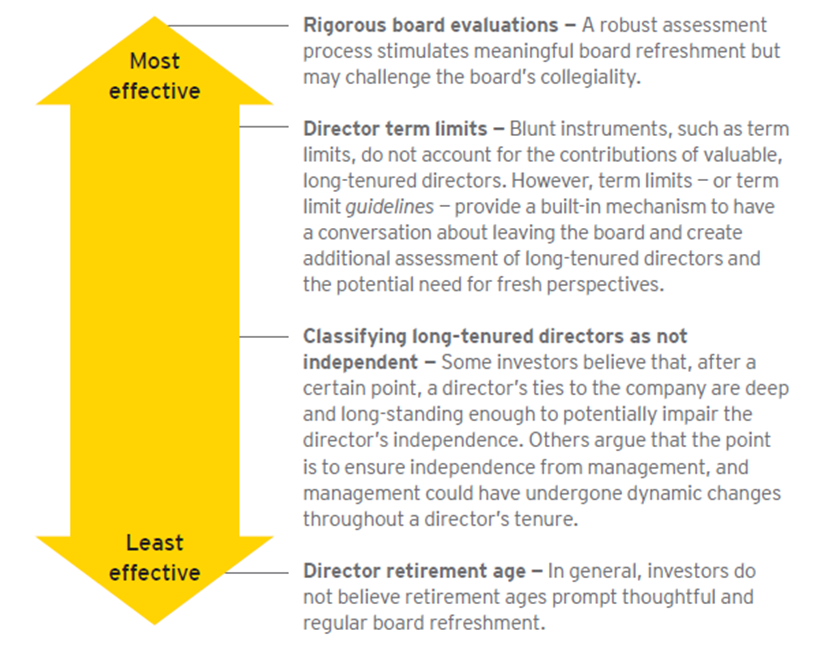
Rigorous board evaluations, including assessing the performance of individual board members, as well as the performance and composition of the board and its committees, are generally considered valuable mechanisms for stimulating thoughtful board turnover, but views about other approaches (e.g., term limits) differ widely.

L’article présente les avenues à explorer pour améliorer la composition des CA. Également, l’article propose trois bons moyens pour renforcer la divulgation liée à la composition du conseil. Enfin, l’article présente une manière originale de conceptualiser le renouvellement des conseils, en s’appuyant, notamment, sur de solides évaluations des administrateurs.

Voici des extraits de l’article. Bonne lecture !

2015 Proxy Season Insights: Board Composition

Room for improvement in making the case for board composition

Despite investor acknowledgement that some leading companies are doing an excellent job in this area, most of the investors we spoke with believe companies are generally not making a compelling enough case in the proxy statement for why their directors are the best candidates for the job.

ey-most-companies-do-good-job

Three ways companies can enhance board composition disclosures

  1. Make disclosures company-specific and tie qualifications to strategy and risk: Be explicit about why the director brings value to the board based on the company’s specific circumstances. Companies should not assume that the connection between a director’s expertise and the company’s strategic and risk oversight needs is obvious. Also, explaining how the board, as a whole, is the right fit can be valuable, particularly given that most investors are evaluating boards holistically.
  2. Provide more disclosure around the director recruitment process and how candidates are sourced and vetted: Disclosing more information around the nomination process—how directors were identified (e.g., through a search firm), what the vetting process entailed, etc.—can mitigate concerns about the recruitment process being insular and informal.
  3. Discuss efforts to enhance gender and ethnic diversity: Many companies—nearly 60% of S&P 500 companies—say they specifically identify gender and ethnicity as a consideration when identifying director nominees, but that is not always reflected in the gender and ethnic makeup of the board. Disclosing a formal process to support board diversity, including providing clarity around what is considered an appropriate level of diversity, can highlight efforts to recruit diverse directors.

A skills matrix tied to company strategy can be a valuable disclosure tool but is not the only way to convey a thoughtful approach. A letter from the lead director or chairman that discusses the board’s succession planning and refreshment process and any recent composition changes can also be effective.

Beyond disclosure, engagement can provide investors a valuable dimension in assessing board quality. Involving key directors in conversations with shareholders can provide further insight into board dynamics, individual director strengths and composition decisions.

Views vary on mechanisms to trigger board renewal

When we asked investors what mechanisms boards can use to most effectively stimulate refreshment, the vast majority chose rigorous board evaluations as the optimal solution and director retirement ages as the least effective. However, views around the different mechanisms and how they should be used vary—as does how investors approach the topic of tenure altogether.

Some investors evaluate tenure and director succession planning as a forward-looking risk, while others focus on past company performance and decisions. The commentary below represents investor opinions on each mechanism.

One of the top takeaways from our dialogue dinners was the importance of robust board evaluations, including evaluations of individual board members, to meaningful board refreshment and board effectiveness. Some directors noted the value in bringing in an independent third party to facilitate in-depth board assessments and in changing evaluation methods as appropriate to reinvigorate the process. Some also noted that board evaluation effectiveness relies on the strength of the independent board leader leading the evaluation.

When it comes to how boards manage director tenure internally, setting expectations up front that directors’ board service will be for a limited amount of time—not necessarily until they reach retirement age—is important. We’ve heard from some directors that having periodic conversations with individual board members about their future on the board is valuable and can help provide “off ramps” and a healthy succession planning process.

ey-mechanisms-is-the-most-effective

Conclusion

Given investors’ increasing focus on board composition, companies may want to review and enhance proxy statement disclosures to ensure that director qualifications are explicitly tied to company-specific strategy and risks and that the board’s approach to diversity and succession planning is transparent.

Beyond disclosure, ongoing dialogue with institutional investors that involves independent board leaders may allow for a rich discussion around board composition. Also, through regular board refreshment and enhanced communications around director succession planning, companies may head off investor uncertainty and temptations to go down a rules-based path regarding director terms.

Aux É.U., il est temps de favoriser le rapprochement entre les administrateurs et les actionnaires


Voici un excellent article paru dans la section Business du The New York Times du 28 mars 2015 qui porte sur les appréhensions, relativement injustifiées, des communications (engagement) entre les administrateurs et leurs actionnaires (en dehors des assemblées annuelles).

L’article évoque le manque de communication des Boards américains avec leurs actionnaires et avec les parties prenantes, contrairement à la situation qui prévaut du côté européen. Selon l’auteure, cette grande distance entre les administrateurs et les actionnaires mène aux insatisfactions croissantes de ceux-ci, et cela se reflète dans l’augmentation du nombre d’administrateurs n’obtenant pas le soutien requis lors des assemblées annuelles.

On le sait, les actionnaires des entreprises américaines souhaitent pouvoir faire inscrire leurs propositions dans les circulaires de procuration, notamment pour présenter des candidatures aux postes d’administrateurs.

En 2015, plusieurs grandes corporations américaines permettront l’accès des grands actionnaires à leurs circulaires de procuration (voir Les conséquences inattendues de l’accès des actionnaires à la circulaire de procuration lors de l’assemblée annuelle et Proxy Access Proposals: The Next Big Thing in Corporate Governance).

Il est donc temps de revoir le mode de communication entre les deux acteurs principaux et d’exposer les avantages à collaborer à la gouvernance de l’entreprise. Plusieurs pays européens donnent l’exemple à cet égard.

Ainsi, en Suède et en Norvège, les cinq (5) plus grands actionnaires d’une entreprise reçoivent des invitations à se joindre au comité de gouvernance et de nomination afin de choisir des administrateurs potentiels.

En Europe, les actionnaires ont plus de poids; ceux qui possèdent au moins 1 % de la propriété peuvent soumettre des candidatures pour les postes d’administrateurs. De plus, dans certains pays européens, contrairement à la situation américaine, les administrateurs doivent soumettre leurs démissions s’ils ne reçoivent pas un soutien majoritaire aux élections.

P1060488

Voici une politique sur la communication du CA avec les investisseurs qui pourrait être envisagée; elle présente un certain nombre de sujets jugés appropriés :

(1) la rémunération de la direction,

(2) la structure des comités du conseil,

(3) le processus de planification de la relève,

(4) le rôle du CA dans la supervision de la stratégie.

Je suis assuré que vous trouverez cet article du NYT stimulant et engageant ! Vos commentaires sont les bienvenus.

Bonne lecture !

At U.S. Companies, Time to Coax the Directors Into Talking

It’s shareholder meeting season again, corporate America’s version of Groundhog Day.

This is the time of year when company directors venture out of the boardroom to encounter the investors they have a duty to serve. After the meetings are over, like so many Punxsutawney Phils, these directors scurry back to their sheltered confines for another year.

This is a bit hyperbolic, of course. But institutional investors argue that there’s a troubling lack of interaction these days between many corporate boards in the United States and their most important investors. They point to contrasting practices in Europe as evidence that it’s time for this to change.

“It’s a very different culture in the U.S.,” said Deborah Gilshan, corporate governance counsel at RPMI Railpen Investments, the sixth-largest pension fund in Britain, which has 20 billion pounds, or about $30 billion, in assets. “In the U.K., we get lots of access to the companies we invest in. In fact, I’ve often wondered why a director wouldn’t want to know directly what a thoughtful shareholder thinks.”

As Ms. Gilshan indicated, directors at European companies routinely make themselves available for investor discussions; in some countries, such meetings are required. Many directors of foreign companies even — gasp — give shareholders their private email addresses and phone numbers.

Their counterparts in the United States seem fearful of such contact. Large shareholders say that some directors of American companies refuse to meet at all, preferring to let company officials speak for them.

Comportements néfastes liés au narcissisme de certains présidents et chefs de direction (PCD) | En reprise


Il est indéniable qu’un PCD (CEO) doit avoir une personnalité marquante, un caractère fort et un leadership manifeste. Ces caractéristiques tant recherchées chez les premiers dirigeants peuvent, dans certains cas, s’accompagner de traits de personnalité dysfonctionnels tels que le narcissisme.

C’est ce que Tomas Chamorro-Premuzic soutien dans son article publié sur le blogue du HuffPost du 2 janvier 2014. Il cite deux études qui confirment que le comportement narcissique de certains dirigeants (1) peut avoir des effets néfastes sur le moral des employés, (2) éloigner les employés potentiels talentueux et (3) contribuer à un déficit de valeurs d’intégrité à l’échelle de toute l’organisation.

L’auteur avance que les membres des conseils d’administration, notamment ceux qui constituent les comités de Ressources humaines, doivent être conscients des conséquences potentiellement dommageables des leaders flamboyants et « charismatiques ». En fait, les études montrent que les vertus d’humilité, plutôt que les traits d’arrogance, sont de bien meilleures prédicteurs du succès d’une organisation.

P1040752La première étude citée montre que les organisations dirigées par des PCD prétentieux et tout-puissants ont tendances à avoir de moins bons résultats, tout en étant plus sujettes à des fraudes.

La seconde étude indique que les valeurs d’humilité incarnées par un leader ont des conséquences positives sur l’engagement des employés.

Voici en quelques paragraphes les conclusions de ces deux études.

Bonne lecture !

In the first study, Antoinette Rijsenbilt and Harry Commandeur assessed the narcissism levels of 953 CEOs from a wide range of industries, as well as examining objective performance indicators of their companies during their tenure. Unsurprisingly, organizations led by arrogant, self-centered, and entitled CEOs tended to perform worse, and their CEOs were significantly more likely to be convicted for corporate fraud (e.g., fake financial reports, rigged accounts, insider trading, etc.). Interestingly, the detrimental effects of narcissism appear to be exacerbated when CEOs are charismatic, which is consistent with the idea that charisma is toxic because it increases employees’ blind trust and irrational confidence in the leader. If you hire a charismatic leader, be prepared to put up with a narcissist.

In the second study, Bradley Owens and colleagues examined the effects of leader humility on employee morale and turnover. Their results showed that « in contrast to rousing employees through charismatic, energetic, and idealistic leadership approaches (…) a ‘quieter’ leadership approach, with listening, being transparent about limitations, and appreciating follower strengths and contributions [is the most] effective way to engage employees. » This suggests that narcissistic CEOs may be good at attracting talent, but they are probably better at repelling it. Prospective job candidates, especially high potentials, should therefore think twice before being seduced by the meteoric career opportunities outlined by charismatic executives. Greed is not only contagious, but competitive and jealous, too…


If we can educate organizations, in particular board members, on the virtues of humility and the destructive consequences of narcissistic and charismatic leadership, we may see a smaller proportion of entitled, arrogant, and fraudulent CEOs — to everyone’s benefit. Instead of worshiping and celebrating the flamboyant habits of corporate bosses, let us revisit the wise words of Peter Drucker, who knew a thing or two about management:

The leaders who work most effectively, it seems to me, never say ‘I’. And that’s not because they have trained themselves not to say ‘I’. They don’t think ‘I’. They think ‘we’; they think ‘team’. They understand their job to be to make the team function. They accept responsibility and don’t sidestep it, but ‘we’ gets the credit.

Enhanced by Zemanta

Qualités managériales recherchées par les conseils d’administration | Entrevue avec le PCD de Korn/Ferry


Voici un article qui met en exergue les qualités que les conseils d’administration veulent voir chez les futurs membres de la haute direction.

L’article, écrit par Lauren Weber dans les pages du The Wall Street Journal, relate un extrait de l’entrevue avec Gary Burnison, PCD de Korn/Ferry International, à propos de la recherche de talents en management à l’échelle internationale.

Le marché de la recherche des meilleurs talents de gestionnaires est en pleine expansion; il représente un marché d’environ 20 Milliards.

Toutes les grandes firmes font affaires avec des entreprises spécialisées dans la recherche des meilleurs talents, dans l’évaluation de ces derniers ainsi que dans leur rétention. De grandes firmes comme Korn/Ferry International possèdent des banques de données très à jour sur les carrières des hauts dirigeants ainsi que des outils de recherche à la fine pointe.

On est donc intéressé à connaître le point de vue du président et chef de la direction de la plus grande entreprise (1 Milliard par année) sur la croissance du marché et sur les qualités des candidatures recherchées.

On y apprend que les C.A. sont préoccupés par la plus grande diversité possible, par des candidats qui sont constamment en processus d’apprentissage, qui possèdent plusieurs réseaux d’affaires, qui savent bien s’entourer et qui ont fait leurs preuves dans des situations de gestion similaires. Le partenaire stratégique du PCD doit être le V-P Ressources humaines … et non le V-P Finance.

Je vous invite à lire l’extrait ci-dessous. Bonne lecture !

Korn/Ferry’s CEO: What Boards Want in Exécutives


WSJ: Your executive-search business was up in the first quarter by 9%. Are companies investing in growth, or are they mostly replacing people who leave?

Mr. Burnison: Industries like health care, technology and energy are going through massive change, and it’s going to continue for the foreseeable future. That creates a need for new positions, whether it’s about delivering health care remotely or finding new ways to tap people instantaneously through social media. Those needs didn’t exist a decade ago.

IMG_20141211_183948

WSJ: Executive search seems like an old-fashioned, Rolodex business. Are LinkedIn and other social-networking tools going to make it obsolete?

Mr. Burnison: CEOs are in this mad fight for growth and relevancy, so they’re paying us not for finding people, but for finding out who people are. You can go lots of places to find people. But you’re going to want somebody to answer, “Okay, but what is this person really like? What do others really say about them?”

WSJ: How do you answer those questions?

Mr. Burnison: For the boardroom or the C-suite, the technical competencies are a starting point. What we’ve seen through our research is that the No. 1 predictor of executive success is learning agility. So we want to get a real line of sight into a person’s thinking style and leadership style. Right now, you’re seeing me how I want you to see me. What you really want to know is “How does Gary make decisions under pressure?”

WSJ: What is learning agility?

Mr. Burnison: It comes down to people’s willingness to grow, to learn, to have insatiable curiosity. Think about the levers of growth that a CEO has. You can consolidate, or tap [new markets], or innovate. When it comes down to the last two, particularly innovation, you want a workforce that is incredibly curious.

WSJ: What are companies getting wrong today about managing their employees?

Mr. Burnison: There’s this gap between what [executives] say and how they invest in people’s careers. They spend an enormous amount on development and performance management, but it’s not well spent.

WSJ: Where are they investing poorly in talent?

Mr. Burnison: They should be asking, how do you develop people in their careers? How do you extend the life of an employee? This is not an environment where you work for an organization for 20 years. But if you can extend it from three years to six years; that has enormous impact. [Turnover] is a huge hidden cost in a profit-and-loss statement that nobody ever focuses on. If there was a line item that showed that, I guarantee you’d have the attention of a CEO.

WSJ: Why aren’t CEOs focused on turnover?

Mr. Burnison: A CEO only has an average tenure today of five years. You have 20 quarters to show that you have a winning team. There is a trade-off between knowing in your heart that you’ve got to empower people, you’ve got to develop them. But then there’s the other side, that says, “Oh, my gosh. I’ve got to win this next game.”

WSJ: How should leaders look beyond the short-term horizon?

Mr. Burnison: The strategic partner to the CEO should be the CHRO [chief human-resources officer] in almost any organization. It shouldn’t be the CFO. The person that is responsible for people should be the biggest lever that a CEO can pull. Too often, it’s not.

WSJ: You’ve been CEO for seven years. Is the clock ticking?

Mr. Burnison: We’re all by definition “on the clock.” However, that ticking clock should never impede the journey. I am having a lot of fun and there is still an enormous amount of work to be done.

WSJ: You’re pushing to create more management products for companies. Why, and what are they?

Mr. Burnison: People are hard to scale. [Products are] very easy to scale. It’s going to be based on predictors of success. By culture, by industry, by function, around the world. It could be a program for how we assess and develop people. It could be licensing a piece of content around onboarding or hiring. Candidates could take an online assessment. You would get feedback and you could license our interviewing technology to say, “With this person, you may want to probe this area and this area when you’re interviewing them.”

WSJ: What do your search clients ask for most often?

Mr. Burnison: The No. 1 request we get in the search business is diversity. Diversity in thought. Diversity in backgrounds. Diversity, yes, in gender. Diversity yes, in race. Diversity, yes in terms of cultural upbringing. That’s got serious legs.

Formation en gouvernance pour les nouveaux administrateurs | Un prérequis ?


La formation en gouvernance est de plus en plus un préalable à l’exercice du rôle d’administrateur de sociétés. L’article retenu montre que l’apprentissage sur le tas est en voie de disparition dans les conseils d’administration de grandes sociétés. La formation préparatoire peut prendre différentes formes : training sur mesure, coaching, séminaires, etc.

Cependant, il semble de plus en plus évident que les programme de formation en gouvernance (tels que IoD, C.dir., ASC, IAS) menant à une certification reconnue, constituent la voie à suivre dans le futur.

L’article de Hannah Prevett, paru dans le Sunday Times, montre que les formations organisées sont de meilleurs endroits pour un apprentissage de qualité que les tables de conseils d’administration… Bonne lecture !


Soirée de remise des diplômes de la promotion 2014
Diplômés ASC du Collège des administrateurs de sociétés 2014


A head start for novices


The received wisdom is that new directors learn on the job. If they are not  equipped with the necessary skills when they accept their first board  appointment, they will need to be quick on the uptake.

Not any more: the tidal wave of new governance requirements means it is not  good enough to acquire expertise over time. And, as a result, many  prospective boardroom stars are seeking training to help them do the job  they’re paid to do from day one. When Alan Kay learnt he was to join the executive board of Costain in 2003, he  immediately began considering how to prepare for his new role at the  engineering and construction group.

“A lot of people haven’t really thought about how to prepare for a board role.  [They think] it’s something that happens naturally: you get on the board and  then you think, I’m going to learn on the job,” said Kay, who is Costain’s  technical and operations director. “But once you’re appointed, becoming  competent and learning as you go takes several months, which is not ideal.”

He researched training options for new board members and came across the  Institute of Directors’ accredited programmes, including the certificate and  diploma in company direction. The IoD fills 6,000 places on such courses annually with representatives of  both large and small organisations — not all of them young guns, as Roger  Barker, head of corporate governance at the IoD, explained.

“The directors of large organisations were reluctant to undertake any form of  formalised director training. These were typically seasoned former  executives, with extensive experience of serving on boards as chief  executives or chief financial officers. It has been difficult to persuade  such individuals that director training is relevant to them,” said Barker.

_________________________________

* En reprise

Enhanced by Zemanta

Les organisations doivent-elles d’abord travailler sur la stratégie ou sur la culture ?


Voici un article très intéressant de Elliot S. Schreiber* paru sur le blogue de Schreiber | Paris récemment. L’auteur pose une question cruciale pour mieux comprendre la nature et la priorité des interventions organisationnelles.

À quoi le management et le C.A. doivent-ils accorder le plus d’attention : À stratégie ou à la culture de l’organisation ?

L’auteur affirme que la culture, étant l’ADN de l’entreprise, devrait se situer en premier, …  avant la stratégie !

Le bref article présenté ci-dessous pose deux questions fondamentales pour connaître si l’entreprise a une culture appropriée :

(1) Does it cost us the same, more or less than competitors to recruit and retain top talent ?

(2) Are customers happy with the relationship they have with our company versus our competition ?

If it costs you more to recruit and retain your best talent or if customers believe that competitors are easier to deal with, you have cultural issues that need to be dealt with.   We can guarantee that if you do not, you will not execute your strategy successfully, no matter what else you do.

Ce point de vue correspond-il à votre réalité ? Vos commentaires sont les bienvenus. Bonne lecture !

Which To Work on First, Strategy or Culture ?


Peter Drucker famously stated “culture eats strategy for breakfast”.   A great quote no doubt and quite right, but it still raises the question – one that we recently got from a board member at a client organization – “which should we work on first, strategy or culture”?

Consider the following; you are driving a boat.  You want to head east, but every time you turn the wheel the boat goes south.  In this analogy, the course direction is strategy; the boat’s rudder is culture.  They are not in synch.  No matter how hard you turn the wheel, the rudder will win.  That is what Drucker meant.

Every organization has a culture, whether it was intentionally developed or not.  This culture gets built over time by the personalities and principles of the leaders, as well as by rewards, incentives, processes and procedures that let people know what really is valued in the company.

Culture is defined as “the way we do things around here every day and allow them to be done”. Employees look to their leaders to determine what behaviors are truly values, as well as to the rewards, incentives, processes and procedures that channel behaviors.

Executives we work with often get confused about culture, thinking that they need to duplicate the companies that are written up in publications as having the best cultures.  We all know the ones in these listings.  They are the ones with skate ramps, Friday beer parties, and day care centers.  All these things are nice, but there is no need to duplicate these unless you are attempting to recruit the same employees and create the same products and services.  No two companies, even those in the same market segment, need to have the same culture.

We know from discussions with other consultants and business executives that there are many who strongly believe that culture comes first.  What they suggest is that since culture is there—it is the DNA of the company—it comes before strategy.  It may be first in historical order, but that is not what matters. You don’t need pool tables and skate ramps like Google to have a good culture.   What matters with culture is whether or not it drives or undermines value creation, which comes from the successful interaction of employees and customers.

…..

____________________________________

* Elliot S. Schreiber, Ph.D., is the founding Chairman of Schreiber Paris.  He has gained a reputation among both corporate executives and academics as one of the world’s most knowledgeable and insightful business and market strategists. Elliot is recognized as an expert in organizational alignment, strategy execution and risk management.  He is a co-founder in 2003 of the Directors College, acknowledged as Canada’s « gold standard » for director education.

Le constat de l’incompétence de plusieurs administrateurs | Harvard Business Review


Aujourd’hui, je vous propose la lecture d’un récent article, paru dans Harvard Business Review, sous la plume de Dominic Barton* et Mark Wiseman*, qui traite d’un sujet assez brûlant : l’incompétence de plusieurs conseils d’administration.

Les auteurs font le constat que, malgré les nombreuses réformes règlementaires effectuées depuis Enron, plusieurs « Boards » sont dysfonctionnels, sinon carrément incompétents !

En effet, une étude de McKinsey montre que seulement 22 % des administrateurs comprennent comment leur firme crée de la valeur; uniquement 16 % des administrateurs comprennent vraiment la dynamique de l’industrie dans laquelle leur société œuvre.

L’article avance même que l’industrie de l’activisme existe parce que les « Boards » sont inadéquatement équipés pour répondre aux intérêts des actionnaires !

Je vous invite à lire cet article provocateur. Voici un extrait de l’introduction. Qu’en pensez-vous ?

Bonne lecture !

Where Boards Fall Short

Boards aren’t working. It’s been more than a decade since the first wave of post-Enron regulatory reforms, and despite a host of guidelines from independent watchdogs such as the International Corporate Governance Network, most boards aren’t delivering on their core mission: providing strong oversight and strategic support for management’s efforts to create long-term value. This isn’t just our opinion. Directors also believe boards are falling short, our research suggests.

435A mere 34% of the 772 directors surveyed by McKinsey in 2013 agreed that the boards on which they served fully comprehended their companies’ strategies. Only 22% said their boards were completely aware of how their firms created value, and just 16% claimed that their boards had a strong understanding of the dynamics of their firms’ industries.

More recently, in March 2014, McKinsey and the Canada Pension Plan Investment Board (CPPIB) asked 604 C-suite executives and directors around the world which source of pressure was most responsible for their organizations’ overemphasis on short-term financial results and underemphasis on long-term value creation. The most frequent response, cited by 47% of those surveyed, was the company’s board. An even higher percentage (74%) of the 47 respondents who identified themselves as sitting directors on public company boards pointed the finger at themselves.

_________________________________

*Dominic Barton is the global managing director of McKinsey & Company and the author of “Capitalism for the Long Term.”

*Mark Wiseman is the president and CEO of the Canada Pension Plan Investment Board.


Le gouvernement résistera-t-il à la tentation partisane de la nomination du prochain PCD à Hydro-Québec ?


Voici un article de Michel Nadeau, ex vice-président de la Caisse de dépôt et placement et directeur général de l’Institut sur la gouvernance (IGOPP), paru dans le Devoir récemment.

L’auteur se questionne, tout comme moi d’ailleurs, sur le processus d’embauche du PDG d’Hydro-Québec et sur la tentation, très réelle, de procéder à une nomination partisane !

Le point de vue de M. Nadeau est tout à fait pertinent eu égard à gouvernance des sociétés d’État.

Ci-dessous, un extrait de l’article.

Bonne lecture. À suivre !

Règles de gouvernance à Hydro-Québec | Nomination du nouveau PDG

Photo: Hydro-Québec

Il était rafraîchissant d’entendre le ministre de l’Énergie et des Ressources naturelles, M. Pierre Arcand, terminer mercredi matin une entrevue chez Marie-France Bazzo en déclarant : « Je vais laisser le conseil d’administration faire le travail et c’est à lui de faire des recommandations quant au successeur de M. Vandal. » Photo: Hydro-Québec

La tentation est toujours très forte dans les cabinets politiques à Québec de passer outre les normes de bonne gouvernance et de sortir un p.-d.g. d’un chapeau partisan. Tout individu a droit à ses convictions politiques, mais l’essentiel est qu’il remplisse les critères de compétence et de crédibilité selon le mandat. À ce chapitre, le premier ministre, M. Philippe Couillard, n’a pas fait vivre un grand moment de gouvernance au Québec en confiant récemment la présidence du conseil d’administration et du comité de gouvernance d’Hydro-Québec à une personne qui n’a aucune expérience dans la gestion du CA d’une grande organisation. Cela étant dit, il faut maintenant faire confiance à M. Michael Penner.

Comme l’indique l’article 11.6 de sa Loi, le conseil d’administration a déjà établi le profil de compétence et d’expérience du candidat recherché….

Le ministre l’a dit : ce n’est pas un choix politique. Le comité des ressources humaines devra trouver le meilleur candidat en interne ou à l’externe sans se gêner pour regarder à l’international. Le CA, qui compte une bonne moitié de gens expérimentés, peut relever ce défi. Les administrateurs pourraient se précipiter sur le bottin de l’Ordre des ingénieurs en cherchant un dirigeant intègre et honnête. Malgré le flou accusateur des audiences de la commission Charbonneau, ce profil peut encore se trouver. Mais rappelons-nous que le marché de l’énergie a beaucoup changé et que l’époque de la construction de grands barrages dans les milliards de dollars et les régions lointaines est, pour le moment, chose du passé. Au cours des prochaines années, la priorité sera davantage la gestion serrée des actifs actuels de 73 milliards et un contrôle rigoureux de l’utilisation des revenus de 13 milliards. Les usagers veulent des gestionnaires intelligents… Pas juste des compteurs !

Cette nomination sera un indicateur du sérieux de ce gouvernement dans la gouvernance et la gestion du plus important outil de développement économique et industriel du Québec.

Pourquoi un C.A. a-t-il besoin d’administrateurs externes … et indépendants ? | En rappel


Aujourd’hui, je vous recommande cette brève lecture dominicale sur les bénéfices à retirer d’un conseil composé, en tout ou en partie, d’administrateurs externes, mais … indépendants.

L’article est récemment paru sur le blogue de * un spécialiste des questions de gouvernance. Nous avons déjà publié un article de cet auteur sur notre blogue il y a un an.

Selon nous, l’admission d’administrateurs externes au sein du conseil est l’une des actions les plus profitables pour tous les types d’entreprises, qu’elles soient, cotées, privées, PME, familiales, coopératives, gouvernementales, ou à but non lucratif.

Selon votre expérience, quels sont les autres avantages qui vous paraissent importants ? Pouvez-vous faire un témoignage en faveur d’un conseil composé uniquement d’administrateurs externes ? Je serais heureux de publier un recueil de bonnes pratiques à ce sujet.

Voici trois autres billets publiés sur mon blogue au cours des dernières années.

Contribution des administrateurs externes à la vision des entreprises

Les bénéfices reliés à la nomination d’administrateurs externes au sein d’une PME

Un argumentaire en faveur du choix d’administrateurs externes au C.A.

Bonne lecture. J’attends vos commentaires !

Why Your Board Needs Outside Directors

Boards without outside directors do not make objective decisions. Boards need outside directors to see all sides of a problem and find the best solution. Outside directors bring incredible value with their “fresh eyes.”369

I believe boards that have not brought somebody new to the organization in the last one to two years run the risk of stalling the growth of the company.

Public companies are obligated to have outside directors, but private and family businesses are not. The Wall Street Journal states: “In US public companies, outside directors make up 66% of all boards and 72% of S&P 500 company boards.”

7 Benefits of Outside Directors:

  1. Unbiased advice: Their advice is not tainted by the existing boards views and politics.
  2. Different perspective than insiders: A CEO needs different views and perspectives to problems that only outsiders can bring. This is especially true for a family business.
  3. Objective: Outsiders have been there and done that and can add the objective advice that boards need to distinguish crises and normal situations.
  4. New skills: New board members skills and experiences bring a different view to problems and discussions.
  5. Credibility: It sends the message that you are a serious organization. This can help with negotiating new financing, selling the company or an IPO.
  6. New resources and contacts: Outside directors bring a whole new set of contacts and connections that can be leveraged. Contact introductions include customers, suppliers, and bankers.
  7. On your side: Outside directors are on management’s side and will give opinions and advice that the company’s lawyers, accountants and bankers cannot give.

I was chairman, CEO and board director of SafeData, a data backup and recovery company. Our premium service offering was cloud-based high availability. High availability is data replication from one server to another.

We had an exceptional outside director who benefited us in all 7 areas. We spoke with him daily. He made the difference in our growth and successful sale of the company.

______________________________

** Outside Director | Interim CEO | CEO | Growth Strategist | Technology | Industrial | CEO Coach & Advisor

Comment composer avec un membre de CA « toxique » ? | En rappel


Aujourd’hui, je vous propose la lecture d’un excellent article de Richard Leblanc* publié dans The Globe and Mail.

Dans cet article, Richard montre que la dynamique comportementale de l’équipe des administrateurs est souvent la clé du succès des entreprises. Souvent la composition de l’équipe est remarquable, mais si un seul membre est dysfonctionnel, « toxique » ou incompétent, il arrive que toute l’efficacité du conseil en souffre.

Dans ces cas, il faut s’assurer que le processus d’évaluation des administrateurs soit capable de déceler les maillons faibles du conseil et, surtout, d’agir résolument pour régler le problème.

Il revient au président du conseil, sur recommandation du comité de gouvernance, de prendre les décisions menant à la non-reconduction du mandat de l’administrateur qui nuit à la dynamique de groupe.

Il faut donc revoir la démarche d’évaluation des membres du CA, souvent avec une firme externe, afin de déceler les problèmes de dynamique d’équipe. À ce stade-ci, il faut noter que les processus de recrutement de nouveaux administrateurs ne font pas suffisamment de place aux critères de nature comportementale.

Également, lorsqu’il devient évident qu’un administrateur est « toxique » pour le travail d’équipe du conseil, le président doit prendre les devants et engager une démarche de correction. Mais plusieurs présidents de CA n’osent pas se compromettre !

Souvent le problème est connu, et reconnu, mais le président laisse porter, au détriment de l’efficacité du travail de groupe. Dans ce cas, c’est le poste de président qui devient en jeu puisque son rôle est de s’assurer que le CA fonctionne harmonieusement et avec respect, tout en favorisant la liberté d’expression.

Vous trouverez, ci-dessous, l’article en question. Si vous avez des suggestions pour mettre un terme à ces comportements déviants, ou si vous avez des exemples à partager avec nos lecteurs, n’hésitez pas à commenter ce billet.

Bonne lecture !

Don’t let your board fail your company

An effective board is the last line of defense for shareholders, regulators and other stakeholders. This small but mighty peer group is responsible for overseeing the management of an organization, so if one thing is flawed – if just one director’s behaviour is disruptive or toxic – it can be the difference between performance and non-performance throughout the entire organization. Poor dynamics have that kind of ripple effect, unfortunately.

A bad board member can derail your board of directors. (iStockphoto)


As an external adviser and specialist in corporate governance and accountability, my work has allowed me to study and evaluate boards, investors and directors across all sectors, including health care.

I’ve never investigated a board failure where flawed dynamics was not a major contributor, which is why I know for a fact that great boards don’t just “happen.” They are carefully and critically designed to be functionally sound. They have to be. A board is just too important an entity to rely on crossed fingers and wishful thinking.

When it comes to toxic behaviours that can bring down a board, I’ve pretty much seen it all. Excessive power, over-reliance on one person, dominant managers, lack of integrity and trustworthiness, confidentiality breaches, lack of transparency and accountability, lack of meeting preparation, undermining board decisions, poor information flow management – these are all warning signs that need to be addressed immediately. But perhaps the biggest red flag is the dysfunctional director and the underperforming director.

I’ve seen dissention amongst the ranks on some of the most iconic boards in Canada. In one instance, there was a director who was so toxic that the board had been consumed by theatrics for nearly a year. When I spoke to the other directors, almost all of them wanted the bullying to stop, but no one had the courage to pull the trigger. Even the chair of the board was too weak to take action. Ultimately, my recommendation was to replace both of them in order to settle things down and get the board back on track.

People are often surprised to hear that the best thing you can do to begin to heal divisions and repair a broken board is to let someone go. But in many cases that’s the only way to start the mending process. It’s not easy to unwind chronic dysfunction on a board – it takes a strong chair or third-party supervision – but getting rid of the root cause is the best way to start. The key is handling the dismissal respectfully and diplomatically.

I once conducted a peer review for the board of an important and highly regulated company. If the board of this particular company makes a mistake, people can die, so it was critical for them to get it right. Every time.

During the review process, I noticed that one director rated another last on almost every single performance dimension. When questioned, the director proceeded to tell me, category by category, why he had rated his peer so poorly – even though others had given that same director exemplary ratings. It eventually became clear that he despised the director he had critiqued so harshly. There was simply no way to repair this enmity, and it had no place on this – or any – board. My recommendation was to remove the hostile director. And that’s exactly what happened.

Board members need to be proactive when they sense there is trouble brewing. The one regret directors repeatedly express is not speaking up and calling out toxic behaviours until it was too late. Letting it fester only makes the situation worse for everyone involved, especially the company.

But of course the best way to create a functional, healthy board is to avoid dysfunction from the start. Nominating committees need to spend more time at the front end recruiting directors, and on the back end retiring them. And they need to do it on the basis of expected and actual performance.

Unfortunately, most competency matrices don’t include behaviour, and all directors have “warts.” Nominating committees must do their due diligence, and that includes a proper competency matrix, the creation of long lists and short lists, interviews, background checks, and making sure to bring on directors who are not friends or known to current directors. A strong and experienced chair at the helm who can appreciate the value of a diverse board and make difficult decisions when necessary is another must-have.

An effective board doesn’t happen by accident. Spend time and effort designing yours by recruiting independent thinkers who can leave their egos at the door, ask the tough questions, give the right advice – and do it all with a smile. Let the notion of, “iron hand in a velvet glove,” be your yardstick as you create your dream team.

*Dr. Richard Leblanc (@DrRLeblanc) is an associate professor of law, governance and ethics at York University (@yorkuniversity) and principal of Boardexpert.com Inc