Le conseil d’administration est garant de la bonne conduite éthique de l’organisation | Rendez-vous à un colloque inspirant !


La considération de l’éthique et des valeurs d’intégrité sont des sujets de grande actualité dans toutes les sphères de la vie organisationnelle*. À ce propos, le Réseau d’éthique organisationnelle du Québec (RÉOQ) tient son colloque annuel les 25 et 26 octobre 2018 à l’hôtel Marriott Courtyard Montréal Centre-Ville et il propose plusieurs conférences qui traitent de l’éthique au quotidien. Je vous invite à consulter le programme du colloque et y participer.


Ne vous méprenez pas, la saine gouvernance des entreprises repose sur l’attention assidue accordée aux questions éthiques par le président du conseil, par le comité de gouvernance et d’éthique, ainsi que par tous les membres du conseil d’administration. Ceux-ci ont un devoir inéluctable de respect de la charte éthique approuvée par le CA.

Les défaillances en ce qui a trait à l’intégrité des personnes et les manquements de nature éthique sont souvent le résultat d’un conseil d’administration qui n’exerce pas un fort leadership éthique et qui n’affiche pas de valeurs transparentes à ce propos. Ainsi, il faut affirmer haut et fort que les comportements des employés sont largement tributaires de la culture de l’entreprise, des pratiques en cours, des contrôles internes… Et que les administrateurs sont les fiduciaires de ces valeurs qui font la réputation de l’entreprise !

Cette affirmation implique que tous les membres d’un conseil d’administration doivent faire preuve de comportements éthiques exemplaires : « Tone at the Top ». Les administrateurs doivent se donner les moyens d’évaluer cette valeur au sein de leur conseil, et au sein de l’organisation.

C’est la responsabilité du conseil de veiller à ce que de solides valeurs d’intégrité soient transmises à l’échelle de toute l’organisation, que la direction et les employés connaissent bien les codes de conduites et que l’on s’assure d’un suivi adéquat à cet égard.

Mais là où les CA achoppent trop souvent dans l’établissement d’une solide conduite éthique, c’est (1) dans la formulation de politiques probantes (2) dans la mise en place de l’instrumentalisation requise (3) dans le recrutement de personnes qui adhèrent aux objectifs énoncés et (4) dans l’évaluation et le suivi du climat organisationnel.

Les administrateurs doivent poser les bonnes questions sur la situation existante et prendre le recul nécessaire pour envisager les divers points de vue des parties prenantes dans le but d’assurer la transmission efficace du code de conduite de l’entreprise.

Les préconceptions et les préjugés sont coriaces, mais ils doivent être confrontés lors des échanges de vues au CA ou lors des huis clos. Les administrateurs doivent aborder les situations avec un esprit ouvert et indépendant.

Vous aurez compris que le président du conseil a un rôle clé à cet égard. C’est lui qui doit incarner le leadership en matière d’éthique et de culture organisationnelle. L’une de ses tâches est de s’assurer qu’il consacre le temps approprié aux questionnements éthiques. Pour ce faire, le président du CA doit poser des gestes concrets (1) en plaçant les considérations éthiques à l’ordre du jour (2) en s’assurant de la formation des administrateurs (3) en renforçant le rôle du comité de gouvernance et (4) en mettant le comportement éthique au cœur de ses préoccupations.

Le choix du premier dirigeant (PDG) est l’une des plus grandes responsabilités des conseils d’administration. Lors du processus de sélection, on doit s’assurer que le PDG incarne les valeurs éthiques qui correspondent aux attentes élevées des administrateurs ainsi qu’aux pratiques en vigueur. L’évaluation annuelle des dirigeants doit tenir compte de leur engagement éthique, et le résultat doit se refléter dans la rémunération variable des dirigeants.

Quels items peut-on utiliser pour évaluer la composante éthique de la gouvernance du conseil d’administration ? Voici un instrument qui peut aider à y voir plus clair. Ce cadre de référence novateur a été conçu par le Bureau de vérification interne de l’Université de Montréal.


1.       Les politiques de votre organisation visant à favoriser l’éthique sont-elles bien connues et appliquées par ses employés, partenaires et bénévoles ?
2.       Le Conseil de votre organisation aborde-t-il régulièrement la question de l’éthique, notamment en recevant des rapports sur les plaintes, les dénonciations ?
3.       Le Conseil et l’équipe de direction de votre organisation participent-ils régulièrement à des activités de formation visant à parfaire leurs connaissances et leurs compétences en matière d’éthique ?
4.       S’assure-t-on que la direction générale est exemplaire et a développé une culture fondée sur des valeurs qui se déclinent dans l’ensemble de l’organisation ?
5.       S’assure-t-on que la direction prend au sérieux les manquements à l’éthique et les gère promptement et de façon cohérente ?
6.       S’assure-t-on que la direction a élaboré un code de conduite efficace auquel elle adhère, et veille à ce que tous les membres du personnel en comprennent la teneur, la pertinence et l’importance ?
7.       S’assure-t-on de l’existence de canaux de communication efficaces (ligne d’alerte téléphonique dédiée, assistance téléphonique, etc.) pour permettre aux membres du personnel et partenaires de signaler les problèmes ?
8.       Le Conseil reconnaît-il l’impact sur la réputation de l’organisation du comportement de ses principaux fournisseurs et autres partenaires ?
9.       Est-ce que le président du Conseil donne le ton au même titre que le DG au niveau des opérations sur la culture organisationnelle au nom de ses croyances, son attitude et ses valeurs ?

10.    Est-ce que l’organisation a la capacité d’intégrer des changements à même ses processus, outils ou comportements dans un délai raisonnable ?


*Autres lectures pertinentes :

  1. Formation en éthique 2.0 pour les conseils d’administration
  2. Rapport spécial sur l’importance de l’éthique dans l’amélioration de la gouvernance | Knowledge@Wharton
  3. Rôle du conseil d’administration en matière d’éthique*
  4. Comment le CA peut-il exercer une veille de l’éthique ?
  5. Le CA est garant de l’intégrité de l’entreprise
  6. Cadre de référence pour évaluer la gouvernance des sociétés | Questionnaire de 100 items

Étude sur le mix des compétences dans la composition des conseils d’administration


Aujourd’hui, je vous recommande la lecture d’un article publié par Anthony Garcia, vice-président de la firme ISS, paru sur le forum de Harvard Law School, qui aborde le sujet des compétences (skills) requises pour siéger à un conseil d’administration.

Plus précisément, l’auteur explore la nature des compétences exigées des administrateurs ; comment celles-ci opèrent-elles pour améliorer les pratiques de gouvernance des entreprises ?

D’abord, il faut noter que la recherche de la diversité des compétences au sein des conseils d’administration est considérée comme un atout important ; cependant, les entreprises mettent encore l’accent sur les compétences et les expertises traditionnelles : le leadership, les connaissances financières, une expérience de CEO, une connaissance des marchés de l’entreprise et une familiarité avec la fonction audit.

L’étude montre aussi que les administrateurs récemment nommés ont des compétences plus diversifiées, notamment eu égard aux connaissances des marchés internationaux, aux compétences reliées aux ventes et à l’expertise dans le domaine des technologies de l’information (TI).

Également, l’étude montre que les femmes administratrices sont plus qualifiées que les hommes dans plusieurs types de compétences.

Résultats de recherche d'images pour « compétences des administrateurs »

Enfin, les entreprises qui ont une plus grande diversité de compétences sont plus susceptibles de divulguer leurs politiques de risques concernant la gouvernance, les aspects sociaux et les considérations environnementales (ESG).

L’auteur résume les caractéristiques d’une matrice des compétences jugée efficace. L’article comporte également plusieurs illustrations assez explicites.


A matrix that does more than “check the box”: The NYC Fund’s Boardroom Accountability Project 2.0 has focused on having companies disclose a “matrix” of skills, as well as race and gender, of the directors. The Project has a “compendium of best practices” that provides examples of the formats and details that are considered within the scope disclosure best-practices. With regard to race and gender, some of the examples disclosed gender and racial information in aggregate format while others listed the race and gender for each board member. With regard to skills, some companies simply listed the skills of each nominee; some provided a brief description of the underlying qualifications for the skill; some also broke out the director’s biography categorically based on the identified skills; the best examples also highlighted the relevance of the particular skill in the context of the company’s business.

Standardized skill disclosure: There is guidance for what constitutes a financial expert for Sarbanes-Oxley compliance. While being a former or current CEO is straightforward answer for whether a director has that skill, something like technology is much less clear. Would working at a company in the information technology sector suffice? Does the director need to be a Chief Technology officer? Setting market standards would reduce the uncertainty and expense for each company to take on the responsibility individually and would also increase investor confidence in analyzing a board based on skills.

Skills mapped to specific responsibilities: The analysis shows that having a particular skill on the board will reduce ESG risks. However, a more in-depth assessment would also consider the skills that exist on the board’s committees and map those skills to the responsibilities of key committees. For example, if the board gives the audit committee oversight of cybersecurity, has the board included any audit committee members that have technology or risk management experience?

Bonne lecture !


Director Skills: Diversity of Thought and Experience in the Boardroom


En quoi une formation en gouvernance des TI est-elle essentielle ?


Plusieurs personnes me demandent s’il existe une formation en gouvernance des TI à l’intention de membres de conseils d’administration et des hauts dirigeants.

Le Collège des administrateurs de sociétés (CAS) offre une formation ciblée d’une journée en gouvernance des TI, même si vous n’êtes pas un spécialiste en la matière.

Bon nombre d’administrateurs se sentent démunis et mal à l’aise lorsque vient le temps de discuter des dossiers de TI au conseil d’administration et de prendre des décisions importantes et stratégiques pour l’entreprise.
Cette formation d’une journée en gouvernance des TI vous donnera des assises solides pour comprendre et bien jouer votre rôle, et ce même si vous n’êtes pas un spécialiste en la matière.

Paule-Anne Morin, ASC, consultante, administratrice de sociétés et formatrice a conçu une formation spécialisée de haut niveau pour combler ce grand besoin.


Thèmes abordés lors de la journée


Gouvernance des TI : pourquoi faut-il s’y intéresser ?

Tremplin stratégique dans la performance des organisations : des outils concrets

Enjeux numériques et gestion de risques

Outils de mesure et de performance TI

CA et gouvernance des TI : rôle, structure et conditions de succès

Profil des participants


– Membres de conseils d’administration

– Hauts dirigeants

– Gestionnaires

– Investisseurs


Prochaines sessions de formation


23 octobre 2018 — Québec

De 8 h à 18 h
Édifice Price
65, rue Sainte-Anne
11e étage Québec (Québec)  G1R 3X5


28 mars 2019 — Montréal

De 8 h à 18 h
Centre de conférence Le 1000
Niveau Mezzanine
1000, rue De La Gauchetière Ouest
Montréal (Québec)  H3B 4W5


Inscrivez-vous ici


Information

Consultez la page Gouvernance des TI sur le site du CAS pour obtenir tous les détails.

Reconnaissance professionnelle

Cette formation, d’une durée de 7,5 heures, est reconnue aux fins des règlements ou des politiques de formation continue obligatoire du Collège et des ordres et organismes professionnels suivants : Barreau du Québec, Ordre des ADMA du Québec, Ordre des CPA du Québec, Ordre des CRHA et Association des MBA du Québec.

Le conseil d’administration est garant de la bonne conduite éthique de l’organisation !


La considération de l’éthique et des valeurs d’intégrité sont des sujets de grande actualité dans toutes les sphères de la vie organisationnelle*. À ce propos, le Réseau d’éthique organisationnelle du Québec (RÉOQ) tient son colloque annuel les 25 et 26 octobre 2018 à l’hôtel Marriott Courtyard Montréal Centre-Ville et il propose plusieurs conférences qui traitent de l’éthique au quotidien. Je vous invite à consulter le programme du colloque et y participer.


Ne vous méprenez pas, la saine gouvernance des entreprises repose sur l’attention assidue accordée aux questions éthiques par le président du conseil, par le comité de gouvernance et d’éthique, ainsi que par tous les membres du conseil d’administration. Ceux-ci ont un devoir inéluctable de respect de la charte éthique approuvée par le CA.

Les défaillances en ce qui a trait à l’intégrité des personnes et les manquements de nature éthique sont souvent le résultat d’un conseil d’administration qui n’exerce pas un fort leadership éthique et qui n’affiche pas de valeurs transparentes à ce propos. Ainsi, il faut affirmer haut et fort que les comportements des employés sont largement tributaires de la culture de l’entreprise, des pratiques en cours, des contrôles internes… Et que les administrateurs sont les fiduciaires de ces valeurs qui font la réputation de l’entreprise !

Cette affirmation implique que tous les membres d’un conseil d’administration doivent faire preuve de comportements éthiques exemplaires : « Tone at the Top ». Les administrateurs doivent se donner les moyens d’évaluer cette valeur au sein de leur conseil, et au sein de l’organisation.

C’est la responsabilité du conseil de veiller à ce que de solides valeurs d’intégrité soient transmises à l’échelle de toute l’organisation, que la direction et les employés connaissent bien les codes de conduites et que l’on s’assure d’un suivi adéquat à cet égard.

Mais là où les CA achoppent trop souvent dans l’établissement d’une solide conduite éthique, c’est (1) dans la formulation de politiques probantes (2) dans la mise en place de l’instrumentalisation requise (3) dans le recrutement de personnes qui adhèrent aux objectifs énoncés et (4) dans l’évaluation et le suivi du climat organisationnel.

Les administrateurs doivent poser les bonnes questions sur la situation existante et prendre le recul nécessaire pour envisager les divers points de vue des parties prenantes dans le but d’assurer la transmission efficace du code de conduite de l’entreprise.

Les préconceptions et les préjugés sont coriaces, mais ils doivent être confrontés lors des échanges de vues au CA ou lors des huis clos. Les administrateurs doivent aborder les situations avec un esprit ouvert et indépendant.

Vous aurez compris que le président du conseil a un rôle clé à cet égard. C’est lui qui doit incarner le leadership en matière d’éthique et de culture organisationnelle. L’une de ses tâches est de s’assurer qu’il consacre le temps approprié aux questionnements éthiques. Pour ce faire, le président du CA doit poser des gestes concrets (1) en plaçant les considérations éthiques à l’ordre du jour (2) en s’assurant de la formation des administrateurs (3) en renforçant le rôle du comité de gouvernance et (4) en mettant le comportement éthique au cœur de ses préoccupations.

Le choix du premier dirigeant (PDG) est l’une des plus grandes responsabilités des conseils d’administration. Lors du processus de sélection, on doit s’assurer que le PDG incarne les valeurs éthiques qui correspondent aux attentes élevées des administrateurs ainsi qu’aux pratiques en vigueur. L’évaluation annuelle des dirigeants doit tenir compte de leur engagement éthique, et le résultat doit se refléter dans la rémunération variable des dirigeants.

Quels items peut-on utiliser pour évaluer la composante éthique de la gouvernance du conseil d’administration ? Voici un instrument qui peut aider à y voir plus clair. Ce cadre de référence novateur a été conçu par le Bureau de vérification interne de l’Université de Montréal.


1.       Les politiques de votre organisation visant à favoriser l’éthique sont-elles bien connues et appliquées par ses employés, partenaires et bénévoles ?
2.       Le Conseil de votre organisation aborde-t-il régulièrement la question de l’éthique, notamment en recevant des rapports sur les plaintes, les dénonciations ?
3.       Le Conseil et l’équipe de direction de votre organisation participent-ils régulièrement à des activités de formation visant à parfaire leurs connaissances et leurs compétences en matière d’éthique ?
4.       S’assure-t-on que la direction générale est exemplaire et a développé une culture fondée sur des valeurs qui se déclinent dans l’ensemble de l’organisation ?
5.       S’assure-t-on que la direction prend au sérieux les manquements à l’éthique et les gère promptement et de façon cohérente ?
6.       S’assure-t-on que la direction a élaboré un code de conduite efficace auquel elle adhère, et veille à ce que tous les membres du personnel en comprennent la teneur, la pertinence et l’importance ?
7.       S’assure-t-on de l’existence de canaux de communication efficaces (ligne d’alerte téléphonique dédiée, assistance téléphonique, etc.) pour permettre aux membres du personnel et partenaires de signaler les problèmes ?
8.       Le Conseil reconnaît-il l’impact sur la réputation de l’organisation du comportement de ses principaux fournisseurs et autres partenaires ?
9.       Est-ce que le président du Conseil donne le ton au même titre que le DG au niveau des opérations sur la culture organisationnelle au nom de ses croyances, son attitude et ses valeurs ?

10.    Est-ce que l’organisation a la capacité d’intégrer des changements à même ses processus, outils ou comportements dans un délai raisonnable ?


*Autres lectures pertinentes :

  1. Formation en éthique 2.0 pour les conseils d’administration
  2. Rapport spécial sur l’importance de l’éthique dans l’amélioration de la gouvernance | Knowledge@Wharton
  3. Rôle du conseil d’administration en matière d’éthique*
  4. Comment le CA peut-il exercer une veille de l’éthique ?
  5. Le CA est garant de l’intégrité de l’entreprise
  6. Cadre de référence pour évaluer la gouvernance des sociétés | Questionnaire de 100 items

Le comportement d’Elon Musk est-il un signe de faible gouvernance chez Tesla ?


Depuis quelques années, on ne cesse de relater les faits d’armes de Elon Musk lequel gère ses entreprises de manières plutôt controversées, ou à tout le moins contraires aux principes de saine gouvernance.Dans cet article de Kevin Reed, publié sur le site de Board Agenda le 17 septembre 2018, on porte un jugement assez sévère sur le comportement autoritaire de Musk qui continue de bafouer les règles les plus élémentaires de gouvernance.

Les investisseurs qui croient dans le génie de cet entrepreneur sont en droit de s’attendre à ce que le fondateur mette en place des systèmes de gouvernance qui respectent les parties prenantes, dont les investisseurs.

Ces comportements de dominance sont tributaires du conseil d’administration où le fondateur joue le rôle de « Chairman, Product architect and CEO », comme s’il était le propriétaire de tout le capital de l’entreprise.

On peut comprendre la confiance que les investisseurs mettent en Musk, mais jusqu’à quel point doivent-ils ignorer certaines règles fondamentales de gouvernance d’entreprise ?

On connaît plusieurs entreprises qui sont dominées complètement par leur fondateur-entrepreneur. Ces comportements « dysfonctionnels » ne sont pas toujours signe de mauvaise performance à court terme. Mais, à long terme, sans de solides principes de gouvernance, ces entreprises rencontrent généralement des problèmes de croissance.

Selon l’auteur Kevin Reed,

Elon Musk, Tesla’s “chairman, product architect and CEO”, has recently the displayed classic traits of a dominant, idiosyncratic and controversial boss which, according to one commentator, is a sure sign of weak governance.

Voici un aperçu de l’argumentaire présenté dans l’article.

Bonne lecture !


Tale of Tesla’s Elon Musk is a ‘sadly familiar story’ of weak governance


Résultats de recherche d'images pour « elon musk »

There has been a long history of dominant, sometimes idiosyncratic and often irascible CEOs.

They will court controversy—which can be directly related to the business’s strategy and operations, or linked to “non-corporate” behaviour or actions.

Names such as Mike Ashley, Lord Sugar and even “shareholder-return-friendly” Sir Martin Sorrell have shown how outspoken and autocratic leaders will find their approach strongly questioned or criticised.

Names such as Mike Ashley, Lord Sugar and even “shareholder-return-friendly” Sir Martin Sorrell have shown how outspoken and autocratic leaders will find their approach strongly questioned or criticised—usually during tough times, despite previous spells of success.

However, recent proclamations on social and traditional media by Tesla’s Elon Musk could well be viewed as beyond the pale.

Whether offering a mini-submarine to rescue children stuck in a Thai cave, to making lewd accusations about another rescuer, through to proclaiming on Twitter that he is considering taking Tesla private, it puts into question whether such behaviour damages shareholder value.

“The tale of Elon Musk is a sadly familiar story of a founder who through vision, drive, ambition and talent grows a company to fantastic levels, but who then seems unable to accept challenge and healthy criticism and feels unable to operate in an appropriate governance environment,” explains Iain Wright, director of corporate and regional engagement at the Institute of Chartered Accountants in England and Wales (ICAEW).

Crashing companies onto rocks

Wright believes that we have seen “time and time again” dominant founders and chiefs “crash those companies onto the rocks” through “weak corporate governance”.

An important part of reining in such dominance is through the board and, namely, the chairman. They need to be able to support someone  with the vision and entrepreneurial spirit of someone like Musk, but also challenge them on behalf of the company and its stakeholders to “curb some of his erratic behaviour”.

“The board is subservient to the founder and chief executive rather than the other way round.”

He adds: “Good corporate governance would put in place a board who would challenge this, led by a chair who has the authority, experience and gravitas to stand up to Musk and tell him to have a holiday and get some sleep.”

And so, what of Tesla’s chairman? Well, that’s Elon Musk, whose full title is “chairman, product architect and CEO”. Attempts to separate the roles and appoint a chairman have been rebuffed by the board in the past, stating that it has a lead independent director in place.

This director is Antonio Gracias, a private equity investor who has reportedly shared many years associated with Musk.

“The board is subservient to the founder and chief executive rather than the other way round,” suggests Wright. “Musk is both chairman and CEO of Tesla, a situation relatively common in the States but quite properly frowned upon as inappropriate corporate governance in the UK.”

Separating the role is for the “long-term benefit of the company”, adds Wright. “This proposal should come back on the table soon.”

L’objectif visé par les fonds d’investissement activistes afin de profiter au maximum de leurs interventions : la vente de l’entreprise au plus offrant !


Vous trouverez, ci-dessous, un article de Roger L. Martinex-doyen de la Rotman School of Management de l’Université de Toronto, paru dans Harvard Business Review le 20 août 2018, qui remet en question la valeur des interventions des fonds activistes au cours des dernières années.

L’auteur pourfend les prétendus bénéfices des campagnes orchestrées par les fonds activistes en s’appuyant notamment sur une étude d’Allaire qui procure des données statistiques probantes sur les rendements des fonds activistes.

Ainsi, l’étude publiée par Allaire montre que les fonds d’investissement activistes réalisent des rendements moyens de 12,4 %, comparés à 13,5 % pour le S&P 500. Le rendement était de 13,9 % pour des firmes de tailles similaires dans les mêmes secteurs industriels.

Je vous invite à prendre connaissance d’une présentation PPT du professeur Allaire qui présente des résultats empiriques très convaincants : Hedge Fund Activism : Some empirical evidence.

Le résultat qui importe, et qui est très payant, pour les investisseurs activistes est la réalisation de la vente de l’entreprise ciblée afin de toucher la prime de contrôle qui est de l’ordre de 30 %.

The reason investors keep giving their money to these hedge funds is simple. There is gold for activist hedge funds if they can accomplish one thing. If they can get their target sold, the compound annual TSR jumps from a lackluster 12,4 % to a stupendous 94,3 %.  That is why they so frequently agitate for the sale of their victim.

Bonne lecture. Vos commentaires sont les bienvenus.


Activist Hedge Funds Aren’t Good for Companies or Investors, So Why Do They Exist?


Résultats de recherche d'images pour « Activist Hedge Funds Aren’t Good for Companies or Investors, So Why Do They Exist? »


Activist hedge funds have become capital market and financial media darlings. The Economist famously called them“capitalism’s unlikely heroes” in a cover story, and the FT published an article saying we “should welcome” them.

But they are utterly reviled by CEOs. And at best, their performance is ambiguous.

The most comprehensive study of activist hedge fund performance that I have read is by Yvan Allaire at the Institute for Governance of Private and Public Organizations in Montreal, which studies hedge fund campaigns against U.S. companies for an eight-year period (2005–2013).

Total shareholder return is what the activist hedge funds claim to enhance. But for the universe of U.S. activist hedge fund investments Allaire studied, the mean compound annual TSR for the activists was 12.4% while for the S&P500 it was 13.5% and for a random sample of firms of similar size in like industries, it was 13.9%. That is to say, if you decided to invest money in a random sample of activist hedge funds, you would have earned 12.4% before paying the hedge fund 2% per year plus 20% of that 12.4% upside. If instead you would have invested in a Vanguard S&P500 index fund, you would have kept all but a tiny fraction of 13.5%.

Since the returns that they produce underwhelm, why do activist hedge funds exist? Why do investors keep giving them money? It is an important question because the Allaire data shows the truly sad and unfortunate outcomes for the companies after the hedge funds ride off into the sunset, after a median holding period of only 423 unpleasant days. Over this span, employee headcount gets reduced by an average of 12%, while R&D gets cut by more than half, and returns don’t change.

The reason investors keep giving their money to these hedge funds is simple. There is gold for activist hedge funds if they can accomplish one thing. If they can get their target sold, the compound annual TSR jumps from a lackluster 12.4% to a stupendous 94.3%.  That is why they so frequently agitate for the sale of their victim.

But why is this such a lucrative avenue? It is because of the control premium. When a S&P500-sized company gets sold, the average premium over the prevailing stock price that is paid for the right to take over that company is in excess of 30%. This is ironic, of course, because studies show the majority of acquisitions don’t earn the cost of capital for the buyer. It is a case of the triumph of hope over reality – which is not unusual. It is not dissimilar to what happens in the National Football League where the trade price for a future draft pick is typically higher than the trade price for an accomplished successful player. That is because the acquiring team dreams that the player it will pick in the draft will be more awesome than that player is likely to turn out to be. But hope springs eternal!

The activist hedge funds have their eyes focused laser-like on the control premium — which for the S&P 500, which has a market capitalization of $23 trillion, is conservatively a $7 trillion pie assuming a 30% control premium. To get a piece of that scrumptious pie, all they need to do is pressure their victim to put itself up for sale and they will have “created shareholder value.” Of course, on average, they will have destroyed shareholder value for the acquiring firm, but they couldn’t care less. They are long gone by that time; off to the next victim.

And they have lots of friends to help them access the control premium pie. Investment bankers want to help them do the deal whether it is a good deal or not and that $7 trillion pie for hedge funds translates into a multibillion dollar annual slice for investment bankers. And for the M&A lawyers that need to opine on the deal. And the accounting firms that need to audit the deal. And for the proxy voting firms that collect the votes for and against the deal. And the consultants who get hired to do post-merger integration. And the financial press that gets to write stories about an exciting deal.

It is an entire ecosystem that sees the $7 trillion pie and wants a piece of it. It doesn’t matter a whit whether a hedge-fund inspired change of control is a good thing for customers, employees or the combined shareholders involved (selling plus acquiring). It is too lucrative a pie to pass up.

What will stop this lunacy? When shareholders come to their senses and realize that when an activist hedge fund has pressured a company intensively enough to put it up for sale, they are simply feeding the hedge fund beast and the vast majority of the time it will be at their own expense. When activist hedge funds’ access to the $7 trillion pie is shut off, they will have to rely on their ability to actually make their victims perform better. And their track record on that front is mediocre at best.

______________________________________________________________

Roger L. Martin is the director of the Martin Prosperity Institute and a former . He is a coauthor of Creating Great Choices: A Leader’s Guide to Integrative Thinking.

Les fonds activistes accusés d’hypocrisie !


Il y a une pléthore d’arguments qui circulent dans la littérature sur la gouvernance et qui concernent les pour et contre des fonds activistes eu égard aux avantages pour les actionnaires.
Voici un article publié par Kai Haakon E. Liekefett*, président de Shareholder Activism Defense Team, paru dans récemment dans ethicalboardroom.
L’auteur tente de montrer l’hypocrisie des fonds activistes de type « edge fund » eu égard aux points suivants :

1. Undermining the shareholder franchise

2. Weakening board independence and diversity

– Overboarding

– Director tenure

– Mandatory retirement age

3. Inconsistency on takeover defences


The hypocrisy of hedge fund activists


In virtually every activism campaign, hedge fund activists don the mantle of the shareholders’ champion and accuse the target company’s board and management of subpar corporate governance.

This claim to having ‘best practices of corporate governance’ at heart is hollow – even hypocritical – as evidenced by at least three examples: hedge fund activists actually undermine the shareholder franchise, they weaken the independence and diversity of the board, and they waffle on their anti-takeover protection stance.


1. Undermining the shareholder franchise


Shareholders have a significant interest in maintaining their franchise: the right to elect directors, approve significant transactions such as a merger or the sale of all or a substantial part of the assets, or amend the charter of a corporation. Hedge fund activists promote themselves as ferocious proponents of this franchise and of ‘shareholder democracy’. In their campaigns, they demand shareholder votes on any matter that allegedly touches on shareholder rights, including areas where corporate law and the bylaws bestow authority on the board.

Yet, in most activism situations, activists seek to influence board decisions and obtain board seats through private settlement negotiations. The price of peace for the corporation is often accepting the addition of one or more activist representatives to the board to avoid the cost and disruption of a proxy contest. Notably, hedge fund activists will accuse directors of  ‘entrenchment’ if a board does not settle and instead opts to let the shareholders decide at the ballot box. This practice of entering into private settlements to appoint directors without a shareholder vote is, of course, directly contrary to the shareholder franchise. For this reason, major institutional investors have called publicly on companies to engage with a broader base of shareholders prior to settling with an activist.

In the same vein, activists habitually accuse directors of ‘disenfranchising shareholders’ when they refresh the board in the face of an activist campaign, arguing that a board must not appoint new directors without shareholder approval. Remarkably, all these concerns for the shareholder franchise quickly disappear once a company engages in settlement discussions with an activist. In private negotiations, activists commonly insist on an immediate appointment to the board. A board’s request to delay the appointment and allow shareholders to vote on an activist’s director designees at the annual meeting is usually met with fierce resistance.

“THERE ARE NUMEROUS EXAMPLES OF CORPORATE GOVERNANCE ‘BEST PRACTICES’ THAT ACTIVISTS TEND TO IGNORE IN CONNECTION WITH THEIR CAMPAIGNS”

Note also that in these private settlement negotiations, activists almost always seek recovery of their campaign expenses and companies typically agree to some level of payment. These demands for expense reimbursement are almost never submitted to shareholders for approval. While the proxy rules expressly require dissidents to disclose ‘whether the question of such reimbursement will be submitted to a vote of security holders’, an activist hedge fund’s interest in the shareholder franchise evaporates once the fund’s own wallet is concerned. All too often, it appears that the activists’ concern for the shareholder franchise is merely for public consumption.


2. Weakening board independence and diversity


The main target of most activist campaigns is the composition of a company’s board of directors. The business model of hedge fund activism is to identify undervalued public companies whose intrinsic value is substantially higher than the share price on the stock exchange. And if the stock market undervalues a company, then it is only fair to look to those in charge of the company: the board of directors. Consequently, activists often argue that a board needs a refresh, typically calling for ‘shareholder representatives’ and ‘industry experts’ to be appointed as directors.

Of course, activists are not interested in just any type of ‘shareholder representative’ in the boardroom. The preferred director candidate is a principal or employee of the activist hedge fund itself. The reason is that activists intend to use the influence in the boardroom to push aggressively for their own agenda. And, in most cases, that agenda is to push the company to take some strategic action that will return financial value to the hedge fund in the near-term – such as a quick sale at a premium – irrespective of the company’s long-term potential.

Often, an activist will also identify the need for more ‘industry experts’ to join the board and propose experts affiliated with the activist to be added. Activists may give lip service to the need for independent director candidates but when they have to choose between placing an independent candidate or themselves on the board, their preferred candidate is an activist principal or employee. Frequently, even if they passionately argued for ‘much-needed industry expertise’ beforehand, activists are quick to drop their independent board nominee in favour of a 30-something activist employee who lacks any significant relevant experience. This is particularly true for smaller activist hedge funds but is also evident at larger companies. Last year, ISS and the Investor Responsibility Research Center Institute (IRRC) published a study of the impact of activism on board refreshment at S&P 1500 companies targeted by activists.  The study found that activist nominees and directors appointed to boards by activists via settlements were nearly three times more likely to be ‘financial services professionals’ compared to directors appointed unilaterally by boards.

Moreover, while proxy advisory firms and key institutional investors increasingly demand more gender and ethnic diversity in boardrooms, most activist slates exclusively feature white, male director candidates. According to last year’s ISS/IRRC study, women comprised only 8.4 per cent of dissident nominees on proxy contest ballots and directors appointed via settlements with activists, and only 4.2 per cent of those candidates and directors were ethnically or racially diverse.

There are numerous other examples of corporate governance ‘best practices’ that activists tend to ignore in connection with their campaigns:

(a) Overboarding ISS, Glass Lewis and most institutional investors agree that a director should not sit on too many boards (in particular if the director is also an executive in his ‘daytime’ job). For activists, this seems to be a non-issue when it comes to themselves or their fund-nominated candidates. In addition, the practice of funds nominating the same people for various campaigns raises independence concerns. As noted in the aforementioned ISS/IRRC study: “Many of these ‘busy’ directors appear to be ‘go-to’ nominees for individual activists. The serial nomination of favourite candidates raises questions about the ‘independence’ of these individuals from their activist sponsors”.

(b) Director tenure Directors who sit on the same board for 10 years and more typically end up in the crosshairs of activist hedge funds, which argue that such directors are entrenched and cannot provide objective oversight. However, it is not uncommon for activist directors to remain on the board for many years if they cannot push the company into a sale.

(c) Mandatory retirement age Young activists frequently decry the high average age of boards and may target older directors as part of a campaign. By contrast, one rarely hears a call for age limits on the board from the more seasoned activists of the 1980s, who are pushing 70 years and beyond. In some campaigns, activists nominated director candidates who were 75 years old, 80 years old or even older.


3. Inconsistency on takeover defences


Activists love to attack companies for their takeover defences and perceived lack of ‘shareholder rights’. They crucify boards who dare to adopt a poison pill in response to a hostile bid or activist stake accumulation. They condemn bylaw amendments for ‘changing the rules of the game after the game has started’. And they deride classified boards as an outrageous entrenchment device whose sole purpose is to shield incumbent directors from the ballot box.

UNLOCKING VALUE Activist hedge funds want to deliver outsize returns within two years

Against this backdrop, it is fascinating and educational to observe what sometimes happens once activists join a board. Activists claim to hate poison pills unless, of course, they were able to acquire a large stake of 15 to 25 per cent before the pill was adopted. In these cases, an activist is sometimes perfectly fine with capping other shareholders at 10 per cent or less because it ensures that the activist remains the largest shareholder with the most influence.

It is also not usual for an activist-controlled board to maintain the very same bylaws the activist previously voraciously attacked in the campaign. Sometimes, activists will limit shareholder rights even further. The rights to act by written consent and call special meetings tend to be among the victims. If shareholders can act by written consent or call special meetings to remove the board, insurgents do not have to wait for an annual shareholder meeting to wage a proxy fight. However, once activists are in charge of a boardroom, these shareholder rights primarily constitute a threat to their own control.

The last example is the classified board (aka ‘staggered board’). In a company with a classified board, only a fraction (usually, one third) of the board members are up for re-election every year. Activists are fierce opponents of classified boards. Classification makes it harder for them to win a proxy fight. For example, it is more difficult to win an election contest for three board seats on a nine-member board if only three board seats are up for election and not all nine directorships. Activists also like the intimidation factor of threatening a proxy fight for control of a board. It makes it easier to settle for two or three seats if the activist starts by demanding seven or more seats. Everything changes, of course, once an activist is on the board. Then, many activists are perfectly comfortable with with it being a classified board. In settlement negotiations, activists often fight hard to be in the director classes that are not up for re-election in the near term. Occasionally, they even suggest a ‘reshuffling’ of the director classes to achieve this. Activists also often refuse to leave a classified board after a standstill expires, arguing that they need to be allowed to serve out their three-year term – even if they previously campaigned for annual director elections.

“ACTIVISTS HAVE BEEN ABLE TO CLOAK THEMSELVES IN THE MANTLE OF SHAREHOLDER CHAMPION WHILE PRIVATELY PUSHING TO INCREASE THEIR OWN INFLUENCE”

In other words, when it comes to takeover defences, activists’ perspectives depend on whether they have control of the boardroom or not. When activists are successful in ‘conquering the castle’, there is sometimes little reluctance on their part to pull up the drawbridge.

The true reason why activists love corporate governance


These examples make clear that most activists really do not care about corporate governance all that much. So why are activists so focussed on corporate governance in their campaigns? For the same reason why politicians kiss babies during political campaigns: it plays well with the voters. Most institutional investors and the proxy advisory firms ISS and Glass Lewis care deeply about governance issues. That is because they believe, with some justification, that good corporate governance will create shareholder value in the long-term. The long term, of course, is rarely the game of activist hedge funds. Most of these funds have capital with relatively short lock-ups, which means that their own investors will be breathing down their neck if they do not deliver outsize returns within a year or two.

Many activists will admit after a few drinks that their professed passion for governance is only a means to an end. Activists preach so-called ‘best practices of corporate governance’ in every proxy fight because it is an effective way to smear an incumbent board and rile up the voters who do care about governance issues.

Conclusion


Hedge fund activists have been able to cloak themselves in the mantle of a shareholder champion while privately pushing to increase their own influence. Institutional investors and proxy advisory firms should not look to activist hedge funds as promoters of good corporate practices. Activists are no Robin Hoods. They care about good corporate governance just as much as they care about taking from the rich and giving to the poor.


_____________________________________________________

Kai Haakon Liekefett* is a partner of Sidley Austin LLP in New York and the chair of the firm’s Shareholder Activism Defense Team. He has over 18 years of experience in corporate law in New York, London, Germany, Hong Kong and Tokyo. He dedicates 100% of his time to defending companies against shareholder activism campaigns and proxy contests. Kai holds a Ph.D. from Freiburg University; an Executive MBA from Muenster Business School; and an LL.M., James Kent Scholar, from Columbia Law School. He is admitted to practice in New York and Germany. The opinions expressed in this article are those of the author and not necessarily those of Sidley Austin LLP or its clients.

Le futur code de gouvernance du Royaume-Uni


Je vous invite à prendre connaissance du futur code de gouvernance du Royaume-Uni (R.-U.).

À cet effet, voici un billet de Martin Lipton*, paru sur le site de Harvard Law School Forum on Corporate Governance, qui présente un aperçu des points saillants.

Bonne lecture !


The Financial Reporting Council today [July 16, 2018] issued a revised corporate governance code and announced that a revised investor stewardship code will be issued before year-end. The code and related materials are available at www.frc.org.uk.

The revised code contains two provisions that will be of great interest. They will undoubtedly be relied upon in efforts to update the various U.S. corporate governance codes. They will also be used to further the efforts to expand the sustainability and stakeholder concerns of U.S. boards.

First, the introduction to the code makes note that shareholder primacy needs to be moderated and that the concept of the “purpose” of the corporation, as long put forth in the U.K. by Colin Mayer and recently popularized in the U.S. by Larry Fink in his 2018 letter to CEO’s, is the guiding principle for the revised code:

Companies do not exist in isolation. Successful and sustainable businesses underpin our economy and society by providing employment and creating prosperity. To succeed in the long-term, directors and the companies they lead need to build and maintain successful relationships with a wide range of stakeholders. These relationships will be successful and enduring if they are based on respect, trust and mutual benefit. Accordingly, a company’s culture should promote integrity and openness, value diversity and be responsive to the views of shareholders and wider stakeholders.

Second, the code provides that the board is responsible for policies and practices which reinforce a healthy culture and that the board should engage:

with the workforce through one, or a combination, of a director appointed from the workforce, a formal workforce advisory panel and a designated non-executive director, or other arrangements which meet the circumstances of the company and the workforce.

It will be interesting to see how this provision will be implemented and whether it gains any traction in the U.S.


The UK Corporate Governance Code


Résultats de recherche d'images pour « UK Corporate Governance Code 2018 »


Martin Lipton* is a founding partner of Wachtell, Lipton, Rosen & Katz, specializing in mergers and acquisitions and matters affecting corporate policy and strategy. This post is based on a Wachtell Lipton memorandum by Mr. Lipton.

Les sept attentes que les comités d’audit ont envers les chefs des finances


Une bonne relation entre le Président du comité d’Audit et le Vice-président Finance (CFO) est absolument essentielle pour une gestion financière éclairée, fidèle et intègre.

Les auteurs sont liés au Centre for Board Effectiveness de Deloitte. Dans cette publication, parue dans le Wall Street Journal, ils énoncent les sept attentes que les comités d’audit ont envers les chefs des finances.

Cet article sera certainement très utile aux membres de conseils, notamment aux membres des comtés d’audit ainsi qu’à la direction financière de l’entreprise.

Bonne lecture ! Vos commentaires sont les bienvenus.


The CFO and the Audit Committee: Building an Effective Relationship


Résultats de recherche d'images pour « Common Expectations Audit Committee Have of CFOs »


The evolution of the CFO’s role is effecting a shift in the audit committee’s expectations for the working relationship between the two. By considering their response to seven commonly held expectations audit committees have of CFOs, CFOs can begin to lay the groundwork for a more effective working relationship with their organization’s audit committee.

Typically, CFOs play four key roles within their organizations, but the amount of time CFOs allocate to each role is changing rapidly. “For CFOs high integrity of work, accuracy, and timely financial reporting are table stakes, but increasingly they are being expected to be Strategists and Catalysts in their organization,” says Ajit Kambil, global research director for Deloitte’s CFO Program. “In fact, our research indicates that CFOs are spending about 60% to 70% of their time in those roles, and that shift is both reflecting and driving higher expectations from the CEO as well as the board.”

As in any relationship, a degree of trust between CFOs and audit committee chairs serves as a foundation to an effective communication on critical issues. “In high-functioning relationships between CFOs and audit committee chairs, trust and dialogue are critical. Challenges can occur if a CFO comes to an audit committee meeting unprepared or presents a surprising conclusion to the audit committee without having sought the audit committee chair’s opinion, leaving the audit committee chair without the ability to influence that conclusion,” says Henry Phillips, vice chairman and national managing partner, Center for Board Effectiveness, Deloitte & Touche LLP.


Common Expectations Audit Committee Have of CFOs


Following are seven key expectations audit committees have of CFOs for both new and established CFOs to bear in mind.


(1) No Surprises: 

Audit committees do not welcome any surprises. Or, if surprises occur, the audit committee will want to be apprised of the issue very quickly. Surprises may be inevitable, but the audit committee expects CFOs to take precautions against known issues and to manage the avoidable ones and to inform them very early on when something unexpected occurs. In order to do this well, it is important for the CFO and the audit committee chair — perhaps some of the other board members — to set a regular cadence of meetings, so that they have a relationship and a context within which to work together when challenging issues arise. Don’t leave these meetings to chance. “If the audit committee chair or committee members are hearing about something of significance for the first time in a meeting, that’s problematic. Rather, the CFO should be apprising the audit committee chair as much in advance of a committee meeting as possible and talk through the issues so the audit committee chair is not surprised in the meeting,” says Phillips.


(2) Strong partnering with the CEO and other leaders: 

Audit committees want to see the CFO as an effective partner with the CEO, as well as with their peer executives. “The audit committee is carefully observing the CFO and how he or she interacts across the C-suite. At the same time, the audit committee also wants the CFO to be objective and to provide to the board independent perspectives on financial and business issues and not be a ‘yes’ person,” says Deb DeHaas, vice chair and national managing partner, Center for Board Effectiveness at Deloitte. A key for the CFO is to proactively manage CEO and peer relations — especially if there are challenging issues that may be brought up to the board. In that case, the CFO should be prepared to take a clear position on what the board needs to hear from management.

(3) Confidence in finance organization talent: 


Audit committees want visibility into the finance organization to ensure that it has the appropriate skills and experience. They also are looking to ensure that the finance organization will be stable over time, that there will be solid succession plans in place and that talent is being developed to create the strongest possible finance organization. CFOs might consider approaching these goals in several ways. One way is to provide key finance team members an opportunity to brief the audit committee on a special topic, for example, a significant accounting policy, a special analysis or another topic that’s on the board agenda. “While I encourage CFOs to give their team members an opportunity to present to the committee, it’s critical to make sure they’re well prepared and ready to address questions,” Phillips notes.

An outside-in view from audit committee members can bring significant value to the CFO — and to the organization.


(4) Command of key accounting, finance and business issues: 


Audit committees want CFOs to have a strong command of the key accounting issues that might be facing the organization, and given that many CFOs are not CPAs, such command is even more critical for the CFO to demonstrate. Toward that end, steps the CFO can take might include scheduling deep dives with management, the independent auditor, the chief accounting officer and others to receive briefings in order to better understand the organization’s critical issues from an accounting perspective, as well as to get trained up on those issues. In addition, CFOs should demonstrate a deep understanding of the business issues that the organization is confronting. There again, CFOs can leverage both internal and external resources to help them master these issues. Industry briefings are also important, particularly for CFOs who are new to an industry.


(5) Insightful forecasting and earnings guidance: 


Forecasts and earnings guidance will likely not always be precise. However, audit committees expect CFOs to not only deliver reliable forecasts, but also to articulate the underlying drivers of the company’s future performance, as well as how those drivers might impact outcomes. When CFOs lack a thorough understanding of critical assumptions and drivers, they can begin to lose support of key audit committee members. For that reason, it is important that CFOs have an experienced FP&A group to support them. In addition,audit committees and boards want to deeply understand the guidance that is being put forward, the ranges, and confidence levels. As audit committee members read earnings releases and other information in the public domain, they tend to focus on whether the information merely meets the letter of the law in terms of disclosures, or does it tell investors what they need to know to make informed decisions. This is where an outside-in view from audit committee members can bring significant value to the CFO — and to the organization. Moreover, audit committees are increasingly interested in the broader macroeconomic issues that can impact the organization, such as interest rates, oil prices, and geographic instability.


(6) Effective risk management: 


CFOs are increasingly held accountable for risk management, even when there is a chief risk officer. Further, audit committees want CFOs to provide leadership not only on traditional financial accounting and compliance risk matters, but also on some of the enterprise operational macro-risk issues — and to show how that might impact the financial statement. It is important for CFOs to set the tone at the top for compliance and ethics, oversee the control environment and ensure that from a compensation perspective, the appropriate incentives and structures are in place to mitigate risk. A key to the CFO’s effectiveness at this level is to find time to have strategic risk conversations at the highest level of management, as well as with the board.


(7) Clear and concise stakeholder communications: 


Audit committees want CFOs to be very effective on how they communicate with key stakeholders, which extend beyond the board and the audit committees. They want CFOs to be able to articulate the story behind the numbers and provide insights and future trends around the business, and to effectively communicate to the Street. CFOs can expect board members to listen to earnings calls and to observe how they interact with the CEOs, demonstrate mastery of the company’s financial and business issues, and communicate those to the Street. Moreover, a CFO who is very capable from an accounting and finance perspective should exercise the communication skills that are necessary to be effective with different stakeholders.


“Communication is the cornerstone for a strong CFO-audit committee chair relationship,” notes DeHaas. “Although the CFO might be doing other things very well, if there is not effective communication and a trusting relationship with the audit committee, the CFO will likely not be as effective.”

Les CA sont composés de plusieurs comités qui, ensemble, accomplissent l’essentiel des devoirs de fiduciaire


Il est maintenant bien établi que les conseils d’administration comptent au moins trois comités composés de membres du conseil qui se rapportent au CA : le comité d’audit, le comité des ressources humaines et le comité de gouvernance.

Les comités sont, en général, formés d’environ trois membres du conseil ; ils sont présidés par un administrateur et ils se réunissent aussi souvent que le CA lui-même.

Il est évident qu’une grande partie du travail des administrateurs du conseil se fait par l’intermédiaire des comités mis en place par le CA.

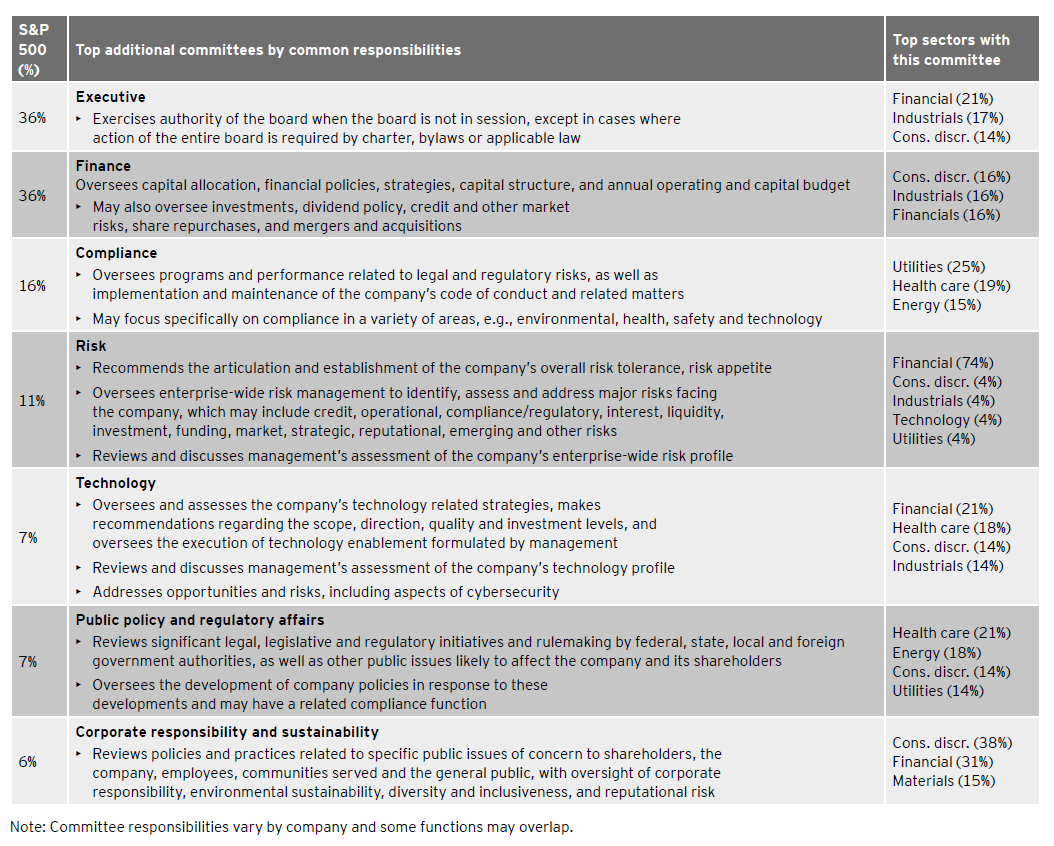
L’article ci-dessous, publié par Steve W. Klemash*, Kellie C. et Jamie Smith, provient d’une publication du Centre de la gouvernance EY. Les auteurs présentent les résultats d’une enquête sur les autres comités mis en place par les CA des entreprises du S&P 500, en sus des trois comités statutaires.

Les résultats sont  présentés succinctement dans le document qui suit. Ainsi, il ressort que :

(1) la plupart des autres comités sont les comités exécutifs et les comités des finances

(2) la nature du secteur industriel a une grande importance sur le type de comité additionnel mis en place

(3) les comités sur la gestion des risques et la technologie sont aussi présents dans environ 10 % des cas

(4) la plupart des nouveaux comités sont en lien avec la veille de la cybersécurité, la transformation numérique et les technologies de l’information.

Je vous invite à prendre connaissance des détails dans le résumé ci-dessous.

Bonne lecture !


A Fresh Look at Board Committees


Résultats de recherche d'images pour « A Fresh Look at Board Committees »


In this age of innovation and transformation, today’s board members face increasingly complex challenges in overseeing corporate culture, strategy and risk oversight.

The digital revolution has facilitated radical changes in business models and made cybersecurity a strategic business imperative. Intangible assets have become a primary driver of long-term value, making the talent agenda mission-critical. Companies are adapting to changes in the labor market, digitization and automation, and a growing spotlight on corporate values and purpose. And all of this is occurring against a backdrop of rising geopolitical tensions and trade policy challenges.

We have tracked board structures since 2013, examining how S&P 500 companies are using board committee structure to address oversight needs. This post is based on a review of the 418 proxy statements filed as of 15 May 2018. The same set of companies in 2018 and 2013 were examined to provide consistency in the review.


Findings


Amid sustained and unprecedented change, board committee structures stayed largely the same over the past six years. Across all industries, boards primarily rely on the three “key” committees generally required by the stock exchanges—audit, compensation, and nominating and governance. [1] Bank holding companies (BHCs) of a certain size, whether public or privately held, are required to also have separate risk committees—a “fourth key committee” so to speak. [2] Above and beyond these committees, institutions typically have one additional standing board committee (“additional committee”) (usually an executive or finance committee). During 2013-18, the portion of companies with at least one additional committee grew marginally from 74% to 76%, and the average number of additional committees remained largely consistent.

The most common committees remained the same. More than one-third of S&P 500 companies had an executive or finance committee. Use of executive committees declined slightly from 38% to 36%, while finance committees held steady at around 36%. Other committees were much less common.

Industry matters. Financial, telecommunications and utilities companies average two or more additional committees. Health care, consumer staples, industrials, consumer discretionary and materials average one to two. Energy, real estate and technology companies average less than one.

Few additional committees focus on emerging risk and innovation. Compliance, risk and technology committees grew marginally. In 2018, the overall percentage of S&P 500 companies with these committees remained low at 16%, 11% and 7%, respectively. Other types of committees largely held steady or declined.

A variety of additional committees oversee technology matters. Ten percent of companies assigned oversight of cybersecurity, digital transformation and information technology to an additional committee. These were typically technology, risk or compliance committees.


Our perspective


Today’s boards are navigating a sustained, highly disruptive and competitive environment. Board agendas have become increasingly packed with complex and evolving oversight topics, and key committee responsibilities have stretched beyond their core purview. Challenging the committee structure as part of the board assessment process may help the board determine the most effective oversight approach based on the company’s unique circumstances.

The ideal board committee structure is appropriate for the company’s specific needs and the board’s unique culture, is forward-looking, and supports the board’s ability to think strategically and comprehensively about key elements of the company business.


A closer look at the big banks


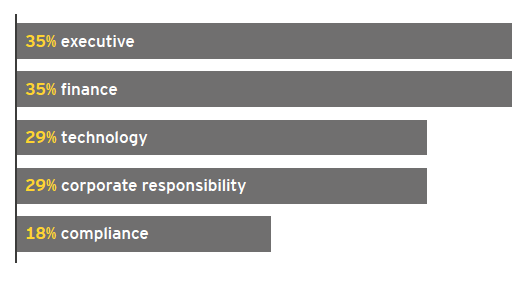
Large BHCs are unusual in that they are required to have a board- level risk committee. For these firms, other common additional committees included:

Questions for the board to consider


Is the board’s committee structure appropriate to forward-looking board priorities and company specific needs?

Is the board size and composition adaptable to changing committee responsibilities as needed based on the company’s evolving oversight needs?

Is the board familiar with how peer companies are addressing board oversight responsibilities?

Do assessments of board effectiveness reveal possible pressure points that might be resolved with changes in committee structure?

As committees assess their own effectiveness and performance, is their capacity, workload and areas of expertise part of that assessment?

As new directors join the board and bring new areas of expertise, does the board consider whether the current committee structure fully leverages those new director skills?

___________________________________________________

Endnotes

1Subject to certain exemptions, companies listed on the NYSE or NASDAQ must have independent audit, compensation and nominating/corporate governance committees. As an alternative to a nominating/corporate governance committee, director nominees may be selected by a majority of the independent directors for NASDAQ-listed companies.(go back)

2The Federal Reserve’s Enhanced Prudential Standards require separate risk committees for large publicly held US bank holding companies with total consolidated assets of \$10 billion or more.(go back)

________________________________________________________________

*Steve W. Klemash is Americas Leader, Kellie C. Huennekens is Associate Director, and Jamie Smith is Associate Director, at the EY Center for Board Matters. This post is based on their EY publication.

Comment un CA peut-il utiliser la technologie pour conserver son avantage concurrentiel ?


Maggie McGhee* a publié un très bon article sur l’importance croissante d’une solide connaissance des administrateurs eu égard aux perspectives offertes par les nouvelles technologies.

C’est la seule façon de s’assurer de développer ou de maintenir un avantage concurrentiel. L’article est paru sur le site de Board Agenda du 5 juillet 2018.

L’utilisation de nouvelles technologies peut varier d’une entreprise à une autre, mais aucune organisation ne peut se priver de questionner son modèle d’affaires afin de tenir compte des changements de paradigme.

L’auteure fait donc un rappel crucial aux administrateurs. De nouvelles compétences sont requises sur le Board !

Je vous invite également à lire un article, en français, sur les 10 nouvelles technologies qui ont marqué l’année 2017.

Enfin, je vous rappelle que cet article peut être traduit en français instantanément (vous n’avez qu’à cliquer sur le premier symbole dans la partie supérieure droite du navigateur Chrome de Google). La traduction est très acceptable pour une bonne compréhension de l’article pour ceux qui ont moins de facilité avec l’anglais.

Bonne lecture !


How boards can use technology to retain a competitive edge


Knowledge and skills in the boardroom must evolve with the risks and opportunities presented by technology—as well as its associated data—if companies are to remain competitive.


Résultats de recherche d'images pour « technologie »


For many organisations, embracing technology can be the difference between remaining relevant in their market, and being disrupted by new entrants. It represents a significant, and often the leading, business risk that boards need to address.

At the same time, by being proactive in their approach towards technology, boards may profit from what others see merely as threats. But what skills does the board need in order to provide such effective oversight, while being strategic?

In the need to remain relevant to customers and stakeholders, organisations are recognising that it is essential to adapt and embrace the opportunities that are created. Technology itself is an enabler, but it is never the solution, nor the sole driver.


Impact of technology


In our report, The Race for Relevance, we consider six technologies that are directly impacting the finance function alone. There are significantly more technologies that impact organisations as a whole.

As customer “stickiness” becomes a key tool in growth, organisations are starting to recognise the value of data created by the technologies that they own. It is an asset that is increasingly important, yet is also vulnerable to attack. Regulatory regimes are changing in order to address this. The upcoming implementation of the General Data Protection Regulation (GDPR) in May 2018, which focuses on personal data held in the EU, is one such example.

For many organisations, technology and the data generated by it present a significant business opportunity and risk—one which deserves appropriate board-level attention. So what role should the board play in assessing the use of technology and data?


Insight and guidance


The board needs to have the capability to provide insight and guidance in a number of areas. First, in the role of technology to deliver the business strategy, and whether advantage is being taken of emerging technologies.

Then there is the appraisal of technology investments, whether they are to support growth and commercial advantage, or to protect assets.

Boards must also evaluate the data strategy of the organisation by assessing whether the financial and non-financial data used to report against strategic objectives is appropriate.

Next, the board should consider the appropriateness of the organisation’s strategies to protect existing assets and information from unauthorised access or malicious attack.

They should also appraise whether the assessments of the critically held data are appropriate, and understand how data flows in an organisation comply with legal and regulatory requirements.

Assessing the risks arising from the use of technology, and how these are monitored through the organisation’s enterprise risk-management framework and internal control structures, is also a priority.

Lastly, boards should consider whether appropriate recovery plans are in place to manage the consequences of business disruption—including the management of technology and data assets.


The right skills


In discharging their responsibilities, boards should ask whether they have the skills within their membership to assess and advise appropriately.

This responsibility can be done in one of two ways. The first is by ensuring that at least one board member has direct experience of technology in the context of the industry in which the organisation operates. Having experience of addressing the risks of projects and protecting assets is invaluable, especially in those sectors where there is a high dependency on technology.

Or as an alternative, it can be done by ensuring the board has access to those with the requisite experience to advise on the risks. These may be internal experts or third parties.

Technology is an issue that cannot be ignored by boards. While not every board member needs to be fully technology-literate, it is important that all members can appreciate where it is used to create and sustain commercial advantage.

Equally, it is important that the board takes the lead in communicating across the organisation the risk and opportunity associated with technology. Without a shared understanding of the organisation’s approach to the use of technology, it will be practically impossible to roll out a consistent approach effectively.

Technology will continue to develop and provide new opportunities. Risks will continue to evolve. Commercial strategies will change as a result.

Boards need to embrace all of this if they are to remain relevant.


Maggie McGhee* is director of professional insights at ACCA (the Association of Chartered Certified Accountants).

Adapter le modèle de gouvernance à la réalité des OBNL de petite taille | en rappel


Il est vrai que la réalité des organisations à but non lucratif (OBNL) est souvent assez éloignée des grands principes de gouvernance généralement reconnus.

Les différences principales portent essentiellement sur l’application rigoureuse de certains principes de gouvernance lorsque l’entreprise est à ses débuts ou en transition.

La distinction nette entre les activités des administrateurs et l’embryon de direction peut alors prendre une forme différente. Il est évident que pour les entreprises en démarrage, le rôle des administrateurs peut comprendre des tâches qui relèveraient normalement de la direction générale de l’entreprise.

Cependant, les administrateurs doivent toujours saisir qu’ils ont d’abord et avant tout un rôle de fiduciaire, ce qui rend leurs prestations d’autant plus délicates ! La gestion de conflits d’intérêts potentiels est à prévoir dans ces cas. Le président du conseil doit être très vigilant à cet égard.

Les administrateurs doivent accepter l’idée que l’organisation ne puisse survivre sans leur apport concret, en attendant la constitution d’une véritable structure de management avec l’embauche d’un directeur général ou d’une directrice générale.

Voici le témoignage de Sandra Dunham* qui a une longue expérience dans la direction des OBNL et qui a été invitée à contribuer au blogue de Imagine Canada.

Bonne lecture ! Ce billet est-il pertinent ? Avez-vous des interrogations ? Vos commentaires sont les bienvenus.


Modèles de gouvernance du CA : oser la différence !


Résultats de recherche d'images pour « obnl imagine canada »


Résultats de recherche d'images pour « OBNL »


Lorsque j’ai débuté dans mon tout premier poste de directrice générale à la fin des années 1990, tout le monde parlait du modèle de gouvernance de Carver. À l’époque, j’ignorais tout de l’existence même d’un « modèle de gouvernance ». Les adeptes de cette théorie l’étudiaient soigneusement, élaboraient des politiques et renseignaient leurs collègues-administrateurs à son sujet. Le modèle Carver était alors considéré comme le nec plus ultra des modèles de gouvernance.

Dans l’organisation à laquelle je me joignais alors, le directeur général sortant avait participé à une formation à ce sujet et avait suggéré aux administrateurs des façons de faire pour devenir un conseil d’administration (CA) conforme au modèle Carver. À mon arrivée, les membres avaient créé une multitude de règlements superflus à propos du fonctionnement du CA, soit en raison des informations relayées par l’ancien directeur général, soit en raison de l’interprétation qu’eux-mêmes en avaient faite ou en raison de l’expertise des nouveaux administrateurs.

Encore aujourd’hui, j’entends certains administrateurs décrire leur CA comme un « CA selon Carver », mais il est devenu beaucoup plus courant de parler d’un modèle de gouvernance par politiques. Malgré la multiplication des formations en gouvernance, les administrateurs ignorent souvent à quel type de CA s’identifier, et s’ils le savent, ils ne réussissent pas toujours à agir en fonction des caractéristiques du modèle choisi.

J’estime qu’il est grand temps pour les CA d’arrêter de vouloir travailler relativement à certaines catégories qui ne correspondent pas à leur réalité et de s’excuser de leur mode de fonctionnement. Ils devraient plutôt se concentrer sur les priorités qui s’imposent compte tenu de leur étape de développement et définir clairement leur rôle dans l’organisation.


Politiques, opérations et entre-deux


Presque tous les CA remplissent d’abord une fonction opérationnelle. Puisque très peu d’organismes comptent des employés dès le jour un de leur existence, les administrateurs doivent assurer le fonctionnement de l’organisation jusqu’à ce qu’un employé rémunéré ou un nombre suffisant de bénévoles se joignent à l’équipe et libèrent les administrateurs de cette tâche. Or, de nombreux CA continuent à assumer certaines tâches opérationnelles même après l’arrivée de personnel et laissent à ces derniers le soin de mettre en œuvre les programmes offerts par l’organisme.

Puis, généralement, au fur et à mesure qu’une organisation grandit et embauche une personne responsable de la gestion quotidienne des activités, les administrateurs prennent leurs distances avec ces aspects de l’organisation (comptabilité, ressources humaines, relations avec les donateurs, etc.) et commencent à se concentrer sur la définition d’orientations stratégiques, l’élaboration de politiques de gouvernance et l’embauche et l’encadrement de la personne la plus haut placée dans l’organisation, soit le directeur général ou la directrice générale. Idéalement, le CA se serait alors déjà doté de politiques qui clarifient les relations entre lui-même et cette personne à la tête de l’organisation.

Cependant, la transition entre ces deux catégories n’est pas un processus linéaire, parfait ou permanent, et il existe autant de bonnes que de mauvaises raisons incitant un CA à tergiverser entre le modèle opérationnel et le modèle par politiques. Voici quelques situations exemplaires :

Pendant les phases de transition, de croissance significative, de changement de mandat ou de menace importante pour l’organisation, un CA qui fonctionne selon le modèle de gouvernance par politiques peut être appelé à participer aux activités opérationnelles de l’organisation.

Certains administrateurs ne reconnaissent pas la valeur de la gouvernance par politiques et ne peuvent s’empêcher de s’ingérer dans les détails des activités opérationnelles.

Si un ou plusieurs administrateurs sont en conflit personnel avec la personne directrice générale, ils pourraient essayer de s’immiscer dans les activités opérationnelles dans une tentative de recueillir des arguments pour une destitution de cette personne.

Lorsque la personne à la tête de la direction générale ne fournit pas assez d’information aux administrateurs pour leur permettre de remplir leurs obligations fiduciaires, ces derniers peuvent décider de participer davantage aux activités opérationnelles pour s’assurer que l’organisation a les reins solides.

Si le CA a réalisé son mandat stratégique et n’est pas en mesure d’amorcer une réflexion visionnaire pour créer une nouvelle stratégie à long terme, ses membres pourraient, par défaut, se tourner vers l’aspect opérationnel du travail afin de s’assurer de leur propre pertinence.


Comment trouver le meilleur modèle pour son CA ?


Dans un monde idéal, les administrateurs et la personne à la tête de la direction générale recevraient une formation exhaustive en matière de gouvernance, adopteraient et respecteraient des politiques de gouvernance adéquates et réaliseraient une autoévaluation sur une base régulière afin de s’assurer que l’organisation continue de fonctionner conformément au modèle de gouvernance retenu. En réalité, la plupart des administrateurs, voire des directeurs généraux, apprennent la gouvernance « sur le tas ». Ils se fient souvent aux informations relayées par des administrateurs ayant siégé à d’autres CA, sans l’assurance que cette information est juste.

Les organisations dont les ressources leur permettent de se prévaloir d’une formation en gouvernance adaptée à leur contexte et leurs besoins devraient en profiter. Cette formation devrait d’abord reconnaître que le modèle de gouvernance par politiques n’est pas approprié pour tous les organismes sans but lucratif et qu’il existe des modèles hybrides, alliant gouvernance opérationnelle et gouvernance par politiques, qui se prêtent davantage à certaines organisations, surtout les petites.

Pour déterminer son rôle le plus approprié dans le contexte de l’organisation, un CA peut également réviser différentes normes de certification en matière de gouvernance, une méthode très efficace et qui demande peu de ressources. Ainsi, le programme de normes d’Imagine Canada est articulé autour des règles de gouvernance les plus importantes, en plus de présenter des normes différentes et adaptées pour les petites organisations.


Mon CA joue un grand rôle opérationnel, et alors ?


Je propose que les CA de petites organisations cessent de s’excuser pour la participation de leurs administrateurs aux activités opérationnelles, car il serait totalement illogique pour une organisation avec un budget de moins de 100 000 $ de suivre le même modèle de gouvernance qu’un hôpital ou une université. Or, souvent, on évalue ces petites organisations en fonction des mêmes critères applicables aux grandes.

Les administrateurs devraient utiliser les normes définies par un programme de certification pertinent pour la taille de leur organisation comme point de référence et de comparaison. S’ils peinent à respecter ces normes, ils peuvent demander de l’aide pour ajuster leur modèle de gouvernance. Si, par contre, ils respectent toutes les normes et si leur organisation fonctionne de manière efficace et réalise ses priorités stratégiques, ils ont toutes les raisons de se montrer fiers de leur travail, de reconnaître leur propre compétence à gérer une organisation en fonction de sa taille et de mettre en lumière tout le travail que les petites organisations réussissent à faire avec peu de moyens.


À propos de l’auteure

Sandra Dunham a à son actif plus de 30 ans d’expérience dans le secteur de la bienfaisance et sans but lucratif ainsi qu’une maîtrise en administration publique de l’Université Dalhousie obtenue alors qu’elle poursuivait une carrière déjà bien entamée. Sandra est la propriétaire unique de Streamline New Perspective Solutions, une boîte de consultation spécialisée en gestion et collecte de fonds dans le secteur caritatif. Nos auteurs invités s’expriment à titre personnel. Leurs opinions ne reflètent pas nécessairement celles d’Imagine Canada.

Conséquences à la non-divulgation d’une cyberattaque majeure


Quelles sont les conséquences de ne pas divulguer une intrusion importante du système de sécurité informatique ?

Les auteurs, Matthew C. Solomon* et Pamela L. Marcogliese, dans un billet publié sur le forum du HLS, ont étudié de près la situation des manquements à la sécurité informatique de Yahoo et ils nous présentent les conséquences de la non-divulgation d’attaques cybernétiques et de bris à la sécurité des informations des clients.

Ils exposent le cas très clairement, puis ils s’attardent aux modalités des arrangements financiers avec la Securities and Exchange Commission (SEC). 

Comme ce sont des événements susceptibles de se produire de plus en plus, il importe que les entreprises soient bien au fait de ce qui les attend en cas de violation des obligations de divulgation.

Les auteurs font les cinq (5) constats suivants eu égard à la situation vécue par Yahoo :


— First, public companies should take seriously the SEC’s repeated warnings that one of its top priorities is ensuring that public companies meet their obligations to adequately disclose material cybersecurity incidents and risks. This requires regular assessment of cyber incidents and risks in light of the company’s disclosures, with the assistance of outside counsel and auditors as appropriate, and ensuring that there are adequate disclosure controls in place for such incidents and risks.

— Second, the SEC’s recently released interpretive guidance on cybersecurity disclosure is an important guidepost for all companies with such disclosure obligations. The guidance specifically cited the fact that the SEC views disclosure that a company is subject to future cybersecurity attacks as inadequate if the company had already suffered such incidents. Notably, the Yahoo settlement specifically faulted the company for this precise inadequacy in its disclosures. Similarly, the recent guidance encouraged companies to adopt comprehensive policies and procedures related to cybersecurity and to assess their compliance regularly, including the sufficiency of their disclosure controls and procedures as they relate to cybersecurity disclosure. The Yahoo settlement also found that the company had inadequate such controls.

— Third, at the same time the SEC announced the settlement, it took care to emphasize that “[w]e do not second-guess good faith exercises of judgment about cyber-incident disclosure.” [7] The SEC went on to note that Yahoo failed to meet this standard with respect to the 2014 Breach, but by articulating a “good faith” standard the SEC likely meant to send a message to the broader market that it is not seeking to penalize companies that make reasonable efforts to meet their cyber disclosure obligations.

— Fourth, it is also notable that the SEC charges did not include allegations that Yahoo violated securities laws with respect to the 2013 Breach. Yahoo had promptly disclosed the 2013 Breach after learning about it in late 2016, but updated its disclosure almost a year later with significant new information about the scope of the breach. The SEC’s recent guidance indicated that it was mindful that some material facts may not be available at the time of the initial disclosure, as was apparently the case with respect to the 2013 Breach. [8] At the same time, the SEC cautioned that “an ongoing internal or external investigation – which often can be lengthy – would not on its own provide a basis for avoiding disclosures of a material cybersecurity incident.” [9]

— Finally, it is worth noting that the Commission did not insist on settlements with any individuals. Companies, of course, can only commit securities violations through the actions of their employees. While it is not unusual for the Commission to settle entity-only cases on a “collective negligence” theory, the SEC Chair and the Enforcement Division’s leadership have emphasized the need to hold individuals accountable in order to maximize the deterrent impact of SEC actions. [10]


Bonne lecture !


Failure to Disclose a Cybersecurity Breach


Résultats de recherche d'images pour « yahoo data breach »


On April 24, 2018, Altaba, formerly known as Yahoo, entered into a settlement with the Securities and Exchange Commission (the “SEC”), pursuant to which Altaba agreed to pay $35 million to resolve allegations that Yahoo violated federal securities laws in connection with the disclosure of the 2014 data breach of its user database. The case represents the first time a public company has been charged by the SEC for failing to adequately disclose a cyber breach, an area that is expected to face continued heightened scrutiny as enforcement authorities and the public are increasingly focused on the actions taken by companies in response to such incidents. Altaba’s settlement with the SEC, coming on the heels of its agreement to pay $80 million to civil class action plaintiffs alleging similar disclosure violations, underscores the increasing potential legal exposure for companies based on failing to properly disclose cybersecurity risks and incidents.

Background

As alleged, Yahoo learned in late 2014 that it had recently suffered a data breach affecting over 500 million user accounts (the “2014 Breach”). Yahoo did not disclose the 2014 Breach until September 2016. During the time period Yahoo was aware of the undisclosed breach, it entered into negotiations to be acquired by Verizon and finalized a stock purchase agreement in July 2016, two months prior to the disclosure of the 2014 Breach. Following the disclosure in September 2016, Yahoo’s stock price dropped 3% and it later renegotiated the stock purchase agreement to reduce the price paid for Yahoo’s operating business by $350 million.

In or about late 2016, following its disclosure of the 2014 Breach, Yahoo learned about a separate breach that had taken place in August 2013 and promptly announced that such breach had affected 1 billion users (the “2013 Breach”). In October 2017, Yahoo updated its disclosure concerning the 2013 Breach, announcing that it now believed that all 3 billion of its accounts had been affected.

The Settlement

Altaba’s SEC settlement centered on the 2014 Breach only. The SEC found that despite learning of the 2014 Breach in late 2014—which resulted in the theft of as many as 500 million of its users’ Yahoo usernames, email addresses, telephone numbers, dates of birth, hashed passwords, and security questions and answers, referred to internally as Yahoo’s “crown jewels”— Yahoo failed to timely disclose the material cybersecurity incident in any of its public securities filings until September 2016. Although Yahoo senior management and relevant legal staff were made aware of the 2014 Breach, according to the SEC, they “did not properly assess the scope, business impact, or legal implications of the breach, including how and where the breach should have been disclosed in Yahoo’s public filings or whether the fact of the breach rendered, or would render, any statements made by Yahoo in its public filings misleading.” [1] The SEC also faulted Yahoo’s senior management and legal staff because they “did not share information regarding the breach with Yahoo’s auditors or outside counsel in order to assess the company’s disclosure obligations in its public filings.” [2]

Among other things, the SEC found that Yahoo’s risk factor disclosures in its annual and quarterly reports from 2014 through 2016 were materially misleading in that they claimed the company only faced the risk of potential future data breaches, without disclosing that “a massive data breach” had in fact already occurred. [3]

The SEC also alleged that Yahoo management’s discussion and analysis of financial condition and results of operations (“MD&A”) in those reports was also misleading to the extent it omitted known trends or uncertainties with regard to liquidity or net revenue presented by the 2014 Breach. [4]Finally, the SEC further found that Yahoo did not maintain adequate disclosure controls and procedures designed to ensure that reports from Yahoo’s information security team raising actual incidents of the theft of user data, or the significant risk of theft of user data, were properly and timely assessed to determine how and where data breaches should be disclosed in Yahoo’s public filings. [5]

Based on these allegations, the SEC found that Yahoo violated Sections 17(a)(2) and 17(a)(3) of the Securities Act and Section 13(a) of the Securities Exchange Act. [6] To settle the charges, Altaba, without admitting or denying liability, agreed to cease and desist from any further violations of the federal securities laws and pay a civil penalty of $35 million.

Takeaways

There are several important takeaways from the settlement:

— First, public companies should take seriously the SEC’s repeated warnings that one of its top priorities is ensuring that public companies meet their obligations to adequately disclose material cybersecurity incidents and risks. This requires regular assessment of cyber incidents and risks in light of the company’s disclosures, with the assistance of outside counsel and auditors as appropriate, and ensuring that there are adequate disclosure controls in place for such incidents and risks.

— Second, the SEC’s recently released interpretive guidance on cybersecurity disclosure is an important guidepost for all companies with such disclosure obligations. The guidance specifically cited the fact that the SEC views disclosure that a company is subject to future cybersecurity attacks as inadequate if the company had already suffered such incidents. Notably, the Yahoo settlement specifically faulted the company for this precise inadequacy in its disclosures. Similarly, the recent guidance encouraged companies to adopt comprehensive policies and procedures related to cybersecurity and to assess their compliance regularly, including the sufficiency of their disclosure controls and procedures as they relate to cybersecurity disclosure. The Yahoo settlement also found that the company had inadequate such controls.

— Third, at the same time the SEC announced the settlement, it took care to emphasize that “[w]e do not second-guess good faith exercises of judgment about cyber-incident disclosure.” [7] The SEC went on to note that Yahoo failed to meet this standard with respect to the 2014 Breach, but by articulating a “good faith” standard the SEC likely meant to send a message to the broader market that it is not seeking to penalize companies that make reasonable efforts to meet their cyber disclosure obligations.

— Fourth, it is also notable that the SEC charges did not include allegations that Yahoo violated securities laws with respect to the 2013 Breach. Yahoo had promptly disclosed the 2013 Breach after learning about it in late 2016, but updated its disclosure almost a year later with significant new information about the scope of the breach. The SEC’s recent guidance indicated that it was mindful that some material facts may not be available at the time of the initial disclosure, as was apparently the case with respect to the 2013 Breach. [8] At the same time, the SEC cautioned that “an ongoing internal or external investigation – which often can be lengthy – would not on its own provide a basis for avoiding disclosures of a material cybersecurity incident.” [9]

— Finally, it is worth noting that the Commission did not insist on settlements with any individuals. Companies, of course, can only commit securities violations through the actions of their employees. While it is not unusual for the Commission to settle entity-only cases on a “collective negligence” theory, the SEC Chair and the Enforcement Division’s leadership have emphasized the need to hold individuals accountable in order to maximize the deterrent impact of SEC actions. [10]

_________________________________________________________________________

Endnotes

1Altaba Inc., f/d/b/a Yahoo! Inc., Securities Act Release No. 10485, Exchange Act Release No. 83096, Accounting and Auditing Enforcement Release No. 3937, Administrative Proceeding File No. 3937 (Apr. 24, 2018) at ¶ 14.(go back)

2Idat ¶ 15.(go back)

3Idat ¶¶ 2, 16.(go back)

4Id.(go back)

5Idat ¶ 15.(go back)

6Idat ¶¶ 22-23.(go back)

7Press Release, SEC, Altaba, Formerly Known As Yahoo!, Charged With Failing to Disclose Massive Cybersecurity Breach; Agrees To Pay $35 Million (Apr. 24, 2018), https://www.sec.gov/news/press-release/2018-71.(go back)

8As we have previously discussed, the federal securities laws do not impose a general affirmative duty on public companies to continuously disclose material information and, as acknowledged in Footnote 37 of the interpretive guidance, circuits are split on whether a duty to update exists. However, in circuits where a duty to update has been found to exist, a distinction has often been drawn between statements of a policy nature that are within the company’s control and statements describing then current facts that would be expected to change over time. The former have been held subject to a duty to update while the latter have not. See In re Advanta Corp. Securities Litigation, 180 F.3d 525, 536 (3d Cir. 1997) (“[T]he voluntary disclosure of an ordinary earnings forecast does not trigger any duty to update.”); In re Burlington Coat Factory Securities Litigation, 114 F.3d 1410, 1433 (3d Cir. 1997); In re Duane Reade Inc. Securities Litigation, No. 02 Civ. 6478 (NRB), 2003 WL 22801416, at *7 (S.D.N.Y. Nov. 25, 2003), aff’d sub nom. Nardoff v. Duane Reade, Inc., 107 F. App’x 250 (2d Cir. 2004) (“‘company has no duty to update forward–looking statements merely because changing circumstances have proven them wrong.’”).(go back)

9See SEC, Commission Statement and Guidance on Public Company Cybersecurity Disclosures, 83 Fed. Reg 8166, 8169 (Feb. 26, 2018), https://www.federalregister.gov/documents/2018/02/26/2018-03858/commission-statement-and-guidance-on-public- company-cybersecurity-disclosures.(go back)

10See, e.g., Steven R. Peikin, Co-Director, Div. Enf’t., SEC, Reflections on the Past, Present, and Future of the SEC’s Enforcement of the Foreign Corrupt Practices Act, Keynote Address at N.Y.U. Program on Corporate Law and Enforcement Conference: No Turning Back: 40 Years of the FCAP and 20 Years of the OECD Anti-Bribery Convention Impacts, Achievements, and Future Challenges (Nov. 9, 2017), https://www.sec.gov/news/speech/speech-peikin2017-11-09;
SEC Div. Enf’t., Annual Report A Look Back at Fiscal Year 2017, at 2 (Nov. 15, 2017), https://www.sec.gov/files/enforcement-annual-report2017.pdf.(go back)

_______________________________________________________________________

*Matthew C. Solomon and Pamela L. Marcogliese are partners and Rahul Mukhi is counsel at Cleary Gottlieb Steen & Hamilton LLP. This post is based on a Cleary Gottlieb publication by Mr. Solomon, Ms. Marcogliese, Ms. Mukhi, and Kal Blassberger.

La bonne gouvernance est associée au rendement selon une étude | Le Temps.ch


Aujourd’hui, je partage avec vous un article publié dans le magazine suisse Le Temps.ch qui présente les résultats d’une recherche sur la bonne gouvernance des caisses de retraite en lien avec les recommandations des fonds de placement tels que BlackRock.

L’auteur, Emmanuel Garessus, montre que même si le lien entre la performance des sociétés et la bonne gouvernance semble bien établi, les caisses de retraite faisant l’objet de la recherche ont des indices de gouvernance assez dissemblables. L’étude montre que les caisses ayant des indices de gouvernance faibles ont des rendements plus modestes en comparaison avec les indices de référence retenus.

Également, il ressort de cette étude que c’était surtout la prédominance de la gestion des risques qui était associée à la performance des caisses de retraite.

Comme le dit Christian Ehmann, spécialisé dans la sélection de fonds de placement auprès de Safra Sarasin, « la gouvernance n’est pas une cause de surperformance, mais il existe un lien direct entre les deux ».

Encore une fois, il appert que BlackRock défend les petits épargnants-investisseurs en proposant des normes de gouvernance uniformisées s’appliquant au monde des entreprises cotées en bourses.

J’ai reproduit l’article en français ci-dessous afin que vous puissiez bien saisir l’objet de l’étude et ses conclusions.

Bonne lecture ! Vos commentaires sont les bienvenus.


BlackRock contre Facebook, un combat de géants


Résultats de recherche d'images pour « le temps »


Résultats de recherche d'images pour « gouvernance »


Le principe de gouvernance selon lequel une action donne droit à une voix en assemblée générale est bafoué par de très nombreuses sociétés, surtout technologiques, au premier rang desquelles on trouve Facebook, Snap, Dropbox et Google. BlackRock, le plus grand groupe de fonds de placement du monde, demande aux autorités d’intervenir et de présenter des standards minimaux, indique le Financial Times.

Le groupe dont Philipp Hildebrand est vice-président préfère un appel à l’Etat plutôt que de laisser les fournisseurs d’indices (MSCI, Dow Jones, etc.) modifier la composition des indices en y intégrant divers critères d’exclusion. Barbara Novick, vice-présidente de BlackRock, a envoyé une lettre à Baer Pettit, président de MSCI, afin de l’informer de son désir de mettre de l’ordre dans les structures de capital des sociétés cotées.


Mark Zuckerberg détient 60% des droits de vote


De nombreuses sociétés ont deux catégories d’actions donnant droit à un nombre distinct de droits de vote. Les titres Facebook de la classe B ont par exemple dix fois plus de droits de vote que ceux de la classe A. Mark Zuckerberg, grâce à ses actions de classe B (dont il détient 75% du total), est assuré d’avoir 60% des droits de vote du groupe. A la suite du dernier scandale lié à Cambridge Analytica, le fondateur du réseau social ne court donc aucun risque d’être mis à la porte, explique Business Insider. L’intervention de BlackRock n’empêche pas l’un de ses fonds (Global Allocation Fund) d’avoir probablement accumulé des titres Facebook après sa correction de mars, selon Reuters, pour l’intégrer dans ses dix principales positions.

Cette structure du capital répartie en plusieurs catégories d’actions permet à un groupe d’actionnaires, généralement les fondateurs, de contrôler la société avec un minimum d’actions. Les titres ayant moins ou pas de droit de vote augmentent de valeur si la société se développe bien, mais leurs détenteurs ont moins de poids en assemblée générale. Les sociétés qui disposent d’une double catégorie de titres la justifient par le besoin de se soustraire aux réactions à court terme du marché boursier et de rester ainsi concentrés sur les objectifs à long terme. Ce sont souvent des sociétés technologiques.

Facebook respecte très imparfaitement les principes de bonne conduite en matière de gouvernance. Mark Zuckerberg, 33 ans, est en effet à la fois président du conseil d’administration et président de la direction générale. Ce n’est pas optimal puisque, en tant que président, il se contrôle lui-même. Sa rémunération est également inhabituelle. Sur les 8,9 millions de dollars de rémunération, 83% sont liés à ses frais de sécurité et le reste presque entièrement à l’utilisation d’un avion privé (son salaire est de 1 dollar et son bonus nul).


Quand BlackRock défend le petit épargnant


Le site de prévoyance IPE indique que le fonds de pension suédois AP7, l’un des plus grands actionnaires du réseau social, est parvenu l’an dernier à empêcher l’émission d’une troisième catégorie de titres Facebook. Cette dernière classe d’actions n’aurait offert aucun droit de vote. Une telle décision, si elle avait été menée à bien, aurait coûté 10 milliards de dollars à AP7. Finalement Facebook a renoncé.

BlackRock prend la défense du petit investisseur. Il est leader de la gestion indicielle et des ETF et ses produits restent investis à long terme dans tous les titres composant un indice. Il préfère influer sur la gouvernance par ses prises de position que de vendre le titre. Le plus grand groupe de fonds de placement du monde demande aux autorités de réglementation d’établir des standards de gouvernance en collaboration avec les sociétés de bourse plutôt que de s’en remettre aux fournisseurs d’indices comme MSCI.

La création de plusieurs classes d’actions peut être justifiée par des start-up en forte croissance dont les fondateurs ne veulent pas diluer leur pouvoir. BlackRock reconnaît ce besoin spécifique aux start-up en forte croissance, mais le gérant estime que «ce n’est acceptable que durant une phase transitoire. Ce n’est pas une situation durable.»

Le géant des fonds de placement aimerait que les producteurs d’indices soutiennent sa démarche et créent des «indices alternatifs» afin d’accroître la transparence et de réduire l’exposition aux sociétés avec plusieurs catégories de titres. L’initiative de BlackRock est également appuyée par George Dallas, responsable auprès du puissant International Corporate Governance Network (ICGN).

La gouvernance des «bonnes caisses de pension»


La recherche économique a largement démontré l’impact positif d’une bonne gouvernance sur la performance d’une entreprise. Mais presque tout reste à faire en matière de fonds de placement et de caisses de pension.

«La gouvernance n’est pas une cause de surperformance, mais il existe un lien direct entre les deux. Les caisses de pension qui appartiennent au meilleur quart en termes de bonne gouvernance présentent une surperformance de 1% par année par rapport au moins bon quart», explique Christian Ehmann, spécialisé dans la sélection de fonds de placement auprès de Safra Sarasin, lors d’une présentation organisée par la CFA Society Switzerland, à Zurich.

Ce dernier est avec le professeur Manuel Ammann coauteur d’une étude sur la gouvernance et la performance au sein des caisses de pension suisses (Is Governance Related to Investment Performance and Asset Allocation?, Université de Saint-Gall, 2016). «Le travail sur cette étude m’a amené à porter une attention particulière à la gouvernance des fonds de placement dans mon travail quotidien», déclare Christian Ehmann. Son regard porte notamment sur la structure de l’équipe de gestion, son organisation et son système de gestion des risques. «Je m’intéresse par exemple à la politique de l’équipe de gérants en cas de catastrophe», indique-t-il.

Claire surperformance


L’étude réalisée sur 139 caisses de pension suisses, représentant 43% des actifs gérés, consiste à noter objectivement la qualité de la gouvernance et à définir le lien avec la performance de gestion. L’analyse détaille les questions de gouvernance en fonction de six catégories, de la gestion du risque à la transparence des informations en passant par le système d’incitations, l’objectif et la stratégie d’investissement ainsi que les processus de placement. Sur un maximum de 60 points, la moyenne a été de 21 (plus bas de 10 et plus haut de 50). La dispersion est donc très forte entre les caisses de pension. Certaines institutions de prévoyance ne disposent par exemple d’aucun système de gestion du risque.

Les auteurs ont mesuré la performance sur trois ans (2010 à 2012), le rendement relatif par rapport à l’indice de référence et l’écart de rendement par rapport au rendement sans risque (ratio de Sharpe). Toutes ces mesures confirment le lien positif entre la gouvernance et la performance (gain de 2,7 points de base par point de gouvernance). Les moteurs de surperformance proviennent clairement de la gestion du risque et du critère portant sur les objectifs et la stratégie d’investissement. Les auteurs constatent aussi que même les meilleurs, en termes de gouvernance, sous-performent leur indice de référence.

La deuxième étape de la recherche portait sur l’existence ou non d’une relation entre le degré de gouvernance et l’allocation des actifs. Ce lien n’a pas pu être établi.

Les responsabilités des administrateurs eu égard à la gestion des risques


Les administrateurs de sociétés doivent apporter une attention spéciale à la gestion des risques telle qu’elle est mise en œuvre par les dirigeants des entreprises.

Les préoccupations des fiduciaires pour la gestion des risques, quoique fondamentales, sont relativement récentes, et les administrateurs ne savent souvent pas comment aborder cette question.

L’article présenté, ci-dessous, est le fruit d’une recherche de Martin Lipton, fondateur de la firme Wachtell, Lipton, Rosen & Katz, spécialisée dans les fusions et acquisitions ainsi que dans les affaires de gouvernance.

L’auteur et ses collaborateurs ont produit un guide des pratiques exemplaires en matière de gestion des risques. Cet article de fond s’adresse aux administrateurs et touche aux éléments-clés de la gestion des risques :

(1) la distinction entre la supervision des risques et la gestion des risques ;

(2) les leçons que l’on doit tirer de la supervision des risques à Wells Fargo ;

(3) l’importance accordée par les investisseurs institutionnels aux questions des risques ;

(4) « tone at the top » et culture organisationnelle ;

(5) les devoirs fiduciaires, les contraintes réglementaires et les meilleures pratiques ;

(6) quelques recommandations spécifiques pour améliorer la supervision des risques ;

(7) les programmes de conformité juridiques ;

(8) les considérations touchant les questions de cybersécurité ;

(9) quelques facettes se rapportant aux risques environnementaux, sociaux et de gouvernance ;

(10) l’anticipation des risques futurs.


Voici donc l’introduction de l’article. Je vous invite à prendre connaissance de l’article au complet.

Bonne lecture !


Risk Management and the Board of Directors


Résultats de recherche d'images pour « Gestion des risques et administrateurs de sociétés »


Overview

The past year has seen continued evolution in the political, legal and economic arenas as technological change accelerates. Innovation, new business models, dealmaking and rapidly evolving technologies are transforming competitive and industry landscapes and impacting companies’ strategic plans and prospects for sustainable, long-term value creation. Tax reform has created new opportunities and challenges for companies too. Meanwhile, the severe consequences that can flow from misconduct within an organization serve as a reminder that corporate operations are fraught with risk. Social and environmental issues, including heightened focus on income inequality and economic disparities, scrutiny of sexual misconduct issues and evolving views on climate change and natural disasters, have taken on a new salience in the public sphere, requiring companies to exercise utmost care to address legitimate issues and avoid public relations crises and liability.

Corporate risk taking and the monitoring of corporate risk remain prominently top of mind for boards of directors, investors, legislators and the media. Major institutional shareholders and proxy advisory firms increasingly evaluate risk oversight matters when considering withhold votes in uncontested director elections and routinely engage companies on risk-related topics. This focus on risk management has also led to increased scrutiny of compensation arrangements throughout the organization that have the potential for incentivizing excessive risk taking. Risk management is no longer simply a business and operational responsibility of management. It has also become a governance issue that is squarely within the oversight responsibility of the board. This post highlights a number of issues that have remained critical over the years and provides an update to reflect emerging and recent developments. Key topics addressed in this post include:

the distinction between risk oversight and risk management;

a lesson from Wells Fargo on risk oversight;

the strong institutional investor focus on risk matters;

tone at the top and corporate culture;

fiduciary duties, legal and regulatory frameworks and third-party guidance on best practices;

specific recommendations for improving risk oversight;

legal compliance programs;

special considerations regarding cybersecurity matters;

special considerations pertaining to environmental, social and governance (ESG) risks; and

anticipating future risks.

Comment présenter ses arguments lors d’une AGA dont les membres sont considérés comme réfractaires à une position du conseil ? | Un cas de communication


Aujourd’hui, je partage avec vous un cas publié sur le site de Julie Garland McLellan qui demande beaucoup d’analyse, de stratégie et de jugement.

Dans ce cas, Xandra, la présidente du comité d’audit d’une petite association professionnelle, propose une solution courageuse afin de mettre un terme au déclin du membership de l’organisation : une diminution des frais de cotisation en échange d’une hausse des frais de service et des frais associés à la formation.

La proposition a été jugée inéquitable par les membres, qui ont soulevé leur grande désapprobation, en la condamnant sur les réseaux sociaux.

Plusieurs membres insistent pour que cette décision soit mise au vote lors de l’AGA, et que le PDG soit démis de ses fonctions.

Étant donné que les règlements internes de l’organisation ne permettent pas aux membres de voter sur ces questions en assemblée générale (puisque c’est une prérogative du CA), le président du conseil demande à Xandra de préparer une défense pour le rejet de la requête.

Xandra est cependant consciente que la stratégie de communication arrêtée devra faire l’objet d’une analyse judicieuse afin de ne pas mettre la survie de l’organisation en danger.

Comment la responsable doit-elle procéder pour présenter une argumentation convaincante ?

La situation est exposée de manière assez synthétique ; puis, trois experts se prononcent sur le dilemme que vit Xandra.

Je vous invite donc à prendre connaissance de ces avis, en cliquant sur le lien ci-dessous, et me faire part vos commentaires.

Bonne lecture !


Communication des propositions du conseil lors des AGA réfractaires


This month our case study investigates the options for a board to respond to shareholders who know that they want something but don’t quite know how to get it. I hope you enjoy thinking about the governance and strategic implications of this dilemma:

Xandra chairs the audit committee of a small professional association. She has a strong working relationship with the chair and CEO who are implementing a strategic reform based on ‘user pays services’ to redress a fall in membership numbers and hence revenue. The strategy bravely introduced a reduced membership fee compensated by charges for advisory services and an increase in the cost of member events and education.

Some members felt that this was unfair as they used more services than others and would now pay a higher total amount each year. They have voiced their concerns through the company’s Facebook page and in an ‘open’ letter addressed to the board. In the letter they have said that they want to put a motion to the next AGM asking for a vote on the new pricing strategy and for the CEO to be dismissed. They copied the letter to a journalist in a national paper. The journalist has not contacted the company for comment or published the letter.

The CEO has checked the bylaws and the open letter does not meet the technical requirements for requisitioning a motion (indeed the authors seem to have confused their right to requisition an EGM with the right of members to speak at the AGM and ask questions of the board and auditor).

As the only person qualified in directorship on the association board, the Chair has asked Xandra « how can we push back against this request? »

Xandra is not sure that it is wise to rebuff a clear request for engagement with the members on an issue that is important for the survival of their association. She agrees that putting a motion to a members’ meeting could be dangerous. She also agrees that the matter needs to be handled sensitively and away from emotive online fora where passions are running unexpectedly high

How should she advise her chair?

Quelles sont les priorités des investisseurs en matière de gouvernance des sociétés ?


Les investisseurs institutionnels (II) cherchent constamment à améliorer leur portefeuille d’entreprises dans une perspective à long terme.

Ainsi, les II sont à la recherche de moyens pour communiquer efficacement avec les sociétés dans lesquelles elles investissent.

L’étude menée par Steve W. Klemash, leader du EY Center for Board Matters, auprès de 60 grands investisseurs institutionnels américains tous azimuts, a tenté de déterminer les cinq plus importantes priorités à accorder aux choix des entreprises sous gestion.

Voici donc les cinq grands thèmes qui intéressent les investisseurs institutionnels dans la sélection des entreprises :

(1) La composition du conseil d’administration, avec un œil sur l’amélioration de la diversité ;

(2) Un niveau d’expertise des administrateurs qui est en lien avec les objectifs d’affaires de l’entreprise ;

(3) Une attention accrue accordée aux risques de nature climatique ou environnemental ;

(4) Une attention marquée accordée à la gestion des talents

(5) Une rémunération qui est très bien alignée sur la performance et la stratégie.

Je vous propose un résumé des principaux résultats de travaux de recherche de EY. Pour plus de détails, je vous invite à consulter l’article ci-dessous.

Bonne lecture !


2018 Proxy Season Review


Résultats de recherche d'images pour « investisseurs institutionnels »

Les cinq grandes priorités des investisseurs institutionnels en 2018


1. La composition du conseil d’administration, avec un œil sur l’amélioration de la diversité


2. Un niveau d’expertise des administrateurs qui est en lien avec les objectifs d’affaires de l’entreprise


3. Une attention accrue accordée aux risques de nature climatique ou environnemental


4. Une attention marquée accordée à la gestion des talents


5. Une rémunération qui est très bien alignée sur la performance et la stratégie


Investor priorities as seen through the shareholder proposal lens


For a broader perspective of investor priorities, a review of the top shareholder proposal topics of 2017, based on average support, shows that around half focus on environment and social topics. While the average support for many of these proposal topics appear low, this understates impact. Environmental and social proposals typically see withdrawal rates of around one-third, primarily due to company-investor successes in reaching agreement. Depending on the company situation and specific proposal being voted, some proposals may receive strong support of votes cast by a company’s broader base of investors.

Conclusion


Institutional investors are increasingly asking companies about how they are navigating changing business environments, technological disruption and environmental challenges to achieve long-term, sustained growth. By addressing these same topics in their interactions with and disclosures to investors, boards and executives have an opportunity to highlight to investors how the company is positioned to navigate business transformations over the short- and long-term. This opportunity, in turn, enables companies to attract the kind of investors that support the approach taken by the board and management. Like strong board composition, enhanced disclosure and investor engagement efforts can serve as competitive advantages.


Questions for the board to consider


– Are there opportunities to strengthen disclosures around the board’s composition and director qualifications and how these support company strategy?

– Do the board and its committees have appropriate access to deep, timely expertise and open communication channels with management as needed for effective oversight?

– Do the board and management understand how key investors generally view the company’s disclosures and strategic initiatives regarding environmental and social matters?

– How does the board define and articulate its oversight responsibilities with regard to talent? And does the board believe that the company has an adequate plan for talent management considering recent employee and employment-related developments and the company’s competitive position?

– To what extent have the board and management offered to dialogue with the governance specialists at their key investor organizations, whether active or passive, and including the largest and smallest, vocal shareholder proponents?

 ____________________________________________
*Steve W. Klemash* is EY Americas Leader at the EY Center for Board Matters. This post is based on an EY publication by Mr. Klemash.

Adapter le modèle de gouvernance à la réalité des OBNL de petite taille


Il est vrai que la réalité des organisations à but non lucratif (OBNL) est souvent assez éloignée des grands principes de gouvernance généralement reconnus.

Les différences principales portent essentiellement sur l’application rigoureuse de certains principes de gouvernance lorsque l’entreprise est à ses débuts ou en transition.

La distinction nette entre les activités des administrateurs et l’embryon de direction peut alors prendre une forme différente. Il est évident que pour les entreprises en démarrage, le rôle des administrateurs peut comprendre des tâches qui relèveraient normalement de la direction générale de l’entreprise.

Cependant, les administrateurs doivent toujours saisir qu’ils ont d’abord et avant tout un rôle de fiduciaire, ce qui rend leurs prestations d’autant plus délicates ! La gestion de conflits d’intérêts potentiels est à prévoir dans ces cas. Le président du conseil doit être très vigilant à cet égard.

Les administrateurs doivent accepter l’idée que l’organisation ne puisse survivre sans leur apport concret, en attendant la constitution d’une véritable structure de management avec l’embauche d’un directeur général ou d’une directrice générale.

Voici le témoignage de Sandra Dunham* qui a une longue expérience dans la direction des OBNL et qui a été invitée à contribuer au blogue de Imagine Canada.

Bonne lecture ! Ce billet est-il pertinent ? Avez-vous des interrogations ? Vos commentaires sont les bienvenus.


Modèles de gouvernance du CA : oser la différence !


Résultats de recherche d'images pour « obnl imagine canada »


Lorsque j’ai débuté dans mon tout premier poste de directrice générale à la fin des années 1990, tout le monde parlait du modèle de gouvernance de Carver. À l’époque, j’ignorais tout de l’existence même d’un « modèle de gouvernance ». Les adeptes de cette théorie l’étudiaient soigneusement, élaboraient des politiques et renseignaient leurs collègues-administrateurs à son sujet. Le modèle Carver était alors considéré comme le nec plus ultra des modèles de gouvernance.

Dans l’organisation à laquelle je me joignais alors, le directeur général sortant avait participé à une formation à ce sujet et avait suggéré aux administrateurs des façons de faire pour devenir un conseil d’administration (CA) conforme au modèle Carver. À mon arrivée, les membres avaient créé une multitude de règlements superflus à propos du fonctionnement du CA, soit en raison des informations relayées par l’ancien directeur général, soit en raison de l’interprétation qu’eux-mêmes en avaient faite ou en raison de l’expertise des nouveaux administrateurs.

Encore aujourd’hui, j’entends certains administrateurs décrire leur CA comme un « CA selon Carver », mais il est devenu beaucoup plus courant de parler d’un modèle de gouvernance par politiques. Malgré la multiplication des formations en gouvernance, les administrateurs ignorent souvent à quel type de CA s’identifier, et s’ils le savent, ils ne réussissent pas toujours à agir en fonction des caractéristiques du modèle choisi.

J’estime qu’il est grand temps pour les CA d’arrêter de vouloir travailler relativement à certaines catégories qui ne correspondent pas à leur réalité et de s’excuser de leur mode de fonctionnement. Ils devraient plutôt se concentrer sur les priorités qui s’imposent compte tenu de leur étape de développement et définir clairement leur rôle dans l’organisation.

Politiques, opérations et entre-deux

Presque tous les CA remplissent d’abord une fonction opérationnelle. Puisque très peu d’organismes comptent des employés dès le jour un de leur existence, les administrateurs doivent assurer le fonctionnement de l’organisation jusqu’à ce qu’un employé rémunéré ou un nombre suffisant de bénévoles se joignent à l’équipe et libèrent les administrateurs de cette tâche. Or, de nombreux CA continuent à assumer certaines tâches opérationnelles même après l’arrivée de personnel et laissent à ces derniers le soin de mettre en œuvre les programmes offerts par l’organisme.

Puis, généralement, au fur et à mesure qu’une organisation grandit et embauche une personne responsable de la gestion quotidienne des activités, les administrateurs prennent leurs distances avec ces aspects de l’organisation (comptabilité, ressources humaines, relations avec les donateurs, etc.) et commencent à se concentrer sur la définition d’orientations stratégiques, l’élaboration de politiques de gouvernance et l’embauche et l’encadrement de la personne la plus haut placée dans l’organisation, soit le directeur général ou la directrice générale. Idéalement, le CA se serait alors déjà doté de politiques qui clarifient les relations entre lui-même et cette personne à la tête de l’organisation.

Cependant, la transition entre ces deux catégories n’est pas un processus linéaire, parfait ou permanent, et il existe autant de bonnes que de mauvaises raisons incitant un CA à tergiverser entre le modèle opérationnel et le modèle par politiques. Voici quelques situations exemplaires :

Pendant les phases de transition, de croissance significative, de changement de mandat ou de menace importante pour l’organisation, un CA qui fonctionne selon le modèle de gouvernance par politiques peut être appelé à participer aux activités opérationnelles de l’organisation.

Certains administrateurs ne reconnaissent pas la valeur de la gouvernance par politiques et ne peuvent s’empêcher de s’ingérer dans les détails des activités opérationnelles.

Si un ou plusieurs administrateurs sont en conflit personnel avec la personne directrice générale, ils pourraient essayer de s’immiscer dans les activités opérationnelles dans une tentative de recueillir des arguments pour une destitution de cette personne.

Lorsque la personne à la tête de la direction générale ne fournit pas assez d’information aux administrateurs pour leur permettre de remplir leurs obligations fiduciaires, ces derniers peuvent décider de participer davantage aux activités opérationnelles pour s’assurer que l’organisation a les reins solides.

Si le CA a réalisé son mandat stratégique et n’est pas en mesure d’amorcer une réflexion visionnaire pour créer une nouvelle stratégie à long terme, ses membres pourraient, par défaut, se tourner vers l’aspect opérationnel du travail afin de s’assurer de leur propre pertinence.

Comment trouver le meilleur modèle pour son CA ?

Dans un monde idéal, les administrateurs et la personne à la tête de la direction générale recevraient une formation exhaustive en matière de gouvernance, adopteraient et respecteraient des politiques de gouvernance adéquates et réaliseraient une autoévaluation sur une base régulière afin de s’assurer que l’organisation continue de fonctionner conformément au modèle de gouvernance retenu. En réalité, la plupart des administrateurs, voire des directeurs généraux, apprennent la gouvernance « sur le tas ». Ils se fient souvent aux informations relayées par des administrateurs ayant siégé à d’autres CA, sans l’assurance que cette information est juste.

Les organisations dont les ressources leur permettent de se prévaloir d’une formation en gouvernance adaptée à leur contexte et leurs besoins devraient en profiter. Cette formation devrait d’abord reconnaître que le modèle de gouvernance par politiques n’est pas approprié pour tous les organismes sans but lucratif et qu’il existe des modèles hybrides, alliant gouvernance opérationnelle et gouvernance par politiques, qui se prêtent davantage à certaines organisations, surtout les petites.

Pour déterminer son rôle le plus approprié dans le contexte de l’organisation, un CA peut également réviser différentes normes de certification en matière de gouvernance, une méthode très efficace et qui demande peu de ressources. Ainsi, le programme de normes d’Imagine Canada est articulé autour des règles de gouvernance les plus importantes, en plus de présenter des normes différentes et adaptées pour les petites organisations.

Mon CA joue un grand rôle opérationnel, et alors ?

Je propose que les CA de petites organisations cessent de s’excuser pour la participation de leurs administrateurs aux activités opérationnelles, car il serait totalement illogique pour une organisation avec un budget de moins de 100 000 $ de suivre le même modèle de gouvernance qu’un hôpital ou une université. Or, souvent, on évalue ces petites organisations en fonction des mêmes critères applicables aux grandes.

Les administrateurs devraient utiliser les normes définies par un programme de certification pertinent pour la taille de leur organisation comme point de référence et de comparaison. S’ils peinent à respecter ces normes, ils peuvent demander de l’aide pour ajuster leur modèle de gouvernance. Si, par contre, ils respectent toutes les normes et si leur organisation fonctionne de manière efficace et réalise ses priorités stratégiques, ils ont toutes les raisons de se montrer fiers de leur travail, de reconnaître leur propre compétence à gérer une organisation en fonction de sa taille et de mettre en lumière tout le travail que les petites organisations réussissent à faire avec peu de moyens.


À propos de l’auteure

Sandra Dunham a à son actif plus de 30 ans d’expérience dans le secteur de la bienfaisance et sans but lucratif ainsi qu’une maîtrise en administration publique de l’Université Dalhousie obtenue alors qu’elle poursuivait une carrière déjà bien entamée. Sandra est la propriétaire unique de Streamline New Perspective Solutions, une boîte de consultation spécialisée en gestion et collecte de fonds dans le secteur caritatif. Nos auteurs invités s’expriment à titre personnel. Leurs opinions ne reflètent pas nécessairement celles d’Imagine Canada.

Dix thèmes prioritaires à mettre à l’ordre du jour des Boards en 2018


Aujourd’hui, je partage avec vous un article de Kerry E. Berchem et Christine B. LaFollette, associés de la firme Akin Gump Strauss Hauer & Feld, qui donne un aperçu des principales préoccupations des CA en 2018.

Ce qui est intéressant, outre les thèmes choisis, c’est l’impact de l’agenda de l’administration Trump sur la gouvernance des sociétés, notamment les points suivants :

– Assouplissements de la réglementation de la SEC ;

– Applications des directives de la SEC, en autres les efforts de remplacement de la réforme Dodd-Frank ;

– Nouveaux échanges commerciaux et applications de sanctions plus sévères ;

– La réforme de la fiscalité.

Bonne lecture ! Vos commentaires sont les bienvenus.


Top 10 Topics for Directors in 2018


1. Cybersecurity threats.

Cybersecurity preparedness is essential in 2018 as the risk of, and associated adverse impact of, breaches continue to rise. The past year redefined the upward bounds of the megabreach, including the Yahoo!, Equifax and Uber hacks, and the SEC cyber-attack. As Securities and Exchange Commission (SEC) Co-Directors of Enforcement Stephanie Avakian and Steven Peikin warned, “The greatest threat to our markets right now is the cyber threat.” No crisis should go to waste. Boards should learn from others’ misfortunes and focus on governance, crisis management and recommended best practices relating to cyber issues.

2. Corporate social responsibility.

By embracing corporate social responsibility (CSR) initiatives, boards are able to proactively identify and address legal, financial, operational and reputational risks in a way that can increase the company value to all stakeholders-investors, shareholders, employees and consumers. Boards should invest in CSR programming as an integral element of company risk assessment and compliance programs, and should advocate public reporting of CSR initiatives. Such initiatives can serve as both differentiating and value-enhancing factors. According to recent studies, companies with strong CSR practices are less likely to suffer large price declines, and they tend to have better three- to five-year returns on equity, as well as a greater chance of long-term success.

3. Managing five generations of employees.

In the coming years, employers will face the unprecedented challenge of having five generations of employees in the workplace. Companies and their boards can help address these tensions by better understanding employee expectations, encouraging cross-generation mentorship, and setting an example of generational diversity with respect to company leadership and members of the board. If managed correctly, boards and companies alike can benefit from the wisdom, collaboration and innovation that comes with generational diversity.

4. Corporate strategy.

Strategic planning with a particular focus on potential acquisitions should continue to be a high priority for boards in 2018. Boards should expect to face conflicting pressures, since shareholders will expect companies to invest in both long-term growth opportunities and short-term stock enhancement measures, including the deployment of excess cash for stock buybacks. Cross-border transactions will likely continue to be attractive options, subject to increased regulatory scrutiny in certain industries and of certain buyers.

5. Board composition.

Board diversity is being actively considered and encouraged by regulators, corporate governance groups and investors, both in the United States and internationally, and the current focus on board diversity is likely to continue. Companies should review the applicable diversity-related obligations in their jurisdictions and assess their current board composition, director search and nomination process, board refreshment practices and diversity policies.

6. Shareholder activism.

Shareholder activism has entrenched itself in the modern climate of corporate governance. In particular, shareholder activists have entered industries that, until recently, have generally steered clear of such investors, including the energy sector. There is an increased emphasis by prominent investors on challenging transactions, corporate strategy and traditional corporate governance concerns, such as board composition and staggered boards.

7. Internal investigations.

Boards are increasingly confronted with the possibility of wrongdoing implicating the company or its employees. The decision whether or not to undertake an independent internal investigation, and how, requires careful consideration and consultation with counsel, since the response of the board will have important implications for the ultimate effects on the company.

8. SEC regulatory relief.

We expect that the Trump administration and the Republican-led U.S. Congress will advance reforms in 2018 designed to encourage companies toward public ownership and to facilitate capital formation in both public and private markets. Although smaller companies will likely be the greatest beneficiaries of the proposals currently being considered, many proposals are expected to also benefit large public companies-by eliminating certain duplicative and nonmaterial disclosure requirements and by addressing concerns regarding shareholder proposals.

9. SEC enforcement.

In addition to new leadership at the SEC, ambitious legislative proposals in Congress and further developments in insider trading law have the potential to impact SEC enforcement, although certain enforcement streams, such as accounting and other disclosure-related investigations, are likely to remain largely unchanged. The SEC’s own cyber breach has brought renewed focus at the agency on information security and the integrity of trading systems. Efforts to repeal Dodd-Frank have also advanced through both chambers of Congress.

10. Trade and sanctions.

During the first year of the Trump administration, U.S. sanctions were expanded significantly to include complex new restrictions that target transactions with Iran, Russia, North Korea and Venezuela, among others. Additionally, there has been an uptick in sanctions enforcement actions, including a continued focus by U.S. enforcement agencies on officers and directors that approve, or engage in, proscribed activities. Accordingly, in an effort to avoid running afoul of U.S. sanctions, boards should be vigilant in understanding how these evolving rules apply to the business activities of their companies and management teams.

Special Bonus: Tax reform.

Tax reform has been a top priority for the Trump Administration and Republicans in Congress. After a slow start to 2017 in terms of legislative wins, the House and Senate are poised to send the first comprehensive tax reform bill to the President’s desk in more than thirty years. While the differences between the House and Senate bills still need to be resolved, the new Tax Cuts and Jobs Act is expected to pass by the end of the year and will present both benefits and challenges for companies in implementation and adaptation as unintended consequences are inevitably uncovered in the months and years to come.

The complete publication is available here.

Comment se comporter lors de campagnes menées par des actionnaires activistes | Cinq conseils utiles


Vous trouverez, ci-dessous, une publication des auteurs Steve Wolosky*, Andrew Freedman, et Ron Berenblat, associés de la firme Olshan Frome Wolosky, qui présente, de façon intelligible, ce que les actionnaires activistes doivent prévoir lorsqu’ils décident de faire inscrire de nouveaux administrateurs sur la liste des candidats aux élections annuelles.

Au cours des dernières années, le phénomène de l’activisme a connu une progression assez substantielle. La gouvernance des entreprises passe souvent par une solide compréhension de ce que les actionnaires activistes cherchent à accomplir.

Les entreprises qui ont des lacunes dans la gouvernance (au conseil) et dans l’efficacité des hauts dirigeants (notamment du CEO) sont beaucoup plus susceptibles d’être la cible des campagnes activistes. Les conseils offerts par la firme Olshan Frome Wolosky sont très utiles, autant pour les actionnaires activistes, que pour les dirigeants des entreprises visés. Leurs recommandations à l’intention des activistes portent sur les cinq points ci-dessous.


– Il est temps de présenter des candidatures qui démontrent un souci marqué pour la diversité dans la composition du conseil d’administration. C’est l’un des plus importants critères des firmes de conseils en votation (ISS et Glass Lewis) et des investisseurs institutionnels.

– Lorsque les actionnaires activistes ciblent le CEO d’une organisation, ceux-ci sont invités à la prudence dans la présentation des arguments à l’actionnariat, car il est toujours délicat et difficile de s’attaquer à la tête dirigeante de l’entreprise.

– Les experts de la gouvernance et les groupes d’activistes ont essentiellement mis l’accent sur les opérations américaines. Cependant, au cours des dernières années, on assiste à un activisme de plus en plus international. Les auteurs incitent donc les actionnaires activistes à s’intéresser aux entreprises mondiales, en soulignant que le terrain est souvent plus propice à leurs activités dans certains pays, tels que la Corée du Sud, le Canada, etc. Certains mécanismes de défense légaux qui existent aux États-Unis sont absents des réglementations de plusieurs pays.

– Les auteurs mettent en garde les actionnaires activistes contre des propositions de candidatures considérées comme « illégitimes ». Il arrive que, dans la préparation de dossiers de candidatures de haut calibre, les activistes aient tendance à oublier la règle du maximum de cinq conseils pour un administrateur indépendant et de deux pour un CEO siégeant à d’autres conseils.

– Enfin, les auteurs soulignent le fait que les entreprises utilisent toutes sortes de moyens de défense pour éliminer les candidatures provenant des activistes. Pour eux, qui prêchent pour leurs paroisses, il est crucial de bien connaître les règlements intérieurs de l’entreprise ciblée ainsi que les mécanismes de nomination.


Bien entendu, la firme Olshan Frome Wolosky propose leurs services juridiques afin de maximiser les efforts des activistes !

J’espère que ce bref tour d’horizon du monde de l’actionnariat activiste vous sera utile dans la bonne gouvernance des entreprises dans lesquelles vous êtes impliqués.

Je vous souhaite donc une bonne lecture et j’attends vos commentaires.

Top 5 Things Shareholder Activists Need to Know


Résultats de recherche d'images pour « actionnaires activistes »


Nomination deadlines for the 2018 proxy season are fast approaching. Based on feedback from our shareholder activist clients and colleagues in the activism community, we are preparing for a very busy nomination season, which will begin to pick up steam in the next few weeks and continue into the new year. Drawing from our experience as the leading law firm to shareholder activists—including our involvement in delivering over 55 nomination letters during the past 12 months alone—and our views on current hot-button topics such as board diversity, global activism and the targeting of CEOs, Olshan’s Activist & Equity Investment Group presents you with its list of top 5 things activists should consider before nominating directors for the upcoming proxy season.


1. It’s Time to Diversify


We are beginning to advise our clients to include diversity as a key criterion in selecting their slates of nominees and, in the case of short-slate contests, identifying the incumbent directors they will seek to replace. Board diversity is currently one of the hottest corporate governance topics and will be highly relevant during the upcoming proxy season. In addition to highlighting the inequality engendered by the lack of diversity of current public company boards, there is abundant research showing a correlation between diverse boards and improved financial performance, corporate governance and accountability to shareholders.

As a result, numerous institutional investors have prioritized their efforts to foster greater diversity, particularly gender diversity, in the boardroom. Earlier this year, BlackRock stated that it will reach out to portfolio companies “to better understand their progress on improving gender balance in the boardroom.” Vanguard recently sent an open letter to public companies stating that over the coming years it will focus on gender diversity in the boardroom and that it “expect[s] boards to focus on it as well, and their demonstration of meaningful progress over time will inform our engagement and voting going forward.” State Street voted against the election of directors at 400 portfolio companies that it determined had failed to take adequate measures to address the absence of women in the boardroom. There is a high probability that one or more of these or other like-minded institutional investors will account for a meaningful percentage of the shareholder base in any domestic election contest initiated by an activist.

An activist’s likelihood of success in an election contest is inextricably tied to the qualifications and expertise of the activist’s director slate. Based on the unebbing wave of board diversity awareness and volume of research extolling the strengths of diverse boards, highly-qualified dissident nominees with diverse backgrounds not only improve the quality of the overall dissident slate—and are therefore more likely to be viewed favorably by shareholders—but are also more likely to be better positioned to advance the activist’s platform once elected to the board. For the same reasons, diversity should also be taken into consideration when evaluating which incumbent directors an activist may seek to replace in a short-slate election contest.


2. Beware of CEO “Bloodlust”


Departing from the early days of shareholder activism, there was a noticeable spike during the past year in the number of activist campaigns that sought the removal of members of their targets’ upper management, particularly CEOs. Elliott Management’s election contest against Arconic, which sought to hold CEO Klaus Kleinfeld directly accountable to shareholders, led to Kleinfeld’s departure during the late stages of the campaign. Pressure from Mantle Ridge resulted in the appointment of Hunter Harrison as the new CEO of CSX. After Marcato Capital ran a slate of directors at Buffalo Wild Wings and called upon the company to replace its CEO Sally Smith, Smith announced on the day of the annual meeting her intention to resign as CEO. Just six months later, Buffalo Wild Wings agreed to be acquired by Arby’s Restaurant Group for a hefty premium.

In a recently settled activist situation, Jeereddi Partners and Purple Mountain Capital initially nominated two director candidates for election at Tuesday Morning’s annual meeting, one of which was recruited specifically for the purpose of becoming the next CEO. Interestingly, in a communication to Tuesday Morning’s employees apprising them of the activist incursion, the existing CEO stated that the investor group’s tactic of seeking to replace him reflected a “new norm” of activism:

These activists also seek to have one of their candidates join the management team as CEO. This tactic used by activist investors is common in today’s market environment.

A Wall Street Journal article by David Benoit succinctly identified this trend in its headline—“Activist Investors Have a New Bloodlust: CEOs.”

Despite the growing number of activist campaigns targeting CEOs, activists should think long and hard before going for the jugular. While every situation is different, seeking to replace a director who is also the CEO (even in a short-slate contest) or calling for the ouster of a CEO as part of the activist’s platform in an election contest is still an aggressive strategy. Attempting to remove the principal executive officer of a company may not sit well with other institutional investors or the proxy advisory firms, depending on the facts and circumstances.

This topic was recently addressed by proxy advisory firm Institutional Shareholder Services (“ISS”) after one of the defense law firms publicly expressed its view that ISS should alter its analytical framework for reviewing proxy contests to take into account whether the dissident is seeking to replace a CEO/director. In commentary issued by ISS dismissing the need to change its analytical framework in this manner, ISS stated:

… the notion that ISS does not already view the targeting of a CEO as an unusual and significant factor—and thus worthy of careful consideration in a short-slate fight—would be a misrepresentation of our framework.

The removal of a CEO from a board represents a vote of no-confidence that carries further-reaching consequences than the removal of most other directors. However, in instances of demonstrably poor execution, operational issues, or undue management influence over the board, such targeting may be appropriate—provided that the consequent risks have been properly assessed.

ISS’ perspective on this topic is highly instructive and, in our view, should be applied broadly by an activist when evaluating whether to target a CEO. Activists should understand that the standard will be higher for obtaining shareholder support and ISS’ recommendation to remove the CEO from the board in an election contest. As ISS points out above, the facts and circumstances of a particular situation could make the targeting of a CEO appropriate, and hence a winning strategy for an activist. Nevertheless, activists should proceed with caution before going down this path.


3. Let’s Go Global


As the activism space gets more and more crowded in the U.S. as a result of an increasing number of activists and bloated war chests activist managers are tasked to deploy, opportunities abound in Europe, Asia and Australia. The corporate governance regimes of certain of these jurisdictions are actually more favorable to shareholders than in the U.S. and the breadth of legal and structural defenses that are commonly utilized by targets in the U.S. are not present in many of these countries. We would even characterize certain countries as “wide open” for shareholder activism. In South Korea, President Moon Jae-in and other government officials are actually inviting foreign shareholders to invest in South Korean companies and play activist roles in overseeing their investments as the administration attempts to promote a culture of accountability to foreign and minority shareholders that South Korea historically lacked.

Offshore campaigns recently commenced by U.S. activist titans are capturing headlines. Third Point is putting pressure on Swiss conglomerate Nestlé to improve productivity, divest non-priority assets and return capital to shareholders. Corvex Management successfully blocked Swiss chemical giant Clariant’s proposed merger with Huntsman. Elliott Management has multiple active situations in Europe, Asia and Australia.

These high-profile campaigns are not isolated incidents. Shareholder activists of all sizes and vintages are taking companies to task all over the globe. In fact, over 290 non-U.S. companies were publicly subjected to activist demands during 2017 (through October 31) according to Activist Insight Online. The action is not only in the U.S.

Activists who are willing to cast a wider net in evaluating potential situations may find prime opportunities abroad. Olshan has experience advising activists in Canada, Europe and Asia and has relationships with law firms, solicitors and consultants all over the globe who can advise on local securities laws, proxy mechanics and cultural considerations that are unique to each jurisdiction.


4. Don’t Go Overboard


Activists should make sure each of their director nominees complies with the “overboarding” guidelines of the two leading proxy advisory firms—ISS and Glass Lewis. Under the current ISS proxy voting guidelines, ISS will generally recommend a vote against or withhold from an individual director nominee who (i) serves on more than five public company boards, or (ii) is CEO of a public company who serves on the boards of more than two public companies (besides his or her own); provided that the negative vote recommendation will only apply to the CEO’s outside boards. ISS may give a positive recommendation for an overboarded nominee after he or she undertakes to gain compliance with the guideline by resigning from an existing directorship if elected at the meeting in question.

Under the Glass Lewis guidelines, Glass Lewis will generally recommend a vote against an individual director nominee who (i) serves on more than five public company boards, or (ii) is an executive officer of a public company while serving on a total of more than two public company boards. Glass Lewis may refrain from making a negative vote recommendation on overboarded nominees if provided with “sufficient rationale” for their board service.

Given the importance of obtaining ISS and Glass Lewis support in most election contests, it is critical that activists take measures to ensure that their nominees are not overboarded. This can be done by requiring prospective nominees to provide updated bios or resumes, including all current directorships and executive officer positions. This is typically covered by Olshan’s form of nominee questionnaire we recommend all our activist clients obtain from their prospective nominees prior to nominating. Nominees should also be made aware of the overboarding requirements and reminded to consult with the activist before accepting additional directorships or executive officer positions prior to the meeting date.


5. Sweat the Mechanics


Failure to pay close attention to the mechanics involved in the nomination process could allow the target company to gain the upper hand or even derail the activist’s campaign in its entirety. Activists who are in the process of evaluating a potential campaign should contact us early in the process so we can begin to identify and work through all the mechanics, which could be complex and involve more than just putting shares in record name in order to validly nominate.

Understanding the company’s advance notice procedures for nominating directors typically contained in the bylaws is critical from both a timing and strategic standpoint. Activists should not necessarily rely on any nomination deadline set forth in the prior year’s proxy statement as these deadlines are often erroneously calculated by the company under the advance notice procedures contained in the bylaws or confused with the Rule 14a-8 deadline due to sloppy drafting. Allowing us sufficient time to review the nomination procedures in the bylaws will ensure that everyone is working with the correct nomination deadline and monitoring the company’s public filings and press releases for the meeting date. This is critical as under most nomination procedures, companies have the ability to accelerate the nomination deadline by announcing a meeting date that is a certain number of days (typically more than 30 or 60 days) before the anniversary of the previous year’s meeting.

Companies are artfully expanding their nomination procedures in order to flush out activists earlier in the process and to make it more expensive for them to nominate. For example, there is a good chance the nomination procedures will contain a requirement that the dissident nominees complete and sign the target company’s director questionnaires for inclusion in the activist’s nomination package. If this is the case, we will need to reach out to company counsel in order to obtain the form of questionnaire prior to the nomination deadline. Getting us involved early can allow us to ensure that the company does not use the nominee questionnaire requirement as a defensive tactic. We are aware of companies whose nomination procedures give them up to 10 days to provide the form of questionnaire after one has been requested by a shareholder. For such companies, we would need to request the form of questionnaire more than 10 days prior to the nomination deadline in order to be in a position to receive the form of questionnaire and submit a complete nomination package prior to the deadline. Otherwise, the company would be permitted to wait until after the nomination deadline before providing a form of questionnaire, thereby preventing the activist from being in technical compliance with the advance nomination procedures.

_____________________________________________________________

*Steve Wolosky, Andrew Freedman, and Ron Berenblat are partners at Olshan Frome Wolosky LLP. This post is based on an Olshan publication by Mr. Wolosky, Mr. Freedman, and Mr. Berenblat. Related research from the Program on Corporate Governance includes Dancing With Activists by Lucian Bebchuk, Alon Brav, Wei Jang, and Thomas Keusch (discussed on the Forum here).