Sept leçons apprises en matière de communications de crise **


Nous avons demandé à Richard Thibault *, président de RTCOMM, d’agir à titre d’auteur invité. Son billet présente sept leçons tirées de son expérience comme consultant en gestion de crise.

En tant que membres de conseils d’administration, vous aurez certainement l’occasion de vivre des crises significatives et il est important de connaître les règles que la direction doit observer en pareilles circonstances.

Voici donc l’article en question, reproduit ici avec la permission de l’auteur. Vos commentaires sont appréciés. Bonne lecture.


Sept leçons apprises en matière de communications de crise

Par Richard Thibault*

La crise la mieux gérée est, dit-on, celle que l’on peut éviter. Mais il arrive que malgré tous nos efforts pour l’éviter, la crise frappe et souvent, très fort. Dans toute situation de crise, l’objectif premier est d’en sortir le plus rapidement possible, avec le moins de dommages possibles, sans compromettre le développement futur de l’organisation.

Voici sept leçons dont il faut s’inspirer en matière de communication de crise, sur laquelle on investit généralement 80% de nos efforts, et de notre budget, en de telles situations.

The Deepwater Horizon oil spill as seen from s...
The Deepwater Horizon oil spill as seen from space by NASA’s Terra satellite on May 24, 2010 (Photo credit: Wikipedia)

(1) Le choix du porte-parole

Les médias voudront tout savoir. Mais il faudra aussi communiquer avec l’ensemble de nos clientèles internes et externes. Avoir un porte-parole crédible et bien formé est essentiel. On ne s’improvise pas porte-parole, on le devient. Surtout en situation de crise, alors que la tension est parfois extrême, l’organisation a besoin de quelqu’un de crédible et d’empathique à l’égard des victimes. Cette personne devra être en possession de tous ses moyens pour porter adéquatement son message et elle aura appris à éviter les pièges. Le choix de la plus haute autorité de l’organisation comme porte-parole en situation de crise n’est pas toujours une bonne idée. En crise, l’information dont vous disposez et sur laquelle vous baserez vos décisions sera changeante, contradictoire même, surtout au début. Risquer la crédibilité du chef de l’organisation dès le début de la crise peut être hasardeux. Comment le contredire ensuite sans nuire à son image et à la gestion de la crise elle-même ?

(2) S’excuser publiquement si l’on est en faute

S’excuser pour la crise que nous avons provoqué, tout au moins jusqu’à ce que notre responsabilité ait été officiellement dégagée, est une décision-clé de toute gestion de crise, surtout si notre responsabilité ne fait aucun doute. En de telles occasions, il ne faut pas tenter de défendre l’indéfendable. Ou pire, menacer nos adversaires de poursuites ou jouer les matamores avec les agences gouvernementales qui nous ont pris en défaut. On a pu constater les impacts négatifs de cette stratégie utilisée par la FTQ impliquée dans une histoire d’intimidation sur les chantiers de la Côte-Nord, à une certaine époque. Règle générale : mieux vaut s’excuser, être transparent et faire preuve de réserve et de retenue jusqu’à ce que la situation ait été clarifiée.

(3) Être proactif

Dans un conflit comme dans une gestion de crise, le premier à parler évite de se laisser définir par ses adversaires, établit l’agenda et définit l’angle du message. On vous conseillera peut-être de ne pas parler aux journalistes. Je prétends pour ma part que si, légalement, vous n’êtes pas obligés de parler aux médias, eux, en contrepartie, pourront légalement parler de vous et ne se priveront pas d’aller voir même vos opposants pour s’alimenter.  En août 2008, la canadienne Maple Leaf, compagnie basée à Toronto, subissait la pire crise de son histoire suite au décès et à la maladie de plusieurs de ses clients. Lorsque le lien entre la listériose et Maple Leaf a été confirmé, cette dernière a été prompte à réagir autant dans ses communications et son attitude face aux médias que dans sa gestion de la crise. La compagnie a très rapidement retiré des tablettes des supermarchés les produits incriminés. Elle a lancé une opération majeure de nettoyage, qu’elle a d’ailleurs fait au grand jour, et elle a offert son support aux victimes. D’ailleurs, la gestion des victimes est généralement le point le plus sensible d’une gestion de crise réussie.

(4) Régler le problème et dire comment

Dès les débuts de la crise, Maple Leaf s’est mise immédiatement au service de l’Agence canadienne d’inspection des aliments, offrant sa collaboration active et entière pour déterminer la cause du problème. Dans le même secteur alimentaire, tout le contraire de ce qu’XL Foods a fait quelques années plus tard. Chez Maple Leaf, tout de suite, des experts reconnus ont été affectés à la recherche de solutions. On pouvait reprocher à la compagnie d’être à la source du problème, mais certainement pas de se trainer les pieds en voulant le régler. Encore une fois, en situation de crise, camoufler sa faute ou refuser de voir publiquement la réalité en face est décidément une stratégie à reléguer aux oubliettes. Plusieurs années auparavant, Tylenol avait montré la voie en retirant rapidement ses médicaments des tablettes et en faisant la promotion d’une nouvelle méthode d’emballage qui est devenue une méthode de référence aujourd’hui.

(5) Employer le bon message

Il est essentiel d’utiliser le bon message, au bon moment, avec le bon messager, diffusé par le bon moyen. Les premiers messages surtout sont importants. Ils serviront à exprimer notre empathie, à confirmer les faits et les actions entreprises, à expliquer le processus d’intervention, à affirmer notre désir d’agir et à dire où se procurer de plus amples informations. Si la gestion des médias est névralgique, la gestion de l’information l’est tout autant. En situation de crise, on a souvent tendance à s’asseoir sur l’information et à ne la partager qu’à des cercles restreints, ou, au contraire, à inonder nos publics d’informations inutiles. Un juste milieu doit être trouvé entre ces deux stratégies sachant pertinemment que le message devra évoluer en même temps que la crise.

(6) Être conséquent et consistant

Même s’il évolue en fonction du stade de la crise, le message de base doit pourtant demeurer le même. Dans l’exemple de Maple Leaf évoqué plus haut, bien que de nouveaux éléments aient surgi au fur et à mesure de l’évolution de la crise, le message de base, à savoir la mise en œuvre de mesures visant à assurer la santé et la sécurité du public, a été constamment repris sur tous les tons. Ainsi, Maple Leaf s’est montrée à la fois consistante en respectant sa ligne de réaction initiale et conséquente, en restant en phase avec le développement de la situation.

(7) Être ouvert d’esprit

Dans toute situation de crise, une attitude d’ouverture s’avérera gagnante. Que ce soit avec les médias, les victimes, nos employés, nos partenaires ou les agences publiques de contrôle, un esprit obtus ne fera qu’envenimer la situation. D’autant plus qu’en situation de crise, ce n’est pas vraiment ce qui est arrivé qui compte mais bien ce que les gens pensent qui est arrivé. Il faut donc suivre l’actualité afin de pouvoir anticiper l’angle que choisiront les médias et s’y préparer en conséquence.

En conclusion

Dans une perspective de gestion de crise, il est essentiel de disposer d’un plan d’action au préalable, même s’il faut l’appliquer avec souplesse pour répondre à l’évolution de la situation. Lorsque la crise a éclaté, c’est le pire moment pour commencer à s’organiser. Il est essentiel d’établir une culture de gestion des risques et de gestion de crise dans l’organisation avant que la crise ne frappe. Comme le dit le vieux sage,  » pour être prêt, faut se préparer ! »


* Richard Thibault, ABCP

Président de RTCOMM, une entreprise spécialisée en positionnement stratégique et en gestion de crise

Menant de front des études de Droit à l’Université Laval de Québec, une carrière au théâtre, à la radio et à la télévision, Richard Thibault s’est très tôt orienté vers le secteur des communications, duquel il a développé une expertise solide et diversifiée. Après avoir été animateur, journaliste et recherchiste à la télévision et à la radio de la région de Québec pendant près de cinq ans, il a occupé le poste d’animateur des débats et de responsable des affaires publiques de l’Assemblée nationale de 1979 à 1987.

Richard Thibault a ensuite tour à tour assumé les fonctions de directeur de cabinet et d’attaché de presse de plusieurs ministres du cabinet de Robert Bourassa, de conseiller spécial et directeur des communications à la Commission de la santé et de la sécurité au travail et de directeur des communications chez Les Nordiques de Québec.

En 1994, il fonda Richard Thibault Communications inc. (RTCOMM). D’abord spécialisée en positionnement stratégique et en communication de crise, l’entreprise a peu à peu élargi son expertise pour y inclure tous les champs de pratique de la continuité des affaires. D’autre part, reconnaissant l’importance de porte-parole qualifiés en période trouble, RTCOMM dispose également d’une école de formation à la parole en public. Son programme de formation aux relations avec les médias est d’ailleurs le seul programme de cette nature reconnu par le ministère de la Sécurité publique du Québec, dans un contexte de communication d’urgence. Ce programme de formation est aussi accrédité par le Barreau du Québec.

Richard Thibault est l’auteur de Devenez champion dans vos communications et de Osez parler en public, publié aux Éditions MultiMondes et de Comment gérer la prochaine crise, édité chez Transcontinental, dans la Collection Entreprendre. Praticien reconnu de la gestion des risques et de crise, il est accrédité par la Disaster Recovery Institute International (DRII).

Spécialités : Expert en positionnement stratégique, gestion des risques, communications de crise, continuité des affaires, formation à la parole en public.

http://www.linkedin.com/profile/view?id=46704908&locale=fr_FR&trk=tyah

** Article en reprise

Enhanced by Zemanta

Lettre ouverte du président des Fonds Vanguard à l’ensemble des administrateurs de compagnies publiques


F. William McNabb III is Chairman and CEO of Vanguard; Glenn Booraem is the head of Investment Stewardship and a principal at Vanguard. This post is based on an excerpt from a recent Vanguard publication by Mr. Booraem, and an open letter to directors of public companies worldwide by Mr. McNabb.


Cinq questions destinées au nouveau président de Vanguard

Investment Stewardship 2017 Annual Report


An open letter to directors of public companies worldwide

Thank you for your role in overseeing the Vanguard funds’ sizable investment in your company. We depend on you to represent our funds’ ownership interests on behalf of our more than 20 million investors worldwide. Our investors depend on Vanguard to be a responsible steward of their assets, and we promote principles of corporate governance that we believe will enhance the long-term value of their investments.

At Vanguard, a long-term perspective informs every aspect of our investment approach, from the way we manage our funds to the advice we give our investors. Our index funds are structurally long-term, holding their investments almost indefinitely. And our active equity managers—who invest nearly $500 billion on our clients’ behalf—are behaviorally long-term, with most holding their positions longer than peer averages. The typical dollar invested with Vanguard stays for more than ten years.

A long-term perspective also underpins our Investment Stewardship program. We believe that well-governed companies are more likely to perform well over the long run. To this end, we consider four pillars when we evaluate corporate governance practices:

  1. The board: A high-functioning, well-composed, independent, diverse, and experienced board with effective ongoing evaluation practices.
  2. Governance structures: Provisions and structures that empower shareholders and protect their rights.
  3. Appropriate compensation: Pay that incentivizes relative outperformance over the long term.
  4. Risk oversight: Effective, integrated, and ongoing oversight of relevant industry- and company-specific risks.

These pillars guide our proxy voting and engagement activity, and we hope that by sharing this framework with you, you’ll have a better perspective on our approach to stewardship.

I’d like to highlight a few key themes that are increasingly important in our stewardship efforts:

Good governance starts with a great board.

We believe that when a company has a great board of directors, good results are more likely to follow.

We view the board as one of a company’s most critical strategic assets. When the board contributes the right mix of skill, expertise, thought, tenure, and personal characteristics, sustainable economic value becomes much easier to achieve. A thoughtfully composed, diverse board more objectively oversees how management navigates challenges and opportunities critical to shareholders’ interests. And a company’s strategic needs for the future inform effectively planned evolution of the board.

Gender diversity is one element of board composition that we will continue to focus on over the coming years. We expect boards to focus on it as well, and their demonstration of meaningful progress over time will inform our engagement and voting going forward. There is compelling evidence that boards with a critical mass of women have outperformed those that are less diverse. Diverse boards also more effectively demonstrate governance best practices that we believe lead to long-term shareholder value. Our stance on this issue is therefore an economic imperative, not an ideological choice. This is among the reasons why we recently joined the 30% Club, a global organization that advocates for greater representation of women in boardrooms and leadership roles. The club’s mission to enhance opportunities for women from “schoolroom to boardroom” is one that we think bodes well for broadening the pipeline of great directors.

Directors are shareholders’ eyes and ears on risk.

Risk and opportunity shape every business. Shareholders rely on a strong board to oversee the strategy for realizing opportunities and mitigating risks. Thorough disclosure of relevant and material risks—a key board responsibility—enables share prices to fully reflect all significant known (and reasonably foreseeable) risks and opportunities. Given our extensive indexed investments, which rely on the price-setting mechanism of the market, that market efficiency is critical to Vanguard and our clients.

Climate risk is an example of a slowly developing and highly uncertain risk—the kind that tests the strength of a board’s oversight and risk governance. Our evolving position on climate risk (much like our stance on gender diversity) is based on the economic bottom line for Vanguard investors. As significant long-term owners of many companies in industries vulnerable to climate risk, Vanguard investors have substantial value at stake.

Although there is no one-size-fits-all approach, market solutions to climate risk and other evolving disclosure practices can be valuable when they reflect the shared priorities of issuers and investors. Our participation in the Investor Advisory Group to the Sustainability Accounting Standards Board (SASB) reflects our belief that materiality-driven, sector-specific disclosures will better illuminate risks in a way that aids market efficiency and price discovery. We believe it is incumbent on all market participants—investors, boards, and management alike—to embrace the disclosure of sustainability risks that bear on a company’s long-term value creation prospects.

Engagement builds mutual understanding and a basis for progress.

Timely and substantive dialogue with companies is core to our investment stewardship approach. We see engagement as mutually beneficial: We convey Vanguard’s views and we hear companies’ perspectives, which adds context to our analysis.

Our funds’ votes on ballot measures—171,000 discrete items in the past year alone—are an outcome of this process, not the starting point. As we analyze ballot items, particularly controversial ones, we often invite direct and open-ended dialogue with the company. We seek management’s and the board’s perspectives on the issues at hand, and we evaluate them against our principles and leading practices. To understand the full picture, we often also engage with other investors, including activists and shareholder proponents. Our goal is that a fund’s ultimate voting decision does not come as a surprise. Our ability to make informed decisions depends on maintaining an ongoing exchange of ideas in a setting in which we can cover the intention and strategy behind the issues.

Yet our engagement activities are not solely focused on the ballot. Because our funds will hold most of their portfolio companies practically permanently, it’s important for us to build relationships with boards and management teams that transcend a transactional focus on any specific issue or vote. Engagement is a process, not an event, whose value only grows over time. A CEO we engaged with once said, “You can’t wait to build a relationship until you need it,” and that couldn’t be more true.

The opportunity to articulate our perspectives and understand a board’s thinking on a range of topics—anchored at the intersection of the firm’s strategy and its enabling governance practices—is a crucial part of our stewardship obligations. Although ballot items are reduced to a series of binary choices—yes or no, for or against—engagement beyond the ballot enables us to deal in nuance and in dialogue that drives meaningful progress over time.

There is a growing role for independent directors in engagement, both on issues over which they hold exclusive purview (such as CEO compensation and board composition/succession) and on deepening investors’ understanding of the alignment between a company’s strategy and governance practices. Our interest in engaging with directors is by no means intended to interfere with management’s ownership of the message on corporate strategy and performance. Rather, we believe it’s appropriate for directors to periodically hear directly from and be heard by the shareowners on whose behalf they serve.

* * *

Our focus on corporate governance and investment stewardship has been and will continue to be a deliberate manifestation of Vanguard’s core purpose: “To take a stand for all investors, to treat them fairly, and to give them the best chance for investment success.” Our four pillars and our increased focus on climate risk and gender diversity are not fleeting priorities for Vanguard. As essentially permanent owners of the companies you lead, we have a special obligation to be engaged stewards actively focused on the long term. Our Investment Stewardship team—available at InvestmentStewardship@vanguard.com—stands ready to engage with you and your leadership teams on matters of mutual importance to our respective stakeholders. Thank you for valuing our perspective and being our partner in stewardship.

Sincerely,

William McNabb III
Chairman and Chief Executive Officer
The Vanguard Group, Inc.

* * *

Investment Stewardship 2017 Annual Report

Our values and beliefs

“To take a stand for all investors, to treat them fairly, and to give them the best chance for investment success.”

—Vanguard’s core purpose

Vanguard’s core values of focus, integrity, and stewardship are reflected every day in the way that we engage with our clients, our crew (what we call our employees), and our community. We view our Investment Stewardship program as a natural extension of these values and of Vanguard’s core purpose. Our clients depend on us to be good stewards of their assets, and we depend on corporate boards to prudently oversee the companies in which our funds invest. That is why we believe we have a unique mission to advocate for a world in which the actions and values of public companies and of investors are aligned to create value for Vanguard fund shareholders over the long term.

We believe well-governed companies will perform better over the long term.

Effective corporate governance is more than the collection of a company’s formal provisions and bylaws. A board of directors serves on behalf of all shareholders and is critical in establishing trust and transparency and ensuring the health of a company—and of the capital markets—over time. This board-centric view is the foundation of Vanguard’s approach to investment stewardship. It guides our discussions with company directors and management, as well as our voting of proxies on the funds’ behalf at shareholder meetings around the globe. Great governance starts with a board of directors that is capable of selecting the right management team, holding that team accountable through appropriate incentives, and overseeing relevant risks that are material to the business. We believe that effective corporate governance is an important ingredient for the long-term success of companies and their investors. And when portfolio companies perform well, so do our clients’ investments.

We value long-term progress over short-term gain.

Because our funds typically own the stock of companies for long periods (and, in the case of index funds, are structurally permanent holders of companies), our emphasis on investment outcomes over the long term is unwavering. That’s why we deliberately focus on enduring themes and topics that drive long-term value, rather than solely short-term results. We believe that companies and boards should similarly be focused on long-term shareholder value—both through the sustainability of their strategy and operations, and by managing the risks most material to their long-term success.

Our approach

Vanguard’s Investment Stewardship team comprises an experienced group of senior leaders and analysts who are responsible for representing Vanguard shareholders’ interests through industry advocacy, company engagement, and proxy voting on behalf of the Vanguard funds. The team also houses an internal research and communications function that is active in developing Vanguard’s views, policies, and ongoing approach to investment stewardship. Our data and technology group supports every aspect of our Investment Stewardship program.

We take a thoughtful and deliberate approach to investment stewardship.

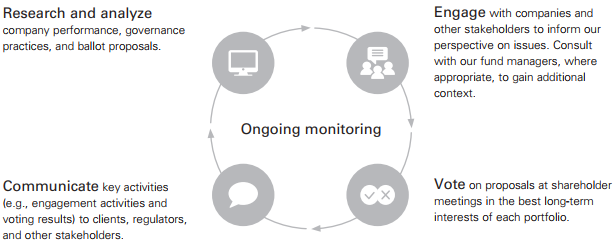
Our team supports effective corporate governance practices in three ways:

Advocating for policies that we believe will enhance the sustainable, long-term value of our clients’ investments. We promote good corporate governance and responsible investment through thoughtful participation in industry events and discussions where we can expand our advocacy and enhance our understanding of investment issues.

Engaging with portfolio company executives and directors to share our corporate governance principles and learn about portfolio companies’ corporate governance practices. We characterize our approach as “quiet diplomacy focused on results”—providing constructive input that will, in our view, better position companies to deliver sustainable value over the long term for all investors.

Voting proxies at company shareholder meetings across each of our portfolios and around the globe. Because of our ongoing advocacy and engagement efforts, companies should be aware of our governance principles and positions by the time we cast our funds’ votes.

Our process is iterative and ongoing
Our four pillars

Board

Good governance begins with a great board of directors. Our primary interest is to ensure that the individuals who represent the interests of all shareholders are independent (both in mindset and freedom from conflicts), capable (across the range of relevant skills for the company and industry), and appropriately experienced (so as to bring valuable perspective to their roles). We also believe that diversity of thought, background, and experience, as well as of personal characteristics (such as gender, race, and age), meaningfully contributes to the board’s ability to serve as effective, engaged stewards of shareholders’ interests. If a company has a well-composed, high-functioning board, good results are more likely to follow.

Structure

We believe in the importance of governance structures that empower shareholders and ensure accountability of the board and management. We believe that shareholders should be able to hold directors accountable as needed through certain governance and bylaw provisions. Among these preferred provisions are that directors must stand for election by shareholders annually and must secure a majority of the votes in order to join or remain on the board. In instances where the board appears resistant to shareholder input, we also support the right of shareholders to call special meetings and to place director nominees on the company’s ballot.

Compensation

We believe that performance-linked compensation policies and practices are fundamental drivers of the sustainable, long-term value for a company’s investors. The board plays a central role in determining appropriate executive pay that incentivizes performance relative to peers and competitors. Providing effective disclosure of these practices, their alignment with company performance, and their outcomes is crucial to giving shareholders confidence in the link between incentives and rewards and the creation of value over the long term.

Risk

Boards are responsible for effective oversight and governance of the risks most relevant and material to each company in the context of its industry and region. We believe that boards should take a thorough, integrated, and thoughtful approach to identifying, understanding, quantifying, overseeing, and—where appropriate—disclosing risks that have the potential to affect shareholder value over the long term. Importantly, boards should communicate their approach to risk oversight to shareholders through their normal course of business.

By the numbers: Voting and engagement

Engagement and voting trends

2015 proxy season 2016 proxy season  2017 proxy season
Company engagements 685 817 954
Companies voted 10,560 11,564 12,974
Meetings voted 12,785 16,740 18,905
Proposals voted 124,230 157,506 171,385
Countries voted in* 70 70 68

* The number of countries can vary each year. In certain markets, some companies do not hold shareholder meetings annually.
Note: The annual proxy season is from July 1 to June 30.

Our voting

Proxy voting reflects our governance pillars worldwide.

Meetings voted by region
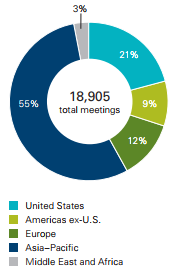
Note: Data pertains to voting activity from July 1, 2016, through June 30, 2017

Global voting activity
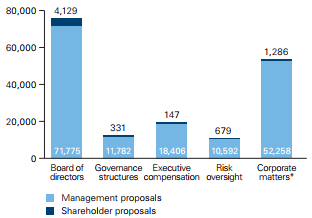
* Includes more than 26,000 proposals related to capitalization; 8,000 proposals related to mergers and acquisitions; 16,000 routine business proposals; and 1,000 other shareholder proposals.
Note: Data pertains to voting activity from July 1, 2016, through June 30, 2017.

Our engagement

We engage with companies of all sizes.

Market Capitalization % of 2017 proxy season engagements
Under $1 billion 19%
$1 billion–under $10 billion 44%
$10 billion–under $50 billion 24%
$50 billion and over 13%

Our engagement with portfolio companies has grown significantly over time.

Number of engagements and assets represented
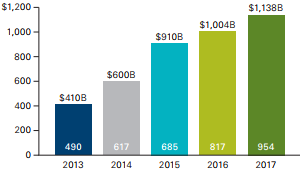
Note: Dollar figures represent the market value of Vanguard fund investments in companies with which we engaged as of June 30, 2017.

We engage on a range of topics aligned with our four pillars

Frequency of topics discussed during Vanguard engagements (%)
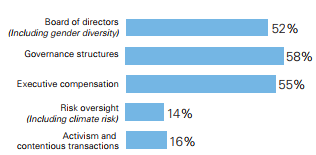
Note: Figures do not total 100%, as individual engagements often span multiple topics.

Boards in focus: Vanguard’s view on gender diversity

One of our most fundamental governance beliefs is that good governance begins with a great board of directors. We believe that diversity among directors—along dimensions such as gender, experience, race, background, age, and tenure—can strengthen a board’s range of perspectives and its capacity to make complex, fully considered decisions.

While we have long discussed board composition and diversity with portfolio companies, gender diversity has emerged as one dimension on which there is compelling support for positive effects on shareholder value. In recent years, a growing body of research has demonstrated that greater gender diversity on boards can lead to better company performance and governance.

Companies should be prepared to discuss—in both their public disclosures and their engagement with investors—their plans to incorporate appropriate diversity over time in their board composition. While we believe that board evolution is a process, not an event, the demonstration of meaningful progress over time will inform our engagement and voting going forward.

Boards in focus: Gender diversity

Engagement case studies

Gender diversity on boards was an important topic of engagement for us during the 12 months ended June 30, 2017. Below are summary examples of discussions we had on the subject.

High-impact engagement on gender diversity

Over several interactions with a U.S. industrial company, our team shared Vanguard’s perspective on board composition and evaluation. The company had undergone recent leadership transitions and was open to amending elements of its governance structure to align with best practices. We expressed particular support for meaningful gender diversity and expressed concern that the board previously had only one female director in its recent history.

Right after this year’s annual general meeting, the company announced it was adding four new directors with diverse experience, including two women. This outcome is the best-case scenario: The board welcomed shareholder input, we shared our view on best corporate governance practices, and the board ultimately incorporated our perspective into its board evolution process.

A denial of diversity’s value

A Canadian materials company that had consistently underperformed was governed by an entrenched, all-male board with seemingly nominal independence from the CEO. A 2017 shareholder resolution asked the company to adopt and publish a policy governing gender diversity on the board. Before voting, Vanguard engaged with the company to learn about its board evolution process, including its perspective on gender diversity. The engagement revealed that the company understood neither the value of gender diversity nor the importance of being responsive to shareholders’ concerns. Despite verbally endorsing gender diversity, the company resisted specifying a strategy or making a commitment to achieve it. The board, when seeking new members, relied solely on recommendations from current directors, a practice that can entrench the current board’s perspective and limit diversity. Our funds voted in support of the shareholder resolution, and we will continue to engage and hold the board accountable for meaningful progress over time.

Mixed results from an ongoing engagement

A U.S. consumer discretionary company had no women on its board, a problem magnified by its medium-term underperformance relative to peers, a classified board structure, and a lengthy average director tenure. We engaged with management twice between the 2016 and 2017 annual meetings to share our perspective on the importance of gender diversity and recommend that they make it a priority for future board evolution and director searches.

In its 2017 proxy, the company described board diversity as critical to the firm’s sustainable value and named gender as an element of diversity to be considered during the director search and nomination process. The company has since added a non-independent woman to the board. Although this move is directionally correct, it does not fully address our concerns; we will continue to encourage the company to add gender diversity to its ranks of independent directors.

Risk in focus: Vanguard’s view on climate risk

As the steward of long-term shareholder value for more than 20 million investors, Vanguard closely monitors how our portfolio companies identify, manage, and mitigate risks—including climate risk. Our approach to climate risk is evolving as the world’s and business community’s understanding of the topic matures.

This year, for the first time, our funds supported a number of climate-related shareholder resolutions opposed by company management. We are also discussing climate risk with company management and boards more than ever before. Our Investment Stewardship team is committed to engaging with a range of stakeholders to inform our perspective on these issues, and to share our thinking with the market, our portfolio companies, and our investors.

Risk in focus: Climate risk

A Q&A with Glenn Booraem, Vanguard’s Investment Stewardship Officer

Vanguard is an investment management company. Why should Vanguard fund investors be concerned about climate risk?

Mr. Booraem: Climate risk has the potential to be a significant long-term risk for companies in many industries. As stewards of our clients’ long-term investments, we must be finely attuned to this risk. We acknowledge that our clients’ views on climate risk span the ideological spectrum. But our position on climate risk is anchored in long-term economic value—not ideology. Regardless of one’s perspective on climate, there’s no doubt that changes in global regulation, energy consumption, and consumer preferences will have a significant economic impact on companies, particularly in the energy, industrial, and utilities sectors.

Why the shift in Vanguard’s assessment of climate risk, and why now?

Mr. Booraem: We’ve been discussing climate risk with portfolio companies for several years. It has been, and will remain, one of our engagement priorities for the foreseeable future. This past year, we engaged with more companies on this issue than ever before, and for the first time our funds supported two climate-related shareholder resolutions in cases where we believed that companies’ disclosure practices weren’t on par with emerging expectations in the market. As with other issues, our point of view has evolved as the topic has matured and, importantly, as its link to shareholder value has become more clear.

What is your top concern when you learn that a company in which a Vanguard portfolio invests does not have a rigorous strategy to evaluate and mitigate climate risk?

Mr. Booraem: Our concern is fundamentally that in the absence of clear disclosure and informed board oversight, the market lacks insight into the material risks of investing in that firm. It’s of paramount importance to us that the market is able to reflect risk and opportunity in stock prices, particularly for our index funds, which don’t get to select the stocks they own. When we’re not confident that companies have an appropriate level of board oversight or disclosure, we’re concerned that the market may not accurately reflect the value of the investment. Because we represent primarily long-term investors, this bias is particularly problematic when underweighting long-term risks inflates a company’s value.

Now that Vanguard has articulated a clear stance on climate risk, what can portfolio companies expect?

Mr. Booraem: First, companies should expect that we’re going to focus on their public disclosures, both about the risk itself and about their board’s and management’s oversight of that risk. Thorough disclosure is the foundation for the market’s understanding of the issue. Second, companies should expect that we’ll evaluate their disclosures in the context of both their leading peers and evolving market standards, such as those articulated by the Sustainability Accounting Standards Board (SASB). Third, they should expect that we’ll listen to their perspective on these and other matters. And finally, they should see our funds’ proxy voting as an extension of our engagement. When we consider a shareholder resolution on climate risk, we give companies a fair hearing on the merits of the proposal and consider their past commitments and the strength of their governance structure.

Engagement case studies

In the 12 months ended June 30, 2017, the topic of climate risk disclosure grew in frequency and prominence in our engagements with companies, particularly those in the energy, industrial, and utilities sectors, where climate risk was addressed in nearly every conversation we had. Below are examples of our engagements on climate risk.

Two companies’ commitments to enhanced disclosure

Our team led similar engagements with two U.S. energy companies facing shareholder resolutions on climate risk. One resolution requested that the first company publish an annual report on climate risk impacts and strategy. At the second company, a resolution requested disclosure of the company’s strategy and targets for transitioning to a low- carbon economy. In both cases, when we engaged with the companies, their management teams committed to improving their climate risk disclosure. Given the companies’ demonstrated responsiveness to shareholder feedback and commitment to improving, our funds did not support either shareholder proposal. Our team will continue to track and evaluate the companies’ progress toward their commitments as we consider our votes in future years.

A vote against a risk and governance outlier For years we engaged with a U.S. energy company that lagged its peers on climate risk disclosure and board accessibility. This year, a shareholder proposal requesting that the company produce a climate risk assessment report demonstrated a compelling link between the requested disclosures and long-term shareholder value. Because the board serves on behalf of shareholders and plays a critical role in risk oversight, we believed it was appropriate to seek a direct dialogue with independent directors about climate risk. Management resisted connecting the independent directors with shareholders, making the company a significant industry outlier in good governance practice. Without the confidence that the board understood or represented our view that climate risk poses a material risk in the energy sector, our team viewed the climate risk and governance issues as intertwined. Ultimately, our funds voted for the shareholder proposal and withheld votes on relevant independent directors for failing to engage with shareholders.

A vote for greater climate risk disclosure

A shareholder proposal at a U.S. energy company asked for an annual report with climate risk disclosure, including scenario planning. Through extensive research and engagements with the company’s management, its independent directors, and other industry stakeholders, our team identified governance shortfalls and a clear connection to long-term shareholder value. The company lagged its peers in disclosure, risk planning, and board oversight and responsiveness to shareholder concerns. Crucially, although the company’s public filings identified climate risk as a material issue, it failed to articulate plans for mitigation or adaptation. A similar proposal last year garnered significant support, but the company made no meaningful changes in response. Engagement had limited effect, so our funds voted for the shareholder proposal.

* * *

This post was excerpted from a Vanguard report; the complete publication is available here.

Gestion des risques liés à la cybersécurité | Guide pratique de McCarthyTetrault pour les entreprises


Aujourd’hui, je vous présente un formidable guide, publié par McCarthyTetrault, sur les risques associés aux questions de la cybersécurité dans les entreprises.

Vous y trouverez une information complète ainsi que divers outils de diagnostic essentiels aux conseils d’administration qui doivent se préparer à affronter des attaques de nature cybernétique, lesquelles sont de plus en plus fréquentes.

Cet excellent document a été porté à mon attention par Joanne Desjardins, LL.B., MBA, CRHA, ASC, associée de la firme Arsenal conseils, spécialisés en gouvernance et en stratégie.

L’ouvrage est divisé en quatre parties :

(1) une mise en contexte de la situation ;

(2) Pourquoi se préparer aux risques ;

(3) Le programme de préparation aux cyberrisques ;

(4) L’exécution efficace du plan d’intervention.

Voici un aperçu de l’introduction. Je vous invite à prendre connaissance de ce document très bien conçu.

Bonne lecture ! Vos commentaires sont les bienvenus.


Gestion des risques liés à la cybersécurité | Guide pratique de McCarthyTetrault pour les entreprises


Résultats de recherche d'images pour « gestion des risques cybernétiques »


Qui dit données dit possibilité de perte de données. La façon dont une organisation se prépare à une atteinte à la protection des données — et la gère si elle se produit – a un effet mesurable sur les répercussions d’une telle atteinte. En gérant efficacement un tel incident, qui peut coûter des millions de dollars et ruiner la réputation d’une organisation, on peut le maîtriser et réduire considérablement la gravité de ses conséquences. Par exemple, à la suite d’une atteinte très médiatisée à la protection des données par un logiciel malveillant installé sur les caisses en libre-service de Home Depot, deux sociétés canadiennes ont entamé des actions collectives, réclamant une indemnisation de 500 millions de dollars ; les recours ont finalement été réglés pour un montant de 400 000 $. Cette réduction importante est justifiée, dit le juge, au vu de la réponse « exemplaire » de Home Depot & NBSP ; : 1

Dans l’affaire en question, attendu : a) que Home Depot n’a apparemment commis aucun acte répréhensible ; b) qu’elle a réagi rapidement et d’une manière responsable, généreuse et exemplaire aux actes criminels perpétrés contre elle par les pirates informatiques ; c) que le comportement de Home Depot n’avait nul besoin d’être géré ; d) que la probabilité que les membres du groupe aient gain de cause contre Home Depot tant sur le plan de la responsabilité que de la preuve de dommages consécutifs était négligeable, voire nulle ; et e) que le risque d’échec devant les tribunaux et les frais de litige connexes étaient importants et immédiats, j’aurais approuvé l’abandon de l’action collective proposé par M. Lozanski, avec ou sans dépens et sans aucun avantage pour les membres du groupe présumés. [traduction libre].

Prolifération des données

Les renseignements personnels se définissent comme les données pouvant servir à identifier une personne, et leur collecte crée des obligations de protection de la vie privée (expliquant l’existence de lois sur la protection de la vie privée). Avec les progrès technologiques, les organisations recueillent, conservent et transfèrent plus de renseignements personnels sur les consommateurs, les professionnels, les patients et les employés que jamais auparavant. L’accumulation de grandes quantités de renseignements personnels dans d’immenses bases de données augmente le risque d’accès non autorisé à ces informations ainsi que les conséquences qui peuvent en découler. Une seule atteinte à la protection des données personnelles peut aujourd’hui toucher des millions de personnes.

L’adoption croissante d’identifiants biométriques (empreintes digitales ou vocales, reconnaissance faciale, etc.) par les entreprises crée aujourd’hui de nouveaux risques, soit la perte ou la mauvaise utilisation de ces éléments d’identification immuables.

Incidents de plus en plus importants et sophistiqués

Si les incidents connaissent une augmentation croissante, le problème le plus important est leur sophistication grandissante. Les modèles d’affaires des malfaiteurs ont évolué et, en plus de recourir à des méthodes toujours plus complexes, leurs cibles ont changé. Autrefois, le modus operandi consistait à voler des renseignements de cartes de crédit pour effectuer des transactions non autorisées. Aujourd’hui, les cyberadversaires utilisent des méthodes d’ingénierie sociale (comme l’hameçonnage au moyen de courriels frauduleux visant à amener par la tromperie des employés à fournir des informations confidentielles ou sensibles) pour obtenir des renseignements de valeur pour l’entreprise. Ces renseignements sont ensuite monnayés directement par leur utilisation dans le cadre de délits d’initiés, vendus à des concurrents (dans le cas d’une propriété intellectuelle ou d’un secret commercial) ou utilisés pour exiger une rançon.

Les hauts dirigeants d’entreprise craignent de plus en plus les atteintes à la protection des données, et il est désormais communément admis que les sociétés ne doivent pas se demander si un tel incident se produira, mais quand ?

Incidents de plus en plus coûteux

Les atteintes à la protection des données deviennent de plus en plus coûteuses. Si de nouveaux produits (comme les assurances contre les cyberrisques) contribuent à en défrayer les coûts, la réaction la plus fréquente au signalement d’un incident est une poursuite en justice (le plus souvent une action collective). Les dommages-intérêts octroyés ont certes été jusqu’ici relativement minimes, mais les coûts de gestion d’une atteinte à la protection des données peuvent être incroyablement élevés.

La réglementation en la matière a un coût. De récentes modifications apportées à la Loi sur la protection des renseignements personnels et les documents électroniques (LPRPDE) du Canada ont introduit l’obligation de notification d’une atteinte et une amende de 100 000 $ CA par atteinte en cas de non-respect de cette exigence — s’ajoutant aux frais financiers et aux coûts des atteintes à la réputation qu’engendrent les incidents liés à la confidentialité des données.

Les coûts ne se limitent pas aux dommages : la responsabilité des atteintes à la protection des données peut être imputée au conseil d’administration. Gregg Steinhafel, chef de la direction et président du conseil de Target, a démissionné tout juste après l’incident dont son entreprise a été victime. Un sort similaire a frappé Amy Pascal, qui a quitté ses fonctions de chef de Sony Pictures dans la foulée du piratage de Sony.

Les coûts ne se limitent pas aux dommages : la responsabilité des atteintes à la protection des données peut être imputée au conseil d’administration. Gregg Steinhafel, chef de la direction et président du conseil de Target, a démissionné tout juste après l’incident dont son entreprise a été victime. Un sort similaire a frappé Amy Pascal, qui a quitté ses fonctions de chef de Sony Pictures dans la foulée du piratage de Sony.

Se poser les bonnes questions en cette période incertaine | Deloitte


Deloitte a récemment publié un document très important intitulé Courage under fire : Embracing disruption (en anglais seulement) dans lequel trois administrateurs chevronnés échangent leurs points de vue sur les grandes perturbations que les organisations mondiales sont appelées à connaître en 2017.

Les questions posées sont les suivantes :

Étant donné les attentes croissantes envers les conseils d’administration, quelles devraient être les priorités des administrateurs ?

Les appels à une meilleure communication de l’information ne cessent de se faire entendre. Comment les conseils réagissent-ils ?

Les organisations sont nombreuses à subir des perturbations numériques. Est-ce un risque incontrôlable de plus à gérer ?

Les perturbations numériques créent beaucoup d’incertitude. Les conseils d’administration réussissent-ils à bien s’adapter à cette réalité ?

Vous pouvez télécharger le document ci-dessous.

Bonne lecture !

Courage under fire : Embracing disruption |  Deloitte


La gouvernance des Cégeps | Le rapport du Vérificateur général du Québec


Nous publions ici un billet de Danielle Malboeuf* qui fait état des recommandations du vérificateur général eu égard à la gouvernance des CÉGEP.

Comme à l’habitude Danielle nous propose son article à titre d’auteure invitée.

Je vous souhaite bonne lecture. Vos commentaires sont appréciés.


La gouvernance des Cégeps et le rapport du Vérificateur général du Québec

par

Danielle Malboeuf*  


À l’automne 2016, le Vérificateur général du Québec produisait un rapport d’audit concernant la gestion administrative de cinq cégeps. Ses travaux ont porté plus précisément sur la gestion des contrats, la gestion des bâtiments, les services autofinancés ainsi que sur la rémunération du personnel d’encadrement et les frais engagés par celui-ci.

Parmi les recommandations formulées à l’endroit des cégeps audités, on en retrouve une qui concerne plus précisément la gouvernance : « S’assurer que les instances de gouvernance reçoivent une information suffisante et en temps opportun afin qu’elles puissent exercer leur rôle quant aux décisions stratégiques et à la surveillance de l’efficacité des contrôles…»[1]

À la lecture de ce rapport et des constats de ces travaux d’audit, on ne peut qu’être qu’en accord avec cette recommandation qui invite les administrateurs à exercer leur rôle. Mais justement, quel rôle ont-ils ? Du point de vue légal, la Loi sur les collèges d’enseignement général et professionnel est peu éclairante à ce sujet.  Contrairement à la Loi sur la gouvernance des sociétés d’État qui précise clairement les fonctions qui sont confiées au conseil d’administration (CA), dont l’obligation d’évaluer l’intégrité des contrôles internes. On y exige également la création de trois sous-comités dont le comité de vérification ou d’audit à qui on confie entre autres, la responsabilité de mettre en place des mécanismes de contrôle interne. De plus, ce sous-comité doit compter sur la présence d’au moins une personne ayant une compétence en matière comptable ou financière.

À mon avis, la gouvernance d’un cégep devrait s’apparenter à celle des sociétés d’État. À ce sujet, dans son rapport publié en mai 2011 soumettant un bilan de l’implantation de la Loi sur la gouvernance des sociétés d’État, l’auteur de ce rapport, l’Institut sur la gouvernance des organismes publics et privés (IGOPP) allait dans le même sens. Il formulait comme première recommandation : « Imposer les nouvelles règles de gouvernance aux nombreux organismes du gouvernement qui ne sont pas inclus dans la loi actuelle sur la gouvernance. »[2]

Malgré le fait que les cégeps n’ont pas l’obligation légale de créer un comité d’audit, plusieurs l’ont fait dans un souci de transparence et afin d’être soutenu par les administrateurs dans leur effort pour assurer une utilisation optimale des ressources financières de l’organisation. Toutefois, le mandat qui leur est confié se limite dans la majorité des cas à une analyse des prévisions budgétaires et des états financiers. Ce n’est pas suffisant !

Considérant la recommandation du vérificateur général, il serait tout à fait approprié d’élargir ce mandat. En plus d’examiner les états financiers et d’en recommander leur approbation au CA, le comité d’audit devrait entre autres, veiller à ce que des mécanismes de contrôle interne soient mis en place et de s’assurer qu’ils soient adéquats et efficaces ainsi que de s’assurer que soit mis en place un processus de gestion des risques.[3] Sachant que les cégeps ne comptent pas de vérificateur interne, il est d’autant plus important de mettre en place un tel comité et de lui confier des fonctions de contrôle financier et de gestion des risques.

Une fois le comité d’audit mis en place, il devrait se pencher prioritairement sur la surveillance du processus de gestion contractuelle. Rappelons que les étapes du processus de gestion contractuelle sont : l’établissement des besoins et l’estimation des coûts, la préparation de l’appel d’offres et la sollicitation des fournisseurs, la sélection du fournisseur et l’attribution du contrat, le suivi du contrat et l’évaluation des biens et des services reçus[4].

À ce sujet, le Vérificateur général, dans son rapport, nous fait part de ses préoccupations. Il a identifié des lacunes dans les modes de sollicitation et constaté des dépassements de coûts et des prolongations dans les délais d’exécution, et ce, sans pénalité. Il précise que «Des activités prévues dans le processus de gestion contractuelle des cégeps audités ne sont pas effectuées de façon rigoureuse.»[5] En jouant son rôle, le comité d’audit du CA pourrait s’assurer que le processus mis en place et le partage des responsabilités retenu sont adéquats et efficaces. Il ne devrait d’ailleurs pas hésiter à faire appel à des ressources externes pour évaluer la performance du Cégep à l’égard de sa gestion contractuelle, le cas échéant.

En terminant, rappelons l’importance de retrouver sur le comité d’audit des administrateurs compétents qui ont une connaissance approfondie de la structure, des politiques, directives et exigences réglementaires. Ils doivent avoir la capacité d’assurer l’efficacité des mécanismes de contrôle interne et de la gestion des risques (un sujet que je développerai dans un article ultérieur).

En présence de telles compétences, il sera plus facile d’assurer la crédibilité du CA et de ses décisions. Il s’agit d’un atout précieux pour toutes institutions collégiales.

_____________________________________

[1] Rapport du Vérificateur général du Québec à l’Assemblée nationale pour l’année 2016-2017, p.35.

[2] Gouvernance des sociétés d’État, bilan et suggestions, IGOPP, p.48.

[3] Loi sur la gouvernance des sociétés d’État, art 24, 3.

[4] Rapport du Vérificateur général du Québec à l’Assemblée nationale pour l’année 2016-2017, annexe 4.

[5] Rapport du Vérificateur général du Québec à l’Assemblée nationale pour l’année 2016-2017, p.9.

_____________________________________

*Danielle Malboeuf est consultante et formatrice en gouvernance ; elle possède une grande expérience dans la gestion des CÉGEPS et dans la gouvernance des institutions d’enseignement collégial et universitaire. Elle est CGA-CPA, MBA, ASC, Gestionnaire et administratrice retraitée du réseau collégial et consultante.


Articles sur la gouvernance des CÉGEPS publiés sur mon blogue par l’auteure :

(1) LE RÔLE DU PRÉSIDENT DU CONSEIL D’ADMINISTRATION (PCA) | LE CAS DES CÉGEPS

(2) Les grands enjeux de la gouvernance des institutions d’enseignement collégial

(3) L’exercice de la démocratie dans la gouvernance des institutions d’enseignement collégial

(4) Caractéristiques des bons administrateurs pour le réseau collégial | Danielle Malboeuf

(5) La gouvernance des CÉGEPS | Une responsabilité partagée

Une culture empreinte de corruption mène habituellement à de sérieux manquements organisationnels !


Si l’on pouvait identifier les variables qui contribuent à créer une culture d’entreprise corrompue, pourrait-on prévoir les comportements corporatifs fautifs ?

C’est essentiellement la question de recherche à laquelle Xiaoding Liu, professeur de finance à University of Oregon’s Lundquist College of Business, a tenté de répondre dans un article utilisant une méthodologie originale et une solide analyse.

L’auteur avance qu’une culture d’entreprise souffrant d’un certain degré de corruption, c’est-à-dire ayant une culture interne plus tolérante envers le manque d’éthique, est plus susceptible de mener à des manquements corporatifs significatifs eu égard aux malversations, aux conflits d’intérêts et aux comportements organisationnels  «opportunistes».

In particular, they ask whether a firm’s inherent tendency to behave opportunistically is deeply rooted in its corporate culture, commonly defined as the shared values and beliefs of a firm’s employees.

Cet article montre qu’il y a un lien significatif entre une culture interne basée sur de faibles valeurs éthiques et la probabilité d’inconduite de la direction.

De plus, l’article montre que les comportements des employés basés sur de faibles valeurs éthiques sont transmissibles à d’autres organisations et que ces conclusions s’appliquent tout autant à la direction.

C’est la raison pour laquelle les conseils d’administration doivent se préoccuper de la culture de l’entreprise, s’assurer d’avoir le pouls du climat interne et être vigilants eu égard aux manquements à l’éthique.

Il est également crucial de s’assurer d’avoir une équipe d’auditeurs internes indépendants et bien outillés qui se rapporte au comité d’audit de l’entreprise.

À la suite de ce compte rendu, vous aurez sûrement des questions d’ordre méthodologique. Si vous voulez en savoir davantage sur la démarche de l’auteur, je vous encourage fortement, même si c’est ardu, de lire l’article au complet.

Bonne lecture !

Corruption Culture and Corporate Misconduct


A key question in corporate governance is how to control problems arising from conflicts of interest between agents and principals. The existing literature has extensively investigated traditional ways of dealing with agency problems such as hostile takeovers, the board of directors, and institutional investors, and has found mixed evidence regarding their effectiveness. Acknowledging the difficulty in designing effective governance rules to curb corporate scandals and bank failures, regulators and academics have recently turned their attention inward to the firm’s employees. In particular, they ask whether a firm’s inherent tendency to behave opportunistically is deeply rooted in its corporate culture, commonly defined as the shared values and beliefs of a firm’s employees.

5424172

In my article, Corruption Culture and Corporate Misconduct, recently published in the Journal of Financial Economics, I investigate this question by studying the role of corporate culture in influencing corporate misconduct. To do so, I create a measure of corporate corruption culture, which captures a firm’s general attitude toward opportunistic behavior. Specifically, corporate corruption culture is calculated as the average corruption attitudes of insiders (i.e., officers and directors) of a company. To measure corruption attitudes of insiders, I use a recently developed methodology from the economics literature that is generally described as the epidemiological approach (Fernández, 2011). It is based on the key idea that when individuals emigrate from their native country to a new country, their cultural beliefs and values travel with them, but their external environment is left behind. Moreover, these immigrants not only bring their beliefs and values to the new country, they also pass down these beliefs to their descendants. Thus, relevant economic outcomes at the country of ancestry are used as proxies of culture for immigrants and their descendants. Applying this approach, I use corruption in the insiders’ country of ancestry to capture corruption attitudes for insiders in the U.S., where the country of ancestry is identified based on surnames using U.S. Census data.

Using a sample of over 8,000 U.S. companies, I test the main prediction that firms with high corruption culture, which tend to be more tolerant toward corrupt behavior, are more likely to engage in corporate misconduct. Consistent with this prediction, I find that corporate corruption culture has a significant positive effect on various types of corporate misconduct such as earnings management, accounting fraud, option backdating, and opportunistic insider trading. The effects are also economically significant: a one standard deviation increase in a firm’s corruption culture is associated with an increase in the likelihood of corporate misconduct by about 2% to 7%, which are comparable to the effects of other governance measures such as board independence.

I further show that my findings are robust to controlling for time-varying local and industry factors, and traditional measures of corporate governance including the board size, the percentage of insider directors, the presence of institutional investors, and the threat of hostile takeovers. Van den Steen (2010) proposes a model of corporate culture and predicts that the appointment of a new CEO will lead to turnover through both selection and self-sorting. Thus, although corporate culture tends to be persistent over time, it is likely to change in a significant way around new CEO appointments. Motivated by this prediction, I examine corporate misconduct 5 years before and after the appointment of a new CEO while controlling for firm fixed effects. I continue to find a significant positive relation between corruption culture and corporate misconduct, which further alleviates endogeneity concerns.

The theoretical literature has predictions regarding the mechanisms through which corporate culture would affect opportunistic behavior. The first channel predicts that corruption culture acts as a selection mechanism by attracting or selecting individuals with similar corruption attitudes to the firm, where these individuals act according to their internal norms that are then reflected in corporate outcomes (Schneider, 1987). Consistent with this channel, I find that individuals with high corruption attitudes are more likely to join firms with high corruption culture and an insider is more likely to leave the firm if his corruption attitudes are more distant from the corruption attitudes of the other insiders in the firm. The second channel predicts that corruption culture can operate beyond internal norms and have a direct effect on individual behavior through group norms (Hackman, 1992). To test this channel, I examine misconduct at the insider level and focus on the sample of insiders that have moved across firms. Holding the individual constant, results show that when the same individual joins a firm with high corruption culture, his likelihood of engaging in personal misconduct increases compared to when he was at a firm with low corruption culture, consistent with corruption culture working through group norms.

In summary, I show that a firm’s corruption culture is an important determinant of the firm’s likelihood of engaging in corporate misconduct. This finding echoes the growing focus on corporate culture by regulators in an effort to curb corporate wrongdoing. Moreover, I provide evidence on the inner workings of corruption culture, showing that it influences corporate misconduct by both acting as a selection mechanism and having a direct influence on individual behavior. To the best of my knowledge, this is the first paper to construct a novel measure of corporate culture based on the ancestry origins of company insiders. By doing so, I contribute to a growing finance literature examining the influence of corporate culture on corporate behavior, where the main challenge is measurement.

The full article is available for download here.

Le point sur la gouvernance au Canada en 2016 | Rapport de Davies Ward Phillips Vineberg


Le rapport annuel de Davies est toujours très attendu car il brosse un tableau très complet de l’évolution de la gouvernance au Canada durant la dernière année.

Le document qui vient de sortir est en anglais mais la version française devrait suivre dans peu de temps.

Je vous invite donc à en prendre connaissance en lisant le court résumé ci-dessous et, si vous voulez en savoir plus sur les thèmes abordés, vous pouvez télécharger le document de 100 pages sur le site de l’entreprise.

Cliquez sur le lien ci-dessous. Bonne lecture !

Rapport de Davies sur la gouvernance 2016


Davies Governance Insights 2016, provides analysis of the top governance trends and issues important to Canadian boards, senior management and governance observers.

insights_governance_2016_fr_thumbnail

The 2016 edition provides readers with our take on important topics ranging from shareholder engagement and activism to leadership diversity and the rise in issues facing boards and general counsel. We also provide practical guidance for boards and senior management of public companies and their investors on these and many other corporate governance topics that we expect will remain under focus in the 2017 proxy season.


Dix thèmes majeurs pour les administrateurs en 2016 | Harvard Law School Forum on Corporate Governance


Vous trouverez, ci-dessous, les dix thèmes les plus importants pour les administrateurs de sociétés selon Kerry E. Berchem, associé du groupe de pratiques corporatives à la firme Akin Gump Strauss Hauer & Feld LLP. Cet article est paru aujourd’hui sur le blogue le Harvard Law School Forum on Corporate Governance.

Bien qu’il y ait peu de changements dans l’ensemble des priorités cette année, on peut quand même noter :

(1) l’accent crucial accordé au long terme ;

(2) Une bonne gestion des relations avec les actionnaires dans la foulée du nombre croissant d’activités menées par les activistes ;

(3) Une supervision accrue des activités liées à la cybersécurité…

Pour plus de détails sur chaque thème, je vous propose la lecture synthèse de l’article ci-dessous.

Bonne lecture !


Ten Topics for Directors in 2016 |   Harvard Law School Forum on Corporate Governance


U.S. public companies face a host of challenges as they enter 2016. Here is our annual list of hot topics for the boardroom in the coming year:

  1. Oversee the development of long-term corporate strategy in an increasingly interdependent and volatile world economy
  2. Cultivate shareholder relations and assess company vulnerabilities as activist investors target more companies with increasing success
  3. Oversee cybersecurity as the landscape becomes more developed and cyber risk tops director concerns
  4. Oversee risk management, including the identification and assessment of new and emerging risks
  5. Assess the impact of social media on the company’s business plans
  6. Stay abreast of Delaware law developments and other trends in M&A
  7. Review and refresh board composition and ensure appropriate succession
  8. Monitor developments that could impact the audit committee’s already heavy workload
  9. Set appropriate executive compensation as CEO pay ratios and income inequality continue to make headlines
  10. Prepare for and monitor developments in proxy access

Strategic Planning Considerations

Strategic planning continues to be a high priority for directors and one to which they want to devote more time. Figuring out where the company wants to—and where it should want to—go and how to get there is not getting any easier, particularly as companies find themselves buffeted by macroeconomic and geopolitical events over which they have no control.

axes

In addition to economic and geopolitical uncertainty, a few other challenges and considerations for boards to keep in mind as they strategize for 2016 and beyond include:

finding ways to drive top-line growth

focusing on long-term goals and enhancing long-term shareholder value in the face of mounting pressures to deliver short-term results

the effect of low oil and gas prices

figuring out whether and when to deploy growing cash stockpiles

assessing the opportunities and risks of climate change and resource scarcity

addressing corporate social responsibility.

Shareholder Activism

Shareholder activism and “suggestivism” continue to gain traction. With the success that activists have experienced throughout 2015, coupled with significant new money being allocated to activist funds, there is no question that activism will remain strong in 2016.

In the first half of 2015, more than 200 U.S. companies were publicly subjected to activist demands, and approximately two-thirds of these demands were successful, at least in part. [1] A much greater number of companies are actually targeted by activism, as activists report that less than a third of their campaigns actually become public knowledge. [2] Demands have continued, and will continue, to vary: from requests for board representation, the removal of officers and directors, launching a hostile bid, advocating specific business strategies and/or opining on the merit of M&A transactions. But one thing is clear: the demands are being heard. According to a recent survey of more than 350 mutual fund managers, half had been contacted by an activist in the past year, and 45 percent of those contacted decided to support the activist. [3]

With the threat of activism in the air, boards need to cultivate shareholder relations and assess company vulnerabilities. Directors—who are charged with overseeing the long-term goals of their companies—must also understand how activists may look at the company’s strategy and short-term results. They must understand what tactics and tools activists have available to them. They need to know and understand what defenses the company has in place and whether to adopt other protective measures for the benefit of the overall organization and stakeholders.

Cybersecurity

Nearly 90 percent of CEOs worry that cyber threats could adversely impact growth prospects. [4] Yet in a recent survey, nearly 80 percent of the more than 1,000 information technology leaders surveyed had not briefed their board of directors on cybersecurity in the last 12 months. [5] The cybersecurity landscape has become more developed and as such, companies and their directors will likely face stricter scrutiny of their protection against cyber risk. Cyber risk—and the ultimate fall out of a data breach—should be of paramount concern to directors.

One of the biggest concerns facing boards is how to provide effective oversight of cybersecurity. The following are questions that boards should be asking:

Governance. Has the board established a cybersecurity review > committee and determined clear lines of reporting and > responsibility for cyber issues? Does the board have directors with the necessary expertise to understand cybersecurity and related issues?

Critical asset review. Has the company identified what its highest cyber risks assets are (e.g., intellectual property, personal information and trade secrets)? Are sufficient resources allocated to protect these assets?

Threat assessment. What is the daily/weekly/monthly threat report for the company? What are the current gaps and how are they being resolved?

Incident response preparedness. Does the company have an incident response plan and has it been tested in the past six months? Has the company established contracts via outside counsel with forensic investigators in the event of a breach to facilitate quick response and privilege protection?

Employee training. What training is provided to employees to help them identify common risk areas for cyber threat?

Third-party management. What are the company’s practices with respect to third parties? What are the procedures for issuing credentials? Are access rights limited and backdoors to key data entry points restricted? Has the company conducted cyber due diligence for any acquired companies? Do the third-party contracts contain proper data breach notification, audit rights, indemnification and other provisions?

Insurance. Does the company have specific cyber insurance and does it have sufficient limits and coverage?

Risk disclosure. Has the company updated its cyber risk disclosures in SEC filings or other investor disclosures to reflect key incidents and specific risks?

The SEC and other government agencies have made clear that it is their expectation that boards actively manage cyber risk at an enterprise level. Given the complexity of the cybersecurity inquiry, boards should seriously consider conducting an annual third-party risk assessment to review current practices and risks.

Risk Management

Risk management goes hand in hand with strategic planning—it is impossible to make informed decisions about a company’s strategic direction without a comprehensive understanding of the risks involved. An increasingly interconnected world continues to spawn newer and more complex risks that challenge even the best-managed companies. How boards respond to these risks is critical, particularly with the increased scrutiny being placed on boards by regulators, shareholders and the media. In a recent survey, directors and general counsel identified IT/cybersecurity as their number one worry, and they also expressed increasing concern about corporate reputation and crisis preparedness. [6]

Given the wide spectrum of risks that most companies face, it is critical that boards evaluate the manner in which they oversee risk management. Most companies delegate primary oversight responsibility for risk management to the audit committee. Of course, audit committees are already burdened with a host of other responsibilities that have increased substantially over the years. According to Spencer Stuart’s 2015 Board Index, 12 percent of boards now have a stand-alone risk committee, up from 9 percent last year. Even if primary oversight for monitoring risk management is delegated to one or more committees, the entire board needs to remain engaged in the risk management process and be informed of material risks that can affect the company’s strategic plans. Also, if primary oversight responsibility for particular risks is assigned to different committees, collaboration among the committees is essential to ensure a complete and consistent approach to risk management oversight.

Social Media

Companies that ignore the significant influence that social media has on existing and potential customers, employees and investors, do so at their own peril. Ubiquitous connectivity has profound implications for businesses. In addition to understanding and encouraging changes in customer relationships via social media, directors need to understand and weigh the risks created by social media. According to a recent survey, 91 percent of directors and 79 percent of general counsel surveyed acknowledged that they do not have a thorough understanding of the social media risks that their companies face. [7]

As part of its oversight duties, the board of directors must ensure that management is thoughtfully addressing the strategic opportunities and challenges posed by the explosive growth of social media by probing management’s knowledge, plans and budget decisions regarding these developments. Given new technology and new social media forums that continue to arise, this is a topic that must be revisited regularly.

M&A Developments

M&A activity has been robust in 2015 and is on track for another record year. According to Thomson Reuters, global M&A activity exceeded $3.2 trillion with almost 32,000 deals during the first three quarters of 2015, representing a 32 percent increase in deal value and a 2 percent increase in deal volume compared to the same period last year. The record deal value mainly results from the increase in mega-deals over $10 billion, which represented 36 percent of the announced deal value. While there are some signs of a slowdown in certain regions based on deal volume in recent quarters, global M&A is expected to carry on its strong pace in the beginning of 2016.

Directors must prepare for possible M&A activity in the future by keeping abreast of developments in Delaware case law and other trends in M&A. The Delaware courts churned out several noteworthy decisions in 2015 regarding M&A transactions that should be of interest to directors, including decisions on the court’s standard of review of board actions, exculpation provisions, appraisal cases and disclosure-only settlements.

Board Composition and Succession Planning

Boards have to look at their composition and make an honest assessment of whether they collectively have the necessary experience and expertise to oversee the new opportunities and challenges facing their companies. Finding the right mix of people to serve on a company’s board of directors, however, is not necessarily an easy task, and not everyone will agree with what is “right.” According to Spencer Stuart’s 2015 Board Index, board composition and refreshment and director tenure were among the top issues that shareholders raised with boards. Because any perceived weakness in a director’s qualification could open the door for activist shareholders, boards should endeavor to have an optimal mix of experience, skills and diversity. In light of the importance placed on board composition, it is critical that boards have a long-term board succession plan in place. Boards that are proactive with their succession planning are able to find better candidates and respond faster and more effectively when an activist approaches or an unforeseen vacancy occurs.

Audit Committees

Averaging 8.8 meetings a year, audit continues to be the most time-consuming committee. [8] Audit committees are burdened not only with overseeing a company’s risks, but also a host of other responsibilities that have increased substantially over the years. Prioritizing an audit committee’s already heavy workload and keeping directors apprised of relevant developments, including enhanced audit committee disclosures, accounting changes and enhanced SEC scrutiny will be important as companies prepare for 2016.

Executive Compensation

Perennially in the spotlight, executive compensation will continue to be a hot topic for directors in 2016. But this year, due to the SEC’s active rulemaking in 2015, directors will have more to fret about than just say-on-pay. Roughly five years after the Dodd-Frank Wall Street Reform and Consumer Protection Act was enacted, the SEC finally adopted the much anticipated CEO pay ratio disclosure rules, which have already begun stirring the debate on income inequality and exorbitant CEO pay. The SEC also made headway on other Dodd-Frank regulations, including proposed rules on pay-for-performance, clawbacks and hedging disclosures. Directors need to start planning how they will comply with these rules as they craft executive compensation for 2016.

Proxy Access

2015 was a turning point for shareholder proposals seeking to implement proxy access, which gives certain shareholders the ability to nominate directors and include those nominees in a company’s proxy materials. During the 2015 proxy season, the number of shareholder proposals relating to proxy access, as well as the overall shareholder support for such proposals, increased significantly. Indeed, approximately 110 companies received proposals requesting the board to amend the company’s bylaws to allow for proxy access, and of those proposals that went to a vote, the average support was close to 54 percent of votes cast in favor, with 52 proposals receiving majority support. [9] New York City Comptroller Scott Springer and his 2015 Boardroom Accountability Project were a driving force, submitting 75 proxy access proposals at companies targeted for perceived excessive executive compensation, climate change issues and lack of board diversity. Shareholder campaigns for proxy access are expected to continue in 2016. Accordingly, it is paramount that boards prepare for and monitor developments in proxy access, including, understanding the provisions that are emerging as typical, as well as the role of institutional investors and proxy advisory firms.

The complete publication is available here.

Endnotes:

[1] Activist Insight, “2015: The First Half in Numbers,” Activism Monthly (July 2015).
(go back)

[2] Activist Insight, “Activist Investing—An Annual Review of Trends in Shareholder Activism,” p. 8. (2015).
(go back)

[3] David Benoit and Kirsten Grind, “Activist Investors’ Secret Ally: Big Mutual Funds,” The Wall Street Journal (August 9, 2015).
(go back)

[4] PwC’s 18th Annual Global CEO Survey 2015.
(go back)

[5] Ponemon Institute’s 2015 Global Megatrends in Cybersecurity (February 2015).
(go back)

[6] Kimberley S. Crowe, “Law in the Boardroom 2015,” Corporate Board Member Magazine (2nd Quarter 2015). See also, Protiviti, “Executive Perspectives on Top Risks for 2015.”
(go back)

[7] Kimberley S. Crowe, supra.
(go back)

[8] 2015 Spencer Stuart Board Index, at p. 26.
(go back)

[9] Georgeson, 2015 Annual Corporate Governance Review, at p. 5.
(go back)

La fonction d’audit interne | de plus en plus incontournable pour assurer une saine gouvernance et l’intégrité du management


Voici le résumé d’un article du Wall Street Journal  (Internal Audit Chiefs Gain in Clout, Compensation), publié par Joann S. Lublin, et paru dans le journal The Australian.

Cet article porte sur l’importance accrue accordée au rôle de l’auditeur interne dans la vérification des mécanismes de contrôle interne, de la gestion des risques, notamment des risques de cyberattaques, ainsi que des processus de gouvernance et de conformité.

7af1886faf1ed569628eae86bf27591c_audit-intern

L’influence du département de l’audit interne prend une place quasi incontournable dans la vaste majorité des grandes sociétés comme en témoignent les statistiques à ce sujet.

Ainsi, 83 % des directions d’audit interne se rapportent au CA ou au comité d’audit du CA ; c’est un accroissement de 76 % en trois ans !

On peut certainement constater que les activités d’audit interne représentent les « yeux et les oreilles du comité d’audit ».

Également, les directeurs des services d’audit interne ont vu leur rémunération augmenter d’environ 30 % au cours des dix dernières années.

Les conseils d’administration accordent maintenant une grande importance à la sélection et à la rémunération des « Chief Audit Executive » (CAE).

Bonne lecture !

Chief audit executives gaining clout and higher pay


Top watchdogs inside many companies bark louder these days.

They are known as chief audit executives, or CAEs, and they assess the effectiveness of corporate controls, risk management and governance processes. As boards worry more about cyber attacks, regulatory compliance and personal liability, these executives are gaining clout and commanding higher pay.

CAEs are becoming more visible in part because directors are playing bigger roles in selecting, evaluating and rewarding internal audit chiefs. In North America, 83 per cent of those executives now report to their employer’s full board or audit committee, according to a report by the Institute of Internal Auditors. That’s up from 76 per cent in 2013.

Another sign of their rising influence: this year, for the first time, the proportion of audit leaders who report to their chief executive matched those overseen by the chief financial officer, the report found.

Solid support from audit committees and top company leaders often give CAEs more freedom to raise red flags, experts said. It can also bring them sizeable pay cheques.

“Boards will pay a lot more for CAEs with superior risk-management and business acumen in their company’s industry,’’ said Richard Chambers, IIA president.

Recruiters agree. “Chief audit executives hired by large companies now command total pay packages approaching $US1 million — about 30 per cent more than a decade ago,’’ said Scott Simmons, a managing director at Crist Kolder Associates, which recruited nearly 15 current CAEs.

Sarbanes-Oxley, the sweeping corporate-reform law enacted in 2002, raised boards’ expectations for heads of internal audit, according to Charles Noski, chairman of the audit committee at Microsoft, Priceline Group and Avon Products.

“Internal audit really is the eyes and ears of the audit committee,’’ he said, adding that CAEs today “are stronger executives’’.

Mr Noski makes sure that’s true of candidates who interview for the job. He said he seeks “a strong backbone”, plus effective boardroom presence and communications skills.

Le point sur la gouvernance au Canada en 2016 | Rapport de Davies Ward Phillips Vineberg


Le rapport annuel de Davies est toujours très attendu car il brosse un tableau très complet de l’évolution de la gouvernance au Canada durant la dernière année.

Le document qui vient de sortir est en anglais mais la version française devrait suivre dans peu de temps.

Je vous invite donc à en prendre connaissance en lisant le court résumé ci-dessous et, si vous voulez en savoir plus sur les thèmes abordés, vous pouvez télécharger le document de 100 pages sur le site de l’entreprise.

Cliquez sur le lien ci-dessous. Bonne lecture !

Rapport de Davies sur la gouvernance 2016


Davies Governance Insights 2016, provides analysis of the top governance trends and issues important to Canadian boards, senior management and governance observers.

insights_governance_2016_fr_thumbnail

The 2016 edition provides readers with our take on important topics ranging from shareholder engagement and activism to leadership diversity and the rise in issues facing boards and general counsel. We also provide practical guidance for boards and senior management of public companies and their investors on these and many other corporate governance topics that we expect will remain under focus in the 2017 proxy season.


Dix thèmes majeurs pour les administrateurs en 2016 | Harvard Law School Forum on Corporate Governance


Vous trouverez, ci-dessous, les dix thèmes les plus importants pour les administrateurs de sociétés selon Kerry E. Berchem, associé du groupe de pratiques corporatives à la firme Akin Gump Strauss Hauer & Feld LLP. Cet article est paru aujourd’hui sur le blogue le Harvard Law School Forum on Corporate Governance.

Bien qu’il y ait peu de changements dans l’ensemble des priorités cette année, on peut quand même noter :

(1) l’accent crucial accordé au long terme ;

(2) Une bonne gestion des relations avec les actionnaires dans la foulée du nombre croissant d’activités menées par les activistes ;

(3) Une supervision accrue des activités liées à la cybersécurité…

Pour plus de détails sur chaque thème, je vous propose la lecture synthèse de l’article ci-dessous.

Bonne lecture !


Ten Topics for Directors in 2016 |   Harvard Law School Forum on Corporate Governance


U.S. public companies face a host of challenges as they enter 2016. Here is our annual list of hot topics for the boardroom in the coming year:

  1. Oversee the development of long-term corporate strategy in an increasingly interdependent and volatile world economy
  2. Cultivate shareholder relations and assess company vulnerabilities as activist investors target more companies with increasing success
  3. Oversee cybersecurity as the landscape becomes more developed and cyber risk tops director concerns
  4. Oversee risk management, including the identification and assessment of new and emerging risks
  5. Assess the impact of social media on the company’s business plans
  6. Stay abreast of Delaware law developments and other trends in M&A
  7. Review and refresh board composition and ensure appropriate succession
  8. Monitor developments that could impact the audit committee’s already heavy workload
  9. Set appropriate executive compensation as CEO pay ratios and income inequality continue to make headlines
  10. Prepare for and monitor developments in proxy access

Strategic Planning Considerations

Strategic planning continues to be a high priority for directors and one to which they want to devote more time. Figuring out where the company wants to—and where it should want to—go and how to get there is not getting any easier, particularly as companies find themselves buffeted by macroeconomic and geopolitical events over which they have no control.

axes

In addition to economic and geopolitical uncertainty, a few other challenges and considerations for boards to keep in mind as they strategize for 2016 and beyond include:

finding ways to drive top-line growth

focusing on long-term goals and enhancing long-term shareholder value in the face of mounting pressures to deliver short-term results

the effect of low oil and gas prices

figuring out whether and when to deploy growing cash stockpiles

assessing the opportunities and risks of climate change and resource scarcity

addressing corporate social responsibility.

Shareholder Activism

Shareholder activism and “suggestivism” continue to gain traction. With the success that activists have experienced throughout 2015, coupled with significant new money being allocated to activist funds, there is no question that activism will remain strong in 2016.

In the first half of 2015, more than 200 U.S. companies were publicly subjected to activist demands, and approximately two-thirds of these demands were successful, at least in part. [1] A much greater number of companies are actually targeted by activism, as activists report that less than a third of their campaigns actually become public knowledge. [2] Demands have continued, and will continue, to vary: from requests for board representation, the removal of officers and directors, launching a hostile bid, advocating specific business strategies and/or opining on the merit of M&A transactions. But one thing is clear: the demands are being heard. According to a recent survey of more than 350 mutual fund managers, half had been contacted by an activist in the past year, and 45 percent of those contacted decided to support the activist. [3]

With the threat of activism in the air, boards need to cultivate shareholder relations and assess company vulnerabilities. Directors—who are charged with overseeing the long-term goals of their companies—must also understand how activists may look at the company’s strategy and short-term results. They must understand what tactics and tools activists have available to them. They need to know and understand what defenses the company has in place and whether to adopt other protective measures for the benefit of the overall organization and stakeholders.

Cybersecurity

Nearly 90 percent of CEOs worry that cyber threats could adversely impact growth prospects. [4] Yet in a recent survey, nearly 80 percent of the more than 1,000 information technology leaders surveyed had not briefed their board of directors on cybersecurity in the last 12 months. [5] The cybersecurity landscape has become more developed and as such, companies and their directors will likely face stricter scrutiny of their protection against cyber risk. Cyber risk—and the ultimate fall out of a data breach—should be of paramount concern to directors.

One of the biggest concerns facing boards is how to provide effective oversight of cybersecurity. The following are questions that boards should be asking:

Governance. Has the board established a cybersecurity review > committee and determined clear lines of reporting and > responsibility for cyber issues? Does the board have directors with the necessary expertise to understand cybersecurity and related issues?

Critical asset review. Has the company identified what its highest cyber risks assets are (e.g., intellectual property, personal information and trade secrets)? Are sufficient resources allocated to protect these assets?

Threat assessment. What is the daily/weekly/monthly threat report for the company? What are the current gaps and how are they being resolved?

Incident response preparedness. Does the company have an incident response plan and has it been tested in the past six months? Has the company established contracts via outside counsel with forensic investigators in the event of a breach to facilitate quick response and privilege protection?

Employee training. What training is provided to employees to help them identify common risk areas for cyber threat?

Third-party management. What are the company’s practices with respect to third parties? What are the procedures for issuing credentials? Are access rights limited and backdoors to key data entry points restricted? Has the company conducted cyber due diligence for any acquired companies? Do the third-party contracts contain proper data breach notification, audit rights, indemnification and other provisions?

Insurance. Does the company have specific cyber insurance and does it have sufficient limits and coverage?

Risk disclosure. Has the company updated its cyber risk disclosures in SEC filings or other investor disclosures to reflect key incidents and specific risks?

The SEC and other government agencies have made clear that it is their expectation that boards actively manage cyber risk at an enterprise level. Given the complexity of the cybersecurity inquiry, boards should seriously consider conducting an annual third-party risk assessment to review current practices and risks.

Risk Management

Risk management goes hand in hand with strategic planning—it is impossible to make informed decisions about a company’s strategic direction without a comprehensive understanding of the risks involved. An increasingly interconnected world continues to spawn newer and more complex risks that challenge even the best-managed companies. How boards respond to these risks is critical, particularly with the increased scrutiny being placed on boards by regulators, shareholders and the media. In a recent survey, directors and general counsel identified IT/cybersecurity as their number one worry, and they also expressed increasing concern about corporate reputation and crisis preparedness. [6]

Given the wide spectrum of risks that most companies face, it is critical that boards evaluate the manner in which they oversee risk management. Most companies delegate primary oversight responsibility for risk management to the audit committee. Of course, audit committees are already burdened with a host of other responsibilities that have increased substantially over the years. According to Spencer Stuart’s 2015 Board Index, 12 percent of boards now have a stand-alone risk committee, up from 9 percent last year. Even if primary oversight for monitoring risk management is delegated to one or more committees, the entire board needs to remain engaged in the risk management process and be informed of material risks that can affect the company’s strategic plans. Also, if primary oversight responsibility for particular risks is assigned to different committees, collaboration among the committees is essential to ensure a complete and consistent approach to risk management oversight.

Social Media

Companies that ignore the significant influence that social media has on existing and potential customers, employees and investors, do so at their own peril. Ubiquitous connectivity has profound implications for businesses. In addition to understanding and encouraging changes in customer relationships via social media, directors need to understand and weigh the risks created by social media. According to a recent survey, 91 percent of directors and 79 percent of general counsel surveyed acknowledged that they do not have a thorough understanding of the social media risks that their companies face. [7]

As part of its oversight duties, the board of directors must ensure that management is thoughtfully addressing the strategic opportunities and challenges posed by the explosive growth of social media by probing management’s knowledge, plans and budget decisions regarding these developments. Given new technology and new social media forums that continue to arise, this is a topic that must be revisited regularly.

M&A Developments

M&A activity has been robust in 2015 and is on track for another record year. According to Thomson Reuters, global M&A activity exceeded $3.2 trillion with almost 32,000 deals during the first three quarters of 2015, representing a 32 percent increase in deal value and a 2 percent increase in deal volume compared to the same period last year. The record deal value mainly results from the increase in mega-deals over $10 billion, which represented 36 percent of the announced deal value. While there are some signs of a slowdown in certain regions based on deal volume in recent quarters, global M&A is expected to carry on its strong pace in the beginning of 2016.

Directors must prepare for possible M&A activity in the future by keeping abreast of developments in Delaware case law and other trends in M&A. The Delaware courts churned out several noteworthy decisions in 2015 regarding M&A transactions that should be of interest to directors, including decisions on the court’s standard of review of board actions, exculpation provisions, appraisal cases and disclosure-only settlements.

Board Composition and Succession Planning

Boards have to look at their composition and make an honest assessment of whether they collectively have the necessary experience and expertise to oversee the new opportunities and challenges facing their companies. Finding the right mix of people to serve on a company’s board of directors, however, is not necessarily an easy task, and not everyone will agree with what is “right.” According to Spencer Stuart’s 2015 Board Index, board composition and refreshment and director tenure were among the top issues that shareholders raised with boards. Because any perceived weakness in a director’s qualification could open the door for activist shareholders, boards should endeavor to have an optimal mix of experience, skills and diversity. In light of the importance placed on board composition, it is critical that boards have a long-term board succession plan in place. Boards that are proactive with their succession planning are able to find better candidates and respond faster and more effectively when an activist approaches or an unforeseen vacancy occurs.

Audit Committees

Averaging 8.8 meetings a year, audit continues to be the most time-consuming committee. [8] Audit committees are burdened not only with overseeing a company’s risks, but also a host of other responsibilities that have increased substantially over the years. Prioritizing an audit committee’s already heavy workload and keeping directors apprised of relevant developments, including enhanced audit committee disclosures, accounting changes and enhanced SEC scrutiny will be important as companies prepare for 2016.

Executive Compensation

Perennially in the spotlight, executive compensation will continue to be a hot topic for directors in 2016. But this year, due to the SEC’s active rulemaking in 2015, directors will have more to fret about than just say-on-pay. Roughly five years after the Dodd-Frank Wall Street Reform and Consumer Protection Act was enacted, the SEC finally adopted the much anticipated CEO pay ratio disclosure rules, which have already begun stirring the debate on income inequality and exorbitant CEO pay. The SEC also made headway on other Dodd-Frank regulations, including proposed rules on pay-for-performance, clawbacks and hedging disclosures. Directors need to start planning how they will comply with these rules as they craft executive compensation for 2016.

Proxy Access

2015 was a turning point for shareholder proposals seeking to implement proxy access, which gives certain shareholders the ability to nominate directors and include those nominees in a company’s proxy materials. During the 2015 proxy season, the number of shareholder proposals relating to proxy access, as well as the overall shareholder support for such proposals, increased significantly. Indeed, approximately 110 companies received proposals requesting the board to amend the company’s bylaws to allow for proxy access, and of those proposals that went to a vote, the average support was close to 54 percent of votes cast in favor, with 52 proposals receiving majority support. [9] New York City Comptroller Scott Springer and his 2015 Boardroom Accountability Project were a driving force, submitting 75 proxy access proposals at companies targeted for perceived excessive executive compensation, climate change issues and lack of board diversity. Shareholder campaigns for proxy access are expected to continue in 2016. Accordingly, it is paramount that boards prepare for and monitor developments in proxy access, including, understanding the provisions that are emerging as typical, as well as the role of institutional investors and proxy advisory firms.

The complete publication is available here.

Endnotes:

[1] Activist Insight, “2015: The First Half in Numbers,” Activism Monthly (July 2015).
(go back)

[2] Activist Insight, “Activist Investing—An Annual Review of Trends in Shareholder Activism,” p. 8. (2015).
(go back)

[3] David Benoit and Kirsten Grind, “Activist Investors’ Secret Ally: Big Mutual Funds,” The Wall Street Journal (August 9, 2015).
(go back)

[4] PwC’s 18th Annual Global CEO Survey 2015.
(go back)

[5] Ponemon Institute’s 2015 Global Megatrends in Cybersecurity (February 2015).
(go back)

[6] Kimberley S. Crowe, “Law in the Boardroom 2015,” Corporate Board Member Magazine (2nd Quarter 2015). See also, Protiviti, “Executive Perspectives on Top Risks for 2015.”
(go back)

[7] Kimberley S. Crowe, supra.
(go back)

[8] 2015 Spencer Stuart Board Index, at p. 26.
(go back)

[9] Georgeson, 2015 Annual Corporate Governance Review, at p. 5.
(go back)

Un guide utile pour bien évaluer les risques organisationnels | En reprise


Voici un article très intéressant sur l’évaluation des risques publié par H. Glen Jenkinset paru dans Inside Counsel (IC) Magazine.

Il s’agit d’un bref exposé sur la notion de risques organisationnels et sur les principaux éléments qu’il faut considérer afin d’en faire une gestion efficace.

Je vous invite à prendre connaissance des autres publications sur le site de IC, notamment Evaluating and managing litigation risk.

Bonne lecture !

Risk assessment: A primer for corporate counsel


The scope of legal responsibilities for in-house counsel varies depending on the size and complexity of the company. For instance, an attorney located at corporate headquarters could be chiefly responsible for issues affecting the shared services that are available and used by corporate headquarters, as well as every business unit and division. And yet at other times, in-house counsel’s concerns may be restricted to matters affecting only the parent company or a specific liability issue faced by only one business unit.


risk management flow chart concept handwritten by businessman

In each instance, however, in-house counsel are generally concerned with specific legal tasks and proactive risk management.

What exactly does risk management mean, and what does it encompass? Furthermore, once the definition of risk management has been established and accepted by the company’s management team, how can in-house counsel efficiently and comprehensively assess all possible risks?

Merriam Webster’s dictionary defines risk as “the possibility that something bad or unpleasant will happen.” Whenever many of us in the accounting and legal profession hear the word “risk,” we inherently may succumb to the aforementioned particular negative connotation of risk. How many times have we heard the phrase, “Risk is a part of life,’ and how often have we associated those five words with an undesirable implication?”


Alternatively, A Positive View of Risk

Taking risks does not always have to be painstakingly negative. It is unlikely that many will disagree with the Institute of Risk Management’s (IRM) assertion that “avoiding all risk would result in no achievement, no progress and no reward.” This statement undoubtedly portrays a different perspective of risk, indicating the potential of a positive outcome.

IRM goes on to define risk as “the combination of the probability of an event and its consequence. Consequences can range from positive and negative.”

Therein lies the basic premise of risk management. If the consequences of risk can be both positive and negative, it would seem only prudent to try and effectively manage risk to have the highest probability of a positive outcome.

Applying IRM’s definition of risk, together with the premise that avoiding all risk would result in no achievement, no progress and no reward, we intrinsically recognize that not all risks are bad and not all risks are to be avoided.

Over the course of three successive articles on risk, we will take a closer look at how in-house counsel works with internal and external resources to help identify, evaluate and categorize risk.

 Risk Assessment: The Starting Point for Successful Risk Management

Risk assessment is the identification, analysis and evaluation of risks involved in a given situation. Risk assessment also implies a comparison against benchmarks or standards, and the determination of an acceptable level of risk. The evaluation of risks should also provide management with a remediation or control for the identified hazard.

The word “risk” alone without any context is a vague and ill-defined term. There is safety risk, country risk, political risk, health risk and the ongoing list is virtually boundless and it is next to impossible to comprehensively assess all possible risks.

According to Tori Silas, privacy officer and senior counsel with Cox Enterprises, Inc., Cox uses the external resources of multinational accounting and advisory companies to assist with its risk assessments. Using best practices they have developed by analyzing business processes and assessing risk for companies on a global level, these organizations assist in the identification of risks in particular areas of the business, and provide a framework within which to rate risks and prioritize remediation efforts associated with those risks.

Assessment Begins with Knowing Who Decides Acceptable Levels of Risk

As an example of financial risk, according to a Tulane University study, the chances of getting hit by an asteroid or comet are 1,000 times greater than winning a jackpot mega millions lottery. Yet, some have accepted that level of risk and will habitually trade their money to play the lottery rather than investing their money or capital in an endeavor that has a much higher probability of building wealth. Whether right or wrong, a good or bad decision, those who make the choice of playing the lottery have intrinsically accepted the financial risk of losing their money in lieu of the near impossible odds to reap a grand reward.

No matter our opinion of playing the lottery, I think we would all agree that it would be highly unlikely to find a pragmatic business executive allotting some portion the company’s wealth and assets to invest in lottery tickets. But why not? Who decides the parameters of acceptable levels of risk for a business and against what benchmarks are those decisions made?

The business owners, board of directors and executive management define the business objectives, and establish the risk appetite and risk tolerances that are to be contemplated on an overall basis by management when making decisions and evaluating options and alternatives. Together they establish a system of rules, practices and processes by which their company is directed and controlled. This concept is often referred to as corporate governance. Businesses of all sizes embrace this concept, but small businesses may cloak this concept within the singular frame of mind of its ownership’s values, ideologies, philosophies, beliefs and individual business principles.

As the privacy officer for Cox Enterprises, Silas strives to make certain the employees of their consumer facing companies are aware of Cox’s obligations regarding data privacy and that they are appropriately trained to identify and mitigate risk related to and to protect any private consumer data they may have collected.

Corporate Governance

Since the purpose of a risk assessment is the identification, analysis, and evaluation of risks that could adversely impact the business meeting its objectives, the process of conducting a risk assessment should be integrated into existing management processes. According to Silas, Cox Enterprises also utilizes its own internal audit services department to examine functional processes and identify opportunities to strengthen controls and mitigate risks. It is recommended that risk assessments should be conducted using a top-down approach beginning with the top level of the company and filtering its way down through each division and business unit.

For example, a company may have three divisions: manufacturing, marketing and finance. Each of those divisions may operate in four global sectors. Using a top-down approach the three top divisions would conduct a risk assessment and each subdivision that is located in each global sector would conduct their own risk assessment. The top-down approach would then be complimented by bottom-up process where the risk assessments are sent up the business chain, gathered and compiled into an integrated risk assessment matrix.

Ten Tips for Conducting an Effective Risk Assessment

In quick summary, here are ten additional tips for conducting an effective risk assessment:

  1. Create, plan and conduct a formal risk assessment;
  2. Define the context and objectives of the risk assessment;
  3. Define and understand the organizations acceptable risk tolerance;
  4. Bring together the best team to conduct the risk assessment;
  5. Employ the best risk assessment techniques for the situation;
  6. Understand control measures to mitigate risk;
  7. Be objective and impartial conducting the risk assessment;
  8. Identify the environment that is conducive to risks;
  9. Identify who could be harmed; and
  10. Review, revisit and re-perform the risk assessment.

Deux billets clés sur les conséquences juridiques du Brexit (en reprise)


Au lendemain du référendum mené en Grande-Bretagne (GB), on peut se demander quelles sont les implications juridiques d’une telle décision. Celles-ci sont nombreuses ; plusieurs scénarios peuvent être envisagés pour prévoir l’avenir des relations entre la GB et l’Union européenne (UE).

Ben Perry de la firme Sullivan & Cromwell et Simon Witty de la firme Davis Polk & Wardwell ont exploré toutes les facettes légales de cette nouvelle situation dans deux articles parus récemment sur le site du Harvard Law School Forum on Corporate Governance.

Ce sont deux articles très approfondis sur les répercussions du Brexit. On doit admettre que le processus de retrait de l’UE est complexe, qu’il y a plusieurs modèles dont la GB peut s’inspirer (Suisse, Norvégien, Islandais, Liechtenstein), et que le vote n’a pas d’effets légaux immédiats. En fait, le processus de sortie et de renégociation peut durer trois ans !

Je vous invite à prendre connaissance de ces deux articles afin d’être mieux informés sur les principales avenues conséquentes au retrait de la GB de l’UE.

Le 25 juin, je vous ai déjà présenté l’article de Perry qui a suscité beaucoup d’intérêt (Brexit: Legal Implications).

Aujourd’hui, je vous présente le texte de l’article de Witty (The Legal Consequences of Brexit) qui met l’accent sur les répercussions prévisibles qu’aura ce retrait sur le marché des capitaux, les fusions et acquisitions, les différends liés aux contrats, les lois antitrusts, les services financiers et les mesures de taxation.

Bonne lecture !

On June 23, 2016, the UK electorate voted to leave the European Union. The referendum was advisory rather than mandatory and does not have any immediate legal consequences. It will, however, have a profound effect. With any next steps being driven by UK and EU politics, it is difficult to predict the future of the UK’s relationship with the EU. This post discusses the process for Brexit, the alternative models of relationship that the UK may seek to adopt, and certain implications for the capital markets, mergers and acquisitions, contractual disputes and enforcement, anti-trust, financial services and tax.

The process for exiting the EU

The treaties that govern the EU expressly contemplate a member state leaving. Under Article 50 of the Treaty on European Union, the UK must notify the European Council of its intention to withdraw from the EU. Once notice is given, the UK has two years to negotiate the terms of its withdrawal. Any extension of the negotiation period will require the consent of all 27 remaining member states. When to invoke the Article 50 mechanism is, therefore, a strategically important decision. In a statement announcing his intention to resign as Prime Minister of the UK, David Cameron stated that the decision to provide notice under Article 50 to the European Council should be taken by the next Prime Minister, who is expected to be in place by October 2016.

Waving United Kingdom and European Union Flag

Any negotiated agreement will require the support of at least 20 out of the 27 remaining member states, representing at least 65% of the EU’s population, and the approval of the European Parliament. If no agreement is reached or no extension is agreed, the UK will automatically exit the EU two years after the Article 50 notice is given, even if no alternative trading model or arrangement has been negotiated. The UK continues to be a member of the EU in the interim period, subject to all EU legislation and rules.

Alternative models of relationship

It is not clear what model of relationship the UK will seek to negotiate with the EU. In the run-up to the referendum, a number of options were suggested. Politicians in favor of withdrawing from the EU did not coalesce around a specific alternative. It is, therefore, unclear what model will ultimately be followed or whether any of the models could be achieved through the Article 50 process. The principal options are outlined below.

The Norwegian model. The UK might seek to join the European Economic Area, as Norway has. The UK would have considerable access to the internal market, i.e., the association of European countries trading with each other without restrictions or tariffs, including in financial services. The UK would have limited access to the internal market for agriculture and fisheries; and it would not benefit from or be bound by the EU’s external trade agreements. In addition, the UK would have to make significant financial contributions to the EU and continue to allow free movement of persons. It would also have to apply EU law in a number of fields, but the UK would no longer participate in policymaking at the EU level, and would be excluded from participation in the European Supervisory Authorities, the key architects of secondary legislation in the financial services sphere. To adopt this model, the UK would require the agreement of all 27 remaining EU member states, plus Iceland, Liechtenstein and Norway.

Negotiated bilateral agreements. Like Switzerland, the UK might seek to enter into various bilateral agreements with the EU to obtain access to the internal market in specific sectors (rather than the market as a whole, which would be the case under the Norwegian model). This model would likely require the UK to accept some of the EU’s rules on free movement of persons and comply with particular EU laws. Again, the UK would not participate formally in the drafting of those laws. The UK would also have to make financial contributions to the EU. Negotiating these bilateral agreements would be a difficult and time-consuming process. Switzerland, for instance, has negotiated more than 100 individual agreements with the EU to cover market access in different sectors. As a result of its complexity, it is unclear whether the EU would work with the UK to negotiate this model within the Article 50 timeframe.

Customs union. A customs union is currently in place between the EU and Turkey in respect of trade in goods, but not services. Under this model, Turkey can export goods to the EU without having to comply with customs restrictions or tariffs. Its external tariffs are also aligned with EU tariffs. The UK might seek to negotiate a similar arrangement with the EU. Under such an arrangement, and unless separately negotiated, UK financial institutions (including UK subsidiaries of US holding companies) would not be able to provide financial and professional services into the EU on equal terms with EU member state firms. For example, the EU passporting regime would not be available, meaning UK firms would have to seek separate licensing in each EU member state to provide certain financial services. Furthermore, in areas where the UK would have access to the internal market, it would likely be required to enforce rules that are equivalent to those in the EU. The UK would not be required to make any financial contributions to the EU, nor would it be bound by the majority of EU law.

Free trade agreement. The UK might seek to negotiate a free trade agreement with the EU, which would cover goods and services. To do so, it may look to the agreement that was recently agreed between the EU and Canada after seven years of negotiations. This agreement removes tariffs in respect of trade in goods, as well as certain non-tariff barriers in respect of trade in goods and services. Although the UK would not be required to contribute to the EU budget, its exports to the EU would have to comply with the applicable EU standards.

WTO membership. Under this model, the UK would not have any preferential access to the internal market or the 53 markets with which the EU has negotiated free trade agreements. Tariffs and other barriers would be imposed on goods and services traded between the UK and the EU, although, under WTO rules, certain caps would apply on tariffs applicable to goods, and limits would be imposed on particular non-tariff barriers applicable to goods and services. The UK would no longer be required to make any financial contributions to the EU, nor would it be bound by EU laws (although it would have to comply with certain rules in order to trade with the EU).

Implications for UK legislation

Regardless of which model it adopts, the UK will no longer be required to apply some (if not all) EU legislation. The UK has implemented certain EU laws (generally, EU directives) via primary legislation that will continue to be part of English law, unless these are amended or repealed. Other EU laws (generally, EU regulations) have direct applicability in the UK without the need for implementation, which means that these laws would fall away once the UK withdraws from the EU, unless they are transposed into UK law. Finally, thousands of statutory instruments have been made pursuant to the European Communities Act 1972. If this act is repealed upon the UK’s withdrawal from the EU, then, unless transposed into UK law, these statutory instruments will cease to apply as well. Therefore, the UK will have to perform a complex exercise to determine which EU laws and EU-derived laws it wishes to retain, amend or repeal, driven in part by the nature of any agreement reached with the EU during exit negotiations.

How may Brexit affect you?

The UK’s withdrawal from the EU will impact countless areas of the economy. The following section discusses a number of Brexit’s potential implications for the capital markets, mergers and acquisitions, contractual disputes and enforcement, anti-trust, financial services and tax. The extent to which these areas will be affected by the UK’s withdrawal from the EU will depend on the model of relationship that the UK and the EU adopt following the Brexit negotiations.

Capital Markets

The financial markets will likely continue to be volatile, particularly during the Brexit negotiations. This may affect the timing of transactions or their ability to be consummated.

The EU Prospectus Directive, which has been transposed into UK law, governs the content, format, approval and publication of prospectuses throughout the EU. Following eventual Brexit, the UK may no longer be bound by the Prospectus Directive and, thus, may seek to amend its prospectus legislation. For example, the Prospectus Directive provides that a company incorporated in an EU member state must prepare a prospectus if it wishes to offer shares to the public and/or request that shares be admitted to trading in the EU, subject to certain exemptions. The UK may wish to expand these exemptions, so that more offers can be made in the UK without a prospectus. Significantly, the Prospectus Directive also provides for the passporting of prospectuses throughout the EU. This means that a company can use a prospectus that has been approved in one member state to offer shares in any other EU member state. Without this passporting regime, UK companies will have to have their prospectuses approved both in the UK and at least one other member state where they wish to offer their shares, which may be particularly costly and time-consuming if the UK amends, for instance, the content requirements for prospectuses following Brexit, so that these no longer align with those prescribed by the Prospectus Directive.

During the Brexit negotiations, transaction documents may need to include specific Brexit provisions, for example to address the uncertainty around the model of relationship to be adopted.

M&A

As a result of ongoing uncertainty around the future of the UK’s relationship with the EU, a number of transactions with a UK nexus may be affected pending the Brexit negotiations.

Share sale transactions generally are not subject to much EU law or regulation. Asset and business sales, however, may be more affected by Brexit. For example, the regulations that protect the rights of employees on a business transfer stem from a European directive. When the UK withdraws from the EU, it may no longer be bound by this directive, and, therefore, the UK may wish to amend or repeal the regulations.

Contractual Disputes and Enforcement

As a member of the EU, the UK is part of a framework for deciding jurisdiction in disputes, recognizing judgments of other member states (and having its own courts’ judgments recognized and enforced throughout the EU) and deciding the governing law of contracts. Following Brexit, the UK may no longer be part of this framework which may affect jurisdiction and governing law choices in transaction documents.

Anti-trust

Currently, mergers that fall within the scope of the EU Merger Regulation can receive EU-wide clearance, which means that they are not also required to be cleared by individual member states. Following Brexit, mergers with a UK nexus may need to be reviewed by the UK’s Competition and Markets Authority separately.

More generally, UK anti-trust legislation is currently based on, and interpreted in line with, EU law, including decisions of the European Commission and the European Court of Justice. Given that UK courts may no longer be required to interpret national law consistently with EU law once the UK withdraws from the EU, businesses face the prospect of having to comply with divergent systems.

Financial Services

Much of the UK’s financial services regulation is based on EU law. This includes legislation such as the Markets in Financial Instruments Directive (MiFID), which regulates investment services and trading venues, the European Market Infrastructure Regulation, which regulates the derivatives market, the Alternative Investment Fund Managers Directive, which regulates hedge funds and private equity, and the Capital Requirements Directive and the Capital Requirements Regulation, which together represent the EU’s implementation of the international Basel III accords for the prudential regulation of banks. The Bank Recovery and Resolution Directive (“BRRD”) has been implemented into UK law via the Banking Act 2009, so the fundamental bank resolution regime should initially survive Brexit. That said, substantial further EU legislative work is expected in this area to modify BRRD (e.g., in relation to the implementation of the TLAC standard), so it is possible that the regimes could diverge rapidly after Brexit. In general with financial services legislation, an assessment will need to be made whether to align with EU legislation or diverge; the greater the divergence, the more the dual burdens on cross-border firms.

As mentioned above, the UK will likely not be part of the European Supervisory Authorities framework and will have no influence in the development of primary or secondary EU legislation and guidance. The UK has been a significant force in the area of financial services legislation and has driven the introduction of, for instance, the BRRD. The UK’s withdrawal may impact the legislative agenda and ultimately the quality of the legislation produced.

Financial institutions established in EEA member states can obtain a “passport” that allows them to access the markets of other EEA member states without being required to set up a subsidiary and obtain a separate license to operate as a financial services institution in those member states. Following Brexit, UK financial services institutions, including subsidiaries of US and other non-EU parent companies, would no longer be able to benefit from passporting (unless the UK were to join the EEA pursuant to the Norway option described above).

Although the UK will likely remain a member of the EU for a substantial period while negotiations are ongoing, there are pressing questions as to how the UK will engage with the ongoing legislative processes that affect the UK financial services industry. There are a number of areas where framework legislation has been passed already, but key secondary legislation is being developed or revised. These areas include the complete overhaul of MiFID and the Payment Services Directive. Even before the UK leaves the EU, we can expect to see a diminished role for the UK Government, UK regulators and UK market participants in shaping the detailed policies and procedures in those areas.

We expect larger financial institutions in the UK, or those based outside the UK that have significant operations in the UK, will wish to contribute to the negotiation process between the EU and UK. In particular, to the extent a unique model for trading relationships is proposed, these institutions may wish to engage with policymakers to minimize disruption and damage to their EU business model.

Tax

The EU has influenced many areas of the UK’s tax system. In some cases, this has been through EU legislation which applies directly in the UK; in other cases, EU rules have been adopted through UK legislation (for example, the UK’s VAT legislation is based on principles which apply across the EU); and, in still other cases, decisions of the European Court of Justice have either influenced the development of UK tax rules, or have prevented the UK’s tax authority from enforcing aspects of the UK’s domestic tax code. This complicated backdrop means that the tax impact of Brexit will be varied and difficult to predict.

Areas to watch include the following:

Direct tax: although the UK has an extensive double tax treaty network, not all treaties provide for zero withholding tax on interest and royalty payments. Accordingly, corporate groups should consider the extent to which existing structures rely on EU rules such as the Parent-Subsidiary Directive or the Interest and Royalties Directive to secure tax efficient payment flows. Similarly, corporate groups proposing to undertake cross border reorganisations would need to consider the extent to which existing cross-EU border merger tax reliefs will survive intact. It should also be borne in mind that, even if Brexit occurs, the UK is likely to continue vigorously supporting the OECD’s BEPS initiative such that there may well be considerable constraints and complexities associated with locating businesses outside the UK.

VAT: although VAT is an EU-wide tax regime, it seems inconceivable that VAT will be abolished. However, it is likely that, over time, there will be a divergence between UK VAT rules and EU VAT rules, including as to input VAT recovery on supplies made to non-UK customers. Additionally, UK companies may lose the administrative benefit of the “one stop shop” for businesses operating in Europe.

Customs duty: if the UK left the customs union, exports to and imports from EU countries may become subject to tariffs or other import duties (as well as additional compliance requirements).

Transfer taxes: it seems that the UK would, at least in principle, be able to (re)impose the 1.5% stamp duty/stamp duty reserve tax charge in respect of UK shares issued or transferred into a clearance or depositary receipt system. Accordingly, the position for UK-headed corporate groups seeking to list on the NYSE or Nasdaq may become less certain.

______________________________

*Ben Perry is a partner in the London office of Sullivan & Cromwell LLP. This post is based on a Sullivan & Cromwell publication.

*Simon Witty is a partner in the Corporate Department at Davis Polk & Wardwell LLP. This post is based on a Davis Polk memorandum.

Sept leçons apprises en matière de communications de crise | En rappel


Cette semaine, nous avons demandé à Richard Thibault*, président de RTCOMM, d’agir à titre d’auteur invité. Son billet présente sept leçons tirées de son expérience comme consultant en gestion de crise. En tant que membres de conseils d’administration, vous aurez certainement l’occasion de vivre des crises significatives et il est important de connaître les règles que la direction doit observer en pareilles circonstances.

Voici donc l’article en question, reproduit ici avec la permission de l’auteur. Vos commentaires sont appréciés. Bonne lecture.

Sept leçons apprises en matière de communications de crise

Par Richard Thibault*

La crise la mieux gérée est, dit-on, celle que l’on peut éviter. Mais il arrive que malgré tous nos efforts pour l’éviter, la crise frappe et souvent, très fort. Dans toute situation de crise, l’objectif premier est d’en sortir le plus rapidement possible, avec le moins de dommages possibles, sans compromettre le développement futur de l’organisation.

Voici sept leçons dont il faut s’inspirer en matière de communication de crise, sur laquelle on investit généralement 80% de nos efforts, et de notre budget, en de telles situations.

communication-de-crise-1-728

(1) Le choix du porte-parole

Les médias voudront tout savoir. Mais il faudra aussi communiquer avec l’ensemble de nos clientèles internes et externes. Avoir un porte-parole crédible et bien formé est essentiel. On ne s’improvise pas porte-parole, on le devient. Surtout en situation de crise, alors que la tension est parfois extrême, l’organisation a besoin de quelqu’un de crédible et d’empathique à l’égard des victimes. Cette personne devra être en possession de tous ses moyens pour porter adéquatement son message et elle aura appris à éviter les pièges. Le choix de la plus haute autorité de l’organisation comme porte-parole en situation de crise n’est pas toujours une bonne idée. En crise, l’information dont vous disposez et sur laquelle vous baserez vos décisions sera changeante, contradictoire même, surtout au début. Risquer la crédibilité du chef de l’organisation dès le début de la crise peut être hasardeux. Comment le contredire ensuite sans nuire à son image et à la gestion de la crise elle-même ?

(2) S’excuser publiquement si l’on est en faute

S’excuser pour la crise que nous avons provoqué, tout au moins jusqu’à ce que notre responsabilité ait été officiellement dégagée, est une décision-clé de toute gestion de crise, surtout si notre responsabilité ne fait aucun doute. En de telles occasions, il ne faut pas tenter de défendre l’indéfendable. Ou pire, menacer nos adversaires de poursuites ou jouer les matamores avec les agences gouvernementales qui nous ont pris en défaut. On a pu constater les impacts négatifs de cette stratégie utilisée par la FTQ impliquée dans une histoire d’intimidation sur les chantiers de la Côte-Nord, à une certaine époque. Règle générale : mieux vaut s’excuser, être transparent et faire preuve de réserve et de retenue jusqu’à ce que la situation ait été clarifiée.

communication-de-crise-3-agence-yourastar

(3) Être proactif

Dans un conflit comme dans une gestion de crise, le premier à parler évite de se laisser définir par ses adversaires, établit l’agenda et définit l’angle du message. On vous conseillera peut-être de ne pas parler aux journalistes. Je prétends pour ma part que si, légalement, vous n’êtes pas obligés de parler aux médias, eux, en contrepartie, pourront légalement parler de vous et ne se priveront pas d’aller voir même vos opposants pour s’alimenter.  En août 2008, la canadienne Maple Leaf, compagnie basée à Toronto, subissait la pire crise de son histoire suite au décès et à la maladie de plusieurs de ses clients. Lorsque le lien entre la listériose et Maple Leaf a été confirmé, cette dernière a été prompte à réagir autant dans ses communications et son attitude face aux médias que dans sa gestion de la crise. La compagnie a très rapidement retiré des tablettes des supermarchés les produits incriminés. Elle a lancé une opération majeure de nettoyage, qu’elle a d’ailleurs fait au grand jour, et elle a offert son support aux victimes. D’ailleurs, la gestion des victimes est généralement le point le plus sensible d’une gestion de crise réussie.

(4) Régler le problème et dire comment

Dès les débuts de la crise, Maple Leaf s’est mise immédiatement au service de l’Agence canadienne d’inspection des aliments, offrant sa collaboration active et entière pour déterminer la cause du problème. Dans le même secteur alimentaire, tout le contraire de ce qu’XL Foods a fait quelques années plus tard. Chez Maple Leaf, tout de suite, des experts reconnus ont été affectés à la recherche de solutions. On pouvait reprocher à la compagnie d’être à la source du problème, mais certainement pas de se trainer les pieds en voulant le régler. Encore une fois, en situation de crise, camoufler sa faute ou refuser de voir publiquement la réalité en face est décidément une stratégie à reléguer aux oubliettes. Plusieurs années auparavant, Tylenol avait montré la voie en retirant rapidement ses médicaments des tablettes et en faisant la promotion d’une nouvelle méthode d’emballage qui est devenue une méthode de référence aujourd’hui.

(5) Employer le bon message

Il est essentiel d’utiliser le bon message, au bon moment, avec le bon messager, diffusé par le bon moyen. Les premiers messages surtout sont importants. Ils serviront à exprimer notre empathie, à confirmer les faits et les actions entreprises, à expliquer le processus d’intervention, à affirmer notre désir d’agir et à dire où se procurer de plus amples informations. Si la gestion des médias est névralgique, la gestion de l’information l’est tout autant. En situation de crise, on a souvent tendance à s’asseoir sur l’information et à ne la partager qu’à des cercles restreints, ou, au contraire, à inonder nos publics d’informations inutiles. Un juste milieu doit être trouvé entre ces deux stratégies sachant pertinemment que le message devra évoluer en même temps que la crise.

(6) Être conséquent et consistant

Même s’il évolue en fonction du stade de la crise, le message de base doit pourtant demeurer le même. Dans l’exemple de Maple Leaf évoqué plus haut, bien que de nouveaux éléments aient surgi au fur et à mesure de l’évolution de la crise, le message de base, à savoir la mise en œuvre de mesures visant à assurer la santé et la sécurité du public, a été constamment repris sur tous les tons. Ainsi, Maple Leaf s’est montrée à la fois consistante en respectant sa ligne de réaction initiale et conséquente, en restant en phase avec le développement de la situation.

(7) Être ouvert d’esprit

Dans toute situation de crise, une attitude d’ouverture s’avérera gagnante. Que ce soit avec les médias, les victimes, nos employés, nos partenaires ou les agences publiques de contrôle, un esprit obtus ne fera qu’envenimer la situation. D’autant plus qu’en situation de crise, ce n’est pas vraiment ce qui est arrivé qui compte mais bien ce que les gens pensent qui est arrivé. Il faut donc suivre l’actualité afin de pouvoir anticiper l’angle que choisiront les médias et s’y préparer en conséquence.

En conclusion

Dans une perspective de gestion de crise, il est essentiel de disposer d’un plan d’action au préalable, même s’il faut l’appliquer avec souplesse pour répondre à l’évolution de la situation. Lorsque la crise a éclaté, c’est le pire moment pour commencer à s’organiser. Il est essentiel d’établir une culture de gestion des risques et de gestion de crise dans l’organisation avant que la crise ne frappe. Comme le dit le vieux sage,  » pour être prêt, faut se préparer ! »


*Richard Thibault, ABCP

Président de RTCOMM, une entreprise spécialisée en positionnement stratégique et en gestion de crise

Menant de front des études de Droit à l’Université Laval de Québec, une carrière au théâtre, à la radio et à la télévision, Richard Thibault s’est très tôt orienté vers le secteur des communications, duquel il a développé une expertise solide et diversifiée. Après avoir été animateur, journaliste et recherchiste à la télévision et à la radio de la région de Québec pendant près de cinq ans, il a occupé le poste d’animateur des débats et de responsable des affaires publiques de l’Assemblée nationale de 1979 à 1987.

Richard Thibault a ensuite tour à tour assumé les fonctions de directeur de cabinet et d’attaché de presse de plusieurs ministres du cabinet de Robert Bourassa, de conseiller spécial et directeur des communications à la Commission de la santé et de la sécurité au travail et de directeur des communications chez Les Nordiques de Québec.

En 1994, il fonda Richard Thibault Communications inc. (RTCOMM). D’abord spécialisée en positionnement stratégique et en communication de crise, l’entreprise a peu à peu élargi son expertise pour y inclure tous les champs de pratique de la continuité des affaires. D’autre part, reconnaissant l’importance de porte-parole qualifiés en période trouble, RTCOMM dispose également d’une école de formation à la parole en public. Son programme de formation aux relations avec les médias est d’ailleurs le seul programme de cette nature reconnu par le ministère de la Sécurité publique du Québec, dans un contexte de communication d’urgence. Ce programme de formation est aussi accrédité par le Barreau du Québec.

Richard Thibault est l’auteur de Devenez champion dans vos communications et de Osez parler en public, publié aux Éditions MultiMondes et de Comment gérer la prochaine crise, édité chez Transcontinental, dans la Collection Entreprendre. Praticien reconnu de la gestion des risques et de crise, il est accrédité par la Disaster Recovery Institute International (DRII).

Spécialités :Expert en positionnement stratégique, gestion des risques, communications de crise, continuité des affaires, formation à la parole en public.

http://www.linkedin.com/profile/view?id=46704908&locale=fr_FR&trk=tyah

Un guide essentiel pour comprendre et enseigner la gouvernance | En rappel


Plusieurs administrateurs et formateurs me demandent de leur proposer un document de vulgarisation sur le sujet de la gouvernance. J’ai déjà diffusé sur mon blogue un guide à l’intention des journalistes spécialisés dans le domaine de la gouvernance des sociétés à travers le monde. Il a été publié par le Global Corporate Governance Forum et International Finance Corporation (un organisme de la World Bank) en étroite coopération avec International Center for Journalists.

Je n’ai encore rien vu de plus complet et de plus pertinent sur la meilleure manière d’appréhender les multiples problématiques reliées à la gouvernance des entreprises mondiales. La direction de Global Corporate Governance Forum m’a fait parvenir le document en français le 14 février.

Qui dirige l’entreprise : Guide pratique de médiatisation du gouvernement d’entreprise — document en français


Ce guide est un outil pédagogique indispensable pour acquérir une solide compréhension des diverses facettes de la gouvernance des sociétés. Les auteurs ont multiplié les exemples de problèmes d’éthiques et de conflits d’intérêts liés à la conduite des entreprises mondiales.

On apprend aux journalistes économiques — et à toutes les personnes préoccupées par la saine gouvernance — à raffiner les investigations et à diffuser les résultats des analyses effectuées. Je vous recommande fortement de lire le document, mais aussi de le conserver en lieu sûr car il est fort probable que vous aurez l’occasion de vous en servir.

Vous trouverez ci-dessous quelques extraits de l’introduction à l’ouvrage. Bonne lecture !

Who’s Running the Company ? A Guide to Reporting on Corporate Governance

À propos du Guide

schema_DD_lightbox


« This Guide is designed for reporters and editors who already have some experience covering business and finance. The goal is to help journalists develop stories that examine how a company is governed, and spot events that may have serious consequences for the company’s survival, shareholders and stakeholders. Topics include the media’s role as a watchdog, how the board of directors functions, what constitutes good practice, what financial reports reveal, what role shareholders play and how to track down and use information shedding light on a company’s inner workings. Journalists will learn how to recognize “red flags,” or warning  signs, that indicate whether a company may be violating laws and rules. Tips on reporting and writing guide reporters in developing clear, balanced, fair and convincing stories.


Three recurring features in the Guide help reporters apply “lessons learned” to their own “beats,” or coverage areas:

– Reporter’s Notebook: Advise from successful business journalists

– Story Toolbox:  How and where to find the story ideas

– What Do You Know? Applying the Guide’s lessons

Each chapter helps journalists acquire the knowledge and skills needed to recognize potential stories in the companies they cover, dig out the essential facts, interpret their findings and write clear, compelling stories:

  1. What corporate governance is, and how it can lead to stories. (Chapter 1, What’s good governance, and why should journalists care?)
  2. How understanding the role that the board and its committees play can lead to stories that competitors miss. (Chapter 2, The all-important board of directors)
  3. Shareholders are not only the ultimate stakeholders in public companies, but they often are an excellent source for story ideas. (Chapter 3, All about shareholders)
  4. Understanding how companies are structured helps journalists figure out how the board and management interact and why family-owned and state-owned enterprises (SOEs), may not always operate in the best interests of shareholders and the public. (Chapter 4, Inside family-owned and state-owned enterprises)
  5. Regulatory disclosures can be a rich source of exclusive stories for journalists who know where to look and how to interpret what they see. (Chapter 5, Toeing the line: regulations and disclosure)
  6. Reading financial statements and annual reports — especially the fine print — often leads to journalistic scoops. (Chapter 6, Finding the story behind the numbers)
  7. Developing sources is a key element for reporters covering companies. So is dealing with resistance and pressure from company executives and public relations directors. (Chapter 7, Writing and reporting tips)

Each chapter ends with a section on Sources, which lists background resources pertinent to that chapter’s topics. At the end of the Guide, a Selected Resources section provides useful websites and recommended reading on corporate governance. The Glossary defines terminology used in covering companies and corporate governance ».

Here’s what Ottawa’s new rules for state-owned buyers may look like (business.financialpost.com)

The Vote is Cast: The Effect of Corporate Governance on Shareholder Value (greenbackd.com)

Effective Drivers of Good Corporate Governance (shilpithapar.com)

Top 15 des billets en gouvernance les plus populaires publiés sur mon blogue au deuxième trimestre de 2016


Voici une liste des billets en gouvernance les plus populaires publiés sur mon blogue au deuxième trimestre de 2016.

Cette liste de 15 billets constitue, en quelque sorte, un sondage de l’intérêt manifesté par des milliers de personnes sur différents thèmes de la gouvernance des sociétés. On y retrouve des points de vue bien étayés sur des sujets d’actualité relatifs aux conseils d’administration.

Que retrouve-t-on dans ce blogue et quels en sont les objectifs?

Ce blogue fait l’inventaire des documents les plus pertinents et les plus récents en gouvernance des entreprises. La sélection des billets est le résultat d’une veille assidue des articles de revue, des blogues et des sites web dans le domaine de la gouvernance, des publications scientifiques et professionnelles, des études et autres rapports portant sur la gouvernance des sociétés, au Canada et dans d’autres pays, notamment aux États-Unis, au Royaume-Uni, en France, en Europe, et en Australie.


Revue-de-presse-630x350


Je fais un choix parmi l’ensemble des publications récentes et pertinentes et je commente brièvement la publication. L’objectif de ce blogue est d’être la référence en matière de documentation en gouvernance dans le monde francophone, en fournissant au lecteur une mine de renseignements récents (les billets) ainsi qu’un outil de recherche simple et facile à utiliser pour répertorier les publications en fonction des catégories les plus pertinentes.

Quelques statistiques à propos du blogue Gouvernance | Jacques Grisé

Ce blogue a été initié le 15 juillet 2011 et, à date, il a accueilli plus de 192000 visiteurs. Le blogue a progressé de manière tout à fait remarquable et, au 30 juin 2016, il était fréquenté par des milliers de visiteurs par mois. Depuis le début, jai œuvré à la publication de 1373 billets.

En 2016, j’estime qu’environ 5000 personnes par mois visiteront le blogue afin de sinformer sur diverses questions de gouvernance. À ce rythme, on peut penser quenviron 60000 personnes visiteront le site du blogue en 2016. 

On note que 80 % des billets sont partagés par l’intermédiaire de différents moteurs de recherche et 20 %  par LinkedIn, Twitter, Facebook et Tumblr.

Voici un aperçu du nombre de visiteurs par pays :

  1. Canada (64 %)
  2. France, Suisse, Belgique (20 %)
  3. Maghreb [Maroc, Tunisie, Algérie] (5 %)
  4. Autres pays de l’Union européenne (3 %)
  5. États-Unis [3 %]
  6. Autres pays de provenance (5 %)

En 2014, le blogue Gouvernance | Jacques Grisé a été inscrit dans deux catégories distinctes du concours canadien Made in Blog [MiB Awards] : Business et Marketing et médias sociaux. Le blogue a été retenu parmi les dix [10] finalistes à l’échelle canadienne dans chacune de ces catégories, le seul en gouvernance. Il n’y avait pas de concours en 2015.

Vos commentaires sont toujours grandement appréciés. Je réponds toujours à ceux-ci.

N.B. Vous pouvez vous inscrire ou faire des recherches en allant au bas de cette page.

Bonne lecture !

 Voici les Tops 15 du second trimestre de 2016 du blogue en gouvernance


 1.       Vous siégez à un conseil d’administration | comment bien se comporter ?
2.       Cinq (5) principes simples et universels de saine gouvernance ?
3.       Le rôle du comité exécutif versus le rôle du conseil d’administration
4.       Taille du CA, limite d’âge et durée des mandats des administrateurs
5.       Les conséquences juridiques du Brexit
6.       LE RÔLE DU PRÉSIDENT DU CONSEIL D’ADMINISTRATION (PCA) | LE CAS DES CÉGEP
7.       Composition du conseil d’administration d’OSBL et recrutement d’administrateurs | Une primeur
8.       La composition du conseil d’administration | Élément clé d’une saine gouvernance
9.       Un guide essentiel pour comprendre et enseigner la gouvernance | En reprise
10.   L’utilisation des huis clos lors des sessions de C.A.
11.   Il ne faut pas attendre d’être à la retraite pour convoiter des postes sur des conseils d’administration !
12.   Attention au syndrome du « bon gars » dans la gouvernance des OBNL !
13.   Quinze (15) astuces d’un CA performant
14.   Comment procéder à l’évaluation du CA, des comités et des administrateurs | Un sujet d’actualité !
15.   Performance et dynamique des conseils d’administration | Yvan Allaire

Deux billets clés sur les conséquences juridiques du Brexit


Au lendemain du référendum mené en Grande-Bretagne (GB), on peut se demander quelles sont les implications juridiques d’une telle décision. Celles-ci sont nombreuses ; plusieurs scénarios peuvent être envisagés pour prévoir l’avenir des relations entre la GB et l’Union européenne (UE).

Ben Perry de la firme Sullivan & Cromwell et Simon Witty de la firme Davis Polk & Wardwell ont exploré toutes les facettes légales de cette nouvelle situation dans deux articles parus récemment sur le site du Harvard Law School Forum on Corporate Governance.

Ce sont deux articles très approfondis sur les répercussions du Brexit. On doit admettre que le processus de retrait de l’UE est complexe, qu’il y a plusieurs modèles dont la GB peut s’inspirer (Suisse, Norvégien, Islandais, Liechtenstein), et que le vote n’a pas d’effets légaux immédiats. En fait, le processus de sortie et de renégociation peut durer trois ans !

Je vous invite à prendre connaissance de ces deux articles afin d’être mieux informés sur les principales avenues conséquentes au retrait de la GB de l’UE.

Le 25 juin, je vous ai déjà présenté l’article de Perry qui a suscité beaucoup d’intérêt (Brexit: Legal Implications).

Aujourd’hui, je vous présente le texte de l’article de Witty (The Legal Consequences of Brexit) qui met l’accent sur les répercussions prévisibles qu’aura ce retrait sur le marché des capitaux, les fusions et acquisitions, les différends liés aux contrats, les lois antitrusts, les services financiers et les mesures de taxation.

Bonne lecture !

On June 23, 2016, the UK electorate voted to leave the European Union. The referendum was advisory rather than mandatory and does not have any immediate legal consequences. It will, however, have a profound effect. With any next steps being driven by UK and EU politics, it is difficult to predict the future of the UK’s relationship with the EU. This post discusses the process for Brexit, the alternative models of relationship that the UK may seek to adopt, and certain implications for the capital markets, mergers and acquisitions, contractual disputes and enforcement, anti-trust, financial services and tax.

The process for exiting the EU

The treaties that govern the EU expressly contemplate a member state leaving. Under Article 50 of the Treaty on European Union, the UK must notify the European Council of its intention to withdraw from the EU. Once notice is given, the UK has two years to negotiate the terms of its withdrawal. Any extension of the negotiation period will require the consent of all 27 remaining member states. When to invoke the Article 50 mechanism is, therefore, a strategically important decision. In a statement announcing his intention to resign as Prime Minister of the UK, David Cameron stated that the decision to provide notice under Article 50 to the European Council should be taken by the next Prime Minister, who is expected to be in place by October 2016.

Waving United Kingdom and European Union Flag

Any negotiated agreement will require the support of at least 20 out of the 27 remaining member states, representing at least 65% of the EU’s population, and the approval of the European Parliament. If no agreement is reached or no extension is agreed, the UK will automatically exit the EU two years after the Article 50 notice is given, even if no alternative trading model or arrangement has been negotiated. The UK continues to be a member of the EU in the interim period, subject to all EU legislation and rules.

Alternative models of relationship

It is not clear what model of relationship the UK will seek to negotiate with the EU. In the run-up to the referendum, a number of options were suggested. Politicians in favor of withdrawing from the EU did not coalesce around a specific alternative. It is, therefore, unclear what model will ultimately be followed or whether any of the models could be achieved through the Article 50 process. The principal options are outlined below.

The Norwegian model. The UK might seek to join the European Economic Area, as Norway has. The UK would have considerable access to the internal market, i.e., the association of European countries trading with each other without restrictions or tariffs, including in financial services. The UK would have limited access to the internal market for agriculture and fisheries; and it would not benefit from or be bound by the EU’s external trade agreements. In addition, the UK would have to make significant financial contributions to the EU and continue to allow free movement of persons. It would also have to apply EU law in a number of fields, but the UK would no longer participate in policymaking at the EU level, and would be excluded from participation in the European Supervisory Authorities, the key architects of secondary legislation in the financial services sphere. To adopt this model, the UK would require the agreement of all 27 remaining EU member states, plus Iceland, Liechtenstein and Norway.

Negotiated bilateral agreements. Like Switzerland, the UK might seek to enter into various bilateral agreements with the EU to obtain access to the internal market in specific sectors (rather than the market as a whole, which would be the case under the Norwegian model). This model would likely require the UK to accept some of the EU’s rules on free movement of persons and comply with particular EU laws. Again, the UK would not participate formally in the drafting of those laws. The UK would also have to make financial contributions to the EU. Negotiating these bilateral agreements would be a difficult and time-consuming process. Switzerland, for instance, has negotiated more than 100 individual agreements with the EU to cover market access in different sectors. As a result of its complexity, it is unclear whether the EU would work with the UK to negotiate this model within the Article 50 timeframe.

Customs union. A customs union is currently in place between the EU and Turkey in respect of trade in goods, but not services. Under this model, Turkey can export goods to the EU without having to comply with customs restrictions or tariffs. Its external tariffs are also aligned with EU tariffs. The UK might seek to negotiate a similar arrangement with the EU. Under such an arrangement, and unless separately negotiated, UK financial institutions (including UK subsidiaries of US holding companies) would not be able to provide financial and professional services into the EU on equal terms with EU member state firms. For example, the EU passporting regime would not be available, meaning UK firms would have to seek separate licensing in each EU member state to provide certain financial services. Furthermore, in areas where the UK would have access to the internal market, it would likely be required to enforce rules that are equivalent to those in the EU. The UK would not be required to make any financial contributions to the EU, nor would it be bound by the majority of EU law.

Free trade agreement. The UK might seek to negotiate a free trade agreement with the EU, which would cover goods and services. To do so, it may look to the agreement that was recently agreed between the EU and Canada after seven years of negotiations. This agreement removes tariffs in respect of trade in goods, as well as certain non-tariff barriers in respect of trade in goods and services. Although the UK would not be required to contribute to the EU budget, its exports to the EU would have to comply with the applicable EU standards.

WTO membership. Under this model, the UK would not have any preferential access to the internal market or the 53 markets with which the EU has negotiated free trade agreements. Tariffs and other barriers would be imposed on goods and services traded between the UK and the EU, although, under WTO rules, certain caps would apply on tariffs applicable to goods, and limits would be imposed on particular non-tariff barriers applicable to goods and services. The UK would no longer be required to make any financial contributions to the EU, nor would it be bound by EU laws (although it would have to comply with certain rules in order to trade with the EU).

Implications for UK legislation

Regardless of which model it adopts, the UK will no longer be required to apply some (if not all) EU legislation. The UK has implemented certain EU laws (generally, EU directives) via primary legislation that will continue to be part of English law, unless these are amended or repealed. Other EU laws (generally, EU regulations) have direct applicability in the UK without the need for implementation, which means that these laws would fall away once the UK withdraws from the EU, unless they are transposed into UK law. Finally, thousands of statutory instruments have been made pursuant to the European Communities Act 1972. If this act is repealed upon the UK’s withdrawal from the EU, then, unless transposed into UK law, these statutory instruments will cease to apply as well. Therefore, the UK will have to perform a complex exercise to determine which EU laws and EU-derived laws it wishes to retain, amend or repeal, driven in part by the nature of any agreement reached with the EU during exit negotiations.

How may Brexit affect you?

The UK’s withdrawal from the EU will impact countless areas of the economy. The following section discusses a number of Brexit’s potential implications for the capital markets, mergers and acquisitions, contractual disputes and enforcement, anti-trust, financial services and tax. The extent to which these areas will be affected by the UK’s withdrawal from the EU will depend on the model of relationship that the UK and the EU adopt following the Brexit negotiations.

Capital Markets

The financial markets will likely continue to be volatile, particularly during the Brexit negotiations. This may affect the timing of transactions or their ability to be consummated.

The EU Prospectus Directive, which has been transposed into UK law, governs the content, format, approval and publication of prospectuses throughout the EU. Following eventual Brexit, the UK may no longer be bound by the Prospectus Directive and, thus, may seek to amend its prospectus legislation. For example, the Prospectus Directive provides that a company incorporated in an EU member state must prepare a prospectus if it wishes to offer shares to the public and/or request that shares be admitted to trading in the EU, subject to certain exemptions. The UK may wish to expand these exemptions, so that more offers can be made in the UK without a prospectus. Significantly, the Prospectus Directive also provides for the passporting of prospectuses throughout the EU. This means that a company can use a prospectus that has been approved in one member state to offer shares in any other EU member state. Without this passporting regime, UK companies will have to have their prospectuses approved both in the UK and at least one other member state where they wish to offer their shares, which may be particularly costly and time-consuming if the UK amends, for instance, the content requirements for prospectuses following Brexit, so that these no longer align with those prescribed by the Prospectus Directive.

During the Brexit negotiations, transaction documents may need to include specific Brexit provisions, for example to address the uncertainty around the model of relationship to be adopted.

M&A

As a result of ongoing uncertainty around the future of the UK’s relationship with the EU, a number of transactions with a UK nexus may be affected pending the Brexit negotiations.

Share sale transactions generally are not subject to much EU law or regulation. Asset and business sales, however, may be more affected by Brexit. For example, the regulations that protect the rights of employees on a business transfer stem from a European directive. When the UK withdraws from the EU, it may no longer be bound by this directive, and, therefore, the UK may wish to amend or repeal the regulations.

Contractual Disputes and Enforcement

As a member of the EU, the UK is part of a framework for deciding jurisdiction in disputes, recognizing judgments of other member states (and having its own courts’ judgments recognized and enforced throughout the EU) and deciding the governing law of contracts. Following Brexit, the UK may no longer be part of this framework which may affect jurisdiction and governing law choices in transaction documents.

Anti-trust

Currently, mergers that fall within the scope of the EU Merger Regulation can receive EU-wide clearance, which means that they are not also required to be cleared by individual member states. Following Brexit, mergers with a UK nexus may need to be reviewed by the UK’s Competition and Markets Authority separately.

More generally, UK anti-trust legislation is currently based on, and interpreted in line with, EU law, including decisions of the European Commission and the European Court of Justice. Given that UK courts may no longer be required to interpret national law consistently with EU law once the UK withdraws from the EU, businesses face the prospect of having to comply with divergent systems.

Financial Services

Much of the UK’s financial services regulation is based on EU law. This includes legislation such as the Markets in Financial Instruments Directive (MiFID), which regulates investment services and trading venues, the European Market Infrastructure Regulation, which regulates the derivatives market, the Alternative Investment Fund Managers Directive, which regulates hedge funds and private equity, and the Capital Requirements Directive and the Capital Requirements Regulation, which together represent the EU’s implementation of the international Basel III accords for the prudential regulation of banks. The Bank Recovery and Resolution Directive (“BRRD”) has been implemented into UK law via the Banking Act 2009, so the fundamental bank resolution regime should initially survive Brexit. That said, substantial further EU legislative work is expected in this area to modify BRRD (e.g., in relation to the implementation of the TLAC standard), so it is possible that the regimes could diverge rapidly after Brexit. In general with financial services legislation, an assessment will need to be made whether to align with EU legislation or diverge; the greater the divergence, the more the dual burdens on cross-border firms.

As mentioned above, the UK will likely not be part of the European Supervisory Authorities framework and will have no influence in the development of primary or secondary EU legislation and guidance. The UK has been a significant force in the area of financial services legislation and has driven the introduction of, for instance, the BRRD. The UK’s withdrawal may impact the legislative agenda and ultimately the quality of the legislation produced.

Financial institutions established in EEA member states can obtain a “passport” that allows them to access the markets of other EEA member states without being required to set up a subsidiary and obtain a separate license to operate as a financial services institution in those member states. Following Brexit, UK financial services institutions, including subsidiaries of US and other non-EU parent companies, would no longer be able to benefit from passporting (unless the UK were to join the EEA pursuant to the Norway option described above).

Although the UK will likely remain a member of the EU for a substantial period while negotiations are ongoing, there are pressing questions as to how the UK will engage with the ongoing legislative processes that affect the UK financial services industry. There are a number of areas where framework legislation has been passed already, but key secondary legislation is being developed or revised. These areas include the complete overhaul of MiFID and the Payment Services Directive. Even before the UK leaves the EU, we can expect to see a diminished role for the UK Government, UK regulators and UK market participants in shaping the detailed policies and procedures in those areas.

We expect larger financial institutions in the UK, or those based outside the UK that have significant operations in the UK, will wish to contribute to the negotiation process between the EU and UK. In particular, to the extent a unique model for trading relationships is proposed, these institutions may wish to engage with policymakers to minimize disruption and damage to their EU business model.

Tax

The EU has influenced many areas of the UK’s tax system. In some cases, this has been through EU legislation which applies directly in the UK; in other cases, EU rules have been adopted through UK legislation (for example, the UK’s VAT legislation is based on principles which apply across the EU); and, in still other cases, decisions of the European Court of Justice have either influenced the development of UK tax rules, or have prevented the UK’s tax authority from enforcing aspects of the UK’s domestic tax code. This complicated backdrop means that the tax impact of Brexit will be varied and difficult to predict.

Areas to watch include the following:

Direct tax: although the UK has an extensive double tax treaty network, not all treaties provide for zero withholding tax on interest and royalty payments. Accordingly, corporate groups should consider the extent to which existing structures rely on EU rules such as the Parent-Subsidiary Directive or the Interest and Royalties Directive to secure tax efficient payment flows. Similarly, corporate groups proposing to undertake cross border reorganisations would need to consider the extent to which existing cross-EU border merger tax reliefs will survive intact. It should also be borne in mind that, even if Brexit occurs, the UK is likely to continue vigorously supporting the OECD’s BEPS initiative such that there may well be considerable constraints and complexities associated with locating businesses outside the UK.

VAT: although VAT is an EU-wide tax regime, it seems inconceivable that VAT will be abolished. However, it is likely that, over time, there will be a divergence between UK VAT rules and EU VAT rules, including as to input VAT recovery on supplies made to non-UK customers. Additionally, UK companies may lose the administrative benefit of the “one stop shop” for businesses operating in Europe.

Customs duty: if the UK left the customs union, exports to and imports from EU countries may become subject to tariffs or other import duties (as well as additional compliance requirements).

Transfer taxes: it seems that the UK would, at least in principle, be able to (re)impose the 1.5% stamp duty/stamp duty reserve tax charge in respect of UK shares issued or transferred into a clearance or depositary receipt system. Accordingly, the position for UK-headed corporate groups seeking to list on the NYSE or Nasdaq may become less certain.

______________________________

*Ben Perry is a partner in the London office of Sullivan & Cromwell LLP. This post is based on a Sullivan & Cromwell publication.

*Simon Witty is a partner in the Corporate Department at Davis Polk & Wardwell LLP. This post is based on a Davis Polk memorandum.

Gestion des risques liés aux tierces parties | Deloitte


Comment votre organisation peut-elle mieux contrôler les risques liés à ses tiers ? C’est ce que vous apprend ce document de Deloitte dans un numéro du bulletin « À l’ordre du jour du conseil ».

Encore récemment, le risque lié aux fournisseurs se limitait pour ainsi dire à la qualité des produits ou des matières premières fournies ou à la possibilité qu’un fournisseur ne respecte pas ses engagements d’approvisionnement et perturbe ainsi la production. Aujourd’hui, les entreprises sont de plus en plus tenues responsables du comportement de leurs fournisseurs, que ce soit en ce qui a trait aux pratiques en matière de santé, de sécurité et d’environnement, au respect des lois sur le travail et autres règlements, à l’utilisation de la propriété intellectuelle, à l’approvisionnement en matières premières, à la corruption et plus encore. Et comme les clients ne font pas de différence entre une organisation et ses fournisseurs, les actions de tiers peuvent également nuire à la réputation de l’organisation ou à la confiance de ses clients.

Voici un aperçu de ce document, notamment les questions que les administrateurs devraient se poser eu égard aux risques reliés aux entités tierces. On y présente également le point de vue de José Écio Pereira, administrateur de compagnie et associé retraité de Deloitte.

Bonne lecture !

Gestion du risque de l’entreprise étendue

Le risque lié aux entités tierces

L’usine d’un fournisseur s’effondre, faisant des centaines de victimes parmi les travailleurs, dont certains sont des enfants. Des milliers de fichiers contenant des données sur les cartes de crédit de clients et d’autres renseignements financiers confidentiels font l’objet de piratage d’un tiers autorisé à accéder au réseau de l’entreprise. Un fournisseur a utilisé des matériaux contaminés et une vaste campagne de rappel visant certains produits doit être lancée.

Encore récemment, le risque lié aux fournisseurs se limitait pour ainsi dire à la qualité des produits ou des matières premières fournis ou à la possibilité qu’un fournisseur ne respecte pas ses engagements d’approvisionnement et perturbe ainsi la production.


Gestion-des-risques


De nos jours, des lois comme la Foreign Corrupt Practices Act aux États-Unis, la Bribery Act au Royaume-Uni et d’autres encore font en sorte que les entreprises sont de plus en plus souvent tenues responsables des agissements de leurs fournisseurs. De même, les clients ne distinguent pas toujours une entreprise de ses fournisseurs. Pour eux, l’entreprise est celle qui leur fournit une solution ; s’il survient un problème, c’est elle qu’ils tiennent responsable, et c’est donc sa réputation qui est en péril. C’est pourquoi les entreprises doivent maintenant élargir leur surveillance des risques à l’entreprise étendue1 et observer chez leurs tiers fournisseurs les pratiques de santé, de sécurité et d’environnement, le respect des lois sur le travail et autres règlements, l’utilisation de la propriété intellectuelle, l’approvisionnement en matières premières, la corruption et plus encore.

Questions que les administrateurs devraient poser

(1) Notre entreprise a-t-elle évalué de manière exhaustive son risque lié aux tiers et, si c’est le cas, quelles en sont les composantes les plus déterminantes pour l’entreprise à l’heure actuelle ?

(2) Quels sont les tiers susceptibles d’entraver le plus gravement la capacité de l’entreprise à atteindre ses buts et objectifs stratégiques ?

(3) Que faisons-nous pour gérer et surveiller de manière proactive le risque et son évolution au sein de notre entreprise étendue ? Quels outils de gestion du risque utilisons-nous ?

(4) Qui est responsable de la gestion du risque lié aux tiers dans notre entreprise ?

(5) À quelle fréquence la direction informe-t-elle le conseil d’administration de son évaluation des risques de tiers et du processus mis en place pour atténuer ces risques ? Cette information est-elle suffisamment détaillée et présentée en temps opportun ?

Le point de vue d’un administrateur

José Écio Pereira est membre des conseils d’administration de Votorantim Cimentos, Fibria et Gafisa et a été membre du conseil de BRMalls ; il préside également le comité d’audit de Votorantim Cimentos et de Gafisa. Il est le propriétaire fondateur de JEPereira Consultoria em Gestão de Negócios et a été associé, maintenant à la retraite, de Deloitte Brésil.

Le risque lié aux entités tierces figure-t-il à l’ordre du jour des conseils d’administration ?

Les conseils dont je connais le fonctionnement effectuent une évaluation du risque tous les trois ou quatre mois. Le risque lié aux entités tierces à proprement parler n’est pas un point distinct à l’ordre du jour, mais nous l’abordons dans notre analyse des risques. Ceci dit, il est clair que de nos jours, les conseils accordent plus d’attention au risque lié aux tiers qu’il y a à peine deux ans. Au Brésil, c’est principalement à cause de la loi anticorruption (Clean Company Act) de 2014. En vertu de cette loi, les entreprises peuvent être tenues responsables des activités illégales ou de la conduite contraire à l’éthique de leurs tiers fournisseurs.

Depuis que cette loi est en vigueur, les administrateurs examinent de beaucoup plus près les risques associés aux tiers fournisseurs des entreprises qu’ils supervisent. Ils examinent les pratiques de leurs fournisseurs en matière de conditions de travail, de normes pour les employés, de mesures de santé et de sécurité et d’autres facteurs pour s’assurer que tous respectent les normes de l’entreprise qui a fait appel à eux. La santé financière des fournisseurs est un autre paramètre fort important, surtout au vu de la situation économique actuelle au Brésil. Les entreprises veulent être sûres que leurs fournisseurs paient leurs impôts et respectent leurs obligations juridiques, en particulier dans leurs relations avec leurs employés, et qu’ils seront à même de poursuivre leur exploitation.

Les administrateurs examinent-ils les relations avec des tiers dans le contexte du cyberrisque ?

Je pense que les entreprises dont les systèmes sont connectés avec ceux de tiers fournisseurs à des fins d’approvisionnement ou de logistique sont conscientes de l’existence du cyberrisque et prennent les mesures nécessaires pour s’en prémunir. Mais ces mesures sont généralement liées aux échanges de produits et de services.

Dans une perspective plus vaste, je dirais que la plupart des entreprises ne disposent pas de systèmes d’information appropriés pour gérer leurs relations avec des tiers. Les systèmes de la plupart des entreprises ne sont pas assez sophistiqués pour se connecter aux systèmes des fournisseurs ; les entreprises ont recours à divers outils pour gérer leurs relations avec des tiers et souvent, ces outils ne sont pas très bien intégrés entre eux. Les relations sont par exemple gérées à l’aide de plusieurs systèmes, y compris des chiffriers et des outils manuels qui ne sont pas du tout conçus pour cet usage.

À qui devrait revenir la responsabilité des tiers fournisseurs ?

Le conseil d’administration doit jouer un rôle de supervision et faire en sorte que les cadres supérieurs disposent d’un processus de gestion du risque lié aux tiers.

Au Brésil, c’est souvent le service de l’approvisionnement qui reste responsable des problèmes opérationnels et qui vérifie que les produits et les services sont bien fournis selon les modalités du contrat conclu avec le tiers fournisseur. De plus, nombre d’entreprises mettent aussi sur pied une fonction particulière chargée de la gestion des contrats conclus avec des tiers. La plupart des entreprises brésiliennes entretiennent plusieurs relations avec des tiers : services alimentaires, sécurité, transports, fabrication. Toutes sont essentielles au fonctionnement d’une entreprise au quotidien. Les entreprises sont donc nombreuses à affecter davantage de ressources à la gestion efficace des contrats.

Certaines entreprises surveillent constamment leurs fournisseurs pour s’assurer que les contrats sont observés à la lettre. Bon nombre exigent que leurs fournisseurs autoévaluent leur conformité contractuelle, en plus d’effectuer des audits périodiques et d’autres tests afin de vérifier le respect des contrats. Toutes ces mesures représentent un travail colossal et parfois, il faut y consacrer une fonction administrative particulière.

Je vais vous relater un exemple authentique. L’une des sociétés avec lesquelles je collabore est en train de construire de nouvelles installations de grande envergure. C’est un investissement de près de 2 milliards de dollars américains, et c’est un projet d’environ : 18 mois. À l’heure actuelle, la construction vient juste de commencer. Plusieurs fournisseurs y travaillent, que ce soit pour la sécurité du chantier ou pour l’approvisionnement en matériel ou son installation.

L’entreprise a mis sur pied un comité directeur de projet qui comprend entre autres des membres de l’équipe de direction. Ce comité se réunit au moins une fois tous les : 15 jours, et les relations avec les fournisseurs reviennent justement sans cesse à son ordre du jour. C’est beaucoup plus qu’une question de diligence raisonnable ; le comité procède aussi au suivi constant des tiers fournisseurs.

Le comité directeur présente chaque mois au conseil l’état d’avancement du projet. Le rapport d’avancement consigne tout ce qui a trait aux tiers fournisseurs : le défaut de verser les retenues sur salaires des employés, de payer des impôts fonciers ou des avantages sociaux, la violation des règles de santé et de sécurité sur le chantier, aussi bien que les problèmes opérationnels comme le non-respect des échéances par un fournisseur ou la qualité insuffisante des services qu’il a rendus. Lorsque des problèmes surgissent, le comité de projet les reporte sur la « carte du risque » du projet, et la direction prend les mesures de suivi nécessaires, y compris l’application des pénalités contractuelles, le cas échéant.

Les entreprises devraient-elles aussi définir leurs propres normes déontologiques à l’endroit des tiers fournisseurs ?

Après l’entrée en vigueur de la loi brésilienne anticorruption, la plupart des entreprises ont passé en revue leurs normes déontologiques et leur code de conduite ; l’une des grandes nouveautés, c’est qu’elles y ont ajouté des procédures et des règles qui s’adressent aux tiers fournisseurs.

Par le passé, toutes les activités encadrant les règles de déontologie, comme la formation et les ateliers, étaient entreprises dans une perspective interne. Les normes s’appliquaient au personnel de l’entreprise, mais ne dépassaient pas les limites de celle-ci pour viser également les fournisseurs externes. Maintenant, la portée s’est élargie et les règles régissant les employés, les mesures de santé et de sécurité, les conditions de travail, l’obéissance aux lois, etc., englobent aussi les tiers fournisseurs. Les entreprises ont également étendu leurs programmes de formation et invitent leurs fournisseurs à leurs séminaires et ateliers où seront expliqués les règles et les processus de surveillance.

Éthique, démission et parachutes dorés | une délicate alchimie


Le séminaire à la maîtrise de Gouvernance de l’entreprise (DRT-7022) dispensé  par Ivan Tchotourian*, professeur en droit des affaires de la Faculté de droit de l’Université Laval, entend apporter aux étudiants une réflexion originale sur les liens entre la sphère économico-juridique, la gouvernance des entreprises et les enjeux sociétaux actuels.

Le séminaire s’interroge sur le contenu des normes de gouvernance et leur pertinence dans un contexte de profonds questionnements des modèles économique et financier. Dans le cadre de ce séminaire, il est proposé aux étudiants de l’hiver 2016 d’avoir une expérience originale de publication de leurs travaux de recherche qui ont porté sur des sujets d’actualité de gouvernance d’entreprise.

Cette publication numérique entend contribuer au partage des connaissances en gouvernance à une large échelle. Le présent billet expose le résultat des recherches de Margaux Mortéo et de Léonie Pamerleau sur les liens entre la rémunération des dirigeants, les effets de la démission du PDG et les questions éthiques sous-jacentes.

Dans le cadre de ce billet, les auteurs reviennent sur l’affaire Volkswagen, notamment sur la légitimité des parachutes dorés dans les cas de démission « obligée ». Ils se questionnent également sur les valeurs éthiques dans de tels cas.

Bonne lecture ! Vos commentaires sont appréciés.


Éthique, démission et parachutes dorés | une délicate alchimie

par

Margaux Mortéo et Léonie Pamerleau


La légitimité des parachutes dorés : Le cas de Volkswagen

Volkswagen, une entreprise automobile leader sur le marché, a fait face à l’un des plus gros scandales dans ce secteur[1]. À la suite de la découverte des tricheries utilisées par la firme afin de commercialiser des véhicules diesel tout en cachant leurs effets polluants, le PDG de Volkswagen (Martin Winterkorn) a décidé le 23 septembre 2015 de démissionner de son poste. Or, cette démission, qui s’inscrit dans un processus quasi habituel des dirigeants face à de telles circonstances, ne semble pas si légitime au regard de certains aspects en raison de l’énorme parachute doré, aussi appelé golden parachute. Cela soulève en effet plusieurs aspects, notamment la responsabilité d’un dirigeant face à des dégâts causés à l’environnement et ce que cela engendre au regard de la réputation de l’entreprise, « actif stratégique le plus important sur le plan de la création de valeur » [2].

Une démission en quête de légitimité ?

Cette pratique est loin d’être un cas isolé. En juillet dernier, le PDG de Toshiba (Hisao Tanaka) a démissionné de ses fonctions suite à un scandale comptable [3]. Cette pratique démontre une quête de légitimité de la part des puissants dirigeants de sociétés. La raison est simple : ces derniers semblent entachés d’une immunité du fait de leur position, mais décident cependant de céder leur place pour le bien-être de leur entreprise, en portant sur leurs épaules le poids de l’entière responsabilité. Martin Winterkorn a même déclaré que son départ avait pour but de permettre à Volkswagen de « (…) prendre un nouveau départ ».

h-CEO-PAY-640x362

Cette décision, très médiatisée, tente de redorer l’image de l’entreprise, sans compter le fait que le PDG n’a pas tout perdu dans l’affaire.

L’étonnante attribution d’un parachute doré confortable

Démissionner semble honorable, mais quand Martin Winterkorn a la garantie d’obtenir près de 28,5 millions d’euros et de prétendre jusqu’à 60 millions d’euros, les objectifs de son départ peuvent avoir le mérite d’être revus. Bien que paraissant légitime, la démission d’un dirigeant de société cotée est souvent accompagnée de golden parachute. Ce qui est intéressant c’est que le contrat qui instituait Winterkorn à la tête d’une des plus importantes sociétés automobiles prévoyait que ce parachute doré lui serait accordé… quelles que soient les raisons de son départ.

La presse n’a pas manqué à son devoir d’information du public en dénonçant cette situation d’autant plus que « (…) les parachutes dorés ainsi que les bonus et primes des dirigeants sont de plus en plus élevés et dépassent ce que l’on peut imaginer » [4] et que l’échec (et le départ) d’un dirigeant fait « (…) partie des risques normaux du métier de patron » [5].

Face à d’énormes scandales, comme celui de Volkswagen, il est normal de se questionner sur la légitimité de telles sommes. Bien que le dirigeant ait pour ambition un nouveau départ de la société, pourquoi dans ce cas bénéficier de bonus qui coûtent à la société ? L’illusion est bonne, mais elle n’est somme toute pas parfaite. Martin Winterkorn a laissé croire que son intérêt n’était porté que vers les actionnaires, les administrateurs et les parties prenantes, mais le fait de pouvoir prétendre à 60 millions d’euros remet tout en cause.

Et l’éthique dans tout cela ?

Si la loi permet de telles sommes de départ, et ce même en cas de fraude, quand est-il de l’éthique ? Ces indemnités de départ, quel que soit leur nom sont-elles légitimes dans un contexte de prise de conscience de la responsabilité sociétale des entreprises (RSE) ? Les parties prenantes sont-elles respectées face à ce genre de comportement ?

Sachant qu’à l’heure actuelle il est impossible d’ignorer complètement les enjeux entourant la RSE, il est normal de se questionner relativement à la légitimité de parachutes dorés [6]. Dans le cas de Volkswagen plus précisément, il est possible de voir les actionnaires se lever et tenter d’empêcher le président d’obtenir son golden parachute, notamment au regard des résultats boursiers moyens de l’entreprise [7].

Vont-ils le faire ? Ne sont-ce pas aux administrateurs eux-mêmes à réagir [8] ? Tant de questions et d’interrogations en réponse au scandale du géant automobile allemand restent en attente de réponses.


[1] Frank Zeller, « Tests manipulés : Volkswagen savait », LaPresse, 27 septembre 2015, en ligne : http://auto.lapresse.ca/actualites/volkswagen/201509/27/01-4904281-tests-manipules-volkswagen-savait.php (consulté le 30 novembre 2015).

[2] Olivier Mondet, « La réputation de l’entreprise est-elle un actif spécifique ? », CREG Versailles, vendredi 21 mars 2014, en ligne : http://www.creg.ac-versailles.fr/spip.php?article732 (consulté le 30 novembre 2015).

[3] « Démission du patron de Toshiba, impliqué dans un vaste scandale comptable », L’OBS à la une, 21 juillet 2015, en ligne : http://tempsreel.nouvelobs.com/topnews/20150721.AFP4308/scandale-toshiba-demission-du-pdg-hisao-tanaka-et de-deux-de-ses-predecesseurs.html (consulté le 30 novembre 2015).

[4] Ivan Tchotourian, « Une décennie d’excès des dirigeants en matière de rémunération : repenser la répartition des pouvoirs dans l’entreprise : une solution perse porteuse de risques », Paris, LGDJ, 2011, p. 9, en ligne : https://papyrus.bib.umontreal.ca/xmlui/bitstream/handle/1866/5208/ChapitreRemunerationetPouvoirs2011_IT.pdf (consulté le 10 décembre 2015).

[5] J. El Ahdab, « Les parachutes dorés et autres indemnités conventionnelles de départ des dirigeants : approche pluridisciplinaire et comparée », Rev. Sociétés, 2004, p. 18.

[6] Christine Neau-Leduc, « La responsabilité sociale de l’entreprise : quels enjeux juridique ? » Droit social, 2006, p. 956.

[7] Jena McGregor, « Outgoing Volkswagen CEO’s exit package could top $67 million », Washington Post, 24 septembre 2015.

[8] « Boards are responsible for limiting excess pay », Financial Times, 17 avril 2016, en ligne : http://www.ft.com/cms/s/194a5de6-02fa-11e6-af1d-c47326021344, Authorised=false.html?siteedition=uk&_i_location=http%3A%2F%2Fwww.ft.com%2Fcms%2Fs%2F0%2F194a5de6-02fa-11e6-af1d-c47326021344.html%3Fsiteedition%3Duk&_i_referer=&classification=conditional_standard&iab=barrier-app#ixzz4677JCobn (consulté le 18 avril 2015).

______________________

*Ivan Tchotourian, professeur en droit des affaires, codirecteur du Centre d’Études en Droit Économique (CÉDÉ), membre du Groupe de recherche en droit des services financiers (www.grdsf.ulaval.ca), Faculté de droit, Université Laval.

Modèle d’affaires hasardeux et gouvernance désastreuse à la société canadienne Valeant


Voici un article récemment publié dans The Economist, qui met en évidence les énormes faiblesses de la gouvernance corporative de Valeant, l’un des « fleurons » de l’industrie pharmaceutique canadienne.

Selon le magazine, il s’agit du plus désastreux constat d’échec d’une firme cotée à la bourse de New York depuis la faillite de Lehman Brothers en 2008 !

À part un modèle d’affaires déficient et douteux, quelles sont les leçons à tirer pour les conseils d’administration de sociétés publiques ?

Les auteurs insistent sur les problèmes de contrôle interne, la faiblesse notoire du conseil d’administration, les interventions opportunistes des actionnaires activistes, notamment Jeffrey Ubben de ValueAct et Bill Ackman de Pershing Square, qui détiennent quatre des douze sièges du conseil d’administration. À lui seul Pershing Square détient 9 % des actions et son président Bill Ackman vient de joindre le CA.

Un article paru hier dans Canadian Business montre encore plus clairement comment l’inefficacité du conseil d’administration est à l’origine des problèmes de Valeant (Why the trouble at Valeant starts with its board of directors).

Vous trouverez, ci-dessous, le paragraphe introductif de l’article paru dans The Economist.

Until recently, America hadn’t had a spectacular corporate disaster since Lehman Brothers in 2008. But Valeant, a Canadian but New York-listed drug firm, now meets all of the tests: a bad business model, accounting problems, acquisitions, debt, an oddly low tax rate, a weak board, credulous analysts, and managers with huge pay packets and a mentality of denial. The result has been a $75 billion loss for shareholders and, possibly, a default on $31 billion of debt.

Je vous invite à lire la suite de cet article, notamment les trois leçons que nous devrions en retirer.

Bonne lecture !


He who would Valeant be | Corporate Governance


On March 21st Valeant announced that Michael Pearson, its CEO, was leaving.

Valeant’s business model was buying other drug firms, cutting costs and yanking up prices. Since 2010 it has done $35 billion of deals, mainly financed by debt. At a time when Americans face stagnant living standards, a strategy based on squeezing customers was bound to encounter political hostility—“I’m going after them,” Hillary Clinton has vowed.

Valeant added to this mix a tendency towards evasiveness. In October investigative reporters revealed its murky relationship with a drugs dispensary, Philidor, which it consolidated into its accounts yet did not control. The relationship was severed but the Securities and Exchange Commission is still investigating. Federal prosecutors are also looking into various of the company’s practices. On Christmas Eve Michael Pearson, Valeant’s CEO and architect, went into hospital with pneumonia. On February 28th Mr Pearson (total pay awarded of $55m since 2012, according to Bloomberg) returned to work, welcomed back by the chairman for his “vision and execution”.


The facts that have emerged in March suggest that Mr Pearson should have been fired. Profit targets have been cut by 24% compared with October’s. The accounts will be restated and the filing of an annual report delayed. The results released on March 15th contain neither a full cash-flow statement nor a balance-sheet, but it appears that Valeant has been generating only just enough cash to pay its $1.6 billion interest bill this year. As suppliers and customers get wary, its cashflow may fall, leading to a default.

There are three lessons. First, boards matter: the managers should have been removed in October. Second, disasters happen in plain sight. Valeant issued $1.45 billion of shares in March 2015, when 90% of Wall Street analysts covering its shares rated them a “buy”. Yet as early as 2014 a rival firm, Allergan, had made an outspoken attack on Valeant’s finances, the thrust of which has been proved correct.

The final lesson is that “activist” investors, who aim to play a hands-on role at the firms that they invest in, have no monopoly on wisdom. Jeffrey Ubben of ValueAct and Bill Ackman of Pershing Square both own chunks of Valeant and have supported it. Mr Ackman is at present trying to consolidate America’s railway system. Mr Ubben is trying to shake up Rolls-Royce, a British aerospace firm. After Valeant, why should anyone listen to what they say?

_____________________________

Pour en connaître davantage sur la société Valeant et sur le rôle des administrateurs : 

How Valeant challenged convention—for better, then for worse

Valeant CEO stepping down, company blames former CFO for misstated earnings

Four ways CEOs can win back the public’s trust

Four ways to build a better corporate board of directors

How corporate boards can set executive pay more fairly

What are corporate boards ethically obligated to know?

How to get corporate boards to think longer-term

How to make corporate boards more diverse