Étude sur les comportements « limites » des PDG (CEO)


Quelles actions les conseils d’administration sont-ils susceptibles d’adopter dans les cas où leur PDG (CEO) a un comportement « limite » tout en n’étant pas illégal ?

L’article récemment publié par David Larcker* et Brian Tayan** dans la Harvard Business Review présente plusieurs exemples de situations où les CEO captent l’attention du public pour de mauvaises raisons !

Les CA sont les garants de la réputation de l’entreprise et, lorsque confrontés à des comportements fautifs de la part de leur CEO, ils doivent s’assurer de prendre toutes les mesures appropriées.

Les auteurs ont identifié 38 cas de comportements de CEO déviants qui ont un des échos révélateurs et qui ont généré des actions de gestion de crises. L’échantillon des cas retenus a été présenté en cinq grandes catégories :

(1) 34 % des cas impliquent des CEO qui ont menti à propos de leurs affaires personnelles ;

(2) 21 % des cas sont de nature sexuelle, impliquant un subordonné, un entrepreneur ou un consultant ;

(3) 16 % des cas concernent l’utilisation « questionnable » des fonds de l’entreprise ;

(4) 16 % des cas consistent en comportements grossiers ou abusifs ;

(5) 13 % des cas consistent en déclarations publiques qui ont des conséquences négatives sur les clients ou sur un groupe social en particulier.

Les résultats suivants ressortent clairement de l’étude :

– The impact of misbehavior on corporate reputation is significant and long-lasting.

– Shareholders generally (but do not always) react negatively to news of misconduct.

– Most companies take an active approach in responding to allegations of misconduct.

– Corporate punishment for CEO misbehavior is inconsistent.

– CEO misbehavior can reverberate across the organization.

For boards of directors, the lessons are clear: For better or worse, the CEO is often the face of the corporation. When the CEO engages in misconduct, the board has an obligation to investigate the matter, take proactive steps to ensure that it is properly dealt with, and — most important — ensure that corporate reputation, culture, and long-term performance are not damaged.

Je vous invite à lire plus à fond les répercussions de ces mauvais comportements sur la réputation de l’organisation ainsi que les décisions prises par les CA dans chaque situation.

Bonne lecture ! Vos commentaires sont les bienvenus.

Incidents of CEO Bad Behavior


3032212-poster-p-4-aa-dov-charney


Most boards of directors know what to do when their CEO is accused of illegal activity. They conduct an independent investigation, and if the allegations are verified, they take corrective action. In most cases, the CEO is terminated.

It is much less obvious what actions the board should take when the CEO is accused of behavior that is questionable but not illegal. For example, if the CEO makes controversial public statements, has personal relations with an employee or contractor, or develops a reputation for being rude, overbearing, or verbally combative, the board must decide what merits investigation. It must also decide whether to address matters publicly or privately. These decisions become even more important when CEO misbehavior is picked up by the media, bringing unwanted public attention that can have an impact on the organization and its reputation.

To examine how corporations handle allegations of CEO misbehavior, we conducted an extensive review of news media between 2000 and 2015. We identified 38 incidents where a CEO’s behavior garnered a meaningful level of media coverage (defined as more than 10 unique news references). We categorized these incidents as follows:

34% involved reports of a CEO lying to the board or shareholders over personal matters, such as a drunk driving offense, undisclosed criminal record, falsification of credentials, or other behavior.

21% involved a sexual affair or relations with a subordinate, contractor, or consultant.

16% involved CEOs making use of corporate funds in a manner that is questionable but not strictly illegal.

16% involved CEOs engaging in objectionable personal behavior or using abusive language.

13% involved CEOs making public statements that are offensive to customers or social groups.

Examining these incidents in detail, five main findings stood out:

The impact of misbehavior on corporate reputation is significant and long-lasting. The incidents that we identified were cited in over 250 news stories each, on average. Furthermore, media coverage was persistent, with references made to the CEO’s actions up to an average of 4.9 years after initial occurrence. For example, news stories today continue to reference former American Apparel CEO Dov Charney’s odd behavior of walking around the company’s offices in his underwear, even though it was first reported over 10 years ago. Boards should not expect allegations of misbehavior to disappear quickly.

Shareholders generally (but do not always) react negatively to news of misconduct. Among the companies in our sample, share prices declined by a market-adjusted 3.1% (1.1% median) over the three-day trading period around the initial news story. For example, Hewlett-Packard stock fell almost 9% following reports that former CEO Mark Hurd had a personal relationship with a female contractor. However, shareholder reactions are not uniformly negative. Of the 38 companies in our sample. 11 exhibited positive stock price returns when CEO misbehavior made the news. Perhaps unexpectedly, there is no discernible relationship between the type of behavior and stock price reaction.

Most companies take an active approach in responding to allegations of misconduct. In 84% of cases, the company issued a press release or formal statement on the matter. In 71% of cases, a spokesperson provided direct commentary to the press. Board members were much less likely to speak to the media, making direct comments only 37% of the time. In over half of cases (55%), the board of directors was known to initiate an independent review or investigation. The board is most likely to announce an independent review in cases of potential financial misconduct. However, the willingness of an individual director to discuss the matter directly with the press does not appear to be associated with the type of behavior involved or the “severity” of the CEO’s actions.

Corporate punishment for CEO misbehavior is inconsistent. In 58% of incidents, the CEO was eventually terminated for his or her actions. Questionable financial practices was the only category of behavior that almost uniformly resulted in termination; all other behaviors resulted in both outcomes (termination and retention) across our sample. Even behavior as straightforward as falsifying information on a resume was treated inconsistently by different boards. In a third of cases (32%), the board took actions other than termination in response to CEO misconduct, such as stripping the CEO of the chair title, removing the CEO from the board, amending the corporate code of conduct, reducing or eliminating the CEO’s bonus, other director resignation, and other changes to board structure or composition.

CEO misbehavior can reverberate across the organization. Approximately one-third of companies faced additional fallout from the CEO’s actions, including loss of a major client, federal investigation, shareholder or federal lawsuit, or shareholder action such as a proxy battle. Forty-five percent of companies in the sample experienced a significant unrelated governance issue following the event, such as an accounting restatement, unrelated lawsuit, shareholder action, or bankruptcy. As for the CEOs themselves, three were reported to resign from other boards because of their actions. Two CEOs who were terminated were subsequently rehired by the same company. We found that many continued in their position or were hired by other corporations or investment groups; otherwise there was no notable news of what happened to them professionally.

For boards of directors, the lessons are clear: For better or worse, the CEO is often the face of the corporation. When the CEO engages in misconduct, the board has an obligation to investigate the matter, take proactive steps to ensure that it is properly dealt with, and — most important — ensure that corporate reputation, culture, and long-term performance are not damaged.


David Larcker* is the James Irvin Miller Professor of Accounting and Senior Faculty at the Rock Center for Corporate Governance at Stanford University. He is a co-author of the books Corporate Governance Matters and A Real Look at Real World Corporate Governance.

Brian Tayan** is a researcher at the Rock Center for Corporate Governance at Stanford University. He is a co-author of the books Corporate Governance Matters and A Real Look at Real World Corporate Governance.

Il ne faut pas attendre d’être à la retraite pour convoiter des postes sur des conseils d’administration !


Cet article de Avery Blank * publié dans le magazine Forbes le 8 juin 2016, est très court et tout à fait pertinent. Il ne faut pas attendre d’être à la retraite pour s’intéresser à des postes sur des conseils d’administration.

Comme le dit l’auteure, un mandat d’administrateur constitue une stratégie pour faire avancer sa carrière, plutôt qu’un plan de retraite…

On évoque trois étapes pour se démarquer dans sa carrière :

(1) le fait de siéger à un CA démontre que vous possédez du leadership et que vous faites preuve d’un bon jugement ;

(2) Vous contribuez à asseoir votre crédibilité et vous assurez votre visibilité au niveau de votre organisation ;

(3) Vous développez un réseau de contacts qui peut être mis à profit dans votre carrière.

Voici les points qui sont présentés avec un peu plus de détails dans l’article.

Bonne lecture !


Being A Board Member Is A Three-Step Strategy For Advancement, Not A Retirement Plan


Being a board member is an advancement strategy (Credit: Shutterstock).


In response to my How To Get On A Board By 30 article, one reader shared with me that “It’s about time that AARP membership is not required for board service.” She is right. Board membership is not a retirement plan, it is an advancement strategy.  Leveraging the years you have in front of you will help you to achieve your goals and then some. Being a board member is not the endgame, it is just the beginning.

Here are the three ways being a board member helps you to advance.

1. Positions you as a leader and assumes good judgment

When you are a member of a board, you are seen as a leader. You have been elected or appointed to oversee an organization. Someone else or a group of people has selected you to look after the best interest(s) of an organization. This is more than “hey, they like me.” They trust you. They are looking to you to make considered decisions and come to sensible conclusions. When others see you as a leader and having good judgment, they will respect and trust you too.

Having good judgment need not mean falling in line either. Take Facebook board member and venture capitalist Peter Thiel. Thiel admitted that he, independently, has funded lawsuits against news outlet Gawker Media, which goes against Facebook’s values in its users being able to express themselves and freely publish on the platform. Did Thiel exercise good judgment? Facebook COO Sheryl Sandberg said that Thiels’ actions have placed Facebook executives in a difficult position but that he will remain on the board. She suggested that independently-minded board members also make great board members. The question of whether Thiel exercised good judgment ultimately lies with Facebook shareholders who will have their annual stockholder meeting on June 20.

2. Adds credibility and visibility for you and your organization

Being a board member of an organization tells others that you are someone worthwhile knowing. People will reach out to you, wanting to get to know more about you, your career, and your role as a board member.

It also provides you with another outlet to become known. No longer are you just associated with the entity for whom you work, but you now are connected with another organization. Your name will become known in other circles. So, too, will your board membership help the company with which you currently work. Along with your name will be your affiliation. What is good for you is good for your company, as well. (If you work for an organization, review your organization’s Code of Conduct as many organizations will require approval by the conflicts committee before accepting a board appointment.)

This is critical for those, particularly women, who find it difficult to self-promote or advocate for themselves. Being a board member is a way for your accomplishment to do the talking for you.

 3. Develops connections that can be leveraged

You get more exposure to people and opportunities when you are a board member. Once you are a member of a board, it is not uncommon to start receiving invitations to sit on other boards. As a board member, you are a member of a club of individuals that have already been vetted (to a certain degree). It becomes easier and quicker to assume roles on other boards when you have one under your belt.

I hear many executives say that when they retire, they will sit on a board or two. Imagine the possibilities if they had assumed board memberships years or decades before retirement. Do not wait until you are at the end of your career to become a board member. Leverage your skills and expertise to find the right board opportunity now. The opportunities can be exponential.

_________________________

*Avery Blank is a millennial lawyer, strategist, and women’s advocate who holds seats on boards and councils.

Comment procéder à l’évaluation du CA, des comités et des administrateurs | Un sujet d’actualité !


Les conseils d’administration sont de plus en plus confrontés à l’exigence d’évaluer l’efficacité de leur fonctionnement par le biais d’une évaluation annuelle du CA, des comités et des administrateurs.

En fait, le NYSE exige depuis dix ans que les conseils procèdent à leur évaluation et que les résultats du processus soient divulgués aux actionnaires. Également, les investisseurs institutionnels et les activistes demandent de plus en plus d’informations au sujet du processus d’évaluation.

Les résultats de l’évaluation peuvent être divulgués de plusieurs façons, notamment dans les circulaires de procuration et sur le site de l’entreprise.

L’article publié par John Olson, associé fondateur de la firme Gibson, Dunn & Crutcher, professeur invité à Georgetown Law Center, et paru sur le forum du Harvard Law School, présente certaines approches fréquemment utilisées pour l’évaluation du CA, des comités et des administrateurs.

On recommande de modifier les méthodes et les paramètres de l’évaluation à chaque trois ans afin d’éviter la routine susceptible de s’installer si les administrateurs remplissent les mêmes questionnaires, gérés par le président du conseil. De plus, l’objectif de l’évaluation est sujet à changement (par exemple, depuis une décennie, on accorde une grande place à la cybersécurité).

C’est au comité de gouvernance que revient la supervision du processus d’évaluation du conseil d’administration. L’article décrit quatre méthodes fréquemment utilisées.

(1) Les questionnaires gérés par le comité de gouvernance ou une personne externe

(2) les discussions entre administrateurs sur des sujets déterminés à l’avance

(3) les entretiens individuels avec les administrateurs sur des thèmes précis par le président du conseil, le président du comité de gouvernance ou un expert externe.

(4) L’évaluation des contributions de chaque administrateur par la méthode d’auto-évaluation et par l’évaluation des pairs.

Chaque approche a ses particularités et la clé est de varier les façons de faire périodiquement. On constate également que beaucoup de sociétés cotées utilisent les services de spécialistes pour les aider dans leurs démarches.

Evaluer-et-faire-évoluer-©-Jingling-Water-Fotolia


La quasi-totalité des entreprises du S&P 500 divulgue le processus d’évaluation utilisé pour améliorer leur efficacité. L’article présente deux manières de diffuser les résultats du processus d’évaluation.

(1) Structuré, c’est-à-dire un format qui précise — qui évalue quoi ; la fréquence de l’évaluation ; qui supervise les résultats ; comment le CA a-t-il agi eu égard aux résultats de l’opération d’évaluation.

(2) Information axée sur les résultats — les grandes conclusions ; les facteurs positifs et les points à améliorer ; un plan d’action visant à corriger les lacunes observées.

Notons que la firme de services aux actionnaires ISS (Institutional Shareholder Services) utilise la qualité du processus d’évaluation pour évaluer la robustesse de la gouvernance des sociétés. L’article présente des recommandations très utiles pour toute personne intéressée par la mise en place d’un système d’évaluation du CA et par sa gestion.

Voici trois articles parus sur mon blogue qui abordent le sujet de l’évaluation :

L’évaluation des conseils d’administration et des administrateurs | Sept étapes à considérer

Quels sont les devoirs et les responsabilités d’un CA ?  (la section qui traite des questionnaires d’évaluation du rendement et de la performance du conseil)

Évaluation des membres de Conseils

Bonne lecture !

Getting the Most from the Evaluation Process


More than ten years have passed since the New York Stock Exchange (NYSE) began requiring annual evaluations for boards of directors and “key” committees (audit, compensation, nominating/governance), and many NASDAQ companies also conduct these evaluations annually as a matter of good governance. [1] With boards now firmly in the routine of doing annual evaluations, one challenge (as with any recurring activity) is to keep the process fresh and productive so that it continues to provide the board with valuable insights. In addition, companies are increasingly providing, and institutional shareholders are increasingly seeking, more information about the board’s evaluation process. Boards that have implemented a substantive, effective evaluation process will want information about their work in this area to be communicated to shareholders and potential investors. This can be done in a variety of ways, including in the annual proxy statement, in the governance or investor information section on the corporate website, and/or as part of shareholder engagement outreach.

To assist companies and their boards in maximizing the effectiveness of the evaluation process and related disclosures, this post provides an overview of several frequently used methods for conducting evaluations of the full board, board committees and individual directors. It is our experience that using a variety of methods, with some variation from year to year, results in more substantive and useful evaluations. This post also discusses trends and considerations relating to disclosures about board evaluations. We close with some practical tips for boards to consider as they look ahead to their next annual evaluation cycle.

Common Methods of Board Evaluation

As a threshold matter, it is important to note that there is no one “right” way to conduct board evaluations. There is room for flexibility, and the boards and committees we work with use a variety of methods. We believe it is good practice to “change up” the board evaluation process every few years by using a different format in order to keep the process fresh. Boards have increasingly found that year-after-year use of a written questionnaire, with the results compiled and summarized by a board leader or the corporate secretary for consideration by the board, becomes a routine exercise that produces few new insights as the years go by. This has been the most common practice, and it does respond to the NYSE requirement, but it may not bring as much useful information to the board as some other methods.

Doing something different from time to time can bring new perspectives and insights, enhancing the effectiveness of the process and the value it provides to the board. The evaluation process should be dynamic, changing from time to time as the board identifies practices that work well and those that it finds less effective, and as the board deals with changing expectations for how to meet its oversight duties. As an example, over the last decade there have been increasing expectations that boards will be proactive in oversight of compliance issues and risk (including cyber risk) identification and management issues.

Three of the most common methods for conducting a board or committee evaluation are: (1) written questionnaires; (2) discussions; and (3) interviews. Some of the approaches outlined below reflect a combination of these methods. A company’s nominating/governance committee typically oversees the evaluation process since it has primary responsibility for overseeing governance matters on behalf of the board.

1. Questionnaires

The most common method for conducting board evaluations has been through written responses to questionnaires that elicit information about the board’s effectiveness. The questionnaires may be prepared with the assistance of outside counsel or an outside advisor with expertise in governance matters. A well-designed questionnaire often will address a combination of substantive topics and topics relating to the board’s operations. For example, the questionnaire could touch on major subject matter areas that fall under the board’s oversight responsibility, such as views on whether the board’s oversight of critical areas like risk, compliance and crisis preparedness are effective, including whether there is appropriate and timely information flow to the board on these issues. Questionnaires typically also inquire about whether board refreshment mechanisms and board succession planning are effective, and whether the board is comfortable with the senior management succession plan. With respect to board operations, a questionnaire could inquire about matters such as the number and frequency of meetings, quality and timeliness of meeting materials, and allocation of meeting time between presentation and discussion. Some boards also consider their efforts to increase board diversity as part of the annual evaluation process.

Many boards review their questionnaires annually and update them as appropriate to address new, relevant topics or to emphasize particular areas. For example, if the board recently changed its leadership structure or reallocated responsibility for a major subject matter area among its committees, or the company acquired or started a new line of business or experienced recent issues related to operations, legal compliance or a breach of security, the questionnaire should be updated to request feedback on how the board has handled these developments. Generally, each director completes the questionnaire, the results of the questionnaires are consolidated, and a written or verbal summary of the results is then shared with the board.

Written questionnaires offer the advantage of anonymity because responses generally are summarized or reported back to the full board without attribution. As a result, directors may be more candid in their responses than they would be using another evaluation format, such as a face-to-face discussion. A potential disadvantage of written questionnaires is that they may become rote, particularly after several years of using the same or substantially similar questionnaires. Further, the final product the board receives may be a summary that does not pick up the nuances or tone of the views of individual directors.

In our experience, increasingly, at least once every few years, boards that use questionnaires are retaining a third party, such as outside counsel or another experienced facilitator, to compile the questionnaire responses, prepare a summary and moderate a discussion based on the questionnaire responses. The desirability of using an outside party for this purpose depends on a number of factors. These include the culture of the board and, specifically, whether the boardroom environment is one in which directors are comfortable expressing their views candidly. In addition, using counsel (inside or outside) may help preserve any argument that the evaluation process and related materials are privileged communications if, during the process, counsel is providing legal advice to the board.

In lieu of asking directors to complete written questionnaires, a questionnaire could be distributed to stimulate and guide discussion at an interactive full board evaluation discussion.

2. Group Discussions

Setting aside board time for a structured, in-person conversation is another common method for conducting board evaluations. The discussion can be led by one of several individuals, including: (a) the chairman of the board; (b) an independent director, such as the lead director or the chair of the nominating/governance committee; or (c) an outside facilitator, such as a lawyer or consultant with expertise in governance matters. Using a discussion format can help to “change up” the evaluation process in situations where written questionnaires are no longer providing useful, new information. It may also work well if there are particular concerns about creating a written record.

Boards that use a discussion format often circulate a list of discussion items or topics for directors to consider in advance of the meeting at which the discussion will occur. This helps to focus the conversation and make the best use of the time available. It also provides an opportunity to develop a set of topics that is tailored to the company, its business and issues it has faced and is facing. Another approach to determining discussion topics is to elicit directors’ views on what should be covered as part of the annual evaluation. For example, the nominating/governance could ask that each director select a handful of possible topics for discussion at the board evaluation session and then place the most commonly cited topics on the agenda for the evaluation.

A discussion format can be a useful tool for facilitating a candid exchange of views among directors and promoting meaningful dialogue, which can be valuable in assessing effectiveness and identifying areas for improvement. Discussions allow directors to elaborate on their views in ways that may not be feasible with a written questionnaire and to respond in real time to views expressed by their colleagues on the board. On the other hand, they do not provide an opportunity for anonymity. In our experience, this approach works best in boards with a high degree of collegiality and a tradition of candor.

3. Interviews

Another method of conducting board evaluations that is becoming more common is interviews with individual directors, done in-person or over the phone. A set of questions is often distributed in advance to help guide the discussion. Interviews can be done by: (a) an outside party such as a lawyer or consultant; (b) an independent director, such as the lead director or the chair of the nominating/governance committee; or (c) the corporate secretary or inside counsel, if directors are comfortable with that. The party conducting the interviews generally summarizes the information obtained in the interview process and may facilitate a discussion of the information obtained with the board.

In our experience, boards that have used interviews to conduct their annual evaluation process generally have found them very productive. Directors have observed that the interviews yielded rich feedback about the board’s performance and effectiveness. Relative to other types of evaluations, interviews are more labor-intensive because they can be time-consuming, particularly for larger boards. They also can be expensive, particularly if the board retains an outside party to conduct the interviews. For these reasons, the interview format generally is not one that is used every year. However, we do see a growing number of boards taking this path as a “refresher”—every three to five years—after periods of using a written questionnaire, or after a major event, such as a corporate crisis of some kind, when the board wants to do an in-depth “lessons learned” analysis as part of its self-evaluation. Interviews also offer an opportunity to develop a targeted list of questions that focuses on issues and themes that are specific to the board and company in question, which can contribute further to the value derived from the interview process.

For nominating/governance committees considering the use of an interview format, one key question is who will conduct the interviews. In our experience, the most common approach is to retain an outside party (such as a lawyer or consultant) to conduct and summarize interviews. An outside party can enhance the effectiveness of the process because directors may be more forthcoming in their responses than they would if another director or a member of management were involved.

Individual Director Evaluations

Another practice that some boards have incorporated into their evaluation process is formal evaluations of individual directors. In our experience, these are not yet widespread but are becoming more common. At companies where the nominating/governance committee has a robust process for assessing the contributions of individual directors each year in deciding whether to recommend them for renomination to the board, the committee and the board may conclude that a formal evaluation every year is unnecessary. Historically, some boards have been hesitant to conduct individual director evaluations because of concerns about the impact on board collegiality and dynamics. However, if done thoughtfully, a structured process for evaluating the performance of each director can result in valuable insights that can strengthen the performance of individual directors and the board as a whole.

As with board and committee evaluations, no single “best practice” has emerged for conducting individual director evaluations, and the methods described above can be adapted for this purpose. In addition, these evaluations may involve directors either evaluating their own performance (self-evaluations), or evaluating their fellow directors individually and as a group (peer evaluations). Directors may be more willing to evaluate their own performance than that of their colleagues, and the utility of self-evaluations can be enhanced by having an independent director, such as the chairman of the board or lead director, or the chair of the nominating/governance committee, provide feedback to each director after the director evaluates his or her own performance. On the other hand, peer evaluations can provide directors with valuable, constructive comments. Here, too, each director’s evaluation results typically would be presented only to that director by the chairman of the board or lead director, or the chair of the nominating/governance committee. Ultimately, whether and how to conduct individual director evaluations will depend on a variety of factors, including board culture.

Disclosures about Board Evaluations

Many companies discuss the board evaluation process in their corporate governance guidelines. [2] In addition, many companies now provide disclosure about the evaluation process in the proxy statement, as one element of increasingly robust proxy disclosures about their corporate governance practices. According to the 2015 Spencer Stuart Board Index, all but 2% of S&P 500 companies disclose in their proxy statements, at a minimum, that they conduct some form of annual board evaluation.

In addition, institutional shareholders increasingly are expressing an interest in knowing more about the evaluation process at companies where they invest. In particular, they want to understand whether the board’s process is a meaningful one, with actionable items emerging from the evaluation process, and not a “check the box” exercise. In the United Kingdom, companies must report annually on their processes for evaluating the performance of the board, its committees and individual directors under the UK Corporate Governance Code. As part of the code’s “comply or explain approach,” the largest companies are expected to use an external facilitator at least every three years (or explain why they have not done so) and to disclose the identity of the facilitator and whether he or she has any other connection to the company.

In September 2014, the Council of Institutional Investors issued a report entitled Best Disclosure: Board Evaluation (available here), as part of a series of reports aimed at providing investors and companies with approaches to and examples of disclosures that CII considers exemplary. The report recommended two possible approaches to enhanced disclosure about board evaluations, identified through an informal survey of CII members, and included examples of disclosures illustrating each approach. As a threshold matter, CII acknowledged in the report that shareholders generally do not expect details about evaluations of individual directors. Rather, shareholders “want to understand the process by which the board goes about regularly improving itself.” According to CII, detailed disclosure about the board evaluation process can give shareholders a “window” into the boardroom and the board’s capacity for change.

The first approach in the CII report focuses on the “nuts and bolts” of how the board conducts the evaluation process and analyzes the results. Under this approach, a company’s disclosures would address: (1) who evaluates whom; (2) how often the evaluations are done; (3) who reviews the results; and (4) how the board decides to address the results. Disclosures under this approach do not address feedback from specific evaluations, either individually or more generally, or conclusions that the board has drawn from recent self-evaluations. As a result, according to CII, this approach can take the form of “evergreen” proxy disclosure that remains similar from year to year, unless the evaluation process itself changes.

The second approach focuses more on the board’s most recent evaluation. Under this approach, in addition to addressing the evaluation process, a company’s disclosures would provide information about “big-picture, board-wide findings and any steps for tackling areas identified for improvement” during the board’s last evaluation. The disclosures would identify: (1) key takeaways from the board’s review of its own performance, including both areas where the board believes it functions effectively and where it could improve; and (2) a “plan of action” to address areas for improvement over the coming year. According to CII, this type of disclosure is more common in the United Kingdom and other non-U.S. jurisdictions.

Also reflecting a greater emphasis on disclosure about board evaluations, proxy advisory firm Institutional Shareholder Services Inc. (“ISS”) added this subject to the factors it uses in evaluating companies’ governance practices when it released an updated version of “QuickScore,” its corporate governance benchmarking tool, in Fall 2014. QuickScore views a company as having a “robust” board evaluation policy where the board discloses that it conducts an annual performance evaluation, including evaluations of individual directors, and that it uses an external evaluator at least every three years (consistent with the approach taken in the UK Corporate Governance Code). For individual director evaluations, it appears that companies can receive QuickScore “credit” in this regard where the nominating/governance committee assesses director performance in connection with the renomination process.

What Companies Should Do Now

As noted above, there is no “one size fits all” approach to board evaluations, but the process should be viewed as an opportunity to enhance board, committee and director performance. In this regard, a company’s nominating/governance committee and board should periodically assess the evaluation process itself to determine whether it is resulting in meaningful takeaways, and whether changes are appropriate. This includes considering whether the board would benefit from trying new approaches to the evaluation process every few years.

Factors to consider in deciding what evaluation format to use include any specific objectives the board seeks to achieve through the evaluation process, aspects of the current evaluation process that have worked well, the board’s culture, and any concerns directors may have about confidentiality. And, we believe that every board should carefully consider “changing up” the evaluation process used from time to time so that the exercise does not become rote. What will be the most beneficial in any given year will depend on a variety of factors specific to the board and the company. For the board, this includes considerations of board refreshment and tenure, and developments the board may be facing, such as changes in board or committee leadership.  Factors relevant to the company include where the company is in its lifecycle, whether the company is in a period of relative stability, challenge or transformation, whether there has been a significant change in the company’s business or a senior management change, whether there is activist interest in the company and whether the company has recently gone through or is going through a crisis of some kind. Specific items that nominating/governance committees could consider as part of maintaining an effective evaluation process include:

  1. Revisit the content and focus of written questionnaires. Evaluation questionnaires should be updated each time they are used in order to reflect significant new developments, both in the external environment and internal to the board.
  2. “Change it up.”  If the board has been using the same written questionnaire, or the same evaluation format, for several years, consider trying something new for an upcoming annual evaluation. This can bring renewed vigor to the process, reengage the participants, and result in more meaningful feedback.
  3. Consider whether to bring in an external facilitator. Boards that have not previously used an outside party to assist in their evaluations should consider whether this would enhance the candor and overall effectiveness of the process.
  4. Engage in a meaningful discussion of the evaluation results. Unless the board does its evaluation using a discussion format, there should be time on the board’s agenda to discuss the evaluation results so that all directors have an opportunity to hear and discuss the feedback from the evaluation.
  5. Incorporate follow-up into the process. Regardless of the evaluation method used, it is critical to follow up on issues and concerns that emerge from the evaluation process. The process should include identifying concrete takeaways and formulating action items to address any concerns or areas for improvement that emerge from the evaluation. Senior management can be a valuable partner in this endeavor, and should be briefed as appropriate on conclusions reached as a result of the evaluation and related action items. The board also should consider its progress in addressing these items.
  6. Revisit disclosures.  Working with management, the nominating/governance committee and the board should discuss whether the company’s proxy disclosures, investor and governance website information and other communications to shareholders and potential investors contain meaningful, current information about the board evaluation process.


Endnotes:

[1] See NYSE Rule 303A.09, which requires listed companies to adopt and disclose a set of corporate governance guidelines that must address an annual performance evaluation of the board. The rule goes on to state that “[t]he board should conduct a self-evaluation at least annually to determine whether it and its committees are functioning effectively.” See also NYSE Rules 303A.07(b)(ii), 303A.05(b)(ii) and 303A.04(b)(ii) (requiring annual evaluations of the audit, compensation, and nominating/governance committees, respectively).
(go back)

[2] In addition, as discussed in the previous note, NYSE companies are required to address an annual evaluation of the board in their corporate governance guidelines.
(go back)

______________________________

*John Olson is a founding partner of the Washington, D.C. office at Gibson, Dunn & Crutcher LLP and a visiting professor at the Georgetown Law Center.

Le rapport 2016 de la firme ISS sur les pratiques relatives aux conseils d’administration


Chaque année, la firme ISS produit un rapport très attendu sur les pratiques relatives aux conseils d’administration.

L’étude publiée par Carol Bowie*, directrice de la recherche à Institutional Shareholder Services (ISS), et parue sur le forum du HLS, présente de façon claire l’état de la situation, les tendances qui se dessinent ainsi que les nouvelles normes qui prévalent dans les entreprises du S&P 500, du MidCap 400 et du SmallCap 600.

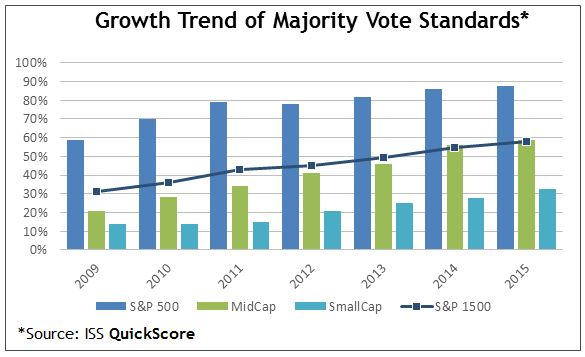
Par exemple, 88 % des entreprises du S&P 500 ont adopté la pratique du vote majoritaire, délaissant ainsi la pratique de la pluralité des voix.

Également, plus de 80 % des entreprises du S&P 500 soumettent leurs administrateurs à des élections annuelles, délaissant ainsi l’habitude des « Staggered Boards » (élections des administrateurs à des périodes différentes).

253092c

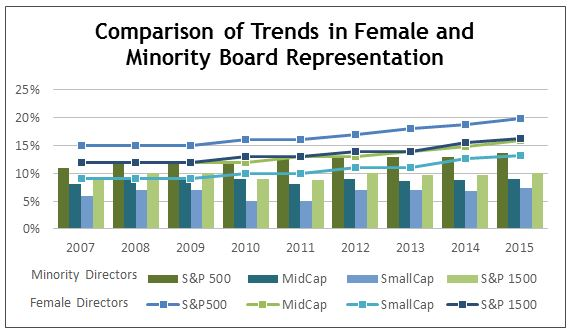
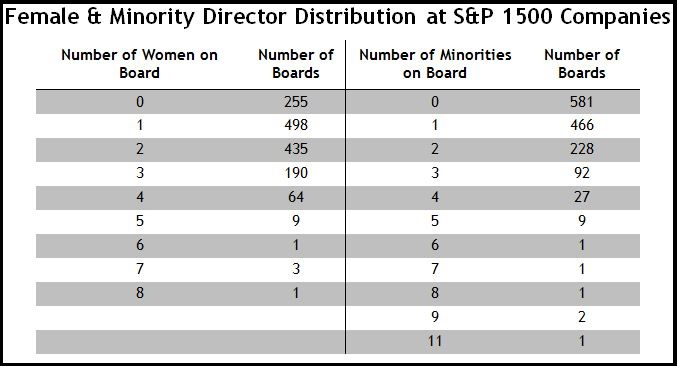
En ce qui concerne la réalité de la diversité des conseils d’administration, on note des progrès continus, mais lents. Ainsi, 98 % des entreprises du S&P 500 ont au moins une femme sur le conseil, et 79 % ont au moins un membre d’une minorité sur le conseil. Au total, environ 20 % de femmes siègent à des conseils d’administration et 17 % des administrateurs proviennent de minorités diverses.

Enfin, l’étude montre que 13,3 % de tous les postes d’administrateurs ont été pourvus par de nouvelles recrues (moins de 2 ans sur le CA).

Je vous invite à jeter un œil aux tableaux qui ponctuent le rapport.

Bonne lecture !


ISS 2016 Board Practices Study


ISS’ latest update of the structure and composition of boards and individual director attributes at Standard & Poor’s U.S. “Super 1,500” companies (i.e., companies in the S&P 500, MidCap 400, and SmallCap 600 indices) found a number of new and continuing trends in board practices and director attributes at these key index companies.

Majority Votes for Directors and Annual Board Elections are the New Normal

Based on analysis of public filings (primarily proxy statements) related to shareholder meetings occurring from July 1, 2014, through June 30, 2015, the study reports that annual board elections and majority vote standards for those elections are now the norm across the S&P 1500. While larger companies initially led the way in adopting these accountability enhancements, the pace of abandoning staggered board terms at smaller companies picked up speed in 2015. Also, Small- and MidCap companies adopted majority vote standards for board elections at a faster pace than their S&P 500 counterparts in 2015—increasing by 4 and 3 percentages points, respectively among the Small- and MidCap firms. For the third consecutive year, well over half of all study companies have majority voting standards, which is now the clear market standard at S&P 500 companies, with over 88 percent of companies in the index having adopted the practice. Only 61 total S&P 500 companies maintain a plurality vote standard, down from 67 last year and 87 in 2013.

5-31-1

There has also been a significant increase over the last five years in the number of companies holding annual elections, both at the S&P 1500 and at each constituent index. The proportion is significantly higher at S&P 500 companies, where it has risen more than 20 percentage points in the last five years. Still, over 60 percent of S&P 1500 companies (and over 80 percent of S&P 500 companies) now hold annual elections for all directors, While the prevalence has increased in the S&P 1500 every year since 2009, the largest jump occurred last year, when it rose from 60 to 64 percent, driven by an 8 percentage point increase at the S&P 500, where only 84 boards now hold staggered elections.

Many companies completed the gradual removals of their classified board structures that had begun in response to a large wave of shareholder proposals offered in a campaign organized by the now defunct Shareholder Rights Project at Harvard Law School. A majority of SmallCap companies held annual elections for the first time in 2014, a trend that has continued, as an additional 2 percent of the index’s companies held annual elections in 2015. Bucking the trend were the MidCap companies, which showed a slight decrease in the proportion holding annual elections in 2015, after steading increases in 2009 through 2014.

Board Diversity

Many corporate governance experts believe that the interplay of different backgrounds and perspectives enhances the effectiveness of boards and facilitates greater long-term corporate success. Some advocates for board diversity believe that a “tone at the top” will penetrate the corporate hierarchy and lead to increased diversity across all ranks of employment.
5-31-2
Companies with larger market caps generally have higher levels of gender and racial/ethnic diversity than those with smaller valuations. As of ISS’ latest analysis, almost all S&P 500 companies have at least one female or minority director, while 90 percent of MidCap boards and 78 percent of SmallCap boards have at least one female or minority member. There has been a market-wide increase over the past five years in board diversity:

Ninety-eight percent of S&P 500 boards have at least one female member and 79 percent have at least one minority, up from 89 and 63 percent in 2010, respectively;

Eighty-four percent of MidCap boards have at least one female member and 53 percent have at least one minority, increased from 74 and 36 percent in 2010, respectively; and

Sixty-nine percent of SmallCap boards have at least one female member and 41 percent have at least one minority, increased from 54 and 22 percent in 2010, respectively.

5-31-3
More than 88 percent of S&P 1500 companies have at least one female or minority director, and a majority of the S&P 1500 have either one female and/or one minority, who, in some instances, are the same individual. Minority women hold 329 directorships, an increase from 279 in 2014. Although this represents an absolute increase, the proportion of S&P 1500 directorships held by minority women has remained at approximately 2.4 percent since 2010.

New Directors

In 2015, 1,833 seats, or about 13.3 percent of all directorships, were filled by directors with less than two years’ tenure and who were elected for the first time in 2014 or 2015 (“new” directors). That compares with about 12 percent of all directorships filled by “new” directors in last year’s analysis, suggesting a slight increase in the turnover rate. The characteristics of these new directors were analyzed to develop a better understanding of what companies may be considering when choosing new director candidates.
5-31-4
New directors are generally younger than directors with tenures of over two years. Also, the average age difference is 5.3 years, an increase from 2014.

Fifty-three percent of new directors serve on only one board, which continues the trend identified in last year’s study, which found that nominating committees are bringing on directors who have no prior board experience. However, a majority of open S&P 500 positions, 56 percent, were filled by a director who sits on at least one other board, which drives the “average” number of outside boards for new directors up to nearly one and underscores the fact that market leading companies seek directors with a track record. New directors are more likely than those with more than two years tenure to be outside hires; 46 percent of all directors joining boards in 2014 and 2015 sit on only one board and are not executives of the companies whose boards they have joined.

Similarly, the percentage of new directors who are female or identified as an ethnic/racial minority continues to exceed the proportion of longer-tenured female- and minority-held S&P 1500 directorships. While the proportion of new directorships held by females has increased for several consecutive years, this momentum seems to be slower for minority directors. Minority directors comprised 16 percent of new directorships in 2015, compared to 10 percent of all new directors in 2014. Female directors filled 27 percent of new directorships in 2015, up from 22 percent in 2014, and 20 percent in 2013. This increase highlights both the overall growth in the number of directorships held by women and the acceleration in the growth of female directorships.

______________________

*This post is based on a recent publication authored by ISS U.S. Research analysts Andrew Borek, Liz Williams, and Rob Yates. Information on how to obtain the full report is available here.

La composition du conseil d’administration | Élément clé d’une saine gouvernance


Les investisseurs et les actionnaires reconnaissent le rôle prioritaire que les administrateurs de sociétés jouent dans la gouvernance et, conséquemment, ils veulent toujours plus d’informations sur le processus de nomination des administrateurs et sur la composition du conseil d’administration.

L’article qui suit, paru sur le Forum du Harvard Law School, a été publié par Paula Loop, directrice du centre de la gouvernance de PricewaterhouseCoopers. Il s’agit essentiellement d’un compte rendu sur l’évolution des facteurs clés de la composition des conseils d’administration. La présentation s’appuie sur une infographie remarquable.

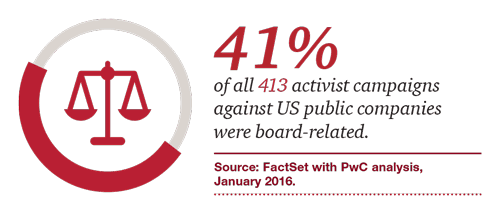
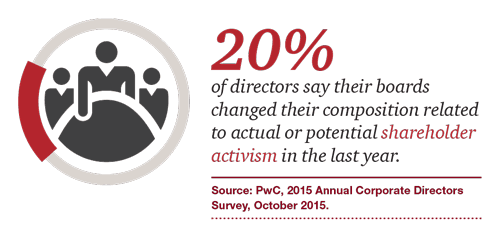
Ainsi, on apprend que 41 % des campagnes menées par les activistes étaient reliées à la composition des CA, et que 20 % des CA ont modifié leur composition en réponse aux activités réelles ou potentielles des activistes.

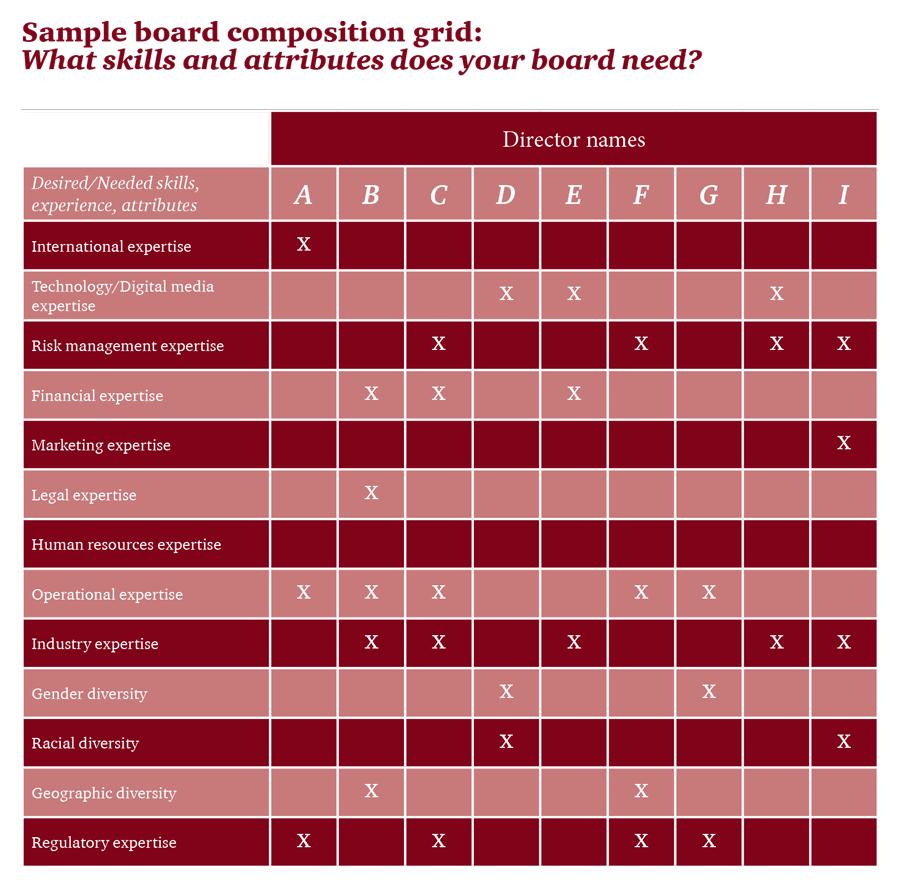
L’article s’attarde sur la grille de composition des conseils relative aux compétences et habiletés requises. Également, on présente les arguments pour une plus grande diversité des CA et l’on s’interroge sur la situation actuelle.

Enfin, l’article revient sur les questions du nombre de mandats des administrateurs et de l’âge de la retraite de ceux-ci ainsi que sur les préoccupations des investisseurs eu égard au renouvellement et au rajeunissement des CA.

Le travail de renouvellement du conseil ne peut se faire sans la mise en place d’un processus d’évaluation complet du fonctionnement du CA et des administrateurs.

À mon avis, c’est certainement un article à lire pour bien comprendre toutes les problématiques reliées à la composition des conseils d’administration.

Bonne lecture !

Investors and Board Composition


sans-titre


In today’s business environment, companies face numerous challenges that can impact success—from emerging technologies to changing regulatory requirements and cybersecurity concerns. As a result, the expertise, experience, and diversity of perspective in the boardroom play a more critical role than ever in ensuring effective oversight. At the same time, many investors and other stakeholders are seeking influence on board composition. They want more information about a company’s director nominees. They also want to know that boards and their nominating and governance committees are appropriately considering director tenure, board diversity and the results of board self-evaluations when making director nominations. All of this is occurring within an environment of aggressive shareholder activism, in which board composition often becomes a central focus.

Shareholder activism and board composition

pwc-1

pwc-2

At the same time, a growing number of companies are adopting proxy access rules—allowing shareholders that meet certain ownership criteria to submit a limited number of director candidates for inclusion on the company’s annual proxy. It has become a top governance issue over the last two years, with many shareholders viewing it as a step forward for shareholder rights. And it’s another factor causing boards to focus more on their makeup.

So within this context, how should directors and investors be thinking about board composition, and what steps should be taken to ensure boards are adequately refreshing themselves?

Assessing what you have–and what you need

In a rapidly changing business climate, a high-performing board requires agile directors who can grasp concepts quickly. Directors need to be fiercely independent thinkers who consciously avoid groupthink and are able to challenge management—while still contributing to a productive and collegial boardroom environment. A strong board includes directors with different backgrounds, and individuals who understand how the company’s strategy is impacted by emerging economic and technological trends.

Sample board composition grid: What skills and attributes does your board need?


pwc-table

In assessing their composition, boards and their nominating and governance committees need to think critically about what skills and attributes the board currently has, and how they tie to oversight of the company. As companies’ strategies change and their business models evolve, it is imperative that board composition be evaluated regularly to ensure that the right mix of skills are present to meet the company’s current needs. Many boards conduct a gap analysis that compares current director attributes with those that it has identified as critical to effective oversight. They can then choose to fill any gaps by recruiting new directors with such attributes or by consulting external advisors. Some companies use a matrix in their proxy disclosures to graphically display to investors the particular attributes of each director nominee.

Board diversity is a hot-button issue

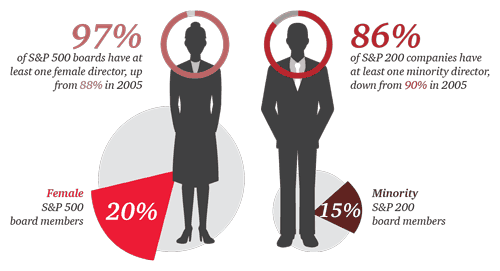
Diversity is a key element of any discussion of board composition. Diversity includes not only gender, race, and ethnicity, but also diversity of skills, backgrounds, personalities, opinions, and experiences. But the pace of adding more gender and ethnic diversity to public company boards has been only incremental over the past five years. For example, a December 2015 report from the US Government Accountability Office estimates that it could take four decades for the representation of women on US boards to be the same as men. [1] Some countries, including Norway, Belgium, and Italy, have implemented regulatory quotas to increase the percentage of women on boards.

Even if equal proportions of women and men joined boards each year beginning in 2015, GAO estimated that it could take more than four decades for women’s representation on boards to be on par with that of men’s.
—US Government Accountability Office, December 2015

According to PwC’s 2015 Annual Corporate Directors Survey, more than 80% of directors believe board diversity positively impacts board and company performance. But more than 70% of directors say there are impediments to increasing board diversity. [2] One of the main impediments is that many boards look to current or former CEOs as potential director candidates. However, only 4% of S&P 500 CEOs are female, [3] less than 2% of the Fortune 500 CEOs are Hispanic or Asian, and only 1% of the Fortune 500 CEOs are African-American. [4] So in order to get boards to be more diverse, the pool of potential director candidates needs to be expanded.

Is there diversity on US boards?


pwc-4

Source: Spencer Stuart US Board Index 2015, November 2015.

SEC rules require companies to disclose the backgrounds and qualifications of director nominees and whether diversity was a nomination consideration. In January 2016, SEC Chair Mary Jo White included diversity as a priority for the SEC’s 2016 agenda and suggested that the SEC’s disclosure rules pertaining to board diversity may be enhanced.

While those who aspire to become directors must play their part, the drive to make diversity a priority really has to come from board leadership: CEOs, lead directors, board chairs, and nominating and governance committee chairs. These leaders need to be proactive and commit to making diversity part of the company and board culture. In order to find more diverse candidates, boards will have to look in different places. There are often many untapped, highly qualified, and diverse candidates just a few steps below the C-suite, people who drive strategies, run large segments of the business, and function like CEOs.

How long is too long? Director tenure and mandatory retirement

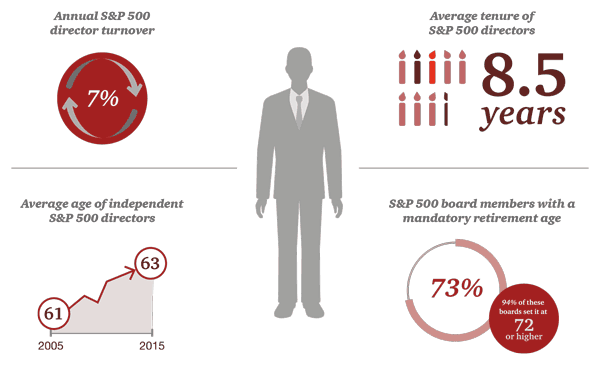
The debate over board tenure centers on whether lengthy board service negatively impacts director independence, objectivity, and performance. Some investors believe that long-serving directors can become complacent over time—making it less likely that they will challenge management. However, others question the virtue of forced board turnover. They argue that with greater tenure comes good working relationships with stakeholders and a deep knowledge of the company. One approach to this issue is to strive for diversity of board tenure—consciously balancing the board’s composition to include new directors, those with medium tenures, and those with long-term service.

This debate has heated up in recent years, due in part to attention from the Council of Institutional Investors (the Council). In 2013, the Council introduced a revised policy statement on board tenure. While the policy “does not endorse a term limit,” [5] the Council noted that directors with extended tenures should no longer be considered independent. More recently, the large pension fund CalPERS has been vocal about tenure, stating that extended board service could impede objectivity. CalPERS updated its 2016 proxy voting guidelines by asking companies to explain why directors serving for over twelve years should still be considered independent.

We believe director independence can be compromised at 12 years of service—in these situations a company should carry out rigorous evaluations to either classify the director as non-independent or provide a detailed annual explanation of why the director can continue to be classified as independent.
— CalPERS Global Governance Principles, second reading, March 14, 2016

Factors in the director tenure and age debate


pwc-3

Source: Spencer Stuart US Board Index 2015, November 2015.

Many boards have a mandatory retirement age for their directors. However, the average mandatory retirement age has increased in recent years. Of the 73% of S&P 500 boards that have a mandatory retirement age in place, 97% set that age at 72 or older—up from 57% that did so ten years ago. Thirty-four percent set it at 75 or older. [6] Others believe that director term limits may be a better way to encourage board refreshment, but only 3% of S&P 500 boards have such policies. [7]

Investor concern

Some institutional investors have expressed concern about board composition and refreshment, and this increased scrutiny could have an impact on proxy voting decisions.

What are investors saying about board composition and refreshment?


pwc-table2

Sources: BlackRock, Proxy voting guidelines for U.S. securities, February 2015; California Public Employees’ Retirement System, Statement of Investment Policy for Global Governance, March 16, 2015; State Street Global Advisors’ US Proxy Voting and Engagement Guidelines, March 2015.

Proxy advisors’ views on board composition—recent developments

Proxy advisory firm Institutional Shareholder Services’s (ISS) governance rating system QuickScore 3.0 views tenure of more than nine years as potentially compromising director independence. ISS’s 2016 voting policy updates include a clarification that a “small number” of long-tenured directors (those with more than nine years of board service) does not negatively impact the company’s QuickScore governance rating, though ISS does not provide specifics on the acceptable quantity.

Glass Lewis’ updated 2016 voting policies address nominating committee performance. Glass Lewis may now recommend against the nominating and governance committee chair “where the board’s failure to ensure the board has directors with relevant experience, either through periodic director assessment or board refreshment, has contributed to a company’s poor performance.” Glass Lewis believes that shareholders are best served when boards are diverse on the basis of age, race, gender and ethnicity, as well as on the basis of geographic knowledge, industry experience, board tenure, and culture.

How can directors proactively address board refreshment?

The first step in refreshing your board is deciding whether to add a new board member and determining which director attributes are most important. One way to do this is to conduct a self-assessment. Directors also have a number of mechanisms to address board refreshment. For one, boards can consider new ways of recruiting director candidates. They can take charge of their composition through active and strategic succession planning. And they can also use robust self-assessments to gauge individual director performance—and replace directors who are no longer contributing.

  1. Act on the results of board assessments. Boards should use their annual self-assessment to help spark discussions about board refreshment. Having a robust board assessment process can offer insights into how the board is functioning and how individual directors are performing. The board can use this process to identify directors that may be underperforming or whose skills may no longer match what the company needs. It’s incumbent upon the board chair or lead director and the chair of the nominating and governance committee to address any difficult matters that may arise out of the assessment process, including having challenging conversations with underperforming directors. In addition, some investors are asking about the results of board assessments. CalPERS and CalSTRS have both called on boards to disclose more information about the impact of their self-assessments on board composition decisions. [8]
  2. Take a strategic approach to director succession planning. Director succession planning is essential to promoting board refreshment. But, less than half of directors “very much” believe their board is spending enough time on director succession. [9] In board succession planning, it’s important to think about the current state of the board, the tenure of current members, and the company’s future needs. Boards should identify possible director candidates based upon anticipated turnover and director retirements.
  3. Broaden the pool of candidates. Often, boards recruit directors by soliciting recommendations from other sitting directors, which can be a small pool. Forward-looking boards expand the universe of potential qualified candidates by looking outside of the C-suite, considering investor recommendations, and by looking for candidates outside the corporate world—from the retired military, academia, and large non-profits. This will provide a broader pool of individuals with more diverse backgrounds who can be great board contributors.

In sum, evaluating board composition and refreshing the board may be challenging at times, but it’s increasingly a topic of concern for many investors, and it’s critical to the board’s ability to stay current, effective, and focused on enhancing long-term shareholder value.

The complete publication, including footnotes and appendix, is available here.

Endnotes:

[1] United States Government Accountability Office, “Corporate Boards: Strategies to Address Representation of Women Include Federal Disclosure Requirements,” December 2015.
(go back)

[2] PwC, 2015 Annual Corporate Directors Survey, October 2015.
(go back)

[3] Catalyst, Women CEOs of the S&P 500, February 3, 2016.
(go back)

[4] “McDonald’s CEO to Retire; Black Fortune 500 CEOs Decline by 33% in Past Year,” DiversityInc, January 29, 2015; http://www.diversityinc.com/leadership/mcdonalds-ceo-retire-black-fortune-500-ceos-decline-33-past-year.
(go back)

[5] Amy Borrus, “More on CII’s New Policies on Universal Proxies and Board Tenure,” Council of Institutional Investors, October 1, 2013; http://www.cii.org/article_content.asp?article=208.
(go back)

[6] Spencer Stuart, 2015 US Board Index, November 2015.
(go back)

[7] Spencer Stuart, 2015 US Board Index, November 2015.
(go back)

[8] California State Teachers’ Retirement System Corporate Governance Principles, April 3, 2015, http://www.calstrs.com/sites/main/files/file-attachments/corporate_governance_principles_1.pdf; The California Public Employees’ Retirement System Global Governance Principles, Updated March 14, 2016, https://www.calpers.ca.gov/docs/board-agendas/201603/invest/item05a-02.pdf.
(go back)

[9] PwC, 2015 Annual Corporate Directors Survey, October 2015. www.pwc.com/us/GovernanceInsightsCenter.

________________________________

*Paula Loop is Leader of the Governance Insights Center at PricewaterhouseCoopers LLP. This post is based on a PwC publication by Ms. Loop and Paul DeNicola. The complete publication, including footnotes and appendix, is available here.

Le fait de siéger à des CA externes augmente-t-il les chances de promotion d’un haut dirigeant dans son entreprise ?


Voici un article très intéressant, récemment publié dans Harvard Business Review par Steven Boivie, Scott D. Graffin, Abbie Oliver et Michael C. Withers, qui montre, de façon convaincante, que, pour un haut dirigeant, le fait de siéger à un CA externe augmente ses chances de promotion dans son entreprise.

Lorsque l’on sait que le travail des administrateurs des entreprises publiques (cotées) est de plus en plus exigeant, l’on peut se demander pourquoi un PDG (CEO) accepte de siéger à un conseil d’administration d’une autre entreprise !

Les auteurs de l’étude ont trouvé des réponses à cette question. Les hauts dirigeants des entreprises de la S&P 1500 qui siègent à d’autres CA augmentent de 44 % leurs chances d’accéder à un poste de CEO dans une entreprise de la S&P 1500, comparativement à leurs collègues qui ne siègent pas à d’autres CA. Et, même s’ils n’ont pas de promotion, la recherche montre que leur rémunération s’accroît de 13 %.

So what do these findings mean for today’s boards of directors and aspiring CEOs? The evidence shows that board appointments increase an executive’s visibility and give him/her access to unique contacts and learning opportunities. Further, these opportunities translate into tangible economic benefits, specifically promotions and raises, which help explain why a sane person would choose to sit on a board.

La recherche d’administrateurs avec un profil de CEO ou de haut dirigeant est de plus en plus fréquente et les firmes de recrutement considèrent que l’obtention de promotions est un signe de leadership notable.

Photo1-petit-poisson

L’étude conclut que, contrairement à la croyance populaire, le fait de siéger à des conseils constitue un atout pour un haut dirigeant, un moyen susceptible d’accroître ses opportunités de carrière.

Il semble bien que le haut dirigeant considère qu’il y a un avantage personnel réel à exercer la fonction d’administrateur dans une autre entreprise. Mais, le CA de l’entreprise sur lequel il siège en retire-t-il un avantage aussi appréciable ?

Ultimately board service is a key professional development tool in grooming potential CEOs that executives and boards alike are beginning to recognize and value.

Je vous invite à lire ce court article du HBR.

Bonne lecture !

Serving on Boards Helps Executives Get Promoted


More than 25 years ago, William Sahlman wrote the HBR article “Why Sane People Shouldn’t Serve on Public Boards,” in which he compared serving on a board to driving without a seatbelt, that it was just too risky—to their time, reputations, and finances—for too little reward.

Board service has always been very demanding. When Warren Buffett retired from Coca-Cola’s board in 2006, he said he no longer had the time necessary. When you consider all of the retreats, travel, reading, meeting prep time, transactions, and committee meetings involved, it is a wonder anyone serves at all.

So why would a busy executive agree to sit on a board? Why is there is a cottage industry of executive search firms focusing on “reverse board searches,” where they proactively work to place executives on outside corporate boards? What do executives gain from serving on boards?

This question was at the heart of a recent study we conducted that is forthcoming at the Academy of Management Journal. In an effort to explore executives’ motivations for serving on boards, we looked at how board service is evaluated in the executive labor market. Specifically we studied whether or not board service increased an executive’s likelihood of receiving a promotion, becoming a CEO, and/or receiving a pay increase.

We hypothesized that being a board director would help an executive in two main ways: First, sitting on a board serves as an important signal or “seal of approval,” for an executive. It means that other people think this executive has potential and value as a result of being selected to serve on a board. Second, board service is an avenue for an executive to gain access to unique knowledge, skills, and connections, so firms actively use external board appointments as a way to groom and develop executives. As Mary Cranston, former CEO and Chairman of Pillsbury, LLP said in an interview, “Being on that board really helped me develop as a CEO because I had another CEO to watch. It was an incredible leadership school for me. On a board you’re together a lot, and you’re working on problems together and you have a shared fiduciary duty, so it creates very tight bonds of friendship.” Similarly, Sempra CEO Debra L. Reed has also said that sitting on the board of another company is “better than an M.B.A.


*Steven Boivie is an associate professor in the Mays Business School at Texas A&M University, Scott D. Graffin is an associate professor at the University of Georgia’s Terry College of Business and also an International Research Fellow at Oxford University’s Centre for Corporate Reputation, Abbie G. Oliver is a doctoral candidate in strategic management at the University of Georgia’s Terry College of Business, Michael C. Withers is an assistant professor of management in the Mays Business School at Texas A&M University.

Gestion des risques liés aux tierces parties | Deloitte


Comment votre organisation peut-elle mieux contrôler les risques liés à ses tiers ? C’est ce que vous apprend ce document de Deloitte dans un numéro du bulletin « À l’ordre du jour du conseil ».

Encore récemment, le risque lié aux fournisseurs se limitait pour ainsi dire à la qualité des produits ou des matières premières fournies ou à la possibilité qu’un fournisseur ne respecte pas ses engagements d’approvisionnement et perturbe ainsi la production. Aujourd’hui, les entreprises sont de plus en plus tenues responsables du comportement de leurs fournisseurs, que ce soit en ce qui a trait aux pratiques en matière de santé, de sécurité et d’environnement, au respect des lois sur le travail et autres règlements, à l’utilisation de la propriété intellectuelle, à l’approvisionnement en matières premières, à la corruption et plus encore. Et comme les clients ne font pas de différence entre une organisation et ses fournisseurs, les actions de tiers peuvent également nuire à la réputation de l’organisation ou à la confiance de ses clients.

Voici un aperçu de ce document, notamment les questions que les administrateurs devraient se poser eu égard aux risques reliés aux entités tierces. On y présente également le point de vue de José Écio Pereira, administrateur de compagnie et associé retraité de Deloitte.

Bonne lecture !

Gestion du risque de l’entreprise étendue

Le risque lié aux entités tierces

L’usine d’un fournisseur s’effondre, faisant des centaines de victimes parmi les travailleurs, dont certains sont des enfants. Des milliers de fichiers contenant des données sur les cartes de crédit de clients et d’autres renseignements financiers confidentiels font l’objet de piratage d’un tiers autorisé à accéder au réseau de l’entreprise. Un fournisseur a utilisé des matériaux contaminés et une vaste campagne de rappel visant certains produits doit être lancée.

Encore récemment, le risque lié aux fournisseurs se limitait pour ainsi dire à la qualité des produits ou des matières premières fournis ou à la possibilité qu’un fournisseur ne respecte pas ses engagements d’approvisionnement et perturbe ainsi la production.


Gestion-des-risques


De nos jours, des lois comme la Foreign Corrupt Practices Act aux États-Unis, la Bribery Act au Royaume-Uni et d’autres encore font en sorte que les entreprises sont de plus en plus souvent tenues responsables des agissements de leurs fournisseurs. De même, les clients ne distinguent pas toujours une entreprise de ses fournisseurs. Pour eux, l’entreprise est celle qui leur fournit une solution ; s’il survient un problème, c’est elle qu’ils tiennent responsable, et c’est donc sa réputation qui est en péril. C’est pourquoi les entreprises doivent maintenant élargir leur surveillance des risques à l’entreprise étendue1 et observer chez leurs tiers fournisseurs les pratiques de santé, de sécurité et d’environnement, le respect des lois sur le travail et autres règlements, l’utilisation de la propriété intellectuelle, l’approvisionnement en matières premières, la corruption et plus encore.

Questions que les administrateurs devraient poser

(1) Notre entreprise a-t-elle évalué de manière exhaustive son risque lié aux tiers et, si c’est le cas, quelles en sont les composantes les plus déterminantes pour l’entreprise à l’heure actuelle ?

(2) Quels sont les tiers susceptibles d’entraver le plus gravement la capacité de l’entreprise à atteindre ses buts et objectifs stratégiques ?

(3) Que faisons-nous pour gérer et surveiller de manière proactive le risque et son évolution au sein de notre entreprise étendue ? Quels outils de gestion du risque utilisons-nous ?

(4) Qui est responsable de la gestion du risque lié aux tiers dans notre entreprise ?

(5) À quelle fréquence la direction informe-t-elle le conseil d’administration de son évaluation des risques de tiers et du processus mis en place pour atténuer ces risques ? Cette information est-elle suffisamment détaillée et présentée en temps opportun ?

Le point de vue d’un administrateur

José Écio Pereira est membre des conseils d’administration de Votorantim Cimentos, Fibria et Gafisa et a été membre du conseil de BRMalls ; il préside également le comité d’audit de Votorantim Cimentos et de Gafisa. Il est le propriétaire fondateur de JEPereira Consultoria em Gestão de Negócios et a été associé, maintenant à la retraite, de Deloitte Brésil.

Le risque lié aux entités tierces figure-t-il à l’ordre du jour des conseils d’administration ?

Les conseils dont je connais le fonctionnement effectuent une évaluation du risque tous les trois ou quatre mois. Le risque lié aux entités tierces à proprement parler n’est pas un point distinct à l’ordre du jour, mais nous l’abordons dans notre analyse des risques. Ceci dit, il est clair que de nos jours, les conseils accordent plus d’attention au risque lié aux tiers qu’il y a à peine deux ans. Au Brésil, c’est principalement à cause de la loi anticorruption (Clean Company Act) de 2014. En vertu de cette loi, les entreprises peuvent être tenues responsables des activités illégales ou de la conduite contraire à l’éthique de leurs tiers fournisseurs.

Depuis que cette loi est en vigueur, les administrateurs examinent de beaucoup plus près les risques associés aux tiers fournisseurs des entreprises qu’ils supervisent. Ils examinent les pratiques de leurs fournisseurs en matière de conditions de travail, de normes pour les employés, de mesures de santé et de sécurité et d’autres facteurs pour s’assurer que tous respectent les normes de l’entreprise qui a fait appel à eux. La santé financière des fournisseurs est un autre paramètre fort important, surtout au vu de la situation économique actuelle au Brésil. Les entreprises veulent être sûres que leurs fournisseurs paient leurs impôts et respectent leurs obligations juridiques, en particulier dans leurs relations avec leurs employés, et qu’ils seront à même de poursuivre leur exploitation.

Les administrateurs examinent-ils les relations avec des tiers dans le contexte du cyberrisque ?

Je pense que les entreprises dont les systèmes sont connectés avec ceux de tiers fournisseurs à des fins d’approvisionnement ou de logistique sont conscientes de l’existence du cyberrisque et prennent les mesures nécessaires pour s’en prémunir. Mais ces mesures sont généralement liées aux échanges de produits et de services.

Dans une perspective plus vaste, je dirais que la plupart des entreprises ne disposent pas de systèmes d’information appropriés pour gérer leurs relations avec des tiers. Les systèmes de la plupart des entreprises ne sont pas assez sophistiqués pour se connecter aux systèmes des fournisseurs ; les entreprises ont recours à divers outils pour gérer leurs relations avec des tiers et souvent, ces outils ne sont pas très bien intégrés entre eux. Les relations sont par exemple gérées à l’aide de plusieurs systèmes, y compris des chiffriers et des outils manuels qui ne sont pas du tout conçus pour cet usage.

À qui devrait revenir la responsabilité des tiers fournisseurs ?

Le conseil d’administration doit jouer un rôle de supervision et faire en sorte que les cadres supérieurs disposent d’un processus de gestion du risque lié aux tiers.

Au Brésil, c’est souvent le service de l’approvisionnement qui reste responsable des problèmes opérationnels et qui vérifie que les produits et les services sont bien fournis selon les modalités du contrat conclu avec le tiers fournisseur. De plus, nombre d’entreprises mettent aussi sur pied une fonction particulière chargée de la gestion des contrats conclus avec des tiers. La plupart des entreprises brésiliennes entretiennent plusieurs relations avec des tiers : services alimentaires, sécurité, transports, fabrication. Toutes sont essentielles au fonctionnement d’une entreprise au quotidien. Les entreprises sont donc nombreuses à affecter davantage de ressources à la gestion efficace des contrats.

Certaines entreprises surveillent constamment leurs fournisseurs pour s’assurer que les contrats sont observés à la lettre. Bon nombre exigent que leurs fournisseurs autoévaluent leur conformité contractuelle, en plus d’effectuer des audits périodiques et d’autres tests afin de vérifier le respect des contrats. Toutes ces mesures représentent un travail colossal et parfois, il faut y consacrer une fonction administrative particulière.

Je vais vous relater un exemple authentique. L’une des sociétés avec lesquelles je collabore est en train de construire de nouvelles installations de grande envergure. C’est un investissement de près de 2 milliards de dollars américains, et c’est un projet d’environ : 18 mois. À l’heure actuelle, la construction vient juste de commencer. Plusieurs fournisseurs y travaillent, que ce soit pour la sécurité du chantier ou pour l’approvisionnement en matériel ou son installation.

L’entreprise a mis sur pied un comité directeur de projet qui comprend entre autres des membres de l’équipe de direction. Ce comité se réunit au moins une fois tous les : 15 jours, et les relations avec les fournisseurs reviennent justement sans cesse à son ordre du jour. C’est beaucoup plus qu’une question de diligence raisonnable ; le comité procède aussi au suivi constant des tiers fournisseurs.

Le comité directeur présente chaque mois au conseil l’état d’avancement du projet. Le rapport d’avancement consigne tout ce qui a trait aux tiers fournisseurs : le défaut de verser les retenues sur salaires des employés, de payer des impôts fonciers ou des avantages sociaux, la violation des règles de santé et de sécurité sur le chantier, aussi bien que les problèmes opérationnels comme le non-respect des échéances par un fournisseur ou la qualité insuffisante des services qu’il a rendus. Lorsque des problèmes surgissent, le comité de projet les reporte sur la « carte du risque » du projet, et la direction prend les mesures de suivi nécessaires, y compris l’application des pénalités contractuelles, le cas échéant.

Les entreprises devraient-elles aussi définir leurs propres normes déontologiques à l’endroit des tiers fournisseurs ?

Après l’entrée en vigueur de la loi brésilienne anticorruption, la plupart des entreprises ont passé en revue leurs normes déontologiques et leur code de conduite ; l’une des grandes nouveautés, c’est qu’elles y ont ajouté des procédures et des règles qui s’adressent aux tiers fournisseurs.

Par le passé, toutes les activités encadrant les règles de déontologie, comme la formation et les ateliers, étaient entreprises dans une perspective interne. Les normes s’appliquaient au personnel de l’entreprise, mais ne dépassaient pas les limites de celle-ci pour viser également les fournisseurs externes. Maintenant, la portée s’est élargie et les règles régissant les employés, les mesures de santé et de sécurité, les conditions de travail, l’obéissance aux lois, etc., englobent aussi les tiers fournisseurs. Les entreprises ont également étendu leurs programmes de formation et invitent leurs fournisseurs à leurs séminaires et ateliers où seront expliqués les règles et les processus de surveillance.

L’utilisation des médias sociaux par les entreprises


Il existe peu de recherche sur les stratégies utilisées par les entreprises publiques (dans ce cas-ci l’indice S&P 1500) eu égard à l’adoption des réseaux sociaux pour divulguer de l’information aux investisseurs.

L’étude dont il est ici question a été réalisée par une équipe de chercheurs et elle a été publiée dans le Harvard Law School Forum par Matteo Tonello*, directeur du Conference Board. Elle montre que plus de la moitié des entreprises utilisent Twitter pour relayer différents types d’informations (principalement de nature financière) auprès d’investisseurs actuels ou potentiels.

Tout le monde reconnaît l’impact phénoménal des médias sociaux pour communiquer nos messages, instantanément, à l’échelle planétaire ; l’étude démontre que les entreprises ont également pris le virage et qu’elles utilisent abondamment les médias sociaux dans toutes les sphères des activités relatives aux affaires.

Mais, comment les entreprises utilisent-elles les réseaux sociaux pour communiquer plus efficacement leurs résultats financiers auprès de leurs investisseurs ? Comment ces entreprises profitent-elles des médias sociaux pour améliorer leur image de marque ? Quelles sont les conséquences non anticipées de la diffusion d’information financière par l’intermédiaire de Twitter ?

Avec les médias traditionnels, les organisations sont très dépendantes des services de presse, si bien que les informations financières ne sont généralement pas bien ciblées et que les entreprises ne savent pas si les investisseurs actuels ou futurs ont bien reçu l’information.

Les auteurs recommandent l’utilisation de courts messages dans un média tel que Twitter, avec un lien vers un communiqué de presse ou vers le site de l’entreprise. La recherche montre également que la divulgation de l’information financière aux investisseurs en utilisant ce moyen peut engendrer une perte de contrôle du message !

Aussi, l’étude montre que les organisations sont moins susceptibles de divulguer leurs résultats financiers via Twitter lorsque les profits ne satisfont pas les attentes des analystes. Les entreprises utilisent essentiellement Twitter pour divulguer les bonnes nouvelles. Cela ne surprendra personne, mais ce comportement illustre le manque de transparence de plusieurs entreprises.

Également, l’étude montre que les grands investisseurs réagissent plus rapidement aux tweets liés aux résultats financiers.

Enfin, les résultats indiquent que les retweets d’informations négatives ont une portée virale et qu’ils génèrent une couverture négative dans les médias traditionnels.

Si vous souhaitez approfondir vos connaissances sur la diffusion d’informations par les entreprises publiques via les médias sociaux, je vous invite à lire ce court extrait de l’étude.

Bonne lecture !


Corporate Use of Social Media


While companies devote considerable effort to creating and managing social media presences, little is known about how they use social media to communicate financial information to investors. This report examines the use of social media by S&P 1500 companies to disseminate financial information and the response from investors and traditional media. The findings show that companies use social media to overcome a perceived lack of traditional media attention and that social media usage improves the company’s information environment. There is also evidence that, in contrast with other types of company communications, the beneficial effects of social media on the company’s information environment are offset when the investor-focused social media communications are disseminated by other social media users. The findings are relevant for managers and boards establishing corporate social media disclosure policies, since they suggest that companies may benefit from developing different approaches to disseminating positive versus negative earnings news.

Social media has transformed communications in many sectors of the US economy. It is now used for disaster preparation and emergency response, security at major events, and public agencies are researching new uses in geolocation, law enforcement, court decisions, and military intelligence. Internationally, social media is credited for organizing political protests across the Middle East and a revolution in Egypt. In the business world, social media has revolutionized sales and marketing practices and developed into a powerful recruiting and networking channel.

puzzle-medias-sociaux

Conventionally, if a company wanted to publicize investor-related information such as an earnings announcement, it would do so by sending a press release to intermediaries such as newswire services, equity research databases, and brokerage firms. A company would not know if or when any of its existing or prospective investors received the information. In contrast, with social media platforms such as Twitter, a company can send one or more short messages directly to a known number of followers with a link to a press release on its corporate website. As such, a company can use Twitter to target its news dissemination, increase the speed and flexibility of the news dissemination, and reduce information acquisition costs for its investors and the traditional media outlets that follow it.

Little research exists, however, on how firms use social media to communicate financial information to investors and how investors respond to information disseminated through social media, despite firms devoting considerable effort to creating and managing social media presences directed at investors. While social media is generally viewed as an opportunity to improve investor communications and increase visibility, the authors hypothesize that disseminating investor communications via social media could also result in the company not retaining full control over its financial communications. This concern stems from the viral nature of social media—even though social media allows a company to connect more easily with its investors, it also allows investors to connect more easily with the company, with each other, and with individuals who do not directly follow the company and are likely less informed about the company’s prior financial communications. As a result, a company’s investor communications via social media can potentially spread to uniformed individuals in a way that creates adverse consequences for the company.

The Adoption Rate of Social Media to Disseminate Information to Investors

To collect data on social media usage, the authors identify whether each company in the S&P 1500 Index had a social media presence on Twitter, Facebook, LinkedIn, Pinterest, YouTube, and Google+ as of January 2013 by visiting each corporate website and looking for icons or links to the company’s social media sites. Twitter and Facebook are the two most frequently adopted social media platforms for corporations. The data show that adoption of Twitter and Facebook exceeds 47 percent and 44 percent, respectively, and is highest for customer-facing industries such as meals, retail, books and services (each over 65 percent) and lowest for industrial sectors such as oil (roughly 20 percent) and steel (roughly 14 percent). Corporate adoption is much lower for the other social media platforms, suggesting that they are less conducive for delivering typical corporate communications.

The authors also collect data on when companies joined Twitter or Facebook by searching for the earliest tweets or posts. The time trend in corporate social media adoption for Facebook and Twitter is illustrated in Figure 1. The earliest adopters of Facebook joined in November 2007 and the first set of firms to create Twitter accounts did so in May 2008. By early 2013, the corporate adoption rate of Twitter surpassed the rate for Facebook. By the end of the data collection period, 51 percent of the S&P 1500 companies had adopted one or the other, with Twitter appearing to edge out Facebook slightly as the preferred social media platform for companies.

tcb-1

Since social media adoption does not necessarily imply that social media is used to disseminate information to investors, which is the focus of the study, the next step is to analyze what types of investor-focused information are disseminated over social media. Since the data suggest that Twitter is the preferred social media platform, it is the focus of this analysis. Quarterly earnings-related tweets are the most prevalent type of investor-focused tweets, far outnumbering tweets related to executive turnover, dividends, board of directors, and even new products and customers. The frequency of each type of investor-related tweet is summarized in Table 1.

tcb-3

The number of firm-quarters with earnings announcements on Facebook (5.7 percent) is approximately half the number on Twitter (11.8 percent), suggesting that the preference for Twitter is even stronger when it comes to earnings news. An overview of the corporate use of Twitter and Facebook is illustrated in Figure 2.

tcb-2

Which Companies Use Social Media and What Is The Capital Market Response?

The consequences of social media usage are identified by combining the detailed information on Twitter usage with other data on stock market outcomes and financial statement data. Using Twitter, rather than other social media data, is advantageous because 1) earnings announcements have been shown in prior work to be of first-order importance to investors, 2) the information content of earnings announcements can be controlled for more effectively than the information content of other financial disclosures, and 3) the precise time that earnings announcements were disseminated through Twitter can be identified. The analyses address four related research questions, which are described in the following subsections:

What Types of Companies Disseminate Earnings through Social Media?

An investigation of the factors associated with the choice to disseminate earnings news through Twitter finds that companies that tweet earnings have less traditional media coverage and tend to issue more press releases than those that do not use Twitter. These findings suggest that companies use social media along with other firm-initiated communications in response to a perceived lack of traditional media coverage. The analysis also shows that larger companies are more likely to use Twitter to disseminate earnings news, which is contrary to the notion that smaller companies benefit more from using social media.

Are Companies Strategic in their use of Social Media?

The authors investigate whether companies strategically disseminate earnings news using Twitter by examining whether there is differential usage of Twitter based on the direction of the earnings news (i.e., positive versus negative earnings news). They find that companies are less likely to disseminate earnings news through Twitter when the earnings miss the consensus forecast and the magnitude of the miss is larger. When the sample is split between companies that consistently use Twitter versus those that do not, these results are driven by this latter group. In other words, it appears that there is a subset of companies that are sporadic in their Twitter usage, and that these companies use Twitter strategically to disseminate positive earnings news.

How does the Capital Market Respond to the Corporate Use of Social Media?

The capital market response to social media dissemination is investigated by looking at intra-day and three-day changes in capital market measures related to price, volume, and spreads. There is a reduction in bid-ask spreads when the company tweets earnings news and when more followers receive the earnings announcement tweet. [1]

Modest price- and volume-based responses are found to earnings announcements disseminated over Twitter during three-day earnings announcement windows. However, when short-window intraday tests focused on companies that tweet earnings news during market hours are used, both trading volume and trade size respond to earnings tweets. There is a significant increase in the mean and median abnormal volume, primarily due to an increase in large trades. Therefore, while social media is commonly viewed as a dissemination channel that provides timely access to information for all investors, the results suggest that larger investors react more quickly to earnings-related tweets.

Does Social Media Influence Traditional Media Coverage?

The authors investigate whether there are adverse consequences to the company from non-firm initiated social media disseminations by examining whether retweets negatively affect the company’s information environment and its coverage by traditional media. In contrast with the evidence for tweets, there is an increase in information asymmetry when the company’s earnings announcement tweets are retweeted to individuals who do not follow the company (i.e., the follower’s followers). Media coverage is also adversely affected by retweet activity. While more retweets are associated with more coverage in traditional media, this association is entirely attributable to negative media coverage. This finding suggests that retweets of earnings information increase negative media coverage, but have no effect on positive media coverage.

Conclusion

The findings shows that the usage of social media by corporations has grown dramatically over a relatively short period of time, from less than 5 percent of S&P 1500 companies in 2008 to more than 50 percent in 2013. This trend suggests that social media usage for communicating with investors has the potential to become an integral part of many companies’ disclosure policies. The findings show that even in the absence of the Securities and Commission’s approval of social media as a channel for investor communication, companies used it to disseminate a variety of information, including earnings news, board and executive changes, new contracts, and dividends.

Overall, the findings demonstrate that social media usage improves the company’s information environment, consistent with the notion that it improves investor communications. However, the benefits are offset when the company’s disclosures are disseminated by other social media users, consistent with the notion that there are potential adverse consequences to the company’s information environment that derive from the viral nature of social media. This finding suggests that an appropriate social media policy for investor communications likely differs from social media usage for other business purposes, such as marketing campaigns, in which companies often want to generate viral reactions to social media dissemination. The results also suggest that companies that adopt social media disclosure policies benefit from developing different approaches to disseminating positive versus negative earnings news. These conclusions are relevant for companies, managers, and boards of directors that are establishing social media disclosure policies.

Endnotes:

[1] The bid-ask spread is the difference between the price that someone is willing to pay for a security at a specific point in time (the bid) and the price at which someone is willing to sell (the ask).

_____________________________

*Matteo Tonello* is managing director at The Conference Board, Inc. This post relates to an issue of The Conference Board’s Director Notes series by Michael Jung, James Naughton, Ahmed Tahoun, and Clare Wang.

Les firmes de conseillers en rémunération contribuent-elles à la mise en place de plans salariaux excessifs des PDG ?


Avez-vous confiance dans les conseillers en rémunération pour faire des propositions salariales qui reflètent vraiment la contribution des dirigeants, et qui sont nécessaires pour la rétention des personnes ?

Dans quelle mesure ceux-ci sont-ils responsables de l’augmentation, souvent excessive, des rémunérations des dirigeants ?

Une étude, à laquelle le professeur Omesh Kini de Georgia State University a contribué, montre que, bien que les consultants soient embauchés par les comités de ressources humaines des CA, ceux-ci peuvent subir l’influence indirecte de la direction.

L’auteur décrit différentes approches de firmes de conseillers dans l’établissement des plans de rémunérations des dirigeants. Les firmes prétendent se différencier en proposant des « packages » de rémunération censés aligner les objectifs des actionnaires sur ceux des administrateurs. Les consultants sont sensibles aux effets du « say on pay » et, par conséquent, tentent d’élaborer des programmes de rémunération bien étoffés.

Plusieurs auteurs avancent que les firmes de conseils en rémunération ont tendance à utiliser des échantillons de comparaisons salariales susceptibles de justifier des rémunérations élevées, sinon excessives. Les auteurs suggèrent que les consultants souhaitent obtenir d’autres contrats avec l’entreprise (« repeat business ») et, en ce sens, elles agissent en fonction de leurs intérêts d’affaires.

L’étude montre que, contrairement à la croyance populaire, les firmes de conseillers en rémunération n’opèrent pas de façon très différente les unes des autres. En réalité, elles ne se distinguent pas par des approches particulières.

Les résultats de l’étude montrent que le choix de la firme de consultants a peu d’importance lorsque l’entreprise est reconnue pour ses solides mécanismes de gouvernance. En revanche, si la gouvernance de l’entreprise laisse à désirer (plusieurs administrateurs non indépendants, comité de RH peu soucieux, PDG omniprésent au CA, manque de leadership du président du conseil, CA peu informé, etc.), les firmes de consultants en rémunération sont plus enclines à proposer des plans salariaux généreux.

Les conclusions de cette étude indiquent que les mécanismes de gouvernance sont les facteurs les plus révélateurs dans l’établissement d’une rémunération juste et adéquate et que le choix d’une firme de conseillers particulière est très secondaire, sinon sans réels effets.

Vous trouverez, ci-dessous, un résumé de l’article paru récemment sur le forum du Harvard Law School.

Bonne lecture !

Do Compensation Consultants Have Distinct Styles ?


In our paper, Do Compensation Consultants have Distinct Styles?, which was recently made public on SSRN, we investigate whether the choice of a specific compensation consultant affects the compensation level and structure of top managers. This question is crucially important because existing studies that examine the compensation of CEOs show that compensation schemes influence their behavior and, consequently, impact firm economic outcomes. Compensation consultants are typically hired by the board of directors’ compensation committee to help craft compensation policies for the top managers of the corporation. Although they serve at the behest of the board, consultants can imprint their own distinct styles in fashioning compensation policies for a firm. We examine whether individual compensation consultants influence compensation policies in unique ways, i.e., exhibit distinct “styles,” after controlling for the known economic determinants of these policies.

Compensation consultants strive to signal distinct styles in a positive manner via their own advertising. For example, Towers Watson claims to “bring a unique portfolio of resources” to the table, with an emphasis on aligning board actions with shareholders (e.g., avoiding “say on pay” disputes). [1] Conversely, the media has reported that consulting advice varies little. For example, Towers Perrin was accused in 1997 of giving nearly identical reports on workplace diversity to multiple consulting clients across different industries. [2] Towers Perrin’s response was that all of the clients reported in the article faced similar economic forces and, therefore, received similar advice. [3] Thus, the anecdotal evidence on consultant style is mixed.

cadres

Compensation consultants have been in the direct line of fire from academics, board members, and policy makers. For example, Bebchuk and Fried (2014) take the view that managers will influence the employment of consultants who are likely to recommend higher pay and use their advice to justify excessive compensation. They further argue that compensation consultants, driven by their cross-selling incentives and/or desire to obtain repeat business, design compensation plans that provide excessive pay to managers. Thus, they suggest that compensation consultants worsen, rather than alleviate, agency problems within firms. Board members also claim that compensation consultants are to blame for spiraling CEO pay (Workforce, February 7, 2008). Finally, the former SEC Commissioner Roel C. Campos in a speech stated, “Another significant driver of excessive CEO compensation is the use of compensation consultants.” He goes on to add, “It is extremely difficult to avoid using high comparables, and consultants can pretty much find high comparable income data to support paying a high amount to the CEO. This is the case even if the consultant reports directly to the board.”

Thus, it is an open question whether individual compensation consultants: (i) have distinct styles and managers/boards hire consultants with a specific style, (ii) do not have distinct styles, but instead give compensation advice based purely on economic characteristics, and (iii) respond in a distinct manner to the incentives that arise from the governance environment of the client firm and their own self-interest. We investigate these issues in our paper. In the process, we attempt to shed light on whether compensation consultants facilitate compensation arrangements that reflect a competitive equilibrium in the level of pay and an efficient equilibrium in the incentives provided by optimal contracts (the “efficient” view) or that compensation contracts are written by captive boards and pliant compensation consultants to enhance the welfare of powerful CEOs (the “agency” view).

Our empirical tests detect little evidence suggesting that individual consultants have their own distinct styles. This evidence can be interpreted in two different ways. One possibility is that compensation consultants do not have any specific style and are perfect substitutes for each other. Consequently, the choice of compensation consultant will not matter much because their compensation advice will be grounded in the economic determinants of compensation level and structure and, thus, will be quite similar. An alternative possibility is that compensation consultants do not have distinct styles, but will work in their own self-interest by reacting to the incentives provided by the hiring firm. We distinguish between these views by finding style-like effects for the subsample of client firms with weak governance mechanisms, but not for the subsample of client firms with strong governance mechanisms. These results suggest that the choice of individual consultant does not matter in firms that have strong governance mechanisms. For the weak governance firms, we find that the style-like effects are largely driven by firms that hire consultants who do not have any non-compensation related businesses. In this subsample, both the lead return on assets and Tobin’s q for their client firms are significantly lower for consultants who recommend a higher salary or higher salary percentage as a proportion of total compensation. We also document style-like effects for the subsample of client firms with whom the consultant has existing business relationships unrelated to compensation consulting (conflicted consultants). Further, when these conflicted consultants recommend higher equity-based compensation, the client firms’ values as measured by their lead Tobin’s q are significantly lower and that these client firms tend to have higher accruals.

Our overall conclusion is that it does not matter which compensation consultant is hired by client firms with strong governance mechanisms in place because they will get similar advice based on their economic characteristics and environment. We conjecture that these client firms may still decide to choose a more reputable consultant because of the stronger certification role it plays, but they will likely have to pay higher fees for the services of this consultant. However, consistent with the Bebchuk and Fried (2104) view that consultants can aggravate agency problems within firms, we do observe style-like effects and some resultant perverse outcomes when there is greater potential for managers to take actions in their self-interest and/or when consultants have weaker incentives to provide objective advice. Thus, based on our subsample analysis, we find evidence consistent with both the “efficient” and “agency” views of compensation contracts.

The full paper is available for download here.

__________________________

Endnotes:

[1] See Towers Watson’s 2015 brochure, “Putting Clients First.”
(go back)

[2] “Familiar Refrain: Consultant’s Advice on Diversity was Anything But Diverse…” Wall Street Journal, 3/11/1997.
(go back)

[3] “TP responds to WSJ allegations.” Consultants News 27, 4/1/1997.
(go back)

Les attentes à l’égard du rôle des administrateurs sont-elles irréalistes ?


Harvard Business Review vient de publier un excellent commentaire sur les attentes irréalistes exercées sur les conseils d’administration par les actionnaires, les autorités réglementaires, les investisseurs institutionnels et le public en général.

L’article des professeurs* Steven Boivie, Michael Bednar et Joel Andrus identifie trois obstacles qui empêchent les administrateurs de jouer adéquatement leurs rôles.

(1) La plupart des administrateurs sont également impliqués dans plusieurs autres fonctions de direction ou d’administration dans d’autres organisations.

(2) Les administrateurs ne doivent pas se mêler directement des affaires de la direction des entreprises.

(3) La complexité des grandes entreprises est telle qu’il est impossible pour un groupe d’administrateurs se réunissant environ dix fois par année de bien jouer leur rôle de surveillance.

Les auteurs suggèrent trois moyens pour lever, un tant soit peu, les barrières qui restreignent l’efficacité des administrateurs dans l’exécution de leurs rôles et responsabilités.

Je vous invite à prendre connaissance des conclusions de leur étude publiée dans Academy of management Annals.

Bonne lecture !


Boards Aren’t the Right Way to Monitor Companies


One of the key functions of a board of directors is to oversee the CEO to ensure that shareholders are getting the most out of their investment. This idea has led to regulation such as the Sarbanes-Oxley Act (2002), as well as requirements by the NYSE and NASDAQ that boards have a majority of independent directors and that members on the audit committee have financial expertise. Such rules rest on the premise that if we can just structure the board properly, management misconduct can largely be prevented. But is this a realistic expectation for directors? Maybe not.

1742912880_B978336891Z_1_20160408112809_000_G9C6I65NN_4-0Over the past few years there has been a growing gap between what shareholders and regulators expect of boards and what academic research shows they are capable of. For instance, consider what it means to be a director of a company like General Electric. GE states, “The primary role of GE’s Board of Directors is to oversee how management serves the interests of shareowners and other stakeholders.” However, GE’s annual revenues last year were $117 billion, and it had over 300,000 employees. The company provides services in a myriad of industries, such as health care, water treatment, aviation, and financing.

……

Taken together, much of the research we reviewed shows that these barriers are so prevalent and significant that consistent monitoring just isn’t very likely. Even when boards are filled with capable, motivated directors, we believe that there are simply too many barriers that prevent them from effectively protecting shareholders. In order to gain the full value from a board, we believe that shareholders and regulators need to focus on what boards can do, and then recalibrate their expectations.

First, we need to stop blaming boards for every failure. Too often the press, shareholders, and legislators blame corporate governance failures on directors, suggesting are unmotivated or unwilling to do their job properly. This was illustrated in 2012 when Groupon’s board came under fire for the company revising its earnings. JPMorgan Chase directors were similarly criticized for not preventing a $6 billion trading loss in the company’s investment office back in 2013.

Boards can do a better job in some cases, but these types of criticisms are often misguided. We have found that most directors are hardworking and capable — they’re just placed in a context that makes it virtually impossible for them to do what is expected of them.

Second, we need to focus more on boards’ ability to provide expert advice to CEOs based on their significant knowledge and experience. Board members often are able to provide insights that top executives may not have considered. Going back to GE’s board, most of the directors have expertise in a specific industry and can therefore draw on that experience to connect managers to external resources and knowledge that can benefit the firm. In addition to providing expert advice, boards can take a much more active role in guiding firms during times of crisis, such as when a CEO is being replaced, when the company is in financial distress, or when there is a significant merger or acquisition under consideration.

Third, if shareholders and regulators insist that boards must monitor, then we need to do a better job of removing the barriers in their way. For instance, if external job demands make it impossible for a director to devote enough time and mental energy to their duty as a director, perhaps we need to change our perception that the best directors are active CEOs of other firms. Maybe we also need to work to promote cultural change within boards through increased sharing of information and by using technology to allow them to meet more frequently.

Boards can and do play an important role in the success of companies. Instead of criticizing them for not meeting impractical expectations, we should value them sharing knowledge, providing advice, and lending legitimacy to firms by virtue of their reputations in the industry.

____________________________

Steven Boivie is an associate professor in the Mays Business School at Texas A&M University. He received his Ph.D. in strategic management from the University of Texas at Austin.

Michael Bednar is an associate professor of Business Administration at the University of Illinois.

Joel Andrus is in the Mays Business School at Texas A&M University.

Les entreprises sont-elles sujettes à trop de règles de conformité ?


Voici un article de Sean J. Griffith, professeur de droit à la Fordham Law School, paru sur le forum du Harvard Law School qui montre toute l’importance que revêt aujourd’hui la gouvernance de « conformité ».

Bien entendu, le rôle des autorités réglementaires, ainsi que les nombreuses législations affectant la gouvernance des entreprises, sont des facteurs contribuant à l’accroissement du fardeau de la conformité.

On peut difficilement imaginer que les pressions à la conformité iront en diminuant. Les entreprises s’adaptent donc aux nouvelles exigences en créant de nouveaux départements dirigés par des chefs de la conformité (Chief Compliance Officer). L’article analyse les effets positifs et négatifs de ce virage.

En ce qui me concerne, je pense que l’on doit faire de grands efforts pour simplifier la gestion de conformité, car il me semble que celle-ci prend une place beaucoup trop importante.

Bonne lecture !

Corporate Governance in an Era of Compliance


conseil_strategie_si-conformite_reglementaire


Much of what scholars and practitioners think of as core corporate governance—the oversight and control of internal corporate affairs— is now being subsumed by “compliance.” Although compliance with law and regulation is not a new idea, the establishment of an autonomous department within firms to detect and deter violations of law and policy is. American corporations are at the dawn of a new era: the era of compliance.

Over the past decade, compliance has blossomed into a thriving industry, and the compliance department has emerged, in many firms, as the co-equal of the legal department. Compliance is commonly headed by a Chief Compliance Officer (CCO) with a staff, in large firms, of hundreds or thousands. Moreover, although the CCO reports to the board, compliance is not wholly subordinate to the board. Boards cannot neglect the compliance function or choose not to install and maintain the function on par with industry peers. Furthermore, once compliance officers generate information through monitoring and surveillance, it is beyond a reasonable board’s authority to stop them. Compliance is thus under the board, but its authority comes from somewhere else.

Unlike other governance structures, the origins of compliance are exogenous to the firm. The impetus for compliance does not come from a traditional corporate constituency. It does not come from shareholders, managers, employees, creditors, or customers. It comes from the government. Compliance is a de facto government mandate imposed upon firms by means of ex ante incentives, ex post enforcement tactics, and formal signaling efforts. Moreover, in imposing compliance on firms, the government is not simply making rules that firms must follow, as it does when it passes new laws and regulations, nor is it adjusting its traditional tools—the amount of enforcement and the size of sanctions—to assure compliance with existing law and regulation. Instead, through compliance, the government dictates how firms must comply, imposing specific governance structures expressly designed to change how the firm conducts its business.

At the level of theory, the contemporary compliance function subverts the notion that corporate governance arrangements both are and ought to be the product of a bargain between shareholders and managers. Compliance rewrites Ronald Coase’s famous passage on the internal organization of firms. Compliance officers come into an organization not necessarily (or not entirely) at the behest of an “entrepreneur-co-ordinator, who directs production,” but rather pursuant to the directive of a government enforcer. Seen through the prism of compliance, the corporation no longer resembles a nexus of contracts but rather a real entity, subject to punishment and rehabilitation at the pleasure of a sovereign. Compliance thus rejects mainstream accounts of the firm in favor of a much older theoretical account.

Moreover, because government interventions in compliance come not through the traditional levers of state corporate or federal securities law, but rather through prosecutions and regulatory enforcement actions, a different set of interests and incentives are at play. Compliance questions arise over what purpose or purposes the firm should serve and revives the “other constituencies” debate. Compliance also raises the question whether the authorities pressing for corporate reforms have the right incentives and the right information to do so. If they do not, the development of compliance may merely result in the imposition of inefficient governance structures on firms.

My article, Corporate Governance in an Era of Compliance, recently published in the William & Mary Law Review, aims to provide a comprehensive account of the compliance function and the various ways in which it challenges corporate law orthodoxy. It launches compliance as a field of inquiry for scholars of corporate law and corporate governance by pairing a thorough descriptive account of the contemporary compliance function with a normative account of the ways in which compliance challenges settled theories of the firm and upsets the political economy of corporate governance.

Compliance begs foundational questions of what the firm is and who the author of corporate governance arrangements ought to be. There is a way out of these uncomfortable questions—by limiting the government’s ability to impose compliance reforms through enforcement or by mandating disclosure of firms’ compliance arrangements—but we may not want to set these issues aside so quickly. The fundamental goal of the Article is thus to start the scholarly conversation on compliance and corporate governance, to raise the issues and problems posed by the contemporary compliance function without necessarily solving them. The Article therefore seeks to provoke scholarly debate and provide a framework for prosecutors, policymakers, and scholars of corporate law and corporate governance to engage the question of compliance.

The full article is available here.

Attention au syndrome du « bon gars » dans la gouvernance des OBNL !


Il faut se méfier des problèmes de gouvernance liés au syndrome du « chic type » qui prévaut encore trop souvent dans les OBNL.

Les administrateurs des OBNL ont autant de responsabilités que ceux des autres types d’entreprises. Trop souvent, ceux-ci n’exercent pas la vigilance requise pour la bonne gestion de l’entité.

Les administrateurs n’osent pas prendre de décisions difficiles parce que les personnes impliquées sont bien connues de la communauté et, en conséquence, ils doivent faire preuve d’une tolérance accrue à leur égard…

C’est une erreur d’administrer une entreprise sur une présomption de bon gars (ou de bonne fille) du DG et des dirigeants en général. Il en va de même pour les administrateurs, et même pour le président du conseil.

L’article d’Eugene Fram* fait état des éléments importants à considérer plus particulièrement dans la gouvernance des OBNL.

Bonne lecture !

Nonprofit Boardroom Elephants and the ‘Nice Guy’ Syndrome: A Complex Problem


At coffee a friend serving on a nonprofit board reported plans to resign from the board shortly. His complaints centered on the board’s unwillingness to take critical actions necessary to help the organization grow.

In specific, the board failed to take any action to remove a director who wasn’t attending meetings, but he refused to resign. His term had another year to go, and the board had a bylaws obligation to summarily remove him from the board. However, a majority of directors decided such action would hurt the director’s feelings. They were unwittingly accepting the “nice-guy” approach in place of taking professional action.

20

In another instance the board refused to sue a local contractor who did not perform as agreed. The “elephant” was that the board didn’t think that legally challenging a local person was appropriate, an issue raised by an influential director. However, nobody informed the group that in being “nice guys,” they could become legally liable, if somebody became injured as a result of their inaction.

Over the years, I have observed many boards with elephants around that have caused significant problems to a nonprofit organization. Some include:

• Selecting a board chair on the basis of personal appearance and personality instead of managerial and organizational competence. Be certain to vet the experience and potential of candidates carefully. Beside working background (accounting, marketing, human resources, etc.), seek harder to define characteristics such as leadership, critical thinking ability, and position flexibility.

Failure to delegate sufficient managerial responsibility to the CEO because the board has enjoyed micromanagement activities for decades. To make a change, make certain new directors recognize the problem, and they eventually are willing to take action to alleviate the problem. Example: One board refused to share its latest strategic plan with it newly appointed ED.

Engaging a weak local CEO because the board wanted to avoid moving expenses. Be certain that local candidates are vetted as carefully as others and that costs of relocation are not the prime reason for their selection.

• Be certain that the board is not “rubber-stamping” proposals of a strong director or CEO. Where major failures occur, be certain that the board or outside counsel determines the causes by conducting a postmortem analysis.

Retaining an ED who is only focusing on the status quo and “minding the store.” The internal accounting systems, human resources and results are all more than adequate. But they are far below what can be done for clients if current and/or potential resources were creatively employed.

* A substantial portion of the board is not reasonably familiar with fund accounting or able to recognize financial “red flags.” Example: One CFO kept delaying the submission of an accounting accounts aging report for over a year. He was carrying as substantial number of noncollectable accounts as an asset. It required the nonprofit to hire high-priced forensic accountants to straighten out the mess. The CEO & CFO were fired, but the board that was also to be blamed for being “nice guys,” and it remained in place. If the organization has gone bankrupt, I would guess that the secretary-of-state would have summarily removed part or all of the board, a reputation loss for all. The board has an obligation to assure stakeholders that the CFO’s knowledge is up to date and to make certain the CEO takes action on obvious “red flags”.

* Inadequate vetting processes that take directors’ time, especially in relation to family and friends of current directors. Example: Accepting a single reference check, such as comments from the candidate’s spouse. This actually happened, and the nominations committee made light of the action.

What can be done about the elephant in the boardroom?

Unfortunately, there is no silver bullet to use, no pun intended! These types of circumstances seem to be in the DNA of volunteers who traditionally avoid any form of conflict, which will impinge upon their personal time or cause conflict with other directors. A cultural change is required to recruit board members who understand director responsibilities, or are willing to learn about them on the job. I have seen a wide variety of directors such, as ministers and social workers, successfully meet the challenges related to this type of the board learning. Most importantly, never underestimate the power of culture when major changes are being considered.

In the meantime, don’t be afraid to ask naive question which forces all to question assumptions, as in Why are we doing the particular thing? Have we really thought it through and considered other possibilities? http://bit.ly/1eNKgtw

Directors need to have passion for the organization’s mission. However, they also need to have the prudence to help the nonprofit board perform with professionalism.


*Eugene Fram, Professor Emeritus at Saunders College of Business, Rochester Institute of Technology

Le contrôle interne dans les OBNL | En reprise


Dans ce billet, je fais référence à un très bon article de Richard Leblanc, paru récemment dans CanadianBusiness.com, qui met l’accent sur la sensibilisation du Conseil à l’importance accrue du contrôle interne dans les OBNL.

L’auteur donne quelques bons exemples d’organisations où le contrôle interne a été défaillant et il montre que les OBNL sont particulièrement vulnérables à des malversations, surtout lorsque l’on sait que le contrôle interne est à peu près inexistant !

C’est la responsabilité du conseil d’administration de s’assurer que les bons contrôles sont en place. L’intérêt public l’exige !

Non-profit boards need a hands-on approach


imagesLHULJYGV


« Non-profit and charitable organizations have stretched resources, which makes them particularly vulnerable to fraudsters. The Salvation Army is currently going through such a situation after a whistleblower informed the organization that $2 million in donated toys had disappeared from—or wasn’t delivered to—their main warehouse in north Toronto over roughly two years ».

Le comportement des initiés lors des rachats d’actions par l’entreprise et lors des offres d’achat d’actions au public


Voici un article très pertinent publié sur le Forum en gouvernance du Harvard Law School par Peter Cziraki, professeur d’économie à l’Université de Toronto, qui porte sur un sujet assez mal connu : la nature des transactions effectuées par des personnes initiées (internes à l’organisation) sur la valeur future de l’entreprise.

La recherche de l’auteur porte sur deux types de transactions : (1) le rachat d’actions par l’entreprise et (2) l’offre d’achat d’actions au public.

En résumé, les résultats montrent que les initiés ont tendance à acheter plus d’actions avant la période de rachat d’action par l’entreprise. Ils ont également tendance à vendre davantage avant la période d’offre de vente par leur entreprise.

Le chercheur conclut que non seulement les transactions d’initiés sont indicatives de la valeur future de l’entreprise, mais aussi que les intérêts des initiés sont en congruence avec les décisions de leur entreprise.

Pour les personnes intéressées à connaître davantage la méthodologie de l’étude, je les invite à lire l’article ci-dessous.

Bonne lecture !


What Do Insiders Know?


The evidence that share repurchases and seasoned equity offers (SEOs) contain value-relevant information is extensive in the corporate finance literature. In addition, we also know that insider trading is informative about future firm value. What is less clear is how trading by firms’ insiders prior to corporate events interacts with firms’ actions and whether this interaction contains additional value-relevant information. In our paper, What Do Insiders Know? Evidence from Insider Trading Around Share Repurchases and SEOs, which was recently made publicly available on SSRN, we examine the information contained in insider trades prior to open market share repurchases and seasoned equity offerings using a comprehensive sample of over 4,300 repurchase and nearly 1,800 SEO announcements.

We find that insiders tend to “put their money where their mouth is.” They buy more before repurchases and sell more before SEOs. In particular, there is a sizable increase in insiders’ net buying in the months before a repurchase announcement, equal to 13% of the standard deviation of a measure of net insider trading. There is a similarly large decrease in insiders’ net buying in the months before an SEO announcement, equal to 40% of the standard deviation of the same measure of net insider trading.

parapluie

Next, we show that insiders’ actions prior to announcements of repurchases and SEOs influence the market’s perception of these events. More insider buying and less insider selling prior to share repurchases is associated with larger positive announcement returns. Similarly, more net buying by insiders before SEOs is associated with less negative announcement returns. A one-standard-deviation increase in pre-event abnormal net insider purchases is associated with an increase of around 80 basis points in abnormal returns measured over the three-day period around repurchase announcements. Similarly, a one-standard-deviation increase in abnormal net insider purchases prior to SEOs is associated with abnormal announcement returns that are 45 basis points higher. These numbers are substantial relative to the average announcement returns of 2.1% in the case of repurchases and -2.6% in the case of SEOs.

Our results also indicate that the market does not immediately absorb all the information in insider trading prior to repurchase announcements. For repurchases, the tercile of firms with the highest insider net purchases prior to the event outperforms firms with the lowest insider net purchases by six percentage points in following one year. On the other hand, the market seems to incorporate the information contained in pre-SEO insider trading fast—there is no evidence of a positive association between pre-SEO insider trading and post-SEO long-term returns.

We design our empirical analysis to ensure that these results can be attributed to the joint signal in insider trading and event announcements. In particular, we examine announcement returns relative to returns of firms that have similar characteristics and exhibit comparable insider trading patterns, but do not engage in share repurchase or SEO. This matched-firm evidence demonstrates that there are complementarities between value-relevant information contained in insider trading prior to SEOs and repurchases on one hand and the information in these event announcements on the other hand. We find that the relation between insider trading and future returns is twice as strong around repurchases as it is at other times.

Finally, we analyze why insider trading around repurchases and SEOs is informative for future returns; or what do insiders know that outside investors do not know? We investigate the types of information that insiders seem to possess and convey to the market. Insiders buy more (sell less) prior to repurchases (SEOs) when expected future operating performance is better. For example, the average change in the return on assets in the three years following repurchase announcements is 1.5-1.6 percentage points higher for repurchases belonging to the top tercile of insider net buying than for those belonging to the bottom tercile. The respective figures are 1.0-1.4 percentage points for the case of pre-SEO insider net buying. We also find highly statistically and economically significant differences in changes in risk and cost of capital following repurchases between firms characterized by relatively high net insider purchases and those with low net insider purchases. Using the Fama-French (1997) model as the benchmark, the reduction in post-repurchase cost of capital is 1.1-1.2 percentage points larger within the tercile of repurchases with the most insider net buying than within the tercile with the least insider net buying. This is not the case for SEOs: pre-SEO insider trading does not seem to be negatively associated with post-SEO risk and cost of capital.

In addition, our results suggest that large part of the information contained in insider trading is not about investor sentiment and insiders’ desire to trade against it. In most cases, the information contained in pre-event insider trading does not differ significantly between subsamples of firms sorted by a measure of relative misvaluation.

Overall, our findings suggest that corporate insiders’ personal investment decisions tend to be consistent with their firms’ actions: Insiders sell more on average prior to SEOs and they sell less on average prior to open market repurchases. Investors seem to incorporate the information in insider trading prior to corporate events when forming reactions to event announcements, although the speed with which the market incorporates the information in pre-event insider trading varies across events. The information that insiders trade on prior to corporate events seems to be about future changes in operating performance and, in the case of repurchases, about future changes in the cost of capital. Altogether, it seems that insiders use their superior information about their firm’s fundamentals (about operating performance and changes in risk) to optimize their trades before corporate events.

The full paper is available for download here.

Orientation de Berkshire Hathaway eu égard à la sélection des administrateurs de sociétés


Vous trouverez, ci-dessous, l’extrait d’une lettre que Warren Buffett fait parvenir annuellement à tous les actionnaires de Berkshire Hathaway. Les énoncés de cette lettre sont issus des rapports annuels de la société.

Cette lettre réfère aux orientations de l’entreprise eu égard à la sélection des administrateurs siégeant au conseil d’administration de Berkshire Hathaway, mais aussi, je suppose, aux nombreux conseils d’administration dans lesquels la société est représentée. Quels enseignements peut-on retirer de l’approche Berkshire, et qui peut expliquer, en partie, le succès phénoménal de cette entreprise ?

Ce que le comité de sélection recherche, ce sont des administrateurs foncièrement indépendants, c’est-à-dire des personnes qui ont la volonté, l’expérience et les compétences pour poser les questions clés aux membres de la direction. Selon Buffett la vraie indépendance est très rare.

Le secret pour assurer cette indépendance est de choisir des personnes dont les intérêts sont alignés sur les intérêts supérieurs des actionnaires, et solidement ancrés dans la détention d’une partie significative de l’actionnariat (pas d’options ou d’unités d’action avec restriction ou différées).

Également, la rémunération des administrateurs de Berkshire est minimale ; selon la doctrine Buffett, aucun administrateur ne devrait compter sur une rémunération susceptible de constituer une part importante de ses revenus et ainsi de compromettre son indépendance (on parle ici de rémunérations globales de l’ordre de 250 000 $ et plus…).

La sélection des administrateurs repose donc sur quatre critères fondamentaux : (1) l’orientation propriétaire (2) l’expérience et la connaissance des affaires (3) l’intérêt pour l’entreprise et (4) l’indépendance complète vis-à-vis du management.

La lettre se termine par ce propos empreint de sagesse… et de simplicité.

At Berkshire, we are in the specialized activity of running a business well, and therefore we seek business judgment.

Je suis reconnaissant à Henry D. Wolfe, investisseur privé dans le capital de risque et dans les fonds LBO, pour avoir partagé cette lettre sur LinkedIn.

Bonne lecture !


Warren Buffett: Annual Letter Comments Regarding the Selection of Corporate Directors


Berkshire Hathaway 2003 Annual Report: Pages 9-10: (bold not italics added)


True independence – meaning the willingness to challenge a forceful CEO when something is wrong or foolish – is an enormously valuable trait in a director. It is also rare. The place to look for it is among high-grade people whose interests are in line with those of rank-and-file shareholders – and are in line in a very big way.

We’ve made that search at Berkshire. We now have eleven directors and each of them, combined with members of their families, owns more than $4 million of Berkshire stock. Moreover, all have held major stakes in Berkshire for many years. In the case of six of the eleven, family ownership amounts to at least hundreds of millions and dates back at least three decades. All eleven directors purchased their holdings in the market just as you did; we’ve never passed out options or restricted shares. Charlie and I love such honest-to-God ownership. After all, who ever washes a rental car?

2014-02-52f337563c760

In addition, director fees at Berkshire are nominal (as my son, Howard, periodically reminds me). Thus, the upside from Berkshire for all eleven is proportionately the same as the upside for any Berkshire shareholder. And it always will be…

The bottom line for our directors: You win, they win big; you lose, they lose big. Our approach might be called owner-capitalism. We know of no better way to engender true independence. (This structure does not guarantee perfect behavior, however: I’ve sat on boards of companies in which Berkshire had huge stakes and remained silent as questionable proposals were rubber-stamped.)

In addition to being independent, directors should have business savvy, a shareholder orientation and a genuine interest in the company. The rarest of these qualities is business savvy – and if it is lacking, the other two are of little help. Many people who are smart, articulate and admired have no real understanding of business. That’s no sin; they may shine elsewhere. But they don’t belong on corporate boards.


Berkshire Hathaway 2006 Annual Report: Page 18: (bold not italics added)


In selecting a new director, we were guided by our long-standing criteria, which are that board members be owner-oriented, business-savvy, interested and truly independent. I say “truly” because many directors who are now deemed independent by various authorities and observers are far from that, relying heavily as they do on directors’ fees to maintain their standard of living. These payments, which come in many forms, often range between $150,000 and $250,000 annually, compensation that may approach or even exceed all other income of the “independent” director. And – surprise, surprise – director compensation has soared in recent years, pushed up by recommendations from corporate America’s favorite consultant, Ratchet, Ratchet and Bingo. (The name may be phony, but the action it conveys is not.)

Charlie and I believe our four criteria are essential if directors are to do their job – which, by law, is to faithfully represent owners. Yet these criteria are usually ignored. Instead, consultants and CEOs seeking board candidates will often say, “We’re looking for a woman,” or “a Hispanic,” or “someone from abroad,” or what have you. It sometimes sounds as if the mission is to stock Noah’s ark. Over the years I’ve been queried many times about potential directors and have yet to hear anyone ask, “Does he think like an intelligent owner?”

The questions I instead get would sound ridiculous to someone seeking candidates for, say, a football team, or an arbitration panel or a military command. In those cases, the selectors would look for people who had the specific talents and attitudes that were required for a specialized job. At Berkshire, we are in the specialized activity of running a business well, and therefore we seek business judgment.

Les dix articles américains les plus marquants en gouvernance corporative en 2015


L’organisation Corporate Practice Commentator vient de publier la liste des meilleurs articles en gouvernance, plus précisément ceux qui concernent le marché des actions.

La sélection a été faite par les professeurs qui se spécialisent en droit corporatif. Cette année plus de 540 articles ont été analysés.

La liste inclut trois articles de la Faculté du Harvard Law School issus du programme en gouvernance corporative dont Lucian Bebchuk, John Coates et Jesse Fried font partie.

Voici la liste en ordre alphabétique.

Bonne recherche !


 Les dix articles américains les plus marquants en gouvernance corporative en 2015


30441567-Nuage-de-mot-avec-la-gouvernance-d-entreprise-li-s-balises-Banque-d'images


  1. Bartlett, Robert P. III. Do Institutional Investors Value the Rule 10b-5 Private Right of Action? Evidence from Investors’ Trading Behavior following Morrison v. National Australia Bank Ltd. 44 J. Legal Stud. 183-227 (2015).
  2. Bebchuk, Lucian, Alon Brav and Wei Jiang. The Long-term Effects of Hedge Fund Activism. 115 Colum. L. Rev. 1085-1155 (2015).
  3. Bratton, William W. and Michael L. Wachter. Bankers and Chancellors. 93 Tex. L. Rev. 1-84 (2014).
  4. Cain, Matthew D. and Steven Davidoff Solomon. A Great Game: The Dynamics of State Competition and Litigation. 100 Iowa L. Rev. 465-500 (2015).
  5. Casey, Anthony J. The New Corporate Web: Tailored Entity Partitions and Creditors’ Selective Enforcement. 124 Yale L. J. 2680-2744 (2015).
  6. Coates, John C. IV. Cost-benefit Analysis of Financial Regulation: Case Studies and Implications. 124 Yale L .J. 882-1011 (2015).
  7. Edelman, Paul H., Randall S. Thomas and Robert B. Thompson. Shareholder Voting in an Age of Intermediary Capitalism. 87 S. Cal. L. Rev. 1359-1434 (2014).
  8. Fisch, Jill E., Sean J. Griffith and Steven Davidoff Solomon. Confronting the Peppercorn Settlement in Merger Litigation: An Empirical Analysis and a Proposal for Reform. 93 Tex. L. Rev. 557-624 (2015).
  9. Fried, Jesse M. The Uneasy Case for Favoring Long-term Shareholders. 124 Yale L. J. 1554-1627 (2015).
  10. Judge, Kathryn. Intermediary Influence. 82 U. Chi. L. Rev. 573-642 (2015).

Top 15 des billets en gouvernance les plus populaires publiés sur mon blogue au premier trimestre de 2016


Voici une liste des billets en gouvernance les plus populaires publiés sur mon blogue au premier trimestre de 2016.

Cette liste de 15 billets constitue, en quelque sorte, un sondage de l’intérêt manifesté par des milliers de personnes sur différents thèmes de la gouvernance des sociétés. On y retrouve des points de vue bien étayés sur des sujets d’actualité relatifs aux conseils d’administration.

Que retrouve-t-on dans ce blogue et quels en sont les objectifs?

Ce blogue fait l’inventaire des documents les plus pertinents et les plus récents en gouvernance des entreprises. La sélection des billets est le résultat d’une veille assidue des articles de revue, des blogues et des sites web dans le domaine de la gouvernance, des publications scientifiques et professionnelles, des études et autres rapports portant sur la gouvernance des sociétés, au Canada et dans d’autres pays, notamment aux États-Unis, au Royaume-Uni, en France, en Europe, et en Australie.

Revue-de-presse-630x350

Je fais un choix parmi l’ensemble des publications récentes et pertinentes et je commente brièvement la publication. L’objectif de ce blogue est d’être la référence en matière de documentation en gouvernance dans le monde francophone, en fournissant au lecteur une mine de renseignements récents (les billets) ainsi qu’un outil de recherche simple et facile à utiliser pour répertorier les publications en fonction des catégories les plus pertinentes.

Quelques statistiques à propos du blogue Gouvernance | Jacques Grisé

Ce blogue a été initié le 15 juillet 2011 et, à date, il a accueilli plus de 185000 visiteurs. Le blogue a progressé de manière tout à fait remarquable et, au 30 avril 2016, il était fréquenté par des milliers de visiteurs par mois. Depuis le début, jai œuvré à la publication de 1355 billets.

En 2016, j’estime qu’environ 5000 personnes par mois visiteront le blogue afin de sinformer sur diverses questions de gouvernance. À ce rythme, on peut penser quenviron 60000 personnes visiteront le site du blogue en 2016. 

On note que 80 % des billets sont partagés par l’intermédiaire de différents moteurs de recherche et 20 %  par LinkedIn, Twitter, Facebook et Tumblr.

Voici un aperçu du nombre de visiteurs par pays :

  1. Canada (64 %)
  2. France, Suisse, Belgique (20 %)
  3. Maghreb [Maroc, Tunisie, Algérie] (5 %)
  4. Autres pays de l’Union européenne (3 %)
  5. États-Unis [3 %]
  6. Autres pays de provenance (5 %)

En 2014, le blogue Gouvernance | Jacques Grisé a été inscrit dans deux catégories distinctes du concours canadien Made in Blog [MiB Awards] : Business et Marketing et médias sociaux. Le blogue a été retenu parmi les dix [10] finalistes à l’échelle canadienne dans chacune de ces catégories, le seul en gouvernance. Il n’y avait pas de concours en 2015.

Vos commentaires sont toujours grandement appréciés. Je réponds toujours à ceux-ci.

N.B. Vous pouvez vous inscrire ou faire des recherches en allant au bas de cette page.

Bonne lecture !

 Voici les Tops 15 du premier trimestre de 2016 du blogue en gouvernance

1.       Cinq [5] principes simples et universels de saine gouvernance ?
2.       Composition du conseil d’administration d’OSBL et recrutement d’administrateurs | Une primeur
3.       Comment un bon président de CA se prépare-t-il pour sa réunion ?
4.       Document complet de KPMG sur les bonnes pratiques de gouvernance et de gestion d’un CA | The Directors Toolkit
5.       Taille du CA, limite d’âge et durée des mandats des administrateurs
6.       Le rôle du comité exécutif versus le rôle du conseil d’administration
7.       Guides de gouvernance à l’intention des OBNL : Questions et réponses
8.       Un guide essentiel pour comprendre et enseigner la gouvernance | En reprise
9.       Vous siégez à un conseil d’administration | Comment bien se comporter ?
10.    La nouvelle réalité des comités de gouvernance des conseils d’administration
11.    LE RÔLE DU PRÉSIDENT DU CONSEIL D’ADMINISTRATION [PCA] | LE CAS DES CÉGEP
12.    Le renforcement de la gouvernance des ordres professionnels
13.    L’évaluation des comportements et de la performance des membres du conseil d’administration
14.    Qu’est-ce qui influence la rémunération des dirigeants d’organisation sans but lucratif ?
15.  L’utilisation des huis clos lors des sessions de C.A.

Éthique, démission et parachutes dorés | une délicate alchimie


Le séminaire à la maîtrise de Gouvernance de l’entreprise (DRT-7022) dispensé  par Ivan Tchotourian*, professeur en droit des affaires de la Faculté de droit de l’Université Laval, entend apporter aux étudiants une réflexion originale sur les liens entre la sphère économico-juridique, la gouvernance des entreprises et les enjeux sociétaux actuels.

Le séminaire s’interroge sur le contenu des normes de gouvernance et leur pertinence dans un contexte de profonds questionnements des modèles économique et financier. Dans le cadre de ce séminaire, il est proposé aux étudiants de l’hiver 2016 d’avoir une expérience originale de publication de leurs travaux de recherche qui ont porté sur des sujets d’actualité de gouvernance d’entreprise.

Cette publication numérique entend contribuer au partage des connaissances en gouvernance à une large échelle. Le présent billet expose le résultat des recherches de Margaux Mortéo et de Léonie Pamerleau sur les liens entre la rémunération des dirigeants, les effets de la démission du PDG et les questions éthiques sous-jacentes.

Dans le cadre de ce billet, les auteurs reviennent sur l’affaire Volkswagen, notamment sur la légitimité des parachutes dorés dans les cas de démission « obligée ». Ils se questionnent également sur les valeurs éthiques dans de tels cas.

Bonne lecture ! Vos commentaires sont appréciés.


Éthique, démission et parachutes dorés | une délicate alchimie

par

Margaux Mortéo et Léonie Pamerleau


La légitimité des parachutes dorés : Le cas de Volkswagen

Volkswagen, une entreprise automobile leader sur le marché, a fait face à l’un des plus gros scandales dans ce secteur[1]. À la suite de la découverte des tricheries utilisées par la firme afin de commercialiser des véhicules diesel tout en cachant leurs effets polluants, le PDG de Volkswagen (Martin Winterkorn) a décidé le 23 septembre 2015 de démissionner de son poste. Or, cette démission, qui s’inscrit dans un processus quasi habituel des dirigeants face à de telles circonstances, ne semble pas si légitime au regard de certains aspects en raison de l’énorme parachute doré, aussi appelé golden parachute. Cela soulève en effet plusieurs aspects, notamment la responsabilité d’un dirigeant face à des dégâts causés à l’environnement et ce que cela engendre au regard de la réputation de l’entreprise, « actif stratégique le plus important sur le plan de la création de valeur » [2].

Une démission en quête de légitimité ?

Cette pratique est loin d’être un cas isolé. En juillet dernier, le PDG de Toshiba (Hisao Tanaka) a démissionné de ses fonctions suite à un scandale comptable [3]. Cette pratique démontre une quête de légitimité de la part des puissants dirigeants de sociétés. La raison est simple : ces derniers semblent entachés d’une immunité du fait de leur position, mais décident cependant de céder leur place pour le bien-être de leur entreprise, en portant sur leurs épaules le poids de l’entière responsabilité. Martin Winterkorn a même déclaré que son départ avait pour but de permettre à Volkswagen de « (…) prendre un nouveau départ ».

h-CEO-PAY-640x362

Cette décision, très médiatisée, tente de redorer l’image de l’entreprise, sans compter le fait que le PDG n’a pas tout perdu dans l’affaire.

L’étonnante attribution d’un parachute doré confortable

Démissionner semble honorable, mais quand Martin Winterkorn a la garantie d’obtenir près de 28,5 millions d’euros et de prétendre jusqu’à 60 millions d’euros, les objectifs de son départ peuvent avoir le mérite d’être revus. Bien que paraissant légitime, la démission d’un dirigeant de société cotée est souvent accompagnée de golden parachute. Ce qui est intéressant c’est que le contrat qui instituait Winterkorn à la tête d’une des plus importantes sociétés automobiles prévoyait que ce parachute doré lui serait accordé… quelles que soient les raisons de son départ.

La presse n’a pas manqué à son devoir d’information du public en dénonçant cette situation d’autant plus que « (…) les parachutes dorés ainsi que les bonus et primes des dirigeants sont de plus en plus élevés et dépassent ce que l’on peut imaginer » [4] et que l’échec (et le départ) d’un dirigeant fait « (…) partie des risques normaux du métier de patron » [5].

Face à d’énormes scandales, comme celui de Volkswagen, il est normal de se questionner sur la légitimité de telles sommes. Bien que le dirigeant ait pour ambition un nouveau départ de la société, pourquoi dans ce cas bénéficier de bonus qui coûtent à la société ? L’illusion est bonne, mais elle n’est somme toute pas parfaite. Martin Winterkorn a laissé croire que son intérêt n’était porté que vers les actionnaires, les administrateurs et les parties prenantes, mais le fait de pouvoir prétendre à 60 millions d’euros remet tout en cause.

Et l’éthique dans tout cela ?

Si la loi permet de telles sommes de départ, et ce même en cas de fraude, quand est-il de l’éthique ? Ces indemnités de départ, quel que soit leur nom sont-elles légitimes dans un contexte de prise de conscience de la responsabilité sociétale des entreprises (RSE) ? Les parties prenantes sont-elles respectées face à ce genre de comportement ?

Sachant qu’à l’heure actuelle il est impossible d’ignorer complètement les enjeux entourant la RSE, il est normal de se questionner relativement à la légitimité de parachutes dorés [6]. Dans le cas de Volkswagen plus précisément, il est possible de voir les actionnaires se lever et tenter d’empêcher le président d’obtenir son golden parachute, notamment au regard des résultats boursiers moyens de l’entreprise [7].

Vont-ils le faire ? Ne sont-ce pas aux administrateurs eux-mêmes à réagir [8] ? Tant de questions et d’interrogations en réponse au scandale du géant automobile allemand restent en attente de réponses.


[1] Frank Zeller, « Tests manipulés : Volkswagen savait », LaPresse, 27 septembre 2015, en ligne : http://auto.lapresse.ca/actualites/volkswagen/201509/27/01-4904281-tests-manipules-volkswagen-savait.php (consulté le 30 novembre 2015).

[2] Olivier Mondet, « La réputation de l’entreprise est-elle un actif spécifique ? », CREG Versailles, vendredi 21 mars 2014, en ligne : http://www.creg.ac-versailles.fr/spip.php?article732 (consulté le 30 novembre 2015).

[3] « Démission du patron de Toshiba, impliqué dans un vaste scandale comptable », L’OBS à la une, 21 juillet 2015, en ligne : http://tempsreel.nouvelobs.com/topnews/20150721.AFP4308/scandale-toshiba-demission-du-pdg-hisao-tanaka-et de-deux-de-ses-predecesseurs.html (consulté le 30 novembre 2015).

[4] Ivan Tchotourian, « Une décennie d’excès des dirigeants en matière de rémunération : repenser la répartition des pouvoirs dans l’entreprise : une solution perse porteuse de risques », Paris, LGDJ, 2011, p. 9, en ligne : https://papyrus.bib.umontreal.ca/xmlui/bitstream/handle/1866/5208/ChapitreRemunerationetPouvoirs2011_IT.pdf (consulté le 10 décembre 2015).

[5] J. El Ahdab, « Les parachutes dorés et autres indemnités conventionnelles de départ des dirigeants : approche pluridisciplinaire et comparée », Rev. Sociétés, 2004, p. 18.

[6] Christine Neau-Leduc, « La responsabilité sociale de l’entreprise : quels enjeux juridique ? » Droit social, 2006, p. 956.

[7] Jena McGregor, « Outgoing Volkswagen CEO’s exit package could top $67 million », Washington Post, 24 septembre 2015.

[8] « Boards are responsible for limiting excess pay », Financial Times, 17 avril 2016, en ligne : http://www.ft.com/cms/s/194a5de6-02fa-11e6-af1d-c47326021344, Authorised=false.html?siteedition=uk&_i_location=http%3A%2F%2Fwww.ft.com%2Fcms%2Fs%2F0%2F194a5de6-02fa-11e6-af1d-c47326021344.html%3Fsiteedition%3Duk&_i_referer=&classification=conditional_standard&iab=barrier-app#ixzz4677JCobn (consulté le 18 avril 2015).

______________________

*Ivan Tchotourian, professeur en droit des affaires, codirecteur du Centre d’Études en Droit Économique (CÉDÉ), membre du Groupe de recherche en droit des services financiers (www.grdsf.ulaval.ca), Faculté de droit, Université Laval.

Matrice de recrutement d’administrateurs d’OBNL


Voici un extrait d’un billet d’Eugene Fram, professeur émérite au Saunders College of Business de l’Institut de technologie de Rochester. Celui-ci nous recommande un guide présentant les caractéristiques d’une matrice de recrutement d’administrateurs d’OBNL et il nous rappelle les principales compétences et habiletés généralement requises :

Expériences dans des fonctions de direction

Expérience dans le secteur d’activité

Qualités reconnues de leader

Compréhension du rôle de la gouvernance 

Compétences en matière de stratégie 

Expertise dans certains domaines spécialisés (comptabilité, GRH, affaires juridiques, marketing, etc.)

Autres connaissances spécifiques à l’organisation

Afin d’avoir plus d’information sur le sujet des matrices de compétences d’administrateurs, veuillez vous référer à l’article paru sur le site de eganassociates.

Vous trouverez, ci-dessous, un extrait du billet d’Eugene Fram.

Bonne lecture !


Enlarging the Nonprofit Recruitment Matrix: The art of selecting new board members


There’s never enough to say about the selection of nonprofit board members. Following my last post on board behaviors and cultures I ran across a guide fo desirable skills/abilities for “for-profit” directors. From this list, I suggest the following additions to the recruitment matrices of 21st century nonprofit board candidates to improve board productivity*.  Those included will have:

sans-titre

Executive and Non-Executive Experiences: These include planners with broad perspectives needed to have visionary outlooks, a well as persons with unusually strong dedication to the organization’s mission. It may include a senior executive from a business organization and a person who has had extensive client level experience. Examples for an association for the blind could be the human resources VP for a Fortune 500 corporation and/or a visually impaired professor at a local university.

Industry Experience or Knowledge: An active or retired executive who has or is working in the same or allied field. However, those who can be competitive with the nonprofit for fund development could then present a significant conflict of interest.

Leadership: Several directors should be selected on the bases of their leadership skills/abilities in business or other nonprofit organizations. Having too many with these qualifications may lead to internal board conflict, especially if they have strong personalities.

Governance: Every board member should have a detailed understanding of the role of governance, their overview, financial/due diligence responsibilities and the potential personal liabilities if they fail to exercise due care. In practice, nonprofits draw from such a wide range of board backgrounds, one can only expect about one-quarter of most boards to have the requisite knowledge. But there are many nonprofit boards that I have encountered that even lack one person with the optimal board/management governance knowledge. Some become so involved with mission activities that they do what the leadership tells them when governance issues are raised. Example: One nonprofit the author encountered, with responsibilities for millions of dollars of assets, operated for 17 years without D&O insurance coverage because the board leadership considered it too costly.

Strategic Thinking & Other Desirable Behavioral Competencies: Not every board member can be capable of or interested in strategic thinking. Their job experiences and educations require them to excel in operations, not envisioning the future. Consequently, every board needs several persons who have visionary experiences and high Emotional
Quotients (EQs.) Those with high EQs can be good team players because they are able to empathize with the emotion of others in the group. Finding board candidates with these abilities takes detailed interpersonal vetting because they do not appear on a resume.

Subject Matter Expertise: Nonprofit Boards have had decades of experience in selecting board candidates by professional affiliations like businessperson, marketing expert, accountant, etc.

Other Factors Relevant to the Particular Nonprofit: Examples: A nonprofit dedicated to improve the lives of children needs to seek a child psychology candidate. One focusing on seniors should seek a geriatric specialist.

* http://eganassociates.com.au/disclosing-the-board-skills-matrix/

Nature des relations entre le CA et la direction | Une saine tension est l’assurance d’une bonne gouvernance (en rappel)


Dans son édition d’avril 2016, le magazine Financier Worldwide présente une excellente analyse de la dynamique d’un conseil d’administration efficace. Pour l’auteur, il est important que le président du conseil soit habileté à exercer un niveau de saine tension entre les administrateurs et la direction de l’entreprise.

Il n’y a pas de place pour la complaisance au conseil. Les membres doivent comprendre que leur rôle est de veiller aux « intérêts supérieurs » de l’entreprise, notamment des propriétaires-actionnaires, mais aussi d’autres parties prenantes.

Le PDG de l’entreprise est recruté par le CA pour faire croître l’entreprise et exécuter une stratégie liée à son modèle d’affaires. Lui aussi doit travailler dans le meilleur intérêt des actionnaires… mais c’est la responsabilité fiduciaire du CA de s’en assurer en mettant en place les mécanismes de surveillance appropriés.

La théorie de l’agence stipule que le CA représente l’autorité souveraine de l’entreprise (puisqu’il possède la légitimité que lui confèrent les actionnaires). Le CA confie à un PDG (et à son équipe de gestion) le soin de réaliser les objectifs stratégiques retenus. Les deux parties — le Board et le Management — doivent bien comprendre leurs rôles respectifs, et trouver les bons moyens pour gérer la tension inhérente à l’exercice de la gouvernance et de la gestion.

Les administrateurs doivent s’efforcer d’apporter une valeur ajoutée à la gestion en conseillant la direction sur les meilleures orientations à adopter, et en instaurant un climat d’ouverture, de soutien et de transparence propice à la réalisation de performances élevées.

Il est important de noter que les actionnaires s’attendent à la loyauté des administrateurs ainsi qu’à leur indépendance d’esprit face à la direction. Les administrateurs sont élus par les actionnaires et sont donc imputables envers eux. C’est la raison pour laquelle le conseil d’administration doit absolument mettre en place un processus d’évaluation de ces membres et divulguer sa méthodologie.

Vous trouverez, ci-dessous, l’article du Financier Worldwide qui illustre assez clairement les tensions existantes entre le CA et la direction, ainsi que les moyens proposés pour assurer la collaboration entre les deux parties.

J’ai souligné en gras les passages clés.

Bonne lecture ! Vos commentaires sont appréciés.

In this age of heightened risk, the need for effective governance has caused a dynamic shift in the role of the board of directors. Cyber security, rapid technological growth and a number of corporate scandals resulting from the financial crisis of 2008, all underscore the necessity of boards working constructively with management to ensure efficient oversight, rather than simply providing strategic direction. This is, perhaps, no more critical than in the middle market, where many companies often don’t have the resources larger organisations have to attract board members, but yet their size requires more structure and governance than smaller companies might need.

Following the best practices of high-performing boards can help lead to healthy tension between management and directors for improved results and better risk management. We all know conflict in the boardroom might sometimes be unavoidable, as the interests of directors and management don’t necessarily always align. Add various personalities and management styles to the mix, and discussions can sometimes get heated. It’s important to deal with situations when they occur in order to constructively manage potential differences of opinion to create a healthy tension that makes the entire organisation stronger.

Various conflict management styles can be employed to ensure that any potential boardroom tension within your organisation is healthy. If an issue seems minor to one person but vital to the rest of the group, accommodation can be an effective way to handle tension. If minor issues arise, it might be best to simply avoid those issues, whereas collaboration should be used with important matters. Arguably, this is the best solution for most situations and it allows the board to effectively address varying opinions. If consensus can’t be reached, however, it might become necessary for the chairman or the lead director to use authoritarian style to manage tension and make decisions. Compromise might be the best approach when the board is pressed for time and needs to take immediate action.

1353558_7_0ad2_miguel-angel-moratinos-ancien-ministre-desThe board chairperson can be integral to the resolution process, helping monitor and manage boardroom conflict. With this in mind, boards should elect chairs with the proven ability to manage all personality types. The chairperson might also be the one to initiate difficult conversations on topics requiring deeper scrutiny. That said, the chairperson cannot be the only enforcer; directors need to assist in conflict resolution to maintain a proper level of trust throughout the group. And the CEO should be proactive in raising difficult issues as well, and boards are typically most effective when the CEO is confident, takes the initiative in learning board best practices and works collaboratively.

Gone are the days of the charismatic, autocratic CEO. Many organisations have separated the role of CEO and chairperson, and have introduced vice chairs and lead directors to achieve a better balance of power. Another way to ensure a proper distribution of authority is for the board to pay attention to any red flags that might be raised by the CEO’s behaviour. For example, if a CEO feels they have all the answers, doesn’t respect the oversight of the board, or attempts to manage or marginalise the board, the chairperson and board members will likely need to be assertive, rather than simply following the CEO’s lead. Initially this might seem counterintuitive, however, in the long-run, this approach will likely create a healthier tension than if they simply ‘followed the leader’.

Everyone in the boardroom needs to understand their basic functions for an effective relationship -executives should manage, while the board oversees. In overseeing, the board’s major responsibilities include approving strategic plans and goals, selecting a CEO, determining a mission or purpose, identifying key risks, and providing oversight of the compliance of corporate policies and regulations. Clearly understanding the line between operations and strategy is also important.

Organisations with the highest performing boards are clear on the appropriate level of engagement for the companies they represent – and that varies from one organisation to the next. Determining how involved the board will be and what type of model the board will follow is key to effective governance and a good relationship with management. For example, an entity that is struggling financially might require a more engaged board to help put it back on track.

Many elements, such as tension, trust, diversity of thought, gender, culture and expertise can impact the delicate relationship between the board and management. Good communication is vital to healthy tension. Following best practices for interaction before, during and after board meetings can enhance conflict resolution and board success.

Before each board meeting, management should prepare themselves and board members by distributing materials and the board package in a timely manner. These materials should be reviewed by each member, with errors or concerns forwarded to the appropriate member of management, and areas of discussion highlighted for the chair. An agenda focused on strategic issues and prioritised by importance of matters can also increase productivity.

During the meeting, board members should treat one another with courtesy and respect, holding questions held until after presentations (or as the presenter directs). Board-level matters should be discussed and debated if necessary, and a consensus reached. Time spent on less strategic or pressing topics should be limited to ensure effective meetings. If appropriate, non-board-level matters might be handed to management for follow-up.

Open communication should also continue after board meetings. Sometimes topics discussed during board meetings take time to digest. When this happens, board members should connect with appropriate management team members to further discuss or clarify. There are also various board committee meetings that need to occur between board meetings. Board committees should be doing the ‘heavy lifting’ for the full board, making the larger group more efficient and effective. Other more informal interactions can further strengthen the relationship between directors and management.

Throughout the year, the board’s engagement with management can be broadened to include discussions with more key players. Gaining multiple perspectives by interacting with other areas of the organisation, such as general counsels, external and internal auditors, public relations and human resources, can help the board identify and address key risks. By participating in internal and external company events, board members get to know management and the company’s customers on a first-hand basis.

Of course, a strategy is necessary for the board as well, as regulatory requirements have increased, leading to greater pressure for high-quality performance. Effective boards maintain a plan for development and succession. They also implement CEO and board evaluation processes to ensure goals are being met and board members are performing optimally. In addition to the evaluation process, however, board members must hold themselves totally accountable for instilling trust in the boardroom.

Competition in today’s increasingly global and complex business environment is fierce, and calls for new approaches for success. Today’s boards need to build on established best practices and create good relationships with management to outperform competitors. The highest performing boards are clear on their functions, and understand the level of engagement appropriate for the companies they support. They are accountable and set the right tone, while being able to discern true goals and aspirations from trendiness. They are capable of understanding and dealing with the ‘big issues’ and are strategic in their planning and implementation of approaches that work for the companies they serve. With the ever-changing risk universe, the ability to work with the right amount of healthy tension is essential to effective governance.

_______________________________________

Hussain T. Hasan is on the Consulting Leadership team as well as a board member at RSM US LLP.