En reprise | Comment les firmes de conseil en votation évaluent-elles les efforts des entreprises eu égard à leur gestion environnementale et sociale ?


Les auteurs* de cet article expliquent en des termes très clairs le sens que les firmes de conseil en votation Glass Lewis et ISS donnent aux risques environnementaux et sociaux associés aux pratiques de gouvernance des entreprises publiques (cotées).

Il est vrai que l’on parle de ESG (en anglais) ou de RSE (en français) sans donner de définition explicite de ces concepts.

Ici, on montre comment les firmes spécialisées en conseils aux investisseurs mesurent les dimensions sous-jacentes à ces expressions.

Les administrateurs de sociétés ont tout intérêt à connaître sur quoi ces firmes se basent pour évaluer la qualité des efforts de leur entreprise en matière de gestion environnementale et de considérations sociales.

J’espère que vous apprécierez ce court extrait paru sur le Forum du Harvard Law School.

Bonne lecture !


Glass Lewis, ISS, and ESG


Résultats de recherche d'images pour « esg »


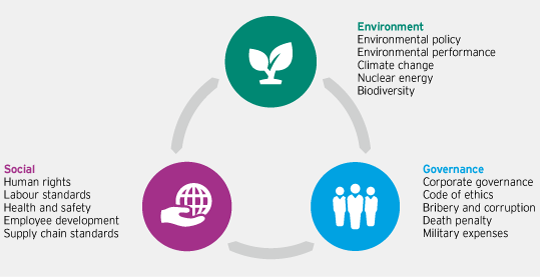
With some help from leading investor groups like Black Rock and T. Rowe Price, environmental, social, and governance (“ESG”) issues, once the sole purview of specialist investors and activist groups, are increasingly working their way into the mainstream for corporate America. For some boards, conversations about ESG are nothing new. For many directors, however, the increased emphasis on the subject creates some consternation, in part because it’s not always clear what issues properly fall under the ESG umbrella. E, S, and G can mean different things to different people—not to mention the fact that some subjects span multiple categories. How do boards know what it is that they need to know? Where should boards be directing their attention?

A natural starting place for directors is to examine the guidelines published by the leading proxy advisory firms ISS and Glass Lewis. While not to be held up as a definitive prescription for good governance practices, the stances adopted by both advisors can provide a window into how investors who look to these organizations for guidance are thinking about the subject.


Institutional Shareholder Services (ISS)


In February of 2018, ISS launched an Environmental & Social Quality Score which they describe as “a data-driven approach to measuring the quality of corporate disclosures on environmental and social issues, including sustainability governance, and to identify key disclosure omissions.”

To date, their coverage focuses on approximately 4,700 companies across 24 industries they view “as being most exposed to E&S risks, including: Energy, Materials, Capital Goods, Transportation, Automobiles & Components, and Consumer Durables & Apparel.” ISS believes that the extent to which companies disclose their practices and policies publicly, as well as the quality of a company’s disclosure on their practices, can be an indicator of ESG performance. This view is not unlike that espoused by Black Rock, who believes that a lack of ESG disclosure beyond what is legally mandated often necessitates further research.

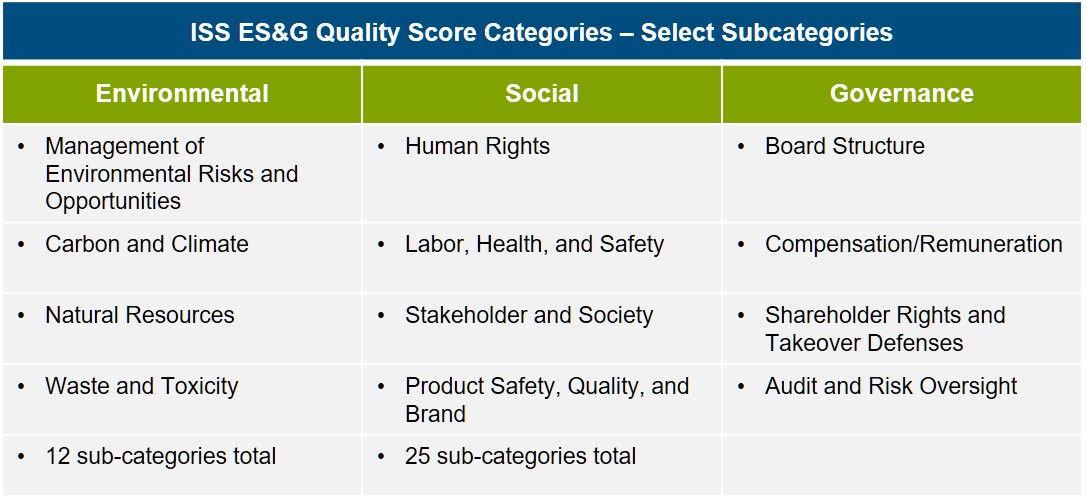
Below is a summary of how ISS breaks down E, S, & G. Clearly the governance category includes topics familiar to any public company board.


iss-esg-quality-score-table


ISS’ E&S scoring is based on answers to over 380 individual questions which ISS analysts attempt to answer for each covered company based on disclosed data. The majority of the questions in the ISS model are applied to all industry groups, and all of them are derived from third-party lists or initiatives, including the United Nations’ Sustainable Development Goals. The E&S Quality Score measures the company’s level of environmental and social disclosure risk, both overall and specific to the eight broad categories listed in the table above. ISS does not combine ES&G into a single score, but provides a separate E&S score that stands alongside the governance score.

These disclosure risk scores, similar to the governance scores companies have become accustomed to seeing each year, are scaled from 1 to 10 with lower scores indicating a lower level of risk relative to industry peers. For example, a score of 2 indicates that a company has lower risk than 80% of its industry peers.


Glass Lewis


Glass Lewis uses data and ratings from Sustainalytics, a provider of ESG research, in the ESG Profile section of their standard Proxy Paper reports for large cap companies or “in instances where [they] identify material oversight issues.” Their stated goal is to provide summary data and insights that can be used by Glass Lewis clients as part of their investment decision-making, including aligning proxy voting and engagement practices with ESG risk management considerations.

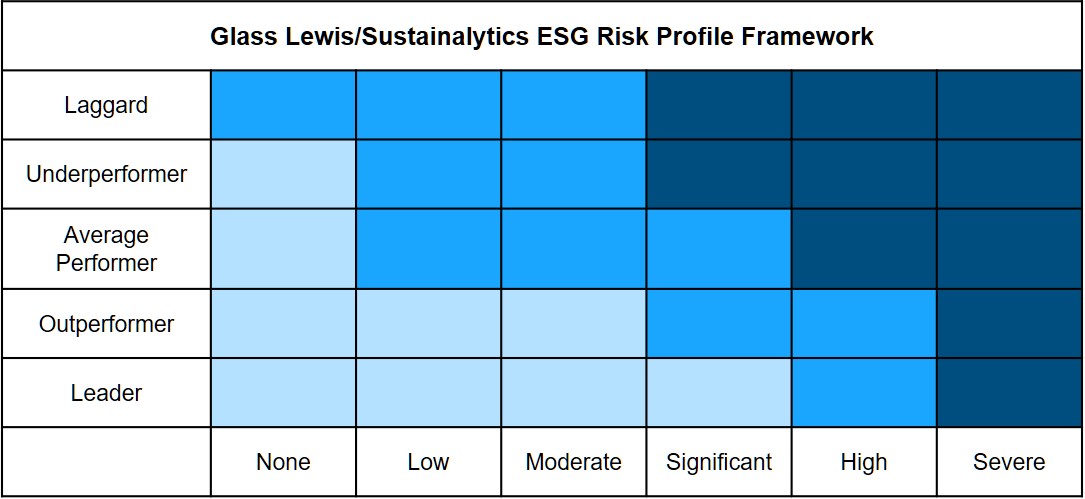
The Glass Lewis evaluation, using Sustainalytics guidelines, rates companies on a matrix which weighs overall “ESG Performance” against the highest level of “ESG Controversy.” Companies who are leaders in terms of ESG practices (or disclosure) have a higher threshold for triggering risk in this model.


glass-lewis-risk-model-chart


The evaluation model also notes that some companies involved in particular product areas are naturally deemed higher risk, including adult entertainment, alcoholic beverages, arctic drilling, controversial weapons, gambling, genetically modified plants and seeds, oil sands, pesticides, thermal coal, and tobacco.

Conclusion


ISS and Glass Lewis guidelines can help provide a basic structure for starting board conversations about ESG. For most companies, the primary focus is on transparency, in other words how clearly are companies disclosing their practices and philosophies regarding ESG issues in their financial filings and on their corporate websites? When a company has had very public environmental or social controversies—and particularly when those issues have impacted shareholder value—advisory firm evaluations of corporate transparency may also impact voting recommendations on director elections or related shareholder proposals.

Pearl Meyer does not expect the advisory firms’ ESG guidelines to have much, if any, bearing on compensation-related recommendations or scorecards in the near term. In the long term, however, we do think certain hot-button topics will make their way from the ES&G scorecard to the compensation scorecard. This shift will likely happen sooner in areas where ESG issues are more prominent, such as those specifically named by Glass Lewis.

We are recommending that organizations take the time to examine any ESG issues relevant to their business and understand how those issues may be important to stakeholders on a proactive basis, perhaps adding ESG policies to the list of sunny day shareholder outreach topics after this year’s proxy season. This does take time and effort, but better that than to find out about a nagging ESG issue through activist activity or a negative voting recommendation from ISS or Glass Lewis.


References

1. https://www.issgovernance.com/iss-announces-launch-of-environmental-social-qualityscore-corporate-profiling-solution/

2. https://www.glasslewis.com/understanding-esg-content/

_________________________________________________________

* David Bixby is managing director and Paul Hudson is principal at Pearl Meyer & Partners, LLC. This post is based on a Pearl Meyer memorandum. Related research from the Program on Corporate Governance includes Social Responsibility Resolutions by Scott Hirst (discussed on the Forum here).

En reprise | Quelles sont les responsabilités dévolues à un conseil d’administration ?


En gouvernance des sociétés, il existe un certain nombre de responsabilités qui relèvent impérativement d’un conseil d’administration.

À la suite d’une décision rendue par la Cour Suprême du Delaware dans l’interprétation de la doctrine Caremark (voir ici),il est indiqué que pour satisfaire leur devoir de loyauté, les administrateurs de sociétés doivent faire des efforts raisonnables (de bonne foi) pour mettre en œuvre un système de surveillance et en faire le suivi.

Without more, the existence of management-level compliance programs is not enough for the directors to avoid Caremark exposure.

L’article de Martin Lipton *, paru sur le Forum de Harvard Law School on Corporate Governance, fait le point sur ce qui constitue les meilleures pratiques de gouvernance à ce jour.

Bonne lecture !


Spotlight on Boards


Résultats de recherche d'images pour « Spotlight on Boards »


  1. Recognize the heightened focus of investors on “purpose” and “culture” and an expanded notion of stakeholder interests that includes employees, customers, communities, the economy and society as a whole and work with management to develop metrics to enable the corporation to demonstrate their value;
  2. Be aware that ESG and sustainability have become major, mainstream governance topics that encompass a wide range of issues, such as climate change and other environmental risks, systemic financial stability, worker wages, training, retraining, healthcare and retirement, supply chain labor standards and consumer and product safety;
  3. Oversee corporate strategy (including purpose and culture) and the communication of that strategy to investors, keeping in mind that investors want to be assured not just about current risks and problems, but threats to long-term strategy from global, political, social, and technological developments;
  4. Work with management to review the corporation’s strategy, and related disclosures, in light of the annual letters to CEOs and directors, or other communications, from BlackRock, State Street, Vanguard, and other investors, describing the investors’ expectations with respect to corporate strategy and how it is communicated;
  5. Set the “tone at the top” to create a corporate culture that gives priority to ethical standards, professionalism, integrity and compliance in setting and implementing both operating and strategic goals;
  6. Oversee and understand the corporation’s risk management, and compliance plans and efforts and how risk is taken into account in the corporation’s business decision-making; monitor risk management ; respond to red flags if and when they arise;
  7. Choose the CEO, monitor the CEO’s and management’s performance and develop and keep current a succession plan;
  8. Have a lead independent director or a non-executive chair of the board who can facilitate the functioning of the board and assist management in engaging with investors;
  9. Together with the lead independent director or the non-executive chair, determine the agendas for board and committee meetings and work with management to ensure that appropriate information and sufficient time are available for full consideration of all matters;
  10. Determine the appropriate level of executive compensation and incentive structures, with awareness of the potential impact of compensation structures on business priorities and risk-taking, as well as investor and proxy advisor views on compensation;
  11. Develop a working partnership with the CEO and management and serve as a resource for management in charting the appropriate course for the corporation;
  12. Monitor and participate, as appropriate, in shareholder engagement efforts, evaluate corporate governance proposals, and work with management to anticipate possible takeover attempts and activist attacks in order to be able to address them more effectively, if they should occur;
  13. Meet at least annually with the team of company executives and outside advisors that will advise the corporation in the event of a takeover proposal or an activist attack;
  14. Be open to management inviting an activist to meet with the board to present the activist’s opinion of the strategy and management of the corporation;
  15. Evaluate the individual director’s, board’s and committees’ performance on a regular basis and consider the optimal board and committee composition and structure, including board refreshment, expertise and skill sets, independence and diversity, as well as the best way to communicate with investors regarding these issues;
  16. Review corporate governance guidelines and committee workloads and charters and tailor them to promote effective board and committee functioning;
  17. Be prepared to deal with crises; and
  18. Be prepared to take an active role in matters where the CEO may have a real or perceived conflict, including takeovers and attacks by activist hedge funds focused on the CEO.


Afin de satisfaire ces attentes, les entreprises publiques doivent :


  1. Have a sufficient number of directors to staff the requisite standing and special committees and to meet investor expectations for experience, expertise, diversity, and periodic refreshment;
  2. Compensate directors commensurate with the time and effort that they are required to devote and the responsibility that they assume;
  3. Have directors who have knowledge of, and experience with, the corporation’s businesses and with the geopolitical developments that affect it, even if this results in the board having more than one director who is not “independent”;
  4. Have directors who are able to devote sufficient time to preparing for and attending board and committee meetings and engaging with investors;
  5. Provide the directors with the data that is critical to making sound decisions on strategy, compensation and capital allocation;
  6. Provide the directors with regular tutorials by internal and external experts as part of expanded director education and to assure that in complicated, multi-industry and new-technology corporations, the directors have the information and expertise they need to respond to disruption, evaluate current strategy and strategize beyond the horizon; and
  7. Maintain a truly collegial relationship among and between the company’s senior executives and the members of the board that facilitates frank and vigorous discussion and enhances the board’s role as strategic partner, evaluator, and monitor.

_________________________________________________________

Martin Lipton* is a founding partner of Wachtell, Lipton, Rosen & Katz, specializing in mergers and acquisitions and matters affecting corporate policy and strategy. This post is based on a Wachtell Lipton memorandum by Mr. Lipton and is part of the Delaware law series; links to other posts in the series are available here.

Un document incontournable en gouvernance : « OECD Corporate Governance Factbook 2019 »


Voici un rapport de recherche exhaustif publié tous les deux ans par l’OCDE.

Vous y retrouverez une mine de renseignements susceptibles de répondre à toute question relative à la gouvernance des plus importantes autorités des marchés financiers au monde.

C’est un document essentiel qui permet de comparer et d’évaluer les progrès en gouvernance dans les 49 plus importants marchés financiers.

Vous pouvez télécharger le rapport à la fin du sommaire exécutif publié ici. Le document est illustré par une multitude de tableaux et de figures qui font image il va sans dire.

Voici l’introduction au document de recherche. Celui-ci vient d’être publié. La version française devrait suivre bientôt.

Bonne lecture !


The 2019 edition of the OECD Corporate Governance Factbook (the “Factbook”) contains comparative data and information across 49 different jurisdictions including all G20, OECD and Financial Stability Board members. The information is presented and commented in 40 tables and 51 figures covering a broad range of institutional, legal and regulatory provisions. The Factbook provides an important and unique tool for monitoring the implementation of the G20/OECD Principles of Corporate Governance. Issued every two years, it is actively used by governments, regulators and others for information about implementation practices and developments that may influence their effectiveness.

It is divided into five chapters addressing: 1) the corporate and market landscape; 2) the corporate governance framework; 3) the rights of shareholders and key ownership functions; 4) the corporate boards of directors; and 5) mechanisms for flexibility and proportionality in corporate governance.
 

OECD (2019), OECD Corporate Governance Factbook 2019


Résultats de recherche d'images pour « OECD Corporate Governance Factbook 2019 »


The corporate and market landscape


Effective design and implementation of corporate governance rules requires a good empirical understanding of the ownership and business landscape to which they will be applied. The first chapter of the Factbook therefore provides an overview of ownership patterns around the world, with respect to both the categories of owners and the degree of concentration of ownership in individual listed companies. Since the G20/OECD Principles also include recommendations with respect to the functioning of stock markets, it also highlights some key structural changes with respect to stock exchanges.

The OECD Equity Market Review of Asia (OECD, 2018a) reported that stock markets have undergone profound changes during the past 20 years. Globally, one of the most important developments has been the rapid growth of Asian stock markets—both in absolute and in relative terms. In 2017, a record number of 1 074 companies listed in Asia, almost twice as many as the annual average for the previous 16 years. Of the five jurisdictions that have had the highest number of non-financial company IPOs in the last decade, three are in Asia. In 2017, Asian non-financial companies accounted for 43% of the global volume of equity raised. The proportion attributable to European and US companies has declined during the same period. In terms of stock exchanges, by total market capitalisation, four Asian exchanges were in the top ten globally (Japan Exchange Group, Shanghai Stock Exchange, Hong Kong Exchanges and Clearing Limited, and Shenzhen Stock Exchange).

With respect to ownership patterns at the company level in the world’s 50 000 listed companies, a recent OECD study (De la Cruz et al., forthcoming) reports a number of features of importance to policymaking and implementation of the G20/OECD Principles. The report, which contains unique information about ownership in companies from 54 jurisdictions that together represent 95% of global market capitalisation, shows that four main categories of investors dominate ownership of today’s publicly listed companies. These are: institutional investors, public sector owners, private corporations, and strategic individual investors. The largest category is institutional investors, holding 41% of global market capitalisation. The second largest category is the public sector, which has significant ownership stakes in 20% of the world’s listed companies and hold shares representing 13% of global market capitalisation. With respect to ownership in individual companies, in half of the world’s publicly listed companies, the three largest shareholders hold more than 50% of the capital, and in three-quarters of the world’s public listed companies, the three largest owners hold more than 30%. This is to a large extent attributable to the growth of stock markets in Asian emerging markets.

Stock exchanges have also undergone important structural changes in recent years, such as mergers and acquisitions and demutualisations. Out of 52 major stock exchanges in 49 jurisdictions, 18 now belong to one of four international groups. Thirty-three (63%) of these exchanges are either self-listed or have an ultimate parent company that is listed on one or more of its own exchanges. More than 62% of market capitalisation is concentrated in the five largest stock exchanges, while more than 95% is concentrated in the largest 25. The top 25 highest valued exchanges include 11 non-OECD jurisdictions.


The corporate governance framework


An important bedrock for implementing the Principles is the quality of the legal and regulatory framework, which is consistent with the rule of law in supporting effective supervision and enforcement.

Against this background, the Factbook monitors who serves as the lead regulatory institution for corporate governance of listed companies in each jurisdiction, as well as issues related to their independence. Securities regulators, financial regulators or a combination of the two play the key role in 82% of all jurisdictions, while the Central Bank plays the key role in 12%. The issue of the independence of regulators is commonly addressed (among 86% of regulatory institutions) through the creation of a formal governing body such as a board, council or commission, usually appointed to fixed terms ranging from two to eight years. In a majority of cases, independence from the government is also promoted by establishing a separate budget funded by fees assessed on regulated entities or a mix of fees and fines. On the other hand, 25% of the regulatory institutions surveyed are funded by the national budget.

Since 2015 when the G20/OECD Principles were issued, 84% of the 49 surveyed jurisdictions have amended either their company law or securities law, or both. Nearly all jurisdictions also have national codes or principles that complement laws, securities regulation and listing requirements. Nearly half of all jurisdictions have revised their national corporate governance codes in the past two years and 83% of them follow a “comply or explain” compliance practice. A growing percentage of jurisdictions—67%—now issue national reports on company implementation of corporate governance codes, up from 58% in 2015. In 29% of the jurisdictions it is the national authorities that serve as custodians of the national corporate governance code.


The rights and equitable treatment of shareholders and key ownership functions


The G20/OECD Principles state that the corporate governance framework shall protect and facilitate the exercise of shareholders’ rights and ensure equitable treatment of all shareholders, including minority and foreign shareholders.

Chapter 3 of the Factbook therefore provides detailed information related to rights to obtain information on shareholder meetings, to request meetings and to place items on the agenda, and voting rights. The chapter also provides detailed coverage of frameworks for review of related party transactions, triggers and mechanisms related to corporate takeover bids, and the roles and responsibilities of institutional investors.

All jurisdictions require companies to provide advance notice of general shareholder meetings. A majority establish a minimum notice period of between 15 and 21 days, while another third of the jurisdictions provide for longer notice periods. Nearly two-thirds of jurisdictions require such notices to be sent directly to shareholders, while all but four jurisdictions require multiple methods of notification, which may include use of a stock exchange or regulator’s electronic platform, publication on the company’s web site or in a newspaper.

Approximately 80% of jurisdictions establish deadlines of up to 60 days for convening special meetings at the request of shareholders, subject to specific ownership thresholds. This is an increase from 73% in 2015. Most jurisdictions (61%) set the ownership threshold for requesting a special shareholder meeting at 5%, while another 32% set the threshold at 10%. Compared to the threshold for requesting a shareholder meeting, many jurisdictions set lower thresholds for placing items on the agenda of the general meeting. With respect to the outcome of the shareholder meeting, approximately 80% of jurisdictions require the disclosure of voting decisions on each agenda item, including 59% that require such disclosure immediately or within 5 days.

The G20/OECD Principles state that the optimal capital structure of the company is best decided by the management and the board, subject to approval of the shareholders. This may include the issuing of different classes of shares with different rights attached to them. In practice, all but three of the 49 jurisdictions covered by the Factbook allow listed companies to issue shares with limited voting rights. In many cases, such shares come with a preference with respect to the receipt of the firm’s profits.

Related party transactions are typically addressed through a combination of measures, including board approval, shareholder approval, and mandatory disclosure. Provisions for board approval are common; two-thirds of jurisdictions surveyed require or recommend board approval of certain types of related party transactions. Shareholder approval requirements are applied in 55% of jurisdictions, but are often limited to large transactions and those that are not carried out on market terms. Nearly all jurisdictions require disclosure of related party transactions, with 82% requiring use of International Accounting Standards (IAS24), while an additional 8% allow flexibility to follow IAS 24 or the local standard.

The Factbook provides extensive data on frameworks for corporate takeovers. Among the 46 jurisdictions that have introduced a mandatory bid rule, 80% take an ex-post approach, where a bidder is required to initiate the bid after acquiring shares exceeding the threshold. Nine jurisdictions take an ex-ante approach, where a bidder is required to initiate a takeover bid for acquiring shares which would exceed the threshold. More than 80% of jurisdictions with mandatory takeover bid rules establish a mechanism to determine the minimum bidding price.

Considering the important role played by institutional investors as shareholders of listed companies, nearly all jurisdictions have established provisions for at least one category of institutional investors (such as pension, investment or insurance funds) to address conflicts of interest, either by prohibiting specific acts or requiring them to establish policies to manage conflicts of interest. Three-fourths of all jurisdictions have established requirements or recommendations for institutional investors to disclose their voting policies, while almost half require or recommend disclosure of actual voting records. Some jurisdictions establish regulatory requirements or may rely on voluntary stewardship codes to encourage various forms of ownership engagement, such as monitoring and constructive engagement with investee companies and maintaining the effectiveness of monitoring when outsourcing the exercise of voting rights.


The corporate board of directors


The G20/OECD Principles require that the corporate governance framework ensures the strategic guidance of the company by the board and its accountability to the company and its shareholders. The most common board format is the one-tier board system, which is favoured in twice as many jurisdictions as those that apply two-tier boards (supervisory and management boards). A growing number of jurisdictions allow both one and two-tier structures.

Almost all jurisdictions require or recommend a minimum number or ratio of independent directors. Definitions of independent directors have also been evolving during this period: 80% of jurisdictions now require directors to be independent of significant shareholders in order to be classified as independent, up from 64% in 2015. The shareholding threshold determining whether a shareholder is significant ranges from 2% to 50%, with 10% to 15% being the most common.

Recommendations or requirements for the separation of the board chair and CEO have doubled in the last four years to 70%, including 30% required. The 2015 edition of the Factbook reported a binding requirement in only 11% of the jurisdictions, with another 25% recommending it in codes.

Nearly all jurisdictions require an independent audit committee. Nomination and remuneration committees are not mandatory in most jurisdictions, although more than 80% of jurisdictions at least recommend these committees to be established and often to be comprised wholly or largely of independent directors.

Requirements or recommendations for companies to assign a risk management role to board level committees have sharply increased since 2015, from 62% to 87% of surveyed jurisdictions. Requirements or recommendations to implement internal control and risk management systems have also increased significantly, from 62% to 90%.

While recruitment and remuneration of management is a key board function, a majority of jurisdictions have a requirement or recommendation for a binding or advisory shareholder vote on remuneration policy for board members and key executives. And nearly all jurisdictions surveyed now require or recommend the disclosure of the remuneration policy and the level/amount of remuneration at least at aggregate levels. Disclosure of individual levels is required or recommended in 76% of jurisdictions.

The 2019 Factbook provides data for the first time on measures to promote gender balance on corporate boards and in senior management, most often via disclosure requirements and measures such as mandated quotas and/or voluntary targets. Nearly half of surveyed jurisdictions (49%) have established requirements to disclose gender composition of boards, compared to 22% with regards to senior management. Nine jurisdictions have mandatory quotas requiring a certain percentage of board seats to be filled by either gender. Eight rely on more flexible mechanisms such as voluntary goals or targets, while three resort to a combination of both. The proportion of senior management positions held by women is reported to be significantly higher than the proportion of board seats held by women.


Mechanisms for flexibility and proportionality in corporate governance


It has already been pointed out that effective implementation of the G20/OECD Principles requires a good empirical understanding of economic realities and adaption to changes in corporate and market developments over time. The G20/OECD Principles therefore state that policy makers have a responsibility to put in place a framework that is flexible enough to meet the needs of corporations that are operating in widely different circumstances, facilitating their development of new opportunities and the most efficient deployment of resources. The 2019 Factbook provides a special chapter that presents the main findings of a complementary OECD review of how 39 jurisdictions apply the concepts of flexibility and proportionality across seven different corporate governance regulatory areas. The chapter builds on the 2018 OECD report Flexibility and Proportionality in Corporate Governance (OECD, 2018b). The report finds that a vast majority of countries have criteria that allow for flexibility and proportionality at company level in each of the seven areas of regulation that were reviewed: 1) board composition, board committees and board qualifications; 2) remuneration; 3) related party transactions; 4), disclosure of periodic financial information and ad hoc information; 5) disclosure of major shareholdings; 6) takeovers; and 7) pre-emptive rights. The report also contains case studies of six countries, which provide a more detailed picture of how flexibility and proportionality is being used in practice.

The complete publication, including footnotes, is available here.

Tendances observées eu égard à la diversité des conseils d’administration américains en 2019


L’article publié par Subodh Mishra, directrice générale de Institutional Shareholder Services (ISS), paru sur le site du forum de Harvard Law School montre clairement que les tendances eu égard à la diversité des Boards américains sont remarquables.

Qu’entend-on par la diversité des conseils d’administration ?

    1. le taux de remplacement des administrateurs sur le conseil
    2. le pourcentage de femmes qui accèdent à des conseils
    3. la diversité ethnique sur les conseils
    4. le choix d’administrateurs dont les compétences ne sont pas majoritairement financières
    5. le taux de nouveaux administrateurs pouvant être considérés comme relativement jeune

L’étude indique que pour chacune de ces variables, les conseils d’administration américains font preuve d’une plus grande diversité, sauf pour l’âge des administrateurs qui continue de croître.

Je vous invite à prendre connaissance de cet article pour vous former une idée plus juste des tendances observées sur les conseils d’administration.

Je n’ai pas de données comparables au Canada, mais je crois que la tendance à l’accroissement de la diversité est similaire.

Bonne lecture !


U.S. Board Diversity Trends in 2019


Résultats de recherche d'images pour « U.S. Board Diversity Trends in 2019 »


As the U.S. annual shareholder meeting season is coming to an end, we review the characteristics of newly appointed directors to reveal trends director in nominations. As of May 30, 2019, ISS has profiled the boards of 2,175 Russell 3000 companies (including the boards of 401 members of the S&P 500) with a general meeting of shareholders during the year. These figures represent approximately 75 percent of Russell 3000 companies that are expected to have a general meeting during the year. (A small portion of index constituents may not have a general meeting during a given calendar year due to mergers and acquisitions, new listings, or other extraordinary circumstances).

Based on our review of 19,791 directorships in the Russell 3000, we observe five major trends in new director appointments for 2019, as outlined below.

1. Board renewal rates continue to increase, as board refreshment, director qualifications, and board diversity remain high-priority issues for companies and investors.

2. The percentage of women joining boards reaches a new record high, with 45 percent of new Russell 3000 board seats filled by women in 2019 (compared to only 12 percent in 2008) and 19 percent of all Russell 3000 seats held by women.

3. Ethnic diversity also reached record highs, but has grown at a much slower rate, with approximately 10 percent of Russell 3000 directors currently belonging to an ethnic minority group, while 15 percent of new directors are ethnically diverse.

4. New director appointments focus on non-financial skillsets, with an increased proportion of directors having international experience, ESG expertise, and background in human resources.

5. The average director age continues to increase, as the appointment of younger directors is less frequent than in previous years, with only 7.2 percent of new directorships filled by directors younger than 45 years, compared to 11.5 percent of new directors in 2008.

Board Refreshment


After a decline in board renewal rates in the first years after the Great Recessions, boards began to add more new directors starting in 2012 and reached record numbers of board replenishment in 2017 and 2018, as a growing number of investors focused on board refreshment and board diversity. In 2019, the trend of board renewal continued, as we observe relatively higher rates of new director appointments as a percentage of all directorships compared to the beginning of the decade. But overall renewal rates are low. As of May 2019, only 5.3 percent of profiled Russell 3000 board directors were new to their boards, down from the record-high figure of 5.7 percent in 2018.


Proposals by Category


The surge in new director appointments observed in the past few years can be attributed to a greater emphasis on board gender diversity and board refreshment by many investors and companies. The percentage of companies introducing at least one new board member increased from 34.3 percent in 2018 to 35.6 percent this year. The percentage of companies introducing at least two new directors declined from 11.2 percent in 2018 to 10.2 percent in 2019, consistently above the 10-percent threshold along with the record-setting years of 2017 and 2018.


Proposals by Category

Gender Diversity


Gender diversity on boards accelerated further this year, breaking another record in terms of the percentage of new directors who are women. In the Russell 3000, 45 percent of new directors are women, up from 34 percent in 2018. Unlike previous years, when the percentage of new female directors was higher at large-capitalization companies, the high rate of new female directors—at almost parity—is consistent across all market segments. Several asset owners and asset managers had voting policies related to gender diversity prior to 2017. However, following State Street’s policy initiative to require at least one female director at every board in 2017, many more large investors have become more vocal about improving gender diversity on boards in the past two years, and many have introduced similar voting policies. We expect this trend to continue, as more investors are beginning to require more than the bare minimum of at least one woman on the board. Proxy advisors also introduced similar policies, with ISS’ policy to make adverse recommendation at all-male boards coming into effect in 2020.

But, more importantly, the push for gender diversity is no longer driven by shareholder engagement and voting only. New regulation in California mandates that all boards of companies headquartered in the state should have at least one woman on their boards in 2019, while at least three women board members are required by 2021 for boards with six members or more. Other states may follow suit, as New Jersey recently introduced legislation modeled after the California law, and Illinois is debating a bill that will require both gender and ethnic diversity on corporate boards.

Given the California mandate (affecting close to 700 public companies) and the continued focus by investors, it is no surprise that smaller firms, where gender diversity has been considerably lower compared to large companies, are revamping their efforts to improve gender diversity.


Proposals by Category


As a result of the record-setting recruitment of women on boards, 2019 saw the biggest jump in the overall gender diversity. The S&P 500 is well on its way of reaching 30 percent directorships held by women in the next couple of years, much earlier than we had predicted in the beginning of last year using a linear regression analysis. Obviously, female director recruitments has seen exponential growth in the past two years, which has accelerated the trend.


Proposals by Category

Ethnic Diversity


In 2019, we also see record number of ethnic minorities joining boards as new board members, with more than one-in-five new directorships being filled by non-Caucasian nominees at S&P 500, while approximately 15 percent of new board seats at all Russell 3000 companies are filled by minorities (the figure stands at 13 percent when excluding the S&P 500). As the discussion of diversity moves beyond gender, we may see the trend of higher minority representation on boards continue.


Proposals by Category


While the trend of increasing ethnic diversity on boards is visible, the rate of change is considerably slower than the trend in board gender diversity. Among board members whose race was identified, non-white Russell 3000 directors crossed the 10-percent threshold for the first time in 2019, compared to approximately 8 percent in 2008. These figures stand well below the proportion of non-White, non-Hispanic population in the U.S. of approximately 40 percent, according to the U.S. census bureau.


Proposals by Category

Director Skills


But diversity among new directors goes beyond gender and ethnicity. We observe a change in the skillsets disclosed by companies for new directors compared to incumbent directors. The rate of disclosure of skills is generally higher for new directors compared to directors who have served on boards for five years or more. Relative to tenure directors, we observe an increase in the percentage of new directors with expertise in technology (10 percentage points), sales (8 percentage points), international experience (8 percentage points), and strategic planning (6 percentage points). At the same time, we see a decrease in some traditional skills, such as financial and audit expertise, and CEO experience.


Proposals by Category

The increase in non-traditional skills becomes more pronounced when we look at the percentage difference in the frequency of each skill for new directors compared to directors with tenure of five years or more. Based on this analysis, international expertise, experience in corporate social responsibility, and human resources expertise all increase by more than 50 percent at new directors compared to their counterparts with tenure on the board of at least five years. As sustainability and corporate culture become focus items for many investors and companies, we expect this trend to continue. The percentage of “other” skills, which do not fall neatly in the established categories, also increases considerably. The list of skills that rank the lowest in terms of change compared to the tenured directors is telling of the increased emphasis in non-traditional skills: CFO experience, financial expertise, CEO experience, government experience, and audit expertise.

Proposals by Category

Age Diversity


U.S. boards are getting older. During the past twelve years, the average director age in the Russell 3000 has increased from 59.7 years in 2008 to 62.1 years in 2019. This trend becomes apparent when observing the age groups of newly appointed directors. In 2008, approximately 11.5 percent of new director were younger than 45 years, and this number has dropped to an all-time low of 7.2 percent in 2019. The percentage of newly appointed directors above the age of 67 has also been decreasing in the past five years reaching 6.5 percent in 2019, compared to its peak of 10.8 in 2014.


Proposals by Category


However, as incumbent directors stay on boards with the passing of time, the overall percentage of directors above the age of 67 years continues to increase, reaching a record high of 31.6 percent of all directorships in 2019, compared to 22.1 percent in 2008. We observe the opposite trend in relation to younger directors, whereby the proportion of directors younger than 45 years has dropped by almost 40 percent from 5.1 percent of directorships in 2008 to 3.2 of directorships in 2019.


Proposals by Category

The Changing Landscape for U.S. Boards

The U.S. is experiencing a significant shift in the composition of corporate boards, as the market expects companies to address a new set of challenges and their boards to better reflect developments in society. Board refreshment continues its upward trajectory in 2019, with higher rates of new directors compared to the beginning of the decade. While traditional skillsets remain paramount, we see a greater emphasis on non-financial skills, highlighting the need to focus on corporate culture, sustainability, and technology. At the same time, investors, companies, and regulators recognize the benefits of diversity, as we see record numbers of women and minorities on boards. Experience and qualifications appear more important than ever, which may explain the decline in younger directors in the past decade. These trends will likely continue, as investors continue to focus on board quality and governance as a foremost measure for protecting their investments and managing risk for sustainable growth.

Le rôle du CA dans le développement durable et la création de valeur pour les actionnaires et les parties prenantes | En reprise


Aujourd’hui, je présente un article publié par Azeus Convene qui montre l’importance accrue que les entreprises doivent apporter au développement durable. 

L’article insiste sur le rôle du conseil d’administration pour faire des principes du développement durable à long terme les principales conditions de succès des organisations.


Les administrateurs doivent concevoir des politiques qui génèrent une valeur ajoutée à long terme pour les actionnaires, mais ils doivent aussi contribuer à améliorer le sort des parties prenantes, telles que les clients, les communautés et la société en général.


Il n’est cependant pas facile d’adopter des politiques qui mettent de l’avant les principes du développement durable et de la gestion des risques liés à l’environnement.


Dans ce document, publié sur le site de Board Agenda, on explique l’approche que les conseils d’administration doivent adopter en insistant plus particulièrement sur trois points :


    1. Un leadership capable de faire valoir les nombreux avantages stratégiques à tirer de cette approche ;
    2. Des conseils eu égard à l’implantation des changements
    3. Le processus de communication à mettre en œuvre afin de faire valoir les succès des entreprises


L’article qui suit donne plus de détails sur les fondements et l’application de l’approche du développement durable.

Bonne lecture ! Vos commentaires sont appréciés.


Le développement durable, la création de valeur et le rôle du CA


Businesses everywhere are developing sustainability policies. Implementation is never easy, but the right guidance can show the way.

When the experts sat down to write the UK’s new Corporate Governance Code earlier this year, they drafted a critical first principle. The role of the board is to “promote the long-term sustainable success of the company”. Boardroom members should generate value for shareholders, but they should also be “contributing to wider society”.

It is the values inherent in this principle that enshrines sustainability at the heart of running a company today.

Often sustainability is viewed narrowly, relating to policies affecting climate change. But it has long since ceased to be just about the environment. Sustainability has become a multifaceted concern embracing the long-term interests of shareholders, but also responsibilities to society, customers and local communities.

Publications like Harvard Business Review now publish articles such as “Inclusive growth: profitable strategies for tackling poverty and inequality”, or “Competing on social purpose”. Forbes has “How procurement will save the world” and “How companies can increase market rewards for sustainability efforts”. Sustainability is a headline issue for company leaders and here to stay.

But it’s not always easy to see how sustainability is integrated into a company’s existing strategy. So, why should your company engage with sustainability and what steps can it take to ensure it is done well?

…one of the biggest issues at the heart of the drive for sustainability is leadership. Implementing the right policies is undoubtedly a “top-down” process, not least because legal rulings have emphatically cast sustainability as a fiduciary duty.

The reasons for adopting sustainability are as diverse as the people and groups upon which companies have an impact. First, there is the clear environmental argument. Governments alone cannot tackle growing environment risk and will need corporates to play their part through their strategies and business models.

The issues driving political leaders have also filtered down to investment managers who have developed deep concerns that companies should be building strategies that factor in environmental, social and governance (ESG) risk. Companies that ignore the issue risk failing to attract capital. A 2015 study by the global benchmarking organisation PRI (Principles for Responsible Investment), conducted with Deutsche Bank Asset Management, showed that among 2,200 studies undertaken since 1970, 63% found a positive link between a company’s ESG performance and financial performance.

There’s also the risk of being left behind, or self-inflicted damage. In an age of instant digital communication news travels fast and a company that fails on sustainability could quickly see stakeholder trust undermined.

Companies that embrace the topic can also create what might be termed “sustainability contagion”: businesses supplying “sustainable” clients must be sustainable themselves, generating a virtuous cascade of sustainability behaviour throughout the supply chain. That means positive results from implemented sustainability policies at one end of the chain, and pressure to comply at the other.

Leadership

But perhaps one of the biggest issues at the heart of the drive for sustainability is leadership. Implementing the right policies is undoubtedly a “top-down” process, not least because legal rulings have emphatically cast sustainability as a fiduciary duty. That makes executive involvement and leadership an imperative. However, involvement of management at the most senior level will also help instil the kind of culture change needed to make sustainability an ingrained part of an organization, and one that goes beyond mere compliance.

Leaders may feel the need to demonstrate the value of a sustainability step-change. This is needed because a full-blooded approach to sustainability could involve rethinking corporate structures, processes and performance measurement. Experts recognise three ways to demonstrate value: risk, reward and recognition.

“Risk” looks at issues such as potential dangers associated with ignoring sustainability such as loss of trust, reputational damage (as alluded to above), legal or regulatory action and fines.

A “rewards”-centred approach casts sustainability as an opportunity to be pursued, as long as policies boost revenues or cut costs, and stakeholders benefit.

Meanwhile, the “recognition” method argues that sharing credit for spreading sustainability policies promotes long-term engagement and responsibility.

Implementation

Getting sustainability policies off the ground can be tricky, particularly because of their multifaceted nature.

recent study into European boards conducted by Board Agenda & Mazars in association with the INSEAD Corporate Governance Centre showed that while there is growing recognition by boards about the importance of sustainability, there is also evidence that they experience challenges about how to implement effective ESG strategies.

Proponents advise the use of “foundation exercises” for helping form the bedrock of sustainability policies. For example, assessing baseline environmental and social performance; analysing corporate management, accountability structures and IT systems; and an examination of material risk and opportunity.

That should provide the basis for policy development. Then comes implementation. This is not always easy, because being sustainable can never be attributed to a single policy. Future-proofing a company has to be an ongoing process underpinned by structures, measures and monitoring.
Policy delivery can be strengthened by the appointment of a chief sustainability officer (CSO) and establishing structures around the role, such as regular reporting to the chief executive and board, as well as the creation of a working committee to manage implementation of policies across the company.

Proponents advise the use of “foundation exercises” for helping form the bedrock of sustainability policies.

Sustainability values will need to be embedded at the heart of policies directing all business activities. And this can be supported through the use of an organisational chart mapping the key policies and processes to be adopted by each part of the business. The chart then becomes a critical ready reckoner for the boardroom and its assessment of progress.

But you can only manage what you measure, and sustainability policies demand the same treatment as any other business development initiative: key metrics accompanying the plan.

But what to measure? Examples include staff training, supply chain optimisation, energy efficiency, clean energy generation, reduced water waste, and community engagement, among many others.

Measuring then enables the creation of targets and these can be embedded in processes such as audits, supplier contracts and executive remuneration. If they are to have an impact, senior management must ensure the metrics have equal weight alongside more traditional measures.

All of this must be underpinned by effective reporting practices that provide a window on how sustainability practices function. And reporting is best supported by automated, straight-through processing, where possible.

Reliable reporting has the added benefit of allowing comparison and benchmarking with peers, if the data is available. The use of globally accepted standards—such as those provided by bodies like the Global Reporting Initiative—build confidence among stakeholders. And management must stay in touch, regularly consulting with the CSO and other stakeholders—customers, investors, suppliers and local communities—to ensure policies are felt in the right places.

Communication

Stakeholders should also hear about company successes, not just deliver feedback. Communicating a sustainability approach can form part of its longevity, as stakeholders hear the good news and develop an expectation of receiving more.

Companies are not expected to achieve all their sustainability goals tomorrow. Some necessarily take time. What is expected is long-term commitment and conviction, honest reporting and steady progress.

Care should be taken, however. Poor communication can be damaging, and a credible strategy will be required, one that considers how to deliver information frequently, honestly and credibly. It will need to take into account regulatory filings and disclosures, and potentially use social media as a means of reaching the right audience.

And that’s because successful sustainability policies are something to shout about. There is enormous pressure on companies to think differently, to reject a blinkered focus only on the bottom line and develop strategies that enable their companies to provide value, not only for shareholders but other stakeholders—society, customers, and suppliers—alike.

Companies are not expected to achieve all their sustainability goals tomorrow. Some necessarily take time. What is expected is long-term commitment and conviction, honest reporting and steady progress. The landscape on which businesses function is changing. They must change with it.

This article has been produced by Board Agenda in collaboration with Azeus Convene, a supporter of Board Agenda.

Composition du conseil d’administration d’OBNL | recrutement d’administrateurs


Ayant collaboré à la réalisation du volume « Améliorer la gouvernance de votre OSBL » des auteurs Jean-Paul Gagné et Daniel Lapointe, j’ai obtenu la primeur de la publication d’un chapitre sur mon blogue en gouvernance.

Pour donner un aperçu de cette importante publication sur la gouvernance des organisations sans but lucratif (OSBL), j’ai eu la permission des éditeurs, Éditions Caractère et Éditions Transcontinental, de publier l’intégralité du chapitre 4 qui porte sur la composition du conseil d’administration et le recrutement d’administrateurs d’OSBL.

Je suis donc très fier de vous offrir cette primeur et j’espère que le sujet vous intéressera suffisamment pour vous inciter à vous procurer cette nouvelle publication.

Vous trouverez, ci-dessous, un court extrait de la page d’introduction du chapitre 4. Je vous invite à cliquer sur le lien suivant pour avoir accès à l’intégralité du chapitre.

Également, les auteurs m’ont avisé qu’ils ont complété une nouvelle version de leur livre. Dès que j’aurai plus d’information, je publierai un nouveau billet.

La composition du conseil d’administration et le recrutement d’administrateurs


Résultats de recherche d'images pour « composition du CA »


Vous pouvez également feuilleter cet ouvrage en cliquant ici

Bonne lecture ! Vos commentaires sont les bienvenus.

__________________________________


Les administrateurs d’un OSBL sont généralement élus dans le cadre d’un processus électoral tenu lors d’une assemblée générale des membres. Ils peuvent aussi faire l’objet d’une cooptation ou être désignés en vertu d’un mécanisme particulier prévu dans une loi (tel le Code des professions).

L’élection des administrateurs par l’assemblée générale emprunte l’un ou l’autre des deux scénarios suivants:

1. Les OSBL ont habituellement des membres qui sont invités à une assemblée générale annuelle et qui élisent des administrateurs aux postes à pourvoir. Le plus souvent, les personnes présentes sont aussi appelées à choisir l’auditeur qui fera la vérification des états financiers de l’organisation pour l’exercice en cours.

ameliorezlagouvernancedevotreosbl

2. Certains OSBL n’ont pas d’autres membres que leurs administrateurs. Dans ce cas, ces derniers se transforment une fois par année en membres de l’assemblée générale, élisent des administrateurs aux postes vacants et choisissent l’auditeur qui fera la vérification des états financiers de l’organisation pour l’exercice en cours.


La cooptation autorise le recrutement d’administrateurs en cours d’exercice. Les personnes ainsi choisies entrent au CA lors de la première réunion suivant celle où leur nomination a été approuvée. Ils y siègent de plein droit, en dépit du fait que celle-ci ne sera entérinée qu’à l’assemblée générale annuelle suivante. La cooptation n’est pas seulement utile pour pourvoir rapidement aux postes vacants; elle a aussi comme avantage de permettre au conseil de faciliter la nomination de candidats dont le profil correspond aux compétences recherchées.

Dans les organisations qui élisent leurs administrateurs en assemblée générale, la sélection en fonction des profils déterminés peut présenter une difficulté : en effet, il peut arriver que les membres choisissent des administrateurs selon des critères qui ont peu à voir avec les compétences recherchées, telles leur amabilité, leur popularité, etc. Le comité du conseil responsable du recrutement d’administrateurs peut présenter une liste de candidats (en mentionnant leurs qualifications pour les postes à pourvoir) dans l’espoir que l’assemblée lui fasse confiance et les élise. Certains organismes préfèrent coopter en cours d’exercice, ce qui les assure de recruter un administrateur qui a le profil désiré et qui entrera en fonction dès sa sélection.

Quant à l’élection du président du conseil et, le cas échéant, du vice-président, du secrétaire et du trésorier, elle est généralement faite par les administrateurs. Dans les ordres professionnels, le Code des professions leur permet de déterminer par règlement si le président est élu par le conseil d’administration ou au suffrage universel des membres. Comme on l’a vu, malgré son caractère démocratique, l’élection du président au suffrage universel des membres présente un certain risque, puisqu’un candidat peut réussir à se faire élire à ce poste sans expérience du fonctionnement d’un CA ou en poursuivant un objectif qui tranche avec la mission, la vision ou encore le plan stratégique de l’organisation. Cet enjeu ne doit pas être pris à la légère par le CA. Une façon de minimiser ce risque est de faire connaître aux membres votants le profil recherché pour le président, profil qui aura été préalablement établi par le conseil. On peut notamment y inclure une expérience de conseil d’administration, ce qui aide à réduire la période d’apprentissage du nouveau président et facilite une transition en douceur.

Top 10 de Harvard Law School Forum on Corporate Governance au 14 novembre 2019


Voici le compte rendu hebdomadaire du forum de la Harvard Law School sur la gouvernance corporative au 14 novembre 2019.

Comme à l’habitude, j’ai relevé les dix principaux billets.

Bonne lecture !

Image associée


  1. Designing Proposals with your Unique Investors In Mind
  2. A Guidebook to Boardroom Governance Issues
  3. What Does the Growth of Impact Investing Mean?
  4. Le Club des Juristes Commission Shareholder Activism Report
  5. Civil Rights and Shareholder Activism: SEC v. Medical Committee for Human Rights
  6. 2020 Policy Guidelines—United States
  7. Index Funds and the Future of Corporate Governance: Presentation Slides
  8. CEO Chairman. Two Jobs, One Person
  9. Do Corporate Governance Ratings Change Investor Expectations? Evidence from Announcements by Institutional Shareholder Services
  10. PCAOB Selection Process and the GAO Report


Les femmes sur les CA | Une perspective internationale


Voici un article de Dan Konigsburg, directeur du groupe Deloitte Touche Tohmatsu Limited (DTTL) qui donne une perspective internationale de la place des femmes sur les CA de 66 pays.

Les progrès sont très lents à venir. À ce rythme, la parité sur les CA ne sera atteinte que dans trente ans !

Les pays qui ont les meilleurs résultats sont ceux qui ont des législations ou des réglementations incitatives à l’égard du rôle de la place des femmes sur les conseils d’administration.

Bonne lecture !

Women in the boardroom | A global perspective


Résultats de recherche d'images pour « Women in the boardroom A global perspective »


Deloitte Global’s sixth edition of Women in the Boardroom: A Global Perspective shares the latest statistics on global boardroom diversity, exploring efforts and regulation in 66 countries to increase gender diversity in their boardrooms while featuring insights on the political, social, and legislative trends behind the numbers.

Globally, women hold just 16.9 percent of board seats, a 1.9 percent increase from the report’s last edition published in 2017. The numbers underscore a now-familiar challenge: women are largely under-represented on corporate boards, and progress to change this trend continues to be slow. If the global trend continues at its current rate of an approximately 1 percent increase of women on boards per year, it will take more than 30 years to achieve global gender parity at the board level. And even then, actual parity is likely to be concentrated to the few countries that are currently making concerted efforts to overcome this issue, leaving several regions lagging behind.

Studies have repeatedly shown that increasing diversity is not only the right thing to do for an organization’s culture, it also leads to better business outcomes. Increased diversity leads to smarter decision-making, contributes to an organization’s bottom line, and powers innovation, among other benefits. Yet, barriers to gender diversity in the boardroom, and more broadly throughout the workplace, persist. Outdated workplace cultures, unconscious bias, and lack of sponsorship are just a few of the factors which prevent many women from reaching senior leadership roles.

One example: women hold just 4.4 percent of CEO positions globally. CFO positions are nearly three times more diverse, but women still hold just 12.7 percent of these positions globally. Given that many board members are recruited from the executive level, this also contributes to a shortage of women in the boardroom.

Key findings from the research include:

  • Germany saw a 6.7 percent increase which is likely linked to recent gender quota legislation passed in 2015.
  • Finland saw a 7.2 percent increase through corporate governance code recommendations and the encouragement of career development programs for women.
  • Malaysia saw a 6.9 percent increase after implementing a series of targets for women in leadership positions, as well as through corporate governance code recommendations.
  • South Africa also saw a 6.9 percent increase after implementing recommendations for listed companies to disclose targets for gender and race representation at the board level.
  • Similarly, Australia, which saw a 5 percent increase, has a recommendation that listed companies establish and disclose board diversity policies, as well as voluntary targets for gender representation on boards.

Boardroom diversity across the Americas rising slowly

Deloitte continues to see a connection between the rise in the number of women serving on boards and the desire for a more inclusive kind of capitalism. The business case for boardroom diversity has been made many times, but there are benefits that extend beyond any single corporation. Female leaders are role models and mentors to other women and girls, and to many men. A strong representation of women in the boardroom has a trickle-down effect in breaking down stereotypes. It encourages girls to pursue careers in business, science, technology, engineering, and math, and its helps narrow the wage gap between genders. These are important steps in achieving greater economic opportunity for women and more inclusive societies.

We expect to see a growing consensus that women and other underrepresented groups are critical contributors to a well-composed board.

To read the full report, please visit: www.deloitte.com/WOB6

About Women in the Boardroom: A Global Perspective

On behalf of Deloitte Global, MSCI ESG Research Inc. collected boardroom diversity data covering nearly 8,648 companies in 49 countries spanning Asia Pacific, the Americas, and EMEA. The data was collected as of 15 December 2018. Based on this data, the Women in the Boardroom publication includes global, regional and country analysis of the progress made towards greater board diversity. It also includes a breakdown of how well women are represented in boardrooms across 6 key industries—financial services; consumer business; technology; media, and telecommunications; manufacturing; life sciences and health care; and energy and resources. To supplement this data, Deloitte Global compiled information about diversity quotas and other board diversity initiatives from 17 additional countries. So, in total, the publication explores the efforts of 66 countries to promote boardroom gender diversity. Finally, interviews were conducted with 3 directors from Australia, the United States, and Spain to provide editorial perspective about the publication findings and additional insight into how boardroom diversity is progressing in their parts of the world.

Spencer Stuart Board Index | 2019.


Julie Hembrock Daum , Laurel McCarthy et Ann Yerger, associés de la firme  Spencer Stuart présentent les grandes lignes du rapport annuel Spencer Stuart Board Index | 2019.

Comme vous le noterez, les changements observés sont cohérents avec les changements de fonds en gouvernance.

Cependant, puisque les CA ont tendance à être de plus petites tailles et que la rotation des administrateurs sur les conseils est plutôt faible, les changements se font à un rythme trop lent pour observer une modernisation significative

The 2019 U.S. Spencer Stuart Board Index finds that boards are heeding the growing calls from shareholders and other stakeholders and adding new directors with diversity of gender, age, race/ethnicity and professional backgrounds. However, because boardroom turnover remains low, with the new directors representing only 8% of all S&P 500 directors, changes to overall numbers continue at a slow pace.

Voici les points saillants de l’étude.

Bonne lecture !

2019 U.S. Spencer Stuart Board Index


A summary of the most notable findings in the 2019 U.S. Spencer Stuart Board Index.

Key Takeaways—2019 Spencer Stuart Board Index

Diversity is a priority

Of the 432 independent directors added to S&P 500 boards over the past year, a record-breaking 59% are diverse (defined as women and minority men), up from half last year. Women comprise 46% of the incoming class. Minority women (defined as African-American/Black, Asian and Hispanic/Latino) comprise 10% of new S&P 500 directors, and minority men 13%.

The professional experiences of S&P 500 directors are changing

Two thirds (65%) of the 2019 incoming class come from outside the ranks of CEO, chair/vice chair, president and COO. Financial talent is a focus area; 27% of the new directors have financial backgrounds. Other corporate leadership skills are valued, with 23% bringing experiences as division/subsidiary heads or as EVPs, SVPs or functional unit leaders.

Diverse directors are driving the changing profile of new S&P 500 directors

Only 19% of the diverse directors are current or former CEOs, compared to 44% of non-diverse men. Meanwhile 34% of the diverse directors are first-time corporate directors, nearly double the 18% of the non-diverse directors. Diverse directors bring other types of corporate leadership experience to the boardroom, with 31% of the diverse directors offering experiences as current or former line or functional leaders, compared to just 11% of the non-diverse men.

Sitting CEOs are increasingly not sitting on outside boards

This year’s survey found that on average, independent directors of S&P 500 companies serve on 2.1 boards, unchanged over the past five years. Meanwhile 59% of S&P 500 CEOs serve on no outside boards, up from 55% last year. Only 23 S&P 500 CEOs (5%) serve on two or more outside boards, and 79 independent directors (2%) serve on more than four public company boards.

Boards are adding younger directors, but the average age of S&P 500 directors is unchanged

Once again, one out of six directors added to S&P 500 boards are 50 or younger. Over half (59%) bring experiences from the private equity/investment management, consumer and information technology sectors. These younger directors are more diverse than the rest of the incoming class, with 69% either women (57% of “next gen” group) or minority men (12% of “next gen” group). They are also more likely to be serving on their first corporate board; 54% are first-time directors.

However, an overwhelming number of new directors are older. More than 40% of the incoming class is 60 or older; the average age of a new S&P 500 independent director is 57.5 years. Of the universe of S&P 500 independent directors, 20% are 70 or older, while only 6% are 50 or younger. The average age of an S&P 500 independent director is 63, largely unchanged since 2009.

Low turnover in the boardroom persists

Consistent with past years, 56% of S&P 500 boards added at least one independent director over the past year. More than one quarter (29%) made no changes to their roster of independent directors—neither adding nor losing independent directors—and 15% reduced the number of independent directors without adding any new independent directors.

The end result: in spite of the record number of female directors, representation of women on S&P 500 boards increased incrementally to 26% of all directors, up from 24% in 2018 and 16% in 2009. Today, 19% of all directors of the top 200 companies are male or female minorities, up from 17% last year and 15% in 2009.

Individual director assessments are gaining traction, but mandatory retirement policies continue to proliferate

This year 44% of S&P 500 companies disclosed some form of individual director assessment (up from 38% last year and 22% 10 years ago). However, 71% of S&P 500 boards (largely unchanged over the past five years) disclosed a mandatory retirement age for directors, and retirement ages continue to rise, with 46% of boards with caps setting the age at 75 or older, compared to just 15% in 2009.

Age caps influenced the majority of director departures from boards with retirement policies, with 41% either exceeding or reaching the age cap and another 14% leaving within three years of the retirement age.

Demographically, only 15% of the independent directors on boards with age caps are within three years of mandatory retirement. As a result, most S&P 500 directors have a long runway before reaching mandatory retirement.

Independent board chairs continue to grow in numbers and pay

Today more than half of S&P 500 boards (53%) split the chair and CEO roles, up from 37% a decade ago. One-third (34%) are chaired by an independent director, up from 31% last year and 16% in 2009.

Although the roles and responsibilities of an independent board chair and a lead director are frequently similar, the difference in compensation is wide and growing. Independent chairs receive, on average, an additional $172,000 in annual compensation, compared to an annual average supplement of $41,000 for independent lead directors.

For the first time, total director pay at S&P 500 boards averages more than $300,000

The average total compensation for S&P 500 non-employee directors, excluding independent chairs, is around $303,000, a 2% year-over-year increase. Director pay varies widely by sector, with a $100,000 difference between the average total pay of the highest and lowest paying sectors.

Key Takeaways—Survey of S&P 500 Nominating and Governance Committee Members

Our survey of more than 110 nominating and governance committee members of S&P 500 companies portends a continuation of trends identified in 2019 U.S. Spencer Stuart Board Index.

Turnover in the boardroom will remain low

On average, the surveyed nominating and governance committee members anticipate appointing/replacing one director each year over the next three years.

Boards will increase their focus on racial/ethnic diversity and continue to focus on gender diversity

Diversity considerations are two of the top five issues for the next three years. While 75% of the surveyed committee members reported that gender diversity was addressed in the past year, 66% said it would continue to be a priority over the next three years. Only 38% reported that racial/ethnic diversity was addressed in the past year, but 65% said it was a top priority for the next three years.

Industry experience will be a key recruiting consideration

The top priority for the next three years—cited by 82% of the surveyed committee members—is expanding director sector/industry experience.

Evaluations of boards and directors will be examined

Enhancing board and individual director evaluations is another top priority for the next three years, identified by 61% of the respondents. While more than three quarters of respondents ranked their full board and committee assessments as very or extremely effective, only 62% gave similar marks to peer evaluations and a just over a majority (53%) gave similar rankings to self-assessments.

Boards will have to cast a wide net to identify director talent

The top five recruiting priorities for the next three years are: female directors (40%); technology experience (38%); active CEO/COO (35%); digital/social media experience (29%); and minorities (27%). Finding a single director who meets all of these criteria is difficult at best, and given supply/demand pressures, boards will have to dig deeper to identify qualified director candidates.

Together the 2019 U.S. Spencer Stuart Board Index and Spencer Stuart’s Survey of S&P 500 Nominating and Governance Committee Members indicate that the profile of S&P 500 directors will continue to change and board composition will continue to evolve. But the pace of change will remain measured.

Actionnaires de contrôle des entreprises | cibles des activistes


Voici un article très intéressant de Amy Freedman, Michael Fein et Ian Robertson de la firme Kingsdale Advisors, publié sur le Forum de Harvard Law School aujourd’hui.

Les auteurs expliquent très bien les situations de contrôle et de quasi-contrôle des entreprises. Ils montrent pourquoi ces entreprises sont vulnérables et comment elles constituent une cible de choix pour les activistes, qui n’hésitent pas à utiliser différents moyens pour arriver à leurs fins.

Les actionnaires minoritaires activistes cherchent à bouleverser les structures de contrôle existantes afin de diminuer le pouvoir des principaux propriétaires. Ultimement, on cherche à modifier la composition du conseil d’administration.

L’article expose différents stratagèmes pour ébranler le pouvoir des actionnaires de contrôle.

      • « Undermine the image of the current board and controlling shareholder as competent business managers
      • Identify and exploit divides between independent directors and the controlling shareholder’s representatives
      • Where familial relationships exist, seek to divide the family members or position them against other directors
      • Demonstrate unfair and abusive treatment of minority shareholders
      • Shine a spotlight on what is seen as “self-dealing” in exposing related-party transactions
      • Demonstrate a divide between top management and the average worker on pay issues
      • Illustrate divides where board and management are out of touch with other stakeholder groups beyond shareholders such as employees, unions, and the communities in which they operate
      • Inflict brand damage that will impact business relations with customers, consumers, and the general public ».

Bonne lecture !

Fall of the Ivory Tower: Controlled Companies and Shareholder Activism


Résultats de recherche d'images pour « Controlled Companies and Shareholder Activism »


Despite longstanding complaints about governance and the tyranny of a few who may or may not hold a meaningful economic interest in the company they founded and/or now control, investors have continued to allocate to controlled or quasi-controlled companies. What has changed is that minority shareholders are no longer content to sit quietly and go along for the ride, increasingly demonstrating they are willing to pull on the few levers of activism and change available at these companies.

Companies that were set up to inoculate themselves from the whims of shareholders have now become targets. Even if directors aren’t at risk of losing their seats in a vote, they are at risk of losing their reputations and being embarrassed into change.

While governance concerns usually provide the thin edge of the wedge to begin the advancement of change, the underlying driver for a minority shareholder is usually a dissatisfaction with the way the controlling entity is running the business—not just in terms of current performance, but also in a lack of willingness to explore other accretive opportunities that may impact the controller’s vision for the company and status quo.

Many of today’s controlled and quasi-controlled companies found their genesis in family enterprises that grew beyond the bounds of private ownership to embrace the opportunities of external capital and diversified ownership, for better or worse.

Given strong, centralized leadership from proven entrepreneur-managers, senior management, and closely aligned directors, the boards of these companies have traditionally seen themselves as only marginally accountable to minority shareholders that held slivers of “their company.” But all of this is starting to transform as shareholders have begun testing the waters for change. The fact is, controlled companies are no longer impenetrable. But will they realize this? And if not, at what cost?

A general awareness of the tools of shareholder activism, the advent of advocacy and advisory groups who target ESG issues at public companies (especially those who are seen as governance laggards), and advancing regulations related to disclosure and transparency have created an environment where controlled companies are exposed, at least from a reputational perspective.

Activists have developed an appetite and motivation for chasing difficult targets Notably, Third Point ran a highly publicized proxy contest to replace the entire twelve-person board at Campbell Soup Company, despite the fact that heirs of the company’s founder held 41% of the shares. Third Point ultimately settled for two seats on an expanded fourteen-person board, indicating that some degree of change is possible despite daunting odds.

While it is unlikely a shareholder proposal related to something like executive pay disclosure would pass, it could serve to embarrass the company and educate the broader shareholder base and market about the actions of the current management.

So far, 2019 has seen the greatest frequency of say-on-pay proposals received by controlled issuers. Furthermore, 2019 has seen an unprecedented level of shareholder support, with an average of 24.95%, compared to 20.65% in 2017 and 17.68% in 2015, years that had comparable volumes of proposals.

How We Define Control

A controlled company is commonly defined as a corporation where more than 50% of voting power is held by a single person, entity, or group. This may be facilitated through a dual-class share structure or outright ownership of the majority of an issuer’s common shares outstanding.

A wider concept of control may also include quasi-controlled companies, wherein a stake of 20% or greater is held by a single person, entity, or group.

Both types of controlled groups are largely comprised of enterprises that were once family-operated or those that have a strategic partner with a large ownership stake. Despite partially divesting their significant ownership stakes, these families and stakeholders still maintain extraordinary influence over operating facets of these companies, from day-to-day strategy to overarching governance, largely influencing how the board is constituted, and the respective board and committee mandates.

Why Controlled Companies Are Vulnerable to Change: The Adapted Activist Playbook

Pursuing an activist course of action at controlled companies presents a unique set of challenges that often require some creativity on the part of the minority shareholder. Given the significant obstacles to immediate and meaningful change, these challenges result in what are often seen as “against all odds” campaigns.

Shareholders who target controlled companies modulate their campaigns with the understanding that it will often require a long, multi-staged process to advance change. Given that influencing meaningful change in a single instance of activism is likely impossible, from a pragmatic standpoint, controlled company activist tactics and goals differ from those of traditional activists. Tactically, activists will rely on informal avenues for change while aiming for more incremental objectives.

Absent conventional proxy fight and bargaining mechanisms—such as the threat of nominating and electing an activist director or calling a special meeting to force change—reputational damage and exposure are the primary forces that an activist at a controlled company can use to influence change. A single campaign tied to a shareholder proposal or a withhold campaign targeted at a specific director may not result in immediate substantive change, but can act as a disciplinary mechanism by publicly shaming the board, serve as a lightning rod to attract and expose broader shareholder opposition that would be useful in a future campaign, or be used as a bargaining chip or lever to obtain smaller, more gradual, changes, such as adding new, independent members to the board or adjusting executive pay to reflect market realities. Through this lens, a successful campaign may not be one that passes, just one that exposes a controlled company’s entrenchment and opens the eyes of the controlling entity.

As such, when private pressure fails, an activist’s strategy at a controlled company usually centers on exacting maximum reputational damage to force change. Such campaigns can become a significant distraction and headache for the board and management. At Kingsdale, we have observed that campaigns against controlled companies generally retain a number of common features, with the activist seeking to:

  • Undermine the image of the current board and controlling shareholder as competent business managers

  • Identify and exploit divides between independent directors and the controlling shareholder’s representatives

  • Where familial relationships exist, seek to divide the family members or position them against other directors

  • Demonstrate unfair and abusive treatment of minority shareholders

  • Shine a spotlight on what is seen as “self-dealing” in exposing related-party transactions

  • Demonstrate a divide between top management and the average worker on pay issues

  • Illustrate divides where board and management are out of touch with other stakeholder groups beyond shareholders such as employees, unions, and the communities in which they operate

  • Inflict brand damage that will impact business relations with customers, consumers, and the general public

L’activisme actionnarial | la situation en France


Voici un texte publié par le Club des juristes français portant sur l’activiste actionnarial.

Cette organisation vient de publier son rapport sur l’état des lieux de l’activisme en France. Le document est en français, ce qui améliore sensiblement la compréhension de la situation.

Après un bref historique du phénomène, les auteurs ont :

identifié les progrès souhaitables (première partie) et ils proposent plusieurs pistes d’amélioration de l’encadrement juridique ou des bonnes pratiques qui régissent l’exercice de l’engagement actionnarial des activistes (deuxième partie).

Vous trouverez ci-dessous le sommaire du rapport, suivi de la table des matières qui fait état des principales recommandations.

Bonne lecture !

ACTIVISME ACTIONNARIAL | Club des juristes français


Résultats de recherche d'images pour « ACTIVISME ACTIONNARIAL »


Sommaire du rapport


▶ L’engagement des actionnaires dans la vie de l’émetteur étant
généralement considéré par tous les acteurs du marché comme une
condition de son bon fonctionnement et encouragé comme tel par les
autorités de marché, comment pourrait-on s’étonner qu’un actionnaire
soit particulièrement actif ?

▶ L’activisme actionnarial apparaît aux États-Unis dans les années
1930. Après s’y être épanoui à partir des années 70 et 80, il s’observe
désormais partout où les actionnaires connaissent un renforcement
de leurs droits : en Italie, en Allemagne, aux Pays-Bas, au Royaume-Uni,
etc. L’intérêt pour le sujet a ainsi pris de l’ampleur en Europe, à partir des
campagnes activistes menées dans les années 2000. Davantage qu’un
mimétisme spontané des actionnaires européens, c’est une exportation
des activistes américains à laquelle on assiste. Près de la moitié des
sociétés visées en 2018 ne sont pas américaines. Il semble que
l’activisme se soit développé en cadence de, et parfois en relation avec,
la généralisation de la gestion passive de titres pour compte de tiers.
En contrepoint d’une gestion indicielle qui ne permet pas d’intervenir
de manière ciblée sur une société déterminée, l’actionnaire activiste
intervient ponctuellement et revendique une fonction d’optimisation du
fonctionnement du marché.

▶ Les fonds activistes ont connu une croissance significative, gagnant
par la même occasion en crédibilité et en force. Par exemple, les
activistes américains ont atteint 250,3 milliards de dollars d’actifs
sous gestion au deuxième trimestre de 2018 quand ils n’en avaient que
94,7 milliards au quatrième trimestre de 2010. L’activisme représente
désormais une puissance colossale avec 65 milliards de capital déployé
dans des campagnes en 2018. Les campagnes en Europe ne sont plus
occasionnelles. Avec 58 campagnes européennes en 2018, les fonds
activistes ont indéniablement intégré le paysage boursier.

▶ Désormais, l’activisme actionnarial présente une telle diversité que sa
délimitation, et par conséquent son encadrement, sont des plus ardus.
Ainsi, aucune réglementation spécifique n’est applicable aux seuls
activistes. Seul le droit commun applicable à tout investisseur permet
d’appréhender l’activiste qui se prévaut précisément des prérogatives
ordinaires de l’actionnaire. Qu’il s’agisse des questions écrites posées
en assemblée générale, de la présentation de résolutions alternatives,
de la demande d’une expertise de gestion, ou, enfin, de l’information
périodique ou permanente, l’activiste invoque ses droits de minoritaire.
Il fait toutefois un exercice de ces droits qui peut apparaître
particulièrement radical voire, selon certains, déloyal, et faire peser un
risque d’atteinte à l’intérêt social. Il peut ainsi sortir du cadre que lui
réservait le législateur en mettant parfois en difficulté la société.

▶ Logiquement, le droit commun fournit des outils pour réagir :
identification des actionnaires, déclaration de franchissement de
seuils, déclaration d’intention, déclaration d’un projet d’opération,
déclaration des transferts temporaires de titres, déclaration des
positions nettes courtes en cas de ventes à découvert, déclaration à
la Banque de France, déclaration de clauses des pactes d’actionnaires,
encadrement de la sollicitation active de mandats et transparence sur
la politique de vote des fonds d’investissement. Ce droit commun
apparaît néanmoins insuffisant au regard de la diversité des outils dont
disposent les activistes et de leur sophistication juridique.

▶ La perspective d’une régulation adaptée ou d’une amélioration des
pratiques impose de cerner au préalable ce que recouvre l’activisme
actionnarial.

▶ Une campagne activiste peut être définie comme le comportement
d’un investisseur usant des prérogatives accordées aux minoritaires
afin d’influencer la stratégie, la situation financière ou la gouvernance
de l’émetteur, par le moyen initial d’une prise de position publique.
L’activiste a un objectif déterminé qui peut varier selon les activistes
et les circonstances propres à chaque campagne. L’activisme peut
être short ou long, avec le cas échéant des objectifs strictement
économiques ou alors environnementaux et sociétaux (ESG), chaque
activiste développant des modalités d’action qui lui sont propres.
Malgré ces différences indéniables entre les types d’activisme, les
difficultés soulevées par l’activisme sont communes et justifient de
traiter de l’activisme dans son ensemble.

▶ L’activisme ne doit pas être confondu avec la prise de position ponctuelle
par un actionnaire sur un sujet particulier, lorsque son investissement
n’est pas motivé par cette seule critique. Un investisseur peut ainsi être
hostile aux droits de vote double et le faire savoir, y compris en recourant
à une sollicitation active de mandats, sans être qualifié d’activiste car la création de valeur recherchée ne repose pas exclusivement sur cette
critique. Dans le cas où le retour sur investissement attendu ne repose
que sur une stratégie de contestation, l’investisseur adopte alors une
forme d’activisme économique.

▶ D’un point de vue prospectif, la question de l’activisme actionnarial a
parfois été abordée à l’occasion de travaux portant sur d’autres sujets
de droit des sociétés ou de droit boursier. Outre les rapports élaborés
par le Club des juristes, dans le cadre de la Commission Europe et
de la Commission Dialogue administrateurs-actionnaires, l’AMF,
tout comme les législateurs français et européen ont identifié la
problématique, sans toutefois proposer, à ce jour, un régime juridique
spécifique.

▶ Alors que l’année 2018 a été qualifiée d’année record de l’activisme,
la question de la montée en puissance des activistes, en Europe et en
France, est devenue un enjeu de Place dont se sont notamment saisis
les pouvoirs publics, comme l’illustrent le lancement par l’Assemblée
nationale d’une Mission d’information sur l’activisme actionnarial et
les déclarations récentes du ministre de l’Économie et des Finances.
Les entreprises y voient un sujet sensible et se sont déjà organisées
individuellement en conséquence. L’Association française des
entreprises privées (AFEP) et Paris Europlace ont également initié des
réflexions à ce sujet.

▶ En parallèle, l’activisme actionnarial a depuis plusieurs années donné
lieu à un vif débat académique sur ses effets économiques et sociaux
sur le long terme, tant aux États-Unis qu’en France. Pour ses
partisans, l’activisme actionnarial permet à la société de créer de la
valeur actionnariale et économique sur le long terme. Pour d’autres, les éventuels effets bénéfiques sont identifiés sur le seul court-terme et les
émetteurs doivent au contraire se focaliser sur la création de valeur à
long terme en intégrant plus vigoureusement les questions sociales et
environnementales comme cela a été acté en France par la loi PACTE
à la suite du Rapport NOTAT SÉNARD et aux États-Unis par la position
récente du Business Roundtable.

▶ C’est dans ce contexte que le Club des juristes a décidé la création d’une
commission multidisciplinaire chargée de faire le point des questions
posées par l’activisme actionnarial et de proposer éventuellement
des améliorations à l’environnement juridique et aux pratiques qui le
concernent.

▶ L’objectif de la Commission n’est pas de prendre parti dans le débat
économique, politique et parfois philosophique qui oppose les partisans
et les détracteurs de l’activisme actionnarial, ni de prendre position sur
telle ou telle campagne activiste actuelle ou passée. Il s’agit plutôt
d’identifier les comportements susceptibles d’être préjudiciables à
la transparence, la loyauté et le bon fonctionnement du marché et
d’examiner, au plan juridique, l’encadrement et les bonnes pratiques qui
pourraient être appliqués aux campagnes activistes.

▶ Les travaux de la Commission du Club des juristes ont consisté à
auditionner une trentaine de parties prenantes à la problématique
de l’activisme actionnarial, représentants des émetteurs et des
investisseurs, intermédiaires de marché et des personnalités
qualifiées, afin de bénéficier de leur expérience et de recueillir leur
avis sur les pistes de droit prospectif. Les autorités compétentes ont participé aux travaux de la Commission en qualité d’observateurs et
ne sont en rien engagées par les conclusions de la Commission. Pour
compléter son analyse, une enquête a été effectuée auprès d’environ
deux cents directeurs financiers et responsables des relations avec les
investisseurs de sociétés cotées.


Table des matières du rapport 

PREMIÈRE PARTIE – ÉTAT DES LIEUX 

I. LA DÉFINITION DE L’ACTIVISME FACE A LA DIVERSITÉ DES ACTIVISTES

1. L’absence de définition juridique de l’activisme actionnarial
2. L’irréductible hétérogénéité de l’activisme actionnarial

II. DES COMPORTEMENTS PARFOIS DISCUTABLES

1. La construction de la position
2. Le dialogue actionnarial
3. La campagne publique
4. Le vote en assemblée générale

DEUXIÈME PARTIE – PISTES DE RÉFLEXION 

1. De nouvelles règles de transparence
2. L’encadrement du short selling
3. L’encadrement du prêt-emprunt de titres en période
d’assemblée générale
4. L’extension de la réglementation sur la sollicitation
active de mandats à la campagne activiste

II. L’AMÉLIORATION DU DIALOGUE ENTRE éMETTEURS ET INVESTISSEURS 

1. Dialogue collectif : la création d’une plateforme de dialogue
actionnarial
2. Le renforcement du dialogue actionnarial en amont
de la campagne
3. La méthode d’élaboration du code de gouvernement
d’entreprise

III. RÉFLEXIONS SUR LE RÔLE DE L’AMF ET SUR L’ESMA

1. L’intervention de l’AMF
2. Les incertitudes de la notion d’action de concert

Conclusions

Guide pratique à l’intention des administrateurs qui cible les situations problématiques


Voici un guide pratique à l’intention des administrateurs de sociétés qui aborde les principales questions de gouvernance auxquelles ils sont confrontés.

Ce guide publié par Katherine Henderson et Amy Simmerman, associés de la firme Wilson Sonsini Goodrich & Rosati, est un outil indispensable pour les administrateurs, mais surtout pour les présidents de conseil.

Les principaux thèmes abordés dans ce document sont les suivants :

    • Le but de l’entreprise et le rôle des parties prenantes ;
    • Le processus de délibération du conseil et la gestion des informations de nature corporative ;
    • L’indépendance des administrateurs et les conflits d’intérêts ;
    • Les conflits d’intérêt des actionnaires de contrôle ;
    • La formation des comités du conseil lors de situations délicates ;
    • Les procès-verbaux ;
    • La découverte de dossiers et de communications électroniques du CA par des actionnaires ;
    • Les obligations de surveillance des administrateurs et des dirigeants ;
    • Les informations relatives à la concurrence et aux occasions d’affaires de l’entreprise ;
    • La rémunération des administrateurs et l’approbation des actionnaires ;
    • La planification de la relève des administrateurs et des dirigeants.

Chaque point ci-dessus fait l’objet de conseils pratiques à l’intention du conseil d’administration. Voici un bref extrait du guide.

Vous pouvez télécharger le document complet en cliquant sur le lien ci-dessous.

Bonne lecture !

A Guidebook to Boardroom Governance Issues


Résultats de recherche d'images pour « A Guidebook to Boardroom Governance Issues »


In recent years, we have seen boards and management increasingly grapple with a recurring set of governance issues in the boardroom. This publication is intended to distill the most prevalent issues in one place and provide our clients with a useful and practical overview of the state of the law and appropriate ways to address complex governance problems. This publication is designed to be valuable both to public and private companies, and various governance issues overlap across those spaces, although certainly some of these issues will take on greater prominence depending on whether a company is public or private. There are other important adjacent topics not covered in this publication—for example, the influence of stockholder activism or the role of proxy advisory firms. Our focus here is on the most sensitive issues that arise internally within the boardroom, to help directors and management run the affairs of the corporation responsibly and limit their own exposure in the process.

Constats sur la perte de contrôle des sociétés québécoises | Le cas de RONA


C’est avec plaisir que je partage l’opinion de Yvan Allaire, président exécutif du CA de l’IGOPP, publié ce jour même dans La Presse.

Ce troisième acte de la saga RONA constitue, en quelque sorte, une constatation de la dure réalité des affaires corporatives d’une société multinationale, vécue dans le contexte du marché financier québécois.

Yvan Allaire présente certains moyens à prendre afin d’éviter la perte de contrôle des fleurons québécois.

Selon l’auteur, « Il serait approprié que toutes les institutions financières canadiennes appuient ces formes de capital, en particulier les actions multivotantes, pourvu qu’elles soient bien encadrées. C’est ce que font la Caisse de dépôt, le Fonds de solidarité et les grands fonds institutionnels canadiens regroupés dans la Coalition canadienne pour la bonne gouvernance ».

Cette opinion d’Yvan Allaire est un rappel aux moyens de défense efficaces face à des possibilités de prises de contrôle hostiles.

Dans le contexte juridique et réglementaire canadien, le seul obstacle aux prises de contrôle non souhaitées provient d’une structure de capital à double classe d’actions ou toute forme de propriété (actionnaires de contrôle, protection législative) qui met la société à l’abri des pressions à court terme des actionnaires de tout acabit. Faut-il rappeler que les grandes sociétés québécoises (et canadiennes) doivent leur pérennité à des formes de capital de cette nature, tout particulièrement les actions à vote multiple ?

Bonne lecture !

RONA, LE TROISIÈME ACTE


Résultats de recherche d'images pour « RONA »


Acte I : La velléité de la société américaine Lowe’s d’acquérir RONA survenant à la veille d’une campagne électorale au Québec suscite un vif émoi et un consensus politique : il faut se donner les moyens de bloquer de telles manœuvres « hostiles ». Inquiet de cette agitation politique et sociale, Lowe’s ne dépose pas d’offre.

Acte II : Lowe’s fait une offre « généreuse » qui reçoit l’appui enthousiaste des dirigeants, membres du conseil et actionnaires de RONA, tous fortement enrichis par cette transaction. Lowe’s devient propriétaire de la société québécoise.

Acte III : Devant un aréopage politique et médiatique québécois, s’est déroulé la semaine dernière un troisième acte grinçant, bien que sans suspense, puisque prévisible dès le deuxième acte.

En effet, qui pouvait croire aux engagements solennels, voire éternels, de permanence des emplois, etc. pris par l’acquéreur Lowe’s en fin du deuxième acte ?

Cette société cotée en Bourse américaine ne peut se soustraire au seul engagement qui compte : tout faire pour maintenir et propulser le prix de son action. Il y va de la permanence des dirigeants et du quantum de leur rémunération. Toute hésitation, toute tergiversation à prendre les mesures nécessaires pour répondre aux attentes des actionnaires sera sévèrement punie.

C’est la loi implacable des marchés financiers. Quiconque est surpris des mesures prises par Lowe’s chez RONA n’a pas compris les règles de l’économie mondialisée et financiarisée. Ces règles s’appliquent également aux entreprises canadiennes lors d’acquisitions de sociétés étrangères.

On peut évidemment regretter cette tournure, pourtant prévisible, chez RONA, mais il ne sert à rien ni à personne d’invoquer de possibles représailles en catimini contre RONA.

QUE FAIRE, ALORS ?

Ce n’est pas en aval, mais en amont que l’on doit agir. Dans le contexte juridique et réglementaire canadien, le seul obstacle aux prises de contrôle non souhaitées provient d’une structure de capital à double classe d’actions ou toute forme de propriété (actionnaires de contrôle, protection législative) qui met la société à l’abri des pressions à court terme des actionnaires de tout acabit. Faut-il rappeler que les grandes sociétés québécoises (et canadiennes) doivent leur pérennité à des formes de capital de cette nature, tout particulièrement les actions à vote multiple ?

Il serait approprié que toutes les institutions financières canadiennes appuient ces formes de capital, en particulier les actions multivotantes, pourvu qu’elles soient bien encadrées. C’est ce que font la Caisse de dépôt, le Fonds de solidarité et les grands fonds institutionnels canadiens regroupés dans la Coalition canadienne pour la bonne gouvernance.

(Il est étonnant que Desjardins, quintessentielle institution québécoise, se soit dotée d’une politique selon laquelle cette institution « ne privilégie pas les actions multivotantes, qu’il s’agit d’une orientation globale qui a été mûrement réfléchie et qui s’appuie sur les travaux et analyses de différents spécialistes » ; cette politique donne à Desjardins, paraît-il, toute la souplesse requise pour évaluer les situations au cas par cas ! On est loin du soutien aux entrepreneurs auquel on se serait attendu de Desjardins.)

Mais que fait-on lorsque, comme ce fut le cas au deuxième acte de RONA, les administrateurs et les dirigeants appuient avec enthousiasme la prise de contrôle de leur société ? Alors restent les actionnaires pourtant grands gagnants en vertu des primes payées par l’acquéreur. Certains actionnaires institutionnels à mission publique, réunis en consortium, pourraient détenir suffisamment d’actions (33,3 %) pour bloquer une transaction.

Ce type de consortium informel devrait toutefois être constitué bien avant toute offre d’achat et ne porter que sur quelques sociétés d’une importance stratégique évidente pour le Québec.

Sans actionnaire de contrôle, sans protection juridique contre les prises de contrôle étrangères (comme c’est le cas pour les banques et compagnies d’assurances, les sociétés de télécommunications, de transport aérien), sans mesures pour protéger des entreprises stratégiques, il faut alors se soumettre hélas aux impératifs des marchés financiers.

Top 10 de Harvard Law School Forum on Corporate Governance au 31 octobre 2019


Voici le compte rendu hebdomadaire du forum de la Harvard Law School sur la gouvernance corporative au 31 octobre 2019.

Comme à l’habitude, j’ai relevé les dix principaux billets.

Bonne lecture !

Résultats de recherche d'images pour « top dix »


  1. The New Stock Market: Law, Economics, and Policy
  2. Stakeholder Governance—Issues and Answers
  3. A Common-Sense Approach to Corporate Purpose, ESG and Sustainability
  4. Recruiting ESG Directors
  5. 2019 Proxy Season Review
  6. The New Paradigm
  7. The Beneficial Owner
  8. Public Views on CEOs Earnings
  9. Dilution, Disclosure, Equity Compensation, and Buybacks
  10. Mechanisms of Market Efficiency

La responsabilité des administrateurs eu égard aux risques climatiques


Les responsabilités des conseils d’administration ne cessent de s’accroître. La gestion du risque est une activité essentielle qui relève des fonctions de surveillance dévolues aux administrateurs de sociétés.
L’article ci-dessous, publié par Richard Howitt dans Board Agenda, présente clairement les devoirs et les responsabilités des administrateurs eu égard aux changements climatiques.
Pour la plupart des entreprises, il s’agit du risque le plus déterminant quoique souvent le plus sous-estimé. L’auteur montre toute l’ampleur du problème et suggère plusieurs manières d’exercer un leadership éclairé dans la considération des risques de cette nature.
À mon avis, chaque administrateur devrait être bien au fait de la situation et réfléchir aux mesures à prendre. L’auteur note que les entreprises qui divulguent leurs plans concernant les risques climatiques sont perçues de façon positive par les investisseurs.

The necessity for “climate competence” to be a core skill for corporate boards had already been underlined through the publication of guidance for Effective Climate Governance on Corporate Boards at the World Economic Forum in January.

Bonne lecture !

TCFD summit confirms climate risk should be your board’s priority


The Task Force on Climate-related Financial Disclosure (TCFD) has set a pathway for climate risk to become an integral part of corporate governance.

climate, climate change, ice melting

Image: Bernhard Staehli/Shutterstock

The recent global summit of the Task Force on Climate-related Financial Disclosure (TCFD) made it clear that companies will increasingly be subject to challenge on management of climate risk by regulators, investors and wider stakeholders.

The necessity for “climate competence” to be a core skill for corporate boards had already been underlined through the publication of guidance for Effective Climate Governance on Corporate Boards at the World Economic Forum in January.

There was a call for increased quality and quality of TCFD reporting, now standing at 800, in the Task Force’s last Status Report in June.

But as climate protests fill news bulletins around the world, this month’s summit in Tokyo is potentially far more significant, in setting a pathway for climate risk to become integral and unavoidable for mainstream corporate governance in all economic sectors.

A major push

If the original TCFD recommendations were a call to action, the summit charted an action plan through which they will be implemented.

Bank of England Governor Mark Carney used the summit to warn that regulation requiring TCFD reporting is probably two years away, appealing to businesses present to develop their own reporting in the meanwhile, to ensure mandatory measures are shaped to be most effective for business itself.

The veiled threat is that companies who delay on climate disclosure will find themselves subject to costly burden.

Full integration of TCFD recommendations in the EU’s Non-Financial Reporting Directive guidelines is a further sign that Europe may lead mandatory reporting requirements as part of its major push towards sustainable finance, also in the next two years.

Investors are themselves now rewarding and penalising companies on how far they are genuinely integrating climate risk

The UK’s own Green Finance Strategy is hardly less ambitious, setting a target for all listed companies and large asset owners to disclose their climate-related risks and opportunities by 2022 at the latest. And the capital markets regulator in Australia has issued guidance to company directors on addressing climate risk.

But the global summit was notable for its recognition that investors, not simply regulators, are themselves now rewarding and penalising companies on how far they are genuinely integrating climate risk.

One tangible initiative from the summit was new green investment guidance published by Japan’s own TCFD consortium. The effect will be a significant increase in investor engagement with companies on climate issues.

Companies present at the summit reporting anecdotal evidence of increased investor engagement on the issue included Shell, Total and Sumitomo Chemical.

A PwC report cited in Tokyo shows positive correlation between stock or share price and the quantity of TCFD disclosures made by the company, with research from the Commonwealth Climate and Law Initiative quantifying that that the risk of non-disclosure is a bigger liability for the company than of disclosure itself.

Meanwhile, during the 2019 proxy season shareholder activists pressed disclosure resolutions including climate risk at no fewer than 64 company AGMs in the US alone.

An opportunity for leadership

The summit heard TCFD reporting is being adopted by companies valued at a combined market capitalisation of $118trn—an important challenge to organisations that have not yet made the shift.

Already we know that climate-related financial risk should be treated by directors as a core part of their duty to promote the success of the company. Failure to do so could expose directors to legal challenge.

But the action required is now clear. The board should ensure that material climate-related risks and opportunities are not simply reported, but fully integrated in to the company’s strategy, risk-management process and investment decisions.

Climate-related financial risk should be treated by directors as a core part of their duty to promote the success of the company

Among the actions required are ensuring board and committee structures incorporate climate risk and opportunity; recruitment of new directors with the requisite knowledge and skills; incorporating management of climate risk into executive remuneration; and fully integrating it in the company’s own risk management.

Board members must provide the leadership for the company to engage with relevant experts and stakeholders to tackle the challenge, and should ensure they are sufficiently informed themselves to maintain adequate oversight.

Lastly, boards should recognise that climate risk may involve addressing timescales beyond conventional board terms, but are within mainstream investment and planning horizons accorded to every other financial risk and opportunity.

A board responsibility

The summit underlined how existing TCFD reporting is still falling short of being decision-useful, in demonstrating strategic resilience of the company and in incorporating targets for transition to net zero.

It also enabled further discussion of the measurements required for reporting, including clarifying what is green revenue, and the definition of terms such as “environmentally sustainable”.

But as work from the Corporate Reporting Dialogue shows, almost all of the necessary indicators are already available in existing frameworks. It is not whether they are available, but how they are used.

Ultimately this is a responsibility that must reside in the boardroom itself

Plentiful assistance for board members is on hand through online resources like the TCFD Knowledge Hub organised by the Climate Disclosure Standards Board, training offered by organisations such as Competent Boards, or detailed guidance for specific sectors through specific TCFD preparer forums.

But ultimately this is a responsibility that must reside in the boardroom itself. Every company board has its own responsibility to consider where its own business model stands in relation to that transition.

And with finance ministries, central banks and regulators in the top 20 economies of the world concluding that climate change is a risk to the stability of the entire global financial system, no company can ignore this task.

______________________________

Richard Howitt is a strategic adviser on corporate responsibility and sustainability, and former CEO at the International Integrated Reporting Council.

Un nouveau paradigme consensuel en gouvernance


Voici un article de Martin Lipton et de William Savitt, associés de la firme Wachtell, Lipton, Rosen & Katz, qui se spécialise dans les questions se rapportant à la gouvernance des organisations.

Les auteurs  montrent clairement la grande convergence  des principes de gouvernance eu égard à la considération des parties prenantes dans l’exercice du leadership et de la mission des entreprises publiques.

L’article montre clairement qu’il est maintenant temps d’officialiser un nouveau paradigme en gouvernance, à la suite de l’adoption de mesures concrètes de la part :

    • The UK Stewardship Code 2020,
    • The UK Financial Reporting Council
    • The World Economic Forum
    • The Statement of the Purpose of a Corporation adopted by the Business Roundtable

Le Code de la Grande-Bretagne stipule que les entreprises publiques doivent s’assurer de considérer le point de vue de toutes les parties prenantes, notamment des employés. Notons cependant que ces mesures sont sujettes au fameux Comply and Explain si familier à l’approche britannique ! On propose de suivre l’une des voies suivantes afin d’actualiser cette règle de gouvernance :

    1. Un administrateur nommé par les employés ;
    2. La mise sur pied d’un groupe de travail formel ;
    3. La nomination d’un membre de la direction au conseil d’administration qui représente le point de vue des employés.

Je vous invite à lire ce bref article et à consulter le texte It’s Time to Adopt The New Paradigm.

Bonne lecture !

The New Paradigm


Résultats de recherche d'images pour « The New Paradigm in governance »


With the adoption this week of The UK Stewardship Code 2020, to accompany The UK Corporate Governance Code 2018, the UK Financial Reporting Council has promulgated corporate governance, stewardship and engagement principles closely paralleling The New Paradigm issued by the World Economic Forum in 2016.

While the FRC codes are “comply and explain,” they fundamentally commit companies and asset managers and asset owners to sustainable long-term investment. As stated by the FRC:

The new Code sets high expectations of those investing money on behalf of UK savers and pensioners. In particular, the new Code establishes a clear benchmark for stewardship as the responsible allocation, management and oversight of capital to create long-term value for clients and beneficiaries leading to sustainable benefits for the economy, the environment and society (emphasis added).

There is a strong focus on the activities and outcomes of stewardship, not just policy statements. There are new expectations about how investment and stewardship is integrated, including environmental, social and governance (ESG) issues ….

The FRC Corporate Governance Code builds on the stakeholder governance provisions of Sec. 172 of the UK Company Law 2006 by requiring a company’s annual report to describe how the interest of all stakeholders have been considered. Of special interest is the Code’s provision with respect to employees:

For engagement with the workforce, one or a combination of the following methods should be used:

  • a director appointed from the workforce;
  • a formal workforce advisory panel;
  • a designated non-executive director.

If the board has not chosen one or more of these methods, it should explain what alternative arrangements are in place and why it considers that they are effective.

In broad outline, the FRC codes would fit very well in implementation of the World Economic Forum’s The New Paradigm: A Roadmap for an Implicit Corporate Governance Partnership Between Corporations and Investors to Achieve Sustainable Long-Term Investment and Growth.

The Statement of the Purpose of a Corporation adopted by the Business Roundtable in August of this year is likewise consistent with the FRC codes and The New Paradigm. Each of these initiatives recognizes that private-sector action is necessary to create a corporate governance regime suited to the challenges of the twenty-first century. And each recognizes that such action is possible within the structure of prevailing corporate law. The convergence of the FRC codes, the BRT statement of purpose, the 2016 BRT Principles of Corporate Governance, and the New Paradigm strongly suggest that the time is right for the BRT and the Investor Stewardship Group (which has similar principles) to create a joint version of The New Paradigm that could be adopted universally. See, It’s Time to Adopt The New Paradigm (discussed on the Forum here).

Êtes-vous moniste, pluraliste ou de l’approche impartiale, eu égard aux objectifs de l’organisation ?


Voici un article très éclairant sur la compréhension des modèles qui expliquent la recherche des objectifs de l’entreprise par les administrateurs de sociétés.

L’article de Amir Licht, professeur de droit à Interdisciplinary Center Herzliya, et publié sur le site du Harvard Law School Forum on Corporate Governance, présente une nouvelle façon de concevoir la gouvernance des organisations.

Êtes-vous moniste, pluraliste ou de l’approche impartiale, eu égard à la détermination des objectifs de l’organisation  ?

Dans le domaine de la gouvernance des entreprises, l’approche de la priorité accordée aux actionnaires domine depuis le début des lois sur la gouvernance des sociétés. C’est l’approche moniste qui considère que les organisations ont comme principal objectif de maximiser les bénéfices des actionnaires.

Récemment, une nouvelle approche émerge avec vigueur. C’est la conception selon laquelle l’entreprise doit prioritairement viser à atteindre les objectifs de l’ensemble des parties prenantes. On parle alors d’une approche pluraliste, c’est-à-dire d’un modèle de gouvernance qui vise à rencontrer les objectifs de plusieurs parties prenantes, d’une manière satisfaisante et optimale.

L’auteur constate que ces deux approches ont plusieurs failles et qu’un modèle mettant principalement l’accent sur l’impartialité de tous les administrateurs est la clé pour l’atteinte des objectifs de l’organisation.

The monistic position endorses a single maximand (that which is to be maximized)—invariably, shareholder interest—while the pluralistic position supports a multiple-objective duty that would balance the interests of several stakeholder constituencies, shareholders included.

Je vous invite à lire ce court article afin de vous former une opinion sur le modèle de gestion privilégiée par votre organisation.

Vos commentaires sont les bienvenus.

Bonne lecture !


Stakeholder Impartiality: A New Classic Approach for the Objectives of the Corporation


Modèles de gouvernance
Ivan Tchotourian, revue Contact – Université Laval


The stockholder/stakeholder dilemma has occupied corporate leaders and corporate lawyers for over a century. Most recently, the Business Roundtable, in a complete turnaround of its prior position, stated that “the paramount duty of management and of boards of directors is to the corporation’s stockholders.” The signatories of this statement failed, however, to specify how they would carry out these newly stated ideals. Directors of large U.K. companies don’t enjoy this luxury anymore. Under section 172 of the Companies Act 2006, directors are required to have regard to the interests of the company’s employees, business partners, the community, and the environment, when they endeavor to promote the success of the company for the benefit of its members (shareholders). Government regulations promulgated in 2018 require large companies to include in their strategic reports a new statement on how the directors have considered stakeholders’ interest in discharging this duty.

These developments are recent twists in a plot that has been unfolding—in circles, in must be said—in the debate over the objectives of the corporation. This debate oscillates between two polar positions, dubbed “monistic” and “pluralistic” in the business management parlance. The monistic position endorses a single maximand (that which is to be maximized)—invariably, shareholder interest—while the pluralistic position supports a multiple-objective duty that would balance the interests of several stakeholder constituencies, shareholders included. How to perform this balancing act is a question that has virtually never been addressed until now. When the Supreme Court of Canada in 2008 discussed it in BCE Inc. v. 1976 Debentureholders, it explicitly eschewed giving it an answer. Lawyers are similarly at sea with regard to a multiple-stakeholder-objective provision in India’s Companies Act, 2013.

This article advances a new, yet classical, approach for the task of considering the interests of various stakeholders by directors and other corporate fiduciaries. I argue that for lawfully accomplishing this task, while also complying with their standard duties of loyalty and care, directors should exercise their discretion impartially. Respectively, judicial review of directors’ conduct in terms of treating different stakeholders should implement the concomitant doctrine of impartiality. This approach is new, as it has not yet been implemented in this context. At the same time, this approach is also classical, even orthodox. The duty of impartiality (or even-handedness, or fairness; courts use these terms interchangeably) has evolved in traditional trust law mostly during the nineteenth century. In recent years, it has been applied in trust cases in several common law jurisdictions. More importantly, this duty has been applied during the latter part of the twentieth century in modern, complex settings of pension funds, where fund trustees face inescapable conflicts between subgroups of savers. These conflicts resemble the tensions between different stakeholders in business corporations—a feature that renders this doctrine a suitable source of inspiration for the task at hand.

In a nutshell, the duty of impartiality accepts that there could be irreconcilable tensions and conflicts among several trust beneficiaries who in all other respects stand on equal footing vis-à-vis the trustee. Applying the rule against duty-duty conflict (dual fiduciary) in this setting would be ineffective, as it would disable the trustee—and consequently, the trust—without providing a solution to the conundrum. The duty of impartiality calls on the trustee to consider the different interests of the beneficiaries impartially, even-handedly, fairly, etc.; it does not impose any heavier burden on the good-faith exercise of the trustee’s discretion. Crucially, the duty of impartiality does not imply equality. All that it requires is that the different interests be considered within very broad margins.

This article thus proposes an analogous process-oriented impartiality duty for directors—to consider the interests of relevant stakeholders. Stakeholder impartiality, too, is a lean duty whose main advantage lies in its being workable. It is particularly suitable for legal systems that hold a pluralistic stance on the objectives of the corporation, such as Canada’s and India’s open-ended stakeholderist approaches. Such a doctrinal framework might also prove useful for systems and individuals that endorse a monistic, shareholder-focused approach. That could be the case in the United Kingdom and Australia, for instance, where directors could face liability if they did not consider creditors’ interest in a timely fashion even before the company reaches insolvency. Moreover, this approach could be helpful where the most extreme versions of doctrinal shareholderism arguably rein, such as Delaware law post-NACEPF v. Gheewalla—in particular, with regard to tensions between common and preferred stockholders post-Trados.

A normatively appealing legal regime is unlikely to satisfy even its proponents if it does not lend itself to practical implementation; a fortiori for its opponents. For legal systems and for individual lawyers that champion a pluralistic stakeholder-oriented approach for the objective of the corporation, having a workable doctrine for implementing that approach is crucial—an absolute necessity. This is precisely where impartiality holds a promise for advancing the discourse and actual legal regulation of shareholder-stakeholder relations through fiduciary duties.

The complete article is available for download here.

Top 10 de Harvard Law School Forum on Corporate Governance au 17 octobre 2019


Voici le compte rendu hebdomadaire du forum de la Harvard Law School sur la gouvernance corporative au 17 octobre 2019.

Comme à l’habitude, j’ai relevé les dix principaux billets.

Bonne lecture !

Résultats de recherche d'images pour « gouvernance »


  1. Recent Trends in Shareholder Activism
  2. CEO Pay Growth and Total Shareholder Return
  3. Board Oversight of Corporate Compliance: Is it Time for a Refresh?
  4. Institutional Investors’ Views and Preferences on Climate Risk Disclosure
  5. ESG and Executive Remuneration—Disconnect or Growing Convergence?
  6. One Size Does Not Fit All
  7. Loosey-Goosey Governance: Four Misunderstood Terms in Corporate Governance
  8. Disclosure on Cybersecurity Risk and Oversight
  9. Public Enforcement after Kokesh: Evidence from SEC Actions
  10. Dual-Class Shares: A Recipe for Disaster

Prix Fidéide | Saine gouvernance


Je me fais le porte-parole du Collège des administrateurs de sociétés (CAS) pour vous sensibiliser au lancement d’un Prix Fidéide visant à reconnaître et encourager les meilleures pratiques en gouvernance : le Fidéide Saine gouvernance.

Le CAS s’associe à nouveau à la Chambre de commerce et d’industrie de Québec (CCIQ) pour la sélection des candidats à ce prix Fidéide.

J’ai donc décidé, à la suite d’une demande de Chantale Coulombe, présidente du Collège des administrateurs de sociétés, d’aider à susciter des candidatures pour ce prestigieux prix en gouvernance. Le prix sera présenté en collaboration avec le cabinet d’avocats Jolicoeur Lacasse.

Voici donc le communiqué que la direction du Collège souhaite partager avec les abonnés de mon blogue.


Fidéide Saine gouvernance


Les critères

Au nombre des critères pour se mériter ce prix, l’entreprise doit avoir en place un comité consultatif ou un conseil d’administration et elle doit s’être distinguée en ayant adopté une ou des pratiques de gouvernance reconnue(s) au cours des trois dernières années que ce soit en lien notamment avec :

(i) la gestion de risque

(ii) les mesures de la performance financière et non financière

(iii) l’implantation de sous-comités

(iv) la parité

(v) les dossiers de ressources humaines

(vi) la relève au sein du CA et\ou au sein de la direction de l’organisation

(vii) le développement durable

(viii) les technologies ou

(iv) la responsabilité sociale.


Retour sur le Fidéide Saine Gouvernance 2019

Connus et reconnus dans la grande région de la Capitale-Nationale et de Chaudière-Appalaches, les Fidéides visent à récompenser des entreprises qui se sont démarquées pour des performances exceptionnelles. L’an dernier, pour la toute première fois, la Chambre ajoutait la catégorie Saine gouvernance et c’est la Coopérative des consommateurs de Lorette – Convivio IGA qui a eu l’honneur de décrocher ce premier Fidéide. Deux autres finalistes prestigieux avaient retenu l’attention du jury en 2019, soit : l’Administration portuaire de Québec et le Réseau de transport de la capitale (RTC).


Une occasion de reconnaître et d’encourager la saine gouvernance

À titre d’administrateur de sociétés, vous connaissez sans aucun doute des organisations qui mériteraient une telle distinction. Aussi, je vous invite fortement à les inciter à poser leur candidature au plus tard le 5 novembre.

En mettant les projecteurs sur les meilleures pratiques adoptées par ces entreprises, c’est toute la gouvernance des sociétés qui en profitera.


Informations et dépôt des candidatures


Pour plus de détails, visitez la page Fidéide Saine gouvernance 2020 sur le site du Collège ou encore, rendez-vous sur la page désignée sur le site de la Chambre.


Top 10 de Harvard Law School Forum on Corporate Governance au 10 octobre 2019


Voici le compte rendu hebdomadaire du forum de la Harvard Law School sur la gouvernance corporative au 10 octobre 2019.

Comme à l’habitude, j’ai relevé les dix principaux billets.

Bonne lecture !

Résultats de recherche d'images pour « top ten »


  1. Women Board Seats in Russell 3000 Pass the 20% Mark
  2. The Reverse Agency Problem in the Age of Compliance
  3. Climate in the Boardroom
  4. Shareholder Activism and Governance in France
  5. Self-Driving Corporations?
  6. A Stakeholder Approach and Executive Compensation
  7. The Role of the Creditor in Corporate Governance and Investor Stewardship
  8. Virtual Shareholder Meetings in the U.S
  9. Corporate Control Across the World
  10. Predicting Long Term Success for Corporations and Investors Worldwide