En quoi une formation en gouvernance des TI est-elle essentielle ?


Plusieurs personnes me demandent s’il existe une formation en gouvernance des TI à l’intention de membres de conseils d’administration et des hauts dirigeants.

Le Collège des administrateurs de sociétés (CAS) offre une formation ciblée d’une journée en gouvernance des TI, même si vous n’êtes pas un spécialiste en la matière.

Bon nombre d’administrateurs se sentent démunis et mal à l’aise lorsque vient le temps de discuter des dossiers de TI au conseil d’administration et de prendre des décisions importantes et stratégiques pour l’entreprise.
Cette formation d’une journée en gouvernance des TI vous donnera des assises solides pour comprendre et bien jouer votre rôle, et ce même si vous n’êtes pas un spécialiste en la matière.

Paule-Anne Morin, ASC, consultante, administratrice de sociétés et formatrice a conçu une formation spécialisée de haut niveau pour combler ce grand besoin.


Thèmes abordés lors de la journée


Gouvernance des TI : pourquoi faut-il s’y intéresser ?

Tremplin stratégique dans la performance des organisations : des outils concrets

Enjeux numériques et gestion de risques

Outils de mesure et de performance TI

CA et gouvernance des TI : rôle, structure et conditions de succès

Profil des participants


– Membres de conseils d’administration

– Hauts dirigeants

– Gestionnaires

– Investisseurs


Prochaines sessions de formation


23 octobre 2018 — Québec

De 8 h à 18 h
Édifice Price
65, rue Sainte-Anne
11e étage Québec (Québec)  G1R 3X5


28 mars 2019 — Montréal

De 8 h à 18 h
Centre de conférence Le 1000
Niveau Mezzanine
1000, rue De La Gauchetière Ouest
Montréal (Québec)  H3B 4W5


Inscrivez-vous ici


Information

Consultez la page Gouvernance des TI sur le site du CAS pour obtenir tous les détails.

Reconnaissance professionnelle

Cette formation, d’une durée de 7,5 heures, est reconnue aux fins des règlements ou des politiques de formation continue obligatoire du Collège et des ordres et organismes professionnels suivants : Barreau du Québec, Ordre des ADMA du Québec, Ordre des CPA du Québec, Ordre des CRHA et Association des MBA du Québec.

Le conseil d’administration est garant de la bonne conduite éthique de l’organisation !


La considération de l’éthique et des valeurs d’intégrité sont des sujets de grande actualité dans toutes les sphères de la vie organisationnelle*. À ce propos, le Réseau d’éthique organisationnelle du Québec (RÉOQ) tient son colloque annuel les 25 et 26 octobre 2018 à l’hôtel Marriott Courtyard Montréal Centre-Ville et il propose plusieurs conférences qui traitent de l’éthique au quotidien. Je vous invite à consulter le programme du colloque et y participer.


Ne vous méprenez pas, la saine gouvernance des entreprises repose sur l’attention assidue accordée aux questions éthiques par le président du conseil, par le comité de gouvernance et d’éthique, ainsi que par tous les membres du conseil d’administration. Ceux-ci ont un devoir inéluctable de respect de la charte éthique approuvée par le CA.

Les défaillances en ce qui a trait à l’intégrité des personnes et les manquements de nature éthique sont souvent le résultat d’un conseil d’administration qui n’exerce pas un fort leadership éthique et qui n’affiche pas de valeurs transparentes à ce propos. Ainsi, il faut affirmer haut et fort que les comportements des employés sont largement tributaires de la culture de l’entreprise, des pratiques en cours, des contrôles internes… Et que les administrateurs sont les fiduciaires de ces valeurs qui font la réputation de l’entreprise !

Cette affirmation implique que tous les membres d’un conseil d’administration doivent faire preuve de comportements éthiques exemplaires : « Tone at the Top ». Les administrateurs doivent se donner les moyens d’évaluer cette valeur au sein de leur conseil, et au sein de l’organisation.

C’est la responsabilité du conseil de veiller à ce que de solides valeurs d’intégrité soient transmises à l’échelle de toute l’organisation, que la direction et les employés connaissent bien les codes de conduites et que l’on s’assure d’un suivi adéquat à cet égard.

Mais là où les CA achoppent trop souvent dans l’établissement d’une solide conduite éthique, c’est (1) dans la formulation de politiques probantes (2) dans la mise en place de l’instrumentalisation requise (3) dans le recrutement de personnes qui adhèrent aux objectifs énoncés et (4) dans l’évaluation et le suivi du climat organisationnel.

Les administrateurs doivent poser les bonnes questions sur la situation existante et prendre le recul nécessaire pour envisager les divers points de vue des parties prenantes dans le but d’assurer la transmission efficace du code de conduite de l’entreprise.

Les préconceptions et les préjugés sont coriaces, mais ils doivent être confrontés lors des échanges de vues au CA ou lors des huis clos. Les administrateurs doivent aborder les situations avec un esprit ouvert et indépendant.

Vous aurez compris que le président du conseil a un rôle clé à cet égard. C’est lui qui doit incarner le leadership en matière d’éthique et de culture organisationnelle. L’une de ses tâches est de s’assurer qu’il consacre le temps approprié aux questionnements éthiques. Pour ce faire, le président du CA doit poser des gestes concrets (1) en plaçant les considérations éthiques à l’ordre du jour (2) en s’assurant de la formation des administrateurs (3) en renforçant le rôle du comité de gouvernance et (4) en mettant le comportement éthique au cœur de ses préoccupations.

Le choix du premier dirigeant (PDG) est l’une des plus grandes responsabilités des conseils d’administration. Lors du processus de sélection, on doit s’assurer que le PDG incarne les valeurs éthiques qui correspondent aux attentes élevées des administrateurs ainsi qu’aux pratiques en vigueur. L’évaluation annuelle des dirigeants doit tenir compte de leur engagement éthique, et le résultat doit se refléter dans la rémunération variable des dirigeants.

Quels items peut-on utiliser pour évaluer la composante éthique de la gouvernance du conseil d’administration ? Voici un instrument qui peut aider à y voir plus clair. Ce cadre de référence novateur a été conçu par le Bureau de vérification interne de l’Université de Montréal.


1.       Les politiques de votre organisation visant à favoriser l’éthique sont-elles bien connues et appliquées par ses employés, partenaires et bénévoles ?
2.       Le Conseil de votre organisation aborde-t-il régulièrement la question de l’éthique, notamment en recevant des rapports sur les plaintes, les dénonciations ?
3.       Le Conseil et l’équipe de direction de votre organisation participent-ils régulièrement à des activités de formation visant à parfaire leurs connaissances et leurs compétences en matière d’éthique ?
4.       S’assure-t-on que la direction générale est exemplaire et a développé une culture fondée sur des valeurs qui se déclinent dans l’ensemble de l’organisation ?
5.       S’assure-t-on que la direction prend au sérieux les manquements à l’éthique et les gère promptement et de façon cohérente ?
6.       S’assure-t-on que la direction a élaboré un code de conduite efficace auquel elle adhère, et veille à ce que tous les membres du personnel en comprennent la teneur, la pertinence et l’importance ?
7.       S’assure-t-on de l’existence de canaux de communication efficaces (ligne d’alerte téléphonique dédiée, assistance téléphonique, etc.) pour permettre aux membres du personnel et partenaires de signaler les problèmes ?
8.       Le Conseil reconnaît-il l’impact sur la réputation de l’organisation du comportement de ses principaux fournisseurs et autres partenaires ?
9.       Est-ce que le président du Conseil donne le ton au même titre que le DG au niveau des opérations sur la culture organisationnelle au nom de ses croyances, son attitude et ses valeurs ?

10.    Est-ce que l’organisation a la capacité d’intégrer des changements à même ses processus, outils ou comportements dans un délai raisonnable ?


*Autres lectures pertinentes :

  1. Formation en éthique 2.0 pour les conseils d’administration
  2. Rapport spécial sur l’importance de l’éthique dans l’amélioration de la gouvernance | Knowledge@Wharton
  3. Rôle du conseil d’administration en matière d’éthique*
  4. Comment le CA peut-il exercer une veille de l’éthique ?
  5. Le CA est garant de l’intégrité de l’entreprise
  6. Cadre de référence pour évaluer la gouvernance des sociétés | Questionnaire de 100 items

Le comportement d’Elon Musk est-il un signe de faible gouvernance chez Tesla ?


Depuis quelques années, on ne cesse de relater les faits d’armes de Elon Musk lequel gère ses entreprises de manières plutôt controversées, ou à tout le moins contraires aux principes de saine gouvernance.Dans cet article de Kevin Reed, publié sur le site de Board Agenda le 17 septembre 2018, on porte un jugement assez sévère sur le comportement autoritaire de Musk qui continue de bafouer les règles les plus élémentaires de gouvernance.

Les investisseurs qui croient dans le génie de cet entrepreneur sont en droit de s’attendre à ce que le fondateur mette en place des systèmes de gouvernance qui respectent les parties prenantes, dont les investisseurs.

Ces comportements de dominance sont tributaires du conseil d’administration où le fondateur joue le rôle de « Chairman, Product architect and CEO », comme s’il était le propriétaire de tout le capital de l’entreprise.

On peut comprendre la confiance que les investisseurs mettent en Musk, mais jusqu’à quel point doivent-ils ignorer certaines règles fondamentales de gouvernance d’entreprise ?

On connaît plusieurs entreprises qui sont dominées complètement par leur fondateur-entrepreneur. Ces comportements « dysfonctionnels » ne sont pas toujours signe de mauvaise performance à court terme. Mais, à long terme, sans de solides principes de gouvernance, ces entreprises rencontrent généralement des problèmes de croissance.

Selon l’auteur Kevin Reed,

Elon Musk, Tesla’s “chairman, product architect and CEO”, has recently the displayed classic traits of a dominant, idiosyncratic and controversial boss which, according to one commentator, is a sure sign of weak governance.

Voici un aperçu de l’argumentaire présenté dans l’article.

Bonne lecture !


Tale of Tesla’s Elon Musk is a ‘sadly familiar story’ of weak governance


Résultats de recherche d'images pour « elon musk »

There has been a long history of dominant, sometimes idiosyncratic and often irascible CEOs.

They will court controversy—which can be directly related to the business’s strategy and operations, or linked to “non-corporate” behaviour or actions.

Names such as Mike Ashley, Lord Sugar and even “shareholder-return-friendly” Sir Martin Sorrell have shown how outspoken and autocratic leaders will find their approach strongly questioned or criticised.

Names such as Mike Ashley, Lord Sugar and even “shareholder-return-friendly” Sir Martin Sorrell have shown how outspoken and autocratic leaders will find their approach strongly questioned or criticised—usually during tough times, despite previous spells of success.

However, recent proclamations on social and traditional media by Tesla’s Elon Musk could well be viewed as beyond the pale.

Whether offering a mini-submarine to rescue children stuck in a Thai cave, to making lewd accusations about another rescuer, through to proclaiming on Twitter that he is considering taking Tesla private, it puts into question whether such behaviour damages shareholder value.

“The tale of Elon Musk is a sadly familiar story of a founder who through vision, drive, ambition and talent grows a company to fantastic levels, but who then seems unable to accept challenge and healthy criticism and feels unable to operate in an appropriate governance environment,” explains Iain Wright, director of corporate and regional engagement at the Institute of Chartered Accountants in England and Wales (ICAEW).

Crashing companies onto rocks

Wright believes that we have seen “time and time again” dominant founders and chiefs “crash those companies onto the rocks” through “weak corporate governance”.

An important part of reining in such dominance is through the board and, namely, the chairman. They need to be able to support someone  with the vision and entrepreneurial spirit of someone like Musk, but also challenge them on behalf of the company and its stakeholders to “curb some of his erratic behaviour”.

“The board is subservient to the founder and chief executive rather than the other way round.”

He adds: “Good corporate governance would put in place a board who would challenge this, led by a chair who has the authority, experience and gravitas to stand up to Musk and tell him to have a holiday and get some sleep.”

And so, what of Tesla’s chairman? Well, that’s Elon Musk, whose full title is “chairman, product architect and CEO”. Attempts to separate the roles and appoint a chairman have been rebuffed by the board in the past, stating that it has a lead independent director in place.

This director is Antonio Gracias, a private equity investor who has reportedly shared many years associated with Musk.

“The board is subservient to the founder and chief executive rather than the other way round,” suggests Wright. “Musk is both chairman and CEO of Tesla, a situation relatively common in the States but quite properly frowned upon as inappropriate corporate governance in the UK.”

Separating the role is for the “long-term benefit of the company”, adds Wright. “This proposal should come back on the table soon.”

Robert Dutton donne son point de vue sur la vente de RONA !


Problèmes de gouvernance ?

Je suis certain que plusieurs seront intéressés à connaître la version de Robert Dutton, ex-PDG de RONA, parue dans un livre racontant les dessous de l’affaire. Je vous souhaite une bonne lecture de l’article publié par Michel Girard dans le Journal de Montréal aujourd’hui.
Mettez-vous à la place de Robert Dutton. Se faire mettre à la porte de «son» entreprise après 35 années de loyaux services, dont 20 à titre de président et chef de la direction, c’est à la fois blessant et révoltant.
La blessure est d’autant plus grande lorsque vous découvrez que votre départ avait en fait pour finalité de permettre aux gros actionnaires, dont la Caisse de dépôt et placement, de faire la piastre en vendant l’entreprise à une multinationale américaine.
Farouche défenseur d’un Québec inc. qui protège ses sièges sociaux, l’ancien grand patron de RONA, Robert Dutton, ne voulait rien savoir des offres d’acquisition de Lowe’s.

Inconcevable

Pour lui, il était inconcevable de voir RONA devenir une filiale d’une multinationale étrangère.
Pour les gros fonds institutionnels qui détiennent des blocs d’actions de votre entreprise, il était évident qu’un PDG comme Dutton représentait un obstacle majeur.
C’est le genre de gars capable de déplacer des montagnes pour protéger l’entreprise contre les prédateurs étrangers.

Les dessous de la vente de RONA : l’ex-PDG ne voulait rien savoir des offres de Lowe’s

Les fonds activistes accusés d’hypocrisie !


Il y a une pléthore d’arguments qui circulent dans la littérature sur la gouvernance et qui concernent les pour et contre des fonds activistes eu égard aux avantages pour les actionnaires.
Voici un article publié par Kai Haakon E. Liekefett*, président de Shareholder Activism Defense Team, paru dans récemment dans ethicalboardroom.
L’auteur tente de montrer l’hypocrisie des fonds activistes de type « edge fund » eu égard aux points suivants :

1. Undermining the shareholder franchise

2. Weakening board independence and diversity

– Overboarding

– Director tenure

– Mandatory retirement age

3. Inconsistency on takeover defences


The hypocrisy of hedge fund activists


In virtually every activism campaign, hedge fund activists don the mantle of the shareholders’ champion and accuse the target company’s board and management of subpar corporate governance.

This claim to having ‘best practices of corporate governance’ at heart is hollow – even hypocritical – as evidenced by at least three examples: hedge fund activists actually undermine the shareholder franchise, they weaken the independence and diversity of the board, and they waffle on their anti-takeover protection stance.


1. Undermining the shareholder franchise


Shareholders have a significant interest in maintaining their franchise: the right to elect directors, approve significant transactions such as a merger or the sale of all or a substantial part of the assets, or amend the charter of a corporation. Hedge fund activists promote themselves as ferocious proponents of this franchise and of ‘shareholder democracy’. In their campaigns, they demand shareholder votes on any matter that allegedly touches on shareholder rights, including areas where corporate law and the bylaws bestow authority on the board.

Yet, in most activism situations, activists seek to influence board decisions and obtain board seats through private settlement negotiations. The price of peace for the corporation is often accepting the addition of one or more activist representatives to the board to avoid the cost and disruption of a proxy contest. Notably, hedge fund activists will accuse directors of  ‘entrenchment’ if a board does not settle and instead opts to let the shareholders decide at the ballot box. This practice of entering into private settlements to appoint directors without a shareholder vote is, of course, directly contrary to the shareholder franchise. For this reason, major institutional investors have called publicly on companies to engage with a broader base of shareholders prior to settling with an activist.

In the same vein, activists habitually accuse directors of ‘disenfranchising shareholders’ when they refresh the board in the face of an activist campaign, arguing that a board must not appoint new directors without shareholder approval. Remarkably, all these concerns for the shareholder franchise quickly disappear once a company engages in settlement discussions with an activist. In private negotiations, activists commonly insist on an immediate appointment to the board. A board’s request to delay the appointment and allow shareholders to vote on an activist’s director designees at the annual meeting is usually met with fierce resistance.

“THERE ARE NUMEROUS EXAMPLES OF CORPORATE GOVERNANCE ‘BEST PRACTICES’ THAT ACTIVISTS TEND TO IGNORE IN CONNECTION WITH THEIR CAMPAIGNS”

Note also that in these private settlement negotiations, activists almost always seek recovery of their campaign expenses and companies typically agree to some level of payment. These demands for expense reimbursement are almost never submitted to shareholders for approval. While the proxy rules expressly require dissidents to disclose ‘whether the question of such reimbursement will be submitted to a vote of security holders’, an activist hedge fund’s interest in the shareholder franchise evaporates once the fund’s own wallet is concerned. All too often, it appears that the activists’ concern for the shareholder franchise is merely for public consumption.


2. Weakening board independence and diversity


The main target of most activist campaigns is the composition of a company’s board of directors. The business model of hedge fund activism is to identify undervalued public companies whose intrinsic value is substantially higher than the share price on the stock exchange. And if the stock market undervalues a company, then it is only fair to look to those in charge of the company: the board of directors. Consequently, activists often argue that a board needs a refresh, typically calling for ‘shareholder representatives’ and ‘industry experts’ to be appointed as directors.

Of course, activists are not interested in just any type of ‘shareholder representative’ in the boardroom. The preferred director candidate is a principal or employee of the activist hedge fund itself. The reason is that activists intend to use the influence in the boardroom to push aggressively for their own agenda. And, in most cases, that agenda is to push the company to take some strategic action that will return financial value to the hedge fund in the near-term – such as a quick sale at a premium – irrespective of the company’s long-term potential.

Often, an activist will also identify the need for more ‘industry experts’ to join the board and propose experts affiliated with the activist to be added. Activists may give lip service to the need for independent director candidates but when they have to choose between placing an independent candidate or themselves on the board, their preferred candidate is an activist principal or employee. Frequently, even if they passionately argued for ‘much-needed industry expertise’ beforehand, activists are quick to drop their independent board nominee in favour of a 30-something activist employee who lacks any significant relevant experience. This is particularly true for smaller activist hedge funds but is also evident at larger companies. Last year, ISS and the Investor Responsibility Research Center Institute (IRRC) published a study of the impact of activism on board refreshment at S&P 1500 companies targeted by activists.  The study found that activist nominees and directors appointed to boards by activists via settlements were nearly three times more likely to be ‘financial services professionals’ compared to directors appointed unilaterally by boards.

Moreover, while proxy advisory firms and key institutional investors increasingly demand more gender and ethnic diversity in boardrooms, most activist slates exclusively feature white, male director candidates. According to last year’s ISS/IRRC study, women comprised only 8.4 per cent of dissident nominees on proxy contest ballots and directors appointed via settlements with activists, and only 4.2 per cent of those candidates and directors were ethnically or racially diverse.

There are numerous other examples of corporate governance ‘best practices’ that activists tend to ignore in connection with their campaigns:

(a) Overboarding ISS, Glass Lewis and most institutional investors agree that a director should not sit on too many boards (in particular if the director is also an executive in his ‘daytime’ job). For activists, this seems to be a non-issue when it comes to themselves or their fund-nominated candidates. In addition, the practice of funds nominating the same people for various campaigns raises independence concerns. As noted in the aforementioned ISS/IRRC study: “Many of these ‘busy’ directors appear to be ‘go-to’ nominees for individual activists. The serial nomination of favourite candidates raises questions about the ‘independence’ of these individuals from their activist sponsors”.

(b) Director tenure Directors who sit on the same board for 10 years and more typically end up in the crosshairs of activist hedge funds, which argue that such directors are entrenched and cannot provide objective oversight. However, it is not uncommon for activist directors to remain on the board for many years if they cannot push the company into a sale.

(c) Mandatory retirement age Young activists frequently decry the high average age of boards and may target older directors as part of a campaign. By contrast, one rarely hears a call for age limits on the board from the more seasoned activists of the 1980s, who are pushing 70 years and beyond. In some campaigns, activists nominated director candidates who were 75 years old, 80 years old or even older.


3. Inconsistency on takeover defences


Activists love to attack companies for their takeover defences and perceived lack of ‘shareholder rights’. They crucify boards who dare to adopt a poison pill in response to a hostile bid or activist stake accumulation. They condemn bylaw amendments for ‘changing the rules of the game after the game has started’. And they deride classified boards as an outrageous entrenchment device whose sole purpose is to shield incumbent directors from the ballot box.

UNLOCKING VALUE Activist hedge funds want to deliver outsize returns within two years

Against this backdrop, it is fascinating and educational to observe what sometimes happens once activists join a board. Activists claim to hate poison pills unless, of course, they were able to acquire a large stake of 15 to 25 per cent before the pill was adopted. In these cases, an activist is sometimes perfectly fine with capping other shareholders at 10 per cent or less because it ensures that the activist remains the largest shareholder with the most influence.

It is also not usual for an activist-controlled board to maintain the very same bylaws the activist previously voraciously attacked in the campaign. Sometimes, activists will limit shareholder rights even further. The rights to act by written consent and call special meetings tend to be among the victims. If shareholders can act by written consent or call special meetings to remove the board, insurgents do not have to wait for an annual shareholder meeting to wage a proxy fight. However, once activists are in charge of a boardroom, these shareholder rights primarily constitute a threat to their own control.

The last example is the classified board (aka ‘staggered board’). In a company with a classified board, only a fraction (usually, one third) of the board members are up for re-election every year. Activists are fierce opponents of classified boards. Classification makes it harder for them to win a proxy fight. For example, it is more difficult to win an election contest for three board seats on a nine-member board if only three board seats are up for election and not all nine directorships. Activists also like the intimidation factor of threatening a proxy fight for control of a board. It makes it easier to settle for two or three seats if the activist starts by demanding seven or more seats. Everything changes, of course, once an activist is on the board. Then, many activists are perfectly comfortable with with it being a classified board. In settlement negotiations, activists often fight hard to be in the director classes that are not up for re-election in the near term. Occasionally, they even suggest a ‘reshuffling’ of the director classes to achieve this. Activists also often refuse to leave a classified board after a standstill expires, arguing that they need to be allowed to serve out their three-year term – even if they previously campaigned for annual director elections.

“ACTIVISTS HAVE BEEN ABLE TO CLOAK THEMSELVES IN THE MANTLE OF SHAREHOLDER CHAMPION WHILE PRIVATELY PUSHING TO INCREASE THEIR OWN INFLUENCE”

In other words, when it comes to takeover defences, activists’ perspectives depend on whether they have control of the boardroom or not. When activists are successful in ‘conquering the castle’, there is sometimes little reluctance on their part to pull up the drawbridge.

The true reason why activists love corporate governance


These examples make clear that most activists really do not care about corporate governance all that much. So why are activists so focussed on corporate governance in their campaigns? For the same reason why politicians kiss babies during political campaigns: it plays well with the voters. Most institutional investors and the proxy advisory firms ISS and Glass Lewis care deeply about governance issues. That is because they believe, with some justification, that good corporate governance will create shareholder value in the long-term. The long term, of course, is rarely the game of activist hedge funds. Most of these funds have capital with relatively short lock-ups, which means that their own investors will be breathing down their neck if they do not deliver outsize returns within a year or two.

Many activists will admit after a few drinks that their professed passion for governance is only a means to an end. Activists preach so-called ‘best practices of corporate governance’ in every proxy fight because it is an effective way to smear an incumbent board and rile up the voters who do care about governance issues.

Conclusion


Hedge fund activists have been able to cloak themselves in the mantle of a shareholder champion while privately pushing to increase their own influence. Institutional investors and proxy advisory firms should not look to activist hedge funds as promoters of good corporate practices. Activists are no Robin Hoods. They care about good corporate governance just as much as they care about taking from the rich and giving to the poor.


_____________________________________________________

Kai Haakon Liekefett* is a partner of Sidley Austin LLP in New York and the chair of the firm’s Shareholder Activism Defense Team. He has over 18 years of experience in corporate law in New York, London, Germany, Hong Kong and Tokyo. He dedicates 100% of his time to defending companies against shareholder activism campaigns and proxy contests. Kai holds a Ph.D. from Freiburg University; an Executive MBA from Muenster Business School; and an LL.M., James Kent Scholar, from Columbia Law School. He is admitted to practice in New York and Germany. The opinions expressed in this article are those of the author and not necessarily those of Sidley Austin LLP or its clients.

Le futur code de gouvernance du Royaume-Uni


Je vous invite à prendre connaissance du futur code de gouvernance du Royaume-Uni (R.-U.).

À cet effet, voici un billet de Martin Lipton*, paru sur le site de Harvard Law School Forum on Corporate Governance, qui présente un aperçu des points saillants.

Bonne lecture !


The Financial Reporting Council today [July 16, 2018] issued a revised corporate governance code and announced that a revised investor stewardship code will be issued before year-end. The code and related materials are available at www.frc.org.uk.

The revised code contains two provisions that will be of great interest. They will undoubtedly be relied upon in efforts to update the various U.S. corporate governance codes. They will also be used to further the efforts to expand the sustainability and stakeholder concerns of U.S. boards.

First, the introduction to the code makes note that shareholder primacy needs to be moderated and that the concept of the “purpose” of the corporation, as long put forth in the U.K. by Colin Mayer and recently popularized in the U.S. by Larry Fink in his 2018 letter to CEO’s, is the guiding principle for the revised code:

Companies do not exist in isolation. Successful and sustainable businesses underpin our economy and society by providing employment and creating prosperity. To succeed in the long-term, directors and the companies they lead need to build and maintain successful relationships with a wide range of stakeholders. These relationships will be successful and enduring if they are based on respect, trust and mutual benefit. Accordingly, a company’s culture should promote integrity and openness, value diversity and be responsive to the views of shareholders and wider stakeholders.

Second, the code provides that the board is responsible for policies and practices which reinforce a healthy culture and that the board should engage:

with the workforce through one, or a combination, of a director appointed from the workforce, a formal workforce advisory panel and a designated non-executive director, or other arrangements which meet the circumstances of the company and the workforce.

It will be interesting to see how this provision will be implemented and whether it gains any traction in the U.S.


The UK Corporate Governance Code


Résultats de recherche d'images pour « UK Corporate Governance Code 2018 »


Martin Lipton* is a founding partner of Wachtell, Lipton, Rosen & Katz, specializing in mergers and acquisitions and matters affecting corporate policy and strategy. This post is based on a Wachtell Lipton memorandum by Mr. Lipton.

La gouvernance des grandes institutions bancaires européennes au cours des dix années qui ont suivi la crise financière des 2008


Voici un article publié par Lisa Andersson*, directrice de la recherche à Aktis et Stilpon Nestor, paru sur le site du Forum de Harvard Law School, qui brosse un portrait de l’évolution de la gouvernance des grandes institutions bancaires européennes au cours des dix années qui ont suivi la crise financière des 2008.

Je vous invite à prendre connaissance de ce document illustré d’infographies très éclairantes. J’ai reproduit, ci-dessous, l’introduction à l’article.

Si vous avez un intérêt pour la gouvernance dans le milieu bancaire, cet article est pour vous.

Bonne lecture ! Vos commentaires sont les bienvenus.


Governance of the 25 Largest European Banks a Decade After the Crisis


Résultats de recherche d'images pour « gouvernance bancaire européenne »


This summer marked the 10-year anniversary of the start of the global financial crisis. Over the 18 months following August 2007, several bank collapses in the United States, Germany and Britain, culminating with the demise of Lehman Brothers in September 2008 shook the financial system to its core. The interconnectivity of the world’s financial system meant that the repercussions would be felt globally, and on a monumental scale. The US Department of the Treasury has estimated that total household wealth would lose some $19.2 trillion following a publicly-funded government bailout program. Over the last decade governments, regulators, banks and their investors have revamped the financial system and its supervision in order to recover the public subsidy and prevent a similar crash from happening again.

In Europe, politicians and regulators at both the national and European level abandoned the path of deregulation and dramatically increased regulatory requirements and the scope of prudential supervision with an unparalleled focus on governance. The Capital Requirements Directive IV (CRD IV) and the ensuing European Banking Authority (EBA) and European Central Bank (ECB) guidance implied stricter suitability reviews for board members and senior management, along with individual responsibility and in some cases criminal liability of non-executive directors (“NEDs”), as well as strict limits on variable remuneration. Higher regulatory requirements were compounded by the creation of a single supervisor for all systemic Eurozone banks. In many countries, especially the smaller ones, familiarity with supervisors usually allow a larger margin of forbearance and greater tolerance in assuming local sovereign risk. This has since disappeared. New rules and stricter oversight practices in the financial industry have translated into higher governance requirements and expectations for European banks’ boards of directors and senior management. So how do the boards and management committees of the top European banks measure up to their former selves? Data from the 25 largest listed banks [1] in Europe shows that boards today are smaller, work harder, and have a higher level of expertise than a decade ago.

While board sizes are getting smaller, the number of committees supporting the board has consistently grown over the years. This is in part driven by the mandatory separation of the audit and risk committee into two separate committees, but also by a general trend towards establishing more and more committees focusing on regulatory and compliance issues, as well as bank culture, conduct and reputation.

On average, 86% of board membership has been refreshed post-crisis. New board members brought with them greater independence, banking experience and general financial expertise among NEDs, as well as an improved gender balance on the board. In fact, women now comprise on average 34% of top European banks’ board membership, a development largely driven by national initiatives. Another significant change since 2007 is the fact that all the bank boards in the group now conduct regular assessments of the effectiveness of the board, a Capital Requirements Directive IV (CRD IV) requirement. The disclosure of this process has also improved significantly, with 48% of banks now disclosing specific challenges identified and actions taken to address these.

The role of a bank NED has evolved post-crisis. With increased scrutiny, boards of financial institutions are now required to adopt a more hands-on approach, requiring a greater time-commitment by their non-executive directors. On average, the workload per director has increased by over 30% compared to pre-crisis levels.

In contrast to the board, the size of management committees has grown in recent years. The top management committee now tend to include more heads of functions, reflected by the increased presence of the Chief Risk Officer, Head of Compliance and Head of Legal. Despite the positive development of a better gender balance on the board of directors, the number of women on the highest management committee has not increased significantly over the last ten years. This may suggest that the “top-down” approach of board quotas adopted in many European countries might be less than effective in promoting gender equality.


*Lisa Andersson is Head of Research of Aktis and Stilpon Nestor is Managing Director and Senior Advisor at Nestor Advisors. This post is based on their recent Nestor Advisors/Aktis publication.


Conséquences à la non-divulgation d’une cyberattaque majeure


Quelles sont les conséquences de ne pas divulguer une intrusion importante du système de sécurité informatique ?

Les auteurs, Matthew C. Solomon* et Pamela L. Marcogliese, dans un billet publié sur le forum du HLS, ont étudié de près la situation des manquements à la sécurité informatique de Yahoo et ils nous présentent les conséquences de la non-divulgation d’attaques cybernétiques et de bris à la sécurité des informations des clients.

Ils exposent le cas très clairement, puis ils s’attardent aux modalités des arrangements financiers avec la Securities and Exchange Commission (SEC). 

Comme ce sont des événements susceptibles de se produire de plus en plus, il importe que les entreprises soient bien au fait de ce qui les attend en cas de violation des obligations de divulgation.

Les auteurs font les cinq (5) constats suivants eu égard à la situation vécue par Yahoo :


— First, public companies should take seriously the SEC’s repeated warnings that one of its top priorities is ensuring that public companies meet their obligations to adequately disclose material cybersecurity incidents and risks. This requires regular assessment of cyber incidents and risks in light of the company’s disclosures, with the assistance of outside counsel and auditors as appropriate, and ensuring that there are adequate disclosure controls in place for such incidents and risks.

— Second, the SEC’s recently released interpretive guidance on cybersecurity disclosure is an important guidepost for all companies with such disclosure obligations. The guidance specifically cited the fact that the SEC views disclosure that a company is subject to future cybersecurity attacks as inadequate if the company had already suffered such incidents. Notably, the Yahoo settlement specifically faulted the company for this precise inadequacy in its disclosures. Similarly, the recent guidance encouraged companies to adopt comprehensive policies and procedures related to cybersecurity and to assess their compliance regularly, including the sufficiency of their disclosure controls and procedures as they relate to cybersecurity disclosure. The Yahoo settlement also found that the company had inadequate such controls.

— Third, at the same time the SEC announced the settlement, it took care to emphasize that “[w]e do not second-guess good faith exercises of judgment about cyber-incident disclosure.” [7] The SEC went on to note that Yahoo failed to meet this standard with respect to the 2014 Breach, but by articulating a “good faith” standard the SEC likely meant to send a message to the broader market that it is not seeking to penalize companies that make reasonable efforts to meet their cyber disclosure obligations.

— Fourth, it is also notable that the SEC charges did not include allegations that Yahoo violated securities laws with respect to the 2013 Breach. Yahoo had promptly disclosed the 2013 Breach after learning about it in late 2016, but updated its disclosure almost a year later with significant new information about the scope of the breach. The SEC’s recent guidance indicated that it was mindful that some material facts may not be available at the time of the initial disclosure, as was apparently the case with respect to the 2013 Breach. [8] At the same time, the SEC cautioned that “an ongoing internal or external investigation – which often can be lengthy – would not on its own provide a basis for avoiding disclosures of a material cybersecurity incident.” [9]

— Finally, it is worth noting that the Commission did not insist on settlements with any individuals. Companies, of course, can only commit securities violations through the actions of their employees. While it is not unusual for the Commission to settle entity-only cases on a “collective negligence” theory, the SEC Chair and the Enforcement Division’s leadership have emphasized the need to hold individuals accountable in order to maximize the deterrent impact of SEC actions. [10]


Bonne lecture !


Failure to Disclose a Cybersecurity Breach


Résultats de recherche d'images pour « yahoo data breach »


On April 24, 2018, Altaba, formerly known as Yahoo, entered into a settlement with the Securities and Exchange Commission (the “SEC”), pursuant to which Altaba agreed to pay $35 million to resolve allegations that Yahoo violated federal securities laws in connection with the disclosure of the 2014 data breach of its user database. The case represents the first time a public company has been charged by the SEC for failing to adequately disclose a cyber breach, an area that is expected to face continued heightened scrutiny as enforcement authorities and the public are increasingly focused on the actions taken by companies in response to such incidents. Altaba’s settlement with the SEC, coming on the heels of its agreement to pay $80 million to civil class action plaintiffs alleging similar disclosure violations, underscores the increasing potential legal exposure for companies based on failing to properly disclose cybersecurity risks and incidents.

Background

As alleged, Yahoo learned in late 2014 that it had recently suffered a data breach affecting over 500 million user accounts (the “2014 Breach”). Yahoo did not disclose the 2014 Breach until September 2016. During the time period Yahoo was aware of the undisclosed breach, it entered into negotiations to be acquired by Verizon and finalized a stock purchase agreement in July 2016, two months prior to the disclosure of the 2014 Breach. Following the disclosure in September 2016, Yahoo’s stock price dropped 3% and it later renegotiated the stock purchase agreement to reduce the price paid for Yahoo’s operating business by $350 million.

In or about late 2016, following its disclosure of the 2014 Breach, Yahoo learned about a separate breach that had taken place in August 2013 and promptly announced that such breach had affected 1 billion users (the “2013 Breach”). In October 2017, Yahoo updated its disclosure concerning the 2013 Breach, announcing that it now believed that all 3 billion of its accounts had been affected.

The Settlement

Altaba’s SEC settlement centered on the 2014 Breach only. The SEC found that despite learning of the 2014 Breach in late 2014—which resulted in the theft of as many as 500 million of its users’ Yahoo usernames, email addresses, telephone numbers, dates of birth, hashed passwords, and security questions and answers, referred to internally as Yahoo’s “crown jewels”— Yahoo failed to timely disclose the material cybersecurity incident in any of its public securities filings until September 2016. Although Yahoo senior management and relevant legal staff were made aware of the 2014 Breach, according to the SEC, they “did not properly assess the scope, business impact, or legal implications of the breach, including how and where the breach should have been disclosed in Yahoo’s public filings or whether the fact of the breach rendered, or would render, any statements made by Yahoo in its public filings misleading.” [1] The SEC also faulted Yahoo’s senior management and legal staff because they “did not share information regarding the breach with Yahoo’s auditors or outside counsel in order to assess the company’s disclosure obligations in its public filings.” [2]

Among other things, the SEC found that Yahoo’s risk factor disclosures in its annual and quarterly reports from 2014 through 2016 were materially misleading in that they claimed the company only faced the risk of potential future data breaches, without disclosing that “a massive data breach” had in fact already occurred. [3]

The SEC also alleged that Yahoo management’s discussion and analysis of financial condition and results of operations (“MD&A”) in those reports was also misleading to the extent it omitted known trends or uncertainties with regard to liquidity or net revenue presented by the 2014 Breach. [4]Finally, the SEC further found that Yahoo did not maintain adequate disclosure controls and procedures designed to ensure that reports from Yahoo’s information security team raising actual incidents of the theft of user data, or the significant risk of theft of user data, were properly and timely assessed to determine how and where data breaches should be disclosed in Yahoo’s public filings. [5]

Based on these allegations, the SEC found that Yahoo violated Sections 17(a)(2) and 17(a)(3) of the Securities Act and Section 13(a) of the Securities Exchange Act. [6] To settle the charges, Altaba, without admitting or denying liability, agreed to cease and desist from any further violations of the federal securities laws and pay a civil penalty of $35 million.

Takeaways

There are several important takeaways from the settlement:

— First, public companies should take seriously the SEC’s repeated warnings that one of its top priorities is ensuring that public companies meet their obligations to adequately disclose material cybersecurity incidents and risks. This requires regular assessment of cyber incidents and risks in light of the company’s disclosures, with the assistance of outside counsel and auditors as appropriate, and ensuring that there are adequate disclosure controls in place for such incidents and risks.

— Second, the SEC’s recently released interpretive guidance on cybersecurity disclosure is an important guidepost for all companies with such disclosure obligations. The guidance specifically cited the fact that the SEC views disclosure that a company is subject to future cybersecurity attacks as inadequate if the company had already suffered such incidents. Notably, the Yahoo settlement specifically faulted the company for this precise inadequacy in its disclosures. Similarly, the recent guidance encouraged companies to adopt comprehensive policies and procedures related to cybersecurity and to assess their compliance regularly, including the sufficiency of their disclosure controls and procedures as they relate to cybersecurity disclosure. The Yahoo settlement also found that the company had inadequate such controls.

— Third, at the same time the SEC announced the settlement, it took care to emphasize that “[w]e do not second-guess good faith exercises of judgment about cyber-incident disclosure.” [7] The SEC went on to note that Yahoo failed to meet this standard with respect to the 2014 Breach, but by articulating a “good faith” standard the SEC likely meant to send a message to the broader market that it is not seeking to penalize companies that make reasonable efforts to meet their cyber disclosure obligations.

— Fourth, it is also notable that the SEC charges did not include allegations that Yahoo violated securities laws with respect to the 2013 Breach. Yahoo had promptly disclosed the 2013 Breach after learning about it in late 2016, but updated its disclosure almost a year later with significant new information about the scope of the breach. The SEC’s recent guidance indicated that it was mindful that some material facts may not be available at the time of the initial disclosure, as was apparently the case with respect to the 2013 Breach. [8] At the same time, the SEC cautioned that “an ongoing internal or external investigation – which often can be lengthy – would not on its own provide a basis for avoiding disclosures of a material cybersecurity incident.” [9]

— Finally, it is worth noting that the Commission did not insist on settlements with any individuals. Companies, of course, can only commit securities violations through the actions of their employees. While it is not unusual for the Commission to settle entity-only cases on a “collective negligence” theory, the SEC Chair and the Enforcement Division’s leadership have emphasized the need to hold individuals accountable in order to maximize the deterrent impact of SEC actions. [10]

_________________________________________________________________________

Endnotes

1Altaba Inc., f/d/b/a Yahoo! Inc., Securities Act Release No. 10485, Exchange Act Release No. 83096, Accounting and Auditing Enforcement Release No. 3937, Administrative Proceeding File No. 3937 (Apr. 24, 2018) at ¶ 14.(go back)

2Idat ¶ 15.(go back)

3Idat ¶¶ 2, 16.(go back)

4Id.(go back)

5Idat ¶ 15.(go back)

6Idat ¶¶ 22-23.(go back)

7Press Release, SEC, Altaba, Formerly Known As Yahoo!, Charged With Failing to Disclose Massive Cybersecurity Breach; Agrees To Pay $35 Million (Apr. 24, 2018), https://www.sec.gov/news/press-release/2018-71.(go back)

8As we have previously discussed, the federal securities laws do not impose a general affirmative duty on public companies to continuously disclose material information and, as acknowledged in Footnote 37 of the interpretive guidance, circuits are split on whether a duty to update exists. However, in circuits where a duty to update has been found to exist, a distinction has often been drawn between statements of a policy nature that are within the company’s control and statements describing then current facts that would be expected to change over time. The former have been held subject to a duty to update while the latter have not. See In re Advanta Corp. Securities Litigation, 180 F.3d 525, 536 (3d Cir. 1997) (“[T]he voluntary disclosure of an ordinary earnings forecast does not trigger any duty to update.”); In re Burlington Coat Factory Securities Litigation, 114 F.3d 1410, 1433 (3d Cir. 1997); In re Duane Reade Inc. Securities Litigation, No. 02 Civ. 6478 (NRB), 2003 WL 22801416, at *7 (S.D.N.Y. Nov. 25, 2003), aff’d sub nom. Nardoff v. Duane Reade, Inc., 107 F. App’x 250 (2d Cir. 2004) (“‘company has no duty to update forward–looking statements merely because changing circumstances have proven them wrong.’”).(go back)

9See SEC, Commission Statement and Guidance on Public Company Cybersecurity Disclosures, 83 Fed. Reg 8166, 8169 (Feb. 26, 2018), https://www.federalregister.gov/documents/2018/02/26/2018-03858/commission-statement-and-guidance-on-public- company-cybersecurity-disclosures.(go back)

10See, e.g., Steven R. Peikin, Co-Director, Div. Enf’t., SEC, Reflections on the Past, Present, and Future of the SEC’s Enforcement of the Foreign Corrupt Practices Act, Keynote Address at N.Y.U. Program on Corporate Law and Enforcement Conference: No Turning Back: 40 Years of the FCAP and 20 Years of the OECD Anti-Bribery Convention Impacts, Achievements, and Future Challenges (Nov. 9, 2017), https://www.sec.gov/news/speech/speech-peikin2017-11-09;
SEC Div. Enf’t., Annual Report A Look Back at Fiscal Year 2017, at 2 (Nov. 15, 2017), https://www.sec.gov/files/enforcement-annual-report2017.pdf.(go back)

_______________________________________________________________________

*Matthew C. Solomon and Pamela L. Marcogliese are partners and Rahul Mukhi is counsel at Cleary Gottlieb Steen & Hamilton LLP. This post is based on a Cleary Gottlieb publication by Mr. Solomon, Ms. Marcogliese, Ms. Mukhi, and Kal Blassberger.

La bonne gouvernance est associée au rendement selon une étude | Le Temps.ch


Aujourd’hui, je partage avec vous un article publié dans le magazine suisse Le Temps.ch qui présente les résultats d’une recherche sur la bonne gouvernance des caisses de retraite en lien avec les recommandations des fonds de placement tels que BlackRock.

L’auteur, Emmanuel Garessus, montre que même si le lien entre la performance des sociétés et la bonne gouvernance semble bien établi, les caisses de retraite faisant l’objet de la recherche ont des indices de gouvernance assez dissemblables. L’étude montre que les caisses ayant des indices de gouvernance faibles ont des rendements plus modestes en comparaison avec les indices de référence retenus.

Également, il ressort de cette étude que c’était surtout la prédominance de la gestion des risques qui était associée à la performance des caisses de retraite.

Comme le dit Christian Ehmann, spécialisé dans la sélection de fonds de placement auprès de Safra Sarasin, « la gouvernance n’est pas une cause de surperformance, mais il existe un lien direct entre les deux ».

Encore une fois, il appert que BlackRock défend les petits épargnants-investisseurs en proposant des normes de gouvernance uniformisées s’appliquant au monde des entreprises cotées en bourses.

J’ai reproduit l’article en français ci-dessous afin que vous puissiez bien saisir l’objet de l’étude et ses conclusions.

Bonne lecture ! Vos commentaires sont les bienvenus.


BlackRock contre Facebook, un combat de géants


Résultats de recherche d'images pour « le temps »


Résultats de recherche d'images pour « gouvernance »


Le principe de gouvernance selon lequel une action donne droit à une voix en assemblée générale est bafoué par de très nombreuses sociétés, surtout technologiques, au premier rang desquelles on trouve Facebook, Snap, Dropbox et Google. BlackRock, le plus grand groupe de fonds de placement du monde, demande aux autorités d’intervenir et de présenter des standards minimaux, indique le Financial Times.

Le groupe dont Philipp Hildebrand est vice-président préfère un appel à l’Etat plutôt que de laisser les fournisseurs d’indices (MSCI, Dow Jones, etc.) modifier la composition des indices en y intégrant divers critères d’exclusion. Barbara Novick, vice-présidente de BlackRock, a envoyé une lettre à Baer Pettit, président de MSCI, afin de l’informer de son désir de mettre de l’ordre dans les structures de capital des sociétés cotées.


Mark Zuckerberg détient 60% des droits de vote


De nombreuses sociétés ont deux catégories d’actions donnant droit à un nombre distinct de droits de vote. Les titres Facebook de la classe B ont par exemple dix fois plus de droits de vote que ceux de la classe A. Mark Zuckerberg, grâce à ses actions de classe B (dont il détient 75% du total), est assuré d’avoir 60% des droits de vote du groupe. A la suite du dernier scandale lié à Cambridge Analytica, le fondateur du réseau social ne court donc aucun risque d’être mis à la porte, explique Business Insider. L’intervention de BlackRock n’empêche pas l’un de ses fonds (Global Allocation Fund) d’avoir probablement accumulé des titres Facebook après sa correction de mars, selon Reuters, pour l’intégrer dans ses dix principales positions.

Cette structure du capital répartie en plusieurs catégories d’actions permet à un groupe d’actionnaires, généralement les fondateurs, de contrôler la société avec un minimum d’actions. Les titres ayant moins ou pas de droit de vote augmentent de valeur si la société se développe bien, mais leurs détenteurs ont moins de poids en assemblée générale. Les sociétés qui disposent d’une double catégorie de titres la justifient par le besoin de se soustraire aux réactions à court terme du marché boursier et de rester ainsi concentrés sur les objectifs à long terme. Ce sont souvent des sociétés technologiques.

Facebook respecte très imparfaitement les principes de bonne conduite en matière de gouvernance. Mark Zuckerberg, 33 ans, est en effet à la fois président du conseil d’administration et président de la direction générale. Ce n’est pas optimal puisque, en tant que président, il se contrôle lui-même. Sa rémunération est également inhabituelle. Sur les 8,9 millions de dollars de rémunération, 83% sont liés à ses frais de sécurité et le reste presque entièrement à l’utilisation d’un avion privé (son salaire est de 1 dollar et son bonus nul).


Quand BlackRock défend le petit épargnant


Le site de prévoyance IPE indique que le fonds de pension suédois AP7, l’un des plus grands actionnaires du réseau social, est parvenu l’an dernier à empêcher l’émission d’une troisième catégorie de titres Facebook. Cette dernière classe d’actions n’aurait offert aucun droit de vote. Une telle décision, si elle avait été menée à bien, aurait coûté 10 milliards de dollars à AP7. Finalement Facebook a renoncé.

BlackRock prend la défense du petit investisseur. Il est leader de la gestion indicielle et des ETF et ses produits restent investis à long terme dans tous les titres composant un indice. Il préfère influer sur la gouvernance par ses prises de position que de vendre le titre. Le plus grand groupe de fonds de placement du monde demande aux autorités de réglementation d’établir des standards de gouvernance en collaboration avec les sociétés de bourse plutôt que de s’en remettre aux fournisseurs d’indices comme MSCI.

La création de plusieurs classes d’actions peut être justifiée par des start-up en forte croissance dont les fondateurs ne veulent pas diluer leur pouvoir. BlackRock reconnaît ce besoin spécifique aux start-up en forte croissance, mais le gérant estime que «ce n’est acceptable que durant une phase transitoire. Ce n’est pas une situation durable.»

Le géant des fonds de placement aimerait que les producteurs d’indices soutiennent sa démarche et créent des «indices alternatifs» afin d’accroître la transparence et de réduire l’exposition aux sociétés avec plusieurs catégories de titres. L’initiative de BlackRock est également appuyée par George Dallas, responsable auprès du puissant International Corporate Governance Network (ICGN).

La gouvernance des «bonnes caisses de pension»


La recherche économique a largement démontré l’impact positif d’une bonne gouvernance sur la performance d’une entreprise. Mais presque tout reste à faire en matière de fonds de placement et de caisses de pension.

«La gouvernance n’est pas une cause de surperformance, mais il existe un lien direct entre les deux. Les caisses de pension qui appartiennent au meilleur quart en termes de bonne gouvernance présentent une surperformance de 1% par année par rapport au moins bon quart», explique Christian Ehmann, spécialisé dans la sélection de fonds de placement auprès de Safra Sarasin, lors d’une présentation organisée par la CFA Society Switzerland, à Zurich.

Ce dernier est avec le professeur Manuel Ammann coauteur d’une étude sur la gouvernance et la performance au sein des caisses de pension suisses (Is Governance Related to Investment Performance and Asset Allocation?, Université de Saint-Gall, 2016). «Le travail sur cette étude m’a amené à porter une attention particulière à la gouvernance des fonds de placement dans mon travail quotidien», déclare Christian Ehmann. Son regard porte notamment sur la structure de l’équipe de gestion, son organisation et son système de gestion des risques. «Je m’intéresse par exemple à la politique de l’équipe de gérants en cas de catastrophe», indique-t-il.

Claire surperformance


L’étude réalisée sur 139 caisses de pension suisses, représentant 43% des actifs gérés, consiste à noter objectivement la qualité de la gouvernance et à définir le lien avec la performance de gestion. L’analyse détaille les questions de gouvernance en fonction de six catégories, de la gestion du risque à la transparence des informations en passant par le système d’incitations, l’objectif et la stratégie d’investissement ainsi que les processus de placement. Sur un maximum de 60 points, la moyenne a été de 21 (plus bas de 10 et plus haut de 50). La dispersion est donc très forte entre les caisses de pension. Certaines institutions de prévoyance ne disposent par exemple d’aucun système de gestion du risque.

Les auteurs ont mesuré la performance sur trois ans (2010 à 2012), le rendement relatif par rapport à l’indice de référence et l’écart de rendement par rapport au rendement sans risque (ratio de Sharpe). Toutes ces mesures confirment le lien positif entre la gouvernance et la performance (gain de 2,7 points de base par point de gouvernance). Les moteurs de surperformance proviennent clairement de la gestion du risque et du critère portant sur les objectifs et la stratégie d’investissement. Les auteurs constatent aussi que même les meilleurs, en termes de gouvernance, sous-performent leur indice de référence.

La deuxième étape de la recherche portait sur l’existence ou non d’une relation entre le degré de gouvernance et l’allocation des actifs. Ce lien n’a pas pu être établi.

Les responsabilités des administrateurs eu égard à la gestion des risques


Les administrateurs de sociétés doivent apporter une attention spéciale à la gestion des risques telle qu’elle est mise en œuvre par les dirigeants des entreprises.

Les préoccupations des fiduciaires pour la gestion des risques, quoique fondamentales, sont relativement récentes, et les administrateurs ne savent souvent pas comment aborder cette question.

L’article présenté, ci-dessous, est le fruit d’une recherche de Martin Lipton, fondateur de la firme Wachtell, Lipton, Rosen & Katz, spécialisée dans les fusions et acquisitions ainsi que dans les affaires de gouvernance.

L’auteur et ses collaborateurs ont produit un guide des pratiques exemplaires en matière de gestion des risques. Cet article de fond s’adresse aux administrateurs et touche aux éléments-clés de la gestion des risques :

(1) la distinction entre la supervision des risques et la gestion des risques ;

(2) les leçons que l’on doit tirer de la supervision des risques à Wells Fargo ;

(3) l’importance accordée par les investisseurs institutionnels aux questions des risques ;

(4) « tone at the top » et culture organisationnelle ;

(5) les devoirs fiduciaires, les contraintes réglementaires et les meilleures pratiques ;

(6) quelques recommandations spécifiques pour améliorer la supervision des risques ;

(7) les programmes de conformité juridiques ;

(8) les considérations touchant les questions de cybersécurité ;

(9) quelques facettes se rapportant aux risques environnementaux, sociaux et de gouvernance ;

(10) l’anticipation des risques futurs.


Voici donc l’introduction de l’article. Je vous invite à prendre connaissance de l’article au complet.

Bonne lecture !


Risk Management and the Board of Directors


Résultats de recherche d'images pour « Gestion des risques et administrateurs de sociétés »


Overview

The past year has seen continued evolution in the political, legal and economic arenas as technological change accelerates. Innovation, new business models, dealmaking and rapidly evolving technologies are transforming competitive and industry landscapes and impacting companies’ strategic plans and prospects for sustainable, long-term value creation. Tax reform has created new opportunities and challenges for companies too. Meanwhile, the severe consequences that can flow from misconduct within an organization serve as a reminder that corporate operations are fraught with risk. Social and environmental issues, including heightened focus on income inequality and economic disparities, scrutiny of sexual misconduct issues and evolving views on climate change and natural disasters, have taken on a new salience in the public sphere, requiring companies to exercise utmost care to address legitimate issues and avoid public relations crises and liability.

Corporate risk taking and the monitoring of corporate risk remain prominently top of mind for boards of directors, investors, legislators and the media. Major institutional shareholders and proxy advisory firms increasingly evaluate risk oversight matters when considering withhold votes in uncontested director elections and routinely engage companies on risk-related topics. This focus on risk management has also led to increased scrutiny of compensation arrangements throughout the organization that have the potential for incentivizing excessive risk taking. Risk management is no longer simply a business and operational responsibility of management. It has also become a governance issue that is squarely within the oversight responsibility of the board. This post highlights a number of issues that have remained critical over the years and provides an update to reflect emerging and recent developments. Key topics addressed in this post include:

the distinction between risk oversight and risk management;

a lesson from Wells Fargo on risk oversight;

the strong institutional investor focus on risk matters;

tone at the top and corporate culture;

fiduciary duties, legal and regulatory frameworks and third-party guidance on best practices;

specific recommendations for improving risk oversight;

legal compliance programs;

special considerations regarding cybersecurity matters;

special considerations pertaining to environmental, social and governance (ESG) risks; and

anticipating future risks.

Comment présenter ses arguments lors d’une AGA dont les membres sont considérés comme réfractaires à une position du conseil ? | Un cas de communication


Aujourd’hui, je partage avec vous un cas publié sur le site de Julie Garland McLellan qui demande beaucoup d’analyse, de stratégie et de jugement.

Dans ce cas, Xandra, la présidente du comité d’audit d’une petite association professionnelle, propose une solution courageuse afin de mettre un terme au déclin du membership de l’organisation : une diminution des frais de cotisation en échange d’une hausse des frais de service et des frais associés à la formation.

La proposition a été jugée inéquitable par les membres, qui ont soulevé leur grande désapprobation, en la condamnant sur les réseaux sociaux.

Plusieurs membres insistent pour que cette décision soit mise au vote lors de l’AGA, et que le PDG soit démis de ses fonctions.

Étant donné que les règlements internes de l’organisation ne permettent pas aux membres de voter sur ces questions en assemblée générale (puisque c’est une prérogative du CA), le président du conseil demande à Xandra de préparer une défense pour le rejet de la requête.

Xandra est cependant consciente que la stratégie de communication arrêtée devra faire l’objet d’une analyse judicieuse afin de ne pas mettre la survie de l’organisation en danger.

Comment la responsable doit-elle procéder pour présenter une argumentation convaincante ?

La situation est exposée de manière assez synthétique ; puis, trois experts se prononcent sur le dilemme que vit Xandra.

Je vous invite donc à prendre connaissance de ces avis, en cliquant sur le lien ci-dessous, et me faire part vos commentaires.

Bonne lecture !


Communication des propositions du conseil lors des AGA réfractaires


This month our case study investigates the options for a board to respond to shareholders who know that they want something but don’t quite know how to get it. I hope you enjoy thinking about the governance and strategic implications of this dilemma:

Xandra chairs the audit committee of a small professional association. She has a strong working relationship with the chair and CEO who are implementing a strategic reform based on ‘user pays services’ to redress a fall in membership numbers and hence revenue. The strategy bravely introduced a reduced membership fee compensated by charges for advisory services and an increase in the cost of member events and education.

Some members felt that this was unfair as they used more services than others and would now pay a higher total amount each year. They have voiced their concerns through the company’s Facebook page and in an ‘open’ letter addressed to the board. In the letter they have said that they want to put a motion to the next AGM asking for a vote on the new pricing strategy and for the CEO to be dismissed. They copied the letter to a journalist in a national paper. The journalist has not contacted the company for comment or published the letter.

The CEO has checked the bylaws and the open letter does not meet the technical requirements for requisitioning a motion (indeed the authors seem to have confused their right to requisition an EGM with the right of members to speak at the AGM and ask questions of the board and auditor).

As the only person qualified in directorship on the association board, the Chair has asked Xandra « how can we push back against this request? »

Xandra is not sure that it is wise to rebuff a clear request for engagement with the members on an issue that is important for the survival of their association. She agrees that putting a motion to a members’ meeting could be dangerous. She also agrees that the matter needs to be handled sensitively and away from emotive online fora where passions are running unexpectedly high

How should she advise her chair?

Douze questions qu’un administrateur doit se poser afin de cerner l’efficacité de son CA


J’ai trouvé très intéressantes les questions qu’un nouvel administrateur pourrait se poser afin de mieux cerner les principaux facteurs liés à la bonne gouvernance d’un conseil d’administration.

Bien sûr, ce petit questionnaire peut également être utilisé par un membre de CA qui veut évaluer la qualité de la gouvernance de son propre conseil d’administration.

Les administrateurs peuvent interroger le président du conseil, les autres membres du conseil et le secrétaire corporatif.

Les douze questions énumérées ci-dessous ont fait l’objet d’une discussion lors d’une table ronde organisée par INSEAD Directors Forum du campus asiatique de Singapore.

Cet article a été publié par Noelle Ahlberg Kleiterp* sur le site de la Harvard Law School Forum on Corporate Governance.

Chaque question est accompagnée de quelques réflexions utiles pour permettre le passage à l’acte.

Bonne lecture ! Vos commentaires sont les bienvenus.


Twelve questions to determine board effectiveness


In many countries, boards of directors (particularly those of large organisations) have functioned too long as black boxes. Directors’ focus has often—and understandably so—been monopolised by a laundry list of issues to be discussed and typically approved at quarterly meetings.

The board’s own performance, effectiveness, processes and habits receive scant reflection. Many directors are happy to leave the corporate secretary with the task of keeping sight of governance best practices; certainly they do not regard it as their own responsibility.

It occurred to me later that these questions could be of broader use to directors as a framework for beginning a reassessment of their board role.

Résultats de recherche d'images pour « questions de gouvernance »

However, increased regulatory pressures are now pushing boards toward greater responsibility, transparency and self-awareness. In some countries, annual board reviews have become compulsory. In addition, mounting concerns about board diversity provide greater scope for questioning the status quo.

Achieving a more heterogeneous mix of specialisations, cultures and professional experiences entails a willingness to revise some unwritten rules that, in many instances, have governed board functions. And that is not without risk.

At the same time, the “diversity recruits” wooed for board positions may not know the explicit, let alone the implicit, rules. Some doubtless never anticipated they would be asked to join a board. Such invitations often come out of the blue, with little motivation or clarity about what is expected from the new recruit. No universal guidelines are available to aid candidates as they decide whether to accept their invitation.

Long-standing directors and outliers alike could benefit from a crash course in the fundamentals of well-run boards. This was the subject of a roundtable discussion held in February 2017 as part of the INSEAD Directors Forum on the Asia campus.

As discussion leader, I gave the participants, most of whom were recent recipients of INSEAD’s Certificate in Corporate Governance, a basic quiz designed to prompt reflection about how their board applies basic governance principles. It occurred to me later that these questions could be of broader use to directors as a framework for beginning a reassessment of their board role.


Questions and reflections


Q1) True/False: My board maintains a proper ratio of governing vs. executing.

Reflection: Recall basic principles of governance. If you are executing, who is maintaining oversight over you? Why aren’t the executive team executing and the board governing?


Q2) True/False: My board possesses the required competencies to fulfil its duties.

Reflection: Competencies can be industry-specific or universal (such as being an effective director). Many boards are reluctant to replace members, yet the needs of the organisation shift and demand new competencies, particularly in the digital age. Does your board have a director trained in corporate governance who could take the lead? Or does it adopt the outdated view of governance as a matter for the corporate secretary, perhaps in consultation with owners?


Q3) True/False: The frequency and duration of my board meetings are sufficient.

Reflection: Do you cover what you must cover and have ample time for strategy discussions? Are discussions taking place at the table that should be conducted prior to meetings?


Q4) How frequently does your chairperson meet with management: weekly, fortnightly, monthly, or otherwise?

Reflection: Meetings can be face-to-face or virtual. An alternative question is: Consider email traffic between the chair/board and management—is correspondence at set times (e.g. prior to scheduled meetings/calls) or random in terms of topic and frequency?


Q5) Is this frequency excessive, adequate or insufficient?

Reflection: Consider what is driving the frequency of the meetings (or email traffic). Is there a pressing topic that justifies more frequent interactions? Is there a lack of trust or lack of interest driving the frequency?


Q6) True/False: My board possesses the ideal mix of competencies to handle the most pressing issue on the agenda.

Reflection: If one issue continually appears on the agenda (e.g. marketing-related), there could be reason to review the board’s effectiveness with regards to this issue, and probably the mix of skills within the current board. If the necessary expertise were present at the table, could the board have resolved the issue?


Q7) True/False: The executive team is competent/capable. If “false”, is your board acting on this?

Reflection: At this point in the quiz, you should be considering whether incompetency is the issue. If so, is it being addressed? How comfortable are you, for example, that your executive team is capable of addressing digitisation?


Q8) True/False: My chairperson is effective.

Reflection: Perhaps incompetency rests with the chairperson or with a few board members. Are elements within control of the chairperson well managed? Does your board function professionally? If not, does the chair intervene and improve matters? Are you alone in your views regarding board effectiveness? A “false” answer here should lead you to take an activist role at the table to guide the chair and the board to effectiveness.


Q9) Yes/No: Does your board effectively make use of committees? If “yes”, how many and for which topics? If “no”, why not?

Reflection: Well-defined committees (e.g. audit, nomination, risk) improve the efficiency of board meetings and are a vital component of governance. In the non-profit arena, use of board committees is less common. However, non-profit boards can equally benefit from this basic guiding principle of good governance.


Q10) True/False: Recruitment/nomination of new board members adheres to a robust process.

Reflection: When are openings posted? Who reviews/targets potential candidates? How are candidate criteria determined?  And is there a clear “on-boarding” process that is regularly revisited?


Q11) True/False: My board performs a board review annually.

Reflection: A board review will touch on many elements mentioned in previous questions. Obtaining buy-in for the first review might prove painful. Thereafter knowledge of an annual review will undoubtedly lead to more conscious governance and opportunities to introduce improvements (including replacement of board members). Procedurally, the review of the board as a whole should precede the review of individuals.


Q12) Think of a tough decision your board has made. Recall how the decision was reached and results were monitored. Was “fair process leadership” (FPL) at play?

Reflection: Put yourself in the shoes of a fellow board member, perhaps the one most dissatisfied with the outcome of a particular decision. Would that person agree that fair process was adhered to, despite his or her own feelings? Boards that apply fair process move on—as a team—from what is perceived to be a negative outcome for an individual board member. If decisions are made rashly and lack follow-up, FPL is not applied. Energies will quickly leave the room.


From reflection to action


Roundtable participants agreed that these questions should be applied in light of the longevity of the organisation concerned. Compared with most mature organisations, a start-up will need many more board meetings and more interactions between the board and the management team. The “exit” phase of an organisation (or a sub-part of the organisation) is another time in the lifecycle that requires intensified board involvement.

Particularly in the non-profit sector, where directors commonly work pro bono, passion for the organisational mission should be a prerequisite for all prospective board members. However, passion—in the form of a determination to see the organisation’s strategy succeed—should be a consideration for all board members and nominees, regardless of the sector.

Directors who apply the above framework and are dissatisfied with what they discover could seek solutions in their professional networks, corporate governance textbooks or a course such as INSEAD’s International Directors Programme.

If you are considering a board role, you could use the 12 questions, tweak them for your needs and evaluate your answers. Speak not only with the chair, but also with as many board members and relevant executive team members as you can. Understand your comfort level with how the board operates and applies governance principles before accepting a mandate.


Noelle Ahlberg Kleiterp, MBA, IDP-C, has worked for 25 years across three continents with companies including GE, KPMG, Andersen Consulting and Atradius. Noelle owns a sole proprietorship in Singapore and serves as a board member on a non-profit organisation in Singapore.

Enjeux clés concernant les membres des comités d’audit | KPMG


Le récent rapport de KPMG sur les grandes tendances en audit présente sept défis que les membres des CA, notamment les membres des comités d’audit, doivent considérer afin de bien s’acquitter de leurs responsabilités dans la gouvernance des sociétés.

Le rapport a été rédigé par des professionnels en audit de la firme KPMG ainsi que par le Conference Board du Canada.

Les sept défis abordés dans le rapport sont les suivants :

– talent et capital humain ;

– technologie et cybersécurité ;

– perturbation des modèles d’affaires ;

– paysage réglementaire en évolution ;

– incertitude politique et économique ;

– évolution des attentes en matière de présentation de l’information ;

– environnement et changements climatiques.

Je vous invite à consulter le rapport complet ci-dessous pour de plus amples informations sur chaque enjeu.

Bonne lecture !


Tendances en audit


Résultats de recherche d'images pour « tendances en audit »


Alors que l’innovation technologique et la cybersécurité continuent d’avoir un impact croissant sur le monde des finances et des affaires à l’échelle mondiale, tant les comités d’audit que les chefs des finances reconnaissent le besoin de compter sur des talents de haut calibre pour contribuer à affronter ces défis et à en tirer parti.

Le rôle du comité d’audit est de s’assurer que l’organisation dispose des bonnes personnes possédant l’expérience et les connaissances requises, tant au niveau de la gestion et des opérations qu’au sein même de sa constitution. Il ne s’agit que de l’un des nombreux défis à avoir fait surface dans le cadre de ce troisième numéro du rapport Tendances en audit.

Les comités d’audit d’aujourd’hui ont la responsabilité d’aider les organisations à s’orienter parmi les nombreux enjeux et défis plus complexes que jamais auxquels ils font face, tout en remplissant leur mandat traditionnel de conformité et de présentation de l’information. Alors que les comités d’audit sont pleinement conscients de cette nécessité, notre rapport indique que les comités d’audit et les chefs des finances se demandent dans quelle mesure leur organisation est bien positionnée pour faire face à la gamme complète des tendances actuelles et émergentes.

Pour mettre en lumière cette préoccupation et d’autres enjeux clés, le rapport Tendances en audit se penche sur les sept défis qui suivent :

  1. talent et capital humain;
  2. technologie et cybersécurité;
  3. perturbation des modèles d’affaires;
  4. paysage réglementaire en évolution;
  5. incertitude politique et économique;
  6. évolution des attentes en matière de présentation de l’information;
  7. environnement et changements climatiques.

Au fil de l’évolution des mandats et des responsabilités, ce rapport se révélera être une ressource précieuse pour l’ensemble des parties prenantes en audit.

Comment le CA peut-il gérer les cyber risques ?


Cet article explique comment les entreprises doivent agir afin de minimiser les risques cybernétiques et les cyberattaques.

Paula Loop*, directrice au Governance Insights Center, vient de publier les conclusions d’une étude de PwC :  2018 Global State of Information Security® Survey

Les résultats sont présentés sous forme de questions relatives à la sécurité informatique :

  1. Le CA doit-il être le responsable de la surveillance de cette activité ?
  2. Votre CA nécessite-t-il plus d’expertise dans le domaine de la cybersécurité ?
  3. Avons-nous toutes les compétences requises au sein du CA ?
  4. Possédons-nous les informations nécessaires pour la supervision des risques de cybersécurité ?
  5. Le CA, et notamment son président, a-t-il développé un niveau de relation ouverte avec le responsable des technologies (CISO) ?
  6. Comment savoir si les contrôles mis en place pour prévenir les brèches dans les systèmes sont efficaces ?


Les auteurs donnent un exemple de tableau de bord utile pour les CA :


Despite how pervasive the threats are, 44% of the 9,500 executives surveyed in PwC’s 2018 Global State of Information Security® Survey say they don’t have an overall information security strategy. That gives you a sense of how much work companies still need to do. Overseeing cyber risk is a huge challenge, but we have ideas for how directors can tackle cybersecurity head-on.


L’article présente également une mine d’informations eu égard aux enjeux, aux défis et aux actions qu’un CA doit entreprendre pour assurer une solide sécurité informatique.

Je vous invite à lire les conclusions de l’étude de PwC ci-dessous. Pour plus d’information sur ce sujet, vous pouvez consulter le rapport complet.

Bonne lecture !


Overseeing Cyber Risk


Résultats de recherche d'images pour « cyber risques entreprise »


Directors can add value as their companies struggle to tackle cyber risk. We put the threat environment in context for you and outline the top issues confronting companies and boards. And we identify concrete steps for boards to up their game in this complex area.

You don’t need us to tell you that cyber threats are everywhere. Breaches make headlines on

what seems like a daily basis. They also cost companies—in money and reputation. Indeed, cyber threats are among US CEOs’ top concerns, according to PwC’s 20th Global CEO Survey.

The pace of cyber breaches isn’t slowing. In part, we’re making it too easy for attackers. How? Employees fall for sophisticated phishing schemes, neglect to install security updates or use weak passwords. We are also doing more work on mobile devices, which tend not to be as well protected. And companies don’t always invest enough in cybersecurity or patch their systems promptly when problems are discovered.

The nature of cyber threats is also evolving. The self-propagating WannaCry attack, for instance, could infect a computer even if the user didn’t click on the link. Indeed, 2017 saw a number of major ransomware attacks that froze computer systems—keeping some companies offline for weeks.

Despite how pervasive the threats are, 44% of the 9,500 executives surveyed in PwC’s 2018 Global State of Information Security® Survey say they don’t have an overall information security strategy. That gives you a sense of how much work companies still need to do. Overseeing cyber risk is a huge challenge, but we have ideas for how directors can tackle cybersecurity head-on.


Challenge:

How can our board understand whether management’s cybersecurity and IT program reduces the risk of a major cyberattack or data breach—or actually makes the company more vulnerable?


Many directors are not confident that management has a handle on cyber threats. PwC’s 2017 Annual Corporate Directors Survey found that only 39% of directors are very comfortable that their company has identified its most valuable and sensitive digital assets. And a quarter had little or no faith at all that their company has identified who might attack.

There are obviously many moving parts that management needs to get right. Many companies align their programs and investments with a cybersecurity framework to help ensure they’re addressing everything they should.

For a board to oversee cyber risks effectively, it needs the right information on how the company addresses those risks. But 63% of directors say they’re not very comfortable that their company is providing the board with adequate cybersecurity metrics. [1]

Boards also shortchange the time they give to discussing cyber risks. We often see board agendas allocate relatively little time to the topic.

Another part of the challenge is that few boards have directors with current technology or cybersecurity expertise. And that puts directors at a disadvantage in being able to figure out if management is doing enough to address this area of significant risk.


Why does cybersecurity often break down in companies?


Common issues Why they matter
There’s no inventory of the company’s digital assets Companies can’t protect assets they don’t know about. Management should be able to explain what information and data they hold, why it’s needed, where it is (within the company’s systems or with third parties) and whether it’s properly protected. They should also know which data is most valuable (the crown jewels).
The company doesn’t know which third parties it digitally connects with A company may interact—and even share sensitive information—with thousands of suppliers and contractors. Hackers often target these third parties as a way to get into a company’s network. Yet more than half of companies don’t keep a comprehensive inventory of the third parties they share sensitive information with. [2]
The company hasn’t identified who is most likely to come after its data Knowing who might attack helps the company better anticipate how they might attack. That in turn may help the company put up better defenses.
The company has poor cyber hygiene Systems that aren’t properly configured are more vulnerable to attacks. So companies should employ leading practices, like multi-factor authentication, to protect highly sensitive information. They also need to do the basics right—like removing access on a timely basis for people who leave the company or change jobs.
The company hasn’t patched known system vulnerabilities System vulnerabilities are being uncovered constantly. But not all software companies push out patches to users. So the company needs to ensure someone regularly monitors to see if patch updates are available. And then make sure those fixes get made.
The company has a wide attack surface Providing more ways to access company systems makes things easier for employees, customers and third parties. And for hackers. So companies need stronger controls (such as multi-factor authentication). And they need to increase their monitoring for suspicious activity.
Employees aren’t trained on their role in security Current employees are the top source of security incidents—whether intentional or not. [3] Yet only half (52%) of executives say their company has an employee security awareness training program. [4]
Cybersecurity is viewed as the CISO’s responsibility A chief information security officer (CISO) can’t do the job alone. Other groups like Infrastructure or Operations need to cooperate and provide resources to address cyber issues.

Board action:

Focus on getting the right information and building relationships with the company’s tech and security leaders so you get a better sense of whether management is doing enough


This is a really tough area to oversee. Here are a number of questions to help as you address it.

1. Since cybersecurity is really a business issue, should the full board oversee it?

Half of directors say their audit committee is responsible for cyber risk, and 16% give it to either a separate risk committee or a separate IT committee. Only 30% say it’s a full board responsibility. [5] If the full board doesn’t want to oversee cyber risk, ensure that, at a minimum, whichever committee is assigned the responsibility provides regular and comprehensive reporting up to the whole board. And consider moving it from the already overloaded audit committee to another board committee.

2. Does our board need greater cybersecurity or technology expertise?

For some companies, the answer will be to recruit a director with serious expertise in cybersecurity. But others won’t choose to close their skill gap by adding a new director. People with these skills are hard to find, especially since the technology landscape is changing so quickly. Some boards may not have room to add another member. Others may not want to add someone with such specific expertise unless they’re confident that person could handle other board matters as well. So instead they look for other ways to address any gap, including continuing education and using outside advisors.

3. Is everyone in the room who needs to be?

The cybersecurity discussion should include business, technology and risk management leaders—as well as the CEO and CFO. Why? For one, it reinforces that cyber is an enterprise-wide issue—and that directors expect everyone to be accountable for managing the risk. The discussion also may expose other areas where there are security gaps. For example, while a CISO will often cover IT, many industrial organizations also need to protect OT—the operational technology that directs what happens in physical plants or processes. So if the CISO isn’t covering OT, the board needs to hear from whoever is.

4. Do we have the information we need to oversee cyber risk?

First, consider whether you have the basic information you need on the company’s IT environment. Without this background, it’s tough to make sense of the level of risk the company faces. There are a few key areas:

The nature of the company’s systems.

Are they developed in-house, purchased and customized or in the cloud?

Are any no longer supported by vendors?

Is the company running multiple versions of key systems in different divisions?

To what extent has the company integrated the systems of companies it acquired?

The security resources.

Where does IT security report?

What are IT security’s resources and budget? How do they compare to industry benchmarks?

Has the company adopted a cybersecurity framework (e.g., NIST, ISO 27001)?

This type of basic information doesn’t change much, so directors likely only need periodic refreshers.

On the other hand, directors will want more frequent reporting on what does change. Each company needs to figure out which items—quantitative and qualitative—are most relevant. It’s also helpful for directors to see whether management believes cyber risk is increasing, stable or decreasing.

A good dashboard gives directors an at-a-glance understanding of the state of the company’s cyber risk. There are a number of different approaches to assembling a dashboard. One is to simply classify issues between external and internal factors, like the example we show below.

If boards sense the dashboard isn’t giving a complete or accurate picture, they shouldn’t be afraid to challenge what’s presented in it. Read more to find out how.


Example of what a dashboard might look like


5. Have we built a relationship that allows the CISO to be candid with us?

The CISO has a lot of responsibility but doesn’t always have the authority to insist that other technology and business leaders fall in line. A strong relationship with the board helps the CISO feel comfortable giving directors the true picture (warts and all) of cyber risks, including his or her views on whether resources are adequate. Periodic private sessions with the CISO are a key part of understanding whether the company is doing enough to manage these risks.

6. How can we know whether the controls and processes designed to prevent data breaches are working?

Speaking to objective groups, such as internal audit, can offer the board different perspectives. The board may also want to hire its own outside consultants to periodically review the state of cybersecurity at the company and report back to the board.

 How can directors improve their knowledge of cybersecurity?

Hold deep-dive discussions about the company’s situation. That could include the company’s cybersecurity strategy, the types of cyber threats facing the company and the nature of the company’s “crown jewels.”

Attend external programs. There are a number of conferences that focus on the oversight of cyber risk.

Ask management what it has learned from connecting with peers and industry groups.

Ask law enforcement (e.g., the FBI) and other experts to present on the threat environment, attack trends and common vulnerabilities. Then discuss with management how the company is addressing these developments.

Challenge:

Given that companies are under constant attack, how can directors understand whether their company is adequately prepared to handle a breach?


No company is immune to the threat of a breach. One particularly scary aspect of cybersecurity is that companies may only know they’ve been breached when an outside party, such as the FBI, notifies them. Then there’s the question of what the company needs to do once it discovers a breach. Obviously it needs to investigate and patch its systems. But there’s much more.

Nearly all US states and many countries have laws requiring entities to notify individuals when there’s been a security breach involving personally identifiable information. These laws often set a deadline for notification—sometimes as short as 72 hours. The data breach notification laws change from time to time, making it a challenge to keep up to date. Separately, companies should also consider any potential SEC disclosure requirements regarding cyber risks and incidents.

Breaches can mean significant fines from regulatory agencies, as well as class-action lawsuits. They can also damage a company’s reputation and brand—resulting in loss of customers, as well as investors possibly losing confidence in the company. And as we have seen with some breaches, senior executives can lose their jobs.

Breaches also mean more costs to companies—to investigate, remediate and compensate those who were harmed. Only half of US companies have cyber insurance, [6] despite the growing number and size of incidents. In part, there’s still some skepticism on how claims will be covered.

Given how likely a breach is and how much companies need to do to respond, it’s surprising that 54% of executives say their companies don’t have an incident response plan. [7] Yet companies that responded well to a breach—thanks to better preparation—usually come out of the crisis better than those that had to scramble.


Board action:

Regularly review the breach and crisis management plan and lessons learned from management’s testing


It’s important to ask management about the company’s cyber incident response and crisis management plan on a regular basis. If there isn’t one, press management for a timeline to develop and test one.

If there is a plan, discuss what it entails and how the company intends to continue operating in the event of a disruptive attack. It should also identify everyone who needs to be involved, which could include the communications team, finance leaders, business leaders, legal counsel and the broader crisis response team, as well as IT specialists. The plan should specify which external resources are on retainer to support the internal teams. And who the company will work with on the law enforcement side.

A key part of the plan should cover breach notification and escalation procedures. When will the board be notified? What is the company’s plan to inform regulators? How and when will other stakeholders—including individuals whose personal information may have been lost—be informed?

Also ask management about plan testing and what changes were made as a result of the last test. Some directors even observe or participate in tabletop testing exercises to get a better appreciation for how management plans to address a cyber crisis.

Finally, have management explain if it has updated controls or recovery plans based on recent incidents at other organizations.


In conclusion…


As cyber threats persist, boards recognize they need to step up their cyber risk oversight. That starts when directors recognize that the responsibility for handling cyber risk goes well beyond the CISO. How? By insisting that cybersecurity be a business discussion, with the right senior executives in the room and a sophisticated understanding of the threats.


____________________________________________________________

Endnotes

1PwC, 2017 Annual Corporate Directors Survey, October 2017.(go back)

2Ponemon Institute, Data Risk in the Third-Party Ecosystem, September 28, 2017.(go back)

3PwC, Global State of Information Security® Survey 2018, October 2017.(go back)

4Ibid.(go back)

5PwC, 2017 Annual Corporate Directors Survey, October 2017.(go back)

6Insurance Journal, “Why 27% of U.S. Firms Have No Plans to Buy Cyber Insurance”, May 31, 2017; http://www.insurancejournal.com/news/national/2017/05/31/452647.htm(go back)

7PwC, Global State of Information Security® Survey 2018, October 2017.(go back)

_______________________________________________

*Paula Loop is Leader at the Governance Insights Center, Catherine Bromilow is Partner at the Governance Insights Center, and Sean Joyce is US Cybersecurity and Privacy Leader at PricewaterhouseCoopers LLP. This post is based on a PwC publication by Ms. Loop, Ms. Bromilow, and Mr. Joyce.

Quelles sont les priorités des investisseurs en matière de gouvernance des sociétés ?


Les investisseurs institutionnels (II) cherchent constamment à améliorer leur portefeuille d’entreprises dans une perspective à long terme.

Ainsi, les II sont à la recherche de moyens pour communiquer efficacement avec les sociétés dans lesquelles elles investissent.

L’étude menée par Steve W. Klemash, leader du EY Center for Board Matters, auprès de 60 grands investisseurs institutionnels américains tous azimuts, a tenté de déterminer les cinq plus importantes priorités à accorder aux choix des entreprises sous gestion.

Voici donc les cinq grands thèmes qui intéressent les investisseurs institutionnels dans la sélection des entreprises :

(1) La composition du conseil d’administration, avec un œil sur l’amélioration de la diversité ;

(2) Un niveau d’expertise des administrateurs qui est en lien avec les objectifs d’affaires de l’entreprise ;

(3) Une attention accrue accordée aux risques de nature climatique ou environnemental ;

(4) Une attention marquée accordée à la gestion des talents

(5) Une rémunération qui est très bien alignée sur la performance et la stratégie.

Je vous propose un résumé des principaux résultats de travaux de recherche de EY. Pour plus de détails, je vous invite à consulter l’article ci-dessous.

Bonne lecture !


2018 Proxy Season Review


Résultats de recherche d'images pour « investisseurs institutionnels »

Les cinq grandes priorités des investisseurs institutionnels en 2018


1. La composition du conseil d’administration, avec un œil sur l’amélioration de la diversité


2. Un niveau d’expertise des administrateurs qui est en lien avec les objectifs d’affaires de l’entreprise


3. Une attention accrue accordée aux risques de nature climatique ou environnemental


4. Une attention marquée accordée à la gestion des talents


5. Une rémunération qui est très bien alignée sur la performance et la stratégie


Investor priorities as seen through the shareholder proposal lens


For a broader perspective of investor priorities, a review of the top shareholder proposal topics of 2017, based on average support, shows that around half focus on environment and social topics. While the average support for many of these proposal topics appear low, this understates impact. Environmental and social proposals typically see withdrawal rates of around one-third, primarily due to company-investor successes in reaching agreement. Depending on the company situation and specific proposal being voted, some proposals may receive strong support of votes cast by a company’s broader base of investors.

Conclusion


Institutional investors are increasingly asking companies about how they are navigating changing business environments, technological disruption and environmental challenges to achieve long-term, sustained growth. By addressing these same topics in their interactions with and disclosures to investors, boards and executives have an opportunity to highlight to investors how the company is positioned to navigate business transformations over the short- and long-term. This opportunity, in turn, enables companies to attract the kind of investors that support the approach taken by the board and management. Like strong board composition, enhanced disclosure and investor engagement efforts can serve as competitive advantages.


Questions for the board to consider


– Are there opportunities to strengthen disclosures around the board’s composition and director qualifications and how these support company strategy?

– Do the board and its committees have appropriate access to deep, timely expertise and open communication channels with management as needed for effective oversight?

– Do the board and management understand how key investors generally view the company’s disclosures and strategic initiatives regarding environmental and social matters?

– How does the board define and articulate its oversight responsibilities with regard to talent? And does the board believe that the company has an adequate plan for talent management considering recent employee and employment-related developments and the company’s competitive position?

– To what extent have the board and management offered to dialogue with the governance specialists at their key investor organizations, whether active or passive, and including the largest and smallest, vocal shareholder proponents?

 ____________________________________________
*Steve W. Klemash* is EY Americas Leader at the EY Center for Board Matters. This post is based on an EY publication by Mr. Klemash.

Dix thèmes prioritaires à mettre à l’ordre du jour des Boards en 2018


Aujourd’hui, je partage avec vous un article de Kerry E. Berchem et Christine B. LaFollette, associés de la firme Akin Gump Strauss Hauer & Feld, qui donne un aperçu des principales préoccupations des CA en 2018.

Ce qui est intéressant, outre les thèmes choisis, c’est l’impact de l’agenda de l’administration Trump sur la gouvernance des sociétés, notamment les points suivants :

– Assouplissements de la réglementation de la SEC ;

– Applications des directives de la SEC, en autres les efforts de remplacement de la réforme Dodd-Frank ;

– Nouveaux échanges commerciaux et applications de sanctions plus sévères ;

– La réforme de la fiscalité.

Bonne lecture ! Vos commentaires sont les bienvenus.


Top 10 Topics for Directors in 2018


1. Cybersecurity threats.

Cybersecurity preparedness is essential in 2018 as the risk of, and associated adverse impact of, breaches continue to rise. The past year redefined the upward bounds of the megabreach, including the Yahoo!, Equifax and Uber hacks, and the SEC cyber-attack. As Securities and Exchange Commission (SEC) Co-Directors of Enforcement Stephanie Avakian and Steven Peikin warned, “The greatest threat to our markets right now is the cyber threat.” No crisis should go to waste. Boards should learn from others’ misfortunes and focus on governance, crisis management and recommended best practices relating to cyber issues.

2. Corporate social responsibility.

By embracing corporate social responsibility (CSR) initiatives, boards are able to proactively identify and address legal, financial, operational and reputational risks in a way that can increase the company value to all stakeholders-investors, shareholders, employees and consumers. Boards should invest in CSR programming as an integral element of company risk assessment and compliance programs, and should advocate public reporting of CSR initiatives. Such initiatives can serve as both differentiating and value-enhancing factors. According to recent studies, companies with strong CSR practices are less likely to suffer large price declines, and they tend to have better three- to five-year returns on equity, as well as a greater chance of long-term success.

3. Managing five generations of employees.

In the coming years, employers will face the unprecedented challenge of having five generations of employees in the workplace. Companies and their boards can help address these tensions by better understanding employee expectations, encouraging cross-generation mentorship, and setting an example of generational diversity with respect to company leadership and members of the board. If managed correctly, boards and companies alike can benefit from the wisdom, collaboration and innovation that comes with generational diversity.

4. Corporate strategy.

Strategic planning with a particular focus on potential acquisitions should continue to be a high priority for boards in 2018. Boards should expect to face conflicting pressures, since shareholders will expect companies to invest in both long-term growth opportunities and short-term stock enhancement measures, including the deployment of excess cash for stock buybacks. Cross-border transactions will likely continue to be attractive options, subject to increased regulatory scrutiny in certain industries and of certain buyers.

5. Board composition.

Board diversity is being actively considered and encouraged by regulators, corporate governance groups and investors, both in the United States and internationally, and the current focus on board diversity is likely to continue. Companies should review the applicable diversity-related obligations in their jurisdictions and assess their current board composition, director search and nomination process, board refreshment practices and diversity policies.

6. Shareholder activism.

Shareholder activism has entrenched itself in the modern climate of corporate governance. In particular, shareholder activists have entered industries that, until recently, have generally steered clear of such investors, including the energy sector. There is an increased emphasis by prominent investors on challenging transactions, corporate strategy and traditional corporate governance concerns, such as board composition and staggered boards.

7. Internal investigations.

Boards are increasingly confronted with the possibility of wrongdoing implicating the company or its employees. The decision whether or not to undertake an independent internal investigation, and how, requires careful consideration and consultation with counsel, since the response of the board will have important implications for the ultimate effects on the company.

8. SEC regulatory relief.

We expect that the Trump administration and the Republican-led U.S. Congress will advance reforms in 2018 designed to encourage companies toward public ownership and to facilitate capital formation in both public and private markets. Although smaller companies will likely be the greatest beneficiaries of the proposals currently being considered, many proposals are expected to also benefit large public companies-by eliminating certain duplicative and nonmaterial disclosure requirements and by addressing concerns regarding shareholder proposals.

9. SEC enforcement.

In addition to new leadership at the SEC, ambitious legislative proposals in Congress and further developments in insider trading law have the potential to impact SEC enforcement, although certain enforcement streams, such as accounting and other disclosure-related investigations, are likely to remain largely unchanged. The SEC’s own cyber breach has brought renewed focus at the agency on information security and the integrity of trading systems. Efforts to repeal Dodd-Frank have also advanced through both chambers of Congress.

10. Trade and sanctions.

During the first year of the Trump administration, U.S. sanctions were expanded significantly to include complex new restrictions that target transactions with Iran, Russia, North Korea and Venezuela, among others. Additionally, there has been an uptick in sanctions enforcement actions, including a continued focus by U.S. enforcement agencies on officers and directors that approve, or engage in, proscribed activities. Accordingly, in an effort to avoid running afoul of U.S. sanctions, boards should be vigilant in understanding how these evolving rules apply to the business activities of their companies and management teams.

Special Bonus: Tax reform.

Tax reform has been a top priority for the Trump Administration and Republicans in Congress. After a slow start to 2017 in terms of legislative wins, the House and Senate are poised to send the first comprehensive tax reform bill to the President’s desk in more than thirty years. While the differences between the House and Senate bills still need to be resolved, the new Tax Cuts and Jobs Act is expected to pass by the end of the year and will present both benefits and challenges for companies in implementation and adaptation as unintended consequences are inevitably uncovered in the months and years to come.

The complete publication is available here.

Comment se comporter lors de campagnes menées par des actionnaires activistes | Cinq conseils utiles


Vous trouverez, ci-dessous, une publication des auteurs Steve Wolosky*, Andrew Freedman, et Ron Berenblat, associés de la firme Olshan Frome Wolosky, qui présente, de façon intelligible, ce que les actionnaires activistes doivent prévoir lorsqu’ils décident de faire inscrire de nouveaux administrateurs sur la liste des candidats aux élections annuelles.

Au cours des dernières années, le phénomène de l’activisme a connu une progression assez substantielle. La gouvernance des entreprises passe souvent par une solide compréhension de ce que les actionnaires activistes cherchent à accomplir.

Les entreprises qui ont des lacunes dans la gouvernance (au conseil) et dans l’efficacité des hauts dirigeants (notamment du CEO) sont beaucoup plus susceptibles d’être la cible des campagnes activistes. Les conseils offerts par la firme Olshan Frome Wolosky sont très utiles, autant pour les actionnaires activistes, que pour les dirigeants des entreprises visés. Leurs recommandations à l’intention des activistes portent sur les cinq points ci-dessous.


– Il est temps de présenter des candidatures qui démontrent un souci marqué pour la diversité dans la composition du conseil d’administration. C’est l’un des plus importants critères des firmes de conseils en votation (ISS et Glass Lewis) et des investisseurs institutionnels.

– Lorsque les actionnaires activistes ciblent le CEO d’une organisation, ceux-ci sont invités à la prudence dans la présentation des arguments à l’actionnariat, car il est toujours délicat et difficile de s’attaquer à la tête dirigeante de l’entreprise.

– Les experts de la gouvernance et les groupes d’activistes ont essentiellement mis l’accent sur les opérations américaines. Cependant, au cours des dernières années, on assiste à un activisme de plus en plus international. Les auteurs incitent donc les actionnaires activistes à s’intéresser aux entreprises mondiales, en soulignant que le terrain est souvent plus propice à leurs activités dans certains pays, tels que la Corée du Sud, le Canada, etc. Certains mécanismes de défense légaux qui existent aux États-Unis sont absents des réglementations de plusieurs pays.

– Les auteurs mettent en garde les actionnaires activistes contre des propositions de candidatures considérées comme « illégitimes ». Il arrive que, dans la préparation de dossiers de candidatures de haut calibre, les activistes aient tendance à oublier la règle du maximum de cinq conseils pour un administrateur indépendant et de deux pour un CEO siégeant à d’autres conseils.

– Enfin, les auteurs soulignent le fait que les entreprises utilisent toutes sortes de moyens de défense pour éliminer les candidatures provenant des activistes. Pour eux, qui prêchent pour leurs paroisses, il est crucial de bien connaître les règlements intérieurs de l’entreprise ciblée ainsi que les mécanismes de nomination.


Bien entendu, la firme Olshan Frome Wolosky propose leurs services juridiques afin de maximiser les efforts des activistes !

J’espère que ce bref tour d’horizon du monde de l’actionnariat activiste vous sera utile dans la bonne gouvernance des entreprises dans lesquelles vous êtes impliqués.

Je vous souhaite donc une bonne lecture et j’attends vos commentaires.

Top 5 Things Shareholder Activists Need to Know


Résultats de recherche d'images pour « actionnaires activistes »


Nomination deadlines for the 2018 proxy season are fast approaching. Based on feedback from our shareholder activist clients and colleagues in the activism community, we are preparing for a very busy nomination season, which will begin to pick up steam in the next few weeks and continue into the new year. Drawing from our experience as the leading law firm to shareholder activists—including our involvement in delivering over 55 nomination letters during the past 12 months alone—and our views on current hot-button topics such as board diversity, global activism and the targeting of CEOs, Olshan’s Activist & Equity Investment Group presents you with its list of top 5 things activists should consider before nominating directors for the upcoming proxy season.


1. It’s Time to Diversify


We are beginning to advise our clients to include diversity as a key criterion in selecting their slates of nominees and, in the case of short-slate contests, identifying the incumbent directors they will seek to replace. Board diversity is currently one of the hottest corporate governance topics and will be highly relevant during the upcoming proxy season. In addition to highlighting the inequality engendered by the lack of diversity of current public company boards, there is abundant research showing a correlation between diverse boards and improved financial performance, corporate governance and accountability to shareholders.

As a result, numerous institutional investors have prioritized their efforts to foster greater diversity, particularly gender diversity, in the boardroom. Earlier this year, BlackRock stated that it will reach out to portfolio companies “to better understand their progress on improving gender balance in the boardroom.” Vanguard recently sent an open letter to public companies stating that over the coming years it will focus on gender diversity in the boardroom and that it “expect[s] boards to focus on it as well, and their demonstration of meaningful progress over time will inform our engagement and voting going forward.” State Street voted against the election of directors at 400 portfolio companies that it determined had failed to take adequate measures to address the absence of women in the boardroom. There is a high probability that one or more of these or other like-minded institutional investors will account for a meaningful percentage of the shareholder base in any domestic election contest initiated by an activist.

An activist’s likelihood of success in an election contest is inextricably tied to the qualifications and expertise of the activist’s director slate. Based on the unebbing wave of board diversity awareness and volume of research extolling the strengths of diverse boards, highly-qualified dissident nominees with diverse backgrounds not only improve the quality of the overall dissident slate—and are therefore more likely to be viewed favorably by shareholders—but are also more likely to be better positioned to advance the activist’s platform once elected to the board. For the same reasons, diversity should also be taken into consideration when evaluating which incumbent directors an activist may seek to replace in a short-slate election contest.


2. Beware of CEO “Bloodlust”


Departing from the early days of shareholder activism, there was a noticeable spike during the past year in the number of activist campaigns that sought the removal of members of their targets’ upper management, particularly CEOs. Elliott Management’s election contest against Arconic, which sought to hold CEO Klaus Kleinfeld directly accountable to shareholders, led to Kleinfeld’s departure during the late stages of the campaign. Pressure from Mantle Ridge resulted in the appointment of Hunter Harrison as the new CEO of CSX. After Marcato Capital ran a slate of directors at Buffalo Wild Wings and called upon the company to replace its CEO Sally Smith, Smith announced on the day of the annual meeting her intention to resign as CEO. Just six months later, Buffalo Wild Wings agreed to be acquired by Arby’s Restaurant Group for a hefty premium.

In a recently settled activist situation, Jeereddi Partners and Purple Mountain Capital initially nominated two director candidates for election at Tuesday Morning’s annual meeting, one of which was recruited specifically for the purpose of becoming the next CEO. Interestingly, in a communication to Tuesday Morning’s employees apprising them of the activist incursion, the existing CEO stated that the investor group’s tactic of seeking to replace him reflected a “new norm” of activism:

These activists also seek to have one of their candidates join the management team as CEO. This tactic used by activist investors is common in today’s market environment.

A Wall Street Journal article by David Benoit succinctly identified this trend in its headline—“Activist Investors Have a New Bloodlust: CEOs.”

Despite the growing number of activist campaigns targeting CEOs, activists should think long and hard before going for the jugular. While every situation is different, seeking to replace a director who is also the CEO (even in a short-slate contest) or calling for the ouster of a CEO as part of the activist’s platform in an election contest is still an aggressive strategy. Attempting to remove the principal executive officer of a company may not sit well with other institutional investors or the proxy advisory firms, depending on the facts and circumstances.

This topic was recently addressed by proxy advisory firm Institutional Shareholder Services (“ISS”) after one of the defense law firms publicly expressed its view that ISS should alter its analytical framework for reviewing proxy contests to take into account whether the dissident is seeking to replace a CEO/director. In commentary issued by ISS dismissing the need to change its analytical framework in this manner, ISS stated:

… the notion that ISS does not already view the targeting of a CEO as an unusual and significant factor—and thus worthy of careful consideration in a short-slate fight—would be a misrepresentation of our framework.

The removal of a CEO from a board represents a vote of no-confidence that carries further-reaching consequences than the removal of most other directors. However, in instances of demonstrably poor execution, operational issues, or undue management influence over the board, such targeting may be appropriate—provided that the consequent risks have been properly assessed.

ISS’ perspective on this topic is highly instructive and, in our view, should be applied broadly by an activist when evaluating whether to target a CEO. Activists should understand that the standard will be higher for obtaining shareholder support and ISS’ recommendation to remove the CEO from the board in an election contest. As ISS points out above, the facts and circumstances of a particular situation could make the targeting of a CEO appropriate, and hence a winning strategy for an activist. Nevertheless, activists should proceed with caution before going down this path.


3. Let’s Go Global


As the activism space gets more and more crowded in the U.S. as a result of an increasing number of activists and bloated war chests activist managers are tasked to deploy, opportunities abound in Europe, Asia and Australia. The corporate governance regimes of certain of these jurisdictions are actually more favorable to shareholders than in the U.S. and the breadth of legal and structural defenses that are commonly utilized by targets in the U.S. are not present in many of these countries. We would even characterize certain countries as “wide open” for shareholder activism. In South Korea, President Moon Jae-in and other government officials are actually inviting foreign shareholders to invest in South Korean companies and play activist roles in overseeing their investments as the administration attempts to promote a culture of accountability to foreign and minority shareholders that South Korea historically lacked.

Offshore campaigns recently commenced by U.S. activist titans are capturing headlines. Third Point is putting pressure on Swiss conglomerate Nestlé to improve productivity, divest non-priority assets and return capital to shareholders. Corvex Management successfully blocked Swiss chemical giant Clariant’s proposed merger with Huntsman. Elliott Management has multiple active situations in Europe, Asia and Australia.

These high-profile campaigns are not isolated incidents. Shareholder activists of all sizes and vintages are taking companies to task all over the globe. In fact, over 290 non-U.S. companies were publicly subjected to activist demands during 2017 (through October 31) according to Activist Insight Online. The action is not only in the U.S.

Activists who are willing to cast a wider net in evaluating potential situations may find prime opportunities abroad. Olshan has experience advising activists in Canada, Europe and Asia and has relationships with law firms, solicitors and consultants all over the globe who can advise on local securities laws, proxy mechanics and cultural considerations that are unique to each jurisdiction.


4. Don’t Go Overboard


Activists should make sure each of their director nominees complies with the “overboarding” guidelines of the two leading proxy advisory firms—ISS and Glass Lewis. Under the current ISS proxy voting guidelines, ISS will generally recommend a vote against or withhold from an individual director nominee who (i) serves on more than five public company boards, or (ii) is CEO of a public company who serves on the boards of more than two public companies (besides his or her own); provided that the negative vote recommendation will only apply to the CEO’s outside boards. ISS may give a positive recommendation for an overboarded nominee after he or she undertakes to gain compliance with the guideline by resigning from an existing directorship if elected at the meeting in question.

Under the Glass Lewis guidelines, Glass Lewis will generally recommend a vote against an individual director nominee who (i) serves on more than five public company boards, or (ii) is an executive officer of a public company while serving on a total of more than two public company boards. Glass Lewis may refrain from making a negative vote recommendation on overboarded nominees if provided with “sufficient rationale” for their board service.

Given the importance of obtaining ISS and Glass Lewis support in most election contests, it is critical that activists take measures to ensure that their nominees are not overboarded. This can be done by requiring prospective nominees to provide updated bios or resumes, including all current directorships and executive officer positions. This is typically covered by Olshan’s form of nominee questionnaire we recommend all our activist clients obtain from their prospective nominees prior to nominating. Nominees should also be made aware of the overboarding requirements and reminded to consult with the activist before accepting additional directorships or executive officer positions prior to the meeting date.


5. Sweat the Mechanics


Failure to pay close attention to the mechanics involved in the nomination process could allow the target company to gain the upper hand or even derail the activist’s campaign in its entirety. Activists who are in the process of evaluating a potential campaign should contact us early in the process so we can begin to identify and work through all the mechanics, which could be complex and involve more than just putting shares in record name in order to validly nominate.

Understanding the company’s advance notice procedures for nominating directors typically contained in the bylaws is critical from both a timing and strategic standpoint. Activists should not necessarily rely on any nomination deadline set forth in the prior year’s proxy statement as these deadlines are often erroneously calculated by the company under the advance notice procedures contained in the bylaws or confused with the Rule 14a-8 deadline due to sloppy drafting. Allowing us sufficient time to review the nomination procedures in the bylaws will ensure that everyone is working with the correct nomination deadline and monitoring the company’s public filings and press releases for the meeting date. This is critical as under most nomination procedures, companies have the ability to accelerate the nomination deadline by announcing a meeting date that is a certain number of days (typically more than 30 or 60 days) before the anniversary of the previous year’s meeting.

Companies are artfully expanding their nomination procedures in order to flush out activists earlier in the process and to make it more expensive for them to nominate. For example, there is a good chance the nomination procedures will contain a requirement that the dissident nominees complete and sign the target company’s director questionnaires for inclusion in the activist’s nomination package. If this is the case, we will need to reach out to company counsel in order to obtain the form of questionnaire prior to the nomination deadline. Getting us involved early can allow us to ensure that the company does not use the nominee questionnaire requirement as a defensive tactic. We are aware of companies whose nomination procedures give them up to 10 days to provide the form of questionnaire after one has been requested by a shareholder. For such companies, we would need to request the form of questionnaire more than 10 days prior to the nomination deadline in order to be in a position to receive the form of questionnaire and submit a complete nomination package prior to the deadline. Otherwise, the company would be permitted to wait until after the nomination deadline before providing a form of questionnaire, thereby preventing the activist from being in technical compliance with the advance nomination procedures.

_____________________________________________________________

*Steve Wolosky, Andrew Freedman, and Ron Berenblat are partners at Olshan Frome Wolosky LLP. This post is based on an Olshan publication by Mr. Wolosky, Mr. Freedman, and Mr. Berenblat. Related research from the Program on Corporate Governance includes Dancing With Activists by Lucian Bebchuk, Alon Brav, Wei Jang, and Thomas Keusch (discussed on the Forum here).

Rôle du CA dans l’établissement d’une forte culture organisationnelle | Un guide pratique


Vous trouverez, ci-dessous, un document partagé par Joanne Desjardins*, qui porte sur le rôle du CA dans l’établissement d’une solide culture organisationnelle.

C’est certainement l’un des guides les plus utiles sur le sujet. Il s’agit d’une référence essentielle en matière de gouvernance.

Je vous invite à lire le sommaire exécutif. Vos commentaires sont appréciés.


Managing Culture | A good practical guide – December 2017


Résultats de recherche d'images pour « tone at the top »

Executive summary


In Australia, the regulators Australian Prudential Regulation Authority (APRA) and Australian Securities and Investments Commission (ASIC) have both signalled that there are significant risks around poor corporate culture. ASIC recognises that culture is at the heart of how an organisation and its staff think and behave, while APRA directs boards to define the institution’s risk appetite and establish a risk management strategy, and to ensure management takes the necessary steps to monitor and manage material risks. APRA takes a broad approach to ‘risk culture’ – includingrisk emerging from a poor culture.

Regulators across the globe are grappling with the issue of risk culture and how best to monitor it. While regulators generally do not dictate a cultural framework, they have identified common areas that may influence an organisation’s risk culture: leadership, good governance, translating values and principles into practices, measurement and accountability, effective communication and challenge, recruitment and incentives. Ultimately, the greatest risk lies in organisations that are believed to be hypocritical when it comes to the espoused versus actual culture.

The board is ultimately responsible for the definition and oversight of culture. In the US, Mary Jo White, Chair of the Securities and Exchange Commission (SEC), recognised that a weak risk culture is the root cause of many large governancefailures, and that the board must set the ‘tone at the top’.

Culture also has an important role to play in risk management and risk appetite, and can pose significant risks that may affect an organisation’s long-term viability.

However, culture is much more about people than it is about rules. This guide argues that an ethical framework – which is different from a code of ethics or a code of conduct – should sit at the heart of the governance framework of an organisation. An ethical framework includes a clearly espoused purpose, supported by values and principles.

There is no doubt that increasing attention is being given to the ethical foundations of an organisation as a driving force of culture, and one method of achieving consistency of organisational conduct is to build an ethical framework in which employees can function effectively by achieving clarity about what the organisation deems to be a ‘good’ or a ‘right’ decision.

Culture can be measured by looking at the extent to which the ethical framework of the organisation is perceived to be or is actually embedded within day-to-day practices. Yet measurement and evaluation of culture is in its early stages, and boards and senior management need to understand whether the culture they have is the culture they want.

In organisations with strong ethical cultures, the systems and processes of the organisation will align with the ethical framework. And people will use the ethical framework in the making of day-to-day decisions – both large and small.

Setting and embedding a clear ethical framework is not just the role of the board and senior management – all areas can play a role. This publication provides high-level guidance to these different roles:

The board is responsible for setting the tone at the top. The board should set the ethical foundations of the organisation through the ethical framework. Consistently, the board needs to be assured that the ethical framework is embedded within the organisation’s systems, processes and culture.

Management is responsible for implementing and monitoring the desired culture as defined and set by the board. They are also responsible for demonstrating leadership of the culture.

Human resources (HR) is fundamental in shaping, reinforcing and changing corporate culture within an organisation. HR drives organisational change programs that ensure cultural alignment with the ethical framework of the organisation. HR provides alignment to the ethical framework through recruitment, orientation, training, performance management, remuneration and other incentives.

Internal audit assesses how culture is being managed and monitored, and can provide an independent view of the current corporate culture.

External audit provides an independent review of an entity’s financial affairs according to legislative requirements, and provides the audit committee with valuable, objective insight into aspects of the entity’s governance and internal controls including its risk management.


*Joanne Desjardins est administratrice de sociétés et consultante en gouvernance. Elle possède plus de 18 années d’expérience comme avocate et comme consultante en gouvernance, en stratégie et en gestion des ressources humaines. Elle est constamment à l’affût des derniers développements en gouvernance et publie des articles sur le sujet.

Dix thèmes majeurs pour les administrateurs de sociétés en 2017


Aujourd’hui, je partage avec vous la liste des dix thèmes majeurs en gouvernance que les auteurs Kerry E. Berchem* et Rick L. Burdick* ont identifiés pour l’année 2017.

Vous êtes assurément au fait de la plupart de ces dimensions, mais il faut noter l’importance accrue à porter aux questions stratégiques, aux changements politiques, aux relations avec les actionnaires, à la cybersécurité, aux nouvelles réglementations de la SEC, à la composition du CA, à l’établissement de la rémunération et aux répercussions possibles des changements climatiques.

sans-titre-gump

Afin de mieux connaître l’ampleur de ces priorités de gouvernance pour les administrateurs de sociétés, je vous invite à lire l’ensemble du rapport publié par Akin Gump.

Bonne lecture !

Dix thèmes majeurs pour les administrateurs de sociétés en 2017


top-10


1. Corporate strategy: Oversee the development of the corporate strategy in an increasingly uncertain and volatile world economy with new and more complex risks

Directors will need to continue to focus on strategic planning, especially in light of significant anticipated changes in U.S. government policies, continued international upheaval, the need for productive shareholder relations, potential changes in interest rates, uncertainty in commodity prices and cybersecurity risks, among other factors.

2. Political changes: Monitor the impact of major political changes, including the U.S. presidential and congressional elections and Brexit

Many uncertainties remain about how the incoming Trump administration will govern, but President-elect Trump has stated that he will pursue vast changes in diverse regulatory sectors, including international trade, health care, energy and the environment. These changes are likely to reshape the legal landscape in which companies conduct their business, both in the United States and abroad.

With respect to Brexit, although it is clear that the United Kingdom will, very probably, leave the European Union, there is no certainty as to when exactly this will happen or what the U.K.’s future relationship, if any, with the EU will be. Once the negotiations begin, boards will need to be quick to assess the likely shape of any deal between the U.K. and the EU and to consider how to adjust their business model to mitigate the threats and take advantage of the opportunities that may present themselves.

3. Shareholder relations: Foster shareholder relations and assess company vulnerabilities to prepare for activist involvement

The current environment demands that directors of public companies remain mindful of shareholder relations and company vulnerabilities by proactively engaging with shareholders, addressing shareholder concerns and performing a self-diagnostic analysis. Directors need to understand their company’s vulnerabilities, such as a de-staggered board or the lack of access to a poison pill, and be mindful of them in any engagement or negotiation process.

4. Cybersecurity: Understand and oversee cybersecurity risks to prepare for increasingly sophisticated and frequent attacks

As cybercriminals raise the stakes with escalating ransomware attacks and hacking of the Internet of Things, companies will need to be even more diligent in their defenses and employee training. In addition, cybersecurity regulation will likely increase in 2017. The New York State Department of Financial Services has enacted a robust cybersecurity regulation, with heightened encryption, log retention and certification requirements, and other regulators have issued significant guidance. Multinational companies will continue implementation of the EU General Data Protection Regulation requirements, which will be effective in May 2018. EU-U.S. Privacy Shield will face a significant legal challenge, particularly in light of concerns regarding President-elect Trump’s protection of privacy. Trump has stated that the government needs to be “very, very tough on cyber and cyberwarfare” and has indicated that he will form a “cyber review team” to evaluate cyber defenses and vulnerabilities.

5. SEC scrutiny: Monitor the SEC’s increased scrutiny and more frequent enforcement actions, including whistleblower developments, guidance on non-GAAP measures and tougher positions on insider trading

2016 saw the Securities and Exchange Commission (SEC) award tens of millions of dollars to whistleblowers and bring first-of-a-kind cases applying new rules flowing from the protections now afforded to whistleblowers of potential violations of the federal securities laws. The SEC was also active in its review of internal accounting controls and their ability to combat cyber intrusions and other modern-day threats to corporate infrastructure. The SEC similarly continued its comprehensive effort to police insider trading schemes and other market abuses, and increased its scrutiny of non-GAAP (generally accepted accounting principles) financial measure disclosures. 2017 is expected to bring the appointment of three new commissioners, including a new chairperson to replace outgoing chair Mary Jo White, which will retilt the scales at the commissioner level to a 3-2 majority of Republican appointees. 2017 may also bring significant changes to rules promulgated previously under Dodd-Frank.

6. CFIUS: Account for CFIUS risks in transactions involving non-U.S. investments in businesses with a U.S. presence

Over the past year, the interagency Committee on Foreign Investment in the United States (CFIUS) has been particularly active in reviewing—and, at times, intervening in—non-U.S. investments in U.S. businesses to address national security concerns. CFIUS has the authority to impose mitigation measures on a transaction before it can proceed, and may also recommend that the President block a pending transaction or order divestiture of a U.S. business in a completed transaction. Companies that have not sufficiently accounted for CFIUS risks may face significant hurdles in successfully closing a deal. With the incoming Trump administration, there is also the potential for an expanded role for CFIUS, particularly in light of campaign statements opposing certain foreign investments.

7. Board composition: Evaluate and refresh board composition to help achieve the company’s goals, increase diversity and manage turnover

In order to promote fresh, dynamic and engaged perspectives in the boardroom and help the company achieve its goals, a board should undertake focused reassessments of its underlying composition and skills, including a review and analysis of board tenure, continuity and diversity in terms of upbringing, educational background, career expertise, gender, age, race and political affiliation.

8. Executive compensation: Determine appropriate executive compensation against the background of an increased focus on CEO pay ratios

Executive compensation will continue to be a hot topic for directors in 2017, especially given that public companies will soon have to start complying with the CEO pay ratio disclosure rules. Recent developments suggest that such disclosure might not be as burdensome or harmful to relations with employees and the public as was initially feared.
The SEC’s final rules allow for greater flexibility and ease in making this calculation, and a survey of companies that have already estimated their ratios indicates that the ratio might not be as high, on average, as previously reported.

9. Antitrust scrutiny: Monitor the increased scrutiny of the antitrust authorities and the implications on various proposed combinations

Despite the promise of synergies and the potential to transform a company’s future, antitrust regulators have become increasingly hostile toward strategic transactions, with the Department of Justice and Federal Trade Commission suing to block 12 transactions since 2015. Although directors should brace for a longer antitrust review, to help navigate the regulatory climate, work upfront can dramatically improve prospects for success. Company directors should develop appropriate deal rationales and, with the benefit of upfront work, allocate antitrust risk in the merger agreement. Merger and acquisition activity may also benefit from the Trump administration, taking, at least for certain industries, a less-aggressive antitrust enforcement stance.

10. Environmental disasters and contagious diseases: Monitor the impact of increasingly volatile weather events and contagious disease outbreaks on risk management processes, employee needs and logistics planning

While the causes of climate change remain a political sticking point, it cannot be debated that volatile weather events, environmental damage and a rise in the diseases that tend to follow, are having increasingly adverse impacts on businesses and markets. Businesses will need to account for, or transfer the risk of, the increasing likelihood of these impacts. The SEC recently announced investigations into climate-risk disclosures within the oil and gas sector to ensure that they adequately allow investors to account for these effects on the bottom line. The growing number of shareholder resolutions and suits addressing climate change confirm that investors want this information, regardless of the position of the next administration.

The complete publication is available here.


*Kerry E. Berchem is partner and head of the corporate practice, and Rick L. Burdick is partner and chair of the Global Energy & Transactions group, at Akin Gump Strauss Hauer & Feld LLP.

Lettre ouverte du président des Fonds Vanguard à l’ensemble des administrateurs de compagnies publiques


F. William McNabb III is Chairman and CEO of Vanguard; Glenn Booraem is the head of Investment Stewardship and a principal at Vanguard. This post is based on an excerpt from a recent Vanguard publication by Mr. Booraem, and an open letter to directors of public companies worldwide by Mr. McNabb.


Cinq questions destinées au nouveau président de Vanguard

Investment Stewardship 2017 Annual Report


An open letter to directors of public companies worldwide

Thank you for your role in overseeing the Vanguard funds’ sizable investment in your company. We depend on you to represent our funds’ ownership interests on behalf of our more than 20 million investors worldwide. Our investors depend on Vanguard to be a responsible steward of their assets, and we promote principles of corporate governance that we believe will enhance the long-term value of their investments.

At Vanguard, a long-term perspective informs every aspect of our investment approach, from the way we manage our funds to the advice we give our investors. Our index funds are structurally long-term, holding their investments almost indefinitely. And our active equity managers—who invest nearly $500 billion on our clients’ behalf—are behaviorally long-term, with most holding their positions longer than peer averages. The typical dollar invested with Vanguard stays for more than ten years.

A long-term perspective also underpins our Investment Stewardship program. We believe that well-governed companies are more likely to perform well over the long run. To this end, we consider four pillars when we evaluate corporate governance practices:

  1. The board: A high-functioning, well-composed, independent, diverse, and experienced board with effective ongoing evaluation practices.
  2. Governance structures: Provisions and structures that empower shareholders and protect their rights.
  3. Appropriate compensation: Pay that incentivizes relative outperformance over the long term.
  4. Risk oversight: Effective, integrated, and ongoing oversight of relevant industry- and company-specific risks.

These pillars guide our proxy voting and engagement activity, and we hope that by sharing this framework with you, you’ll have a better perspective on our approach to stewardship.

I’d like to highlight a few key themes that are increasingly important in our stewardship efforts:

Good governance starts with a great board.

We believe that when a company has a great board of directors, good results are more likely to follow.

We view the board as one of a company’s most critical strategic assets. When the board contributes the right mix of skill, expertise, thought, tenure, and personal characteristics, sustainable economic value becomes much easier to achieve. A thoughtfully composed, diverse board more objectively oversees how management navigates challenges and opportunities critical to shareholders’ interests. And a company’s strategic needs for the future inform effectively planned evolution of the board.

Gender diversity is one element of board composition that we will continue to focus on over the coming years. We expect boards to focus on it as well, and their demonstration of meaningful progress over time will inform our engagement and voting going forward. There is compelling evidence that boards with a critical mass of women have outperformed those that are less diverse. Diverse boards also more effectively demonstrate governance best practices that we believe lead to long-term shareholder value. Our stance on this issue is therefore an economic imperative, not an ideological choice. This is among the reasons why we recently joined the 30% Club, a global organization that advocates for greater representation of women in boardrooms and leadership roles. The club’s mission to enhance opportunities for women from “schoolroom to boardroom” is one that we think bodes well for broadening the pipeline of great directors.

Directors are shareholders’ eyes and ears on risk.

Risk and opportunity shape every business. Shareholders rely on a strong board to oversee the strategy for realizing opportunities and mitigating risks. Thorough disclosure of relevant and material risks—a key board responsibility—enables share prices to fully reflect all significant known (and reasonably foreseeable) risks and opportunities. Given our extensive indexed investments, which rely on the price-setting mechanism of the market, that market efficiency is critical to Vanguard and our clients.

Climate risk is an example of a slowly developing and highly uncertain risk—the kind that tests the strength of a board’s oversight and risk governance. Our evolving position on climate risk (much like our stance on gender diversity) is based on the economic bottom line for Vanguard investors. As significant long-term owners of many companies in industries vulnerable to climate risk, Vanguard investors have substantial value at stake.

Although there is no one-size-fits-all approach, market solutions to climate risk and other evolving disclosure practices can be valuable when they reflect the shared priorities of issuers and investors. Our participation in the Investor Advisory Group to the Sustainability Accounting Standards Board (SASB) reflects our belief that materiality-driven, sector-specific disclosures will better illuminate risks in a way that aids market efficiency and price discovery. We believe it is incumbent on all market participants—investors, boards, and management alike—to embrace the disclosure of sustainability risks that bear on a company’s long-term value creation prospects.

Engagement builds mutual understanding and a basis for progress.

Timely and substantive dialogue with companies is core to our investment stewardship approach. We see engagement as mutually beneficial: We convey Vanguard’s views and we hear companies’ perspectives, which adds context to our analysis.

Our funds’ votes on ballot measures—171,000 discrete items in the past year alone—are an outcome of this process, not the starting point. As we analyze ballot items, particularly controversial ones, we often invite direct and open-ended dialogue with the company. We seek management’s and the board’s perspectives on the issues at hand, and we evaluate them against our principles and leading practices. To understand the full picture, we often also engage with other investors, including activists and shareholder proponents. Our goal is that a fund’s ultimate voting decision does not come as a surprise. Our ability to make informed decisions depends on maintaining an ongoing exchange of ideas in a setting in which we can cover the intention and strategy behind the issues.

Yet our engagement activities are not solely focused on the ballot. Because our funds will hold most of their portfolio companies practically permanently, it’s important for us to build relationships with boards and management teams that transcend a transactional focus on any specific issue or vote. Engagement is a process, not an event, whose value only grows over time. A CEO we engaged with once said, “You can’t wait to build a relationship until you need it,” and that couldn’t be more true.

The opportunity to articulate our perspectives and understand a board’s thinking on a range of topics—anchored at the intersection of the firm’s strategy and its enabling governance practices—is a crucial part of our stewardship obligations. Although ballot items are reduced to a series of binary choices—yes or no, for or against—engagement beyond the ballot enables us to deal in nuance and in dialogue that drives meaningful progress over time.

There is a growing role for independent directors in engagement, both on issues over which they hold exclusive purview (such as CEO compensation and board composition/succession) and on deepening investors’ understanding of the alignment between a company’s strategy and governance practices. Our interest in engaging with directors is by no means intended to interfere with management’s ownership of the message on corporate strategy and performance. Rather, we believe it’s appropriate for directors to periodically hear directly from and be heard by the shareowners on whose behalf they serve.

* * *

Our focus on corporate governance and investment stewardship has been and will continue to be a deliberate manifestation of Vanguard’s core purpose: “To take a stand for all investors, to treat them fairly, and to give them the best chance for investment success.” Our four pillars and our increased focus on climate risk and gender diversity are not fleeting priorities for Vanguard. As essentially permanent owners of the companies you lead, we have a special obligation to be engaged stewards actively focused on the long term. Our Investment Stewardship team—available at InvestmentStewardship@vanguard.com—stands ready to engage with you and your leadership teams on matters of mutual importance to our respective stakeholders. Thank you for valuing our perspective and being our partner in stewardship.

Sincerely,

William McNabb III
Chairman and Chief Executive Officer
The Vanguard Group, Inc.

* * *

Investment Stewardship 2017 Annual Report

Our values and beliefs

“To take a stand for all investors, to treat them fairly, and to give them the best chance for investment success.”

—Vanguard’s core purpose

Vanguard’s core values of focus, integrity, and stewardship are reflected every day in the way that we engage with our clients, our crew (what we call our employees), and our community. We view our Investment Stewardship program as a natural extension of these values and of Vanguard’s core purpose. Our clients depend on us to be good stewards of their assets, and we depend on corporate boards to prudently oversee the companies in which our funds invest. That is why we believe we have a unique mission to advocate for a world in which the actions and values of public companies and of investors are aligned to create value for Vanguard fund shareholders over the long term.

We believe well-governed companies will perform better over the long term.

Effective corporate governance is more than the collection of a company’s formal provisions and bylaws. A board of directors serves on behalf of all shareholders and is critical in establishing trust and transparency and ensuring the health of a company—and of the capital markets—over time. This board-centric view is the foundation of Vanguard’s approach to investment stewardship. It guides our discussions with company directors and management, as well as our voting of proxies on the funds’ behalf at shareholder meetings around the globe. Great governance starts with a board of directors that is capable of selecting the right management team, holding that team accountable through appropriate incentives, and overseeing relevant risks that are material to the business. We believe that effective corporate governance is an important ingredient for the long-term success of companies and their investors. And when portfolio companies perform well, so do our clients’ investments.

We value long-term progress over short-term gain.

Because our funds typically own the stock of companies for long periods (and, in the case of index funds, are structurally permanent holders of companies), our emphasis on investment outcomes over the long term is unwavering. That’s why we deliberately focus on enduring themes and topics that drive long-term value, rather than solely short-term results. We believe that companies and boards should similarly be focused on long-term shareholder value—both through the sustainability of their strategy and operations, and by managing the risks most material to their long-term success.

Our approach

Vanguard’s Investment Stewardship team comprises an experienced group of senior leaders and analysts who are responsible for representing Vanguard shareholders’ interests through industry advocacy, company engagement, and proxy voting on behalf of the Vanguard funds. The team also houses an internal research and communications function that is active in developing Vanguard’s views, policies, and ongoing approach to investment stewardship. Our data and technology group supports every aspect of our Investment Stewardship program.

We take a thoughtful and deliberate approach to investment stewardship.

Our team supports effective corporate governance practices in three ways:

Advocating for policies that we believe will enhance the sustainable, long-term value of our clients’ investments. We promote good corporate governance and responsible investment through thoughtful participation in industry events and discussions where we can expand our advocacy and enhance our understanding of investment issues.

Engaging with portfolio company executives and directors to share our corporate governance principles and learn about portfolio companies’ corporate governance practices. We characterize our approach as “quiet diplomacy focused on results”—providing constructive input that will, in our view, better position companies to deliver sustainable value over the long term for all investors.

Voting proxies at company shareholder meetings across each of our portfolios and around the globe. Because of our ongoing advocacy and engagement efforts, companies should be aware of our governance principles and positions by the time we cast our funds’ votes.

Our process is iterative and ongoing
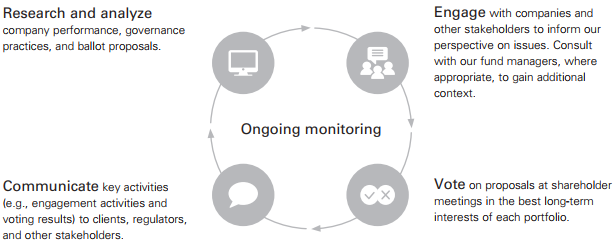
Our four pillars

Board

Good governance begins with a great board of directors. Our primary interest is to ensure that the individuals who represent the interests of all shareholders are independent (both in mindset and freedom from conflicts), capable (across the range of relevant skills for the company and industry), and appropriately experienced (so as to bring valuable perspective to their roles). We also believe that diversity of thought, background, and experience, as well as of personal characteristics (such as gender, race, and age), meaningfully contributes to the board’s ability to serve as effective, engaged stewards of shareholders’ interests. If a company has a well-composed, high-functioning board, good results are more likely to follow.

Structure

We believe in the importance of governance structures that empower shareholders and ensure accountability of the board and management. We believe that shareholders should be able to hold directors accountable as needed through certain governance and bylaw provisions. Among these preferred provisions are that directors must stand for election by shareholders annually and must secure a majority of the votes in order to join or remain on the board. In instances where the board appears resistant to shareholder input, we also support the right of shareholders to call special meetings and to place director nominees on the company’s ballot.

Compensation

We believe that performance-linked compensation policies and practices are fundamental drivers of the sustainable, long-term value for a company’s investors. The board plays a central role in determining appropriate executive pay that incentivizes performance relative to peers and competitors. Providing effective disclosure of these practices, their alignment with company performance, and their outcomes is crucial to giving shareholders confidence in the link between incentives and rewards and the creation of value over the long term.

Risk

Boards are responsible for effective oversight and governance of the risks most relevant and material to each company in the context of its industry and region. We believe that boards should take a thorough, integrated, and thoughtful approach to identifying, understanding, quantifying, overseeing, and—where appropriate—disclosing risks that have the potential to affect shareholder value over the long term. Importantly, boards should communicate their approach to risk oversight to shareholders through their normal course of business.

By the numbers: Voting and engagement

Engagement and voting trends

2015 proxy season 2016 proxy season  2017 proxy season
Company engagements 685 817 954
Companies voted 10,560 11,564 12,974
Meetings voted 12,785 16,740 18,905
Proposals voted 124,230 157,506 171,385
Countries voted in* 70 70 68

* The number of countries can vary each year. In certain markets, some companies do not hold shareholder meetings annually.
Note: The annual proxy season is from July 1 to June 30.

Our voting

Proxy voting reflects our governance pillars worldwide.

Meetings voted by region
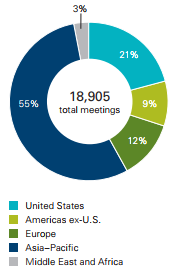
Note: Data pertains to voting activity from July 1, 2016, through June 30, 2017

Global voting activity
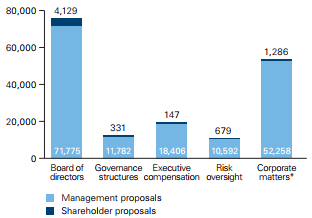
* Includes more than 26,000 proposals related to capitalization; 8,000 proposals related to mergers and acquisitions; 16,000 routine business proposals; and 1,000 other shareholder proposals.
Note: Data pertains to voting activity from July 1, 2016, through June 30, 2017.

Our engagement

We engage with companies of all sizes.

Market Capitalization % of 2017 proxy season engagements
Under $1 billion 19%
$1 billion–under $10 billion 44%
$10 billion–under $50 billion 24%
$50 billion and over 13%

Our engagement with portfolio companies has grown significantly over time.

Number of engagements and assets represented
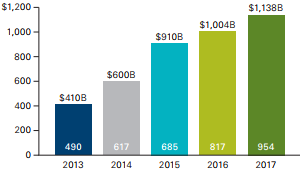
Note: Dollar figures represent the market value of Vanguard fund investments in companies with which we engaged as of June 30, 2017.

We engage on a range of topics aligned with our four pillars

Frequency of topics discussed during Vanguard engagements (%)
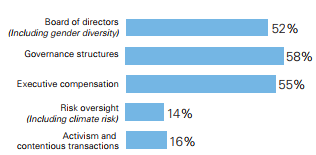
Note: Figures do not total 100%, as individual engagements often span multiple topics.

Boards in focus: Vanguard’s view on gender diversity

One of our most fundamental governance beliefs is that good governance begins with a great board of directors. We believe that diversity among directors—along dimensions such as gender, experience, race, background, age, and tenure—can strengthen a board’s range of perspectives and its capacity to make complex, fully considered decisions.

While we have long discussed board composition and diversity with portfolio companies, gender diversity has emerged as one dimension on which there is compelling support for positive effects on shareholder value. In recent years, a growing body of research has demonstrated that greater gender diversity on boards can lead to better company performance and governance.

Companies should be prepared to discuss—in both their public disclosures and their engagement with investors—their plans to incorporate appropriate diversity over time in their board composition. While we believe that board evolution is a process, not an event, the demonstration of meaningful progress over time will inform our engagement and voting going forward.

Boards in focus: Gender diversity

Engagement case studies

Gender diversity on boards was an important topic of engagement for us during the 12 months ended June 30, 2017. Below are summary examples of discussions we had on the subject.

High-impact engagement on gender diversity

Over several interactions with a U.S. industrial company, our team shared Vanguard’s perspective on board composition and evaluation. The company had undergone recent leadership transitions and was open to amending elements of its governance structure to align with best practices. We expressed particular support for meaningful gender diversity and expressed concern that the board previously had only one female director in its recent history.

Right after this year’s annual general meeting, the company announced it was adding four new directors with diverse experience, including two women. This outcome is the best-case scenario: The board welcomed shareholder input, we shared our view on best corporate governance practices, and the board ultimately incorporated our perspective into its board evolution process.

A denial of diversity’s value

A Canadian materials company that had consistently underperformed was governed by an entrenched, all-male board with seemingly nominal independence from the CEO. A 2017 shareholder resolution asked the company to adopt and publish a policy governing gender diversity on the board. Before voting, Vanguard engaged with the company to learn about its board evolution process, including its perspective on gender diversity. The engagement revealed that the company understood neither the value of gender diversity nor the importance of being responsive to shareholders’ concerns. Despite verbally endorsing gender diversity, the company resisted specifying a strategy or making a commitment to achieve it. The board, when seeking new members, relied solely on recommendations from current directors, a practice that can entrench the current board’s perspective and limit diversity. Our funds voted in support of the shareholder resolution, and we will continue to engage and hold the board accountable for meaningful progress over time.

Mixed results from an ongoing engagement

A U.S. consumer discretionary company had no women on its board, a problem magnified by its medium-term underperformance relative to peers, a classified board structure, and a lengthy average director tenure. We engaged with management twice between the 2016 and 2017 annual meetings to share our perspective on the importance of gender diversity and recommend that they make it a priority for future board evolution and director searches.

In its 2017 proxy, the company described board diversity as critical to the firm’s sustainable value and named gender as an element of diversity to be considered during the director search and nomination process. The company has since added a non-independent woman to the board. Although this move is directionally correct, it does not fully address our concerns; we will continue to encourage the company to add gender diversity to its ranks of independent directors.

Risk in focus: Vanguard’s view on climate risk

As the steward of long-term shareholder value for more than 20 million investors, Vanguard closely monitors how our portfolio companies identify, manage, and mitigate risks—including climate risk. Our approach to climate risk is evolving as the world’s and business community’s understanding of the topic matures.

This year, for the first time, our funds supported a number of climate-related shareholder resolutions opposed by company management. We are also discussing climate risk with company management and boards more than ever before. Our Investment Stewardship team is committed to engaging with a range of stakeholders to inform our perspective on these issues, and to share our thinking with the market, our portfolio companies, and our investors.

Risk in focus: Climate risk

A Q&A with Glenn Booraem, Vanguard’s Investment Stewardship Officer

Vanguard is an investment management company. Why should Vanguard fund investors be concerned about climate risk?

Mr. Booraem: Climate risk has the potential to be a significant long-term risk for companies in many industries. As stewards of our clients’ long-term investments, we must be finely attuned to this risk. We acknowledge that our clients’ views on climate risk span the ideological spectrum. But our position on climate risk is anchored in long-term economic value—not ideology. Regardless of one’s perspective on climate, there’s no doubt that changes in global regulation, energy consumption, and consumer preferences will have a significant economic impact on companies, particularly in the energy, industrial, and utilities sectors.

Why the shift in Vanguard’s assessment of climate risk, and why now?

Mr. Booraem: We’ve been discussing climate risk with portfolio companies for several years. It has been, and will remain, one of our engagement priorities for the foreseeable future. This past year, we engaged with more companies on this issue than ever before, and for the first time our funds supported two climate-related shareholder resolutions in cases where we believed that companies’ disclosure practices weren’t on par with emerging expectations in the market. As with other issues, our point of view has evolved as the topic has matured and, importantly, as its link to shareholder value has become more clear.

What is your top concern when you learn that a company in which a Vanguard portfolio invests does not have a rigorous strategy to evaluate and mitigate climate risk?

Mr. Booraem: Our concern is fundamentally that in the absence of clear disclosure and informed board oversight, the market lacks insight into the material risks of investing in that firm. It’s of paramount importance to us that the market is able to reflect risk and opportunity in stock prices, particularly for our index funds, which don’t get to select the stocks they own. When we’re not confident that companies have an appropriate level of board oversight or disclosure, we’re concerned that the market may not accurately reflect the value of the investment. Because we represent primarily long-term investors, this bias is particularly problematic when underweighting long-term risks inflates a company’s value.

Now that Vanguard has articulated a clear stance on climate risk, what can portfolio companies expect?

Mr. Booraem: First, companies should expect that we’re going to focus on their public disclosures, both about the risk itself and about their board’s and management’s oversight of that risk. Thorough disclosure is the foundation for the market’s understanding of the issue. Second, companies should expect that we’ll evaluate their disclosures in the context of both their leading peers and evolving market standards, such as those articulated by the Sustainability Accounting Standards Board (SASB). Third, they should expect that we’ll listen to their perspective on these and other matters. And finally, they should see our funds’ proxy voting as an extension of our engagement. When we consider a shareholder resolution on climate risk, we give companies a fair hearing on the merits of the proposal and consider their past commitments and the strength of their governance structure.

Engagement case studies

In the 12 months ended June 30, 2017, the topic of climate risk disclosure grew in frequency and prominence in our engagements with companies, particularly those in the energy, industrial, and utilities sectors, where climate risk was addressed in nearly every conversation we had. Below are examples of our engagements on climate risk.

Two companies’ commitments to enhanced disclosure

Our team led similar engagements with two U.S. energy companies facing shareholder resolutions on climate risk. One resolution requested that the first company publish an annual report on climate risk impacts and strategy. At the second company, a resolution requested disclosure of the company’s strategy and targets for transitioning to a low- carbon economy. In both cases, when we engaged with the companies, their management teams committed to improving their climate risk disclosure. Given the companies’ demonstrated responsiveness to shareholder feedback and commitment to improving, our funds did not support either shareholder proposal. Our team will continue to track and evaluate the companies’ progress toward their commitments as we consider our votes in future years.

A vote against a risk and governance outlier For years we engaged with a U.S. energy company that lagged its peers on climate risk disclosure and board accessibility. This year, a shareholder proposal requesting that the company produce a climate risk assessment report demonstrated a compelling link between the requested disclosures and long-term shareholder value. Because the board serves on behalf of shareholders and plays a critical role in risk oversight, we believed it was appropriate to seek a direct dialogue with independent directors about climate risk. Management resisted connecting the independent directors with shareholders, making the company a significant industry outlier in good governance practice. Without the confidence that the board understood or represented our view that climate risk poses a material risk in the energy sector, our team viewed the climate risk and governance issues as intertwined. Ultimately, our funds voted for the shareholder proposal and withheld votes on relevant independent directors for failing to engage with shareholders.

A vote for greater climate risk disclosure

A shareholder proposal at a U.S. energy company asked for an annual report with climate risk disclosure, including scenario planning. Through extensive research and engagements with the company’s management, its independent directors, and other industry stakeholders, our team identified governance shortfalls and a clear connection to long-term shareholder value. The company lagged its peers in disclosure, risk planning, and board oversight and responsiveness to shareholder concerns. Crucially, although the company’s public filings identified climate risk as a material issue, it failed to articulate plans for mitigation or adaptation. A similar proposal last year garnered significant support, but the company made no meaningful changes in response. Engagement had limited effect, so our funds voted for the shareholder proposal.

* * *

This post was excerpted from a Vanguard report; the complete publication is available here.