Le monde des affaires peut-il contribuer à assainir le processus politique américain ?


Aujourd’hui, je partage avec vous les réflexions de Ben W. Heineman, Jr*, ex-conseiller en chef de GE et Fellow de la Harvard Law School et de la Kennedy School of Government.

L’article illustre certaines dysfonctions du processus politique américain et montre que les sociétés américaines sont, en partie responsable du climat de méfiance de la population envers Washington.

L’auteur identifie plusieurs moyens que le monde des affaires devrait explorer afin de remédier aux lacunes observées dans le fonctionnement de notre démocratie et des relations entre le gouvernement et les sociétés :

  1. Limitation des sommes investies par les entreprises dans les campagnes politiques (7 milliards US en 2016)
  2. Divulgation financière accrue
  3. Meilleure identification des éléments factuels en matière politique
  4. Reconnaître la nécessité de se mettre à la place de l’autre partie dans le but d’atteindre un équilibre des valeurs
  5. Bâtir de larges coalitions
  6. Garder la tête froide afin d’éviter la confrontation
  7. Éviter la partisanerie

Le monde des entreprises ne doit pas s’ériger en modèle eu égard à la gestion des affaires de l’État ; cependant, je crois que les organisations doivent prendre en compte les moyens suggérés par l’auteur afin d’améliorer la communication et la bonne gouvernance.

Bonne lecture !


Can Business Help Fix Our Broken Politics?

 

xvm14ba5104-eae6-11e5-bbc3-b89f324a88fb


Many business people are appalled at the current state of our politics. Few, however, would admit that the “business community” is responsible, in part, for our dysfunctional political culture. And fewer yet may be prepared to think about how business can take steps—in concert with other political actors—to help soothe the distemper.

But, this dreary campaign season is a good time for corporate leaders to consider specific changes in political processes—less money, more disclosure, fair facts, balanced proposals, broad coalitions, cooler rhetoric, bi-partisanship—which could help fix our broken politics and rehabilitate business’s own political standing. Such process changes proceed from an understanding that there will always be significant substantive policy differences about societal problems but that those differences require a national politics that promotes common sense, civility and compromise to move the country forward, as has happened before in our history.

First a brief background sketch on the sorry state of our current political discourse.

The problem in our political system is not just the cacophony of the campaigns which distorts and obscures the real issues facing the nation. Below the noise, we have a populist revolt among a significant segment of the electorate that is more sharply critical of business than the general anti-corporate undercurrent which has long been present in American politics. That revolt stems partly from genuine problems of recession and a changing economy which is leaving some people behind but partly from the demagogic appeals to latent anger about race, immigration, Islam and trade. Moreover, the two major parties have been dead-locked for a long time on how to deal with major issues of paramount concern to the economy and the country—e.g., taxes, trade, worker dislocation, inequality, stimulus/deficit, infrastructure, immigration, education, energy and the environment—yielding a Congressional approval rating of only 14 percent!

Moreover, the well-publicized problems in the corporate community have added to political dysfunction, leading to low levels of trust in business’ role in policy and politics. These include: a steady drumbeat of corporate scandals (Wells Fargo is only the latest); ever higher executive compensation combined with stagnant real income of average citizens; corporate mistakes relating to leverage and liquidity as a major cause of the Great Recession; the perception that business elites are have disproportionate influence due to money in politics; and an aggregate sense that too much of corporate involvement in policy is in the service of “crony capitalism”, the range of subsidies, loopholes, franchises, concessions et al. that have little or no basis in advancing the broad public interest.

Business is hardly alone in its credibility problems with parts of the electorate. Other prominent actors—for example, unions, consumers, environmentalists and political parties—also have perceived failings. And, while some of the general distrust is due to political hyperventilation, there are, as noted, genuine substantive differences about whether libertarian, conservative, populist or liberal ideas are the right approach to various national problems.

But the rude noise of our current politics and the genuine substantive differences suggest that business ought to consider working with other actors in our political system on at least the following issues of political process to engender more civility and compromise. Each of these subjects is worthy of extended, book-length discussions, but here are the headlines:

New substantive limits on campaigns awash in money (more than $7B estimated in 2016 federal elections).

Although “independent” spending for educational purposes or in support of candidates is protected speech under the First Amendment, it may be limited under the Constitution if improperly “coordinated” with candidates’ campaigns or if used for “corrupt” purposes. Similarly, “educational” efforts by social welfare organizations authorized by the IRS could be more carefully circumscribed only to include genuine charitable and less partisan activities. Congress could take such narrowing steps or authorize the IRS and a reconstituted Federal Election Commission (which could have a tie-breaking chair appointed by the party in power) to address these issues.

More financial disclosure.

In elections, the Federal Election Commission and the IRS could require more real time disclosure of contributors and expenditures for “independent” entities organized under their jurisdiction. This timely disclosure (the IRS is particularly slow) would also cover more campaign finance if the scope of campaign activity funded through IRS entities was limited, forcing independent funds into the more transparent FEC Super PACs. And, the IRS could consider whether there should be an exception to the general rule of non-disclosure regarding contributors for trade associations or other authorized 501(c)(3) entities engaged in “education” on campaign issues during a defined political season.

Develop fairer, clearer facts in policy disputes.

Corporations and other parties could work with public officials to devise better, honest methods for establishing a record of consensus facts in legislative and regulatory disputes and identifying the assumptions underlying contested facts so that the battle of experts is more clearly understood by decision-makers and the public.

Acknowledge the need to balance values in conflict.

Corporations and other parties should identify and acknowledge the values on both sides of most regulatory and legislative debates and make a good faith effort to give weight to all the values in conflict, e.g. finding a fair balance between the verities of equity and efficiency in social welfare legislation or between access, cost and quality in healthcare legislation or between expedition and safety in drug approvals or between short-term cost and long-term benefit in environmental regulation.

Build broad coalitions.

Too often business public policy efforts take place in the self-referential echo-chamber of trade associations or other business groups. Working with other interested parties to create coalitions that include, but are not limited to, business allies increases the chances of broad-minded approaches that can secure approval and provide durable benefits. Indeed, there no united “business community,” and disagreements among business actors (e.g. global v. domestic, tech v. industrial) means broader coalition building is necessary.

Cool the rhetoric.

One of the poisonous aspects of our current political culture is rhetoric that demonizes opponents with words like “hate” or that bemoans an approaching American Armageddon. Business, especially, should use calm and reasoned civil discourse, recognizing that there are usually legitimate opposing values in political debates and helping find a middle ground that does not demand total victory.

Avoid Partisanship.

Corporations should seek bipartisan or nonpartisan solutions to our most pressing problems to mitigate the anger and hostility exchanged across the aisle on so many pressing national issues which require sensible compromises. Too often relations in Congress or between Congress and the Executive look like an insoluble “blood feud.”

There should be no mistake. These political process issues—relating to money, facts, balance, coalitions, rhetoric and bipartisanship—may be as vexing and controversial for the business community as substantive policy positions. Some companies will resist, inter alia, because they believe their particular substantive position is more important than general process or because they believe gridlock in public policy is better than compromise.

Nonetheless, a timely question is whether corporations, by focusing on these and other process issues, can help heal, rather than exacerbate, the manifest ills in our political system—ills posing serious threats to the maintenance of a healthy constitutional democracy and a sound mixed economy in which vital public goods can be secured and private enterprise can flourish? These issues relating to the process of political participation should be central to a company’s future debates about what constitutes being a “good corporate citizen.” This subject is too vast for a single corporation, but a broad based “coalition of the willing,” extending far beyond corporations, may be the way past the dystopic present—what leading political scientist Francis Fukuyama has warned is American “political decay”—to a post-election future of a vibrant and workable democracy.

__________________________________

*Ben W. Heineman, Jr. is former GE General Counsel and is a senior fellow at Harvard Law School and Harvard Kennedy School of Government. He is author of the new book, The Inside Counsel Revolution: Resolving the Partner-Guardian Tension (Ankerwycke 2016), as well as High Performance with High Integrity (Harvard Business Press 2008).

Amendements à la loi canadienne sur les sociétés par actions : De quoi s’agit-il ?


Le 28 septembre 2016, le gouvernement fédéral a proposé un certain nombre de modifications à la Loi canadienne sur les sociétés par actions (projet de loi C-25) afin de clarifier les obligations de divulgation des émetteurs canadiens. Les amendements à la loi ont deux objectifs :

(1) s’assurer que certaines règles adoptées par le Toronto Stock Exchange (TSX) soient clarifiées et incorporées dans la loi canadienne sur les sociétés par actions ;

(2) faire en sorte que la loi amendée reflète davantage les bonnes pratiques de gouvernance généralement reconnue.

Dans leur compte rendu sur les implications de ce projet de loi, paru sur le site du Harvard Law School Forum on Corporate Governance, Louis-Martin O’Neill et Jennifer Longhurst, associés de la firme Davies Ward Phillips & Vineberg LLP, discutent de trois changements susceptibles d’affecter la gouvernance et les modes de divulgation des sociétés.

Voici les changements proposés :

  1. True majority voting: requiring shareholders to cast their votes “for” or “against” each individual director’s election (rather than slate voting), and prohibiting a director who has not been elected by a majority of the votes cast from serving as a direcror, except in “prescribed circumstances”;
  2. Annual director elections: requiring corporations to hold annual elections for all directors of a company’s board, effectively prohibiting staggered boards; and
  3. Diversity disclosures: requiring corporations to place before shareholders, at each AGM, information respecting diversity among the directors and among the members of senior management.

Je vous encourage à prendre connaissance de ce bref article.

L’article suivant est également : Proposed Changes to the Canada Business Corporations Act – How Could this Affect You?

Bonne lecture !

Proposed Canada Business Corporations Act Amendments: A New Era?


amendement-a-la-loi-canadienne-sur-les-societes-par-actions
Amendement à la loi canadienne sur les sociétés par actions | Proposed Changes to the Canada Business Corporations Act – How Could this Affect You?


True majority voting requirement

In 2014, the Toronto Stock Exchange (TSX) implemented rules requiring majority voting for most TSX-listed issuers. This entailed adopting a majority voting policy requiring any undersupported director (i.e., a nominee who does not receive a majority of “for” votes) in an uncontested director election to tender his or her resignation to the board; the board is then required to consider and, save for “exceptional circumstances,” accept that resignation and publicly announce its decision. Since then, there has been some lingering controversy surrounding the TSX’s majority voting standard as a result of many boards rejecting the resignations of undersupported directors in reliance on those so-called exceptional circumstances, despite the expressed will of the shareholders.

For example, our Davies Governance Insights 2015 report revealed that in 2015 only one of 10 directors who failed to achieve majority support from shareholders had their resignation accepted by the board. The report explained how some of the boards relied on the “exceptional circumstances” carve-out to allow undersupported directors to remain on the board. Our most recent Davies Governance Insights 2016 report, however, suggests that this trend may be changing: in 2016, in those cases where directors of issuers on the TSX/S&P Composite and SmallCap indices received less than majority approval, the boards accepted their resignations.

The Proposed Amendments would put an end to this debate. They provide that (1) the shareholders of a distributing corporation will be able to vote only “for” or “against” each individual director (as opposed to withholding their votes); and (2) each director is elected only if the number of “for” votes represents a majority of the total shareholder votes cast. Slate voting would no longer be permitted, except for certain “prescribed corporations” (to be outlined in revised regulations, not yet published, to the CBCA). Moreover, the Proposed Amendments also provide that a director who is not elected by a majority cannot be appointed by the remaining directors to fill a vacancy on the board, except in “prescribed circumstances.”

In doing so, the Proposed Amendments would reverse the current practice that has developed under the TSX rules: rather than having an undersupported nominee elected as a matter of law and leaving to the board the decision on whether to accept their resignation, the Proposed Amendments would mean that a nominee who fails to get a majority of “for” votes is not elected as a matter of law, and may be appointed by the directors only in “prescribed circumstances.”  Whether the Proposed Amendments will result in meaningful change to the current practice for TSX-listed companies will, however, depend on what those “prescribed circumstances” are, to be set out in the not yet released regulations to the CBCA.

Annual elections now required

The TSX rules currently require its listed companies to hold annual director elections, effectively prohibiting staggered boards, a fairly uncommon practice in Canada. The Proposed Amendments will bring the CBCA up to speed with this current corporate governance best practice. We note that an exception included in the Proposed Amendments allows for elections to be held in accordance with existing CBCA requirements, which allow for three-year terms and staggered boards, in the case of “any prescribed class of distributing corporations” or “any prescribed circumstances respecting distributing corporations.” There is currently no such exception in the TSX rules, save for foreign issuers. The impact of this change will, therefore, depend upon the prescribed categories of corporations and circumstances that will be proposed in the CBCA regulations, if this change is implemented.

Disclosure relating to diversity

TSX-listed and other non-venture issuers are currently required, under National Instrument 58-101—Disclosure of Corporate Governance Practices (NI 58-101), to disclose certain information relating to the diversity of their board and executive officers, including whether they have adopted a written policy regarding female representation on the board, whether they consider the level of female representation when making board or executive officer nominations or appointments, and whether they have adopted a target regarding the representation of women on the board or in senior management; if not, the issuer must disclose why not. The Proposed Amendments to the CBCA would require “prescribed corporations” to provide the “prescribed information” respecting diversity among their directors and members of senior management.

Once again, the “prescribed corporations” and “prescribed information” that will need to be disclosed have not yet been determined. Accordingly, until proposed regulations clarifying these concepts have been released, it remains unclear whether the Proposed Amendments will alter the existing “comply or explain” model under NI 58-101 or impose stricter requirements on subject companies. We do not, however, expect the Proposed Amendments to impose targets or quotas on issuers; instead, they are likely to promote a similar approach to that currently in place under securities laws.

Conclusions

The majority voting requirement set forth in the Proposed Amendments is likely to bring an end to the debate over those circumstances in which an undersupported director may remain on the board. The questions, however, that are still unanswered will be whether boards will be inclined to use the Proposed Amendments to fill a vacancy by appointing an undersupported director whose failed election created the vacancy in the first place; and, in such a situation, how stringent the “prescribed circumstances” will be that would allow the directors to appoint an undersupported director. We also note there are some inconsistencies between the TSX rules and the Proposed Amendments that could subject some TSX-listed CBCA companies to potentially different (and potentially conflicting) sets of rules. We expect the regulators are attuned to and will be focused on minimizing that risk. In any case, if the Proposed Amendments are adopted, we expect TSX-listed issuers that are governed by the CBCA may need to revisit and revise their majority voting policies to ensure compliance with the Proposed Amendments.

While some view the Proposed Amendments as a welcome modernization of the federal corporate statute and a reflection of the need to enhance companies’ corporate governance practices, in many ways the Proposed Amendments are entrenching practices or policies that are already addressed under the TSX rules and securities laws. By delving into these areas, there remains a risk that the Proposed Amendments could lead to compliance and interpretational issues, as well as confusion over the appropriate mandates for each of the regulators, a concern expressed by some commentators in response to Industry Canada’s initial December 2013 consultation paper on the potential CBCA amendments. In addition, several undetermined exceptions and terms that will be laid out in revised CBCA regulations have yet to be published—only once they are will the full impact of the Proposed Amendments be known.

Prélude à un code de gouvernance aux É.U. !


Voici un bref article de Gary Larkin, associé à The Conference Board Governance Center, qui porte sur la perspective de concevoir un code de gouvernance qui  s’adresse à l’ensemble des entreprises publiques (cotées) américaines.

Le projet de code est l’initiative de quelques leaders d’entreprises cotées, de gestionnaires d’actif, d’un gestionnaire de fonds de pension et d’un actionnaire activiste.

Cet énoncé des grands principes de gouvernance se veut un exercice devant jeter les bases d’un code de gouvernance comme on en retrouve dans plusieurs pays, notamment au Royaume-Uni.

Voici les points saillants des principes retenus :


Every board should meet regularly without the CEO present, and every board should have active and direct engagement with executives below the CEO level.

Directors should be elected by a majority  of either “for” or “against/withhold” votes (with abstentions and non-votes not be counted)

Board refreshment should always be considered in order that the board’s skillset and perspectives remain current.

Every board should have members with complementary and diverse skills, backgrounds and experiences.

If the board decides on a combined CEO/Chair role, it is essential that the board have a strong independent director.

Institutional investors that make decisions on proxy issues important to long-term value creation should have access to the company, its management, and, in some circumstances, the board.

Companies should only provide earnings guidance to the extent they believe it is beneficial to shareholders.

Bonne lecture !


It’s Commonsense to Have a U.S. Corporate Governance Code


lp-corp-gov-charter_880x330


Over the summer, one of the most interesting pieces of corporate governance literature was the Commonsense Corporate Governance Principles.

The publication was the result of meetings between a group of leading executives of public companies, asset managers, a public pension fund, and a shareholder activist. The principles themselves may not have broken new ground—they addressed such basic issues as director independence, board refreshment and diversity, the need for earnings guidance, and shareholder engagement.  But the fact that such a publication was released at a time when some in Congress to roll back Dodd-Frank corporate-governance-related regulations is impressive.

It’s impressive because of who was in the meetings. It’s impressive because the meetings took place without any government or third-party instigation. It’s impressive because it might be the beginning of a new strategy for overseeing corporate governance in the United States. It shows that sometimes industry can lead by example without rules and regulations to tell them how to govern their own companies and boards.

Maybe these principles could be the start of the first true US corporate governance code, something that our brethren in the UK have had for years. Even smaller markets such as South Africa and Singapore have codes that are used to guide corporate governance.

Granted, those at the meetings, some of who included J. P. Morgan Chase CEO Jamie Dimon, Berkshire Hathaway chief Warren Buffett, General Motors head Mary Barra, BlackRock Chair and CEO Larry Fink, and Canada Pension Plan Investment Board President and CEO Mark Machin might not have envisioned themselves as U.S. corporate governance pioneers. But it’s a first step toward a true principles-based approach to good corporate governance in a country that is used to following rules and hiring attorneys to find the loopholes.

If you look at the main points made in the Commonsense Principles, you can see the foundation for such a code:

  1. Every board should meet regularly without the CEO present, and every board should have active and direct engagement with executives below the CEO level.
  2. Directors should be elected by a majority  of either “for” or “against/withhold” votes (with abstentions and non-votes not be counted)
  3. Board refreshment should always be considered in order that the board’s skillset and perspectives remain current.
  4. Every board should have members with complementary and diverse skills, backgrounds and experiences.
  5. If the board decides on a combined CEO/Chair role, it is essential that the board have a strong independent director.
  6. Institutional investors that make decisions on proxy issues important to long-term value creation should have access to the company, its management, and, in some circumstances, the board.
  7. Companies should only provide earnings guidance to the extent they believe it is beneficial to shareholders.

Microsoft, a Governance Center member, is satisfied with the Commonsense Principles because it aligns with what it has in place, according to a blog from Microsoft Corporate Secretary John Seethoff. “For example, we’ve made a concerted effort to assure board refreshment occurs with a focus on diversity in skillsets, backgrounds, and experiences,” he wrote. “The Principles agree with this emphasis, asserting, ‘Diversity along multiple dimensions is critical to a high-functioning board. Director candidates should be drawn from a rigorously diverse pool.’ Board tenure receives similarly thoughtful consideration, with the Principles underscoring the need to temper ‘fresh thinking and new perspectives’ with ‘age and experience.’”

Seethoff concluded: “At Microsoft, we’ve long believed that good corporate governance encourages accountability and transparency, as well as promotes sound decision-making to support our business over time. The ultimate goal is to create a system that provides appropriate structure for the company at present, allows flexibility to change in the future, and has a long-term perspective that matches our business objectives and strategy. As part of this open, constructive mindset, we applaud the leaders for outlining these Principles and look forward to continued dialogue on this important effort.”

If you ask me, the Commonsense Principles can definitely be the US Corporate Governance Code Version 1.0. They could be treated like climate change agreements (i.e. the 2015 Paris Climate Change Agreement) where countries come together and sign on. The original group of executives could hold a follow-up meeting or convention that would allow US companies to promise to follow the principles, similar to The Giving Pledge started by Buffet and Microsoft founder Bill Gates.

L’évolution de la divulgation des comités d’audit aux actionnaires


Voici un article d’Ann Yerger, directrice du Center for Board Matters, de la firme Ernst & Young, qui porte sur l’évolution significative des politiques de divulgation des comités d’audit aux actionnaires des entreprises cotées en bourse aux États-Unis en 2106. L’article est paru sur le site du Harvard Law School Forum on Corporate Governance le 9 octobre.

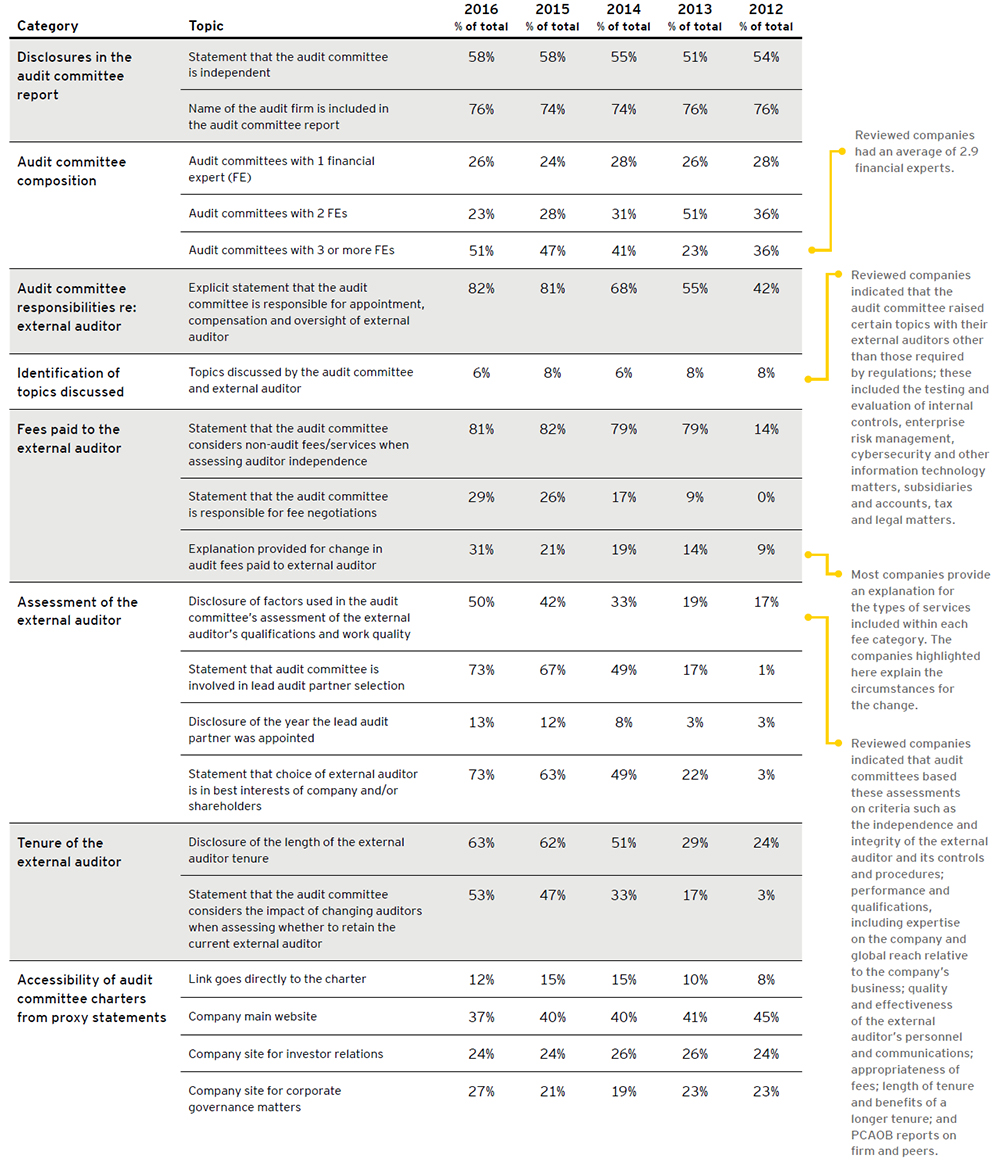
L’étendue des divulgations aux actionnaires est vraiment très importante dans certains cas. Par exemple, en 2012, seulement 42 % des entreprises dévoilaient explicitement que le comité d’audit était responsable de l’engagement, de la rémunération et de la surveillance des auditeurs externes, alors qu’en 2016, 82 % divulguent, souvent en détail, les informations de cette nature.

Plusieurs autres résultats font état de changements remarquables dans la reddition de compte des comités d’audit aux actionnaires des entreprises.

Ceux-ci sont maintenant plus en mesure d’évaluer la portée des décisions des comités d’audit eu égard à la qualité du travail des auditeurs externes, aux raisons invoquées pour changer d’auditeur externe, à la fixation du mandat de l’auditeur externe, à la composition du comité d’audit, à l’augmentation des honoraires des firmes comptables dans les quatre catégories suivantes : audit, relié aux travaux d’audit, fiscalité et autres services connexes, etc.

Bonne lecture !

Audit Committee Reporting to Shareholders in 2016


audit


Audit committees have a key role in overseeing the integrity of financial reporting. Nevertheless, relatively little information is required to be disclosed by US public companies about the audit committee’s important work. Since our first publication in this series in 2012, we have described efforts by investors, regulators and other stakeholders to seek increased audit­-related disclosures, as well as the resulting voluntary disclosures to respond to this interest.

Over 2015–2016, US regulators have placed a spotlight on audit-related disclosures and financial reporting more generally. The US Securities and Exchange Commission (SEC) and the US Public Company Accounting Oversight Board (PCAOB) have both taken action to consider the possibility of requiring new disclosures relating to the audit.

SEC representatives also have used speeches to urge companies and audit committees to increase disclosures in this area voluntarily. While additional disclosure requirements for audit committees are not expected in the near term, regulators continue to monitor developments in this area. This post seeks to shed light on the evolving audit­-related disclosure landscape.

Context

Public company audit committees are responsible for overseeing financial reporting, including the external audit. Under US securities laws, audit committees are “directly responsible for the appointment, compensation, retention and oversight” of the external auditor, and must include a report in annual proxy statements about their work. This audit committee report, however, currently must affirm only that the committee carried out certain specific responsibilities related to communications with the external auditor, and this requirement has not changed since 1999.

In recent years, a variety of groups have brought attention to the relative lack of information available about the audit committee and the audit, including their view that this area of disclosure may not have kept up with the needs of investors and other proxy statement users. These groups include pension funds, asset managers, investors, corporate governance groups, and domestic and foreign regulators. As efforts to seek additional information have continued, there has been a steady increase in voluntary audit-related disclosures.

Over the last year, the SEC has taken a series of actions to consider whether and how to improve transparency around audit committees, audits and financial reporting more generally. The combined effect of these activities has been to increase engagement by issuers, audit firms, investors and other stakeholders in discussions about the current state of financial reporting­ related disclosure as well as how it should change.

Findings

Our analysis of the 2016 proxy statements of Fortune 100 companies indicates that voluntaryaudit-related disclosures continue to trend upward in a number of areas. The CBM data for this review is based on the 78 companies on the 2016 Fortune 100 list that filed proxy statements each year from 2012 to 2016 for annual meetings through August 15, 2016. Below are highlights from our research:

  1. The percentage of companies that disclosed factors considered by the audit committee when assessing the qualifications and work quality of the external auditor increased to 50%, up from 42% in 2015. In 2012, only 17% of audit committees disclosed this information.
  2. Another significant increase was in disclosures stating that the audit committee believed that the choice of external auditor was in the best interests of the company and/or the shareholders. In 2016, 73% of companies disclosed such information; in 2015, this percentage was 63%. In 2012, only 3% of companies made this disclosure.
  3. The audit committees of 82% of the companies explicitly stated that they are responsible for the appointment, compensation and oversight of the external auditor; in 2012, only 42% of audit committees provided such disclosures.
  4. 31% of companies provided information about the reasons for changes in fees paid to the external auditor compared to 21% the previous year. Reasons provided in these disclosures include one­-time events, such as a merger or acquisition. Under current SEC rules, companies are required to disclose fees paid to the external auditor, divided into the following categories: audit, audit-related, tax and all other fees. They are not, however, required to discuss the reasons why these fees have increased or decreased. From 2012 to 2016, the percentage of companies disclosing information to explain changes in audit fees rose from 9% to 31%. Additional CBM research examined the disclosures of the subset of studied companies (43) that had changes in audit fees of +/-­ 5% or more compared to the previous year. Out of these 43 companies, roughly 20% provided explanatory disclosures regarding the change in audit fees.
  5. 29 of the 43 companies had fee increases of 5% or more, out of which 8 companies disclosed the reasons for the increases. 14 of the 43 companies had fee decreases of 5% or more, out of which only one company provided an explanatory disclosure.
  6. 53% of companies disclosed that the audit committee considered the impact of changing auditors when assessing whether to retain the current auditor. This was a 6 percentage point increase over 2015. In 2012, this disclosure was made by 3% of the Fortune 100 companies. Over the past five years, the number of companies disclosing that the audit committee was involved in the selection of the lead audit partner has grown dramatically, up to 73% in 2016. In 2015, 67% of companies disclosed this information, while in 2012, only 1% of companies did so.
  7. 51% of companies disclosed that they have three or more financial experts on their audit committees, up from 47% in 2015 and 36% in 2012.

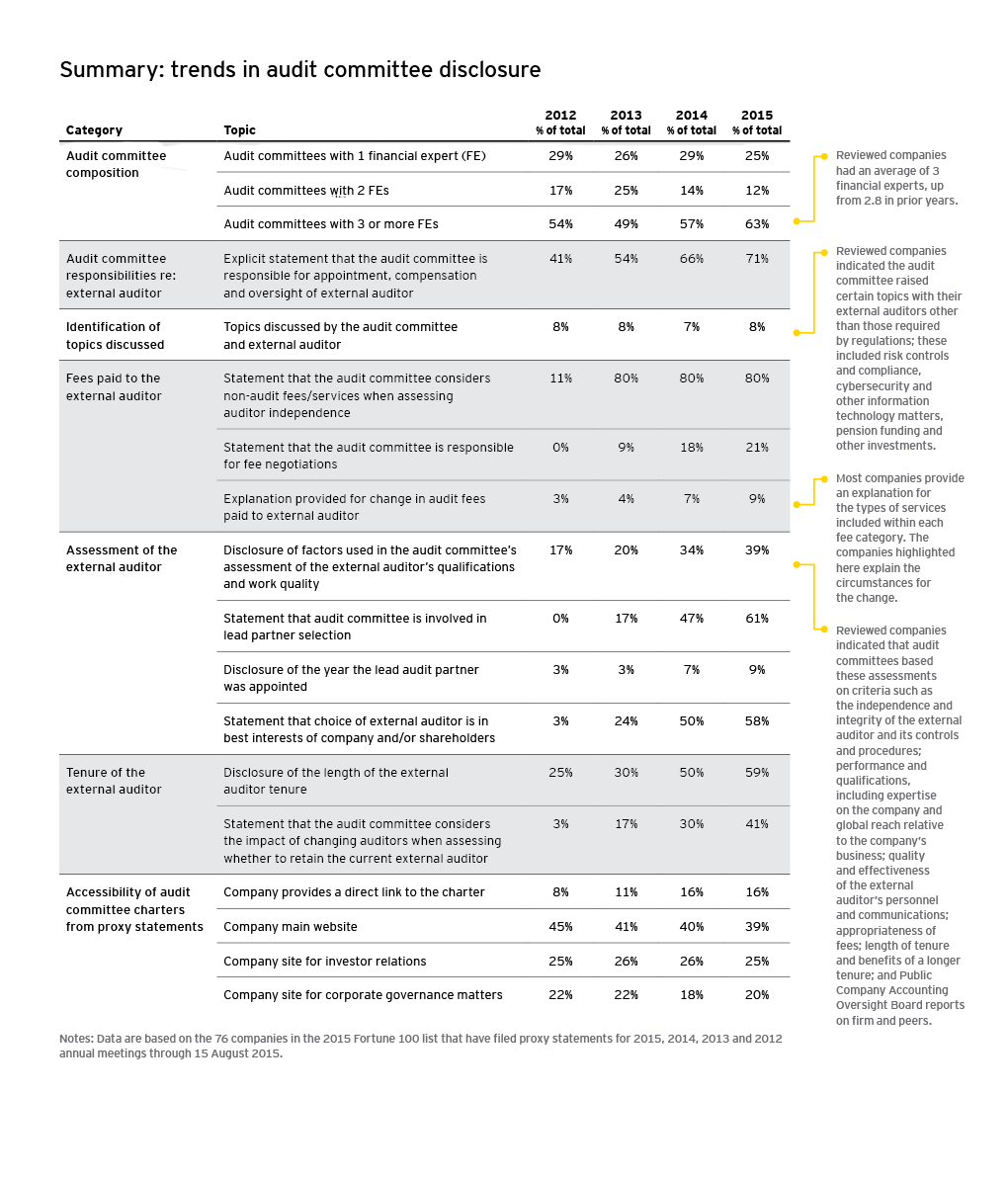
Summary: Trends in Audit Committee Disclosure

(Cliquez pour agrandir)

ey-summary-trends-in-audit-committee


Le point sur la gouvernance au Canada en 2016 | Rapport de Davies Ward Phillips Vineberg


Le rapport annuel de Davies est toujours très attendu car il brosse un tableau très complet de l’évolution de la gouvernance au Canada durant la dernière année.

Le document qui vient de sortir est en anglais mais la version française devrait suivre dans peu de temps.

Je vous invite donc à en prendre connaissance en lisant le court résumé ci-dessous et, si vous voulez en savoir plus sur les thèmes abordés, vous pouvez télécharger le document de 100 pages sur le site de l’entreprise.

Cliquez sur le lien ci-dessous. Bonne lecture !

Rapport de Davies sur la gouvernance 2016


Davies Governance Insights 2016, provides analysis of the top governance trends and issues important to Canadian boards, senior management and governance observers.

insights_governance_2016_fr_thumbnail

The 2016 edition provides readers with our take on important topics ranging from shareholder engagement and activism to leadership diversity and the rise in issues facing boards and general counsel. We also provide practical guidance for boards and senior management of public companies and their investors on these and many other corporate governance topics that we expect will remain under focus in the 2017 proxy season.


Livres phares sur la gouvernance d’entreprise


On me demande souvent de proposer un livre qui fait le tour de la question eu égard à ce qui est connu comme statistiquement valide sur les relations entre la gouvernance et le succès des organisations (i.e. la performance financière !)

Voici un article de James McRitchie, publié dans Corporate governance, qui commente succinctement le dernier volume de Richard Leblanc.

Comme je l’ai déjà mentionné dans un autre billet, le livre de Richard Leblanc est certainement l’un des plus importants ouvrages (sinon le plus important) portant sur la gouvernance du conseil d’administration.

Une révision du volume de Richard Leblanc | Handbook of Board Governance

The Handbook of Board Governance


Mentionnons également que le volume publié par David F. Larcker et Brian Tayan, professeurs au Graduate School de l’Université Stanford, en est à sa deuxième édition et il donne l’heure juste sur l’efficacité des principes de gouvernance. Voici une brève présentation du volume de Larcker.

Corporate Governance Matters: A Closer Look at Organizational Choices and Their Consequences (2nd edition)

Je vous recommande donc vivement de vous procurer ces volumes.

Enfin, je profite de l’occasion pour vous indiquer que je viens de recevoir la dernière version  des Principes de gouvernance d’entreprise du G20 et de l’OCDE en français et j’ai suggéré au Collège des administrateurs de sociétés (CAS) d’inclure cette publication dans la section Nouveauté du site du CAS.

Il s’agit d’une publication très attendue dans le monde de la gouvernance. La documentation des organismes internationaux est toujours d’abord publiée en anglais. Ce document en français de l’OCDE sur les principes de gouvernance est la bienvenue !

Bonne lecture !

Comment procéder à l’évaluation du CA, des comités et des administrateurs | Un sujet d’actualité 


Les conseils d’administration sont de plus en plus confrontés à l’exigence d’évaluer l’efficacité de leur fonctionnement par le biais d’une évaluation annuelle du CA, des comités et des administrateurs.

En fait, le NYSE exige depuis dix ans que les conseils procèdent à leur évaluation et que les résultats du processus soient divulgués aux actionnaires. Également, les investisseurs institutionnels et les activistes demandent de plus en plus d’informations au sujet du processus d’évaluation.

Les résultats de l’évaluation peuvent être divulgués de plusieurs façons, notamment dans les circulaires de procuration et sur le site de l’entreprise.

L’article publié par John Olson, associé fondateur de la firme Gibson, Dunn & Crutcher, professeur invité à Georgetown Law Center, et paru sur le forum du Harvard Law School, présente certaines approches fréquemment utilisées pour l’évaluation du CA, des comités et des administrateurs.

On recommande de modifier les méthodes et les paramètres de l’évaluation à chaque trois ans afin d’éviter la routine susceptible de s’installer si les administrateurs remplissent les mêmes questionnaires, gérés par le président du conseil. De plus, l’objectif de l’évaluation est sujet à changement (par exemple, depuis une décennie, on accorde une grande place à la cybersécurité).

C’est au comité de gouvernance que revient la supervision du processus d’évaluation du conseil d’administration. L’article décrit quatre méthodes fréquemment utilisées.

(1) Les questionnaires gérés par le comité de gouvernance ou une personne externe

(2) les discussions entre administrateurs sur des sujets déterminés à l’avance

(3) les entretiens individuels avec les administrateurs sur des thèmes précis par le président du conseil, le président du comité de gouvernance ou un expert externe.

(4) L’évaluation des contributions de chaque administrateur par la méthode d’auto-évaluation et par l’évaluation des pairs.

Chaque approche a ses particularités et la clé est de varier les façons de faire périodiquement. On constate également que beaucoup de sociétés cotées utilisent les services de spécialistes pour les aider dans leurs démarches.

fotolia_100107623

La quasi-totalité des entreprises du S&P 500 divulgue le processus d’évaluation utilisé pour améliorer leur efficacité. L’article présente deux manières de diffuser les résultats du processus d’évaluation.

(1) Structuré, c’est-à-dire un format qui précise — qui évalue quoi ; la fréquence de l’évaluation ; qui supervise les résultats ; comment le CA a-t-il agi eu égard aux résultats de l’opération d’évaluation.

(2) Information axée sur les résultats — les grandes conclusions ; les facteurs positifs et les points à améliorer ; un plan d’action visant à corriger les lacunes observées.

Notons que la firme de services aux actionnaires ISS (Institutional Shareholder Services) utilise la qualité du processus d’évaluation pour évaluer la robustesse de la gouvernance des sociétés. L’article présente des recommandations très utiles pour toute personne intéressée par la mise en place d’un système d’évaluation du CA et par sa gestion.

Voici trois articles parus sur mon blogue qui abordent le sujet de l’évaluation :

L’évaluation des conseils d’administration et des administrateurs | Sept étapes à considérer

Quels sont les devoirs et les responsabilités d’un CA ?  (la section qui traite des questionnaires d’évaluation du rendement et de la performance du conseil)

Évaluation des membres de Conseils

Bonne lecture !

Getting the Most from the Evaluation Process


More than ten years have passed since the New York Stock Exchange (NYSE) began requiring annual evaluations for boards of directors and “key” committees (audit, compensation, nominating/governance), and many NASDAQ companies also conduct these evaluations annually as a matter of good governance. [1] With boards now firmly in the routine of doing annual evaluations, one challenge (as with any recurring activity) is to keep the process fresh and productive so that it continues to provide the board with valuable insights. In addition, companies are increasingly providing, and institutional shareholders are increasingly seeking, more information about the board’s evaluation process. Boards that have implemented a substantive, effective evaluation process will want information about their work in this area to be communicated to shareholders and potential investors. This can be done in a variety of ways, including in the annual proxy statement, in the governance or investor information section on the corporate website, and/or as part of shareholder engagement outreach.

To assist companies and their boards in maximizing the effectiveness of the evaluation process and related disclosures, this post provides an overview of several frequently used methods for conducting evaluations of the full board, board committees and individual directors. It is our experience that using a variety of methods, with some variation from year to year, results in more substantive and useful evaluations. This post also discusses trends and considerations relating to disclosures about board evaluations. We close with some practical tips for boards to consider as they look ahead to their next annual evaluation cycle.

Common Methods of Board Evaluation

As a threshold matter, it is important to note that there is no one “right” way to conduct board evaluations. There is room for flexibility, and the boards and committees we work with use a variety of methods. We believe it is good practice to “change up” the board evaluation process every few years by using a different format in order to keep the process fresh. Boards have increasingly found that year-after-year use of a written questionnaire, with the results compiled and summarized by a board leader or the corporate secretary for consideration by the board, becomes a routine exercise that produces few new insights as the years go by. This has been the most common practice, and it does respond to the NYSE requirement, but it may not bring as much useful information to the board as some other methods.

Doing something different from time to time can bring new perspectives and insights, enhancing the effectiveness of the process and the value it provides to the board. The evaluation process should be dynamic, changing from time to time as the board identifies practices that work well and those that it finds less effective, and as the board deals with changing expectations for how to meet its oversight duties. As an example, over the last decade there have been increasing expectations that boards will be proactive in oversight of compliance issues and risk (including cyber risk) identification and management issues.

Three of the most common methods for conducting a board or committee evaluation are: (1) written questionnaires; (2) discussions; and (3) interviews. Some of the approaches outlined below reflect a combination of these methods. A company’s nominating/governance committee typically oversees the evaluation process since it has primary responsibility for overseeing governance matters on behalf of the board.

1. Questionnaires

The most common method for conducting board evaluations has been through written responses to questionnaires that elicit information about the board’s effectiveness. The questionnaires may be prepared with the assistance of outside counsel or an outside advisor with expertise in governance matters. A well-designed questionnaire often will address a combination of substantive topics and topics relating to the board’s operations. For example, the questionnaire could touch on major subject matter areas that fall under the board’s oversight responsibility, such as views on whether the board’s oversight of critical areas like risk, compliance and crisis preparedness are effective, including whether there is appropriate and timely information flow to the board on these issues. Questionnaires typically also inquire about whether board refreshment mechanisms and board succession planning are effective, and whether the board is comfortable with the senior management succession plan. With respect to board operations, a questionnaire could inquire about matters such as the number and frequency of meetings, quality and timeliness of meeting materials, and allocation of meeting time between presentation and discussion. Some boards also consider their efforts to increase board diversity as part of the annual evaluation process.

Many boards review their questionnaires annually and update them as appropriate to address new, relevant topics or to emphasize particular areas. For example, if the board recently changed its leadership structure or reallocated responsibility for a major subject matter area among its committees, or the company acquired or started a new line of business or experienced recent issues related to operations, legal compliance or a breach of security, the questionnaire should be updated to request feedback on how the board has handled these developments. Generally, each director completes the questionnaire, the results of the questionnaires are consolidated, and a written or verbal summary of the results is then shared with the board.

Written questionnaires offer the advantage of anonymity because responses generally are summarized or reported back to the full board without attribution. As a result, directors may be more candid in their responses than they would be using another evaluation format, such as a face-to-face discussion. A potential disadvantage of written questionnaires is that they may become rote, particularly after several years of using the same or substantially similar questionnaires. Further, the final product the board receives may be a summary that does not pick up the nuances or tone of the views of individual directors.

In our experience, increasingly, at least once every few years, boards that use questionnaires are retaining a third party, such as outside counsel or another experienced facilitator, to compile the questionnaire responses, prepare a summary and moderate a discussion based on the questionnaire responses. The desirability of using an outside party for this purpose depends on a number of factors. These include the culture of the board and, specifically, whether the boardroom environment is one in which directors are comfortable expressing their views candidly. In addition, using counsel (inside or outside) may help preserve any argument that the evaluation process and related materials are privileged communications if, during the process, counsel is providing legal advice to the board.

In lieu of asking directors to complete written questionnaires, a questionnaire could be distributed to stimulate and guide discussion at an interactive full board evaluation discussion.

2. Group Discussions

Setting aside board time for a structured, in-person conversation is another common method for conducting board evaluations. The discussion can be led by one of several individuals, including: (a) the chairman of the board; (b) an independent director, such as the lead director or the chair of the nominating/governance committee; or (c) an outside facilitator, such as a lawyer or consultant with expertise in governance matters. Using a discussion format can help to “change up” the evaluation process in situations where written questionnaires are no longer providing useful, new information. It may also work well if there are particular concerns about creating a written record.

Boards that use a discussion format often circulate a list of discussion items or topics for directors to consider in advance of the meeting at which the discussion will occur. This helps to focus the conversation and make the best use of the time available. It also provides an opportunity to develop a set of topics that is tailored to the company, its business and issues it has faced and is facing. Another approach to determining discussion topics is to elicit directors’ views on what should be covered as part of the annual evaluation. For example, the nominating/governance could ask that each director select a handful of possible topics for discussion at the board evaluation session and then place the most commonly cited topics on the agenda for the evaluation.

A discussion format can be a useful tool for facilitating a candid exchange of views among directors and promoting meaningful dialogue, which can be valuable in assessing effectiveness and identifying areas for improvement. Discussions allow directors to elaborate on their views in ways that may not be feasible with a written questionnaire and to respond in real time to views expressed by their colleagues on the board. On the other hand, they do not provide an opportunity for anonymity. In our experience, this approach works best in boards with a high degree of collegiality and a tradition of candor.

3. Interviews

Another method of conducting board evaluations that is becoming more common is interviews with individual directors, done in-person or over the phone. A set of questions is often distributed in advance to help guide the discussion. Interviews can be done by: (a) an outside party such as a lawyer or consultant; (b) an independent director, such as the lead director or the chair of the nominating/governance committee; or (c) the corporate secretary or inside counsel, if directors are comfortable with that. The party conducting the interviews generally summarizes the information obtained in the interview process and may facilitate a discussion of the information obtained with the board.

In our experience, boards that have used interviews to conduct their annual evaluation process generally have found them very productive. Directors have observed that the interviews yielded rich feedback about the board’s performance and effectiveness. Relative to other types of evaluations, interviews are more labor-intensive because they can be time-consuming, particularly for larger boards. They also can be expensive, particularly if the board retains an outside party to conduct the interviews. For these reasons, the interview format generally is not one that is used every year. However, we do see a growing number of boards taking this path as a “refresher”—every three to five years—after periods of using a written questionnaire, or after a major event, such as a corporate crisis of some kind, when the board wants to do an in-depth “lessons learned” analysis as part of its self-evaluation. Interviews also offer an opportunity to develop a targeted list of questions that focuses on issues and themes that are specific to the board and company in question, which can contribute further to the value derived from the interview process.

For nominating/governance committees considering the use of an interview format, one key question is who will conduct the interviews. In our experience, the most common approach is to retain an outside party (such as a lawyer or consultant) to conduct and summarize interviews. An outside party can enhance the effectiveness of the process because directors may be more forthcoming in their responses than they would if another director or a member of management were involved.

Individual Director Evaluations

Another practice that some boards have incorporated into their evaluation process is formal evaluations of individual directors. In our experience, these are not yet widespread but are becoming more common. At companies where the nominating/governance committee has a robust process for assessing the contributions of individual directors each year in deciding whether to recommend them for renomination to the board, the committee and the board may conclude that a formal evaluation every year is unnecessary. Historically, some boards have been hesitant to conduct individual director evaluations because of concerns about the impact on board collegiality and dynamics. However, if done thoughtfully, a structured process for evaluating the performance of each director can result in valuable insights that can strengthen the performance of individual directors and the board as a whole.

As with board and committee evaluations, no single “best practice” has emerged for conducting individual director evaluations, and the methods described above can be adapted for this purpose. In addition, these evaluations may involve directors either evaluating their own performance (self-evaluations), or evaluating their fellow directors individually and as a group (peer evaluations). Directors may be more willing to evaluate their own performance than that of their colleagues, and the utility of self-evaluations can be enhanced by having an independent director, such as the chairman of the board or lead director, or the chair of the nominating/governance committee, provide feedback to each director after the director evaluates his or her own performance. On the other hand, peer evaluations can provide directors with valuable, constructive comments. Here, too, each director’s evaluation results typically would be presented only to that director by the chairman of the board or lead director, or the chair of the nominating/governance committee. Ultimately, whether and how to conduct individual director evaluations will depend on a variety of factors, including board culture.

Disclosures about Board Evaluations

Many companies discuss the board evaluation process in their corporate governance guidelines. [2] In addition, many companies now provide disclosure about the evaluation process in the proxy statement, as one element of increasingly robust proxy disclosures about their corporate governance practices. According to the 2015 Spencer Stuart Board Index, all but 2% of S&P 500 companies disclose in their proxy statements, at a minimum, that they conduct some form of annual board evaluation.

In addition, institutional shareholders increasingly are expressing an interest in knowing more about the evaluation process at companies where they invest. In particular, they want to understand whether the board’s process is a meaningful one, with actionable items emerging from the evaluation process, and not a “check the box” exercise. In the United Kingdom, companies must report annually on their processes for evaluating the performance of the board, its committees and individual directors under the UK Corporate Governance Code. As part of the code’s “comply or explain approach,” the largest companies are expected to use an external facilitator at least every three years (or explain why they have not done so) and to disclose the identity of the facilitator and whether he or she has any other connection to the company.

In September 2014, the Council of Institutional Investors issued a report entitled Best Disclosure: Board Evaluation (available here), as part of a series of reports aimed at providing investors and companies with approaches to and examples of disclosures that CII considers exemplary. The report recommended two possible approaches to enhanced disclosure about board evaluations, identified through an informal survey of CII members, and included examples of disclosures illustrating each approach. As a threshold matter, CII acknowledged in the report that shareholders generally do not expect details about evaluations of individual directors. Rather, shareholders “want to understand the process by which the board goes about regularly improving itself.” According to CII, detailed disclosure about the board evaluation process can give shareholders a “window” into the boardroom and the board’s capacity for change.

The first approach in the CII report focuses on the “nuts and bolts” of how the board conducts the evaluation process and analyzes the results. Under this approach, a company’s disclosures would address: (1) who evaluates whom; (2) how often the evaluations are done; (3) who reviews the results; and (4) how the board decides to address the results. Disclosures under this approach do not address feedback from specific evaluations, either individually or more generally, or conclusions that the board has drawn from recent self-evaluations. As a result, according to CII, this approach can take the form of “evergreen” proxy disclosure that remains similar from year to year, unless the evaluation process itself changes.

The second approach focuses more on the board’s most recent evaluation. Under this approach, in addition to addressing the evaluation process, a company’s disclosures would provide information about “big-picture, board-wide findings and any steps for tackling areas identified for improvement” during the board’s last evaluation. The disclosures would identify: (1) key takeaways from the board’s review of its own performance, including both areas where the board believes it functions effectively and where it could improve; and (2) a “plan of action” to address areas for improvement over the coming year. According to CII, this type of disclosure is more common in the United Kingdom and other non-U.S. jurisdictions.

Also reflecting a greater emphasis on disclosure about board evaluations, proxy advisory firm Institutional Shareholder Services Inc. (“ISS”) added this subject to the factors it uses in evaluating companies’ governance practices when it released an updated version of “QuickScore,” its corporate governance benchmarking tool, in Fall 2014. QuickScore views a company as having a “robust” board evaluation policy where the board discloses that it conducts an annual performance evaluation, including evaluations of individual directors, and that it uses an external evaluator at least every three years (consistent with the approach taken in the UK Corporate Governance Code). For individual director evaluations, it appears that companies can receive QuickScore “credit” in this regard where the nominating/governance committee assesses director performance in connection with the renomination process.

What Companies Should Do Now

As noted above, there is no “one size fits all” approach to board evaluations, but the process should be viewed as an opportunity to enhance board, committee and director performance. In this regard, a company’s nominating/governance committee and board should periodically assess the evaluation process itself to determine whether it is resulting in meaningful takeaways, and whether changes are appropriate. This includes considering whether the board would benefit from trying new approaches to the evaluation process every few years.

Factors to consider in deciding what evaluation format to use include any specific objectives the board seeks to achieve through the evaluation process, aspects of the current evaluation process that have worked well, the board’s culture, and any concerns directors may have about confidentiality. And, we believe that every board should carefully consider “changing up” the evaluation process used from time to time so that the exercise does not become rote. What will be the most beneficial in any given year will depend on a variety of factors specific to the board and the company. For the board, this includes considerations of board refreshment and tenure, and developments the board may be facing, such as changes in board or committee leadership.  Factors relevant to the company include where the company is in its lifecycle, whether the company is in a period of relative stability, challenge or transformation, whether there has been a significant change in the company’s business or a senior management change, whether there is activist interest in the company and whether the company has recently gone through or is going through a crisis of some kind. Specific items that nominating/governance committees could consider as part of maintaining an effective evaluation process include:

  1. Revisit the content and focus of written questionnaires. Evaluation questionnaires should be updated each time they are used in order to reflect significant new developments, both in the external environment and internal to the board.
  2. “Change it up.”  If the board has been using the same written questionnaire, or the same evaluation format, for several years, consider trying something new for an upcoming annual evaluation. This can bring renewed vigor to the process, reengage the participants, and result in more meaningful feedback.
  3. Consider whether to bring in an external facilitator. Boards that have not previously used an outside party to assist in their evaluations should consider whether this would enhance the candor and overall effectiveness of the process.
  4. Engage in a meaningful discussion of the evaluation results. Unless the board does its evaluation using a discussion format, there should be time on the board’s agenda to discuss the evaluation results so that all directors have an opportunity to hear and discuss the feedback from the evaluation.
  5. Incorporate follow-up into the process. Regardless of the evaluation method used, it is critical to follow up on issues and concerns that emerge from the evaluation process. The process should include identifying concrete takeaways and formulating action items to address any concerns or areas for improvement that emerge from the evaluation. Senior management can be a valuable partner in this endeavor, and should be briefed as appropriate on conclusions reached as a result of the evaluation and related action items. The board also should consider its progress in addressing these items.
  6. Revisit disclosures.  Working with management, the nominating/governance committee and the board should discuss whether the company’s proxy disclosures, investor and governance website information and other communications to shareholders and potential investors contain meaningful, current information about the board evaluation process.

Endnotes:

[1] See NYSE Rule 303A.09, which requires listed companies to adopt and disclose a set of corporate governance guidelines that must address an annual performance evaluation of the board. The rule goes on to state that “[t]he board should conduct a self-evaluation at least annually to determine whether it and its committees are functioning effectively.” See also NYSE Rules 303A.07(b)(ii), 303A.05(b)(ii) and 303A.04(b)(ii) (requiring annual evaluations of the audit, compensation, and nominating/governance committees, respectively).
(go back)

[2] In addition, as discussed in the previous note, NYSE companies are required to address an annual evaluation of the board in their corporate governance guidelines.
(go back)

______________________________

*John Olson is a founding partner of the Washington, D.C. office at Gibson, Dunn & Crutcher LLP and a visiting professor at the Georgetown Law Center.

Dix thèmes majeurs pour les administrateurs en 2016 | Harvard Law School Forum on Corporate Governance


Vous trouverez, ci-dessous, les dix thèmes les plus importants pour les administrateurs de sociétés selon Kerry E. Berchem, associé du groupe de pratiques corporatives à la firme Akin Gump Strauss Hauer & Feld LLP. Cet article est paru aujourd’hui sur le blogue le Harvard Law School Forum on Corporate Governance.

Bien qu’il y ait peu de changements dans l’ensemble des priorités cette année, on peut quand même noter :

(1) l’accent crucial accordé au long terme ;

(2) Une bonne gestion des relations avec les actionnaires dans la foulée du nombre croissant d’activités menées par les activistes ;

(3) Une supervision accrue des activités liées à la cybersécurité…

Pour plus de détails sur chaque thème, je vous propose la lecture synthèse de l’article ci-dessous.

Bonne lecture !


Ten Topics for Directors in 2016 |   Harvard Law School Forum on Corporate Governance


U.S. public companies face a host of challenges as they enter 2016. Here is our annual list of hot topics for the boardroom in the coming year:

  1. Oversee the development of long-term corporate strategy in an increasingly interdependent and volatile world economy
  2. Cultivate shareholder relations and assess company vulnerabilities as activist investors target more companies with increasing success
  3. Oversee cybersecurity as the landscape becomes more developed and cyber risk tops director concerns
  4. Oversee risk management, including the identification and assessment of new and emerging risks
  5. Assess the impact of social media on the company’s business plans
  6. Stay abreast of Delaware law developments and other trends in M&A
  7. Review and refresh board composition and ensure appropriate succession
  8. Monitor developments that could impact the audit committee’s already heavy workload
  9. Set appropriate executive compensation as CEO pay ratios and income inequality continue to make headlines
  10. Prepare for and monitor developments in proxy access

Strategic Planning Considerations

Strategic planning continues to be a high priority for directors and one to which they want to devote more time. Figuring out where the company wants to—and where it should want to—go and how to get there is not getting any easier, particularly as companies find themselves buffeted by macroeconomic and geopolitical events over which they have no control.

axes

In addition to economic and geopolitical uncertainty, a few other challenges and considerations for boards to keep in mind as they strategize for 2016 and beyond include:

finding ways to drive top-line growth

focusing on long-term goals and enhancing long-term shareholder value in the face of mounting pressures to deliver short-term results

the effect of low oil and gas prices

figuring out whether and when to deploy growing cash stockpiles

assessing the opportunities and risks of climate change and resource scarcity

addressing corporate social responsibility.

Shareholder Activism

Shareholder activism and “suggestivism” continue to gain traction. With the success that activists have experienced throughout 2015, coupled with significant new money being allocated to activist funds, there is no question that activism will remain strong in 2016.

In the first half of 2015, more than 200 U.S. companies were publicly subjected to activist demands, and approximately two-thirds of these demands were successful, at least in part. [1] A much greater number of companies are actually targeted by activism, as activists report that less than a third of their campaigns actually become public knowledge. [2] Demands have continued, and will continue, to vary: from requests for board representation, the removal of officers and directors, launching a hostile bid, advocating specific business strategies and/or opining on the merit of M&A transactions. But one thing is clear: the demands are being heard. According to a recent survey of more than 350 mutual fund managers, half had been contacted by an activist in the past year, and 45 percent of those contacted decided to support the activist. [3]

With the threat of activism in the air, boards need to cultivate shareholder relations and assess company vulnerabilities. Directors—who are charged with overseeing the long-term goals of their companies—must also understand how activists may look at the company’s strategy and short-term results. They must understand what tactics and tools activists have available to them. They need to know and understand what defenses the company has in place and whether to adopt other protective measures for the benefit of the overall organization and stakeholders.

Cybersecurity

Nearly 90 percent of CEOs worry that cyber threats could adversely impact growth prospects. [4] Yet in a recent survey, nearly 80 percent of the more than 1,000 information technology leaders surveyed had not briefed their board of directors on cybersecurity in the last 12 months. [5] The cybersecurity landscape has become more developed and as such, companies and their directors will likely face stricter scrutiny of their protection against cyber risk. Cyber risk—and the ultimate fall out of a data breach—should be of paramount concern to directors.

One of the biggest concerns facing boards is how to provide effective oversight of cybersecurity. The following are questions that boards should be asking:

Governance. Has the board established a cybersecurity review > committee and determined clear lines of reporting and > responsibility for cyber issues? Does the board have directors with the necessary expertise to understand cybersecurity and related issues?

Critical asset review. Has the company identified what its highest cyber risks assets are (e.g., intellectual property, personal information and trade secrets)? Are sufficient resources allocated to protect these assets?

Threat assessment. What is the daily/weekly/monthly threat report for the company? What are the current gaps and how are they being resolved?

Incident response preparedness. Does the company have an incident response plan and has it been tested in the past six months? Has the company established contracts via outside counsel with forensic investigators in the event of a breach to facilitate quick response and privilege protection?

Employee training. What training is provided to employees to help them identify common risk areas for cyber threat?

Third-party management. What are the company’s practices with respect to third parties? What are the procedures for issuing credentials? Are access rights limited and backdoors to key data entry points restricted? Has the company conducted cyber due diligence for any acquired companies? Do the third-party contracts contain proper data breach notification, audit rights, indemnification and other provisions?

Insurance. Does the company have specific cyber insurance and does it have sufficient limits and coverage?

Risk disclosure. Has the company updated its cyber risk disclosures in SEC filings or other investor disclosures to reflect key incidents and specific risks?

The SEC and other government agencies have made clear that it is their expectation that boards actively manage cyber risk at an enterprise level. Given the complexity of the cybersecurity inquiry, boards should seriously consider conducting an annual third-party risk assessment to review current practices and risks.

Risk Management

Risk management goes hand in hand with strategic planning—it is impossible to make informed decisions about a company’s strategic direction without a comprehensive understanding of the risks involved. An increasingly interconnected world continues to spawn newer and more complex risks that challenge even the best-managed companies. How boards respond to these risks is critical, particularly with the increased scrutiny being placed on boards by regulators, shareholders and the media. In a recent survey, directors and general counsel identified IT/cybersecurity as their number one worry, and they also expressed increasing concern about corporate reputation and crisis preparedness. [6]

Given the wide spectrum of risks that most companies face, it is critical that boards evaluate the manner in which they oversee risk management. Most companies delegate primary oversight responsibility for risk management to the audit committee. Of course, audit committees are already burdened with a host of other responsibilities that have increased substantially over the years. According to Spencer Stuart’s 2015 Board Index, 12 percent of boards now have a stand-alone risk committee, up from 9 percent last year. Even if primary oversight for monitoring risk management is delegated to one or more committees, the entire board needs to remain engaged in the risk management process and be informed of material risks that can affect the company’s strategic plans. Also, if primary oversight responsibility for particular risks is assigned to different committees, collaboration among the committees is essential to ensure a complete and consistent approach to risk management oversight.

Social Media

Companies that ignore the significant influence that social media has on existing and potential customers, employees and investors, do so at their own peril. Ubiquitous connectivity has profound implications for businesses. In addition to understanding and encouraging changes in customer relationships via social media, directors need to understand and weigh the risks created by social media. According to a recent survey, 91 percent of directors and 79 percent of general counsel surveyed acknowledged that they do not have a thorough understanding of the social media risks that their companies face. [7]

As part of its oversight duties, the board of directors must ensure that management is thoughtfully addressing the strategic opportunities and challenges posed by the explosive growth of social media by probing management’s knowledge, plans and budget decisions regarding these developments. Given new technology and new social media forums that continue to arise, this is a topic that must be revisited regularly.

M&A Developments

M&A activity has been robust in 2015 and is on track for another record year. According to Thomson Reuters, global M&A activity exceeded $3.2 trillion with almost 32,000 deals during the first three quarters of 2015, representing a 32 percent increase in deal value and a 2 percent increase in deal volume compared to the same period last year. The record deal value mainly results from the increase in mega-deals over $10 billion, which represented 36 percent of the announced deal value. While there are some signs of a slowdown in certain regions based on deal volume in recent quarters, global M&A is expected to carry on its strong pace in the beginning of 2016.

Directors must prepare for possible M&A activity in the future by keeping abreast of developments in Delaware case law and other trends in M&A. The Delaware courts churned out several noteworthy decisions in 2015 regarding M&A transactions that should be of interest to directors, including decisions on the court’s standard of review of board actions, exculpation provisions, appraisal cases and disclosure-only settlements.

Board Composition and Succession Planning

Boards have to look at their composition and make an honest assessment of whether they collectively have the necessary experience and expertise to oversee the new opportunities and challenges facing their companies. Finding the right mix of people to serve on a company’s board of directors, however, is not necessarily an easy task, and not everyone will agree with what is “right.” According to Spencer Stuart’s 2015 Board Index, board composition and refreshment and director tenure were among the top issues that shareholders raised with boards. Because any perceived weakness in a director’s qualification could open the door for activist shareholders, boards should endeavor to have an optimal mix of experience, skills and diversity. In light of the importance placed on board composition, it is critical that boards have a long-term board succession plan in place. Boards that are proactive with their succession planning are able to find better candidates and respond faster and more effectively when an activist approaches or an unforeseen vacancy occurs.

Audit Committees

Averaging 8.8 meetings a year, audit continues to be the most time-consuming committee. [8] Audit committees are burdened not only with overseeing a company’s risks, but also a host of other responsibilities that have increased substantially over the years. Prioritizing an audit committee’s already heavy workload and keeping directors apprised of relevant developments, including enhanced audit committee disclosures, accounting changes and enhanced SEC scrutiny will be important as companies prepare for 2016.

Executive Compensation

Perennially in the spotlight, executive compensation will continue to be a hot topic for directors in 2016. But this year, due to the SEC’s active rulemaking in 2015, directors will have more to fret about than just say-on-pay. Roughly five years after the Dodd-Frank Wall Street Reform and Consumer Protection Act was enacted, the SEC finally adopted the much anticipated CEO pay ratio disclosure rules, which have already begun stirring the debate on income inequality and exorbitant CEO pay. The SEC also made headway on other Dodd-Frank regulations, including proposed rules on pay-for-performance, clawbacks and hedging disclosures. Directors need to start planning how they will comply with these rules as they craft executive compensation for 2016.

Proxy Access

2015 was a turning point for shareholder proposals seeking to implement proxy access, which gives certain shareholders the ability to nominate directors and include those nominees in a company’s proxy materials. During the 2015 proxy season, the number of shareholder proposals relating to proxy access, as well as the overall shareholder support for such proposals, increased significantly. Indeed, approximately 110 companies received proposals requesting the board to amend the company’s bylaws to allow for proxy access, and of those proposals that went to a vote, the average support was close to 54 percent of votes cast in favor, with 52 proposals receiving majority support. [9] New York City Comptroller Scott Springer and his 2015 Boardroom Accountability Project were a driving force, submitting 75 proxy access proposals at companies targeted for perceived excessive executive compensation, climate change issues and lack of board diversity. Shareholder campaigns for proxy access are expected to continue in 2016. Accordingly, it is paramount that boards prepare for and monitor developments in proxy access, including, understanding the provisions that are emerging as typical, as well as the role of institutional investors and proxy advisory firms.

The complete publication is available here.

Endnotes:

[1] Activist Insight, “2015: The First Half in Numbers,” Activism Monthly (July 2015).
(go back)

[2] Activist Insight, “Activist Investing—An Annual Review of Trends in Shareholder Activism,” p. 8. (2015).
(go back)

[3] David Benoit and Kirsten Grind, “Activist Investors’ Secret Ally: Big Mutual Funds,” The Wall Street Journal (August 9, 2015).
(go back)

[4] PwC’s 18th Annual Global CEO Survey 2015.
(go back)

[5] Ponemon Institute’s 2015 Global Megatrends in Cybersecurity (February 2015).
(go back)

[6] Kimberley S. Crowe, “Law in the Boardroom 2015,” Corporate Board Member Magazine (2nd Quarter 2015). See also, Protiviti, “Executive Perspectives on Top Risks for 2015.”
(go back)

[7] Kimberley S. Crowe, supra.
(go back)

[8] 2015 Spencer Stuart Board Index, at p. 26.
(go back)

[9] Georgeson, 2015 Annual Corporate Governance Review, at p. 5.
(go back)

Séparation des fonctions de président du conseil et de chef de la direction : un retour sur un grand classique !


Voici le deuxième billet présenté par le professeur Ivan Tchotourian de la Faculté de droit de l’Université Laval, élaboré dans le cadre de son cours de maîtrise Gouvernance de l’entreprise.

Dans le cadre d’un programme de recherche, il a été proposé aux étudiants non seulement de mener des travaux sur des sujets qui font l’actualité en gouvernance de l’entreprise, mais encore d’utiliser un format original permettant la diffusion des résultats. Le présent billet expose le résultat des recherches menées par Nadia Abida, Arnaud Grospeillet, Thomas Medjir et Nathalie Robitaille.

Ce travail revient sur les arguments échangés concernant la dissociation des fonctions de président du conseil d’administration et de chef de la direction. Ce billet alimente la discussion en faisant une actualité comparative des normes et des éléments juridiques, et en présentant les dernières statistiques en ce domaine.

Le papier initial des étudiants a été retravaillé par Nadia Abida afin qu’il correspondre au style du blogue . Bonne lecture ! Vos commentaires et vos points de vue sont les bienvenus.

« Je vous en souhaite bonne lecture et suis certain que vous prendrez autant de plaisir à le lire que j’ai pu en prendre à le corriger. Merci encore à Jacques de permettre la diffusion de ce travail et d’offrir ainsi la chance à des étudiants de contribuer aux riches discussions dont la gouvernance d’entreprise est l’objet ».  (Ivan Tchotourian)


Séparation des fonctions de président du conseil et de chef de la direction : retour sur un grand classique


Nadia Abida, Arnaud Grospeillet, Thomas Medjir, Nathalie Robitaille

Anciens étudiants du cours DRT-6056 Gouvernance de l’entreprise


La séparation entre les fonctions de président du conseil d’administration (CA) et du chef de la direction est l’un des facteurs incontournables de l’indépendance des administrateurs. Cette dernière est un indicateur de pratique de bonne gouvernance d’entreprise. Cependant, et malgré l’importance avérée de la séparation des deux fonctions, nombre d’entreprises continuent à en pratiquer le cumul. Les arguments foisonnent de part et d’autre, et ne s’accordent pas sur la nécessité de cette séparation.

P1120057

Un retour sur une proposition d’actionnaires de la banque JP Morgan démontre la nécessité de ne pas laisser ce sujet sans réflexions. Cette proposition en faveur d’une séparation des fonctions a été émise à la suite d’une divulgation par la société d’une perte s’élevant à 2 milliards de dollars… perte essuyée sous la responsabilité de son PDG actuel [1].

Ce n’est un secret pour personne que cette société a un passif lourd avec des pertes colossales engendrées par des comportements critiquables sur lesquels la justice a apporté un éclairage. Les conséquences de cette gestion auraient-elles été identiques si une séparation des pouvoirs avait était mise en place entre une personne agissant et une personne surveillant ?


Silence du droit et positions ambiguës


Les textes législatifs (lois ou règlements) canadiens, américains ou européens apportent peu de pistes de solution à ce débat. La plupart se montrent en effet silencieux en ce domaine faisant preuve d’une retenue étonnamment rare lorsque la gouvernance d’entreprise est débattue. Dans ses lignes directrices [2], l’OCDE – ainsi que la Coalition canadienne pour une saine gestion des Entreprises dans ses principes de gouvernance d’entreprise [3] – atteste pourtant de l’importance du cloisonnement entre les deux fonctions.

De ce cloisonnement résulte l’indépendance et l’objectivité nécessaires aux décisions prises par le conseil d’administration. Au Canada, le comité Saucier dans son rapport de 2001 et le rapport du Milstein center [4] ont mis en exergue l’importance d’une telle séparation. En comparaison, la France s’est montrée plus discrète et il n’a pas été question de trancher dans son Code de gouvernement d’entreprise des sociétés cotées (même dans sa version amendée de 2013) [5] : ce dernier ne privilégie ainsi ni la séparation ni le cumul des deux fonctions [6].


Quelques chiffres révélateurs


Les études contemporaines démontrent une nette tendance en faveur de la séparation des deux rôles. Le Canadian Spencer Stuart Board Index [7] estime qu’une majorité de 85 % des 100 plus grandes entreprises canadiennes cotées en bourse ont opté pour la dissociation entre les deux fonctions. Dans le même sens, le rapport Clarkson affiche que 84 % des entreprises inscrites à la bourse de Toronto ont procédé à ladite séparation [8]. Subsistent cependant encore de nos jours des entreprises canadiennes qui  permettent le cumul. L’entreprise Air Transat A.T. Inc en est la parfaite illustration : M. Jean-Marc Eustache est à la fois président du conseil et chef de la direction. A contrario, le fond de solidarité de la Fédération des travailleurs du Québec vient récemment de procéder à la séparation des deux fonctions. Aux États-Unis en 2013, 45 % des entreprises de l’indice S&P500 (au total 221 entreprises) dissocient les rôles de PDG et de président du conseil. Toutefois, les choses ne sont pas aussi simples qu’elles y paraissent : 27 % des entreprises de cet indice ont recombiné ces deux rôles [9]. Évoquons à ce titre le cas de Target Corp dont les actionnaires ont refusé la dissociation des deux fonctions [10].


Il faut séparer les fonctions !


Pendant longtemps, il a été d’usage au sein des grandes sociétés par actions, que le poste de président du conseil soit de l’apanage du chef de la direction. Selon les partisans du non cumul, fusionner ces deux fonctions revient néanmoins à réunir dans une seule main un trop grand pouvoir et des prérogatives totalement antagonistes, voir même contradictoires. En ce sens, Yvan Allaire [11] souligne qu’il est malsain pour le chef de la direction de présider aussi le conseil d’administration. Rappelons que le CA nomme, destitue, rémunère et procède à l’évaluation du chef de la direction. La séparation des deux fonctions trouve pleinement son sens ici puisqu’elle crée une contre mesure du pouvoir : le président du CA est chargé du contrôle permanent de la gestion, et le directeur général est en situation de subordination par rapport au CA.

Sous ce contrôle, le directeur général ne peut être que plus diligent et prudent dans l’exercice de ses fonctions, puisqu’il doit en rendre compte au CA. Des idées et décisions confrontées et débattues sont de loin plus constructives que des décisions prises de manière unilatérale. N’y a-t-il pas plus d’esprit dans deux têtes que dans une comme le dit le proverbe ? De plus, les partisans du non cumul avancent d’autres arguments. Il en va ainsi de la rémunération de la direction. Le cumul des deux fonctions irait de pair avec la rémunération conséquente. Celui qui endosse les deux fonctions est enclin à prendre des risques qui peuvent mettre en péril les intérêts financiers de la société pour obtenir une performance et un rendement qui justifieraient une forte rémunération. Par ailleurs, le cumul peut entrainer une négligence des deux rôles au profit de l’un ou de l’autre. Aussi, le choix du non cumul s’impose lorsque l’implication de la majorité ou encore, de la totalité des actionnaires ou membres dans la gestion quotidienne de la société, est faible. Cette séparation permet en effet aux actionnaires ou aux membres d’exercer une surveillance adéquate de la direction et de la gestion quotidienne de ladite société [12].


Attention à la séparation !


Nonobstant les arguments cités plus haut, la séparation des deux fonctions ne représente pas nécessairement une meilleure gestion du conseil d’administration. Les partisans du cumul clament que non seulement l’endossement des deux fonctions par une seule personne unifie les ordres et réduit les couts de l’information, mais que c’est aussi un mécanisme d’incitation pour les nouveaux chefs en cas de transition. Cela se traduit par la facilité de remplacer une seule personne qui détient les deux pouvoirs, à la place de remplacer deux personnes. Par ailleurs, la séparation limiterait l’innovation et diluerait le pouvoir d’un leadership effectif [13] en augmentant la rivalité entre les deux responsables pouvant même aller jusqu’à semer la confusion.


Coûts et flexibilité du choix


En dépit de la critique classique du cumul des fonctions, les deux types de structures sont potentiellement sources de bénéfices et de coûts, bénéfices et coûts que les entreprises vont peser dans leur choix de structure. Les coûts de la théorie de l’agence impliquent des arrangements institutionnels lorsqu’il y a séparation entre les fonctions de président et de chef de la direction [14]. Ces coûts sont occasionnés par exemple par la surveillance du CA sur le chef de la direction. Il devient plus cher de séparer les deux fonctions que de les unifier.

Cependant, une antithèse présentée par Andrea Ovans [15] soutient qu’au contraire il est plus cher d’unifier les deux fonctions que de les séparer. Comment ? Simplement à travers la rémunération (salaire de base, primes, incitations, avantages, stock-options, et les prestations de retraite). L’imperméabilité entre les deux fonctions qui apparaît comme « la » solution en matière de bonne gouvernance pourrait ne pas l’être pour toutes les entreprises.

Si le cumul des fonctions et les autres mécanismes de surveillance fonctionnement bien, pourquoi faudrait-il prévoir un changement ? De surcroit, le « one size fits all » n’est pas applicable en la matière. Devrait-on prévoir les mêmes règles en termes de séparation pour les grandes et petites entreprises ? Rien n’est moins sûr… Le cumul des fonctions apparaît plus adapté aux entreprises de petite taille : ceci est dû à la fluidité de communication entre les deux responsables et à la faiblesse de la quantité d’informations à traiter [16].


[1] Investors seek to split JP Morgan CEO, Chairman http://www.wfaa.com/news/business/192146051.html, <en ligne>, date de consultation : 12 Juillet 2014.

[2] http://www.oecd.org/fr/gouvernementdentreprise/ae/gouvernancedesentreprisespubliques/34803478.pdf, <en ligne>, date de consultation : 12 juillet 2014. Dans le même sens, voir l’instruction générale 85-201 et le rapport Cadbury en 1992.

[3] CCGG : Principes de gouvernance d’entreprise pour la mise en place de conseils d’administration performants, http://www.ccgg.ca/site/ccgg/assets/pdf/Principes_de_gouvernance.pdf, <en ligne>, date de consultation : 12 juillet 2014

[4] « Split CEO/Chair Roles: The Geteway to Good Governance? », http://www.rotman.utoronto.ca/FacultyAndResearch/ResearchCentres/ClarksonCentreforBoardEffectiveness/CCBEpublications/SplitCEO.aspx, <en ligne>, date de consultation : 18 juillet 2014.

[5] Code de gouvernement d’entreprise des sociétés cotées (révisé en juin 2013), http://www.medef.com/fileadmin/www.medef.fr/documents/AFEP-MEDEF/Code_de_gouvernement_d_entreprise_des_societes_cotees_juin_2013_FR.pdf, <en ligne>, date de consultation : 15 juillet 2014.

[6] L’Union européenne ne s’est pas prononcée sur la séparation des deux fonctions. Voir à ce propos Richard Leblanc.

[7] Canadian Spencer Stuart Board Index 2013, https://www.spencerstuart.com/~/media/Canadian-Board-Index-2013_27Jan2014.pdf, <en ligne>, date de consultation : 12 Juillet 2014 ; p. 19.

[8] Public Submissions on Governance Issues, http://www.powercorporation.com/en/governance/public-submissions-governance-issues/may-12-2014-canada-business-corporations-act/#_ftn12, <en ligne>, date de consultation : 18 juillet 2014.

[9] Spencer Stuart Board Index 2013 (US), https://www.spencerstuart.com/~/media/PDF%20Files/Research%20and%20Insight%20PDFs/SSBI13%20revised%2023DEC2013.pdf, <en ligne>, date de consultation : 25 juillet 2014.

[10] Target shareholders narrowly reject splitting CEO, Chairman posts, http://www.bizjournals.com/twincities/news/2014/06/13/target-shareholders-narrowly-reject-splitting-ceo.html, <en ligne>, date de consultation : 18 juillet 2014.

[11] Yvan Allaire, « Un « bon » président du CA ? », http://droit-des-affaires.blogspot.ca/2007/11/un-bon-prsident-du-ca.html, <en ligne>, date de consultation : 23 juillet 2014.

[12] À ce propos, voir André Laurin, « La fonction de président de conseil d’administration », http://www.lavery.ca/upload/pdf/fr/DS_080203f.pdf, <en ligne>, date de consultation : 21 juillet 2014, p. 2.

[13] Aiyesha Dey, Ellen Engel and Xiaohui Gloria Liu, « CEO and Board Chair Roles: to Split or not to Split? », December 16, 2009, http://papers.ssrn.com/sol3/papers.cfm?abstract_id=1412827, <en ligne>, date de consultation : 22 juillet 2014.

[14] Idem.

[15] Voir Coûts élevés associés à la combinaison des rôles du président du conseil et du président de la société : https://jacquesgrisegouvernance.com/2014/06/29/couts-eleves-associes-a-la-combinaison-des-roles-du-president-du-conseil-et-du-president-de-la-societe/, <en ligne>, date de consultation : 21 juillet 2014.

[16] Aiyesha Dey, « What JPMorgan Shareholders Should Know About Splitting the CEO and Chair Roles », Research, http://blogs.hbr.org/2013/05/research-what-jpmorgan-shareho/, <en ligne>, date de consultation : 21 juillet 2014.

Vous désirez siéger comme administrateur de sociétés ?


Très bon billet de James Citrin, Senior Director | Spencer Stuart, sur un sujet qui intéressera sûrement plusieurs personnes désirant décrocher un poste sur un conseil d’administration.

Les diplômés et les diplômées des programmes de formation en gouvernance de sociétés, tels que le Collèges des administrateurs de sociétés (CAS), le Directors College (DC) et l’Institute of Corporate Directors (ICD), sont particulièrement invités (es) à lire ce billet d’expert, mais aussi à suivre les discussions sur son Blogue.

Voici, ci-dessous, un extrait de l’article :

You Want to Be a Board Director – Now What?


« You’re a sitting chief executive officer who wants to see how another company’s board governs.  Or you’re an aspiring CEO who wants to benefit from a valuable professional development opportunity and expand your marketability.

Perhaps you are a newly retired executive who wants to stay active and connected.  Or maybe you are a functional leader who wants to contribute your expertise in exchange for gaining a broader strategic perspective.

2011 Board of Directors Retreat

You may even be a CEO or chief HR officer looking for ways to improve your own company’s succession planning by getting your CEO-ready executives boardroom experience. Whether it is one of these or any other number of reasons, many of today’s senior executives would like to join a corporate board of directors.

The irony is that while much has been written about the legitimate difficulties of companies finding qualified and interested directors for their boards, there are a growing number of prospective directors who would be all too happy to serve. If you are one of these prospective directors, the question is how position yourself and navigate the nuances of the director selection process to get placed on a board ».

L’auteur propose six étapes à suivre.  Lire l’article pour plus de détails.

  1. Board Bio
  2. Target List
  3. Your Interests
  4. Director Events
  5. Search Firms
  6. Not for Profits

Board service is often a rewarding experience both professionally and personally.  There is a growing demand for dedicated directors who can guide and govern our corporations.  So if you want to be a board director and bring your expertise to bear, we offer these six steps to get you on your way.  Good luck.

Articles reliés :

Un guide essentiel pour comprendre et enseigner la gouvernance | En rappel


Plusieurs administrateurs et formateurs me demandent de leur proposer un document de vulgarisation sur le sujet de la gouvernance. J’ai déjà diffusé sur mon blogue un guide à l’intention des journalistes spécialisés dans le domaine de la gouvernance des sociétés à travers le monde. Il a été publié par le Global Corporate Governance Forum et International Finance Corporation (un organisme de la World Bank) en étroite coopération avec International Center for Journalists.

Je n’ai encore rien vu de plus complet et de plus pertinent sur la meilleure manière d’appréhender les multiples problématiques reliées à la gouvernance des entreprises mondiales. La direction de Global Corporate Governance Forum m’a fait parvenir le document en français le 14 février.

Qui dirige l’entreprise : Guide pratique de médiatisation du gouvernement d’entreprise — document en français


Ce guide est un outil pédagogique indispensable pour acquérir une solide compréhension des diverses facettes de la gouvernance des sociétés. Les auteurs ont multiplié les exemples de problèmes d’éthiques et de conflits d’intérêts liés à la conduite des entreprises mondiales.

On apprend aux journalistes économiques — et à toutes les personnes préoccupées par la saine gouvernance — à raffiner les investigations et à diffuser les résultats des analyses effectuées. Je vous recommande fortement de lire le document, mais aussi de le conserver en lieu sûr car il est fort probable que vous aurez l’occasion de vous en servir.

Vous trouverez ci-dessous quelques extraits de l’introduction à l’ouvrage. Bonne lecture !

Who’s Running the Company ? A Guide to Reporting on Corporate Governance

À propos du Guide

schema_DD_lightbox


« This Guide is designed for reporters and editors who already have some experience covering business and finance. The goal is to help journalists develop stories that examine how a company is governed, and spot events that may have serious consequences for the company’s survival, shareholders and stakeholders. Topics include the media’s role as a watchdog, how the board of directors functions, what constitutes good practice, what financial reports reveal, what role shareholders play and how to track down and use information shedding light on a company’s inner workings. Journalists will learn how to recognize “red flags,” or warning  signs, that indicate whether a company may be violating laws and rules. Tips on reporting and writing guide reporters in developing clear, balanced, fair and convincing stories.


Three recurring features in the Guide help reporters apply “lessons learned” to their own “beats,” or coverage areas:

– Reporter’s Notebook: Advise from successful business journalists

– Story Toolbox:  How and where to find the story ideas

– What Do You Know? Applying the Guide’s lessons

Each chapter helps journalists acquire the knowledge and skills needed to recognize potential stories in the companies they cover, dig out the essential facts, interpret their findings and write clear, compelling stories:

  1. What corporate governance is, and how it can lead to stories. (Chapter 1, What’s good governance, and why should journalists care?)
  2. How understanding the role that the board and its committees play can lead to stories that competitors miss. (Chapter 2, The all-important board of directors)
  3. Shareholders are not only the ultimate stakeholders in public companies, but they often are an excellent source for story ideas. (Chapter 3, All about shareholders)
  4. Understanding how companies are structured helps journalists figure out how the board and management interact and why family-owned and state-owned enterprises (SOEs), may not always operate in the best interests of shareholders and the public. (Chapter 4, Inside family-owned and state-owned enterprises)
  5. Regulatory disclosures can be a rich source of exclusive stories for journalists who know where to look and how to interpret what they see. (Chapter 5, Toeing the line: regulations and disclosure)
  6. Reading financial statements and annual reports — especially the fine print — often leads to journalistic scoops. (Chapter 6, Finding the story behind the numbers)
  7. Developing sources is a key element for reporters covering companies. So is dealing with resistance and pressure from company executives and public relations directors. (Chapter 7, Writing and reporting tips)

Each chapter ends with a section on Sources, which lists background resources pertinent to that chapter’s topics. At the end of the Guide, a Selected Resources section provides useful websites and recommended reading on corporate governance. The Glossary defines terminology used in covering companies and corporate governance ».

Here’s what Ottawa’s new rules for state-owned buyers may look like (business.financialpost.com)

The Vote is Cast: The Effect of Corporate Governance on Shareholder Value (greenbackd.com)

Effective Drivers of Good Corporate Governance (shilpithapar.com)

La gouvernance en chiffres | EY


Voici un document appréciable et remarquable qui illustre les principales données sur la gouvernance des sociétés américaines en les présentant sous forme chiffrée. Cet article est paru dans Harvard Law School forum par Ann Yerger, directrice générale du « Center for Board Matters » d’Ernst & Young.

L’auteur a compilé les données de plus de 3 000 sociétés publiques aux États-Unis, en les présentant selon les 5 indices les plus importants : S&P 500, S&P MidCap 400, S&P SmallCap 600, S&P 1500 et Russell 3000.

On se pose souvent des questions sur le profil de la gouvernance, notamment sur la composition des CA ; l’étude répond bien à ces interrogations et est facile à comprendre.

La présentation sous forme de tableaux et d’infographies est très explicite.

Bonne lecture !

Corp-Gov

Board Composition

Board composition* S&P 500 S&P MidCap 400  S&P SmallCap 600  S&P 1500 Russell 3000
Age 62 years 63 years 62 years 62 years 61 years
Gender diversity 2 (21%) 2 (16%) 1 (14%) 2 (17%) 1 (14%)
Independence 85% 82% 81% 83% 79%
Tenure 9 years 9 years 9 years 9 years 8 years
* Numbers based on all directorships in each index; gender diversity data represents average number of women directors on a board (and the percentage this represents)

Board Meetings and Size

Board meetings and size S&P 500 S&P MidCap 400  S&P SmallCap 600  S&P 1500 Russell 3000
Board meetings 8 7 8 8 8
Board size 10.8 9.3 8.3 9.4 8.8

Board Leadership Structure

Board leadership structure* S&P 500 S&P MidCap 400  S&P SmallCap 600  S&P 1500 Russell 3000
Separate chair/CEO 47% 57% 61% 55% 56%
Independent chair 28% 37% 42% 36% 36%
Independent lead director 54% 51% 41% 48% 40%
* Percentage based on portion of index; data through 31 Dec 2015

Board Elections

Board elections* S&P 500 S&P MidCap 400  S&P SmallCap 600  S&P 1500 Russell 3000
Annual elections 91% 62% 55% 69% 60%
Majority voting in director elections 88% 60% 38% 62% 44%
* Percentage based on portion of index; data through 31 Dec 2015

Board and Executive Compensation

Board and executive compensation S&P 500 S&P MidCap 400  S&P SmallCap 600  S&P 1500 Russell 3000
Independent directors $291,987 $310,238 $171,120 $248,625 $226,053
CEO 3-yr average pay $12.4 million $6.2 million $3.3 million $7.1 million $5.6 million
NEO 3-yr average pay $4.7 million $2.2 million $1.2 million $2.6 million $2.1 million
Average pay ratio: CEO / NEO 2.6 times 2.8 times 2.8 times 2.7 times 2.7 times
* Numbers based on all directorships and executive positions in each index

Russell 3000 Opposition in Votes in Director Elections

Russell 3000: Opposition votes in director elections Full year 2015 Year to date 2016
Total elections 17,808 15,529
Average opposition votes received (support) 4.0% (96.0%) 4.1% (95.9%)
Russell 3000: Opposition votes received by board nominees Full year 2015 Year to date 2016
Directors with less than 80% support (% of nominees) 4.0% 4.0%
Number of directors 709 615
Directors with less than 50% support (% of nominees) 0.3% 0.3%
Number of directors 56 46

Say-on-Pay Proposals

Russell 3000: Say-on-Pay proposals voted Full year 2015 Year to date 2016
Total proposals voted 2,194 1,850
Proposals with less than 70% support (% of proposals) 8.0% 6.7%
Number of proposals 175 124
Proposals with less than 50% support (% of proposals) 2.6% 1.5%
Number of proposals 56 27
Say-on-Pay proposals vote support Full year 2015 Year to date 2016
S&P 500 92.0% 91.5%
S&P 1500 91.6% 91.8%
Russell 3000 91.3% 91.5%

Shareholder Proposals

Shareholder proposal categories Number voted Portion of voted proposals
Environmental/social 199 39%
Board-focused 163 32%
Compensation 56 11%
Anti-takeover/strategic 86 17%
Routine/other 7 1%
All 511 100%


Top shareholder proposals by vote support* Average support
Eliminate Classified Board 74.7%
Adopt Majority Vote to Elect Directors 68.5%
Eliminate Supermajority Vote 61.0%
Adopt/Amend Proxy Access 51.8%
Allow Shareholders to Call Special Meeting 41.9%
Allow Shareholders to Act by Written Consent 39.7%
Increase/Report on Board Diversity 35.4%
Address Corporate EEO/Diversity 32.5%
Appoint Independent Board Chair 29.2%
Review/Report on Climate Related Risks 28.6%
* Based on topics where at least 5 shareholder proposals went to a vote


Top shareholder proposals by number voted* Number voted
Adopt/Amend Proxy Access 76
Appoint Independent Board Chair 47
Review/Report on Lobbying Activities 40
Review/Report on Political Spending 29
Address Human Rights 23
Adopt Majority Vote to Elect Directors 22
Limit Post-Employment Executive Pay 21
Report on Sustainability 20
Allow Shareholders to Call Special Meeting 18
Review/Report on Climate Related Risks 18
* Based on topics where at least 5 shareholder proposals went to a vote

Trends in Audit Committee Disclosures

The data below was current as of August 2015 and appears in Audit committee reporting to shareholders in 2015.


ey

Shareholder Engagement Trends

The data below was current as of June 2016 and appears in Four takeaways from proxy season 2016 (discussed on the Forum here).

S&P 500 companies disclosing engaging with investors*

ey-sandp-500-companies-disclosing-engaging-with-investors-June-2016

*Percentages for 2016 based on 436 proxy statements for S&P 500 companies available as of June 10, 2016.

__________________________________

*Ann Yerger is an executive director at the EY Center for Board Matters at Ernst & Young LLP.

Une révision du volume de Richard Leblanc | Handbook of Board Governance


Voici un article de James McRitchie, publié dans Corporate governance, qui commente succinctement le dernier volume de Richard Leblanc.

Comme je l’ai déjà mentionné dans un autre billet, le livre de Richard Leblanc est certainement l’un des plus importants ouvrages (sinon le plus important) portant sur la gouvernance du conseil d’administration.

Je vous encourage à prendre connaissance de la revue de M. McRitchie, et à vous procurer cette bible.

Bonne lecture !


The Handbook of Board Governance


The Handbook of Board Governance


I continue my review of The Handbook of Board Governance: A Comprehensive Guide for Public, Private, and Not-for-Profit Board Member. With the current post, I provide comments on Part 2 of the book, What Makes for a Good Board? See prior introductory comments and those on Part 1. I suspect the book will soon be the most popular collection of articles of current interest in the field of corporate governance.

The Handbook of Board Governance: Director Independence, Competency, and Behavior


Dr. Richard Leblanc‘s chapter focuses on the above three elements that make an effective director. Regulations require independence but not industry expertise; both are important elements. Leblanc cites ways director independence is commonly compromised and how independence ‘of mind’ can be enhanced. He then applies most of the same principles to choosing external advisors.  Throughout the chapter he employees useful exhibits that reinforce the text with bullet points, tables, etc. for quick reference.

Director competency matrices have become relatively commonplace, although not ubiquitous. Leblanc not only provides a sample and scale, he reminds readers that being a CEO is an experience, not a competency and experience is not synonymous with competency. A sample board diversity matrix is also presented with measurable objectives for age, gender, ethnicity and geography.

Director behavior is the last topic in Leblanc’s chapter. Of course, each board needs to define how its directors are to act, subject to self- and peer-assessment but Leblanc’s ten behaviors is a good starting place:

  1. Independent Judgment
  2. Integrity
  3. Organizational Loyalty
  4. Commitment
  5. Capacity to Challenge
  6. Willingness to Act
  7. Conceptual Thinking Skills
  8. Communication Skills
  9. Teamwork Skills
  10. Influence Skills

That’s just one list of many. Leblanc’s examples and commentary on each adds color and depth. Under the UK’s Corporate Governance Code, director reviews are required to be facilitated by an independent provider every two or three years. Great advice for boards elsewhere as well. As Leblanc reminds readers:

« Proxy access and other renewal reforms are the direct result of boards steadfastly resisting director recruitment on the basis of competencies, the removal of underperforming directors; and the lack of boardroom refreshment, diversification, and renewal ».

Comment procéder à l’évaluation du CA, des comités et des administrateurs | En rappel !


Les conseils d’administration sont de plus en plus confrontés à l’exigence d’évaluer l’efficacité de leur fonctionnement par le biais d’une évaluation annuelle du CA, des comités et des administrateurs.

En fait, le NYSE exige depuis dix ans que les conseils procèdent à leur évaluation et que les résultats du processus soient divulgués aux actionnaires. Également, les investisseurs institutionnels et les activistes demandent de plus en plus d’informations au sujet du processus d’évaluation.

Les résultats de l’évaluation peuvent être divulgués de plusieurs façons, notamment dans les circulaires de procuration et sur le site de l’entreprise.

L’article publié par John Olson, associé fondateur de la firme Gibson, Dunn & Crutcher, professeur invité à Georgetown Law Center, et paru sur le forum du Harvard Law School, présente certaines approches fréquemment utilisées pour l’évaluation du CA, des comités et des administrateurs.

On recommande de modifier les méthodes et les paramètres de l’évaluation à chaque trois ans afin d’éviter la routine susceptible de s’installer si les administrateurs remplissent les mêmes questionnaires, gérés par le président du conseil. De plus, l’objectif de l’évaluation est sujet à changement (par exemple, depuis une décennie, on accorde une grande place à la cybersécurité).

C’est au comité de gouvernance que revient la supervision du processus d’évaluation du conseil d’administration. L’article décrit quatre méthodes fréquemment utilisées.

(1) Les questionnaires gérés par le comité de gouvernance ou une personne externe

(2) les discussions entre administrateurs sur des sujets déterminés à l’avance

(3) les entretiens individuels avec les administrateurs sur des thèmes précis par le président du conseil, le président du comité de gouvernance ou un expert externe.

(4) L’évaluation des contributions de chaque administrateur par la méthode d’auto-évaluation et par l’évaluation des pairs.

Chaque approche a ses particularités et la clé est de varier les façons de faire périodiquement. On constate également que beaucoup de sociétés cotées utilisent les services de spécialistes pour les aider dans leurs démarches.

agenda733X370-slide


La quasi-totalité des entreprises du S&P 500 divulgue le processus d’évaluation utilisé pour améliorer leur efficacité. L’article présente deux manières de diffuser les résultats du processus d’évaluation.

(1) Structuré, c’est-à-dire un format qui précise — qui évalue quoi ; la fréquence de l’évaluation ; qui supervise les résultats ; comment le CA a-t-il agi eu égard aux résultats de l’opération d’évaluation.

(2) Information axée sur les résultats — les grandes conclusions ; les facteurs positifs et les points à améliorer ; un plan d’action visant à corriger les lacunes observées.

Notons que la firme de services aux actionnaires ISS (Institutional Shareholder Services) utilise la qualité du processus d’évaluation pour évaluer la robustesse de la gouvernance des sociétés. L’article présente des recommandations très utiles pour toute personne intéressée par la mise en place d’un système d’évaluation du CA et par sa gestion.

Voici trois articles parus sur mon blogue qui abordent le sujet de l’évaluation :

L’évaluation des conseils d’administration et des administrateurs | Sept étapes à considérer

Quels sont les devoirs et les responsabilités d’un CA ?  (la section qui traite des questionnaires d’évaluation du rendement et de la performance du conseil)

Évaluation des membres de Conseils

Bonne lecture !

Getting the Most from the Evaluation Process


More than ten years have passed since the New York Stock Exchange (NYSE) began requiring annual evaluations for boards of directors and “key” committees (audit, compensation, nominating/governance), and many NASDAQ companies also conduct these evaluations annually as a matter of good governance. [1] With boards now firmly in the routine of doing annual evaluations, one challenge (as with any recurring activity) is to keep the process fresh and productive so that it continues to provide the board with valuable insights. In addition, companies are increasingly providing, and institutional shareholders are increasingly seeking, more information about the board’s evaluation process. Boards that have implemented a substantive, effective evaluation process will want information about their work in this area to be communicated to shareholders and potential investors. This can be done in a variety of ways, including in the annual proxy statement, in the governance or investor information section on the corporate website, and/or as part of shareholder engagement outreach.

To assist companies and their boards in maximizing the effectiveness of the evaluation process and related disclosures, this post provides an overview of several frequently used methods for conducting evaluations of the full board, board committees and individual directors. It is our experience that using a variety of methods, with some variation from year to year, results in more substantive and useful evaluations. This post also discusses trends and considerations relating to disclosures about board evaluations. We close with some practical tips for boards to consider as they look ahead to their next annual evaluation cycle.

Common Methods of Board Evaluation

As a threshold matter, it is important to note that there is no one “right” way to conduct board evaluations. There is room for flexibility, and the boards and committees we work with use a variety of methods. We believe it is good practice to “change up” the board evaluation process every few years by using a different format in order to keep the process fresh. Boards have increasingly found that year-after-year use of a written questionnaire, with the results compiled and summarized by a board leader or the corporate secretary for consideration by the board, becomes a routine exercise that produces few new insights as the years go by. This has been the most common practice, and it does respond to the NYSE requirement, but it may not bring as much useful information to the board as some other methods.

Doing something different from time to time can bring new perspectives and insights, enhancing the effectiveness of the process and the value it provides to the board. The evaluation process should be dynamic, changing from time to time as the board identifies practices that work well and those that it finds less effective, and as the board deals with changing expectations for how to meet its oversight duties. As an example, over the last decade there have been increasing expectations that boards will be proactive in oversight of compliance issues and risk (including cyber risk) identification and management issues.

Three of the most common methods for conducting a board or committee evaluation are: (1) written questionnaires; (2) discussions; and (3) interviews. Some of the approaches outlined below reflect a combination of these methods. A company’s nominating/governance committee typically oversees the evaluation process since it has primary responsibility for overseeing governance matters on behalf of the board.

1. Questionnaires

The most common method for conducting board evaluations has been through written responses to questionnaires that elicit information about the board’s effectiveness. The questionnaires may be prepared with the assistance of outside counsel or an outside advisor with expertise in governance matters. A well-designed questionnaire often will address a combination of substantive topics and topics relating to the board’s operations. For example, the questionnaire could touch on major subject matter areas that fall under the board’s oversight responsibility, such as views on whether the board’s oversight of critical areas like risk, compliance and crisis preparedness are effective, including whether there is appropriate and timely information flow to the board on these issues. Questionnaires typically also inquire about whether board refreshment mechanisms and board succession planning are effective, and whether the board is comfortable with the senior management succession plan. With respect to board operations, a questionnaire could inquire about matters such as the number and frequency of meetings, quality and timeliness of meeting materials, and allocation of meeting time between presentation and discussion. Some boards also consider their efforts to increase board diversity as part of the annual evaluation process.

Many boards review their questionnaires annually and update them as appropriate to address new, relevant topics or to emphasize particular areas. For example, if the board recently changed its leadership structure or reallocated responsibility for a major subject matter area among its committees, or the company acquired or started a new line of business or experienced recent issues related to operations, legal compliance or a breach of security, the questionnaire should be updated to request feedback on how the board has handled these developments. Generally, each director completes the questionnaire, the results of the questionnaires are consolidated, and a written or verbal summary of the results is then shared with the board.

Written questionnaires offer the advantage of anonymity because responses generally are summarized or reported back to the full board without attribution. As a result, directors may be more candid in their responses than they would be using another evaluation format, such as a face-to-face discussion. A potential disadvantage of written questionnaires is that they may become rote, particularly after several years of using the same or substantially similar questionnaires. Further, the final product the board receives may be a summary that does not pick up the nuances or tone of the views of individual directors.

In our experience, increasingly, at least once every few years, boards that use questionnaires are retaining a third party, such as outside counsel or another experienced facilitator, to compile the questionnaire responses, prepare a summary and moderate a discussion based on the questionnaire responses. The desirability of using an outside party for this purpose depends on a number of factors. These include the culture of the board and, specifically, whether the boardroom environment is one in which directors are comfortable expressing their views candidly. In addition, using counsel (inside or outside) may help preserve any argument that the evaluation process and related materials are privileged communications if, during the process, counsel is providing legal advice to the board.

In lieu of asking directors to complete written questionnaires, a questionnaire could be distributed to stimulate and guide discussion at an interactive full board evaluation discussion.

2. Group Discussions

Setting aside board time for a structured, in-person conversation is another common method for conducting board evaluations. The discussion can be led by one of several individuals, including: (a) the chairman of the board; (b) an independent director, such as the lead director or the chair of the nominating/governance committee; or (c) an outside facilitator, such as a lawyer or consultant with expertise in governance matters. Using a discussion format can help to “change up” the evaluation process in situations where written questionnaires are no longer providing useful, new information. It may also work well if there are particular concerns about creating a written record.

Boards that use a discussion format often circulate a list of discussion items or topics for directors to consider in advance of the meeting at which the discussion will occur. This helps to focus the conversation and make the best use of the time available. It also provides an opportunity to develop a set of topics that is tailored to the company, its business and issues it has faced and is facing. Another approach to determining discussion topics is to elicit directors’ views on what should be covered as part of the annual evaluation. For example, the nominating/governance could ask that each director select a handful of possible topics for discussion at the board evaluation session and then place the most commonly cited topics on the agenda for the evaluation.

A discussion format can be a useful tool for facilitating a candid exchange of views among directors and promoting meaningful dialogue, which can be valuable in assessing effectiveness and identifying areas for improvement. Discussions allow directors to elaborate on their views in ways that may not be feasible with a written questionnaire and to respond in real time to views expressed by their colleagues on the board. On the other hand, they do not provide an opportunity for anonymity. In our experience, this approach works best in boards with a high degree of collegiality and a tradition of candor.

3. Interviews

Another method of conducting board evaluations that is becoming more common is interviews with individual directors, done in-person or over the phone. A set of questions is often distributed in advance to help guide the discussion. Interviews can be done by: (a) an outside party such as a lawyer or consultant; (b) an independent director, such as the lead director or the chair of the nominating/governance committee; or (c) the corporate secretary or inside counsel, if directors are comfortable with that. The party conducting the interviews generally summarizes the information obtained in the interview process and may facilitate a discussion of the information obtained with the board.

In our experience, boards that have used interviews to conduct their annual evaluation process generally have found them very productive. Directors have observed that the interviews yielded rich feedback about the board’s performance and effectiveness. Relative to other types of evaluations, interviews are more labor-intensive because they can be time-consuming, particularly for larger boards. They also can be expensive, particularly if the board retains an outside party to conduct the interviews. For these reasons, the interview format generally is not one that is used every year. However, we do see a growing number of boards taking this path as a “refresher”—every three to five years—after periods of using a written questionnaire, or after a major event, such as a corporate crisis of some kind, when the board wants to do an in-depth “lessons learned” analysis as part of its self-evaluation. Interviews also offer an opportunity to develop a targeted list of questions that focuses on issues and themes that are specific to the board and company in question, which can contribute further to the value derived from the interview process.

For nominating/governance committees considering the use of an interview format, one key question is who will conduct the interviews. In our experience, the most common approach is to retain an outside party (such as a lawyer or consultant) to conduct and summarize interviews. An outside party can enhance the effectiveness of the process because directors may be more forthcoming in their responses than they would if another director or a member of management were involved.

Individual Director Evaluations

Another practice that some boards have incorporated into their evaluation process is formal evaluations of individual directors. In our experience, these are not yet widespread but are becoming more common. At companies where the nominating/governance committee has a robust process for assessing the contributions of individual directors each year in deciding whether to recommend them for renomination to the board, the committee and the board may conclude that a formal evaluation every year is unnecessary. Historically, some boards have been hesitant to conduct individual director evaluations because of concerns about the impact on board collegiality and dynamics. However, if done thoughtfully, a structured process for evaluating the performance of each director can result in valuable insights that can strengthen the performance of individual directors and the board as a whole.

As with board and committee evaluations, no single “best practice” has emerged for conducting individual director evaluations, and the methods described above can be adapted for this purpose. In addition, these evaluations may involve directors either evaluating their own performance (self-evaluations), or evaluating their fellow directors individually and as a group (peer evaluations). Directors may be more willing to evaluate their own performance than that of their colleagues, and the utility of self-evaluations can be enhanced by having an independent director, such as the chairman of the board or lead director, or the chair of the nominating/governance committee, provide feedback to each director after the director evaluates his or her own performance. On the other hand, peer evaluations can provide directors with valuable, constructive comments. Here, too, each director’s evaluation results typically would be presented only to that director by the chairman of the board or lead director, or the chair of the nominating/governance committee. Ultimately, whether and how to conduct individual director evaluations will depend on a variety of factors, including board culture.

Disclosures about Board Evaluations

Many companies discuss the board evaluation process in their corporate governance guidelines. [2] In addition, many companies now provide disclosure about the evaluation process in the proxy statement, as one element of increasingly robust proxy disclosures about their corporate governance practices. According to the 2015 Spencer Stuart Board Index, all but 2% of S&P 500 companies disclose in their proxy statements, at a minimum, that they conduct some form of annual board evaluation.

In addition, institutional shareholders increasingly are expressing an interest in knowing more about the evaluation process at companies where they invest. In particular, they want to understand whether the board’s process is a meaningful one, with actionable items emerging from the evaluation process, and not a “check the box” exercise. In the United Kingdom, companies must report annually on their processes for evaluating the performance of the board, its committees and individual directors under the UK Corporate Governance Code. As part of the code’s “comply or explain approach,” the largest companies are expected to use an external facilitator at least every three years (or explain why they have not done so) and to disclose the identity of the facilitator and whether he or she has any other connection to the company.

In September 2014, the Council of Institutional Investors issued a report entitled Best Disclosure: Board Evaluation (available here), as part of a series of reports aimed at providing investors and companies with approaches to and examples of disclosures that CII considers exemplary. The report recommended two possible approaches to enhanced disclosure about board evaluations, identified through an informal survey of CII members, and included examples of disclosures illustrating each approach. As a threshold matter, CII acknowledged in the report that shareholders generally do not expect details about evaluations of individual directors. Rather, shareholders “want to understand the process by which the board goes about regularly improving itself.” According to CII, detailed disclosure about the board evaluation process can give shareholders a “window” into the boardroom and the board’s capacity for change.

The first approach in the CII report focuses on the “nuts and bolts” of how the board conducts the evaluation process and analyzes the results. Under this approach, a company’s disclosures would address: (1) who evaluates whom; (2) how often the evaluations are done; (3) who reviews the results; and (4) how the board decides to address the results. Disclosures under this approach do not address feedback from specific evaluations, either individually or more generally, or conclusions that the board has drawn from recent self-evaluations. As a result, according to CII, this approach can take the form of “evergreen” proxy disclosure that remains similar from year to year, unless the evaluation process itself changes.

The second approach focuses more on the board’s most recent evaluation. Under this approach, in addition to addressing the evaluation process, a company’s disclosures would provide information about “big-picture, board-wide findings and any steps for tackling areas identified for improvement” during the board’s last evaluation. The disclosures would identify: (1) key takeaways from the board’s review of its own performance, including both areas where the board believes it functions effectively and where it could improve; and (2) a “plan of action” to address areas for improvement over the coming year. According to CII, this type of disclosure is more common in the United Kingdom and other non-U.S. jurisdictions.

Also reflecting a greater emphasis on disclosure about board evaluations, proxy advisory firm Institutional Shareholder Services Inc. (“ISS”) added this subject to the factors it uses in evaluating companies’ governance practices when it released an updated version of “QuickScore,” its corporate governance benchmarking tool, in Fall 2014. QuickScore views a company as having a “robust” board evaluation policy where the board discloses that it conducts an annual performance evaluation, including evaluations of individual directors, and that it uses an external evaluator at least every three years (consistent with the approach taken in the UK Corporate Governance Code). For individual director evaluations, it appears that companies can receive QuickScore “credit” in this regard where the nominating/governance committee assesses director performance in connection with the renomination process.

What Companies Should Do Now

As noted above, there is no “one size fits all” approach to board evaluations, but the process should be viewed as an opportunity to enhance board, committee and director performance. In this regard, a company’s nominating/governance committee and board should periodically assess the evaluation process itself to determine whether it is resulting in meaningful takeaways, and whether changes are appropriate. This includes considering whether the board would benefit from trying new approaches to the evaluation process every few years.

Factors to consider in deciding what evaluation format to use include any specific objectives the board seeks to achieve through the evaluation process, aspects of the current evaluation process that have worked well, the board’s culture, and any concerns directors may have about confidentiality. And, we believe that every board should carefully consider “changing up” the evaluation process used from time to time so that the exercise does not become rote. What will be the most beneficial in any given year will depend on a variety of factors specific to the board and the company. For the board, this includes considerations of board refreshment and tenure, and developments the board may be facing, such as changes in board or committee leadership.  Factors relevant to the company include where the company is in its lifecycle, whether the company is in a period of relative stability, challenge or transformation, whether there has been a significant change in the company’s business or a senior management change, whether there is activist interest in the company and whether the company has recently gone through or is going through a crisis of some kind. Specific items that nominating/governance committees could consider as part of maintaining an effective evaluation process include:

  1. Revisit the content and focus of written questionnaires. Evaluation questionnaires should be updated each time they are used in order to reflect significant new developments, both in the external environment and internal to the board.
  2. “Change it up.”  If the board has been using the same written questionnaire, or the same evaluation format, for several years, consider trying something new for an upcoming annual evaluation. This can bring renewed vigor to the process, reengage the participants, and result in more meaningful feedback.
  3. Consider whether to bring in an external facilitator. Boards that have not previously used an outside party to assist in their evaluations should consider whether this would enhance the candor and overall effectiveness of the process.
  4. Engage in a meaningful discussion of the evaluation results. Unless the board does its evaluation using a discussion format, there should be time on the board’s agenda to discuss the evaluation results so that all directors have an opportunity to hear and discuss the feedback from the evaluation.
  5. Incorporate follow-up into the process. Regardless of the evaluation method used, it is critical to follow up on issues and concerns that emerge from the evaluation process. The process should include identifying concrete takeaways and formulating action items to address any concerns or areas for improvement that emerge from the evaluation. Senior management can be a valuable partner in this endeavor, and should be briefed as appropriate on conclusions reached as a result of the evaluation and related action items. The board also should consider its progress in addressing these items.
  6. Revisit disclosures.  Working with management, the nominating/governance committee and the board should discuss whether the company’s proxy disclosures, investor and governance website information and other communications to shareholders and potential investors contain meaningful, current information about the board evaluation process.

Endnotes:

[1] See NYSE Rule 303A.09, which requires listed companies to adopt and disclose a set of corporate governance guidelines that must address an annual performance evaluation of the board. The rule goes on to state that “[t]he board should conduct a self-evaluation at least annually to determine whether it and its committees are functioning effectively.” See also NYSE Rules 303A.07(b)(ii), 303A.05(b)(ii) and 303A.04(b)(ii) (requiring annual evaluations of the audit, compensation, and nominating/governance committees, respectively).
(go back)

[2] In addition, as discussed in the previous note, NYSE companies are required to address an annual evaluation of the board in their corporate governance guidelines.
(go back)

______________________________

*John Olson is a founding partner of the Washington, D.C. office at Gibson, Dunn & Crutcher LLP and a visiting professor at the Georgetown Law Center.

La gouvernance en Grande-Bretagne | Nouveau paradigme énoncé par Theresa May


Voici les éléments de la proposition de Theresa May eu égard à la nouvelle gouvernance corporative de la Grande-Bretagne.

Ce texte est de Martin Lipton de la firme Wachtell, Lipton, Rosen & Katz. C’est un résumé des principaux points évoqués aujourd’hui par la ministre.

Bonne lecture !

Corporate Governance—A New Paradigm from the U.K.


ShowImage


1. Stakeholder, not shareholder, governance.

2. Board diversity: consumers and workers to be added.

3. Protection from takeover for national champions like Cadbury and AstraZeneca.

4. Binding, not advisory, say-on-pay.

5. Long-term, not short-term, business strategy.

6. Greater corporate transparency.

7. Stricter antitrust.

8. Higher taxes and crack down on tax avoidance and evasion.

9. It is not anti-business to suggest that big business needs to change. Better governance will help these companies to take better decisions, for their own long-term benefit and that of the economy overall.

The full speech is attached.

Top 15 des billets en gouvernance les plus populaires publiés sur mon blogue au deuxième trimestre de 2016


Voici une liste des billets en gouvernance les plus populaires publiés sur mon blogue au deuxième trimestre de 2016.

Cette liste de 15 billets constitue, en quelque sorte, un sondage de l’intérêt manifesté par des milliers de personnes sur différents thèmes de la gouvernance des sociétés. On y retrouve des points de vue bien étayés sur des sujets d’actualité relatifs aux conseils d’administration.

Que retrouve-t-on dans ce blogue et quels en sont les objectifs?

Ce blogue fait l’inventaire des documents les plus pertinents et les plus récents en gouvernance des entreprises. La sélection des billets est le résultat d’une veille assidue des articles de revue, des blogues et des sites web dans le domaine de la gouvernance, des publications scientifiques et professionnelles, des études et autres rapports portant sur la gouvernance des sociétés, au Canada et dans d’autres pays, notamment aux États-Unis, au Royaume-Uni, en France, en Europe, et en Australie.


Revue-de-presse-630x350


Je fais un choix parmi l’ensemble des publications récentes et pertinentes et je commente brièvement la publication. L’objectif de ce blogue est d’être la référence en matière de documentation en gouvernance dans le monde francophone, en fournissant au lecteur une mine de renseignements récents (les billets) ainsi qu’un outil de recherche simple et facile à utiliser pour répertorier les publications en fonction des catégories les plus pertinentes.

Quelques statistiques à propos du blogue Gouvernance | Jacques Grisé

Ce blogue a été initié le 15 juillet 2011 et, à date, il a accueilli plus de 192000 visiteurs. Le blogue a progressé de manière tout à fait remarquable et, au 30 juin 2016, il était fréquenté par des milliers de visiteurs par mois. Depuis le début, jai œuvré à la publication de 1373 billets.

En 2016, j’estime qu’environ 5000 personnes par mois visiteront le blogue afin de sinformer sur diverses questions de gouvernance. À ce rythme, on peut penser quenviron 60000 personnes visiteront le site du blogue en 2016. 

On note que 80 % des billets sont partagés par l’intermédiaire de différents moteurs de recherche et 20 %  par LinkedIn, Twitter, Facebook et Tumblr.

Voici un aperçu du nombre de visiteurs par pays :

  1. Canada (64 %)
  2. France, Suisse, Belgique (20 %)
  3. Maghreb [Maroc, Tunisie, Algérie] (5 %)
  4. Autres pays de l’Union européenne (3 %)
  5. États-Unis [3 %]
  6. Autres pays de provenance (5 %)

En 2014, le blogue Gouvernance | Jacques Grisé a été inscrit dans deux catégories distinctes du concours canadien Made in Blog [MiB Awards] : Business et Marketing et médias sociaux. Le blogue a été retenu parmi les dix [10] finalistes à l’échelle canadienne dans chacune de ces catégories, le seul en gouvernance. Il n’y avait pas de concours en 2015.

Vos commentaires sont toujours grandement appréciés. Je réponds toujours à ceux-ci.

N.B. Vous pouvez vous inscrire ou faire des recherches en allant au bas de cette page.

Bonne lecture !

 Voici les Tops 15 du second trimestre de 2016 du blogue en gouvernance


 1.       Vous siégez à un conseil d’administration | comment bien se comporter ?
2.       Cinq (5) principes simples et universels de saine gouvernance ?
3.       Le rôle du comité exécutif versus le rôle du conseil d’administration
4.       Taille du CA, limite d’âge et durée des mandats des administrateurs
5.       Les conséquences juridiques du Brexit
6.       LE RÔLE DU PRÉSIDENT DU CONSEIL D’ADMINISTRATION (PCA) | LE CAS DES CÉGEP
7.       Composition du conseil d’administration d’OSBL et recrutement d’administrateurs | Une primeur
8.       La composition du conseil d’administration | Élément clé d’une saine gouvernance
9.       Un guide essentiel pour comprendre et enseigner la gouvernance | En reprise
10.   L’utilisation des huis clos lors des sessions de C.A.
11.   Il ne faut pas attendre d’être à la retraite pour convoiter des postes sur des conseils d’administration !
12.   Attention au syndrome du « bon gars » dans la gouvernance des OBNL !
13.   Quinze (15) astuces d’un CA performant
14.   Comment procéder à l’évaluation du CA, des comités et des administrateurs | Un sujet d’actualité !
15.   Performance et dynamique des conseils d’administration | Yvan Allaire

Performance et dynamique des conseils d’administration | Yvan Allaire


Yvan Allaire, président exécutif du conseil de l’Institut sur la gouvernance (IGOPP) vient de me faire parvenir un nouvel article intitulé « Performance et dynamique des conseils d’administration | un échange avec des administrateurs expérimentés ».

Je crois que cet article intéressera tous les administrateurs siégeant à des conseils d’administration. Personnellement, je suis très heureux de constater que la démarche ait consisté en des rencontres avec des groupes d’administrateurs chevronnés.

Plusieurs messages très pertinents ressortent des rencontres. Ils sont regroupés selon les catégories suivantes :

  1. La taille du conseil
  2. La composition du conseil
  3. La présidence du conseil
  4. L’évaluation du conseil
  5. Information et prise de décision
  6. Les comités du conseil

Je vous invite à lire l’ensemble du document sur le site de l’IGOPP. Voici un  extrait de cet article.

Bonne lecture !

Performance et dynamique des conseils d’administration | un échange avec des administrateurs expérimentés


« Une longue expérience comme administrateur de sociétés mène souvent au constat que la qualité de la gouvernance et l’efficacité d’un conseil tiennent à des facteurs subtils, difficilement quantifiables, mais tout aussi importants, voire plus importants, que les aspects fiduciaires et formels.

Cette dimension informelle de la gouvernance prend forme et substance dans les échanges, les interactions sociales, l’encadrement des discussions, le style de leadership du président du conseil, dans tout ce qui se passe avant et après les réunions formelles ainsi qu’autour de la table au moment des réunions du conseil et de ses comités.

105868_les-administrateurs-independants-se-developpent-dans-les-eti-web-tete-0203979034507

Cela est vrai pour tout type de sociétés, que ce soient une entreprise cotée en bourse, un organisme public, une société d’État, une coopérative ou un organisme sans but lucratif.

L’IGOPP estime que pour relever encore l’efficacité des conseils d’administration il est important de bien comprendre ce qui peut contribuer à une dynamique productive entre les membres d’un conseil.

Pourtant, alors que les études sur tous les aspects de la gouvernance foisonnent, cet aspect fait l’objet de peu de recherches empiriques, et ce pour une raison bien simple. Les conseils d’administration ne peuvent donner à des chercheurs un accès direct à leurs réunions ni à leur documentation en raison des contraintes de confidentialité.

Le professeur Richard Leblanc, grâce au réseau de son directeur de thèse de doctorat et co-auteur James Gillies, a pu, rare exception, observer un certain nombre de conseils d’administration en action. Ils ont publié en 2005 un ouvrage Inside the Boardroom, lequel propose une intéressante typologie des comportements dominants des membres de conseil au cours de réunions.

Depuis aucune autre étude empirique n’a été menée sur le sujet. D’ailleurs, l’ouvrage de Leblanc et Gillies, se limitant aux comportements observables lors de réunions formelles, ne nous éclairait que sur une partie du phénomène »

« L’IGOPP a voulu mieux comprendre cette dynamique et, si possible, proposer aux administrateurs et présidents de conseil des suggestions pouvant améliorer la qualité de la gouvernance.

L’IGOPP a donc invité des membres de conseil expérimentés et férus de gouvernance pour un échange sur cet enjeu. Les 14 personnes suivantes ont accepté promptement notre invitation et nous les en remercions chaleureusement:

  1. Jacynthe Côté
  2. Gérard Coulombe
  3. Isabelle Courville
  4. Paule Doré
  5. Jean La Couture
  6. Sylvie Lalande
  7. John LeBoutillier
  8. Brian Levitt
  9. David L. McAusland
  10. Marie-José Nadeau
  11. Réal Raymond
  12. Louise Roy
  13. Guylaine Saucier
  14. Jean-Marie Toulouse, qui a agi comme modérateur des discussions.

Collectivement, nos interlocuteurs siègent au sein de 75 conseils, dont 34 sont des sociétés ouvertes parmi lesquelles 14 ont leur siège hors Québec.

Nous avons tenu quatre sessions, chacune comptant un petit nombre d’administrateurs, de façon à ce que les discussions permettent à tous de s’exprimer pleinement.

Ces sessions furent riches en commentaires, observations pertinentes et suggestions utiles ».

Plusieurs messages très pertinents ressortent des rencontres. Ils sont regroupés selon les catégories suivantes :

  1. La taille du conseil
  2. La composition du conseil
  3. La présidence du conseil
  4. L’évaluation du conseil
  5. Information et prise de décision
  6. Les comités du conseil

En conclusion, l’auteur mentionne que « ce texte tente de rendre justice aux échanges entre les 14 administrateurs chevronnés qui ont participé à cette recherche de pistes d’amélioration de la dynamique des conseils d’administration et donc de la gouvernance de nos sociétés ».


Les conséquences juridiques du Brexit


Au lendemain du référendum mené en Grande-Bretagne (GB), on peut se demander quelles sont les implications juridiques d’une telle décision. Celles-ci sont nombreuses ; plusieurs scénarios peuvent être envisagés pour prévoir l’avenir des relations entre la GB et l’Union européenne (UE).

Ben Perry* de la firme Sullivan & Cromwell a exploré toutes les facettes légales de cette nouvelle situation dans un article paru hier sur le site du Harvard Law School Forum on Corporate Governance.

C’est un article très poussé sur les répercussions du Brexit. On doit admettre que le processus de retrait de l’UE est complexe, qu’il y a plusieurs modèles dont la GB peut s’inspirer (Suisse, Norvégien, Islandais, Liechtenstein), et que le vote n’a pas d’effets légaux immédiats. En fait, le processus de sortie et de renégociation peut durer trois ans !

Je vous invite à lire ce très intéressant article afin d’être mieux informés sur les principales avenues conséquentes au retrait de la GB de l’UE.

Bonne lecture !


In a referendum held in the UK on June 23, 2016, a majority of those voting voted for the UK to leave the EU. This post briefly summarizes some of the main legal implications of the “leave” vote and is primarily for the benefit of those outside the UK who have not followed the referendum campaign in detail.

The “leave” vote has no immediate legal effect under either UK or EU law

The UK currently remains a member of the EU and there will not be any immediate change in either EU or UK law as a consequence of the “leave” vote. EU law does not govern contracts and the UK is not part of the EU’s monetary union.

brexit-800x500

However, the “leave” vote now heralds the beginning of a lengthy process under which (i) the terms of the UK’s withdrawal from, and future relationship with, the EU are negotiated and (ii) legislation to implement the UK’s withdrawal from the EU is enacted (primarily in the UK, but also at the EU level and in other EU member states to the extent necessary).

The terms of the UK’s future relationship with the EU will need to be negotiated

The ultimate legal impact of the “leave” vote will depend on the terms that are negotiated in relation to the UK’s future relationship with the EU, as described below. This is currently the principal source of uncertainty as to the legal implications of the “leave” vote. Each of the UK government and the EU will need to formulate their respective positions for the withdrawal negotiations over the coming months. Once this is done, the likely direction for the UK’s future relationship with the EU will become clearer, allowing for a sharper focus on the legal implications.

It is not yet clear what terms the UK will seek to negotiate with the EU (or what the EU will offer to the UK) in relation to its withdrawal from, and future relationship with, the EU. To date, there has been no consensus, even among “leave” campaigners, as to the terms which the UK should seek in these negotiations. The key factor is the extent to which the UK wishes to continue to benefit from any part of the EU single market (i.e., the current EU regime which allows for free movement of goods, services, capital and persons, and freedom of establishment, within the EU).

There are several different existing models that could be adopted, either alone or in combination with one another. These include the following:

Total exit: the UK leaves the EU and does not continue to benefit from any part of the single market. The UK either relies solely on the rules of the World Trade Organization (which include rules governing the imposition of tariffs on goods and services) as the basis for trading with the EU or negotiates a new bilateral trade deal with the EU.

The Norwegian model: the UK leaves the EU but joins the European Economic Area (EEA). The EEA is constituted by the EEA Agreement among the 28 EU member states and three countries which are not EU member states (Norway, Iceland and Liechtenstein), and extends the free movement of goods, services, capital and persons beyond the EU to those three countries. Under this arrangement, EU law relating to these four freedoms (which could be modified by the EU without the UK’s consent) would largely continue to apply to the UK, and the UK would continue to have full access to the single market.

The Swiss model: the UK leaves the EU and does not join the EEA as described above. It may instead rejoin EFTA (an intergovernmental organization comprised of European countries who are not members of the EU—the UK was a member of EFTA before it joined the EU in 1973). Currently, only Switzerland is a member of EFTA but not a member of the EEA. Switzerland has (on its own behalf rather than as a member of EFTA) negotiated a large number of sector-specific bilateral agreements with the EU and has access to some parts of the single market, but is excluded from the single market in some major sectors (for example, Switzerland is not part of the single market in the financial services sector).

Although the EU treaty provides a framework for a member state to withdraw from the EU, this particular framework has never been used before and it is therefore not certain how it will operate in practice

The EU treaty provides (in article 50) a mechanism whereby a member state can withdraw from the EU and notify the European Council of its intention to do so. The giving of such a notice triggers the start of a two year time period for the negotiation of a withdrawal agreement between that member state and the EU. The withdrawal agreement is required to be approved by (i) the 27 EU member states excluding the withdrawing member state (by qualified majority rather than unanimously) and (ii) the European Parliament (by simple majority).

No announcement has yet been made by the UK government as to when it intends to deliver any notice of withdrawal under article 50.

The withdrawal of the UK from the EU would take effect either on the effective date of the withdrawal agreement or, in the absence of agreement, two years after the article 50 notice referred to above, unless the UK and all the other EU member states agreed to extend this date.

Although the timescale is not at all clear at this stage, it appears likely that the withdrawal of the UK from the EU (both the conclusion of a withdrawal agreement and the arrangements for the UK’s future relationship with the EU) will take more than two years to negotiate and conclude. Even the withdrawal of Greenland (an autonomous country within the state of Denmark) from the EU, where the issues were far more limited, took three years from the relevant referendum vote to come into effect.

The UK will need to decide the extent to which existing EU law should continue to apply in the UK

Since 1973, the UK has implemented a vast number of EU directives into UK law. These will remain effective as UK law unless they are amended or repealed. This means that, in a total exit, or if the Swiss model were to be adopted, there will of necessity be a massive exercise, spanning several years, in which the UK government will need to determine which aspects of these EU directives it wishes to either (i) retain, (ii) amend or (iii) repeal.

In addition, the UK would need to enact new laws to the extent it wished to retain:

  1. any EU laws which had been enacted by means of EU regulations, which are currently directly applicable in the UK without any implementing measures; or
  2. any other EU laws which had direct effect in the UK without any implementing measures (e.g., provisions of the EU treaty, or EU directives which had not been implemented in the UK within the required timeframe but which were sufficiently clear and precise, unconditional and did not give member states substantial discretion in their application).

This is because those EU laws would, absent any such further UK laws being enacted, automatically cease to have effect in the UK on the UK’s withdrawal from the EU becoming effective.

The current relationship between EU law and UK law is principally governed by a UK statute (the European Communities Act 1972) which, among other things:

  1. provides for the direct application of EU regulations and the direct effect of those EU laws which are stated to have direct effect;
  2. gives the UK government power to introduce delegated legislation to implement EU law generally; and
  3. provides for the supremacy of EU law over UK law.

However, repealing the European Communities Act on its own would not avoid the need for the extensive review of existing UK laws implementing EU directives as described above. There have been some suggestions by “leave” campaigners prior to the referendum that the UK government should seek to repeal the European Communities Act prior to an agreement having been reached on the withdrawal arrangements and future relationship of the UK with the EU, although this would be a politically charged move.

If the Norwegian model were adopted, however, EU law relating to the free movement of goods, services, capital and persons would be likely to continue to largely apply in the UK.

If the UK were not a full participant in the single market, the ability of EU nationals to work in the UK, or the ability of UK nationals to work in the EU, would likely be affected

In a total exit, EU nationals would lose the automatic right to work in the UK, and UK nationals would lose the automatic right to work in the EU, subject to transitional arrangements which would presumably need to be put in place for an interim period. New immigration rules would therefore need to be implemented (i) in the UK in relation to EU nationals and (ii) in the other EU member states in relation to UK nationals.

If the Norwegian model were adopted, as part of having full access to the single market, the UK would likely continue to be bound by the EU treaty principle of free movement of persons, which would continue to enable EU nationals to work in the UK without requiring authorization.

If the Swiss model were adopted, the UK would need to enter into an agreement with the EU setting out the extent to which EU nationals would have the right to work in the UK, and UK nationals would have the right to work in the EU.

There are two related areas which, as they are matters of UK national sovereignty, would not be affected in the same way as the right of non-EU nationals to work in the UK.

First, the current visa requirements for non-EU nationals to work in the UK would remain in place, although additional restrictions on immigration from outside the EU could be imposed by the UK government in any event, and to the extent that nationals of any country had the right to work in the UK as a result of a bilateral agreement between that country and the EU (e.g., Switzerland) that right would cease to apply and new arrangements would need to be negotiated between the UK and that country.

Second, the UK’s current tax regime for individuals who are resident but not domiciled in the UK is not a creation of EU law and would not fall away as a consequence of the UK’s withdrawal from the EU.

One of the areas of law potentially most affected will likely be the regulation of financial services

Those areas which will be potentially most affected will be those where the EU has embarked on its most significant harmonization efforts in recent years, in particular the regulation of financial services.

Unless the Norwegian model were adopted, the UK government would need to decide whether to retain, amend or repeal a number of significant pieces of EU financial services legislation, notwithstanding that many of these are Basel-based. These include, among others, the Capital Requirements Directive (CRD) IV and other aspects of the bank supervisory regime, the Markets in Financial Instruments (MiFID) II and other aspects of the investment firms’ supervisory regime, the Solvency II Directive and other aspects of the insurance supervisory regime, the Alternative Investment Fund Managers’ Directive (AIFMD) and other aspects of the alternative investment management supervisory regime, the cap on bankers’ bonuses, the Prospectus Directive and the Transparency Directive and other aspects of the capital markets regime, and the European Market Infrastructure Regulation (EMIR) and other aspects of the derivatives regime.

In addition, unless the Norwegian model were adopted or the application of the Norwegian model had been specifically negotiated for a transitional period as part of the withdrawal arrangements, there would be no right for UK-authorized firms or individuals to provide financial services in the EU on a “passported” basis. Any non-EU financial institution currently using a UK-authorized person to provide financial services elsewhere in the EU would need to obtain authorization from an EU member state by either establishing an authorized branch in an EU member state or obtaining authorization for one of its subsidiaries in an EU member state. The impact of any loss of “passporting” rights would be more serious for some financial institutions than for others.

It is very difficult to predict the overall impact on the UK financial services sector as a whole because, irrespective of whether the UK remains part of the single market for financial services, there are other factors which have historically helped the development of the financial services sector in the UK (such as the availability of talent, support services and other infrastructure and the use of English as the global language for financial services) which will continue to be present.

Other areas of law which would potentially be affected include, among others: M&A and corporate law; capital markets; competition law; and tax. In each of these areas, the extent of the impact will depend on the model which is adopted for the UK’s future relationship with the EU.

There is potential for contractual disputes to arise

While it is not possible to anticipate all of the events which may arise as a consequence of the “leave” vote, there may, in some cases, be circumstances which arise which cause parties to claim that provisions either excusing the performance of contractual obligations, or triggering a right to terminate contracts, are capable of being invoked. Any such issues will require careful consideration in light of the relevant contracts as a whole and the possibility that circumstances may continue to change rapidly.

______________________________

*Ben Perry is a partner in the London office of Sullivan & Cromwell LLP. This post is based on a Sullivan & Cromwell publication.

Le scandale de Volkswagen vu sous l’angle de la gouvernance corporative | Raymonde Crête


Aujourd’hui, je vous propose la lecture d’un article paru dans la revue European Journal of Risk Regulation (EJRR) qui scrute le scandale de Volkswagen sous l’angle juridique, mais, surtout, sous l’angle des manquements à la saine gouvernance.

Me Raymonde Crête, auteure de l’article, est professeure à la Faculté de Droit de l’Université Laval et elle dirige le Groupe de recherche en droit des services financiers (GRDSF).

Le texte se présente comme un cas en gouvernance et en management. Celui-ci devrait alimenter les réflexions sur l’éthique, les valeurs culturelles et les effets des pressions excessives à la performance.

Vous trouverez, ci-dessous, l’intégralité de l’article avec le consentement de l’auteure. Je n’ai pas inclus les références, qui sont très abondantes et qui peuvent être consultées sur le site de la maison d’édition lexxion.

Bonne lecture !

The Volkswagen Scandal from the Viewpoint of Corporate Governance

par Me Raymonde Crête

I. Introduction

Like some other crises and scandals that periodically occur in the business community, the Volkswagen (“VW”) scandal once again highlights the devastating consequences of corporate misconduct, once publicly disclosed, and the media storm that generally follows the discovery of such significant misbehaviour by a major corporation. Since the crisis broke in September 2015, the media have relayed endless détails about the substantial negative impacts on VW on various stakeholder groups such as employees, directors, investors, suppliers and consumers, and on the automobile industry as a whole (1)

The multiple and negative repercussions at the economic, organizational and legal levels have quickly become apparent, in particular in the form of resignations, changes in VW’s senior management, layoffs, a hiring freeze, the end to the marketing of diesel-engined vehicles, vehicle recalls, a decline in car sales, a drop in market capitalization, and the launching of internal investigations by VW and external investigations by the public authorities. This comes in addition to the threat of numerous civil, administrative, penal and criminal lawsuits and the substantial penalties they entail, as well as the erosion of trust in VW and the automobile industry generally (2).

FILE PHOTO: Martin Winterkorn, chief executive officer of Volkswagen AG, reacts during an earnings news conference at the company's headquarters in Wolfsburg, Germany, on Monday, March 12, 2012. Volkswagen said 11 million vehicles were equipped with diesel engines at the center of a widening scandal over faked pollution controls that will cost the company at least 6.5 billion euros ($7.3 billion). Photographer: Michele Tantussi/Bloomberg *** Local Caption *** Martin Winterkorn
FILE PHOTO: Martin Winterkorn, chief executive officer of Volkswagen AG, reacts during an earnings news conference at the company’s headquarters in Wolfsburg, Germany, on Monday, March 12, 2012. Volkswagen said 11 million vehicles were equipped with diesel engines at the center of a widening scandal over faked pollution controls that will cost the company at least 6.5 billion euros ($7.3 billion). Photographer: Michele Tantussi/Bloomberg *** Local Caption *** Martin Winterkorn

A scandal of this extent cannot fail to raise a number of questions, in particular concerning the cause of the alleged cheating, liable actors, the potential organizational and regulatory problems related to compliance, and ways to prevent further misconduct at VW and within the automobile industry. Based on the information surrounding the VW scandal, it is premature to capture all facets of the case. In order to analyze inmore depth the various problems raised, we will have to wait for the findings of the investigations conducted both internally by the VW Group and externally by the regulatory authorities.

While recognizing the incompleteness of the information made available to date by VW and certain commentators, we can still use this documentation to highlight a few features of the case that deserve to be studied from the standpoint of corporate governance.

This Article remains relatively modest in scope, and is designed to highlight certain organizational factors that may explain the deviant behaviour observed at VW. More specifically, it submits that the main cause of VW’s alleged wrongdoing lies in the company’s ambitious production targets for the U.S. market and the time and budget constraints imposed on employees to reach those targets. Arguably, the corporate strategy and pressures exerted on VW’s employees may have led them to give preference to the performance priorities set by the company rather than compliance with the applicable legal and ethical standards. And this corporate misconduct could not be detected because of deficiencies in the monitoring and control mechanisms, and especially in the compliance system established by the company to ensure that legal requirements were respected.

Although limited in scope, this inquiry may prove useful in identifying means to minimize, in the future, the risk of similar misconduct, not only at VW but wihin other companies as well (3). Given the limited objectives of the Article, which focuses on certain specific organizational deficiencies at VW, the legal questions raised by the case will not be addressed. However, the Article will refer to one aspect of the law of business corporations in the United States, Canada and in the EU Member States in order to emphasize the crucial role that boards in publicly-held companies must exercise to minimize the risk of misconduct (4).

II. A Preliminary Admission by VW: Individual Misconduct by a few Software Engineers

When a scandal erupts in the business community following a case of fraud, embezzlement, corruption, the marketing of dangerous products or other deviant behaviour, the company concerned and the regulatory authorities are required to quickly identify the individuals responsible for the alleged misbehaviour. For example, in the Enron, WorldCom, Tyco and Adelphia scandals of the early 2000s, the investigations revealed that certain company senior managers had acted fraudulently by orchestrating accounting manipulations to camouflage their business’s dire financial situation (5).

These revelations led to the prosecution and conviction of the officers responsible for the corporations’ misconduct (6). In the United States, the importanace of identifying individual wrongdoers is clearly stated in the Principles of Federal Prosecutions of Business Organizations issued by the U.S. Department of Justice which provide guidelines for prosecutions of corporate misbehaviour (7). On the basis of a memo issued in 2015 by the Department of Justice (the “Yatesmemo”) (8), these principles were recently revised to express a renewed commitment to investigate and prosecute individuals responsible for corporate wrongdoing.While recognizing the importance of individual prosecutions in that context, the strategy is only one of the ways to respond to white-collar crime. From a prevention standpoint, it is essential to conduct a broader examination of the organizational environment in which senior managers and employees work to determine if the enterprise’s culture, values, policies, monitoring mechanisms and practices contribute or have contributed to the adoption of deviant behaviour (9).

In the Volkswagen case, the company’s management concentrated first on identifying the handful of individuals it considered to be responsible for the deception, before admitting few weeks later that organizational problems had also encouraged or facilitated the unlawful corporate behaviour. Once news broke of the Volkswagen scandal, one of VW’s officers quickly linked the wrongdoing to the actions of a few employees, but without uncovering any governance problems or misbehaviour at the VW management level (10).

In October 2015, the President and Chief Executive Officer of the VW Group in the United States, Michael Horn, stated in testimony before a Congressional Subcommittee: “[t]his was a couple of software engineers who put this for whatever reason » […]. To my understanding, this was not a corporate decision. This was something individuals did » (11). In other words, the US CEO considered that sole responsibility for the scandal lay with a handful of engineers working at the company, while rejecting any allegation tending to incriminate the company’s management.

This portion of his testimony failed to convince the members of the Subcommittee, who expressed serious doubts about placing sole blame on the misbehaviour of a few engineers, given that the problem had existed since 2009. As expressed in a sceptical response from one of the committee’s members: « I cannot accept VW’s portrayal of this as something by a couple of rogue software engineers […] Suspending three folks – it goes way, way higher than that » (12).

Although misconduct similar to the behaviour uncovered at Volkswagen can often be explained by the reprehensible actions of a few individuals described as « bad apples », the violation of rules can also be explained by the existence of organizational problems within a company (13).

III. Recognition of Organizational Failures by VW

In terms of corporate governance, an analysis of misbehaviour can highlight problems connected with the culture, values, policies and strategies promoted by a company’s management that have a negative influence on the behaviour of senior managers and employees. Considering the importance of the organizational environment in which these players act, regulators provide for several internal and external governance mechanisms to reduce the risk of corporate misbehaviour or to minimize agency problems (14). As one example of an internal governance mechanism, the law of business corporations in the U.S., Canada and the EU Member States gives the board of directors (in a one-tier board structure, as prescribed Under American and Canadian corporation law) and the management board and supervisory board (in a two tier board structure, as provided for in some EU Member States, such as Germany) a key role to play in monitoring the company’s activities and internal dealings (15). As part of their monitoring mission, the board must ensure that the company and its agents act in a diligent and honest way and in compliance with the regulations, in particular by establishing mechanisms or policies in connection with risk management, internal controls, information disclosure, due diligence investigation and compliance (16).

When analysing the Volkswagen scandal from the viewpoint of its corporate governance, the question to be asked is whether the culture, values, priorities, strategies and monitoring and control mechanisms established by the company’s management board and supervisory board – in other words « the tone at the top »-, created an environment that contributed to the emergence of misbehaviour (17).

In this saga, although the initial testimony given to the Congressional Subcommittee by the company’s U.S. CEO, Michael Horn, assigned sole responsibility to a small circle of individuals, « VW’s senior management later recognized that the misconduct could not be explained simply by the deviant behaviour of a few people, since the evidence also pointed to organizational problems supporting the violation of regulations (18). In December 2015, VW’s management released the following observations, drawn from the preliminary results of its internal investigation:

« Group Audit’s examination of the relevant processes indicates that the software-influenced NOx emissions behavior was due to the interaction of three factors:

– The misconduct and shortcomings of individual employees

– Weaknesses in some processes

– A mindset in some areas of the Company that tolerated breaches of rules » (19).

Concerning the question of process,VW released the following audit key findings:

« Procedural problems in the relevant subdivisions have encouraged misconduct;

Faults in reporting and monitoring systems as well as failure to comply with existing regulations;

IT infrastructure partially insufficient and antiquated. » (20)

More fundamentally, VW’s management pointed out at the same time that the information obtained up to that point on “the origin and development of the nitrogen issue […] proves not to have been a one-time error, but rather a chain of errors that were allowed to happen (21). The starting point was a strategic decision to launch a large-scale promotion of diesel vehicles in the United States in 2005. Initially, it proved impossible to have the EA 189 engine meet by legal means the stricter nitrogen oxide requirements in the United States within the required timeframe and budget » (22).

In other words, this revelation by VW’s management suggests that « the end justified the means » in the sense that the ambitious production targets for the U.S. market and the time and budget constraints imposed on employees encouraged those employees to use illegal methods in operational terms to achieve the company’s objective. And this misconduct could not be detected because of deficiencies in the monitoring and control mechanisms, and especially in the compliance system established by the company to ensure that legal requirements were respected. Among the reasons given to explain the crisis, some observers also pointed to the excessive centralization of decision-making powers within VW’s senior management, and an organizational culture that acted as a brake on internal communications and discouraged mid-level managers from passing on bad news (23).

IV. Organizational Changes Considered as a Preliminary Step

In response to the crisis, VW’s management, in a press release in December 2015, set out the main organizational changes planned to minimize the risk of similar misconduct in the future. The changes mainly involved « instituting a comprehensive new alignment that affects the structure of the Group, as well as is way of thinking and its strategic goals (24).

In structural terms, VW changed the composition of the Group’s Board of Management to include the person responsible for the Integrity and Legal Affairs Department as a board member (25). In the future, the company wanted to give « more importance to digitalization, which will report directly to the Chairman of the Board of Management, » and intended to give « more independence to brand and divisions through a more decentralized management (26). With a view to initiating a new mindset, VW’s management stated that it wanted to avoid « yes-men » and to encourage managers and engineers « who are curious, independent, and pioneering » (27). However, the December 2015 press release reveals little about VW’s strategic objectives: « Strategy 2025, with which Volkswagen will address the main issues for the future, is scheduled to be presented in mid 2016 » (28).

Although VW’s management has not yet provided any details on the specific objectives targeted in its « Strategy 2025 », it is revealing to read the VW annual reports from before 2015 in which the company sets out clear and ambitious objectives for productivity and profitability. For example, the annual reports for 2007, 2009 and 2014 contained the following financial objectives, which the company hoped to reach by 2018.

In its 2007 annual report,VW specified, under the heading « Driving ideas »:

“Financial targets are equally ambitious: for example, the Volkswagen Passenger Cars brand aims to increase its unit sales by over 80 percent to 6.6 million vehicles by 2018, thereby reaching a global market share of approximately 9 percent. To make it one of the most profitable automobile companies as well, it is aiming for an ROI of 21 percent and a return on sales before tax of 9 percent.” (29).

Under the same heading, VW stated in its 2009 annual report:

“In 2018, the Volkswagen Group aims to be the most successful and fascinating automaker in the world. […] Over the long term, Volkswagen aims to increase unit sales to more than 10 million vehicles a year: it intends to capture an above-average share as the major growth markets develop (30).

And in its 2014 annual report, under the heading « Goals and Strategies », VW said:

“The goal is to generate unit sales of more than 10 million vehicles a year; in particular, Volkswagen intends to capture an above-average share of growth in the major growth markets.”

Volkswagen’s aim is a long-term return on sales before tax of at least 8% so as to ensure that the Group’s solid financial position and ability to act are guaranteed even in difficult market periods (31).

Besides these specific objectives for financial performance, the annual reports show that the company’s management recognized, at least on paper, the importance of ensuring regulatory compliance and promoting corporate social responsibility (CSR) and sustainability (31). However, after the scandal broke in September 2015, questions can be asked about the effectiveness of the governance mechanisms, especially of the reporting and monitoring systems put in place by VW to achieve company goals in this area (33). In light of the preliminary results of VW’s internal investigation (34), as mentionned above, it seems that, in the organizational culture, the commitment to promote compliance, CSR and sustainability was not as strong as the effort made to achieve the company’s financial performance objectives.

Concerning the specific and challenging priorities of productivity and profitability established by VW’s management in previous years, the question is whether the promotion of financial objectives such as these created a risk because of the pressure it placed on employees within the organizational environment. The priorities can, of course, exert a positive influence and motivate employees to make an even greater effort to achieve the objectives (35). On the other hand, the same priority can exert a negative influence by potentially encouraging employees to use all means necessary to achieve the performance objectives set, in order to protect their job or obtain a promotion, even if the means they use for that purpose contravene the regulations. In other words, the employees face a « double bind » or dilemma which, depending on the circumstances, can lead them to give preference to the performance priorities set by the company rather than compliance with the applicable legal and ethical standards.

In the management literature, a large number of theoretical and empirical studies emphasize the beneficial effects of the setting of specific and challenging goals on employee motivation and performance within a company (36). However, while recognizing these beneficial effects, some authors point out the unwanted or negative side effects they may have.

As highlighted by Ordóñez, Schweitzer, Galinsky and Bazerman, specific goal setting can result in employees focusing solely on those goals while neglecting other important, but unstated, objectives (37). They also mention that employees motivated by « specific, challenging goals adopt riskier strategies and choose riskier gambles than do those with less challenging or vague goals (38). As an additional unwanted side effet, goal setting can encourage unlawful or unethical behaviour, either by inciting employees to use dishonest methods to meet the performance objectives targeted, or to “misrepresent their performance level – in other words, to report that they met a goal when in fact they fell short (39). Based on these observations, the authors suggest that companies should set their objectives with the greatest care and propose various ways to guard against the unwanted side effects highlighted in their study. This approach could prove useful for VW’s management which will once again, at some point, have to define its objectives and stratégies.

V. Conclusion

In the information released to the public after the emissions cheating scandal broke, as mentioned above, VW’s management quickly stated that the misconduct was directly caused by the individual misbehaviour of a couple of software engineers. Later, however, it admitted that the individual misconduct of a few employees was not the only cause, and that there were also organizational deficiencies within the company itself.

Although the VW Group’s public communications have so far provided few details about the cause of the crisis, the admission by management that both individual and organizational failings were involved constitutes, in our opinion, a lever for understanding the various factors that may have led to reprehensible conduct within the company. Based on the investigations that will be completed over the coming months, VW’s management will be in a position to identify more precisely the nature of these organizational failings and to propose ways to minimize the risk of future violations. During 2016, VW’s management will also announce the objectives and stratégies it intends to pursue over the next few years.

Rémunération, par les fonds activistes, de candidats à des postes d’administrateurs | Est-ce acceptable ?


Un actionnaire activiste (Hedge Funds) qui veut faire élire un de ses partisans à un conseil d’administration ciblé peut-il le rémunérer afin qu’il puisse faire campagne pour son élection à un poste d’administrateur ?

Quelle est la loi à cet égard ? Quelles sont les recommandations de la firme ISS dans ces cas ?

La laisse dorée (« golden leash »), comme on appelle ce lien avec le promoteur de la campagne électorale, est-elle congruente avec le droit des actionnaires ? Ou, cette pratique est-elle sujette à d’éventuels conflits d’intérêts au détriment des actionnaires ?

Il semble bien que cette pratique soit de plus en plus répandue et qu’elle soit « légale », bien que la SEC n’ait pas dit son dernier mot à ce stade-ci. La pratique est appuyée par les grandes firmes de conseil en votation (ISS et Glass Lewis).

L’article publié par Andrew A. Schwartz*, professeur à l’École de droit de l’Université du Colorado, est paru aujourd’hui sur le forum de la HBL School on Corporate Governance. On y présente différentes  problématiques, telles que la volonté des CA de bloquer l’élection d’administrateurs externes et la volonté des fonds activistes de remplacer certains administrateurs par des candidats favorables aux changements stratégiques souhaités.

Je crois que vous serez intéressés par une meilleure compréhension de ces pratiques, de plus en plus fréquentes, tolérées et non réglementées.

Qu’en pensez-vous ? Vos opinions sont les bienvenues et elles sont appréciées de nos lecteurs.

Bonne lecture !

Financing Corporate Elections

There is a battle in progress between activist hedge funds and public companies over so-called “golden leash” payments. This is where an activist shareholder running a proxy contest promises to pay her slate of director-candidates a supplemental compensation, over and above the ordinary director fees paid by the company to all directors. The purpose of the golden leash, according to the hedge funds that invented it, is to help activists recruit highly qualified people to challenge incumbent board members and, once on the board, to push for business decisions that will benefit all shareholders. Because the golden leash serves to enhance corporate democracy by helping activists mount effective proxy contests to challenge the incumbent board, the advisory services ISS and Glass Lewis have voiced support for the practice, as have some other commentators.

hqdefault

Many others, however, have expressed concern that the golden leash, by placing a director ‘on the payroll’ of a third party, creates an obvious incentive for her to favor the interests of her sponsor, even at the expense of the corporation or the shareholders as a whole. Thus Columbia Professor John Coffee has analogized the golden leash to a bribe, and UCLA Professor Stephen Bainbridge has called it illegal nonsense. On the suggestion of Wachtell, Lipton, Rosen and Katz, dozens of public companies adopted bylaws that prohibited golden leash payments on their boards. Although most of those bylaws were later retracted in the face of ISS opposition, the battle still rages.

The latest front is at NASDAQ, which has not only proposed a new exchange rule that would require the disclosure of golden leash arrangements, but has also floated the idea of banning the golden leash entirely at NASDAQ-listed companies. The former proposal is currently pending before the SEC, which received thoughtful comments on both sides and which has called for more time to consider it.

So, should we ban the golden leash—or should we laud it? Both sides of the debate make strong arguments, but I think that neither has focused sufficient analytical attention on the nature of the golden leash itself. Before deciding whether to criticize or defend the golden leash, it is surely vital to understand it first, and I undertake that analysis in my latest article, Financing Corporate Elections. In my view, the golden leash is not, or not only, a payment for service performed as a director. Rather, the golden leash can best be understood as a form of campaign contribution paid by the activist sponsor to a director-candidate in a contested proxy contest. At its most basic, the golden leash is a payment of contingent consideration from an activist to a director-candidate in order to encourage the latter to launch a campaign for office; and the same activist is also willing to bear the costs of running the campaign. This fits well into the conceptual framework of third-party campaign finance, where one party pays the expenses of the political campaign of another.

Accepting the golden leash as a campaign contribution, what are the rules or limits on corporate campaign finance? Are there legal limits on who may contribute to a director-candidate or her campaign, or how much they may contribute? May an incumbent board impose such limits by amending its bylaws? What about disclosure? These are all new questions for corporate elections, and there is no case law on point. Yet analogous questions regarding political campaign finance have been analyzed and resolved for decades under the First Amendment and a line of doctrine derived from the landmark Supreme Court case of Buckley v. Valeo, decided in 1976. The so-called “Buckley framework” is premised in part on a concern that incumbent officeholders may impose such tight limits on campaign finance that they neutralize their political competitors and entrench the incumbents in office. In order to protect our republican form of democracy, Buckley thus imposes strict scrutiny, meaning the government must prove that its campaign finance law or regulation furthers a “compelling interest” and is “narrowly tailored” to achieve that interest.

I contend in Financing Corporate Elections that the underlying logic of the Buckley framework is transferrable to the corporate context via the famous Blasius doctrine of Delaware law. [1] Incumbent directors, just like incumbent politicians, have an interest in perpetuating themselves in office, and it is easy to imagine that an incumbent board might impose limits on financing corporate elections that have the effect of hindering insurgent campaigns (and thus entrenching the incumbents). I therefore argue that Blasius should be understood to call for a Buckley-like analysis of corporate campaign finance regulation. My proposed “Blasius-Buckley framework” would ask courts to strictly scrutinize board-imposed campaign finance regulations to determine whether they advance a compelling corporate interest in a narrowly tailored fashion.

How would this insight apply to the golden leash and efforts to limit or ban it? Since the golden leash is a form of campaign contribution, then a board-imposed bylaw that regulates it is just the type of campaign finance regulation that should, in my view, be analyzed using the Blasius-Buckley framework. The first issue under Blasius-Buckley is whether there is a compelling corporate interest in regulating the golden leash, and here the answer is almost certain to be yes. The golden leash poses a direct threat to the foundational corporate interest in having a board of directors whose loyalty unquestionably lies with the corporation and its shareholders. When one party makes large payments directly to a director-candidate, as in the golden leash, this clearly raises the specter that the candidate will follow the sponsor’s commands or advance its interests, even if doing so may not be in the best long-term interest of the corporation or its shareholders as a whole. A corporation surely has a compelling interest in preventing this sort of subversion.

The second prong of the Blasius-Buckley framework goes to narrow tailoring, and this part of the analysis would depend on the precise nature of the limits placed by the incumbent directors. An incumbent board that places too-strict limits on the golden leash may thereby hamstring their rivals and effectively entrench themselves in office, which would offend the core value of shareholder sovereignty. Hence, a bylaw that were to ban the golden leash entirely, as the model bylaw proposed by Wachtell, Lipton, Rosen & Katz appears to do, would probably not pass muster under the narrow-tailoring prong of Blasius-Buckley. But less-draconian bylaws that merely seek to regulate the golden leash would probably survive. Disclosure requirements, reasonable limits on the size and form of golden leash payments, and restrictions on the source of such payments, would likely all qualify as narrowly tailored.

The full article is available for download here.

Endnotes:

[1]SeeBlasius Indus., Inc. v. Atlas Corp., 564 A.2d 651 (Del. Ch. 1988).

_______________________________

*Andrew A. Schwartz is an Associate Professor at University of Colorado Law School. This post is based on Professor Schwartz’s recent article published in The Journal of Corporation Law, available here. Related research from the Program on Corporate Governance includes The Long-Term Effects of Hedge Fund Activism by Lucian Bebchuk, Alon Brav, and Wei Jiang (discussed on the Forum here), The Myth that Insulating Boards Serves Long-Term Value by Lucian Bebchuk (discussed on the Forum here), and Servants of Two Masters? The Feigned Hysteria Over Activist-Paid Directors, by Yaron Nili (discussed on the Forum here).