Les actions multivotantes sont populaires aux États-Unis. Les entreprises canadiennes devraient-elles emboîter le pas ?


Je vous recommande la lecture de cet article d’Yvan Allaire*, président exécutif du conseil d’administration de l’IGOPP, paru dans le Financial Post le 6 mars 2019.

Comme je l’indiquais dans un précédent billet, Les avantages d’une structure de capital composée d’actions multivotantes, celles-ci « n’ont pas la cote au Canada ! Bien que certains arguments en faveur de l’exclusion de ce type de structure de capital soient, de prime abord, assez convaincants, il existe plusieurs autres considérations qui doivent être prises en compte avant de les interdire et de les fustiger ».

Cependant, comme l’auteur le mentionne dans son article, cette structure de capital est de plus en plus populaire dans le cas d’entreprises entrepreneuriales américaines.

Il y a de nombreux avantages de se prévaloir de la formule d’actions multivotantes. Selon Allaire, les entreprises canadiennes, plus particulièrement les entreprises québécoises, devraient en profiter pour se joindre au mouvement.

J’ai reproduit, ci-dessous, l’article publié dans le Financial Post. Quelle est votre opinion sur ce sujet controversé ?

Bonne lecture ! Vos commentaires sont les bienvenus.


Dual-class shares are hot in the U.S. again. Canada should join in


Image associée
Some 69 dual-class companies are now listed on the Toronto Stock Exchange, down from 100 in 2005. Peter J. Thompson/National Post 

American fund managers are freaking out about the popularity of multiple voting shares among entrepreneurs going for an initial public offering (IPO). In recent years, some 20 per cent of American IPOs (and up to a third among tech entrepreneurs) have adopted a dual-class structure. Fund managers are working overtime to squelch this trend.

In Canada, this form of capital structure has been the subject of unrelenting attacks by some fund managers, proxy-advisory firms and, to a surprising degree, by academics. Some 69 dual-class companies are now listed on the Toronto Stock Exchange, down from 100 in 2005. Since 2005, only 23 Canadian companies went public with dual-class shares and 16 have since converted to a single-class.

A dual class of shares provides some measure of protection from unwanted takeovers as well as from the bullying that has become a feature of current financial markets. (The benefits of homegrown champions, controlled by citizens of the country and headquartered in that country need no elaboration. Not even the U.S. tolerates a free-for-all takeover regime, but Canada does!)

These 69 dual-class companies have provided 19 of Canada’s industrial champions as well as 12 of the 50 largest Canadian employers. The 54 companies (out of the 69 that were listed on the TSX 10 years ago) provided investors with a mean annual compounded return of 8.98 per cent (median 9.62 per cent) as compared to 5.06 per cent for the S&P/TSX Index and 6.0 per cent for the TSX 60 index (as per calculations by the Institute for Governance of Private and Public Organizations).

As for the quality of their governance, by the standards set by The Globe and Mail for its annual governance scoring of TSX-listed companies, the average governance score of companies without a dual-class of shares is 66.15 while the score of companies with multiple voting shares, once the penalty (up to 10 points) imposed on dual-class companies is removed, is 60.1, a barely significant difference.


*Cet article a été et rédigé par Yvan Allaire, Ph. D. (MIT), MSRC, président exécutif du conseil d’administration de l’IGOPP.

ÉTAT DE LA GOUVERNANCE DE SOCIÉTÉS COTÉES DU QUÉBEC EN 2018


Je vous invite à prendre connaissance d’un document incontournable sur l’état de la gouvernance de sociétés cotées du Québec en 2018.

Le rapport publié par la Chaire de recherche en gouvernance de sociétés de l’Université Laval fait suite à l’étude de Jean Bédard, Ph. D., FCPA, professeur et titulaire de la Chaire et de Jérôme Deschênes, Ph. D., MBA, professionnel de recherche.

Le rapport présente « l’état actuel de la gouvernance des sociétés québécoises dont les actions sont inscrites à la Bourse de Toronto (TSX) et à la Bourse de croissance TSX (TSXV) en 2018 et son évolution par rapport à l’année 2013 ».

Vous trouverez ci-dessous le sommaire de l’étude.

Le rapport complet est accessible en cliquant sur ce lien suivant : ÉTAT DE LA GOUVERNANCE DE SOCIÉTÉS COTÉES DU QUÉBEC EN 2018

Bonne lecture !

ÉTAT DE LA GOUVERNANCE DE SOCIÉTÉS COTÉES DU QUÉBEC EN 2018


chaireGouvernance


Ce rapport présente notre analyse de l’état actuel de la gouvernance des sociétés québécoises dont les actions sont inscrites à la Bourse de Toronto (TSX) et à la Bourse de croissance TSX (TSXV). Notre intérêt est centré sur la documentation se rapportant au dernier cycle d’assemblée générale des actionnaires (2018). Néanmoins, afin d’obtenir un point de comparaison historique, nous faisons également état de la situation au cours du cycle de 2013. Cet écart de cinq années nous permet un regard plus approfondi sur l’évolution de la situation au cours de cette période.


CONSEIL TYPE


En 2018, le conseil d’administration typique des 87 sociétés québécoises inscrites à la TSX est composé de neuf administrateurs. De ceux-ci, sept sont indépendants, un est lié et l’autre est PDG de la société. Ce conseil se réunit huit fois par année et a mis en place trois comités : un comité d’audit prescrit par la loi, un comité de gouvernance (82%) et un comité de ressources humaines (62%). Pour les 88 sociétés inscrites à la TSXV, le conseil d’administration typique est composé de six administrateurs, dont quatre indépendants, moins d’un administrateur lié et deux hauts dirigeants de la société. Le conseil se réunit six fois par année et comprend deux comités. En plus du comité d’audit, 43% des sociétés inscrites à la TSXV ont un comité de gouvernance et 34% ont un comité de ressources humaines. Dans plusieurs cas, les fonctions de ces deux comités sont regroupées sous un seul comité. Le conseil d’administration type de 2018 est similaire à celui de 2013, tant pour les sociétés de la TSX que celles de la TSXV.


ADMINISTRATEUR TYPE


L’administrateur type d’une société de la TSX est un homme résidant au Québec et âgé de 63 ans. Il est en poste depuis huit ans et n’est administrateur d’aucune autre société inscrite en bourse. Il assiste à 97% des réunions du conseil. Malgré le fait que l’administrateur type a peu changé entre 2013 et 2018, on note une plus grande proportion de femmes en 2018 ainsi qu’une plus grande proportion d’administrateurs issus d’autres pays. L’administrateur type reçoit une rémunération totale de 141 000 $, principalement sous forme d’honoraires (58%) et d’actions (32%). Sa rémunération totale a augmenté de 18% depuis 2013. De plus, sa rémunération sous forme d’options a diminué de plus de la moitié par rapport à 2013 et ne représente plus que 5% de la rémunération totale. Bien entendu, plus la société a une grande valeur boursière, plus la rémunération est élevée. L’administrateur type d’une société de la TSXV est aussi un homme résidant au Québec, mais il est plus jeune que celui de la TSX, étant âgé de 59 ans. Il est en poste depuis six ans et n’est administrateur d’aucune autre société inscrite en bourse. Il assiste à 98% des réunions du conseil. Il reçoit une rémunération de 10 000 $ sous forme d’honoraires. Il reçoit une rémunération équivalente ou supérieure sous forme d’options.


RENOUVELLEMENT DES CONSEILS


En 2018, 11% des administrateurs des sociétés de la TSX et 16% de celles de la TSXV sont de nouveaux membres du conseil. Conséquemment, un conseil type est entièrement renouvelé tous les 8 ou 9 ans. Les nouveaux membres de conseils des sociétés de la TSX (TSXV) sont, comme leurs collègues déjà en poste, à 84% (92%) des hommes résidant au Québec et indépendants. Ils sont en moyenne cinq ans plus jeunes que la population d’administrateurs de ces deux bourses.


INFORMATION RELATIVE À LA GOUVERNANCE


En vertu de la réglementation de l’Autorité des marchés financiers, les sociétés inscrites en bourse doivent communiquer des informations à propos du conseil et de ses membres pour permettre aux investisseurs et autres parties prenantes d’évaluer la qualité de la gouvernance de la société et leur permettre de prendre une décision éclairée quant à leur vote à l’assemblée annuelle. Notre collecte d’information a mis en lumière divers éléments qui limitent la capacité des parties prenantes à obtenir une bonne compréhension de la gouvernance d’une société. Pour les sociétés de la TSX, il faut consulter deux documents (la circulaire de sollicitation de procurations et la notice annuelle) pour obtenir toutes les informations relatives aux administrateurs et au conseil. De plus, dans la circulaire, la section où se retrouvent certaines informations varie d’une société à l’autre. Finalement, les allègements consentis aux sociétés de la TSXV quant à la communication de certaines informations limitent la capacité à évaluer la gouvernance sur ces dimensions.

Les avantages d’une structure de capital composée d’actions multivotantes


C’est avec ravissement que je vous recommande la lecture de cette onzième prise de position d’Yvan Allaire* au nom de l’IGOPP.

Au Canada, mais aussi dans plusieurs pays, les actions multivotantes n’ont pas la cote ! Bien que certains arguments en faveur de l’exclusion de ce type de structure de capital soient de prime abord assez convaincantes, il existe plusieurs autres considérations qui doivent être prises en compte avant de les interdire et de les fustiger.

Comme l’auteur le mentionne dans ses recommandations, l’analyse attentive de ce type d’action montre les nombreux avantages à se doter de cet instrument.

J’ai reproduit, ci-dessous, le sommaire exécutif du document ainsi que les recommandations. Pour plus de détails, je vous invite à lire le texte au complet.

Bonne lecture ! Vos commentaires sont les bienvenus. Ils orienteront les nouvelles exigences en matière de gouvernance.


Prise de position en faveur des actions multivotantes


Résultats de recherche d'images pour « action multivotantes »


Sommaire exécutif


En 2018, 69 sociétés ayant des actions à droit de vote supérieur (ADVS) étaient inscrites à la bourse de Toronto alors qu’elles étaient 100 en 2005. De 2005 à 2018, 38 n’avaient plus d’ADVS suite à des fusions, acquisitions, faillites et autres, 16 sociétés avaient converti leurs ADVS en actions à droit de vote unique et 23 nouvelles sociétés ayant des ADVS s’étaient inscrites à la bourse de Toronto
en émettant des ADVS.

Les arguments pour ou contre ce type de structure de capital-actions sont nombreux et, à certains égards, persuasifs. D’une part, certains fonds « proactifs » (notamment les fonds de couverture « activistes ») insistent auprès de conseils et des directions de sociétés publiques ciblées pour que soient prises des mesures et des décisions, qui selon eux feraient accroître le prix de l’action, quand ce n’est pas carrément de chercher à imposer la vente prématurée de l’entreprise au plus offrant. Évidemment, ce phénomène a renforcé la détermination des entrepreneurs à se protéger contre de telles pressions en adoptant lors de leur premier appel public à l’épargne des actions ayant différents droits de vote (davantage aux USA qu’au Canada).

D’autre part, les fonds indiciels et les fonds négociés en bourse (FNB ou ETF en anglais), désormais des investisseurs importants et en croissance, mais obligés de refléter soigneusement dans leurs placements la composition et la valeur des titres des indices boursiers, ne peuvent donc pas simplement manifester leurs insatisfactions en vendant leurs actions. Ils doivent exercer leur influence sur la direction d’une société par l’exercice de leur droit de vote (lequel est restreint dans les sociétés ayant des ADVS) et en exprimant haut et fort leur frustration et leurs désaccords. C’est sans surprise que ces fonds sont farouchement opposés aux actions à droit de vote supérieur, exhortant avec succès les fournisseurs d’indices (ex. : Dow-Jones, et autres) à exclure toutes nouvelles sociétés ayant des actions à droit de vote supérieur.

Ils font aussi campagne, avec moins de succès à ce jour, auprès de la Securities and Exchange Commission des États-Unis (SEC) afin qu’elle interdise cette structure de capital-actions. Leur dernier stratagème en date, promu par le Council of Institutional Investors (CII), serait d’imposer une clause crépusculaire temporelle obligatoire rentrant en vigueur 7 ans après un PAPE3. Bien entendu, ce terme pourrait être renouvelé par un vote majoritaire de  l’ensemble des actionnaires (quels que soient leurs droits de vote).

La question des « clauses crépusculaires » est ainsi devenue un enjeu névralgique. Certains investisseurs institutionnels, les agences de conseils en vote et autres gendarmes de la gouvernance ainsi qu’un certain nombre de chercheurs académiques proposent de restreindre, de contrôler et d’imposer un temps limite à la liberté relative que procurent aux entrepreneurs et aux entreprises familiales les actions à droits de vote supérieurs.

Au cours des dernières années, un vif débat s’est engagé, particulièrement aux États-Unis, entre les apôtres du dogme « une action, un vote » et les hérétiques qui estiment bénéfiques les actions ayant des droits de vote inégaux.


Recommandations


Les sociétés ayant des ADVS et les entreprises familiales comportent de grands avantages à la condition que soient bien protégés les porteurs d’actions ayant des droits de vote inférieurs.

La clause d’égalité de traitement (« coattail ») imposée depuis 1987 par la Bourse de Toronto, une caractéristique uniquement canadienne, doit être conservée pour les sociétés qui ont émis ou voudraient émettre des actions ayant différents droits de vote.

Comme l’IGOPP l’a fait en 2006, il recommande à nouveau en 2018 que le ratio des droits de vote des ADVS soit plafonné à 4:1, ce qui signifie qu’il est nécessaire de détenir 20 % de la valeur des capitaux propres de la société pour en détenir le contrôle absolu (50 % des votes et plus).

La bourse TSX de Toronto devrait plafonner le ratio des droits de vote des ADVS à 10:1.

Les actions sans droit de vote devraient être interdites ; en effet, il est impossible d’accorder le droit d’élire un tiers des membres du conseil à des actionnaires qui n’ont aucun droit de vote ; ou encore d’assurer un décompte distinct des votes sur les propositions des actionnaires et pour l’élection des membres du conseil à une classe d’actionnaires sans droit de vote !

Nous recommandons fortement un décompte distinct des voix pour chaque classe d’actions et de rendre les résultats publics, tant pour l’élection des membres du conseil d’administration que pour toute autre proposition soumise au vote des actionnaires.

Les actionnaires disposant de droits de vote inférieurs devraient avoir le droit d’élire un tiers des membres du conseil d’administration, dont les candidatures seraient proposées par le conseil. Jumelée au décompte distinct des voix pour chaque classe d’actions, cette mesure inciterait le conseil et les gestionnaires à sélectionner des candidats susceptibles de s’attirer les faveurs des actionnaires « minoritaires ». Évidemment, tous les membres du conseil d’administration ne doivent agir que dans l’intérêt de la société.

Pour les raisons citées précédemment et expliquées par la suite dans la position, l’IGOPP s’oppose résolument à l’imposition de clauses crépusculaires temporelles pour les sociétés ayant des ADVS. Nous sommes aussi contre les clauses crépusculaires déclenchées par un événement précis ainsi que par celles déclenchées en fonction de l’âge du fondateur, de l’entrepreneur ou de l’actionnaire de contrôle.

Toutefois, l’IGOPP recommande qu’à l’avenir une clause crépusculaire basée sur un seuil de propriété (dilution sunset) soit incluse lors du PAPE d’une société faisant usage d’ADVS.

Dans la suite logique de notre démonstration de la valeur économique et sociale des entreprises familiales, l’IGOPP est favorable à une grande latitude de transférabilité du contrôle aux membres de la famille du fondateur.

Également dans la suite de notre appui aux ADVS comme rempart contre les visées à court terme et l’influence indue de certains types de spéculateurs, nous recommandons que le contrôle de ces sociétés puisse aussi être transmis à une fiducie dirigée par une majorité de fiduciaires indépendants au bénéfice des héritiers du fondateur.

Lorsqu’un parent ou un descendant de l’actionnaire de contrôle est candidat pour le poste de PDG, les administrateurs indépendants, conseillés adéquatement, devraient discuter des mérites des divers candidats avec l’actionnaire de contrôle et faire rapport de la démarche adoptée par le conseil pour arrêter son choix à l’assemblée annuelle des actionnaires suivant l’entrée en fonction d’un nouveau chef de la direction.

L’IGOPP est favorable à l’adoption d’une forme d’ADVS comportant des droits de vote supérieurs que pour l’élection de la majorité (ou la totalité) des membres du conseil.

« L’examen approfondi des arguments et des controverses à propos d’actions multivotantes nous mène à la conclusion que les avantages de cette structure l’emportent haut la main sur ses inconvénients.

Non seulement de plus en plus d’études confortent leur performance économique, mais le fait de combiner la propriété familiale et les actions à droit de vote supérieur résulte en une plus grande longévité de l’entreprise, en une meilleure intégration dans les collectivités hôtes, à moins de vulnérabilité aux pressions des actionnaires de court terme et à moins de susceptibilité aux « modes » stratégiques et financières.

Cette précieuse forme de propriété doit être assortie de mesures assurant le respect et la protection des droits des actionnaires minoritaires. Nous avons formulé un certain nombre de recommandations à cette fin. Nous encourageons les sociétés ayant présentement des ADVS et les entrepreneurs qui souhaiteront demain inscrire une société en bourse et émettre des ADVS à adopter nos recommandations ».


*Ce document a été préparé et rédigé par Yvan Allaire, Ph. D. (MIT), MSRC, président exécutif du conseil d’administration de l’IGOPP.

L’âge des administrateurs de sociétés représente-t-il un facteur déterminant dans leur efficacité comme membres indépendants de conseils d’administration ?


Voici une question que beaucoup de personnes expertes avec les notions de bonne gouvernance se posent : « L’âge des administrateurs de sociétés représente-t-il un facteur déterminant dans leur efficacité comme membres indépendants de conseils d’administration ? »

En d’autres termes, les administrateurs indépendants (AI) de 65 ans et plus sont-ils plus avisés, ou sont-ils carrément trop âgés ?

L’étude menée par Ronald Masulis* de l’Université de New South Wales Australian School of Business et de ses collègues est très originale dans sa conception et elle montre que malgré toutes les réformes réglementaires des dernières années, l’âge des administrateurs indépendants est plus élevé au lieu d’être plus bas, comme on le souhaitait.

L’étude montre que pendant la période allant de 1998 à 2014, l’âge médian des administrateurs indépendants (AI) des grandes entreprises américaines est passé de 60 à 64 ans. De plus, le pourcentage de firmes ayant une majorité de AI de plus de 65 ans est passé de 26 % à 50 % !

L’étude montre que le choix d’administrateurs indépendants de plus de 65 ans se fait au détriment d’une nouvelle classe de jeunes administrateurs dynamiques et compétents. Cela a pour effet de réduire le bassin des nouveaux administrateurs requis pour des postes d’administrateurs de la relève, ainsi que pour les besoins criants d’une plus grande diversité.

In our new study Directors: Older and Wiser, or Too Old to Govern?, we investigate this boardroom aging phenomenon and examine how it affects board effectiveness in terms of firm decision making and shareholder value creation. On the one hand, older independent directors can be valuable resources to firms given their wealth of business experience and professional connections accumulated over the course of their long careers. Moreover, since they are most likely to have retired from their full-time jobs, they should have more time available to devote to their board responsibilities. On the other hand, older independent directors can face declining energy, physical strength, and mental acumen, which can undermine their monitoring and advisory functions. They can also have less incentive to build and maintain their reputation in the director labor market, given their dwindling future directorship opportunities and shorter expected board tenure as they approach normal retirement age.

Dans la foulée des mouvements activistes, plusieurs entreprises semblent faire le choix d’AI plus âgés. Cependant, l’analyse coût/bénéfice de l’efficacité des AI plus âgés montre que leurs rendements est possiblement surfait et que la tendance à éliminer ou à retarder l’âge limite de retraite doit faire l’objet d’une bonne réflexion !

Si le sujet vous intéresse, je vous invite à lire l’article original. Vos commentaires sont les bienvenus.

Bonne lecture !

Directors: Older and Wiser, or Too Old to Govern?


figure 3


The past two decades have witnessed dramatic changes to the boards of directors of U.S. public corporations. Several recent governance reforms (the 2002 Sarbanes-Oxley Act, the revised 2003 NYSE/Nasdaq listing rules, and the 2010 Dodd-Frank Act) combined with a rise in shareholder activism have enhanced director qualifications and independence and made boards more accountable. These regulatory changes have significantly increased the responsibilities and liabilities of outside directors. Many firms have also placed limits on how many boards a director can sit on. This changing environment has reduced the ability and incentives of active senior corporate executives to serve on outside boards. Faced with this reduced supply of qualified independent directors and the increased demand for them, firms are increasingly relying on older director candidates. As a result, in recent years the boards of U.S. public corporations have become notably older in age. For example, over the period of 1998 to 2014, the median age of independent directors at large U.S. firms rose from 60 to 64, and the percentage of firms with a majority of independent directors age 65 or above nearly doubled from 26% to 50%.

In our new study Directors: Older and Wiser, or Too Old to Govern?, we investigate this boardroom aging phenomenon and examine how it affects board effectiveness in terms of firm decision making and shareholder value creation. On the one hand, older independent directors can be valuable resources to firms given their wealth of business experience and professional connections accumulated over the course of their long careers. Moreover, since they are most likely to have retired from their full-time jobs, they should have more time available to devote to their board responsibilities. On the other hand, older independent directors can face declining energy, physical strength, and mental acumen, which can undermine their monitoring and advisory functions. They can also have less incentive to build and maintain their reputation in the director labor market, given their dwindling future directorship opportunities and shorter expected board tenure as they approach normal retirement age.

We analyze a sample of S&P 1500 firms over the 1998-2014 period and define an independent director as an “older independent director” (OID) if he or she is at least 65 years old. We begin by evaluating individual director performance by comparing board meeting attendance records and major board committee responsibilities of older versus younger directors. Controlling for a battery of director and firm characteristics as well as director, year, and industry fixed effects, we find that OIDs exhibit poorer board attendance records and are less likely to serve as the chair or a member of an important board committee. These results suggest that OIDs either are less able or have weaker incentives to fulfill their board duties.

We next examine major corporate policies and find a large body of evidence consistently pointing to monitoring deficiencies of OIDs. To measure the extent of boardroom aging, we construct a variable, OID %, as the fraction of all independent directors who are categorized as OIDs. As the percentage of OIDs on corporate boards rises, excess CEO compensation increases. This relationship is mainly driven by the cash component of CEO compensation. A greater OID presence on corporate boards is also associated with firms having lower financial reporting quality, poorer acquisition profitability measured by announcement returns, less generous payout polices, and lower CEO turnover-to-performance sensitivity. Moreover, we find that firm performance, measured either by a firm’s return on assets or its Tobin’s Q, is significantly lower when firms have a greater fraction of OIDs on their boards. These results collectively support the conclusion that OIDs suffer from monitoring deficiencies that impair the board’s effectiveness in providing management oversight.

We employ a number of approaches to address the endogeneity issue. First, we include firm-fixed effects wherever applicable to control for unobservable time-invariant firm-specific factors that may correlate with both the presence of OIDs and the firm outcome variables that we study. Second, we employ an instrumental variable regression approach where we instrument for the presence of OIDs on a firm’s board with a measure capturing the local supply of older director candidates in the firm’s headquarters state. We find that all of our firm-level results continue to hold under a two-stage IV regression framework. Third, we exploit a regulatory shock to firms’ board composition. The NYSE and Nasdaq issued new listing standards in 2003 following the passage of the Sarbanes-Oxley Act (SOX), which required listed firms to have a majority of independent directors on the board. We show that firms non-compliant with the new rule experienced a significantly larger increase in the percentage of OIDs over the 2000-2005 period compared to compliant firms. A major reason for this difference is that noncompliant firms needed to hire more OIDs to comply with the new listing standards. Using a firm’s noncompliance status as an instrument for the change in the board’s OID percentage, we find that firm performance deteriorates as noncompliant firms increase OIDs on their boards. We also conduct two event studies, one on OID appointment announcements and the other on the announcements of firm policy changes that increase the mandatory retirement age of outside directors. We find that shareholders react negatively to both announcements.

In our final set of analysis, we explore cross-sectional variations in the relation between OIDs and firm performance and policies. We find that the negative relation between OIDs and firm performance is more pronounced when OIDs hold multiple outside board seats. This evidence suggests that “busyness” exacerbates the monitoring deficiency of OIDs. We also find that for firms with high advisory needs, the relation between OIDs and firm performance is no longer significantly negative and in some cases, becomes positive. These results are consistent with OIDs using their experience and resources to provide valuable counsel to senior managers in need of board advice. Also consistent with OIDs performing a valuable advisory function, our analysis of acquirer returns shows that the negative relation between OIDs and acquirer returns is limited to OIDs who have neither prior acquisition experience, nor experience in the target industry. For OIDs with either type of experience, their marginal effect on acquirer returns is non-negative, and sometimes significantly positive.

Our research is the first investigation of the pervasive and growing phenomenon of boardroom aging at large U.S. corporations and its impact on board effectiveness and firm performance. As the debate over director age limits continues in the news media and among activist shareholders and regulators, our findings on the costs and benefits associated with OIDs can provide important and timely policy guidance. For companies considering lifting or waiving mandatory director retirement age requirements, so as to lower the burden of recruiting and retaining experienced independent directors, our evidence should give them pause. Similarly, while recent corporate governance reforms and the rise in shareholder activism have made boards, and especially independent directors, more accountable for managerial decisions and firm performance, they may also have created the unintended consequence of shrinking the supply of potential independent directors who are younger active executives. This result has led firms to tap deeper into the pool of older director candidates, which our analysis shows can undermine the very objectives that corporate governance reforms seek to accomplish.

The complete paper is available for download here.

___________________________________________________________________________________

*Ronald Masulis is Scientia Professor of Finance at University of New South Wales Australian School of Business; Cong Wang is Professor of Finance at The Chinese University of Hong Kong, Shenzhen and the associate director of Shenzhen Finance Institute; Fei Xie is Associate Professor of Finance at the University of Delaware; and Shuran Zhang is Associate Professor of Finance at Jinan University. This post is based on their recent paper.

Dix sujets « hots » pour les administrateurs en 2019


Voici dix thèmes « chauds » qui devraient préoccuper les administrateurs en 2019.

Ils ont été identifiés par Kerry BerchemChristine LaFollette, et Frank Reddick, associés de la firme Akin Gump Strauss Hauer & Feld.

Le billet est paru aujourd’hui sur le forum du Harvard Law School.

Bonne lecture ! Quels sont vos points de vue à ce sujet ?


Top 10 Topics for Directors in 2019


Résultats de recherche d'images pour « Akin Gump Strauss Hauer & Feld »


1. Corporate Culture

The corporate culture of a company starts at the top, with the board of directors, and directors should be attuned not only to the company’s business, but also to its people and values across the company. Ongoing and thoughtful efforts to understand the company’s culture and address any issues will help the board prepare for possible crises, reduce potential liability and facilitate appropriate responses internally and externally.

2. Board Diversity

As advocates and studies continue to highlight the business case for diversity, public companies are facing increasing pressure from corporate governance groups, investors, regulators and other stakeholders to improve gender and other diversity on the board. As a recent McKinsey report highlights, many successful companies regard inclusion and diversity as a source of competitive advantage and, specifically, as a key enabler of growth.

3. #MeToo Movement

A responsible board should anticipate the possibility that allegations of sexual harassment may arise against a C-suite or other senior executive. The board should set the right tone from the top to create a respectful culture at the company and have a plan in place before these incidents occur. In that way, the board is able to quickly and appropriately respond to any such allegations. Any such response plan should include conducting an investigation, proper communications with the affected parties and the implementation of any necessary remedial steps.

4. Corporate Social Responsibility

Corporate social responsibility (CSR) concerns remained a hot-button issue in 2018. Social issues were at the forefront this year, ranging from gun violence, to immigration reform, to human trafficking, to calls for greater accountability and action from the private sector on issues such as climate change. This reflects a trend that likely foretells continued and increased focus on environmental, social and governance issues, including from regulatory authorities.

5. Corporate Strategy

Strategic planning should continue to be a high priority for boards in 2019, with a focus on the individual and combined impacts of the U.S. and global economies, geopolitical and regulatory uncertainties, and mergers and acquisitions activity on their industries and companies. Boards should consider maximizing synergies from recent acquisitions or reviewing their companies’ existing portfolios for potential divestitures.

6. Sanctions

During the second year of the Trump administration, U.S. sanctions expanded significantly to include new restrictions that target transactions with Iran, Russia and Venezuela. Additionally, the U.S. government has expanded its use of secondary sanctions to penalize non-U.S. companies that engage in proscribed activities involving sanctioned persons and countries. To avoid sanctions-related risks, boards should understand how these evolving rules apply to the business activities of their companies and management teams.

7. Shareholder Activism

There has been an overall increase in activism campaigns in 2018 regarding both the number of companies targeted and the number of board seats won by these campaigns. This year has also seen an uptick in traditionally passive and institutional investors playing an active role in encouraging company engagement with activists, advocating for change themselves and formulating express policies for handling activist campaigns.

8. Cybersecurity

With threats of nation-states infiltrating supply chains, and landmark laws being passed, cybersecurity and privacy are critical aspects of director oversight. Directors must focus on internal controls to guard against cyber-threats (including accounting, cybersecurity and insider trading) and expand diligence of third-party suppliers. Integrating both privacy and security by design will be critical to minimizing ongoing risk of cybersecurity breaches and state and federal enforcement.

9. Tax Cuts and Jobs Act

A year has passed since President Trump signed the Tax Cuts and Jobs Act (TCJA) into law, and there will be plenty of potential actions and new faces on the tax landscape in 2019. Both the Senate Finance Committee and the Ways and Means Committee will have new chairs, and Treasury regulations implementing the TCJA will be finalized. President Trump will continue to make middle-class tax cuts a priority heading into next year. Perennial issues, such as transportation, retirement savings and health care, will likely make an appearance, and legislation improving the tax reform bill could be on the table depending on the outcome of the Treasury regulations.

10. SEC Regulation and Enforcement

To encourage public security ownership, the Securities and Exchange Commission (SEC) has adopted and proposed significant revisions to update and simplify disclosure requirements for public companies. It has taken steps to enhance the board’s role in evaluating whether to include shareholder proposals in a company’s proxy statement. It has also solicited comments on the possible reform of proxy advisor regulation, following increasing and competing calls from corporations, investor advocates and congressional leaders to revise these regulations. Boards and companies should monitor developments in this area, as well as possible changes in congressional and administration emphasis following the 2018 midterm elections.

Bonus: Midterm Elections

The 2018 midterm elections are officially over. Americans across the country cast their ballots for candidates for the House of Representatives and the Senate in what was widely perceived to be a referendum on President Trump’s first two years in office. With Democrats taking control of the House, and Republicans maintaining control of the Senate, a return to divided government will bring new challenges for effective governance. Compromise and bipartisanship will be tested by what is expected to be an aggressive oversight push from House Democrats. However, areas where there may be possible compromise include federal data privacy standards, infrastructure development, criminal justice reform and pharmaceutical drug pricing initiatives.

The complete publication is available here.

On constate une évolution progressive dans la composition des conseils d’administration


Les plus jeunes administrateurs sont appelés à devenir de nouvelles voix influentes dans les conseils ;


New Voices in the Boardroom: The Gradual Evolution of Board Composition


Résultats de recherche d'images pour « evolution composition CA »


The stakes for having the right people around the boardroom table have never been higher. Directors need to have the skills and experiences that not only align with their company’s long-term strategic direction but also enable their boards to effectively advise management amid unprecedented change and business disruption. Board succession has emerged as a key priority for shareholders, who increasingly expect boards to have a rigorous process in place for assessing board composition and refreshment. Of particular concern are whether there is enough diversity in the boardroom, whether the board has the right combination of skills, and how the board views director tenure.

Notably, directors with diverse profiles are increasingly joining US boardrooms. However, a chronically low rate of director turnover is bringing about only gradual shifts in the overall makeup of US boards. The modest pace of change is likely to persist, meaning that corporate boards are likely to evolve only incrementally.

Directors with diverse profiles are increasingly joining US boardrooms.

Looking to the year ahead, the following represent the board trends Spencer Stuart believes will continue or accelerate in 2019, and how they are likely to shape board composition in 2019 and beyond.


Turnover will continue to be driven by director departures and mandatory retirement in the near term.


In 2018, S&P 500 companies added the highest number of new directors since 2004 — roughly 0.88 new independent directors per board. That said, overall turnover in US boardrooms is modest, and is likely to remain so for the foreseeable future, impeding meaningful year-over-year change in the overall composition of S&P 500 boards. During the 2018 proxy season, a little more than half of S&P 500 boards (57%) added one or more new directors.

Barring changes in boardroom refreshment practices, this trend is likely to continue. Limits on director tenure are rare today. Only 25 S&P 500 boards (5%) set explicit term limits for nonexecutive directors, with terms ranging from 9 to 20 years. Additionally, it does not appear that individual and/or peer assessments are regularly used by boards to promote refreshment. Only 38 percent of S&P 500 companies report some form of individual director evaluations, a percentage largely unchanged over the past five years.

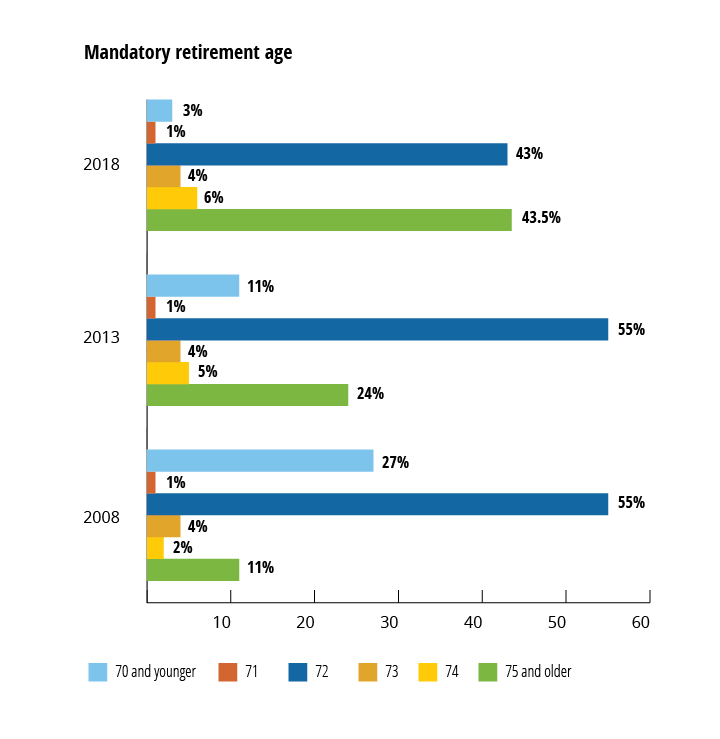
Instead, S&P 500 boards are likely to continue relying on mandatory retirement policies to stimulate board turnover. Today, 71 percent of S&P 500 boards disclose a mandatory retirement age for directors, consistent with the past five years. Retirement ages also continue to climb. In 2008, a meager 11 percent of S&P 500 companies with mandatory retirement policies set the age limit at 75 or older, compared to 43.5 percent today. More than half of these companies mandate a retirement age of at least 73 or older. Three boards have a retirement age of 80.


Three-quarters of the independent directors who left S&P 500 boards in the 2018 proxy season served on boards with mandatory retirement ages. The age limits appeared to have influenced many of these departures — 37 percent of retirees had reached or exceeded the age limit at retirement, and another 16 percent left within three years of the retirement age. Currently, only 16 percent of the independent directors on S&P 500 boards with age caps are within three years of mandatory retirement.

Experience as a CEO, board chair, or similar position is no longer viewed as the only qualifying credential for director candidates.

The boardroom will gradually be reshaped by new perspectives and expertise.


While modest turnover will continue, evidence suggests that boards will use openings from director departures to inject fresh perspectives and expertise into emerging areas of need.

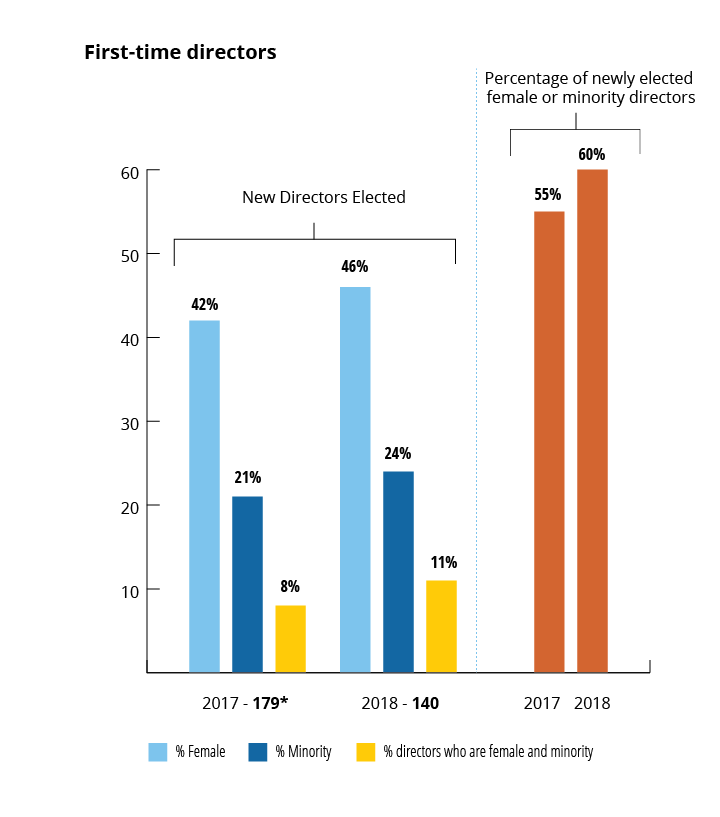
For one thing, experience as a CEO, board chair, or similar position is no longer viewed as the only qualifying credential for director candidates. Of the 428 new independent directors added to S&P 500 boards in the 2018 proxy year, only 35.5 percent were active or retired CEOs, board chairs, or similar, down from 47 percent a decade ago. Nor is a background in a public company boardroom a requirement. First-time public company directors constituted 33 percent of the 2018 class of new S&P 500 directors. These first-timers are younger than their peers and more likely to be actively employed (64% versus 53%). They are less likely to be CEOs or chief operating officers, and more likely to have other managerial experiences such as line or functional backgrounds or to hold roles in division/subsidiary leadership. They are also more likely to be minorities: 24 percent of first-time directors in 2018 are minorities, versus 19 percent of all new S&P 500 directors.

Of the 428 new independent directors added to S&P 500 boards in the 2018 proxy year, only 35.5 percent were active or retired CEOs, board chairs, or similar, down from 47 percent a decade ago.

*Includes directors who had served or were serving as an executive director on a public company board.


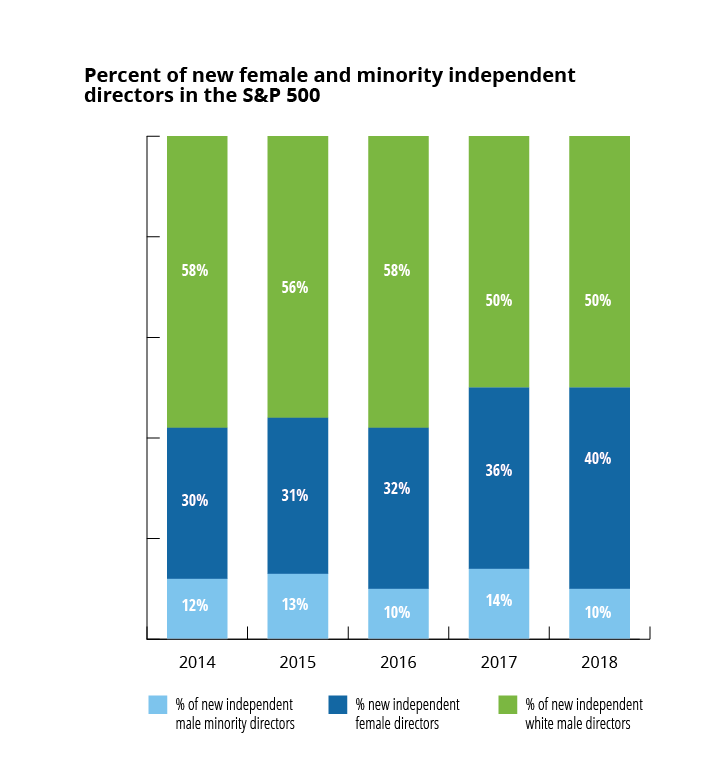
Recognizing the strategic imperative for new perspectives and experience in the boardroom, boards are increasingly adding directors with backgrounds in technology, digital transformation and technologies, consumer marketing, and other areas of emerging importance. Financial talent remains prized, especially the experiences of chief financial officers, finance executives, and/or investment professionals. That said, as investors have continued to press for more gender diversity, S&P 500 boards have increased the number of women directors, reaching a new high: 40 percent of new directors in the 2018 proxy year are women, an increase from 36 percent in 2017.

Financial talent remains prized, especially the experiences of chief financial officers, finance executives, and/or investment professionals.


Boards are also likely to enhance disclosures about composition. As interest in boardroom composition among investors has increased, a growing number of companies are voluntarily enhancing their disclosures to highlight the diversity of their boards and to showcase how director skills and qualifications align with company strategy. In fact, nearly a third (30%) of S&P 500 companies have published a board matrix spotlighting the skills and qualifications of each director on their governance web page.

Younger directors may become a potent new voice in the boardroom.


As boards prioritize new areas of expertise — such as industry and functional experience in technology and digital transformation, and certain areas of marketing and finance — many are tapping “next-generation” directors whose qualifications align with the needs of their organizations. One out of six directors (17%) in the 2018 class of new directors is age 50 or younger.

Given that their backgrounds and profiles differ from more traditional board members, these directors are likely to bring varied perspectives to boardroom discussions. Nearly two-thirds of these “next-gen” corporate directors have expertise in three sectors: technology/telecommunications (34%), consumer goods (16%), and private equity/investments (14%). A majority (almost two-thirds) are serving on their first public company board. More than half (53%) are women.

Interestingly, these directors may also be less likely to have lengthy tenures, due to factors such as the demands of their careers, a desire to move on, or dissatisfaction with their board experience. Twenty-eight (7%) of the 417 directors who left an S&P 500 board seat in the 2018 proxy season were 55 years old or younger, with an average tenure of five years. Other directors who departed their boards over the same period had a much longer tenure on average (12.7 years) and were 68.4 years old on average.

Business demands and investor pressure are likely to change how boards think about composition and refreshment strategies.

The implications for your board


Business demands and investor pressure are likely to change how boards think about composition and refreshment strategies. Increasingly, directors are recognizing that board composition should support and reflect the strategic needs of the organization. Boards can use the following recommendations to enhance short- and long-term approaches to their composition:

Have an ongoing refreshment strategy.

The composition of the board should be viewed as a strategic asset. Boards will be better prepared to plan for and take advantage of openings if there is a formal approach to refreshment. This includes regularly reviewing and aligning the board’s makeup to the company’s strategic direction, identifying desired competencies for future directors, and regularly infusing the board with perspectives relevant to the organization’s future needs.

Increasingly, investors consider meaningful full-board and individual assessments as “best practice” not only for evaluating and enhancing board and director performance but also for promoting boardroom refreshment. While annual evaluations have become the norm for boards, far fewer — 38 percent of S&P 500 boards — report some form of individual director evaluations. Proactive boards assess skills and attributes, incorporating results from board self-assessments. They also take a multiyear view of departures, including upcoming board leadership changes, and set clear expectations around director tenure.

Key Questions for Directors to Consider:


  1. Does the board as currently constituted give the company its best shot at success in supporting the strategy?
  2. What additional, and potentially underrepresented, skills or expertise would significantly enhance the board’s ability to do its job?
  3. What are our refreshment mechanisms and strategy, and how are they communicated to stakeholders, including investors?
  4. Are we using board evaluations to help identify gaps in expertise and skills the board may require in the coming years?
  5. Is our onboarding program robust and tailored to individual director needs and backgrounds?
Position new directors for success.

The nominating and governance committee chair and other board leaders should ensure that the board has a robust new-director orientation program in place. Incoming directors, particularly younger and first-time board members, benefit from an orientation and continuing education that familiarize them with the company’s needs and the board’s approach to governance. At a minimum, a director onboarding program should provide insights about public disclosures and nonpublic materials (such as board meeting minutes, forecasts, budgets, strategic plans, etc.) and socialize the new director(s) with key executives and members of senior management. Additionally, the board should recognize that new directors may find it helpful to partner with a mentor — formally or informally — who they can turn to for questions and feedback.

With greater focus on diversity, board culture becomes critical.

Boards are adding new perspectives to enhance board deliberations and improve outcomes. But greater diversity also increases the likelihood of misunderstanding and tension among directors with different points of view and backgrounds. In the past, boards tended to be more homogeneous and, as a result, there was typically more implicit agreement about director interaction and behavior. Today, with higher levels of diversity in the boardroom — whether in terms of experiences, skills, gender, race, ethnicity, nationality, and/or age — it’s critical to create a boardroom culture that facilitates constructive interactions between board members. All boards can benefit from cultures that value inquisitiveness and flexibility, and where directors are comfortable challenging one another’s — and management’s — assumptions and ideas.

_____________________________________________________________

Note: This article was originally published in the NACD 2019 Governance Outlook.

*Julie Hembrock Daum leads the North American Board Practice and was a long standing board member of Spencer Stuart. She consults with corporate boards, working with companies of all sizes from the Fortune 10 to pre-IPO companies. She has conducted more than 1,000 board director assignments, recently recruiting outside directors for Johnson & Johnson, Whole Foods, Amazon, Saudi Aramco, Nike, numerous IPOs and spin off boards.

Éléments susceptibles d’influer sur les décisions relatives à la gouvernance des grandes entreprises en 2019


L’article ci-dessous brosse un portrait de ce qui attend les grandes entreprises en 2019. Le billet de Holly J. Gregory, associé de la firme Sidley Austin, a été publié sur le site de Harvard Law School Forum aujourd’hui.

Quelles sont les variables susceptibles d’influer sur les décisions relatives à la gouvernance ainsi que sur les relations avec les actionnaires ?

L’auteur fait ressortir les éléments critiques suivants :

  1. Le maintien des caractéristiques du rôle du conseil et des devoirs des administrateurs;
  2. L’examen approfondi de la primauté des actionnaires et de leur influence;
  3. La réforme du vote par procuration et la réglementation des conseillers en vote;
  4. La poursuite de la convergence des idées sur les pratiques de gouvernance d’entreprise;
  5. Un accent encore plus affirmé sur les questions environnementales, sociales et de gouvernance (ESG);
  6. Une demande continue d’engagement des actionnaires et d’attention envers les investisseurs activistes.


Bonne lecture !


Looking Ahead: Key Trends in Corporate Governance

Résultats de recherche d'images pour « trend en gouvernance »

Board’s Role and Director Duties Remain Durable


While the corporate governance environment is always changing, board responsibilities and the fiduciary duties of directors under state corporate law have proven remarkably durable. Directors must:

Manage or direct the affairs of the company and cannot abdicate that responsibility by deferring to shareholder pressure.

Act with due care, without conflict, in good faith, and in the company’s best interest.

Delegate and oversee management of the company (for example, by selecting the CEO, monitoring the CEO’s performance, and planning for succession), and oversee strategy and risk management.

Ensuring that the day-to-day management of the company is in the right hands, providing management with forward-looking strategic guidance, and monitoring management’s efforts to identify and manage risk, including risks that pose an existential threat, remain at the heart of the board’s role. To accomplish this, boards need to understand and address disruptive risks. Boards should be mindful that adequate time is reserved on the agenda for these matters, with less focus on formal management presentations and more focus on the problems and concerns management is grappling with.

The National Association of Corporate Directors (NACD) Blue Ribbon Commission recently provided guidance on oversight of risks that pose an existential threat (NACD, Adaptive Governance: Board Oversight of Disruptive Risks (Oct. 2018), available at nacdonline.org). The Commission recommends that boards prioritize certain actions, including:

Understanding and addressing disruptive risks “in the context of the [company’s] specific circumstances, strategic assumptions, and objectives.”

Allocating oversight of disruptive risks between and among the full board and its committees, and clarifying the allocation of responsibilities in committee charters.

Recognizing that enterprise risk management processes may not capture disruptive risks.

Evaluating board culture regularly for “openness to sharing
concerns, potential problems, or bad news; response to mistakes; and acceptance of nontraditional points of view.”

Assessing “leadership abilities in an environment of disruptive risks” in CEO selection and evaluation processes.

Aligning the company’s “talent strategy” with “the skills and structure needed to navigate disruptive risks.”

Refraining from automatically re-nominating directors as a “default decision.”

Treating board diversity as “a strategic imperative, not a compliance issue.”

Requiring continuing learning of all directors, and assessing that factor in the board’s evaluation process.

Ensuring risk reports provide “forward-looking information about changing business conditions and potential risks in a format that enables productive dialogue and decision making.”

Holding a substantive discussion, at least annually, of the company’s vulnerability to disruptive risks, “using approaches such as scenario planning, simulation exercises, and stress testing to inform these discussions.”

Shareholder Primacy and Shareholder Influence Under Scrutiny


While it is prudent for directors to listen to and engage with shareholders and understand their interests, directors must apply their own business judgment and determine what course is in the best interests of the company. This means that they cannot merely succumb to pressures from activist investors and other shareholders (see, for example, In re PLX Tech., Inc. Stockholders Litig., 2018 WL 5018535, at *45 (Oct. 16, 2018) (an activist “succeeded in influencing the directors to favor a sale when they otherwise would have decided to remain independent” and the incumbent directors improperly deferred to the activist and allowed him “to take control of the sale process when it mattered most”)).

However, shareholders have gained considerable power relative to boards over the last 20 years, making it difficult to resolve shareholder pressures that conflict with director viewpoints regarding the best course for the company. The forces that have strengthened shareholder influence include:

Concentration of shareholding in the hands of powerful institutional investors (with institutions owning 70% of US public company shares in 2018).

The activation of institutional investors regarding proxy voting (with institutional voting participation at 91% compared to retail shareholder participation at 28%).

The rise of proxy advisory firms that serve to coordinate proxy voting.

The dismantling of classic corporate defenses, such as classified boards and poison pills.

The rise in shareholder engagement and negotiation (or “private ordering”) of governance processes. (Broadridge, 2018 Proxy Season Review (Oct. 2, 2018), available at broadridge.com.)

While there is no sign that shareholder influence will dissipate, recent legislative developments suggest that shareholder primacy (the premise that a company is run for the benefit of its shareholders in the first instance) is under some pressure. For example, in August 2018, US Senator Elizabeth Warren proposed the Accountable Capitalism Act, which among other things would require directors of US companies with $1 billion or more in annual revenues to obtain a charter as a “United States Corporation” and consider the interests of all corporate stakeholders, including employees, customers, and communities, in their decision-making, in addition to the interests of shareholders. (S. 3348, 115th Cong. § 5(c)(1)(B) (2017–2018); for more information, search Looking Ahead: Key Trends in Corporate Governance on Practical Law.)

In addition, there are increasing calls for the responsible use of power by large institutional investors, which have a considerable and growing influence on the companies in which they invest. The underlying concern is the responsible use of significant economic power, given the substantial impact on society that large institutional investors and companies have. For example, in January 2018, BlackRock CEO Larry Fink wrote to the CEOs of BlackRock portfolio companies that “society increasingly is turning to the private sector and asking that companies respond to broader societal challenges. … To prosper over time, every company must not only deliver financial performance, but also show how it makes a positive contribution to society. Companies must benefit all of their stakeholders, including shareholders, employees, customers, and the communities in which they operate” (Annual Letter to CEOs from Larry Fink, Chairman and CEO, BlackRock, available at blackrock.com).

This broader view of a company’s purpose recognizes that, while social interests and shareholder interests are often viewed as in tension, outside of a short-term perspective social interests and shareholder interests tend to align. For pension funds and many other institutional investors, the interests of their beneficiaries are aligned with the successful performance of healthy companies over a period of years.

Given the size of institutional investors’ portfolios, they face challenges in applying their influence on a company-specific basis. While some of the largest institutional investors are investing in the human resources and technology needed to make informed voting decisions on a case-by-case, company-specific basis, with respect to a large number of companies in their portfolios, many institutional investors still apply set policies on a one-size-fits-all basis, without nuanced analysis of the circumstances, in voting their shares. Institutional investors should assess whether they:

Are well positioned to vote their shares on an informed basis.

Have designed screens that consider company performance and other factors that may support a change from standard policy, if relying on the application of pre-set policies.

When institutional investors turn to proxy advisory firms to make voting decisions, they should evaluate how the proxy advisor is positioned to make sophisticated and nuanced case-by-case determinations, and whether resource constraints require the proxy advisor to rely heavily on the use of set policies (see below Convergence of Ideas on Corporate Governance Practices Continues).

In January 2017, a group of institutional investors launched the Investor Stewardship Group (ISG) and issued Stewardship Principles and Corporate Governance Principles that took effect on January 1, 2018 (available at isgframework.org). The Stewardship Principles set forth a stewardship framework for institutional investors that includes the following principles:

Principle A: Institutional investors are accountable to those whose money they invest.

Principle B: Institutional investors should demonstrate how they evaluate corporate governance factors with respect to the companies in which they invest.

Principle C: Institutional investors should disclose, in general terms, how they manage potential conflicts of interest that may arise in their proxy voting and engagement activities.

Principle D: Institutional investors are responsible for proxy voting decisions and should monitor the relevant activities and policies of third parties that advise them on those decisions.

Principle E: Institutional investors should address and attempt to resolve differences with companies in a constructive and pragmatic manner.

Principle F: Institutional investors should work together, where appropriate, to encourage the adoption and implementation of the Corporate Governance Principles and Stewardship Principles.

Reform of Proxy Voting and Regulation of Proxy Advisors Under Consideration


The Securities and Exchange Commission (SEC) staff recently held a roundtable to assess whether the SEC should update its rules governing proxy voting mechanics and the shareholder proposal process, and strengthen the regulation of proxy advisory firms. These issues have been under consideration since the SEC solicited public comment on the proxy system in 2010. (SEC, November 15, 2018: Roundtable on the Proxy Process, available at sec.gov; Concept Release on the U.S. Proxy System, 75 Fed. Reg. 42982-01, 2010 WL 2851569 (July 22, 2010).)

Topics discussed at the roundtable included:

Proxy voting mechanics and technology. Panelists agreed that the current proxy voting system needs to be modernized and simplified, for example, by:

implementing a vote confirmation process so that shareholders may verify, before the vote deadline, that voting instructions were followed and their votes were counted;

using technology to encourage wider participation and reduce costs and delays in the voting process;

studying why retail shareholder participation has fallen and whether more direct communication channels would improve information flow and participation; and

mandating use of universal proxy cards in proxy contests.

The shareholder proposal process. Some panelists asserted that the current shareholder proposal process functions well, while others identified areas for reform, including:

revisiting the ownership thresholds and holding period required to submit a shareholder proposal (currently, the lesser of $2,000 or 1%, and one year);

increasing resubmission thresholds to address reappearance of a proposal even though a majority of shareholders voted it down year after year;

providing more SEC guidance on no-action decisions and rationales;

requiring proxy disclosure of the name of the shareholder proponent (and its proxy, if any) and its level of holdings; and

requiring disclosure of preliminary vote tallies.

The role and regulation of proxy advisory firms. While no significant consensus emerged regarding whether proxy advisory firms should be subject to further SEC regulation, areas under discussion included:

improving accuracy of proxy advisor reports and affording all companies opportunities to review and verify information in advance of publication; and

improving procedures to monitor and manage, and enhancing disclosure of, conflicts of interest.

The Corporate Governance Reform and Transparency Act


The Corporate Governance Reform and Transparency Act, H.R. 4015, would require proxy advisory firms to register with the SEC, which would require:

Sufficient staffing to provide voting recommendations based on current and accurate information.

The establishment of procedures to permit companies reasonable time to review and provide meaningful comment on draft proxy advisory firm recommendations, including the opportunity to present (in person or telephonically) to the person responsible for the recommendation.

The employment of an ombudsman to receive and timely resolve complaints about the accuracy of voting information used in making recommendations.

Policies and procedures to manage conflicts of interest.

Disclosure of procedures and methodologies used in developing proxy recommendations and analyses.

Designation of a compliance officer responsible for administering the required policies and procedures.

Annual reporting to the SEC on the proxy advisory firm’s recommendations, including the number of companies that are also consulting division clients, as well as the number of proxy advisory firm staff who reviewed and made recommendations.

The bill would also direct the SEC staff to withdraw two no-action letters issued by the SEC in 2004, which the fact sheet suggests “have led to overreliance on proxy advisory firm recommendations.” (The SEC rescinded those two no-action letters in September 2018.)

The bill is supported by both Nasdaq and the New York Stock Exchange, as well as leading business groups and the Society for Corporate Governance. It is opposed by the Council of Institutional Investors, the Consumer Federation of America, and many public pension fund managers.

(See, for example, Nelson Griggs, Nasdaq, U.S. House of Representatives Passes Proxy Advisory Firm Reform Legislation (Dec. 16, 2017), available at nasdaq.com; Council of Institutional Investors, CII Urges Members to Contact Congressional Reps, Opposing Proxy Advisors Bill (Jan. 13, 2018), available at cii.org.) The bill is unlikely to be passed into law before the current congressional term ends, but may be reintroduced during the following congressional term.

It remains to be seen whether the SEC will incorporate input from the roundtable into future rulemaking or new SEC staff guidance or practice. The SEC is more likely to focus on proxy reform as a priority than on regulation of proxy advisory firms absent pressure from Congress.

Two bills seeking SEC regulation of proxy advisory firms were introduced in the 115th Congress:

The Corporate Governance Reform and Transparency Act, H.R. 4015. In June 2018, the Senate Committee on Banking, Housing, and Urban Affairs held a hearing on this bill, which was sent by the House of Representatives to the Senate in December 2017 for consideration. (See Box, The Corporate Governance Reform and Transparency Act.)

The Corporate Governance Fairness Act, S. 3614. In November 2018, this bill was introduced in the Senate to amend the Investment Advisers Act of 1940 (Advisers Act) to expressly require proxy advisory firms to register as investment advisers under the Advisers Act, thereby subjecting them to enhanced fiduciary duties and SEC oversight, including regular SEC staff examinations into their conflict of interest policies and programs, and whether they knowingly have made false statements to clients or have omitted to state material facts that would be necessary to make statements to clients not misleading.

Both bills would subject proxy advisory firms to SEC regulation, and focus on policies and procedures regarding conflicts of interest and accuracy. H.R. 4015 goes further by mandating
maintenance of certain staffing levels and annual reporting relating to recommendations. Neither bill is likely to be passed into law by the end of the current session of Congress.


Convergence of Ideas on Corporate Governance Practices Continues


Proxy advisory firms are often criticized for imposing a one-size-fits-all view of corporate governance on public companies in the US. However, the divide is narrowing between what investors and their proxy advisors, on the one hand, and corporate directors and CEOs, on the other hand, think are good corporate governance practices.

Recently, a high-profile group of senior executives from major public companies and institutional investors issued the Commonsense Principles 2.0 to revise corporate governance principles that the group published in 2016 (available at governanceprinciples.org). The Commonsense Principles 2.0 describe corporate governance practices that have become widely accepted among leading companies and their institutional investors, including in previously controversial areas such as majority voting in uncontested director elections and proxy access. A majority of S&P 500 companies already practice most of the recommendations, and many of the recommendations are requirements for publicly traded companies under SEC regulations or stock exchange listing rules. For example, the Commonsense Principles 2.0 provide that:

One-year terms for directors are generally preferable, but if a board is classified, the reason for that structure should be explained.

The independent directors should decide whether to have combined or separate chair and CEO roles based on the circumstances. If they combine the chair and CEO roles, they should designate a strong lead independent director. In any event, the reasons for combining or separating the roles should be explained clearly.

A director who fails to receive a majority of votes in uncontested elections should resign and the board should accept the resignation or explain to shareholders why it is not accepted.

These recommendations are in line with evolving practices.

The Commonsense Principles 2.0 address some recommendations to institutional investors and asset managers, and call on them to use their influence transparently and responsibly. Among other things, they urge asset managers to disclose their proxy voting guidelines and reliance on proxy advisory firms, and be satisfied that the information that they are relying on is accurate and relevant.

Notably, the Commonsense Principles 2.0 reflect the convergence of viewpoints through agreement among a coalition of high-profile leaders of well-known public companies, institutional investors, and one activist hedge fund. Signatories include Mary Barra of General Motors, Ed Breen of DowDupont, Warren Buffet of Berkshire Hathaway, Jamie Dimon of JPMorgan Chase, Larry Fink of BlackRock, Bill McNabb of Vanguard, Ronald O’Hanley of State Street, and Jeff Ubben of ValueAct Capital. The Council of Institutional Investors and the Business Roundtable have expressed support for or endorsed the Commonsense Principles 2.0.


Shifting Focus of Private Ordering to ESG Issues


The convergence of views among corporate leaders and large institutional investors on corporate governance practices reflects to a significant degree the success shareholders have had in influencing corporate governance reforms through engagement with boards, or private ordering. Shareholders are continuing to engage companies and press for reforms in the areas of shareholder rights and board composition and quality, but they are also increasing their focus on ESG issues, such as climate change, diversity, and board effectiveness, and the impact of ESG issues on companies’ financial performance. ESG is no longer a fringe issue of interest only to special issue investors. Mainstream institutional investors are recognizing that attention to ESG and corporate social responsibility impacts portfolio company financial performance.

The rising interest in ESG among investors is apparent in the sharp rise in US-domiciled assets under management using ESG strategies ($12.0 trillion at the start of 2018, up 38% since 2016 and an 18-fold increase since 1995, as reported by the US SIF Foundation), increasing support for shareholder proposals relating to ESG issues, as well as in the focus of engagement efforts. According to Broadridge, institutional investor support for social and environmental proposals increased from 19% in 2014 to 29% in 2018 (Broadridge, 2018 Proxy Season Review (Oct. 2, 2018), available at broadridge.com).


Continuing Demand for Shareholder Engagement and Attention to Activist Investors


In this era of enhanced shareholder influence, directors need to be especially attuned to the interests and concerns of significant shareholders, while continuing to apply their own judgment about the best interests of the company. This requires active outreach and engagement with the company’s core shareholders and, in particular, the persons responsible for voting proxies and setting the governance policies that often drive voting decisions. Caution, balance, and effective communication are also necessary to ensure that director judgment is not replaced with shareholder appeasement.

In the first half of 2018, record numbers of hedge fund activist campaigns were launched, backed by record levels of capital. Activist investors are having greater success in negotiating board seats and in winning seats in contested elections. The general level of vote support for directors is falling. For example, 416 directors failed to receive majority shareholder support in the 2018 proxy season (an 11% increase over 2017) and 1,408 directors failed to attain at least 70% shareholder support (a 14% increase over 2017) (Broadridge, 2018 Proxy Season Review (Oct. 2, 2018), available at broadridge.com).

Understanding key shareholders’ interests and developing relationships with long-term shareholders can help position the company to address calls by activist investors for short-term actions that may impair long-term value. However, boards also should view the input they receive from activist investors as valuable, because it could help identify potential areas of vulnerability. Moreover, establishing an open and positive dialogue with activist investors, and engaging with them in meaningful discussions, can assist boards in avoiding a public shareholder activist campaign in the future. This requires:

Identifying the company’s key shareholders and the issues about which they care the most.

Objectively assessing strategy and performance from the perspective of an activist investor, including proactively identifying areas in which the company may be subject to activism.

Monitoring corporate governance benchmarks and trends in shareholder activism to keep abreast of “hot topic” issues.

Comparing the company’s corporate governance practices to evolving best practice.

Attending to potential vulnerabilities in board composition. Activist investors scrutinize the tenure, age, demographics, and experience of each director. They will target directors whose expertise is arguably outdated, who have poor track records as officers or directors of other companies, or who have served on the board for long tenures. They will also look for gaps in the expertise needed by the board given the current dynamic business environment, and for a lack of gender or ethnic diversity. Boards should monitor developments in these areas (see, for example, Institutional Shareholder Services Inc. (ISS), 2019 ISS Americas Policy Updates (Nov. 19, 2018), available at issgovernance.com (announcing that, beginning in 2020, ISS will oppose the nominating committee chair at Russell 3000 or S&P 1500 companies when there are no women on the board); 2018 Cal. Legis. Serv. ch. 954 (S.B. 826) (to be codified at Cal. Corp. Code §§ 301.3, 2115.5) (mandating gender quotas for boards of US public companies that are headquartered in California)).

Addressing potential vulnerabilities in CEO compensation, including disparity with respect to peer companies and other named executive officers. Activist investors could claim that this signals a culture in which too much deference is given to the CEO and there is a lack of team emphasis in the compensation of management.

Reviewing structural defenses with the assistance of seasoned proxy fight and corporate governance counsel. Many companies have not reviewed their charter and bylaws recently, and in a proxy contest the language of many bylaw provisions can take on a different meaning. Boards should be aware that proxy advisory firm ISS recently announced that it will generally oppose management proposals to ratify a company’s existing charter or bylaw provisions, unless the provisions align with best practice (2019 ISS Americas Policy Updates, at 11).

Effectively communicating long-term plans with respect to strategy and performance pressures, defending past performance, and addressing calls for an exploration of strategic alternatives.

Preparing a response plan for engaging with activist investors to ensure that the board and management convey a measured and unified position.

Il y a encore trop de CA sans représentation féminine !


Lyla Qureshi, analyste chez Equilar, vient de publier un article très intéressant sur les caractéristiques des entreprises du Russell 3000 qui n’ont pas de femmes siégeant au conseil d’administration.

L’une des raisons invoquées pour ne pas avoir de représentation féminine au conseil est que la composition du CA n’est pas une priorité pour les actionnaires ! Qu’en pensez-vous ?

La situation change, mais pas suffisamment rapidement selon les spécialistes de la gouvernance.

Bonne lecture !


Boardrooms Without Female Representation


Board diversity is a governance issue that has been getting a large amount of attention for the past couple of years. This year, gender diversity, particularly in relation to board member appointments, has been in the limelight. This heightened focus comes in part thanks to SB-826, a recently-passed California bill that will mandate that public companies headquartered in the state must place at least one woman on their board by the end of 2019. Furthermore, the legislation directs publicly listed companies to have two women on boards with five members, and three on those which have six or more members by 2021. To find out where the current Russell 3000, not just California, stands in terms of board gender diversity, Equilar conducted a study to examine which companies have not had a woman on their board.


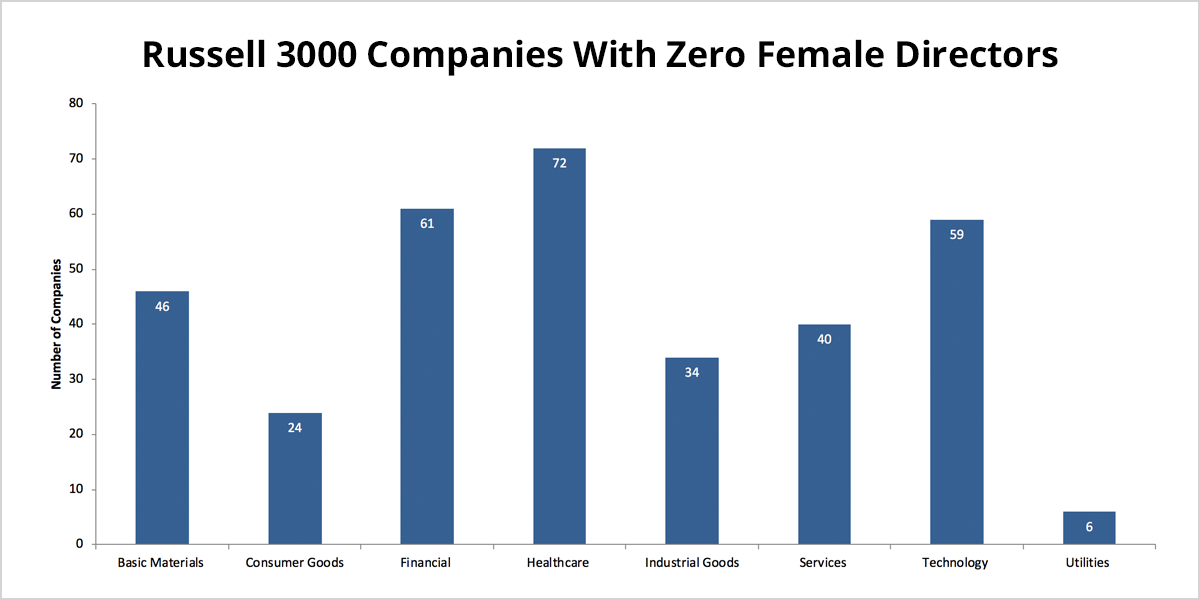
Out of the entire Russell 3000 index, 344 companies have not had a female board member in the history of the Equilar database, which goes back to the year 2000. Additionally, the two sectors with the highest count of companies without a female on their board are the financial and technology sectors, with each having approximately 48 companies with all male boards. Healthcare, as well as the services sector, both had at least 40 companies with all male boards for their entire Equilar database history. On the flip side, companies that are a part of the utilities sector account for approximately 1.4% of the companies with all-male boards.

According to The Guardian, one of the reasons cited by companies for not recruiting females to their boards is the fact that the make-up of boards is not a priority for shareholders. However, that excuse may not necessarily hold true. For instance, BlackRock, one of the largest shareholders of American companies, stated in the beginning of this year that they would like to see at least two female board members at companies in which it invests. As mentioned in The Wall Street Journal, Michelle Edkins, Global Head of Investment Stewardship at BlackRock, wrote, “We believe that a lack of diversity on the board undermines its ability to make effective strategic decisions. That, in turn, inhibits the company’s capacity for long-term growth.” Yet another reason provided by companies to justify male-dominated boards is due to an alleged dearth of qualified female candidates and “over-boarding” of women who are experienced. Research conducted on this indicates that rather than a lack of expertise, what women tend to lack is board experience. This is because many businesses prefer veteran female directors over novices. Women trying to enter the world of board memberships have a tough time landing their first board position; however the same is not true for men. While speaking with The Wall Street Journal, Bill George, former head of Medtronic PLC, said, “To gain their first corporate board seat, women still have to overcome strong cultural issues that most men don’t have to overcome.” Furthermore, men also have the advantage of having a wider network made up of other powerful, well-positioned men. Coco Brown, founder of Athena Alliance, told The Journal, “Women on the whole are outside the trusted networks of public company boards. So they end up with the bar that requires board experience.”

Although the numbers provided above are not encouraging, what is positive is that there were approximately 44 new companies that added a female to their board in the second quarter of 2018. An interesting trend observed in the proxies of these companies is that almost all of the documents had a disclosure regarding diversity in them. Out of the 44 companies in discussion, 38 had text that addressed the topic of diversity, while 29 of those 38 disclosures had text pertaining specifically to gender diversity. The disclosures stated that the company recognized the importance of diversity and relayed the fact that they were cognizant that changes must be made to the organization in order show how truly committed they are to rectifying the male-dominated board structure. The appointments of female directors by these companies shortly after the release of their proxies showed that the companies followed through with their promise of making their board more gender balanced.

Although the numbers reported in this study with respect to the prevalence of all-male boards paint a bleak picture regarding gender equity in American boardrooms, the increased focus on gender-balanced boards has resulted in companies making concrete changes, as witnessed by the rise in female board members this year alone. In a study earlier this year, Equilar reported that the percentage of women on Russell 3000 boards increased from 16.9% to 17.7% between March 31 and June 30, 2018. Despite the fact that for some the pace of change is not fast enough, one hopes that if present efforts to ensure equal gender representation on boards continue, gender-balanced boardrooms will become a reality in the near future.

Tendances globales en gouvernance et « Trends » régionaux


À l’occasion de la nouvelle année 2019, je partage avec vous une étude de la firme Russell Reynolds Associates sur les tendances en gouvernance selon différentes régions du monde.

L’article a été publié sur le site de Harvard Law School Forum par Jack « Rusty » O’Kelley, III, Anthony Goodman et Melissa Martin.

Ce qu’il y a de particulier dans cette publication ,c’est que l’on identifie cinq (5) grandes tendances globales et que l’on tente de prédire les Trends dans plusieurs régions du monde telles que :

(1) Les États-Unis et le Canada

(2) L’Union européenne

(3) La Grande-Bretagne

(4) Le Brésil

(5) l’Inde

(6) Le Japon

Les grandes tendances observées sont :

(1) la qualité et la composition du CA

(2) le degré d’attention apportée à la surveillance de la culture organisationnelle

(3) les activités des investisseurs qui limitent la primauté des actionnaires en mettant l’accent sur le long terme

(4) la responsabilité sociale des entreprises qui constitue toujours une variable critique et

(5) les investisseurs activistes qui continuent d’exercer une pression sur les CA.

Je vous recommande la lecture intégrale de cette publication pour vous former une opinion réaliste de l’évolution des saines pratiques de gouvernance. Les États-Unis et le Canada semblent mener la marche, mais les autres régions du globe ont également des préoccupations qui rejoignent les tendances globales.

C’est une lecture très instructive pour toute personne intéressée par la gouvernance des sociétés.

Bonne lecture et Bonne Année 2019 !


2019 Global & Regional Trends in Corporate Governance


Résultats de recherche d'images pour « Russell Reynolds Associates governance »


Institutional investors (both active managers and index fund giants) spent the last few years raising their expectations of public company boards—a trend we expect to see continue in 2019. The demand for board quality, effectiveness, and accountability to shareholders will continue to accelerate across all global markets. Toward the end of each year, Russell Reynolds Associates interviews a global mix of institutional and activist investors, pension fund managers, proxy advisors, and other corporate governance professionals regarding the trends and challenges that public company boards may face in the coming year. This year we interviewed over 40 experts to develop our insights and identify trends.

Overview of Global Trends


In 2019, we expect to see the emergence or continued development of the following key global governance trends:


1. Board quality and composition are at the heart of corporate governance.

Since investors cannot see behind the boardroom veil, they have little choice but to rely on various governance criteria as a stand-in for board quality: whether the board is truly independent, whether its composition is deliberate and under regular review, and whether board competencies align with and support the company’s forward-looking strategy. Directors face increased scrutiny around how equipped the board is with industry knowledge, capital allocation skills, and transformation experience. Institutional investors are pushing to further encourage robust, independent, and regular board evaluation processes that may result in board evolution. Boards will need to be vigilant as they consider individual tenure, director overboarding, and gender imbalance—all of which may provoke votes against the nominating committee or its chair. Gender diversity continues to be an area of focus across many countries and investors. Companies can expect increased pressure to disclose their prioritization of board competencies, board succession plans, and how they are building a diverse pipeline of director candidates. Norges Bank Investment Management, the world’s largest sovereign wealth fund, has set a new standard for at least two independent directors with relevant industry experience on each of their 9,000 investee boards.

2. Deeper focus on oversight of corporate culture.

Human capital and intangible assets, including organizational culture and reputation, are important aspects of enterprise value, as they directly impact the ability to attract and retain top talent. Culture risk exists when there is misalignment between the values a company seeks to embody and the behaviors it demonstrates. Investors are keen to learn how boards are engaging with management on this issue and how they go about understanding corporate culture. A few compensation committees are including culture and broader human capital issues as part of their remit.

3. Investors placing limits on shareholder primacy and emphasizing long-termism.

The role of corporations in many countries is evolving to include meeting the needs of a broader set of stakeholders. Global investors are increasingly discussing social value; long-termism; and environment, social, and governance (ESG) changes that are shifting corporations from a pure shareholder primacy model. While BlackRock CEO Larry Fink’s 2018 letter to investee companies on the importance of social purpose and a strategy for achieving long-term growth generated discussion in the US, much of the rest of the world viewed this as further confirmation of the focus on broader stakeholder, as well as shareholder, concerns. Institutional investors are more actively focusing on long-termism and partnering with groups to increase the emphasis on long-term, sustainable results.

4. ESG continues to be a critical issue globally and is at the forefront of governance concerns in some countries.

Asset managers and asset owners are integrating ESG into investment decisions, some under the framework of sustainability or integrated reporting. The priority for investors will be linking sustainability to long-term value creation and balancing ESG risks with opportunities. ESG oversight, improved disclosure, relative company performance against peers, and understanding how these issues are built into corporate strategy will become key focus areas. Climate change and sustainability are critical issues to many investors and are at the forefront of governance in many countries. Some investors regard technology disruption and cybersecurity as ESG issues, while others continue to categorize them as a major business risk. Either way, investors want to understand how boards are providing adequate oversight of technology disruption and cyber risk.

5. Activist investors continue to impact boards.

Activist investors are using various strategies to achieve their objectives. The question for boards is no longer if, but when and why an activist gets involved. The characterization of activists as hostile antagonists is waning, as some activists are becoming more constructive with management. Institutional investors are increasingly open to activists’ perspectives and are deploying activist tactics to bring about desired change. Activists continue to pay close attention to individual director performance and oversight failures. We are seeing even more boards becoming “their own activist” or commissioning independent assessments to preemptively identify vulnerabilities. Firms such as Russell Reynolds are conducting more director-vulnerability analysis, looking at the strengths and weaknesses of board composition and proactively identifying where activists may attack director composition. In the following sections, we explore these trends and how they will impact the United States and Canada, the European Union and the United Kingdom, Brazil, India, and Japan.


The United States and Canada

Investor stewardship.

Eighty-eight percent of the S&P 500 companies have either Vanguard, BlackRock, or State Street as the largest shareholder, and together these investors collectively own 18.7 percent of all the shares in the S&P 500. Because the index funds’ creators are obligated to hold shares for as long as a company is included in a relevant index (e.g., Dow Jones, S&P 500, Russell 3000), the institutional investors view themselves as permanent capital. These investors view governance not as a compliance exercise, but as a key component of value creation and risk mitigation. Passive investors are engaging even more frequently with companies to ensure that their board and management are taking the necessary actions and asking the right questions. Investors want to understand the long-term value creation story and see disclosure showing the right balance between the long term and short term. They take this very seriously and continue to invest in stewardship and governance oversight. Several of the largest institutional investors want greater focus on long-term, sustainable results and are partnering with organizations to drive the dialogue toward the long term.

Board quality.

Investors are pushing for improved board quality and view board composition, diversity, and the refreshment process as key elements. There is similarly a push for richer insight into director skill relevancy. The Boardroom Accountability Project 2.0 has encouraged more companies to disclose a “board matrix,” setting out the skills, experiences, and demographic profile of directors. That practice is fast becoming the norm for proxy disclosure. Many more institutional investors want richer disclosure around director competencies and a clearer, more direct link between each director’s skills and the company’s strategy. As one investor noted, “We want to know why this collection of directors was selected to lead the company and whether they are prepared for change and disruption.” Some of the largest US institutional investors are pushing for better board succession and board evaluation processes and the use of external firms to assess board quality, composition, and effectiveness. Institutional investors are even more concerned about board succession processes and the continued use of automatic refreshment mechanisms (retirement ages and tenure limits) rather than a “foundational assessment process over time with a mix of internal and external reviewers.”

Board diversity.

In 2019, directors should expect more investors to vote against the nominating committee or its chair if there are no women on the board (or fewer than two women in some cases). Investors want to see an increased diversity of thought and experiences to better enable the board to identify risks and improve company performance. In the US, gender diversity has become a proxy for cognitive diversity. Institutional Shareholder Services (ISS) has updated its policies on gender diversity for Russell 3000 and S&P 1500 companies and may recommend votes against nominating committee chairs or members beginning in 2020. This follows recent California legislation requiring gender diversity for California-headquartered companies. Some very large investors are starting to take a broader approach to diversity, particularly as it relates to ethnicity and race. In Canada, nearly 40 percent of TSX-listed companies have no women on their boards. Proxy advisors have recently established voting guidelines related to the disclosure of formal gender diversity policies and gender diversity by TSX-listed companies.

ESG.

Investors are pushing companies to consider their broader societal impact—both what they do and how they disclose it. ESG has moved from being a discrete topic to a fundamental part of how investors evaluate companies. They will increasingly focus on how companies explain their approach to value creation, the impact of the company on society, and how companies weigh various stakeholder interests. Other investors will continue to look at ESG primarily through a financial lens, screening for risk identification and measurement, incorporation of ESG into strategy and long-term value creation, and executive compensation. There is continued and growing focus in the US on sustainability and climate change across a range of sectors. In Canada, proactive companies will consider developing and disclosing their own ESG policies and upgrading boards—through both changes in director education and, on occasion, board composition—to ensure that directors are equipped to understand ESG risk.

Oversight of corporate culture.

Given many high-profile failures in corporate culture and leadership over the last few years, investors and regulators will expect more disclosure and will ask more questions regarding how a board understands the company’s culture. When engaging with institutional investors, boards should expect questions regarding how they are understanding and assessing the health of a corporation’s culture. Boards need to reflect on whether they really understand the company culture and how they plan to assess hot spots and potential issues.

Activist investing.

Shareholder activism remains part of the US corporate governance landscape and is continuing to grow in Canada. In Canada, the industries with the highest levels of activism include basic materials, energy, banking, and financial institutions, and emerging sectors with high growth potential (e.g., blockchain, cannabis) could be next. Proxy battles are showing no signs of slowing down, but activists are using other methods to promote change, such as constructive engagement. Canadian companies are also seeing an increase in proxy contests launched by former insiders or company founders. Experts in Canada anticipate this trend will continue and, as a result, increased shareholder engagement will be critical.

Executive compensation.

Investors are looking for better-quality disclosure around pay-for-performance metrics, particularly sustainability metrics linked to risk management and strategy. In the US, institutional investors may vote against pay plans where there is misalignment and against compensation committees where there is “excessive” executive pay for two or more consecutive years. Some investors are uncomfortable with stock performance being a primary driver of CEO compensation since it may not reflect real leadership impact. In Canada, investors are urging companies to adopt say-on-pay policies in the absence of a mandatory vote, even though such adoption rates have been sluggish to date. Investors will likely continue to push for this reform.

Governance codes.

Earlier this year, the Corporate Governance Principles of the Investor Stewardship Group (ISG) went into effect with the purpose of setting consistent governance standards for the US market. Version 2.0 of the Commonsense Principles of Corporate Governance was also published. US companies will want to consider proactive disclosure of how they comply with these sets of principles.

European Union

Investors more active.

Institutional investors are expanding resources for their engagement and stewardship teams in Europe. In 2019, investors will focus on connecting governance to long-term value creation through board oversight of talent management, ESG, and corporate culture. Additionally, some US activists are setting their sights on Europe and raising funds focused on European companies. Institutional investors are more willing to support activist investors if inadequate oversight by the board has led to poor share price and total shareholder return (TSR) performance.

Company and board diversity.

Though EU boards tend to have more women directors due to legislation and regulation, progress on gender diversity has not carried over into the C-suite. Boards can expect to engage with investors on this topic and will need to explain the root causes and plans to address it through talent management processes and diversity and inclusion initiatives. With gender diversity regulations already widely adopted across Europe, Austria has now also stipulated that public company boards have at least 30 percent women directors. However, since board terms are usually for five years, the full impact likely will not be visible until future election cycles.

ESG.

Many investors are encouraging use of the Task Force on Climate-related Financial Disclosures (TCFD) framework for consistent measurement, assessment, and disclosure of ESG risks. Investors are likely to integrate climate-change competency and risk oversight into their voting guidelines in some form, and boards will need to demonstrate that they are thinking strategically about the opportunities, risks, and impact of climate change. A new legislative proposal in France could mandate that companies consider various stakeholders, the social environment, and the nonfinancial outcome of their actions.

Revised governance codes.

A recent study found strong compliance rates for the German Corporate Governance Code, except for the areas of executive remuneration and board composition recommendations. German boards should expect more investor engagement and pressure on these matters, including enhanced disclosure. Next year, the German code may include amendments impacting director independence and executive compensation. The revised governance code in the Netherlands focuses more closely on how long-term value creation and culture are vital elements within the governance framework. Denmark’s code now recommends that remuneration policies be approved at least every four years and bars retiring CEOs from stepping into the chairman or vice chairman role.

Board leadership.

Norges Bank Investment Management (commonly referred to as The Government Pension Fund Global) is pushing globally for the separation of CEO and chairman roles and independent chair appointments. In France, investors are focused on board composition and quality. Boards should expect to see continued pressure on separating the CEO and chairman roles as well as strengthening the role and prevalence of the lead director. Companies without a lead director could see negative votes against the reelection of the CEO/chair.

United Kingdom

Revised code.

Recent legislation and market activity have set the stage for the United Kingdom to implement governance reforms that will continue to influence global markets. The new UK Corporate Governance code will apply to reporting periods starting from January 1, 2019, although many companies have begun to apply it more quickly. The new code was complemented by updated and enhanced Guidance on Board Effectiveness to reemphasize that boards need to focus on improving their effectiveness—not just their compliance. Meanwhile the voluntary principle of “comply or explain” is itself being tested as the Kingman Review reconsiders the Financial Reporting Council’s powers and its twin role as both the government-designated regulator and the custodian of a voluntary code. Proxy advisors, who are growing more powerful, are also frequently voting against firms choosing to “explain” rather than comply. 2019 code changes include guidance around the board’s duty to consider the perspective of key stakeholders and to incorporate their interests into discussion and decisionmaking. Employees can be engaged via designating an existing non-executive director (already on the board), a workforce advisory committee, or a workforce representative on the board.

Board leadership and composition.

Other changes in the code include prioritizing non-executive chair succession planning and capping non-executive chair total tenure at nine years (including any time spent previously as a non-executive director)—a recommendation which could impact over 10 percent of the FTSE 350. Several investors noted that they understand the new tenure rule may cause unintended consequences around board chair succession planning. Investors are likely to focus on skills mix, diversity, and functional and industry experience. While directors can expect negative votes against their reelection if they are currently on more than four boards, better disclosure of director capacity and commitment may help sway investors.

Culture oversight.

The board’s evolving role in overseeing corporate culture—now explicit in the revised code—will be a primary focus for investors in 2019. The Financial Reporting Council has suggested that culture can be measured using several factors, such as turnover and absenteeism rates, reward and promotion decisions, health and safety data, and exit interviews. The code emphasizes that the board is responsible for a healthy culture that should promote delivering long-term sustainable performance. Auditor reform. Given public concern about recent corporate collapses, the role of external auditor and the structure of the audit firm market are under scrutiny. The government is under pressure to improve auditing and increase competition. Audit independence, rigor, and quality are likely to be examined, and boards may face greater pressure to change auditors more regularly. ISS is changing its policies for its UK/Ireland (and Continental European) policies beginning in 2019. ISS will begin tracking significant audit quality issues at the lead engagement partner level and will identify (when possible) any lead audit partners who have been linked to significant audit controversies.

Activist investors.

While institutional investors’ concerns center around the impact of disruption and how companies are responding with an eye toward long-termism and sustainability, activist campaigns continue to act as a potential counterweight. UK companies account for about 55 percent of activist campaigns in Europe, and UK companies will likely continue to be targeted next year.

Company diversity.

Diversity will continue to be a priority for board attention, including gender and ethnic diversity. The revised code broadened the role of the nominating committee to oversee the development of diversity in senior management ranks and to review diversity and inclusion initiatives and outcomes throughout the business.

Brazil

Outlook.

Following the highly polarized presidential election, Brazil is still facing some political uncertainty around the potential business and political agenda the new government will pursue. Despite recent ministry appointments being generally well received, global investors will likely still be cautious about investing in the country given the government’s deep history of entanglement with corporate affairs.

Governance reforms and stewardship.

Governance regulation is still in its early stages in Brazil and continues to be focused on overhauling compliance practices and implementing governance reforms. Securities regulator CVM recently issued guidelines regarding indemnity agreements between companies and board members (and other company stakeholders), which could lead to possible disclosure implications. The guidance serves to warn companies about potential conflicts of interest, and directors are cautioned to pay close attention to these new policies. Brazilian public companies are now required to file a comply-or-explain governance report as part of the original mandate stemming from the 2016 Corporate Governance Code, with an emphasis on the quality of such disclosures. Stewardship continues to be of growing importance, and boards are at the center of that discussion. The Association of Capital Market Investors is focusing on ensuring that the CVM and other market participants are holding companies to the highest governance standards not issuing waivers or failing to hold companies accountable for their actions.

Improved independence.

There is an ongoing push for more independence within the governance framework. More independent directors are being appointed to boards due to wider capital distribution. Brazil is working toward implementing reforms targeting political appointments within state-owned enterprises (SOE), but progress could slow depending upon the new government’s priorities. Recently, the Brazilian Chamber of Deputies approved legislation that would allow politicians to once again be nominated to SOE boards. The Federal Senate will soon decide on the proposal, but its approval could trigger a backlash. Organizations like the Brazilian Institute of Corporate Governance are firmly positioning themselves against the law change, viewing it as a step back from recent governance progress. However, the Novo Mercado rules and Corporate Governance Code are strengthening the definition of independence and using shareholder meetings to confirm the independence of those directors.

Remote voting.

The recent introduction of the remote voting card for shareholders could have a major impact on boards. Public companies required to implement the new system should expect to see more flexibility and inclusion of minority shareholder-backed nominees on the ballot. While Brazil is making year-over-year progress toward minority shareholder protections, they continue to be a challenge.

Board effectiveness.

Experts anticipate increased pressure to upgrade board mechanics and processes, including establishing a nominations policy regarding board director and committee appointments, routine board evaluation processes, succession planning, and onboarding/training programs. CVM, along with B3 (the Brazilian stock exchange), continues to push for higher governance standards and processes. There is an increased focus on board and director assessment (whether internally or externally led) to ensure board effectiveness and the right board composition. Under the Corporate Governance Code, companies will have to comply or explain why they do not have a board assessment process.

Compensation disclosure.

For almost a decade, Brazilian companies used a court injunction (known as the “IBEF Injunction”) to avoid having to disclose the remuneration of their highest-paid executives. Now that this has been overturned, public companies will be expected to start disclosing compensation information for their highest-paid executives and board members. Companies are concerned that the disclosure may trigger a backlash among minority shareholders and negative votes against remuneration.

India

Regulatory reform.

Motivated by a desire to attract global investments, curb corruption, and strengthen corporate governance, India is continuing to push for regulatory reform. In the spring of 2018, much to the surprise of many, the Securities and Exchange Board of India (SEBI) adopted many of the 81 provisions put forward by the Kotak Committee. The adoption of the recommendations has caused many companies to consider and aspire to meet this new standard. Kotak implementation has triggered a significant wave of governance implications centered around improving transparency and financial reporting. The adoption of these governance reforms is staggered, with most companies striving to reach compliance between April 2019 and April 2020.

Board composition, leadership, and independence.

Boards will face enhanced disclosure rules regarding the skills and experience of directors, which has triggered many companies to engage in board composition assessments. Directors will also be limited in the number of boards they can serve on simultaneously: eight in 2019; seven in 2020. The top 1,000 listed companies in India will need to ensure they have a minimum of six directors on their boards by April 2019, with the next 1,000 having an additional year to comply. Among other changes are new criteria for independence determinations and changes to director compensation. Additionally, the CEO or managing director role and the chair role must be separated and cannot be held by the same person for the top 500 listed companies by market capitalization. This will significantly change board leadership and control in many companies where the role was held by the same person, and it will boost overall independence. To further drive board and director independence, the definition of independence was strengthened, and board interlocks will receive greater scrutiny.

Board diversity.

India continues to make improvements toward gender diversity five years after the Companies Act of 2013 and ongoing pressure from investors and policymakers. Nevertheless, institutional investors and proxy advisors are calling for more progress, as a quarter of women appointments are held by family members of the business owners (and are thus not independent). Starting in 2019, boards of the top 500 listed companies will need to ensure they have at least one independent woman director; by 2020, the top 1,000 listed companies will need to comply.

Board effectiveness.

The reforms also include a requirement for the implementation of an oversight process for succession planning and updating the board evaluation and director review process.

Investor expectations.

Governance stakeholders are eager to see how much progress Indian companies will make during the next 18 months, but many are not overly optimistic given the magnitude of change required in such a short period of time. Investors are setting their expectations accordingly and understand that regional governance norms will not transform overnight. While it is unclear exactly how the government and regulators will respond to noncompliance, companies and their boards are feeling anxious about the potential repercussions and penalties.

Japan

Continued focus on governance.

The Japanese government continues to be a driving force for corporate governance improvements. To make Japan more attractive to global investors, policymakers are increasingly focused on improving board accountability. Despite a trend toward more proactive investor stewardship, regulatory bodies including the Financial Services Agency continue to lead reforms, with several new comply-or-explain guidelines added to the Amended Corporate Governance Code that came into effect in 2018. These guidelines, such as minimum independence requirements, establishing an objective CEO succession and dismissal process, and the unloading of cross-shareholdings, are aimed at enhancing transparency.

Director independence.

Director independence has been a concern for investors, with outside directors taking only about 31 percent of board seats. Though some observers perceive a weakening of language in the code regarding independence, investors are unlikely to lower their expectations and standards. The amended code now calls for at least one-third of the board to be composed of outside directors (up from the quota requirement of two directors that existed previously). The change is intended to encourage transparency and accountability around the board’s decision-making process. Starting next year, ISS will adopt a similar approach to its Japanese governance policies, employing a one-third independence threshold as well.

Executive compensation.

Given recent scandals, institutional investors and regulators will continue to pay close attention to the structure of executive compensation. Performance-based compensation plans will be a major area of focus in 2019. More companies are introducing new types of equity-based compensation schemes, such as restricted stock, and are expected to follow the trend into next year. Board diversity. Over 50 percent of listed companies still have no women on their boards. To upgrade board quality and performance, investors will likely engage more forcefully on gender diversity, board composition and processes, board oversight duties and roles, and the board director evaluation process.

ESG.

In 2019, boards can expect more shareholder interest in sustainability metrics and strategy. Investors are keen to see enhanced disclosure that aids their understanding of value creation and the link to performance targets, as well as explanations concerning board monitoring.

Activist investing.

Activism continues to rise in Japan, and we expect that trend to continue. Activists are showing a willingness to demand a board seat and engage in proxy battles, and institutional investors are increasingly willing to support the activist recommendations.

Governance practices.

Investors also will be paying close attention to several other governance practices, such as the earlier disclosure of proxy materials and delivery in digital format, and protecting the interest of minority shareholders. The code further emphasizes succession planning by requiring companies to implement a fair and transparent process for the CEO’s removal and succession. As a result, more companies are introducing nominating committees and discussing

CEO succession.

Companies are also being urged to unload their cross-shareholdings (when a listed company owns stock of another company in the same listing) and adopt controls that will determine whether the ownership of such equity is appropriate. Such holdings are likely to be policed more by regulators due to the tendency of such holdings to insulate boards from external pressure, including takeover bids.

___________________________________________________________

*Jack “Rusty” O’Kelley, III is Global Leader of the Board Advisory & Effectiveness Practice, Anthony Goodman is a member of the Board Consulting and Effectiveness Practice, and Melissa Martin is a Board and CEO Advisory Group Specialist at Russell Reynolds Associates.at Russell Reynolds Associates. This post is based on a Russell Reynolds memorandum by Mr. O’Kelley, Mr. Goodman, and Ms. Martin.


Recommandations des firmes de conseils en votation pour l’année 2019


Comme à chaque fin d’année, le blogue du Harvard Law School on Corporate Governance Forum, présente un sommaire des grandes tendances en gouvernance.

Voici les recommandations que les firmes-conseils en votation Institutional Shareholder Services (ISS) et Glass Lewis & Co. font aux actionnaires qui voteront lors des assemblées annuelles de 2019.

Ces changements aux politiques de votation nous offrent une belle occasion de constater l’évolution des pratiques de saine gouvernance.

Bonne lecture !


ISS and Glass Lewis Policy Updates for the 2019 Proxy Season


Résultats de recherche d'images pour « recommandations de Institutional Shareholder Services (ISS) »


The key changes to ISS’ proxy voting policies for 2019 relate to:

Board Gender Diversity—Beginning in 2020, ISS will generally recommend voting against nominating committee chairs (and potentially other directors) at companies with no female directors unless certain mitigating factors apply.

Economic Value Added Data for Pay-For-Performance Evaluation—In 2019, solely for informational purposes, ISS will include on a phased-in basis Economic Value Added (EVA) data in its proxy research reports as a supplement to GAAP/accounting performance measures to provide additional insight into company performance when evaluating pay-for-performance alignment. ISS will continue to explore the potential future use of EVA data as part of its pay-for-performance evaluation.

Management Ratification Proposals

Under a new policy, ISS will generally recommend voting against management proposals to ratify provisions of the company’s existing charter or bylaws, unless such provisions align with best practice.

ISS will also recommend voting against or withholding from individual directors, members of the governance committee or the full board, where boards ask shareholders to ratify existing charter or bylaw provisions considering specified factors.

Under a revised policy, if a management proposal to ratify existing charter or bylaw provisions fails to receive majority support, ISS will conduct a board responsiveness analysis for the next annual meeting.

Chronic Poor Attendance by Directors—In cases of “chronic poor attendance” by a director (defined as three or more consecutive years of poor attendance without reasonable explanation), in addition to recommending votes against the director(s) with chronic poor attendance, ISS will generally recommend voting against or withholding from appropriate members of the nominating/governance committee or the full board.

Director Performance Evaluation—Under a revised policy, when evaluating director performance, ISS will assess a company’s 5-year total shareholder returns (TSR) as part of the initial screen for underperformance rather than during the second step of its evaluation.

Reverse Stock Splits—Under a revised policy, ISS will evaluate on a case-by-case basis certain management proposals to implement reverse stock splits, taking into consideration (i) disclosure of substantial doubt about the company’s ability to continue as a going concern without additional financing, (ii) the company’s rationale or (iii) other factors as applicable.

Shareholder Proposals on Environmental and Social (E&S) Issues—Under a revised policy, ISS expanded the factors it will consider when analyzing E&S shareholder proposals to include whether there are significant controversies, fines, penalties or litigation associated with the company’s E&S practices.

Excessive Non-Employee Director Compensation—ISS will delay until at least 2020 its previously-announced new policy of potentially issuing negative vote recommendations against members of the board committee responsible for setting or approving excessive non-employee director compensation in two or more consecutive years without a compelling rationale or other mitigating factors.

Nouvelles perspectives pour la gouvernance en 2018


Aujourd’hui, je vous propose la lecture d’un excellent article de Martin Lipton* sur les nouvelles perspectives de la gouvernance en 2018. Cet article est publié sur le site du Harvard Law School Forum on Corporate Governance.

Après une brève introduction portant sur les meilleures pratiques observées dans les entreprises cotées, l’auteur se penche sur les paramètres les plus significatifs de la nouvelle gouvernance.

Les thèmes suivants sont abordés dans un contexte de renouvellement de la gouvernance pour le futur :

  1. La notion de l’actionnariat élargie pour tenir compte des parties prenantes ;
  2. L’importance de considérer le développement durable et la responsabilité sociale des entreprises ;
  3. L’adoption de stratégies favorisant l’engagement à long terme ;
  4. La nécessité de se préoccuper de la composition des membres du CA ;
  5. L’approche à adopter eu égard aux comportements d’actionnaires/investisseurs activistes ;
  6. Les attentes eu égard aux rôles et responsabilités des administrateurs.

À l’approche de la nouvelle année 2018, cette lecture devrait compter parmi les plus utiles pour les administrateurs et les dirigeants d’entreprises ainsi que pour toute personne intéressée par l’évolution des pratiques de gouvernance.

Bonne lecture ! Vos commentaires sont appréciés.


Some Thoughts for Boards of Directors in 2018


Introduction


As 2017 draws to a conclusion and we reflect on the evolution of corporate governance since the turn of the millennium, a recurring question percolating in boardrooms and among shareholders and other stakeholders, academics and politicians is: what’s next on the horizon for corporate governance? In many respects, we seem to have reached a point of relative stasis. The governance and takeover defense profiles of U.S. public companies have been transformed by the widespread adoption of virtually all of the “best practices” advocated to enhance the rights of shareholders and weaken takeover defenses.

While the future issues of corporate governance remain murky, there are some emerging themes that portend a potentially profound shift in the way that boards will need to think about their roles and priorities in guiding the corporate enterprise. While these themes are hardly new, they have been gaining momentum in prompting a rethinking of some of the most basic assumptions about corporations, corporate governance and the path forward.

First, while corporate governance continues to be focused on the relationship between boards and shareholders, there has been a shift toward a more expansive view that is prompting questions about the broader role and purpose of corporations. Most of the governance reforms of the past few decades targeted the ways in which boards are structured and held accountable to the interests of shareholders, with debates often boiling down to trade-offs between a board-centric versus a more shareholder-centric framework and what will best create shareholder value. Recently, efforts to invigorate a more long-term perspective among both corporations and their investors have been laying the groundwork for a shift from these process-oriented debates to elemental questions about the basic purpose of corporations and how their success should be measured and defined.

In particular, sustainability has become a major, mainstream governance topic that encompasses a wide range of issues such as climate change and other environmental risks, systemic financial stability, labor standards, and consumer and product safety. Relatedly, an expanded notion of stakeholder interests that includes employees, customers, communities, and the economy and society as a whole has been a developing theme in policymaking and academic spheres as well as with investors. As summarized in a 2017 report issued by State Street Global Advisor,

“Today’s investors are looking for ways to put their capital to work in a more sustainable way, one focused on long-term value creation that enables them to address their financial goals and responsible investing needs. So, for a growing number of institutional investors, the environmental, social and governance (ESG) characteristics of their portfolio are key to their investment strategy.”

While both sustainability and expanded constituency considerations have been emphasized most frequently in terms of their impact on long-term shareholder value, they have also been prompting fresh dialogue about the societal role and purpose of corporations.

Another common theme that underscores many of the corporate governance issues facing boards today is that corporate governance is inherently complex and nuanced, and less amenable to the benchmarking and quantification that was a significant driver in the widespread adoption of corporate governance “best practices.” Prevailing views about what constitutes effective governance have morphed from a relatively binary, check-the-box mentality—such as whether a board is declassified, whether shareholders can act by written consent and whether companies have adopted majority voting standards—to tackling questions such as how to craft a well-rounded board with the skills and experiences that are most relevant to a particular corporation, how to effectively oversee the company’s management of risk, and how to forge relationships with shareholders that meaningfully enhance the company’s credibility. Companies and investors alike have sought to formulate these “next generation” governance issues in a way that facilitates comparability, objective assessment and accountability. For example, many companies have been including skills matrices in their proxy statements to show, in a visual snapshot, that their board composition encompasses appropriate skills and experiences. Yet, to the extent that complicated governance issues cannot be reduced to simple, user-friendly metrics, it remains to be seen whether this will prompt new ways of defining “good” corporate governance that require a deeper understanding of companies and their businesses, and the impact that could have on the expectations and practices of stakeholders.

Against this backdrop, a few of the more significant issues that boards of directors will face in the coming year, as well as an overview of some key roles and responsibilities, are highlighted below. Parts II through VI contain brief summaries of some of the leading proposals and thinking for corporate governance of the future. In Part VII, we turn to the issues boards of directors will face in 2018 and suggestions as to how to prepare to deal with them.


Expanded Stakeholders


The primacy of shareholder value as the exclusive objective of corporations, as articulated by Milton Friedman and then thoroughly embraced by Wall Street, has come under scrutiny by regulators, academics, politicians and even investors. While the corporate governance initiatives of the past year cannot be categorized as an abandonment of the shareholder primacy agenda, there are signs that academic commentators, legislators and some investors are looking at more nuanced and tempered approaches to creating shareholder value.

In his 2013 book, Firm Commitment: Why the Corporation is Failing Us and How to Restore Trust in It, and a series of brilliant articles and lectures, Colin Mayer of the University of Oxford has convincingly rejected shareholder value primacy and put forth proposals to reconceive the business corporation so that it is committed to all its stakeholders, including the community and the general economy. His new book, Prosperity: Better Business Makes the Greater Good, to be published by Oxford University Press in 2018, continues the theme of his earlier publications and will be required reading.

Similarly, an influential working paper by Oliver Hart and Luigi Zingales argues that the appropriate objective of the corporation is shareholder welfare rather than shareholder wealth. Hart and Zingales advocate that corporations and asset managers should pursue policies consistent with the preferences of their investors, specifically because corporations may be able to accomplish objectives that shareholders acting individually cannot. In such a setting, the implicit separability assumption underlying Milton Friedman’s theory of the purpose of the firm fails to produce the best outcome for shareholders. Indeed, even though Hart and Zingales propose a revision that remains shareholder-centered, by recognizing the unique capability of corporations to engage in certain kinds of activities, their theory invites a careful consideration of other goals such as sustainability, board diversity and employee welfare, and even such social concerns, as, for example, reducing mass violence or promoting environmental stewardship. Such a model of corporate decision-making emphasizes the importance of boards establishing a relationship with significant shareholders to understand shareholder goals, beyond simply assuming that an elementary wealth maximization framework is the optimal path.

Perhaps closer to a wholesale rejection of the shareholder primacy agenda, an article by Joseph L. Bower and Lynn S. Paine, featured in the May-June 2017 issue of the Harvard Business Review, attacks the fallacies of the economic theories that have been used since 1970 to justify shareholder-centric corporate governance, short-termism and activist attacks on corporations. In questioning the benefits of hedge fund activism, Bower and Paine argue that some of the value purportedly created for shareholders by activists is not actually value created, but rather value transferred from other parties or from the public purse, such as shifting a company’s tax domicile to a lower-tax jurisdiction or eliminating exploratory research and development. The article supports the common sense notion that boards have a fiduciary duty not just to shareholders, but also to employees, customers and the community—a constituency theory of governance penned into law in a number of states’ business corporation laws.

Moreover, this theme has been metastasizing from a theoretical debate into specific reform initiatives that, if implemented, could have a direct impact on boards. For example, Delaware and 32 other states and the District of Columbia have passed legislation approving a new corporate form—the benefit corporation —a for-profit corporate entity with expanded fiduciary obligations of boards to consider other stakeholders in addition to shareholders. Benefit corporations are mandated by law to consider their overall positive impact on society, their workers, the communities in which they operate and the environment, in addition to the goal of maximizing shareholder profit.

This broader sense of corporate purpose has been gaining traction among shareholders. For example, the endorsement form for the Principles published by the Investor Stewardship Group in 2017 includes:

“[I]t is the fiduciary responsibility of all asset managers to conduct themselves in accordance with the preconditions for responsible engagement in a manner that accrues to the best interests of stakeholders and society in general, and that in so doing they’ll help to build a framework for promoting long-term value creation on behalf of U.S. companies and the broader U.S. economy.”

Notions of expanded stakeholder interests have often been incorporated into the concept of long-termism, and advocating a long-term approach has also entailed the promotion of a broader range of stakeholder interests without explicitly eroding the primacy of shareholder value. Recently, however, the interests of other stakeholders have increasingly been articulated in their own right rather than as an adjunct to the shareholder-centric model of corporate governance. Ideas about the broader social purpose of corporations have the potential to drive corporate governance reforms into uncharted territory requiring navigation of new questions about how to measure and compare corporate performance, how to hold companies accountable and how to incentivize managers.


Sustainability


The meaning of sustainability is no longer limited to describing environmental practices, but rather more broadly encompasses the sustainability of a corporation’s business model in today’s fast-changing world. The focus on sustainability encompasses the systemic sustainability of public markets and pressures boards to think about corporate strategy and how governance should be structured to respond to and compete in this environment.

Recently, the investing world has seen a rise of ESG-oriented funds—previously a small, niche segment of the investment community. Even beyond these specialized funds, ESG has also become a focus of a broad range of traditional investment funds and institutional investors. For instance, BlackRock and State Street both offer their investors products that specifically focus on ESG-oriented topics like climate change and impact investing—investing with an intention of generating a specific social or environmental outcome alongside financial returns.

At the beginning of 2017, State Street’s CEO Ronald P. O’Hanley wrote a letter advising the boards of the companies in which State Street invests that State Street defines sustainability “as encompassing a broad range of environmental, social and governance issues that include, for example, effective independent board leadership and board composition, diversity and talent development, safety issues, and climate change.” The letter was a reminder that broader issues that impact all of a company’s stakeholders may have a material effect on a company’s ability to generate returns. Chairman and CEO of BlackRock, Laurence D. Fink remarked similarly in his January 2017 letter that

“[e]nvironmental, social and governance factors relevant to a company’s business can provide essential insights into management effectiveness and thus a company’s long-term prospects. We look to see that a company is attuned to the key factors that contribute to long-term growth: sustainability of the business model and its operations, attention to external and environmental factors that could impact the company, and recognition of the company’s role as a member of the communities in which it operates.”

Similarly, the UN Principles for Responsible Investment remind corporations that ESG factors should be incorporated into all investment decisions to better manage risk and generate sustainable, long-term returns.

Shareholders’ engagement with ESG issues has also increased. Previously, ESG was somewhat of a fringe issue with ESG-related shareholder proxy proposals rarely receiving significant shareholder support. This is no longer the case. In the 2017 proxy season, the two most common shareholder proposal topics related to social (201 proposals) and environmental (144 proposals, including 69 on climate change) issues, as opposed to 2016’s top two topics of proxy access (201) and social issues (160). Similar to cybersecurity and other risk management issues, sustainability practices involve the nuts and bolts of operations—e.g., life-cycle assessments of a product and management of key performance indicators (KPIs) using management information systems that facilitate internal and public reporting—and provide another example of an operational issue that has become a board/governance issue.

The expansion of sustainability requires all boards—not just boards of companies with environmentally sensitive businesses—to be aware of and be ready to respond to ESG-related concerns. The salient question is whether “best” sustainability practices will involve simply the “right” messaging and disclosures, or whether investors and companies will converge on a method to measure sustainability practices that affords real impact on capital allocation, risk-taking and proactive—as opposed to reactive—strategy.

Indeed, measurement and accountability are perhaps the elephants in the room when it comes to sustainability. Many investors appear to factor sustainability into their investing decisions. Other ways to measure sustainability practices include the presence of a Chief Sustainability Officer or Corporate Responsibility Committee. However, while there are numerous disclosure frameworks relating to sustainability and ESG practices, there is no centralized ESG rating system. Further, rating methodologies and assessments of materiality vary widely across ESG data providers and disclosure requirements vary across jurisdictions.

Pending the development of clear and agreed standards to benchmark performance on ESG issues, boards of directors should focus on understanding how their significant investors value and measure ESG issues, including through continued outreach and engagement with investors focusing on these issues, and should seek tangible agreed-upon methodologies to address these areas, while also promoting the development of improved metrics and disclosure.

Promoting a Long-Term Perspective


As the past year’s corporate governance conversation has explored considerations outside the goal of maximizing shareholder value, the conversation within the shareholder value maximization framework has also continued to shift toward an emphasis on long-term value rather than short term. A February 2017 discussion paper from the McKinsey Global Institute in cooperation with Focusing Capital on the Long Term found that long-term focused companies, as measured by a number of factors including investment, earnings quality and margin growth, generally outperformed shorter-term focused companies in both financial and other performance measures. Long-term focused companies had greater, and less volatile, revenue growth, more spending on research and development, greater total returns to shareholders and more employment than other firms.

This empirical evidence that corporations focused on stakeholders and long-term investment contribute to greater economic growth and higher GDP is consistent with innovative corporate governance initiatives. A new startup, comprised of veterans of the NYSE and U.S. Treasury Department, is working on creating the “Long-Term Stock Exchange”—a proposal to build and operate an entirely new stock exchange where listed companies would have to satisfy not only all of the normal SEC requirements to allow shares to trade on other regulated U.S. stock markets but, in addition, other requirements such as tenured shareholder voting power (permitting shareholder voting to be proportionately weighted by the length of time the shares have been held), mandated ties between executive pay and long-term business performance and disclosure requirements informing companies who their long-term shareholders are and informing investors of what companies’ long-term investments are.

In addition to innovative alternatives, numerous institutional investors and corporate governance thought leaders are rethinking the mainstream relationship between all boards of directors and institutional investors to promote a healthier focus on long-term investment. While legislative reform has taken a stronger hold in the U.K. and Europe, leading American companies and institutional investors are pushing for a private sector solution to increase long-term economic growth. Commonsense Corporate Governance Principles and The New Paradigm: A Roadmap for an Implicit Corporate Governance Partnership Between Corporations and Investors to Achieve Sustainable Long-Term Investment and Growth were published in hopes of recalibrating the relationship between boards and institutional investors to protect the economy against the short-term myopic approach to management and investing that promises to impede long-term economic prosperity. Under a similar aim, the Investor Stewardship Group published its Stewardship Principles and Corporate Governance Principles, set to become effective in January 2018, to establish a framework with six principles for investor stewardship and six principles for corporate governance to promote long-term value creation in American business. A Synthesized Paradigm for Corporate Governance, Investor Stewardship, and Engagement provides a synthesis of these and others in the hope that companies and investors would agree on a common approach. In fact, over 100 companies to date have signed The Compact for Responsive and Responsible Leadership: A Roadmap for Sustainable Long-Term Growth and Opportunity, sponsored by the World Economic Forum, which includes the key features of The New Paradigm.

Similarly, the BlackRock Investment Stewardship team has proactively outlined five focus areas for its engagement efforts: Governance, Corporate Strategy for the Long-Term, Executive Compensation that Promotes Long-Termism, Disclosure of Climate Risks, and Human Capital Management. BlackRock’s outline reflects a number of key trends, including heightened transparency by institutional investors, more engagement by “passive” investors, and continued disintermediation of proxy advisory firms. In the United Kingdom, The Investor Forum was founded to provide an intermediary to represent the views of its investor members to investee companies in the hope of reducing activism, and appears to have achieved a successful start.

Similarly, in June 2017, the Coalition for Inclusive Capitalism and Ernst & Young jointly announced the launch of a project on long-term value creation. Noting among other elements that trust and social cohesion are necessary ingredients for the long-term success of capitalism, the project will emphasize reporting mechanisms and credible measurements supporting long-term value, developing and testing a framework to better reflect the full value companies create beyond simply financial value. There is widespread agreement that focusing on long-term investment will promote long-term economic growth. The next step is a consensus between companies and investors on a common path of action that will lead to restored trust and cohesion around long-term goals.


Board Composition


The corporate governance conversation has become increasingly focused on board composition, including board diversity. Recent academic studies have confirmed and expanded upon existing empirical evidence that hedge fund activism has been notably counterproductive in increasing gender diversity—yet another negative externality of this type of activism. Statistical evidence supports the hypothesis that the rate of shareholder activism is higher toward female CEOs holding all else equal, including industries, company sizes and levels of performance. A study forthcoming in the Journal of Applied Psychology investigated the reasons that hedge fund activists seemingly ignore the evidence for gender-diverse boards in their choices for director nominees and disproportionately target female CEOs. The authors suggest these reasons may include subconscious biases of hedge funds against women leaders due to perceptions and cultural attitudes.

In the United Kingdom, the focus on board diversity has spread into policy. The House of Commons Business, Energy, and Industrial Strategy Committee report on Corporate Governance, issued in 2017, included recommendations for improving ethnic, gender and social diversity of boards, noting that “[to] be an effective board, individual directors need different skills, experience, personal attributes and approaches.” The U.K. government’s response to this report issued in September 2017 notes its agreement on various diversity-related issues, stating that the “Government agrees with the Committee that it makes business sense to recruit directors from as broad a base as possible across the demographic of the UK” and further, tying into themes of stakeholder capitalism, that the “Government believes that greater diversity within the boardroom can help companies connect with their workforces, supply chains, customers and shareholders.”

In the United States, institutional investors are focused on a range of board composition issues, including term limits, board refreshment, diversity, skills matrices and board evaluation processes, as well as disclosures regarding these issues. In a recent letter, Vanguard explained that it considers the board to be “one of a company’s most critical strategic assets” and looks for a “high-functioning, well-composed, independent, diverse, and experienced board with effective ongoing evaluation practices,” stating that “Good governance starts with a great Board.” The New York Comptroller’s Boardroom Accountability Project 2.0 is focused on increasing diversity of boards in order to strengthen their independence and competency. In connection with launching this campaign, the NYC Pension Funds asked the boards of 151 U.S. companies to disclose the race and gender of their directors alongside board members’ skills in a standardized matrix format. And yet, similar to the difficulty of measuring and comparing sustainability efforts of companies, investors and companies alike continue to struggle with how to measure and judge a board’s diversity, and board composition generally, as the conversation becomes more nuanced. Board composition and diversity aimed at increasing board independence and competency is not a topic that lends itself to a “check-the-box” type measurement.

In light of the heightened emphasis on board composition, boards should consider increasing their communications with their major shareholders about their director selection and nomination processes to show the board understands the importance of its composition. Boards should consider disclosing how new director candidates are identified and evaluated, how committee chairs and the lead director are determined, and how the operations of the board as a whole and the performance of each director are assessed. Boards may also focus on increasing tutorials, facility visits, strategic retreats and other opportunities to increase the directors’ understanding of the company’s business—and communicate such efforts to key shareholders and constituents.


Activism


Despite the developments and initiatives striving to protect and promote long-term investment, the most dangerous threat to long-term economic prosperity has continued to surge in the past year. There has been a significant increase in activism activity in countries around the world and no slowdown in the United States. The headlines of 2017 were filled with activists who do not fit the description of good stewards of the long-term interests of the corporation. A must-read Bloombergarticle described Paul Singer, founder of Elliott Management Corp., which manages $34 billion of assets, as “aggressive, tenacious and litigious to a fault” and perhaps “the most feared activist investor in the world.” Numerous recent activist attacks underscore that the CEO remains a favored activist target. Several major funds have become more nuanced and taken a merchant banker approach of requesting board representation to assist a company to improve operations and strategy for long-term success. No company is too big for an activist attack. Substantial new capital has been raised by activist hedge funds and several activists have created special purpose funds for investment in a single target. As long as activism remains a serious threat, the economy will continue to experience the negative externalities of this approach to investing—companies attempting to avoid an activist attack are increasingly managed for the short term, cutting important spending on research and development and focusing on short-term profits by effecting share buybacks and paying dividends at the expense of investing in a strategy for long-term growth.

To minimize the impact of activist attacks, boards must focus on building relationships with major institutional investors. The measure of corporate governance success has shifted from checking the right boxes to building the right relationships. Major institutional investors have reiterated their commitment to bringing a long-term perspective to public companies, including, for example, Vanguard, which sent an open letter to directors of public companies world-wide explaining that a long-term perspective informed every aspect of its investment approach. Only by forging relationships of trust and credibility with long-term shareholders can a company expect to gain support for its long-term strategy when it needs it. In many instances, when an activist does approach, a previously established relationship provides a foundation for management and the board to persuade key shareholders that short-term activism is not in their best interest—an effort that is already showing some promise. General Motors’ resounding defeat of Greenlight Capital’s attempt to gain shareholder approval to convert its common stock into two classes shows a large successful company’s ability to garner the

support of its institutional investors against financial engineering. Trian’s recent proxy fight against Procter & Gamble shows the importance of proactively establishing relationships with long-term shareholders. Given Trian’s proven track record of success in urging changes in long-term strategy, Nelson Peltz was able to gain support for a seat on P&G’s board from proxy advisors and major institutional investors. We called attention to importantlessons from this proxy fight (discussed on the Forum here and here).


Spotlight on Boards


The ever-evolving challenges facing corporate boards prompts an updated snapshot of what is expected from the board of directors of a major public company—not just the legal rules, but also the aspirational “best practices” that have come to have equivalent influence on board and company behavior. In the coming year, boards will be expected to:

Oversee corporate strategy and the communication of that strategy to investors;

Set the tone at the top to create a corporate culture that gives priority to ethical standards, professionalism, integrity and compliance in setting and implementing strategic goals;

Choose the CEO, monitor the CEO’s and management’s performance and develop a succession plan;

Determine the agendas for board and committee meetings and work with management to assure appropriate information and sufficient time are available for full consideration of all matters;

Determine the appropriate level of executive compensation and incentive structures, with awareness of the potential impact of compensation structures on business priorities and risk-taking, as well as investor and proxy advisor views on compensation;

Develop a working partnership with the CEO and management and serve as a resource for management in charting the appropriate course for the corporation;

Oversee and understand the corporation’s risk management and compliance efforts, and how risk is taken into account in the corporation’s business decision-making; respond to red flags when and if they arise (see Risk Management and the Board of Directors, discussed on the Forum here);

Monitor and participate, as appropriate, in shareholder engagement efforts, evaluate potential corporate governance proposals and anticipate possible activist attacks in order to be able to address them more effectively;

Evaluate the board’s performance on a regular basis and consider the optimal board and committee composition and structure, including board refreshment, expertise and skill sets, independence and diversity, as well as the best way to communicate with investors regarding these issues;

Review corporate governance guidelines and committee charters and tailor them to promote effective board functioning;

Be prepared to deal with crises; and

Be prepared to take an active role in matters where the CEO may have a real or perceived conflict, including takeovers and attacks by activist hedge funds focused on the CEO.

To meet these expectations, major public companies should seek to:

Have a sufficient number of directors to staff the requisite standing and special committees and to meet expectations for diversity;

Have directors who have knowledge of, and experience with, the company’s businesses, even if this results in the board having more than one director who is not “independent”;

Have directors who are able to devote sufficient time to preparing for and attending board and committee meetings;

Meet investor expectations for director age, diversity and periodic refreshment;

Provide the directors with the data that is critical to making sound decisions on strategy, compensation and capital allocation;

Provide the directors with regular tutorials by internal and external experts as part of expanded director education; and

Maintain a truly collegial relationship among and between the company’s senior executives and the members of the board that enhances the board’s role both as strategic partner and as monitor.

______________________________________

*Martin Lipton is a founding partner of Wachtell, Lipton, Rosen & Katz, specializing in mergers and acquisitions and matters affecting corporate policy and strategy. This post is based on a Wachtell Lipton publication by Mr. Lipton, Steven A. Rosenblum, Karessa L. Cain, Sabastian V. Niles, Vishal Chanani, and Kathleen C. Iannone.

Enquête de Deloitte sur la diversité des conseils d’administration ! En rappel


Il existe une solide unanimité sur l’importance d’accroître la diversité dans les conseils d’administration.

Mike Fucci, président du conseil de Deloitte, nous présente une excellente infographie* sur le sujet.

Voici un sommaire des thèmes traités dans son article, paru dans Harvard Law School Forum on Corporate Governance.

(1) Perception de la diversité dans les conseils d’administration

Les CA sont d’accord avec la nécessité d’une grande diversité

Les leaders perçoivent clairement les bienfaits de la diversité

Cependant, il y a peu d’administrateurs qui voient le manque de diversité comme un problème majeur !

(2) Recrutement et pratiques d’évaluation

Les CA s’en remettent trop souvent aux critères traditionnels de sélection des administrateurs (grande expérience de management ou de PDG)

Environ la moitié des organisations qui ont des plans de relève n’ont pas de processus de recrutement comportant des habiletés liées à la diversité

Presque toutes les organisations sont conscientes que les politiques concernant la limitation du nombre de mandats et de l’âge sont nécessaires pour assurer le renouvellement du CA

Cependant, les pratiques utilisées semblent limiter la diversité

(3) Nouveau modèle de gouvernance — la mixtocratie

Atteindre un équilibre entre l’expérience souhaitée et la diversité requise

Nécessité de revoir la notion de risque

Faire la promotion du modèle de diversité

Revoir systématiquement la composition du conseil

Redynamiser la planification de la relève

Avoir des objectifs clairs de diversité


L’infographie présentée parle d’elle-même. Bonne lecture !


2017 Board Diversity Survey


Part 1. Perceptions of board diversity


The findings in this section show that the survey found nearly universal agreement on the need for diverse skill sets and perspectives on the board, and on the potential benefits of diversity.


Boards agree on the need for diversity


Note, however, that this finding does not reveal where diversity of skill sets and perspectives are needed. Thus, the skills and perspectives could be those of, say, financial or operating or information
technology executives. Such backgrounds would represent diversity of skills and perspectives, but not the demographic diversity that the term “diversity” usually implies.

Demographic diversity remains an essential goal in that gender and racial differences are key determinates of a person’s experiences, attitudes, frame of reference, and point of view.

As the next finding reveals, however, respondents do not see demographic diversity as enough.


Board members see diversity as going beyond basic demographics


Nine in ten respondents agree that gender and racial diversity alone does not produce the diversity required for an organization to be innovative or disruptive. This may be surprising, given that gender and racial differences are generally seen as contributing to diverse perspectives. Yet those contributions may be tempered if recruiting and selection methods skew toward candidates with the backgrounds and experiences of white males with executive experience.

More to the point, it would be unfortunate if a focus on diversity of skills and perspectives were to undermine or cloud the focus on gender and racial diversity. In fact, typical definitions of board diversity include a demographic component. Deloitte’s 2016 Board Practices Report found that 53 percent of large-cap and 45 percent of mid-cap organizations disclose gender data on their board’s diversity; the respective numbers for racial diversity are, far lower, however: 18 percent and 9 percent. [1]

So, the deeper questions may be these: How does the board go about defining diversity? Does its definition include gender and racial factors? Does it also include factors such as skills, experiences, and perspectives? Will the board’s practices enable it to achieve diversity along these various lines?

Before turning to practices, we consider the potential benefits of diversity.


Leaders overwhelmingly perceive benefits in diversity


Taken at face value, these answers indicate that boards believe in diversity, however they go about defining it, for business reasons and not just for its own sake or reasons of social responsibility.


…Yet relatively few see a lack of diversity as a top problem


The foregoing findings show that leaders believe that boards need greater diversity of skills and perspectives, that demographic diversity alone may not produce that diversity, and that diversity is seen as beneficial in managing innovation, disruption, and business performance. Yet, somewhat surprisingly, few respondents cited a lack of diversity as a top problem.

So, while 95 percent of respondents agree that their board needs to seek out more candidates with diverse skills and perspectives, far smaller percentages cite lack of diversity as among the top problems they face in candidate recruitment or selection.

Does this reflect contentment with current board composition and acceptance of the status quo?

Perhaps, or perhaps not.

However, we can say that many board recruitment and selection practices remain very traditional.


Part 2. Recruitment and evaluation practices


Board recruitment practices have arguably not kept pace with the desire and need for greater board diversity.


Boards still rely on traditional candidate criteria


In addition, 81 percent of respondents would expect multiple board members to see a candidate without executive experience as unqualified to serve on the board.

The low percentage of women candidates (16 percent) is striking, as is that of racial minorities (19 percent). However, that may be a logical outcome of a process favoring selecting candidates with board experience—who historically have tended to be white and male.

So, in the recruitment process, board members are often seeking people who tend to be like themselves—and like management. Such a process may help to reinforce a lack of diversity in perspectives and experiences, as well as (in most companies) in gender and race.

Relying on resumes, which reflect organizational and educational experience, helps to reinforce traditional patterns of board composition.


About half of organizations have processes focused on diverse skills and disruptive views


Given all their other responsibilities, many boards understandably rely on existing recruitment tools and processes. They use resumes, their networks, and executive recruiters—all of which tend to generate results very similar to past results.

However, our current disruptive environment likely calls for more creative approaches to reaching diverse candidates. Some organizations have taken steps to address these needs.


Our survey did not assess the nature or extent of the processes for recruiting candidates with diverse skills or perspectives, indicating an area for further investigation.


Policies affecting board refreshment


Policies, as well as processes, can affect board composition. Low turnover on boards can not only hinder movement toward greater diversity but also lead to myopic views of operations or impaired ability to oversee evolving strategies and risks.

While board members expressed agreement with term and age limits, the latter are far more common. Our separate 2016 Board Practices Report found that 81 percent of large-cap and 74 percent of mid-cap companies have age limits, but only 5 percent and 6 percent, respectively, have term limits. [2] This evidences a large gap between agreement with term limits as an idea and term limits as a practice.


Current practices tend to limit diversity


Deloitte’s 2016 Board Practices Report also found that 84 percent of large-cap and 90 percent of mid-cap organizations most often rely on current directors’ recommendations of candidates. [3] That same study found that 68 percent and 79 percent, respectively, use a recruiting firm when needed, and that 62 percent and 79 percent use a board skills matrix or similar tool.

Relying on current directors’ recommendations will generally produce candidates much like those directors. Recruiting firms can be valuable, but tend to adopt the client’s view of diversity. Tools such as board competency matrices generally do not account for an organization’s strategy, nor do they provide a very nuanced view of individual board members’ experiences and capabilities. In other words, bringing people with diverse skills, perspectives, and experiences to the board—as well as women and racial and ethnic minorities—requires more robust processes than those currently used by most boards.


Part 3. A path forward—The Mixtocracy Model


The term meritocracy describes organizational advancement based upon merit—talents and accomplishments—and aims to combat the nepotism and cronyism that traditionally permeated many businesses. However, too often meritocracy results in mirrortocracy in which all directors bring similar perspectives and approaches to governance, risk management, and other board responsibilities.

A board differs from a position, such as chief executive officer or chief financial officer, in that it is a collection of individuals. A board is a team and, like any other team, it requires people who can fulfill specific roles, contribute different skills and views, and work together to achieve certain goals.

Thus, a board can include nontraditional members who will be balanced out by more traditional ones. Many existing recruiting methods do too little to achieve true diversity. The prevalence of those criteria and methods can repeatedly send boards back to the same talent pool, even in the case of women and minority candidates. For example, Deloitte’s 2016 Board Diversity Census shows that female and black directors are far more likely than white male directors to hold multiple Fortune 500 board seats. [4]

Therefore, organizations should consider institutionalizing a succession planning and recruitment process that more closely aligns to their ideal board composition and diversity goals. Here are three ways to potentially do that:

 Look beyond “the tried and true.” Even when boards account for gender and race, current practices may tend to source candidates with similar views. Succession plans should create seats for those who are truly different, for example someone with no board experience but a strong cybersecurity background or someone who more closely mirrors the customer base.

Take a truly analytical approach. Developing the optimal mix on the board calls for considering risks, opportunities, and markets, as well as customers, employees, and other stakeholders. A data-driven analytics tool that assesses management’s strategies, the board’s needs, and desired director attributes can help define the optimal mix in light of those factors.

Use more sophisticated criteria. Look beyond resumes and check-the-box approaches to recruiting women, minorities, and those with the right title. Surface-level diversity will not necessarily generate varying perspectives and innovative responses to disruption. Deep inquiry into a candidate’s outlook, experience, and fit can take the board beyond standard criteria, while prompting the board to more fully consider women and minority candidates—that is, to not see them mainly as women and minority candidates.

To construct and maintain a board that can meet evolving governance, advisory, and risk oversight needs, leaders should also consider the following steps.


Rethink risk


Digitalization continues to disrupt the business landscape. The ability to not only respond to disruption, but to proactively disrupt, has commonly become a must. Yet boards have historically focused on loss prevention rather than value creation. Every board should ask itself who best can help in ascertaining that management is taking the right risks to innovate and win in the marketplace. The more diversity of thought, perspectives, experiences, and skills a board collectively possesses, the better it can oversee moves into riskier territory in an informed and useful way—and to assist management in making bold decisions that are likely to pay off.


Elevate diversity


Current definitions of board diversity tend to focus on at-birth traits, such as gender and race. While such diversity is essential, it may promote a check-the-box approach to gender and racial diversity. Boards that include those traits and also enrich them by considering differences gained through employment paths, industry experiences, educational, artistic, and cultural endeavors, international living, and government, military, and other service will more likely achieve a true mix of perspectives
and capabilities.

They may also develop a more holistic vision of gender and racial diversity. After all, woman and minority board members do not want to be “women and minority board members”—they want to be board members. In other words, this approach should aim to generate a fuller view of candidates and board members, as well as more diversity of skills and perspectives and gender and race.


Retool board composition


Current tools for achieving an optimal mix of directors can generally be classified as simplistic, generic, and outdated. They often help in organizing information, but provide little to no support in identifying strategic needs and aligning a board’s skills, perspectives, and experiences with those needs.

Successful board composition typically demands analysis of data on organizational strategies, customer demographics, industry disruption, and market trends to identify gaps and opportunities. A board should consider not only individual member’s profiles but also assess the board as one working body to ascertain that complementary characteristics and capabilities are in place or can be put in place.

A tool to support this analysis should be the initial input into the succession planning and recruitment process. It should also be used in ongoing assessments to help ensure that the board equals a whole that is greater than the sum of its parts.


Revitalize succession planning


The process of filling an open board position may be seen as similar to that for recruiting C-suite candidates. But that would ignore the fact that the board is a collection of individuals rather than a single role. An approach geared to creating a mixtocracy can strengthen the board by combining individual differences in a deliberate manner. Differing gender and ethnic backgrounds as well as skills, perspectives, and experiences can make for more rigorous, far-reaching, and thought-provoking discussions, inquiries, and challenges. This can enable the board to provide a more effective counterbalance to management as well as better support in areas such as innovation, disruption, and assessments of strategies, decisions, and underlying assumptions.

In plans for board succession, the uniqueness of thought an individual will bring to the table can be as important as his or her more ostensible characteristics and accomplishments.


Toward greater board diversity


Given its responsibility to provide guidance on strategy, oversight of risk, governance of practices, and protection of shareholders’ interests, the board arguably has a greater need for diversity than the C-suite, where diversity also enriches management. The path forward remains long, but it is becoming increasing clear as boards continue to work toward achieving greater diversity on multiple fronts.

____________________________________

Endnotes

1 2016 Boards Practices Report – A transparent look at the work of the board. Tenth edition, 2017, Society for Corporate Governance and Deloitte Development LLC.(go back)

2 ibid.(go back)

3 ibid.(go back)

4 Missing Pieces Report: The 2016 Board Diversity Census of Women and Minorities on Fortune 500 Boards, 2017, Deloitte Development LLC.(go back)


*The 2017 board diversity survey was conducted in spring 2017 among 300 board members and C-suite executives at U.S. companies with at least $50 million in annual revenue and at least 1,000 employees. Conducted by Wakefield Research via an email invitation and online questionnaire, the survey sought to ascertain respondents’ perspectives on board diversity and their organizations’ criteria and practices for recruiting and selecting board members. The margin of error for this study is +/- 5.7 percentage points at the 95 percent confidence level.

Éléments clés à considérer par les administrateurs dans la gouvernance des organisations


Récemment, je suis intervenu auprès du conseil d’administration d’une OBNL et j’ai animé une discussion tournant autour des thèmes suivants en affirmant certains principes de gouvernance que je pense être incontournable.

J’ai regroupé les thèmes en 15 volets :

(1) Le conseil d’administration est souverain — il est l’ultime organe décisionnel.

(2) Le rôle des administrateurs est d’assurer la saine gestion de l’organisation en fonction d’objectifs établis. L’administrateur a un rôle de fiduciaire, non seulement envers les membres qui les ont élus, mais aussi envers les parties prenantes de toute l’organisation. Son rôle comporte des devoirs et des responsabilités envers celle-ci.

(3) Les administrateurs ont un devoir de surveillance et de diligence ; ils doivent cependant s’assurer de ne pas s’immiscer dans la gestion de l’organisation (« nose in, fingers out »).

(4) La décision la plus importante du conseil d’administration est le choix du premier dirigeant, c’est-à-dire le directeur général de l’organisation.

(5) Les administrateurs élus par l’assemblée générale ne sont pas porteurs des intérêts propres à leur groupe ; ce sont les intérêts supérieurs de l’organisation qui priment.

(6) Le président du conseil est le chef d’orchestre du groupe d’administrateurs ; il doit être en étroite relation avec le premier dirigeant et bien comprendre les coulisses du pouvoir. Il doit de plus s’assurer que chaque administrateur apporte une valeur ajoutée aux décisions du CA.

Résultats de recherche d'images pour « gouvernance des organisations »

(7) Les membres du conseil doivent entretenir des relations de collaboration et de respect entre eux ; ils doivent viser les consensus et exprimer leur solidarité, notamment par la confidentialité des échanges.

(8) Les administrateurs doivent être bien préparés pour les réunions du conseil et ils doivent poser les bonnes questions afin de bien comprendre les enjeux et de décider en toute indépendance d’esprit. Pour ce faire, ils peuvent tirer profit de l’avis d’experts indépendants.

(9) La composition du conseil devrait refléter la diversité de l’organisation. On doit privilégier l’expertise, la connaissance de l’industrie et la complémentarité.

(10) Le conseil d’administration doit accorder toute son attention aux orientations stratégiques de l’organisation et passer le plus clair de son temps dans un rôle de conseil stratégique.

(11) Le rôle des comités du conseil (Ressources humaines, audit, gouvernance) est crucial ; ceux-ci doivent alimenter la réflexion des membres du conseil et faire des recommandations.

(12) La nécessité de fonctionner avec un comité exécutif varie selon la configuration du conseil d’administration de l’organisation.

(13) Chaque réunion devrait se conclure par un huis clos, systématiquement inscrit à l’ordre du jour de toutes les rencontres.

(14) Le président du comité de gouvernance doit mettre en place une évaluation du fonctionnement et de la dynamique du conseil.

(15) Les administrateurs doivent prévoir des activités de formation en gouvernance et en éthique.


Vos commentaires sont les bienvenus.

Quelles sont les tendances en gouvernance qui se sont avérées au cours des 4 dernières années ?


Dans un premier temps, j’ai tenté de répondre à cette question en renvoyant le lecteur à deux publications que j’ai faites sur le sujet. C’est du genre check-list !

Puis, dans un deuxième temps, je vous invite à consulter les documents suivants qui me semblent très pertinents pour répondre à la question. Il s’agit en quelque sorte d’une revue de la littérature sur le sujet.

  1. La gouvernance relative aux sociétés en 2017 | Un « Survey » des entreprises du SV 150 et de la S&P 100
  2. Principales tendances en gouvernance à l’échelle internationale en 2017
  3. Séparation des fonctions de PDG et de président du conseil d’administration | Signe de saine gouvernance !
  4. Six mesures pour améliorer la gouvernance des organismes publics au Québec | Yvan Allaire
  5. Cadre de référence pour évaluer la gouvernance des sociétés | Questionnaire de 100 items
  6. La gouvernance française suit-elle la tendance mondiale ?
  7. Enquête mondiale sur les conseils d’administration et la gouvernance


J’espère que ces commentaires vous seront utiles, même si mon intervention est colorée par la situation canadienne et américaine !

Bonne lecture !


Résultats de recherche d'images pour « tendances en gouvernance »


Gouvernance : 12 tendances à surveiller


J’ai réalisé une entrevue avec le Journal des Affaires le 17 mars 2014. Une rédactrice au sein de l’Hebdo des AG, un média numérique qui se consacre au traitement des sujets touchant à la gouvernance des entreprises françaises, m’a contacté afin de connaître mon opinion sur quelles « prédictions » se sont effectivement avérées, et lesquelles restent encore à améliorer.

J’ai préparé quelques réflexions en référence aux douze tendances que j’avais identifiées le 17 mars 2014. J’ai donc revisité les tendances afin de vérifier comment la situation avait évolué en quatre ans. J’ai indiqué en rouge mon point de vue eu égard à ces tendances.

 « Si la gouvernance des entreprises a fait beaucoup de chemin depuis quelques années, son évolution se poursuit. Afin d’imaginer la direction qu’elle prendra au cours des prochaines années, nous avons consulté l’expert en gouvernance Jacques Grisé, ex- directeur des programmes du Collège des administrateurs de sociétés, de l’Université Laval. Toujours affilié au Collège, M. Grisé publie depuis plusieurs années le blogue www.jacquesgrisegouvernance.com, un site incontournable pour rester à l’affût des bonnes pratiques et tendances en gouvernance. Voici les 12 tendances dont il faut suivre l’évolution, selon Jacques Grisé »


  1. Les conseils d’administration réaffirmeront leur autorité. « Auparavant, la gouvernance était une affaire qui concernait davantage le management », explique M. Grisé. La professionnalisation de la fonction d’administrateur amène une modification et un élargissement du rôle et des responsabilités des conseils. Les CA sont de plus en plus sollicités et questionnés au sujet de leurs décisions et de l’entreprise. Cette affirmation est de plus en plus vraie. La formation certifiée en gouvernance est de plus en plus prisée. Les CA, et notamment les présidents de CA, sont de plus en plus sollicités pour expliquer leurs décisions, leurs erreurs et les problèmes de gestion de crise.
  2. La formation des administrateurs prendra de l’importance. À l’avenir, on exigera toujours plus des administrateurs. C’est pourquoi la formation est essentielle et devient même une exigence pour certains organismes. De plus, la formation continue se généralise ; elle devient plus formelle. Il va de soi que la formation en gouvernance prendra plus d’importance, mais les compétences et les expériences reliées au secteur d’activité de l’entreprise seront toujours très recherchées.
  3. L’affirmation du droit des actionnaires et celle du rôle du conseil s’imposeront. Le débat autour du droit des actionnaires par rapport à celui des conseils d’administration devra mener à une compréhension de ces droits conflictuels. Aujourd’hui, les conseils doivent tenir compte des parties prenantes en tout temps. Il existe toujours une situation potentiellement conflictuelle entre les intérêts des actionnaires et la responsabilité des administrateurs envers toutes les parties prenantes.
  4. La montée des investisseurs activistes se poursuivra. L’arrivée de l’activisme apporte une nouvelle dimension au travail des administrateurs. Les investisseurs activistes s’adressent directement aux actionnaires, ce qui mine l’autorité des conseils d’administration. Est-ce bon ou mauvais ? La vision à court terme des activistes peut être néfaste, mais toutes leurs actions ne sont pas négatives, notamment parce qu’ils s’intéressent souvent à des entreprises qui ont besoin d’un redressement sous une forme ou une autre. Pour bien des gens, les fonds activistes sont une façon d’améliorer la gouvernance. Le débat demeure ouvert. Le débat est toujours ouvert, mais force est de constater que l’actionnariat activiste est en pleine croissance partout dans le monde. Les effets souvent décriés des activistes sont de plus en plus acceptés comme bénéfiques dans plusieurs situations de gestion déficiente.
  5. La recherche de compétences clés deviendra la norme. De plus en plus, les organisations chercheront à augmenter la qualité de leur conseil en recrutant des administrateurs aux expertises précises, qui sont des atouts dans certains domaines ou secteurs névralgiques. Cette tendance est très nette. Les CA cherchent à recruter des membres aux expertises complémentaires.
  6. Les règles de bonne gouvernance vont s’étendre à plus d’entreprises. Les grands principes de la gouvernance sont les mêmes, peu importe le type d’organisation, de la PME à la société ouverte (ou cotée), en passant par les sociétés d’État, les organismes à but non lucratif et les entreprises familiales. Ici également, l’application des grands principes de gouvernance se généralise et s’applique à tous les types d’organisation, en les adaptant au contexte.
  7. Le rôle du président du conseil sera davantage valorisé. La tendance veut que deux personnes distinctes occupent les postes de président du conseil et de PDG, au lieu qu’une seule personne cumule les deux, comme c’est encore trop souvent le cas. Un bon conseil a besoin d’un solide leader, indépendant du PDG. Le rôle du Chairman est de plus en plus mis en évidence, car c’est lui qui représente le conseil auprès des différents publics. Il est de plus en plus indépendant de la direction. Les É.U. sont plus lents à adopter la séparation des fonctions entre Chairman et CEO.
  8. La diversité deviendra incontournable. Même s’il y a un plus grand nombre de femmes au sein des conseils, le déficit est encore énorme. Pourtant, certaines études montrent que les entreprises qui font une place aux femmes au sein de leur conseil sont plus rentables. Et la diversité doit s’étendre à d’autres origines culturelles, à des gens de tous âges et d’horizons divers. La diversité dans la composition des conseils d’administration est de plus en plus la norme. On a fait des progrès remarquables à ce chapitre, mais la tendance à la diminution de la taille des CA ralentit quelque peu l’accession des femmes aux postes d’administratrices.
  9. Le rôle stratégique du conseil dans l’entreprise s’imposera. Le temps où les CA ne faisaient qu’approuver les orientations stratégiques définies par la direction est révolu. Désormais, l’élaboration du plan stratégique de l’entreprise doit se faire en collaboration avec le conseil, en profitant de son expertise. Certes, l’un des rôles les plus importants des administrateurs est de voir à l’orientation de l’entreprise, en apportant une valeur ajoutée aux stratégies élaborées par la direction. Les CA sont toujours sollicités, sous une forme ou une autre, dans la conception de la stratégie.
  10. La réglementation continuera de se raffermir. Le resserrement des règles qui encadrent la gouvernance ne fait que commencer. Selon Jacques Grisé, il faut s’attendre à ce que les autorités réglementaires exercent une surveillance accrue partout dans le monde, y compris au Québec, avec l’Autorité des marchés financiers. En conséquence, les conseils doivent se plier aux règles, notamment en ce qui concerne la rémunération et la divulgation. Les responsabilités des comités au sein du conseil prendront de l’importance. Les conseils doivent mettre en place des politiques claires en ce qui concerne la gouvernance. Les conseils d’administration accordent une attention accrue à la gouvernance par l’intermédiaire de leur comité de gouvernance, mais aussi par leurs comités de RH et d’Audit. Les autorités réglementaires mondiales sont de plus en plus vigilantes eu égard à l’application des principes de saine gouvernance. La SEC, qui donnait souvent le ton dans ce domaine, est en mode révision de la réglementation parce que le gouvernement de Trump la juge trop contraignante pour les entreprises. À suivre !
  11. La composition des conseils d’administration s’adaptera aux nouvelles exigences et se transformera. Les CA seront plus petits, ce qui réduira le rôle prépondérant du comité exécutif, en donnant plus de pouvoir à tous les administrateurs. Ceux-ci seront mieux choisis et formés, plus indépendants, mieux rémunérés et plus redevables de leur gestion aux diverses parties prenantes. Les administrateurs auront davantage de responsabilités et seront plus engagés dans les comités aux fonctions plus stratégiques. Leur responsabilité légale s’élargira en même temps que leurs tâches gagnent en importance. Il faudra donc des membres plus engagés, un conseil plus diversifié, dirigé par un leader plus fort. C’est la voie que les CA ont empruntée. La taille des CA est de plus en plus réduite ; les conseils exécutifs sont en voie de disparition pour faire plus de place aux trois comités statutaires : Gouvernance, Ressources Humaines et Audit. Les administrateurs sont de plus en plus engagés et ils doivent investir plus de temps dans leurs fonctions.
  12. L’évaluation de la performance des conseils d’administration deviendra la norme. La tendance est déjà bien ancrée aux États-Unis, où les entreprises engagent souvent des firmes externes pour mener cette évaluation. Certaines choisissent l’auto-évaluation. Dans tous les cas, le processus est ouvert et si les résultats restent confidentiels, ils contribuent à l’amélioration de l’efficacité des conseils d’administration. Effectivement, l’évaluation de la performance des conseils d’administration est devenue une pratique quasi universelle dans les entreprises cotées. Celles-ci doivent d’ailleurs divulguer le processus dans le rapport aux actionnaires. On assiste à un énorme changement depuis les dix dernières années.


À ces 12 tendances, il faudrait en ajouter deux autres qui se sont révélées cruciales pour les conseils d’administration depuis quelques années :

(1) la mise en œuvre d’une politique de gestion des risques, l’identification des risques, l’évaluation des facteurs de risque eu égard à leur probabilité d’occurrence et d’impact sur l’organisation, le suivi effectué par le comité d’audit et par l’auditeur interne.

(2) le renforcement des ressources du conseil par l’ajout de compétences liées à la cybersécurité. La sécurité des données est l’un des plus grands risques des entreprises.


Aspects fondamentaux à considérer par les administrateurs dans la gouvernance des organisations


Récemment, je suis intervenu auprès du conseil d’administration d’une OBNL et j’ai animé une discussion tournant autour des thèmes suivants en affirmant certains principes de gouvernance que je pense être incontournables.

Vous serez certainement intéressé par les propositions suivantes :

(1) Le conseil d’administration est souverain — il est l’ultime organe décisionnel.

(2) Le rôle des administrateurs est d’assurer la saine gestion de l’organisation en fonction d’objectifs établis. L’administrateur a un rôle de fiduciaire, non seulement envers les membres qui les ont élus, mais aussi envers les parties prenantes de toute l’organisation. Son rôle comporte des devoirs et des responsabilités envers celle-ci.

(3) Les administrateurs ont un devoir de surveillance et de diligence ; ils doivent cependant s’assurer de ne pas s’immiscer dans la gestion de l’organisation (« nose in, fingers out »).

(4) Les administrateurs élus par l’assemblée générale ne sont pas porteurs des intérêts propres à leur groupe ; ce sont les intérêts supérieurs de l’organisation qui priment.

(5) Le président du conseil est le chef d’orchestre du groupe d’administrateurs ; il doit être en étroite relation avec le premier dirigeant et bien comprendre les coulisses du pouvoir.

(6) Les membres du conseil doivent entretenir des relations de collaboration et de respect entre eux ; ils doivent viser les consensus et exprimer leur solidarité, notamment par la confidentialité des échanges.

(7) Les administrateurs doivent être bien préparés pour les réunions du conseil et ils doivent poser les bonnes questions afin de bien comprendre les enjeux et de décider en toute indépendance d’esprit. Pour ce faire, ils peuvent tirer profit de l’avis d’experts indépendants.

(8) La composition du conseil devrait refléter la diversité de l’organisation. On doit privilégier l’expertise, la connaissance de l’industrie et la complémentarité.

(9) Le conseil d’administration doit accorder toute son attention aux orientations stratégiques de l’organisation et passer le plus clair de son temps dans un rôle de conseil stratégique.

(10) Chaque réunion devrait se conclure par un huis clos, systématiquement inscrit à l’ordre du jour de toutes les rencontres.

(11) Le président du CA doit procéder à l’évaluation du fonctionnement et de la dynamique du conseil.

(12) Les administrateurs doivent prévoir des activités de formation en gouvernance et en éthique.


Voici enfin une documentation utile pour bien appréhender les grandes tendances qui se dégagent dans le monde de la gouvernance aux É.U., au Canada et en France.


  1. La gouvernance relative aux sociétés en 2017 | Un « Survey » des entreprises du SV 150 et de la S&P 100
  2. Principales tendances en gouvernance à l’échelle internationale en 2017
  3. Séparation des fonctions de PDG et de président du conseil d’administration | Signe de saine gouvernance !
  4. Six mesures pour améliorer la gouvernance des organismes publics au Québec | Yvan Allaire
  5. Cadre de référence pour évaluer la gouvernance des sociétés | Questionnaire de 100 items
  6. La gouvernance française suit-elle la tendance mondiale ?
  7. Enquête mondiale sur les conseils d’administration et la gouvernance


Cadre de référence pour évaluer la gouvernance des sociétés – un questionnaire de 100 items | En rappel


Le Bureau de la vérification interne (BVI) de l’Université de Montréal (UdeM) a récemment développé un cadre de référence novateur pour l’évaluation de la gouvernance. La méthodologie, ainsi que le questionnaire qui en résulte, contribue, à mon avis, à l’avancement des connaissances dans le domaine de l’évaluation des caractéristiques et des pratiques de la gouvernance par les auditeurs internes.

Ayant eu l’occasion de collaborer à la conception de cet instrument de mesure de la gouvernance des sociétés, j’ai obtenu du BVI la permission de publier le résultat de cet exercice.

Cette version du cadre se veut « générique » et peut être utilisée pour l’évaluation de la gouvernance d’un projet, d’une activité, d’une unité ou d’une entité.

De ce fait, les termes, les intervenants ainsi que les structures attendues doivent être adaptés au contexte de l’évaluation. Il est à noter que ce cadre de référence correspond à une application optimale recherchée en matière de gouvernance. Certaines pratiques pourraient ne pas s’appliquer ou ne pas être retenues de façon consciente et transparente par l’organisation.

Le questionnaire se décline en dix thèmes, chacun comportant dix items :


Thème 1 — Structure et fonctionnement du Conseil

Thème 2 — Travail du président du Conseil

Thème 3 — Relation entre le Conseil et le directeur général (direction)

Thème 4 — Structure et travail des comités du Conseil

Thème 5 — Performance du Conseil et de ses comités

Thème 6 — Recrutement, rémunération et évaluation du rendement du directeur général

Thème 7 — Planification stratégique

Thème 8 — Performance et reddition de comptes

Thème 9 — Gestion des risques

Thème 10 — Éthique et culture organisationnelle


On retrouvera en Annexe une représentation graphique du cadre conceptuel qui permet d’illustrer les liens entre les thèmes à évaluer dans le présent référentiel.

L’évaluation s’effectue à l’aide d’un questionnaire de type Likert (document distinct du cadre de référence). L’échelle de Likert est une échelle de jugement par laquelle la personne interrogée exprime son degré d’accord ou de désaccord eu égard à une affirmation ou une question.


  1. Tout à fait d’accord
  2. D’accord
  3. Ni en désaccord ni d’accord
  4. Pas d’accord
  5. Pas du tout d’accord
  6. Ne s’applique pas (S.O.)


Une section commentaire est également incluse dans le questionnaire afin que les participants puissent exprimer des informations spécifiques à la question. L’audit interne doit réaliser son évaluation à l’aide de questionnaires ainsi que sur la base de la documentation qui lui sera fournie.


Résultats de recherche d'images pour « gouvernance d'entreprise »


Thème 1 — Structure et fonctionnement du Conseil

(Questions destinées au président du comité de gouvernance [PCG] et/ou au président du Conseil [PC])


1.       Le Conseil compte-t-il une proportion suffisante de membres indépendants pour lui permettre d’interagir de manière constructive avec la direction ?
2.       La taille du Conseil vous semble-t-elle raisonnable compte tenu des objectifs et de la charge de travail actuel ? (dans une fourchette idéale de 9 à 13 membres, avec une moyenne d’environ 10 membres)
3.       La composition du Conseil est-elle guidée par une politique sur la diversité des membres ?
4.       Le Conseil a-t-il conçu un processus rigoureux de recrutement de ses membres, basé sur une matrice des compétences complémentaires ?
5.       Le président et les membres du comité responsable du recrutement (comité de gouvernance) ont-ils clairement exprimé aux candidats potentiels les attentes de l’organisation en matière de temps, d’engagement et de contributions reliés avec leurs compétences ?
6.       Les réunions sont-elles bien organisées et structurées ? (durée, PV, taux de présence, documentation pertinente et à temps, etc.)
7.       Les échanges portent-ils sur surtout sur des questions stratégiques, sans porter sur les activités courantes (qui sont davantage du ressort de l’équipe de direction) ?
8.       Les membres sont-ils à l’aise d’émettre des propos qui vont à contre-courant des idées dominantes ?
9.       Une séance à huis clos est-elle systématiquement prévue à la fin de chacune des réunions afin de permettre aux membres indépendants de discuter des sujets sensibles ?
10.    Les membres ont-ils accès à la planification des rencontres sur une période idéale de 18 mois en y incluant certains items ou sujets récurrents qui seront abordés lors des réunions du Conseil (plan de travail) ?


Thème 2 — Travail du président du Conseil 

(Questions destinées à un administrateur indépendant, au PC [auto-évaluation] et au président du comité de gouvernance [PCG])


1.       Le président s’assure-t-il de former un solide tandem avec le directeur général et de partager avec lui une vision commune de l’organisation ?
2.       Le président promeut-il de hauts standards d’efficacité et d’intégrité afin de donner le ton à l’ensemble de l’organisation ?
3.       Le président, de concert avec le directeur général, prépare-t-il adéquatement les réunions du Conseil ?
4.       Le président préside-t-il avec compétence et doigté les réunions du Conseil ?
5.       Le président s’assure-t-il que les échanges portent surtout sur des questions stratégiques et que les réunions du Conseil ne versent pas dans la micro gestion ?
6.       Le président s’investit-il pleinement dans la sélection des présidents et des membres des comités du Conseil ?
7.       Le président s’assure-t-il de l’existence d’une formation et d’une trousse d’accueil destinées aux nouveaux membres afin qu’ils soient opérationnels dans les plus brefs délais ?
8.       Le président s’assure-t-il de l’existence d’un processus d’évaluation du rendement du Conseil et de ses membres ?
9.       Le président prend-il la peine d’aborder les membres non performants pour les aider à trouver des solutions ?
10.    Le président s’assure-t-il que les membres comprennent bien leurs devoirs de fiduciaire, c’est-à-dire qu’ils doivent veiller aux meilleurs intérêts de l’organisation et non aux intérêts de la base dont ils sont issus ?


Thème 3 — Relation entre le Conseil et le directeur général (direction)

(Questions destinées au PC et au Directeur général [DG])


1.       Le président du Conseil et le directeur général ont-ils des rencontres régulières et statutaires pour faire le point entre les réunions du Conseil ?
2.       Le président du Conseil et le directeur général maintiennent-ils une communication franche et ouverte ? (équilibre entre une saine tension et des relations harmonieuses et efficaces)
3.       Le Conseil résiste-t-il à la tentation de faire de la micro gestion lors de ses réunions et s’en tient-il à assumer les responsabilités qui lui incombent ?
4.       Le Conseil agit-il de façon respectueuse à l’endroit du directeur général lors des réunions du Conseil et cherche-t-il à l’aider à réussir ?
5.       Le Conseil procède-t-il à une évaluation annuelle du rendement du directeur général (par le comité de GRH) basée sur des critères objectifs et mutuellement acceptés ?
6.       Les membres du Conseil s’abstiennent-ils de donner des ordres ou des directives aux employés qui relèvent de l’autorité du directeur général ?
7.       Le président comprend-il que le directeur général ne relève pas de lui, mais plutôt du Conseil, et agit-il en conséquence ?
8.       Le directeur général aide-t-il adéquatement le président dans la préparation des réunions du Conseil, fournit-il aux membres l’information dont ils ont besoin et répond-il à leurs questions de manière satisfaisante ?
9.       Le directeur général s’assure-t-il de ne pas embourber les réunions du Conseil de sujets qui relèvent de sa propre compétence ?
10.    Le directeur général accepte-t-il de se rallier aux décisions prises par le Conseil, même dans les cas où il a exprimé des réserves ?


Thème 4 — Structure et travail des comités du Conseil

 (Questions destinées au PC et au président d’un des comités)


1.       Existe-t-il, au sein de votre organisation, les comités du Conseil suivants :

·         Audit ?

·         Gouvernance ?

·         Ressources humaines ?

·         Gestion des risques ?

·         Sinon, a-t-on inclus les responsabilités de ces comités dans le mandat du Conseil ou d’une autre instance indépendante ?

·         Autres comités reliés à la recherche (ex. éthique, scientifique) ?


2.       Les recommandations des comités du Conseil aident-elles le Conseil à bien s’acquitter de son rôle ?
3.       Les comités du Conseil sont-ils actifs et présentent-ils régulièrement des rapports au Conseil ?
4.       Estimez-vous que les comités créent de la valeur pour votre organisation ?
5.       Les comités du Conseil s’abstiennent-ils de s’immiscer dans la sphère de responsabilité du directeur général ?
6.       À l’heure actuelle, la séparation des rôles et responsabilités respectifs du Conseil, des comités et de la direction est-elle officiellement documentée, généralement comprise et mise en pratique ?
7.       Les membres qui siègent à un comité opérationnel comprennent-ils qu’ils travaillent sous l’autorité du directeur général ?
8.       Le directeur général est-il invité à assister aux réunions des comités du Conseil ?
9.       Chacun des comités et des groupes de travail du Conseil dispose-t-il d’un mandat clair et formulé par écrit ?
10.    S’il existe un comité exécutif dans votre organisation, son existence est-elle prévue dans le règlement de régie interne et, si oui, son rôle est-il clairement défini ?


Thème 5 — Performance du Conseil et de ses comités 

(Questions destinées au PC et au président du comité de gouvernance [PCG])


1.       Est-ce que la rémunération des membres du Conseil a été déterminée par le comité de gouvernance ou avec l’aide d’un processus indépendant ? (Jetons de présence ?)
2.       Par quels processus s’assure-t-on que le Conseil consacre suffisamment de temps et d’attention aux tendances émergentes et à la prévision des besoins futurs de la collectivité qu’il sert ?
3.       Est-ce que l’on procède à l’évaluation de la performance du Conseil, des comités et de ses membres au moins annuellement ?
4.       Est-ce que la logique et la démarche d’évaluation ont été expliquées aux membres du Conseil, et ceux-ci ont-ils pu donner leur point de vue avant de procéder à l’évaluation ?
5.       A-t-on convenu préalablement de la façon dont les données seront gérées de manière à fournir une garantie sur la confidentialité de l’information recueillie ?
6.       Est-ce que le président de Conseil croit que le directeur général et la haute direction font une évaluation positive de l’apport des membres du Conseil ?
7.       L’évaluation du Conseil et de ses comités mène-t-elle à un plan d’action réaliste pour prendre les mesures nécessaires selon leur priorité ?
8.       L’évaluation du Conseil permet-elle de relever les lacunes en matière de compétences et d’expérience qui pourraient être comblées par l’ajout de nouveaux membres ?
9.       Est-ce que les membres sont évalués en fonction des compétences et connaissances qu’ils sont censés apporter au Conseil ?
10.    Les membres sont-ils informés par le président du Conseil de leurs résultats d’évaluation dans le but d’aboutir à des mesures de perfectionnement ?


Thème 6 — Recrutement, rémunération et évaluation du rendement du DG

(Questions destinées au PC, au DG [auto-évaluation] et au président du comité des RH)


1.       Existe-t-il une description du poste de directeur général ? Cette description a-t-elle servi au moment de l’embauche du titulaire du poste ?
2.       Un comité du Conseil (comité de GRH) ou un groupe de membres indépendants est-il responsable de l’évaluation du rendement du directeur général (basé sur des critères objectifs) ?
3.       Le président du Conseil s’est-il vu confier un rôle prépondérant au sein du comité responsable de l’évaluation du rendement du directeur général afin qu’il exerce le leadership que l’on attend de lui ?
4.       Le comité responsable de l’évaluation du rendement et le directeur général ont-ils convenu d’objectifs de performance sur lesquels ce dernier sera évalué ?
5.       Le rendement du directeur général est-il évalué au moins une fois l’an en fonction de ces objectifs ?
6.       Les objectifs de rendement du directeur général sont-ils liés au plan stratégique ?
7.       Le comité responsable de l’évaluation du rendement s’est-il entretenu avec le directeur général en cours d’année pour lui donner une rétroaction préliminaire ?
8.       La rémunération du directeur général est-elle équitable par rapport à l’ensemble des employés et a-t-elle fait l’objet d’une analyse comparative avec le marché des organisations afin d’assurer un certain degré de compétitivité ?
9.       Les hausses salariales du directeur général sont-elles uniquement accordées en fonction de l’évaluation de son rendement ?
10.    Est-ce que le Conseil consacre l’attention nécessaire à la succession du directeur général et dispose-t-il d’un processus robuste d’identification d’un nouveau premier dirigeant, tant pour les transitions planifiées que non planifiées ?


Thème 7 — Planification stratégique 

(Questions destinées au PC et au DG)


1.       Votre organisation possède-t-elle un plan stratégique incluant notamment :

·         le contexte dans lequel évoluent la société et les principaux enjeux auxquels elle fait face ?

·         les objectifs et les orientations stratégiques de la société ?

·         les résultats visés au terme de la période couverte par le plan ?

·         les indicateurs de performance utilisés pour mesurer l’atteinte des résultats ?

2.       Le plan stratégique porte-t-il sur une période cohérente avec la mission et l’environnement dans lequel il œuvre ?
3.       La mission, les valeurs et l’énoncé de vision de l’organisation ont-ils été déterminés et réévalués périodiquement ?
4.       Est-ce qu’il y a eu une analyse Forces/faiblesses et opportunités/menaces ?
5.       L’ensemble des parties prenantes de l’organisation a-t-il été consulté notamment au moyen de sondages et d’entrevues, et lors d’un atelier de planification stratégique ?
6.       Les membres ont-ils été engagés dans le processus, notamment par la création d’un comité ad hoc chargé de piloter l’exercice et par des rapports périodiques aux réunions du Conseil ?
7.       Le Conseil évalue-t-il la stratégie proposée, notamment les hypothèses clés, les principaux risques, les ressources nécessaires et les résultats cibles, et s’assure-t-il qu’il traite les questions primordiales telles que l’émergence de la concurrence et l’évolution des préférences des clients ?
8.       Le président du Conseil s’assure-t-il que le plan stratégique soit débattu lors de réunions spéciales et que le Conseil dispose de suffisamment de temps pour être efficace ?
9.       Le Conseil est-il satisfait des plans de la direction pour la mise en œuvre de la stratégie approuvée ?
10.    Le Conseil surveille-t-il la viabilité permanente de la stratégie, et est-elle ajustée, si nécessaire, pour répondre aux évolutions de l’environnement ?


Thème 8 — Performance et reddition de comptes

 (Questions destinées au Président du comité d’audit ou au PC, au DG et au secrétaire corporatif)


1.       S’assure-t-on que les indicateurs de performance utilisés par la direction et présentés au Conseil sont reliés à la stratégie de l’organisation et aux objectifs à atteindre ?
2.       S’assure-t-on que les indicateurs de la performance sont équilibrés entre indicateurs financiers et non financiers, qu’ils comprennent des indicateurs prévisionnels et permettent une comparaison des activités similaires ?
3.       A-t-on une assurance raisonnable de la fiabilité des indicateurs de performance qui sont soumis au Conseil ?
4.       Utilise-t-on des informations de sources externes afin de mieux évaluer la performance de l’organisation ?
5.       Le Conseil et les comités réexaminent-ils régulièrement la pertinence de l’information qu’il reçoit ?
6.       Le Conseil examine-t-il d’un œil critique les informations à fournir aux parties prenantes ?
7.       Le Conseil est-il satisfait du processus de communication de crise de la société et est-il à même de surveiller de près son efficacité si une crise survient ?
8.       Le Conseil est-il satisfait de son implication actuelle dans la communication avec les parties prenantes externes et comprend-il les évolutions susceptibles de l’inciter à modifier son degré de participation ?
9.       Est-ce que la direction transmet suffisamment d’information opérationnelle au Conseil afin que celui-ci puisse bien s’acquitter de ses responsabilités de surveillance ?
10.    Est-ce que le Conseil s’assure que les informations sont fournies aux parties prenantes telles que les organismes réglementaires, les organismes subventionnaires et les partenaires d’affaires ?


Thème 9 — Gestion des risques

 (Questions destinées au PC et au Président du comité de Gestion des risques ou au Président du comité d’audit)


1.       L’organisation a-t-elle une politique de gestion des risques et obtient-elle l’adhésion de l’ensemble des dirigeants et des employés ?
2.       L’organisation a-t-elle identifié et évalué les principaux risques susceptibles de menacer sa réputation, son intégrité, ses programmes et sa pérennité ainsi que les principaux mécanismes d’atténuation ?
3.       L’organisation a-t-elle un plan de gestion de la continuité advenant un sinistre ?
4.       Est-ce que les risques les plus élevés font l’objet de mandats d’audit interne afin de donner un niveau d’assurance suffisant aux membres du Conseil ?
5.       L’organisation se penche-t-elle occasionnellement sur les processus de contrôle des transactions, par exemple l’autorisation des dépenses, l’achat de biens et services, la vérification et l’approbation des factures et des frais de déplacement, l’émission des paiements, etc. ?
6.       Existe-t-il une délégation d’autorité documentée et comprise par tous les intervenants ?
7.       Le Conseil a-t-il convenu avec la direction de l’appétit pour le risque ? (le niveau de risque que l’organisation est prête à assumer)
8.       Le Conseil est-il informé en temps utile lors de la matérialisation d’un risque critique et s’assure-t-il que la direction les gère convenablement ?
9.       S’assure-t-on que la direction entretient une culture qui encourage l’identification et la gestion des risques ?
10.   Le Conseil s’est-il assuré que la direction a pris les mesures nécessaires pour se prémunir des risques émergents, notamment ceux reliés à la cybersécurité et aux cyberattaques ?


Thème 10 — Éthique et culture organisationnelle

 (Questions destinées au DG et au PC)


1.       Les politiques de votre organisation visant à favoriser l’éthique sont-elles bien connues et appliquées par ses employés, partenaires et bénévoles ?
2.       Le Conseil de votre organisation aborde-t-il régulièrement la question de l’éthique, notamment en recevant des rapports sur les plaintes, les dénonciations ?
3.       Le Conseil et l’équipe de direction de votre organisation participent-ils régulièrement à des activités de formation visant à parfaire leurs connaissances et leurs compétences en matière d’éthique ?
4.       S’assure-t-on que la direction générale est exemplaire et a développé une culture fondée sur des valeurs qui se déclinent dans l’ensemble de l’organisation ?
5.       S’assure-t-on que la direction prend au sérieux les manquements à l’éthique et les gère promptement et de façon cohérente ?
6.       S’assure-t-on que la direction a élaboré un code de conduite efficace auquel elle adhère, et veille à ce que tous les membres du personnel en comprennent la teneur, la pertinence et l’importance ?
7.       S’assure-t-on de l’existence de canaux de communication efficaces (ligne d’alerte téléphonique dédiée, assistance téléphonique, etc.) pour permettre aux membres du personnel et partenaires de signaler les problèmes ?
8.       Le Conseil reconnaît-il l’impact sur la réputation de l’organisation du comportement de ses principaux fournisseurs et autres partenaires ?
9.       Est-ce que le président du Conseil donne le ton au même titre que le DG au niveau des opérations sur la culture organisationnelle au nom de ses croyances, son attitude et ses valeurs ?
10.    Est-ce que l’organisation a la capacité d’intégrer des changements à même ses processus, outils ou comportements dans un délai raisonnable ?


Annexe

Présentation du schéma conceptuel


Thème (1) — Structure et fonctionnement du Conseil

Thème (2) — Travail du président du Conseil

Thème (3) — Relation entre le Conseil et le directeur général (direction)

Thème (4) — Structure et travail des comités du Conseil

Thème (5) — Performance du Conseil et de ses comités

Thème (6) — Recrutement, rémunération et évaluation du rendement du directeur général

Thème (7) — Planification stratégique

Thème (8) — Performance et reddition de comptes

Thème (9) — Gestion des risques

Thème (10) — Éthique et culture organisationnelle

Cinq (5) principes simples et universels de saine gouvernance | En rappel


Quels sont les principes fondamentaux de la bonne gouvernance ? Voilà un sujet bien d’actualité, une question fréquemment posée, qui appelle, trop souvent, des réponses complexes et peu utiles pour ceux qui siègent à des conseils d’administration.

L’article de Jo Iwasaki, paru sur le site du NewStateman, a l’avantage de résumer très succinctement les cinq (5) grands principes qui doivent animer et inspirer les administrateurs de sociétés.

quota-de-femmes

Les principes évoqués dans l’article sont simples et directs ; ils peuvent même paraître simplistes, mais, à mon avis, ils devraient servir de puissants guides de référence à tous les administrateurs de sociétés.

Les cinq principes retenus dans l’article sont les suivants :

Un solide engagement du conseil (leadership) ;

Une grande capacité d’action liée au mix de compétences, expertises et savoir-être ;

Une reddition de compte efficace envers les parties prenantes ;

Un objectif de création de valeur et une distribution équitable entre les principaux artisans de la réussite ;

De solides valeurs d’intégrité et de transparence susceptibles de faire l’objet d’un examen minutieux de la part des parties prenantes.

« What board members need to remind themselves is that they are collectively responsible for the long-term success of their company. This may sound obvious but it is not always recognised ».


What are the fundamental principles of corporate governance ?

« Our suggestion is to get back to the fundamental principles of good governance which board members should bear in mind in carrying out their responsibilities. If there are just a few, simple and short principles, board members can easily refer to them when making decisions without losing focus. Such a process should be open and dynamic.

In ICAEW’s  recent paper (The Institute of Chartered Accountants in England and Wales) What are the overarching principles of corporate governance?, we proposed five such principles of corporate governance.

Leadership

An effective board should head each company. The Board should steer the company to meet its business purpose in both the short and long term.

Capability

The Board should have an appropriate mix of skills, experience and independence to enable its members to discharge their duties and responsibilities effectively.

Accountability

The Board should communicate to the company’s shareholders and other stakeholders, at regular intervals, a fair, balanced and understandable assessment of how the company is achieving its business purpose and meeting its other responsibilities.

Sustainability

The Board should guide the business to create value and allocate it fairly and sustainably to reinvestment and distributions to stakeholders, including shareholders, directors, employees and customers.

Integrity

The Board should lead the company to conduct its business in a fair and transparent manner that can withstand scrutiny by stakeholders.

We kept them short, with purpose, but we also kept them aspirational. None of them should be a surprise – they might be just like you have on your board. Well, why not share and exchange our ideas – the more we debate, the better we remember the principles which guide our own behaviour ».

De son côté, l’Ordre des administrateurs agréés du Québec (OAAQ a retenu six (6) valeurs fondamentales qui devraient guider les membres dans l’accomplissement de leurs tâches de professionnels. Il est utile de les rappeler dans ce billet :

Transparence 

La transparence laisse paraître la réalité tout entière, sans qu’elle soit altérée ou biaisée. Il n’existe d’autre principe plus vertueux que la transparence de l’acte administratif par l’administrateur qui exerce un pouvoir au nom de son détenteur ; celui qui est investi d’un pouvoir doit rendre compte de ses actes à son auteur.

Essentiellement, l’administrateur doit rendre compte de sa gestion au mandant ou autre personne ou groupe désigné, par exemple, à un conseil d’administration, à un comité de surveillance ou à un vérificateur. L’administrateur doit également agir de façon transparente envers les tiers ou les préposés pouvant être affectés par ses actes dans la mesure où le mandant le permet et qu’il n’en subit aucun préjudice.

Continuité

La continuité est ce qui permet à l’administration de poursuivre ses activités sans interruption. Elle implique l’obligation du mandataire de passer les pouvoirs aux personnes et aux intervenants désignés pour qu’ils puissent remplir leurs obligations adéquatement.

La continuité englobe aussi une perspective temporelle. L’administrateur doit choisir des avenues et des solutions qui favorisent la survie ou la croissance à long terme de la société qu’il gère. En ce qui concerne la saine gestion, l’atteinte des objectifs à court terme ne doit pas menacer la viabilité d’une organisation à plus long terme.

Efficience

L’efficience allie efficacité, c’est-à-dire, l’atteinte de résultats et l’optimisation des ressources dans la pose d’actes administratifs. L’administrateur efficient vise le rendement optimal de la société dont il a la charge et maximise l’utilisation des ressources à sa disposition, dans le respect de l’environnement et de la qualité de vie.

Conscient de l’accès limité aux ressources, l’administrateur met tout en œuvre pour les utiliser avec diligence, parcimonie et doigté dans le but d’atteindre les résultats anticipés. L’absence d’une utilisation judicieuse des ressources constitue une négligence, une faute qui porte préjudice aux commettants.

Équilibre

L’équilibre découle de la juste proportion entre force et idées opposées, d’où résulte l’harmonie contributrice de la saine gestion des sociétés. L’équilibre se traduit chez l’administrateur par l’utilisation dynamique de moyens, de contraintes et de limites imposées par l’environnement en constante évolution.

Pour atteindre l’équilibre, l’administrateur dirigeant doit mettre en place des mécanismes permettant de répartir et balancer l’exercice du pouvoir. Cette pratique ne vise pas la dilution du pouvoir, mais bien une répartition adéquate entre des fonctions nécessitant des compétences et des habiletés différentes.

Équité

L’équité réfère à ce qui est foncièrement juste. Plusieurs applications relatives à l’équité sont enchâssées dans la Charte canadienne des droits et libertés de la Loi canadienne sur les droits de la personne et dans la Charte québécoise des droits et libertés de la personne. L’administrateur doit faire en sorte de gérer en respect des lois afin de prévenir l’exercice abusif ou arbitraire du pouvoir.

Abnégation

L’abnégation fait référence à une personne qui renonce à tout avantage ou intérêt personnel autres que ceux qui lui sont accordés par contrat ou établis dans le cadre de ses fonctions d’administrateur.

Articles reliés au sujet :

Effective Governance | Top Ten Steps to Improving Corporate Governance | Effective Governance (jacquesgrisegouvernance.com)

Vous vous préparez à occuper un poste d’administrateur d’une entreprise ? (jacquesgrisegouvernance.com)

Corporate Governance Quick Read – The role of the board is to govern (togovern.wordpress.com)

Fact and Fiction in Corporate Law and Governance (blogs.law.harvard.edu)

Rôle du CA dans l’établissement d’une forte culture organisationnelle | Une référence essentielle


Vous trouverez, ci-dessous, un document partagé par Joanne Desjardins*, qui porte sur le rôle du CA dans l’établissement d’une solide culture organisationnelle.

C’est certainement l’un des guides les plus utiles sur le sujet. Il s’agit d’une référence essentielle en matière de gouvernance.

Je vous invite à lire le sommaire exécutif. Vos commentaires sont appréciés.


Managing Culture | A good practical guide – December 2017


Résultats de recherche d'images pour « tone at the top »

Executive summary


In Australia, the regulators Australian Prudential Regulation Authority (APRA) and Australian Securities and Investments Commission (ASIC) have both signalled that there are significant risks around poor corporate culture. ASIC recognises that culture is at the heart of how an organisation and its staff think and behave, while APRA directs boards to define the institution’s risk appetite and establish a risk management strategy, and to ensure management takes the necessary steps to monitor and manage material risks. APRA takes a broad approach to ‘risk culture’ – includingrisk emerging from a poor culture.

Regulators across the globe are grappling with the issue of risk culture and how best to monitor it. While regulators generally do not dictate a cultural framework, they have identified common areas that may influence an organisation’s risk culture: leadership, good governance, translating values and principles into practices, measurement and accountability, effective communication and challenge, recruitment and incentives. Ultimately, the greatest risk lies in organisations that are believed to be hypocritical when it comes to the espoused versus actual culture.

The board is ultimately responsible for the definition and oversight of culture. In the US, Mary Jo White, Chair of the Securities and Exchange Commission (SEC), recognised that a weak risk culture is the root cause of many large governancefailures, and that the board must set the ‘tone at the top’.

Culture also has an important role to play in risk management and risk appetite, and can pose significant risks that may affect an organisation’s long-term viability.

However, culture is much more about people than it is about rules. This guide argues that an ethical framework – which is different from a code of ethics or a code of conduct – should sit at the heart of the governance framework of an organisation. An ethical framework includes a clearly espoused purpose, supported by values and principles.

There is no doubt that increasing attention is being given to the ethical foundations of an organisation as a driving force of culture, and one method of achieving consistency of organisational conduct is to build an ethical framework in which employees can function effectively by achieving clarity about what the organisation deems to be a ‘good’ or a ‘right’ decision.

Culture can be measured by looking at the extent to which the ethical framework of the organisation is perceived to be or is actually embedded within day-to-day practices. Yet measurement and evaluation of culture is in its early stages, and boards and senior management need to understand whether the culture they have is the culture they want.

In organisations with strong ethical cultures, the systems and processes of the organisation will align with the ethical framework. And people will use the ethical framework in the making of day-to-day decisions – both large and small.

Setting and embedding a clear ethical framework is not just the role of the board and senior management – all areas can play a role. This publication provides high-level guidance to these different roles:

The board is responsible for setting the tone at the top. The board should set the ethical foundations of the organisation through the ethical framework. Consistently, the board needs to be assured that the ethical framework is embedded within the organisation’s systems, processes and culture.

Management is responsible for implementing and monitoring the desired culture as defined and set by the board. They are also responsible for demonstrating leadership of the culture.

Human resources (HR) is fundamental in shaping, reinforcing and changing corporate culture within an organisation. HR drives organisational change programs that ensure cultural alignment with the ethical framework of the organisation. HR provides alignment to the ethical framework through recruitment, orientation, training, performance management, remuneration and other incentives.

Internal audit assesses how culture is being managed and monitored, and can provide an independent view of the current corporate culture.

External audit provides an independent review of an entity’s financial affairs according to legislative requirements, and provides the audit committee with valuable, objective insight into aspects of the entity’s governance and internal controls including its risk management.


*Joanne Desjardins est administratrice de sociétés et consultante en gouvernance. Elle possède plus de 18 années d’expérience comme avocate et comme consultante en gouvernance, en stratégie et en gestion des ressources humaines. Elle est constamment à l’affût des derniers développements en gouvernance et publie des articles sur le sujet.

L’activisme actionnarial sans frontières et sans limites


L’activisme actionnarial est de plus en plus en vogue dans les grandes entreprises publiques, partout à l’échelle de la planète.

Selon François Dauphin, ce phénomène mondial est dommageable à plusieurs titres. Son article soulève plusieurs exemples d’organisations qui ont été la cible d’attaques de la part de fonds de couverture (hedge funds).

Les effets négatifs de ce mouvement sont encore trop méconnus des Québécois et plusieurs grandes entreprises ne sont pas suffisamment vigilantes à cet égard. L’auteur mentionne les cas d’entreprises de chez nous qui ont été ciblées.

Les recherches qu’il a menées avec Yvan Allaire de l’IGOPP ont démontré « que les rendements obtenus par les activistes n’étaient pas supérieurs à ceux d’un groupe d’entreprises comparables, sauf lorsque les entreprises ciblées étaient vendues. Lorsque des améliorations opérationnelles étaient constatées, celles-ci provenaient essentiellement de la vente d’actifs, d’une réduction des investissements en capital ou en recherche et développement, de rachat d’actions ou d’une réduction du nombre d’employés. Bref, les avantages sur le plan du rendement financier s’expliquaient par des manœuvres à courte vue ».

François a accepté d’agir en tant qu’auteur invité dans mon blogue en gouvernance. Voici donc son article ; vos commentaires sont les bienvenus.

Bonne lecture !


Résultats de recherche d'images pour « activisme actionnarial »
Qu’est-ce que l’activisme actionnarial ? Définition d’une pratique aux multiples visages


L’activisme actionnarial sans frontières et sans limites

par François Dauphin*

Chargé de cours ESG-UQAM


Dans le cadre d’une conférence donnée à New York le 9 octobre dernier, Bill Ackman a dévoilé, dans son style habituel, que le fonds de couverture qu’il dirige, Pershing Square, a fait l’acquisition de 15,2 millions d’actions de Starbucks (une valeur de près de 900 millions de dollars). Après l’annonce, l’action a grimpé de 5 %, avant de clôturer la séance en hausse de 1,5 %, et le prix est demeuré relativement stable depuis, malgré la correction subie par les marchés durant la même période.

Les coups d’éclat se multiplient chaque année. Aux États-Unis, l’emblématique Campbell Soup est actuellement aux prises avec l’activiste Dan Loeb, de Third Point, qui menace de renverser le conseil d’administration au complet afin de prendre le contrôle de la compagnie. Le conseil en place se défend, accusant l’activiste de souhaiter faire vendre la compagnie en totalité ou en pièces détachées. L’ultime jury, composé des actionnaires de la compagnie, tranchera le 29 novembre prochain au moment de l’élection des 12 membres du conseil lors de l’assemblée annuelle.

Le phénomène de l’activisme actionnarial demeure relativement méconnu au Québec. Pourtant, des sociétés canadiennes ont fait l’objet d’attaques, parfois répétées, de ces actionnaires aux objectifs résolument à court terme. Seulement au cours de la dernière année, des sociétés comme HBC, Power Corp, Open Text et Aimia ont été ciblées. Elles s’ajoutent aux Canadien Pacifique, Tim Hortons et autres sociétés qui ont été profondément transformées par le passage d’un investisseur activiste au sein de leur actionnariat.

Le phénomène ne s’essouffle pas, bien au contraire. Selon les données compilées par la firme américaine Lazard, 62 milliards de dollars ont été déployés par 108 activistes dans le cadre de 193 campagnes activistes en 2017 (dans des entreprises ciblées ayant des capitalisations boursières de 500 millions de dollars ou plus [1]). Après 6 mois en 2018, 145 campagnes ciblant 136 entreprises ont déjà été enregistrées, un nouveau record.

Et ces campagnes portent fruit… Au cours de l’année 2017, les activistes ont ainsi gagné 100 sièges aux conseils d’administration d’entreprises ciblées, et un total de 551 administrateurs auront été déboulonnés au cours des cinq dernières années en conséquence d’attaques activistes. Voilà une statistique qui devrait faire réfléchir tout administrateur qui se croit en position immuable, incluant nos administrateurs québécois qui pourraient se croire à l’abri de telles agitations.

L’activisme actionnarial n’est plus limité à l’Amérique du Nord. Après diverses incursions au Japon au cours des dernières années, on voit maintenant de plus en plus de sociétés européennes ciblées par ces campagnes, incluant des entreprises que l’on croyait à l’épreuve de telles manœuvres. En effet, Nestlé (vives critiques sur la stratégie, avec une demande de recentrer les activités) et Crédit Suisse (demande de scission de la banque en trois entités), par exemple, ont été au cœur de campagnes virulentes. 33 campagnes activistes européennes ont déjà été entamées au cours du premier semestre de 2018.

Les rendements justifient-ils cette recrudescence de cas ?

Dans une étude menée par l’IGOPP [2], il avait été démontré que les rendements obtenus par les activistes n’étaient pas supérieurs à ceux d’un groupe d’entreprises comparables, sauf lorsque les entreprises ciblées étaient vendues. Lorsque des améliorations opérationnelles étaient constatées, celles-ci provenaient essentiellement de la vente d’actifs, d’une réduction des investissements en capital ou en recherche et développement, de rachat d’actions ou d’une réduction du nombre d’employés. Bref, les avantages sur le plan du rendement financier s’expliquaient par des manœuvres à courte vue. Ces constats ont été maintes fois observés dans des études subséquentes, mais une divergence idéologique demeure profondément ancrée dans certains milieux académiques (et financiers) soutenant sans réserve les bienfaits de l’activisme actionnarial.

Les rendements réels des fonds activistes font également réfléchir sur le bien-fondé de cette excitation qui perturbe grandement les activités des entreprises ciblées. Pershing Square, le fonds dirigé par Ackman, est une société inscrite à la bourse et publie donc des résultats annuellement. Les rendements nets du fonds : -20,5 %, -13,5 % et -4,0 % en 2015, 2016 et 2017 respectivement. Ces rendements sont comparés à ceux du S&P 500 qui ont été de 1,4 %, 11,9 % et 21,8 % pour les trois mêmes années. Peu impressionnant.

Les 16 hauts dirigeants du fonds Pershing Square se sont néanmoins partagé la modique somme de 81,6 millions de dollars en rémunération en 2017, soit une moyenne de 5,1 millions par individu. Il est vrai qu’il s’agissait là d’une importante réduction comparativement aux dernières années, dont 2015, alors que les 18 membres de la haute direction s’étaient partagé 515,4 millions de dollars (une moyenne de 28,6 millions par individu).

Si les bienfaits pour les entreprises ciblées demeurent à prouver, le bénéfice pour les activistes eux-mêmes n’est assurément plus à démontrer. Pourtant, de nombreux administrateurs de régimes de retraite se laissent tenter à investir dans ces fonds de couverture activistes sous le mirage de rendements alléchants, alors que, ironiquement, les conséquences des campagnes activistes affectent généralement en premier lieu les travailleurs pour lesquels ils administrent cet argent, un fait souvent décrié par Leo E. Strine Jr., juge en chef de la Cour Suprême du Delaware. Ces travailleurs, paradoxalement, fourbissent donc eux-mêmes l’arme de leur bourreau en épargnant dans des régimes collectifs. Les administrateurs de tels régimes qui appuient les activistes devraient réviser leur stratégie de placement à la lumière d’un nécessaire examen de conscience.

[1] Selon Activist Insight, l’année 2017 a été marquée par 805 campagnes activistes en faisant abstraction du critère de la taille des entreprises ciblées.

[2] Allaire Y, et F. Dauphin, « The game of activist hedge funds: Cui bono ? », International Journal of Disclosure and Governance, Vol. 13, no 4, novembre 2016, pp.279-308.


*François Dauphin, MBA, CPA, CMA

François est actuellement vice-président directeur pour Ellix Gestion Condo, une firme spécialisée dans la gestion de syndicats de copropriété de grande envergure au centre-ville de Montréal. Auparavant, François était Directeur de la recherche de l’Institut sur la gouvernance d’organisations privées et publiques (IGOPP) où il était notamment responsable des activités de recherche et de publication sur des sujets reliés la gouvernance corporative et à la réglementation financière. Avant de se joindre à l’IGOPP, François a travaillé pour l’Ordre des comptables professionnels agréés du Québec (CPA) dans le cadre du programme de formation continue en management et en comptabilité de management; il demeure impliqué auprès de l’Ordre à titre de membre du Groupe de travail en gouvernance et planification stratégique. François cumule une expérience professionnelle de plus d’une vingtaine d’années en entreprise, dont plusieurs à des fonctions de haute direction. Il a toujours maintenu un lien avec l’enseignement en parallèle à ses activités professionnelles; il est chargé de cours à l’UQAM où il enseigne la stratégie des affaires depuis 2008. Membre de l’Ordre des comptables professionnels agréés du Québec, François détient un MBA de l’Université du Québec à Montréal.

Quelles tendances en gouvernance, identifiées en 2014, se sont avérées au 20 octobre 2018


Dans un premier temps, j’ai tenté de répondre à cette question en renvoyant le lecteur à deux publications que j’ai faites sur le sujet. C’est du genre check-list !

Puis, dans un deuxième temps, je vous invite à consulter les documents suivants qui me semblent très pertinents pour répondre à la question. Il s’agit en quelque sorte d’une revue de la littérature sur le sujet.

  1. La gouvernance relative aux sociétés en 2017 | Un « Survey » des entreprises du SV 150 et de la S&P 100
  2. Principales tendances en gouvernance à l’échelle internationale en 2017
  3. Séparation des fonctions de PDG et de président du conseil d’administration | Signe de saine gouvernance !
  4. Six mesures pour améliorer la gouvernance des organismes publics au Québec | Yvan Allaire
  5. Cadre de référence pour évaluer la gouvernance des sociétés | Questionnaire de 100 items
  6. La gouvernance française suit-elle la tendance mondiale ?
  7. Enquête mondiale sur les conseils d’administration et la gouvernance


J’espère que ces commentaires vous seront utiles, même si mon intervention est colorée par la situation canadienne et américaine !

Bonne lecture !


Résultats de recherche d'images pour « tendances en gouvernance »


Gouvernance : 12 tendances à surveiller


J’ai réalisé une entrevue avec le Journal des Affaires le 17 mars 2014. Une rédactrice au sein de l’Hebdo des AG, un média numérique qui se consacre au traitement des sujets touchant à la gouvernance des entreprises françaises, m’a contacté afin de connaître mon opinion sur quelles « prédictions » se sont effectivement avérées, et lesquelles restent encore à améliorer.

J’ai préparé quelques réflexions en référence aux douze tendances que j’avais identifiées le 17 mars 2014. J’ai donc revisité les tendances afin de vérifier comment la situation avait évolué en quatre ans. J’ai indiqué en rouge mon point de vue eu égard à ces tendances.

 « Si la gouvernance des entreprises a fait beaucoup de chemin depuis quelques années, son évolution se poursuit. Afin d’imaginer la direction qu’elle prendra au cours des prochaines années, nous avons consulté l’expert en gouvernance Jacques Grisé, ex- directeur des programmes du Collège des administrateurs de sociétés, de l’Université Laval. Toujours affilié au Collège, M. Grisé publie depuis plusieurs années le blogue www.jacquesgrisegouvernance.com, un site incontournable pour rester à l’affût des bonnes pratiques et tendances en gouvernance. Voici les 12 tendances dont il faut suivre l’évolution, selon Jacques Grisé »


  1. Les conseils d’administration réaffirmeront leur autorité. « Auparavant, la gouvernance était une affaire qui concernait davantage le management », explique M. Grisé. La professionnalisation de la fonction d’administrateur amène une modification et un élargissement du rôle et des responsabilités des conseils. Les CA sont de plus en plus sollicités et questionnés au sujet de leurs décisions et de l’entreprise. Cette affirmation est de plus en plus vraie. La formation certifiée en gouvernance est de plus en plus prisée. Les CA, et notamment les présidents de CA, sont de plus en plus sollicités pour expliquer leurs décisions, leurs erreurs et les problèmes de gestion de crise.
  2. La formation des administrateurs prendra de l’importance. À l’avenir, on exigera toujours plus des administrateurs. C’est pourquoi la formation est essentielle et devient même une exigence pour certains organismes. De plus, la formation continue se généralise ; elle devient plus formelle. Il va de soi que la formation en gouvernance prendra plus d’importance, mais les compétences et les expériences reliées au secteur d’activité de l’entreprise seront toujours très recherchées.
  3. L’affirmation du droit des actionnaires et celle du rôle du conseil s’imposeront. Le débat autour du droit des actionnaires par rapport à celui des conseils d’administration devra mener à une compréhension de ces droits conflictuels. Aujourd’hui, les conseils doivent tenir compte des parties prenantes en tout temps. Il existe toujours une situation potentiellement conflictuelle entre les intérêts des actionnaires et la responsabilité des administrateurs envers toutes les parties prenantes.
  4. La montée des investisseurs activistes se poursuivra. L’arrivée de l’activisme apporte une nouvelle dimension au travail des administrateurs. Les investisseurs activistes s’adressent directement aux actionnaires, ce qui mine l’autorité des conseils d’administration. Est-ce bon ou mauvais ? La vision à court terme des activistes peut être néfaste, mais toutes leurs actions ne sont pas négatives, notamment parce qu’ils s’intéressent souvent à des entreprises qui ont besoin d’un redressement sous une forme ou une autre. Pour bien des gens, les fonds activistes sont une façon d’améliorer la gouvernance. Le débat demeure ouvert. Le débat est toujours ouvert, mais force est de constater que l’actionnariat activiste est en pleine croissance partout dans le monde. Les effets souvent décriés des activistes sont de plus en plus acceptés comme bénéfiques dans plusieurs situations de gestion déficiente.
  5. La recherche de compétences clés deviendra la norme. De plus en plus, les organisations chercheront à augmenter la qualité de leur conseil en recrutant des administrateurs aux expertises précises, qui sont des atouts dans certains domaines ou secteurs névralgiques. Cette tendance est très nette. Les CA cherchent à recruter des membres aux expertises complémentaires.
  6. Les règles de bonne gouvernance vont s’étendre à plus d’entreprises. Les grands principes de la gouvernance sont les mêmes, peu importe le type d’organisation, de la PME à la société ouverte (ou cotée), en passant par les sociétés d’État, les organismes à but non lucratif et les entreprises familiales. Ici également, l’application des grands principes de gouvernance se généralise et s’applique à tous les types d’organisation, en les adaptant au contexte.
  7. Le rôle du président du conseil sera davantage valorisé. La tendance veut que deux personnes distinctes occupent les postes de président du conseil et de PDG, au lieu qu’une seule personne cumule les deux, comme c’est encore trop souvent le cas. Un bon conseil a besoin d’un solide leader, indépendant du PDG. Le rôle du Chairman est de plus en plus mis en évidence, car c’est lui qui représente le conseil auprès des différents publics. Il est de plus en plus indépendant de la direction. Les É.U. sont plus lents à adopter la séparation des fonctions entre Chairman et CEO.
  8. La diversité deviendra incontournable. Même s’il y a un plus grand nombre de femmes au sein des conseils, le déficit est encore énorme. Pourtant, certaines études montrent que les entreprises qui font une place aux femmes au sein de leur conseil sont plus rentables. Et la diversité doit s’étendre à d’autres origines culturelles, à des gens de tous âges et d’horizons divers. La diversité dans la composition des conseils d’administration est de plus en plus la norme. On a fait des progrès remarquables à ce chapitre, mais la tendance à la diminution de la taille des CA ralentit quelque peu l’accession des femmes aux postes d’administratrices.
  9. Le rôle stratégique du conseil dans l’entreprise s’imposera. Le temps où les CA ne faisaient qu’approuver les orientations stratégiques définies par la direction est révolu. Désormais, l’élaboration du plan stratégique de l’entreprise doit se faire en collaboration avec le conseil, en profitant de son expertise. Certes, l’un des rôles les plus importants des administrateurs est de voir à l’orientation de l’entreprise, en apportant une valeur ajoutée aux stratégies élaborées par la direction. Les CA sont toujours sollicités, sous une forme ou une autre, dans la conception de la stratégie.
  10. La réglementation continuera de se raffermir. Le resserrement des règles qui encadrent la gouvernance ne fait que commencer. Selon Jacques Grisé, il faut s’attendre à ce que les autorités réglementaires exercent une surveillance accrue partout dans le monde, y compris au Québec, avec l’Autorité des marchés financiers. En conséquence, les conseils doivent se plier aux règles, notamment en ce qui concerne la rémunération et la divulgation. Les responsabilités des comités au sein du conseil prendront de l’importance. Les conseils doivent mettre en place des politiques claires en ce qui concerne la gouvernance. Les conseils d’administration accordent une attention accrue à la gouvernance par l’intermédiaire de leur comité de gouvernance, mais aussi par leurs comités de RH et d’Audit. Les autorités réglementaires mondiales sont de plus en plus vigilantes eu égard à l’application des principes de saine gouvernance. La SEC, qui donnait souvent le ton dans ce domaine, est en mode révision de la réglementation parce que le gouvernement de Trump la juge trop contraignante pour les entreprises. À suivre !
  11. La composition des conseils d’administration s’adaptera aux nouvelles exigences et se transformera. Les CA seront plus petits, ce qui réduira le rôle prépondérant du comité exécutif, en donnant plus de pouvoir à tous les administrateurs. Ceux-ci seront mieux choisis et formés, plus indépendants, mieux rémunérés et plus redevables de leur gestion aux diverses parties prenantes. Les administrateurs auront davantage de responsabilités et seront plus engagés dans les comités aux fonctions plus stratégiques. Leur responsabilité légale s’élargira en même temps que leurs tâches gagnent en importance. Il faudra donc des membres plus engagés, un conseil plus diversifié, dirigé par un leader plus fort. C’est la voie que les CA ont empruntée. La taille des CA est de plus en plus réduite ; les conseils exécutifs sont en voie de disparition pour faire plus de place aux trois comités statutaires : Gouvernance, Ressources Humaines et Audit. Les administrateurs sont de plus en plus engagés et ils doivent investir plus de temps dans leurs fonctions.
  12. L’évaluation de la performance des conseils d’administration deviendra la norme. La tendance est déjà bien ancrée aux États-Unis, où les entreprises engagent souvent des firmes externes pour mener cette évaluation. Certaines choisissent l’auto-évaluation. Dans tous les cas, le processus est ouvert et si les résultats restent confidentiels, ils contribuent à l’amélioration de l’efficacité des conseils d’administration. Effectivement, l’évaluation de la performance des conseils d’administration est devenue une pratique quasi universelle dans les entreprises cotées. Celles-ci doivent d’ailleurs divulguer le processus dans le rapport aux actionnaires. On assiste à un énorme changement depuis les dix dernières années.


À ces 12 tendances, il faudrait en ajouter deux autres qui se sont révélées cruciales pour les conseils d’administration depuis quelques années :

(1) la mise en œuvre d’une politique de gestion des risques, l’identification des risques, l’évaluation des facteurs de risque eu égard à leur probabilité d’occurrence et d’impact sur l’organisation, le suivi effectué par le comité d’audit et par l’auditeur interne.

(2) le renforcement des ressources du conseil par l’ajout de compétences liées à la cybersécurité. La sécurité des données est l’un des plus grands risques des entreprises.


Aspects fondamentaux à considérer par les administrateurs dans la gouvernance des organisations


Récemment, je suis intervenu auprès du conseil d’administration d’une OBNL et j’ai animé une discussion tournant autour des thèmes suivants en affirmant certains principes de gouvernance que je pense être incontournables.

Vous serez certainement intéressé par les propositions suivantes :

(1) Le conseil d’administration est souverain — il est l’ultime organe décisionnel.

(2) Le rôle des administrateurs est d’assurer la saine gestion de l’organisation en fonction d’objectifs établis. L’administrateur a un rôle de fiduciaire, non seulement envers les membres qui les ont élus, mais aussi envers les parties prenantes de toute l’organisation. Son rôle comporte des devoirs et des responsabilités envers celle-ci.

(3) Les administrateurs ont un devoir de surveillance et de diligence ; ils doivent cependant s’assurer de ne pas s’immiscer dans la gestion de l’organisation (« nose in, fingers out »).

(4) Les administrateurs élus par l’assemblée générale ne sont pas porteurs des intérêts propres à leur groupe ; ce sont les intérêts supérieurs de l’organisation qui priment.

(5) Le président du conseil est le chef d’orchestre du groupe d’administrateurs ; il doit être en étroite relation avec le premier dirigeant et bien comprendre les coulisses du pouvoir.

(6) Les membres du conseil doivent entretenir des relations de collaboration et de respect entre eux ; ils doivent viser les consensus et exprimer leur solidarité, notamment par la confidentialité des échanges.

(7) Les administrateurs doivent être bien préparés pour les réunions du conseil et ils doivent poser les bonnes questions afin de bien comprendre les enjeux et de décider en toute indépendance d’esprit. Pour ce faire, ils peuvent tirer profit de l’avis d’experts indépendants.

(8) La composition du conseil devrait refléter la diversité de l’organisation. On doit privilégier l’expertise, la connaissance de l’industrie et la complémentarité.

(9) Le conseil d’administration doit accorder toute son attention aux orientations stratégiques de l’organisation et passer le plus clair de son temps dans un rôle de conseil stratégique.

(10) Chaque réunion devrait se conclure par un huis clos, systématiquement inscrit à l’ordre du jour de toutes les rencontres.

(11) Le président du CA doit procéder à l’évaluation du fonctionnement et de la dynamique du conseil.

(12) Les administrateurs doivent prévoir des activités de formation en gouvernance et en éthique.


Voici enfin une documentation utile pour bien appréhender les grandes tendances qui se dégagent dans le monde de la gouvernance aux É.U., au Canada et en France.


  1. La gouvernance relative aux sociétés en 2017 | Un « Survey » des entreprises du SV 150 et de la S&P 100
  2. Principales tendances en gouvernance à l’échelle internationale en 2017
  3. Séparation des fonctions de PDG et de président du conseil d’administration | Signe de saine gouvernance !
  4. Six mesures pour améliorer la gouvernance des organismes publics au Québec | Yvan Allaire
  5. Cadre de référence pour évaluer la gouvernance des sociétés | Questionnaire de 100 items
  6. La gouvernance française suit-elle la tendance mondiale ?
  7. Enquête mondiale sur les conseils d’administration et la gouvernance


Quels sont les efforts à faire pour obtenir un poste d’administrateur de société de nos jours ? | Un rappel utile


Plusieurs personnes très qualifiées me demandent comment procéder pour décrocher un poste d’administrateur de sociétés… rapidement.

Dans une période où les conseils d’administration ont des tailles de plus en plus restreintes ainsi que des exigences de plus en plus élevées, comment faire pour obtenir un poste, surtout si l’on a peu ou pas d’expérience comme CEO d’une entreprise ?

Je leur réponds qu’ils doivent :

(1) viser un secteur d’activité dans lequel ils ont une solide expertise

(2) bien comprendre ce qui les démarque (en revisitant leur CV)

(3) se demander comment leurs avantages comparatifs peuvent ajouter de la valeur à l’organisation

(4) explorer comment ils peuvent faire appel à leurs réseaux de contacts

(5) s’assurer de bien comprendre l’industrie et le modèle d’affaires de l’entreprise

(6) bien faire connaître leurs champs d’intérêt et leurs compétences en gouvernance, notamment en communiquant avec le président du comité de gouvernance de l’entreprise convoitée, et

(7) surtout… d’être patients !

Si vous n’avez pas suivi une formation en gouvernance, je vous encourage fortement à consulter les programmes du Collège des administrateurs de sociétés (CAS).

L’article qui suit présente une démarche de recherche d’un mandat d’administrateur en six étapes. L’article a été rédigé par Alexandra Reed Lajoux, directrice de la veille en gouvernance à la National Association of Corporate Directors (NACD).

Vous trouverez, ci-dessous, une brève introduction de l’article paru sur le blogue de Executive Career Insider, ainsi qu’une énumération des 6 éléments à considérer.

Je vous conseille de lire ce court article en vous rappelant qu’il est surtout destiné à un auditoire américain. Vous serez étonné de constater les similitudes avec la situation canadienne.


6 Steps to Becoming a Corporate Director This Year


Of all the career paths winding through the business world, few can match the prestige and fascination of corporate board service. The honor of being selected to guide the future of an enterprise, combined with the intellectual challenge of helping that enterprise succeed despite the odds, make directorship a strong magnet for ambition and a worthy goal for accomplishment.

Furthermore, the pay can be decent, judging from the NACD and Pearl Meyer & Partners director compensation studies. While directors do risk getting underpaid for the accordion-like hours they can be called upon to devote (typical pay is a flat retainer plus stock, but hours are as needed with no upper limit), it’s typically equivalent to CEO pay, if considered hour for hour. For example, a director can expect to work a good 250 hours for the CEO’s 2,500 and to receive nearly 10 percent of the CEO’s pay. In a public company that can provide marketable equity (typically half of pay), the sums can be significant—low six figures for the largest global companies.

Granted, directorship cannot be a first career. As explained in my previous post, boards offer only part time engagements and they typically seek candidates with track records. Yet directorship can be a fulfilling mid-career sideline, and a culminating vocation later in life—for those who retire from day to day work, but still have much to offer.

So, at any age or stage, how can you get on a board? Here are 6 steps, representing common wisdom and some of my own insights based on what I have heard from directors who have searched for – or who are seeking – that first board seat.


1. Recast your resume – and retune your mindset – for board service. Before you begin your journey, remember that the most important readers of your resume will be board members in search of a colleague. As such, although they will be duly impressed by your skills and accomplishments as an executive, as they read your resume or talk to you in an interview they will be looking and listening for clues that you will be an effective director. Clearly, any board positions you have had – including nonprofit board service, work on special committees or task forces and the like should be prominent on your resume and in your mind.

2. Integrate the right keywords. Language can be tuned accordingly to “directorspeak.” Any language that suggests you singlehandedly brought about results should be avoided. Instead, use language about “working with peers,” “dialogue,” and “stewardship” or “fiduciary group decisions, » « building consensus, » and so forth. While terms such as “risk oversight,” “assurance,” “systems of reporting and compliance,” and the like should not be overdone (boards are not politbureaus) they can add an aura of governance to an otherwise ordinary resume. This is not to suggest that you have two resumes – one for executive work and one for boards. Your use of boardspeak can enhance an existing executive resume. So consider updating the resume you have on Bluesteps and uploading that same resume to NACD’s Directors Registry.

3. Suit up and show up—or as my colleague Rochelle Campbell, NACD senior member engagement manager, often says, “network, network, network.” In a letter to military leaders seeking to make a transition From Battlefield to Boardroom (BtoB)through a training program NACD offers for military flag officers, Rochelle elaborates: “Make sure you attend your local chapter events—and while you are there don’t just shake hands, get to know people, talk to the speakers, and create opportunities for people to learn about you and your capabilities, not just your biography.” Rochelle, who has helped military leaders convey the value of their military leadership experience to boards, adds: “Ensure when you are networking, that you are doing so with a purpose. Include in your conversations that you are ready, qualified, and looking for a board seat.” Rochelle also points out the value of joining one’s local Chamber of Commerce and other business groups in relevant industries.

4. Cast a wide net. It is unrealistic for most candidates to aim for their first service to be on a major public company board. Your first board seat will likely be an unpaid position on a nonprofit board, or an equity-only spot on a start-up private board, or a small-cap company in the U.S. or perhaps oversees. Consider joining a director association outside the U.S. Through the Global Network of Director Institutes‘ website you can familiarize yourself with the world’s leading director associations. Some of them (for example, the Institute of Directors in New Zealand) send out regular announcements of open board seats, soliciting applications. BlueSteps members also have access to board opportunities, including one currently listed for in England seeking a non-executive director.

5. Join NACD. As long as you serve as a director on a board (including even a local nonprofit) you can join NACD as an individual where you will be assigned your own personal concierge and receive an arrange of benefits far too numerous to list here. (Please visit NACDonline.org to see them.)  If you seek additional board seats beyond the one you have, you will be particularly interested in our Directors Registry, where NACD members can upload their resumes and fill out a profile so seeking boards can find them. Another aspect will be your ability to attend local NACD chapter events, many of which are closed to nonmembers. You can also join NACD as a Boardroom Executive Affiliate no matter what your current professional status.

6. Pace yourself. If you are seeking a public company board seat, bear in mind that a typical search time will be more than two years, according to a relevant survey from executive search firm Heidrick & Struggles and the affinity group WomenCorporateDirectors. That’s how long on average that both female and male directors responding to the survey said it took for them to get on a board once they started an active campaign. (An earlier H&S/WCD survey had indicated that it took more time for women than for men, but that discrepancy seems to have evened out now – good news considering studies by Credit Suisse and others showing a connection between gender diversity and corporate performance.)  Remember that the two years is how long it took successful candidates to land a seat (people looking back from a boardroom seat on how long it took to get them there). If you average in the years spent by those who never get a board seat and gave up, the time would be longer. This can happen.


An Uphill Battle

Jim Kristie, longtime editor of Directors & Boards, once shared a poignant letter from one of his readers, whose all too valid complaint he called “protypical”:
When I turned 50, I felt like I had enough experience to add value to a public board of directors. I had served on private boards. I joined the National Association of Corporate Directors, and began soliciting smaller public companies to serve on their boards. I even solicited pink sheet companies. I solicited private equity firms to serve on the boards of portfolio companies. I signed up with headhunters, and Nasdaq Board Recruiting. In the last several years, I have sent my CV to hundreds of people, and made hundreds of telephone calls. I have been in the running, but so far no board positions.

Jim responded that the individual had done “all the right things” (thanks for the endorsement!) and steered him to additional relevant resources.

Similarly, a highly respected military flag officer, an Army general who spent two solid years looking for a board seat with help from NACD, called his search an “uphill battle.”  While four-star generals tend to attract invitations for board service, flag officers and others do not always get the attention they merit from recruiters and nominating committees. In correspondence to our CEO, he praised the BtoB program, but had some words of realism:
My experience over the past two years has convinced me that until sitting board room members see the value and diversity of thought that a B2B member brings, we will never see an appreciable rise in board room membership beyond the defense industry and even then, they only really value flag membership for the access they bring. The ‘requirements’  listed for new board members coming from industry will rarely match with a B2B resume and until such time that boards understand the value that comes with having a B2B member as part of their leadership team, they probably never will.

We’ve heard similar words from other kinds of leaders—from human resources directors to chief internal auditors, to university presidents. With so few board seats opening up every year, and with a strong leaning toward for-profit CEOs, it’s a real challenge to get through the boardroom door.

One of NACD’s long-term goals is to educate existing boards on the importance of welcoming these important forms of leadership, dispelling the notion that only a for-profit CEO can serve. For example, I happen to believe that a tested military leader can offer boards as much as or more than a civilian leader in the current high-risk environment. But no matter what your theatre of action, you must prepare for a long campaign. It’s worth the battle!