Le futur code de gouvernance du Royaume-Uni


Je vous invite à prendre connaissance du futur code de gouvernance du Royaume-Uni (R.-U.).

À cet effet, voici un billet de Martin Lipton*, paru sur le site de Harvard Law School Forum on Corporate Governance, qui présente un aperçu des points saillants.

Bonne lecture !


The Financial Reporting Council today [July 16, 2018] issued a revised corporate governance code and announced that a revised investor stewardship code will be issued before year-end. The code and related materials are available at www.frc.org.uk.

The revised code contains two provisions that will be of great interest. They will undoubtedly be relied upon in efforts to update the various U.S. corporate governance codes. They will also be used to further the efforts to expand the sustainability and stakeholder concerns of U.S. boards.

First, the introduction to the code makes note that shareholder primacy needs to be moderated and that the concept of the “purpose” of the corporation, as long put forth in the U.K. by Colin Mayer and recently popularized in the U.S. by Larry Fink in his 2018 letter to CEO’s, is the guiding principle for the revised code:

Companies do not exist in isolation. Successful and sustainable businesses underpin our economy and society by providing employment and creating prosperity. To succeed in the long-term, directors and the companies they lead need to build and maintain successful relationships with a wide range of stakeholders. These relationships will be successful and enduring if they are based on respect, trust and mutual benefit. Accordingly, a company’s culture should promote integrity and openness, value diversity and be responsive to the views of shareholders and wider stakeholders.

Second, the code provides that the board is responsible for policies and practices which reinforce a healthy culture and that the board should engage:

with the workforce through one, or a combination, of a director appointed from the workforce, a formal workforce advisory panel and a designated non-executive director, or other arrangements which meet the circumstances of the company and the workforce.

It will be interesting to see how this provision will be implemented and whether it gains any traction in the U.S.


The UK Corporate Governance Code


Résultats de recherche d'images pour « UK Corporate Governance Code 2018 »


Martin Lipton* is a founding partner of Wachtell, Lipton, Rosen & Katz, specializing in mergers and acquisitions and matters affecting corporate policy and strategy. This post is based on a Wachtell Lipton memorandum by Mr. Lipton.

Les CA sont composés de plusieurs comités qui, ensemble, accomplissent l’essentiel des devoirs de fiduciaire


Il est maintenant bien établi que les conseils d’administration comptent au moins trois comités composés de membres du conseil qui se rapportent au CA : le comité d’audit, le comité des ressources humaines et le comité de gouvernance.

Les comités sont, en général, formés d’environ trois membres du conseil ; ils sont présidés par un administrateur et ils se réunissent aussi souvent que le CA lui-même.

Il est évident qu’une grande partie du travail des administrateurs du conseil se fait par l’intermédiaire des comités mis en place par le CA.

L’article ci-dessous, publié par Steve W. Klemash*, Kellie C. et Jamie Smith, provient d’une publication du Centre de la gouvernance EY. Les auteurs présentent les résultats d’une enquête sur les autres comités mis en place par les CA des entreprises du S&P 500, en sus des trois comités statutaires.

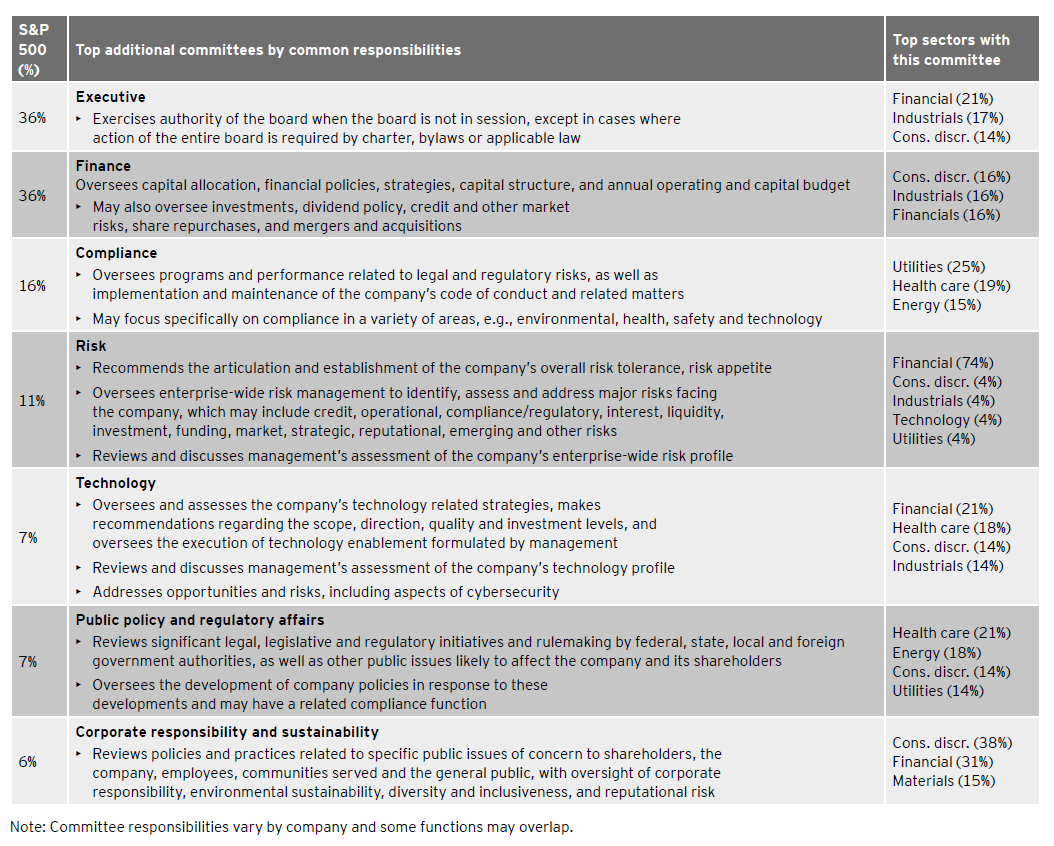
Les résultats sont  présentés succinctement dans le document qui suit. Ainsi, il ressort que :

(1) la plupart des autres comités sont les comités exécutifs et les comités des finances

(2) la nature du secteur industriel a une grande importance sur le type de comité additionnel mis en place

(3) les comités sur la gestion des risques et la technologie sont aussi présents dans environ 10 % des cas

(4) la plupart des nouveaux comités sont en lien avec la veille de la cybersécurité, la transformation numérique et les technologies de l’information.

Je vous invite à prendre connaissance des détails dans le résumé ci-dessous.

Bonne lecture !


A Fresh Look at Board Committees


Résultats de recherche d'images pour « A Fresh Look at Board Committees »


In this age of innovation and transformation, today’s board members face increasingly complex challenges in overseeing corporate culture, strategy and risk oversight.

The digital revolution has facilitated radical changes in business models and made cybersecurity a strategic business imperative. Intangible assets have become a primary driver of long-term value, making the talent agenda mission-critical. Companies are adapting to changes in the labor market, digitization and automation, and a growing spotlight on corporate values and purpose. And all of this is occurring against a backdrop of rising geopolitical tensions and trade policy challenges.

We have tracked board structures since 2013, examining how S&P 500 companies are using board committee structure to address oversight needs. This post is based on a review of the 418 proxy statements filed as of 15 May 2018. The same set of companies in 2018 and 2013 were examined to provide consistency in the review.


Findings


Amid sustained and unprecedented change, board committee structures stayed largely the same over the past six years. Across all industries, boards primarily rely on the three “key” committees generally required by the stock exchanges—audit, compensation, and nominating and governance. [1] Bank holding companies (BHCs) of a certain size, whether public or privately held, are required to also have separate risk committees—a “fourth key committee” so to speak. [2] Above and beyond these committees, institutions typically have one additional standing board committee (“additional committee”) (usually an executive or finance committee). During 2013-18, the portion of companies with at least one additional committee grew marginally from 74% to 76%, and the average number of additional committees remained largely consistent.

The most common committees remained the same. More than one-third of S&P 500 companies had an executive or finance committee. Use of executive committees declined slightly from 38% to 36%, while finance committees held steady at around 36%. Other committees were much less common.

Industry matters. Financial, telecommunications and utilities companies average two or more additional committees. Health care, consumer staples, industrials, consumer discretionary and materials average one to two. Energy, real estate and technology companies average less than one.

Few additional committees focus on emerging risk and innovation. Compliance, risk and technology committees grew marginally. In 2018, the overall percentage of S&P 500 companies with these committees remained low at 16%, 11% and 7%, respectively. Other types of committees largely held steady or declined.

A variety of additional committees oversee technology matters. Ten percent of companies assigned oversight of cybersecurity, digital transformation and information technology to an additional committee. These were typically technology, risk or compliance committees.


Our perspective


Today’s boards are navigating a sustained, highly disruptive and competitive environment. Board agendas have become increasingly packed with complex and evolving oversight topics, and key committee responsibilities have stretched beyond their core purview. Challenging the committee structure as part of the board assessment process may help the board determine the most effective oversight approach based on the company’s unique circumstances.

The ideal board committee structure is appropriate for the company’s specific needs and the board’s unique culture, is forward-looking, and supports the board’s ability to think strategically and comprehensively about key elements of the company business.


A closer look at the big banks


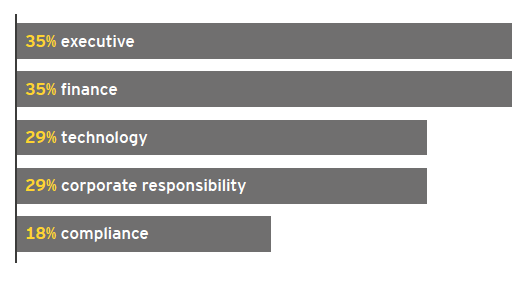
Large BHCs are unusual in that they are required to have a board- level risk committee. For these firms, other common additional committees included:

Questions for the board to consider


Is the board’s committee structure appropriate to forward-looking board priorities and company specific needs?

Is the board size and composition adaptable to changing committee responsibilities as needed based on the company’s evolving oversight needs?

Is the board familiar with how peer companies are addressing board oversight responsibilities?

Do assessments of board effectiveness reveal possible pressure points that might be resolved with changes in committee structure?

As committees assess their own effectiveness and performance, is their capacity, workload and areas of expertise part of that assessment?

As new directors join the board and bring new areas of expertise, does the board consider whether the current committee structure fully leverages those new director skills?

___________________________________________________

Endnotes

1Subject to certain exemptions, companies listed on the NYSE or NASDAQ must have independent audit, compensation and nominating/corporate governance committees. As an alternative to a nominating/corporate governance committee, director nominees may be selected by a majority of the independent directors for NASDAQ-listed companies.(go back)

2The Federal Reserve’s Enhanced Prudential Standards require separate risk committees for large publicly held US bank holding companies with total consolidated assets of \$10 billion or more.(go back)

________________________________________________________________

*Steve W. Klemash is Americas Leader, Kellie C. Huennekens is Associate Director, and Jamie Smith is Associate Director, at the EY Center for Board Matters. This post is based on their EY publication.

Comment un CA peut-il utiliser la technologie pour conserver son avantage concurrentiel ?


Maggie McGhee* a publié un très bon article sur l’importance croissante d’une solide connaissance des administrateurs eu égard aux perspectives offertes par les nouvelles technologies.

C’est la seule façon de s’assurer de développer ou de maintenir un avantage concurrentiel. L’article est paru sur le site de Board Agenda du 5 juillet 2018.

L’utilisation de nouvelles technologies peut varier d’une entreprise à une autre, mais aucune organisation ne peut se priver de questionner son modèle d’affaires afin de tenir compte des changements de paradigme.

L’auteure fait donc un rappel crucial aux administrateurs. De nouvelles compétences sont requises sur le Board !

Je vous invite également à lire un article, en français, sur les 10 nouvelles technologies qui ont marqué l’année 2017.

Enfin, je vous rappelle que cet article peut être traduit en français instantanément (vous n’avez qu’à cliquer sur le premier symbole dans la partie supérieure droite du navigateur Chrome de Google). La traduction est très acceptable pour une bonne compréhension de l’article pour ceux qui ont moins de facilité avec l’anglais.

Bonne lecture !


How boards can use technology to retain a competitive edge


Knowledge and skills in the boardroom must evolve with the risks and opportunities presented by technology—as well as its associated data—if companies are to remain competitive.


Résultats de recherche d'images pour « technologie »


For many organisations, embracing technology can be the difference between remaining relevant in their market, and being disrupted by new entrants. It represents a significant, and often the leading, business risk that boards need to address.

At the same time, by being proactive in their approach towards technology, boards may profit from what others see merely as threats. But what skills does the board need in order to provide such effective oversight, while being strategic?

In the need to remain relevant to customers and stakeholders, organisations are recognising that it is essential to adapt and embrace the opportunities that are created. Technology itself is an enabler, but it is never the solution, nor the sole driver.


Impact of technology


In our report, The Race for Relevance, we consider six technologies that are directly impacting the finance function alone. There are significantly more technologies that impact organisations as a whole.

As customer “stickiness” becomes a key tool in growth, organisations are starting to recognise the value of data created by the technologies that they own. It is an asset that is increasingly important, yet is also vulnerable to attack. Regulatory regimes are changing in order to address this. The upcoming implementation of the General Data Protection Regulation (GDPR) in May 2018, which focuses on personal data held in the EU, is one such example.

For many organisations, technology and the data generated by it present a significant business opportunity and risk—one which deserves appropriate board-level attention. So what role should the board play in assessing the use of technology and data?


Insight and guidance


The board needs to have the capability to provide insight and guidance in a number of areas. First, in the role of technology to deliver the business strategy, and whether advantage is being taken of emerging technologies.

Then there is the appraisal of technology investments, whether they are to support growth and commercial advantage, or to protect assets.

Boards must also evaluate the data strategy of the organisation by assessing whether the financial and non-financial data used to report against strategic objectives is appropriate.

Next, the board should consider the appropriateness of the organisation’s strategies to protect existing assets and information from unauthorised access or malicious attack.

They should also appraise whether the assessments of the critically held data are appropriate, and understand how data flows in an organisation comply with legal and regulatory requirements.

Assessing the risks arising from the use of technology, and how these are monitored through the organisation’s enterprise risk-management framework and internal control structures, is also a priority.

Lastly, boards should consider whether appropriate recovery plans are in place to manage the consequences of business disruption—including the management of technology and data assets.


The right skills


In discharging their responsibilities, boards should ask whether they have the skills within their membership to assess and advise appropriately.

This responsibility can be done in one of two ways. The first is by ensuring that at least one board member has direct experience of technology in the context of the industry in which the organisation operates. Having experience of addressing the risks of projects and protecting assets is invaluable, especially in those sectors where there is a high dependency on technology.

Or as an alternative, it can be done by ensuring the board has access to those with the requisite experience to advise on the risks. These may be internal experts or third parties.

Technology is an issue that cannot be ignored by boards. While not every board member needs to be fully technology-literate, it is important that all members can appreciate where it is used to create and sustain commercial advantage.

Equally, it is important that the board takes the lead in communicating across the organisation the risk and opportunity associated with technology. Without a shared understanding of the organisation’s approach to the use of technology, it will be practically impossible to roll out a consistent approach effectively.

Technology will continue to develop and provide new opportunities. Risks will continue to evolve. Commercial strategies will change as a result.

Boards need to embrace all of this if they are to remain relevant.


Maggie McGhee* is director of professional insights at ACCA (the Association of Chartered Certified Accountants).

Conséquences à la non-divulgation d’une cyberattaque majeure


Quelles sont les conséquences de ne pas divulguer une intrusion importante du système de sécurité informatique ?

Les auteurs, Matthew C. Solomon* et Pamela L. Marcogliese, dans un billet publié sur le forum du HLS, ont étudié de près la situation des manquements à la sécurité informatique de Yahoo et ils nous présentent les conséquences de la non-divulgation d’attaques cybernétiques et de bris à la sécurité des informations des clients.

Ils exposent le cas très clairement, puis ils s’attardent aux modalités des arrangements financiers avec la Securities and Exchange Commission (SEC). 

Comme ce sont des événements susceptibles de se produire de plus en plus, il importe que les entreprises soient bien au fait de ce qui les attend en cas de violation des obligations de divulgation.

Les auteurs font les cinq (5) constats suivants eu égard à la situation vécue par Yahoo :


— First, public companies should take seriously the SEC’s repeated warnings that one of its top priorities is ensuring that public companies meet their obligations to adequately disclose material cybersecurity incidents and risks. This requires regular assessment of cyber incidents and risks in light of the company’s disclosures, with the assistance of outside counsel and auditors as appropriate, and ensuring that there are adequate disclosure controls in place for such incidents and risks.

— Second, the SEC’s recently released interpretive guidance on cybersecurity disclosure is an important guidepost for all companies with such disclosure obligations. The guidance specifically cited the fact that the SEC views disclosure that a company is subject to future cybersecurity attacks as inadequate if the company had already suffered such incidents. Notably, the Yahoo settlement specifically faulted the company for this precise inadequacy in its disclosures. Similarly, the recent guidance encouraged companies to adopt comprehensive policies and procedures related to cybersecurity and to assess their compliance regularly, including the sufficiency of their disclosure controls and procedures as they relate to cybersecurity disclosure. The Yahoo settlement also found that the company had inadequate such controls.

— Third, at the same time the SEC announced the settlement, it took care to emphasize that “[w]e do not second-guess good faith exercises of judgment about cyber-incident disclosure.” [7] The SEC went on to note that Yahoo failed to meet this standard with respect to the 2014 Breach, but by articulating a “good faith” standard the SEC likely meant to send a message to the broader market that it is not seeking to penalize companies that make reasonable efforts to meet their cyber disclosure obligations.

— Fourth, it is also notable that the SEC charges did not include allegations that Yahoo violated securities laws with respect to the 2013 Breach. Yahoo had promptly disclosed the 2013 Breach after learning about it in late 2016, but updated its disclosure almost a year later with significant new information about the scope of the breach. The SEC’s recent guidance indicated that it was mindful that some material facts may not be available at the time of the initial disclosure, as was apparently the case with respect to the 2013 Breach. [8] At the same time, the SEC cautioned that “an ongoing internal or external investigation – which often can be lengthy – would not on its own provide a basis for avoiding disclosures of a material cybersecurity incident.” [9]

— Finally, it is worth noting that the Commission did not insist on settlements with any individuals. Companies, of course, can only commit securities violations through the actions of their employees. While it is not unusual for the Commission to settle entity-only cases on a “collective negligence” theory, the SEC Chair and the Enforcement Division’s leadership have emphasized the need to hold individuals accountable in order to maximize the deterrent impact of SEC actions. [10]


Bonne lecture !


Failure to Disclose a Cybersecurity Breach


Résultats de recherche d'images pour « yahoo data breach »


On April 24, 2018, Altaba, formerly known as Yahoo, entered into a settlement with the Securities and Exchange Commission (the “SEC”), pursuant to which Altaba agreed to pay $35 million to resolve allegations that Yahoo violated federal securities laws in connection with the disclosure of the 2014 data breach of its user database. The case represents the first time a public company has been charged by the SEC for failing to adequately disclose a cyber breach, an area that is expected to face continued heightened scrutiny as enforcement authorities and the public are increasingly focused on the actions taken by companies in response to such incidents. Altaba’s settlement with the SEC, coming on the heels of its agreement to pay $80 million to civil class action plaintiffs alleging similar disclosure violations, underscores the increasing potential legal exposure for companies based on failing to properly disclose cybersecurity risks and incidents.

Background

As alleged, Yahoo learned in late 2014 that it had recently suffered a data breach affecting over 500 million user accounts (the “2014 Breach”). Yahoo did not disclose the 2014 Breach until September 2016. During the time period Yahoo was aware of the undisclosed breach, it entered into negotiations to be acquired by Verizon and finalized a stock purchase agreement in July 2016, two months prior to the disclosure of the 2014 Breach. Following the disclosure in September 2016, Yahoo’s stock price dropped 3% and it later renegotiated the stock purchase agreement to reduce the price paid for Yahoo’s operating business by $350 million.

In or about late 2016, following its disclosure of the 2014 Breach, Yahoo learned about a separate breach that had taken place in August 2013 and promptly announced that such breach had affected 1 billion users (the “2013 Breach”). In October 2017, Yahoo updated its disclosure concerning the 2013 Breach, announcing that it now believed that all 3 billion of its accounts had been affected.

The Settlement

Altaba’s SEC settlement centered on the 2014 Breach only. The SEC found that despite learning of the 2014 Breach in late 2014—which resulted in the theft of as many as 500 million of its users’ Yahoo usernames, email addresses, telephone numbers, dates of birth, hashed passwords, and security questions and answers, referred to internally as Yahoo’s “crown jewels”— Yahoo failed to timely disclose the material cybersecurity incident in any of its public securities filings until September 2016. Although Yahoo senior management and relevant legal staff were made aware of the 2014 Breach, according to the SEC, they “did not properly assess the scope, business impact, or legal implications of the breach, including how and where the breach should have been disclosed in Yahoo’s public filings or whether the fact of the breach rendered, or would render, any statements made by Yahoo in its public filings misleading.” [1] The SEC also faulted Yahoo’s senior management and legal staff because they “did not share information regarding the breach with Yahoo’s auditors or outside counsel in order to assess the company’s disclosure obligations in its public filings.” [2]

Among other things, the SEC found that Yahoo’s risk factor disclosures in its annual and quarterly reports from 2014 through 2016 were materially misleading in that they claimed the company only faced the risk of potential future data breaches, without disclosing that “a massive data breach” had in fact already occurred. [3]

The SEC also alleged that Yahoo management’s discussion and analysis of financial condition and results of operations (“MD&A”) in those reports was also misleading to the extent it omitted known trends or uncertainties with regard to liquidity or net revenue presented by the 2014 Breach. [4]Finally, the SEC further found that Yahoo did not maintain adequate disclosure controls and procedures designed to ensure that reports from Yahoo’s information security team raising actual incidents of the theft of user data, or the significant risk of theft of user data, were properly and timely assessed to determine how and where data breaches should be disclosed in Yahoo’s public filings. [5]

Based on these allegations, the SEC found that Yahoo violated Sections 17(a)(2) and 17(a)(3) of the Securities Act and Section 13(a) of the Securities Exchange Act. [6] To settle the charges, Altaba, without admitting or denying liability, agreed to cease and desist from any further violations of the federal securities laws and pay a civil penalty of $35 million.

Takeaways

There are several important takeaways from the settlement:

— First, public companies should take seriously the SEC’s repeated warnings that one of its top priorities is ensuring that public companies meet their obligations to adequately disclose material cybersecurity incidents and risks. This requires regular assessment of cyber incidents and risks in light of the company’s disclosures, with the assistance of outside counsel and auditors as appropriate, and ensuring that there are adequate disclosure controls in place for such incidents and risks.

— Second, the SEC’s recently released interpretive guidance on cybersecurity disclosure is an important guidepost for all companies with such disclosure obligations. The guidance specifically cited the fact that the SEC views disclosure that a company is subject to future cybersecurity attacks as inadequate if the company had already suffered such incidents. Notably, the Yahoo settlement specifically faulted the company for this precise inadequacy in its disclosures. Similarly, the recent guidance encouraged companies to adopt comprehensive policies and procedures related to cybersecurity and to assess their compliance regularly, including the sufficiency of their disclosure controls and procedures as they relate to cybersecurity disclosure. The Yahoo settlement also found that the company had inadequate such controls.

— Third, at the same time the SEC announced the settlement, it took care to emphasize that “[w]e do not second-guess good faith exercises of judgment about cyber-incident disclosure.” [7] The SEC went on to note that Yahoo failed to meet this standard with respect to the 2014 Breach, but by articulating a “good faith” standard the SEC likely meant to send a message to the broader market that it is not seeking to penalize companies that make reasonable efforts to meet their cyber disclosure obligations.

— Fourth, it is also notable that the SEC charges did not include allegations that Yahoo violated securities laws with respect to the 2013 Breach. Yahoo had promptly disclosed the 2013 Breach after learning about it in late 2016, but updated its disclosure almost a year later with significant new information about the scope of the breach. The SEC’s recent guidance indicated that it was mindful that some material facts may not be available at the time of the initial disclosure, as was apparently the case with respect to the 2013 Breach. [8] At the same time, the SEC cautioned that “an ongoing internal or external investigation – which often can be lengthy – would not on its own provide a basis for avoiding disclosures of a material cybersecurity incident.” [9]

— Finally, it is worth noting that the Commission did not insist on settlements with any individuals. Companies, of course, can only commit securities violations through the actions of their employees. While it is not unusual for the Commission to settle entity-only cases on a “collective negligence” theory, the SEC Chair and the Enforcement Division’s leadership have emphasized the need to hold individuals accountable in order to maximize the deterrent impact of SEC actions. [10]

_________________________________________________________________________

Endnotes

1Altaba Inc., f/d/b/a Yahoo! Inc., Securities Act Release No. 10485, Exchange Act Release No. 83096, Accounting and Auditing Enforcement Release No. 3937, Administrative Proceeding File No. 3937 (Apr. 24, 2018) at ¶ 14.(go back)

2Idat ¶ 15.(go back)

3Idat ¶¶ 2, 16.(go back)

4Id.(go back)

5Idat ¶ 15.(go back)

6Idat ¶¶ 22-23.(go back)

7Press Release, SEC, Altaba, Formerly Known As Yahoo!, Charged With Failing to Disclose Massive Cybersecurity Breach; Agrees To Pay $35 Million (Apr. 24, 2018), https://www.sec.gov/news/press-release/2018-71.(go back)

8As we have previously discussed, the federal securities laws do not impose a general affirmative duty on public companies to continuously disclose material information and, as acknowledged in Footnote 37 of the interpretive guidance, circuits are split on whether a duty to update exists. However, in circuits where a duty to update has been found to exist, a distinction has often been drawn between statements of a policy nature that are within the company’s control and statements describing then current facts that would be expected to change over time. The former have been held subject to a duty to update while the latter have not. See In re Advanta Corp. Securities Litigation, 180 F.3d 525, 536 (3d Cir. 1997) (“[T]he voluntary disclosure of an ordinary earnings forecast does not trigger any duty to update.”); In re Burlington Coat Factory Securities Litigation, 114 F.3d 1410, 1433 (3d Cir. 1997); In re Duane Reade Inc. Securities Litigation, No. 02 Civ. 6478 (NRB), 2003 WL 22801416, at *7 (S.D.N.Y. Nov. 25, 2003), aff’d sub nom. Nardoff v. Duane Reade, Inc., 107 F. App’x 250 (2d Cir. 2004) (“‘company has no duty to update forward–looking statements merely because changing circumstances have proven them wrong.’”).(go back)

9See SEC, Commission Statement and Guidance on Public Company Cybersecurity Disclosures, 83 Fed. Reg 8166, 8169 (Feb. 26, 2018), https://www.federalregister.gov/documents/2018/02/26/2018-03858/commission-statement-and-guidance-on-public- company-cybersecurity-disclosures.(go back)

10See, e.g., Steven R. Peikin, Co-Director, Div. Enf’t., SEC, Reflections on the Past, Present, and Future of the SEC’s Enforcement of the Foreign Corrupt Practices Act, Keynote Address at N.Y.U. Program on Corporate Law and Enforcement Conference: No Turning Back: 40 Years of the FCAP and 20 Years of the OECD Anti-Bribery Convention Impacts, Achievements, and Future Challenges (Nov. 9, 2017), https://www.sec.gov/news/speech/speech-peikin2017-11-09;
SEC Div. Enf’t., Annual Report A Look Back at Fiscal Year 2017, at 2 (Nov. 15, 2017), https://www.sec.gov/files/enforcement-annual-report2017.pdf.(go back)

_______________________________________________________________________

*Matthew C. Solomon and Pamela L. Marcogliese are partners and Rahul Mukhi is counsel at Cleary Gottlieb Steen & Hamilton LLP. This post is based on a Cleary Gottlieb publication by Mr. Solomon, Ms. Marcogliese, Ms. Mukhi, and Kal Blassberger.

Les responsabilités des administrateurs eu égard à la gestion des risques


Les administrateurs de sociétés doivent apporter une attention spéciale à la gestion des risques telle qu’elle est mise en œuvre par les dirigeants des entreprises.

Les préoccupations des fiduciaires pour la gestion des risques, quoique fondamentales, sont relativement récentes, et les administrateurs ne savent souvent pas comment aborder cette question.

L’article présenté, ci-dessous, est le fruit d’une recherche de Martin Lipton, fondateur de la firme Wachtell, Lipton, Rosen & Katz, spécialisée dans les fusions et acquisitions ainsi que dans les affaires de gouvernance.

L’auteur et ses collaborateurs ont produit un guide des pratiques exemplaires en matière de gestion des risques. Cet article de fond s’adresse aux administrateurs et touche aux éléments-clés de la gestion des risques :

(1) la distinction entre la supervision des risques et la gestion des risques ;

(2) les leçons que l’on doit tirer de la supervision des risques à Wells Fargo ;

(3) l’importance accordée par les investisseurs institutionnels aux questions des risques ;

(4) « tone at the top » et culture organisationnelle ;

(5) les devoirs fiduciaires, les contraintes réglementaires et les meilleures pratiques ;

(6) quelques recommandations spécifiques pour améliorer la supervision des risques ;

(7) les programmes de conformité juridiques ;

(8) les considérations touchant les questions de cybersécurité ;

(9) quelques facettes se rapportant aux risques environnementaux, sociaux et de gouvernance ;

(10) l’anticipation des risques futurs.


Voici donc l’introduction de l’article. Je vous invite à prendre connaissance de l’article au complet.

Bonne lecture !


Risk Management and the Board of Directors


Résultats de recherche d'images pour « Gestion des risques et administrateurs de sociétés »


Overview

The past year has seen continued evolution in the political, legal and economic arenas as technological change accelerates. Innovation, new business models, dealmaking and rapidly evolving technologies are transforming competitive and industry landscapes and impacting companies’ strategic plans and prospects for sustainable, long-term value creation. Tax reform has created new opportunities and challenges for companies too. Meanwhile, the severe consequences that can flow from misconduct within an organization serve as a reminder that corporate operations are fraught with risk. Social and environmental issues, including heightened focus on income inequality and economic disparities, scrutiny of sexual misconduct issues and evolving views on climate change and natural disasters, have taken on a new salience in the public sphere, requiring companies to exercise utmost care to address legitimate issues and avoid public relations crises and liability.

Corporate risk taking and the monitoring of corporate risk remain prominently top of mind for boards of directors, investors, legislators and the media. Major institutional shareholders and proxy advisory firms increasingly evaluate risk oversight matters when considering withhold votes in uncontested director elections and routinely engage companies on risk-related topics. This focus on risk management has also led to increased scrutiny of compensation arrangements throughout the organization that have the potential for incentivizing excessive risk taking. Risk management is no longer simply a business and operational responsibility of management. It has also become a governance issue that is squarely within the oversight responsibility of the board. This post highlights a number of issues that have remained critical over the years and provides an update to reflect emerging and recent developments. Key topics addressed in this post include:

the distinction between risk oversight and risk management;

a lesson from Wells Fargo on risk oversight;

the strong institutional investor focus on risk matters;

tone at the top and corporate culture;

fiduciary duties, legal and regulatory frameworks and third-party guidance on best practices;

specific recommendations for improving risk oversight;

legal compliance programs;

special considerations regarding cybersecurity matters;

special considerations pertaining to environmental, social and governance (ESG) risks; and

anticipating future risks.

Rôle du conseil d’administration en cas de gestion de crises | Les défis de Facebook


Voici un article qui met en garde les structures de gouvernance telles que Facebook.

L’article publié sur le site de Directors&Boards par Eve Tahmincioglu soulève plusieurs questions fondamentales :

(1) L’actionnariat à vote multiple conduit-il à une structure de gouvernance convenable et acceptable ?

(2) Pourquoi le principe de gouvernance stipulant une action, un vote, est-il bafoué dans le cas de plusieurs entreprises de la Silicone Valley ?

(3) Quel est le véritable pouvoir d’un conseil d’administration où les fondateurs sont majoritaires par le jeu des actions à classe multiple ?

(4) Doit-on réglementer pour rétablir la position de suprématie du conseil d’administration dirigé par des administrateurs indépendants ?

(5) Dans une situation de gestion de crise comme celle qui confronte Facebook, quel est le rôle d’un administrateur indépendant, président de conseil ?

(6) Les médias cherchent à connaître la position du PDG sans se questionner sur les responsabilités des administrateurs. Est-ce normal en gestion de crise ?

Je vous invite à lire l’article ci-dessous et à exprimer vos idées sur les principes de bonne gouvernance appliqués aux entreprises publiques contrôlées par les fondateurs.

Bonne lecture !


Facebook Confronts Its Biggest Challenge: But where’s the “high-powered” board?


Résultats de recherche d'images pour « facebook »i


Facebook is arguably facing one of the toughest challenges the company has ever faced. But the slow and tepid response from leadership, including the boards of directors, concerns governance experts.

The scandal involving data-mining firm Cambridge Analytica allegedly led to 50 million Facebook users’ private information being compromised but a public accounting from Facebook’s CEO and chairman Mark Zuckerberg has been slow coming.

Could this be a governance breakdown?

“This high-powered board needs to engage more strongly,” says Steve Odland, CEO of the Committee for Economic Development and a board member for General Mills, Inc. and Analogic Corporation. Facebook’s board includes Netflix’s CEO Reed Hastings; Susan D. Desmond-Hellmann, CEO of The Gates Foundation; the former chairman of American Express Kenneth I. Chenault; and PayPal cofounder Peter A. Thiel, among others.

Odland points out that Facebook has two powerful and well-known executives, Zuckerberg and Facebook COO Sheryl Sandberg, who have been publicly out there on every subject, but largely absent on this one.

While Zuckerberg released a written statement late today on his Facebook page, he didn’t talk directly to the public, or take media questions. He is reportedly planning to appear on CNN tonight.

It was a long time coming for many.

“They need to get out and publicly talk about this quickly,” Odland maintains. “They didn’t have to have all the answers. But this vacuum of communications gets filled by others, and that’s not good for the company.”

Indeed, politicians, the Federal Trade Commission and European politicians are stepping in, he says, “and that could threaten the whole platform.”

Typically, he adds, it comes back to management to engage and use the board, but “I don’t think Zuckerberg is all that experienced in that regard. This is where the board needs to help him.”

But how much power does the board have?

Charles Elson, director of the University of Delaware’s Weinberg Center for Corporate Governance, sees the dual-class ownership structure of Facebook that gives the majority of voting power to Zuckerberg and thus undermines shareholders and the board’s power.

“It’s his board because of the dual-class stock. There is nothing [directors] can do; neither can the shareholders and a lawsuit would yield really nothing,” he explains.

Elson has been warning against such structures for some time, including in a piece for this publication on Snap’s dual-class IPO.

He and his coauthor Craig K. Ferrere wrote:

Increasingly, company founders have been opting to shore up control by creating stock ownership structures that undercut shareholder voting power, where only a decade ago almost all chose the standard and accepted one-share, one-vote model.

Now the Snap Inc. initial public offering (IPO) takes it even further with the first-ever solely non-voting stock model. It’s a stock ownership structure that further undercuts shareholder influence, undermines corporate governance and will likely shift the burden of investment grievances to the courts.

By offering stock in the company with no shareholder vote at all, Snap — the company behind the popular mobile-messaging app Snapchat that’s all about giving a voice to the many — has acknowledged that public voting power at companies with a hierarchy of stock ownership classes is only a fiction. And it begs the question: Why does Snap even need a board?

But some critics have waved Elson’s assertions away because so many tech companies, including Facebook, have been doing well by investors.

Alas, Facebook’s shares have tanked as a result of the Cambridge Analytica revelations, and it’s unclear what’s happening among the leaders at Facebook to deal with the crisis.

Facebook’s board, advises Odland, needs to get involved and help create privacy policies and if those are violated, they need to follow up.

“This is a relatively young company in a relatively young industry that has grown to be a powerhouse and incredibly important,” he explains.  Given that, he says, there are “new forms of risk management this board needs to tackle.”

Enjeux clés concernant les membres des comités d’audit | KPMG


Le récent rapport de KPMG sur les grandes tendances en audit présente sept défis que les membres des CA, notamment les membres des comités d’audit, doivent considérer afin de bien s’acquitter de leurs responsabilités dans la gouvernance des sociétés.

Le rapport a été rédigé par des professionnels en audit de la firme KPMG ainsi que par le Conference Board du Canada.

Les sept défis abordés dans le rapport sont les suivants :

– talent et capital humain ;

– technologie et cybersécurité ;

– perturbation des modèles d’affaires ;

– paysage réglementaire en évolution ;

– incertitude politique et économique ;

– évolution des attentes en matière de présentation de l’information ;

– environnement et changements climatiques.

Je vous invite à consulter le rapport complet ci-dessous pour de plus amples informations sur chaque enjeu.

Bonne lecture !


Tendances en audit


Résultats de recherche d'images pour « tendances en audit »


Alors que l’innovation technologique et la cybersécurité continuent d’avoir un impact croissant sur le monde des finances et des affaires à l’échelle mondiale, tant les comités d’audit que les chefs des finances reconnaissent le besoin de compter sur des talents de haut calibre pour contribuer à affronter ces défis et à en tirer parti.

Le rôle du comité d’audit est de s’assurer que l’organisation dispose des bonnes personnes possédant l’expérience et les connaissances requises, tant au niveau de la gestion et des opérations qu’au sein même de sa constitution. Il ne s’agit que de l’un des nombreux défis à avoir fait surface dans le cadre de ce troisième numéro du rapport Tendances en audit.

Les comités d’audit d’aujourd’hui ont la responsabilité d’aider les organisations à s’orienter parmi les nombreux enjeux et défis plus complexes que jamais auxquels ils font face, tout en remplissant leur mandat traditionnel de conformité et de présentation de l’information. Alors que les comités d’audit sont pleinement conscients de cette nécessité, notre rapport indique que les comités d’audit et les chefs des finances se demandent dans quelle mesure leur organisation est bien positionnée pour faire face à la gamme complète des tendances actuelles et émergentes.

Pour mettre en lumière cette préoccupation et d’autres enjeux clés, le rapport Tendances en audit se penche sur les sept défis qui suivent :

  1. talent et capital humain;
  2. technologie et cybersécurité;
  3. perturbation des modèles d’affaires;
  4. paysage réglementaire en évolution;
  5. incertitude politique et économique;
  6. évolution des attentes en matière de présentation de l’information;
  7. environnement et changements climatiques.

Au fil de l’évolution des mandats et des responsabilités, ce rapport se révélera être une ressource précieuse pour l’ensemble des parties prenantes en audit.

Comment le CA peut-il gérer les cyber risques ?


Cet article explique comment les entreprises doivent agir afin de minimiser les risques cybernétiques et les cyberattaques.

Paula Loop*, directrice au Governance Insights Center, vient de publier les conclusions d’une étude de PwC :  2018 Global State of Information Security® Survey

Les résultats sont présentés sous forme de questions relatives à la sécurité informatique :

  1. Le CA doit-il être le responsable de la surveillance de cette activité ?
  2. Votre CA nécessite-t-il plus d’expertise dans le domaine de la cybersécurité ?
  3. Avons-nous toutes les compétences requises au sein du CA ?
  4. Possédons-nous les informations nécessaires pour la supervision des risques de cybersécurité ?
  5. Le CA, et notamment son président, a-t-il développé un niveau de relation ouverte avec le responsable des technologies (CISO) ?
  6. Comment savoir si les contrôles mis en place pour prévenir les brèches dans les systèmes sont efficaces ?


Les auteurs donnent un exemple de tableau de bord utile pour les CA :


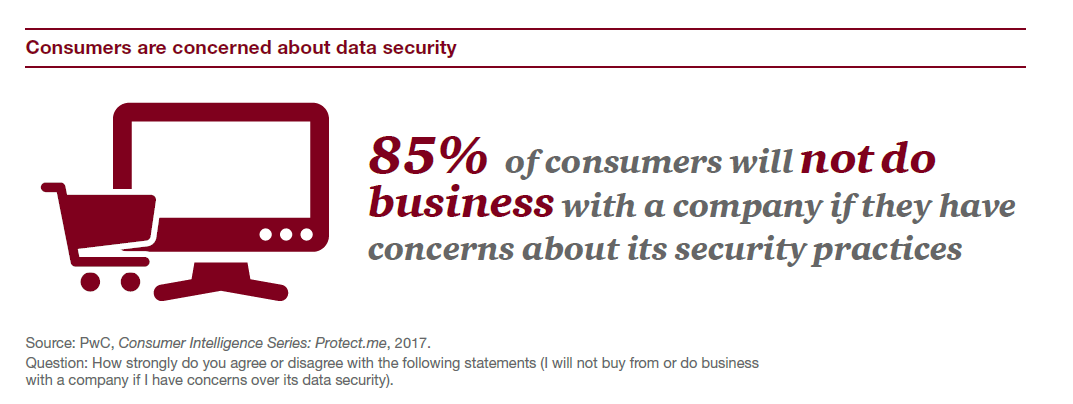
Despite how pervasive the threats are, 44% of the 9,500 executives surveyed in PwC’s 2018 Global State of Information Security® Survey say they don’t have an overall information security strategy. That gives you a sense of how much work companies still need to do. Overseeing cyber risk is a huge challenge, but we have ideas for how directors can tackle cybersecurity head-on.


L’article présente également une mine d’informations eu égard aux enjeux, aux défis et aux actions qu’un CA doit entreprendre pour assurer une solide sécurité informatique.

Je vous invite à lire les conclusions de l’étude de PwC ci-dessous. Pour plus d’information sur ce sujet, vous pouvez consulter le rapport complet.

Bonne lecture !


Overseeing Cyber Risk


Résultats de recherche d'images pour « cyber risques entreprise »


Directors can add value as their companies struggle to tackle cyber risk. We put the threat environment in context for you and outline the top issues confronting companies and boards. And we identify concrete steps for boards to up their game in this complex area.

You don’t need us to tell you that cyber threats are everywhere. Breaches make headlines on

what seems like a daily basis. They also cost companies—in money and reputation. Indeed, cyber threats are among US CEOs’ top concerns, according to PwC’s 20th Global CEO Survey.

The pace of cyber breaches isn’t slowing. In part, we’re making it too easy for attackers. How? Employees fall for sophisticated phishing schemes, neglect to install security updates or use weak passwords. We are also doing more work on mobile devices, which tend not to be as well protected. And companies don’t always invest enough in cybersecurity or patch their systems promptly when problems are discovered.

The nature of cyber threats is also evolving. The self-propagating WannaCry attack, for instance, could infect a computer even if the user didn’t click on the link. Indeed, 2017 saw a number of major ransomware attacks that froze computer systems—keeping some companies offline for weeks.

Despite how pervasive the threats are, 44% of the 9,500 executives surveyed in PwC’s 2018 Global State of Information Security® Survey say they don’t have an overall information security strategy. That gives you a sense of how much work companies still need to do. Overseeing cyber risk is a huge challenge, but we have ideas for how directors can tackle cybersecurity head-on.


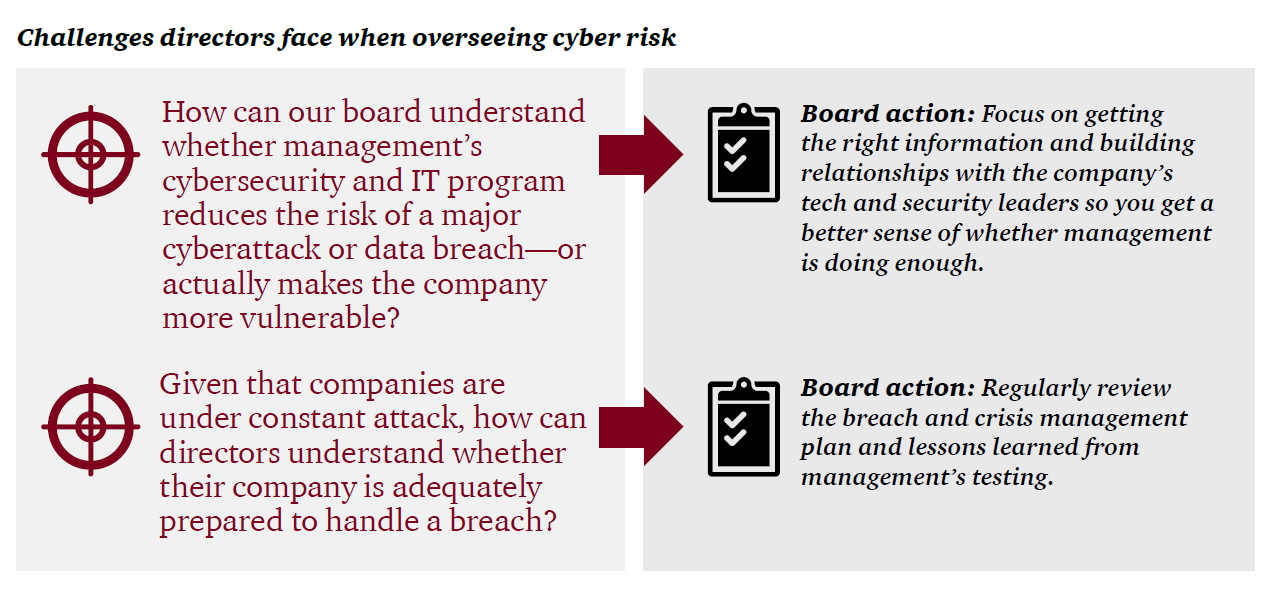
Challenge:

How can our board understand whether management’s cybersecurity and IT program reduces the risk of a major cyberattack or data breach—or actually makes the company more vulnerable?


Many directors are not confident that management has a handle on cyber threats. PwC’s 2017 Annual Corporate Directors Survey found that only 39% of directors are very comfortable that their company has identified its most valuable and sensitive digital assets. And a quarter had little or no faith at all that their company has identified who might attack.

There are obviously many moving parts that management needs to get right. Many companies align their programs and investments with a cybersecurity framework to help ensure they’re addressing everything they should.

For a board to oversee cyber risks effectively, it needs the right information on how the company addresses those risks. But 63% of directors say they’re not very comfortable that their company is providing the board with adequate cybersecurity metrics. [1]

Boards also shortchange the time they give to discussing cyber risks. We often see board agendas allocate relatively little time to the topic.

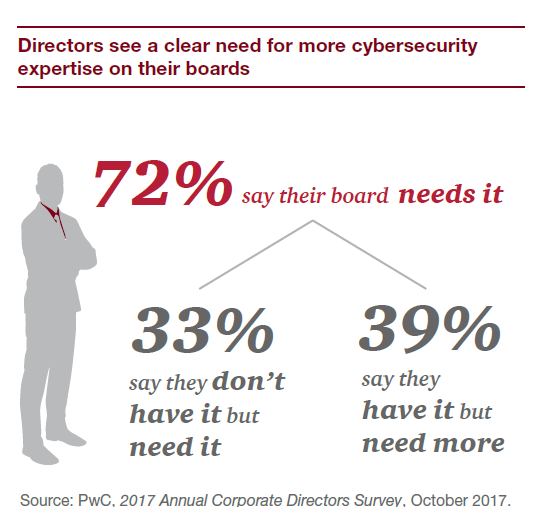
Another part of the challenge is that few boards have directors with current technology or cybersecurity expertise. And that puts directors at a disadvantage in being able to figure out if management is doing enough to address this area of significant risk.


Why does cybersecurity often break down in companies?


Common issues Why they matter
There’s no inventory of the company’s digital assets Companies can’t protect assets they don’t know about. Management should be able to explain what information and data they hold, why it’s needed, where it is (within the company’s systems or with third parties) and whether it’s properly protected. They should also know which data is most valuable (the crown jewels).
The company doesn’t know which third parties it digitally connects with A company may interact—and even share sensitive information—with thousands of suppliers and contractors. Hackers often target these third parties as a way to get into a company’s network. Yet more than half of companies don’t keep a comprehensive inventory of the third parties they share sensitive information with. [2]
The company hasn’t identified who is most likely to come after its data Knowing who might attack helps the company better anticipate how they might attack. That in turn may help the company put up better defenses.
The company has poor cyber hygiene Systems that aren’t properly configured are more vulnerable to attacks. So companies should employ leading practices, like multi-factor authentication, to protect highly sensitive information. They also need to do the basics right—like removing access on a timely basis for people who leave the company or change jobs.
The company hasn’t patched known system vulnerabilities System vulnerabilities are being uncovered constantly. But not all software companies push out patches to users. So the company needs to ensure someone regularly monitors to see if patch updates are available. And then make sure those fixes get made.
The company has a wide attack surface Providing more ways to access company systems makes things easier for employees, customers and third parties. And for hackers. So companies need stronger controls (such as multi-factor authentication). And they need to increase their monitoring for suspicious activity.
Employees aren’t trained on their role in security Current employees are the top source of security incidents—whether intentional or not. [3] Yet only half (52%) of executives say their company has an employee security awareness training program. [4]
Cybersecurity is viewed as the CISO’s responsibility A chief information security officer (CISO) can’t do the job alone. Other groups like Infrastructure or Operations need to cooperate and provide resources to address cyber issues.

Board action:

Focus on getting the right information and building relationships with the company’s tech and security leaders so you get a better sense of whether management is doing enough


This is a really tough area to oversee. Here are a number of questions to help as you address it.

1. Since cybersecurity is really a business issue, should the full board oversee it?

Half of directors say their audit committee is responsible for cyber risk, and 16% give it to either a separate risk committee or a separate IT committee. Only 30% say it’s a full board responsibility. [5] If the full board doesn’t want to oversee cyber risk, ensure that, at a minimum, whichever committee is assigned the responsibility provides regular and comprehensive reporting up to the whole board. And consider moving it from the already overloaded audit committee to another board committee.

2. Does our board need greater cybersecurity or technology expertise?

For some companies, the answer will be to recruit a director with serious expertise in cybersecurity. But others won’t choose to close their skill gap by adding a new director. People with these skills are hard to find, especially since the technology landscape is changing so quickly. Some boards may not have room to add another member. Others may not want to add someone with such specific expertise unless they’re confident that person could handle other board matters as well. So instead they look for other ways to address any gap, including continuing education and using outside advisors.

3. Is everyone in the room who needs to be?

The cybersecurity discussion should include business, technology and risk management leaders—as well as the CEO and CFO. Why? For one, it reinforces that cyber is an enterprise-wide issue—and that directors expect everyone to be accountable for managing the risk. The discussion also may expose other areas where there are security gaps. For example, while a CISO will often cover IT, many industrial organizations also need to protect OT—the operational technology that directs what happens in physical plants or processes. So if the CISO isn’t covering OT, the board needs to hear from whoever is.

4. Do we have the information we need to oversee cyber risk?

First, consider whether you have the basic information you need on the company’s IT environment. Without this background, it’s tough to make sense of the level of risk the company faces. There are a few key areas:

The nature of the company’s systems.

Are they developed in-house, purchased and customized or in the cloud?

Are any no longer supported by vendors?

Is the company running multiple versions of key systems in different divisions?

To what extent has the company integrated the systems of companies it acquired?

The security resources.

Where does IT security report?

What are IT security’s resources and budget? How do they compare to industry benchmarks?

Has the company adopted a cybersecurity framework (e.g., NIST, ISO 27001)?

This type of basic information doesn’t change much, so directors likely only need periodic refreshers.

On the other hand, directors will want more frequent reporting on what does change. Each company needs to figure out which items—quantitative and qualitative—are most relevant. It’s also helpful for directors to see whether management believes cyber risk is increasing, stable or decreasing.

A good dashboard gives directors an at-a-glance understanding of the state of the company’s cyber risk. There are a number of different approaches to assembling a dashboard. One is to simply classify issues between external and internal factors, like the example we show below.

If boards sense the dashboard isn’t giving a complete or accurate picture, they shouldn’t be afraid to challenge what’s presented in it. Read more to find out how.


Example of what a dashboard might look like


5. Have we built a relationship that allows the CISO to be candid with us?

The CISO has a lot of responsibility but doesn’t always have the authority to insist that other technology and business leaders fall in line. A strong relationship with the board helps the CISO feel comfortable giving directors the true picture (warts and all) of cyber risks, including his or her views on whether resources are adequate. Periodic private sessions with the CISO are a key part of understanding whether the company is doing enough to manage these risks.

6. How can we know whether the controls and processes designed to prevent data breaches are working?

Speaking to objective groups, such as internal audit, can offer the board different perspectives. The board may also want to hire its own outside consultants to periodically review the state of cybersecurity at the company and report back to the board.

 How can directors improve their knowledge of cybersecurity?

Hold deep-dive discussions about the company’s situation. That could include the company’s cybersecurity strategy, the types of cyber threats facing the company and the nature of the company’s “crown jewels.”

Attend external programs. There are a number of conferences that focus on the oversight of cyber risk.

Ask management what it has learned from connecting with peers and industry groups.

Ask law enforcement (e.g., the FBI) and other experts to present on the threat environment, attack trends and common vulnerabilities. Then discuss with management how the company is addressing these developments.

Challenge:

Given that companies are under constant attack, how can directors understand whether their company is adequately prepared to handle a breach?


No company is immune to the threat of a breach. One particularly scary aspect of cybersecurity is that companies may only know they’ve been breached when an outside party, such as the FBI, notifies them. Then there’s the question of what the company needs to do once it discovers a breach. Obviously it needs to investigate and patch its systems. But there’s much more.

Nearly all US states and many countries have laws requiring entities to notify individuals when there’s been a security breach involving personally identifiable information. These laws often set a deadline for notification—sometimes as short as 72 hours. The data breach notification laws change from time to time, making it a challenge to keep up to date. Separately, companies should also consider any potential SEC disclosure requirements regarding cyber risks and incidents.

Breaches can mean significant fines from regulatory agencies, as well as class-action lawsuits. They can also damage a company’s reputation and brand—resulting in loss of customers, as well as investors possibly losing confidence in the company. And as we have seen with some breaches, senior executives can lose their jobs.

Breaches also mean more costs to companies—to investigate, remediate and compensate those who were harmed. Only half of US companies have cyber insurance, [6] despite the growing number and size of incidents. In part, there’s still some skepticism on how claims will be covered.

Given how likely a breach is and how much companies need to do to respond, it’s surprising that 54% of executives say their companies don’t have an incident response plan. [7] Yet companies that responded well to a breach—thanks to better preparation—usually come out of the crisis better than those that had to scramble.


Board action:

Regularly review the breach and crisis management plan and lessons learned from management’s testing


It’s important to ask management about the company’s cyber incident response and crisis management plan on a regular basis. If there isn’t one, press management for a timeline to develop and test one.

If there is a plan, discuss what it entails and how the company intends to continue operating in the event of a disruptive attack. It should also identify everyone who needs to be involved, which could include the communications team, finance leaders, business leaders, legal counsel and the broader crisis response team, as well as IT specialists. The plan should specify which external resources are on retainer to support the internal teams. And who the company will work with on the law enforcement side.

A key part of the plan should cover breach notification and escalation procedures. When will the board be notified? What is the company’s plan to inform regulators? How and when will other stakeholders—including individuals whose personal information may have been lost—be informed?

Also ask management about plan testing and what changes were made as a result of the last test. Some directors even observe or participate in tabletop testing exercises to get a better appreciation for how management plans to address a cyber crisis.

Finally, have management explain if it has updated controls or recovery plans based on recent incidents at other organizations.


In conclusion…


As cyber threats persist, boards recognize they need to step up their cyber risk oversight. That starts when directors recognize that the responsibility for handling cyber risk goes well beyond the CISO. How? By insisting that cybersecurity be a business discussion, with the right senior executives in the room and a sophisticated understanding of the threats.


____________________________________________________________

Endnotes

1PwC, 2017 Annual Corporate Directors Survey, October 2017.(go back)

2Ponemon Institute, Data Risk in the Third-Party Ecosystem, September 28, 2017.(go back)

3PwC, Global State of Information Security® Survey 2018, October 2017.(go back)

4Ibid.(go back)

5PwC, 2017 Annual Corporate Directors Survey, October 2017.(go back)

6Insurance Journal, “Why 27% of U.S. Firms Have No Plans to Buy Cyber Insurance”, May 31, 2017; http://www.insurancejournal.com/news/national/2017/05/31/452647.htm(go back)

7PwC, Global State of Information Security® Survey 2018, October 2017.(go back)

_______________________________________________

*Paula Loop is Leader at the Governance Insights Center, Catherine Bromilow is Partner at the Governance Insights Center, and Sean Joyce is US Cybersecurity and Privacy Leader at PricewaterhouseCoopers LLP. This post is based on a PwC publication by Ms. Loop, Ms. Bromilow, and Mr. Joyce.

Billets récents publiés sur mon blogue en gouvernance en janvier 2018


Voici les quinze billets publiés sur mon blogue en gouvernance des sociétés en janvier 2018.

Bonne lecture ! Vos commentaires sont toujours les bienvenus.


Résultats de recherche d'images pour « blogue en gouvernance »


  1. Que pensez-vous des classes d’actions à droit de vote multiples ?
  2. Compte rendu hebdomadaire de la Harvard Law School Forum on Corporate Governance | 25 janvier 2018
  3. Aspects fondamentaux à considérer par les administrateurs dans la gouvernance des organisations
  4. Comment se préparer à la divulgation du ratio qui révèle la rémunération du CEO comparée à la moyenne des salaires des employés
  5. Compte rendu hebdomadaire de la Harvard Law School Forum on Corporate Governance | 18 janvier 2018
  6. BlackRock soutient le modèle de gouvernance basé sur la primauté accordée aux parties prenantes
  7. Adapter le modèle de gouvernance à la réalité des OBNL de petite taille
  8. Les administrateurs de sociétés qui cumulent plusieurs postes deviennent-ils trop accaparés ?
  9. Compte rendu hebdomadaire de la Harvard Law School Forum on Corporate Governance | 12 janvier 2018
  10. Quelle est l’influence des femmes CEO sur la structure de gouvernance des entreprises ?
  11. La souveraineté des conseils d’administration
  12. Compte rendu hebdomadaire de la Harvard Law School Forum on Corporate Governance | 4 janvier 2018
  13. Enquête de Deloitte sur la diversité des conseils d’administration
  14. Dix thèmes prioritaires à mettre à l’ordre du jour des Boards en 2018
  15. La gouvernance relative aux sociétés en 2017 | Un « Survey » des entreprises du SV 150 et de la S&P 100

Dix thèmes prioritaires à mettre à l’ordre du jour des Boards en 2018


Aujourd’hui, je partage avec vous un article de Kerry E. Berchem et Christine B. LaFollette, associés de la firme Akin Gump Strauss Hauer & Feld, qui donne un aperçu des principales préoccupations des CA en 2018.

Ce qui est intéressant, outre les thèmes choisis, c’est l’impact de l’agenda de l’administration Trump sur la gouvernance des sociétés, notamment les points suivants :

– Assouplissements de la réglementation de la SEC ;

– Applications des directives de la SEC, en autres les efforts de remplacement de la réforme Dodd-Frank ;

– Nouveaux échanges commerciaux et applications de sanctions plus sévères ;

– La réforme de la fiscalité.

Bonne lecture ! Vos commentaires sont les bienvenus.


Top 10 Topics for Directors in 2018


1. Cybersecurity threats.

Cybersecurity preparedness is essential in 2018 as the risk of, and associated adverse impact of, breaches continue to rise. The past year redefined the upward bounds of the megabreach, including the Yahoo!, Equifax and Uber hacks, and the SEC cyber-attack. As Securities and Exchange Commission (SEC) Co-Directors of Enforcement Stephanie Avakian and Steven Peikin warned, “The greatest threat to our markets right now is the cyber threat.” No crisis should go to waste. Boards should learn from others’ misfortunes and focus on governance, crisis management and recommended best practices relating to cyber issues.

2. Corporate social responsibility.

By embracing corporate social responsibility (CSR) initiatives, boards are able to proactively identify and address legal, financial, operational and reputational risks in a way that can increase the company value to all stakeholders-investors, shareholders, employees and consumers. Boards should invest in CSR programming as an integral element of company risk assessment and compliance programs, and should advocate public reporting of CSR initiatives. Such initiatives can serve as both differentiating and value-enhancing factors. According to recent studies, companies with strong CSR practices are less likely to suffer large price declines, and they tend to have better three- to five-year returns on equity, as well as a greater chance of long-term success.

3. Managing five generations of employees.

In the coming years, employers will face the unprecedented challenge of having five generations of employees in the workplace. Companies and their boards can help address these tensions by better understanding employee expectations, encouraging cross-generation mentorship, and setting an example of generational diversity with respect to company leadership and members of the board. If managed correctly, boards and companies alike can benefit from the wisdom, collaboration and innovation that comes with generational diversity.

4. Corporate strategy.

Strategic planning with a particular focus on potential acquisitions should continue to be a high priority for boards in 2018. Boards should expect to face conflicting pressures, since shareholders will expect companies to invest in both long-term growth opportunities and short-term stock enhancement measures, including the deployment of excess cash for stock buybacks. Cross-border transactions will likely continue to be attractive options, subject to increased regulatory scrutiny in certain industries and of certain buyers.

5. Board composition.

Board diversity is being actively considered and encouraged by regulators, corporate governance groups and investors, both in the United States and internationally, and the current focus on board diversity is likely to continue. Companies should review the applicable diversity-related obligations in their jurisdictions and assess their current board composition, director search and nomination process, board refreshment practices and diversity policies.

6. Shareholder activism.

Shareholder activism has entrenched itself in the modern climate of corporate governance. In particular, shareholder activists have entered industries that, until recently, have generally steered clear of such investors, including the energy sector. There is an increased emphasis by prominent investors on challenging transactions, corporate strategy and traditional corporate governance concerns, such as board composition and staggered boards.

7. Internal investigations.

Boards are increasingly confronted with the possibility of wrongdoing implicating the company or its employees. The decision whether or not to undertake an independent internal investigation, and how, requires careful consideration and consultation with counsel, since the response of the board will have important implications for the ultimate effects on the company.

8. SEC regulatory relief.

We expect that the Trump administration and the Republican-led U.S. Congress will advance reforms in 2018 designed to encourage companies toward public ownership and to facilitate capital formation in both public and private markets. Although smaller companies will likely be the greatest beneficiaries of the proposals currently being considered, many proposals are expected to also benefit large public companies-by eliminating certain duplicative and nonmaterial disclosure requirements and by addressing concerns regarding shareholder proposals.

9. SEC enforcement.

In addition to new leadership at the SEC, ambitious legislative proposals in Congress and further developments in insider trading law have the potential to impact SEC enforcement, although certain enforcement streams, such as accounting and other disclosure-related investigations, are likely to remain largely unchanged. The SEC’s own cyber breach has brought renewed focus at the agency on information security and the integrity of trading systems. Efforts to repeal Dodd-Frank have also advanced through both chambers of Congress.

10. Trade and sanctions.

During the first year of the Trump administration, U.S. sanctions were expanded significantly to include complex new restrictions that target transactions with Iran, Russia, North Korea and Venezuela, among others. Additionally, there has been an uptick in sanctions enforcement actions, including a continued focus by U.S. enforcement agencies on officers and directors that approve, or engage in, proscribed activities. Accordingly, in an effort to avoid running afoul of U.S. sanctions, boards should be vigilant in understanding how these evolving rules apply to the business activities of their companies and management teams.

Special Bonus: Tax reform.

Tax reform has been a top priority for the Trump Administration and Republicans in Congress. After a slow start to 2017 in terms of legislative wins, the House and Senate are poised to send the first comprehensive tax reform bill to the President’s desk in more than thirty years. While the differences between the House and Senate bills still need to be resolved, the new Tax Cuts and Jobs Act is expected to pass by the end of the year and will present both benefits and challenges for companies in implementation and adaptation as unintended consequences are inevitably uncovered in the months and years to come.

The complete publication is available here.

Nouvelles perspectives pour la gouvernance en 2018


Aujourd’hui, je vous propose la lecture d’un excellent article de Martin Lipton* sur les nouvelles perspectives de la gouvernance en 2018. Cet article est publié sur le site du Harvard Law School Forum on Corporate Governance.

Après une brève introduction portant sur les meilleures pratiques observées dans les entreprises cotées, l’auteur se penche sur les paramètres les plus significatifs de la nouvelle gouvernance.

Les thèmes suivants sont abordés dans un contexte de renouvellement de la gouvernance pour le futur :

  1. La notion de l’actionnariat élargie pour tenir compte des parties prenantes ;
  2. L’importance de considérer le développement durable et la responsabilité sociale des entreprises ;
  3. L’adoption de stratégies favorisant l’engagement à long terme ;
  4. La nécessité de se préoccuper de la composition des membres du CA ;
  5. L’approche à adopter eu égard aux comportements d’actionnaires/investisseurs activistes ;
  6. Les attentes eu égard aux rôles et responsabilités des administrateurs.

À l’approche de la nouvelle année 2018, cette lecture devrait compter parmi les plus utiles pour les administrateurs et les dirigeants d’entreprises ainsi que pour toute personne intéressée par l’évolution des pratiques de gouvernance.

Bonne lecture ! Vos commentaires sont appréciés.


Some Thoughts for Boards of Directors in 2018


Introduction


As 2017 draws to a conclusion and we reflect on the evolution of corporate governance since the turn of the millennium, a recurring question percolating in boardrooms and among shareholders and other stakeholders, academics and politicians is: what’s next on the horizon for corporate governance? In many respects, we seem to have reached a point of relative stasis. The governance and takeover defense profiles of U.S. public companies have been transformed by the widespread adoption of virtually all of the “best practices” advocated to enhance the rights of shareholders and weaken takeover defenses.

While the future issues of corporate governance remain murky, there are some emerging themes that portend a potentially profound shift in the way that boards will need to think about their roles and priorities in guiding the corporate enterprise. While these themes are hardly new, they have been gaining momentum in prompting a rethinking of some of the most basic assumptions about corporations, corporate governance and the path forward.

First, while corporate governance continues to be focused on the relationship between boards and shareholders, there has been a shift toward a more expansive view that is prompting questions about the broader role and purpose of corporations. Most of the governance reforms of the past few decades targeted the ways in which boards are structured and held accountable to the interests of shareholders, with debates often boiling down to trade-offs between a board-centric versus a more shareholder-centric framework and what will best create shareholder value. Recently, efforts to invigorate a more long-term perspective among both corporations and their investors have been laying the groundwork for a shift from these process-oriented debates to elemental questions about the basic purpose of corporations and how their success should be measured and defined.

In particular, sustainability has become a major, mainstream governance topic that encompasses a wide range of issues such as climate change and other environmental risks, systemic financial stability, labor standards, and consumer and product safety. Relatedly, an expanded notion of stakeholder interests that includes employees, customers, communities, and the economy and society as a whole has been a developing theme in policymaking and academic spheres as well as with investors. As summarized in a 2017 report issued by State Street Global Advisor,

“Today’s investors are looking for ways to put their capital to work in a more sustainable way, one focused on long-term value creation that enables them to address their financial goals and responsible investing needs. So, for a growing number of institutional investors, the environmental, social and governance (ESG) characteristics of their portfolio are key to their investment strategy.”

While both sustainability and expanded constituency considerations have been emphasized most frequently in terms of their impact on long-term shareholder value, they have also been prompting fresh dialogue about the societal role and purpose of corporations.

Another common theme that underscores many of the corporate governance issues facing boards today is that corporate governance is inherently complex and nuanced, and less amenable to the benchmarking and quantification that was a significant driver in the widespread adoption of corporate governance “best practices.” Prevailing views about what constitutes effective governance have morphed from a relatively binary, check-the-box mentality—such as whether a board is declassified, whether shareholders can act by written consent and whether companies have adopted majority voting standards—to tackling questions such as how to craft a well-rounded board with the skills and experiences that are most relevant to a particular corporation, how to effectively oversee the company’s management of risk, and how to forge relationships with shareholders that meaningfully enhance the company’s credibility. Companies and investors alike have sought to formulate these “next generation” governance issues in a way that facilitates comparability, objective assessment and accountability. For example, many companies have been including skills matrices in their proxy statements to show, in a visual snapshot, that their board composition encompasses appropriate skills and experiences. Yet, to the extent that complicated governance issues cannot be reduced to simple, user-friendly metrics, it remains to be seen whether this will prompt new ways of defining “good” corporate governance that require a deeper understanding of companies and their businesses, and the impact that could have on the expectations and practices of stakeholders.

Against this backdrop, a few of the more significant issues that boards of directors will face in the coming year, as well as an overview of some key roles and responsibilities, are highlighted below. Parts II through VI contain brief summaries of some of the leading proposals and thinking for corporate governance of the future. In Part VII, we turn to the issues boards of directors will face in 2018 and suggestions as to how to prepare to deal with them.


Expanded Stakeholders


The primacy of shareholder value as the exclusive objective of corporations, as articulated by Milton Friedman and then thoroughly embraced by Wall Street, has come under scrutiny by regulators, academics, politicians and even investors. While the corporate governance initiatives of the past year cannot be categorized as an abandonment of the shareholder primacy agenda, there are signs that academic commentators, legislators and some investors are looking at more nuanced and tempered approaches to creating shareholder value.

In his 2013 book, Firm Commitment: Why the Corporation is Failing Us and How to Restore Trust in It, and a series of brilliant articles and lectures, Colin Mayer of the University of Oxford has convincingly rejected shareholder value primacy and put forth proposals to reconceive the business corporation so that it is committed to all its stakeholders, including the community and the general economy. His new book, Prosperity: Better Business Makes the Greater Good, to be published by Oxford University Press in 2018, continues the theme of his earlier publications and will be required reading.

Similarly, an influential working paper by Oliver Hart and Luigi Zingales argues that the appropriate objective of the corporation is shareholder welfare rather than shareholder wealth. Hart and Zingales advocate that corporations and asset managers should pursue policies consistent with the preferences of their investors, specifically because corporations may be able to accomplish objectives that shareholders acting individually cannot. In such a setting, the implicit separability assumption underlying Milton Friedman’s theory of the purpose of the firm fails to produce the best outcome for shareholders. Indeed, even though Hart and Zingales propose a revision that remains shareholder-centered, by recognizing the unique capability of corporations to engage in certain kinds of activities, their theory invites a careful consideration of other goals such as sustainability, board diversity and employee welfare, and even such social concerns, as, for example, reducing mass violence or promoting environmental stewardship. Such a model of corporate decision-making emphasizes the importance of boards establishing a relationship with significant shareholders to understand shareholder goals, beyond simply assuming that an elementary wealth maximization framework is the optimal path.

Perhaps closer to a wholesale rejection of the shareholder primacy agenda, an article by Joseph L. Bower and Lynn S. Paine, featured in the May-June 2017 issue of the Harvard Business Review, attacks the fallacies of the economic theories that have been used since 1970 to justify shareholder-centric corporate governance, short-termism and activist attacks on corporations. In questioning the benefits of hedge fund activism, Bower and Paine argue that some of the value purportedly created for shareholders by activists is not actually value created, but rather value transferred from other parties or from the public purse, such as shifting a company’s tax domicile to a lower-tax jurisdiction or eliminating exploratory research and development. The article supports the common sense notion that boards have a fiduciary duty not just to shareholders, but also to employees, customers and the community—a constituency theory of governance penned into law in a number of states’ business corporation laws.

Moreover, this theme has been metastasizing from a theoretical debate into specific reform initiatives that, if implemented, could have a direct impact on boards. For example, Delaware and 32 other states and the District of Columbia have passed legislation approving a new corporate form—the benefit corporation —a for-profit corporate entity with expanded fiduciary obligations of boards to consider other stakeholders in addition to shareholders. Benefit corporations are mandated by law to consider their overall positive impact on society, their workers, the communities in which they operate and the environment, in addition to the goal of maximizing shareholder profit.

This broader sense of corporate purpose has been gaining traction among shareholders. For example, the endorsement form for the Principles published by the Investor Stewardship Group in 2017 includes:

“[I]t is the fiduciary responsibility of all asset managers to conduct themselves in accordance with the preconditions for responsible engagement in a manner that accrues to the best interests of stakeholders and society in general, and that in so doing they’ll help to build a framework for promoting long-term value creation on behalf of U.S. companies and the broader U.S. economy.”

Notions of expanded stakeholder interests have often been incorporated into the concept of long-termism, and advocating a long-term approach has also entailed the promotion of a broader range of stakeholder interests without explicitly eroding the primacy of shareholder value. Recently, however, the interests of other stakeholders have increasingly been articulated in their own right rather than as an adjunct to the shareholder-centric model of corporate governance. Ideas about the broader social purpose of corporations have the potential to drive corporate governance reforms into uncharted territory requiring navigation of new questions about how to measure and compare corporate performance, how to hold companies accountable and how to incentivize managers.


Sustainability


The meaning of sustainability is no longer limited to describing environmental practices, but rather more broadly encompasses the sustainability of a corporation’s business model in today’s fast-changing world. The focus on sustainability encompasses the systemic sustainability of public markets and pressures boards to think about corporate strategy and how governance should be structured to respond to and compete in this environment.

Recently, the investing world has seen a rise of ESG-oriented funds—previously a small, niche segment of the investment community. Even beyond these specialized funds, ESG has also become a focus of a broad range of traditional investment funds and institutional investors. For instance, BlackRock and State Street both offer their investors products that specifically focus on ESG-oriented topics like climate change and impact investing—investing with an intention of generating a specific social or environmental outcome alongside financial returns.

At the beginning of 2017, State Street’s CEO Ronald P. O’Hanley wrote a letter advising the boards of the companies in which State Street invests that State Street defines sustainability “as encompassing a broad range of environmental, social and governance issues that include, for example, effective independent board leadership and board composition, diversity and talent development, safety issues, and climate change.” The letter was a reminder that broader issues that impact all of a company’s stakeholders may have a material effect on a company’s ability to generate returns. Chairman and CEO of BlackRock, Laurence D. Fink remarked similarly in his January 2017 letter that

“[e]nvironmental, social and governance factors relevant to a company’s business can provide essential insights into management effectiveness and thus a company’s long-term prospects. We look to see that a company is attuned to the key factors that contribute to long-term growth: sustainability of the business model and its operations, attention to external and environmental factors that could impact the company, and recognition of the company’s role as a member of the communities in which it operates.”

Similarly, the UN Principles for Responsible Investment remind corporations that ESG factors should be incorporated into all investment decisions to better manage risk and generate sustainable, long-term returns.

Shareholders’ engagement with ESG issues has also increased. Previously, ESG was somewhat of a fringe issue with ESG-related shareholder proxy proposals rarely receiving significant shareholder support. This is no longer the case. In the 2017 proxy season, the two most common shareholder proposal topics related to social (201 proposals) and environmental (144 proposals, including 69 on climate change) issues, as opposed to 2016’s top two topics of proxy access (201) and social issues (160). Similar to cybersecurity and other risk management issues, sustainability practices involve the nuts and bolts of operations—e.g., life-cycle assessments of a product and management of key performance indicators (KPIs) using management information systems that facilitate internal and public reporting—and provide another example of an operational issue that has become a board/governance issue.

The expansion of sustainability requires all boards—not just boards of companies with environmentally sensitive businesses—to be aware of and be ready to respond to ESG-related concerns. The salient question is whether “best” sustainability practices will involve simply the “right” messaging and disclosures, or whether investors and companies will converge on a method to measure sustainability practices that affords real impact on capital allocation, risk-taking and proactive—as opposed to reactive—strategy.

Indeed, measurement and accountability are perhaps the elephants in the room when it comes to sustainability. Many investors appear to factor sustainability into their investing decisions. Other ways to measure sustainability practices include the presence of a Chief Sustainability Officer or Corporate Responsibility Committee. However, while there are numerous disclosure frameworks relating to sustainability and ESG practices, there is no centralized ESG rating system. Further, rating methodologies and assessments of materiality vary widely across ESG data providers and disclosure requirements vary across jurisdictions.

Pending the development of clear and agreed standards to benchmark performance on ESG issues, boards of directors should focus on understanding how their significant investors value and measure ESG issues, including through continued outreach and engagement with investors focusing on these issues, and should seek tangible agreed-upon methodologies to address these areas, while also promoting the development of improved metrics and disclosure.

Promoting a Long-Term Perspective


As the past year’s corporate governance conversation has explored considerations outside the goal of maximizing shareholder value, the conversation within the shareholder value maximization framework has also continued to shift toward an emphasis on long-term value rather than short term. A February 2017 discussion paper from the McKinsey Global Institute in cooperation with Focusing Capital on the Long Term found that long-term focused companies, as measured by a number of factors including investment, earnings quality and margin growth, generally outperformed shorter-term focused companies in both financial and other performance measures. Long-term focused companies had greater, and less volatile, revenue growth, more spending on research and development, greater total returns to shareholders and more employment than other firms.

This empirical evidence that corporations focused on stakeholders and long-term investment contribute to greater economic growth and higher GDP is consistent with innovative corporate governance initiatives. A new startup, comprised of veterans of the NYSE and U.S. Treasury Department, is working on creating the “Long-Term Stock Exchange”—a proposal to build and operate an entirely new stock exchange where listed companies would have to satisfy not only all of the normal SEC requirements to allow shares to trade on other regulated U.S. stock markets but, in addition, other requirements such as tenured shareholder voting power (permitting shareholder voting to be proportionately weighted by the length of time the shares have been held), mandated ties between executive pay and long-term business performance and disclosure requirements informing companies who their long-term shareholders are and informing investors of what companies’ long-term investments are.

In addition to innovative alternatives, numerous institutional investors and corporate governance thought leaders are rethinking the mainstream relationship between all boards of directors and institutional investors to promote a healthier focus on long-term investment. While legislative reform has taken a stronger hold in the U.K. and Europe, leading American companies and institutional investors are pushing for a private sector solution to increase long-term economic growth. Commonsense Corporate Governance Principles and The New Paradigm: A Roadmap for an Implicit Corporate Governance Partnership Between Corporations and Investors to Achieve Sustainable Long-Term Investment and Growth were published in hopes of recalibrating the relationship between boards and institutional investors to protect the economy against the short-term myopic approach to management and investing that promises to impede long-term economic prosperity. Under a similar aim, the Investor Stewardship Group published its Stewardship Principles and Corporate Governance Principles, set to become effective in January 2018, to establish a framework with six principles for investor stewardship and six principles for corporate governance to promote long-term value creation in American business. A Synthesized Paradigm for Corporate Governance, Investor Stewardship, and Engagement provides a synthesis of these and others in the hope that companies and investors would agree on a common approach. In fact, over 100 companies to date have signed The Compact for Responsive and Responsible Leadership: A Roadmap for Sustainable Long-Term Growth and Opportunity, sponsored by the World Economic Forum, which includes the key features of The New Paradigm.

Similarly, the BlackRock Investment Stewardship team has proactively outlined five focus areas for its engagement efforts: Governance, Corporate Strategy for the Long-Term, Executive Compensation that Promotes Long-Termism, Disclosure of Climate Risks, and Human Capital Management. BlackRock’s outline reflects a number of key trends, including heightened transparency by institutional investors, more engagement by “passive” investors, and continued disintermediation of proxy advisory firms. In the United Kingdom, The Investor Forum was founded to provide an intermediary to represent the views of its investor members to investee companies in the hope of reducing activism, and appears to have achieved a successful start.

Similarly, in June 2017, the Coalition for Inclusive Capitalism and Ernst & Young jointly announced the launch of a project on long-term value creation. Noting among other elements that trust and social cohesion are necessary ingredients for the long-term success of capitalism, the project will emphasize reporting mechanisms and credible measurements supporting long-term value, developing and testing a framework to better reflect the full value companies create beyond simply financial value. There is widespread agreement that focusing on long-term investment will promote long-term economic growth. The next step is a consensus between companies and investors on a common path of action that will lead to restored trust and cohesion around long-term goals.


Board Composition


The corporate governance conversation has become increasingly focused on board composition, including board diversity. Recent academic studies have confirmed and expanded upon existing empirical evidence that hedge fund activism has been notably counterproductive in increasing gender diversity—yet another negative externality of this type of activism. Statistical evidence supports the hypothesis that the rate of shareholder activism is higher toward female CEOs holding all else equal, including industries, company sizes and levels of performance. A study forthcoming in the Journal of Applied Psychology investigated the reasons that hedge fund activists seemingly ignore the evidence for gender-diverse boards in their choices for director nominees and disproportionately target female CEOs. The authors suggest these reasons may include subconscious biases of hedge funds against women leaders due to perceptions and cultural attitudes.

In the United Kingdom, the focus on board diversity has spread into policy. The House of Commons Business, Energy, and Industrial Strategy Committee report on Corporate Governance, issued in 2017, included recommendations for improving ethnic, gender and social diversity of boards, noting that “[to] be an effective board, individual directors need different skills, experience, personal attributes and approaches.” The U.K. government’s response to this report issued in September 2017 notes its agreement on various diversity-related issues, stating that the “Government agrees with the Committee that it makes business sense to recruit directors from as broad a base as possible across the demographic of the UK” and further, tying into themes of stakeholder capitalism, that the “Government believes that greater diversity within the boardroom can help companies connect with their workforces, supply chains, customers and shareholders.”

In the United States, institutional investors are focused on a range of board composition issues, including term limits, board refreshment, diversity, skills matrices and board evaluation processes, as well as disclosures regarding these issues. In a recent letter, Vanguard explained that it considers the board to be “one of a company’s most critical strategic assets” and looks for a “high-functioning, well-composed, independent, diverse, and experienced board with effective ongoing evaluation practices,” stating that “Good governance starts with a great Board.” The New York Comptroller’s Boardroom Accountability Project 2.0 is focused on increasing diversity of boards in order to strengthen their independence and competency. In connection with launching this campaign, the NYC Pension Funds asked the boards of 151 U.S. companies to disclose the race and gender of their directors alongside board members’ skills in a standardized matrix format. And yet, similar to the difficulty of measuring and comparing sustainability efforts of companies, investors and companies alike continue to struggle with how to measure and judge a board’s diversity, and board composition generally, as the conversation becomes more nuanced. Board composition and diversity aimed at increasing board independence and competency is not a topic that lends itself to a “check-the-box” type measurement.

In light of the heightened emphasis on board composition, boards should consider increasing their communications with their major shareholders about their director selection and nomination processes to show the board understands the importance of its composition. Boards should consider disclosing how new director candidates are identified and evaluated, how committee chairs and the lead director are determined, and how the operations of the board as a whole and the performance of each director are assessed. Boards may also focus on increasing tutorials, facility visits, strategic retreats and other opportunities to increase the directors’ understanding of the company’s business—and communicate such efforts to key shareholders and constituents.


Activism


Despite the developments and initiatives striving to protect and promote long-term investment, the most dangerous threat to long-term economic prosperity has continued to surge in the past year. There has been a significant increase in activism activity in countries around the world and no slowdown in the United States. The headlines of 2017 were filled with activists who do not fit the description of good stewards of the long-term interests of the corporation. A must-read Bloombergarticle described Paul Singer, founder of Elliott Management Corp., which manages $34 billion of assets, as “aggressive, tenacious and litigious to a fault” and perhaps “the most feared activist investor in the world.” Numerous recent activist attacks underscore that the CEO remains a favored activist target. Several major funds have become more nuanced and taken a merchant banker approach of requesting board representation to assist a company to improve operations and strategy for long-term success. No company is too big for an activist attack. Substantial new capital has been raised by activist hedge funds and several activists have created special purpose funds for investment in a single target. As long as activism remains a serious threat, the economy will continue to experience the negative externalities of this approach to investing—companies attempting to avoid an activist attack are increasingly managed for the short term, cutting important spending on research and development and focusing on short-term profits by effecting share buybacks and paying dividends at the expense of investing in a strategy for long-term growth.

To minimize the impact of activist attacks, boards must focus on building relationships with major institutional investors. The measure of corporate governance success has shifted from checking the right boxes to building the right relationships. Major institutional investors have reiterated their commitment to bringing a long-term perspective to public companies, including, for example, Vanguard, which sent an open letter to directors of public companies world-wide explaining that a long-term perspective informed every aspect of its investment approach. Only by forging relationships of trust and credibility with long-term shareholders can a company expect to gain support for its long-term strategy when it needs it. In many instances, when an activist does approach, a previously established relationship provides a foundation for management and the board to persuade key shareholders that short-term activism is not in their best interest—an effort that is already showing some promise. General Motors’ resounding defeat of Greenlight Capital’s attempt to gain shareholder approval to convert its common stock into two classes shows a large successful company’s ability to garner the

support of its institutional investors against financial engineering. Trian’s recent proxy fight against Procter & Gamble shows the importance of proactively establishing relationships with long-term shareholders. Given Trian’s proven track record of success in urging changes in long-term strategy, Nelson Peltz was able to gain support for a seat on P&G’s board from proxy advisors and major institutional investors. We called attention to importantlessons from this proxy fight (discussed on the Forum here and here).


Spotlight on Boards


The ever-evolving challenges facing corporate boards prompts an updated snapshot of what is expected from the board of directors of a major public company—not just the legal rules, but also the aspirational “best practices” that have come to have equivalent influence on board and company behavior. In the coming year, boards will be expected to:

Oversee corporate strategy and the communication of that strategy to investors;

Set the tone at the top to create a corporate culture that gives priority to ethical standards, professionalism, integrity and compliance in setting and implementing strategic goals;

Choose the CEO, monitor the CEO’s and management’s performance and develop a succession plan;

Determine the agendas for board and committee meetings and work with management to assure appropriate information and sufficient time are available for full consideration of all matters;

Determine the appropriate level of executive compensation and incentive structures, with awareness of the potential impact of compensation structures on business priorities and risk-taking, as well as investor and proxy advisor views on compensation;

Develop a working partnership with the CEO and management and serve as a resource for management in charting the appropriate course for the corporation;

Oversee and understand the corporation’s risk management and compliance efforts, and how risk is taken into account in the corporation’s business decision-making; respond to red flags when and if they arise (see Risk Management and the Board of Directors, discussed on the Forum here);

Monitor and participate, as appropriate, in shareholder engagement efforts, evaluate potential corporate governance proposals and anticipate possible activist attacks in order to be able to address them more effectively;

Evaluate the board’s performance on a regular basis and consider the optimal board and committee composition and structure, including board refreshment, expertise and skill sets, independence and diversity, as well as the best way to communicate with investors regarding these issues;

Review corporate governance guidelines and committee charters and tailor them to promote effective board functioning;

Be prepared to deal with crises; and

Be prepared to take an active role in matters where the CEO may have a real or perceived conflict, including takeovers and attacks by activist hedge funds focused on the CEO.

To meet these expectations, major public companies should seek to:

Have a sufficient number of directors to staff the requisite standing and special committees and to meet expectations for diversity;

Have directors who have knowledge of, and experience with, the company’s businesses, even if this results in the board having more than one director who is not “independent”;

Have directors who are able to devote sufficient time to preparing for and attending board and committee meetings;

Meet investor expectations for director age, diversity and periodic refreshment;

Provide the directors with the data that is critical to making sound decisions on strategy, compensation and capital allocation;

Provide the directors with regular tutorials by internal and external experts as part of expanded director education; and

Maintain a truly collegial relationship among and between the company’s senior executives and the members of the board that enhances the board’s role both as strategic partner and as monitor.

______________________________________

*Martin Lipton is a founding partner of Wachtell, Lipton, Rosen & Katz, specializing in mergers and acquisitions and matters affecting corporate policy and strategy. This post is based on a Wachtell Lipton publication by Mr. Lipton, Steven A. Rosenblum, Karessa L. Cain, Sabastian V. Niles, Vishal Chanani, and Kathleen C. Iannone.

Dix thèmes majeurs pour les administrateurs de sociétés en 2017


Aujourd’hui, je partage avec vous la liste des dix thèmes majeurs en gouvernance que les auteurs Kerry E. Berchem* et Rick L. Burdick* ont identifiés pour l’année 2017.

Vous êtes assurément au fait de la plupart de ces dimensions, mais il faut noter l’importance accrue à porter aux questions stratégiques, aux changements politiques, aux relations avec les actionnaires, à la cybersécurité, aux nouvelles réglementations de la SEC, à la composition du CA, à l’établissement de la rémunération et aux répercussions possibles des changements climatiques.

sans-titre-gump

Afin de mieux connaître l’ampleur de ces priorités de gouvernance pour les administrateurs de sociétés, je vous invite à lire l’ensemble du rapport publié par Akin Gump.

Bonne lecture !

Dix thèmes majeurs pour les administrateurs de sociétés en 2017


top-10


1. Corporate strategy: Oversee the development of the corporate strategy in an increasingly uncertain and volatile world economy with new and more complex risks

Directors will need to continue to focus on strategic planning, especially in light of significant anticipated changes in U.S. government policies, continued international upheaval, the need for productive shareholder relations, potential changes in interest rates, uncertainty in commodity prices and cybersecurity risks, among other factors.

2. Political changes: Monitor the impact of major political changes, including the U.S. presidential and congressional elections and Brexit

Many uncertainties remain about how the incoming Trump administration will govern, but President-elect Trump has stated that he will pursue vast changes in diverse regulatory sectors, including international trade, health care, energy and the environment. These changes are likely to reshape the legal landscape in which companies conduct their business, both in the United States and abroad.

With respect to Brexit, although it is clear that the United Kingdom will, very probably, leave the European Union, there is no certainty as to when exactly this will happen or what the U.K.’s future relationship, if any, with the EU will be. Once the negotiations begin, boards will need to be quick to assess the likely shape of any deal between the U.K. and the EU and to consider how to adjust their business model to mitigate the threats and take advantage of the opportunities that may present themselves.

3. Shareholder relations: Foster shareholder relations and assess company vulnerabilities to prepare for activist involvement

The current environment demands that directors of public companies remain mindful of shareholder relations and company vulnerabilities by proactively engaging with shareholders, addressing shareholder concerns and performing a self-diagnostic analysis. Directors need to understand their company’s vulnerabilities, such as a de-staggered board or the lack of access to a poison pill, and be mindful of them in any engagement or negotiation process.

4. Cybersecurity: Understand and oversee cybersecurity risks to prepare for increasingly sophisticated and frequent attacks

As cybercriminals raise the stakes with escalating ransomware attacks and hacking of the Internet of Things, companies will need to be even more diligent in their defenses and employee training. In addition, cybersecurity regulation will likely increase in 2017. The New York State Department of Financial Services has enacted a robust cybersecurity regulation, with heightened encryption, log retention and certification requirements, and other regulators have issued significant guidance. Multinational companies will continue implementation of the EU General Data Protection Regulation requirements, which will be effective in May 2018. EU-U.S. Privacy Shield will face a significant legal challenge, particularly in light of concerns regarding President-elect Trump’s protection of privacy. Trump has stated that the government needs to be “very, very tough on cyber and cyberwarfare” and has indicated that he will form a “cyber review team” to evaluate cyber defenses and vulnerabilities.

5. SEC scrutiny: Monitor the SEC’s increased scrutiny and more frequent enforcement actions, including whistleblower developments, guidance on non-GAAP measures and tougher positions on insider trading

2016 saw the Securities and Exchange Commission (SEC) award tens of millions of dollars to whistleblowers and bring first-of-a-kind cases applying new rules flowing from the protections now afforded to whistleblowers of potential violations of the federal securities laws. The SEC was also active in its review of internal accounting controls and their ability to combat cyber intrusions and other modern-day threats to corporate infrastructure. The SEC similarly continued its comprehensive effort to police insider trading schemes and other market abuses, and increased its scrutiny of non-GAAP (generally accepted accounting principles) financial measure disclosures. 2017 is expected to bring the appointment of three new commissioners, including a new chairperson to replace outgoing chair Mary Jo White, which will retilt the scales at the commissioner level to a 3-2 majority of Republican appointees. 2017 may also bring significant changes to rules promulgated previously under Dodd-Frank.

6. CFIUS: Account for CFIUS risks in transactions involving non-U.S. investments in businesses with a U.S. presence

Over the past year, the interagency Committee on Foreign Investment in the United States (CFIUS) has been particularly active in reviewing—and, at times, intervening in—non-U.S. investments in U.S. businesses to address national security concerns. CFIUS has the authority to impose mitigation measures on a transaction before it can proceed, and may also recommend that the President block a pending transaction or order divestiture of a U.S. business in a completed transaction. Companies that have not sufficiently accounted for CFIUS risks may face significant hurdles in successfully closing a deal. With the incoming Trump administration, there is also the potential for an expanded role for CFIUS, particularly in light of campaign statements opposing certain foreign investments.

7. Board composition: Evaluate and refresh board composition to help achieve the company’s goals, increase diversity and manage turnover

In order to promote fresh, dynamic and engaged perspectives in the boardroom and help the company achieve its goals, a board should undertake focused reassessments of its underlying composition and skills, including a review and analysis of board tenure, continuity and diversity in terms of upbringing, educational background, career expertise, gender, age, race and political affiliation.

8. Executive compensation: Determine appropriate executive compensation against the background of an increased focus on CEO pay ratios

Executive compensation will continue to be a hot topic for directors in 2017, especially given that public companies will soon have to start complying with the CEO pay ratio disclosure rules. Recent developments suggest that such disclosure might not be as burdensome or harmful to relations with employees and the public as was initially feared.
The SEC’s final rules allow for greater flexibility and ease in making this calculation, and a survey of companies that have already estimated their ratios indicates that the ratio might not be as high, on average, as previously reported.

9. Antitrust scrutiny: Monitor the increased scrutiny of the antitrust authorities and the implications on various proposed combinations

Despite the promise of synergies and the potential to transform a company’s future, antitrust regulators have become increasingly hostile toward strategic transactions, with the Department of Justice and Federal Trade Commission suing to block 12 transactions since 2015. Although directors should brace for a longer antitrust review, to help navigate the regulatory climate, work upfront can dramatically improve prospects for success. Company directors should develop appropriate deal rationales and, with the benefit of upfront work, allocate antitrust risk in the merger agreement. Merger and acquisition activity may also benefit from the Trump administration, taking, at least for certain industries, a less-aggressive antitrust enforcement stance.

10. Environmental disasters and contagious diseases: Monitor the impact of increasingly volatile weather events and contagious disease outbreaks on risk management processes, employee needs and logistics planning

While the causes of climate change remain a political sticking point, it cannot be debated that volatile weather events, environmental damage and a rise in the diseases that tend to follow, are having increasingly adverse impacts on businesses and markets. Businesses will need to account for, or transfer the risk of, the increasing likelihood of these impacts. The SEC recently announced investigations into climate-risk disclosures within the oil and gas sector to ensure that they adequately allow investors to account for these effects on the bottom line. The growing number of shareholder resolutions and suits addressing climate change confirm that investors want this information, regardless of the position of the next administration.

The complete publication is available here.


*Kerry E. Berchem is partner and head of the corporate practice, and Rick L. Burdick is partner and chair of the Global Energy & Transactions group, at Akin Gump Strauss Hauer & Feld LLP.

Gestion des risques liés à la cybersécurité | Guide pratique de McCarthyTetrault pour les entreprises


Aujourd’hui, je vous présente un formidable guide, publié par McCarthyTetrault, sur les risques associés aux questions de la cybersécurité dans les entreprises.

Vous y trouverez une information complète ainsi que divers outils de diagnostic essentiels aux conseils d’administration qui doivent se préparer à affronter des attaques de nature cybernétique, lesquelles sont de plus en plus fréquentes.

Cet excellent document a été porté à mon attention par Joanne Desjardins, LL.B., MBA, CRHA, ASC, associée de la firme Arsenal conseils, spécialisés en gouvernance et en stratégie.

L’ouvrage est divisé en quatre parties :

(1) une mise en contexte de la situation ;

(2) Pourquoi se préparer aux risques ;

(3) Le programme de préparation aux cyberrisques ;

(4) L’exécution efficace du plan d’intervention.

Voici un aperçu de l’introduction. Je vous invite à prendre connaissance de ce document très bien conçu.

Bonne lecture ! Vos commentaires sont les bienvenus.


Gestion des risques liés à la cybersécurité | Guide pratique de McCarthyTetrault pour les entreprises


Résultats de recherche d'images pour « gestion des risques cybernétiques »


Qui dit données dit possibilité de perte de données. La façon dont une organisation se prépare à une atteinte à la protection des données — et la gère si elle se produit – a un effet mesurable sur les répercussions d’une telle atteinte. En gérant efficacement un tel incident, qui peut coûter des millions de dollars et ruiner la réputation d’une organisation, on peut le maîtriser et réduire considérablement la gravité de ses conséquences. Par exemple, à la suite d’une atteinte très médiatisée à la protection des données par un logiciel malveillant installé sur les caisses en libre-service de Home Depot, deux sociétés canadiennes ont entamé des actions collectives, réclamant une indemnisation de 500 millions de dollars ; les recours ont finalement été réglés pour un montant de 400 000 $. Cette réduction importante est justifiée, dit le juge, au vu de la réponse « exemplaire » de Home Depot & NBSP ; : 1

Dans l’affaire en question, attendu : a) que Home Depot n’a apparemment commis aucun acte répréhensible ; b) qu’elle a réagi rapidement et d’une manière responsable, généreuse et exemplaire aux actes criminels perpétrés contre elle par les pirates informatiques ; c) que le comportement de Home Depot n’avait nul besoin d’être géré ; d) que la probabilité que les membres du groupe aient gain de cause contre Home Depot tant sur le plan de la responsabilité que de la preuve de dommages consécutifs était négligeable, voire nulle ; et e) que le risque d’échec devant les tribunaux et les frais de litige connexes étaient importants et immédiats, j’aurais approuvé l’abandon de l’action collective proposé par M. Lozanski, avec ou sans dépens et sans aucun avantage pour les membres du groupe présumés. [traduction libre].

Prolifération des données

Les renseignements personnels se définissent comme les données pouvant servir à identifier une personne, et leur collecte crée des obligations de protection de la vie privée (expliquant l’existence de lois sur la protection de la vie privée). Avec les progrès technologiques, les organisations recueillent, conservent et transfèrent plus de renseignements personnels sur les consommateurs, les professionnels, les patients et les employés que jamais auparavant. L’accumulation de grandes quantités de renseignements personnels dans d’immenses bases de données augmente le risque d’accès non autorisé à ces informations ainsi que les conséquences qui peuvent en découler. Une seule atteinte à la protection des données personnelles peut aujourd’hui toucher des millions de personnes.

L’adoption croissante d’identifiants biométriques (empreintes digitales ou vocales, reconnaissance faciale, etc.) par les entreprises crée aujourd’hui de nouveaux risques, soit la perte ou la mauvaise utilisation de ces éléments d’identification immuables.

Incidents de plus en plus importants et sophistiqués

Si les incidents connaissent une augmentation croissante, le problème le plus important est leur sophistication grandissante. Les modèles d’affaires des malfaiteurs ont évolué et, en plus de recourir à des méthodes toujours plus complexes, leurs cibles ont changé. Autrefois, le modus operandi consistait à voler des renseignements de cartes de crédit pour effectuer des transactions non autorisées. Aujourd’hui, les cyberadversaires utilisent des méthodes d’ingénierie sociale (comme l’hameçonnage au moyen de courriels frauduleux visant à amener par la tromperie des employés à fournir des informations confidentielles ou sensibles) pour obtenir des renseignements de valeur pour l’entreprise. Ces renseignements sont ensuite monnayés directement par leur utilisation dans le cadre de délits d’initiés, vendus à des concurrents (dans le cas d’une propriété intellectuelle ou d’un secret commercial) ou utilisés pour exiger une rançon.

Les hauts dirigeants d’entreprise craignent de plus en plus les atteintes à la protection des données, et il est désormais communément admis que les sociétés ne doivent pas se demander si un tel incident se produira, mais quand ?

Incidents de plus en plus coûteux

Les atteintes à la protection des données deviennent de plus en plus coûteuses. Si de nouveaux produits (comme les assurances contre les cyberrisques) contribuent à en défrayer les coûts, la réaction la plus fréquente au signalement d’un incident est une poursuite en justice (le plus souvent une action collective). Les dommages-intérêts octroyés ont certes été jusqu’ici relativement minimes, mais les coûts de gestion d’une atteinte à la protection des données peuvent être incroyablement élevés.

La réglementation en la matière a un coût. De récentes modifications apportées à la Loi sur la protection des renseignements personnels et les documents électroniques (LPRPDE) du Canada ont introduit l’obligation de notification d’une atteinte et une amende de 100 000 $ CA par atteinte en cas de non-respect de cette exigence — s’ajoutant aux frais financiers et aux coûts des atteintes à la réputation qu’engendrent les incidents liés à la confidentialité des données.

Les coûts ne se limitent pas aux dommages : la responsabilité des atteintes à la protection des données peut être imputée au conseil d’administration. Gregg Steinhafel, chef de la direction et président du conseil de Target, a démissionné tout juste après l’incident dont son entreprise a été victime. Un sort similaire a frappé Amy Pascal, qui a quitté ses fonctions de chef de Sony Pictures dans la foulée du piratage de Sony.

Les coûts ne se limitent pas aux dommages : la responsabilité des atteintes à la protection des données peut être imputée au conseil d’administration. Gregg Steinhafel, chef de la direction et président du conseil de Target, a démissionné tout juste après l’incident dont son entreprise a été victime. Un sort similaire a frappé Amy Pascal, qui a quitté ses fonctions de chef de Sony Pictures dans la foulée du piratage de Sony.

La composition de votre CA est-elle adéquate pour faire face au futur ? | Résultats d’une étude américaine de PwC


Au fil des ans, j’ai publié plusieurs billets sur la composition des conseils d’administration. Celle-ci devient un enjeu de plus en plus critique pour les investisseurs et les actionnaires en 2017. Voici les billets publiés qui traitent de la composition des conseils d’administration :

La composition du conseil d’administration | Élément clé d’une saine gouvernance

Conseils d’administration d’OBNL : Problèmes de croissance et composition du conseil

Approche stratégique à la composition d’un conseil d’administration (1re partie de 2)

Approche stratégique à la composition d’un conseil d’administration (2e partie de 2)

L’évolution de la composition des conseils d’administration du CAC 40 ?

Priorité à la diversité sur les conseils d’administration | Les entreprises à un tournant !

Bâtir un conseil d’administration à « valeur ajoutée »

Assurer une efficacité supérieure du conseil d’administration 

Enquête mondiale sur les conseils d’administration et la gouvernance 

Le rapport 2016 de la firme ISS sur les pratiques relatives aux conseils d’administration 

L’article publié par Paula Loop, directrice du Centre de la gouvernance de PricewaterhouseCoopers (PwC), est très pertinent pour tous les CA de ce monde. Il a été publié sur le forum du Harvard Law School on Corporate Governance.

Même si l’étude de PwC concerne les entreprises américaines cotées en bourse (S&P 500), les conclusions s’appliquent aussi aux entreprises canadiennes.

Le sujet à l’ordre du jour des Boards est le renouvellement (refreshment) du conseil afin d’être mieux préparé à affronter les changements futurs. Le CA a-t-il la composition optimale pour s’adapter aux nouvelles circonstances d’affaires ?

La recherche de PwC a porté sur les résultats de l’évolution des CA dans neuf (9) secteurs industriels. Dans l’ensemble, 91 % des administrateurs croient que la diversité contribue à l’efficacité du conseil. De plus, 84 % des administrateurs lient la variable de la diversité à l’accroissement de la performance organisationnelle.

L’auteure avance qu’il existe trois moyens utiles aux fins du renouvellement des CA :

  1. Une plus grande diversité ;
  2. La fixation d’un âge limite et d’un nombre de mandats maximum ;
  3. L’évaluation de la séparation des rôles entre la présidence du conseil (Chairperson) et la présidence de l’entreprise (CEO).

L’article est très intéressant en raison des efforts consentis à la présentation des résultats par l’illustration infographique. Le tableau présenté en annexe est particulièrement pertinent, car on y trouve une synthèse des principales variables liées au renouvellement des CA selon les neuf secteurs industriels ainsi que l’indice du S&P 500.

Au Canada, les recherches montrent que les entreprises sont beaucoup plus proactives eu égard aux facteurs de renouvellement des conseils d’administration.

Bonne lecture !

Does your board have the right makeup for the future?


Résultats de recherche d'images pour « composition du conseil d'administration »


Board composition is “the” issue for investors in 2017. Some industries are taking more steps to refresh their board than others—how does yours stack up? As the economic environment changes and lines between industries start to blur, companies are looking for directors with different, less traditional and even broader skills. Technology skills will be key across sectors.

Who’s sitting in your boardroom? Do your directors bring the right mix of skills, experiences and expertise to best oversee your company? Are they a diverse group, or a group with common backgrounds and outlooks? Can they help see into the future and how your industry is likely to take shape? And are some of your directors serving on your board as well as those in other industries?

These questions should be top of mind for executives and board members alike. Why? Because the volume of challenges companies are facing and the pace of change has intensified in recent years. From emerging technologies and cybersecurity threats to new competitors and changing regulatory requirements, companies–and their boards–have to keep up. Some boards have realized that having board members with multiple industry perspectives can prove helpful when navigating the vast amount of change businesses are faced with today.

If your board isn’t thinking about its composition and refreshment, you are opening up the door to scrutiny. Board composition is “the” issue for investors in 2017. Investors want to know who is sitting in the boardroom and whether they are the best people for the job. If they don’t think you have the right people on the board, you will likely hear about it. This is no longer something that is “nice” to think about, it’s becoming something boards “must” think about. And think about regularly.

How can you refresh your board?


In 2016, we analyzed the board demographics of select companies in nine industries to see how they compared to each other and to the S&P 500. Where does your industry fall when it comes to board refreshment? Does your board have the right makeup for the future?


There are a number of ways to refresh your board. One way is to think about diversity. Many have taken on the gender imbalance on their boards and are adding more women directors. But diversity isn’t only about women. It’s about race, ethnicity, skills, experience, expertise, age and even geography. It’s about diversity of thought and perspective. And it’s not just a talking point anymore. Regulators started drafting disclosure rules around board diversity in mid-2016. Whether the rules become final remains to be seen, but either way, board diversity is in the spotlight. Add to that the common criticism that the US is far behind its developed country peers. Norway, France and the Netherlands have been using quotas for a while, and Germany in 2015 passed a law mandating 30% women on the boards of its biggest companies. While it’s unlikely quotas would be enacted in the US, some believe they’re a needed catalyst.


While we only looked at gender diversity on boards, we believe this is a good indicator of the efforts some boards are making to become more diverse overall. Secondly, mandatory retirement ages and term limits are two tools that boards can use to refresh itself. Our analysis showed that some industries seemed to be adopting these provisions more so than others. Some directors question their effectiveness.

Some of the industries in our PwC peer group analysis don’t have term limits at all

Banking and capital markets

Insurance

Communications

Technology

A third move that some companies have taken often, under investor pressure—is to evaluate their leadership structure and split the chair and CEO role. While the issue is still one that investors care about, certain industries have kept the combined role. And some companies don’t plan on making the change any time soon. Most often, boards with a combined chair/CEO role have an independent lead or presiding director. This may ease concerns that institutional investors and proxy firms may have about independence in the leadership role.


Who would have thought? Some interesting findings


While our analysis shows that most industries didn’t veer too far from the S&P 500 averages for most benchmarking categories, a few stand out. Retail in particular seems to be leading the charge when it comes to board refreshment.


Other industries aren’t moving along quite so quickly. And there were some surprises. Which industry had the lowest average age? Perhaps surprisingly, it’s not technology. Retail claimed that one, too. And, also unexpected, was that technology had one of the highest average tenures. [6] Another surprising finding came from our analysis of the banking and capital markets industry—an industry that’s often considered to be male-dominated. BCM boards had the highest percentage of women, at 26%. That compares to just 21% for the S&P 500. Both the entertainment and media and the communications industries were also ahead of the curve when it comes to women in the boardroom, with the highest and second-highest percentages of new female directors. Retail tied with communications for second-highest, as well.


On a less progressive note, both the entertainment and media and communications industries were below the S&P 500 average when it came to having an independent lead or presiding director when the board chair is not independent. And they ranked lowest of the industries we analyzed on this topic—by far.

Blurred lines across industries


Skills, experience and diversity of thought will likely become even more important in the coming years. In the past five years alone, once bright industry lines have started to blur. Take the retail industry, for example. Brick and mortar stores, shopping malls and strip malls were what used to come to mind when thinking about that industry. Now it’s mobile devices and drones. Across many industries, business models are changing, competitors from different industries are appearing and new skills are needed. The picture of what your industry looks like today may not be the same in just a few years.

Technology is the key to much of this change. Just a few years ago, many boards were not enthusiastic about the idea of adding a director solely with technology or digital skills. But times are changing. Technology is increasingly becoming a critical skill to have on the board. We consulted our experts in the nine industries we analyzed, and all of them put technology high on the “must-have” list for new directors. Interestingly, financial, operational and industry experience—the top three from our 2016 Annual Corporate Directors Survey, were not among the most commonly listed.

Taking a fresh look


If your company is shifting gears and changing the way it does business, it may be important to take a fresh look at your board composition at more frequent intervals. Some boards use a skills matrix to see what they might be lacking in their board composition. Others may be forced by a shareholder activist to add new skills to the board.


So how do you fill the holes in the backgrounds or skills you want from your directors? One way is to look to other industries. As our analysis shows, board composition and refreshment approaches vary by industry. As industry lines blur, other industry perspectives could compliment your company—it might be helpful to consider filling any holes with board members from other industries.

No matter which approach you take, it’s very important to think about your board’s composition proactively. Use your board evaluations to understand which directors have the necessary skills and expertise—and which might be lacking what the board needs. Think about your board holistically as you think about your company’s future. Your board composition is critical to ensuring your board is effective—and keeping up with the world outside the boardroom.


Appendix


How do our industry peer groups stack up to the S&P 500? Making this evaluation can be a good way to begin determining whether your board has the right balance in terms of board composition.


Analysis excludes two companies that are newer spinoffs.
Analysis excludes one company that does not combine or separate the roles.
Excludes the tenure of one newly-formed company.
Four of the five companies that have a mandatory retirement age have waived or state that the board can choose to waive it.

Sources: Spencer Stuart, U.S. Board Index 2016, November, 2016; PwC analysis of US SEC registrants: 27 of the largest industrial products companies by market capitalization and revenue, May 2016; 11 of the largest retail companies by revenue, May 2016; 21 of the largest banking and capital markets companies by revenue, September 2016; 24 of the largest insurance companies by market capitalization, May 2016; 17 of the largest entertainment and media companies by revenue, May 2016; nine of the largest communications companies by revenue, May 2016; 25 of the largest power and utilities companies by revenue, October 2016; 16 of the largest technology companies by revenue, May 2016; 23 of the largest pharma/life sciences companies by revenue, May 2016.


Endnotes:

1Sources: PwC, 2016 Annual Corporate Directors Survey, October 2016; Spencer Stuart, 2016 US Board Index, November 2016.(go back)

2Sources: PwC analysis of 11 of the largest retail companies by revenue that are also US SEC registrants, May 2016; PwC analysis of 25 of the largest power and utilities companies by revenue that are also US SEC registrants, October 2016; Spencer Stuart, U.S. Board Index 2016, November 2016.(go back)

3Sources: PwC analysis of 11 of the largest retail companies by revenue that are also US SEC registrants, May 2016; PwC analysis of 17 of the largest entertainment and media companies by revenue that are also US SEC registrants, May 2016; Spencer Stuart, S. Board Index 2016, November 2016.(go back)

4Sources: PwC analysis of 21 of the largest banking and capital markets companies by revenue that are also US SEC registrants, September 2016; PwC analysis of 16 of the largest technology companies by revenue that are also US SEC registrants, May 2016; Spencer Stuart, S. Board Index 2016, November 2016.(go back)

5Sources: PwC analysis of US SEC registrants: nine of the largest communications companies by revenue, May 2016; 11 of the largest retail companies by revenue, May 2016; 21 of the largest banking and capital markets companies by revenue, September 2016; 24 of the largest insurance companies by market capitalization, May 2016; 16 of the largest technology companies by revenue, May 2016; 17 of the largest entertainment and media companies by revenue, May 2016; Spencer Stuart, U.S. Board Index 2016, November 2016.(go back)

6Analysis excludes two companies that are newer spinoffs.(go back)

7Sources: PwC analysis of 16 of the largest technology companies by revenue that are also US SEC registrants, May 2016; Spencer Stuart, U.S. Board Index 2016, November 2016.(go back)

8Sources: PwC analysis of 11 of the largest retail companies by revenue that are also US SEC registrants, May 2016; PwC analysis of 21 of the largest banking and capital markets companies by revenue that are also US SEC registrants, September 2016; Spencer Stuart, U.S. Board Index 2016, November, 2016(go back)

9Sources: PwC analysis of 17 of the largest entertainment and media companies by revenue that are also US SEC registrants, May 2016; PwC analysis of nine of the largest communications companies by revenue that are also US SEC registrants, May 2016; PwC analysis of 11 of the largest retail companies by revenue that are also US SEC registrants, May 2016; Spencer Stuart, S. Board Index 2016, November 2016.(go back)

10Sources: PwC analysis of 17 of the largest entertainment and media companies by revenue that are also US SEC registrants, May 2016; PwC analysis of nine of the largest communications companies by revenue that are also US SEC registrants, May 2016; Spencer Stuart, S. Board Index 2016, November 2016; PwC analysis of 11 of the largest retail companies by revenue that are also US SEC registrants, May 2016; PwC analysis of 21 of the largest banking and capital markets companies by revenue that are also US SEC registrants, September 2016; PwC analysis of 24 of the largest insurance companies by market capitalization that are also US SEC registrants, May 2016; PwC analysis of 16 of the largest technology companies by revenue that are also US SEC registrants, May 2016; PwC analysis of 23 of the largest pharma/life sciences companies by revenue that are also US SEC registrants, May 2016.

Dix thèmes majeurs pour les administrateurs de sociétés en 2017


Aujourd’hui, je partage avec vous la liste des dix thèmes majeurs en gouvernance que les auteurs Kerry E. Berchem* et Rick L. Burdick* ont identifiés pour l’année 2017.

Vous êtes assurément au fait de la plupart de ces dimensions, mais il faut noter l’importance accrue à porter aux questions stratégiques, aux changements politiques, aux relations avec les actionnaires, à la cybersécurité, aux nouvelles réglementations de la SEC, à la composition du CA, à l’établissement de la rémunération et aux répercussions possibles des changements climatiques.

sans-titre-gump

Afin de mieux connaître l’ampleur de ces priorités de gouvernance pour les administrateurs de sociétés, je vous invite à lire l’ensemble du rapport publié par Akin Gump.

Bonne lecture !

Dix thèmes majeurs pour les administrateurs de sociétés en 2017


top-10


1. Corporate strategy: Oversee the development of the corporate strategy in an increasingly uncertain and volatile world economy with new and more complex risks

Directors will need to continue to focus on strategic planning, especially in light of significant anticipated changes in U.S. government policies, continued international upheaval, the need for productive shareholder relations, potential changes in interest rates, uncertainty in commodity prices and cybersecurity risks, among other factors.

2. Political changes: Monitor the impact of major political changes, including the U.S. presidential and congressional elections and Brexit

Many uncertainties remain about how the incoming Trump administration will govern, but President-elect Trump has stated that he will pursue vast changes in diverse regulatory sectors, including international trade, health care, energy and the environment. These changes are likely to reshape the legal landscape in which companies conduct their business, both in the United States and abroad.

With respect to Brexit, although it is clear that the United Kingdom will, very probably, leave the European Union, there is no certainty as to when exactly this will happen or what the U.K.’s future relationship, if any, with the EU will be. Once the negotiations begin, boards will need to be quick to assess the likely shape of any deal between the U.K. and the EU and to consider how to adjust their business model to mitigate the threats and take advantage of the opportunities that may present themselves.

3. Shareholder relations: Foster shareholder relations and assess company vulnerabilities to prepare for activist involvement

The current environment demands that directors of public companies remain mindful of shareholder relations and company vulnerabilities by proactively engaging with shareholders, addressing shareholder concerns and performing a self-diagnostic analysis. Directors need to understand their company’s vulnerabilities, such as a de-staggered board or the lack of access to a poison pill, and be mindful of them in any engagement or negotiation process.

4. Cybersecurity: Understand and oversee cybersecurity risks to prepare for increasingly sophisticated and frequent attacks

As cybercriminals raise the stakes with escalating ransomware attacks and hacking of the Internet of Things, companies will need to be even more diligent in their defenses and employee training. In addition, cybersecurity regulation will likely increase in 2017. The New York State Department of Financial Services has enacted a robust cybersecurity regulation, with heightened encryption, log retention and certification requirements, and other regulators have issued significant guidance. Multinational companies will continue implementation of the EU General Data Protection Regulation requirements, which will be effective in May 2018. EU-U.S. Privacy Shield will face a significant legal challenge, particularly in light of concerns regarding President-elect Trump’s protection of privacy. Trump has stated that the government needs to be “very, very tough on cyber and cyberwarfare” and has indicated that he will form a “cyber review team” to evaluate cyber defenses and vulnerabilities.

5. SEC scrutiny: Monitor the SEC’s increased scrutiny and more frequent enforcement actions, including whistleblower developments, guidance on non-GAAP measures and tougher positions on insider trading

2016 saw the Securities and Exchange Commission (SEC) award tens of millions of dollars to whistleblowers and bring first-of-a-kind cases applying new rules flowing from the protections now afforded to whistleblowers of potential violations of the federal securities laws. The SEC was also active in its review of internal accounting controls and their ability to combat cyber intrusions and other modern-day threats to corporate infrastructure. The SEC similarly continued its comprehensive effort to police insider trading schemes and other market abuses, and increased its scrutiny of non-GAAP (generally accepted accounting principles) financial measure disclosures. 2017 is expected to bring the appointment of three new commissioners, including a new chairperson to replace outgoing chair Mary Jo White, which will retilt the scales at the commissioner level to a 3-2 majority of Republican appointees. 2017 may also bring significant changes to rules promulgated previously under Dodd-Frank.

6. CFIUS: Account for CFIUS risks in transactions involving non-U.S. investments in businesses with a U.S. presence

Over the past year, the interagency Committee on Foreign Investment in the United States (CFIUS) has been particularly active in reviewing—and, at times, intervening in—non-U.S. investments in U.S. businesses to address national security concerns. CFIUS has the authority to impose mitigation measures on a transaction before it can proceed, and may also recommend that the President block a pending transaction or order divestiture of a U.S. business in a completed transaction. Companies that have not sufficiently accounted for CFIUS risks may face significant hurdles in successfully closing a deal. With the incoming Trump administration, there is also the potential for an expanded role for CFIUS, particularly in light of campaign statements opposing certain foreign investments.

7. Board composition: Evaluate and refresh board composition to help achieve the company’s goals, increase diversity and manage turnover

In order to promote fresh, dynamic and engaged perspectives in the boardroom and help the company achieve its goals, a board should undertake focused reassessments of its underlying composition and skills, including a review and analysis of board tenure, continuity and diversity in terms of upbringing, educational background, career expertise, gender, age, race and political affiliation.

8. Executive compensation: Determine appropriate executive compensation against the background of an increased focus on CEO pay ratios

Executive compensation will continue to be a hot topic for directors in 2017, especially given that public companies will soon have to start complying with the CEO pay ratio disclosure rules. Recent developments suggest that such disclosure might not be as burdensome or harmful to relations with employees and the public as was initially feared.
The SEC’s final rules allow for greater flexibility and ease in making this calculation, and a survey of companies that have already estimated their ratios indicates that the ratio might not be as high, on average, as previously reported.

9. Antitrust scrutiny: Monitor the increased scrutiny of the antitrust authorities and the implications on various proposed combinations

Despite the promise of synergies and the potential to transform a company’s future, antitrust regulators have become increasingly hostile toward strategic transactions, with the Department of Justice and Federal Trade Commission suing to block 12 transactions since 2015. Although directors should brace for a longer antitrust review, to help navigate the regulatory climate, work upfront can dramatically improve prospects for success. Company directors should develop appropriate deal rationales and, with the benefit of upfront work, allocate antitrust risk in the merger agreement. Merger and acquisition activity may also benefit from the Trump administration, taking, at least for certain industries, a less-aggressive antitrust enforcement stance.

10. Environmental disasters and contagious diseases: Monitor the impact of increasingly volatile weather events and contagious disease outbreaks on risk management processes, employee needs and logistics planning

While the causes of climate change remain a political sticking point, it cannot be debated that volatile weather events, environmental damage and a rise in the diseases that tend to follow, are having increasingly adverse impacts on businesses and markets. Businesses will need to account for, or transfer the risk of, the increasing likelihood of these impacts. The SEC recently announced investigations into climate-risk disclosures within the oil and gas sector to ensure that they adequately allow investors to account for these effects on the bottom line. The growing number of shareholder resolutions and suits addressing climate change confirm that investors want this information, regardless of the position of the next administration.

The complete publication is available here.


*Kerry E. Berchem is partner and head of the corporate practice, and Rick L. Burdick is partner and chair of the Global Energy & Transactions group, at Akin Gump Strauss Hauer & Feld LLP.

La tendance est à la tenue des assemblées annuelles des actionnaires en ligne


Les assemblées annuelles des actionnaires ont de plus en plus tendance à se tenir de manière virtuelle. Nous sommes d’avis, qu’à l’avenir, avec le développement des technologies de l’information, toutes les réunions se feront exclusivement en ligne.

Nous n’en sommes encore qu’au tout début de ce changement, mais il semble clair que les assemblées annuelles tenues sur place ou de manière hybride (virtuelle et sur place) céderont le pas aux rencontres en ligne.

L’article publié par Lisa A. Fontenot et Linda Dang associées de la firme Gibson, Dunn & Crutcher et paru sur le site du Harvard Law School Forum, fait le point sur les tenants et aboutissants de cette nouvelle approche à la conduite des réunions annuelles des actionnaires.

Parmi les avantages de l’utilisation de l’approche en ligne, mentionnons l’accroissement de la participation des actionnaires et la diminution des coûts pour l’ensemble des opérations.

Par contre, à ce stade-ci, plusieurs grandes organisations de défenses des actionnaires et plusieurs actionnaires activistes sont farouchement opposés à cette façon de procéder parce que la relation face à face avec les dirigeants et les administrateurs leur apparaît essentielle à la bonne gouvernance, mais surtout parce qu’elles croient que les entreprises auront tendance, et même intérêt, à gérer les questions des actionnaires à leur avantage.

Les auteures discutent en profondeur des bénéfices et des défis posés par cette problématique. Elles indiquent comment procéder pour mettre en place ces réunions virtuelles en s’appuyant sur les principes élaborés par un groupe de travail constitué d’un grand nombre de parties prenantes : « Best Practices Working Group for Online Shareholder Participation in Annual Meetings ».

Je vous souhaite une bonne lecture.

Annual Shareholder Meeting: Selected Considerations for a Virtual-Only Meeting


ag-2016-banner


In recent years, an increasing number of companies have opted to hold annual shareholder meetings exclusively online—i.e., a virtual meeting without a corresponding physical meeting—rather than a virtual meeting in tandem with a physical meeting (the so-called “hybrid” approach). While hybrid approaches are generally welcome or not opposed by investors and activist shareholders, some have criticized companies holding virtual-only annual meetings, asserting that virtual meetings limit the opportunity for shareholder participation in the meeting as well as engagement with management and the board. In spite of these criticisms, just as corporate use of the internet and social media to communicate with stakeholders is growing, virtual meetings are on the rise.

In 2001, Inforte Corporation was the first company to hold a virtual-only meeting, following Delaware’s 2000 amendment to its General Corporation Law permitting such meetings. Though virtual meetings are still very much a minority of total annual shareholder meetings, more and more companies have been holding virtual meetings over the last few years: 27 virtual meetings in 2012, 35 in 2013, 53 in 2014 and 90 in 2015. Broadridge Financial Solutions, an investor communications firm and a provider of a virtual meeting platform, reported 136 virtual meetings held in 2016 to date, with particular popularity with recently-publicly listed companies and technology companies. These include companies, large and small, such as Intel, HP Inc., Hewlett Packard Enterprise, Fitbit, Yelp, NVIDIA, Sprint, Lululemon, Graco, GoPro, Rambus, El Pollo Loco and Herman Miller.

Considerations for a Virtual Meeting

Benefits of Virtual Meetings

Virtual meetings present many potential advantages for companies and their shareholders. Advocates suggest that virtual meetings will increase shareholder participation as compared to physical-only meetings because of improved access—shareholders who cannot attend in person due to location or other reasons can attend virtually and do not have to incur the time and costs of travel to a physical meeting. As an example, one company had only three shareholders attend its last physical meeting in 2008, while 186 shareholders attended its virtual meeting in 2009. In addition, considering that thousands of annual shareholder meetings are held within a few weeks of each other, shareholders can participate in more virtual meetings than physical meetings.

Similarly, companies may find virtual meetings appealing in their potential to reach as many shareholders as possible. Companies can also choose among different approaches to handling shareholder questions, some of which allow companies to preview and prioritize important questions, eliminate duplicative items and prepare more substantive or complete responses. Moreover, for some companies, the use of technology for the conduct of a shareholder meeting may be consistent with promoting the technology business of the company or enable a company to project a tech-savvy image.

A benefit to both shareholders and companies is the reduced cost of the annual meeting—a virtual meeting avoids the time, effort and expense of organizing a physical meeting, including reserving a large venue and arranging for appropriate personnel and materials. With companies and investors becoming increasingly global, virtual meetings can trim travel time and costs for shareholders, avoid traffic and other logistical delays and be easier to schedule amidst competing time demands. A virtual meeting may also be less disruptive to the company’s daily routine, allowing management and other employees to return to their work more quickly. In the current atmosphere where physical safety is always a concern, it is relatively easy to maintain security and control for a virtual meeting as compared to a live one. Lastly, holding the annual meeting virtually can reduce environmental impact, because there would be less travel and fewer printed materials regardless of the number of participants.

Challenges Presented by Virtual Meetings

Despite the potential advantages, some perceived challenges raised by virtual meetings cause certain institutional investors, such as the California Public Employees’ Retirement System (CalPERS), the largest U.S. public pension fund, and shareholder groups, such as the Council of Institutional Investors (CII), to oppose virtual meetings. These investors assert that virtual meetings reduce the effectiveness of shareholder participation by eliminating shareholders’ ability to meet with directors and express their concerns face-to-face. There is also concern that companies will manipulate shareholder questions to reduce any negative impact or redirect focus, by filtering, grouping, rephrasing or even ignoring questions so that companies can manage questions and their responses to advance the company viewpoints. By selecting questions ahead of time, companies could choose not to answer hard questions that would be more difficult to avoid in person. In effect, virtual meetings could potentially allow companies to limit the influence of corporate governance activists.

Companies may fear that virtual meetings lack the personal connection with shareholders and communities that in-person meetings can convey. Virtual meetings may create more uncertainty in shareholder votes because shareholders can more easily attend virtual meetings than physical meetings and thus electronically vote or change votes at the last moment while attending a virtual meeting. Especially in contested elections, the certainty of proxies received in advance of physical meetings provides more comfort for companies about the projected outcome of votes. Shareholders who can attend a meeting virtually may be less inclined to vote by proxy in advance, making voting results less predictable and making it harder for companies to gauge whether their solicitation methods are effective or need to be adjusted. In proxy contests, parties could continue solicitation efforts via e-mail up to the time of the virtual meeting, though a company’s last-minute announcements or statements may similarly be more likely to affect votes. Some companies may avoid virtual meetings because of their reluctance to make their shareholder lists available online, as required by many states for virtual meetings. Moreover, without the personal touch present when face-to-face, virtual meetings may diminish companies’ ability to resolve hostile or otherwise challenging questions as effectively as in physical meetings. Finally, to the extent that a virtual meeting broadcasts shareholder questions on a real-time basis, it could be more difficult for companies to manage disruptive participants than in a physical meeting.

Some prominent activist shareholders also oppose virtual meetings. For the 2017 proxy season, John Chevedden has submitted shareholder proposals to various companies requesting that the companies’ board of directors adopt a governance policy to initiate or restore in-person annual meetings and publicize this policy to investors. Mr. Chevedden has argued that in-person meetings serve an important function by enabling shareholders to better judge management’s performance and plans. Similarly, James McRitchie has written on his website about the negative impact of holding virtual annual meetings and advocated for shareholder proposals requiring physical meetings.

Both CalPERS and CII believe that companies “should hold shareowner meetings by remote communication (so-called ‘virtual’ meetings) only as a supplement to traditional in-person shareowner meetings, not as a substitute” and that “a virtual option, if used, should facilitate the opportunity for remote attendees to participate in the meeting to the same degree as in-person attendees.”California State Teachers’ Retirement System (CalSTRS) has also expressed a preference for a hybrid meeting, though it acknowledged that “the technology is moving.” At this time, most other major institutional investors have not taken a public stance regarding virtual meetings.

Neither Institutional Shareholder Services (ISS) nor Glass Lewis have directly opposed virtual meetings in their guidelines, although ISS has indicated that it may make adverse recommendations where a company is using virtual-meeting technology to impede shareholder discussions or proposals.

Best practices for virtual meetings are continuing to evolve as more companies hold virtual meetings, so it may be difficult to predict investor response to specific practices.

Initial Considerations in Deciding Whether to Hold a Virtual Meeting

Governing Law and Documents

If a company desires to hold its meeting virtually, it first must confirm that the law of its state of incorporation permits virtual annual meetings and the requirements applicable to such meetings. Almost half of the U.S. states, including Delaware, permit virtual meetings. However, some of these 22 states include conditions that, practically speaking, mean that virtual meetings likely would not be used—for example, California permits virtual meetings but only with the consent of each shareholder participating remotely. Seventeen states and the District of Columbia do not permit virtual meetings but do permit hybrid meetings, and 11 states require a physical location for the shareholders’ meeting while permitting remote participation.

A Delaware corporation can hold its annual meeting virtually if it complies with certain statutory requirements. The company must “implement reasonable measures” to confirm that each person voting is a shareholder or proxyholder and to provide such persons with “a reasonable opportunity to participate in the meeting and to vote,” including the ability to read or hear the meeting proceedings on a substantially concurrent basis. The company must also maintain records of votes or other actions taken by the shareholder or proxyholder.

After confirming that virtual meetings are allowed under the state law applicable to the company, the company should make note of any statutory conditions, such as disclosure or shareholder consent requirements or objection rights. For example, as noted above, a company may also be required to make its shareholder list electronically available during the meeting. A company must also confirm that its governing documents permit virtual meetings; for example, a company’s bylaws often state where annual meetings are to be held and may need amendment to provide for virtual meetings. Notably, federal securities laws do not impose restrictions on how shareholder meetings are held. Similarly, while stock exchanges like the NYSE and NASDAQ require listed companies to hold shareholder meetings, they also do not prohibit nor impose restrictions on virtual meetings.

Factors Influencing the Decision to Hold a Virtual Meeting

A company should assess typical shareholder attendance at its annual meeting and the interest of senior management and directors in holding the annual meeting virtually who may have concerns about investor reaction to a virtual meeting announcement or who may want the company to demonstrate its embrace of current technology. A company should also compare the costs and logistical efforts necessary for a physical meeting against those needed for a virtual meeting, which will include fees for the virtual meeting platform and may still include travel expenses for certain directors and management team members. Other factors include whether any shareholder proposals are pending and the level of shareholder dissent, such as with respect to the company’s performance or governance. The company should evaluate the risk of triggering shareholder activism if it announces an intent to hold its annual meeting virtually. There may be reasons why a physical meeting may be preferable, such as where director elections are contested or a significant business transaction or controversial proposal will be put to a shareholder vote. To date, no virtual meetings involving proxy contests have been held.

Planning for a Virtual Meeting

In 2012, a group of “interested constituencies, comprised of retail and institutional investors, public company representatives, as well as proxy and legal service providers” published guidelines for virtual meetings. Chaired by a representative of CalSTRS and including members from the National Association of Corporate Directors, the Society for Corporate Governance (formerly known as the Society of Corporate Secretaries & Governance Professionals), AFL-CIO and NASDAQ and others, this “Best Practices Working Group for Online Shareholder Participation in Annual Meetings” set forth the following principles for online shareholder participation in annual meetings:

  1. Companies should “employ safeguards and mechanisms to protect [shareholder interests] and to ensure that companies are not using technology to avoid opportunities for dialogue that would otherwise be available at an in-person shareholder meeting.” Companies should adopt safeguards for shareholders’ online participation by adopting policies and procedures that offer a similar level of transparency and interaction as a physical meeting. The policies and procedures should also address validation of attendees (to confirm that they are shareholders and proxyholders) and enable online voting.
  2. Companies should “maximize the use of technology” to make the meeting accessible to all shareholders. Steps to be considered include offering telephone or videoconferencing access “so that shareholders can call in to ask questions during the meeting,” ensuring accessible technology “by utilizing a platform that accommodates most, if not all, shareholders,” “providing a technical support line for shareholders,” and “opening web lines and telephone lines in advance” for pre-meeting testing access.

If a company decides to hold its annual meeting virtually, it may wish to proactively discuss the proposed change with key shareholders and explain the rationale for it. The company must also determine how it would handle shareholder questions—for example, whether all questions would be posted and establishing what happens to questions received during the meeting that are not answered during the meeting.

A company has several options for hosting a virtual meeting (audio, video, telephone, web, etc.), and a company’s choice among those options will be guided by state legal requirements. Providers offer virtual meeting platforms on which companies can host their annual meetings and shareholders can attend and vote online. These commercial platforms can help companies comply with statutory requirements, such as Delaware’s requirement to maintain records of votes and other shareholder actions. If possible, the company should leverage technology to allow attendees with different levels of technological savvy or resources to attend.

Conclusion

Though some originally thought that only small companies would use virtual meetings because larger, more well-known companies would want to use the annual meeting as a public relations opportunity and to avoid backlash from shareholder groups, large companies have now started holding virtual meetings. In deciding whether to hold a virtual meeting, companies should weigh the relative advantages and disadvantages applicable to their situations, which may include potential negative sentiment from investors. With technological advances that enable the meetings to be more similar to physical meetings, the potential cost and time savings of virtual meetings may appeal to more companies.

The complete publication, including footnotes, is available here.

L’utilisation des médias sociaux par les entreprises


Il existe peu de recherche sur les stratégies utilisées par les entreprises publiques (dans ce cas-ci l’indice S&P 1500) eu égard à l’adoption des réseaux sociaux pour divulguer de l’information aux investisseurs.

L’étude dont il est ici question a été réalisée par une équipe de chercheurs et elle a été publiée dans le Harvard Law School Forum par Matteo Tonello*, directeur du Conference Board. Elle montre que plus de la moitié des entreprises utilisent Twitter pour relayer différents types d’informations (principalement de nature financière) auprès d’investisseurs actuels ou potentiels.

Tout le monde reconnaît l’impact phénoménal des médias sociaux pour communiquer nos messages, instantanément, à l’échelle planétaire ; l’étude démontre que les entreprises ont également pris le virage et qu’elles utilisent abondamment les médias sociaux dans toutes les sphères des activités relatives aux affaires.

Mais, comment les entreprises utilisent-elles les réseaux sociaux pour communiquer plus efficacement leurs résultats financiers auprès de leurs investisseurs ? Comment ces entreprises profitent-elles des médias sociaux pour améliorer leur image de marque ? Quelles sont les conséquences non anticipées de la diffusion d’information financière par l’intermédiaire de Twitter ?

Avec les médias traditionnels, les organisations sont très dépendantes des services de presse, si bien que les informations financières ne sont généralement pas bien ciblées et que les entreprises ne savent pas si les investisseurs actuels ou futurs ont bien reçu l’information.

Les auteurs recommandent l’utilisation de courts messages dans un média tel que Twitter, avec un lien vers un communiqué de presse ou vers le site de l’entreprise. La recherche montre également que la divulgation de l’information financière aux investisseurs en utilisant ce moyen peut engendrer une perte de contrôle du message !

Aussi, l’étude montre que les organisations sont moins susceptibles de divulguer leurs résultats financiers via Twitter lorsque les profits ne satisfont pas les attentes des analystes. Les entreprises utilisent essentiellement Twitter pour divulguer les bonnes nouvelles. Cela ne surprendra personne, mais ce comportement illustre le manque de transparence de plusieurs entreprises.

Également, l’étude montre que les grands investisseurs réagissent plus rapidement aux tweets liés aux résultats financiers.

Enfin, les résultats indiquent que les retweets d’informations négatives ont une portée virale et qu’ils génèrent une couverture négative dans les médias traditionnels.

Si vous souhaitez approfondir vos connaissances sur la diffusion d’informations par les entreprises publiques via les médias sociaux, je vous invite à lire ce court extrait de l’étude.

Bonne lecture !


Corporate Use of Social Media


While companies devote considerable effort to creating and managing social media presences, little is known about how they use social media to communicate financial information to investors. This report examines the use of social media by S&P 1500 companies to disseminate financial information and the response from investors and traditional media. The findings show that companies use social media to overcome a perceived lack of traditional media attention and that social media usage improves the company’s information environment. There is also evidence that, in contrast with other types of company communications, the beneficial effects of social media on the company’s information environment are offset when the investor-focused social media communications are disseminated by other social media users. The findings are relevant for managers and boards establishing corporate social media disclosure policies, since they suggest that companies may benefit from developing different approaches to disseminating positive versus negative earnings news.

Social media has transformed communications in many sectors of the US economy. It is now used for disaster preparation and emergency response, security at major events, and public agencies are researching new uses in geolocation, law enforcement, court decisions, and military intelligence. Internationally, social media is credited for organizing political protests across the Middle East and a revolution in Egypt. In the business world, social media has revolutionized sales and marketing practices and developed into a powerful recruiting and networking channel.

puzzle-medias-sociaux

Conventionally, if a company wanted to publicize investor-related information such as an earnings announcement, it would do so by sending a press release to intermediaries such as newswire services, equity research databases, and brokerage firms. A company would not know if or when any of its existing or prospective investors received the information. In contrast, with social media platforms such as Twitter, a company can send one or more short messages directly to a known number of followers with a link to a press release on its corporate website. As such, a company can use Twitter to target its news dissemination, increase the speed and flexibility of the news dissemination, and reduce information acquisition costs for its investors and the traditional media outlets that follow it.

Little research exists, however, on how firms use social media to communicate financial information to investors and how investors respond to information disseminated through social media, despite firms devoting considerable effort to creating and managing social media presences directed at investors. While social media is generally viewed as an opportunity to improve investor communications and increase visibility, the authors hypothesize that disseminating investor communications via social media could also result in the company not retaining full control over its financial communications. This concern stems from the viral nature of social media—even though social media allows a company to connect more easily with its investors, it also allows investors to connect more easily with the company, with each other, and with individuals who do not directly follow the company and are likely less informed about the company’s prior financial communications. As a result, a company’s investor communications via social media can potentially spread to uniformed individuals in a way that creates adverse consequences for the company.

The Adoption Rate of Social Media to Disseminate Information to Investors

To collect data on social media usage, the authors identify whether each company in the S&P 1500 Index had a social media presence on Twitter, Facebook, LinkedIn, Pinterest, YouTube, and Google+ as of January 2013 by visiting each corporate website and looking for icons or links to the company’s social media sites. Twitter and Facebook are the two most frequently adopted social media platforms for corporations. The data show that adoption of Twitter and Facebook exceeds 47 percent and 44 percent, respectively, and is highest for customer-facing industries such as meals, retail, books and services (each over 65 percent) and lowest for industrial sectors such as oil (roughly 20 percent) and steel (roughly 14 percent). Corporate adoption is much lower for the other social media platforms, suggesting that they are less conducive for delivering typical corporate communications.

The authors also collect data on when companies joined Twitter or Facebook by searching for the earliest tweets or posts. The time trend in corporate social media adoption for Facebook and Twitter is illustrated in Figure 1. The earliest adopters of Facebook joined in November 2007 and the first set of firms to create Twitter accounts did so in May 2008. By early 2013, the corporate adoption rate of Twitter surpassed the rate for Facebook. By the end of the data collection period, 51 percent of the S&P 1500 companies had adopted one or the other, with Twitter appearing to edge out Facebook slightly as the preferred social media platform for companies.

tcb-1

Since social media adoption does not necessarily imply that social media is used to disseminate information to investors, which is the focus of the study, the next step is to analyze what types of investor-focused information are disseminated over social media. Since the data suggest that Twitter is the preferred social media platform, it is the focus of this analysis. Quarterly earnings-related tweets are the most prevalent type of investor-focused tweets, far outnumbering tweets related to executive turnover, dividends, board of directors, and even new products and customers. The frequency of each type of investor-related tweet is summarized in Table 1.

tcb-3

The number of firm-quarters with earnings announcements on Facebook (5.7 percent) is approximately half the number on Twitter (11.8 percent), suggesting that the preference for Twitter is even stronger when it comes to earnings news. An overview of the corporate use of Twitter and Facebook is illustrated in Figure 2.

tcb-2

Which Companies Use Social Media and What Is The Capital Market Response?

The consequences of social media usage are identified by combining the detailed information on Twitter usage with other data on stock market outcomes and financial statement data. Using Twitter, rather than other social media data, is advantageous because 1) earnings announcements have been shown in prior work to be of first-order importance to investors, 2) the information content of earnings announcements can be controlled for more effectively than the information content of other financial disclosures, and 3) the precise time that earnings announcements were disseminated through Twitter can be identified. The analyses address four related research questions, which are described in the following subsections:

What Types of Companies Disseminate Earnings through Social Media?

An investigation of the factors associated with the choice to disseminate earnings news through Twitter finds that companies that tweet earnings have less traditional media coverage and tend to issue more press releases than those that do not use Twitter. These findings suggest that companies use social media along with other firm-initiated communications in response to a perceived lack of traditional media coverage. The analysis also shows that larger companies are more likely to use Twitter to disseminate earnings news, which is contrary to the notion that smaller companies benefit more from using social media.

Are Companies Strategic in their use of Social Media?

The authors investigate whether companies strategically disseminate earnings news using Twitter by examining whether there is differential usage of Twitter based on the direction of the earnings news (i.e., positive versus negative earnings news). They find that companies are less likely to disseminate earnings news through Twitter when the earnings miss the consensus forecast and the magnitude of the miss is larger. When the sample is split between companies that consistently use Twitter versus those that do not, these results are driven by this latter group. In other words, it appears that there is a subset of companies that are sporadic in their Twitter usage, and that these companies use Twitter strategically to disseminate positive earnings news.

How does the Capital Market Respond to the Corporate Use of Social Media?

The capital market response to social media dissemination is investigated by looking at intra-day and three-day changes in capital market measures related to price, volume, and spreads. There is a reduction in bid-ask spreads when the company tweets earnings news and when more followers receive the earnings announcement tweet. [1]

Modest price- and volume-based responses are found to earnings announcements disseminated over Twitter during three-day earnings announcement windows. However, when short-window intraday tests focused on companies that tweet earnings news during market hours are used, both trading volume and trade size respond to earnings tweets. There is a significant increase in the mean and median abnormal volume, primarily due to an increase in large trades. Therefore, while social media is commonly viewed as a dissemination channel that provides timely access to information for all investors, the results suggest that larger investors react more quickly to earnings-related tweets.

Does Social Media Influence Traditional Media Coverage?

The authors investigate whether there are adverse consequences to the company from non-firm initiated social media disseminations by examining whether retweets negatively affect the company’s information environment and its coverage by traditional media. In contrast with the evidence for tweets, there is an increase in information asymmetry when the company’s earnings announcement tweets are retweeted to individuals who do not follow the company (i.e., the follower’s followers). Media coverage is also adversely affected by retweet activity. While more retweets are associated with more coverage in traditional media, this association is entirely attributable to negative media coverage. This finding suggests that retweets of earnings information increase negative media coverage, but have no effect on positive media coverage.

Conclusion

The findings shows that the usage of social media by corporations has grown dramatically over a relatively short period of time, from less than 5 percent of S&P 1500 companies in 2008 to more than 50 percent in 2013. This trend suggests that social media usage for communicating with investors has the potential to become an integral part of many companies’ disclosure policies. The findings show that even in the absence of the Securities and Commission’s approval of social media as a channel for investor communication, companies used it to disseminate a variety of information, including earnings news, board and executive changes, new contracts, and dividends.

Overall, the findings demonstrate that social media usage improves the company’s information environment, consistent with the notion that it improves investor communications. However, the benefits are offset when the company’s disclosures are disseminated by other social media users, consistent with the notion that there are potential adverse consequences to the company’s information environment that derive from the viral nature of social media. This finding suggests that an appropriate social media policy for investor communications likely differs from social media usage for other business purposes, such as marketing campaigns, in which companies often want to generate viral reactions to social media dissemination. The results also suggest that companies that adopt social media disclosure policies benefit from developing different approaches to disseminating positive versus negative earnings news. These conclusions are relevant for companies, managers, and boards of directors that are establishing social media disclosure policies.

Endnotes:

[1] The bid-ask spread is the difference between the price that someone is willing to pay for a security at a specific point in time (the bid) and the price at which someone is willing to sell (the ask).

_____________________________

*Matteo Tonello* is managing director at The Conference Board, Inc. This post relates to an issue of The Conference Board’s Director Notes series by Michael Jung, James Naughton, Ahmed Tahoun, and Clare Wang.

Éthique, démission et parachutes dorés | une délicate alchimie


Le séminaire à la maîtrise de Gouvernance de l’entreprise (DRT-7022) dispensé  par Ivan Tchotourian*, professeur en droit des affaires de la Faculté de droit de l’Université Laval, entend apporter aux étudiants une réflexion originale sur les liens entre la sphère économico-juridique, la gouvernance des entreprises et les enjeux sociétaux actuels.

Le séminaire s’interroge sur le contenu des normes de gouvernance et leur pertinence dans un contexte de profonds questionnements des modèles économique et financier. Dans le cadre de ce séminaire, il est proposé aux étudiants de l’hiver 2016 d’avoir une expérience originale de publication de leurs travaux de recherche qui ont porté sur des sujets d’actualité de gouvernance d’entreprise.

Cette publication numérique entend contribuer au partage des connaissances en gouvernance à une large échelle. Le présent billet expose le résultat des recherches de Margaux Mortéo et de Léonie Pamerleau sur les liens entre la rémunération des dirigeants, les effets de la démission du PDG et les questions éthiques sous-jacentes.

Dans le cadre de ce billet, les auteurs reviennent sur l’affaire Volkswagen, notamment sur la légitimité des parachutes dorés dans les cas de démission « obligée ». Ils se questionnent également sur les valeurs éthiques dans de tels cas.

Bonne lecture ! Vos commentaires sont appréciés.


Éthique, démission et parachutes dorés | une délicate alchimie

par

Margaux Mortéo et Léonie Pamerleau


La légitimité des parachutes dorés : Le cas de Volkswagen

Volkswagen, une entreprise automobile leader sur le marché, a fait face à l’un des plus gros scandales dans ce secteur[1]. À la suite de la découverte des tricheries utilisées par la firme afin de commercialiser des véhicules diesel tout en cachant leurs effets polluants, le PDG de Volkswagen (Martin Winterkorn) a décidé le 23 septembre 2015 de démissionner de son poste. Or, cette démission, qui s’inscrit dans un processus quasi habituel des dirigeants face à de telles circonstances, ne semble pas si légitime au regard de certains aspects en raison de l’énorme parachute doré, aussi appelé golden parachute. Cela soulève en effet plusieurs aspects, notamment la responsabilité d’un dirigeant face à des dégâts causés à l’environnement et ce que cela engendre au regard de la réputation de l’entreprise, « actif stratégique le plus important sur le plan de la création de valeur » [2].

Une démission en quête de légitimité ?

Cette pratique est loin d’être un cas isolé. En juillet dernier, le PDG de Toshiba (Hisao Tanaka) a démissionné de ses fonctions suite à un scandale comptable [3]. Cette pratique démontre une quête de légitimité de la part des puissants dirigeants de sociétés. La raison est simple : ces derniers semblent entachés d’une immunité du fait de leur position, mais décident cependant de céder leur place pour le bien-être de leur entreprise, en portant sur leurs épaules le poids de l’entière responsabilité. Martin Winterkorn a même déclaré que son départ avait pour but de permettre à Volkswagen de « (…) prendre un nouveau départ ».

h-CEO-PAY-640x362

Cette décision, très médiatisée, tente de redorer l’image de l’entreprise, sans compter le fait que le PDG n’a pas tout perdu dans l’affaire.

L’étonnante attribution d’un parachute doré confortable

Démissionner semble honorable, mais quand Martin Winterkorn a la garantie d’obtenir près de 28,5 millions d’euros et de prétendre jusqu’à 60 millions d’euros, les objectifs de son départ peuvent avoir le mérite d’être revus. Bien que paraissant légitime, la démission d’un dirigeant de société cotée est souvent accompagnée de golden parachute. Ce qui est intéressant c’est que le contrat qui instituait Winterkorn à la tête d’une des plus importantes sociétés automobiles prévoyait que ce parachute doré lui serait accordé… quelles que soient les raisons de son départ.

La presse n’a pas manqué à son devoir d’information du public en dénonçant cette situation d’autant plus que « (…) les parachutes dorés ainsi que les bonus et primes des dirigeants sont de plus en plus élevés et dépassent ce que l’on peut imaginer » [4] et que l’échec (et le départ) d’un dirigeant fait « (…) partie des risques normaux du métier de patron » [5].

Face à d’énormes scandales, comme celui de Volkswagen, il est normal de se questionner sur la légitimité de telles sommes. Bien que le dirigeant ait pour ambition un nouveau départ de la société, pourquoi dans ce cas bénéficier de bonus qui coûtent à la société ? L’illusion est bonne, mais elle n’est somme toute pas parfaite. Martin Winterkorn a laissé croire que son intérêt n’était porté que vers les actionnaires, les administrateurs et les parties prenantes, mais le fait de pouvoir prétendre à 60 millions d’euros remet tout en cause.

Et l’éthique dans tout cela ?

Si la loi permet de telles sommes de départ, et ce même en cas de fraude, quand est-il de l’éthique ? Ces indemnités de départ, quel que soit leur nom sont-elles légitimes dans un contexte de prise de conscience de la responsabilité sociétale des entreprises (RSE) ? Les parties prenantes sont-elles respectées face à ce genre de comportement ?

Sachant qu’à l’heure actuelle il est impossible d’ignorer complètement les enjeux entourant la RSE, il est normal de se questionner relativement à la légitimité de parachutes dorés [6]. Dans le cas de Volkswagen plus précisément, il est possible de voir les actionnaires se lever et tenter d’empêcher le président d’obtenir son golden parachute, notamment au regard des résultats boursiers moyens de l’entreprise [7].

Vont-ils le faire ? Ne sont-ce pas aux administrateurs eux-mêmes à réagir [8] ? Tant de questions et d’interrogations en réponse au scandale du géant automobile allemand restent en attente de réponses.


[1] Frank Zeller, « Tests manipulés : Volkswagen savait », LaPresse, 27 septembre 2015, en ligne : http://auto.lapresse.ca/actualites/volkswagen/201509/27/01-4904281-tests-manipules-volkswagen-savait.php (consulté le 30 novembre 2015).

[2] Olivier Mondet, « La réputation de l’entreprise est-elle un actif spécifique ? », CREG Versailles, vendredi 21 mars 2014, en ligne : http://www.creg.ac-versailles.fr/spip.php?article732 (consulté le 30 novembre 2015).

[3] « Démission du patron de Toshiba, impliqué dans un vaste scandale comptable », L’OBS à la une, 21 juillet 2015, en ligne : http://tempsreel.nouvelobs.com/topnews/20150721.AFP4308/scandale-toshiba-demission-du-pdg-hisao-tanaka-et de-deux-de-ses-predecesseurs.html (consulté le 30 novembre 2015).

[4] Ivan Tchotourian, « Une décennie d’excès des dirigeants en matière de rémunération : repenser la répartition des pouvoirs dans l’entreprise : une solution perse porteuse de risques », Paris, LGDJ, 2011, p. 9, en ligne : https://papyrus.bib.umontreal.ca/xmlui/bitstream/handle/1866/5208/ChapitreRemunerationetPouvoirs2011_IT.pdf (consulté le 10 décembre 2015).

[5] J. El Ahdab, « Les parachutes dorés et autres indemnités conventionnelles de départ des dirigeants : approche pluridisciplinaire et comparée », Rev. Sociétés, 2004, p. 18.

[6] Christine Neau-Leduc, « La responsabilité sociale de l’entreprise : quels enjeux juridique ? » Droit social, 2006, p. 956.

[7] Jena McGregor, « Outgoing Volkswagen CEO’s exit package could top $67 million », Washington Post, 24 septembre 2015.

[8] « Boards are responsible for limiting excess pay », Financial Times, 17 avril 2016, en ligne : http://www.ft.com/cms/s/194a5de6-02fa-11e6-af1d-c47326021344, Authorised=false.html?siteedition=uk&_i_location=http%3A%2F%2Fwww.ft.com%2Fcms%2Fs%2F0%2F194a5de6-02fa-11e6-af1d-c47326021344.html%3Fsiteedition%3Duk&_i_referer=&classification=conditional_standard&iab=barrier-app#ixzz4677JCobn (consulté le 18 avril 2015).

______________________

*Ivan Tchotourian, professeur en droit des affaires, codirecteur du Centre d’Études en Droit Économique (CÉDÉ), membre du Groupe de recherche en droit des services financiers (www.grdsf.ulaval.ca), Faculté de droit, Université Laval.

Rendez-vous Internationaux de la Francophonie en Management Public et organisation du commerce


M. Danny Pagé, président de l’Institut d’administration publique du grand Montréal, porte à mon attention la 1re Édition d’un événement international majeur réunissant 90 leaders économiques et politiques d’Afrique, d’Europe et d’Amérique, douze ministres et le Maire de Montréal, Monsieur Denis Coderre.

Ce rendez-vous de la francophonie en management public et en organisation du commerce se tiendra à Montréal les 21 et 22 mars 2016 sous la coprésidence d’honneur du président du Conseil du Trésor, ministre responsable de l’administration gouvernementale et de la révision permanente des programmes, Monsieur Sam Hamad, et du Maire de la Ville de Montréal, Monsieur Denis Coderre.


Cette rencontre abordera deux thèmes :

(1) le premier thème porte sur la modernisation de l’État appuyée par la stratégie numérique dans un contexte de crise mondiale des finances publiques | Une présentation comparée des meilleures pratiques de la Belgique, de la France, du Sénégal, du Québec et du Canada


(2) le deuxième thème porte sur les modèles de gouvernance et de développement économique des villes. Le modèle montréalais des sociétés de développement commercial (SDC) et la fiscalité des PME comme moteur du développement local seront notamment abordés.


Veuillez consulter le programme du colloque de deux jours

Des logiciels capables de repérer des anomalies dans les informations financières des entreprises !


Le billet d’aujourd’hui nous a été soumis par Patrice Bloch, ASC,  fondateur du cabinet français Conseil Independia.

L’article paru en février 2016 dans le journal électronique Les échos.fr nous invite à réfléchir sur l’utilisation de logiciels performants pour détecter des erreurs dans les informations financières communiquées dans les rapports de gestion.

Voici donc l’article en question, reproduit ici avec la permission de l’auteur.

Vos commentaires sont appréciés. Bonne lecture !


Quand les algorithmes détectent les fausses informations financières

par

Patrice Bloch*

618123_1381908921_logiciels-intro


Des logiciels sont désormais capables de repérer des anomalies dans les informations financières communiquées par les entreprises

Le Big Data au quotidien. Il est maintenant constaté et admis que l’information est partout via notamment les diverses connexions que nous utilisons : internet, objets connectés…

Appliqué à la finance, le Big Data est bien sûr présent dans les transactions boursières .

Il s’est affiné depuis quelques années jusqu’à la lecture des bilans pour en dégager des modèles d’opinion sur les entreprises. D’une manière générale, l’information devient de plus en plus accessible de par l’analyse « industrielle » de documents au moyen d’ algorithmes adaptés .

(1) La communication financière mise à l’épreuve

Cette surenchère de robots a pour conséquence une évolution des moyens de surveillance des autorités financières notamment qui tentent de prévenir et/ou de déceler les manipulations de cours de bourse par exemple. Inversement, une entreprise peut être tentée d’utiliser un logiciel pour détecter un autre logiciel censeur, et ainsi satisfaire aux normes prescrites alors que le produit n’est pas conforme.

Les affaires financières qui ont éclaté au grand jour (Enron et consorts) ont paradoxalement affiché une communication financière répondant aux critères requis dans une parfaite conformité. De même, les conseils d’administration ainsi que les contrôleurs des comptes approuvaient les fausses situations affichées. Ce sont des détails qui ont mis à jour les scandales (notamment le hors bilan de Enron, un salarié qui révèle une manipulation par ailleurs…).

(2) Déceler les informations dissimulées

L’émergence du Big Data met à l’épreuve la communication financière des sociétés, car une masse d’information circule à leurs propos et n’est pas contrôlée par les protagonistes : salariés, dirigeants, fournisseurs, banques, journalistes, actionnaires, autres parties prenantes, environnement économique, géopolitique…

L’entreprise communique ses états financiers qui seront confrontés à une masse d’information via des algorithmes qui croiseront toutes ces données. Une information dissimulée pourrait être révélée incidemment par le truchement d’événements apparemment anodins dans un contexte géopolitique par exemple.

(3) Mieux choisir ses investissements

Les gendarmes boursiers sont équipés de logiciels capables de détecter des anomalies dans les informations émises. Les investisseurs, et notamment les activistes, recherchent continuellement l’information qui orientera le choix de l’investissement et ils sont très certainement à la fine pointe de l’élaboration de l’algorithme pertinent.

Actuellement, la société Muddy Waters est particulièrement active sur le cours de Casino. Sans se prononcer sur le bien-fondé de ses déclarations, il est fort probable que ce cabinet utilise, entre autres, des moyens de recherche d’information liés au Big Data. Inversement, cette démarche peut être gratifiante pour l’entreprise « vertueuse » qui n’est pas prise en défaut et qui peut donc faire l’objet de recommandations d’achat. Le Big data sera peut-être l’épreuve de vérité pour la communication financière qui passera sous les projecteurs des algorithmes.

_____________________________________

*Patrice Bloch est fondateur et PDG du cabinet de conseil INDEPENDIA, une société française indépendante, fondée en 2000. Près de 30 années d’expérience ont amené Patrice Bloch à concilier l’approche opérationnelle et conceptuelle dans différents domaines économiques à très haut niveau auprès de dirigeants, états-majors et conseils d’administration de sociétés cotées (notamment, CAC 40), et de PME de tailles importantes. De formation finance (Institut de Haute Finance de Paris – Master), ancien auditeur IHEDN (Institut des Hautes Études de la Défense nationale – Intelligence Économique), Patrice Bloch a effectué des recherches doctorales sur la gouvernance. Il est diplômé du Collège des Administrateurs de l’Université Laval de Québec (Canada) et détient le titre d’ASC (Administrateur de sociétés certifié).