Conseils d’administration d’OBNL et recrutement d’administrateurs


Ayant collaboré à la réalisation du volume « Améliorer la gouvernance de votre OSBL » des auteurs Jean-Paul Gagné et Daniel Lapointe, j’ai obtenu la primeur de la publication d’un chapitre sur mon blogue en gouvernance.

Pour vous donner un aperçu de cette importante publication sur la gouvernance des organisations sans but lucratif (OSBN), j’ai eu la permission des éditeurs, Éditions Caractère et Éditions Transcontinental, de publier l’intégralité du chapitre 4 qui porte sur la composition du conseil d’administration et le recrutement d’administrateurs d’OSBL.

Je suis heureux de vous offrir cette primeur et j’espère que le sujet vous intéressera suffisamment pour vous inciter à vous procurer cette nouvelle publication.

Vous trouverez, ci-dessous, un court extrait de la page d’introduction du chapitre 4. Je vous invite à cliquer sur le lien suivant pour avoir accès à l’intégralité du chapitre.


La composition du conseil d’administration et le recrutement d’administrateurs


Vous pouvez également feuilleter cet ouvrage en cliquant ici

Bonne lecture ! Vos commentaires sont les bienvenus.

__________________________________


Les administrateurs d’un OSBL sont généralement élus dans le cadre d’un processus électoral tenu lors d’une assemblée générale des membres. Ils peuvent aussi faire l’objet d’une cooptation ou être désignés en vertu d’un mécanisme particulier prévu dans une loi (tel le Code des professions).

ameliorezlagouvernancedevotreosbl


L’élection des administrateurs par l’assemblée générale emprunte l’un ou l’autre des deux scénarios suivants:

1. Les OSBL ont habituellement des membres qui sont invités à une assemblée générale annuelle et qui élisent des administrateurs aux postes à pourvoir. Le plus souvent, les personnes présentes sont aussi appelées à choisir l’auditeur qui fera la vérification des états financiers de l’organisation pour l’exercice en cours.

2. Certains OSBL n’ont pas d’autres membres que leurs administrateurs. Dans ce cas, ces derniers se transforment une fois par année en membres de l’assemblée générale, élisent des administrateurs aux postes vacants et choisissent l’auditeur qui fera la vérification des états financiers de l’organisation pour l’exercice en cours.


La cooptation autorise le recrutement d’administrateurs en cours d’exercice. Les personnes ainsi choisies entrent au CA lors de la première réunion suivant celle où leur nomination a été approuvée. Ils y siègent de plein droit, en dépit du fait que celle-ci ne sera entérinée qu’à l’assemblée générale annuelle suivante. La cooptation n’est pas seulement utile pour pourvoir rapidement aux postes vacants; elle a aussi comme avantage de permettre au conseil de faciliter la nomination de candidats dont le profil correspond aux compétences recherchées.

Dans les organisations qui élisent leurs administrateurs en assemblée générale, la sélection en fonction des profils déterminés peut présenter une difficulté : en effet, il peut arriver que les membres choisissent des administrateurs selon des critères qui ont peu à voir avec les compétences recherchées, telles leur amabilité, leur popularité, etc. Le comité du conseil responsable du recrutement d’administrateurs peut présenter une liste de candidats (en mentionnant leurs qualifications pour les postes à pourvoir) dans l’espoir que l’assemblée lui fasse confiance et les élise. Certains organismes préfèrent coopter en cours d’exercice, ce qui les assure de recruter un administrateur qui a le profil désiré et qui entrera en fonction dès sa sélection.

Quant à l’élection du président du conseil et, le cas échéant, du vice-président, du secrétaire et du trésorier, elle est généralement faite par les administrateurs. Dans les ordres professionnels, le Code des professions leur permet de déterminer par règlement si le président est élu par le conseil d’administration ou au suffrage universel des membres. Comme on l’a vu, malgré son caractère démocratique, l’élection du président au suffrage universel des membres présente un certain risque, puisqu’un candidat peut réussir à se faire élire à ce poste sans expérience du fonctionnement d’un CA ou en poursuivant un objectif qui tranche avec la mission, la vision ou encore le plan stratégique de l’organisation. Cet enjeu ne doit pas être pris à la légère par le CA. Une façon de minimiser ce risque est de faire connaître aux membres votants le profil recherché pour le président, profil qui aura été préalablement établi par le conseil. On peut notamment y inclure une expérience de conseil d’administration, ce qui aide à réduire la période d’apprentissage du nouveau président et facilite une transition en douceur.

Cinq (5) principes simples et universels de saine gouvernance | En rappel


Quels sont les principes fondamentaux de la bonne gouvernance ? Voilà un sujet bien d’actualité, une question fréquemment posée, qui appelle, trop souvent, des réponses complexes et peu utiles pour ceux qui siègent à des conseils d’administration.

L’article de Jo Iwasaki, paru sur le site du NewStateman, a l’avantage de résumer très succinctement les cinq (5) grands principes qui doivent animer et inspirer les administrateurs de sociétés.

quota-de-femmes

Les principes évoqués dans l’article sont simples et directs ; ils peuvent même paraître simplistes, mais, à mon avis, ils devraient servir de puissants guides de référence à tous les administrateurs de sociétés.

Les cinq principes retenus dans l’article sont les suivants :

Un solide engagement du conseil (leadership) ;

Une grande capacité d’action liée au mix de compétences, expertises et savoir-être ;

Une reddition de compte efficace envers les parties prenantes ;

Un objectif de création de valeur et une distribution équitable entre les principaux artisans de la réussite ;

De solides valeurs d’intégrité et de transparence susceptibles de faire l’objet d’un examen minutieux de la part des parties prenantes.

« What board members need to remind themselves is that they are collectively responsible for the long-term success of their company. This may sound obvious but it is not always recognised ».


What are the fundamental principles of corporate governance ?

« Our suggestion is to get back to the fundamental principles of good governance which board members should bear in mind in carrying out their responsibilities. If there are just a few, simple and short principles, board members can easily refer to them when making decisions without losing focus. Such a process should be open and dynamic.

In ICAEW’s  recent paper (The Institute of Chartered Accountants in England and Wales) What are the overarching principles of corporate governance?, we proposed five such principles of corporate governance.

Leadership

An effective board should head each company. The Board should steer the company to meet its business purpose in both the short and long term.

Capability

The Board should have an appropriate mix of skills, experience and independence to enable its members to discharge their duties and responsibilities effectively.

Accountability

The Board should communicate to the company’s shareholders and other stakeholders, at regular intervals, a fair, balanced and understandable assessment of how the company is achieving its business purpose and meeting its other responsibilities.

Sustainability

The Board should guide the business to create value and allocate it fairly and sustainably to reinvestment and distributions to stakeholders, including shareholders, directors, employees and customers.

Integrity

The Board should lead the company to conduct its business in a fair and transparent manner that can withstand scrutiny by stakeholders.

We kept them short, with purpose, but we also kept them aspirational. None of them should be a surprise – they might be just like you have on your board. Well, why not share and exchange our ideas – the more we debate, the better we remember the principles which guide our own behaviour ».

De son côté, l’Ordre des administrateurs agréés du Québec (OAAQ a retenu six (6) valeurs fondamentales qui devraient guider les membres dans l’accomplissement de leurs tâches de professionnels. Il est utile de les rappeler dans ce billet :

Transparence 

La transparence laisse paraître la réalité tout entière, sans qu’elle soit altérée ou biaisée. Il n’existe d’autre principe plus vertueux que la transparence de l’acte administratif par l’administrateur qui exerce un pouvoir au nom de son détenteur ; celui qui est investi d’un pouvoir doit rendre compte de ses actes à son auteur.

Essentiellement, l’administrateur doit rendre compte de sa gestion au mandant ou autre personne ou groupe désigné, par exemple, à un conseil d’administration, à un comité de surveillance ou à un vérificateur. L’administrateur doit également agir de façon transparente envers les tiers ou les préposés pouvant être affectés par ses actes dans la mesure où le mandant le permet et qu’il n’en subit aucun préjudice.

Continuité

La continuité est ce qui permet à l’administration de poursuivre ses activités sans interruption. Elle implique l’obligation du mandataire de passer les pouvoirs aux personnes et aux intervenants désignés pour qu’ils puissent remplir leurs obligations adéquatement.

La continuité englobe aussi une perspective temporelle. L’administrateur doit choisir des avenues et des solutions qui favorisent la survie ou la croissance à long terme de la société qu’il gère. En ce qui concerne la saine gestion, l’atteinte des objectifs à court terme ne doit pas menacer la viabilité d’une organisation à plus long terme.

Efficience

L’efficience allie efficacité, c’est-à-dire, l’atteinte de résultats et l’optimisation des ressources dans la pose d’actes administratifs. L’administrateur efficient vise le rendement optimal de la société dont il a la charge et maximise l’utilisation des ressources à sa disposition, dans le respect de l’environnement et de la qualité de vie.

Conscient de l’accès limité aux ressources, l’administrateur met tout en œuvre pour les utiliser avec diligence, parcimonie et doigté dans le but d’atteindre les résultats anticipés. L’absence d’une utilisation judicieuse des ressources constitue une négligence, une faute qui porte préjudice aux commettants.

Équilibre

L’équilibre découle de la juste proportion entre force et idées opposées, d’où résulte l’harmonie contributrice de la saine gestion des sociétés. L’équilibre se traduit chez l’administrateur par l’utilisation dynamique de moyens, de contraintes et de limites imposées par l’environnement en constante évolution.

Pour atteindre l’équilibre, l’administrateur dirigeant doit mettre en place des mécanismes permettant de répartir et balancer l’exercice du pouvoir. Cette pratique ne vise pas la dilution du pouvoir, mais bien une répartition adéquate entre des fonctions nécessitant des compétences et des habiletés différentes.

Équité

L’équité réfère à ce qui est foncièrement juste. Plusieurs applications relatives à l’équité sont enchâssées dans la Charte canadienne des droits et libertés de la Loi canadienne sur les droits de la personne et dans la Charte québécoise des droits et libertés de la personne. L’administrateur doit faire en sorte de gérer en respect des lois afin de prévenir l’exercice abusif ou arbitraire du pouvoir.

Abnégation

L’abnégation fait référence à une personne qui renonce à tout avantage ou intérêt personnel autres que ceux qui lui sont accordés par contrat ou établis dans le cadre de ses fonctions d’administrateur.

Articles reliés au sujet :

Effective Governance | Top Ten Steps to Improving Corporate Governance | Effective Governance (jacquesgrisegouvernance.com)

Vous vous préparez à occuper un poste d’administrateur d’une entreprise ? (jacquesgrisegouvernance.com)

Corporate Governance Quick Read – The role of the board is to govern (togovern.wordpress.com)

Fact and Fiction in Corporate Law and Governance (blogs.law.harvard.edu)

Rôle du CA dans l’établissement d’une forte culture organisationnelle | Une référence essentielle


Vous trouverez, ci-dessous, un document partagé par Joanne Desjardins*, qui porte sur le rôle du CA dans l’établissement d’une solide culture organisationnelle.

C’est certainement l’un des guides les plus utiles sur le sujet. Il s’agit d’une référence essentielle en matière de gouvernance.

Je vous invite à lire le sommaire exécutif. Vos commentaires sont appréciés.


Managing Culture | A good practical guide – December 2017


Résultats de recherche d'images pour « tone at the top »

Executive summary


In Australia, the regulators Australian Prudential Regulation Authority (APRA) and Australian Securities and Investments Commission (ASIC) have both signalled that there are significant risks around poor corporate culture. ASIC recognises that culture is at the heart of how an organisation and its staff think and behave, while APRA directs boards to define the institution’s risk appetite and establish a risk management strategy, and to ensure management takes the necessary steps to monitor and manage material risks. APRA takes a broad approach to ‘risk culture’ – includingrisk emerging from a poor culture.

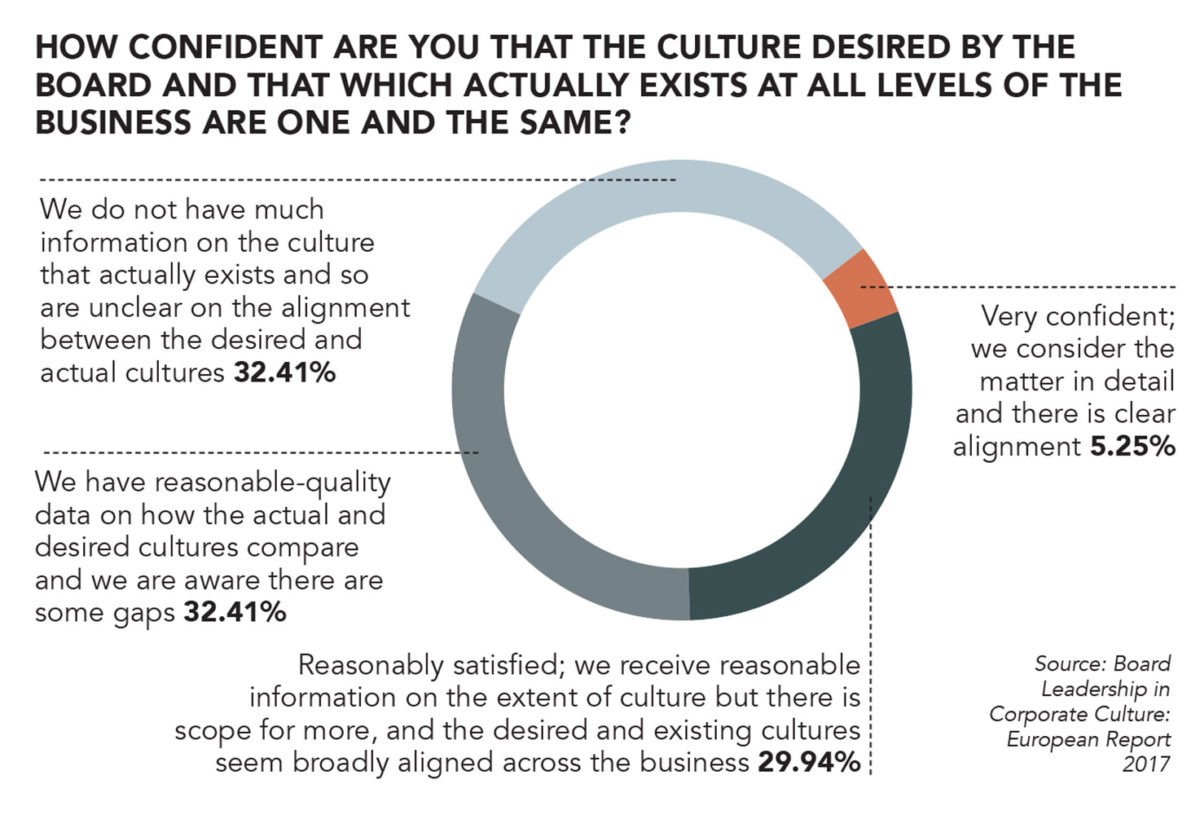
Regulators across the globe are grappling with the issue of risk culture and how best to monitor it. While regulators generally do not dictate a cultural framework, they have identified common areas that may influence an organisation’s risk culture: leadership, good governance, translating values and principles into practices, measurement and accountability, effective communication and challenge, recruitment and incentives. Ultimately, the greatest risk lies in organisations that are believed to be hypocritical when it comes to the espoused versus actual culture.

The board is ultimately responsible for the definition and oversight of culture. In the US, Mary Jo White, Chair of the Securities and Exchange Commission (SEC), recognised that a weak risk culture is the root cause of many large governancefailures, and that the board must set the ‘tone at the top’.

Culture also has an important role to play in risk management and risk appetite, and can pose significant risks that may affect an organisation’s long-term viability.

However, culture is much more about people than it is about rules. This guide argues that an ethical framework – which is different from a code of ethics or a code of conduct – should sit at the heart of the governance framework of an organisation. An ethical framework includes a clearly espoused purpose, supported by values and principles.

There is no doubt that increasing attention is being given to the ethical foundations of an organisation as a driving force of culture, and one method of achieving consistency of organisational conduct is to build an ethical framework in which employees can function effectively by achieving clarity about what the organisation deems to be a ‘good’ or a ‘right’ decision.

Culture can be measured by looking at the extent to which the ethical framework of the organisation is perceived to be or is actually embedded within day-to-day practices. Yet measurement and evaluation of culture is in its early stages, and boards and senior management need to understand whether the culture they have is the culture they want.

In organisations with strong ethical cultures, the systems and processes of the organisation will align with the ethical framework. And people will use the ethical framework in the making of day-to-day decisions – both large and small.

Setting and embedding a clear ethical framework is not just the role of the board and senior management – all areas can play a role. This publication provides high-level guidance to these different roles:

The board is responsible for setting the tone at the top. The board should set the ethical foundations of the organisation through the ethical framework. Consistently, the board needs to be assured that the ethical framework is embedded within the organisation’s systems, processes and culture.

Management is responsible for implementing and monitoring the desired culture as defined and set by the board. They are also responsible for demonstrating leadership of the culture.

Human resources (HR) is fundamental in shaping, reinforcing and changing corporate culture within an organisation. HR drives organisational change programs that ensure cultural alignment with the ethical framework of the organisation. HR provides alignment to the ethical framework through recruitment, orientation, training, performance management, remuneration and other incentives.

Internal audit assesses how culture is being managed and monitored, and can provide an independent view of the current corporate culture.

External audit provides an independent review of an entity’s financial affairs according to legislative requirements, and provides the audit committee with valuable, objective insight into aspects of the entity’s governance and internal controls including its risk management.


*Joanne Desjardins est administratrice de sociétés et consultante en gouvernance. Elle possède plus de 18 années d’expérience comme avocate et comme consultante en gouvernance, en stratégie et en gestion des ressources humaines. Elle est constamment à l’affût des derniers développements en gouvernance et publie des articles sur le sujet.

Cinq questionnements qui préoccupent les nouveaux administrateurs de sociétés | SpencerStuart


Aujourd’hui, je reviens sur un texte vraiment très important de SpencerStuart qui propose des conseils aux nouveaux administrateurs qui acceptent de siéger à des conseils d’administration, peu importe le type d’organisation.

Les conseils prodigués par les auteurs George AndersonTessa BamfordJason BaumgartenKevin A. Jurd, afin d’accélérer l’efficacité des nouveaux administrateurs peuvent se résumer essentiellement à cinq grandes préoccupations :

  1. Comment puis-je savoir si je choisis le bon CA ? Quels devoirs dois-je accomplir avant d’accepter une offre ?
  2. Comment dois-je me préparer pour ma première réunion du conseil ?
  3. Quels comportements en matière de prises de parole dois-je adopter lors de cette première rencontre ?
  4. Quelles sont les stratégies à adopter pour avoir un impact et une plus-value sur le CA et sur l’entreprise ?
  5. Si j’expérimente une grande préoccupation, comment montrer mon désaccord ou soulever une question délicate ?


À l’heure où environ le tiers des postes d’administrateurs sont occupés par de nouvelles recrues, il est crucial de bien explorer les occasions qui se présentent, car un engagement comme administrateur peut nous occuper plus de 20 jours par année, pour une période de neuf ans !

Je vous invite donc à lire attentivement ce document si vous êtes dans votre première année d’un mandat qui pourrait être assez long.

Bonne lecture !


The Five Most Common New Director Questions


Résultats de recherche d'images pour « spencer stuart »


No matter how experienced they are as leaders or how much previous boardroom exposure they have had, most first-time directors will admit to having some trepidation before their first board meeting: What will the first board meeting be like? Should I say anything at all in my first meeting? Am I prepared?

Helping these directors quickly acclimate matters because, depending on the country, first-timers can represent a sizable share of the new director population in a given year. One-third of newly appointed S&P 500 directors in the U.S., for example, are serving on their first corporate board, as are about 30 percent of new U.K. non-executive directors. Given the escalating demands on boards, new directors must be prepared to quickly contribute.

In working with first-time board directors around the world and the chairmen and lead independent directors of the boards they join, we have found that their questions and concerns about board experience typically fall into the five following areas:

  1. How do I know what’s the right board to join? Should I say yes to the first board invitation?
  2. What do I need to do to prepare for my first board?
  3. How much should I speak up during the early board meetings?
  4. How can I have an impact for the board and company?
  5. What if I have concerns? How do I disagree or raise questions when I’m new?

To explore these first-time director questions in more detail, we spoke with directors around the world who shared what they learned from their first board experience and offered observations that boards can use to enhance their new director onboarding programs.


(1) Selecting the right opportunity


Most directors would describe their first non-executive board role as a major professional milestone, a terrific growth opportunity and something they are very glad they did, even though it represented a significant commitment. Given the demands of board service — 20-30 days a year up to nine or more years — it pays to carefully weigh the pros and cons of a given opportunity. The key question, say directors, is whether it is mutually beneficial — one that the prospective director finds engaging and useful as a growth opportunity and that adds a valuable perspective to the board. As one director put it, “You need something that will bind you to the job, because it is a lot of time.” Ask yourself, “Is this a business that I will still be interested in, say, in six to nine years’ time?”

Other considerations may be who else is on the board — especially the opportunity to work with a good chair and gain exposure to experienced executives from other industries — the strength and diversity of the management team, and how well the board and management team work together, which in part reflects how much the CEO values the board’s contribution. “I asked the CEO, ‘Do you like having a board?’ And he very honestly said, ‘Mostly.’ If he’d said to me, ‘I think they’re marvelous all the time,’ I’d know he was lying because that’s just not how executives think,” recalls one director.

When considering whether you can balance board service with other commitments, particularly if you have a full-time executive role, understand that you will likely underestimate how much time it will take, especially early on. “It took much more time than I thought would be required initially to get up to speed — to understand the business, strategies, key issues and opportunities,” one director told us. If you have to travel to meetings, plan on that adding a day or two to the board meeting commitment. You also should allow time for work related to committee assignments and, depending on your expertise, you may be tapped to mentor someone on the executive team, work on issues outside of board meetings or respond to unexpected demands related to a crisis or deal. “It can be hard to budget for that, and it can happen at the worst time. But you can’t shake off your responsibilities at the time when you’re needed most, when there’s an activist or stakeholder issue, a significant transition or a succession planning issue that you have to work through.”

Conversely, don’t immediately take yourself out of the running for a very valuable opportunity. “If I thought too much about the time commitment, there is a chance I would have turned it down, which would have been a terrible thing,” one director told us. Equally do your research; it’s amazing the sorts of businesses that initially might seem not right for you but on further research are really interesting and worth pursuing.


(2) Preparing for the first board meeting


As part of your due diligence, you will already have read published information about the company, and it goes without saying that new directors will have received a wealth of material as part of the onboarding process and in advance of the first meeting. What many don’t appreciate before they’ve done it is just how much pre-reading material there can be, and the amount of time it can take to thoroughly digest it.

Many first-time directors have presented to their own company’s board of directors, but these encounters provide just a narrow glimpse of the board’s responsibilities. For this reason, some first-time directors find it helpful to attend a formal director education program providing a deep dive into corporate governance, including the board’s fiduciary responsibilities and areas such as NED liability, reporting to shareholders and reporting on sustainability. “They expect you to have an understanding of governance when you come in. They’re happy to answer questions, but they’re not going to know what you don’t know. If you don’t even know what you don’t know, then you don’t know to ask,” said one director.

Most formal onboarding programs encourage new directors to meet with key members of management, and many will schedule site visits to key operations. “It was really helpful to spend quality time with each of the CEO’s main direct reports so that I could get a sense of their top priorities and how they think about running their businesses. Without that little additional context from some of these executives in the organization, you’re really operating in a bubble.”

One-on-one meetings with as many of other directors as possible before the first board meeting can provide a sense of the priorities of the board, and the dynamics among directors and between management and the board. When these meetings are not an explicit part of the onboarding process, it can feel awkward to reach out to other board members, but directors say arranging a breakfast or dinner meeting or even a coffee with other directors, starting with committee chairs, is well worth it. “Everybody is busy, but the time you take to meet people upfront definitely pays dividends in the long run because you get context you wouldn’t have gotten any other way. You can’t replace seeing someone’s facial expression or their gestures while they’re talking about a certain topic. You’ll see how much something worries them. How emphatic they’re being. You’ll see their brow wrinkle when you dig deeper into certain issues.”

What else did new directors find most helpful in preparing for their first board meetings?

The key performance indicators (KPIs) and lead indicators for the company. “What do I have to keep my eye on? Every other question ends up stemming from those KPIs.”

A glossary of company and industry-specific jargon and acronyms. “Many companies overlook this, but it’s a real impediment to being productive in your first couple of meetings.”

Meeting with as many members of the executive committee or senior management team as possible.

Understand how the board views sector and company risk. How does management assess, present and articulate risk? Are assumptions discussed and challenged clearly and freely?

A detailed overview of the operations, operational challenges and underlying infrastructure. “You can think you know how an airline runs, but when you walk through the operation center and see hundreds of people managing thousands of flights in the air at the same time around the world, you begin to understand the complexity of the business.”

A holistic view of the board calendar and activities — not just what the next board meeting is about, but the key processes of the board over the course of 12 months of board meetings. “When you’re new, you might wonder why the board isn’t talking about the compensation implication of a decision, as an example, but everyone else knows that’s because the next meeting is the one when the board does the comp review.”

A detailed explanation of how the finances are organized, including a complete listing of accounts in an accounting system. “Everybody’s chart of accounts is different. Depending on how it’s drawn, you can get a very different look at P&L.”


Spotlight: Director induction best practices


Most boards have a formal induction program, which typically includes the following:

Presentations from management on the business model, profitability and performance

A review of the previous 12 months’ board papers and minutes to provide context on the current issues

Meetings with key business executives and functional leaders, including finance, marketing, IT, HR, etc.

Site visits providing new directors a better sense of how the business works and an opportunity to meet people on the ground

Meetings with external advisers such as accountants, bankers, brokers and others

Explanation of regulatory and governance issues

Attendance at an investor day

Mentoring: First-time directors, especially, tell us they appreciate having a mentor during the first six to 12 months on the board. An informal mentor program pairs a new director with a more experienced director who can provide perspective on boardroom activities and dynamics or help with meeting preparation, explain aspects of board papers, and debrief and act as a sounding board between meetings.

What new directors can do: Don’t be afraid to ask for the process to be tailored to your needs if you want to explore certain areas of the business in greater depth.

(3) Participating in early meetings


First-time directors tend to assume that they should say little during their first few meetings, while they observe and get to know the board and its dynamics. The directors we spoke with recommend a more balanced approach: listen more than talk, but be willing to participate in the discussion, especially in your area of expertise. “You’re there for a reason. You’re there because they thought you could add value.” New directors appreciate getting feedback from the board chair or lead director about their contribution level — so, if it’s not given, directors should ask for it. “After the first meeting, the lead director said, ‘I’m glad you spoke up a couple times. Do that more. We brought you here to get your point of view so feel free to speak up.’ It was great to hear that. You never want to hear it the other way, where you spoke up too much or took up too much air time.”

Nothing is more valuable for getting a sense of the board dynamics and directors’ expectations for how you should behave in those early meetings than one-on-one discussions with individual board members. “I wanted to get to know them a little bit personally before meetings where more-involved or controversial topics would be discussed so that we at least have met and have a little bit of an understanding of one another.”

New directors also appreciate when the board chair or lead independent director is proactive in making sure that the multiple voices are heard in board discussions. “Even when the board composition is diverse along many dimensions, your work isn’t done. You still have to actively work to avoid conforming your behaviors and opinions and to hear diverse viewpoints. That’s a constant work in progress.”


(4) Having an impact


“How do I have impact?” It’s a question that is top of mind for most new directors, especially those who were brought on the board because of their expertise in areas such as digital technology, product development, risk management or go-to-market experience. Depending on the size of the company and experience of the management team, a new director’s involvement outside the boardroom could include interviewing candidates for key roles, mentoring senior leaders, advising on specific topics or making useful introductions. “Engagement has to be on the terms that work for the executive team,” advised one of the directors we interviewed.

New directors with specialized expertise also play a role in educating other directors. “You don’t want a situation where the rest of the board sits back while all the questions flow to one person. Over time, all directors want to learn how to ask challenging questions in these areas. I find that other directors ask me questions like: ‘Why did you ask that? Why did you put the question in this way? What were you looking for? There seems to be something in the response to that question that troubles you, so let’s peel that apart a little bit.’”

First-time directors can find it challenging to know if they are having a positive impact on the board — and that the board is positively contributing to the business — because of the lack of regular feedback. “I would like a little more focus on making performance feedback a continuous process, particularly for the first six to 12 months. Following every meeting, there should be opportunities to point to out what’s working well and what could work differently, even if it’s just a 10- or 15-minute conversation to reinforce and correct the issues that didn’t go well in context.” So it is important to ask the chairman for feedback.


(5) Raising questions


By definition, a new director lacks perspective on the board’s history — the sacred cows, the topics that have been debated ad nauseam already and other important context. This makes knowing when to raise questions or to push for more information all the more difficult. “Fresh eyes are good, but one of the worst things you can do is walk into the board and hone in on topics that aren’t going to be productive, that the board has already hashed to death.” That is why it is important to have read the board minutes, if not papers, for the previous year or so, so you can understand some of the key issues and debates.

Getting a read from other directors about the board’s priorities can provide important context, as can using meeting breaks to follow up on your questions. “You’re not going to know everything going in. Expect that you’ve got a lot of holes. When I have big questions, I’ll grab a board member who I know will have the context and say, ‘Hey, I noticed this,’ or ‘I had a question on this,’ or ‘I’m sure there’s context here that I don’t know about,’ and just let them talk.”

When a director does have questions or concerns that go deeper, the delivery is important. “Asking questions, even when you know what the answer is, rather than making declarative statements is a good general approach. Other directors will be receptive to your questions if you communicate that you’re trying to get to the heart of important issues and facilitate discussion that needs to happen to gain consensus on direction.” How you frame questions also is important: Ask, “How are you thinking about …?” rather than trying to be too prescriptive and asking, “Have you considered …?”


Conclusion


Most new directors truly value their first board assignment, despite the time demands and steep learning curve. First-time directors are most likely to enjoy the experience when they conduct careful research and due diligence before accepting a board invitation, prepare thoroughly for board meetings and have the confidence to be themselves in the boardroom.

______________________________________________________________

Participating Directors :

Stewart Butel, former managing director of Wesfarmers Resources and independent director for DUET Company Limited
Amy L. Chang, CEO and founder of Accompany and non-executive director of Cisco, The Procter & Gamble Company and Splunk
Sue Clark, managing director of SABMiller Europe and non-executive director of Britvic
Greg Couttas, former Deloitte audit partner and non-executive director of Virtus Health
Tom Killalea, former Amazon vice president and independent director of Capital One, Carbon Black and MongoDB
George Mattson, former managing director of the Global Industrials Group for Goldman Sachs and independent director of Delta Air Lines
Admiral (Ret.) Gary Roughead, former chief of Naval Operations and independent director of Northrop Grumman Corporation
Michelle Somerville, former KPMG audit partner and independent director of The GPT Group and Challenger
Sybella Stanley, director of corporate finance at RELX and non-executive director at Tate & Lyle and Merchants Trust
Jane Thompson, former senior vice president of Match.com and independent director of Michael Kors
Gene Tilbrook, chair of The GPT Group Nomination and Remuneration Committee
Trae Vassallo, co-founder and managing director of Defy Partners and non-executive director of Telstra Corporation

Les pratiques émergentes à long terme


Voici un article que je ne peux passer sous silence tellement le travail de recherche de Brian Tomlinson* est exemplaire eu égard à l’exploration des pratiques émergentes à long terme.

Je vous invite à prendre connaissance des points soulevés dans cet article paru sur le site de Harvard Law School on Corporate Governance.

Bonne lecture !


Emerging Practice in Long-Term Plans


Résultats de recherche d'images pour « long terme »


Executive Summary

The information asymmetry between corporations and investors is particularly severe regarding long-term strategic plans: existing market infrastructure for disclosure is very short-term focused and underserves sources of long-term value creation. The CEO-delivered long-term plan gives corporations an opportunity to reorient disclosures to the long-term. The Strategic Investor Initiative provides comprehensive guidance to CEOs and their Investor Relations teams on the key components of a long-term plan—set out in our Investor Letter to CEOs.

Through feedback from institutional investors we have identified content elements essential to an effective investor-facing CEO-delivered long-term plan:

  1. Additive to existing disclosures: Add information to the public domain or provide additional context for existing disclosures.
  2. More than marketing—contextualized disclosures: A strategic plan narrative is not a recitation of good news stories. Initiatives should be contextualized to help investors assess their significance.
  3. Focused by materiality: A long-term plan should disclose information that is material to the operating performance and financial prospects of the business.
  4. Integrated discussion of material Environmental, Social, and Governance (ESG) issues: Part of an integrated discussion—not a silo or presented as a list of “awards.”
  5. Forward looking information: A long-term plan is an opportunity for a company to meaningfully talk about the future across a broad range of value-relevant topics, accompanied by goals, metrics and milestones.

Emerging Practice in Long-Term Plans—By Key Theme

In this paper we set out key themes that CEOs have addressed in their long-term plan presentations delivered at CEO Investor Forums convened by the Strategic Investor Initiative. We identify why each theme is an enduring subject of investor interest (and identified in our Investor Letter to CEOs) and provide examples from CEO presentations of content that was well-received by institutional investors. We also provide suggestions of key additions that CEOs can make to enhance the utility of disclosures on these key themes:

  1. Risk factors and mega-trends: Highlights presentations by Delphi and PG&E
  2. Corporate governance: Highlights presentations by Medtronic and Merck
  3. Capital allocation: Highlights the presentation by Becton Dickinson
  4. Human capital management: Highlights the presentation by Aetna
  5. Shareholder and stakeholder engagement: Highlights the presentations by Merck, Telia, and Prudential

We are delighted to feature Insights from FCLTGlobal in the corporate governance theme.

Introduction: The Long-Term Imperative

A gap exists between a corporation’s knowledge of its practices and prospects and the knowledge of its investors. Periodic disclosures are intended to reduce the level of this information asymmetry. This structural information gap between corporations and investors appears particularly severe regarding forward-looking information about a corporation’s long-term strategic plans—an issue long-term institutional investors are increasingly vocal about wanting companies to address.

Corporations endure, and often plan, over decades through long-term-focused management and strategic planning processes. Although a strategic plan can address periods of 3, 5, or 15 years, corporations tend to communicate in quarters (through the 10-Q and earnings call).

Some corporations do, of course, communicate with investors through a variety of other forums (in addition to the earnings call), including investor days, industry conferences, and, increasingly, common year-round bilateral engagements, in addition to mandatory disclosures such as the 10-K and voluntary disclosures, such as sustainability reports. However, the landscape of corporate communications with shareholders does not include a disclosure venue focused on long-term sustainable value creation. The existing market infrastructure for disclosure remains very short-term focused and the mix of information provided underserves sources of long-term value creation—to the continuing of frustration of long-term institutional investors.

Through our convening of CEO Investor Forums, we provide a venue for a curated conversation between leading CEOs and long-term investors to help plug an unmet need for information with a long-term time horizon and reorient capital markets toward the long term. To date, over 25 companies (representing over $2 trillion in market cap) have presented long-term plans at a CEO-Investor Forum to an investor audience representing in excess of $25 trillion in AUM.

In this paper, we set out examples of emerging practices in CEO-presented long-term plans, identify core investor content expectations, and highlight how CEOs are seeking to tackle key themes for improved corporate disclosure. We hope both investors and corporations find it useful.

Six Reasons Companies Should Share Their Long-Term Thinking

  1. To demonstrate that there is an effective long-term strategy
  2. To show that the company can anticipate and capitalize on mega-trends
  3. To help investors understand ESG issues “through the eyes of management”
  4. To encourage the C-Suite to reflect on the corporate ecosystem, including a consideration of its stakeholders
  5. To help inspire—and retain—both employees and investors over the long-term
  6. To foster leadership in corporate-shareholder communications

Adapted from “Far Beyond the Quarterly Call: CECP’s first CEO Investor Forum” published in the Journal of Applied Corporate Finance

SII’s Investor Letter to CEOs

In the Strategic Investor Initiative’s Investor Letter to CEOs, signed by Bill McNabb and nine leading institutional investors, we ask CEOs to present their long-term plans for sustainable value creation at our CEO Investor Forums.

The letter asks CEOs to: set out a long-term plan with a five-year trajectory accompanied by goals, metrics and milestones; offer commentary on the role of the board in formulating and monitoring strategy; discuss financially material risks and the firm’s framework for identifying material ESG risks; and review the company’s capital allocation strategy.

The Themes of the Seven Questions Every CEO Should Be Able to Answer

How Do These Themes Connect to Long-Term Strategy:

  1. Risk factors and mega-trends
  2. Corporate purpose and role in society
  3. Frameworks for shareholder engagement
  4. Financially material business issues and frameworks for identifying those issues
  5. Human capital management
  6. Board composition
  7. Role of the board

Investor Feedback: Helping CEOS Meet Investors’ Content Expectations

CEO-delivered long-term plans can help plug a gap in existing market infrastructure and help meet the information needs of long-term investors. To date, we’ve received feedback, both in person and online, from hundreds of institutional investors on the long-term plans presented at CEO Investor Forums. We asked these investors to identify in each CEO presentation the themes that were most useful and the themes that were least useful for informing their investment outlook, voting, and engagement activities.

Building on this investor feedback, we have identified content elements essential to an effective investor-facing long-term plan—in addition to the expectations set out in our Investor Letter to CEOs:

Additive to existing disclosures: A long-term plan should add information to the public domain or provide additional contextualizing commentary to such existing disclosures (e.g., build on disclosures made at the investor day or in other disclosure forums).

More than marketing—Contextualized disclosures: a strategic plan narrative is not a recitation of good news stories. A long-term plan presentation is an opportunity to delineate key risks and challenges facing the business and to help investors see those issues “through the eyes of management,” given management’s “unique perspective on its business that only it can present.” Highlighting key initiatives within the business is useful for expanding investor understanding. However, to avoid being dismissed as marketing, such initiatives should be contextualized to help investors assess their significance within the business.

Focused by materiality—A long-term plan should disclose information that is material to the operating performance and financial prospects of the business over the long term. Material business issues tend to vary systematically by sector, giving management an opportunity to provide a focused presentation on issues of enduring investor interest and relevance for that sector. The disclosure framework provided by the Sustainability Accounting Standards Board (SASB) gives corporations a method to identify and organize such disclosures in a way relevant to investors.

Integrated discussion of material ESG issues—These issues are widely acknowledged as core to business success over the long term. As a result, ESG issues should be part of an integrated discussion—not be placed in a silo or presented as list of “awards.”

Forward looking information—Corporate disclosure abounds with backward-looking information. A long-term plan is an opportunity for a company to meaningfully talk about the future across a broad range of value-relevant topics, accompanied by goals, metrics, and milestones.

Least Useful CEO Disclosures

  1. Disclosures unconnected to long-term strategy
  2. Sustainability presented as a silo or eye-catching initiatives without adequate context
  3. Extended commentary on the history of the corporation
  4. Discussions of “corporate purpose” unconnected to operations and strategy
  5. Extended discussion of issues immaterial to the industry or sector

Emerging Practice in Long-Term Plans: Early Evidence From a Year of CEO Investor Forums

The long-term plan is an experimental form. CEOs who have presented their corporations’ plans to date have been guided by our Investor Letter to CEOs—but they do have broad flexibility to set out their corporations’ authentic long-term narratives.

Set out below are key themes addressed in long-term plans presented at our CEO Investor Forums and examples of how companies have tackled those themes. In each case, we identify the broad market need for such information and why it is relevant to long-term-focused investors.

Risk Factors and Mega-Trends

Leading executives spend much of their time addressing long-term business issues and strategy with their teams—and increasingly with their boards. Such thinking requires a consideration of the mega-trends impacting the operating model, product markets, and geographies in which their company operates. Capitalizing on these long-range trends is a key informing context for the development of a corporation’s strategic plan and the capital allocation decisions that will enable the plan to be implemented.

To date, existing disclosures have not proved effective in enabling corporations to talk about these long-term, forward-looking trends with their investors—and, when disclosures are made on these topics, they tend to be of low utility to investors.

For example, the MD&A section of the 10-K 9 requires disclosures regarding “known trends and uncertainties.” In considering disclosure, the corporation is asked to assess the likelihood of the trend occurring and, if it is reasonably likely to occur, seek to quantify the potential impact of that trend. This gives a corporation an opportunity to reflect on long-range trends—information highly valuable to investors. The wide discretion provided by the two-part materiality determination significantly reduces the extent of such disclosures, which also tend to be static—with only a small percentage of firms making significant changes to MD&A language over time. Risk factor disclosures are also a requirement in the 10-K. Specific risk factor disclosures are decision-relevant to investors.

However, disclosures of risk factors often lack corporation-specific elements, tend toward generic or vague language—best characterized as boilerplate—drafted more as a litigation shield than as a medium through which to inform investors.

As a result, existing disclosures inadequately capture the elements and outcomes of the strategic planning process and often fail to address long-range trends (whether market, environmental or societal) in a manner useful to investors.

Mega-trends Identified at CEO Investor Forums: Investor Letter Question:
  1. The transition to a low-carbon economy (PG&E)
  2. Disruption and democratization of product markets (UPS)
  3. Aging societies (BD)
  4. Unsustainable health care systems (Aetna, Medtronic)
  5. Technology amplifying corporate risk from cybersecurity to reputation (Delphi)


Mega-trends“What are the key risk factors and mega-trends (such as climate change) your business faces over the next three to seven years and how have these influenced corporate strategy?”

Mega-trends represent a formidable set of financial, operational, governance, and policy challenges; these cross-cutting issues vary in intensity by sector.

Kevin Clark of Delphi highlighted how the major disruptions of the Fourth Industrial Revolution, such as AI and drive-train electrification, are changing the nature of the automobile—and, consequently, the nature of the automobile technology business. Clark identified the mega-trends of “Safe, Green, and Connected” that are broadly impacting the automotive sector and sought to identify how trends were having impacts on long-term strategy across the business. One element identified was the extent to which new technology required significant adjustments in workplace skills and recruitment patterns. Delphi had responded to these new requirements through collaborations in “talent rich” recruitment markets among other initiatives.

Anthony Earley and Geisha Williams of PG&E structured their presentations in the context of the transition to a low-carbon economy in both energy generation and transport and highlighted how that trend was driven by regulation, the urgency of climate change, and consumer demand. That overview was contextualized by commentary on PG&E’s science-based emission reduction targets and proportion of renewable energy in its overall energy generation mix. Both presentations set out comparisons of carbon intensity with peer utilities and identified the trajectory of future energy generation and use.

Examples of Key Issues for Discussion in “Mega-Trends and Key Risks”

Climate Change and Task Force on Climate-related Financial Disclosures (TCFD): In those sectors with large exposures to issues involved in climate change, investors expect a structured discussion on the implications of climate change.

The TCFD provides a four-part framework through which corporations can address climate change:

  1. Governance
  2. Strategy
  3. Risk management
  4. Metrics and targets

Commentary, structured around the operating model of the business, enables investors to assess whether climate change adaptation is being implemented at an adequate scale and the extent of exposures to related risks, such as regulatory change.

The extent of scenario analysis conducted and the assumptions underlying it gives investors critical visibility into a corporation’s preparedness for climate change under various scenarios. Given the board-centric view of many long-term investors, commentary around the governance arrangements for assessing and responding to climate risk is particularly well received.

Corporate Governance: Long-Term Strategy, Compensation, and Composition

Long-term investors are deeply interested in effective governance and high-quality boards. Shareholders have some agency here as the boards of directors of listed companies are appointed by shareholders. This focus on the board is also a product of the board’s key responsibility as overseer of long-term strategy, although recent work suggests that many public boards neglect this key strategic role and are mired in issues of compliance.

Expectations of the competence and workload of corporate boards have expanded significantly as institutional investors have taken increasingly clear positions on key corporate governance issues such as risk and strategy oversight, entrenchment, pay, tenure, refreshment, and diversity. Investors have also set out broad elements they expect to see in effective corporate governance practices, providing companies with key signals to reflect in their governance arrangements. This more assertive stance is partly driven by a concern that boards have been too passive, unwilling to interrogate the strategy of assertive management teams. Boards have also been identified as a source of short-term performance pressures.

At the CEO Investor Forums, long-term plans are presented by CEOs. Therefore, we ask the CEO to provide commentary on the role of the board (included in our Investor Letter to CEOs). A CEO’s stated understanding of the role expected of the board and its functioning will give investors valuable insights into how effectively a corporation is governed and the extent to which the board is meaningfully involved in strategy formation, oversight and challenge. In a CEO’s discussion of the long-term plan, what is useful is setting out a commentary on the way the board signals for management to take the long-term view—but employ language that isn’t a boilerplate description of formal corporate governance arrangements.

Investor Letter Question: Board’s Involvement in Strategy

How will the composition of your board (today and in the future) help guide the corporation to its long-term strategic goals?

What is the role of the board in setting corporate strategy, setting incentives for and overseeing management?

We note that a useful discussion of the role of the board in corporate strategy, incentives, and oversight could take many forms and that an effective board may have a variety of characteristics beyond a box-tick of observable formal elements.

Omar Ishrak provided an overview of Medtronic’s corporate governance practices. He described a board deeply immersed in the strategy of the business at the business unit level in addition to the overall strategy for the firm (at country-specific and global levels). He indicated that an effort had been made to limit the time spent on compliance issues at the full board level to enable discussion of strategy by business unit and region (which consumed 4-6 hours of every board meeting). Ishrak indicated that these were real, iterative discussions with business unit heads. This is vital commentary as one of the most valuable activities for a board is to debate within itself and with the CEO and senior management the appropriateness and effectiveness of strategy; increasing the likelihood that the board does not take a reflexively subordinate role to CEO and senior management but rather adopts a stance of “constructive support and engaged challenge.”

Ishrak talked about the value of diversity within Medtronic’s board and throughout the organization. This complemented similar discussions in the presentations by Ken Frazier (CEO and Chairman of Merck) and Alex Gorsky (CEO and Chairman of Johnson & Johnson) about the need for corporations operating in health care, pharmaceuticals and medical devices to maintain a significant proportion of the board dedicated to professionals with a science background.

Going Further with the Board

Is the board enabled to be effective on long-term strategy:

Investors want to know that boards are performing well and are engaged in meaningful discussions on long-term strategy and related risks. A CEO can spend valuable time explaining the governance structures and procedures the company uses to ensure meaningful strategy discussions:

  1. Is the full board and relevant board committees structured to facilitate strategy discussion? Is time carved out for strategy discussion?
  2. Does the board test the assumptions underlying strategy and with what frequency?
  3. How does the board monitor strategy implementation? Does it seek external views in testing strategy?
  4. How is the board’s composition, now and in the future, related to long-term strategy?

Insights From FCLTGlobal

FCLTGlobal, a member-supported not-for-profit organization dedicated to developing practical tools that encourage long-term business and investment behaviors, recently published, “Long-term Boards in a Short-term World,” outlining a set of potential tools to aid boards considering taking a longer-term approach.

Directors, as shareholders’ representatives and leaders of the company, typically with average tenures that exceed management, are uniquely positioned to keep a company focused on the distant horizon, setting an appropriate long-term tone for both corporate management and shareholders.

One of the hallmarks of a successful long-term board is direct engagement with long-term shareholders. Companies that have developed board-level relationships with their key shareholders, hearing from them regularly on not just governance topics but also matters related to strategy and investment, benefit from investors’ perspective—lending invaluable insight that serves as a counterpoint to the often short-term views presented by media, the sell-side, and transient or activist investors.

Practical solutions to enable board-level dialogue with shareholders include:

  1. Appointing a lead independent director or directors as shareholder relationship manager(s),
  2. Encouraging director attendance and availability for shareholder meetings and at events like investor days, and
  3. Having a published statement which spells out the Board’s belief of its duty to long-term shareholders.

Capital Allocation

Capital allocation is the fuel that enables strategy implementation—making the investments the strategic plan identifies as key to long-term performance. Corporations strive to maintain enduring capital allocation frameworks. However, these must be adaptable to allow the corporation to make critical long-term investments and capitalize on the competitive landscape, market, and mega-trends it faces.

A long-term plan is an opportunity to highlight those long-term investments that will take time to pay off and perhaps how those investments distinguish the corporation from its industry peers. Investors should be given a working understanding of those investments and be able to track progress against the strategy over time. In Q&A, investors have sought commentary on how CEOs think about capital allocation in the context of the current concerns regarding the extent, timing, and impact of share buy-backs.

Investor Letter Context: Capital Allocation

A corporation should communicate its view of key financially material risks, including long-range mega-trends and the relevant frameworks used to identify ESG factors. The majority of this discussion should focus on the strategy and resources allocated to address future risks.

Investors expect a CEO to outline the corporation’s framework for allocating capital and how that framework enables strategy implementation. CEOs at our Forums have presented such frameworks supplemented by long-range capital distribution goals such as maintaining the historic dividend trajectory.

Vince Forlenza of Becton Dickinson (BD) described how capital allocation and business-relevant stakeholder investments were the keys to the long-term success of his business. Forlenza provided a detailed discussion of the capital allocation framework, with specific dollar allocations to each segment. That set up the discussion of strategy, beginning with BD’s 2020 Sustainability Strategy and Goals—with sustainability discussed as a whole-firm concept. Taking a similar approach, Kevin Clark of Delphi embedded the discussion of capital allocation in the context of the “Safe, Green, and Connected” mega-trends identified earlier. This commentary was well received as it placed the capital allocation framework in the context of core strategy.

Building on These Presentations—The Pozen Framework

Enhancing the discussion of capital allocation through Senior Lecturer, MIT Sloan School of Management Robert Pozen’s capital allocation template:

For the next 3 to 5 years a corporation should outline the target percentage of its annual free cash flow allocated to the following:

Return to shareholders in the form of dividends (and share repurchases); and

Reinvest in the corporation for growth:

How much will be allocated to external growth via acquisitions (or how much will be funded by divestitures), even if this is a qualitative indication?

How much will be allocated to internal growth: i. R&D and innovation? ii. Major capital expenditures? iii. Human capital development? iv. Investments in other capitals or significant stakeholder groups as long-term system-health investments, investments in brand and reputation and in risk mitigation?

Human Capital Management

Human capital management is a key source of resilient business performance. As intangibles have become the dominant location of business value, how a business recruits, retains and incentivizes its people has become a value-relevant issue of investor interest.

Human capital management is an extremely broad topic for a CEO to address concisely in a long-term plan as it could include: high-level commentary on establishing and maintaining a strong organizational culture to support the firm’s mission and vision; Occupational Health and Safety compliance; or managing performance on key metrics such as training and development spend, employee turnover and employee engagement survey results. The picture is complicated further by effective human capital management tending not to rely on a single management technique or metric but rather a bundle of supportive practices that work together to drive value.

Corporations collect a wealth of human capital metrics for internal management purposes, much of which are not disclosed; regulatory requirements to disclose human capital are very limited.

Investors seek expanded disclosures on human capital. The Human Capital Management Coalition recently submitted a rule-making petition to the SEC to request that the Commission’s required disclosures be extended to include decision-useful information on human capital “policies, practices, and performance”. Investors such as BlackRock and Vanguard have identified human capital as a priority issue in their engagement strategies with investee companies. Index providers, including Thomson Reuters, have developed products (the Diversity & Inclusion Index is one) that acknowledge both the demand for good human capital practices and their value-relevance.

Given the complexity of the issue, a CEO must give priority to telling the corporation’s authentic human capital management story: how is the corporation investing in human capital? how does that relate to long-term strategy? what does the firm expect those investments to achieve in terms of improved performance?

Human Capital—Financially Material—The Evidence: Investor Letter Question:
  1. Companies identified as best to work for, outperform
  2. High-quality human capital management delivers enhanced returns
  3. Employee engagement correlated with performance
  4. Human capital analytics enable better performance
Human Capital“How do you manage your future human capital requirements over the long term and how do you communicate your future human capital management plans to your investors?”

A valuable example was provided by Mark Bertolini of Aetna; he spoke about human capital in the context of developing a culture of health for employees, in addition to addressing pay equity, as keys to long-term business performance.

Bertolini identified how employee engagement surveys were uncovering a pattern of employees talking about the difficulties of their working lives. These lower-income employees tended to be on food stamps and Medicaid. Bertolini explained his decision to raise wages and reduce the health care costs of these workers. He then identified key costs and outcomes: $27 million cost in year one, 5,700 workers affected, on average 22% increase in disposable income. This initiative was combined with programs on mindfulness, tuition assistance, and life style practices associated with productivity (e.g., paying employees to get 8 hours of sleep a night). Bertolini indicated that these measures were associated with significant increases in employee engagement scores—but he emphasized that it was vital for management to “get beyond the spreadsheet” to understand the benefits (hard and soft) of such investments in human capital over the long term. This commentary provides investors with an understanding of management’s view of the business and some of its thinking about its people and how that relates to the operating performance and financial prospects of the business.

Meeting Investor Needs on Human Capital

Human capital is a material issue across industries, though the relevance of human capital-related factors can vary by sector. Investors have identified a variety of measures by which corporations can enhance their disclosure of human capital issues.

Nine broad categories of information were deemed fundamental to human capital analysis as a starting point to ongoing dialogue with investors:

Workforce demographics Workforce stability Workforce composition
Workforce skills and capabilities Workforce culture and empowerment Workforce health and safety
Workforce productivity Human rights Workforce compensation and incentives

Shareholder and Stakeholder Engagement

Shareholder expectations of the volume and quality of engagement with investee companies have expanded significantly. The Commonsense Corporate Governance Principles regard effective corporate governance as requiring constructive engagement between a company and its shareholders. This is reflected in companies taking more time to prepare directors for on-going engagements and relationship building with investors and devoting significant time and resources to such engagements. Investors use these year-round engagements to inform their investing outlook, voting, and future engagement activities—and expect companies to be responsive, to some extent, to these engagements.

Shareholders expect investee companies to develop a rigorous process and framework for managing shareholder engagement and responding to the themes on which meaningful investor engagement takes place. Corporations can take several approaches. However, it is key that they enable their shareholders to understand the approach and structure of investor engagement efforts—this allows investors to respond and coordinate their activities accordingly.

A long-term plan also gives a CEO an opportunity to reflect on the company’s relationship with its broader community of stakeholders. As a long-term plan is an investor-facing presentation, it is useful for a CEO to highlight the framework through which the corporation identifies which stakeholder interests are critical to the long-term success of the company and how the corporation seeks to manage those stakeholder relationships.

Investor Letter Question: Shareholder and Stakeholder Engagement

What is the corporation’s framework/strategies for interacting with its shareholders and key stakeholders?

Prudential’s presentation by Marc Grier, Chairman of the Board, outlined a set of leading corporate governance practices that it has adopted, including designating its Lead Independent Director as the primary point of engagement with shareholders. Prudential had also sought to describe its approach to shareholder engagement, quantify such engagement, and account for its outcomes in expanded proxy statement disclosures (identified as an example of best practice by the Council of Institutional Investors).

Corporations have taken different approaches to identifying key stakeholder interests and describing the business, strategy and governance implications of that effort. Merck’s CEO Ken Frazier described a stakeholder matrix in which more than 40 stakeholder issues were analyzed in the context of long-term business performance. Frazier identified how that matrix helped inform board-level strategy considerations—and had proved useful in guiding the long-term direction of the company.

Telia CEO Johan Dennelind explained how its board of directors had adopted a statement of significant audiences and materiality. Through this kind of statement, a board acknowledges a specific set of stakeholders (broader than shareholders) relevant to its future success and key material issues for its business. The statement is a new tool on the corporate reporting landscape. In addition to the benefits it offers a board in thinking through key issues and stakeholders, such a statement may help CEOs provide investors with an overview of how the corporation thinks about and manages material stakeholder interests.

__________________________________________________________

*Brian Tomlinson is Research Director of the Strategic Investor Initiative at CECP. This post is based on a CECP memorandum by Mr. Tomlinson. Related research from the Program on Corporate Governance includes Socially Responsible Firms by Alan Ferrell, Hao Liang, and Luc Renneboog (discussed on the Forum here) and Social Responsibility Resolutions by Scott Hirst (discussed on the Forum here).

Quelles sont les tendances eu égard à l’évaluation des conseils d’administration à l’échelle internationale ?


Voici un article très intéressant sur les tendances en évaluation des CA à l’échelle internationale.

Les auteurs, Mark Fenwick* et Erik P. M. Vermeulen, ont étudié l’état de la situation de l’évaluation des conseils dans 20 juridictions différentes qu’ils ont classifiées en 5 groupes, allant d’absence de législation, à des réglementations détaillées et explicites.

Dans l’ensemble, l’étude montre que les juridictions qui sont explicites eu égard aux meilleures pratiques en matière d’évaluation des conseils sont plus susceptibles d’adopter des processus d’évaluation efficaces. La législation et la réglementation ont un grand pouvoir d’influence sur les pratiques exemplaires.

Les auteurs retiennent un certain nombre de constats sur les meilleures pratiques en évaluation des CA :


(1) Although there is “no one-size-fits-all” solution, and the design of the evaluation should be tailored to meet the needs of the individual company and the particular circumstances of that company, board evaluation needs to be a continuous and on-going process rather than a periodic event.

(2) Evaluation should include not only compliance and risk-management competencies, but also skills and experience in business-related and organization-related areas, such as strategy, innovation, marketing, globalization, and growth.

(3) Regulator-issued “best practice” principles and guidelines should provide enough detail to offer genuine help to companies in implementing and evaluation processes, but also leave enough flexibility for companies to tailor the process to their specific needs. Additional guidelines need to provide more information about the criteria, methods, and form of the evaluation process (without compelling companies to make use of them).

(4) The board member or committee responsible for driving the evaluation process should actively involve external experts if, and when, necessary. In addition, “Legal Tech”, specifically board evaluation software and application, can help facilitate the assessment process.

(5) Boards should engage in a more open and detailed form of communication and disclosure about the evaluation process and its outcomes.


Bonne lecture !


Board Evaluation: International Practice


Résultats de recherche d'images pour « Board Evaluation: International Practice »
Corporate Governance Practice Framework


Although there is a broad consensus that we need “better corporate governance,” there is often less agreement as to what this actually means or how we might achieve it. Such uncertainties are hardly surprising. Contemporary corporate governance frameworks were significantly re-worked in the 2000s in response to a series of high-profile scandals. But these reforms appear to have had little effect on the performance of listed companies during the 2008 Financial Crisis. Moreover, the number, scale, and damage of corporate scandals and economic failures do not appear to be diminishing.

One possible reason for the poor performance of corporate governance measures has been an over-emphasis on the regulatory design of “checks-and-balances” in listed companies, rather than on the equally important question of how governance structures can add value to a firm. Our new paper, Evaluating the Board of Directors: International Practice, explores this latter issue, with particular reference to the role of boards and board evaluation.

In the conventional “checks and balances” model of corporate governance, authority and empowerment flow “downwards” from the shareholders (the legal and moral owners of a company) through the board of directors/supervisory board to the management and, eventually, employees. Corporate governance mechanisms are intended to curtail agency problems, notably those that arise between (potentially) self-interested management and investor-owners.

Since management is responsible to the board of directors or supervisory board that, in turn, owes a responsibility to the shareholders or owners of the firm, board members have also been heavily affected by the regulations that have been implemented over the last two decades. In particular, policymakers have emphasized the monitoring and oversight role of “independent” or “outside” directors as crucial in protecting shareholder interests and preventing self-interested transactions. In countries with controlling shareholders, which is common in Europe and Asia, board members are also expected to protect the interests of “minority investors” and other stakeholders in the company. This is deemed necessary because controlling block shareholders may engage in activities that are detrimental to the interests of minority shareholders or other stakeholders in the company.

As such, the dominant view of policymakers has been to treat the board as supervisor/monitors of the senior managers. In consequence, the board of directors has tended to focus on the control of management behavior and the monitoring of company past-performance and sustainability.

An alternative way of framing the issue, however, would be to move beyond a control perspective and recognize that a well-balanced board can be a competitive advantage for a company looking to create value and build its capacity for delivering innovation. Such a broader view can be found in the G20/OECD Principles of Corporate Governance, for instance, or, more recently, The New Paradigm, A Roadmap for an Implicit Corporate Governance Partnership Between Corporations and Investors to Achieve Sustainable Long-Term Investment and Growth, issued on 2 September 2016 by the World Economic Forum.

Moreover, companies themselves, as well as their investors, now recognize that the “monitoring” role is no longer sufficient and that the model of board supervision and independence constitutes a missed opportunity. Instead, more innovative firms have integrated a diverse range of individuals onto their boards in the expectation that they will work in collaboration with the firm’s CEO and other senior managers in developing new business strategies. These directors can help a firm stay relevant via the inclusion of diverse perspectives that are directly relevant to a company’s core business operation. A more collaborative model of the relationship between the board and senior management (and the companies’ investors) ensures that these different perspectives are properly integrated into the decision-making processes in a way that can add genuine value to a firm’s business performance.

It is in this context that policymakers, regulators and companies seek to understand better the factors that impact the effectiveness of board performance. As a consequence, board evaluation and evaluation processes have become a key point of interest. In particular, many boards have recognized that it is vital for them to evaluate and assess the effectiveness of their performance on a regular basis. This has resulted in more attention to board evaluations in many jurisdictions. Again, this trend can be seen in the G20/OECD Corporate Governance Principles which recommend including regular board evaluations in a country’s corporate governance framework

As is often the case, however, the risk of regulatory initiatives aimed at forcing or “nudging” changes in corporate behavior is that it merely encourages “box-ticking” in which managing the appearance of compliance becomes the overriding objective. Resources devoted to managing an image of compliance and not substantive compliance are wasted, and the potential gains from meaningful compliance—in this case, effective board evaluation—are never realized.

Our paper, therefore, aims to evaluate regulatory measures aimed at promoting meaningful board evaluation. An empirical study of twenty different jurisdictions was conducted employing multiple criteria. The jurisdictions were classified into five groups ranging from no legal provision for board evaluation to jurisdictions with detailed rules and procedures.

The evidence presented in our paper seems to indicate that companies that are listed in countries with more specific principles and rules, as well as substantive guidance on “best practice” do tend to adopt more meaningful and open forms of board evaluation practice than their counterparts in jurisdictions with no or less detailed requirements, i.e., there seems to be evidence that “law matters” in this context.

As to what constitutes “best practice” in board evaluation the paper makes a number of findings and suggestions. Crucial amongst them are the suggestions that (1) Although there is “no one-size-fits-all” solution, and the design of the evaluation should be tailored to meet the needs of the individual company and the particular circumstances of that company, board evaluation needs to be a continuous and on-going process rather than a periodic event. (2) Evaluation should include not only compliance and risk-management competencies, but also skills and experience in business-related and organization-related areas, such as strategy, innovation, marketing, globalization, and growth. (3) Regulator-issued “best practice” principles and guidelines should provide enough detail to offer genuine help to companies in implementing and evaluation processes, but also leave enough flexibility for companies to tailor the process to their specific needs. Additional guidelines need to provide more information about the criteria, methods, and form of the evaluation process (without compelling companies to make use of them). (4) The board member or committee responsible for driving the evaluation process should actively involve external experts if—and when—necessary. In addition, “Legal Tech”—specifically board evaluation software and applications—can help facilitate the assessment process. (5) Boards should engage in a more open and detailed form of communication and disclosure about the evaluation process and its outcomes.

“Done right”, board evaluation has the potential to enhance a board’s supervisory functions but—just as importantly—it can allow a firm to identify (and fill) expertise gaps on the board and leverage the expertise of board members to improve firm performance by building strategic partnerships with executives and senior management.

The complete paper is available for download here.


*Mark Fenwick is a Professor at Kyushu University Graduate School of Law and Erik P. M. Vermeulen is Professor of Business & Financial Law at Tilburg University. This post is based on a recent paper by Professor Fenwick and Professor Vermeulen.

Quand les opinions d’un président de compagnie deviennent-elles un sujet de préoccupation pour le CA ? | Un cas pratique


Voici un cas publié, sur le site de Julie Garland McLellan, qui met l’accent sur une problématique particulière pouvant ébranler la réputation d’une entreprise.

Quand une déclaration d’un président sur les médias sociaux (notamment Facebook) constitue-t-elle une entorse à la saine gestion d’une entreprise ? Comment un président peut-il faire connaître son point de vue sur une politique gouvernementale sans affecter la réputation de l’entreprise ?

Qui est responsable de proposer une stratégie pour réparer les pots cassés. Dans ce cas, à mon avis, le président du conseil est appelé à intervenir pour éviter les débordements sur la place publique et résorber une crise potentielle de réputation, le président sortant Finneas a également un rôle important à jouer.

Le cas est bref, mais présente la situation de manière assez explicite ; puis, trois experts se prononcent sur le dilemme que vit le président du conseil.

Bonne lecture ! Vos commentaires sont toujours les bienvenus.


Risques associés aux communications publiques des CEO sur les réseaux sociaux | un cas pratique


Résultats de recherche d'images pour « communications publique »


Finneas chairs a medium-sized listed company board. He has been with the company through a very successful CEO transition and is enjoying the challenge of helping the new CEO to hone his leadership of the company.

The CEO has proved a good choice and the staff are settled and productive. Recently the government announced a new policy that will most likely increase the cost of doing business and decrease export competitiveness.

The CEO is rightly concerned. He has already made some personal statements opposing the policy – calling it ‘Stupid and short-sighted industrial vandalism’ – on his Facebook page. Fortunately, the CEO keeps his Facebook account mainly for friends and family so Finneas felt the comments hadn’t attracted much attention.

At his most recent meeting with the CEO, Finneas heard that a journalist had seen the comments and called the CEO asking if he would be prepared to participate in an interview. The CEO is excited at the opportunity to stimulate public debate about the issue. Finneas is more concerned that the CEO will cause people to think poorly of himself, as a harsh critic, and of the company. There are a couple of days before the scheduled interview.

How should Finneas proceed?

Voir les réponses de trois experts de la gouvernance | http://www.mclellan.com.au/archive/dilemma_201811.html

Le courage, une qualité du cœur | Une réflexion de René Villemure


Cette semaine, nous renouons avec notre habitude de collaboration avec des experts avisés en matière de gouvernance et d’éthique. Ainsi, à l’occasion du colloque du réseau d’éthique organisationnel du Québec (RÉOQ) intitulé « Vivre l’éthique au quotidien dans son organisation : entre le rêve et la réalité », j’ai demandé à René Villemure*, conférencier d’honneur du colloque, d’agir à titre d’auteur invité sur mon blogue, et de jeter un regard philosophique sur une réalité avec laquelle tout administrateur et tout gestionnaire est confronté : le courage.

En tant qu’administrateur de société, faire preuve de courage, c’est de poser les bonnes questions, en temps opportun, et en lien avec nos valeurs profondes.

Voici donc la réflexion que nous livre René Villemure à ce sujet. Vous pouvez visiter son site à www.ethique.net pour mieux connaître ses champs d’intérêt et consulter ses nombreux bulletins réflexifs.

Vos commentaires sont appréciés. Bonne lecture !


Le courage, une qualité du cœur

par René Villemure*


Le courage c’est l’exception, c’est automatiquement la solitude ; quel vide autour du courage ! — Jean Giono


Résultats de recherche d'images pour « courage »


Tant dans la direction des entreprises que lors de conseils d’administration, on parle peu de courage, sinon que pour citer ce vague courage managérial qui, au fond, ne signifie, au mieux, que l’on fera les choix qui doivent être faits afin de faire son boulot comme attendu.

Si un mot est la construction d’un son et d’un sens, il semblerait que le courage ne soit devenu qu’un son sans le sens, c’est-à-dire que l’on reconnaît le mot lorsqu’on l’entend, lorsque certains l’évoquent, mais que, au fond, personne ne sait réellement ce en quoi il consiste.

On aura beau créer des formations universitaires en gouvernance, en administration des affaires ou en management, le courage n’est pas une valeur qui se codifie ou qui s’enseigne.

Le courage ne consiste pas à faire son travail tel qu’on l’attend de vous, ce qui n’est que compétence. Non, le courage est une qualité du cœur qui porte à réfléchir et à agir contre la facilité, avec sagesse, dans des circonstances difficiles. Le courage n’existe pas en théorie, il ne peut se démontrer que dans l’action.

Tout comme l’éthique, le courage exige un peu moins de soi et un peu plus des autres. La personne courageuse mettra de côté son intérêt personnel à court terme en vue de réaliser la raison d’être de l’entreprise.

Dans la conduite des affaires, combien de personnes, devant l’adversité, préféreront détourner le regard, se voiler les yeux, ou dire que cela ne me regarde pas ? Combien préféreront la facilité ? Combien diront que c’est imposé et que je n’ai pas le choix ?

Il importe de savoir que le courage ne signifie pas l’absence de peur ; la personne courageuse peut avoir peur dans des circonstances difficiles. Toutefois, la personne courageuse mesurera le danger, évaluera les actions qui peuvent être entreprises, surmontera sa peur et fera ce qui peut être fait dans les circonstances. Le courage se distingue de la témérité, qui n’est après tout que de foncer sans réfléchir. La témérité n’est qu’un excès de courage — sans-réflexion.

Comme dirigeants, comme administrateurs, vous avez toujours le choix. Vous avez d’ailleurs été nommés afin d’exercer ce choix. La question n’est donc pas de savoir si vous avez ou non le choix, mais, plutôt, si vous aurez le courage d’exercer ce choix. Pour le dire autrement : aurez-vous assez de cœur afin de faire ce qui doit être fait ?

Malheureusement, l’observation de la vie des organisations nous offre de [trop] nombreux exemples où plusieurs ont préféré le confort au courage. Confort, c’est un joli mot, mais en réalité, ce confort n’est que lâcheté qui n’ose dire son nom. Certes, lâcheté, c’est moins joli, mais c’est plus exact.

Lorsque l’on y pense un instant, sans courage, on devient sans-cœur.

Dans une société qui change rapidement, on a plus besoin de modèles et de héros que de mercenaires à la fidélité douteuse. C’est pourquoi, dans la conduite des affaires, il convient de réhabiliter le courage, de comprendre sa distinction d’avec la témérité et d’agir de manière juste.

Avec courage.

Avec cœur.

Si le courage mène à l’héroïsme, le manque de courage mène au cynisme.


*René Villemure est Éthicien et Chasseur de tendances. Il a fondé l’Institut québécois d’éthique appliquée en 1998 et Éthikos en 2003. Il a été le premier éthicien au Canada à s’intéresser à la gestion éthique des organisations à l’époque où personne ne connaissait les termes « gouvernance », « responsabilité sociétale des entreprises », « développement durable » et « gestion éthique ». Il croyait que ces sujets étaient cruciaux, fondamentaux, incontournables, et ne devaient pas demeurer dans l’ombre ou le privilège de quelques experts et éthiciens d’occasion.

Éthicien depuis 1998, son point de vue est recherché par les gouvernements et les dirigeants de grandes sociétés publiques et privées tant en Amérique qu’en Europe et en Afrique. Il a, à ce jour, prononcé plus de 675 conférences et formé plus de 65 000 personnes, autour du monde, dans plus de 700 organisations puis a participé à plus de 375 entrevues dans les médias francophones et anglophones. Ses interventions sur l’éthique touchent des domaines aussi variés que le monde de l’entreprise, la santé, l’éducation, l’industrie du luxe, l’agroalimentaire, les relations internationales que la culture ou encore l’intelligence artificielle.

Visionnaire, il invente dès 1998 les concepts de Diagnostic éthique ©, de Modèle de gestion éthique © et signe la conception de la méthode Éthique et valeurs © puis, en 2014, il crée BoardEthics qui mesure la compréhension et la sensibilité éthique de membres de conseils d’administration et de la haute direction. Depuis 2009, il enseigne la Gouvernance éthique au Collège des administrateurs de sociétés de l’Université Laval. Il offre également des séminaires éthiques à l’Institut Français des Administrateurs (IFA) à Paris.

Le conseil d’administration est garant de la bonne conduite éthique de l’organisation | Rendez-vous à un colloque inspirant !


La considération de l’éthique et des valeurs d’intégrité sont des sujets de grande actualité dans toutes les sphères de la vie organisationnelle*. À ce propos, le Réseau d’éthique organisationnelle du Québec (RÉOQ) tient son colloque annuel les 25 et 26 octobre 2018 à l’hôtel Marriott Courtyard Montréal Centre-Ville et il propose plusieurs conférences qui traitent de l’éthique au quotidien. Je vous invite à consulter le programme du colloque et y participer.


Ne vous méprenez pas, la saine gouvernance des entreprises repose sur l’attention assidue accordée aux questions éthiques par le président du conseil, par le comité de gouvernance et d’éthique, ainsi que par tous les membres du conseil d’administration. Ceux-ci ont un devoir inéluctable de respect de la charte éthique approuvée par le CA.

Les défaillances en ce qui a trait à l’intégrité des personnes et les manquements de nature éthique sont souvent le résultat d’un conseil d’administration qui n’exerce pas un fort leadership éthique et qui n’affiche pas de valeurs transparentes à ce propos. Ainsi, il faut affirmer haut et fort que les comportements des employés sont largement tributaires de la culture de l’entreprise, des pratiques en cours, des contrôles internes… Et que les administrateurs sont les fiduciaires de ces valeurs qui font la réputation de l’entreprise !

Cette affirmation implique que tous les membres d’un conseil d’administration doivent faire preuve de comportements éthiques exemplaires : « Tone at the Top ». Les administrateurs doivent se donner les moyens d’évaluer cette valeur au sein de leur conseil, et au sein de l’organisation.

C’est la responsabilité du conseil de veiller à ce que de solides valeurs d’intégrité soient transmises à l’échelle de toute l’organisation, que la direction et les employés connaissent bien les codes de conduites et que l’on s’assure d’un suivi adéquat à cet égard.

Mais là où les CA achoppent trop souvent dans l’établissement d’une solide conduite éthique, c’est (1) dans la formulation de politiques probantes (2) dans la mise en place de l’instrumentalisation requise (3) dans le recrutement de personnes qui adhèrent aux objectifs énoncés et (4) dans l’évaluation et le suivi du climat organisationnel.

Les administrateurs doivent poser les bonnes questions sur la situation existante et prendre le recul nécessaire pour envisager les divers points de vue des parties prenantes dans le but d’assurer la transmission efficace du code de conduite de l’entreprise.

Les préconceptions et les préjugés sont coriaces, mais ils doivent être confrontés lors des échanges de vues au CA ou lors des huis clos. Les administrateurs doivent aborder les situations avec un esprit ouvert et indépendant.

Vous aurez compris que le président du conseil a un rôle clé à cet égard. C’est lui qui doit incarner le leadership en matière d’éthique et de culture organisationnelle. L’une de ses tâches est de s’assurer qu’il consacre le temps approprié aux questionnements éthiques. Pour ce faire, le président du CA doit poser des gestes concrets (1) en plaçant les considérations éthiques à l’ordre du jour (2) en s’assurant de la formation des administrateurs (3) en renforçant le rôle du comité de gouvernance et (4) en mettant le comportement éthique au cœur de ses préoccupations.

Le choix du premier dirigeant (PDG) est l’une des plus grandes responsabilités des conseils d’administration. Lors du processus de sélection, on doit s’assurer que le PDG incarne les valeurs éthiques qui correspondent aux attentes élevées des administrateurs ainsi qu’aux pratiques en vigueur. L’évaluation annuelle des dirigeants doit tenir compte de leur engagement éthique, et le résultat doit se refléter dans la rémunération variable des dirigeants.

Quels items peut-on utiliser pour évaluer la composante éthique de la gouvernance du conseil d’administration ? Voici un instrument qui peut aider à y voir plus clair. Ce cadre de référence novateur a été conçu par le Bureau de vérification interne de l’Université de Montréal.


1.       Les politiques de votre organisation visant à favoriser l’éthique sont-elles bien connues et appliquées par ses employés, partenaires et bénévoles ?
2.       Le Conseil de votre organisation aborde-t-il régulièrement la question de l’éthique, notamment en recevant des rapports sur les plaintes, les dénonciations ?
3.       Le Conseil et l’équipe de direction de votre organisation participent-ils régulièrement à des activités de formation visant à parfaire leurs connaissances et leurs compétences en matière d’éthique ?
4.       S’assure-t-on que la direction générale est exemplaire et a développé une culture fondée sur des valeurs qui se déclinent dans l’ensemble de l’organisation ?
5.       S’assure-t-on que la direction prend au sérieux les manquements à l’éthique et les gère promptement et de façon cohérente ?
6.       S’assure-t-on que la direction a élaboré un code de conduite efficace auquel elle adhère, et veille à ce que tous les membres du personnel en comprennent la teneur, la pertinence et l’importance ?
7.       S’assure-t-on de l’existence de canaux de communication efficaces (ligne d’alerte téléphonique dédiée, assistance téléphonique, etc.) pour permettre aux membres du personnel et partenaires de signaler les problèmes ?
8.       Le Conseil reconnaît-il l’impact sur la réputation de l’organisation du comportement de ses principaux fournisseurs et autres partenaires ?
9.       Est-ce que le président du Conseil donne le ton au même titre que le DG au niveau des opérations sur la culture organisationnelle au nom de ses croyances, son attitude et ses valeurs ?

10.    Est-ce que l’organisation a la capacité d’intégrer des changements à même ses processus, outils ou comportements dans un délai raisonnable ?


*Autres lectures pertinentes :

  1. Formation en éthique 2.0 pour les conseils d’administration
  2. Rapport spécial sur l’importance de l’éthique dans l’amélioration de la gouvernance | Knowledge@Wharton
  3. Rôle du conseil d’administration en matière d’éthique*
  4. Comment le CA peut-il exercer une veille de l’éthique ?
  5. Le CA est garant de l’intégrité de l’entreprise
  6. Cadre de référence pour évaluer la gouvernance des sociétés | Questionnaire de 100 items

Pour une gouvernance efficace des coopératives


Récemment, un ami qui prépare une conférence sur la gouvernance des coopératives me demanda si je pouvais lui procurer des références sur les spécificités de ce type d’organisation pour les administrateurs d’un CA en relation avec d’autres catégories d’entreprises.

J’ai réalisé que je n’avais pas beaucoup publié sur les coopératives comme mode d’organisation du travail. Le portail du gouvernement du Québec sur les coopératives est une mine d’informations très pertinentes pour toutes les questions concernant les coopératives. Les articles suivants sont importants pour bien définir le contexte :

Définition d’une coopérative

Gouvernance des coopératives


Résultats de recherche d'images pour « gouvernance des coopératives »


On y note que celles-ci constituent une grande part de l’économie québécoise et qu’elles sont présentes dans de nombreux secteurs d’activité économique.

Environ 3 300 coopératives et mutuelles sont actives au Québec. Elles regroupent 8,8 millions de producteurs, de consommateurs et de travailleurs. On les trouve notamment dans les secteurs :

– des services financiers et des assurances;

– de l’industrie agroalimentaire;

– de l’alimentation;

– de l’habitation;

– de l’industrie forestière;

– des services funéraires;

– des soins de santé et en milieu scolaire.

Les coopératives régies par la Loi sur les coopératives

Les quelque 2 800 coopératives non financières regroupent environ 1,3 million de membres. Ces entreprises procurent un emploi à plus de 46 000 personnes et font un chiffre d’affaires annuel global de plus de 14,5 milliards de dollars. Ces coopératives sont constituées juridiquement en vertu de la Loi sur les coopératives (RLRQ, c. C-67.2). Ce lien mène à un site qui n'est peut-être pas soumis au standard gouvernemental sur l'accessibilité..

Également, je crois que les deux références suivantes sont très utiles pour mieux comprendre la gouvernance :


Gouvernance et coopératives

LA GOUVERNANCE EFFICACE DES COOPÉRATIVES

Enfin, je vous soumets un Tableau comparatif entre une coopérative, une société par actions et un organisme à but non lucratif.

Bonne lecture !


Tableau comparatif entre une coopérative, une société par actions et un organisme à but non lucratif

COOPÉRATIVE SOCIÉTÉ PAR ACTIONS ORGANISME À BUT NON LUCRATIF (OBNL)
RLRQ, chapitre C-67.2
Loi sur les coopératives
La loi est appliquée par la Direction du développement des coopératives du ministère de l’Économie, de la Science et de l’Innovation.
RLRQ, chapitre S-31.1
Loi sur les sociétés par actions
La loi est appliquée par le Registraire des entreprises.
RLRQ, chapitre C-38
Loi sur les compagnies
Partie III
La loi est appliquée par le Registraire des entreprises.
PARTICIPATION À LA PROPRIÉTÉ
Part sociale Action au porteur Capital social ou capital-actions
La part sociale est nominative.
Article 39
Un certificat d’actions fait preuve que l’actionnaire a droit aux actions qui y sont représentées.
Article 63
Inexistant
Article 224
La part sociale a une valeur nominale de 10 $, sauf dans une coopérative en milieu scolaire.
Articles 41 et 221.5
Le capital-actions est sans valeur nominale, sauf disposition contraire des statuts.
Article 43
La part sociale est rachetable L’action est rachetable
Un membre peut obtenir, à certaines conditions, le remboursement de ses parts sociales à leur valeur nominale.
Articles 38, 38.1, 44 et 202
La loi contient certaines dispositions spécifiques régissant l’achat et le rachat des actions.
Articles 93 et suiv.
Ne s’applique pas.
Responsabilité des membres Responsabilité des actionnaires Responsabilité des membres
La responsabilité des membres est limitée au montant de leur souscription en capital social. Les membres ne sont pas personnellement responsables des dettes de la coopérative.
Articles 309 et 315 du Code civil du Québec (C.c.Q.)
La responsabilité des actionnaires est limitée au montant non payé sur les actions qu’ils détiennent. Les actionnaires ne sont pas personnellement responsables des dettes de la société par actions.
Article 224
La responsabilité des membres est limitée à l’obligation de verser une contribution fixée par règlement. Les membres ne sont pas personnellement responsables des dettes de l’organisme.
Articles 222 et 226
PARTICIPATION AU POUVOIR
Un membre, un vote Une action, un vote Un membre, un vote
Un membre n’a droit qu’à une seule voix, quel que soit le nombre de parts qu’il détient.
Articles 4 et 68
L’actionnaire dispose habituellement d’une voix par action.
Article 179
Un membre n’a droit qu’à une seule voix. Toutefois, les règlements peuvent limiter le droit de vote à certaines catégories de membres.
Article 225
Le vote par procuration est interdit Le vote par procuration est permis Le vote par procuration est interdit
Un membre ne peut voter par procuration.
Article 4
Chaque actionnaire peut se faire représenter par son fondé de pouvoir.
Article 170
Un membre ne peut voter par procuration.
Article 224
Il a le droit de se faire représenter par son conjoint ou son enfant majeur non membre, sous réserve des règlements.
Article 69
Responsabilités des administrateurs Responsabilités des administrateurs Responsabilités des administrateurs
Les administrateurs ont le rôle et les devoirs de mandataires de la coopérative.
Article 91
Articles 2138 et suiv. du C.c.Q.
Les dirigeants ont le rôle et les devoirs de mandataires de la société par actions.
Article 116
Articles 2138 et suiv. du C.c.Q.
Les administrateurs ont le rôle et les devoirs de mandataires de l’organisme.
Article 321 C.c.Q.
Articles 2138 et suiv. du C.c.Q.
Devoirs et responsabilités d’administrateurs d’une personne morale.
Articles 321 à 330 du C.c.Q.
Devoirs et responsabilités d’administrateurs de la société par actions.
Articles 119 à 133
Devoirs et responsabilités d’administrateurs d’une personne morale.
Articles 321 à 330 du C.c.Q.
Devoirs particuliers découlant de la Loi sur les coopératives.
Article 90
Responsabilités découlant de la Loi sur les sociétés par actions.
Articles 154 à 158
Responsabilités découlant de la Loi sur les compagnies.
Article 95
Responsabilités en vertu d’autres lois. Responsabilités en vertu d’autres lois. Responsabilités en vertu d’autres lois.
PARTICIPATION AUX RÉSULTATS
Intérêt sur le capital social Dividende
La loi décrète qu’aucun intérêt ne sera payable sur la part sociale. Par ailleurs, elle prévoit qu’un intérêt peut être payé sur la part privilégiée et que cet intérêt doit être limité par résolution du conseil d’administration. Enfin, un intérêt peut également être payé sur la part privilégiée participante, mais celui-ci doit être limité par règlement de la coopérative.
Articles 4, paragraphe 3
Articles 42, 46, 49.1 et 49.4
La société par actions peut déclarer et payer tout dividende, sauf si elle ne peut de ce fait acquitter son passif à échéance.
Articles 103 à 105
Ne s’applique pas.
La part sociale ne peut avoir de plus-value La valeur de l’action ordinaire est variable
L’article 38.1 stipule que seules les sommes payées sur les parts sociales des membres démissionnaires ou exclus leur sont remboursées. Comme l’article 147 décrète que la réserve ne peut être partagée entre les membres ou les membres auxiliaires, elle ne peut servir à conférer une plus-value sur ces parts. Un actionnaire peut vendre ses actions à une autre personne, à un prix convenu avec elle. La rentabilité de la société par actions et la valeur des bénéfices non répartis influent sur la valeur des actions. Ne s’applique pas.
Affectation des trop-perçus ou des excédents Affectation des profits Affectation des excédents
Les trop-perçus annuels sont affectés à la réserve ou attribués aux membres ou aux membres auxiliaires, sous forme de ristournes, au prorata des opérations de chacun avec la coopérative.
Articles 4, 143 et 149
Les profits peuvent être distribués sous forme de dividendes, si les administrateurs en déclarent selon les droits prévus pour les différentes catégories d’actions. Ils peuvent être également réinvestis dans la société par actions.
Les membres d’un organisme à but non lucratif n’ont aucun droit sur les biens ou les revenus de cet organisme. De plus, un organisme n’attribue pas de ristourne à ses membres.
Liquidation Liquidation Liquidation
Le titulaire de parts, dans le cas d’une liquidation, n’a droit qu’aux sommes versées sur ses parts. Le détenteur d’actions ordinaires, dans le cas d’une liquidation, participe au partage du reliquat des biens de la société.
Articles 47 et 48
Le membre, dans le cas d’une liquidation, ne participe généralement pas à la distribution des biens de l’organisme.
Le liquidateur paie d’abord les dettes de la coopérative ainsi que les frais de liquidation et rembourse ensuite aux membres les sommes versées sur leurs parts, suivant la priorité établie par règlement ou résolution du conseil. Après ces versements, le solde de l’actif est dévolu à une coopérative, à une fédération, à une confédération ou au Conseil québécois de la coopération et de la mutualité, par une résolution adoptée à la majorité des voix exprimées.
Article 185
Cette disposition ne concerne pas certaines coopératives agricoles.
Article 208
Le liquidateur recouvre les créances et exécute les obligations de la société par actions. Il effectue ensuite le partage du reliquat des biens conformément à une proposition de partage approuvée par les actionnaires.
Articles 337 à 346
Les lettres patentes de la plupart des organismes à but non lucratif ordonnent que le résidu des biens soit remis à un autre organisme poursuivant des fins similaires. Dans ce cas, les membres n’ont aucun droit sur les biens de l’organisme.
Articles 28(2), 31(Q) et 224Toutefois, si les lettres patentes sont muettes sur cette question, les membres ont droit à ces biens au prorata entre eux.

En quoi une formation en gouvernance des TI est-elle essentielle ?


Plusieurs personnes me demandent s’il existe une formation en gouvernance des TI à l’intention de membres de conseils d’administration et des hauts dirigeants.

Le Collège des administrateurs de sociétés (CAS) offre une formation ciblée d’une journée en gouvernance des TI, même si vous n’êtes pas un spécialiste en la matière.

Bon nombre d’administrateurs se sentent démunis et mal à l’aise lorsque vient le temps de discuter des dossiers de TI au conseil d’administration et de prendre des décisions importantes et stratégiques pour l’entreprise.
Cette formation d’une journée en gouvernance des TI vous donnera des assises solides pour comprendre et bien jouer votre rôle, et ce même si vous n’êtes pas un spécialiste en la matière.

Paule-Anne Morin, ASC, consultante, administratrice de sociétés et formatrice a conçu une formation spécialisée de haut niveau pour combler ce grand besoin.


Thèmes abordés lors de la journée


Gouvernance des TI : pourquoi faut-il s’y intéresser ?

Tremplin stratégique dans la performance des organisations : des outils concrets

Enjeux numériques et gestion de risques

Outils de mesure et de performance TI

CA et gouvernance des TI : rôle, structure et conditions de succès

Profil des participants


– Membres de conseils d’administration

– Hauts dirigeants

– Gestionnaires

– Investisseurs


Prochaines sessions de formation


23 octobre 2018 — Québec

De 8 h à 18 h
Édifice Price
65, rue Sainte-Anne
11e étage Québec (Québec)  G1R 3X5


28 mars 2019 — Montréal

De 8 h à 18 h
Centre de conférence Le 1000
Niveau Mezzanine
1000, rue De La Gauchetière Ouest
Montréal (Québec)  H3B 4W5


Inscrivez-vous ici


Information

Consultez la page Gouvernance des TI sur le site du CAS pour obtenir tous les détails.

Reconnaissance professionnelle

Cette formation, d’une durée de 7,5 heures, est reconnue aux fins des règlements ou des politiques de formation continue obligatoire du Collège et des ordres et organismes professionnels suivants : Barreau du Québec, Ordre des ADMA du Québec, Ordre des CPA du Québec, Ordre des CRHA et Association des MBA du Québec.

Le conseil d’administration est garant de la bonne conduite éthique de l’organisation !


La considération de l’éthique et des valeurs d’intégrité sont des sujets de grande actualité dans toutes les sphères de la vie organisationnelle*. À ce propos, le Réseau d’éthique organisationnelle du Québec (RÉOQ) tient son colloque annuel les 25 et 26 octobre 2018 à l’hôtel Marriott Courtyard Montréal Centre-Ville et il propose plusieurs conférences qui traitent de l’éthique au quotidien. Je vous invite à consulter le programme du colloque et y participer.


Ne vous méprenez pas, la saine gouvernance des entreprises repose sur l’attention assidue accordée aux questions éthiques par le président du conseil, par le comité de gouvernance et d’éthique, ainsi que par tous les membres du conseil d’administration. Ceux-ci ont un devoir inéluctable de respect de la charte éthique approuvée par le CA.

Les défaillances en ce qui a trait à l’intégrité des personnes et les manquements de nature éthique sont souvent le résultat d’un conseil d’administration qui n’exerce pas un fort leadership éthique et qui n’affiche pas de valeurs transparentes à ce propos. Ainsi, il faut affirmer haut et fort que les comportements des employés sont largement tributaires de la culture de l’entreprise, des pratiques en cours, des contrôles internes… Et que les administrateurs sont les fiduciaires de ces valeurs qui font la réputation de l’entreprise !

Cette affirmation implique que tous les membres d’un conseil d’administration doivent faire preuve de comportements éthiques exemplaires : « Tone at the Top ». Les administrateurs doivent se donner les moyens d’évaluer cette valeur au sein de leur conseil, et au sein de l’organisation.

C’est la responsabilité du conseil de veiller à ce que de solides valeurs d’intégrité soient transmises à l’échelle de toute l’organisation, que la direction et les employés connaissent bien les codes de conduites et que l’on s’assure d’un suivi adéquat à cet égard.

Mais là où les CA achoppent trop souvent dans l’établissement d’une solide conduite éthique, c’est (1) dans la formulation de politiques probantes (2) dans la mise en place de l’instrumentalisation requise (3) dans le recrutement de personnes qui adhèrent aux objectifs énoncés et (4) dans l’évaluation et le suivi du climat organisationnel.

Les administrateurs doivent poser les bonnes questions sur la situation existante et prendre le recul nécessaire pour envisager les divers points de vue des parties prenantes dans le but d’assurer la transmission efficace du code de conduite de l’entreprise.

Les préconceptions et les préjugés sont coriaces, mais ils doivent être confrontés lors des échanges de vues au CA ou lors des huis clos. Les administrateurs doivent aborder les situations avec un esprit ouvert et indépendant.

Vous aurez compris que le président du conseil a un rôle clé à cet égard. C’est lui qui doit incarner le leadership en matière d’éthique et de culture organisationnelle. L’une de ses tâches est de s’assurer qu’il consacre le temps approprié aux questionnements éthiques. Pour ce faire, le président du CA doit poser des gestes concrets (1) en plaçant les considérations éthiques à l’ordre du jour (2) en s’assurant de la formation des administrateurs (3) en renforçant le rôle du comité de gouvernance et (4) en mettant le comportement éthique au cœur de ses préoccupations.

Le choix du premier dirigeant (PDG) est l’une des plus grandes responsabilités des conseils d’administration. Lors du processus de sélection, on doit s’assurer que le PDG incarne les valeurs éthiques qui correspondent aux attentes élevées des administrateurs ainsi qu’aux pratiques en vigueur. L’évaluation annuelle des dirigeants doit tenir compte de leur engagement éthique, et le résultat doit se refléter dans la rémunération variable des dirigeants.

Quels items peut-on utiliser pour évaluer la composante éthique de la gouvernance du conseil d’administration ? Voici un instrument qui peut aider à y voir plus clair. Ce cadre de référence novateur a été conçu par le Bureau de vérification interne de l’Université de Montréal.


1.       Les politiques de votre organisation visant à favoriser l’éthique sont-elles bien connues et appliquées par ses employés, partenaires et bénévoles ?
2.       Le Conseil de votre organisation aborde-t-il régulièrement la question de l’éthique, notamment en recevant des rapports sur les plaintes, les dénonciations ?
3.       Le Conseil et l’équipe de direction de votre organisation participent-ils régulièrement à des activités de formation visant à parfaire leurs connaissances et leurs compétences en matière d’éthique ?
4.       S’assure-t-on que la direction générale est exemplaire et a développé une culture fondée sur des valeurs qui se déclinent dans l’ensemble de l’organisation ?
5.       S’assure-t-on que la direction prend au sérieux les manquements à l’éthique et les gère promptement et de façon cohérente ?
6.       S’assure-t-on que la direction a élaboré un code de conduite efficace auquel elle adhère, et veille à ce que tous les membres du personnel en comprennent la teneur, la pertinence et l’importance ?
7.       S’assure-t-on de l’existence de canaux de communication efficaces (ligne d’alerte téléphonique dédiée, assistance téléphonique, etc.) pour permettre aux membres du personnel et partenaires de signaler les problèmes ?
8.       Le Conseil reconnaît-il l’impact sur la réputation de l’organisation du comportement de ses principaux fournisseurs et autres partenaires ?
9.       Est-ce que le président du Conseil donne le ton au même titre que le DG au niveau des opérations sur la culture organisationnelle au nom de ses croyances, son attitude et ses valeurs ?

10.    Est-ce que l’organisation a la capacité d’intégrer des changements à même ses processus, outils ou comportements dans un délai raisonnable ?


*Autres lectures pertinentes :

  1. Formation en éthique 2.0 pour les conseils d’administration
  2. Rapport spécial sur l’importance de l’éthique dans l’amélioration de la gouvernance | Knowledge@Wharton
  3. Rôle du conseil d’administration en matière d’éthique*
  4. Comment le CA peut-il exercer une veille de l’éthique ?
  5. Le CA est garant de l’intégrité de l’entreprise
  6. Cadre de référence pour évaluer la gouvernance des sociétés | Questionnaire de 100 items

Le comportement d’Elon Musk est-il un signe de faible gouvernance chez Tesla ?


Depuis quelques années, on ne cesse de relater les faits d’armes de Elon Musk lequel gère ses entreprises de manières plutôt controversées, ou à tout le moins contraires aux principes de saine gouvernance.Dans cet article de Kevin Reed, publié sur le site de Board Agenda le 17 septembre 2018, on porte un jugement assez sévère sur le comportement autoritaire de Musk qui continue de bafouer les règles les plus élémentaires de gouvernance.

Les investisseurs qui croient dans le génie de cet entrepreneur sont en droit de s’attendre à ce que le fondateur mette en place des systèmes de gouvernance qui respectent les parties prenantes, dont les investisseurs.

Ces comportements de dominance sont tributaires du conseil d’administration où le fondateur joue le rôle de « Chairman, Product architect and CEO », comme s’il était le propriétaire de tout le capital de l’entreprise.

On peut comprendre la confiance que les investisseurs mettent en Musk, mais jusqu’à quel point doivent-ils ignorer certaines règles fondamentales de gouvernance d’entreprise ?

On connaît plusieurs entreprises qui sont dominées complètement par leur fondateur-entrepreneur. Ces comportements « dysfonctionnels » ne sont pas toujours signe de mauvaise performance à court terme. Mais, à long terme, sans de solides principes de gouvernance, ces entreprises rencontrent généralement des problèmes de croissance.

Selon l’auteur Kevin Reed,

Elon Musk, Tesla’s “chairman, product architect and CEO”, has recently the displayed classic traits of a dominant, idiosyncratic and controversial boss which, according to one commentator, is a sure sign of weak governance.

Voici un aperçu de l’argumentaire présenté dans l’article.

Bonne lecture !


Tale of Tesla’s Elon Musk is a ‘sadly familiar story’ of weak governance


Résultats de recherche d'images pour « elon musk »

There has been a long history of dominant, sometimes idiosyncratic and often irascible CEOs.

They will court controversy—which can be directly related to the business’s strategy and operations, or linked to “non-corporate” behaviour or actions.

Names such as Mike Ashley, Lord Sugar and even “shareholder-return-friendly” Sir Martin Sorrell have shown how outspoken and autocratic leaders will find their approach strongly questioned or criticised.

Names such as Mike Ashley, Lord Sugar and even “shareholder-return-friendly” Sir Martin Sorrell have shown how outspoken and autocratic leaders will find their approach strongly questioned or criticised—usually during tough times, despite previous spells of success.

However, recent proclamations on social and traditional media by Tesla’s Elon Musk could well be viewed as beyond the pale.

Whether offering a mini-submarine to rescue children stuck in a Thai cave, to making lewd accusations about another rescuer, through to proclaiming on Twitter that he is considering taking Tesla private, it puts into question whether such behaviour damages shareholder value.

“The tale of Elon Musk is a sadly familiar story of a founder who through vision, drive, ambition and talent grows a company to fantastic levels, but who then seems unable to accept challenge and healthy criticism and feels unable to operate in an appropriate governance environment,” explains Iain Wright, director of corporate and regional engagement at the Institute of Chartered Accountants in England and Wales (ICAEW).

Crashing companies onto rocks

Wright believes that we have seen “time and time again” dominant founders and chiefs “crash those companies onto the rocks” through “weak corporate governance”.

An important part of reining in such dominance is through the board and, namely, the chairman. They need to be able to support someone  with the vision and entrepreneurial spirit of someone like Musk, but also challenge them on behalf of the company and its stakeholders to “curb some of his erratic behaviour”.

“The board is subservient to the founder and chief executive rather than the other way round.”

He adds: “Good corporate governance would put in place a board who would challenge this, led by a chair who has the authority, experience and gravitas to stand up to Musk and tell him to have a holiday and get some sleep.”

And so, what of Tesla’s chairman? Well, that’s Elon Musk, whose full title is “chairman, product architect and CEO”. Attempts to separate the roles and appoint a chairman have been rebuffed by the board in the past, stating that it has a lead independent director in place.

This director is Antonio Gracias, a private equity investor who has reportedly shared many years associated with Musk.

“The board is subservient to the founder and chief executive rather than the other way round,” suggests Wright. “Musk is both chairman and CEO of Tesla, a situation relatively common in the States but quite properly frowned upon as inappropriate corporate governance in the UK.”

Separating the role is for the “long-term benefit of the company”, adds Wright. “This proposal should come back on the table soon.”

L’âge des nouveaux administrateurs est une variable de diversité trop souvent négligée dans la composition des CA !


Lorsque l’on parle de diversité au sein des conseils d’administration, on se réfère, la plupart du temps, à la composition du CA sur la base des genres et des origines ethniques.

L’âge des nouveaux administrateurs est une variable de diversité trop souvent négligée de la composition des CA. Dans cette enquête complète de PwC, les auteurs mettent l’accent sur les caractéristiques des administrateurs qui ont moins de 50 ans et qui servent sur les CA du S&P 500.

Cette étude de PwC est basée sur des données statistiques objectives provenant de diverses sources de divulgation des grandes entreprises américaines.

En consultant la table des matières du rapport, on constate que l’étude vise à répondre aux questions suivantes :


(1) Quelle est la population des jeunes administrateurs sur les CA du S&P 500 ?

Ils sont peu nombreux, et ils ne sont pas trop jeunes !

Ils ont été nommés récemment

Les femmes font une entrée remarquable, mais pas dans tous les groupes…


(2) Qu’y a-t-il de particulier à propos des « jeunes administrateurs » ?

96 % occupent des emplois comme hauts dirigeants, 31 % des jeunes administrateurs indépendants sont CEO provenant d’autres entreprises,

Plus de la moitié proviennent des secteurs financiers et des technologies de l’information

Ils sont capables de concilier les exigences de leurs emplois avec celles de leurs rôles d’administrateurs

Ils sont recherchés pour leurs connaissances en finance/investissement ou pour leurs expertises en technologie

90 % des jeunes administrateurs siègent à un comité du CA et 50 % siègent à deux comités

La plupart évitent de siéger à d’autres conseils d’administration


(3) Quelles entreprises sont les plus susceptibles de nommer de jeunes administrateurs ?

Les jeunes CEO représentent une plus grande probabilité d’agir comme administrateurs indépendants

Plus de 50 % des jeunes administrateurs indépendants proviennent des secteurs des technologies de l’information, et des produits aux consommateurs

Les secteurs les moins pourvus de jeunes administrateurs sont les suivants : télécommunications, utilités, finances et immobiliers

Les plus jeunes administrateurs expérimentent des relations mutuellement bénéfiques.


La conclusion de l’étude c’est qu’il est fondamental de repenser la composition des CA en fonction de l’âge. Les conseils prodigués relatifs à l’âge sont les suivants :


Have you analyzed the age diversity on your board, or the average age of your directors?

Does your board have an updated succession plan? Does age diversity play into considerations for new board members?

Are there key areas where your board lacks current expertise—such as technology or consumer habits? Could a new—and possibly younger—board member bring this knowledge?

Does your board have post-Boomers represented?

Does your board have a range of diversity of thought—not just one or two people in the room who you look to continually for the “diversity angle”?

Could younger directors bring some needed change to the boardroom?


Notons que cette étude a été faite auprès des grandes entreprises américaines. Dans l’ensemble de la population des entreprises québécoises, la situation est assez différente, car il y a beaucoup plus de jeunes sur les conseils d’administration.

Mais, à mon avis, il y a encore de nombreux efforts à faire afin de rajeunir et renouveler nos CA.

Bonne lecture !


Board composition: Consider the value of younger directors on your board


Résultats de recherche d'images pour « Board composition: Consider the value of younger directors on your board »

Résumé des principaux résultats


There are 315 Younger Directors in the S&P 500. Together, they hold 348 board seats of companies in the index. Of these 348 Younger Director seats, 260 are filled by independent Younger Directors.

Fewer than half of S&P 500 companies have a Younger Director. Only 43% of the S&P 500 (217 companies) have at least one Younger Director on the board. At 50 of those companies, one of the Younger Directors is the company’s CEO.

S&P 500 companies with younger CEOs are much more likely to have independent Younger Directors on the board. Sixty percent (60%) of the 527 companies with a CEO aged 50 or under have at least one independent Younger
Director on the board—as compared to just 42% of companies that have a CEO over the age of 50.

Almost one-third of Younger Directors are women. Women comprise a much larger percentage (31%) of Younger Directors than in the S&P 500 overall (22%). This is in spite of the fact that over 90% of Younger Directors nominated under
shareholder agreements—such as those with an activist, private equity investor or family shareholder—are men.

Information technology and consumer products companies are more likely to have Younger Directors. The three companies in the telecommunications sector have no Younger Directors.

Close to half of the independent Younger Directors have finance/investing backgrounds. Just under one-third are cited for their technology expertise, executive experience or industry knowledge.

Younger Directors fit in board service while pursuing their careers. According to their companies’ SEC filings, 96% of Younger Directors cite active jobs or positions in addition to their board service.

Younger Directors serve on fewer boards. The average independent S&P 500 director sits on 2.1 public company boards. In contrast, independent Younger Directors sit on an average of 1.7 boards. More than half serve on only one public board.

More than half of the independent Younger Directors have held their board seat for two years or less. Only 18% have been on the board for more than five yearsé

La place des femmes sur les CA et dans la haute direction des entreprises


Voici un rapport qui fait le point sur la place des femmes dans les CA et dans des postes de haute direction des entreprises publiques (cotées) américaines et internationales.

Cet article, publié par Subodh Mishra* directeur de Institutional Shareholder Services (ISS), est paru sur le forum du Harvad Law School on Corporate Governance, le 13 août 2018.

On note des progrès dans tous les domaines, mais l’évolution est encore trop lente. Eu égard à la présence des femmes sur les CA des grandes entreprises cotées, c’est la France qui remporte la palme avec 43 % de femmes sur les CA.

Les entreprises se dotent de plus en plus de politique de divulgation de la diversité sur les postes de haute direction. Le Danemark (96 %), l’Australie (91 %) et le R.U. (84 %) sont en tête de liste en ce qui concerne la présence de politique à cet égard. Les É.U. (32 %) et la Russie (22 %) ferment la marche. Le Canada est en milieu de peloton avec 63 %.

L’infographie présentée ici montre clairement les tendances dans ce domaine.

L’auteur identifie les cinq pratiques émergentes les plus significatives pour mettre en œuvre une politique de diversité exemplaire.

(1) Address subtle or unconscious bias.

Cultivating a strong culture free of subtle or unconscious bias is a fundamental step towards an inclusive work environment. A meta-analysis by the Harvard Business Review finds that subtle discrimination has as negative effects, if not more negative, than overt discrimination, as it can drain emotional and cognitive resources, it can accumulate quickly, and is difficult to address through legal recourse. The researchers suggest that structured processes and procedures around hiring, assignments, and business decisions limit the opportunity for unconscious bias to creep in. In addition, they suggest training programs and practicing techniques, such as mindfulness, to reduce bias.

(2) Establish clear diversity targets and measure progress towards goals.

Most companies with gender diversity strategies set clear, measurable targets. BP has set a goal of women representing at least 25 percent of its group leaders by 2020, while Symantecaims at having 30 percent of leadership roles occupied by women by the same year. This approach allows firms to focus on concrete performance results, while also creating a framework of accountability in the company’s gender diversity and inclusion program.

(3) Focus on key roles and redefine the path to leadership.

True meritocracy should determine the criteria for leadership roles. However, companies should recognize that there may be multiple paths to the CEO position, and should focus on their efforts on roles that lead to those paths. Women CEOs Speak, A Korn Ferry Institute study supported by the Rockefeller Foundation, identifies four different career approaches for women to prepare for the CEO role. However, the study identifies early assumption of profit-and-loss responsibilities in all four paths as a crucial experience leading to top positions.

(4) Establish mentorship and sponsorship programs.

Training and development programs within the organization can help facilitate mentorships and sponsorships, which are crucial in career development. GM’s Diversity and Inclusion Report explains how its Executive Leadership Program aims at creating a support network of female leaders, as well as training and development sessions hosted by female executives. Mentors can support employees earlier in their career with coaching and advice, while sponsors take a more active role later in one’s career to promote the individual. Gender should obviously not constitute a barrier for such mentorships and sponsorships, and organizations should take active steps to encourage such relationships across genders and remove any hesitations or biases.

(5) Provide flexibility and support towards work-life balance.

Top executive assignments often involve significant time commitments and travel that can impact an executive’s family life. In a New York Times news analysis, former McDonald’s executive Janice Fields, identified her choice not to work overseas as a handicap to becoming the CEO. Making accommodations in relation family, including both children and spouses, can remove some significant hurdles for women.


Women in the C-Suite: The Next Frontier in Gender Diversity


Résultats de recherche d'images pour « Women in the C-Suite: The Next Frontier in Gender Diversity »


Despite recent advances in female board participation globally, gender diversity among top executives remains disappointingly low across all markets, with some improvement discerned in the past few years. Moreover, there does not appear a correlation between board gender diversity and gender diversity in the C-Suite at the market level. Some of the markets that have implemented gender quotas on boards and have achieved the highest rates of female board participation, such as France, Sweden, and Germany, appear to have embarrassingly low rates of female top executives. In fact, many of the markets with progressive board diversity policies have lower gender diversity levels in executive positions compared to several emerging markets like South Africa, Singapore, and Thailand. Thus, achieving higher rates of gender diversity in the C-Suite will require deeper cultural shifts within organizations in order to overcome potential biases and hurdles to gender equality.

The number of female top executives remains low


In the past decade, gender quotas, policy initiatives, and—more recently—investor pressure have led to boards improving female board participation in Europe and North America significantly. The percentage of female directors in the Russell 3000 increased from 10 percent in 2008 to 18 percent in 2018, with most of the increase taking place since 2013. Similarly, the percentage of female directors in ISS’s core universe of widely-held European firms more than tripled from 8 percent in 2008 to 27 percent in 2018. While the recent push by policymakers, investors, and advocacy groups for greater gender diversity has primarily focused on board positions, the discussion is beginning to evolve to encompass diversity in all leadership roles, including top management. In the United States, we have observed small but significant changes in the gender composition of the C-Suite over the past five years. Since 2012, the Russell 3000 has seen a 70-percent increase in the number of female CEOs. Despite the relative increase, the number of top female executives remains disappointingly low, with only 5 percent of Russell 3000 companies having a female CEO in 2018.


Companies need to develop the pipeline of female executive leaders


The scarcity of female CEOs does not appear surprising, especially after taking a closer look at the rest of the members of the C-Suite, who often comprise the primary candidates in line for succession for the top job. These roles include the Chief Operating Officer, the Chief Financial Officer, and the Head of Sales, among others. Only 9 percent of top executive positions in the Russell 3000 are filled by women, which means that companies have a long way to go towards building gender equity within the top ranks where the next generation of CEOs are cultivated. Certain sectors lag considerably more than others, with Real Estate, Telecommunications and Energy exhibiting the lowest rates of female named executive officers.


Within the C-Suite, gender differentiation persists in terms of executive roles


The picture seems even bleaker for the future of gender parity at the CEO level when examining the types of roles that female top executives currently occupy within their organizations. Female executives appear scarcer at roles with profit-and-loss responsibilities that often serve as stepping stones to the CEO role, such as COO, Head of Sales, or CEOs of business units and subsidiary groups. Meanwhile, women are more highly concentrated in positions that rarely see a promotion to the top job, such as Human Resources Officer, General Counsel, and Chief Administrative Officer.


Not surprisingly, and in conjunction with the disparity in functions described above, women who belong to the group of the five highest paid executive officers in their organization, are far more likely to rank fourth or fifth in pay rank compared to their male counterparts. Approximately 46 percent of women in the top five positions rank either fourth or fifth in pay, compared to 33 percent of male top five executives in these pay rankings.


Breaking down barriers to gender diversity in the C-Suite


Companies can take a number steps to foster gender diversity in their executive leadership, and to remove biases or potential obstacles to an inclusive management environment. Many companies have identified gender diversity in leadership positions as a key priority, and have established gender diversity strategies to achieve specific goals. While workforce diversity policies appear to become the standard across most markets, gender diversity policies at the senior management level are common only in some markets. According to ISS Environmental & Social QualityScore data, the majority of companies in developed European markets and Canada disclose gender diversity policies for senior managers. The practice has not been widely established United States, where 32 percent of the S&P 500 and only 4 percent of the remaining Russell 3000 disclose such policies.


Several companies and advocacy groups identify gender diversity and inclusion as a major driver for talent acquisition and performance. The recognition of the absence of women in top executive roles has sparked several initiatives that seek to promote inclusivity in the workplace. The Rockefeller Foundation’s 100×25 advocacy initiative aims at bringing more women to the C-Suite, with the explicit goal of having 100 Fortune 500 female CEOs by 2025. Meanwhile, Paradigm for Parity was formed by a coalition of business leaders (CEOs, founders, and board members), and set the goal of achieving full gender parity by 2030. The group has created a 5-point action plan to help companies accelerate their progress.

Based on the work of these initiatives and actual programs disclosed by companies, we identify five of the emerging best practices that companies adopt to address gender diversity in leadership roles.

Address subtle or unconscious bias. Cultivating a strong culture free of subtle or unconscious bias is a fundamental step towards an inclusive work environment. A meta-analysis by the Harvard Business Review finds that subtle discrimination has as negative effects, if not more negative, than overt discrimination, as it can drain emotional and cognitive resources, it can accumulate quickly, and is difficult to address through legal recourse. The researchers suggest that structured processes and procedures around hiring, assignments, and business decisions limit the opportunity for unconscious bias to creep in. In addition, they suggest training programs and practicing techniques, such as mindfulness, to reduce bias.

Establish clear diversity targets and measure progress towards goals. Most companies with gender diversity strategies set clear, measurable targets. BP has set a goal of women representing at least 25 percent of its group leaders by 2020, while Symantecaims at having 30 percent of leadership roles occupied by women by the same year. This approach allows firms to focus on concrete performance results, while also creating a framework of accountability in the company’s gender diversity and inclusion program.

Focus on key roles and redefine the path to leadership. True meritocracy should determine the criteria for leadership roles. However, companies should recognize that there may be multiple paths to the CEO position, and should focus on their efforts on roles that lead to those paths. Women CEOs Speak, A Korn Ferry Institute study supported by the Rockefeller Foundation, identifies four different career approaches for women to prepare for the CEO role. However, the study identifies early assumption of profit-and-loss responsibilities in all four paths as a crucial experience leading to top positions.

Establish mentorship and sponsorship programs. Training and development programs within the organization can help facilitate mentorships and sponsorships, which are crucial in career development. GM’s Diversity and Inclusion Report explains how its Executive Leadership Program aims at creating a support network of female leaders, as well as training and development sessions hosted by female executives. Mentors can support employees earlier in their career with coaching and advice, while sponsors take a more active role later in one’s career to promote the individual. Gender should obviously not constitute a barrier for such mentorships and sponsorships, and organizations should take active steps to encourage such relationships across genders and remove any hesitations or biases.

Provide flexibility and support towards work-life balance. Top executive assignments often involve significant time commitments and travel that can impact an executive’s family life. In a New York Times news analysis, former McDonald’s executive Janice Fields, identified her choice not to work overseas as a handicap to becoming the CEO. Making accommodations in relation family, including both children and spouses, can remove some significant hurdles for women.

_________________________________________________________________

*Subodh Mishra is Executive Director at Institutional Shareholder Services, Inc. This post is based on an ISS Analytics publication by Kosmas Papadopoulos, Managing Editor at ISS Analytics.

Les fonds activistes accusés d’hypocrisie !


Il y a une pléthore d’arguments qui circulent dans la littérature sur la gouvernance et qui concernent les pour et contre des fonds activistes eu égard aux avantages pour les actionnaires.
Voici un article publié par Kai Haakon E. Liekefett*, président de Shareholder Activism Defense Team, paru dans récemment dans ethicalboardroom.
L’auteur tente de montrer l’hypocrisie des fonds activistes de type « edge fund » eu égard aux points suivants :

1. Undermining the shareholder franchise

2. Weakening board independence and diversity

– Overboarding

– Director tenure

– Mandatory retirement age

3. Inconsistency on takeover defences


The hypocrisy of hedge fund activists


In virtually every activism campaign, hedge fund activists don the mantle of the shareholders’ champion and accuse the target company’s board and management of subpar corporate governance.

This claim to having ‘best practices of corporate governance’ at heart is hollow – even hypocritical – as evidenced by at least three examples: hedge fund activists actually undermine the shareholder franchise, they weaken the independence and diversity of the board, and they waffle on their anti-takeover protection stance.


1. Undermining the shareholder franchise


Shareholders have a significant interest in maintaining their franchise: the right to elect directors, approve significant transactions such as a merger or the sale of all or a substantial part of the assets, or amend the charter of a corporation. Hedge fund activists promote themselves as ferocious proponents of this franchise and of ‘shareholder democracy’. In their campaigns, they demand shareholder votes on any matter that allegedly touches on shareholder rights, including areas where corporate law and the bylaws bestow authority on the board.

Yet, in most activism situations, activists seek to influence board decisions and obtain board seats through private settlement negotiations. The price of peace for the corporation is often accepting the addition of one or more activist representatives to the board to avoid the cost and disruption of a proxy contest. Notably, hedge fund activists will accuse directors of  ‘entrenchment’ if a board does not settle and instead opts to let the shareholders decide at the ballot box. This practice of entering into private settlements to appoint directors without a shareholder vote is, of course, directly contrary to the shareholder franchise. For this reason, major institutional investors have called publicly on companies to engage with a broader base of shareholders prior to settling with an activist.

In the same vein, activists habitually accuse directors of ‘disenfranchising shareholders’ when they refresh the board in the face of an activist campaign, arguing that a board must not appoint new directors without shareholder approval. Remarkably, all these concerns for the shareholder franchise quickly disappear once a company engages in settlement discussions with an activist. In private negotiations, activists commonly insist on an immediate appointment to the board. A board’s request to delay the appointment and allow shareholders to vote on an activist’s director designees at the annual meeting is usually met with fierce resistance.

“THERE ARE NUMEROUS EXAMPLES OF CORPORATE GOVERNANCE ‘BEST PRACTICES’ THAT ACTIVISTS TEND TO IGNORE IN CONNECTION WITH THEIR CAMPAIGNS”

Note also that in these private settlement negotiations, activists almost always seek recovery of their campaign expenses and companies typically agree to some level of payment. These demands for expense reimbursement are almost never submitted to shareholders for approval. While the proxy rules expressly require dissidents to disclose ‘whether the question of such reimbursement will be submitted to a vote of security holders’, an activist hedge fund’s interest in the shareholder franchise evaporates once the fund’s own wallet is concerned. All too often, it appears that the activists’ concern for the shareholder franchise is merely for public consumption.


2. Weakening board independence and diversity


The main target of most activist campaigns is the composition of a company’s board of directors. The business model of hedge fund activism is to identify undervalued public companies whose intrinsic value is substantially higher than the share price on the stock exchange. And if the stock market undervalues a company, then it is only fair to look to those in charge of the company: the board of directors. Consequently, activists often argue that a board needs a refresh, typically calling for ‘shareholder representatives’ and ‘industry experts’ to be appointed as directors.

Of course, activists are not interested in just any type of ‘shareholder representative’ in the boardroom. The preferred director candidate is a principal or employee of the activist hedge fund itself. The reason is that activists intend to use the influence in the boardroom to push aggressively for their own agenda. And, in most cases, that agenda is to push the company to take some strategic action that will return financial value to the hedge fund in the near-term – such as a quick sale at a premium – irrespective of the company’s long-term potential.

Often, an activist will also identify the need for more ‘industry experts’ to join the board and propose experts affiliated with the activist to be added. Activists may give lip service to the need for independent director candidates but when they have to choose between placing an independent candidate or themselves on the board, their preferred candidate is an activist principal or employee. Frequently, even if they passionately argued for ‘much-needed industry expertise’ beforehand, activists are quick to drop their independent board nominee in favour of a 30-something activist employee who lacks any significant relevant experience. This is particularly true for smaller activist hedge funds but is also evident at larger companies. Last year, ISS and the Investor Responsibility Research Center Institute (IRRC) published a study of the impact of activism on board refreshment at S&P 1500 companies targeted by activists.  The study found that activist nominees and directors appointed to boards by activists via settlements were nearly three times more likely to be ‘financial services professionals’ compared to directors appointed unilaterally by boards.

Moreover, while proxy advisory firms and key institutional investors increasingly demand more gender and ethnic diversity in boardrooms, most activist slates exclusively feature white, male director candidates. According to last year’s ISS/IRRC study, women comprised only 8.4 per cent of dissident nominees on proxy contest ballots and directors appointed via settlements with activists, and only 4.2 per cent of those candidates and directors were ethnically or racially diverse.

There are numerous other examples of corporate governance ‘best practices’ that activists tend to ignore in connection with their campaigns:

(a) Overboarding ISS, Glass Lewis and most institutional investors agree that a director should not sit on too many boards (in particular if the director is also an executive in his ‘daytime’ job). For activists, this seems to be a non-issue when it comes to themselves or their fund-nominated candidates. In addition, the practice of funds nominating the same people for various campaigns raises independence concerns. As noted in the aforementioned ISS/IRRC study: “Many of these ‘busy’ directors appear to be ‘go-to’ nominees for individual activists. The serial nomination of favourite candidates raises questions about the ‘independence’ of these individuals from their activist sponsors”.

(b) Director tenure Directors who sit on the same board for 10 years and more typically end up in the crosshairs of activist hedge funds, which argue that such directors are entrenched and cannot provide objective oversight. However, it is not uncommon for activist directors to remain on the board for many years if they cannot push the company into a sale.

(c) Mandatory retirement age Young activists frequently decry the high average age of boards and may target older directors as part of a campaign. By contrast, one rarely hears a call for age limits on the board from the more seasoned activists of the 1980s, who are pushing 70 years and beyond. In some campaigns, activists nominated director candidates who were 75 years old, 80 years old or even older.


3. Inconsistency on takeover defences


Activists love to attack companies for their takeover defences and perceived lack of ‘shareholder rights’. They crucify boards who dare to adopt a poison pill in response to a hostile bid or activist stake accumulation. They condemn bylaw amendments for ‘changing the rules of the game after the game has started’. And they deride classified boards as an outrageous entrenchment device whose sole purpose is to shield incumbent directors from the ballot box.

UNLOCKING VALUE Activist hedge funds want to deliver outsize returns within two years

Against this backdrop, it is fascinating and educational to observe what sometimes happens once activists join a board. Activists claim to hate poison pills unless, of course, they were able to acquire a large stake of 15 to 25 per cent before the pill was adopted. In these cases, an activist is sometimes perfectly fine with capping other shareholders at 10 per cent or less because it ensures that the activist remains the largest shareholder with the most influence.

It is also not usual for an activist-controlled board to maintain the very same bylaws the activist previously voraciously attacked in the campaign. Sometimes, activists will limit shareholder rights even further. The rights to act by written consent and call special meetings tend to be among the victims. If shareholders can act by written consent or call special meetings to remove the board, insurgents do not have to wait for an annual shareholder meeting to wage a proxy fight. However, once activists are in charge of a boardroom, these shareholder rights primarily constitute a threat to their own control.

The last example is the classified board (aka ‘staggered board’). In a company with a classified board, only a fraction (usually, one third) of the board members are up for re-election every year. Activists are fierce opponents of classified boards. Classification makes it harder for them to win a proxy fight. For example, it is more difficult to win an election contest for three board seats on a nine-member board if only three board seats are up for election and not all nine directorships. Activists also like the intimidation factor of threatening a proxy fight for control of a board. It makes it easier to settle for two or three seats if the activist starts by demanding seven or more seats. Everything changes, of course, once an activist is on the board. Then, many activists are perfectly comfortable with with it being a classified board. In settlement negotiations, activists often fight hard to be in the director classes that are not up for re-election in the near term. Occasionally, they even suggest a ‘reshuffling’ of the director classes to achieve this. Activists also often refuse to leave a classified board after a standstill expires, arguing that they need to be allowed to serve out their three-year term – even if they previously campaigned for annual director elections.

“ACTIVISTS HAVE BEEN ABLE TO CLOAK THEMSELVES IN THE MANTLE OF SHAREHOLDER CHAMPION WHILE PRIVATELY PUSHING TO INCREASE THEIR OWN INFLUENCE”

In other words, when it comes to takeover defences, activists’ perspectives depend on whether they have control of the boardroom or not. When activists are successful in ‘conquering the castle’, there is sometimes little reluctance on their part to pull up the drawbridge.

The true reason why activists love corporate governance


These examples make clear that most activists really do not care about corporate governance all that much. So why are activists so focussed on corporate governance in their campaigns? For the same reason why politicians kiss babies during political campaigns: it plays well with the voters. Most institutional investors and the proxy advisory firms ISS and Glass Lewis care deeply about governance issues. That is because they believe, with some justification, that good corporate governance will create shareholder value in the long-term. The long term, of course, is rarely the game of activist hedge funds. Most of these funds have capital with relatively short lock-ups, which means that their own investors will be breathing down their neck if they do not deliver outsize returns within a year or two.

Many activists will admit after a few drinks that their professed passion for governance is only a means to an end. Activists preach so-called ‘best practices of corporate governance’ in every proxy fight because it is an effective way to smear an incumbent board and rile up the voters who do care about governance issues.

Conclusion


Hedge fund activists have been able to cloak themselves in the mantle of a shareholder champion while privately pushing to increase their own influence. Institutional investors and proxy advisory firms should not look to activist hedge funds as promoters of good corporate practices. Activists are no Robin Hoods. They care about good corporate governance just as much as they care about taking from the rich and giving to the poor.


_____________________________________________________

Kai Haakon Liekefett* is a partner of Sidley Austin LLP in New York and the chair of the firm’s Shareholder Activism Defense Team. He has over 18 years of experience in corporate law in New York, London, Germany, Hong Kong and Tokyo. He dedicates 100% of his time to defending companies against shareholder activism campaigns and proxy contests. Kai holds a Ph.D. from Freiburg University; an Executive MBA from Muenster Business School; and an LL.M., James Kent Scholar, from Columbia Law School. He is admitted to practice in New York and Germany. The opinions expressed in this article are those of the author and not necessarily those of Sidley Austin LLP or its clients.

Principes simples et universels de saine gouvernance | Rappel d’un billet antérieur


Quels sont les principes fondamentaux de la bonne gouvernance ? Voilà un sujet bien d’actualité, une question fréquemment posée, qui appelle, trop souvent, des réponses complexes et peu utiles pour ceux qui siègent à des conseils d’administration.

L’article de Jo Iwasaki, paru sur le site du NewStateman, a l’avantage de résumer très succinctement les cinq (5) grands principes qui doivent animer et inspirer les administrateurs de sociétés.

Les principes évoqués dans l’article sont simples et directs ; ils peuvent même paraître simplistes, mais, à mon avis, ils devraient servir de puissants guides de référence à tous les administrateurs de sociétés.

Les cinq principes retenus dans l’article sont les suivants :


(1) Un solide engagement du conseil (leadership) ;

(2) Une grande capacité d’action liée au mix de compétences, expertises et savoir-être ;

(3) Une reddition de compte efficace envers les parties prenantes ;

(4) Un objectif de création de valeur et une distribution équitable entre les principaux artisans de la réussite ;

(5) De solides valeurs d’intégrité et de transparence susceptibles de faire l’objet d’un examen minutieux de la part des parties prenantes.


« What board members need to remind themselves is that they are collectively responsible for the long-term success of their company. This may sound obvious but it is not always recognised ».


What are the fundamental principles of corporate governance ?


Résultats de recherche d'images pour « les principes de la bonne gouvernance »


Our suggestion is to get back to the fundamental principles of good governance which board members should bear in mind in carrying out their responsibilities. If there are just a few, simple and short principles, board members can easily refer to them when making decisions without losing focus. Such a process should be open and dynamic.

In ICAEW’s  recent paper (The Institute of Chartered Accountants in England and Wales) What are the overarching principles of corporate governance?, we proposed five such principles of corporate governance.

Leadership

An effective board should head each company. The Board should steer the company to meet its business purpose in both the short and long term.

Capability

The Board should have an appropriate mix of skills, experience and independence to enable its members to discharge their duties and responsibilities effectively.

Accountability

The Board should communicate to the company’s shareholders and other stakeholders, at regular intervals, a fair, balanced and understandable assessment of how the company is achieving its business purpose and meeting its other responsibilities.

Sustainability

The Board should guide the business to create value and allocate it fairly and sustainably to reinvestment and distributions to stakeholders, including shareholders, directors, employees and customers.

Integrity

The Board should lead the company to conduct its business in a fair and transparent manner that can withstand scrutiny by stakeholders.

We kept them short, with purpose, but we also kept them aspirational. None of them should be a surprise – they might be just like you have on your board. Well, why not share and exchange our ideas – the more we debate, the better we remember the principles which guide our own behaviour.


De son côté, l’Ordre des administrateurs agréés du Québec (OAAQ) a retenu six (6) valeurs fondamentales qui devraient guider les membres dans l’accomplissement de leurs tâches de professionnels.

Il est utile de les rappeler dans ce billet :


Transparence 


La transparence laisse paraître la réalité tout entière, sans qu’elle soit altérée ou biaisée. Il n’existe d’autre principe plus vertueux que la transparence de l’acte administratif par l’administrateur qui exerce un pouvoir au nom de son détenteur ; celui qui est investi d’un pouvoir doit rendre compte de ses actes à son auteur.

Essentiellement, l’administrateur doit rendre compte de sa gestion au mandant ou autre personne ou groupe désigné, par exemple, à un conseil d’administration, à un comité de surveillance ou à un vérificateur. L’administrateur doit également agir de façon transparente envers les tiers ou les préposés pouvant être affectés par ses actes dans la mesure où le mandant le permet et qu’il n’en subit aucun préjudice.


Continuité


La continuité est ce qui permet à l’administration de poursuivre ses activités sans interruption. Elle implique l’obligation du mandataire de passer les pouvoirs aux personnes et aux intervenants désignés pour qu’ils puissent remplir leurs obligations adéquatement.

La continuité englobe aussi une perspective temporelle. L’administrateur doit choisir des avenues et des solutions qui favorisent la survie ou la croissance à long terme de la société qu’il gère. En lien avec la saine gestion, l’atteinte des objectifs à court terme ne doit pas menacer la viabilité d’une organisation à plus long terme.


Efficience


L’efficience allie efficacité, c’est-à-dire, l’atteinte de résultats et l’optimisation des ressources dans la pose d’actes administratifs. L’administrateur efficient vise le rendement optimal de la société à sa charge et maximise l’utilisation des ressources à sa disposition, dans le respect de l’environnement et de la qualité de vie.

Conscient de l’accès limité aux ressources, l’administrateur met tout en œuvre pour les utiliser avec diligence, parcimonie et doigté dans le but d’atteindre les résultats anticipés. L’absence d’une utilisation judicieuse des ressources constitue une négligence, une faute qui porte préjudice aux commettants.


Équilibre


L’équilibre découle de la juste proportion entre force et idées opposées, d’où résulte l’harmonie contributrice de la saine gestion des sociétés. L’équilibre se traduit chez l’administrateur par l’utilisation dynamique de moyens, de contraintes et de limites imposées par l’environnement en constante évolution.

Pour atteindre l’équilibre, l’administrateur dirigeant doit mettre en place des mécanismes permettant de répartir et balancer l’exercice du pouvoir. Cette pratique ne vise pas la dilution du pouvoir, mais bien une répartition adéquate entre des fonctions nécessitant des compétences et des habiletés différentes.


Équité


L’équité réfère à ce qui est foncièrement juste. Plusieurs applications en lien avec l’équité sont enchâssées dans la Charte canadienne des droits et libertés de la Loi canadienne sur les droits de la personne et dans la Charte québécoise des droits et libertés de la personne. L’administrateur doit faire en sorte de gérer en respect des lois afin de prévenir l’exercice abusif ou arbitraire du pouvoir.


Abnégation


L’abnégation fait référence à une personne qui renonce à tout avantage ou intérêt personnel autres que ceux qui lui sont accordés par contrat ou établis dans le cadre de ses fonctions d’administrateur.

Pourquoi les employés ont-ils tendance à bafouer les règles d’éthique ?


Dans le contexte du nouveau code de gouvernance du Royaume-Uni, les administrateurs doivent exercer une vigilance accrue de la culture des organisations.

Cet article de GUENDALINA DONDE*publié dans Board Agenda, nous rappelle certains enseignements concernant la nature des comportements éthiques dans les organisations.

Perhaps the first important lesson from behavioural ethics is to forget the idea that human beings are perfectly rational. In reality, people do not always make consistent decisions, based on strict logic or narrow self-interest. Human behaviour is complex and emotions and intuition have a significant role to play in individual decision-making.

Voici donc plusieurs facteurs qui peuvent avoir une incidence significative sur les comportements éthiques et sur la culture organisationnelle.

J’ai pensé que tous les administrateurs devraient se familiariser avec ces notions.

Bonne lecture ! Vos commentaires sont les bienvenus.


Business ethics: Why do good people do bad things?


The UK’s revised governance code will require boards to keep a watchful eye on their corporate cultures. To this end, understanding behavioural ethics can help instil the right values in employees.

There is no escaping the current increasing pressure for boards to have this question on their agenda, as the draft new UK Corporate Governance Code contains a provision requiring directors to monitor and assess their corporate culture to satisfy themselves that behaviour throughout the business is in line with the company’s values.

Perhaps the first important lesson from behavioural ethics is to forget the idea that human beings are perfectly rational.

What can be done to ensure that employee behaviour is in line with ethical values? Ethics programmes, which include the development of a code of ethics, training and communication campaigns can go some way, but even the best-intentioned ethics programmes will fail if they don’t take into account behavioural ethics—the biases that can blind us to unethical behaviour, whether ours or that of others.


People are likely to put aside their personal moral standards at work if they think this is what is expected of their role


“I was only following orders” is a classic indicator of this kind of ethical blindness. Expectations of a role can translate into pressure to compromise one’s ethical standards.

Many organisations make explicit in their code of ethics that all employees, and managers in particular, have the responsibility to be a role model for ethics in the organisation. It is important that this message is also reinforced through the communications strategy and through training for managers.


Ethics needs to become part of the reward, recognition and promotion system


Availability bias means that people tend to overestimate the likelihood of something happening because a similar event has either happened recently or because they feel emotional about a previous similar event. If employees remember that someone was promoted or rewarded for commercial results, which were achieved by unethical means, they will think that this is the norm—even if it was just a one-off event.

On the other hand, recognising and rewarding those who live up to the organisation’s ethical values, or communicating positive stories internally, can be a quick and effective way to send employees the message that ethics is important in the organisation.


Time pressure can negatively impact organisational culture and the ability to consider ethical implications of decisions


A group of seminary students were asked to prepare a talk on the Good Samaritan at two adjacent buildings. In between talks, the researchers told participants that they should hurry, varying the amount of urgency between students. An actor was situated in an alleyway between the two buildings, posing as a sick man.

The results showed that time pressure had a significant impact on the students’ willingness to stop and help the sick man: in low-hurry situations, 63% helped; medium hurry, 45%; and high hurry only 10%. This was even when, ironically, they were on their way to prepare a talk on the Good Samaritan.


Internal communications and the language used within an organisation can have a significant impact on ethical culture


The framing effect is a cognitive bias where individuals respond differently to the same problem depending on how it is presented. Communications manipulate perception and how a situation is interpreted or framed, making it easier for employees to rationalise their behaviour. The use of aggressive language—such as “at war with competitors”—promotes rigid framing which can, in turn, drive ethical blindness.

On the other hand, using positive language can be a driver of change—changing a whistleblowing line to a “Speak Up” line can have a significant effect on call volume.


In some circumstances, “nudging” ethics can be more effective than enforcing compliance


Nudge Theory (developed by the 2017 Nobel laureate Richard Thaler) suggests that positive reinforcement and indirect suggestions can be more effective in encouraging desired behaviour than direct instructions, legislation and enforcement.

This concept has seen many applications, especially in marketing, and it can also be used to promote an ethical culture. An approach that focuses on ethics—by communicating ethical values, explaining how and why an organisation does its business, encouraging individual judgement based on ethical values—is at least as important as having clear rules of conduct which employees must follow, and the related sanctions.


Individual responsibility for values and associated behaviours needs to be encouraged


Following the atrocities of World War II, one of the most researched behaviour patterns has been the willingness of people to put aside their own moral standards and give up responsibility for their actions if they are following the instructions of a person in a position of authority.

To prevent this kind of blind obedience, it is important that companies encourage employees to apply critical thinking and learn how to take initiative, rather than just follow orders.corporate culture, Board Agenda Culture Survey

Perhaps the most well known of these studies was by Stanley Milgram, whose electric-shock experiment showed that people are likely to follow orders given by authority figures (e.g. managers, teachers, police officers) even if it means inflicting harm on another human being.

To prevent this kind of blind obedience, it is important that companies encourage employees to apply critical thinking and learn how to take initiative, rather than just follow orders. Promoting an open culture where employees feel empowered to challenge decisions, even when they have been instructed by a superior, is paramount.


People determine the appropriate behaviour by looking at what others are doing


The phrase “everybody’s doing it” is a red flag which signifies that there may be an ethical problem. Social pressure from a majority group can cause a person to conform to a certain behaviour, and there is plenty of research to back this up, most recently from behavioural economists like Francesca Gino and Dan Ariely.

To avoid this ethical risk, training staff on ethical matters is important to create a shared systems of beliefs and to keep these issues prominent in people’s minds when they face a difficult decision.

Leadership engagement and the right “tone at the top” are also crucial. We naturally follow our leaders, and employees will be more likely to behave unethically if they perceive that their senior leaders and managers fail to “walk the talk”.


Doing the right thing needs to become our instinctive reaction


Daniel Kahneman, professor of psychology at Princeton University, proposes that most human decision-making is done intuitively and subconsciously (“System 1”) before the cognitive part of the brain engages (“System 2”).

In many circumstances, even when people feel they are making a rational decision, their cognitive System 2 is simply rationalising a decision that their intuitive System 1 has already made. Sometimes this results in a seemingly irrational decision that might increase ethical risk.

Embedding ethical values into everything the organisation does can help them become an automatic part of an employee’s System 1. Corporate culture—“the way things are done around here”—is a powerful influence upon our corporate subconscious.

Sometimes a company’s culture can actually be working against its ethical values. Looking at which behaviours are rewarded, considering how messages are framed, and setting an example at the top are all examples of how ethics can achieve saliency in an organisation.

So perhaps the question should be: Why do good people do good things? And how can we support and empower them to consider the ethical implications of their decisions?

________________________________________________________________________

Guendalina Dondè* is a senior researcher at the Institute of Business Ethics.

Le futur code de gouvernance du Royaume-Uni


Je vous invite à prendre connaissance du futur code de gouvernance du Royaume-Uni (R.-U.).

À cet effet, voici un billet de Martin Lipton*, paru sur le site de Harvard Law School Forum on Corporate Governance, qui présente un aperçu des points saillants.

Bonne lecture !


The Financial Reporting Council today [July 16, 2018] issued a revised corporate governance code and announced that a revised investor stewardship code will be issued before year-end. The code and related materials are available at www.frc.org.uk.

The revised code contains two provisions that will be of great interest. They will undoubtedly be relied upon in efforts to update the various U.S. corporate governance codes. They will also be used to further the efforts to expand the sustainability and stakeholder concerns of U.S. boards.

First, the introduction to the code makes note that shareholder primacy needs to be moderated and that the concept of the “purpose” of the corporation, as long put forth in the U.K. by Colin Mayer and recently popularized in the U.S. by Larry Fink in his 2018 letter to CEO’s, is the guiding principle for the revised code:

Companies do not exist in isolation. Successful and sustainable businesses underpin our economy and society by providing employment and creating prosperity. To succeed in the long-term, directors and the companies they lead need to build and maintain successful relationships with a wide range of stakeholders. These relationships will be successful and enduring if they are based on respect, trust and mutual benefit. Accordingly, a company’s culture should promote integrity and openness, value diversity and be responsive to the views of shareholders and wider stakeholders.

Second, the code provides that the board is responsible for policies and practices which reinforce a healthy culture and that the board should engage:

with the workforce through one, or a combination, of a director appointed from the workforce, a formal workforce advisory panel and a designated non-executive director, or other arrangements which meet the circumstances of the company and the workforce.

It will be interesting to see how this provision will be implemented and whether it gains any traction in the U.S.


The UK Corporate Governance Code


Résultats de recherche d'images pour « UK Corporate Governance Code 2018 »


Martin Lipton* is a founding partner of Wachtell, Lipton, Rosen & Katz, specializing in mergers and acquisitions and matters affecting corporate policy and strategy. This post is based on a Wachtell Lipton memorandum by Mr. Lipton.

Les CA sont composés de plusieurs comités qui, ensemble, accomplissent l’essentiel des devoirs de fiduciaire


Il est maintenant bien établi que les conseils d’administration comptent au moins trois comités composés de membres du conseil qui se rapportent au CA : le comité d’audit, le comité des ressources humaines et le comité de gouvernance.

Les comités sont, en général, formés d’environ trois membres du conseil ; ils sont présidés par un administrateur et ils se réunissent aussi souvent que le CA lui-même.

Il est évident qu’une grande partie du travail des administrateurs du conseil se fait par l’intermédiaire des comités mis en place par le CA.

L’article ci-dessous, publié par Steve W. Klemash*, Kellie C. et Jamie Smith, provient d’une publication du Centre de la gouvernance EY. Les auteurs présentent les résultats d’une enquête sur les autres comités mis en place par les CA des entreprises du S&P 500, en sus des trois comités statutaires.

Les résultats sont  présentés succinctement dans le document qui suit. Ainsi, il ressort que :

(1) la plupart des autres comités sont les comités exécutifs et les comités des finances

(2) la nature du secteur industriel a une grande importance sur le type de comité additionnel mis en place

(3) les comités sur la gestion des risques et la technologie sont aussi présents dans environ 10 % des cas

(4) la plupart des nouveaux comités sont en lien avec la veille de la cybersécurité, la transformation numérique et les technologies de l’information.

Je vous invite à prendre connaissance des détails dans le résumé ci-dessous.

Bonne lecture !


A Fresh Look at Board Committees


Résultats de recherche d'images pour « A Fresh Look at Board Committees »


In this age of innovation and transformation, today’s board members face increasingly complex challenges in overseeing corporate culture, strategy and risk oversight.

The digital revolution has facilitated radical changes in business models and made cybersecurity a strategic business imperative. Intangible assets have become a primary driver of long-term value, making the talent agenda mission-critical. Companies are adapting to changes in the labor market, digitization and automation, and a growing spotlight on corporate values and purpose. And all of this is occurring against a backdrop of rising geopolitical tensions and trade policy challenges.

We have tracked board structures since 2013, examining how S&P 500 companies are using board committee structure to address oversight needs. This post is based on a review of the 418 proxy statements filed as of 15 May 2018. The same set of companies in 2018 and 2013 were examined to provide consistency in the review.


Findings


Amid sustained and unprecedented change, board committee structures stayed largely the same over the past six years. Across all industries, boards primarily rely on the three “key” committees generally required by the stock exchanges—audit, compensation, and nominating and governance. [1] Bank holding companies (BHCs) of a certain size, whether public or privately held, are required to also have separate risk committees—a “fourth key committee” so to speak. [2] Above and beyond these committees, institutions typically have one additional standing board committee (“additional committee”) (usually an executive or finance committee). During 2013-18, the portion of companies with at least one additional committee grew marginally from 74% to 76%, and the average number of additional committees remained largely consistent.

The most common committees remained the same. More than one-third of S&P 500 companies had an executive or finance committee. Use of executive committees declined slightly from 38% to 36%, while finance committees held steady at around 36%. Other committees were much less common.

Industry matters. Financial, telecommunications and utilities companies average two or more additional committees. Health care, consumer staples, industrials, consumer discretionary and materials average one to two. Energy, real estate and technology companies average less than one.

Few additional committees focus on emerging risk and innovation. Compliance, risk and technology committees grew marginally. In 2018, the overall percentage of S&P 500 companies with these committees remained low at 16%, 11% and 7%, respectively. Other types of committees largely held steady or declined.

A variety of additional committees oversee technology matters. Ten percent of companies assigned oversight of cybersecurity, digital transformation and information technology to an additional committee. These were typically technology, risk or compliance committees.


Our perspective


Today’s boards are navigating a sustained, highly disruptive and competitive environment. Board agendas have become increasingly packed with complex and evolving oversight topics, and key committee responsibilities have stretched beyond their core purview. Challenging the committee structure as part of the board assessment process may help the board determine the most effective oversight approach based on the company’s unique circumstances.

The ideal board committee structure is appropriate for the company’s specific needs and the board’s unique culture, is forward-looking, and supports the board’s ability to think strategically and comprehensively about key elements of the company business.


A closer look at the big banks


Large BHCs are unusual in that they are required to have a board- level risk committee. For these firms, other common additional committees included:

Questions for the board to consider


Is the board’s committee structure appropriate to forward-looking board priorities and company specific needs?

Is the board size and composition adaptable to changing committee responsibilities as needed based on the company’s evolving oversight needs?

Is the board familiar with how peer companies are addressing board oversight responsibilities?

Do assessments of board effectiveness reveal possible pressure points that might be resolved with changes in committee structure?

As committees assess their own effectiveness and performance, is their capacity, workload and areas of expertise part of that assessment?

As new directors join the board and bring new areas of expertise, does the board consider whether the current committee structure fully leverages those new director skills?

___________________________________________________

Endnotes

1Subject to certain exemptions, companies listed on the NYSE or NASDAQ must have independent audit, compensation and nominating/corporate governance committees. As an alternative to a nominating/corporate governance committee, director nominees may be selected by a majority of the independent directors for NASDAQ-listed companies.(go back)

2The Federal Reserve’s Enhanced Prudential Standards require separate risk committees for large publicly held US bank holding companies with total consolidated assets of \$10 billion or more.(go back)

________________________________________________________________

*Steve W. Klemash is Americas Leader, Kellie C. Huennekens is Associate Director, and Jamie Smith is Associate Director, at the EY Center for Board Matters. This post is based on their EY publication.