Cadre de référence pour évaluer la gouvernance des sociétés | Questionnaire de 100 items


Le Bureau de la vérification interne (BVI) de l’Université de Montréal (UdeM) a récemment développé un cadre de référence novateur pour l’évaluation de la gouvernance. La méthodologie, ainsi que le questionnaire qui en résulte, contribue, à mon avis, à l’avancement des connaissances dans le domaine de l’évaluation des caractéristiques et des pratiques de la gouvernance par les auditeurs internes.

Ayant eu l’occasion de collaborer à la conception de cet instrument de mesure de la gouvernance des sociétés, j’ai obtenu du BVI la permission de publier le résultat de cet exercice.

Cette version du cadre se veut « générique » et peut être utilisée pour l’évaluation de la gouvernance d’un projet, d’une activité, d’une unité ou d’une entité.

De ce fait, les termes, les intervenants ainsi que les structures attendues doivent être adaptés au contexte de l’évaluation. Il est à noter que ce cadre de référence correspond à une application optimale recherchée en matière de gouvernance. Certaines pratiques pourraient ne pas s’appliquer ou ne pas être retenues de façon consciente et transparente par l’organisation.

Le questionnaire se décline en dix thèmes, chacun comportant dix items :


Thème 1 — Structure et fonctionnement du Conseil

Thème 2 — Travail du président du Conseil

Thème 3 — Relation entre le Conseil et le directeur général (direction)

Thème 4 — Structure et travail des comités du Conseil

Thème 5 — Performance du Conseil et de ses comités

Thème 6 — Recrutement, rémunération et évaluation du rendement du directeur général

Thème 7 — Planification stratégique

Thème 8 — Performance et reddition de comptes

Thème 9 — Gestion des risques

Thème 10 — Éthique et culture organisationnelle


On retrouvera en Annexe une représentation graphique du cadre conceptuel qui permet d’illustrer les liens entre les thèmes à évaluer dans le présent référentiel.

L’évaluation s’effectue à l’aide d’un questionnaire de type Likert (document distinct du cadre de référence). L’échelle de Likert est une échelle de jugement par laquelle la personne interrogée exprime son degré d’accord ou de désaccord eu égard à une affirmation ou une question.


  1. Tout à fait d’accord
  2. D’accord
  3. Ni en désaccord ni d’accord
  4. Pas d’accord
  5. Pas du tout d’accord
  6. Ne s’applique pas (S.O.)


Une section commentaire est également incluse dans le questionnaire afin que les participants puissent exprimer des informations spécifiques à la question. L’audit interne doit réaliser son évaluation à l’aide de questionnaires ainsi que sur la base de la documentation qui lui sera fournie.


Résultats de recherche d'images pour « gouvernance d'entreprise conseil d'administration »


Thème 1 — Structure et fonctionnement du Conseil

(Questions destinées au président du comité de gouvernance [PCG] et/ou au président du Conseil [PC])


1.       Le Conseil compte-t-il une proportion suffisante de membres indépendants pour lui permettre d’interagir de manière constructive avec la direction ?
2.       La taille du Conseil vous semble-t-elle raisonnable compte tenu des objectifs et de la charge de travail actuel ? (dans une fourchette idéale de 9 à 13 membres, avec une moyenne d’environ 10 membres)
3.       La composition du Conseil est-elle guidée par une politique sur la diversité des membres ?
4.       Le Conseil a-t-il conçu un processus rigoureux de recrutement de ses membres, basé sur une matrice des compétences complémentaires ?
5.       Le président et les membres du comité responsable du recrutement (comité de gouvernance) ont-ils clairement exprimé aux candidats potentiels les attentes de l’organisation en matière de temps, d’engagement et de contributions reliés avec leurs compétences ?
6.       Les réunions sont-elles bien organisées et structurées ? (durée, PV, taux de présence, documentation pertinente et à temps, etc.)
7.       Les échanges portent-ils sur surtout sur des questions stratégiques, sans porter sur les activités courantes (qui sont davantage du ressort de l’équipe de direction) ?
8.       Les membres sont-ils à l’aise d’émettre des propos qui vont à contre-courant des idées dominantes ?
9.       Une séance à huis clos est-elle systématiquement prévue à la fin de chacune des réunions afin de permettre aux membres indépendants de discuter des sujets sensibles ?
10.    Les membres ont-ils accès à la planification des rencontres sur une période idéale de 18 mois en y incluant certains items ou sujets récurrents qui seront abordés lors des réunions du Conseil (plan de travail) ?


Thème 2 — Travail du président du Conseil 

(Questions destinées à un administrateur indépendant, au PC [auto-évaluation] et au président du comité de gouvernance [PCG])


1.       Le président s’assure-t-il de former un solide tandem avec le directeur général et de partager avec lui une vision commune de l’organisation ?
2.       Le président promeut-il de hauts standards d’efficacité et d’intégrité afin de donner le ton à l’ensemble de l’organisation ?
3.       Le président, de concert avec le directeur général, prépare-t-il adéquatement les réunions du Conseil ?
4.       Le président préside-t-il avec compétence et doigté les réunions du Conseil ?
5.       Le président s’assure-t-il que les échanges portent surtout sur des questions stratégiques et que les réunions du Conseil ne versent pas dans la micro gestion ?
6.       Le président s’investit-il pleinement dans la sélection des présidents et des membres des comités du Conseil ?
7.       Le président s’assure-t-il de l’existence d’une formation et d’une trousse d’accueil destinées aux nouveaux membres afin qu’ils soient opérationnels dans les plus brefs délais ?
8.       Le président s’assure-t-il de l’existence d’un processus d’évaluation du rendement du Conseil et de ses membres ?
9.       Le président prend-il la peine d’aborder les membres non performants pour les aider à trouver des solutions ?
10.    Le président s’assure-t-il que les membres comprennent bien leurs devoirs de fiduciaire, c’est-à-dire qu’ils doivent veiller aux meilleurs intérêts de l’organisation et non aux intérêts de la base dont ils sont issus ?


Thème 3 — Relation entre le Conseil et le directeur général (direction)

(Questions destinées au PC et au Directeur général [DG])


1.       Le président du Conseil et le directeur général ont-ils des rencontres régulières et statutaires pour faire le point entre les réunions du Conseil ?
2.       Le président du Conseil et le directeur général maintiennent-ils une communication franche et ouverte ? (équilibre entre une saine tension et des relations harmonieuses et efficaces)
3.       Le Conseil résiste-t-il à la tentation de faire de la micro gestion lors de ses réunions et s’en tient-il à assumer les responsabilités qui lui incombent ?
4.       Le Conseil agit-il de façon respectueuse à l’endroit du directeur général lors des réunions du Conseil et cherche-t-il à l’aider à réussir ?
5.       Le Conseil procède-t-il à une évaluation annuelle du rendement du directeur général (par le comité de GRH) basée sur des critères objectifs et mutuellement acceptés ?
6.       Les membres du Conseil s’abstiennent-ils de donner des ordres ou des directives aux employés qui relèvent de l’autorité du directeur général ?
7.       Le président comprend-il que le directeur général ne relève pas de lui, mais plutôt du Conseil, et agit-il en conséquence ?
8.       Le directeur général aide-t-il adéquatement le président dans la préparation des réunions du Conseil, fournit-il aux membres l’information dont ils ont besoin et répond-il à leurs questions de manière satisfaisante ?
9.       Le directeur général s’assure-t-il de ne pas embourber les réunions du Conseil de sujets qui relèvent de sa propre compétence ?
10.    Le directeur général accepte-t-il de se rallier aux décisions prises par le Conseil, même dans les cas où il a exprimé des réserves ?


Thème 4 — Structure et travail des comités du Conseil

 (Questions destinées au PC et au président d’un des comités)


1.       Existe-t-il, au sein de votre organisation, les comités du Conseil suivants :

·         Audit ?

·         Gouvernance ?

·         Ressources humaines ?

·         Gestion des risques ?

·         Sinon, a-t-on inclus les responsabilités de ces comités dans le mandat du Conseil ou d’une autre instance indépendante ?

·         Autres comités reliés à la recherche (ex. éthique, scientifique) ?


2.       Les recommandations des comités du Conseil aident-elles le Conseil à bien s’acquitter de son rôle ?
3.       Les comités du Conseil sont-ils actifs et présentent-ils régulièrement des rapports au Conseil ?
4.       Estimez-vous que les comités créent de la valeur pour votre organisation ?
5.       Les comités du Conseil s’abstiennent-ils de s’immiscer dans la sphère de responsabilité du directeur général ?
6.       À l’heure actuelle, la séparation des rôles et responsabilités respectifs du Conseil, des comités et de la direction est-elle officiellement documentée, généralement comprise et mise en pratique ?
7.       Les membres qui siègent à un comité opérationnel comprennent-ils qu’ils travaillent sous l’autorité du directeur général ?
8.       Le directeur général est-il invité à assister aux réunions des comités du Conseil ?
9.       Chacun des comités et des groupes de travail du Conseil dispose-t-il d’un mandat clair et formulé par écrit ?
10.    S’il existe un comité exécutif dans votre organisation, son existence est-elle prévue dans le règlement de régie interne et, si oui, son rôle est-il clairement défini ?


Thème 5 — Performance du Conseil et de ses comités 

(Questions destinées au PC et au président du comité de gouvernance [PCG])


1.       Est-ce que la rémunération des membres du Conseil a été déterminée par le comité de gouvernance ou avec l’aide d’un processus indépendant ? (Jetons de présence ?)
2.       Par quels processus s’assure-t-on que le Conseil consacre suffisamment de temps et d’attention aux tendances émergentes et à la prévision des besoins futurs de la collectivité qu’il sert ?
3.       Est-ce que l’on procède à l’évaluation de la performance du Conseil, des comités et de ses membres au moins annuellement ?
4.       Est-ce que la logique et la démarche d’évaluation ont été expliquées aux membres du Conseil, et ceux-ci ont-ils pu donner leur point de vue avant de procéder à l’évaluation ?
5.       A-t-on convenu préalablement de la façon dont les données seront gérées de manière à fournir une garantie sur la confidentialité de l’information recueillie ?
6.       Est-ce que le président de Conseil croit que le directeur général et la haute direction font une évaluation positive de l’apport des membres du Conseil ?
7.       L’évaluation du Conseil et de ses comités mène-t-elle à un plan d’action réaliste pour prendre les mesures nécessaires selon leur priorité ?
8.       L’évaluation du Conseil permet-elle de relever les lacunes en matière de compétences et d’expérience qui pourraient être comblées par l’ajout de nouveaux membres ?
9.       Est-ce que les membres sont évalués en fonction des compétences et connaissances qu’ils sont censés apporter au Conseil ?
10.    Les membres sont-ils informés par le président du Conseil de leurs résultats d’évaluation dans le but d’aboutir à des mesures de perfectionnement ?


Thème 6 — Recrutement, rémunération et évaluation du rendement du DG

(Questions destinées au PC, au DG [auto-évaluation] et au président du comité des RH)


1.       Existe-t-il une description du poste de directeur général ? Cette description a-t-elle servi au moment de l’embauche du titulaire du poste ?
2.       Un comité du Conseil (comité de GRH) ou un groupe de membres indépendants est-il responsable de l’évaluation du rendement du directeur général (basé sur des critères objectifs) ?
3.       Le président du Conseil s’est-il vu confier un rôle prépondérant au sein du comité responsable de l’évaluation du rendement du directeur général afin qu’il exerce le leadership que l’on attend de lui ?
4.       Le comité responsable de l’évaluation du rendement et le directeur général ont-ils convenu d’objectifs de performance sur lesquels ce dernier sera évalué ?
5.       Le rendement du directeur général est-il évalué au moins une fois l’an en fonction de ces objectifs ?
6.       Les objectifs de rendement du directeur général sont-ils liés au plan stratégique ?
7.       Le comité responsable de l’évaluation du rendement s’est-il entretenu avec le directeur général en cours d’année pour lui donner une rétroaction préliminaire ?
8.       La rémunération du directeur général est-elle équitable par rapport à l’ensemble des employés et a-t-elle fait l’objet d’une analyse comparative avec le marché des organisations afin d’assurer un certain degré de compétitivité ?
9.       Les hausses salariales du directeur général sont-elles uniquement accordées en fonction de l’évaluation de son rendement ?
10.    Est-ce que le Conseil consacre l’attention nécessaire à la succession du directeur général et dispose-t-il d’un processus robuste d’identification d’un nouveau premier dirigeant, tant pour les transitions planifiées que non planifiées ?


Thème 7 — Planification stratégique 

(Questions destinées au PC et au DG)


1.       Votre organisation possède-t-elle un plan stratégique incluant notamment :

·         le contexte dans lequel évoluent la société et les principaux enjeux auxquels elle fait face ?

·         les objectifs et les orientations stratégiques de la société ?

·         les résultats visés au terme de la période couverte par le plan ?

·         les indicateurs de performance utilisés pour mesurer l’atteinte des résultats ?

2.       Le plan stratégique porte-t-il sur une période cohérente avec la mission et l’environnement dans lequel il œuvre ?
3.       La mission, les valeurs et l’énoncé de vision de l’organisation ont-ils été déterminés et réévalués périodiquement ?
4.       Est-ce qu’il y a eu une analyse Forces/faiblesses et opportunités/menaces ?
5.       L’ensemble des parties prenantes de l’organisation a-t-il été consulté notamment au moyen de sondages et d’entrevues, et lors d’un atelier de planification stratégique ?
6.       Les membres ont-ils été engagés dans le processus, notamment par la création d’un comité ad hoc chargé de piloter l’exercice et par des rapports périodiques aux réunions du Conseil ?
7.       Le Conseil évalue-t-il la stratégie proposée, notamment les hypothèses clés, les principaux risques, les ressources nécessaires et les résultats cibles, et s’assure-t-il qu’il traite les questions primordiales telles que l’émergence de la concurrence et l’évolution des préférences des clients ?
8.       Le président du Conseil s’assure-t-il que le plan stratégique soit débattu lors de réunions spéciales et que le Conseil dispose de suffisamment de temps pour être efficace ?
9.       Le Conseil est-il satisfait des plans de la direction pour la mise en œuvre de la stratégie approuvée ?
10.    Le Conseil surveille-t-il la viabilité permanente de la stratégie, et est-elle ajustée, si nécessaire, pour répondre aux évolutions de l’environnement ?


Thème 8 — Performance et reddition de comptes

 (Questions destinées au Président du comité d’audit ou au PC, au DG et au secrétaire corporatif)


1.       S’assure-t-on que les indicateurs de performance utilisés par la direction et présentés au Conseil sont reliés à la stratégie de l’organisation et aux objectifs à atteindre ?
2.       S’assure-t-on que les indicateurs de la performance sont équilibrés entre indicateurs financiers et non financiers, qu’ils comprennent des indicateurs prévisionnels et permettent une comparaison des activités similaires ?
3.       A-t-on une assurance raisonnable de la fiabilité des indicateurs de performance qui sont soumis au Conseil ?
4.       Utilise-t-on des informations de sources externes afin de mieux évaluer la performance de l’organisation ?
5.       Le Conseil et les comités réexaminent-ils régulièrement la pertinence de l’information qu’il reçoit ?
6.       Le Conseil examine-t-il d’un œil critique les informations à fournir aux parties prenantes ?
7.       Le Conseil est-il satisfait du processus de communication de crise de la société et est-il à même de surveiller de près son efficacité si une crise survient ?
8.       Le Conseil est-il satisfait de son implication actuelle dans la communication avec les parties prenantes externes et comprend-il les évolutions susceptibles de l’inciter à modifier son degré de participation ?
9.       Est-ce que la direction transmet suffisamment d’information opérationnelle au Conseil afin que celui-ci puisse bien s’acquitter de ses responsabilités de surveillance ?
10.    Est-ce que le Conseil s’assure que les informations sont fournies aux parties prenantes telles que les organismes réglementaires, les organismes subventionnaires et les partenaires d’affaires ?


Thème 9 — Gestion des risques

 (Questions destinées au PC et au Président du comité de Gestion des risques ou au Président du comité d’audit)


1.       L’organisation a-t-elle une politique de gestion des risques et obtient-elle l’adhésion de l’ensemble des dirigeants et des employés ?
2.       L’organisation a-t-elle identifié et évalué les principaux risques susceptibles de menacer sa réputation, son intégrité, ses programmes et sa pérennité ainsi que les principaux mécanismes d’atténuation ?
3.       L’organisation a-t-elle un plan de gestion de la continuité advenant un sinistre ?
4.       Est-ce que les risques les plus élevés font l’objet de mandats d’audit interne afin de donner un niveau d’assurance suffisant aux membres du Conseil ?
5.       L’organisation se penche-t-elle occasionnellement sur les processus de contrôle des transactions, par exemple l’autorisation des dépenses, l’achat de biens et services, la vérification et l’approbation des factures et des frais de déplacement, l’émission des paiements, etc. ?
6.       Existe-t-il une délégation d’autorité documentée et comprise par tous les intervenants ?
7.       Le Conseil a-t-il convenu avec la direction de l’appétit pour le risque ? (le niveau de risque que l’organisation est prête à assumer)
8.       Le Conseil est-il informé en temps utile lors de la matérialisation d’un risque critique et s’assure-t-il que la direction les gère convenablement ?
9.       S’assure-t-on que la direction entretient une culture qui encourage l’identification et la gestion des risques ?
10.   Le Conseil s’est-il assuré que la direction a pris les mesures nécessaires pour se prémunir des risques émergents, notamment ceux reliés à la cybersécurité et aux cyberattaques ?


Thème 10 — Éthique et culture organisationnelle

 (Questions destinées au DG et au PC)


1.       Les politiques de votre organisation visant à favoriser l’éthique sont-elles bien connues et appliquées par ses employés, partenaires et bénévoles ?
2.       Le Conseil de votre organisation aborde-t-il régulièrement la question de l’éthique, notamment en recevant des rapports sur les plaintes, les dénonciations ?
3.       Le Conseil et l’équipe de direction de votre organisation participent-ils régulièrement à des activités de formation visant à parfaire leurs connaissances et leurs compétences en matière d’éthique ?
4.       S’assure-t-on que la direction générale est exemplaire et a développé une culture fondée sur des valeurs qui se déclinent dans l’ensemble de l’organisation ?
5.       S’assure-t-on que la direction prend au sérieux les manquements à l’éthique et les gère promptement et de façon cohérente ?
6.       S’assure-t-on que la direction a élaboré un code de conduite efficace auquel elle adhère, et veille à ce que tous les membres du personnel en comprennent la teneur, la pertinence et l’importance ?
7.       S’assure-t-on de l’existence de canaux de communication efficaces (ligne d’alerte téléphonique dédiée, assistance téléphonique, etc.) pour permettre aux membres du personnel et partenaires de signaler les problèmes ?
8.       Le Conseil reconnaît-il l’impact sur la réputation de l’organisation du comportement de ses principaux fournisseurs et autres partenaires ?
9.       Est-ce que le président du Conseil donne le ton au même titre que le DG au niveau des opérations sur la culture organisationnelle au nom de ses croyances, son attitude et ses valeurs ?
10.    Est-ce que l’organisation a la capacité d’intégrer des changements à même ses processus, outils ou comportements dans un délai raisonnable ?


Annexe

Présentation du schéma conceptuel


Thème (1) — Structure et fonctionnement du Conseil

Thème (2) — Travail du président du Conseil

Thème (3) — Relation entre le Conseil et le directeur général (direction)

Thème (4) — Structure et travail des comités du Conseil

Thème (5) — Performance du Conseil et de ses comités

Thème (6) — Recrutement, rémunération et évaluation du rendement du directeur général

Thème (7) — Planification stratégique

Thème (8) — Performance et reddition de comptes

Thème (9) — Gestion des risques

Thème (10) — Éthique et culture organisationnelle



Évolution des pratiques dans le processus de succession du premier dirigeant


Le Conference Board (CB) a effectué une étude sur les pratiques entourant la succession des premiers dirigeants (CEO) des grandes entreprises américaines. Le rapport met en lumière plusieurs changements significatifs dans le taux de rotation des CEO attribuable en grande partie aux entreprises sous-performantes.

L’étude montre également que les organisations se préoccupent beaucoup plus du processus de succession à la tête de la direction. Les entreprises mettent de plus en plus l’accent sur le rôle joué par le conseil d’administration dans la préparation à la succession. La divulgation des activités reliées à la relève des PDG montre également que la transition s’effectue sur une plus longue période.

Plusieurs conclusions intéressantes ressortent également de cette étude. Voici celles que l’auteur a retenues :

– The stability seen in the succession rate of better-performing companies may indicate that increased scrutiny over executive pay and performance has started to produce results. 

– High rates of CEO turnover are also seen among consumer products companies, another signal that the sector is bracing for new strategic and market changes. 

– Much-talked about, gender diversity continues to be elusive at the helm of the largest US public companies, as only six of the 63 CEO positions that became available in the S&P 500 in 2016 were filled by a woman..

– After years of sharp rise, the succession rate of older CEOs has started to normalize at levels seen before the financial crisis, confirming the completion of a generational shift in business leadership. 

– Departing CEO tenure in 2016 was nine years, but five percent of S&P 500 companies are led by CEOs with tenures of 20 years or longer. 

– One out of 10 CEO successions in 2016 were navigated by an interim CEO, a role once used only in situations of emergencies and unplanned transitions. 

– The immediate appointment of the incoming CEO as board chairman has become a rare exception, as proxy advisors and the investment community increasingly demand independent board leadership 

Je vous invite à lire le bref compte rendu de cette étude publiée par Matteo Tonello sur le site du Harvard Law School Forum.

Bonne lecture. Vos commentaires sont appréciés.


CEO Succession Practices: 2017 Edition


According to a new report by The Conference Board, in 2016 CEO exits from underperforming companies have risen to a level unseen in 15 years amid record-high dismissals in the retail sector. In particular, last year the CEO of poorly performing companies had a 40 percent higher probability of being replaced than in 2015 and a 60 percent higher probability of being replaced than the CEOs of better-performing companies. The report, CEO Succession Practices: 2017 Edition, annually documents and analyzes succession events of chief executives of S&P 500 companies. In 2016, there were 63 cases of S&P companies that underwent a CEO turnover.

In 2016, The Conference Board found that poorly performing companies (i.e. those with an industry-adjusted two-year total shareholder return (TSR) in the bottom quartile of the S&P 500 sample) had a record-high CEO succession rate of 17.1 percent, up sharply from the 12.2 percent of 2015. It is the highest rate of turnover seen for this group of companies since 2002 and higher than the 2001-2016 average of 13.9 percent. The major driver of this surge in 2016 is the exceptional number of CEO dismissals in the wholesale and retail trade sector, which—battled by a stronger dollar, weak emerging markets, and the rise to dominance of online one-stop-shop competitors such as Amazon—was widely reported as among the biggest job cutters in recent years. In this business industry, CEO dismissals were 50 percent of the total succession tally for 2016, compared to 14.3 percent in the prior year. Oil and gas extraction companies also experienced a spike in dismissals, with 75 percent of CEO succession cases in 2016 classified by The Conference Board as disciplinary, compared to 25 percent in the prior year.

Another notable finding from the report is that companies are becoming more communicative about their CEO succession plans so as to avoid surprising market participants. Communication practices more commonly include providing earlier notice of the CEO succession event, including the description of the role performed by the board of directors in the CEO succession process, and offering more details on the reasons for the transition. In particular, compared with a year earlier, in 2016 boards were 30 percent less likely to announce that the transition was effective immediately.

La gouvernance des entreprises à droit de vote multiple


Voici un excellent article de Blair A. Nicholas*, publié aujourd’hui, sur le site de Harvard Law School Forum on Corporate Governance, qui aborde un sujet bien d’actualité, et très controversé : le futur de la gouvernance dans le contexte d’émission d’actions à droit de vote multiple.

L’auteur présente l’historique de ce mouvement, montre les failles attribuables à ce genre de structure de capital, et suggère certains moyens pour contrer les lacunes observées dans le domaine de la gouvernance.

Plusieurs investisseurs institutionnels se déclarent défavorables à l’émission d’actions à droit de vote multiple, mais on assiste quand même à un accroissement sensible de ce type de structure actionnariale. Par exemple, le nombre d’entreprises américaines qui ont opté pour cette formule a quadruplé en dix ans, passant de 6 à 27. La plupart des entreprises en question sont dans le domaine des technologies : Google, Alibaba, Facebook, LinkedIn, Square, Zynga, Snap inc. Certaines entreprises ont commencé à émettre des actions sans droit de vote en guise de dividende…

Également, ce type d’arrangement est l’apanage de plusieurs entreprises québécoises qui cherchent à maintenir le pouvoir entre les mains des familles entrepreneuriales : Bombardier, Groupe Jean Coutu, Alimentation Couche-Tard, Power Corporation, etc. Est-ce dans « l’intérêt supérieur » de la société québécoise ?

Selon Blair, les études montrent que les entreprises à droit de vote multiple ont des performances inférieures, et que leur structure de gouvernance est plus faible.

Academic studies also reveal that dual-class structures underperform the market and have weaker corporate governance structures. For instance, a 2012 study funded by the Investor Responsibility Research Center Institute, and conducted by Institutional Shareholder Services Inc., found that controlled firms with multi-class capital structures not only underperform financially, but also have more material weaknesses in accounting controls and are riskier in terms of volatility.

The study concluded that multi-class firms underperformed even other controlled companies, noting that the average 10-year shareholder return for controlled companies with multi-class structures was 7.52%, compared to 9.76% for non-controlled companies, and 14.26% for controlled companies with a single share class. A follow-up 2016 study reaffirmed these findings, noting that multi-class companies have weaker corporate governance and higher CEO pay.

Je vous invite également à lire l’article de Richard Dufour dans La Presse : Actions à droit de vote multiple : Bombardier critiqué

Résultats de recherche d'images pour « droit de vote multiple »

On pourrait dire que « quand ça va mal dans ce genre d’entreprise, on dirait que rien ne va bien ! » L’exemple de Hollinger est éloquent à cet égard.

Par contre, « quand ça va bien, on dirait qu’il n’y a rien qui va mal ! » Ici, l’exemple de Couche-Tard est approprié.

Bonne lecture !

Quelle est votre opinion sur ce sujet ?

Dual-Class: The Consequences of Depriving Institutional Investors of Corporate Voting Rights

Recent developments and uncertainties in the securities markets are drawing institutional investors’ attention back to core principles of corporate governance. As investors strive for yield in this post-Great Recession, low interest rate environment, large technology companies’ valuations climb amid the promises of rapid growth. But at the same time, some of these successful companies are asking investors to give up what most regard as a fundamental right of ownership: the right to vote. Companies in the technology sector and elsewhere are increasingly issuing two classes or even three classes of stock with disparate voting rights in order to give certain executives and founders outsized voting power. By issuing stock with 1/10th the voting power of the executives’ or founders’ stock, or with no voting power at all, these companies create a bulwark for managerial entrenchment. Amid ample evidence that such skewed voting structures lead to reduced returns long run, many public pension funds and other institutional investors are standing up against this trend. But in the current environment of permissive exchange rules allowing for such dual-class or multi-class stock, there is still more that investors can do to protect their fundamental voting rights.

The problem of dual-class stock is not new. In the 1920s, many companies went public with dual-class share structures that limited “common” shareholders’ voting rights. But after the Great Depression, the NYSE—the dominant exchange at the time—adopted a “one share, one vote” rule that guided our national securities markets for decades. It was only in the corporate takeover era of the 1980s that dual-class stock mounted a comeback, with executives receiving stock that gave them voting power far in excess of their actual ownership stake. Defense-minded corporate executives left, or threatened to leave, the NYSE for the NASDAQ’s or the American Exchange’s rules, which permitted dual-class stock. In a race to the bottom, the NYSE suspended enforcement of its one share, one vote rule in 1984. While numerous companies have since adopted or retained dual-class structures, they remain definitively in the minority. Prominent among such outliers are large media companies that perpetuate the managerial oversight of a particular family or a dynastic editorial position, such as The New YorkTimes, CBS, Clear Channel, Viacom, and News Corp.

Now, corporate distributions of non-voting shares are on the rise, particularly among emerging technology companies. They have also been met with strong resistance from influential institutional investors. In 2012, Google—which already protected its founders through Class B shares that had ten times the voting power of Class A shares—moved to dilute further the voting rights of Class A shareholders by issuing to them third-tier Class C shares with no voting rights as “dividends.” Shareholders, led by a Massachusetts pension fund, filed suit, alleging that executives had breached their fiduciary duty by sticking investors with less valuable non-voting shares. On the eve of trial, the parties agreed to settle the case by letting the market decide the value of lost voting rights. When the non-voting shares ended up trading at a material discount to the original Class A shares, Google was forced to pay over $560 million to the plaintiff investors for their lost voting rights.

Facebook followed suit in early 2016 with a similar post-IPO plan to distribute non-voting shares and solidify founder and CEO Mark Zuckerberg’s control. Amid renewed investor outcry, the pension fund Sjunde AP-Fonden and numerous index funds filed a suit alleging breach of fiduciary duty. Also in 2016, Barry Diller and IAC/InterActive Corp. tried a similar gambit, creating a new, non-voting class of stock in order to cement the control of Diller and his family over the business despite the fact that they owned less than 8% of the company’s stock. The California Public Employees Retirement System (CalPERS), which manages the largest public pension fund in the United States, filed suit in late 2016. [1] Both suits are currently pending.

To forego the ownership gymnastics of diluting existing shareholders’ voting rights by issuing non-voting shares as dividends, the more recent trend is to set up multi-class structures with non-voting shares from the IPO stage. Alibaba was so intent on going public with a dual-class structure that it crossed the Pacific Ocean to do so. The company first applied for an IPO on the Hong Kong stock exchange, but when that exchange refused to bend its one share, one vote rule, the company went public on the NYSE. LinkedIn, Square, and Zynga also each implemented dual-class structures before going public. Overall, the number of IPOs with multi-class structures is increasing. There were only 6 such IPOs in 2006, but that number more than quadrupled to 27 in 2015. The latest example is Snap Inc., which earlier this year concluded the largest tech IPO since Alibaba’s, and took the unprecedented step of offering IPO purchasers no voting rights at all. This is a stark break from tradition, as prior dual-class firms had given new investors at least some—albeit proportionally weak—voting rights. As Anne Sheehan, Director of Corporate Governance for the California State Teachers’ Retirement System (“CalSTRS”), has concluded, Snap’s recent IPO “raise[s] the discussion to a new level.”

Institutional investors such as CalSTRS are increasingly voicing opposition to IPOs promoting outsized executive and founder control. In 2016, the Council for Institutional Investors (“CII”) called for an end to dual-class IPOs. The Investor Stewardship Group, a collective of some of the largest U.S.-based institutional investors and global asset managers, including BlackRock, CalSTRS, the Vanguard Group, T. Rowe Price, and State Street Global Advisors, launched a stewardship code for the U.S. market in January, 2017. The code (discussed on the Forum here), called the Framework for Promoting Long-Term Value Creation for U.S. Companies, focuses explicitly on long-term value creation and states as core Corporate Governance Principle 2 that “shareholders should be entitled to voting rights in proportion to their economic interest.” Proxy advisory firm, Institutional Shareholder Services Inc., has also voiced strong opposition to dual-class structures.

The Snap IPO in particular has elicited investors’ rebuke. After Snap announced its intended issuance of non-voting stock, CII sent a letter to Snap’s executives, co-signed by 18 institutional investors, urging them to abandon their plan to “deny[] outside shareholders any voice in the company.” The letter noted that a single-class voting structure “is associated with stronger long-term performance, and mechanisms for accountability to owners,” and that when CII was formed over thirty years ago, “the very first policy adopted was the principle of one share, one vote.” Anne Simpson, Investment Director at CalPERS, has strongly criticized Snap’s non-voting share model, stating: “Ceding power without accountability is very troubling. I think you have to relabel this junk equity. Buyer beware.” Investors have also called for stock index providers to bar Snap’s shares from becoming part of major indices due to its non-voting shares. By keeping index fund investors’ cash out of such companies’ stock, such efforts could help provide concrete penalties for companies seeking to go to market with non-voting shares.

There are many compelling reasons why institutional investors strongly oppose dual-class stock structures that separate voting rights from cash-flow rights. In addition to the immediate deprivation of investors’ voting rights, there is ample evidence that giving select shareholders control, that is far out of line with their ownership stakes, reduces company value. Such structures reduce oversight by, and accountability to, the actual majority owners of the company. They hamper the ability of boards of directors to execute their fiduciary duties to shareholders. And they can incentivize managers to act in their own interests, instead of acting in the interest of the company’s owners. Hollinger International, a large international newspaper publisher now known as Sun-Times Media Group, is a striking example. Although former CEO, Conrad Black, owned just 30% of the firm’s equity, he controlled all of the company’s Class B shares, giving him an overwhelming 73% of the voting power. He filled the board with friends, then used the company for personal ends, siphoning off company funds through a variety of fees and dividends. Restrained by the dual-class stock structure, Hollinger stockholders at-large were essentially powerless to rein in such actions. Ultimately, the public also paid the price for the mismanagement, footing the bill to incarcerate Black for over three years after he was convicted of fraud. This is a classic example of dual-class shares leading to misalignment between management’s actions and most owners’ interests.

The typical retort from proponents of dual-class structures is that depriving most investors of equal voting rights allows managers the leeway to make forward-thinking decisions that cause short-term pain for overall long-term gain. This assertion, however, ignores that many investors—and in particular public pension funds and other long-term institutional investors—are themselves focused on long-term gains. If managers have good ideas for long-term investments, such prominent investors will likely support them.

Academic studies also reveal that dual-class structures underperform the market and have weaker corporate governance structures. For instance, a 2012 study funded by the Investor Responsibility Research Center Institute, and conducted by Institutional Shareholder Services Inc., found that controlled firms with multi-class capital structures not only underperform financially, but also have more material weaknesses in accounting controls and are riskier in terms of volatility. The study concluded that multi-class firms underperformed even other controlled companies, noting that the average 10-year shareholder return for controlled companies with multi-class structures was 7.52%, compared to 9.76% for non-controlled companies, and 14.26% for controlled companies with a single share class. A follow-up 2016 study reaffirmed these findings, noting that multi-class companies have weaker corporate governance and higher CEO pay. As IRCC Institute Executive Director Jon Lukomnik summarized, multi-class companies are “built for comfort, not performance.”

Proponents of dual-class structures also argue that investors who prize voting power can simply take the “Wall Street Walk,” selling shares of companies that resemble dictatorships while retaining shares of companies with a more democratic voting structure. That is often easier said than done. For instance, passively managed funds may not be able to simply sell individual companies’ stock at will. Structural safeguards such as equal voting rights should ensure investors’ ability to guide and correct management productively as events unfold. If the only solution is for investors to abandon certain investments after dual-class systems have done their damage, owners lose out financially and discussions in corporate boardrooms and C-suites across the country will suffer from a lack of diversity, perspective, and accountability.

Ultimately, arguments regarding investor choice also ignore that failures in corporate governance can impose costs not only on corporate shareholders, but also on society at large. When dual-class stock structures prevent boards and individual shareholders from effectively monitoring corporate executives, that monitoring function can be exported to third parties, including the courts and government regulators. Regulators may need to step up disclosure provisions to ensure transparency of such controlled companies, and courts may be called upon to remedy the behavior of unchecked executives. In the monitoring and in the clean-up, the externalities placed upon outsiders make corporate voting rights an issue of public policy.

As the trend of issuing dual-class or multi-class stock continues, institutional investors should remain vigilant to protect shareholders’ voting rights. Pre-IPO investors can oppose the issuance of non-voting shares during IPOs. Investors in publicly traded companies can speak out against proposed changes to share structures or resort to litigation when necessary, such as in the Google, Facebook, and IAC cases. Institutional investors may also lobby Congress, regulators, and the national exchanges to revive the traditional ban on non-voting shares or make it harder to issue no-vote shares. For instance, in the wake of the Snap IPO, CII Executive Director Ken Bertsch and other investors met with the SEC Investor Advisory Committee. They encouraged the SEC to work with U.S.-based exchanges to (1) bar future no-vote share classes; (2) require sunset provisions for differential common stock voting rights; and (3) consider enhanced board requirements for dual-class companies in order to discourage rubber-stamp boards. Whether by working with regulators, securities exchanges, index providers, or corporate boards, institutional investors that continue to fight for shareholder voting rights will be working to promote open and responsive capital markets, and the long-term value creation that comes with them.

Endnotes

1Our firm, Bernstein Litowitz Berger & Grossmann, represents CalPERS in this litigation.(go back)

_______________________________________

*Blair A. Nicholas is a partner and Brandon Marsh is senior counsel at Bernstein Litowitz Berger & Grossmann LLP. This post is based on a Bernstein Litowitz publication by Mr. Nicholas and Mr. Marsh.

Related research from the Program on Corporate Governance includes The Untenable Case for Perpetual Dual-Class Stock by Lucian Bebchuk and Kobi Kastiel (discussed on the Forum here).

Pourquoi une société choisirait-elle de remplacer son PDG par un membre du CA ?


Lorsqu’un PDG d’une grande entreprise démissionne ou se retire, l’organisation se retrouve souvent en mode de gestion de crise. C’est alors que certains CA optent pour la nomination d’un de leurs membres comme premier dirigeant, pour une période plus ou moins longue ! C’est l’objet de l’étude du professeur Larker.

Le nouveau PDG connaît déjà très bien l’organisation et, puisqu’il n’est pas membre du cercle fermé des hauts dirigeants, il est bien placé pour orchestrer les changements nécessaires ou pour poursuivre une stratégie qui s’était avérée efficace.

L’étude effectuée montre que sur les entreprises du Fortune 1000, 58 étaient dirigées par un ex-administrateur. Les deux tiers des cas étaient liés à une démission soudaine du PDG. Seulement, un tiers des nouveaux PDG avait fait l’objet d’une succession planifiée.

Résultats de recherche d'images pour « CEO and board »

Également, l’étude révèle que 64 % des administrateurs nommés comme PDG l’étaient à la suite d’un problème de performance.

Il appert que les nominations se font très rapidement, souvent le même jour de la démission du PDG. Les nominations se font par intérim dans 45 % des cas, et permanente dans 55 % des cas, ce qui est un peu surprenant étant donné que l’engagement se fait sans les formalités de recrutement habituelles.

Enfin, il ressort de cela que les administrateurs nommés restent en fonction seulement 3,3 ans, comparativement à 8 ans pour les PDG des grandes sociétés du Fortune 1000.

Enfin, les deux tiers des administrateurs nommés avaient une expérience de PDG dans une autre entreprise auparavant. La performance de ces nouveaux administrateurs nommés n’est pas jugée supérieure.

Je vous invite à lire cet article si vous souhaitez avoir plus de détails.

Bonne lecture !


From Boardroom to C-Suite: Why Would a Company Pick a Current Director as CEO?


We recently published a paper on SSRN (From Boardroom to C-Suite: Why Would a Company Pick a Current Director as Its CEO?) that explores situations in which companies appoint a non-executive director from the board as CEO.

Many observers consider the most important responsibility of the board of directors its responsibility to hire and fire the CEO. To this end, an interesting situation arises when a CEO resigns and the board chooses neither an internal nor external candidate, but a current board member as successor.

Résultats de recherche d'images pour « CEO and board »

Why would a company make such a decision? The benefit of appointing a current director to the CEO position is that the director can act as a hybrid “inside-outside” CEO. He or she is likely well versed in all aspects of the company, including strategy, business model, and risk-management practices. A current director likely also has personal relationships with the executive team and fellow board members, making it easier to determine cultural fit prior to hiring. At the same time, this individual is not a member of the current senior management team, and therefore has greater freedom to make organizational changes if needed. On the other hand, appointing a current director as CEO has potential drawbacks. The most obvious of these is that it signals a lack of preparedness on the company’s part to groom internal talent.

To understand the circumstances in which a company appoints a current board member as CEO, we conducted a search of CEO successions among Fortune 1000 companies between 2005 and 2016 and identified 58 instances where a non-executive (outside) director became CEO. Some companies made this decision more than once during the measurement period, and so our final sample includes 58 directors-turned-CEO at 50 companies.

Most director-turned-CEO appointments occur following a sudden resignation of the outgoing CEO. Over two-thirds (69 percent) follow a sudden resignation; whereas only one-third (31 percent) appear to be part of planned succession. Furthermore, director-turned-CEO appointments have an above average likelihood of following termination of a CEO for performance. Half (52 percent) of the outgoing CEOs in our sample resigned due to poor performance and an additional 12 percent resigned as part of a corporate-governance crisis, such as accounting restatement or ethical violation. That is, 64 percent of director-turned-CEO appointments followed a performance-driven turnover event compared to an estimated general market average of less than 40 percent.

Shareholders do not appear to be active drivers of these successions. In over three-quarter (78 percent) of the incidents in our sample, we failed to detect any significant press coverage of shareholder pressure for the outgoing CEO to resign. (This does not rule out the possibility that shareholders privately pressed the board of directors for change.) In 13 of 58 incidents (23 percent), a hedge fund, activist investor, or other major blockholder played a part in instigating the transition.

In most cases, companies name the director-turned-CEO as successor on the same day that the outgoing CEO resigns. In 91 percent of the incidents in our sample, the director was hired on the same day that the outgoing CEO stepped down; in only 9 percent of the incidents was there a gap between these announcements. When a gap did occur, the average number of days between the announcement of the resignation and the announcement of the successor was approximately four months (129 days). These situations included a mix of orderly successions and performance- or crisis-driven turnover.

The stock market reaction to the announcement of a director-turned-CEO is modest and not significantly different from zero. Because the outgoing CEO resignation tends to occur on the same day that the successor is named it is not clear how the market weighs the hiring decision of the director-turned-CEO relative to the news of the outgoing CEO resignation. In the small number of cases where the outgoing CEO resigned on a different date than the successor was appointed, we observe positive abnormal returns both to the resignation (2.4 percent) and to the succession (3.2 percent), suggesting that in these cases the market viewed these decisions favorably.

A large minority of director-turned-CEO appointments appear to be “emergency” appointments. In 45 percent of cases, directors were appointed CEO on an interim basis, although in a quarter of these the director was subsequently named permanent CEO. In the remaining 55 percent of cases, the director was named permanent CEO at the initial announcement date.

In terms of background, most directors-turned-CEO have significant experience with the company, with the industry, or as CEO of another company. Fifty-seven percent of directors-turned-CEO in our sample were recruited to the board during their predecessor’s tenure and served for an average of 6.9 years before being named CEO. Two-thirds (67 percent) had prior CEO experience at another company, and almost three-quarters (72 percent) had direct industry experience. Of note, only 9 percent had neither industry nor CEO experience.

Of note, directors-turned-CEO do not remain in the position very long, regardless of whether they are named permanently to the position or on an interim basis. We found that the directors-turned-CEO who served on an interim basis remained CEO for 174 days (just shy of 6 months) on average; directors permanently named to the CEO position remained CEO for only 3.3 years on average, compared to an average tenure of 8 years among all public company CEOs. It might be that their shorter tenure was driven by more challenging operating conditions at the time of their appointment, as indicated by the higher likelihood of performance-driven turnover preceding their tenure.

Finally, we do not find evidence that directors-turned-CEO exhibit above-average performance. Across our entire sample, we find slightly negative cumulative abnormal stock price returns (-2.3 percent) for companies who hire a director as CEO, relative to the S&P 500 Index. The results are similar when interim and permanent CEOs are evaluated separately. This suggests that the nature of the succession, rather than the choice of director as successor, is likely the more significant determinant of performance among these companies.

The complete paper is available for download here.

______________________________________

David Larcker is Professor of Accounting at Stanford Graduate School of Business. This post is based on a paper authored by Professor Larcker and Brian Tayan, Researcher with the Corporate Governance Research Initiative at Stanford Graduate School of Business.

La composition de votre CA est-elle adéquate pour faire face au futur ? | Résultats d’une étude américaine de PwC


Au fil des ans, j’ai publié plusieurs billets sur la composition des conseils d’administration. Celle-ci devient un enjeu de plus en plus critique pour les investisseurs et les actionnaires en 2017. Voici les billets publiés qui traitent de la composition des conseils d’administration :

La composition du conseil d’administration | Élément clé d’une saine gouvernance

Conseils d’administration d’OBNL : Problèmes de croissance et composition du conseil

Approche stratégique à la composition d’un conseil d’administration (1re partie de 2)

Approche stratégique à la composition d’un conseil d’administration (2e partie de 2)

L’évolution de la composition des conseils d’administration du CAC 40 ?

Priorité à la diversité sur les conseils d’administration | Les entreprises à un tournant !

Bâtir un conseil d’administration à « valeur ajoutée »

Assurer une efficacité supérieure du conseil d’administration 

Enquête mondiale sur les conseils d’administration et la gouvernance 

Le rapport 2016 de la firme ISS sur les pratiques relatives aux conseils d’administration 

L’article publié par Paula Loop, directrice du Centre de la gouvernance de PricewaterhouseCoopers (PwC), est très pertinent pour tous les CA de ce monde. Il a été publié sur le forum du Harvard Law School on Corporate Governance.

Même si l’étude de PwC concerne les entreprises américaines cotées en bourse (S&P 500), les conclusions s’appliquent aussi aux entreprises canadiennes.

Le sujet à l’ordre du jour des Boards est le renouvellement (refreshment) du conseil afin d’être mieux préparé à affronter les changements futurs. Le CA a-t-il la composition optimale pour s’adapter aux nouvelles circonstances d’affaires ?

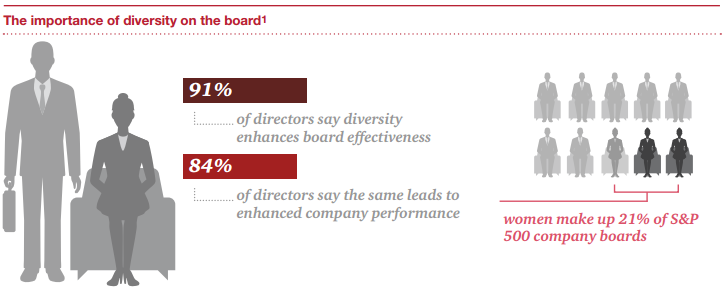
La recherche de PwC a porté sur les résultats de l’évolution des CA dans neuf (9) secteurs industriels. Dans l’ensemble, 91 % des administrateurs croient que la diversité contribue à l’efficacité du conseil. De plus, 84 % des administrateurs lient la variable de la diversité à l’accroissement de la performance organisationnelle.

L’auteure avance qu’il existe trois moyens utiles aux fins du renouvellement des CA :

  1. Une plus grande diversité ;
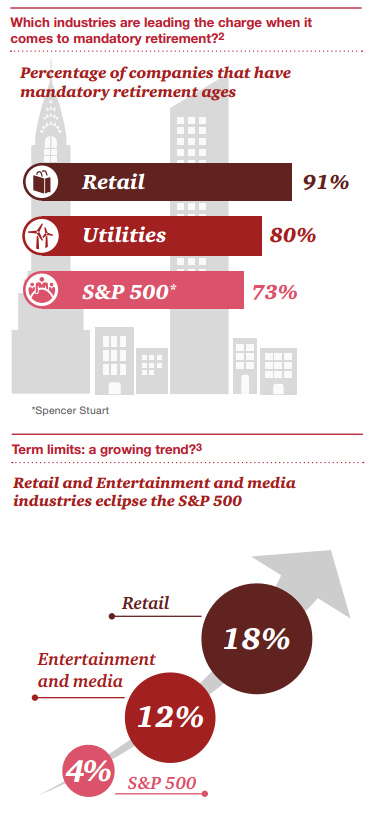
  2. La fixation d’un âge limite et d’un nombre de mandats maximum ;
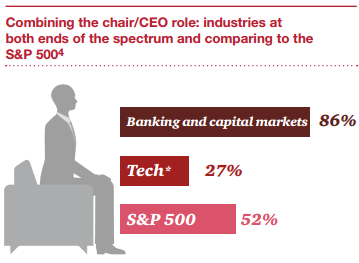
  3. L’évaluation de la séparation des rôles entre la présidence du conseil (Chairperson) et la présidence de l’entreprise (CEO).

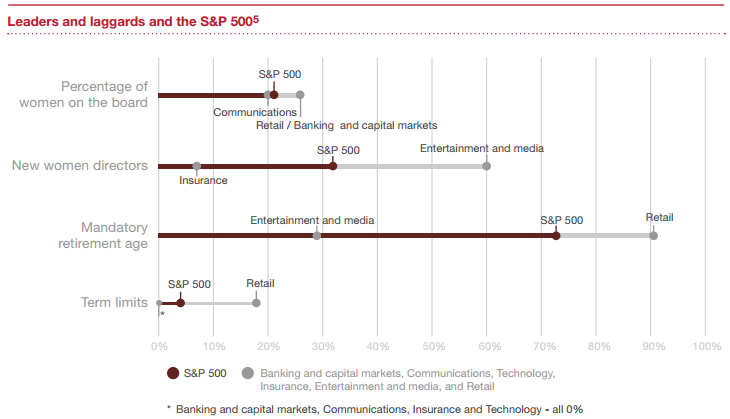
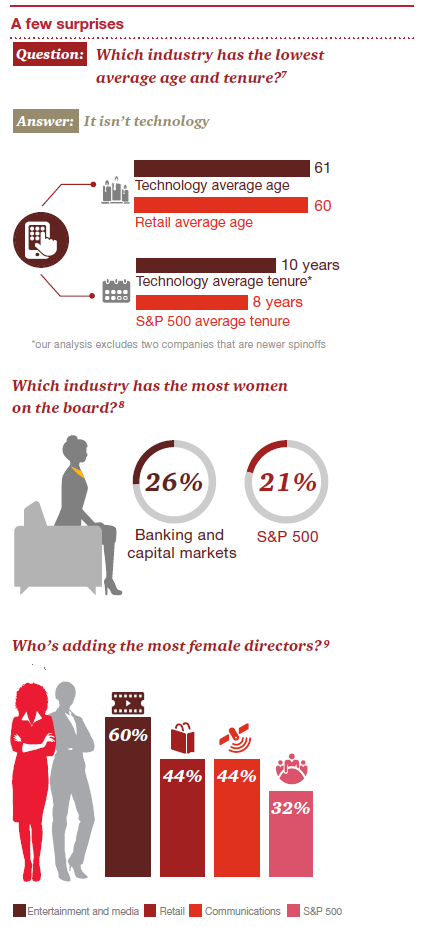
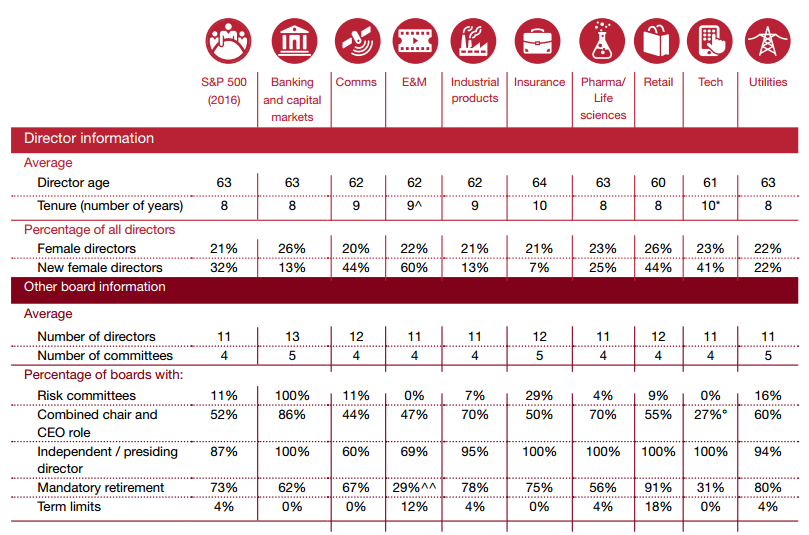
L’article est très intéressant en raison des efforts consentis à la présentation des résultats par l’illustration infographique. Le tableau présenté en annexe est particulièrement pertinent, car on y trouve une synthèse des principales variables liées au renouvellement des CA selon les neuf secteurs industriels ainsi que l’indice du S&P 500.

Au Canada, les recherches montrent que les entreprises sont beaucoup plus proactives eu égard aux facteurs de renouvellement des conseils d’administration.

Bonne lecture !

Does your board have the right makeup for the future?


Résultats de recherche d'images pour « composition du conseil d'administration »


Board composition is “the” issue for investors in 2017. Some industries are taking more steps to refresh their board than others—how does yours stack up? As the economic environment changes and lines between industries start to blur, companies are looking for directors with different, less traditional and even broader skills. Technology skills will be key across sectors.

Who’s sitting in your boardroom? Do your directors bring the right mix of skills, experiences and expertise to best oversee your company? Are they a diverse group, or a group with common backgrounds and outlooks? Can they help see into the future and how your industry is likely to take shape? And are some of your directors serving on your board as well as those in other industries?

These questions should be top of mind for executives and board members alike. Why? Because the volume of challenges companies are facing and the pace of change has intensified in recent years. From emerging technologies and cybersecurity threats to new competitors and changing regulatory requirements, companies–and their boards–have to keep up. Some boards have realized that having board members with multiple industry perspectives can prove helpful when navigating the vast amount of change businesses are faced with today.

If your board isn’t thinking about its composition and refreshment, you are opening up the door to scrutiny. Board composition is “the” issue for investors in 2017. Investors want to know who is sitting in the boardroom and whether they are the best people for the job. If they don’t think you have the right people on the board, you will likely hear about it. This is no longer something that is “nice” to think about, it’s becoming something boards “must” think about. And think about regularly.

How can you refresh your board?


In 2016, we analyzed the board demographics of select companies in nine industries to see how they compared to each other and to the S&P 500. Where does your industry fall when it comes to board refreshment? Does your board have the right makeup for the future?


There are a number of ways to refresh your board. One way is to think about diversity. Many have taken on the gender imbalance on their boards and are adding more women directors. But diversity isn’t only about women. It’s about race, ethnicity, skills, experience, expertise, age and even geography. It’s about diversity of thought and perspective. And it’s not just a talking point anymore. Regulators started drafting disclosure rules around board diversity in mid-2016. Whether the rules become final remains to be seen, but either way, board diversity is in the spotlight. Add to that the common criticism that the US is far behind its developed country peers. Norway, France and the Netherlands have been using quotas for a while, and Germany in 2015 passed a law mandating 30% women on the boards of its biggest companies. While it’s unlikely quotas would be enacted in the US, some believe they’re a needed catalyst.


While we only looked at gender diversity on boards, we believe this is a good indicator of the efforts some boards are making to become more diverse overall. Secondly, mandatory retirement ages and term limits are two tools that boards can use to refresh itself. Our analysis showed that some industries seemed to be adopting these provisions more so than others. Some directors question their effectiveness.

Some of the industries in our PwC peer group analysis don’t have term limits at all

Banking and capital markets

Insurance

Communications

Technology

A third move that some companies have taken often, under investor pressure—is to evaluate their leadership structure and split the chair and CEO role. While the issue is still one that investors care about, certain industries have kept the combined role. And some companies don’t plan on making the change any time soon. Most often, boards with a combined chair/CEO role have an independent lead or presiding director. This may ease concerns that institutional investors and proxy firms may have about independence in the leadership role.


Who would have thought? Some interesting findings


While our analysis shows that most industries didn’t veer too far from the S&P 500 averages for most benchmarking categories, a few stand out. Retail in particular seems to be leading the charge when it comes to board refreshment.


Other industries aren’t moving along quite so quickly. And there were some surprises. Which industry had the lowest average age? Perhaps surprisingly, it’s not technology. Retail claimed that one, too. And, also unexpected, was that technology had one of the highest average tenures. [6] Another surprising finding came from our analysis of the banking and capital markets industry—an industry that’s often considered to be male-dominated. BCM boards had the highest percentage of women, at 26%. That compares to just 21% for the S&P 500. Both the entertainment and media and the communications industries were also ahead of the curve when it comes to women in the boardroom, with the highest and second-highest percentages of new female directors. Retail tied with communications for second-highest, as well.


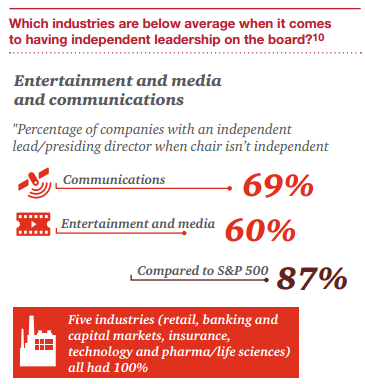
On a less progressive note, both the entertainment and media and communications industries were below the S&P 500 average when it came to having an independent lead or presiding director when the board chair is not independent. And they ranked lowest of the industries we analyzed on this topic—by far.

Blurred lines across industries


Skills, experience and diversity of thought will likely become even more important in the coming years. In the past five years alone, once bright industry lines have started to blur. Take the retail industry, for example. Brick and mortar stores, shopping malls and strip malls were what used to come to mind when thinking about that industry. Now it’s mobile devices and drones. Across many industries, business models are changing, competitors from different industries are appearing and new skills are needed. The picture of what your industry looks like today may not be the same in just a few years.

Technology is the key to much of this change. Just a few years ago, many boards were not enthusiastic about the idea of adding a director solely with technology or digital skills. But times are changing. Technology is increasingly becoming a critical skill to have on the board. We consulted our experts in the nine industries we analyzed, and all of them put technology high on the “must-have” list for new directors. Interestingly, financial, operational and industry experience—the top three from our 2016 Annual Corporate Directors Survey, were not among the most commonly listed.

Taking a fresh look


If your company is shifting gears and changing the way it does business, it may be important to take a fresh look at your board composition at more frequent intervals. Some boards use a skills matrix to see what they might be lacking in their board composition. Others may be forced by a shareholder activist to add new skills to the board.


So how do you fill the holes in the backgrounds or skills you want from your directors? One way is to look to other industries. As our analysis shows, board composition and refreshment approaches vary by industry. As industry lines blur, other industry perspectives could compliment your company—it might be helpful to consider filling any holes with board members from other industries.

No matter which approach you take, it’s very important to think about your board’s composition proactively. Use your board evaluations to understand which directors have the necessary skills and expertise—and which might be lacking what the board needs. Think about your board holistically as you think about your company’s future. Your board composition is critical to ensuring your board is effective—and keeping up with the world outside the boardroom.


Appendix


How do our industry peer groups stack up to the S&P 500? Making this evaluation can be a good way to begin determining whether your board has the right balance in terms of board composition.


Analysis excludes two companies that are newer spinoffs.
Analysis excludes one company that does not combine or separate the roles.
Excludes the tenure of one newly-formed company.
Four of the five companies that have a mandatory retirement age have waived or state that the board can choose to waive it.

Sources: Spencer Stuart, U.S. Board Index 2016, November, 2016; PwC analysis of US SEC registrants: 27 of the largest industrial products companies by market capitalization and revenue, May 2016; 11 of the largest retail companies by revenue, May 2016; 21 of the largest banking and capital markets companies by revenue, September 2016; 24 of the largest insurance companies by market capitalization, May 2016; 17 of the largest entertainment and media companies by revenue, May 2016; nine of the largest communications companies by revenue, May 2016; 25 of the largest power and utilities companies by revenue, October 2016; 16 of the largest technology companies by revenue, May 2016; 23 of the largest pharma/life sciences companies by revenue, May 2016.


Endnotes:

1Sources: PwC, 2016 Annual Corporate Directors Survey, October 2016; Spencer Stuart, 2016 US Board Index, November 2016.(go back)

2Sources: PwC analysis of 11 of the largest retail companies by revenue that are also US SEC registrants, May 2016; PwC analysis of 25 of the largest power and utilities companies by revenue that are also US SEC registrants, October 2016; Spencer Stuart, U.S. Board Index 2016, November 2016.(go back)

3Sources: PwC analysis of 11 of the largest retail companies by revenue that are also US SEC registrants, May 2016; PwC analysis of 17 of the largest entertainment and media companies by revenue that are also US SEC registrants, May 2016; Spencer Stuart, S. Board Index 2016, November 2016.(go back)

4Sources: PwC analysis of 21 of the largest banking and capital markets companies by revenue that are also US SEC registrants, September 2016; PwC analysis of 16 of the largest technology companies by revenue that are also US SEC registrants, May 2016; Spencer Stuart, S. Board Index 2016, November 2016.(go back)

5Sources: PwC analysis of US SEC registrants: nine of the largest communications companies by revenue, May 2016; 11 of the largest retail companies by revenue, May 2016; 21 of the largest banking and capital markets companies by revenue, September 2016; 24 of the largest insurance companies by market capitalization, May 2016; 16 of the largest technology companies by revenue, May 2016; 17 of the largest entertainment and media companies by revenue, May 2016; Spencer Stuart, U.S. Board Index 2016, November 2016.(go back)

6Analysis excludes two companies that are newer spinoffs.(go back)

7Sources: PwC analysis of 16 of the largest technology companies by revenue that are also US SEC registrants, May 2016; Spencer Stuart, U.S. Board Index 2016, November 2016.(go back)

8Sources: PwC analysis of 11 of the largest retail companies by revenue that are also US SEC registrants, May 2016; PwC analysis of 21 of the largest banking and capital markets companies by revenue that are also US SEC registrants, September 2016; Spencer Stuart, U.S. Board Index 2016, November, 2016(go back)

9Sources: PwC analysis of 17 of the largest entertainment and media companies by revenue that are also US SEC registrants, May 2016; PwC analysis of nine of the largest communications companies by revenue that are also US SEC registrants, May 2016; PwC analysis of 11 of the largest retail companies by revenue that are also US SEC registrants, May 2016; Spencer Stuart, S. Board Index 2016, November 2016.(go back)

10Sources: PwC analysis of 17 of the largest entertainment and media companies by revenue that are also US SEC registrants, May 2016; PwC analysis of nine of the largest communications companies by revenue that are also US SEC registrants, May 2016; Spencer Stuart, S. Board Index 2016, November 2016; PwC analysis of 11 of the largest retail companies by revenue that are also US SEC registrants, May 2016; PwC analysis of 21 of the largest banking and capital markets companies by revenue that are also US SEC registrants, September 2016; PwC analysis of 24 of the largest insurance companies by market capitalization that are also US SEC registrants, May 2016; PwC analysis of 16 of the largest technology companies by revenue that are also US SEC registrants, May 2016; PwC analysis of 23 of the largest pharma/life sciences companies by revenue that are also US SEC registrants, May 2016.

La gouvernance des CÉGEPS | Une responsabilité partagée


Nous publions ici un cinquième billet de Danielle Malboeuf* laquelle nous a soumis ses réflexions sur les grands enjeux de la gouvernance des institutions d’enseignement collégial les 23 et 27 novembre 2013, le 24 novembre 2014 et le 4 septembre 2015, à titre d’auteure invitée.

Dans un premier article, publié le 23 novembre 2013 sur ce blogue, on insistait sur l’importance, pour les CA des Cégeps, de se donner des moyens pour assurer la présence d’administrateurs compétents dont le profil correspond à celui qui est recherché. D’où les propositions adressées à la Fédération des cégeps et aux CA pour élaborer un profil de compétences et pour faire appel à la Banque d’administrateurs certifiés du Collège des administrateurs de sociétés (CAS), le cas échéant. Un autre enjeu identifié dans ce billet concernait la remise en question de l’indépendance des administrateurs internes.

Le deuxième article publié le 27 novembre 2013 abordait l’enjeu entourant l’exercice de la démocratie par différentes instances au moment du dépôt d’avis au conseil d’administration.

Le troisième article portait sur l’efficacité du rôle du président du conseil d’administration (PCA).

Le quatrième billet abordait les qualités et les caractéristiques des bons administrateurs dans le contexte du réseau collégial québécois (CÉGEP)

Dans ce cinquième billet, l’auteure réagit aux préoccupations actuelles de la ministre de l’Enseignement supérieur eu égard à la gouvernance des CÉGEPS.


La gouvernance des CÉGEPS | Une responsabilité partagée

par

Danielle Malboeuf*  


Dans les suites du rapport de la vérificatrice générale portant sur la gestion administrative des Cégeps, la ministre de l’Enseignement supérieur, madame Hélène David a demandé au ministère un plan d’action pour améliorer la gouvernance dans le réseau collégial. Voici un point de vue qui pourrait enrichir sa réflexion.

Rappelons que pour atteindre de haut standard d’excellence, les collèges doivent compter sur un conseil d’administration (CA) performant dont les membres font preuve d’engagement, de curiosité et de courage tout en possédant les qualifications suivantes : crédibles, compétents, indépendants, informés et outillés.

Considérant l’importance des décisions prises par les administrateurs, il est essentiel que ces personnes possèdent des compétences et une expertise pertinente. Parmi les bonnes pratiques en gouvernance, les CA devraient d’ailleurs élaborer un profil de compétences recherchées pour ses membres et l’utiliser au moment de la sélection des administrateurs.  Au moment de solliciter la nomination d’un administrateur externe auprès du gouvernement, ce profil devrait être fortement recommandé. Sachant que chacun des 48 CA des Collèges d’enseignement général et professionnel compte sept personnes nommées par la ministre pour un mandat de trois ans renouvelable, il est important de lui rappeler l’importance d’en tenir compte.

373bb2f

Il est également essentiel qu’elle procède à ces nominations dans les meilleurs délais. À l’heure actuelle, on constate que, dans certains cas, le délai pour nommer et remplacer des administrateurs externes peut être de plusieurs mois. Cette situation est doublement préoccupante quand plusieurs membres quittent le CA en même temps. Sachant qu’il existe une banque de candidats dûment formés par le Collège des administrateurs de sociétés et des membres de plusieurs ordres professionnels qui répondent au profil de compétences recherchées par les collèges, il serait pertinent de recruter des candidats parmi ces personnes.

De plus, pour être en présence d’administrateurs performants, il est essentiel que ces personnes soient au fait de leurs rôles et responsabilités. Des formations devraient donc leur être offertes. Toutefois, cette formation ne doit pas se limiter à leur faire connaître les obligations légales et financières qui s’appliquent au réseau collégial, mais les bonnes pratiques de gouvernance doivent également leur être enseignées. À ce sujet, il faut se réjouir du souhait formulé par madame David afin d’offrir des formations en ce sens.

Signalons aussi que les administrateurs ne devraient pas se retrouver en situation de conflit d’intérêts. Ainsi, il faut s’assurer, entre autres, que les administrateurs internes ne subissent pas de pressions des  groupes d’employés dont ils proviennent. Les  conseils d’administration des collèges comptent quatre membres du personnel qui enrichissent les échanges par leurs expériences pertinentes. La Loi sur les collèges prévoit que ces administrateurs internes sont élus par leurs pairs. Dans plusieurs collèges, le processus de sélection est confié au syndicat qui procède à l’élection de leur représentant au conseil d’administration lors d’une assemblée syndicale. Ces personnes peuvent subir des pressions surtout quand certains syndicats inscrivent dans leur statut et règlement que ces personnes doivent représenter l’assemblée syndicale et y faire rapport. D’autres collèges ont prévu des modalités qui respectent beaucoup mieux l’esprit de la loi. On confie au secrétaire général, le mandat de recevoir les candidatures et de procéder dans le cadre de processus convenu à la sélection de ces personnes. Cette dernière pratique devrait être encouragée.

Considérant les pouvoirs du CA qui agit tant sur les aspects financiers et légaux que sur les orientations du collège, il est essentiel que la direction fasse preuve de transparence et transmette aux membres toutes les informations pertinentes. Pour permettre aux administrateurs de porter des jugements adéquats et de juger de la pertinence et de l’efficacité de sa gestion, le collège doit aussi leur fournir des indicateurs. Sachant que des indicateurs sont présents dans le plan stratégique, les administrateurs devraient, donc porter une attention toute particulière à ces indicateurs, et ce, sur une base régulière.

Par ailleurs, les administrateurs ne doivent pas hésiter à poser des questions et à demander des informations additionnelles, le cas échéant. Le président du CA peut, dans ce sens, jouer un rôle essentiel. Il doit, entre autres, porter un regard critique sur les documents qui sont transmis avant les rencontres et encourager la création de sous-comités pour enrichir les réflexions. Considérant le rôle qui lui est confié dans la Loi, les présidents de CA pourraient être tentés de se limiter à jouer un rôle d’animateur de réunions, ce qui n’est pas suffisant.

En résumé, la présence de CA performant dans les Cégeps exige une évolution des pratiques et idéalement, des modifications législatives qui mettront à contribution chacun des acteurs du réseau collégial.

_______________________

*Danielle Malboeuf est consultante et formatrice en gouvernance ; elle possède une grande expérience dans la gestion des CÉGEPS et dans la gouvernance des institutions d’enseignement collégial et universitaire. Elle est CGA-CPA, MBA, ASC, Gestionnaire et administratrice retraitée du réseau collégial et consultante.

___________________________

Articles sur la gouvernance des CÉGEPS publiés sur mon blogue par l’auteure :

(1) LE RÔLE DU PRÉSIDENT DU CONSEIL D’ADMINISTRATION (PCA) | LE CAS DES CÉGEPS

(2) Les grands enjeux de la gouvernance des institutions d’enseignement collégial

(3) L’exercice de la démocratie dans la gouvernance des institutions d’enseignement collégial

(4) Caractéristiques des bons administrateurs pour le réseau collégial | Danielle Malboeuf

Enhanced by Zemanta

La planification de la relève du PDG par le CA | Une activité très négligée


Voici un article d’Eben Harrell paru dans le numéro de décembre 2016 de Harvard Business Review.

L’auteur affirme, basé sur plusieurs résultats de recherche, que les conseils d’administration ne sont pas préparés à assurer la relève du président-directeur général.

En effet, il appert que le roulement des fonctions de CEO s’accélère grandement (plus de 15 %) et que seulement la moitié des CA sont préparés à faire face aux conséquences.

On estime que 40 % des nouvelles recrues CEO ne peuvent répondre aux exigences de leurs tâches dans les 18 premiers mois !

Le remplacement d’un PDG peut prendre plusieurs mois, voire des années !

Doit-on recruter à l’interne ou recruter à l’externe ? Les recherches montrent que l’on a de plus en plus tendance à recruter les candidats à l’externe ; on parle de 20 % à 30 % du recrutement qui se fait à l’externe.

On constate que les conseils d’administration ne font pas les efforts nécessaires pour planifier la relève de leur CEO et que les coûts reliés à ces manquements sont considérables.

Bonne lecture !

Succession Planning: What the Research Says


All CEOs will inevitably leave office, yet research has long shown that most organizations are ill-prepared to replace them. In this article, we review the most salient studies of succession planning and offer context from experts on the process of picking new leaders for organizations.

Boards Aren’t Ready for Succession

Each year about 10% to 15% of corporations must appoint a new CEO, whether because of executives’ retirement, resignation, dismissal, or ill health. In 2015, in fact, turnover among global CEOs hit a 15-year high. Activist investors are increasingly forcing out leaders they deem underperforming. Yet despite these trends, most boards are unprepared to replace their chief executives. A 2010 survey by the search firm Heidrick & Struggles and the Rock Center for Corporate Governance at Stanford University revealed that only 54% of boards were grooming a specific successor, and 39% had no viable internal candidates who could immediately replace the CEO if the need arose.

0c6d26e8-bd5f-41bd-beb5-9153dfb50498_originalAn organization’s top executive is one of the few variables over which boards have total control—and their failure to plan for CEO transitions has a high cost. A study of the world’s 2,500 largest public companies shows that companies that scramble to find replacements for departing CEOs forgo an average of $1.8 billion in shareholder value. A separate study reveals that the longer it takes a company to name a new CEO during a succession crisis, the worse it subsequently performs relative to its peers. Finally, poor succession planning often extends the tenure of ineffective CEOs, who end up lingering in office long after they should have been replaced. A study by Booz & Company found that, on average, firms with stock returns in the lowest decile underperformed their industry peers by 45 percentage points over a two-year period—and yet the probability that their CEOs would be forced out was only 5.7%. The authors commented that “boards are giving underperforming CEOs more latitude than might be expected.”

Lack of preparedness is only part of the problem, however. An equal challenge, the consultant Ram Charan wrote in 2005, is that all too often, “CEOs are being replaced badly.” Boards aren’t finding the right man or woman for the job. Estimates suggest that up to 40% of new CEOs fail to meet performance expectations in the first 18 months.

Planning Takes Years, Not Months

So what can directors do not only to prepare for succession events but to ensure they make a winning pick when the time comes? A first step is to integrate executive development programs with CEO succession planning so that the best internal candidates are identified early and flagged at the board level. The proof that such an approach works can be found in companies with prestigious leadership-training programs. Researchers at Santa Clara University and Indiana University who examined the track records of chief executives groomed at “CEO factories,” such as General Electric, IBM, and Procter & Gamble, found that the stock market reacted positively when they were appointed and that they delivered superior operating performance over the next three years. The researchers concluded that certain firms “are efficient in developing leadership skills” because “they are able to expose executives to a broad variety of industries and help them develop skills that can be transferred to different business environments.”

Internal grooming of promising executives can create value beyond the avoidance of costly interregnums. In his book Succession, Noel Tichy, a management professor at the Ross School of Business at the University of Michigan, argues that by putting potential successors in charge of new projects, companies can accelerate change while also testing candidates’ suitability for the top spot. Few boards of directors seize that opportunity, however. Research by the Conference Board, the Institute of Executive Development, and the Rock Center found that most directors lack detailed knowledge of the skills, capabilities, and performance of senior executives just one level below the CEO. Only 55% of directors surveyed in the study claimed to understand the strengths and weaknesses of those executives well or very well. Seventy-seven percent did not participate in the performance evaluations of their firm’s top executives other than the CEO. And only 7% of companies formally assigned a director to mentor senior executives below the CEO.

Some commentators believe this lack of involvement is the result of CEOs’ efforts to stymie boards: The absence of clear successors keeps incumbents in the job longer and gives them more bargaining power with boards. A packed governance agenda may also be to blame. When the consulting firm Mercer Delta surveyed directors about the amount of time they spent on nine key activities, a large majority reported devoting more and more hours to monitoring accounting, risk, and financial performance and other governance duties. Directors also indicated that they spent less time interacting with potential CEO successors than on any other activity.

Michael Useem, a professor of management at the University of Pennsylvania’s Wharton School, believes a shortage of directors with experience in hiring top executives also contributes to poor succession planning. He advocates for more current and former CEOs on boards. “People who know how to hire and manage top executives will better understand what a company needs in executive talent and which of the final candidates best brings that to the table,” he says.

In his book It’s Not the How or the What but the Who, Claudio Fernández-Aráoz of the search firm Egon Zehnder lays out six succession-planning guidelines for busy directors: First, start early, ideally the moment a new CEO takes charge. Second, create strict performance metrics and a process for evaluating the CEO against them. Third, identify and develop potential successors within the firm and then benchmark them against external talent. (Useem says directors can go deep during vetting by interviewing all the direct reports of the internal front-runners.) Fourth, look externally to widen the pool of candidates, through executive search firms that don’t use contingency arrangements or charge percentage fees (which Fernández-Aráoz believes create perverse incentives). Fifth, require the board to conduct periodic emergency succession drills. And finally, put in place an extensive transition process to help with onboarding, which is especially important given that 80% of CEO appointees have never served in a chief executive role before.

Insiders Versus Outsiders?

Boards often face a binary choice: Go with an internal candidate, or recruit an executive from another company? Traditionally, internal candidates favored by boards have progressed through positions with responsibility for larger and more complex P&L centers. They might start off by managing a single product and then move into an overseas “head of country” position before returning to the main corporate office to supervise a business unit and then run an entire division. Such a tightly choreographed internal trajectory is increasingly rare in a world of job hopping and frequent executive shuffles, however. Consider that in 1988, an executive typically worked for fewer than three employers in his or her lifetime; 10 years later the average had risen to more than five.

Increasingly, CEO vacancies are being filled by external candidates. In 2013, 20% to 30% of boards chose to replace an outgoing CEO with an external hire. In contrast, just 8% to 10% of newly appointed CEOs at S&P 500 companies were outsiders during the 1970s and 1980s.

This trend toward external hires has been strongly criticized by some scholars, including Harvard Business School’s Rakesh Khurana, who argues in his book Searching for a Corporate Savior that too often boards hire charismatic outsiders even when their experience and abilities are not right for companies’ needs. He also blames high-priced executive search firms for driving up demand for external candidates and censures the business press and the investor community for helping fuel what he calls “the cult of the outsider.”

Khurana may have a point: Candidates that are headhunted from other firms are paid more than internally promoted candidates. According to the executive-compensation research firm Equilar, the median pay of CEOs who are outsiders is $3.2 million more than the median pay of insiders. Far from deserving such a premium, externally appointed CEOs seem to underperform their internally promoted counterparts over the long run. A 2010 study by Booz & Company found that insider CEOs had delivered superior market-adjusted shareholder returns in seven out of the preceding 10 years. And Gregory Nagel of Middle Tennessee State University and James Ang of Florida State University used elaborate multiple regression analyses to show that, on average, going outside the company to fill the top office was justified in just 6% of cases.

These studies might not be capturing the whole picture, however. Companies tend to look outside their own ranks for leaders when recent financial results are poor, which suggests that external hires might struggle simply because they’re walking into challenging conditions at underperforming companies. What’s more, multiple studies have concluded that the CEO’s influence on corporate performance pales in comparison with other, uncontrollable effects—which is to say, it’s very hard to ascertain if a CEO is lucky or good. Furthermore, studies indicate that outsiders who join the company three to four years before they become CEO do just as well as insiders with much more experience at the firm, a crossover category of executive that Harvard Business School’s Joseph Bower calls “inside-outside” leaders. For these and other reasons, says David Larcker, a professor at Stanford Business School, “it is difficult to conclude whether internal or external candidates are systematically better operators.”

What Are the Traits of a Great CEO?

Whether they’re searching for a successor in a firm’s internal ranks or an external pool, directors would benefit from knowing which qualities best predict success in the top job. Unfortunately, while much ink has been spilled on the topic of individual leadership, very little of it can be scientifically supported. In an influential book published in 1991, the University of San Diego’s Joseph Rost pointed out that writers had defined leadership in more than 200 ways since 1900, often with nothing but conjecture or personal experience to back up their claims. That’s slowly changing as researchers look for correlations between personal biographies and leadership success. For instance, one study found that CEOs who had previously served on the boards of large public companies seemed to outperform those without such experience. Another study found that CEOs with military backgrounds were less likely to engage in fraudulent activity. Yet another found that CEOs who spent lavishly in their personal lives were more likely to oversee corporations with loose internal financial controls. Age may also be relevant: Researchers at Mississippi State and the University of Missouri found that younger CEOs outperformed their older counterparts, even after accounting for the fact that younger CEOs were more likely to work in fast-growing industries such as technology. And charismatic CEOs seemed to outperform during periods of upheaval and uncertainty but provided no boost during more stable times.

The private equity industry, which has vast experience hiring CEOs, may also offer some clues about what qualities make for strong CEOs. A recent survey of managing partners at 32 firms found that when choosing a chief executive, they paid less attention to attributes such as track record and industry experience and gave more weight to softer skills such as team building and resilience. But the PEs valued urgency much more highly than empathy—a finding more in keeping with a separate assessment of CEO personalities at venture-backed and private-equity-owned corporations, which suggested that attributes having to do with execution (such as speed, aggressiveness, persistence, work ethic, and high standards) were more predictive of strong performance than interpersonal strengths (such as listening skills, teamwork, integrity, and openness to criticism).

While intriguing, the attempt to find the traits of the ideal CEO-in-waiting is still in its infancy. No one has yet disproved the view of legendary management scholar Peter Drucker, who wrote that successful executives “differ widely in their personalities, strengths, weaknesses, values, and beliefs. All they have in common is that they get the right things done.” While we may be a long way from building a predictive algorithm that can identify the perfect CEO successor, researchers have shown that there still remains a great deal more that boards could do to improve their succession planning—starting (in many cases) with having a plan in the first place.

L’efficacité du rôle du président du conseil


Nous publions ici un quatrième billet de Danielle Malboeuf* laquelle nous a soumis ses réflexions sur les grands enjeux de la gouvernance des institutions d’enseignement collégial les 23 et 27 novembre 2013, à titre d’auteure invitée.

Dans un premier billet, publié le 23 novembre 2013 sur ce blogue, on insistait sur l’importance, pour les CA des Cégep, de se donner des moyens pour assurer la présence d’administrateurs compétents dont le profil correspond à celui recherché.

D’où les propositions adressées à la Fédération des cégeps et aux CA pour préciser un profil de compétences et pour faire appel à la Banque d’administrateurs certifiés du Collège des administrateurs de sociétés (CAS), le cas échéant. Un autre enjeu identifié dans ce billet concernait la remise en question de l’indépendance des administrateurs internes.

Le deuxième billet publié le 27 novembre 2013 abordait l’enjeu entourant l’exercice de la démocratie par différentes instances au moment du dépôt d’avis au conseil d’administration.

Le troisième billet portait sur l’efficacité du rôle du président du conseil d’administration (PCA).

Ce quatrième billet est une mise à jour de son dernier article portant sur le rôle du président de conseil.

Voici donc l’article en question, reproduit ici avec la permission de l’auteure.

Vos commentaires sont appréciés. Bonne lecture.

________________________________________


LE RÔLE DU PRÉSIDENT DU CONSEIL D’ADMINISTRATION | LE CAS DES INSTITUTIONS D’ENSEIGNEMENT COLLÉGIAL 

par Danielle Malboeuf*  


Il y a deux ans, je publiais un article sur le rôle du président du conseil d’administration (CA) [1]. J’y rappelais le rôle crucial et déterminant du président du CA et j’y précisais, entre autres, les compétences recherchées chez cette personne et l’enrichissement attendu de son rôle.

Depuis, on peut se réjouir de constater qu’un nombre de plus en plus élevé de présidents s’engagent dans de nouvelles pratiques qui améliorent la gouvernance des institutions collégiales. Ils ne se limitent plus à jouer un rôle d’animateurs de réunions, comme on pouvait le constater dans le passé.

president-du-conseil-dadministration

Notons, entre autres, que les présidents visent de plus en plus à bien s’entourer, en recherchant des personnes compétentes comme administrateurs. D’ailleurs, à cet égard, les collèges vivent une situation préoccupante. La Loi sur les collèges d’enseignement général et professionnel prévoit que le ministre [2] nomme les administrateurs externes. Ainsi, en plus de connaître des délais importants pour la nomination de nouveaux administrateurs, les collèges ont peu d’influence sur leur choix.

Présentement, les présidents et les directions générales cherchent donc à l’encadrer. Ils peuvent s’inspirer, à cet égard, des démarches initiées par d’autres organisations publiques en établissant, entre autres, un profil de compétences recherchées qu’ils transmettent au ministre. Ils peuvent ainsi tenter d’obtenir une complémentarité d’expertise dans le groupe d’administrateurs.

Une fois les administrateurs nommés, les présidents doivent se préoccuper d’assurer leur formation continue pour développer les compétences recherchées. Ils se donnent ainsi l’assurance que ces personnes comprennent bien leur rôle et leurs responsabilités et qu’elles sont outillées pour remplir le mandat qui leur est confié. De plus, ils doivent s’assurer que les administrateurs connaissent bien l’organisation, qu’ils adhèrent à sa mission et qu’ils partagent les valeurs institutionnelles. En présence d’administrateurs compétents, éclairés, et dont l’expertise est reconnue, il est plus facile d’assurer la légitimité et la crédibilité du CA et de ses décisions.

Un président performant démontrera aussi de grandes qualités de leadership. Il fera connaître à toutes les instances du milieu le mandat confié au CA. Il travaillera à mettre en place un climat de confiance au sein du CA et avec les gestionnaires de l’organisation. Il  cherchera à exploiter l’ensemble des compétences et à faire jouer au CA un rôle qui va au-delà de celui de fiduciaire, soit celui de contribuer significativement à la mission première du cégep : donner une formation pertinente et de qualité où l’étudiant et sa réussite éducative sont au cœur des préoccupations.

Plusieurs ont déjà fait le virage… c’est encourageant ! Les approches préconisées par l’Institut sur la gouvernance des organismes publics et privés (IGOPP) et le Collège des administrateurs de sociétés (CAS) puis reprises dans la loi sur la gouvernance des sociétés d’État ne sont sûrement pas étrangères à cette évolution. En fournissant aux présidents de CA le soutien, la formation et les outils appropriés pour améliorer leur gouvernance, le Centre collégial des services regroupés (CCSR) [3] contribue à assurer le développement des institutions collégiales dans un contexte de saine gestion.

Un CA performant est guidé par un président compétent.


[1] https://jacquesgrisegouvernance.com/2014/01/24/le-role-du-president-du-conseil-dadministration-pca-le-cas-des-cegep/

[2] Ministre de l’Enseignement supérieur, de la Recherche, de la Science et de la Technologie

[3] Formation développée en partenariat avec l’Institut sur la gouvernance des organisations privées et publiques (IGOPP)

_______________________________

*Danielle Malboeuf est consultante et formatrice en gouvernance ; elle possède une grande expérience dans la gestion des CEGEP et dans la gouvernance des institutions d’enseignement collégial et universitaire. Elle est CGA-CPA, MBA, ASC, Gestionnaire et administratrice retraité du réseau collégial et consultante.


Articles sur la gouvernance des CEGEP

(1) Les grands enjeux de la gouvernance des institutions d’enseignement collégiaux

(2) L’exercice de la démocratie dans la gouvernance des institutions d’enseignement collégiaux

(3) LE RÔLE DU PRÉSIDENT DU CONSEIL D’ADMINISTRATION (PCA) | LE CAS DES CÉGEP

Enhanced by Zemanta

Dix thèmes majeurs pour les administrateurs en 2016 | Harvard Law School Forum on Corporate Governance


Vous trouverez, ci-dessous, les dix thèmes les plus importants pour les administrateurs de sociétés selon Kerry E. Berchem, associé du groupe de pratiques corporatives à la firme Akin Gump Strauss Hauer & Feld LLP. Cet article est paru aujourd’hui sur le blogue le Harvard Law School Forum on Corporate Governance.

Bien qu’il y ait peu de changements dans l’ensemble des priorités cette année, on peut quand même noter :

(1) l’accent crucial accordé au long terme ;

(2) Une bonne gestion des relations avec les actionnaires dans la foulée du nombre croissant d’activités menées par les activistes ;

(3) Une supervision accrue des activités liées à la cybersécurité…

Pour plus de détails sur chaque thème, je vous propose la lecture synthèse de l’article ci-dessous.

Bonne lecture !


Ten Topics for Directors in 2016 |   Harvard Law School Forum on Corporate Governance


U.S. public companies face a host of challenges as they enter 2016. Here is our annual list of hot topics for the boardroom in the coming year:

  1. Oversee the development of long-term corporate strategy in an increasingly interdependent and volatile world economy
  2. Cultivate shareholder relations and assess company vulnerabilities as activist investors target more companies with increasing success
  3. Oversee cybersecurity as the landscape becomes more developed and cyber risk tops director concerns
  4. Oversee risk management, including the identification and assessment of new and emerging risks
  5. Assess the impact of social media on the company’s business plans
  6. Stay abreast of Delaware law developments and other trends in M&A
  7. Review and refresh board composition and ensure appropriate succession
  8. Monitor developments that could impact the audit committee’s already heavy workload
  9. Set appropriate executive compensation as CEO pay ratios and income inequality continue to make headlines
  10. Prepare for and monitor developments in proxy access

Strategic Planning Considerations

Strategic planning continues to be a high priority for directors and one to which they want to devote more time. Figuring out where the company wants to—and where it should want to—go and how to get there is not getting any easier, particularly as companies find themselves buffeted by macroeconomic and geopolitical events over which they have no control.

axes

In addition to economic and geopolitical uncertainty, a few other challenges and considerations for boards to keep in mind as they strategize for 2016 and beyond include:

finding ways to drive top-line growth

focusing on long-term goals and enhancing long-term shareholder value in the face of mounting pressures to deliver short-term results

the effect of low oil and gas prices

figuring out whether and when to deploy growing cash stockpiles

assessing the opportunities and risks of climate change and resource scarcity

addressing corporate social responsibility.

Shareholder Activism

Shareholder activism and “suggestivism” continue to gain traction. With the success that activists have experienced throughout 2015, coupled with significant new money being allocated to activist funds, there is no question that activism will remain strong in 2016.

In the first half of 2015, more than 200 U.S. companies were publicly subjected to activist demands, and approximately two-thirds of these demands were successful, at least in part. [1] A much greater number of companies are actually targeted by activism, as activists report that less than a third of their campaigns actually become public knowledge. [2] Demands have continued, and will continue, to vary: from requests for board representation, the removal of officers and directors, launching a hostile bid, advocating specific business strategies and/or opining on the merit of M&A transactions. But one thing is clear: the demands are being heard. According to a recent survey of more than 350 mutual fund managers, half had been contacted by an activist in the past year, and 45 percent of those contacted decided to support the activist. [3]

With the threat of activism in the air, boards need to cultivate shareholder relations and assess company vulnerabilities. Directors—who are charged with overseeing the long-term goals of their companies—must also understand how activists may look at the company’s strategy and short-term results. They must understand what tactics and tools activists have available to them. They need to know and understand what defenses the company has in place and whether to adopt other protective measures for the benefit of the overall organization and stakeholders.

Cybersecurity

Nearly 90 percent of CEOs worry that cyber threats could adversely impact growth prospects. [4] Yet in a recent survey, nearly 80 percent of the more than 1,000 information technology leaders surveyed had not briefed their board of directors on cybersecurity in the last 12 months. [5] The cybersecurity landscape has become more developed and as such, companies and their directors will likely face stricter scrutiny of their protection against cyber risk. Cyber risk—and the ultimate fall out of a data breach—should be of paramount concern to directors.

One of the biggest concerns facing boards is how to provide effective oversight of cybersecurity. The following are questions that boards should be asking:

Governance. Has the board established a cybersecurity review > committee and determined clear lines of reporting and > responsibility for cyber issues? Does the board have directors with the necessary expertise to understand cybersecurity and related issues?

Critical asset review. Has the company identified what its highest cyber risks assets are (e.g., intellectual property, personal information and trade secrets)? Are sufficient resources allocated to protect these assets?

Threat assessment. What is the daily/weekly/monthly threat report for the company? What are the current gaps and how are they being resolved?

Incident response preparedness. Does the company have an incident response plan and has it been tested in the past six months? Has the company established contracts via outside counsel with forensic investigators in the event of a breach to facilitate quick response and privilege protection?

Employee training. What training is provided to employees to help them identify common risk areas for cyber threat?

Third-party management. What are the company’s practices with respect to third parties? What are the procedures for issuing credentials? Are access rights limited and backdoors to key data entry points restricted? Has the company conducted cyber due diligence for any acquired companies? Do the third-party contracts contain proper data breach notification, audit rights, indemnification and other provisions?

Insurance. Does the company have specific cyber insurance and does it have sufficient limits and coverage?

Risk disclosure. Has the company updated its cyber risk disclosures in SEC filings or other investor disclosures to reflect key incidents and specific risks?

The SEC and other government agencies have made clear that it is their expectation that boards actively manage cyber risk at an enterprise level. Given the complexity of the cybersecurity inquiry, boards should seriously consider conducting an annual third-party risk assessment to review current practices and risks.

Risk Management

Risk management goes hand in hand with strategic planning—it is impossible to make informed decisions about a company’s strategic direction without a comprehensive understanding of the risks involved. An increasingly interconnected world continues to spawn newer and more complex risks that challenge even the best-managed companies. How boards respond to these risks is critical, particularly with the increased scrutiny being placed on boards by regulators, shareholders and the media. In a recent survey, directors and general counsel identified IT/cybersecurity as their number one worry, and they also expressed increasing concern about corporate reputation and crisis preparedness. [6]

Given the wide spectrum of risks that most companies face, it is critical that boards evaluate the manner in which they oversee risk management. Most companies delegate primary oversight responsibility for risk management to the audit committee. Of course, audit committees are already burdened with a host of other responsibilities that have increased substantially over the years. According to Spencer Stuart’s 2015 Board Index, 12 percent of boards now have a stand-alone risk committee, up from 9 percent last year. Even if primary oversight for monitoring risk management is delegated to one or more committees, the entire board needs to remain engaged in the risk management process and be informed of material risks that can affect the company’s strategic plans. Also, if primary oversight responsibility for particular risks is assigned to different committees, collaboration among the committees is essential to ensure a complete and consistent approach to risk management oversight.

Social Media

Companies that ignore the significant influence that social media has on existing and potential customers, employees and investors, do so at their own peril. Ubiquitous connectivity has profound implications for businesses. In addition to understanding and encouraging changes in customer relationships via social media, directors need to understand and weigh the risks created by social media. According to a recent survey, 91 percent of directors and 79 percent of general counsel surveyed acknowledged that they do not have a thorough understanding of the social media risks that their companies face. [7]

As part of its oversight duties, the board of directors must ensure that management is thoughtfully addressing the strategic opportunities and challenges posed by the explosive growth of social media by probing management’s knowledge, plans and budget decisions regarding these developments. Given new technology and new social media forums that continue to arise, this is a topic that must be revisited regularly.

M&A Developments

M&A activity has been robust in 2015 and is on track for another record year. According to Thomson Reuters, global M&A activity exceeded $3.2 trillion with almost 32,000 deals during the first three quarters of 2015, representing a 32 percent increase in deal value and a 2 percent increase in deal volume compared to the same period last year. The record deal value mainly results from the increase in mega-deals over $10 billion, which represented 36 percent of the announced deal value. While there are some signs of a slowdown in certain regions based on deal volume in recent quarters, global M&A is expected to carry on its strong pace in the beginning of 2016.

Directors must prepare for possible M&A activity in the future by keeping abreast of developments in Delaware case law and other trends in M&A. The Delaware courts churned out several noteworthy decisions in 2015 regarding M&A transactions that should be of interest to directors, including decisions on the court’s standard of review of board actions, exculpation provisions, appraisal cases and disclosure-only settlements.

Board Composition and Succession Planning

Boards have to look at their composition and make an honest assessment of whether they collectively have the necessary experience and expertise to oversee the new opportunities and challenges facing their companies. Finding the right mix of people to serve on a company’s board of directors, however, is not necessarily an easy task, and not everyone will agree with what is “right.” According to Spencer Stuart’s 2015 Board Index, board composition and refreshment and director tenure were among the top issues that shareholders raised with boards. Because any perceived weakness in a director’s qualification could open the door for activist shareholders, boards should endeavor to have an optimal mix of experience, skills and diversity. In light of the importance placed on board composition, it is critical that boards have a long-term board succession plan in place. Boards that are proactive with their succession planning are able to find better candidates and respond faster and more effectively when an activist approaches or an unforeseen vacancy occurs.

Audit Committees

Averaging 8.8 meetings a year, audit continues to be the most time-consuming committee. [8] Audit committees are burdened not only with overseeing a company’s risks, but also a host of other responsibilities that have increased substantially over the years. Prioritizing an audit committee’s already heavy workload and keeping directors apprised of relevant developments, including enhanced audit committee disclosures, accounting changes and enhanced SEC scrutiny will be important as companies prepare for 2016.

Executive Compensation

Perennially in the spotlight, executive compensation will continue to be a hot topic for directors in 2016. But this year, due to the SEC’s active rulemaking in 2015, directors will have more to fret about than just say-on-pay. Roughly five years after the Dodd-Frank Wall Street Reform and Consumer Protection Act was enacted, the SEC finally adopted the much anticipated CEO pay ratio disclosure rules, which have already begun stirring the debate on income inequality and exorbitant CEO pay. The SEC also made headway on other Dodd-Frank regulations, including proposed rules on pay-for-performance, clawbacks and hedging disclosures. Directors need to start planning how they will comply with these rules as they craft executive compensation for 2016.

Proxy Access

2015 was a turning point for shareholder proposals seeking to implement proxy access, which gives certain shareholders the ability to nominate directors and include those nominees in a company’s proxy materials. During the 2015 proxy season, the number of shareholder proposals relating to proxy access, as well as the overall shareholder support for such proposals, increased significantly. Indeed, approximately 110 companies received proposals requesting the board to amend the company’s bylaws to allow for proxy access, and of those proposals that went to a vote, the average support was close to 54 percent of votes cast in favor, with 52 proposals receiving majority support. [9] New York City Comptroller Scott Springer and his 2015 Boardroom Accountability Project were a driving force, submitting 75 proxy access proposals at companies targeted for perceived excessive executive compensation, climate change issues and lack of board diversity. Shareholder campaigns for proxy access are expected to continue in 2016. Accordingly, it is paramount that boards prepare for and monitor developments in proxy access, including, understanding the provisions that are emerging as typical, as well as the role of institutional investors and proxy advisory firms.

The complete publication is available here.

Endnotes:

[1] Activist Insight, “2015: The First Half in Numbers,” Activism Monthly (July 2015).
(go back)

[2] Activist Insight, “Activist Investing—An Annual Review of Trends in Shareholder Activism,” p. 8. (2015).
(go back)

[3] David Benoit and Kirsten Grind, “Activist Investors’ Secret Ally: Big Mutual Funds,” The Wall Street Journal (August 9, 2015).
(go back)

[4] PwC’s 18th Annual Global CEO Survey 2015.
(go back)

[5] Ponemon Institute’s 2015 Global Megatrends in Cybersecurity (February 2015).
(go back)

[6] Kimberley S. Crowe, “Law in the Boardroom 2015,” Corporate Board Member Magazine (2nd Quarter 2015). See also, Protiviti, “Executive Perspectives on Top Risks for 2015.”
(go back)

[7] Kimberley S. Crowe, supra.
(go back)

[8] 2015 Spencer Stuart Board Index, at p. 26.
(go back)

[9] Georgeson, 2015 Annual Corporate Governance Review, at p. 5.
(go back)

L’efficacité du rôle du président du conseil


Nous publions ici un quatrième billet de Danielle Malboeuf* laquelle nous a soumis ses réflexions sur les grands enjeux de la gouvernance des institutions d’enseignement collégial les 23 et 27 novembre 2013, à titre d’auteure invitée.

Dans un premier billet, publié le 23 novembre 2013 sur ce blogue, on insistait sur l’importance, pour les CA des Cégep, de se donner des moyens pour assurer la présence d’administrateurs compétents dont le profil correspond à celui recherché.

D’où les propositions adressées à la Fédération des cégeps et aux CA pour préciser un profil de compétences et pour faire appel à la Banque d’administrateurs certifiés du Collège des administrateurs de sociétés (CAS), le cas échéant. Un autre enjeu identifié dans ce billet concernait la remise en question de l’indépendance des administrateurs internes.

Le deuxième billet publié le 27 novembre 2013 abordait l’enjeu entourant l’exercice de la démocratie par différentes instances au moment du dépôt d’avis au conseil d’administration.

Le troisième billet portait sur l’efficacité du rôle du président du conseil d’administration (PCA).

Ce quatrième billet est une mise à jour de son dernier article portant sur le rôle du président de conseil.

Voici donc l’article en question, reproduit ici avec la permission de l’auteure.

Vos commentaires sont appréciés. Bonne lecture.

________________________________________


LE RÔLE DU PRÉSIDENT DU CONSEIL D’ADMINISTRATION | LE CAS DES INSTITUTIONS D’ENSEIGNEMENT COLLÉGIAL 

par Danielle Malboeuf*  


Il y a deux ans, je publiais un article sur le rôle du président du conseil d’administration (CA) [1]. J’y rappelais le rôle crucial et déterminant du président du CA et j’y précisais, entre autres, les compétences recherchées chez cette personne et l’enrichissement attendu de son rôle.

Depuis, on peut se réjouir de constater qu’un nombre de plus en plus élevé de présidents s’engagent dans de nouvelles pratiques qui améliorent la gouvernance des institutions collégiales. Ils ne se limitent plus à jouer un rôle d’animateurs de réunions, comme on pouvait le constater dans le passé.

president-du-conseil-dadministration

Notons, entre autres, que les présidents visent de plus en plus à bien s’entourer, en recherchant des personnes compétentes comme administrateurs. D’ailleurs, à cet égard, les collèges vivent une situation préoccupante. La Loi sur les collèges d’enseignement général et professionnel prévoit que le ministre [2] nomme les administrateurs externes. Ainsi, en plus de connaître des délais importants pour la nomination de nouveaux administrateurs, les collèges ont peu d’influence sur leur choix.

Présentement, les présidents et les directions générales cherchent donc à l’encadrer. Ils peuvent s’inspirer, à cet égard, des démarches initiées par d’autres organisations publiques en établissant, entre autres, un profil de compétences recherchées qu’ils transmettent au ministre. Ils peuvent ainsi tenter d’obtenir une complémentarité d’expertise dans le groupe d’administrateurs.

Une fois les administrateurs nommés, les présidents doivent se préoccuper d’assurer leur formation continue pour développer les compétences recherchées. Ils se donnent ainsi l’assurance que ces personnes comprennent bien leur rôle et leurs responsabilités et qu’elles sont outillées pour remplir le mandat qui leur est confié. De plus, ils doivent s’assurer que les administrateurs connaissent bien l’organisation, qu’ils adhèrent à sa mission et qu’ils partagent les valeurs institutionnelles. En présence d’administrateurs compétents, éclairés, et dont l’expertise est reconnue, il est plus facile d’assurer la légitimité et la crédibilité du CA et de ses décisions.

Un président performant démontrera aussi de grandes qualités de leadership. Il fera connaître à toutes les instances du milieu le mandat confié au CA. Il travaillera à mettre en place un climat de confiance au sein du CA et avec les gestionnaires de l’organisation. Il  cherchera à exploiter l’ensemble des compétences et à faire jouer au CA un rôle qui va au-delà de celui de fiduciaire, soit celui de contribuer significativement à la mission première du cégep : donner une formation pertinente et de qualité où l’étudiant et sa réussite éducative sont au cœur des préoccupations.

Plusieurs ont déjà fait le virage… c’est encourageant ! Les approches préconisées par l’Institut sur la gouvernance des organismes publics et privés (IGOPP) et le Collège des administrateurs de sociétés (CAS) puis reprises dans la loi sur la gouvernance des sociétés d’État ne sont sûrement pas étrangères à cette évolution. En fournissant aux présidents de CA le soutien, la formation et les outils appropriés pour améliorer leur gouvernance, le Centre collégial des services regroupés (CCSR) [3] contribue à assurer le développement des institutions collégiales dans un contexte de saine gestion.

Un CA performant est guidé par un président compétent.


[1] https://jacquesgrisegouvernance.com/2014/01/24/le-role-du-president-du-conseil-dadministration-pca-le-cas-des-cegep/

[2] Ministre de l’Enseignement supérieur, de la Recherche, de la Science et de la Technologie

[3] Formation développée en partenariat avec l’Institut sur la gouvernance des organisations privées et publiques (IGOPP)

_______________________________

*Danielle Malboeuf est consultante et formatrice en gouvernance ; elle possède une grande expérience dans la gestion des CEGEP et dans la gouvernance des institutions d’enseignement collégial et universitaire. Elle est CGA-CPA, MBA, ASC, Gestionnaire et administratrice retraité du réseau collégial et consultante.


Articles sur la gouvernance des CEGEP

(1) Les grands enjeux de la gouvernance des institutions d’enseignement collégiaux

(2) L’exercice de la démocratie dans la gouvernance des institutions d’enseignement collégiaux

(3) LE RÔLE DU PRÉSIDENT DU CONSEIL D’ADMINISTRATION (PCA) | LE CAS DES CÉGEP

Enhanced by Zemanta

Dix thèmes majeurs pour les administrateurs en 2016 | Harvard Law School Forum on Corporate Governance


Vous trouverez, ci-dessous, les dix thèmes les plus importants pour les administrateurs de sociétés selon Kerry E. Berchem, associé du groupe de pratiques corporatives à la firme Akin Gump Strauss Hauer & Feld LLP. Cet article est paru aujourd’hui sur le blogue le Harvard Law School Forum on Corporate Governance.

Bien qu’il y ait peu de changements dans l’ensemble des priorités cette année, on peut quand même noter :

(1) l’accent crucial accordé au long terme ;

(2) Une bonne gestion des relations avec les actionnaires dans la foulée du nombre croissant d’activités menées par les activistes ;

(3) Une supervision accrue des activités liées à la cybersécurité…

Pour plus de détails sur chaque thème, je vous propose la lecture synthèse de l’article ci-dessous.

Bonne lecture !


Ten Topics for Directors in 2016 |   Harvard Law School Forum on Corporate Governance


U.S. public companies face a host of challenges as they enter 2016. Here is our annual list of hot topics for the boardroom in the coming year:

  1. Oversee the development of long-term corporate strategy in an increasingly interdependent and volatile world economy
  2. Cultivate shareholder relations and assess company vulnerabilities as activist investors target more companies with increasing success
  3. Oversee cybersecurity as the landscape becomes more developed and cyber risk tops director concerns
  4. Oversee risk management, including the identification and assessment of new and emerging risks
  5. Assess the impact of social media on the company’s business plans
  6. Stay abreast of Delaware law developments and other trends in M&A
  7. Review and refresh board composition and ensure appropriate succession
  8. Monitor developments that could impact the audit committee’s already heavy workload
  9. Set appropriate executive compensation as CEO pay ratios and income inequality continue to make headlines
  10. Prepare for and monitor developments in proxy access

Strategic Planning Considerations

Strategic planning continues to be a high priority for directors and one to which they want to devote more time. Figuring out where the company wants to—and where it should want to—go and how to get there is not getting any easier, particularly as companies find themselves buffeted by macroeconomic and geopolitical events over which they have no control.

axes

In addition to economic and geopolitical uncertainty, a few other challenges and considerations for boards to keep in mind as they strategize for 2016 and beyond include:

finding ways to drive top-line growth

focusing on long-term goals and enhancing long-term shareholder value in the face of mounting pressures to deliver short-term results

the effect of low oil and gas prices

figuring out whether and when to deploy growing cash stockpiles

assessing the opportunities and risks of climate change and resource scarcity

addressing corporate social responsibility.

Shareholder Activism

Shareholder activism and “suggestivism” continue to gain traction. With the success that activists have experienced throughout 2015, coupled with significant new money being allocated to activist funds, there is no question that activism will remain strong in 2016.

In the first half of 2015, more than 200 U.S. companies were publicly subjected to activist demands, and approximately two-thirds of these demands were successful, at least in part. [1] A much greater number of companies are actually targeted by activism, as activists report that less than a third of their campaigns actually become public knowledge. [2] Demands have continued, and will continue, to vary: from requests for board representation, the removal of officers and directors, launching a hostile bid, advocating specific business strategies and/or opining on the merit of M&A transactions. But one thing is clear: the demands are being heard. According to a recent survey of more than 350 mutual fund managers, half had been contacted by an activist in the past year, and 45 percent of those contacted decided to support the activist. [3]

With the threat of activism in the air, boards need to cultivate shareholder relations and assess company vulnerabilities. Directors—who are charged with overseeing the long-term goals of their companies—must also understand how activists may look at the company’s strategy and short-term results. They must understand what tactics and tools activists have available to them. They need to know and understand what defenses the company has in place and whether to adopt other protective measures for the benefit of the overall organization and stakeholders.

Cybersecurity

Nearly 90 percent of CEOs worry that cyber threats could adversely impact growth prospects. [4] Yet in a recent survey, nearly 80 percent of the more than 1,000 information technology leaders surveyed had not briefed their board of directors on cybersecurity in the last 12 months. [5] The cybersecurity landscape has become more developed and as such, companies and their directors will likely face stricter scrutiny of their protection against cyber risk. Cyber risk—and the ultimate fall out of a data breach—should be of paramount concern to directors.

One of the biggest concerns facing boards is how to provide effective oversight of cybersecurity. The following are questions that boards should be asking:

Governance. Has the board established a cybersecurity review > committee and determined clear lines of reporting and > responsibility for cyber issues? Does the board have directors with the necessary expertise to understand cybersecurity and related issues?

Critical asset review. Has the company identified what its highest cyber risks assets are (e.g., intellectual property, personal information and trade secrets)? Are sufficient resources allocated to protect these assets?

Threat assessment. What is the daily/weekly/monthly threat report for the company? What are the current gaps and how are they being resolved?

Incident response preparedness. Does the company have an incident response plan and has it been tested in the past six months? Has the company established contracts via outside counsel with forensic investigators in the event of a breach to facilitate quick response and privilege protection?

Employee training. What training is provided to employees to help them identify common risk areas for cyber threat?

Third-party management. What are the company’s practices with respect to third parties? What are the procedures for issuing credentials? Are access rights limited and backdoors to key data entry points restricted? Has the company conducted cyber due diligence for any acquired companies? Do the third-party contracts contain proper data breach notification, audit rights, indemnification and other provisions?

Insurance. Does the company have specific cyber insurance and does it have sufficient limits and coverage?

Risk disclosure. Has the company updated its cyber risk disclosures in SEC filings or other investor disclosures to reflect key incidents and specific risks?

The SEC and other government agencies have made clear that it is their expectation that boards actively manage cyber risk at an enterprise level. Given the complexity of the cybersecurity inquiry, boards should seriously consider conducting an annual third-party risk assessment to review current practices and risks.

Risk Management

Risk management goes hand in hand with strategic planning—it is impossible to make informed decisions about a company’s strategic direction without a comprehensive understanding of the risks involved. An increasingly interconnected world continues to spawn newer and more complex risks that challenge even the best-managed companies. How boards respond to these risks is critical, particularly with the increased scrutiny being placed on boards by regulators, shareholders and the media. In a recent survey, directors and general counsel identified IT/cybersecurity as their number one worry, and they also expressed increasing concern about corporate reputation and crisis preparedness. [6]

Given the wide spectrum of risks that most companies face, it is critical that boards evaluate the manner in which they oversee risk management. Most companies delegate primary oversight responsibility for risk management to the audit committee. Of course, audit committees are already burdened with a host of other responsibilities that have increased substantially over the years. According to Spencer Stuart’s 2015 Board Index, 12 percent of boards now have a stand-alone risk committee, up from 9 percent last year. Even if primary oversight for monitoring risk management is delegated to one or more committees, the entire board needs to remain engaged in the risk management process and be informed of material risks that can affect the company’s strategic plans. Also, if primary oversight responsibility for particular risks is assigned to different committees, collaboration among the committees is essential to ensure a complete and consistent approach to risk management oversight.

Social Media

Companies that ignore the significant influence that social media has on existing and potential customers, employees and investors, do so at their own peril. Ubiquitous connectivity has profound implications for businesses. In addition to understanding and encouraging changes in customer relationships via social media, directors need to understand and weigh the risks created by social media. According to a recent survey, 91 percent of directors and 79 percent of general counsel surveyed acknowledged that they do not have a thorough understanding of the social media risks that their companies face. [7]

As part of its oversight duties, the board of directors must ensure that management is thoughtfully addressing the strategic opportunities and challenges posed by the explosive growth of social media by probing management’s knowledge, plans and budget decisions regarding these developments. Given new technology and new social media forums that continue to arise, this is a topic that must be revisited regularly.

M&A Developments

M&A activity has been robust in 2015 and is on track for another record year. According to Thomson Reuters, global M&A activity exceeded $3.2 trillion with almost 32,000 deals during the first three quarters of 2015, representing a 32 percent increase in deal value and a 2 percent increase in deal volume compared to the same period last year. The record deal value mainly results from the increase in mega-deals over $10 billion, which represented 36 percent of the announced deal value. While there are some signs of a slowdown in certain regions based on deal volume in recent quarters, global M&A is expected to carry on its strong pace in the beginning of 2016.

Directors must prepare for possible M&A activity in the future by keeping abreast of developments in Delaware case law and other trends in M&A. The Delaware courts churned out several noteworthy decisions in 2015 regarding M&A transactions that should be of interest to directors, including decisions on the court’s standard of review of board actions, exculpation provisions, appraisal cases and disclosure-only settlements.

Board Composition and Succession Planning

Boards have to look at their composition and make an honest assessment of whether they collectively have the necessary experience and expertise to oversee the new opportunities and challenges facing their companies. Finding the right mix of people to serve on a company’s board of directors, however, is not necessarily an easy task, and not everyone will agree with what is “right.” According to Spencer Stuart’s 2015 Board Index, board composition and refreshment and director tenure were among the top issues that shareholders raised with boards. Because any perceived weakness in a director’s qualification could open the door for activist shareholders, boards should endeavor to have an optimal mix of experience, skills and diversity. In light of the importance placed on board composition, it is critical that boards have a long-term board succession plan in place. Boards that are proactive with their succession planning are able to find better candidates and respond faster and more effectively when an activist approaches or an unforeseen vacancy occurs.

Audit Committees

Averaging 8.8 meetings a year, audit continues to be the most time-consuming committee. [8] Audit committees are burdened not only with overseeing a company’s risks, but also a host of other responsibilities that have increased substantially over the years. Prioritizing an audit committee’s already heavy workload and keeping directors apprised of relevant developments, including enhanced audit committee disclosures, accounting changes and enhanced SEC scrutiny will be important as companies prepare for 2016.

Executive Compensation

Perennially in the spotlight, executive compensation will continue to be a hot topic for directors in 2016. But this year, due to the SEC’s active rulemaking in 2015, directors will have more to fret about than just say-on-pay. Roughly five years after the Dodd-Frank Wall Street Reform and Consumer Protection Act was enacted, the SEC finally adopted the much anticipated CEO pay ratio disclosure rules, which have already begun stirring the debate on income inequality and exorbitant CEO pay. The SEC also made headway on other Dodd-Frank regulations, including proposed rules on pay-for-performance, clawbacks and hedging disclosures. Directors need to start planning how they will comply with these rules as they craft executive compensation for 2016.

Proxy Access

2015 was a turning point for shareholder proposals seeking to implement proxy access, which gives certain shareholders the ability to nominate directors and include those nominees in a company’s proxy materials. During the 2015 proxy season, the number of shareholder proposals relating to proxy access, as well as the overall shareholder support for such proposals, increased significantly. Indeed, approximately 110 companies received proposals requesting the board to amend the company’s bylaws to allow for proxy access, and of those proposals that went to a vote, the average support was close to 54 percent of votes cast in favor, with 52 proposals receiving majority support. [9] New York City Comptroller Scott Springer and his 2015 Boardroom Accountability Project were a driving force, submitting 75 proxy access proposals at companies targeted for perceived excessive executive compensation, climate change issues and lack of board diversity. Shareholder campaigns for proxy access are expected to continue in 2016. Accordingly, it is paramount that boards prepare for and monitor developments in proxy access, including, understanding the provisions that are emerging as typical, as well as the role of institutional investors and proxy advisory firms.

The complete publication is available here.

Endnotes:

[1] Activist Insight, “2015: The First Half in Numbers,” Activism Monthly (July 2015).
(go back)

[2] Activist Insight, “Activist Investing—An Annual Review of Trends in Shareholder Activism,” p. 8. (2015).
(go back)

[3] David Benoit and Kirsten Grind, “Activist Investors’ Secret Ally: Big Mutual Funds,” The Wall Street Journal (August 9, 2015).
(go back)

[4] PwC’s 18th Annual Global CEO Survey 2015.
(go back)

[5] Ponemon Institute’s 2015 Global Megatrends in Cybersecurity (February 2015).
(go back)

[6] Kimberley S. Crowe, “Law in the Boardroom 2015,” Corporate Board Member Magazine (2nd Quarter 2015). See also, Protiviti, “Executive Perspectives on Top Risks for 2015.”
(go back)

[7] Kimberley S. Crowe, supra.
(go back)

[8] 2015 Spencer Stuart Board Index, at p. 26.
(go back)

[9] Georgeson, 2015 Annual Corporate Governance Review, at p. 5.
(go back)

Vous désirez siéger comme administrateur de sociétés ?


Très bon billet de James Citrin, Senior Director | Spencer Stuart, sur un sujet qui intéressera sûrement plusieurs personnes désirant décrocher un poste sur un conseil d’administration.

Les diplômés et les diplômées des programmes de formation en gouvernance de sociétés, tels que le Collèges des administrateurs de sociétés (CAS), le Directors College (DC) et l’Institute of Corporate Directors (ICD), sont particulièrement invités (es) à lire ce billet d’expert, mais aussi à suivre les discussions sur son Blogue.

Voici, ci-dessous, un extrait de l’article :

You Want to Be a Board Director – Now What?


« You’re a sitting chief executive officer who wants to see how another company’s board governs.  Or you’re an aspiring CEO who wants to benefit from a valuable professional development opportunity and expand your marketability.

Perhaps you are a newly retired executive who wants to stay active and connected.  Or maybe you are a functional leader who wants to contribute your expertise in exchange for gaining a broader strategic perspective.

2011 Board of Directors Retreat

You may even be a CEO or chief HR officer looking for ways to improve your own company’s succession planning by getting your CEO-ready executives boardroom experience. Whether it is one of these or any other number of reasons, many of today’s senior executives would like to join a corporate board of directors.

The irony is that while much has been written about the legitimate difficulties of companies finding qualified and interested directors for their boards, there are a growing number of prospective directors who would be all too happy to serve. If you are one of these prospective directors, the question is how position yourself and navigate the nuances of the director selection process to get placed on a board ».

L’auteur propose six étapes à suivre.  Lire l’article pour plus de détails.

  1. Board Bio
  2. Target List
  3. Your Interests
  4. Director Events
  5. Search Firms
  6. Not for Profits

Board service is often a rewarding experience both professionally and personally.  There is a growing demand for dedicated directors who can guide and govern our corporations.  So if you want to be a board director and bring your expertise to bear, we offer these six steps to get you on your way.  Good luck.

Articles reliés :

La nouvelle réalité des comités de gouvernance des conseils d’administration | en rappel


Aujourd’hui, je veux partager avec vous certaines considérations cruciales pour un meilleur fonctionnement des comités de gouvernance des conseils d’administration (aussi appelés comités de nomination).

Cet article, publié par Ruby Sharma* et Ann Yerger*, associées au EY Center for Board Matters de la firme Ernst & Young, paru sur le blogue du Harvard Law School Forum on Corporate Governance (HLSF), montre l’ascension fulgurante des comités de gouvernance. Ce phénomène est attribuable à l’importance accrue accordée à la diversité et à la divulgation, dans un contexte où les investisseurs institutionnels et les fonds activistes sont de plus en plus soucieux de la compétence des administrateurs de sociétés.

Les auteurs montrent toute l’importance qui doit être apportée au travail des comités de gouvernance afin de mieux s’adapter aux changements majeurs qui surviennent dans le monde de la gouvernance.

(1) Les comités de gouvernance doivent faire preuve de plus de divulgation sur la composition du conseil d’administration, sur les qualifications des administrateurs ainsi que sur le mix de leurs compétences, et sur les méthodes d’évaluation des administrateurs afin de montrer comment chacun contribue au CA.

(2) Les comités de gouvernance doivent intégrer les considérations liées à la diversité, à l’expertise, au nombre de mandats ainsi qu’aux questions de planification de la relève.

(3) Enfin, les comités de gouvernance doivent être sensibles au fait que la composition des conseils d’administration influencera de plus en plus le vote des investisseurs (actionnaires) aux assemblées générales annuelles.

Voici un extrait de l’article publié dans HLSF.

Bonne lecture !

Three Things Nominating Committees Need to Know


gouvernance


(1) Evaluate and enhance disclosures about director qualifications, board composition and board assessment processes

Most institutional investors we spoke with (more than 75%) said companies are not doing a good job explaining why they have the right directors on the board. Historically, investor understanding of director qualifications has been limited to basic biographic information in proxy filings representing “to the letter” compliance with the requirement to disclose: “… the particular experience, qualifications, attributes or skills that qualified that person to serve as a director of the company … in light of the company’s business.”

Now, companies are increasingly enhancing their disclosures by explaining more about how each director contributes to the board. Some disclosures go further to describe how the board and its committees, as a whole, have the appropriate mix of skills, expertise and perspectives to oversee the company’s key strategies, challenges and risk management efforts.

Companies are making other efforts to enhance the way they communicate to investors, such as by using graphics, tables and letters to shareholders. Some are exploring the use of videos and other media. And some are looking to other markets such as the United Kingdom, Australia and Canada for ideas for how to enhance their own disclosures. For example, some companies may explain how new directors complement the existing board, provide specific examples of industry and functional expertise, illustrate how different forms of diversity combine to provide for a more dynamic board, explain how the board’s expertise is enhanced through additional educational opportunities and discuss how the board assessment process is used to further strengthen the board.

When there are questions about company performance, investors are likely to look more closely at board composition, and when there are minimal or no disclosures demonstrating how directors contribute to the company’s strategic goals, investors may question the performance assessment process. For example, they may ask how the evaluation process is structured, how often it’s carried out and how results are addressed. They also may ask about the role of independent board leaders, other stakeholders and/or third parties in the process. They may also question how board candidates are sourced, the board succession planning process and director education practices.

(2) Integrate diversity, expertise and tenure considerations into board composition and succession planning

Nominating committees play the critical role of linking the board’s director recruitment, selection and succession planning processes to the company’s strategic goals. They do this by trying to maintain the best mix of expertise and perspectives in the boardroom to address the ever-changing business environment and oversee the company’s key strategic efforts.

Nominating committees, institutional investors and other governance observers are increasingly weighing additional perspectives in the director selection process, such as diversity (including gender, racial, cultural, geographical, generational diversity), industry knowledge, global perspectives, and expertise in areas such as cybersecurity and environmental sustainability.

An ongoing focus on board composition allows the nominating committee to maintain a balanced mix of fresh insights (from recently appointed directors) with institutional knowledge (from seasoned and longer-tenured directors) and other perspectives in between (based on variations in board tenure). The table below provides some general metrics on board composition, which may be helpful to nominating committees seeking to develop a view about longer-term positioning for their boards.

How does your brand compare?

Summary data S&P 500 S&P 1500 Russell 3000
Average board tenure 10 10 9
Average age 63 63 62
Gender diversity 20% 16% 13%

(3) Growing attention to board composition and quality may influence how investors vote in future director elections

Investors historically have voted against director nominees based on triggers such as poor meeting attendance, excessive board service, executive compensation challenges, independence concerns, perceptions of subpar performance and/or unresponsiveness to shareholders.

Now, institutional investors appear to be moving beyond these traditional metrics for evaluating boards. Increasingly investors are calling out the lack of board diversity as a governance issue in engagement conversations with companies, stewardship reports and proxy voting guidelines —with some investors adopting policies of voting against board nominees when they perceive insufficient diversity, such as too few women and/or minority directors.

New policies by proxy advisory firm Glass Lewis reflect the emerging shift to consider board composition and director qualifications in voting recommendations. For example, beginning in 2016, Glass Lewis, which develops its policies with investor input, will recommend that investors oppose the re-election of a nominating committee chair in the event of poor performance and the chair’s “failure to ensure the board has directors with relevant experience, either through periodic director assessment or board refreshment …”


Where do nominating committees go from here?


Nominating committee members should recognize that these developments are occurring as investor votes are becoming more meaningful, with annually elected boards (versus staggered) and with a majority voting requirement (versus plurality). There also appears to be an emerging trend of targeted voting practices, with investors opposing perceived action or inaction by specific directors and committees. For example, we recently found that companies with low say-on-pay votes saw higher opposition votes directed at compensation committee members.

When directors step off the board, whether as planned or unexpectedly, nominating committees need to reconsider overall board composition, what the departure may mean for the board now and going forward, and how best to communicate these changes to investors. An effective, experienced and diverse board is a strategic asset to any company and its investors and there’s an opportunity cost to standing still. The keys to that are in the nominating committee hands.

2015 director opposition votes


Summary data S&P 500 large cap S&P 400 mid cap S&P 600 small cap Russell 3000
Average director opposition votes 3% 4% 5% 5%
Number of director candidates 4,700 2,500 3,200 17,500
Portion of director nominees with more than 20% opposition votes 2% 3% 5% 4%

Questions for the board and nominating committee to consider


  1. Are the company’s proxy disclosures adequately showcasing the diverse backgrounds, skills and qualifications of the directors?
  2. Is there a robust mix of perspectives—aligned with company strategies and risks—among the current line-up of directors?
  3. Based on changing company strategies, risks and challenges, how much board turnover is optimal—in the next one, two or three years—in order to stay on top of these developments?
  4. Is the board providing a robust disclosure of the board assessment processes?
  5. Does the board follow through with board assessments by reviewing key takeaways and implementing an action plan—with deadlines?
  6. When was the last time the selection criteria for director nominees was reassessed and updated?

___________________________________

*Ruby Sharma is a principal and Ann Yerger is an executive director at the EY Center for Board Matters at Ernst & Young LLP. The following post is based on a report from the EY Center for Board Matters, available here.


Dix mesures que les présidents de CA devraient examiner afin d’affirmer leurs rôles de leader


À chaque semaine je donne la parole à Johanne Bouchard* qui agit à titre d’auteure invitée sur mon blogue en gouvernance. Ce billet est une reprise de son article publié le 27 juillet 2015.

L’auteure a une solide expérience d’interventions de consultation auprès de conseils d’administration de sociétés américaines et d’accompagnements auprès de hauts dirigeants de sociétés publiques.

Dans ce billet, elle propose dix (10) mesures que les présidents de conseils d’administration (PCA) devraient considérer afin de mieux exercer leurs rôles de leader.

Je crois que vous serez intéressés à connaître les mesures qu’une consultante chevronnée recommande aux présidents de conseils eu égard au bon fonctionnement de leurs conseils ? Elle nous invite par ailleurs à examiner le fonctionnement du CA à la lumière de ces questions.

Bonne lecture ! Vos commentaires sont les bienvenus.

Soyez un président de conseil d’administration exemplaire en dix (10) étapes

CA

L’article que je recommande aujourd’hui s’adresse aux praticiens qui se questionnent encore sur la pertinence et l’à-propos de l’utilisation des médias sociaux pour communiquer des informations financières, dans ce cas-ci par l’intermédiaire de Twitter.

Les auteurs ont procédé à une étude scientifique, l’une des plus exhaustives dans le domaine, afin de connaître les effets de la divulgation des résultats financiers sur Twitter, le média par excellence pour faire connaître, universellement et à une période bien définie, des informations concernant la performance des entreprises. L’article investigue en détail les effets bénéfiques de l’utilisation de ce canal pour disséminer des informations simultanément à toute la communauté des affaires.

L’article utilise une méthodologie scientifique rigoureuse et une analyse statistique élaborée qui peut cependant paraître un peu difficile d’accès. C’est pourquoi je vous recommande la lecture de l’extrait qui suit et qui décrit sommairement l’approche méthodologique, les questions de recherches ainsi que l’analyse des résultats.

En bref, aujourd’hui, aucune entreprise ne peut se passer de l’apport des médias sociaux pour communiquer de manière instantanée avec le marché financier. L’étude examine les stratégies que les entreprises mettent en œuvre afin de profiter au maximum des opportunités offertes à l’ère des médias sociaux (par exemple, en étant plus actives lorsque les résultats sont conformes ou dépassent les attentes des analystes financiers).

Cet article, publié dans le Harvard Law School Forum, par les professeurs James Naughton et  Clare Wang de Northwestern University, Michael Jung, de New York University, et Ahmed Tahoun, du London Business School, est l’un des premiers à s’intéresser à la divulgation des résultats via Twitter.

Bonne lecture ! Vos commentaires sont les bienvenus.

Peu importe le type de conseil, l’exercice du pouvoir d’influence autour de la table est loin d’être évident. Bien qu’il y ait une personne nommée pour présider les réunions du conseil, il y a en général plusieurs personnes autour de la table qui voudront exercer leur pouvoir d’influence sur les autres. Il est fréquent pour les membres du conseil d’administration de manquer de précision au sujet de la responsabilité du président, y compris pour le président lui-même et le chef de la direction.

Encore aujourd’hui, les postes de président du conseil d’administration et de chef de la direction sont trop souvent tenus par la même personne. On peut comprendre que dans des circonstances exceptionnelles, telle une transition au niveau du chef de la direction, cela puisse être encore le cas. Cependant, afin d’assurer une gouvernance exemplaire, les postes de président du conseil d’administration et de chef de la direction doivent être séparés et occupés par deux personnes distinctes, même si cela peut créer des défis au niveau relationnel et dynamique. Ceci peut créer de la confusion quant à l’attribution des responsabilités de chacun.

Voici dix (10) mesures que vous pouvez prendre pour devenir un excellent président de CA

1. Soyez clairs au sujet de votre rôle et de celui des autres

À titre de président, votre rôle est la direction générale du conseil d’administration. Le président est responsable d’assurer la bonne gouvernance du conseil et d’établir des processus clairs que tous les membres comprennent lorsqu’on traite de questions critiques. Les conseils d’administration doivent adopter des procédures pour traiter de ces questions. Maîtrisez-les et assurez-vous que chaque personne autour de la table connaisse votre rôle et le leur, y compris le rôle du chef de la direction (ou du directeur général quand il s’agit du conseil d’administration d’un organisme à but non lucratif).

2. Le président du conseil et le chef de la direction doivent travailler ensemble, et non les uns contre les autres

Le chef de la direction assure la direction de son équipe de gestionnaires (le management) et assiste d’office aux réunions du conseil d’administration, sans nécessairement être un administrateur ; c’est le président toutefois qui dirige le conseil.

3. Établissez des règles éthique élevées

Concentrez-vous d’abord sur la gouvernance; établissez et maintenez des normes éthiques élevées, accompagnées d’un véritable code d’éthique, que les administrateurs comprennent et avec lequel ils sont d’accord et qui reflète la culture de l’entreprise. Soyez un modèle en ce qui regarde la conduite éthique. Ayez le courage de bien faire, en étant conscients des conséquences négatives de ne pas bien le faire.

4. Bâtissez et maintenez le bon conseil

Autrefois, les conseils d’administration fonctionnaient comme un groupe d’individus se réunissant pour entendre les mises à jour et prendre des décisions, sans s’engager dans la stratégie de l’entreprise. De nos jours, il est essentiel que le président du conseil d’administration bâtisse un conseil efficace avec la vision et la volonté de gérer rondement les crises majeures, avec le plus de transparence possible, le tout sans nuire à l’accomplissement des affaires quotidiennes.

5. Incitez chaque administrateur à respecter les normes d’éthique établies par le conseil

Vous devez prendre des mesures correctives lorsque le comportement d’un membre s’écarte des règles d’éthique acceptées. Il n’y a pas de place pour les excuses.

6. Définissez et respectez un ordre du jour clair

C’est la responsabilité du président de rencontrer et d’interagir avec tous les membres du conseil d’administration, ainsi qu’avec le chef de la direction (ou avec le directeur général, s’il s’agit d’un OBNL) entre les réunions du conseil pour recueillir leurs commentaires concernant les actions qui nécessitent une prise de décision et les questions non résolues qui doivent être abordées à la prochaine rencontre. Le chef de la direction doit être impliqué dans la préparation de l’ordre du jour, mais c’est le président du conseil qui doit donner son accord final. Il en est le maître.

7. Le président du conseil devrait guider le chef de la direction

Le rôle du président du conseil est de fournir de l’aide au chef de la direction entre les réunions. Il est important de soutenir le chef de la direction dans la communication des faits, bons et moins bons. Ne soyez pas complaisant avec lui. Félicitez-le, lorsque cela est justifié, et n’hésitez pas à lui dire ce qui n’est pas acceptable. Assurez-vous qu’il ne reçoive pas d’informations divergentes d’autres administrateurs de la société, et qu’il se sente confortable avec vous lorsque qu’une clarification est nécessaire ou lorsqu’il doit rester sur ses positions pour le bien de l’entreprise.

8. Le président du conseil doit prioriser la formation continue et le développement des compétences

Soyez conscients que votre leadership se doit d’être inspirant, et que vous devez avoir le pouls des enjeux en cours. Vous devez avoir des connaissances spécifiques en ce qui regarde les affaires de l’entreprise, ses clients, ses partenaires et son management. Vous devez avoir une bonne connaissance des facteurs qui menacent l’industrie, tels que la cyber-sécurité, la fraude, la mondialisation, les actionnaires activistes, etc. La surveillance des risques demeure la responsabilité du président et des membres de son conseil d’administration.

9. Le président doit guider le conseil de manière à ce qu’il établisse un processus de participation à la conception et au suivi de la planification stratégique avec le chef de la direction et son groupe de dirigeants

Les temps sont révolus où un conseil d’administration se contentait simplement d’approuver les décisions. Ne tenez pas pour acquis que le président et son conseil sont d’accord sur la meilleure stratégie à mettre en œuvre à un moment précis de croissance ou de stress de l’entreprise. Veillez à ce que les actions du conseil et celles des cadres soient bien alignées. Prenez l’initiative, avec le chef de la direction, de planifier une retraite annuelle de discussion stratégique avec les cadres. Celle-ci doit être minutieusement préparée avec le soutien d’un expert-conseil qui ne soit pas lié aux résultats, qui n’ait pas de préjugés concernant les participants, et qui soit objectif en toute circonstance.

10. Le président doit être un précurseur et tenir le CA, le chef de la direction et les autres dirigeants imputables

Évaluez annuellement l’efficacité du conseil d’administration est une quasi-nécessité de nos jours. Sincèrement, connaissez-vous une équipe dont on n’évalue pas la performance ? Alors, déléguez cette importante responsabilité au président du comité de gouvernance. Assurez-vous de reconnaître les talents de tous vos administrateurs et essayez de repérer des moyens pour améliorer votre propre leadership. Évaluez le rendement du chef de la direction ainsi que la performance de l’équipe dirigeante.

Quand j’évalue le leadership d’un conseil d’administration, je remarque que les administrateurs respectent un président qui est engagé, qui sait comment créer une culture saine au sein du conseil et qui peut soutenir son chef de la direction dans l’amélioration de son rendement. Les membres de la haute direction me rappellent souvent que les présidents de conseils d’administration peuvent amoindrir son efficacité s’ils ne sont pas clairs quant aux limites de leur rôle. Bien que les dirigeants désirent un rapprochement avec le conseil d’administration, son président ne devrait pas utiliser ces occasions pour se ranger du côté des cadres au détriment du leadership du chef de la direction. Il est crucial pour le président et les administrateurs de connaître le potentiel des hauts dirigeants.

Prenez le temps requis pour bien préparer les administrateurs avant les réunions du conseil. Soyez transparents avec eux. Devenez un leader puissant, non pas pour vous approprier un pouvoir personnel, mais pour gagner le respect que ce rôle de leader exige.


*Johanne Bouchard est consultante auprès de conseils d’administration, de chefs de la direction et de comités de direction. Johanne a développé une expertise au niveau de la dynamique et la de composition d’un conseil d’administration. Après l’obtention de son diplôme d’ingénieure en informatique, sa carrière l’a menée à œuvrer dans tous les domaines du secteur de la technologie, du marketing et de la stratégie à l’échelle mondiale.

Pour en connaître plus sur le site de Johanne Bouchard

La longueur des mandats confiés aux administrateurs compromet-elle leur indépendance ?


La littérature en gouvernance aborde de plus en plus fréquemment les sujets du renouvellement des membres du conseil d’administration, de l’âge et de la durée des mandats en les associant à l’indépendance des administrateurs.

Plusieurs investisseurs institutionnels et firmes de conseil en votation ont inclus le facteur de longévité des administrateurs parmi les éléments à considérer dans l’évaluation du rôle des administrateurs indépendants.

David A. Katz*, associé de la firme Wachtell, Lipton, Rosen & Katz, a publié un article dans le Harvard Law School Forum, qui présente clairement la problématique liée à cet enjeu ; il conclut qu’il n’y a pas de lien de causalité entre le nombre d’années de présence à un conseil et l’indépendance des administrateurs.

Le travail du comité de gouvernance, notamment les plans de relève des administrateurs et l’évaluation des performances des administrateurs sont les meilleurs gages d’une saine indépendance.

In conclusion, we believe that the focus on director tenure is generally misplaced, and that investors would be better served by directly addressing any underlying issues and concerns rather than using board tenure as a proxy. Appropriate board refreshment and director succession plans, accompanied by robust annual director evaluations, are the best means for public companies to ensure that board members are independent, engaged and productive and that they have the relevant experience and expertise to assist the company as it executes on its strategy.

Qu’en pensez-vous ?


Director Tenure Remains a Focus of Investors and Activists


Director tenure, or “board refreshment,” is a corporate governance flashpoint at the moment for institutional investors, boards of directors and proxy advisory firms. One of the top takeaways from the 2016 proxy season, according to EY, is that “board composition remains a key focus—with director tenure and board leadership coming under increased investor scrutiny.” [1] Many investors and shareholder activists view director tenure as integral to issues of board composition, succession planning, diversity, and, most of all, independence.

director tenure

Fortunately, term limits for directors is an idea that, in the United States, appears to have more appeal in theory than in practice. Term limits are in place at only three percent of S&P 500 companies—a decrease from five percent in 2010. Although the sample size is small, term limits in this group range from 10 to 20 years. [2] And, despite the seeming popularity of term limits among investors, during the 2016 proxy season, there were no shareholder proposals regarding director term limits, and during the 2015 proxy season, there were only two. [3] The small number of boards that have mandatory term limits indicates that the vast majority of directors—though they may appreciate the arguments in favor of term limits—determine, as a practical matter, that director tenure is best evaluated on a case-by-case basis, both at the company level and at the level of individual directors. The best way to achieve healthy board turnover is not term limits or retirement ages but a robust director evaluation process combined with an ongoing director succession process.

Board Tenure and Director Independence

For some investors, director term limits represent another avenue to address concerns over director independence. Firmly entrenched as an ideal, yet subject to many interpretations, “director independence” remains the linchpin of good corporate governance. Rules on independence generally aim to ensure that directors deemed “independent” have no conflicts of interest with respect to their service on the board, through financial investments, professional or personal connections, recent employment with the company, and the like. It is considered particularly important that members of the key board committees—audit, nominating/governance, and compensation—have no apparent conflicts that would cast doubt on their ability to exercise, or their likelihood of exercising, their business judgment in an objective and professional manner. Notably, having a significant investment in the company as a stockholder (other than a controlling stockholder), generally does not affect a director’s independence under the SEC or stock exchange rules, even though such directors may have different interests than other shareholders.

Shareholder groups and institutional investors have begun to incorporate director tenure considerations into their company evaluations and voting recommendations. Globally, mandatory term limits and comply-or-explain regimes are being implemented as the issue becomes increasingly high-profile worldwide. [4] Notably, a 2016 Spencer Stuart global survey of 4,000 directors in 60 different countries indicated that directors in private companies are significantly less likely to be subject to term limits. [5] It is telling that, absent the pressures faced by public companies, private boards clearly choose to maintain their latitude regarding board composition decisions.

One source of these pressures may be that in recent years, the average age of directors has increased, and mandatory director retirement ages have either been increased or eliminated at many public companies. Public companies naturally wish to retain productive, experienced directors—many of whom are staying active later in life than their predecessors in previous generations—as well as a recognition that age is not itself generally a limiting fact for a good director. Companies with robust annual director evaluation programs should not need a mandatory retirement age to weed out poorly performing directors. Similarly, younger directors need to undergo the same evaluation on an annual basis to ensure that their performance is up to par.

Long service as an independent director on a board is viewed by some as creating a conflict on the basis that extended tenure creates too close a relationship among longstanding board members and chief executives. Accordingly, a number of influential investors and proxy advisors include director tenure as a consideration in determining their proxy voting policies. CalPERS, for example, updated its proxy voting policy for 2016 to assert that “director independence can be compromised at twelve years of service,” and that after such time, companies should conduct “rigorous evaluations to either classify the director as non-independent or provide a detailed annual explanation of why the director can continue to be classified as independent.” [6]

Equating long tenure with a lack of independence is problematic in several ways. As a statistical matter, the average tenure of CEOs in the S&P 500 is 7.4 years, an increase of less than one year in the last decade. [7] Average director tenure in the S&P 500, meanwhile, has remained stable in recent years at roughly 8.5 years. [8] Long coterminous service of directors and chief executives would appear to be the exception rather than the norm. Moreover, long-serving directors are often the ones that have accrued the expertise and standing to influence and effectively oversee a long-serving or otherwise powerful CEO. Institutional investors surveyed by EY last year expressed reservations about director term limits, indicating their concern that mandatory limits do not adequately account for the valuable contributions of experienced directors. Some of these investors felt that a guideline, rather than a strict requirement, as to director tenure could provide a useful starting point for a discussion of board refreshment. [9]

Some investors and academics have gone so far as to propose that, after a certain length of tenure, directors should be considered not independent for the purposes of serving on the audit and compensation committees. [10] In our view, this would be counterproductive in important ways. First, it would limit the usefulness of a board’s most experienced directors by precluding them from serving on the key committees where their expertise may be most valuable. Second, such a ban would impinge upon the board’s business judgment and discretion by micromanaging the very organizational structure of the board itself. Ultimately, if a company’s shareholders have so little confidence in their directors that they feel the need to intervene in board committee assignments, they could not possibly trust the directors to supervise the company generally. Director tenure is an issue at once too picayune—as it is well within the discretion of the board—and too significant—as it affects the board’s latitude to do its job effectively—to be determined by shareholders or outside groups rather than by directors themselves.

We believe that many investors as well as proxy advisory firms are looking at this issue the wrong way. Rather than focusing on simply the longest tenured directors, we believe that it is the average tenure of the entire board that is most relevant. This is a more meaningful metric for evaluating board refreshment and director succession.

Boards Must Maintain Flexibility

Boards should, as a general matter, annually perform a substantive self-evaluation, in which director tenure is one element to consider. The directors should review not only the contributions of current directors, but also the ongoing needs of the board. New directors will be essential as the company undergoes natural changes in strategy and management, and as the board ensures that it creates opportunities to benefit from the contributions of directors with diverse professional and personal backgrounds. A significant amount of director turnover happens as a matter of course: For instance, EY estimates that nearly 20 percent of directors in the S&P 100 are set to retire in the next five years. [11] As an indication that the board is aware of tenure concerns among some investor groups, companies may choose to set forth the average tenure of non-management directors as a separate item in their proxy statement disclosures. [12] As noted above, in our view, average tenure is a more appropriate measure.

When considering the adoption of mandatory term or age limits, boards should recognize that waiving the limits often requires disclosure and may result in negative publicity and even negative vote recommendations. Glass Lewis, for example, does not encourage the adoption of what it calls “inflexible rules” regarding director terms; indeed, its 2016 proxy guidelines endorse the position that length of tenure and age are not correlated with director performance. That said, its policy is to consider recommending a vote against directors on the nominating and/or governance committees if the board waives the company’s mandatory term limit absent explanations and special circumstances. [13]

Directors would be well advised to consider the approach of BlackRock, whose policy is aimed at the substantive issues to which director tenure is only superficially related. BlackRock focuses not on the number of years of service but instead on “board responsiveness to shareholders on board composition concerns, evidence of board entrenchment, insufficient attention to board diversity, and/or failure to promote adequate board succession planning.” [14]

BlackRock sensibly observes in its stated policy that long board tenure does not necessarily impair director independence.

As both Glass Lewis and BlackRock note in their policy statements, term limits can be a tool for boards that are having difficulty in moving long-serving members off the board. Though negotiations of this nature indeed can be fraught, boards are far better served in the long term by working their way through the issue and preserving their own discretion rather than implementing a rule that, while helpful in one instance, may prove undesirable in the future.

In conclusion, we believe that the focus on director tenure is generally misplaced, and that investors would be better served by directly addressing any underlying issues and concerns rather than using board tenure as a proxy. Appropriate board refreshment and director succession plans, accompanied by robust annual director evaluations, are the best means for public companies to ensure that board members are independent, engaged and productive and that they have the relevant experience and expertise to assist the company as it executes on its strategy.

Endnotes:

[1] EY Center for Board Matters, “Four Takeaways from Proxy Season 2016,” discussed on the Forum here.
(go back)

[2] Spencer Stuart Board Index 2015, at 14, available at https://www.spencerstuart.com/%7E/media/pdf%20files/research%20and%20insight%20pdfs/ssbi-2015_110215-web.pdf.
(go back)

[3] The first was at Barnwell Industries, Inc., and it did not come to a vote. The second was at Costco Wholesale Corporation, and it received supporting votes from less than 5 percent of the outstanding shares.
(go back)

[4] See David A. Katz & Laura A. McIntosh, “Renewed Focus on Director Tenure,” May 22, 2014, discussed on the Forum here, for a discussion of viewpoints on director tenure in the United States and abroad.
(go back)

[5] Spencer Stuart 2016 Global Board of Directors Survey, at 9, available at https://www.spencerstuart.com/research-and-insight/2016-global-board-of-directors-survey. The survey found that 39 percent of public companies have mandatory term limits, as opposed to 30 percent of private companies. In addition, 33 percent of public companies had mandatory retirement ages, as opposed to 12 percent of private companies.
(go back)

[6] CalPERS Global Governance Principles, March 2016, at 16, available at https://www.calpers.ca.gov/docs/board-agendas/201603/invest/item05a-02.pdf.
(go back)

[7] Equilar Blog, “CEO Tenure Has Increased Nearly One Full Year since 2005,” available at http://www.equilar.com/blogs/59-ceo-tenure.html.
(go back)

[8] Spencer Stuart Board Index 2015, at 5.
(go back)

[9] EY Center for Board Matters, “2015 Proxy Season Insights: Spotlight on Board Composition,” discussed on the Forum here.
(go back)

[10] See, for example, Yaron Nili, “The ‘New Insiders,’: Rethinking Independent Directors’ Tenure,” U. Wis. L. Sch. Research Paper Series, Paper No. 1390 (2016), discussed on the Forum here.
(go back)

[11] EY Center for Board Matters, “Five-year Outlook: Nearly 20% of Directors Poised for Board Exit,” discussed on the Forum here.
(go back)

[12] See, e.g., American Express Co., 2016 Proxy Statement, at 5 (available at http://ir.americanexpress.com/Cache/1500082785.PDF?O=PDF&T=&Y=&D=&FID=1500082785&iid=102700).
(go back)

[13] Glass Lewis Proxy Paper Guidelines, 2016 Proxy Season, United States, at 20-21, available at http://www.glasslewis.com/wp-content/uploads/2016/01/2016_Guidelines_United_States.pdf.
(go back)

[14] BlackRock Proxy Voting Guidelines for U.S. Securities, February 2015, at 4-5, available at http://www.blackrock.com/corporate/en-us/literature/fact-sheet/blk-responsible-investment-guidelines-us.pdf.
(go back)

_________________________________

*David A. Katz is a partner and Laura A. McIntosh is a consulting attorney at Wachtell, Lipton, Rosen & Katz. The following post is based on an article by Mr. Katz and Ms. McIntosh that first appeared in the New York Law Journal. The views expressed are the authors’ and do not necessarily represent the views of the partners of Wachtell, Lipton, Rosen & Katz or the firm as a whole. Related research from the Program on Corporate Governance includes The “New Insiders”: Rethinking Independent Directors’ Tenure by Yaron Nili (discussed on the Forum here).

Les dix (10) billets vedettes sur mon blogue en gouvernance au premier trimestre de 2016


Voici une liste des billets en gouvernance les plus populaires publiés sur mon blogue au cours du dernier trimestre se terminant le 31 mars 2016.

Cette liste constitue, en quelque sorte, un sondage de l’intérêt manifesté par des milliers de personnes sur différents thèmes de la gouvernance des sociétés. On y retrouve des points de vue bien étayés sur des sujets d’actualité relatifs aux conseils d’administration.

Que retrouve-t-on dans ce blogue et quels en sont les objectifs?

Ce blogue fait l’inventaire des documents les plus pertinents et les plus récents en gouvernance des entreprises. La sélection des billets est le résultat d’une veille assidue des articles de revue, des blogues et des sites web dans le domaine de la gouvernance, des publications scientifiques et professionnelles, des études et autres rapports portant sur la gouvernance des sociétés, au Canada et dans d’autres pays, notamment aux États-Unis, au Royaume-Uni, en France, en Europe, et en Australie.

ECH20163057_1

Je fais un choix parmi l’ensemble des publications récentes et pertinentes et je commente brièvement la publication.

L’objectif de ce blogue est d’être la référence en matière de documentation en gouvernance dans le monde francophone, en fournissant au lecteur une mine de renseignements récents (les billets) ainsi qu’un outil de recherche simple et facile à utiliser pour répertorier les publications en fonction des catégories les plus pertinentes.

Quelques statistiques à propos du blogue Gouvernance | Jacques Grisé

Ce blogue a été initié le 15 juillet 2011 et, à date, il a accueilli plus de 170000 visiteurs. Le blogue a progressé de manière tout à fait remarquable et, au 31 décembre 2015, il était fréquenté par plusieurs milliers de visiteurs par mois. Depuis le début, j’ai œuvré à la publication de 1305 billets.

En 2016, j’estime qu’environ 5000 personnes par mois visiteront le blogue afin de s’informer sur diverses questions de gouvernance. À ce rythme, on peut penser qu’environ 60000 personnes visiteront le site du blogue en 2016. 

On note que 44 % des billets sont partagés par l’intermédiaire de LinkedIn et 45 % par différents moteurs de recherche. Les autres réseaux sociaux (Twitter, Facebook et Tumblr) se partagent 11 % des références.

Voici un aperçu du nombre de visiteurs par pays :

  1. Canada (64 %)
  2. France, Suisse, Belgique (20 %)
  3. Maghreb (Maroc, Tunisie, Algérie) (5 %)
  4. Autres pays de l’Union européenne (3 %)
  5. États-Unis (3 %)
  6. Autres pays de provenance (5 %)

Il y a deux ans, le blogue Gouvernance | Jacques Grisé a été inscrit dans deux catégories distinctes du concours canadien Made in Blog (MiB Awards) : Business et Marketing et médias sociaux. Le blogue a été retenu parmi les dix (10) finalistes à l’échelle canadienne dans chacune de ces catégories, le seul en gouvernance. Il n’y avait pas de concours en 2015.

Vos commentaires sont toujours grandement appréciés. Je réponds toujours à ceux-ci.


N.B. Vous pouvez vous inscrire ou faire des recherches en allant au bas de cette page.


Bonne lecture !

1.      Cinq (5) principes simples et universels de saine gouvernance ?
2.      Comment un bon président de CA se prépare-t-il pour sa réunion ?
3.      Composition du conseil d’administration d’OSBL et recrutement d’administrateurs | Une primeur
4.      Le rôle du comité exécutif versus le rôle du conseil d’administration
5.      Document complet de KPMG sur les bonnes pratiques de gouvernance et de gestion d’un CA | The Directors Toolkit
6.      Une formation en éthique 2.0 pour les conseils d’administration
7.      La nouvelle réalité des comités de gouvernance des conseils d’administration
8.      Dix thèmes majeurs pour les administrateurs en 2016 | Harvard Law School Forum on Corporate Governance
9.      Un guide essentiel pour comprendre et enseigner la gouvernance | En reprise

10.  L’utilisation des huis clos lors des sessions de C.A.

Comment un CA peut-il s’acquitter de ses responsabilités eu égard à la planification de la succession du PDG (CEO) et de la relève des principaux dirigeants ?


Certainement, l’une des activités essentielles des administrateurs de sociétés est de s’assurer que l’entreprise se dote d’un plan de succession (relève) pour tous les postes de hauts dirigeants et qu’ils mettent en place un processus de planification de la succession du PDG (CEO).

Cette importante activité est généralement confiée au comité de gouvernance.

Ainsi, le comité de gouvernance du CA doit veiller à ce que tous les postes de haute direction fassent l’objet de mécanismes systématiques d’identification des remplaçants éventuels, la plupart du temps au sein de l’organisation. Dans ce cas, c’est la responsabilité du PDG de gérer le processus et de faire rapport au conseil d’administration. Mais comment, concrètement, le comité et le CA peuvent-ils s’assurer de l’opérationnalisation de ce comportement ?

Dans le cas du plan de relève du PDG, c’est la responsabilité ultime du comité de gouvernance de mettre en œuvre des scénarios de succession.

Ce n’est pas une tâche facile, car le PDG n’est habituellement pas impliqué dans l’exercice d’identification de sa propre relève. Celui-ci étant nommé par le CA, c’est donc le rôle du conseil de voir à ce qu’il y ait une continuité dans la gestion de l’entreprise. Lorsqu’une organisation n’a pas prévu de démarches de remplacement de son PDG, il peut en résulter de graves préjudices pour les actionnaires, car l’entreprise subit une perte de leadership et d’expérience de gestion stratégique qui peut durer de deux à six mois.

Pendant cette période de recherche, de recrutement, de sélection et d’introduction d’un nouveau PDG, surtout s’il provient de l’extérieur, il faut assurer l’intérim ! La plupart des organisations ne sont pas préparées à assumer ce rôle de gestion en attendant l’arrivée du remplaçant. Le résultat est que l’entreprise est en période d’attente et qu’elle tourne au ralenti. En effet, les membres de la direction désignés pour gérer l’entreprise, en attendant, s’inquiètent de l’arrivée du nouveau PDG. Ils se questionnent notamment sur sa vision, ses valeurs et ses objectifs de rendement.

L’article qui suit, rédigé par Nell Minow, analyste de la gouvernance des entreprises, et paru sur le site du Huffpost Business, aborde la difficile question de la manière de faire dans les deux cas de figure présentés. L’auteure croit fermement qu’il est absolument nécessaire de faire de l’activité du plan de succession un élément clé du processus d’évaluation des dirigeants. En somme, les dirigeants doivent être rémunérés pour assurer la réalisation concrète de l’activité.

The best way to make sure that executives devote adequate resources and attention to succession planning is to pay them for it, including incentive compensation for attracting and retaining top talent to make sure that internal candidates are available

Dans cet article, on donne des exemples de façons de faire de plusieurs entreprises eu égard à l’introduction de cette pratique dans l’évaluation du rendement des dirigeants.

21958335_mlL’article donne également l’exemple du comportement de l’entreprise eBay en ce qui a trait à la divulgation détaillée de son approche à la succession des dirigeants dans la circulaire à l’intention des actionnaires.

Afin de respecter le principe de continuité et de saine gouvernance d’une organisation, il faut que le CA assume pleinement son rôle, car les coûts peuvent être grands en terme financier et en termes de réputation.

J’espère vous avoir convaincu de l’importance fondamentale de cette activité de planification, et sur la responsabilité du conseil d’administration à cet égard.

En tant que membre d’un CA, avez-vous déjà vécu une expérience de manquement en ce qui concerne la planification des ressources humaines ? Vos commentaires sont les bienvenus.

Bonne lecture !

Why Can’t Boards Get CEO Succession Right ?


It’s been 25 years since Professor Jeffrey Sonnenfeld’s landmark book The Hero’s Farewell vividly documented the challenges and failures of CEO succession planning at large publicly traded companies, and not much has changed beyond the exponential growth in what the top executives get paid.

A typical view was expressed by a CEO interviewed for a report chaired by Sonnenfeld for the National Association of Corporate Directors a few years after the book came out. When asked for his thought on finding a successor, the CEO “joked” that he was going to try to find the geneticist who figured out how to clone Dolly the Sheep so that he could stay in charge forever.

The NACD report urged boards to take control of succession planning, but too often boards still defer to the CEO on succession planning as they do on compensation, acquisitions, strategy and board membership itself. That last is the reason that even capable, accomplished executives tend to relinquish authority to the CEO who appoints, informs, and compensates them.

My friend and colleague Annalisa Barrett, who teaches at the University of San Diego School of Business, has produced a new study for the Investor Responsibility Research Center Institute that documents the cost to investors of inadequate disclosures about succession planning.

Companies with successful chief executive officer (CEO) transitions were far more likely to have provided shareowners with more disclosure about their CEO succession plans, according to a new study released today by the Investor Responsibility Research Center Institute (IRRCi). Unfortunately, that is not usually the case, as the report also found that nearly a quarter of companies that changed CEOs in 2012 did not disclose anything about succession planning in the three years prior to the change. Moreover, the disclosures that were made were often inadequate, failing to even mention basic information such as which board committee is responsible for succession planning.

This data only reinforces shareholder concerns about whether directors are devoting the necessary attention and resources to finding the next CEO. Succession planning should be a perpetual agenda item to make sure that the company is prepared for both expected and unexpected transitions at the top.

The best way to make sure that executives devote adequate resources and attention to succession planning is to pay them for it, including incentive compensation for attracting and retaining top talent to make sure that internal candidates are available. Longtime activist fund Relational Investors identified succession planning as one of the three most common causes of financial underperformance, and suggested the inclusion of succession planning as a consideration when it comes to compensation decisions and to disclose this information to shareholders. And a Blue Ribbon Commission report on the Compensation Committee published by the National Association of Corporate Directors in 2015 suggests that “pay plans …[should] reward executives for promoting the development of talent internally.” We can encourage boards to focus more consistently and independently on succession planning by tying their own compensation to the results, perhaps by requiring them to hold onto their stock for five years after leaving the board.

Some companies have incorporated succession planning into their executive incentive compensation programs, though most only temporarily during periods of transition. Barrett’s IRRCI study included examples:

• Airgas Inc. provided its Chairman and CEO a discretionary bonus in 2012 for “working with the Committee and the Board to implement the succession plan that positions Airgas for the future.” The company positioned itself for the future by selling itself to France’s Air Liquide.
• FBL Financial Group Inc. awarded its interim CEO a performance-based restricted stock award, which included a goal of “codifying a succession planning framework.” Then it was dropped.
• Hanger Inc. included an individual goal of “executive progression and succession transition activities” for its retiring CEO, but once he was replaced it disappeared.
• Legg Mason Inc. incorporated the “enhancement of the] company’s management succession planning and strategic planning processes” as a performance measure for the CEO’s incentive award, and then omitted it in a subsequent filing.
• Louisiana-Pacific Corp. included the following in its list of individual goals incentive purposes for the CEO: “Lead the efforts for succession planning for all senior management positions to ensure that plans are in place to meet both short-term and long-term goals of the organization” and did keep succession in the next year’s disclosure.
• McDonalds Corp. had an individual performance factor in its incentive plan for its CEO, stating that it “includes a robust succession planning process, which focuses on ensuring that McDonald’s has the right leadership talent to drive success today and tomorrow.” The 2015 proxy does not include a discussion of succession planning. They have increased their disclosure regarding the CEO succession planning process, but it is not addressed in the incentive plan.

More companies should follow the example of eBay. In their 2015 proxy, eBay discussed succession planning in detail, especially in regard to the PayPal spinoff. When “making decisions regarding the amount and form of each element of compensation for each of our executive officers, the [Compensation] Committee takes into account the size and complexity of the executive officer’s job and business unit or function, including the following:

●The Company’s overall financial performance
●Performance versus other goals, such as defining corporate and business unit strategy and executing against it
●Supporting the business units in the achievement of their goals
●Leadership
●Improving and supporting innovation and execution at the Company
●Hiring, developing, and retaining the senior leadership team
●Planning for succession
●Investing in technology and key talent
●Driving gender diversity as a priority for the Company

Boards who adopt and follow through with these goals will make their companies stronger. They will earn the confidence of their shareholders — and, as Barrett’s study shows, make more money for them, too.

Planification de la relève | Un impératif stratégique


Je cède régulièrement la parole à Johanne Bouchard* à titre d’auteure invitée sur mon blogue en gouvernance. Celle-ci a une solide expérience d’interventions de consultation auprès de conseils d’administration de sociétés américaines ainsi que d’accompagnements auprès de hauts dirigeants de sociétés publiques (cotées), d’organismes à but non lucratif (OBNL) et d’entreprises en démarrage.

Dans ce billet, elle aborde un sujet de vie ou de mort pour toutes les organisations : la planification de la relève à tous les niveaux.

L’auteur tente de démontrer le caractère stratégique de cette activité et elle s’efforce de nous convaincre de son importance vitale pour assurer la pérennité des organisations.

Bien sûr, ces conseils s’appliquent aussi aux conseils d’administration qui doivent faire cet exercice dans le cadre des activités du comité de gouvernance.

L’expérience de Johanne Bouchard auprès d’entreprises cotées en bourse est soutenue ; elle en tire des enseignements utiles pour tous les conseils d’administration.

Bonne lecture ! Vos commentaires sont toujours accueillis favorablement.


Planification de la relève | Un impératif stratégique

par

Johanne Bouchard

kissbackup


J’ai écrit à propos de l’importance d’une approche stratégique en matière de planification de la relève afin d’assurer un rendement optimal du conseil d’administration et de veiller à ce que des leaders compétents soient assignés à chaque niveau stratégique de l’organisation afin d’optimiser la réussite. Pour déterminer à qui vous devez assigner les rôles de leadership du PLT (Pivotal Leadership Trio), vous devez connaître le niveau nécessaire de compétences, de connaissances et d’expérience, le niveau de rendement attendu et la façon dont les gens se complètent et se nourrissent mutuellement afin d’obtenir un résultat individuel et collectif optimal. Vous devez également connaître, d’une part, quels indicateurs de rendement trimestriels ou annuels sont à surveiller en vue de mieux anticiper les changements nécessaires qui s’imposeront et, d’autre part, comment un changement dans le rôle d’un des membres du conseil peut affecter la réussite organisationnelle de l’entreprise, surtout quand un poste devient soudainement et brusquement vacant.
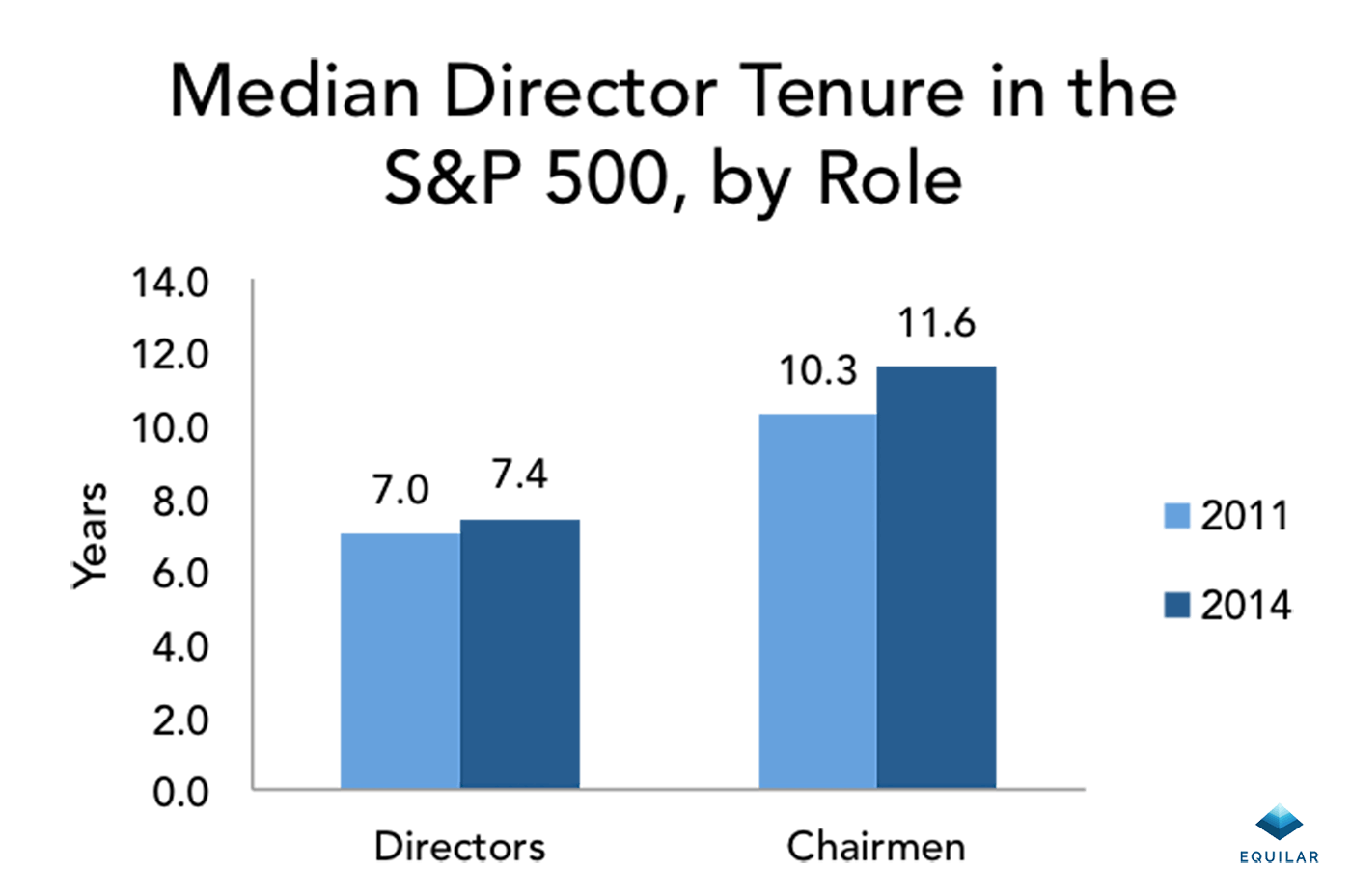
Dans une entreprise, la planification de la relève implique  :

(1) la mise en place de dispositions relatives à la retraite du personnel de cadre supérieur

(2) la mise à jour de chaque rôle de leadership

(3) le départ hâtif des dirigeants qui n’ont pu répondre aux attentes de rendement ou qui affichent un comportement inacceptable, entraînant des conséquences dramatiques

(4) le départ prévu pour ceux les personnes qui désirent passer à autre chose

(5) le recrutement de nouveaux cadres et la capacité d’intervenir dans les situations d’urgence médicale ou de crises pouvant influencer le leadership d’un chef de la direction.

Prenez du recul, réfléchissez et observez le Trio PLT. Demandez-vous quel est votre niveau d’exposition aux risques, ainsi que les conséquences encourues, quand un poste devient inoccupé à un moment quelconque. Quelle importance cela aurait-il si un de ces postes devenait inoccupé pour une journée ou plus sans préavis ? Que faire si plusieurs postes devenaient inoccupés en même temps ? Quelles seraient les conséquences de ne pas être en mesure de régler ce vide de manière rapide et stratégique ? Quelqu’un a-t-il été nommé pour intervenir et assurer le nouveau leadership, le cas échéant ?


JB-PLT


Je tiens à souligner l’importance d’une approche stratégique à la planification de la relève pour l’ensemble du Trio PLT (et pour tous les types d’entreprises, qu’elles soient de petite ou de grande taille). Une planification stratégique qui est totalement synchronisée avec l’approche stratégique du concept du PLT, afin d’assurer, qu’à tout moment, la composition du PLT soit aussi forte qu’elle doit l’être pour atteindre un résultat financier optimal pour tous les intervenants (clients, employés, partenaires, collectivités et actionnaires).

La planification stratégique de la relève devrait assurer une transition en douceur quand le besoin de changer est nécessaire ou quand un poste de leadership devient vacant sans avertissement.

Pensez aux équipes sportives professionnelles. Il arrive que des joueurs soient blessés et soient mis hors jeu pendant une ou deux parties. Si cela se produit en début de saison ou à la dernière rencontre de l’après-saison, cela augmente inévitablement leur vulnérabilité. Cependant, ils ont prévu un minimum de joueurs au banc de remplacement et ces athlètes ont été entraînés précisément pour agir à différents points stratégiques de la partie, au moyen de tactiques de ripostes au jeu de l’adversaire.

Le résultat escompté de l’équipe sera grandement affecté si un joueur est dans l’incapacité de jouer, mais il y a toujours un plan de rechange pour surmonter les pires scénarios en recourant aux joueurs de remplacement qui ont été minutieusement sélectionnés, entraînés, évalués régulièrement et intégrés dans l’équipe afin de minimiser l’impact négatif sur les résultats recherchés. Le banc est rempli de joueurs afin de s’assurer d’avoir les meilleures chances de gagner!

Former les membres de l’équipe pour le PLT est une tâche qui nécessite la coopération et l’engagement de tous les membres : le conseil, l’équipe de direction et le directeur.

La planification stratégique de la relève à chaque niveau stratégique du PLT est critique, bien que plusieurs organisations ne s’en préoccupent guère au-delà du poste de directeur. C’est comme si une équipe sportive professionnelle avait un joueur de remplacement pour le quart-arrière, mais n’avait prévu aucun autre joueur à la deuxième ligne. Avoir un plan de relève advenant qu’un des postes clés devienne vacant et évaluer régulièrement le rendement des personnes assignées à ces fonctions est aussi important que de pourvoir ces postes, avec les bonnes personnes, dès le début. (Afin de faciliter la composition d’un conseil d’administration et une planification stratégique optimale de la relève, une évaluation du rendement du leadership de chaque dirigeant du PLT devient inévitable et obligatoire, puisqu’ils sont tous étroitement liés.)

La meilleure approche à la planification de la relève considère stratégiquement comment un changement au sein d’une fonction peut affecter toutes les dynamiques organisationnelles du PLT. Le conseil d’administration et les chefs de direction doivent se soucier de la planification de la relève des dirigeants à tous les niveaux du PLT afin d’assurer le bon fonctionnement de l’entreprise dans toutes ses activités courantes. Dans cette approche, le niveau de responsabilité de certains dirigeants clés au sein des conseils d’administration et des ressources humaines est encore plus déterminant. Le coût des infrastructures applicable aux changements prévisibles et imprévisibles à chaque niveau de leadership du PLT est bien connu et le cadre du plan de communication est clairement établi, quelles que soient les circonstances.

Le processus de recrutement, du personnel subalterne jusqu’aux directeurs, doit également être stratégiquement réfléchi, en tenant compte de la capacité des gens à croître et à intervenir si les circonstances décrites ci-dessus risquaient de déstabiliser le leadership de l’équipe dirigeante ou d’un secteur fonctionnel.

Lorsque la planification de la relève devient l’impératif stratégique d’une organisation, le recrutement des membres de conseils, des dirigeants et des responsables de la haute direction devient une démarche préventive plutôt que réactive. Si l’organisation devait être confrontée à une situation imprévue, une planification de la relève adéquate devrait minimiser la confusion pour les entreprises et les employés, en leur permettant de fonctionner dans une plus grande harmonie.


*Johanne Bouchard est consultante auprès de conseils d’administration, de chefs de la direction et de comités de direction. Johanne a développé une expertise au niveau de la dynamique et de la composition de conseils d’administration. Après l’obtention de son diplôme d’ingénieure en informatique, sa carrière l’a menée à œuvrer dans tous les domaines du secteur de la technologie, du marketing et de la stratégie à l’échelle mondiale.

La nouvelle réalité des comités de gouvernance des conseils d’administration


Aujourd’hui, je veux partager avec vous certaines considérations cruciales pour un meilleur fonctionnement des comités de gouvernance des conseils d’administration (aussi appelés comités de nomination).

Cet article, publié par Ruby Sharma* et Ann Yerger*, associées au EY Center for Board Matters de la firme Ernst & Young, paru sur le blogue du Harvard Law School Forum on Corporate Governance (HLSF), montre l’ascension fulgurante des comités de gouvernance. Ce phénomène est attribuable à l’importance accrue accordée à la diversité et à la divulgation, dans un contexte où les investisseurs institutionnels et les fonds activistes sont de plus en plus soucieux de la compétence des administrateurs de sociétés.

Les auteurs montrent toute l’importance qui doit être apportée au travail des comités de gouvernance afin de mieux s’adapter aux changements majeurs qui surviennent dans le monde de la gouvernance.

(1) Les comités de gouvernance doivent faire preuve de plus de divulgation sur la composition du conseil d’administration, sur les qualifications des administrateurs ainsi que sur le mix de leurs compétences, et sur les méthodes d’évaluation des administrateurs afin de montrer comment chacun contribue au CA.

(2) Les comités de gouvernance doivent intégrer les considérations liées à la diversité, à l’expertise, au nombre de mandats ainsi qu’aux questions de planification de la relève.

(3) Enfin, les comités de gouvernance doivent être sensibles au fait que la composition des conseils d’administration influencera de plus en plus le vote des investisseurs (actionnaires) aux assemblées générales annuelles.

Voici un extrait de l’article publié dans HLSF.

Bonne lecture !

Three Things Nominating Committees Need to Know


gouvernance


(1) Evaluate and enhance disclosures about director qualifications, board composition and board assessment processes

Most institutional investors we spoke with (more than 75%) said companies are not doing a good job explaining why they have the right directors on the board. Historically, investor understanding of director qualifications has been limited to basic biographic information in proxy filings representing “to the letter” compliance with the requirement to disclose: “… the particular experience, qualifications, attributes or skills that qualified that person to serve as a director of the company … in light of the company’s business.”

Now, companies are increasingly enhancing their disclosures by explaining more about how each director contributes to the board. Some disclosures go further to describe how the board and its committees, as a whole, have the appropriate mix of skills, expertise and perspectives to oversee the company’s key strategies, challenges and risk management efforts.

Companies are making other efforts to enhance the way they communicate to investors, such as by using graphics, tables and letters to shareholders. Some are exploring the use of videos and other media. And some are looking to other markets such as the United Kingdom, Australia and Canada for ideas for how to enhance their own disclosures. For example, some companies may explain how new directors complement the existing board, provide specific examples of industry and functional expertise, illustrate how different forms of diversity combine to provide for a more dynamic board, explain how the board’s expertise is enhanced through additional educational opportunities and discuss how the board assessment process is used to further strengthen the board.

When there are questions about company performance, investors are likely to look more closely at board composition, and when there are minimal or no disclosures demonstrating how directors contribute to the company’s strategic goals, investors may question the performance assessment process. For example, they may ask how the evaluation process is structured, how often it’s carried out and how results are addressed. They also may ask about the role of independent board leaders, other stakeholders and/or third parties in the process. They may also question how board candidates are sourced, the board succession planning process and director education practices.

(2) Integrate diversity, expertise and tenure considerations into board composition and succession planning

Nominating committees play the critical role of linking the board’s director recruitment, selection and succession planning processes to the company’s strategic goals. They do this by trying to maintain the best mix of expertise and perspectives in the boardroom to address the ever-changing business environment and oversee the company’s key strategic efforts.

Nominating committees, institutional investors and other governance observers are increasingly weighing additional perspectives in the director selection process, such as diversity (including gender, racial, cultural, geographical, generational diversity), industry knowledge, global perspectives, and expertise in areas such as cybersecurity and environmental sustainability.

An ongoing focus on board composition allows the nominating committee to maintain a balanced mix of fresh insights (from recently appointed directors) with institutional knowledge (from seasoned and longer-tenured directors) and other perspectives in between (based on variations in board tenure). The table below provides some general metrics on board composition, which may be helpful to nominating committees seeking to develop a view about longer-term positioning for their boards.

How does your brand compare?

Summary data S&P 500 S&P 1500 Russell 3000
Average board tenure 10 10 9
Average age 63 63 62
Gender diversity 20% 16% 13%

(3) Growing attention to board composition and quality may influence how investors vote in future director elections

Investors historically have voted against director nominees based on triggers such as poor meeting attendance, excessive board service, executive compensation challenges, independence concerns, perceptions of subpar performance and/or unresponsiveness to shareholders.

Now, institutional investors appear to be moving beyond these traditional metrics for evaluating boards. Increasingly investors are calling out the lack of board diversity as a governance issue in engagement conversations with companies, stewardship reports and proxy voting guidelines —with some investors adopting policies of voting against board nominees when they perceive insufficient diversity, such as too few women and/or minority directors.

New policies by proxy advisory firm Glass Lewis reflect the emerging shift to consider board composition and director qualifications in voting recommendations. For example, beginning in 2016, Glass Lewis, which develops its policies with investor input, will recommend that investors oppose the re-election of a nominating committee chair in the event of poor performance and the chair’s “failure to ensure the board has directors with relevant experience, either through periodic director assessment or board refreshment …”


Where do nominating committees go from here?


Nominating committee members should recognize that these developments are occurring as investor votes are becoming more meaningful, with annually elected boards (versus staggered) and with a majority voting requirement (versus plurality). There also appears to be an emerging trend of targeted voting practices, with investors opposing perceived action or inaction by specific directors and committees. For example, we recently found that companies with low say-on-pay votes saw higher opposition votes directed at compensation committee members.

When directors step off the board, whether as planned or unexpectedly, nominating committees need to reconsider overall board composition, what the departure may mean for the board now and going forward, and how best to communicate these changes to investors. An effective, experienced and diverse board is a strategic asset to any company and its investors and there’s an opportunity cost to standing still. The keys to that are in the nominating committee hands.

2015 director opposition votes


Summary data S&P 500 large cap S&P 400 mid cap S&P 600 small cap Russell 3000
Average director opposition votes 3% 4% 5% 5%
Number of director candidates 4,700 2,500 3,200 17,500
Portion of director nominees with more than 20% opposition votes 2% 3% 5% 4%

Questions for the board and nominating committee to consider


  1. Are the company’s proxy disclosures adequately showcasing the diverse backgrounds, skills and qualifications of the directors?
  2. Is there a robust mix of perspectives—aligned with company strategies and risks—among the current line-up of directors?
  3. Based on changing company strategies, risks and challenges, how much board turnover is optimal—in the next one, two or three years—in order to stay on top of these developments?
  4. Is the board providing a robust disclosure of the board assessment processes?
  5. Does the board follow through with board assessments by reviewing key takeaways and implementing an action plan—with deadlines?
  6. When was the last time the selection criteria for director nominees was reassessed and updated?

___________________________________

*Ruby Sharma is a principal and Ann Yerger is an executive director at the EY Center for Board Matters at Ernst & Young LLP. The following post is based on a report from the EY Center for Board Matters, available here.


Gouvernance et management | La performance au-delà des chiffres !


Récemment, afin de donner suite à un sondage effectué auprès de ses membres, l’Ordre des administrateurs agréés du Québec (OAAQ) a tenté de répondre aux besoins de formation exprimés en créant un événement majeur ayant pour objet la gestion de la performance, vue sous plusieurs éclairages. Cette réflexion a donné suite au thème du congrès annuel 2016 de l’Ordre : « La performance | Au-delà des chiffres ! »

Bien que la performance soit le moteur principal de toute organisation, elle n’en est pas moins très subtile, étant donné que les relations humaines sont au cœur de l’action.

La performance est encore, trop souvent, associée strictement aux résultats financiers à court terme de l’entreprise et aux réalisations individuelles des employés.

performance-changement

Mais qu’en est-il du facteur humain et du leadership de l’équipe de direction dans tout cela ? Comment expliquer la performance dans les organisations ? En sommes-nous rendus à un tournant critique eu égard à notre façon de reconnaître la vraie performance ? Comment peut-on s’accomplir en tant que dirigeant ? Comment mobiliser son équipe et faire en sorte de « rester sur la vague » ? La gestion des talents est-elle garante d’une gouvernance exemplaire ? Et celle-ci est-elle associée à une plus forte performance financière des organisations ?

En décembre, dans mon blogue sur la Gouvernance des sociétés, j’attirais l’attention des lecteurs sur un rapport de recherche australien intitulé New risks, new rules, paru sur le site de InvestorDaily.

Les résultats de l’étude ont mis en exergue le fait que 89 % des répondants croient que la « bonne gouvernance » est le principal facteur de la performance des investissements.

Il a souvent été avancé qu’une grande considération accordée aux mécanismes de gouvernance mis en place par le CA, ainsi qu’une attention soutenue consentie au management de la performance, était reliée à la bonne performance de celle-ci. Cette étude renforce ce constat.

Vous trouverez, ci-dessous, le programme complet du congrès de l’Ordre des administrateurs agréés. Vous serez en mesure de constater que les animateurs et les experts n’ont ménagé aucun effort pour répondre aux questions touchant la notion de performance. Également, vous trouverez, ci-dessous les thèmes retenus par nos intervenants lors de leurs prestations.

Bonne lecture !


Congrès de deux jours des Adm.A | La performance au-delà des chiffres !


B7FC269DFC6A488F9697C57F077C2090

Thèmes des interventions choisies par les intervenants


  1. Performance – Risques, euphorie et résultats
  2. Recrutement, performance, gouvernance – Un trio gagnant !
  3. Transformer pour mieux performer
  4. Performance en économie – Comment mieux mesurer et mieux prévoir
  5. Optimiser la performance individuelle – Où sont les obstacles et comment les éliminer ?
  6. Quand gestion de la performance et mobilisation vont de pair
  7. Les technologies de l’information (TI) – Plus qu’un simple levier de performance
  8. Et si on parlait de performance humaine !
  9. Parlons performance – Quels défis pour les gestionnaires au quotidien ?
  10. Performance ou accomplissement de soi ?
  11. Performance en gestion de crise
  12. Performance en contexte difficile
  13. Performance sous pression – Briller ou s’effondrer
  14. Performance et cycles de vie d’une organisation
  15. Paradigmes de la performance – Du fichier Excel à la pensée circulaire
  16. Conférence de clôture – De la parole aux actes
  17. Consortium familial – Assurez la pérennité de votre patrimoine et de ses valeurs